Mapping: Right Brain-Left Brain Learning in the EFL Classroom
Ronald S. Zavislak
INTRODUCTION
Since 1958, research in the "double knowledge" theor
y, or more specifically the specialized functions of the right and l
eft hemispheres of the brain, has become of major concern in the
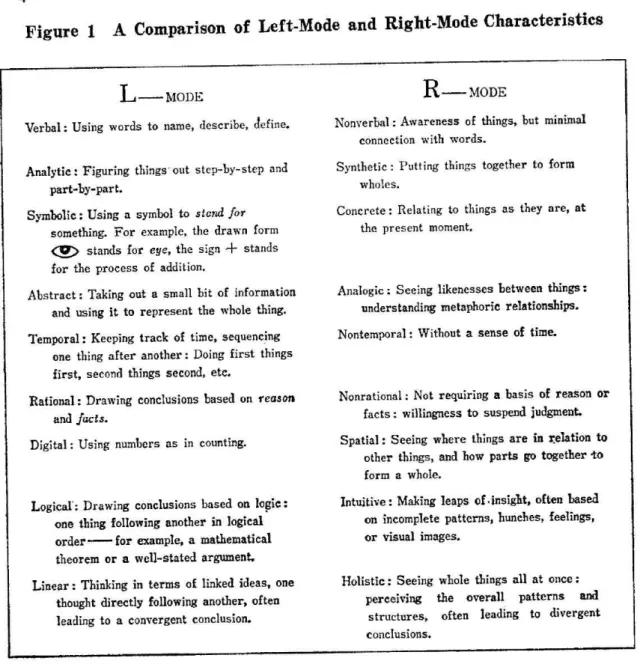
attempt to understand how people learn . Betty Edwards (Edwards , 1979, pp. 30-31) in her research with split brain patients created a serie
s of tests which helped identify certain characteristics of the two he
mispheric functions . (Figure 1)
David Kolb (1984, pp. 41-51) discusses the connection between the brain' s dual function and Piaget' s concept of apprehensi
on, (experien- cing and knowing from cur reality of the moment) ver
sus compre- hension, (shaping and ordering what we have apprehe
nded) and how this affects our learning . Kolb also says that without the process of transforming knowledge through experience
, learning doesn' t take place. According to "whole language" theory(Goodman , 1986), language learning takes place when it is real, natural, whole, has utility for the learner and, most importantly is accessible to the
student. How does this affect the language learner and what is the co
nnection to mapping ? In this article , I would like to talk about three points: 1) the theories behind mapping, 2) some potential uses of mapping, and 3) my present work with this idea .
MAPPING: A DEFINITION
Mapping is a way to make more effective use of th
e brain's dual
48
Figure 1 A Comparison of Left-Mode and Right-Mode Characteristics
L MODE
Verbal: Using words to name, describe, define.
Analytic : Figuring things' out step-by-step and part-by-part.
Symbolic : Using a symbol to stand for something. For example, the drawn form
stands for eye, the sign - stands
for the process of addition.
Abstract : Taking out a small bit of information
and using it to represent the whole thing.
Temporal: Keeping track of time, sequencing
one thing after another : Doing first things first, second things second, etc.
Rational: Drawing conclusions based on reason and facts.
Digital: Using numbers as in counting.
Logical: Drawing conclusions based on logic:
one thing following another in logical
order for example, a mathematical theorem or a well-stated argument.
Linear : Thinking in terms of linked ideas, one thought directly following another, often
leading to a convergent conclusion.
R MODE
Nonverbal: Awareness of things, but minimal connection with words.
Synthetic : Putting things together to form wholes.
Concrete : Relating to things as they are, at the present moment.
Analogic : Seeing likenesses between things:
understanding metaphoric relationships.
Nontemporal: Without a sense of time.
Nonrational: Not requiring a basis of reason or facts: willingness to suspend judgment.
Spatial : Seeing where things are in relation to other things, and how parts go together to form a whole.
Intuitive : Making leaps of .insight, often based on incomplete patterns, hunches, feelings,
or visual images.
Holistic : Seeing whole things all at once:
perceiving the overall patterns and
structures, often leading to divergent
conclusions.
[Source: Betty Edwards, Drawing on the Right Side of the Brain (Los Angeles:
J.P. Tarcher, 1979)]
ability. Some people call it brainstorming, freewriting or even outlining. However it is seldom used in the EFL/ESL classroom. It is a way to have students create a visual image of the language territory they are dealing with and then form concepts and interact with the information. When we write or speak, the critical mind tries to sequence the concepts or language we are using. Writer's block is
a common form of the left-brain censoring any ideas that don' t seem to fit logically with what we are writing. A map, on the other
Mapping: Right Brain-Left Brain Learning in the EFL Cl
assroom49 hand, allows free association of words around a core which can later be organized. Since there are no constraints on th
e students, out put mapping seems to reduce tension , anxiety and resistance to the language caused by the necessity to get things right or p
erfect the first time . In the past twenty years scientists and doctor
s have found that the brain' s left and right sides can and do work ind
ependently. We also know today that each side specializes in proc
essing and using the same information very differently . Gabriele Rico in her book, Writing the Natural Way, defines the two sides as the Sign (left)
and Design (right) minds. How are these two sides different ? Suppose I asked you to imagine a trip in the Rocky Mountains . Each person would use previously known information to build an i
mage. The only limitations on your imagination would be related t
o your experiences . Those who have camped would use that information to build an image but still each image would be unique and ori
ginal. Some would probably have no images. This would occur because of using the l brain to think "What is this crazy idea ?" or "Wh eft
at will happen next ?". Your critical Sign mind blocks the ability to d
ream or imagine.
There is evidence that the left hemisphere of the br
ain is responsible for intellectual, analytical and logical functions (
grammar and sequ- encing of language), whereas the right hemisphere deal
s with global, social and emotional needs which incorporate block
s of language and imagistic thinking (see Rico, 1983: 69). How does this affect what happens in our language classroom ? How does thi
s apply to teaching and learning English ?
Through a completely left-brain focused education, many of our students as well as ourselves have come to belie
ve that we can't write or be creative and at the same time expre
ss anything of importance or value. Even with research into how we
acquire language, many people have assumed that the right brain had little to do with la
nguage as such. Studies at UCLA are showing that eve
n though the right-brain seems mute during a language experience
, it does seem to play a role
50
in the processing and comprehension of language. In 1971 an article appeared in the Journal of Reading entitled "Mapping: A Technique for Translating Reading into Thinking" (Hanf, 1971), Hanf showed
that mapping not only created a higher interest in reading but also improved comprehension. Other research recently is related to what is called "schema theory" or studying how information is stored, retrieved and used to comprehend new input (Carrell, 1983: 556). Since the
1970's mapping has been incorporated to create more effective teaching and learning methods for native reading and writing skills (Andersen, 1989; Hanf, 1971) . In the past few years mapping has been considered for ESOL classes and is currently being explored in teaching ESL students in a number of Japanese university classes (Suenaga, 1989).
POTENTIAL APPLICATIONS IN EFL CLASSES
Reading, writing and speaking are all forms of language interaction that require comprehension. These three activities require the actors or in our case the students to use previous information to ask, respond to and understand new information. Recent theories on second language acquisition focus on how the brain works and differences in cognitive styles (Stevick, 1982) . In pre-reading and pre-writing, mapping helps focus students attention, categorize already known material, hypothesize and encourage student investment in the topic based on what they already know. During the second stage, the interactive stage, the students are scanning the new material and are given opportunities to reflect on it. This allows them to make links to previous material, focus on what they don' t know and evaluate what they have learned. In the third stage with reading, it allows the students a self-assessment of their comprehension, helps to focus atten- tion on what needs to be covered, and combines previous ideas with new
materials to finally organize the newly acquired material. (Figure 2) Very often students are asked to explain or write about something they have just read or they are asked to write a composition on a
CD
Mapping: Right Brain--Left Brain Learning in the EFL Classroom 5 1
Figure 2
Pre-Presentation Stage Q Presentation & Reflection Stage Attention is focused on topic Scan new material
Have students generate known material Focus on needed material Hypothesize about new materialHelp link previous material to
new Assess material on topicEvalute new material and
comprehension
Mapping
1
0 Practice & Experimentation StageAllow students their interpretation of comprehension
Help organize acquired information
Help internalize, verify, synthesize old and new material
Promote interaction with new materials in terms of speaking and
writing
topic in class. This presents a multitude of problems for th
e language learner who may have the knowledge
, vocabulary and comprehension for the task but is overwhelmed by the immediate assi
gnment. How well do native speakers perform if they are asked to write
a composition on their interpretation of a poem in twenty minutes ? Th
e task, for the foreign language learner , can be compared to a child baking a cake for the first time. He looks in the cookbook
, goes and gets the flour, measures it and puts it in the bowl . He looks at the cookbook
, goes and gets the eggs and adds them to the mixture . An experienced cook gets all the ingredients together and then proceeds with making the cake with an image of what the finished product will look lik
e. In the language classroom , mapping helps students to get out whatever vocabulary or ideas they have concerning the topic at first
. When the materials are out there visually
, they can then form sentences to clarify these ideas. Finally they can apply formal schema rules t
o unify
52
and logically present the material. (Figure 2) In this way the students.
and the teacher can help identify each student's weak areas as well as their understanding of the material presented. In the tradi-
tional class it is assumed that students who can answer comprehension questions or translate have "learned" the material, with little or no
interaction with the material or teacher. Mapping provides the students with strategies for dealing with new materials by giving them the opportunity to move beyond the sentence comprehension stage to hypothesizing about the material, discovering information they feel important and being able to discuss or present their ideas in the target
language. It helps them become independent learners and provides an environment conducive to higher risk taking. Such an environment encourages them to bring out, as well as, try out the language they are dealing with. Mapping also lets the students deal with the areas of language and the material that they find interesting or relevant while finding the global meaning of the material presented.
Figure 3
[Summary of Steps]
1. For Writing
a) Put topic in the middle of the paper b) Allow 5-10 minutes for free association
c) Ask students to identify groups
d) Have them make sentences to connect words or associations (Figures 3a, 3b, 3c)
2. For Reading
a) Put topic in the middle of the paper b) Associate previous knowledge
c) Scan material for main ideas d) Add new material to the map
e) Read again for details and complete map
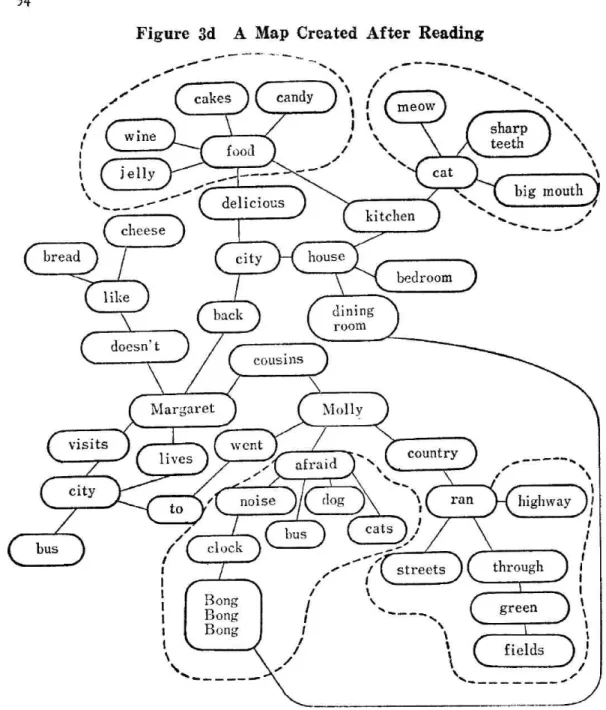
f) Summarize material to verify your understanding (Figure 3d) 3. For Speaking
a) Sequence is basically the same except material is later organized orally and discussed
b) Varies according to whether discussion is based on reading or just free association on a topic (Figure 3e, 3f)
Mapping: Right Brain-Left Brain Learning in the EFL Classroom 53 CURRENT USES
In large Japanese foreign language classes, students have been taught to translate, give grammatically correct answers or just receive the information provided by the instructor. Depending on the goals of the class, I use mapping in a number of ways to activate, evaluate, Figure 3a A Beginning Map Figure 3b A Preparatory Map for
Poetry Writing
melancholy
1
rainy season) ~~„yellow )
umbrella)(
children RAIN
rainbowdrop 1cold
river seven colorsj
beautiful spring
fresh water blue Figure 3c The Poem Composed from the Map
RAIN
The rainy season has come.
It's a children's world.
Children put on rain coats. rain shoes and hold yellow umbrellas.
They make merry.
They collect many drops of rain in their hand.
They run swinging their umbrellas.
Hear children's voices, a rainbow appears above their heads.
A rainbow is a beautiful bridge that has seven colors.
Children have a dream that they can cross the colorful bridge.
The rainbow goes out, but it exists in children's hearts.
The rainy season has gone. (10/12/88)
(Written by: Yuko Shimada, university sophomore)
54
Figure 3d A Map Created After Reading
dining room
Bong Bong Bong
sharp teeth
big mouth
(Created by three 5th grade Japanese children based on the story The City Mouse and the Country Mouse, Oxford Picture Readers.)
and facilitate the use of the target language. I have used it in a number of classes with a wide range of student levels and have found it to be a useful tool in helping the students to use vocabulary that has been passive, evaluate their own global comprehension of the material and focus on finding information they need rather then just translating. Figure 3 gives a summary of steps I currently use. Figures 3a~3f are actual examples taken from a variety of classes.
Figure 3e
Brain-Left Brain Learning in the
Map Based on a Newspaper
using the 1ibrary
university
EFL Classroom Article
55
supermarket
buyi ng their food
visiting each other
like vacation hotel
no bars outside
Denmark
local house
revolutionally new prison
dangeroous
Japan Times
ridiculous good
w^•^1____....e
human b ready•fc
self-confidence
self-respect
Penitentiary
half women
half menC resPonsibi1iTIy
inmates
commit correctional
murder crimes institutions
Figure 3f Resulting 3 Minute Speech (uncorrected) The man was sentenced to
punishment of 3 years. His thought
was that prisons have many guardmen .
He went to one that was like a camp.
There were no walls and only five
guards. The guards didn't have weapons.
The prison was surrounded by a fence.
There were tennis courts, volleyball courts
etc. Prisoners can buy ice cream, soft
drinks in a commissary. They can wear
designer jeans, polo shirts, and have their
own Walkman. He can earn money. He
can get a job. If he doesn't know how to
do something he was taught.
Conclusion
I feel that mapping can be a very useful tool for assessing what the students bring with them in terms of knowledge and vocabulary
.
56
Also, it allows them to combine the creative powers of the right brain or Design mind with the logical and organizing powers of the left brain or Sign mind. Mapping helps to give students a chance to evaluate and improve their own comprehension and unlock some of their passive English vocabulary. I feel its greatest value is that it allows students to interact with English on their own level, and by combining this with new language, move their reading, writing and speaking skills to a higher level. On a metacognitive level, using a visual map of the language provides students with learning strategies for dealing with new information. Mapping can be applied in one' s own native language for writing papers, books and even romantic poems.
Bibliography
Andersen, Richard, "Writing That Works", McGraw Hill Publishing, 1989.
Carrell, Patricia, and Joan Eisterhold, "Schema Theory and ESL Reading
Pedagogy", TESOL Quarterly, Vol. 17, No. 4, Dec. 1983, pp. 553-573.
Carrell, Patricia, "Facilitating ESL Reading by Teaching Text Structure",
TESOL Quarterly, Vol. 19, No. 4, Dec. 1985, pp. 727-752.
---
"Three Components of Background Knowledge in Reading Compre- hension", Language Learning, Vol. 33, No. 2, 1983, pp. 183-207.
Edwards, Betty, "Drawing on the Right Side of the Brain", J.P. Tarcher, 1979.
Elbow, Peter, "Writing Without Teachers", Oxford University Press, 1973.
Goodman, Ken, "What's Whole in Whole Language", Heinemann Educatio-
nal Books, 1986.
Kolb, David, A., "Experiential Learning: Experience as the Source of Learning and Development", Prentice-Hall Inc., 1984.
Rico, Gabriele, "Writing the Natural Way", J.P. Tarcher Inc., 1983.
Stevick, Earl, "Teaching and Learning Foreign Languages", Cambridge Uni- versity Press, 1982.
Suenaga, Eiji, "Schematic Mapping To Activate Reading Comrehension In The EFL Classroom", SIT Independent Personal Project, Jan. 1989.
Ueland, Brenda, "If You Want To Write", Grey Wolf Press, 1987.
Vacca, Richard, T. and Joanne L. Vacca, "Content Area Reading", Scott Foresman & Company, 1986.