The Endogeneity of Tariffs in Korea
著者 Heo Yoon, Chung Yurie
出版者 Institute of Comparative Economic Studies, Hosei University
journal or
publication title
Journal of International Economic Studies
volume 22
page range 113‑122
year 2008‑03
URL http://doi.org/10.15002/00003138
The Endogeneity of Tariffs in Korea
Yoon Heo *
andYurie Chung **
Abstract
This article examines the validity of the “endogenous tariff model” in Korea. For many developed countries, accounting for a tariff in its endogenous notion has become increasingly important as special interest groups play pivotal roles in shaping trade policy. Yet, little evi- dence exists on the determinants of tariffs in Korea. Korea is an interesting case in that its pro- tective measures have been strategically designed and extensively implemented as a means to successful economic development. With a full set of industry specific cross-sectional data, uti- lizing a simultaneous equation system, the study finds that: 1) a smaller number of establish- ments alleviates the free-rider problem, reducing transaction costs and thereby increasing the level of protection, 2) even though import competition intensifies in the short run, it does not necessarily lead to a higher level of protection.
Keywords: Tariff Endogeneity, Import Competition, Korean Trade Policy, Industry Characteristics
I. Introduction
Trade liberalization has accelerated since World WarⅡthrough the widening and deepen- ing of multilateral and regional trade integrations. Despite such a trend toward freer global trade, however, tariff- and non-tariff based forms of protective barriers are still epidemic in most countries, including Korea.
Korea is an interesting case in that its protective measures have been strategically designed and extensively implemented as a means to successful economic development despite the mounting pressure of trade liberalization. The Korean government has used tariffs as an integral part of its industrial policy and they indeed played a pivotal role in the constant upgrading of the industrial structure. Artificially distorted market prices worked as a catalyst to correct market failures and promote exports (Heo, 2001).
An alternate view to this interventionist notion of trade policy in Korea is that tariffs are simply the outcomes of special interest groups’ lobbying efforts. In other words, tariffs are not exogenous in nature but rather are endogenously determined by characteristics endemic to the
Journal of International Economic Studies (2008), No.22, 113–122
©2008 The Institute of Comparative Economic Studies, Hosei University
* Associate Professor, Graduate School of International Studies, Sogang University, Korea, 1 Sindu-dong, Mapo-gu, Seoul, Korea zip. 121-742. Tel: 82-2-705-8948 Fax: 82-2-705-8755 E-mail: [email protected] Earlier version of this paper was presented at 2006 International Conference of Korea Trade Research Association and Sogang IIAS Research Series on International Affairs. Helpful comments made by the referee are greatly appreciated.
** Researcher, Northeast Asia Economic Forum, Seoul, Korea
industries. To some extent, tariffs may increase wages and profits for some protected indus- tries against intensified competition from imports. Changes in the international economic environment can lead industries to lobby the government for favors, such as imposing tariffs and other preferential or protectionist policies.
This study examines the validity of the endogenous tariff theory in Korea. The determi- nants of tariffs at the industry level are empirically tested and interpreted. Section 2 is a litera- ture review and Section 3 is the regression analysis. Section 4 offers the empirical results and Section 5 concludes the study.
II. Literature Review
Neoclassical theories about tariffs predict that small countries need to implement free trade while large countries can use tariff barriers. This is because large countries can exercise their power to influence the terms of global trade to their advantage. This prediction has been rejected by most observers, however, because in reality, larger countries’ trade regimes are closer to free trade than those of small countries, which implies that the level of protection may not be exogenously determined by its welfare implication.
There are two approaches to modeling endogenous trade policies: the voting model and the lobbying model. Voting behavior, and its resulting policies, has been studied by Baldwin (1985, 2000), Mayer (1984) and Brock and Magee (1978). Policies can be supported directly or indirectly by ballot, or public campaigns aimed at maximizing votes, or by donating funds to politicians. Several aspects of the process can be modeled: the voting process and the mechanism with which parties compete for votes on trade bills. For example, Brock and Magee (1978) devoted their attention to the endogenous protection model focusing on the problem of simultaneous optimal contributions by interest group and the vote-maximizing tar- iffs that the politicians set.
The lobbying model is based on imperfectly informed voters, which leads to differential trade policies for different groups and incentives for special interest groups to lobby the gov- ernment. There are at least two types of lobbying models. One incorporates governments choosing policies that maximize their political support, and interest groups offering contribu- tions to influence those policy decisions. Examples of this approach can be found in literature by Hillman (1989) and Grossman and Helpman (1994). The other approach focuses on recip- rocal competition between politicians and regards the motivation for lobbying as the desire to influence election outcomes. In this approach, it is imperative to identify how and which lob- bying expenditures translate into votes. Lobbying by interest groups clearly affects the out- come of political elections. Findlay and Wellisz (1982) used the general equilibrium frame- work assuming that the level of protection was given. With this, they provided the special interest model of endogenous lobbying. In case of Korea, the lobbying model seems more appropriate than the voting model in that lobbying efforts by the industry level interest groups actually exist and the government has its discretionary power over the determination of its protection level.
Empirical works on endogenous protectionism were also carried out by many economists such as Magee et at (1989), Bohara and Kaempfer (1991), Trefler (1993), Das and Das (1994), and most recently Tombazos (2003). These scholars mainly tested cases in Australia and the United States.
III. Regression Analysis
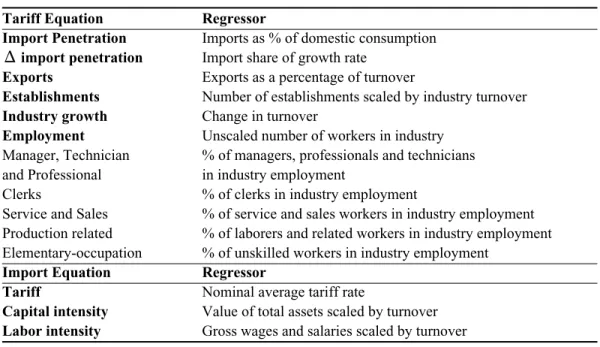
1. Tariff EquationThe theory of endogenous protection denotes that the equilibrium level of protectionism is determined by the supply of and demand for protectionism. Protection is demanded by interest groups and is supplied by politicians seeking to maximize their own interests. We assume that industry characteristics affect not only the profitability of trade concessions but also the political process by which trade concessions can be practiced. The relevant industry characteristics incorporated in the tariff equation are outlined in Table 1.
Import penetration is chosen to capture the extent to which the domestic market’s satura- tion with foreign products represents a legitimate threat to domestic producers. We expect that an increase in import penetration will lead to an increase in the corresponding tariff rate.
Higher levels of infilteration of foreign products into the domestic economy will lead to more serious efforts by the interest groups for greater protection. This prediction is derived from various theoretical models, including Brock and Magee (1978), Hillman (1982) and Mayer (1984), and empirical tests including Tombazos (2003), Anderson (1980), Ray (1981) and Trefler (1993).
Following Trefler (1993) and Tombazos (2003), import penetration also enters the tariff equation indirectly via changes (Δ) in import penetration. This variable quantifies the degree of import competition’s intensification at the industry level. When the profit lost to import competition exceeds the cost of a successful lobbying campaign for protection, private inter- ests will undertake such lobbying activities. The larger the losses from foreign competition, the more lobbying efforts are initiated. So the coefficients associated with import penetration and changes in import penetration are both expected to be positive.
Along with the variables of import penetration, the percentage of exports sent abroad as measured as a percentage of turnover represents an important measure of comparative advan- tage. We expect that it will be negatively correlated with import tariffs. Export industries are
Yoon Heo, Yurie Chung
Table 1. Regressors of Equation Tariff Equation Regressor
Import Penetration Imports as % of domestic consumption Δ
Δimport penetration Import share of growth rate Exports Exports as a percentage of turnover
Establishments Number of establishments scaled by industry turnover Industry growth Change in turnover
Employment Unscaled number of workers in industry Manager, Technician % of managers, professionals and technicians and Professional in industry employment
Clerks % of clerks in industry employment
Service and Sales % of service and sales workers in industry employment Production related % of laborers and related workers in industry employment Elementary-occupation % of unskilled workers in industry employment
Import Equation Regressor
Tariff Nominal average tariff rate
Capital intensity Value of total assets scaled by turnover Labor intensity Gross wages and salaries scaled by turnover
likely to profit less from protectionism for the following two reasons: First, exports reflect rel- atively efficient production circumstances. Therefore, imports are not likely to represent a legitimate threat to the sales of exporters. Second, exporters are concerned mostly about the tariff barriers of their trading partners on a reciprocal basis, and the protection of export ori- ented industries may provoke retaliatory action by trading partners that will negatively affect these industries’ profits.
Lobbying efforts for protection are positively related to the expected reward and inversely related to transactional lobbying costs and existing barriers to entry. The number of establish- ments scaled by industry turnover is counted in order to figure out the degree of lobbying con- tributions. According to the argument by Stigler (1971), if entry barriers restrict both domestic and foreign rivals, then the barriers eliminate the need for protection, thus reducing the level of protection by making the market’s structure itself a valuable way of excluding foreign rivals. The proxy for barriers to entry is the number of establishments.
There are two opposite expectations in interpreting the signs of coefficients. Tombazos (2003) states that greater concentration reduces the free rider problem and is expected to lead to higher protection. However, Caves (1976) and Ray (1981) argue that a larger number of establishments, relative to industry turnover (total sales), may provide a stronger political base to lobby for protection. We expect that the number of establishments over industry turnover is a good proxy for market concentration, and that concentration will increase the lobbying efforts for protection because as concentration increases, coordinating lobbying cost shrinks.
The industry growth rate and the demand for tariffs are expected to be negatively corre- lated, while the industry specific number of workforce in employment and the demand for tar- iffs are expected to show a positive correlation. Following the theoretical literature by Anderson (1980), Hillman (1982), Trefler (1993) and Tombazos (2003) an industry is consid- ered to be “disadvantaged” if it experiences a slow growth rate and a large proportion of its workforce consists of production labor.
The relationship between tariffs and employment are empirically examined in two ways.
First, the unscaled number of total workers in each industry is included in the regression model to capture its lobbying power over the determination of tariffs. Second, the proportion of workers employed in separately categorized groups is tested for any distinctive impacts on the level of protection. In both cases, we expect the coefficients’ signs to be positive.
2. Import Equation
According to Trefler (1993), the ideal trade model from which to derive the import esti- mating equation must satisfy two criteria. First, it must predict the pattern of trade. Second, it must be compatible with the theory of endogenous protection. In this context, the model includes the specifications of the imports equation as outlived and is consistent with a
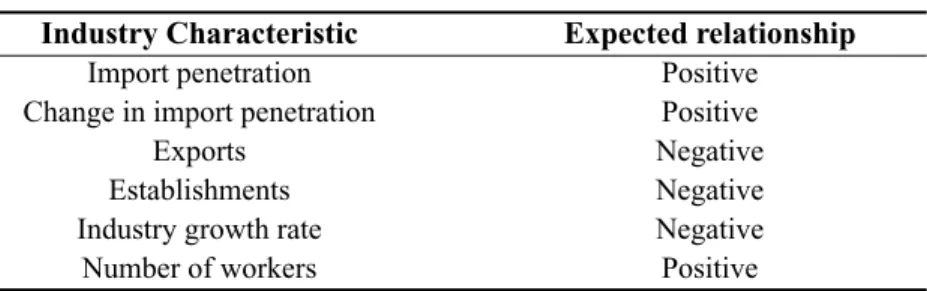
Table 2. Industry Characteristics and Tariff
Industry Characteristic Expected relationship
Import penetration Positive
Change in import penetration Positive
Exports Negative
Establishments Negative
Industry growth rate Negative
Number of workers Positive
Heckscher-Ohlin framework of trade.
This equation collects the factor intensities of primary capital and labor inputs represent- ed by the values of capital scaled by turnover and the sum of wages and salaries scaled by turnover, respectively. If we consider that the tariff equation incorporates a total of three vari- ables that are explicitly modeled as endogenous [that is, tariffs, import penetration and Δ (import penetration)], then the model will be identified only if the import equation incorpo- rates at least two exogenous variables not included in the tariff equation. We assume that labor and capital intensities are distinct from the exogenous variables used in the tariff equation.
3. Simultaneity of Imports and Tariffs
The theory of endogenous protection regards high levels of imports as a cause of protec- tionism. Unlike the singular equation used by Magee et al (1989), we used the system of two equations introduced by Trefler (1993) and Tombazos (2003). The system using the singular equation would not capture the circular bidirectional dynamics of the system in the study.
Using the system of two equations ensures that both tariffs and imports (penetration) are determined simultaneously.
The system of equations that are jointly estimated is given as follows:
T= aT+ bM:M+ CT:XT+ fT (1) Tariff equation M= aM+ bT:T+ CM:XM+ fM (2) Import equation
These equations represent a cross-sectional characterization of Korean industries. T denotes the nominal average tariff rate that corresponds to the level of protection given to an industry facing a level of import penetration M. XTand XMrepresent vectors of industry char- acteristics that determine tariff concessions and the demand for imports, respectively. The vec- tors of each equation’s constants and residuals are given by aT, aM and fT, fM, respectively.
The dependent variable in the tariff equation is the nominal average tariff rate and the depen- dent variable in the import equation is import penetration.
4. Data
“Tariff ” refers to the average rate of tariff applied to products coming into Korea. The annual data on the average tariff rates of 186 industries (12 mining and quarrying industries plus 174 manufacturing industries) are taken from Korea’s year 2000 tariff schedules issued by the Korea Customs and Trade Institute (KCTI). We followed two steps to get each indus- try’s average tariff rate as classif ied by the KSIC (Korean Standard of Industrial Classification, following the ISIC system) because the data provided by the KCTI, following the HS system, cover every single product coming into the country. First, a simple average was calculated at the HS level. Then, using a concordance table of HS classification to the
Yoon Heo, Yurie Chung
Table 3. Industry Characteristics and Import Penetration Industry Characteristics Expected relationship
Tariff rate Negative
Capital intensity Positive
Labor intensity Positive
ISIC aggregates, a second simple average was calculated. An establishment is a unit that engages in industrial-related activity at a single location, under a single ownership or control.
We limit the size of a unit to only those employing more than 10 workers. The data on exports, imports and domestic production are obtained from the input-output tables provided by the Bank of Korea. Total assets refers to total value of assets that each industry possesses. It includes capital stock mentioned before plus the value of land and inventory. Employment refers to the total number of people who work in the unit. Workers working in a unit hiring less than 10 are not included in the establishment. The total number of workers in this paper includes regular and part-time workers on the payroll, people working outside the unit who belong to it and are paid by it, and unpaid family workers. Total wages and salaries include all monetary payments and payments in kind paid or supplied by the employer to all people
counted on the payroll. They include all payments in cash or in kind paid, payment for time not worked and special payments such as gratuities and bonuses. The sources of the data on labor and capital are a statistical database offered by the Korean National Statistical Office and labor statistics from the Ministry of Labor.
IV. Empirical Results
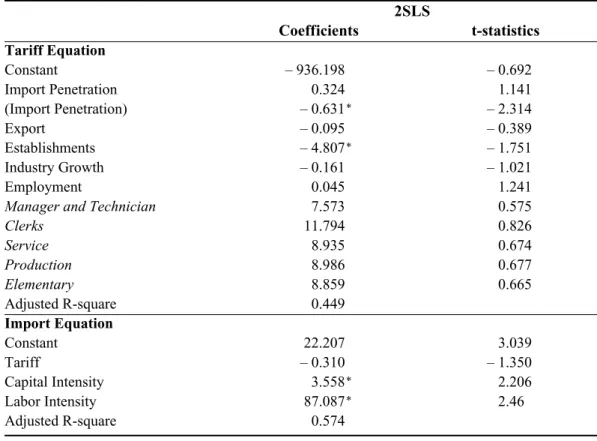
The equations are estimated simultaneously using the two stage least square (2SLS) method. The resulting estimated coefficients of the regression equations are reported in Table
Table 4. Estimated Coefficients 2SLS
Coefficients t-statistics Tariff Equation
Constant – 936.198 – 0.692
Import Penetration 0.324 1.141
(Import Penetration) – 0.631* – 2.314
Export – 0.095 – 0.389
Establishments – 4.807* – 1.751
Industry Growth – 0.161 – 1.021
Employment 0.045 1.241
Manager and Technician 7.573 0.575
Clerks 11.794 0.826
Service 8.935 0.674
Production 8.986 0.677
Elementary 8.859 0.665
Adjusted R-square 0.449
Import Equation
Constant 22.207 3.039
Tariff – 0.310 – 1.350
Capital Intensity 3.558* 2.206
Labor Intensity 87.087* 2.46
Adjusted R-square 0.574
*P < 0.05, **P<0.01
4, together with t-statistics and adjusted R-square.
As expected, import penetration, in general, corresponds positively to the tariff rate applied. The result is not statistically significant, however, implying that the industries with strong import penetration do not always come up with higher levels of protection. In other words, as Anderson (1980) noted from the Australian case, “the more assisted industries have not necessarily been those whose domestic markets have been supplied largely by imports” (p.
139).
These results hold true for the Korea economy. Korea is poor in natural resources (for example, oil and metals), and therefore, the country depends heavily on high value-added exports as well as imports. For example, the following sectors have an import penetration ratio of more than 30% but the tariff rates applied to these sectors are low: coal (import share in domestic market = 90.45%); uranium and natural gas (100%); metal ores (99.3%); leather (31.48%); office, accounting and computing machinery (34.02%); electrical machinery (49.77%); medical precision and optical instruments (59.88%); and transportation equipment (75.19%). The same results hold true for the intermediate and capital goods industries, too.
These imported items are essential for a country such as Korea, whose development strat- egy is export-oriented and that produces high value-added exportable commodities using imported raw materials and intermediate goods. In this case, lobbying efforts for tariff reduc- tion, that is, the imports’ impact on domestic firms’ profit margin, would occur. The higher the tariff imposed, the less competitive the price becomes for export. Therefore, the govern- ment strategically imposes relatively low tariffs on such items. This finding means that differ- ent industries may receive different treatment from the government and that, ultimately, these differences may be seen in the results.
The dynamic change in import penetration [Δ(import penetration)] of industry i (includ- ing mining, quarrying and manufacturing), on the other hand, is negatively correlated with the nominal tariff rate applied at a significant level of 5%. This implies that even though import competition intensifies in the short run, it does not necessarily lead to a higher level of protec- tion. In other words, a large increase in import penetration does not necessarily push up the relevant protection level.
Tombazos (2003) explains a similar result for Australia as a reflection of the system’s rigidity. A large increase in import penetration in the industries that traditionally receive a moderate level of protection may lead to relatively small change in the level of protection, whereas industries that have been receiving considerable assistance from the government may have a higher relative level of protection.
Regarding exports’ impacts on tariffs, as expected, exports have a negative influence over the tariff rates applied; as exports shrink, lobbying for higher levels of government protection increases, although the estimated coefficient is not statistically significant. In the United States and Australia, the coefficients were both negative and statistically significant (Trefler, 1993; Tombazos, 2003).
Turning our attention to the establishments, we found that the estimated coefficient corre- sponding to this variable is found to be negative and statistically significant. This result is exactly the same as in the case study of the United Stated by Trefler (1993). A smaller number of establishments alleviates the free-rider problem, thereby increasing the level of protection.
This result shows that the lobbying contribution from the supply side (that is, businesses), rather than the demand side (that is, consumers), strongly affects the decisions about levels of protection. More concentrated industries lobby for a high level of protection either to block free-riders or to block new players from both inside and out. Tombazos (2003) also found the
Yoon Heo, Yurie Chung
relationship between establishments and tariffs to be negative but not statistically significant.
He used other variables such as capital stock and industry concentration ratio to capture the degree of barriers to entry. With these variables, his result was consistent with Caves (1976) but opposite Trefler (1993). We dropped these variables due to the multicollinearity problem among the explanatory variables.
An important dimension of forming an endogenous trade policy relates to the extent to which industries lobbying for protection are disadvantaged. The results show that industry growth is negatively related to the protection level. According to Magee, Brock and Young (1989), disadvantaged groups have a low opportunity cost of lobbying from the perspective of protection demand. From the supply side perspective of protectionism, voters are unwilling to approve assistance that is dispensed to industries that are not generally considered to be facing significant hardship. Our result is consistent with our a priori expectation that the level of pro- tection offered by the government is believed to be biased toward industries that are character- ized by sluggish growth. Tombazos (2003) also found the relationship negative but not statisti- cally significant.
The dynamics associated with employment, meaning labor as a whole and workers employed in the various categorized groups, are positively related to the level of protection.
No differentiated impacts on tariffs were discernible among the various categorized groups of labor. We found that the proportions of all categories are also positively related to the level of protection, though the results are not statistically significant. That is, the tariff, in general, is positively correlated with employment. If the tariff declines, the number of employed workers declines as well. A large workforce itself is an existing lobby that can be redirected toward lobbying for trade protection; therefore, a large workforce leads to high levels of protection. In the United States, engineers and scientists received the most protection while less skilled workers received little protection (Trefler, 1993).
Regarding the import equation, we found that both labor intensity and capital intensity are positively correlated with import penetration, as expected. This is related to the import- demand function. In Australia, both coefficients were positive, too (Tombazos, 2003). Tariff decreases were found to have a small positive effect on imports.
V. Conclusion
This paper tests an endogenous tariff model for Korea. Major findings in the study can be summarized as follows:
First, import penetration has a positive but negligible impact on the tariff rate imposed.
However, the dynamic change in import penetration affects the nominal tariff rate negatively at a significant level of 5%. This finding implies that the intensification of import competition in the short run will not drive the relevant tariff concession higher than that awarded to any other industry facing a higher overall import penetration.
Second, the number of establishments over industry turnover does influence the level of protection, and its impact is negative and statistically significant. This result connotes that a smaller number of establishments alleviates the free-rider problem, reducing transactional lob- bying cost and thereby increasing the level of protection. It provides indirect evidence sup- porting the concentration-collusion doctrine in the field of industrial organization.
Third, as export activity shrinks and/or sales growth slows down, lobbying for higher lev- els of tariffs increases, though the estimated coefficients are not statistically significant. It is
more imperative for disadvantaged industries than for solid industries to seek higher level of protection.
Fourth, labor as a whole and workers in different categories are positively related to the level of protection. That is, the tariff is positively correlated with employment but the results are not statistically significant. Unlike in the United States and Australia, no differentiated impacts on tariffs were discernible among differently categorized groups of labor in Korea.
Finally, capital and labor intensities are positively correlated with import penetration.
These results suggest that, in Korea, import competition accelerates in industries with higher ratios for capital and labor over the turnover.
The study offers empirical evidence for the determinants of Korea’s trade policy regard- ing endogenous protection and import penetration. In sum, the level of protection rendered by the government in terms of tariff concessions is biased toward industries with a comparative disadvantage, few establishments, sluggish growth and a large workforce. Similar to the United States and Australia, we find that industry specific characteristics had more influence than labor in shaping Korea’s trade policy.
<References>
Anderson, K. (1980), The political market for government assistance to Australian manufacturing industries. Economic Record56:132-44.
Baldwin, R. E. (1985), The political economy of U.S. import policy. Cambridge, MA: MIT Press.
Baldwin, R. E. and C. S. Magee. (2000), Is trade policy for sale? Congressional voting on recent trade bills. Public Choice105:79-101.
Bank of Korea, Monthly Economic Statistics, related issues.
Bank of Korea, Economic Statistics Year Book, related issues.
Bohara, A. K. and W. H. Kaempfer. (1991), A test of tariff endogeneity in the United States. The American Economic Review81:952-60.
Brock, W. and S. Magee. (1978), The economics of special interest politics: the case of the tariff.
American Economic Review68:246-50.
Caves, R. E. (1976), Economic models of political choice: Canada’s tariff structure. Canadian Journal of Economics9:278-300.
Das, Sanghamitra and Das, Satya P. (1994), Quantitative assessment of tariff endogeneity. Economi Letters. 44:139-46.
Findlay, R. J., and S. Wellisz (1982), Endogenous tariffs, the political economy of trade restrictions, and welfare. in Import competition and response, edited by Jagdish N. Bhagwati. Chicago:
University of Chicago Press, pp. 223-38.
Yoon Heo, Yurie Chung
Grossman, G. M., and E. Helpman. (1994), Protection for sale. American Economic Review72:1180-7.
Heo, Yoon. (2001), Development Strategy in Korea reexamined: an interventionist perspective, Social Science Journal38:217-231.
Hillman, A. L. (1989), The political economy of protection. New York: Harwood.
Magee, S., W. Brock, and L. Young. (1989), Black hole tariffs and endogenous policy theory: political economy in general equilibrium, New York: Cambridge University Press.
Mayer, W. (1984), Endogenous tariff formation. American Economic Review74:970-85.
Ray, E. J. (1987), The impact of economic regulation. Bell Journal of Economics and management Science2:3-21.
Tombazos, C. G. (2003), Unprotective tariffs, ineffective liberalization, and other mysteries: An investi- gation of the endogenous dimension of trade policy formation in Australia. Southern Economic Journal 70:49-74.
Trefler, D. (1993), Trade Liberalization and the theory of endogenous protection: An economic study of U.S. import policy. Journal of Political Economy101:138-60.
World Bank, World Development Indicators. related issues.
WTO, International Trade Statistics, related issues.