Savings Determinants with Late Labour Engagement
著者 Ogwumike Fidelis, Aderemi Taiwo Adekunte, Ofoegbu Donald
出版者 The Institute of Comparative Economic Studies, Hosei University
journal or
publication title
Journal of International Economic Studies
volume 33
page range 49‑62
year 2019‑03
URL http://doi.org/10.15002/00022547
A Micro-Analysis of the Life Cycle Model and Savings Determinants with Late Labour Engagement
1Fidelis Ogwumike
Department of Economics University of Ibadan Nigeria
Taiwo Adekunte Aderemi
2Department of Economics University of Ibadan Nigeria
Donald Ofoegbu
Department of Economics University of Ibadan Nigeria
Abstract
The Nigerian economy has grown moderately in the past years. A major way of increasing economic output is raising investment, through savings mobilization. Scanty evidence exists on the savings’
determinants from a micro perspective in Nigeria.
Using a synthetic cohort approach and six waves of surveys (1980, 1985, 1992, 1996, 2004 and 2009), this study profiled the savings pattern of households and examined savings determinants in Nigeria. Household savings pattern validated the Life Cycle Hypothesis, but did not hold for age group 65-79. Savings rate among the working group peaked late at 60-64, indicating increased saving till retirement due to poor retirement income security during the periods.
The empirical findings show that rural dwellers and women are thriftier and higher educational attainment reduces savings. The latter finding suggests that higher education may not necessarily increase savings in Nigeria due possibly to high unemployment among the educated, and trade-off between higher savings and increased spending on children’s education. The government should provide a more conducive environment for informal sector actors due to its high employment absorptive capacity. Rapid financial inclusion in the rural sector and women empowerment are key ways of mobilizing savings for growth.
Keywords: Labour, Life Cycle Hypothesis, Savings JEL classification: D14, D15
1. INTRODUCTION
The performance of the Nigerian economy in the last three decades as measured by the growth rate of the gross domestic product has been moderate. Average yearly GDP growth rate over this period
1 We acknowledge the efforts of the reviewers of this paper in improving its quality.
2 Corresponding author.
was only 4.2 percent. The growth rate of per capita income has performed poorly, averaging 2.2%
between 2008 and 2016 (WDI, 2016).
One major way to increase economic output is raising the level of investment. Accumulation of capital however depends to a large extent on the amount of savings mobilized in the economy. The role of savings in stimulating economic growth is well documented in the literature, although evidence on the direction of causality are inconclusive.3 The positive relationship between economic growth and saving is the most cogent and central prediction of relevant growth theories as well as the Life Cycle Hypothesis (LCH). This hypothesis provides a comprehensive analysis of the savings pattern of households over their lifetime. The LCH, due primarily to the contribution of Modigliani and Brumberg (1954, 1979), has been the mainstream theoretical framework used by economists to understand the dynamic savings behaviour of consumers.
The assumption is that individuals smooth consumption over their lifetimes using savings and borrowing. Since labour income flows are uneven over the course of life, this theory implies that savings rates will be uneven over the path of life. In particular, savings rates will be low during early adult years, will rise with age as income increases, and will decrease in retirement as earnings fall.
A number of studies have examined the effects of increasing-population, education and government expenditure on the savings pattern of households (Mikesell and Zinser, 1973; Fry, 1978; Deaton, 1989; Webb and Zia, 1990; and Deaton et al., 1997). The literature on savings has also been extended to the effects of demographic variables on the savings’ patterns of households.
In Nigeria, a significant number of studies that have examined the determinants of savings pattern have done so within the macro-economic perspective. The micro aspect of this topic has not been fully exploited. To fully understand savings behaviour, particularly in a country with diverse ethnic group and widened income inequality, it is essential that a micro perspective is adopted to capture these heterogenous features. This is one of the gaps filled by this study. The outcome of our empirical findings could aid policy decisions in mobilizing savings for investment purposes, thereby growing the economy.
Another distinctive feature of this study is that it attempts to study the determinants of savings in Nigeria within the Life-Cycle framework using a synthetic cohort approach. Unemployment rate in Nigeria is high, particularly among the youths4. It is therefore important to investigate if high jobless rate distorts savings pattern within the Life-Cycle framework.
The paper is in two folds. The first part analyzes the profile of household saving in Nigeria using data from the National Consumer Surveys of 1980, 1985, 1992, 1996; and the Nigeria Living Standards Surveys of 2004 and 2009. The second section involves an empirical estimation of the determinants of savings in Nigeria using the same data set. Following the introduction is a review of literature on savings’ determinants in Nigeria. Section three presents the analytical framework for the study. Section four presents the methodology. The savings patterns of households at the national, geo-political zones5 and across national per capita income deciles are presented in section five. In addition to this, the Life-Cycle profile is also examined. Section six empirically investigates the determinants of private savings in Nigeria, and section seven concludes.
2. EMPIRICAL LITERATURE
Numerous studies have documented the determinants of private savings in both the developed and
3 See Aghion et al. (2009), and Bankole and Fatai (2013) for some of these studies.
4 Unemployment rate was 33.2% in 2016, using the old computation (NBS, 2016).
5 Nigeria is delineated into six Geo-Political Zones (South East, South South, South West, North East, North West and North Central).
developing economies. Nevertheless, there has not been a conclusive empirical evidence to accord the effects of real interest rate, demographic factors and per capita income on private savings (Massonet al., 1998). Some of the factors often highlighted as possible determinants of private savings in Nigeria include; income, financial depth, real interest rate, inflation rate, age, education, and dependency ratio. Soyibo and Adekanye (1992) examined the effect of the financial sector liberalization during the Structural Adjustment Programme on savings mobilization in Nigeria.
Applying the Ordinary Least Squares estimation technique on a time-series data, they found that past aggregate savings, current level of the gross domestic product, foreign savings, and ex-post real interest rate were the determinants of savings in Nigeria. Foreign savings was negatively correlated with savings, while gross domestic product and real interest rate positively affect savings. Their results pointed out that real interest rate is correlated with savings behaviour, as a one percentage point increase in real interest rate only resulted to a 0.13% increase in savings. Financial system deregulation was not statistically significant in explaining savings pattern in Nigeria.
The role of demographics in the savings behaviour was emphasized by Nwakeze and Omoju (2011). In their paper, they studied the effect of an increasing population on savings. Using time- series data spanning 1980-2007 and the error correction mechanism, they found that rapid population growth depresses savings, while income level positively drives savings in Nigeria. They found inflation rate to have a negative and statistically significant effect on savings behaviour. Their study also indicated that financial depth does not explain savings in Nigeria, thus supporting Soyibo and Adekanye (1992).
Nwachukwu (2012) examined both the short run and long run effects of some variables on private savings in Nigeria. The study used the error correction method on a time-series data from 1970 to 2010. The findings revealed that in the short run, only growth in income positively influences private savings rate. However, in the long run, private savings rate is driven by income growth and real interest rate with positive coefficients of 0.50 and 0.0028, respectively. The coefficient of real interest rate obtained in this study although positive and statistically significant indicates a weak relationship between real interest rate and savings rate. It is smaller than what Soyibo and Adekanye (1992) obtained. The study also showed that financial development does not play a significant role in savings mobilization in Nigeria.
Ogwumike and Ofoegbu(2012) also studied the impact of financial sector liberalization on domestic savings in Nigeria. Applying the Autoregressive Distributed Lag (ARDL) estimation technique on a time-series data covering 1970 to 2009, they found that financial liberalisation has a temporary positive and significant effect on domestic savings. They explained further that the shift to a negative and significant relationship could be attributed to the non-sustainability of financial liberalisation reforms in the country. Credit to the private sector however had a positive short and long run impact on domestic savings.
One of the few studies that adopted a micro data in studying the determinants of savings in Nigeria is, Ike and Umuedafe (2013). The study used a survey data of 150 households in Isoko Local government in Delta state, Nigeria. The authors adopted the Ordinary Least Squares estimation technique and their findings showed that farm income, non-farm income, experience in savings programme, age, and distance to financial institutions were all statistically significant in explaining savings behaviour among households. Distance to financial institutions had a negative coefficient, implying that shorter distance to both formal and informal financial institutions increased savings rate.
Some inferences can be drawn from this brief literature review. In the Nigerian literature, there appears to be some consensus on the impact of income, inflation rate, real interest rate, and financial depth on savings pattern. The possible roles of education, unemployment, late labour engagement, and other micro variables have not been fully exploited. That points to the paucity of micro-data
studies on this topic. Similarly, since we attempt to use a survey data, our focus is household saving rather than aggregate saving. This feature allows us to analyze the saving behaviour under the LCH and for different per capita income deciles.
3. ANALYTICAL FRAMEWORK
The Life Cycle-Model of Savings
According to the Life Cycle model, individuals try to smoothing consumption pattern over their lifetimes. Since labour income flows are uneven over the course of life, this theory implies that savings rates will be uneven over the course of life. In particular, savings rates will be zero and then low during early adult years, will rise with age as income increases, and will decrease in retirement as earnings fall. Thus, consumption behaviour is influenced not only by the short term or long term consideration alone but also by the consumer’s expectation about his entire life time earnings. The major assumption of the life cycle hypothesis is that households operate under the condition of certainty. In developing countries however, labour income flows are often distorted and measures to cushion the negative effect of these unexpected exogenous shocks do not exist. For instance, in Nigeria unemployment benefits do not exist. Therefore, a household head that loses his job will have a distorted savings. The pattern of savings rate is further worsened by the high unemployment rate which reduces the likelihood of such person being integrated back into the active labour force.
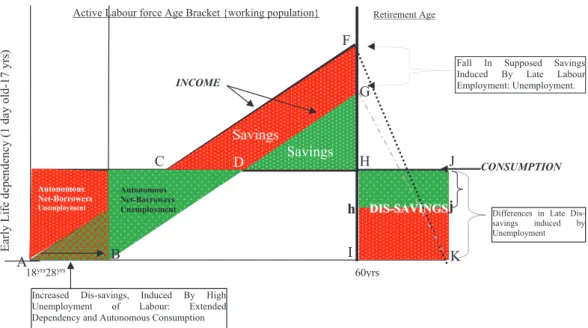
Similarly, late labour engagement of able-bodied men and women into the active labour force is prevalent in Nigeria. This may alter the savings pattern as predicted by the life cycle model. When people get engaged late into the active labour force, years of zero savings increase, while there is a high possibility of carrying over increased savings into retirement. Figure 1 illustrates the stylized pattern of income, savings and consumption, when late-labour engagement is incorporated into the standard life cycle model.
Figure 1. Stylized Individual Consumption-Savings Life Cycle Hypothesis with Unemployed Labour.
Source: Authors’ analysis
Active Labour force Age Bracket {working population}
h
A I K
J H
C
Increased Dis-savings, Induced By High Unemployment of Labour: Extended Dependency and Autonomous Consumption
18yrs28yrs 60yrs
Autonomous Net-Borrowers Unemployment Autonomous
Net-Borrowers Unemployment
Savings Savings
Fall In Supposed Savings Induced By Late Labour Employment: Unemployment.
INCOME
Differences in Late Dis- savings induced by Unemployment
CONSUMPTION DIDISS--SSAAVVIINNGGSS
B
D
F G
j
Early Life dependency (1 day old-17 yrs)
Retirement Age
In Figure 1, the lifetime income stream “ACFK”, represents a typical life-cycle model. It shows that during the first part of the individual’s lifetimes, an individual earns relatively little or no income and consume a relatively large amount of goods and services at the youthful stage where his consumption therefore exceeds his income and he therefore borrows. Because income tends to increase with the level of education and age, the individual reaches a point where he no longer needs to borrow (Point C). Beyond this point, at a middle age, savings become positive (CFH), income grows to a point, then begins to decline (Point F) beyond a certain age (age 60 representing the peak of the labour force) shortly after this point savings eventually begins to decline (F down to K) as he dis-saves to ensure consumption for the remaining time he has to live. The household therefore maintains a complete smooth consumption path across periods. With a constant consumption, an individual with an early income stream “ACF”, can easily smooth consumption over a lifetime given larger accumulated wealth (savings) area “CFH” due to early engagement in labour.
Consequently he has enough to dis-save after retirement “HJKI” to smooth the remaining lifetime consumption and possibly leave a bequest.
Figure 1 also presents another scenario; the same life cycle model for the individual, but instead, with late engagement into the labour market as a result of prevalent unemployment. The individual has his lifetime income stream as “BDG”, instead of “ACF”. This reduces accumulated wealth to
“DGH”, and consequently less to be dis-saved “Hjih”. This deficit in consumption smoothing over the individual’s lifetime is on account of the late engagement into the labour market. Consequently, the individual may have little or nothing to dis-save after retirement due to low accumulated savings and constraint of fixed retirement age.6
4. METHODOLOGY
4.1. DATA
The data used in this study draws from the Nigerian National Consumer (NCS) Surveys of 1980, 1985, 1992, and 1996; and the Nigerian Living Standards Surveys (NLSS) of 2004 and 2009. These surveys involved a sample of enumeration areas selected in each state which is a representative of both the urban and rural areas. In the 1980, 1985, 1992, and 1996 surveys, 11,110; 9,317; 9,697; and 14,951 households were surveyed respectively. The 2004 survey was individual and household- based, and contained detailed information on respondents. The 2004 survey covered 19,158 households and 92,610 individuals. The 2009 survey had 73,329 households and 332, 938 individuals.
Data set from the survey years 1980 to 2009 is used to profile the savings rate and Life Cycle Pattern among households.
4.2. MODEL
In investigating the determinants of savings, a cross-sectional regression was adopted using the individual surveys. The main reason for this is that the available household surveys are not longitudinal in nature (i.e. different households are surveyed over time). This makes it difficult to track changes in a particular household over time. In Nigeria, remittances play a major contributory factor in augmenting household income. According to the World Bank data, Nigeria is the largest recipient of remittances in Africa, estimated at $18.9 billion in 2016 7. Remittance was included as an explanatory variable only in the 2004 and 2009 cross-sectional regression, since the National
6 It is a common practice in Nigeria, particularly for employees of private sector jobs to depend on their children for survival after retirement.
7 See 2016 World Development Indicator (WDI) data on remittances inflow.
Consumer Surveys do not provide information on remittances.
Following the literature on the determinants of savings rate within the Life-Cycle Hypothesis, this study considered a set of explanatory variables, which were augmented with some variables peculiar to the determinants of savings in Nigeria. In the literature, the possible reverse causality between savings and education, on one hand, and saving and income has been well documented as a potential cause of endogeneity problems8. To overcome this problem, we adopted a two-stage least squares technique and specify the model below.
Where i= 1980, 1985, 1992, 1996, 2004 and 2009.
In equation 1, savgs and inc. denotes savings and income level, respectively. Xi1 is a vector of control variables including age, gender, location, occupation dummy, States of residence, remittances, and household size. Income, savings and remittances were adjusted for price changes in the different periods. In the second equation, fathers’ educational attainment ( fedu ) was used as an instrument for education of respondents in the 2004 and 2009 estimation. The 1980 to 1996 household surveys do not provide information on the respondent father’s educational status or a suitable instrument, thus Ordinary Least Squares technique was adopted. In addition, getting a valid and appropriate instrument for income was difficult. Hence, the relationship between income and savings would be treated as associative rather than causative. yi2 account for other factors affecting educational attainment.
5. SAVING PROFILE OF NIGERIAN HOUSEHOLDS (1980-2009) AND LIFE-CYCLE PATTERN
5.1. Saving Profile of Households
The saving pattern of households at the national level is presented in this section. The definition of saving in this study is a residual and the difference between the expenditure and income of households, while saving rate is this residual divided by total income of household and expressed as a percentage of 100. This definition has been used extensively in the savings literature and follows from Bersales and Mapa (2006). Also presented is the saving rate by per capita income deciles.
Figure 2 shows the saving pattern of households in Nigeria between 1980 and 2009. Aggregate saving rate declined to 18% in 2009 from 25% in 1980. Also evident, is the high dis-saving in 1992.
The national saving rate reached a peak of 40.6% in 1996, but was not sustained, as it declined to 19.3% in 2004 and experienced a marginal increase in 2009. It is worth pointing out that even at this level, saving rate among households in Nigeria is much higher than in most developed countries. For instance, average saving rate in the United Kingdom and United States of America in 2000-2007 was 1.7% and 4.1%. Similarly, in the post financial crisis period (2012-2016) it was 0.56% and 6.05%, respectively (OECD data).
8 See Bersales and Mapa (2006).
Table 1 shows the saving rate of households by per capita income deciles between 1980 and 2009. In 1980, savings rate across the deciles increased gradually. A similar trend is exhibited in 1985, where the top deciles had higher savings rates than the bottom deciles. Almost all deciles dis- saved in 1992, except the top deciles (8th, 9th and 10th deciles) that saved marginally. The dis-saving observed during this period may partly be attributed to significant decline in real income arising from unprecedented increase in the Consumer Price Index (CPI). For instance, the CPI rose by 48.8% between December 1991 and December 1992 (CBN, 2008). The sharp rise in consumer prices was largely due to imported inflation arising from rapid Naira depreciation against the United States Dollar. Naira depreciated by 75% from ₦9.90/$ in 1991 to ₦17.298 in 1992. Generally, Consumer Price Index (CPI) increased by 451% and Naira lost about 1,835% of its value to the US Dollar, between 1985 and 1992 (CBN, 2008).
Table 1. Household Saving Rates by National Per Capita Income Deciles
Source: Authors’ computation from Survey data
The saving pattern of deciles 1-3 significantly declined over the years, as they have been the worst hit by harsh economic conditions. Nevertheless, the saving rate increased across all deciles in 1996 (deciles 1-3 inclusive), as they benefitted from relative stability in the Naira value, moderated inflation rate and two successive minimum wage increases in 1991 and 1993. The Consumer Price Index (CPI) grew by only 14.3% in 1996, compared to historically high CPI growth of above 49%.
The 45% increase in the minimum wage in 1993 was not implemented in most states of the country until 1994/1995. The magnitude of the saving of deciles 4-10 did not change significantly over the survey years.
Household saving rates by geo-political zones, location, and age-group are also presented in the Figure 2. National Saving Rates, using NCS and NLSS survey years: 1980-2009
Source: Authors’ computation from Household Surveys
Appendix. Overall, we observed a general decline in the savings rates pattern in the geo-political zones over the years, except in the South-West which increased marginally. The largest decline was recorded by South-South, from 20.8% in 1980 to 12.2% in 2004. Average savings rate pattern increased with age, reaching a peak among individuals who are 65 years old and above. This may be attributed to the extended retirement age for some public officials. Retirement age for Professors in academic institutions in Nigeria is age 70 years, while it is 65 years old for other faculty and administrative staff. In addition, retirement ages for judges range from 65-70 years depending on the Court of law.
Higher saving rate among the 65+ category may also be explained by increased savings as retirement approaches and remittances to retired people from their children. It is the practice of children to send money home to parents. In addition, rural dwellers have higher savings rates compared to those in the urban areas.
5.2. Life Cycle Profiles
Tracing out the life cycle profiles of saving rate among households requires a longitudinal household survey in which the same households are sampled over time. The Nigeria National Consumer Surveys and Nigeria Living Standard Survey however do not follow the same household through time. One way to overcome this problem is using a synthetic cohort approach (see Attanasio and Szekely, 2000; Bersales and Mapa, 2006). This technique uses the average behaviour of group of households instead of individual households. Following these authors, we adopted this technique in studying the dynamic pattern of household saving in Nigeria. The age-groups of household heads are grouped using the National Consumer Surveys and Nigeria Living Standard Surveys of the available years (1980-2009). The average behaviour of these groups is assumed to be representative of cohort behaviours overtime.
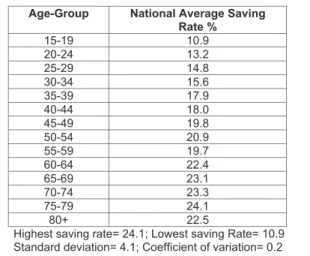
Table 2. Household Saving Rate by Age Groups (1980-2009)
Source: Authors’ computation from NCS and NLSS surveys Highest saving rate= 24.1; Lowest saving Rate= 10.9 Standard deviation= 4.1; Coefficient of variation= 0.2
Age-Group National Average Saving Rate %
15-19 10.9
20-24 13.2
25-29 14.8
30-34 15.6
35-39 17.9
40-44 18.0
45-49 19.8
50-54 20.9
55-59 19.7
60-64 22.4
65-69 23.1
70-74 23.3
75-79 24.1
80+ 22.5
As shown in Table 2, the national saving rates are highest and lowest among age-groups 75-79 and 15-19, respectively. This indicates that household saving rate is higher among the older population than the younger ones. The coefficient of variation of 0.2 suggests that the degree of variation in the saving rates across households is marginal. The standard deviation of 4.1 reflects stability across the savings distribution of different age-groups.
The survey data validated the life-cycle pattern as household saving rates increase with age as shown in Table 2. Decline in savings started late at above 80 years. The LCH did not hold for the age-group 65-79 whose saving rates continued on an upward trend instead of declining. This pattern mimics that observed by Bersales and Mapa (2006) for households in Phillipines; also a developing country. The saving rate among the labour force i.e. (15-64), peaked very late at the age-group 60- 64. An intuition from this is that due to poor retirement scheme in the country during a larger part of the period covered, workers saved heavily till retirement9.
Another striking observation from Table 2 is that high youth unemployment of the Nigerian labour force does not seem to distort the savings pattern of households. Saving rates among age- groups 20-24 and 25-29 increased on average. These age-groups constitute a larger fraction of the unemployed and it is expected that their saving rates would decline or they will dis-save. In 2015, unemployment rate among age-group 15-24 was 19 percent, and 34.5 percent were under-employed (NBS, 2016). The non-conformity of their saving rates pattern to the expected trend may be attributed to the fact that many unemployed graduates get engaged in the informal sector either as self- employed or paid-employee, thus maintaining their saving habits.
6. RESULTS AND DISCUSSION
Table 3 presents the findings of empirical estimation using cohort groupings of household surveys of 1980, 1985, 1992, 1996, 2004 and 2009. Incomplete, missing observations and households who reported no income were dropped from the final sample. Individuals aged 0-14 years were not included in the analysis since they are not categorized as part of the labour force.
The surveys of 1980-1996 were estimated individually using Ordinary Least Squares method.
The potential endogeneity arising from education variable was not accounted for in the model. This is due to lack of viable instruments in the cross-sectional data. The relationship between the covariates and dependent variable were therefore interpreted as associative rather than causative (see Malapit et al., 2015; Malapit and Quisumbing, 2015). In estimating the 2004 and 2009 surveys, Two-Stage Least Squares method was adopted, and father’s education was used as an instrument to correct for potential endogeneity problems as specified in equation 2 of the model. Diagnostic tests to ascertain the appropriateness of the chosen instrument are presented in the lower panel of Table 3.
As shown in column 2 of Table 3, income, household size, gender, and location are statistically significant in explaining household savings in 1980. Income and household size had the expected signs and are both positively and negatively associated with savings, respectively. The latter result suggests that a household with a larger size saves less than a smaller household. Women and rural dwellers are more favourably disposed to savings than men and those who reside in urban centres.
Educational attainment was not statistically significant in influencing savings in the year 1980.
Findings from the 1985 survey were not different from the earlier presented results, except that educational attainment is statistically significant and negatively affects savings. Generally, this trend is repeated in the results for 1996, 2004 and 2009, with larger reduction in savings. This appears surprising and does not conform to apriori expectations. Numerous studies, particularly using developed country data have documented positive correlation between education and savings behaviour (Bersales and Mapa, 2006; Messacar, 2017).
Some reasons may however be given for this anomaly. In developing countries, savings could
9 Prior to the enactment of the Pension Reform Act (2004), pension administration was mired by challenges such as malpractices and accumulation of arrears of payments of pension rights. The enactment of the Act, restructured pension administration in Nigeria and mandated both Public and Private sector organizations to key into a Contributory Pension Scheme, in which both the employer and employee contribute towards the latter’s retirement benefit.
Table 3. Estimates of Savings Determinants in Nigeria using Household Survey Data (1980-2009)
s g n i v a S l a e Independent R
variable OLS
(1980) OLS
(1985) OLS
(1992) OLS
(1996) 2SLS
(2004) 2SLS (2009) Real income 0.2032***
(0.0138) 0.1906***
(0.0172) 0.4261***
(0.0226) 0.1999***
(0.0089) Log(income less
remit) 0.5600***
(0.0706) 0.4401***
(0.0737) Household size -0.0084***
(0.0025) -0.0042**
(0.0019) -0.01706***
(0.0048) 0.1207***
(0.0031) 0.1145***
(0.0138) 0.1026**
(0.0451) Gender(male) -0.0558**
(0.0276) 0.0729
(0.0243) -0.0723*
(0.0435) -0.1007***
(0.0222) -0.1105***
(0.0217) -0.1422***
(0.0301) Location(urban) -0.0644***
(0.0191) -0.3475***
(0.0175) -0.0977***
(0.0348) -0.1160***
(0.0174) -0.0970***
(0.0222) -0.1303***
(0.0148)
Remittance 0.2140***
(0.0150) 0.1200**
(0.0585) Education(level) 0.0002
(0.0020) -0.0732***
(0.0083) 0.0212
(0.0181) -0.0449***
(0.0074) -0.0618***
(0.0165) -0.0440**
(0.0220)
Reference(15-24)
Age 25-34 -0.0264
(0.0482) -0.01705
(0.0498) 0.0742
(0.0866) 0.2647***
(0.0620) -0.0062
(0.0688) -0.0187 (0.0504) Age 35-44 -0.0519
(0.0485) -0.0152
(0.0496) -0.0460
(0.0879) 0.3558***
(0.0609) -0.0438
(0.0682) 0.0015 (0.0502) Age 45-54 -0.0577
(0.0500) 0.0163
(0.0499) -0.0236
(0.0893) 0.3118***
(0.0612) -0.0474
(0.0689) 0.0457 (0.0506)
Age 55-64 0.0088
(0.0529) 0.0057
(0.0529) 0.0162
(0.0931) 0.2537***
(0.0626) -0.0053
(0.0691) 0.0385 (0.0536)
Age 65+ 0.0749
(0.0536) 0.0293
(0.0545) -0.0475
(0.0977) 0.2093***
(0.0636) 0.0434
(0.0706) 0.0550 (0.0554)
Adjusted R2 0.5082 0.4570 0.5013 0.6891 0.6160 0.6259
Observations 10264 9316 8885 14864 7826 9856
F-statistic 351.96 564.32 476.55 2283.11 2170.67 2921.44
P-value 0.0000 0.0000 0.0000 0.0000 0.0000 0.0000
Endogeneity test
n i b u R - n o s r e d n
ANull: endogvars
irrelevant
A-R Wald test, p-
value 0.0000 0.0000
A-R Wald Chi2
test,p-value 0.0000 0.0000
Weak instrument
test:
First stageF 69.55 85.23
Critical value for IV bias relative to OLS
20.08 24.40
Notes: *, **, *** indicate 10, 5, and 1 percent significance levels. Robust Standard Errors are in parenthesis. Structural differences in savings arising from occupation and State of work place have been accounted for, through the inclusion of these variables as controls in the model. It is not shown here due to space constraints, but available upon request.
decline with higher education, if parents consider investment in children’s education as an asset diversification option (Virmani, 1986). Due to poor or non-existent social benefits and retirement plans, literate parents may consider increased spending on their children as a future investment strategy. The second plausible reason is that, since the expected positive relationship between higher educational attainment and savings is closely tied to gainful employment, high unemployment or under-employment among educated people in Nigeria may negatively correlate savings rate. Ahmad and Asghar (2004) also found that savings declined with higher schooling levels in Pakistan as educated parents increase educational expenditure on children. Income, household size and location were also statistically significant in explaining savings rate.
Generally, the positive relationship between income and savings as found in this study is well established in the Nigerian literature (see Soyibo and Adekanye, 1992; Nwakeze and Omoju, 2011).
Using micro data, Umuedafe (2013) also supports this finding. Household size negatively affects savings profile and rural households save more than urban dwellers. The summary statistics presented in the Appendix provides credence to higher savings among the rural households.
Estimations using the 1992 survey also exhibit the same trend, as income, household size, gender, location and education are the major influencing factors of savings. The results for 1996, 2004 and 2009 showed a divergent pattern of effect of household size on savings. As shown in Table 3 (columns 5, 6 and 7) household size positively correlates savings.
One interpretation for this is that the composition of household structure changed during these periods, such that more adult workers within the household who are economically engaged increased their savings. Age dependency ratio declined continuously during the survey periods, with larger decline between 1994 and 2010. This could have relieved the household head of financial burden and increased savings. For instance age dependency ratio declined from 91.3 in 1985 to 86.6 in 2004, and rose marginally to 87.7 in 2009 (data.worldbank.org/indicators/). Other variables had the expected signs and interpretation as given in the previous discussion. For instance, rural dwellers and women were more likely to have had higher savings in 1996. Higher educational attainment is associated with reduced savings.
As noted earlier, the estimation of 2004 and 2009 surveys accounted for potential endogeneity bias of the education variable. Father’s educational status was used as an instrument to correct for potential endogeneity of education variable. The chosen instrument correlates with the endogenous variable, but is uncorrelated with the error term except through the dependent variable. Similar instrument was adopted by Bargain and Melly (2008) in their paper on “gender wage differentials and selectivity into the public sector”. They used a variable “whether the father is a civil servant or not” as an instrument. The lower panel of columns 6 and 7 present the results of exogeneity test. The Anderson-Rubin test rejects the null hypothesis of exogeneity, as the endogenous variables are relevant. We therefore adopted Two-Stage Least squares technique to correct this anomaly.
The F-test, confirming the reliability of the instruments is also presented in columns 6 and 7.
For both years, the F-statistic is greater than ten, and above the critical values of F. Thus, we can conclude that that the Instrumental Variable bias in our model is less than 5% of OLS bias (Stock and Yogo, 2005).
Our analysis in 2004 and 2009 shows that a unit increase in income would lead to ₦0.56 and
₦0.44 increase in real savings. A higher educational level completed (between primary to secondary and tertiary levels), reduces monthly real savings by ₦0.06 and ₦0.04, in 2004 and 2009, respectively.
Increase in remittances has a positive impact on savings. This buttresses the evidence that remittances are major sources of income for households in Nigeria and that they have poverty-reducing effects (Chukwuone, 2012). Rural dwellers also save more than urban households.
Generally, the findings of this study point to the depressing influence of higher educational
attainment on savings pattern in Nigeria. This unveils the fact that education is not sufficient for savings mobilization in developing countries. In this context, the high unemployment rate in the country may be a contributing factor. Gainful employment may play a vital role, as education without jobs could limit the ability to save. This is a promising area for further research using micro-data information on respondents’ unemployment and labour characteristics. The surveys used in this research do not provide adequate information to compute respondents’ labour supply or the extent of involvement in the labour market.
Thus, policy makers should view job creation as a way to mobilize savings for economic growth. Another inference drawn from these results is that literate parents appear to trade-off higher current savings for increased spending on children’s education. In this perspective, children are seen as investment which would yield positive future returns (see Virmani, 1986; Ahmad and Asghar, 2004). Our findings show that women have higher likelihood to save more than men. Therefore, ongoing women empowerment programmes should be strengthened and newer ones initiated as a way of rapidly mobilizing savings for development purposes.
7. CONCLUSION
This study used household surveys of 1980, 1985, 1992, 1996, 2004 and 2009 to investigate the Life Cycle Pattern within the framework of labour engagement in Nigeria. Two approaches were adopted in this regard. The first method involved the use of a synthetic cohort system to trace the savings pattern of households over the survey years, while an econometric estimation of the determinants of private savings was presented in the second method. The second part used a nationally representative micro-data, which is relatively new to studies on savings’ determinants in Nigeria.
Taking into consideration the Life Cycle Hypothesis and labour engagement in Nigeria, the findings show that average household saving rate was high between 1980 and 2009. This indicates that there are huge potentials for savings mobilization for investment and economic growth in the country. A volatile savings pattern by income deciles was also observed during the period. Another novel finding of the study, which conforms to findings from developing countries, is that higher educational attainment reduces savings rate. This is explained by the trade-off between higher current savings and increased spending on children’s education.
The saving pattern validated the Life Cycle Hypothesis (LCH). However, the LCH did not hold for age-group 65-79 whose saving rate increased instead of declining. Savings peaked late among the labour force at age 60-64. As pointed out earlier, insecurity at old age, as a result of irregular or non-payment of pension may have prompted such savings behavioural pattern among the elderly.
Generally, results of the empirical estimation show that income, household size, years of education, gender, and location influence private savings in Nigeria. While income positively drives savings, the relationship between household size and savings appears mixed. Education was found to negatively impact savings. This notable finding is supported by other developing country studies and suggests that a highly educated population may not necessarily translate into increased savings.
The trade-off between higher savings and investment in children’s education plays an important role. Similarly, gainfully employment among educated people also matters for savings mobilization.
This further reiterates the need for the government to provide a more conducive atmosphere for job creation. Remittances received by households, increased their savings. In addition, women and rural dwellers were found to be thriftier. In this regard, aggressive promotion of financial services and products in rural areas would aid increased savings mobilization and boost economic growth.
References
Aghion, P. Comin, D, Howitt, P. and Tecu, I. (2009), When Does Domestic Saving Matter for Economic Growth?, Harvard Business School Working Paper 09-080.
Ahmad, M. and Asghar, T. (2004), Estimation of Saving Behaviour in Pakistan using Micro Data, The Lahore Journal of Economics, Vol. 9, No. 2, pp. 73-92.
Attanasio, O.P. and Szekely, M. (2000), Household Saving in Developing Countries: Inequality, Demographics and All That: How Different are Latin America and South East Asia?, Working Paper 427, Inter-American Development Bank, Research Department.
Bankole, A.S. and Fatai, B.O. (2013), Relationship between Savings and Economic Growth in Nigeria, The Social Sciences 8(3) pp. 224-230.
Bargain, O. and Melly, B. (2008), Public Sector Pay Gap in France: New Evidence Using Panel Data, IZA Discussion Paper No. 3427.
Bersales, L.G. and Mapa,D.S. (2006), Patterns and Determinants of Household Saving in the Philippines, Technical Report submitted to USAID/ Philippines OEDG.
Callen, T, and Thimann, C. (1997), Empirical Determinants of Household Saving: Evidence from OECD Countries, IMF Working Paper WP/97/181.
Chukwuone, N., Amaechina, E., Enebeli-Uzor, S.E., Iyoko, E. And Okpukpara, B. (2012), Analysis of Impact of Remittances on Poverty in Nigeria, Partnership for Economic Policy (PEP) Working Paper 2012-09.
CBN (2008), Central Bank of Nigeria, Statistical Bulletin, Golden Jubilee Edition, 2008.
Deaton, A. (1989), Saving in developing countries: theory and review. In proceedings of the World Bank Annual Conference on Development Economics. World Bank.
Deaton, A. and Paxson, C. (1997), The effects of Economic and Population Growth on National Saving and Inequality, Demography, Vol. 34, No.1, pp 97-114.
Fry, M.J. (1978), Money and Capital or Financial Deepening in Economic Development? Journal of development Economics, Vol 19, June.
Ike, P.C. and Umuedafe, D.E. (2013), Determinants of Savings and Capital Formation among Rural farmers in Isoko Local Government Area, Delta State, Nigeria, Asian Economic and Financial Review, 3(10), pp 1289-1297.
Messacar, D. (2017), The Effects of Education on Canadian’s Retirement Savings Behaviour, Analytical Studies Branch Research Paper Series, Catalogue No. 11F009M-No. 391. ISBN 978-0-660-08021-5.
Mikesell, R.F. and Zinser, E. (1973), The Nature of Savings Function in Developing Counties: a Survey of Theoretical and Empirical Literature, Journal of Economic Literature 11.
Malapit, H.J.L. and Quisumbing, A.R. (2015), What Dimensions of Women’s Empowerment in Agriculture Matter for Nutrition in Ghana?, Food Policy, 52, 54-63.
Malapit, H.J.L., Kadiyala,. S., Quisumbing, A.R., Cunningham, K., and Tyagi, P. (2015),
Women’s Empowerment Mitigates the Negative Effects of Low Production Diversity on Maternal and Child Nutrition in Nepal, The Journal of Development Studies, 51(8), 1097-1123.
Masson, P.R, Bayoumi, T, and Samiei, H. (1998), International Evidence on the Detewrminants of Private Saving, The World Bank Economic Review, Vol.12, No. 3 pp 483-501.
Modigliani, F. and Brumberg R.E. (1954), Utility Analysis and the Consumption Function, in Post- Keynesian Economics, ed. Kurihara K. K., New Brunswick, N.J.: Rutgers, University Press, 1954.
Modigliani, F. and Brumberg R.E. (1979), Utility Analysis and the Aggregate Consumption Function:
An Attempt at Integration, in Collected Papers of Franco Modigliani, Vol. 2, Cambridge, MIT Press, 1979.
NBS(2016), Annual Abstract of Statistics, Vol. 1, National Bureau of Statistics, July, 2017.
Nwachulwu, T. (2012), Determinants of Private Saving in Nigeria, Journal of Monetary and Economic Integration, Vol. 11, No. 2.
Nwakeze, N.M. and Omoju, O.E. (2011), Population Growth and Savings in Nigeria, American International Journal of Contemporary Research. Vol. 1, No.3, pp 144-150
Ogwumike, F.O and Ofoegbu, D.I (2012), Financial Liberalisation and Domestic Savings in Nigeria, The Social Sciences 7(4), pp 635-646.
Soyibo, A. and Adekanye, F. (1992), Financial System Regulation and Savings Mobilization in Nigeria, AERC Research Paper 11.
Stock, J.H. and Yogo, M. (2005), Testing for Weak Instruments in Linear IV Regression, in D.W.K.
Andrews and J.H. Stock (eds), Identification and Inference for Econometric Models, Essays in Honor of Thomas Rothenberg, 80-108. New York: Cambridge University Press.
Virmani, A. (1986), The Determinants of Savings in Developing Countries: Theory, Policy and Research Issues, Discussion Paper, Report No. DRD 186, Development Research Department, Economics and Research Staff, World Bank.
Webb, S.B and Zia, H. (1990), Lower Birth Rates, Higher Savings in LDC’s, Finance and Development, 27. No.2
WDI (2016), World Development Indicators. www.wdi.worldbank.org. Assessed on March 19, 2018.
www.data.worldbank.org/indicators/. Assessed on July 25, 2018.
https://data.oecd.org/hha/household-savings.htm. Assessed on July 12, 2018.
Appendix
Savings Rate by Geo-political Zones, Age, and Location )
% ( e t a r s g n i v a
S
1980 1985 1992 1996 2004 2009 Average
Geo-Political Zones
South-West 23.6 23.2 14.4 34 23.6 24.1 23.8
South-East 22.9 18.1 8.7 42.6 19 19.5 21.8
South-South 20.8 18.4 6.9 35.1 12.2 12.3 17.6
North-Central 27.1 32.1 15.1 44.6 19.9 20.1 26.5
North-West 24.5 34.9 6.6 40.1 19.5 20.0 24.3
North-East 26.7 39.7 2.1 46.6 20.2 21.0 26.1
Age Group
7 . 9 1 8 . 2 2 4 . 2 2 9 . 8 1 3 . 5 2 . 5 2 6 . 3 2 4
2 - 5 1
4 . 1 2 6 . 1 2 1 2 8 . 9 2 3 . 7 7 . 4 2 9 . 3 2 4
3 - 5 2
3 . 3 2 6 . 8 1 3 . 7 1 8 . 1 4 1 . 7 4 . 1 3 8 . 3 2 4
4 - 5 3
5 . 5 2 2 . 9 1 7 . 8 1 7 . 7 4 9 . 9 7 . 1 3 6 . 5 2 4
5 - 5 4
3 . 6 2 6 . 0 2 5 . 9 1 4 . 4 4 8 . 4 1 1 . 1 3 6 . 7 2 4
6 - 5 5
9 . 7 2 9 . 1 2 1 . 1 2 5 . 0 4 3 . 6 1 2 . 6 3 6 . 1 3 +
5 6
Location
Urban 20.4 18.4 16.2 35.6 14.2 15.5 20.1
5 . 3 3 7 . 2 2 7 . 0 2 8 . 1 4 1 . 0 4 1 . 5 4 4 . 0 3 l
a r u R