九州大学学術情報リポジトリ
Kyushu University Institutional Repository
吸着工程による、新たな軽油超深度脱硫プロセスの 開発
佐野, 洋介
http://hdl.handle.net/2324/2236346
出版情報:九州大学, 2018, 博士(工学), 論文博士 バージョン:
権利関係:
1 / 80
A Doctoral Thesis
A New Integrated Process for Deep Desulfurization Process
using Adsorptive Treatment
(和題: 吸着工程による、新たな軽油超深度脱硫プロセスの開発)
Kyushu University
Yosuke Sano
2 / 80
CONTENTS
LIST OF CAPTIONS ... 4
TECHNICAL TERMS ... 6
CHAPTER 1 ... 8
INTRODUCTION ... 8
Environmental Regulation for Automotive Fuel ... 8
World’s Trend on Refinery Business ... 9
Sulfur Removal Process for Diesel Fuel ... 11
New approach for Ultra Low Sulfur Diesel via Adsorption ... 13
References ... 14
CHAPTER 2 ... 16
ADSORPTIVE REMOVAL OF SULFUR AND NITROGEN COMPOUNDS FROM A STRAIGHT RUN DIESEL OVER ACTIVATED CARBONS FOR ITS DEEP HYDRODESULFURIZATION ... 16
Introduction ... 16
Experimental ... 18
Result ... 20
Discussion ... 29
Conclusion ... 30
References ... 31
CHAPTER 3 ... 33
EFFECTS OF NITROGEN AND REFRACTORY SULFUR COMPOUNDS REMOVAL ON THE DEEP HDS OF DIESEL 33 Introduction ... 33
Experimental ... 34
Result ... 35
Discussion ... 41
Conclusion ... 44
References ... 44
CHAPTER 4 ... 46
TWO-STEP ADSORPTION PROCESS FOR DEEP DESULFURIZATION OF DIESEL OIL ... 46
Introduction ... 46
Experimental ... 47
Result ... 49
Discussion ... 59
Conclusion ... 61
References ... 61
CHAPTER 5 ... 62
3 / 80
COST AND ENERGY EFFICIENT PROCESS FOR ULTRA LOW SULFUR DIESEL FUEL PRODUCTION ... 62
Introduction ... 62
Basis of Study ... 63
Result ... 70
Discussion ... 72
Conclusion ... 73
References ... 74
CHAPTER 6 ... 75
CONCLUSIONS... 75
Summary of Research ... 75
Conclusion and Further Work ... 79
4 / 80
LIST OF CAPTIONS
Description Page
Fig. 1.1a Sulfur Regulation for Gasoline in Japan No. 8
Fig. 1.1b Sulfur Regulation for Diesel in Japan 9
Fig. 1.2a Forecast of regional crude oil consumption 10
Fig. 1.2b Maximum Sulfur Limit in Gasoline, 2017 11
Fig. 1.2c Diesel Regulation Application, expected in 2020 11 Fig. 1.3 Typical Process Flow for Diesel Hydrotreating 12 Table 2.2.1 The characteristics of the carbon materials examined in the present
study 19
Fig. 2.3.1a Carbon, sulfur, and nitrogen chromatograms of (A) Straight Run Diesel
and (B) treated Straight Run Diesel. 20
Fig. 2.3.1b Sulfur chromatograms of Straight Run Diesel and treated Diesel. 21 Fig. 2.3.2 Sulfur and Nitrogen removal ratio among three Activated Carbons. 22 Fig. 2.3.3a Sulfur and Nitrogen breakthrough profiles of Straight Run Diesel on
MAXSORB-II at various adsorption temperatures. 23
Fig. 2.3.3b Sulfur and nitrogen breakthrough profiles of Straight Run Diesel on
MAXSORB-II at 30 degC. 24
Fig. 2.3.4a Breakthrough profiles of MGC-B series 25
Fig. 2.3.4b Breakthrough profiles of OG-20A series 25
Fig. 2.3.4c TPD results of MGC-B series 26
Fig. 2.3.4c TPD results of OG-20A series 27
Fig. 2.3.5a Sulfur Chromatogram of (A) FCC Gasoline (B) Treated FCC Gasoline 28 Fig. 2.3.5b Sulfur Chromatogram of (A) Kerosene. (B) Treated Kerosene. 28 Fig. 2.3.5c Sulfur Chromatogram of (A) LCO (B) Treated LCO 29 Fig. 3.3.1a Sulfur-chromatograms of Hydrodesulfurized products from (A)
Straight Run Diesel and (B–D) treated Straight Run Diesels. Nitrogen contents were (A) 260, (B) 60, (C) 40 and (D) 20 wt-ppm.
The content of refractory sulfur compounds were (A) 1680, (B) 980, (C) 920 and (D) 860 wt-ppm.
35
Fig. 3.3.1b Sulfur-chromatograms of treated Straight Run Diesel (1) Alumina
and (2) MAXSORB-II of Activated Carbon. 36
Fig. 3.3.1c Nitrogen-chromatograms of treated Straight Run Diesel (1) Alumina
and (2) MAXSORB-II of Activated Carbon. 37
Fig. 3.3.2a Plot of sulfur content in Hydrodesulfurized oil with nitrogen content
in feed oil. 37
Fig. 3.3.2b Plot of sulfur content in Hydrodesulfurized oil with refractory sulfur
compounds in feed oil, whose nitrogen content is 35 wt-ppm. 38
5 / 80
Fig. 3.3.2c Hydrodesulfurized of treated oils with various content of nitrogen
compounds at fixed content of refractory sulfur compounds. 39 Fig. 3.3.3 Plot of calculated reaction constant with observed reaction constant. 40 Fig. 4.1 The concept of consecutive adsorption process. 46 Fig. 4.3.1 Sulfur and Nitrogen chromatograms of (A) Straight Run Diesel, (B)
Hydrodesulfurized Diesel (C) Hydrodesulfurized Diesel with adsorptive treatment.
50
Table 4.3.1a Sulfur and nitrogen content in Diesel Oils 50 Fig. 4.3.2a Sulfur chromatograms of (A) Hydrodesulfurized Diesel, treated after
(B) 40 ml and (C) 20 ml of oil. 51
Fig. 4.3.2b Sulfur breakthrough profiles of Hydrodesulfurized Diesel with (A)
300 wt-ppm (B) 50 wt-ppm of sulfur content. 52
Fig. 4.3.3 Sulfur chromatogram of treated diesel of: (A) Hydrodesulfurized Diesel (No additives)
(B) 50 wt% of 1M-Naphthalene added Hydrodesulfurized Diesel
53
Table 4.3.3 The effects of coexists on adsorption capacity of sulfur compounds 54 Fig. 4.3.3a Nitrogen breakthrough profiles from Straight Run Diesel over virgin
and spent OG-20A 54
Fig. 4.3.4b Sulfur chromatograms of: (A) Straight Run Diesel, Straight Run Diesel treated by Spent OG-20A (B) treated 100 ml of Diesel with 300 wt- ppm of sulfur content (C) treated 100 ml of Diesel of 50 wt-ppm of sulfur content.
55
Fig. 4.3.5c Sulfur chromatograms of Hydrodesulfurized products from (A)
Straight Run Diesel (B) treated Straight Run Diesel 56 Fig. 4.3.5a Sulfur and nitrogen content of eluted solvents from spent Activated
Carbon. 57
Fig. 4.3.5b Removal amount of sulfur compounds in Hydrodesulfurized Diesel and nitrogen in Straight Run Diesel over virgin and regenerated Activated Carbon.
58
Fig. 4.4 Comparing the one bed system with two bed system 60 Fig. 5.2.1 Conceptual Flow Scheme for Ultra-deep Desulfurization Process 64 Fig. 5.2.2 Configuration of Absorbers for Adsorption and Regeneration 65 Table 5.2.2 Comparison of New Process Scheme and Conventional Process 66 Fig. 5.2.3a Configuration of Regenerant Supply from and Return to Refinery 67 Fig. 5.2.3b Typical Refinery Configuration – Gasoline Max Refinery 68 Fig. 5.2.3c Typical Refinery Configuration – Diesel Max Refinery 69 Table 5.2.3 Comparison of FCC Main Fractionator Operating Conditions 70
6 / 80
TECHNICAL TERMS
BPSD: Barres Per Standard Day, commonly used unit of measurement for Refinery facility
CCR Platformer
Catalytic Reformer for naphtha stream with Continuous Catalyst Regeneration. Hydrotreated naphtha of paraffinic / naphthenic molecules are converted to Aromatic molecules by De-Hydrogenation.
Delayed Coker:
The process unit in refinery, treating residues from distillation units for thermal cracking to produce light distillate.
FCC: Fluid Catalytic Cracking (Unit). The residue or vacuum gas oil, whose normal boiling temperature over 360 degC treated in this unit to produce Gasoline and other light distillates.
GC-AED: Atomic Emission Detector. HP6890P and G2350A was used in this series of studies
HDS Catalyst:
The catalyst used for Hydrodesulfurization.
For Diesel Hydrodesulfurization, the Cobalt – Molybdenum (CoMo) or Nickel– Molybdenum (NiMo) supported on silica alumina / zeolite.
Hydrodesulfurization:
The typical reaction for removal of sulfur from semi-finished petroleum product. The sulfur atoms contained in molecule is removed on the active sites of HDS catalyst and converted to H2S
LCO Light Cycle Oil, which is bi-product from FCC Unit, which is in the same distillation range as Diesel
Pump-Around:
The side drawoff from fractionator, which is to be returned to column after heat recovery.
Reformate:
7 / 80
Product Oil from CCR Platformer. One of the gasoline component with high octane number (usually 100 RON) due to high aromatics content (90wt%+)
Refractory Sulfur Compounds
The sulfur compounds, which are difficult to be desulfurized with HDS Catalyst. 4,6 – Dimethyl Dibenzothiophene is the typical molecule, which has steric hindrance for sulfur atom to contact with active site of HDS catalyst.
Straight Run Diesel:
Untreated diesel oil, derived from Crude Oil, whose normal boiling temperature is usually 240 degC – 360 degC, depending on the local product specification
TPD: Temperature Programmed Desorption. TPD-1-AT, Nippon Bell. Co. was used in this series of studies
8 / 80
CHAPTER 1 INTRODUCTION
Environmental Regulation for Automotive Fuel
The increasing concerns on the air quality have urged the petroleum refining industry to proceed with cleaner products by removing heteroatoms containing molecules from their major products, such as diesel and gasoline fuel. Presence of sulfur compounds in gasoline, diesel and marine fuel is still in the major source of air pollution since they are poisoning the catalyst for exhaust gas from Automotive. Then, untreated exhaust gas causes the environmental pollution (Acid Gas, Photochemical smog) or health issues (Azuma, etc...)
Especially in the developed country (e.g. North America, West Europe or Japan), the stricter regulation has been applied to the fossil fuel, such as gasoline, diesel and marine fuels. [1-7] Fig. 1.1a and Fig. 1.1b show the trend of sulfur regulation for gasoline and diesel in Japan.
Fig. 1.1a Sulfur Regulation for Gasoline in Japan
9 / 80
Fig. 1.1b Sulfur Regulation for Diesel in Japan
Such strict regulation has not been applied for domestic regulation in developing country, such as South East Asia, China, India and Mid / South America since many of refineries in those developing countries does not yet have the capability for clean fuel production and suffering from the severe financial problems for upgrading the existing facilities. Even though some of newly built refineries have capability for cleaner fuel production; they mainly export to developed country to gain the foreign currency.
However, worldwide effect of air pollution becomes highlighted and the severer regulations began to be applied for some of south east Asian country, e.g. 50 wt-ppm of sulfur content regulation on Gasoline in 2017 / Diesel in 2010 was in effect by Singapore Government. Since the significant growth of motive fuel consumption is expected in those developing countries, application of this regulation is strongly requested to minimize the global environmental issues.
World’s Trend on Refinery Business
Although some of developed countries are facing the “peak out” of oil demand, the world-wide consumption of oils is expected to be increased, mainly lead by
10 / 80
China, India, Middle East and ASEAN Countries. Fig. 1.2a & Fig. 1.2b shows the forecast of regional crude oil consumption. [8 - 10]
Fig. 1.2a Forecast of regional crude oil consumption
As can be seen in the Fig 1.2b and Fig 1.2c, most of growing countries have not yet applying the regulation applied in developed country but needed to be applied as soon as possible. In general, however, the stricter environmental regulation is one of the most concerned dilemma for Refiners. For compliance of new severer regulations, Refinery has three choices, the simplest approach is the reduction of throughput for increasing the Hydrogen / Oil ratio and Catalyst / Oil Ratio, 2nd one is the revamp of exiting unit and last one is to build new unit. However, none of those options assures the competitiveness of existing refinery due to loss of revenue or significant capital cost. Therefore, all existing Refiners are suffering from new regulations and new process for compliance of stricter regulation with lowest capital cost / without reduction of throughput is highly desired.
11 / 80
Fig. 1.2b Maximum Sulfur Limit in Gasoline, 2017
Fig. 1.2c Diesel Regulation Application, expected in 2020
Sulfur Removal Process for Diesel Fuel
The Hydrodesulfurization is the common methodology for removal of sulfur from diesel in the current refinery industry. [11] The typical process flow scheme for diesel Hydrodesulfurization facility is illustrated in Fig. 1.3.
12 / 80
Fig. 1.3 Typical Process Flow for Diesel Hydrotreating
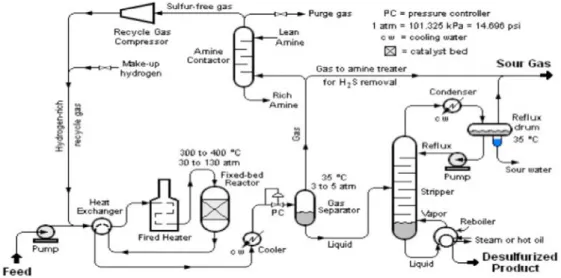
The feedstock of Diesel Hydrodesulfurization Unit is pumped up and mixed with Hydrogen Rich Gas. Before entering Reactor, this mixed stream is heated by heat exchanger and fired heater. In the reactor, sulfur compounds in feedstock is converted to H2S by HDS Catalyst. The reactor effluent is then cooled down and routed to separator, where the vapor and liquid separation is taken place.
The vapor will be treated by Amine for removal of H2S, generated in the reactor and recycle back to mixer after boosting up by compressor. The liquid is to be sent to Stripper for removal of light end before sending to Storage Tank.
The reaction kinetics in reactor is depending on the structure of molecules and heavy-aromatic sulfur compounds (so called Refractory Sulfur Compounds) has significantly lower reactivity than other compound with sulfur. [12 - 17]
Accordingly, the removal of this Refractory Sulfur Compounds is the controlling factor for sulfur content in final diesel product.
On the other hand, the desulfurization of Refractory Sulfur Compounds is strongly inhibited by the co-present inhibitors H2S, NH3 and organonitrogen compounds. [18 - 21] Hence, most of the attempts to achieve the “less than 10 wt-ppm of sulfur content” from Straight Run Diesel have been focused to increase the reactivity of the catalyst for the refractory sulfur compounds and
13 / 80
resistivity against inhibitors. New catalysts have been developed to provide the more active sites with morphology of molybdenum sulfide on the support, and/or more acidity, which is known to facilitate the Hydrogenation and isomerization of 4,6-Dimethyl Dibenzothiophene to relieve the steric hindrance of such refractory sulfur compounds. The resistivity against inhibition by H2S is also to be strengthened. Gas phase inhibitors, such as H2S and NH3, could be removed in a two-stage reaction configuration, proposed by Choi, et. al, in which pure Hydrogengas refreshed the reaction atmosphere between the first and second stage reactor. Some of nitrogen compounds, in particular, alkylated carbazoles, are rather refractory to survive until the last stage of deep Hydrodesulfurization, inhibiting the conversion of sulfur compounds to H2S.
Also, there is the reaction inhibiting materials. NH3 and basic nitrogen compound is one of the known compounds. They occupy the acidic site on HDS Catalyst, slowing down the reaction.
New approach for Ultra Low Sulfur Diesel via Adsorption
The series of researches in this Doctoral dissertation are purposed for the discovery of energy & economically efficient sulfur removal process to produce the diesel with sulfur content of less than 10 wt-ppm. The adsorption by using the adsorptive capability of Activated Carbon.
The experimental in Chapter 2 shows that the Activated Carbon has remarkable capability for removal of Nitrogen & Sulfur Compounds in Straight Run Diesel, which is connected to the drastic improvement on reactivity of subsequent Hydrodesulfurization using conventional CoMo Catalyst. The several experimental are also examined to comprehend the relationship between amount of adsorbed nitrogen / sulfur compounds and surface property of Activated Carbon, operating temperature and type of feedstocks.
Then, the quantitative analysis for relationship between remaining Nitrogen / Sulfur compounds and Hydrodesulfurization reactivity were made in the Chapter 3. The result of this quantitative analysis indicated that there is a
“sweet spot” for treatment, where the extent of reactivity improvement is remarkable.
14 / 80
The experimental in Chapter 4 shows that the spent Activated Carbon (no more adsorption capability) can be regenerated by using the aromatic solvent, e.g.
Toluene. Together with experimental facts attained in the Chapter 2 & 3, the new integrated process is proposed in the Chapter 4.
Chapter 5 shows how to implement this new technology into actual industry and evident its feasibility based on the several years experience in Engineering, Procurement and Construction for Refinery Process. The reality found in the refinery industry provided an idea for actual implementation of new process proposed in Chapter 4.
The actual implementation of new technology proposed in this research will accelerate the application of severer regulation for sulfur in diesel. This will directly contribute to the environmental protection.
References
[1] Dorective 2009/30/EC of the European Parliament and of the Council of 23 April 2009.
[2] EPA, control of air pollution from new motor vehicles: heavy-duty engine and vehicle standards and highway diesel fuel sulfur control requirements, Federal Register, vol. 66, 2001, p.5101.
[3] Enabling Fuel Requirement of Low Emissions Vehicle Technology in Europe CONCAWE 31 July,2000.
[4] K. Barrow, Oil Gas Journal 107 (2009) 38
[5] A. Stanislaus, A. Marafi, MS Rana, Catalysis Today 153 (2010) 1
[6] ACEA data of the sulfur effect on advanced emission control technologies July, 2000.
[7] Central Environment Council, Future Policy for Motor Vehicles Exhaust Emissions Reduction (7th Report), Japanese Ministry of the Environment, July 29, 2003.
15 / 80 [8] Exxon Mobil Outlook for Energy 2017 [9] Shell Mountains Scenario (2013) [10] IEA World Energy Outlook 2017 [11] World Scientific News (2015)
[12] S.S. Shih., S. Mizrahi, L. A. Green, Industrial & Engineering Chemistry Research 31 (1992) 1232
[13] T. Kabe, A. Ishihara., H. Tajima, Industrial & Engineering Chemistry Research 31 31 (1992) 1577
[14] H. Schulz., W. Bohringer, F. Ousmanov, Fuel Processing Technology 61 (1999) 5
[15] M. Macaud, A. Milenkovic, E. Schulz, Journal of Catalysis 193 (2000) 255 [16] T. Kabe, W. Qian, A. Ishihara, Journal of Catalysis 149 (1994) 171.
[17] M. V. Laudau, Catalysis Today 36 (4) (1997) 393
[18] D.D. Whitehurst, T. Isoda, I. Mochida, Advances in Catalysis. 42 (1998) 345.
[19] D.D. Whitehurst, H. Farag, T. Nagamatsu, K. Sakanishi, I. Mochida, Catalysis Today 45 (1998) 299.
[20] I. Mochida, K.-H. Choi, J. Jpn. Journal of the Japan Petroleum Institute (2004), 145
[21] P. Zeuthen, K.G. Knudsen, D.D. Whitehurst, Catalysis Today 65 (2001) 307.
16 / 80
CHAPTER 2
ADSORPTIVE REMOVAL OF SULFUR AND NITROGEN COMPOUNDS FROM A STRAIGHT RUN DIESEL OVER ACTIVATED CARBONS FOR ITS
DEEP HYDRODESULFURIZATION
Introduction
The nitrogen compounds of both basic and neutral natures in Straight Run Diesel are known as the inhibitors for deep Hydrodesulfurization of refractory sulfur compounds especially at their low level in the range of 10–200 wt-ppm [1]. Basic nitrogen compounds tend to show strong inhibition to Hydrodesulfurization of Straight Run Diesel but many of them are to be denitrogenated at rather initial stage of Hydrodesulfurization. The neutral nitrogen compounds, such as carbazoles or its alkylate, has lower reactivity than most of sulfur compounds in Straight Run Diesel and tend to stay through the whole stage of deep Hydrodesulfurization. In the last stage of Hydrodesulfurization reaction, refractory sulfur compounds are Hydrodesulfurized to achieve sulfur level less than 10 wt-ppm [2], which is the common specification for diesel product in developed country, and its reactivity is affected by remaining inhibitors at this stage. Hence, their removal prior to the Hydrodesulfurization is very effective to reduce the remaining sulfur content as previously reported [3-6], even if they were denitrogenated at the last minute of Hydrodesulfurization.
There are some proposals of the pre-treatment for Diesel to remove nitrogen compounds by silica or silica–alumina prior to Hydrodesulfurization [3-6].
However, there are still some windows to improve the cost and performance in terms of the adsorbent. Removal level of nitrogen compounds, efficiency and effects of sulfur removal, regeneration of adsorbent and oil recovery must be delicately balanced. Song and Ma [7] proposed selective adsorption for removing sulfur at ambient temperature (SARS) process to achieve ultra clean diesel and gasoline. They used 5 wt-% metal loaded on silica gel as an adsorbent.
Feed oil was not real diesel, but model compounds which did not contain the nitrogen compounds. Although detail information on the adsorbent was not disclosed, their adsorbent showed rather fast breakthrough over 10 wt-ppm after eluting about 5 ml of model diesel. IRVAD and S-Zorb process also utilize adsorption to remove the heteroatoms in gasoline and diesel. But, operating
17 / 80
temperature of them are reported to be over 240 degC (IRVAD) and 340 – 410 degC (S-Zorb) [8-10]. Yang and coworkers [11,12] reported that Cu and Ag- exchanged Y-type zeolites were very effective to selectively adsorb the thiophene and the used adsorbents could be regenerated by heating them at 350 degC under flowing air.
Several new approaches have been proposed and some of them were practically examined to achieve the ultra deep Hydrodesulfurization [13].
However, more efficient and more economical process is still desired despite various efforts by researchers in the world. Critical barriers for achieving ultra deep Hydrodesulfurization are very low reactivity of refractory sulfur compounds under conventional conditions and strong inhibition by H2S, NH3, nitrogen, and even aromatic compounds against ultra deep Hydrodesulfurization. Such inhibitors retard the Hydrodesulfurization, very markedly in the region of 0–100 wt-ppm of sulfur content [1,14-17].
Activated Carbon and Activated Carbon fiber have been recognized to be versatile absorbents for gaseous and liquid substrates [18,19]. Their surface structure and properties can be controllable to propose better adsorbent [20 – 22]. In this study, sulfur and nitrogen compounds were removed from Straight Run Diesel through the dynamic adsorption over some Activated Carbon materials at room temperature. A particular Activated Carbon of very large surface area was examined in detail.
2.1.1 The effect of further activation of Activated Carbon on Adsorption Capability Activated Carbon. MGC-B and OG-20A were treated by H2O2, H2SO4 and HNO3, followed by dried out operation at 180 degC, 400 degC and 600 degC, respectively for further activation. Then, proceed with the same adsorption experimental as described in Section 2.2.1. Prior to the experimental for adsorption, the Activated Carbon of further activation were analyzed by TPD apparatus.
This experimental is purposed to see if any relationship between surface properties of Activated Carbon and its adsorption capability for nitrogen compound in Straight Run Diesel.
18 / 80 Experimental
2.2.1 Adsorption for Nitrogen and Sulfur Compounds in Straight Run Diesel
Straight Run Diesel (11,780 wt-ppm of sulfur content and 260 wt-ppm Nitrogen), which was provided by a Japanese commercial refinery, was used in this study as a feedstock for adsorptive treatment by Activated Carbon. Normal Boiling Point of component in Straight Run Diesel are in the range of 240 – 360 degC with carbon number of C12 – C20. Most of sulfur compounds in Straight Run Diesel were benzothiophenes (BT), dibenzothiophenes (DBTs). Carbazoles (Cz) were found in nitrogen-specific chromatogram of Straight Run Diesel.
With regard to the adsorbent, three types of Activated Carbon - MAXSORB-II, OG-20A and MGC-B were used in this experimental. The key properties of those Activated Carbons are listed in Table 2.2.1.
Prior to the experimental for adsorption, the Activated Carbon materials were dried at 110 degC under vacuum oven for removal of water on the surface. As a batch type adsorption experimental at the first place, 1 g of this dried Activated were put in the 120 ml of Straight Run Diesel and mixed under ambient pressure & temperature (30 degC). Then, the filtered liquid was analyzed by GC-AED for changes in the distribution of sulfur and nitrogen components.
Secondary, the adsorption experimental of continuous operation was carried out. The dried Activated Carbon materials were packed into the stainless-steel tube of 50 mm length and 6 mm diameter. Then, Straight Run Diesel was fed into the tube by an HPLC pump (Shimadzu, LC-10AD) at the rate of 0.1 ml/min under the pressure of 20 psi. The eluted oil was sampled for 30 s (0.05 ml) at every 60 min and analyzed by GC-AED. The sulfur and nitrogen content in total recovered oil for 6 hrs. operation (36 ml) was also analyzed by GC-AED. In this experimental, the tube filled with Activated Carbon was maintained at constant temperature of 30 degC by water bath. In order to check the impact from adsorption temperature on Activated Carbon’s capability for adsorption of sulfur / nitrogen compound in Straight Run Diesel, this experimental was carried out with MAXSORB-II at 10 degC and 50 degC.
19 / 80
Table 2.2.1 The characteristics of the carbon materials examined in the present study
2.2.2 Adsorption for Sulfur Compounds in Other Petroleum Products
By using same experimental apparatus and procedure explained in Section 2.2.1, following petroleum products / byproducts were treated:
FCC Gasoline, whose sulfur content is 64 wt-ppm
Hydrotreated Kerosene, whose sulfur content is 10 wt-ppm
LCO, whose sulfur content is 8,900 wt-ppm
This experimental was conducted with batch operation, using 0.3 g of Activated Carbon for treating 20 ml of oil at 30 degC. The collected liquid was analyzed by GC-AED.
20 / 80 Result
2.3.1 Removal of nitrogen and sulfur over MAXSORB-II, a particular Activated Carbon of the largest surface area
The carbon-, sulfur-, nitrogen-chromatograms of treated Straight Run Diesel (120 ml oil / 1 g MAXSORB-II) are illustrated in Fig. 2.3.1a.
Fig. 2.3.1a Carbon, sulfur, and nitrogen chromatograms of (A) Straight Run Diesel and (B) treated Straight Run Diesel.
There was no difference between the carbon - chromatograms of Straight Run Diesel and that of treated Straight Run Diesel. On the other hand, smaller peaks are found in the sulfur – chromatograms of treated Straight Run Diesel. As for the nitrogen – chromatograms, remarkably smaller peaks are found in the treated Straight Run Diesel than Non-Treated Straight Diesel.
The sulfur chromatogram for eluted oil in initial stage of adsorption experimental is also illustrated in the Fig. 2.3.1a.
21 / 80
Fig. 2.3.1b Sulfur chromatograms of Straight Run Diesel and treated Diesel.
In the initial stage of this experimental, the peaks of sulfur compounds of higher boiling point (peaks in right side of chromatogram) are reduced but the height of those peaks are gradually increased. Also, the peaks of sulfur compounds of lower boiling point (peaks in left side of chromatogram) in eluted oil at 120 min.
shows higher peak than feedstock. This means that the adsorbed sulfur compounds in the initial stage on Activated Carbon is desorbed in the later stage, possibly by sulfur compounds of higher boiling point
2.3.2 Adsorption performance among Activated Carbon materials for sulfur and nitrogen compound in Straight Run Diesel
Fig. 2.3.2 illustrates the removal ratio of the sulfur and nitrogen compound in Straight Run Diesel over three Activated Carbon materials through 6 hrs.
experimental. Among three kinds of Activated Carbons, MAXSORB-II of highest surface area and highest oxygen content shows remarkable adsorption capability for nitrogen compound in Straight Run Diesel. Also, Fig. 2.3.2 indicates that MGC-B of lower surface area than OG-20A showed 30% more nitrogen compound removal ratio than OG-20A. This indicates that the Oxygen functional group on surface of Activated Carbon plays roles in the adsorption of Nitrogen Compound in Straight Run Diesel.
22 / 80
Fig. 2.3.2 Sulfur and Nitrogen removal ratio among three Activated Carbons.
With regards to the adsorptive removal of sulfur compound in Straight Run Diesel, MAXSORB-II of highest surface area shows the highest adsorption capability as well. However, the removal ratio was proportional to neither surface area, pore volume, nor other hetero molecules in Activated Carbon.
2.3.3 Adsorption performance with MAXSORB-II for sulfur and nitrogen compound in Straight Run Diesel
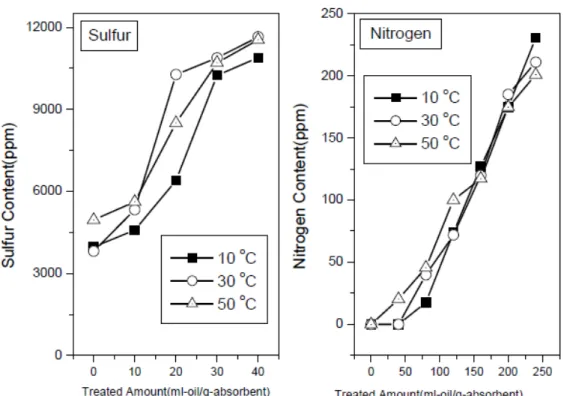
Fig. 2.3.3 shows the breakthrough profiles during adsorptive removal of the sulfur and nitrogen compounds over the Activated Carbon at various temperatures (10 degC, 30 degC, and 50 degC). The removal extents of nitrogen compounds were basically independent on the adsorption temperature as shown in Fig. 2.3.1a. In contrast, adsorption at the higher temperature reduced the adsorption of total sulfur compounds, which is typical phenomena in physical adsorption process.
23 / 80
Fig. 2.3.3a Sulfur and Nitrogen breakthrough profiles of Straight Run Diesel on MAXSORB-II at various adsorption temperatures.
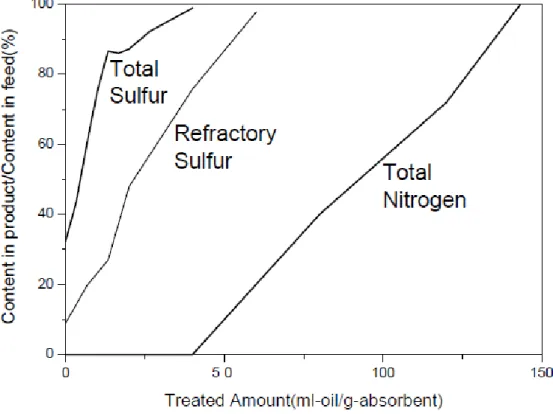
Fig. 2.3.3b illustrates sulfur and nitrogen contents in treated Straight Run Diesels sampled at various elution times. The 37% of total sulfur compounds were left in the first 0.05 ml of the treated Straight Run Diesel. The content increased rapidly to 90% by 20 ml elution and then slowly to 100% by 45 ml elution. The slow increase of sulfur compounds from 20 to 40 ml elution corresponded to the removal of refractory sulfur compounds such as 4,6- DMDBT and 4,6,X-TMDBT as described below. Only 10% of refractory sulfur compounds were left in the first 0.05 ml of the eluted Straight Run Diesel. The content increased slowly to reach 100% by 55 ml elution, showing longer breakthrough profile than the total sulfur content. Preferential adsorption of refractory sulfur compounds was definite over MAXSORB-II.
Adsorption of nitrogen compounds was much more effective than that of sulfur compounds. The nitrogen content remained at much lower level than the sulfur content in Straight Run Diesel. First 0.05 ml of eluted Straight Run Diesel contained no nitrogen compounds at all. The nitrogen content increased
24 / 80
gradually to reach 100% by 150 ml elution. The removed amounts of total sulfur, refractory sulfur, and nitrogen compounds until their 100% breakthrough were calculated; 0.098 g total sulfur, 0.042 g refractory sulfur, and 0.039 g total nitrogen over 1 g MAXSORB-II, respectively, at 30 deg C.
Fig. 2.3.3b Sulfur and nitrogen breakthrough profiles of Straight Run Diesel on MAXSORB-II at 30 degC.
2.3.4 Further activation of Activated Carbon and its impact to adsorption capability on Nitrogen Compound in Straight Run Diesel
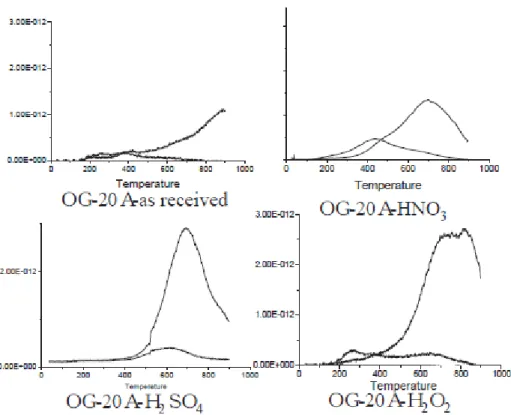
Fig. 2.3.4c and Fig. 2.3.4d showed the nitrogen breakthrough profiles by treated MGC-B and OG-20A series. H2O2-, H2SO4, HNO3-treated Activated Carbons, which dried at 180 degC, 400 degC and 600 degC respectively, showed better adsorption than those of “as-received” ones.
25 / 80
Fig. 2.3.4a Breakthrough profiles of MGC-B series
Fig. 2.3.4b Breakthrough profiles of OG-20A series
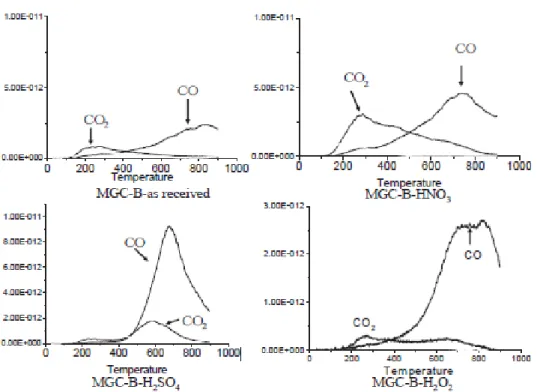
Fig. 2.3.4c and Fig. 2.3.4d showed the TPD spectrums of these Activated Carbons, where Activated Carbon of larger adsorption capacity for nitrogen compound shows the CO peak at 600 - 800 degC and those of low adsorption capacity for nitrogen compounds showed CO2-peak at 200 - 400 degC.
26 / 80
This experimental shows the consistent tendency of experimental result in Section 2.3.2, where the nitrogen removal ratio is highly related to oxygen molecules in Activated Carbon.
Fig. 2.3.4c TPD results of MGC-B series
27 / 80
Fig. 2.3.4c TPD results of OG-20A series
2.3.5 Adsorptive removal of sulfur compounds from various petroleum products Fig. 2.3.5a shows the sulfur chromatogram for FCC Gasoline of (A) “As received Gasoline” and (B) “Treated Gasoline”.
Adsorptive sulfur removal from FCC Gasoline is highly attractive for refiner since conventional hydrotreating scheme enhance the octane loss due to saturation of olefin component. However, Activated Carbon did not remove the sulfur compounds in FCC Gasoline, even though the sulfur content in feedstock is only 64 wt-ppm. This experimental result indicates that the adsorption of sulfur compound found in the adsorptive treatment for Straight Run Gas oil is not direct interaction between Sulfur Molecule and Activated Carbon but the affinity of bulk liquid against surface of Activated Carbon.
28 / 80
Fig. 2.3.5a Sulfur Chromatogram of (A) FCC Gasoline (B) Treated FCC Gasoline
Fig. 2.3.5b shows the sulfur chromatogram for (A) “As received Kerosene” and (B) “Treated Kerosene”. Alkylated benzothiophenes (peak number of 5 - 6) in kerosene were not adsorbed over Activated Carbon at all while Dibenzothiophene (4) and alkylated Dibenzothiophenes (1 – 3) in kerosene were adsorbed. These characteristics are consistent with the experimental result in Straight Run Diesel. However, refinery industry may not be very interested in this fact since there is no technical difficulty for hydrotreating Kerosene.
Fig. 2.3.5b Sulfur Chromatogram of (A) Kerosene. (B) Treated Kerosene.
29 / 80
Fig. 2.3.5c shows the sulfur chromatogram for (A) “As received LCO” and (B)
“Treated LCO”. Although sulfur component is removed, the adsorption bed was plugged when proceed with adsorption experimental described in Section 2.2.1. This may be caused due to the gummed materials, which are
polymerized olefin material.
Fig. 2.3.5c Sulfur Chromatogram of (A) LCO (B) Treated LCO
Discussion
MAXSORB-II was found particularly active to remove both nitrogen and sulfur compounds in Straight Run Diesel although all three carbon materials examined in the present study showed much higher removal capacity than silica gel and alumina, which had been reported as effective adsorbents for nitrogen compounds in the Diesel. Its adsorption capacity (0.098 g total sulfur and 0.039 g total nitrogen) was much larger than Cu-exchanged Y-zeolite (1.40 wt.%) [11].
Although some decrease in adsorption capability were found in higher temperature, its remarkable ability for sulfur and nitrogen compound at ambient temperature will provides the advantage on operation cost as well.
As indicated in the Section 2.3.1 in this Chapter, the remaining nitrogen content in treated oil is very low. Therefore, the Activated Carbon as adsorber has high potential for commercial use as a pre-treatment section of diesel hydrotreating
30 / 80
facility to increase the reactivity in Hydrodesulfurization reaction by eliminating the nitrogen compound of its inhibitor. Those very large surface area and high oxygen content may be explained as a reason for its high performance.
MAXSORB-II has been disclosed to be prepared through KOH activation of green coke [20, 23], which results in very high cost at present. Therefore, further development of Activated Carbon for lower cost with higher adsorption capability is desired. The experimental results described in Section 2.3.4 of this Chapter showed the improved capability of nitrogen removal by acid treatment.
This fact suggests that there is possibility for improving the adsorption capability with more economical process.
As for the sulfur removal, the experimental results shown in Section 2.3.1 in this Chapter indicated that the number of sulfur compounds in Straight Run Diesel is too large in comparison with Activated Carbon’s adsorption capability.
Therefore, desulfurization of Straight Run Diesel solely with adsorption by Activated Carbon can not be the practical solution. However, Activated Carbon’s unique characteristic of “higher selectivity for removing the sulfur compounds of high boiling point “shows the potential for practical use as post treatment of Hydrodesulfurization.
Finally, Activated Carbon was tried to be used for adsorptive removal of sulfur compounds in FCC Gasoline, Hydrotreated Kerosene and LCO in Section 2.3.5 in this Chapter. However, none of the experimental result supports the needs of further studies.
Conclusion
The present section emphasizes following two points:
1. A particular Activated Carbon, MAXSORB-II, showed the excellent performance in the removal of nitrogen compounds in Straight Run Diesel by adsorption.
2. The number of sulfur compounds in Straight Run Diesel is too large in comparison with Activated Carbon’s adsorption capability.
31 / 80
3. The adsorption capability of Activated Carbon for nitrogen compound in Straight Run Diesel can be increased by further treatment with acid. The oxygen functional groups on surface of Activated Carbon plays roles on it.
References
[1] S. Shin, H. Yang, K. Sakanishi, I. Mochida, D.A. Groudoski, J.H. Shinn, Applied Catalysis A 243 (2003) 207.
[2] A. Szymanska, M. Lewandowski, C. Sayag, G.D. Mariadassou, Journal of Catalysis. 218 (2003) 24.
[3] S.D. Sumbogo, M.H. Yang, K.H. Choi, T. Korai, I. Mochida, Applied Catalysis A 252 (2003) 331.
[4] B.C. Gates, H. Topsoe, Polyhedron 16 (1997) 18.
[5] K.-H Choi, T. Korai, I. Mochida, J.W. Ryoo, W. Min, Applied Catalysis B 50 (2004) 9.
[6] W.-S. Min, K.-I. Choi, S.-Y. Khang, D.-S. Min, J.-W. Ryu, K.-S. Yoo, J.-H. Kim, US Patent 6 248 230, to SK Corporation (2001).
[7] C. Song, X. Ma, Applied Catalysis B 41 (2003) 207.
[8] G.P. Khare, US Patent 6 346 190, to Phillips Petroleum Company (2002).
[9] A.S.H. Salem, H.S. Hamid, Chemical Engineering & Technology 20 (1997) 342.
[10] R.L. Irvine US Patent 5 730 860, to the Pritchard Corporation (1998).
[11] A.J. Hernandez-Maldonado, R.T. Yang, Industrial & Engineering Chemistry Research 42 (2003) 123.
[12] A. Takahashi, F.H. Yang, R.T. Yang, Industrial & Engineering Chemistry Research 41 (2003) 2487.
[13] I.V. Babich, J.A. Moulijn, Fuel 82 (2003) 607.
32 / 80
[14] D.D. Whitehurst, T. Isoda, I. Mochida, Advances in Catalysis 42 (1998) 345.
[15] D.D. Whitehurst, H. Farag, T. Nagamatsu, K. Sakanishi, I. Mochida, Catalysis Today 45 (1998) 299.
[16] I. Mochida, K.-H. Choi, Journal of the Japan Petroleum Institute. (2004), 145
[17] P. Zeuthen, K.G. Knudsen, D.D. Whitehurst, Catalysis Today 65 (2001) 307.
[18] N. Shirahama, S.H. Moon, K.-H. Choi, T. Enjoji, S. Kawano, Y. Korai, M.
Tanoura, I. Mochida, Carbon 40 (2002) 2605.
[19] R. Leboda, J. Skubiszewska-Ziba, W. Tomaszewski, V.M. Gunko, Journal of Colloid and Interface Science. 263 (2003) 533.
[20] J. Hayashi, T. Horikawa, I. Takeda, K. Muroyama, F.N. Ani, Carbon 40 (2002) 2381.
[21] A.M. Puziy, O.I. Poddubnaya, A. Mart´ınez-Alonso, F. Suárez-Garc´ıa, J.M.D. Tascón, Applied Surface Science. 200 (2002) 1493.
[22] T. Otowa, R. Tanibata, M. Itoh, Gas Separation & Purification 4 (1993) 241.
[23] T. Otowa, Y. Nojima, T. Miyazaki, Carbon 35 (1997) 1315
33 / 80
CHAPTER 3
EFFECTS OF NITROGEN AND REFRACTORY SULFUR COMPOUNDS REMOVAL ON THE DEEP HDS OF DIESEL
Introduction
In the series of study in Chapter 2, it was found that the Activated Carbons of high surface area has capability for removing not only the much more nitrogen compounds than silica but also heavier sulfur compounds from Straight Run Diesel [1-5]. The roles of nitrogen and refractory sulfur compounds on the Hydrodesulfurization have been extensively studied to clarify their inhibiting effect in the HDS mechanisms by using model mixture [6]. However, the results so far reported by many research groups could not draw a universal rule about the effects of removal extent of such compounds on the achievable sulfur content in the successive Hydrodesulfurized product due to the wide variation of reaction conditions and feed compositions. Quantitative description about effects of nitrogen and sulfur compounds in the feed oil on its deep Hydrodesulfurization can provide a practical guideline to specify the feedstock composition for achieving ultra low sulfur diesel.
In this Chapter, the pre-removal of nitrogen compounds has been reported to be very effective on the achievable sulfur content of Diesel [7,8], where nitrogen contents were varied at several levels and total sulfur content was fixed. However, both refractory sulfur content and nitrogen content in Straight Run Diesel must be counted to obtain the exact relationship between compositions of feed Diesel and achievable sulfur content in Hydrodesulfurized Diesel since Activated Carbon removed also refractory sulfur compounds to some extent. Such a relation is very useful to design the removal facility and operating conditions since the pre-treated feed must be evaluated about its achievable sulfur content with under HDS conditions.
The present study in this Chapter attempted to describe more quantitatively the removal effects of both nitrogen and refractory sulfur compounds on the Hydrodesulfurization of Straight Run Diesel. Combination of alumina and Activated Carbon of large surface area allowed the selective removal of refractory sulfur compounds as well as nitrogen compounds to provide a series of feed Diesels having various nitrogen and refractory sulfur contents. Such oils
34 / 80
were Hydrodesulfurized over a conventional catalyst under the same condition to obtain a series of sulfur contents in the product oils which could be compared to the contents of nitrogen and refractory sulfur compounds in feed oils
Experimental
Straight Run Diesel (11,780 wt-ppm of sulfur content and 260 wt-ppm Nitrogen), which was provided by a Japanese commercial refinery, was used in this study as a feedstock for adsorptive treatment with Activated Carbon, followed by Hydrotreating with Catalyst. By changing the ratio of Straight Run Diesel and MAXSORB-II of Activated Carbon, treated Straight Run Diesel of 20 wt-ppm, 40 wt-ppm and 60 wt-ppm of nitrogen content was produced. In this operation, the refractory sulfur compounds (Dimethyl Dibenzothiophene and heavier) are also removed from Straight Run Diesel.
The Straight Run Diesel and pretreated Straight Run Diesel were Hydrodesulfurized over a commercially available HDS Catalyst (CoMo/SiO2– Al2O3, surface area 208 m2/g cat, pore volume 0.3 cm3/g cat, acidity 0.7 mmolNH3/g cat) in an autoclave-type reactor (100 ml internal volume). Prior to the Hydrodesulfurization reaction, HDS Catalyst must be proceed with sulfiding operation, where heated at 360 degC in Hydrogen with 5% Hydrogen sulfide to replace the oxygen atom on Molybdenum to sulfur atom.
10 g of oil and 1 g of sulfide HDS Catalyst were charged into the autoclave-type reactor at room temperature. This reactor was heated to 340 degC by 50 min under initial Hydrogen pressure of 5.0 MPaG where Hydrodesulfurization reaction was taken place for 2 hr. The Hydrodesulfurized product of 0.5 ml was collected through a sampling tube fitted to the reactor and analyzed with GC- AED.
Similarly, feedstock for Hydrodesulfurization reaction with various combination of sulfur and nitrogen content by using OG-20A, MGC-B and Alumina. These feedstocks have proceeded with Hydrodesulfurization reaction for analysis of its kinetics.
35 / 80 Result
3.3.1 Hydrodesulfurization of treated Straight Run Diesels
Fig. 3.3.1a compares sulfur-chromatograms of Hydrodesulfurized products from the non-treated and treated Straight Run Diesels. The non-treated Straight Run Diesel and the treated Straight Run Diesels had the nitrogen contents of 260, 60, 40, 20 wt-ppm and the refractory sulfur content of 1680, 980, 920 and 860 wt-ppm, respectively.
Fig. 3.3.1a Sulfur-chromatograms of Hydrodesulfurized products from (A) Straight Run Diesel and (B–D) treated Straight Run Diesels.
Nitrogen contents were (A) 260, (B) 60, (C) 40 and (D) 20 wt-ppm.
The content of refractory sulfur compounds were (A) 1680, (B) 980, (C) 920 and (D) 860 wt-ppm.
The adsorptive treatment for removing nitrogen compound and refractory sulfur compound in Straight Run Diesel was found very effective to enhance the Hydrodesulfurization Reaction, results in the reduced sulfur content in reaction effluent. While Hydrodesulfurized products of non-treated Straight Run Diesel shows 193 wt-ppm of remaining sulfur content, the Hydrodesulfurized products of treated Straight Run Diesel shows 11 wt-ppm, 8 wt-ppm and 7 wt- ppm of remaining sulfur content, respectively. This evident that the reduction of nitrogen level to be less than 60 wt-ppm obtained by adsorptive treatment accelerated Hydrodesulfurized to achieve the sulfur level less than 15 wt-ppm
36 / 80
under the conventional Hydrodesulfurized conditions regardless of the contents of refractory sulfur compounds.
On the other hand, the nitrogen-free Straight Run Diesel can be obtained by using alumina as an adsorbent but the sulfur content of its Hydrodesulfurized product was reduced to only 41 wt-ppm under same condition. This fact supports the partial removal of refractory sulfur compounds, which is happened in Activated Carbon only, plays an important role of reducing the remaining sulfur content in Hydrodesulfurized product. Fig. 3.3.1b & Fig. 3.3.1c compare the sulfur and nitrogen chromatogram of Straight Run Diesel, treated by (1) Alumina and (2) MAXSORB-II of Activated Carbon.
Fig. 3.3.1b Sulfur-chromatograms of treated Straight Run Diesel (1) Alumina and (2) MAXSORB-II of Activated Carbon.
37 / 80
Fig. 3.3.1c Nitrogen-chromatograms of treated Straight Run Diesel (1) Alumina and (2) MAXSORB-II of Activated Carbon.
3.3.2 Hydrodesulfurization of treated Straight Run Diesels
Fig. 3.3.2a plots the remaining sulfur content in Hydrodesulfurized Diesel against Nitrogen Content in feedstock of Hydrodesulfurization Reaction, which is Straight Run Diesel treated with Activated Carbons.
Fig. 3.3.2a Plot of sulfur content in Hydrodesulfurized oil with nitrogen content in feed oil.
38 / 80
In the range of nitrogen content in feedstock of less than 100 wt-ppm and remaining sulfur content in Hydrodesulfurized Product of less than 50 wt-ppm, the remaining sulfur content is reduced linearly as nitrogen in feedstock reduced. However, it was found that the reduction of nitrogen content in feedstock is not contributing the reduction of remaining sulfur content in Hydrodesulfurized Product if it is less than 60 wt-ppm.
Fig. 3.3.2b plots the remaining sulfur content in Hydrodesulfurized Diesel against Content of refractory sulfur compounds in feedstock of Hydrodesulfurization Reaction at the fixed nitrogen content of 35 wt-ppm.
Fig. 3.3.2b Plot of sulfur content in Hydrodesulfurized oil with refractory sulfur compounds in feed oil, whose nitrogen content is 35 wt- ppm.
Similarly, the remaining sulfur content in Hydrodesulfurized Product is proportionally reduced when the remaining sulfur content if it is less than 20 wt-ppm of remaining sulfur compounds in Hydrodesulfurized Product but not linearly reduced in further range. The consistent tendency was found in the Fig.
3.3.2c, where the content of refractory sulfur compounds in feedstock is 900
39 / 80
wt-ppm and 1,200 wt-ppm / nitrogen contents in feedstock is varied from 0 wt- ppm to 60wt-ppm with 20 wt-ppm intervals
Fig. 3.3.2c Hydrodesulfurized of treated oils with various content of nitrogen compounds at fixed content of refractory sulfur compounds.
3.3.3 Hydrodesulfurized Reaction kinetics when the content of both nitrogen and refractory sulfur compounds in feed oil were varied
Even without adsorptive treatment on feedstock, the reactive sulfur compounds will be disappeared from Hydrodesulfurized product. This indicates that the reduction kinetics of reactive sulfur compounds is very rapid and the remaining sulfur content in Hydrodesulfurized product is governed principally by the remaining content of refractory sulfur compounds. Therefore, we may approach that the reaction kinetics of diesel desulfurization is equivalent to reaction kinetics of refractory sulfur compounds.
Per studies by Topsoe [9,10] and other Catalyst Manufacturers, Kinetics for Hydrodesulfurization of refractory sulfur compounds is described by the following equation:
40 / 80
where krefractory (h−1) and Crefractory (wt-ppm) are the apparent rate constant and content of refractory sulfur compounds, respectively. The rate constant can be described by Langmuir–Hinshelwood type equation to include the inhibition terms of nitrogen compounds on the same active site for refractory sulfur compounds as following:
The inhibition terms of H2S and NH3 were not included in this equation as those are constant value in this experience. By using all data obtained in the present study, the values of k∗refractory, a, b and d are determined statically as 3.3 h−1, 0.00039 wt-ppm−1, 0.00275 wt-ppm−1 and 0.75, respectively. This equation with these values allows to calculate the Hydrodesulfurized rates of refractory sulfur compounds. Calculated values of krefractory are compared with those of observed krefractory as shown in Fig. 3.3.3. The observed values of krefractory agreed well with the calculated ones, indicating proper description of Equation above for the inhibition of nitrogen compounds on the Hydrodesulfurized of refractory sulfur compounds.
41 / 80
Fig. 3.3.3 Plot of calculated reaction constant with observed reaction constant.
Discussion
3.4.1 Contribution of nitrogen and refractory sulfur compounds removal to deep Hydrodesulfurization
Ultra deep desulfurization of Diesel to reduce sulfur level to be less than 10 wt- ppm can be achieved by Hydrodesulfurization. As the reactive sulfur compounds are converted to H2S at the early stage of Hydrodesulfurization Reaction, the Hydrodesulfurization of refractory sulfur compounds governs the remaining sulfur content in Hydrodesulfurized Diesel.
In this regard, as indicated in the experimental facts in this chapter, the removal of the nitrogen content and content of refractory sulfur compound shows remarkable improvement on the reactivity of Hydrodesulfurization. In other word, the nitrogen compound and refractory sulfur compound shows are considered as serious inhibitors for Hydrodesulfurization reaction.
Hence, the reduction of nitrogen compounds and/or refractory sulfur compounds at the pre-treatment step is very effective to reduce the sulfur content in Hydrodesulfurized product. In such a case, removal of nitrogen compounds through the adsorptive treatment over silica, alumina, silica–
alumina and Activated Carbon showed the considerable improvement of its Hydrodesulfurization reactivity as reported in previous literatures [1-5,11,12]
and Fig. 3.3.2b. Among such adsorbents, Activated Carbon showed the exceptional performance, removing refractory sulfur compounds as well as nitrogen compounds. Removal of both compounds results in the deeper Hydrodesulfurization than the removal of just nitrogen alone as reported in a previous paper [1-5] and shown in Fig. 3.3.2c of the present study.
3.4.2 Kinetics of Hydrodesulfurized
Langmuir–Hinshelwood kinetics has been widely applied in the Hydrodesulfurization of DBT and alkylated DBTs. However, the nitrogen effects
42 / 80
were not extensively studied on kinetic bases, in particular, by using the practical feed yet.
We set up a simple equation as indicated in Section 3.3.2 by adding the inhibiting terms of refractory sulfur compounds and nitrogen compounds.
Laredo et al. reported the following kinetic model for Hydrodesulfurization of DBT which was inhibited by indole, indoline and o-ethylaniline, respectively [6]:
where KN is the apparent adsorption equilibrium constant of nitrogen compounds (l/mol), Cnitrogen and n the initial nitrogen compound concentration (mol/l) and the fitting exponent, respectively. There were good relations between calculated values and observed values in the report. Laredo et al.
proposed n value of carbazole as 0.5 in Hydrodesulfurization of DBT [6] while our results indicate n value of 0.75, which was estimated in deep range Hydrodesulfurization. Such a difference may suggest that the inhibition by carbazoles is more sensitive to their contents in the real Diesel at deep Hydrodesulfurization region than that observe in the model mixtures.
Topsoe et al. showed Equation below, which could be used to describe the kinetics for very deep desulfurization of Diesel over NiMoS and CoMoS catalysts [10]:
In this equation, the first term represents the direct extraction route, which is enhanced by an increase of the Hydrogen partial pressure and inhibited by the presence of H2S.
The second term represents the Hydrogenation route, which is also enhanced by an increase of the Hydrogen partial pressure and inhibited by the presence of aromatic compounds, and in particular heterocyclic compounds such as carbazoles (denoted by F in the equation). In the present report, the first term and PH2 were regarded to be constant and second term was investigated in detail.
43 / 80
Nitrogen compounds and refractory sulfur compounds must competitively adsorb on the active site for Hydrogenation of their aromatic rings, which is believed as the first step of their elimination reactions. As described above, non-basic nitrogen compounds such as carbazoles adsorb also preferentially on the active site, inhibiting the Hydrodesulfurization of refractory sulfur compounds.
Refractory sulfur compounds such as 4,6-DMDBT are Hydrodesulfurized on the same active sites as nitrogen compounds. The bottleneck step in Hydrodesulfurization of refractory sulfur compounds may be their adsorption on these sites. Hence, Hydrodesulfurization of refractory sulfur compounds is strongly inhibited by nitrogen compounds and the inhibition effects can be described as a Langmuir–Hinshelwood equation (3). The value of d in Eq. (3) was 0.75, indicating the inhibition severity per one molecule of nitrogen compounds becomes bigger as the content of nitrogen compounds is lower. Eq.
(3) explains well the trends found in Fig. 3.3.2b; the removal of nitrogen compounds governed the achieved sulfur content after Hydrodesulfurization when nitrogen content is higher than 100 wt-ppm. However, the achieved sulfur content after Hydrodesulfurization is governed by the content of refractory sulfur compounds not by that of the nitrogen compounds when the nitrogen content is lower than 100 wt-ppm.
The data bank of our present study is not large enough to analyze the results of Hydrodesulfurization in the whole range by the equations. As the first approximation, the initial content of nitrogen and refractory sulfur compounds in the feed oil are assumed to be influential on the sulfur contents after Hydrodesulfurization reaction over the same catalyst under the same conditions. The good agreement of observed and calculated values of Hydrodesulfurization in Fig. 3.3.3 indicates the validity of the first approximation, confirming the effectiveness of both nitrogen and sulfur compounds removal by the adsorptive pretreatment for deep Hydrodesulfurization of Diesel.
44 / 80 Conclusion
There is liner relationship between nitrogen contents of Hydrodesulfurized feed oil and sulfur content of Hydrodesulfurized product at the range of nitrogen content more than 100 wt-ppm. Also, it is essential to remove the refractory sulfur compounds to improve the Hydrodesulfurized reactivity as well.
However, in accordance with Langmuir–Hinshelwood type equation described in this chapter, the Hydrodesulfurization reaction kinetics in the ultra deep desulfurization region (> 10 wt-ppm as target) will be very low due to its low sulfur content. Therefore, the pre-treatment for removing the sulfur and nitrogen compound may not be the best option to achieve the ultra deep desulfurization of diesel oil.
References
[1] Y. Sano, K.-H. Choi, Y. Korai, I. Mochida, Applied Catalysis B 49 (2004) 219.
[2] Y. Sano, K.-H. Choi, Y. Korai, I. Mochida, Energy Fuels18 (2004) 644.
[3] Y. Sano, K. Sugahara, K.-H. Choi, Y. Korai, I. Mochida, Fuel, 84, (2005) 903.
[4] Y. Sano, K.-H. Choi, Y. Korai, I. Mochida, American Chemical Society Division of Fuel Chemistry 48 (1) (2003) 138.
[5] Y. Sano, K.-H. Choi, Y. Korai, I. Mochida, American Chemical Society Division of Fuel Chemistry 48 (2) (2003) 658.
[6] G.C. Laredo S., J.A. De los Reyes H., J.L. Cano D., J.J. Castillom M., Applied Catalysis A 207 (2001) 103.
[7] K.-H. Choi, Y. Korai, I. Mochida, J.-W. Ryu, W. Min, Applied Catalysis B 50 (2003) 9.
[8] S.D. Sumbogo, M.H. Yang, K.-H. Choi, Y. Korai, I. Mochida, Applied Catalysis A 252 (2003) 331.
[9] I.V. Babich, J.A. Moulijn, Fuel 82 (2003) 607.
45 / 80
[10] K.G. Knudsen, B.H. Cooper, H. Topsoe, Applied Catalysis A 18 (1999) 205.
[11] D.D. Whitehurst, M. Brorson, K. Knudsen, P. Zeuthen, B.H. Cooper, US Patent 6 551 501, to Haldor Topsoe A/S (2003)
[12] C. Song, X. Ma, Applied Catalysis B 41 (2003) 207.
46 / 80
CHAPTER 4
TWO-STEP ADSORPTION PROCESS FOR DEEP DESULFURIZATION OF DIESEL OIL
Introduction
This study proposes an integrated process for deep desulfurization including the adsorption steps as shown in Fig. 4.1, which is consist of Pre-Treatment Step, Conventional Hydrodesulfurization Step and Post Treatment Step.
As presented in Chapter 2 and Chapter 3, the reaction kinetics in conventional Hydrodesulfurization is remarkably improved when Straight Run Diesel is processed by adsorptive Pre-Treatment Step, using Activated Carbon. Also, Post-Treatment Step using Activated Carbon will remove the sulfur compounds in Hydrodesulfurized Diesel by adsorption and can reduce the sulfur content from 50 wt-ppm to less than 10 wt-ppm. This will relax the severity in Conventional Hydrodesulfurization Step since reaction kinetics of Hydrodesulfurization is very low in this region.
Fig. 4.1 The concept of consecutive adsorption process.
47 / 80
The key issues in this section is to prove the following two points:
Activated Carbon has capability to produce the ultra deep desulfurized diesel oil with less than 10 wt-ppm of sulfur content.
Activated Carbon, which is breakthrough on sulfur adsorption, can still be utilized for nitrogen adsorption
Activated Carbon has ability to be regenerated and reused.
Experimental
4.2.1 Adsorptive treatment of Hydrotreated Diesel
0.3 g of Activated Carbon of OG-20A was dried at 110 degC under vacuum for 2 hrs. and packed into the stainless-steel tube of 50 mm length and 6 mm diameter. Hydrodesulfurized Diesel was fed into the tube by an HPLC pump at the rate of 0.1 ml/min and at the pressure of about 20 psi. The adsorption temperature was maintained at 30 degC by a water bath. The eluted oil from adsorption bed was sampled as much as 0.05 ml at every 60 min and their sulfur contents were analyzed by GC-AED. This experimental has been carried out for two sets of Hydrodesulfurized diesel were used as feedstocks, one contains 50 wt-ppm of sulfur compounds and the other contains 300 wt-ppm of sulfur compounds.
4.2.2 Re-use of Activated Carbon after adsorptive treatment of Hydrodesulfurized Diesel Product
With same operating conditions described in section 4.2.1, Hydrodesulfurized Diesel was fed into the tube with Activated Carbon until the sulfur content in eluted oil reached at 10 wt-ppm. Once sulfur content in eluted oil reached at 10 wt-ppm, feedstock was changed to Straight Run Diesel and continue the operation. The eluted oil was collected until accumulated liquid reached to 27 ml. The collected oil was Hydrodesulfurized by using an autoclave-type reactor of 100 ml internal volume. Catalyst used in the Hydrodesulfurized was a commercially available CoMo/SiO2–Al2O3, which was pre-sulfided by 5%
H2S/H2 at 360 degC for 2 h. 10 ml oil, 1 g catalyst, and 50 kg/cm2 Hydrogen gases were mixed in the reactor. Reaction temperature was set at 340 degC and
48 / 80
kept for 2 hrs. After the reaction, the liquid is collected and analyzed by GC-AED for sulfur content.
4.2.3 Changes in adsorption capability with various additives
10 wt% of toluene, decane, decaline, tetralin and 10 – 50 wt% of 1- metylnaphthalene were mixed with 30 ml of Hydrodesulfurized Diesel, whose sulfur content is 300 wt-ppm. 0.3 g of Activated Carbon (OG-20A) was dipped in each liquid and stirred. Then, the collected liquid was analyzed with GC-AED and adsorbed amount of sulfur components were calculated.
This experimental was purposed to investigate how the aromatic, paraffinic and naphthenic material impacts on Activated Carbon’s capability for removing the sulfur compounds from Hydrodesulfurized Diesel.
4.2.4 Regeneration of the used Activated Carbon fiber
After adsorptive treatment described in Section 4.2.2, the remaining diesel in adsorption bed were purged out by nitrogen gas. After complete purge out, toluene, 1-methyl naphthalene and tetralin was fed into the adsorption bed.
The eluted liquid from adsorption bed was collected every 10 ml and its sulfur and nitrogen content was analyzed with GC-AED.
Used Activated Carbon, breakthrough with sulfur and nitrogen compounds after adsorption experiment, was washed by toluene, 1-methyl-naphthalene and tetralin for regeneration. Used Activated Carbon was dipped into the 50 ml of solvents for 2 hrs. at 70 degC under ultrasonic radiation. The solvent used for regeneration was also analyzed by GC-AED for desorbed nitrogen and sulfur compounds.
Activated Carbon was filtered and dried at 120 degC under vacuum and proceed with adsorptive treatment for Straight Run Diesel. With analysis for treated oil, the amount of adsorbed sulfur and nitrogen compounds over regenerated Activated Carbon was calculated.