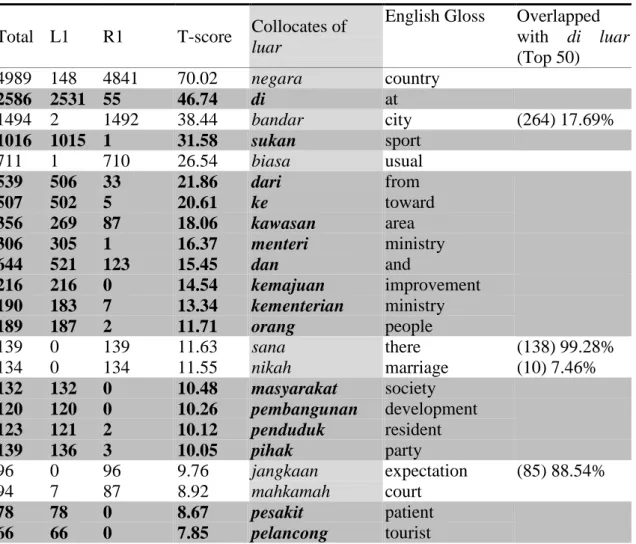
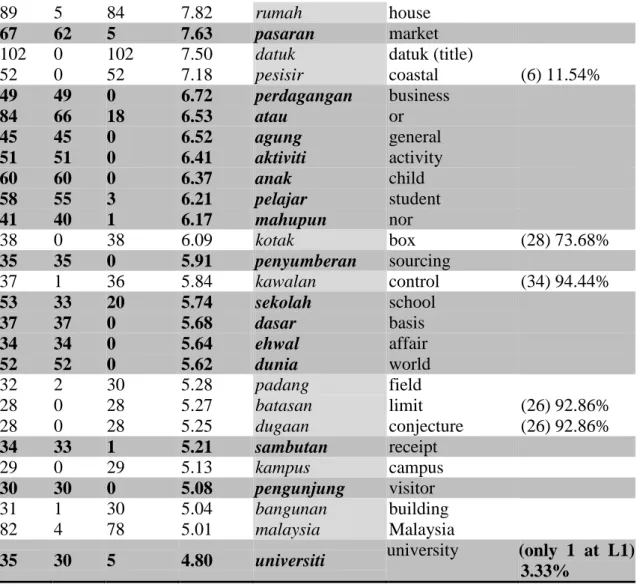
CHUNG, Siaw-Fong. 2014. A Corpus-based investigation of Malay antonymous prepositions bawah:atas and dalam:luar. In Siaw-Fong Chung and Hiroki Nomoto, eds.
Current Trends in Malay Linguistics. NUSA 57: 51–82. [Permanent URL:
http://hdl.handle.net/10108/79285]
A corpus-based investigation of Malay antonymous prepositions bawah:atas and dalam:luar
Siaw-Fong CHUNG
National Chengchi University, Taiwan [email protected]
The aims of this study are twofold. First, we compare the free form and the combination [di + relational noun] (e.g. bawah versus di bawah). Second, we provide a quantitative comparison between pairs of antonymous free forms (e.g. bawah versus atas) and between the di counterparts (e.g. di bawah versus di atas). The analysis was carried out by comparing the number of corpus instances and dictionary senses, as well as the collocates in the left-one (L1) and right-one (R1) positions. For the contrast with and without di, it was found that all free forms were more frequent except for bawah. Regarding the contrast between pairs, bawah (but not atas) clearly represented the second part of the conceptual metaphor HAVING CONTROL OR FORCE IS UP; BEING SUBJECT TO CONTROL OR FORCE IS DOWN,while dalam and luar behaved dissimilarly, without many opposite meanings in use.
1. Introduction1
In semantics, antonyms do not receive as much attention as synonyms do. The discussion of antonyms often focuses on the distinction of their types, such as gradable (hot:cold) and non-gradable (female:male), as well as many other sub-types, some of which have been extensively discussed in Cruse (1976) and Lyons (1977). Cruse (1976:283), for instance, discussed antonyms based on the “committedness” of the term (e.g. John is twice as bad as Bill is committed but This one is twice as heavy as that one is not).
Committed antonym pairs such as good:bad and clever:stupid have “an evaluative feature as part of their meaning” (p. 285), while non-committed pairs such as long:short and heavy:light both “have an evaluatively neutral, objectively descriptive sense as one of their principal meanings.” (p. 284). In a pair of antonyms, sometimes one of the forms is more marked than the other. For instance, something good is not given as much attention as the bad occurrences in many news reports. In other words, the two forms of an antonym pair do not always receive equivalent attention in use. Similarly, long and short display different levels of markedness or are sometimes asymmetrical in meaning.
A traditional logical distinction of antonyms is often based on contradictories (female:male) and contraries (hot:cold). Contradictories are mutually exclusive (e.g. if not female, then male) but contraries are more often gradable (hot-warm-cool-cold).
Murphy (2010:120) stated that contradictories (which are also called complementaries)
“are those for which the assertion of one entails the negation of the other and vice versa.”
Some antonyms may seem binary, such as honest:dishonest, but there exists a “middle ground” between the two ends of the dichotomy (e.g. neither honest nor dishonest) (ibid.,
1 The review process of this work was handled completely by the other guest editor (Hiroki Nomoto) and the paper had undergone blind reviews by two reviewers. The author would like to thank the Taiwan Ministry of Science and Technology Project (101-2410-H-004-176-MY2) for supporting the research herein.
p. 120). Therefore, apart from the clearly dichotomous antonyms (such as on and off), some antonyms could be argued to possess a gradable scale.
Fellbaum (1995) and Jones (2002) both found that antonyms could appear in coordinated constructions such as X and Y (big and small) and X or Y (living or dead). Murphy (2003), on the other hand, provided a “relational” account called Relation by Contrast (RC) to address most semantic relations: “It holds that items are related if they are minimally different in contextually appropriate ways.” (ibid., p. 26). Murphy (2003:176) also stated that “canonical antonym pairings [(e.g. black:white, tall:short, good:bad)] not only co-occur, but must be minimally different and maximally similar in ways relevant to the contexts in which they co-occur.”2 He postulated that antonymy “requires similarity of meaning,” a similar point emphasized in Lyons (1977:286): “Oppositions are drawn along some dimension of similarity.” For example, the antonyms up and down describe
“directions in the same dimension” (Murphy 2003:43), or are “based upon an opposition drawn within motion away from P,” a given location (Lyons 1977:281). In other words, antonyms do not necessarily represent two opposites that are unrelated. In fact, they share
“the same contextually relevant properties” (Murphy 2003:43) except for one (which might be “direction” in the case of moving away from P for up and down), which makes them a contrasting pair.
In contrast to the traditional distinction, the “similarity” view provides a novel way of looking at antonymy. For instance, the construction big and small refers not to one single object but a group of items and their range from big to small. Examples such as these have been used as evidence to show how antonyms are not real opposites, as they can co-occur to refer to the same object(s). Jones (2002:1), in his book Antonymy, mentions the following:
Often, ‘antonymy’ is thought of as being the correct linguistic term for
‘opposites’, as ‘parentheses’ is simply a technical name for ‘brackets’.
However this is not entirely true.
Similarly, it is possible to predict that prepositions such as above:below, up:down, in:out, etc. do not always exhibit opposite meanings. This point has been noted by Tyler &
Evans (2003:141) and Lindstromberg (2010:193). As mentioned, some complementaries such as alive:dead and honest:dishonest can also be made gradable, as in more dead than alive (cf. Palmer 1981) (see also Murphy 2003:195). Ogden (1967) noted that some directional antonyms, like inside:outside, behave more as gradable antonyms than as real opposites. Lyons (1977:278) also posited that “temporal and spatial relations (‘above’:‘below’, ‘in front of’:‘behind’, ‘before’:‘after’, etc.)” are converses, i.e.
relations that show the reversal of the other and that express a relation like that of husband:wife, where “X is the husband of Y” is the converse of “X is the wife of Y”, thus having reversed roles.
Jones (2002) held that antonymy is best defined based on corpus data. He defined antonyms as “pairs of words which contrast along a given semantic scale and frequently function in a coordinated and ancillary fashion such that they become lexically enshrined as ‘opposites’” (p. 179). Among the types of antonyms he observed include those in (1) below:
2 Non-canonical antonym pairings are, for example, cruel/kind (cf. Murphy 2003:31).
(1) a. While pensions will not be abolished, the government will encourage everyone, rich and poor, to rely for their retirement mainly on money they invest in private pension funds. (p. 61) (coordinated antonymy) b. I love to cook but I hate doing the dishes. (p. 45) (ancillary antonymy) The antonyms rich and poor in (1a) are coordinated in the sense that they “signal inclusiveness or exhaustiveness of scale” (ibid., p. 61); a similar reading is given to big and small in the earlier discussion. Jones assumed that the opposite meanings do not always occur in the antonyms themselves but may occur in the pairs of items surrounding the antonyms (to cook versus doing the dishes), as in the case of (1b).
While works in the past that discuss English antonyms are many, literature discussing the Malay antonymous prepositions is rare. Ho-Abdullah (2006) is one work that discusses atas ‘up’ and bawah ‘down’ from a cognitive perspective, while many others (Chung 2013; Djenar 2007; Ho-Abdullah 2005) discuss only synonymous prepositions. In this study, we used a corpus linguistic perspective to examine two pairs of Malay prepositions that are widely accepted as antonyms (bawah ‘down’ versus atas ‘up’, and dalam ‘in’
versus luar ‘out’). (Like English prepositions, a Malay preposition also includes related meanings, such that down entails the meanings of ‘under’, ‘underneath’, ‘lower part’, etc., and these meanings will not be glossed.) The following section will discuss some examples of Malay prepositions.
2. Malay prepositions and antonyms
The following examples show some uses of prepositions in Standard Malay in Malaysia (hereafter Malay), most of which can follow the locative markers di and ke. Due to the limitation of space, when a Malay sentence is too long, only the important words (underlined) will have word-to-word glosses in square brackets. Under each sentence, free translation is given for all examples.
(2) a. air bawah tanah [water BAWAH ground/soil] yang mengalir terlalu banyak menyebabkan struktur tanah menjadi lembut (10931.txt)
‘the overflowing underground water softens the structure of the soil’
b. Pembangunan teknologi ini diintegrasikan ketika proses pembinaan sesebuah bangunan di mana saluran paip diletakkan di bawah tanah [DI BAWAH ground/soil]. (31351.txt)
‘Interaction with regard to the development of technology has taken place during the construction of any building so that pipes are placed underground. ’
c. …najis lembu bersepah atas jalan [stool cow BER-scatter ATAS road].
(4459.txt)
‘…cow stools were scattered on the road. ’
d. Kedua-dua mangsa tercampak di atas jalan [both victim TER-throw DI ATAS road] dan meninggal dunia di tempat kejadian. (4410.txt)
‘Both victims were thrown on the road and were dead at the site. ’ e. …tetapi air tidak naik ke atas rumah dua tingkat [KE ATAS house two
storey] yang saya sewa… (25943.txt)
‘…but the water did not rise (up) to the double-storey house that I rented…’
The absence and presence of di in Malay has been discussed in Chung (2013) and Ho-Abdullah (2006) but will also be reviewed here. Ke has a meaning of ‘toward’ as in (2e) but will not be the focus of discussion at this point. For ease of reference, the term
‘preposition’ will be used as a general term to refer to both constructions under investigation. Specific terms will be used when referring to particular forms: di is a
‘locative marker,’ while bawah, atas, dalam, and luar are ‘relational nouns.’
As can be seen in (2a) and (2b), tanah ‘ground/soil’ can co-occur with both bawah (2a) and di bawah (2b). However, the two have subtle differences. Chung (2013) and Ramlan (1980), among many others, are of the view that relational nouns with di denote a more specific location in a given space. For instance, di bawah tanah in (2b) shows that the pipes were placed at a designated location under the ground, whereas bawah tanah in (2a) refers to underground water, the location of which is not specific. Similarly, atas jalan in (2c), accompanied by bersepah ‘scatter’, indicates a non-specific location on the road, whereas di atas jalan in (2d) means that the two corpses were discarded on the road at a specific location.3 Chung’s work is based on the collocations of di, dalam, and di dalam.
Djenar (2006), on Indonesian, held that the addition of di/ke not only adds specificity but also serves a discourse function—the compounds [di/ke + preposition] are more preferred in written discourse. Djenar concluded that these compounds are “multifunctional,” such that sometimes the semantic (specificity) or the pragmatic (discourse) function
“dominates” (p. 404). Nonetheless, this comparison is made solely between di-/ke-only and their compounds. The comparison was not carried out among all three (preposition-only, di-/ke-only, and the compounds); therefore, it is not known whether the preposition-only pattern (or the free form) also serves a similar discourse function as the compounds do.
The free forms, or the prepositions, were also termed ‘relational nouns’ by Wienold &
Rohmer (1997). The relationship between a preposition and a noun form can be seen in the quotation below:
Kata atas, bawah, tengah, tepi dikategorikan sebagai kata nama arah mengikut Tatabahasa Dewan. Sebagai kata nama arah, kata ini boleh membentuk kata nama majmuk seperti tingkat atas, tingkat bawah, ruang atas/bawah, garis atas/bawah (Ho-Abdullah 2006:285).
3 The first line of the news article of example (2d) states: “Sepasang suami isteri terbunuh apabila motosikal yang mereka naiki bertembung dengan sebuah bas RapidKL di Jalan Dato Keramat, berhampiran Stesen LRT Damai, di sini hari ini (A couple of husband and wife was killed when the motorcycle that they were riding collided with a RapidKL bus at Dato Keramat Road, close to the LRT Damai station, here today),” in which the location (near the LRT Damai station) has been given in prior context. A pragmatic interpretation also allows readers to know that the position of the corpses was at a specific location near the place where the accident occurred.
[Words such as atas, bawah, tengah, and tepi are categorized as directional nouns following the definition in Kamus Dewan. As directional nouns, they can form compound nouns such as ‘upper floor’, ‘lower floor’, ‘upper/lower space’, and ‘upper/lower line’; translation by the author.]
Bawah and atas examples can be seen in (2), while examples of dalam and luar are given in (3) below:
(3) a. Bagaimanapun, difahamkan beliau akan kembali bertugas seperti biasa dalam masa terdekat ini [DALAM time TER-close this]. (0056.txt)
‘However, it was understood that he will be back on duty like usual within the shortest time. ’
b. untuk terus diguna dalam bilik darjah [for continue DI-use DALAM room class] (10370.txt)
‘to be continuously used in the classroom’
c. Saya juga terkejut apabila menemui sebilah parang di dalam bilik berkenaan [DI DALAM room BER-touch-AN]. (10687.txt)
‘I was shocked when I saw a ‘parang’ (long knife) in that room. ’ d. namun dia bukanlah anak luar nikah [LUAR marriage] seperti yang
didakwa! (10862.txt)
‘but she is not born out of wedlock like she was accused of! ’
e. Kes Nik Aziz saman Utusan RM20j selesai luar mahkamah [LUAR
court]. (Headline; 35694.txt)
‘Nik Aziz summoned [Newspaper] Utusan RM20 million settled out of court. ’
f. Beliau ketika ditemui pemberita di luar mahkamah [DI LUAR court]
melahirkan rasa syukur. (11593.txt)
‘He showed relief when he was seen by reporters outside the court. ’ Example (3a) and (3b) are dalam-only examples. Example (3b) shows a noun bilik (darjah) ‘(class)room’ that can also take a di locative marker, as in (3c). Nonetheless, as pointed out by many, the two differ in the sense that dalam bilik darjah refers to the space within a classroom, whereas di dalam bilik refers to a specific location in the room. From two resources we know that a specific location is meant in (3c)—the use of di and from the context that the discovery of the ‘long knife’ had to have taken place at a certain spot.
(3d) is an example in which luar appears as a compound noun (luar nikah). In (3e), the figurative meaning of ‘outside court’ is meant rather than the locational meaning in (3f).
The use of bawah, atas, dalam, and luar can be observed in a corpus by listing their nearby left and right collocates. It is hypothesized that antonymous meanings, in various degrees, can be examined based on these collocates. The following section will explain the methodology used in this study.
3. Methodology
Each preposition was searched using a 10-million-word corpus consisting of news articles from Utusan Malaysia, containing 35,767 texts, from December 2010 through January 2011.4 Utusan Malaysia was selected because its website has an archive search function that allows searches to be carried out conveniently. Since the target keywords investigated in this work are function words, the selection of newspapers did not affect the findings. All texts were written texts in Standard Malaysian Malay.
Each of the keywords was searched in the corpus using AntConc 3.2.4w (Anthony 2005).
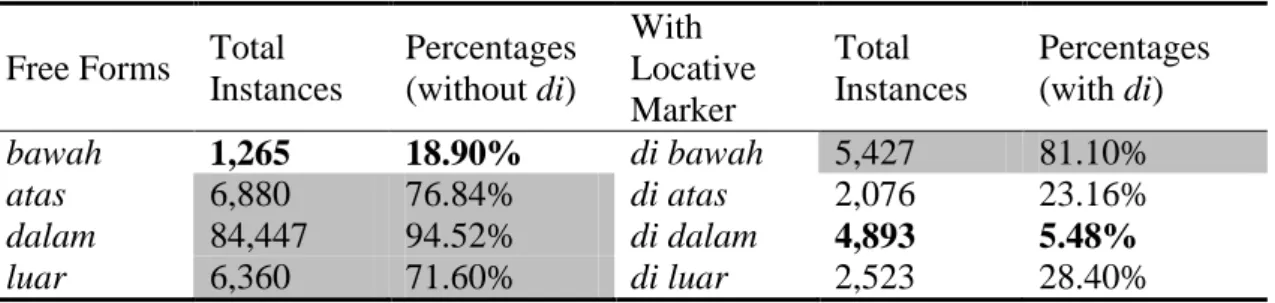
Table 1 below shows the basic frequency of each of the items searched. Data of the free forms appear in the first, second, and third columns, while those co-appearing with the locative marker di are given in the fourth, fifth, and sixth columns.
Table 1. Total instances of the Malay prepositions
Free Forms Total Instances
Percentages (without di)
With Locative Marker
Total Instances
Percentages (with di)
bawah 1,265 18.90% di bawah 5,427 81.10%
atas 6,880 76.84% di atas 2,076 23.16%
dalam 84,447 94.52% di dalam 4,893 5.48%
luar 6,360 71.60% di luar 2,523 28.40%
From Table 1, it is possible to predict that the seemingly opposite pairs bawah:atas and dalam:luar may not exhibit similar behaviors, based on their frequency distribution when they appear with or without di. Among the four free forms, bawah had the lowest percentage of appearing as a free form (18.90%), while more than 94% of instances of dalam appeared alone. Atas and luar behaved quite similarly in that both distributed rather similarly with and without di. The shading shows the higher percentages, while the boldfaced numbers show the comparatively low percentages. For instance, bawah-only constituted less than one-fifth of the total instances of bawah, and di dalam constituted less than 6% of its total instances. Both dalam- and atas-only constituted the majority of their totals, but the frequency of dalam-only (84,477) was 13 times higher than atas-only (6,880), while the frequency of di dalam was only twice higher than that of di atas. The variations displayed in Table 1 are definitely worthy of investigation. Most scholars in the past have postulated that antonyms are not real opposites; however, no studies have clearly laid out the methodology to investigate them as is done in this work.
One point worth discussing here is that Djenar (2006:417) has posited that when compared to di/ke alone, the compound [di/ke + preposition] “is biased not only with respect to medium but also discourse type.” Compounds are more frequently found in
“procedural discourse, particularly the written.” Our study differs in that we compared [relational noun-only] (or Djenar’s “preposition”) and [di + relational noun], and we identified the types of relational nouns to be observed. Like Djenar’s findings, we postulate that the addition of di/ke demands a high degree of “explicitness and specificity”
(ibid., p. 417). Although this postulation (i.e. specificity in meaning) is agreed by many,
4 http://www.utusan.com.my/utusan/search.asp
specificity found in written discourse is worth investigation. As the [relational noun-only]
pattern was not included in Djenar’s work, it is not known whether the discourse preference of the three might also differ. From our observation, since all four relational nouns had different numbers of occurrences and some were highly frequent, by randomly collecting a given number of the combination [di/ke + relational nouns], constituted by different relational nouns, it is possible that some relational nouns might have dominated this combination and thus affected the overall performance. For instance, di bawah might dominate the majority of the written corpus (as in our case, too, newspapers are written corpus) and the discourse preference found by Djenar might also reflect the uses of these dominating relational nouns. To avoid this problem, in this paper, each relational noun was investigated individually and in comparison with their di counterpart. The aim was to see how similar or different a pair of antonyms might appear in a corpus of Malay. Our findings on Standard Malaysian Malay can also be considered a comparison to Djenar’s study on Indonesian prepositions.
Before we inspect how the antonym pairs bawah:atas and dalam:luar might behave in the corpus, we will first examine their dictionary meanings, which might provide insight into their meaning differences. Table 2 below shows the list of meanings for bawah and atas from Kamus Dewan, a standard Malay dictionary in Malaysia. The literal meanings (usually the locational and spatial meanings) are shaded.
Table 2. Dictionary meanings of bawah and atas
Bawah Atas
1. terletak separas dgn permukaan tanah (bkn bahagian bangunan, rumah, dsb): pejabatnya terletak di tingkat ~ bangunan itu
“placed at the same level as the surface of the ground (not part of the building, house, etc.): His/Her office is located at the lower floor of this building.”
1. (pd) tempat atau paras dsb yang lebih tinggi, lwn bawah: dr ~ bukit itu nampak laut; tingkat ~; bibir ~
“(at) places or level, etc., that are higher, opposite of bawah: from the top of that mountain, the sea is visible;
upper level; upper lip.”
2. ruang kosong yang terletak di antara tiang rumah atau kaki almari (meja, kerusi, dsb): ~rumah itu boleh dijadikan stor
“empty space that is placed between pillars of a house or at the foot of a closet (table, chair, etc.): The space below the house could become a storeroom.”
2. pihak yang berkuasa: perintah drpd ~
“party/someone with power: order from above.”
3. kerana, dengan: dia meletakkan jawatan it bukan ~ kemahuannya
“because, with: he/she quits not because of (upon) his/her willingness.”
4. mengenai, tentang, akan, berkaitan dgn, terhadap: beliau puas hati ~ kemajuan yang telah dicapai; tidak mengaku salah ~ tuduhan yang dimajukan
“with regard to, about, related to, toward: he/she (Hon) is satisfied about the progress that has been achieved;
not admit (to be) wrong with regard to the accusation that was put forward.”
5. berdasarkan, berasaskan: keputusan itu dibuat ~ beberapa pertimbangan; ~ soal-soal yang dibincangkan oleh pengarang, dapat saya mengatakan bahawa novelnya merupakan propaganda politik
“based on, based upon: the decision was made based upon several considerations; based on the questions that were discussed by the editors, I could say that his/her novel is political propaganda.”
6. mengikuti, menurut, berdasarkan:
maka dikahwinkan anak Raja Kida Hindi dgn Raja Iskandar ~ syariat Nabi Ibrahim
“following, according to, based on:
then the child of Raja Kida Hindi was married to Raja Iskandar according to the syariat Nabi Ibrahim.”
Di bawah Di atas
1. di kawasan sekeliling rumah dsb yang bertangga (mis di taman, di perkarangan, dsb): kanak-kanak itu disuruh ibu mereka pergi bermain ~
“area surrounding the house, etc., that with ladders (e.g. in the garden, at the residency area, etc.): The children were asked by their mother to go play at the area surrounding the house.”
1. pd bahagian atas, di sebalah atas (bukan di bawah): letakkan bungkusan itu ~ meja; suatu kesimpulan boleh dibuat berdasarkan huraian yang diberikan ~
“at the upper part, the upper side (not under): place that parcel on the table; one conclusion could be made based on the elaboration given above.”
2. di ruang kosong di antara tiang rumah atau kaki meja (kerusi dll): ~ meja
“empty space between pillars of house or feet of table (chair, etc.):
space below the table.”
2. lebih tinggi drpd: ~ harga itu, tidak sanggup saya membelinya
“higher than: higher than that price, I am not able to buy it.”
3. yg terletak pd baris (ruang dsb) yang berikutnya: sila rujuk pd rajah ~;
baca petikan ~
“that which is placed at a line (space, etc.) that follows: please refer to the diagram below; read the article below.”
4. kurang drpd: kanak-kanah ~ umur 12 tahun
“less than: children under the age of 12.”
5. berada dlm atau tertakluk pd (peraturan, undang-undang, bimbingan, arahan, kuasa, dsb):
kakitangan ~ jaggannya; orkestra ~ pimpinan Jonari Saleh
“inside or under the governing of (regulations, laws, leadership, direction, power, etc.): staff under his/her care; orchestra under the leadership of Jonari Saleh.”
At a first glance, the dictionary meanings provide some hints about the characteristics of the bawah:atas pair. From Table 1, it can be seen that bawah has two meanings and atas has more figurative uses, while bawah as a free form has fewer meanings than di bawah (half literal, half metaphorical).5 This might explain the fewer corpus instances of bawah in Table 1 and might also be the reason why more than 76% of atas appeared on its own, while only a small number of di atas were found. From this analysis, one can see that the relationship between the number of senses and the corpus frequency is inter-related.
Table 3 below shows the meanings of dalam:luar:
Table 3. Dictionary meanings of dalam and luar
Dalam Luar
1. antara, di kalangan: ~ mereka yg bertiga belas itu ada yang bergirang-girang.
“between, among: Among the thirteen people, there are some who are excited.”
1. lwn (bahagian) dalam: terdengar bunyi keturan dr ~; kulit ~; orang ~
“opposite (part) dalam: heard knocking sound from outside; outer skin; outer person.”
2. di dalam (see below)
5 Although the number of senses is not an absolute criterion, it could be used to predict the variety of meanings a word may possess.
3. sambil: ~ kita berharap keadaan akan bertambah baik kita mesti juga beringat-ingat.
“while: While we are hoping that the situation will become better, we should always remind ourselves (of something).”
4. pd waktu (tertentu): jika berharap keadaan akan bertambah baik ~ tahun hadapan; dia masih ~ pantang lagi.
“at a (certain) time: If (someone) hopes that the situation will be better at the year ahead…; he is still at his rebellion stage.”
Di dalam Di luar
1. (bukan di luar lingungan dsb sesuatu): ~ Willayah Persekutuan; ~ bidang mata pelajaran tersebut.
“inside (not out of the scope, etc., of something): in the municipality (directly under the jurisdiction of the Central Government); inside the subject (of learning).”
1. di bahagian luar, di sebelah luar:
keadaan ~ bertambah sunyi dan gelap
“at the outer part, at the outside: The situation outside has become quieter and darker.”
2. tidak masuk (perkara, perhitungan, tanggungan, dll), kecuali, tidak diliputi (terliput) oleh, lain drpd: budak-budak nakal itu melepaskan kata-kata yg ~ pengalaman mereka; kejadian itu ~ pengetahuannya
“not included (matter, calculation, responsibility, etc.), except, not covered by, different from: the naughty children released words that are outside of their (real) experience;
the situation is out of his/her knowledge.”
In the corpus, both dalam and luar had a higher frequency when the terms appeared by themselves. However, the dictionary provides only one meaning for luar. Under this meaning, many compound nouns are listed (Table 3 lists only a few). Many are two-word compound nouns, such as luar biasa ‘unusual’, luar nikah ‘out of wedlock’, and (orang) luar pagar ‘(person) unrelated to a matter of concern’. If the frequency of each compound noun is high, this could mean that these collocation patterns are highly predictable in the corpus. Di dalam, which constituted less than 6% of the total occurrences of dalam in the corpus, has one meaning only. In Kamus Dewan, di dalam does not have an entry of its own. It was originally listed as part of the meanings of dalam, indicating its less prominent role in use. Comparatively, di luar has an entry of its own, carrying two meanings in the dictionary, and its percentage in the corpus is only 28.40% of the total
occurrences of luar, a majority of which are compound nouns. The following section will examine the analysis of the collocates.
4. Analysis of the collocates
A detail analysis of the collocates is provided below. From this analysis, it can further be seen how the antonymous pairs might behave in the corpus. Comparisons will be made in two ways: (a) between the free form and its di counterpart; and (b) between the anonymous pairs (as free forms as well as with di, respectively).
4.1 Bawah and di bawah
All corpus instances of bawah and di bawah were examined in terms of their left and right collocates. The collocates that appear in the left-one (L1) and right-one (R1) positions are exemplified in (4) below:
(4) a. Letupan itu berlaku di laluan palong air bawah tanah. [water BAWAH
ground/soil] (26573.txt) target R1
‘The explosion took place in the ‘palong’ route of the underground water. ’
b. Mohamad Rodi Abdul Rahman bersama lima kakitangan sedang bermesyuarat di tingkat bawah [storey BAWAH] bangunan tersebut.
(11017.txt) target R1
‘Mohamad Rodi Abdul Rahman and his five staff are meeting at the lower floor of that building. ’
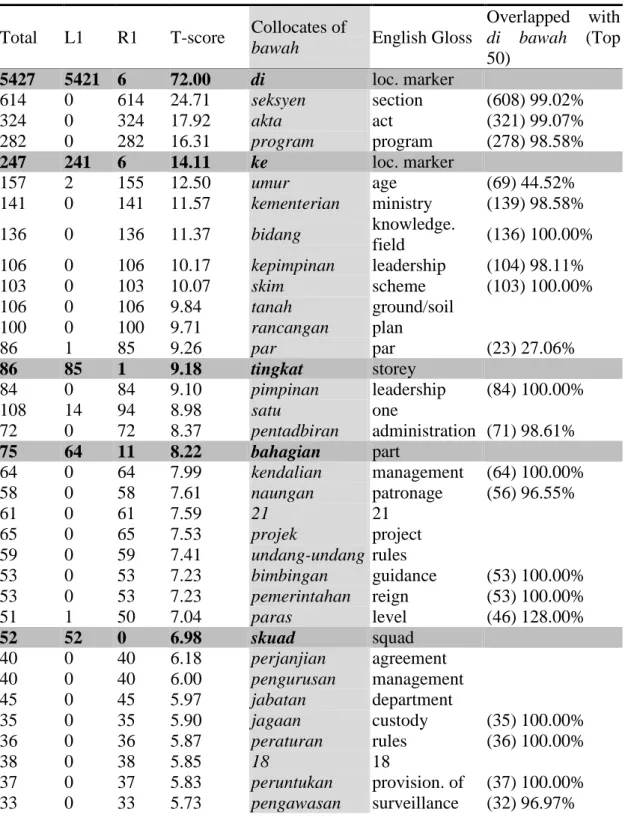
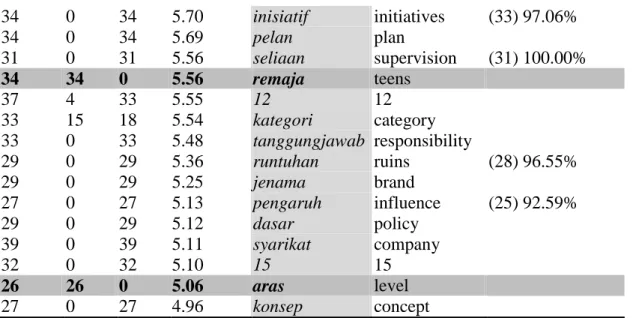
The collocate list in Table 4 (to follow) is arranged in order from the highest to the lowest t-score (column four) to emphasize the position of a word and its strength in collocating with the target word when compared to all other words.6 The shaded rows are the collocates that appeared more often in the L1 position, whereas the non-shaded rows are the collocates that appeared more often in the R1 position. By presenting the collocates in table form, one can see in which position (L1 or R1) the collocates with the higher t-scores appear and in which position a majority of the collocates can be found.
From the rightmost column, most of the collocates of bawah were also the collocates of di bawah—“overlapped” in the sense that these collocates were also found in the top 50 collocates of di bawah, with their percentages shown in this column. The overlapped collocates were kept because it is important to see whether a preposition was strongly used by itself or with the locative markers di or ke. The row seksyen ‘section’ exemplifies the overlapped cases. Among the 614 instances of seksyen ‘section’, 608 (99.02%) were di bawah seksyen, while bawah seksyen had only six instances (614 minus 608).
The R1 collocates (non-shaded rows) that were strongly bawah-only (not overlapped in the top 50 collocates) were tanah ‘ground/soil’, rancangan ‘program’, satu ‘one’, 21 ‘21’, projek ‘project’, undang-undang ‘rules’, perjanjian ‘agreement’, pengurusan
6 T-score was selected as the unit for measurement because these prepositions are function words and are better represented using t-scores (cf. Hunston 2002; Stubbs 1995).
‘management’, etc.7 An example can be seen in (4a). L1 collocates that were strongly bawah-only included tingkat ‘storey’, bahagian ‘part’, skuad ‘squad’, and remaja ‘teens’, and an example is shown in (4b). Most of these L1 collocates formed compound nouns with bawah.
Table 4. Bawah and its collocates
Total L1 R1 T-score Collocates of
bawah English Gloss
Overlapped with di bawah (Top 50)
5427 5421 6 72.00 di loc. marker
614 0 614 24.71 seksyen section (608) 99.02%
324 0 324 17.92 akta act (321) 99.07%
282 0 282 16.31 program program (278) 98.58%
247 241 6 14.11 ke loc. marker
157 2 155 12.50 umur age (69) 44.52%
141 0 141 11.57 kementerian ministry (139) 98.58%
136 0 136 11.37 bidang knowledge.
field (136) 100.00%
106 0 106 10.17 kepimpinan leadership (104) 98.11%
103 0 103 10.07 skim scheme (103) 100.00%
106 0 106 9.84 tanah ground/soil
100 0 100 9.71 rancangan plan
86 1 85 9.26 par par (23) 27.06%
86 85 1 9.18 tingkat storey
84 0 84 9.10 pimpinan leadership (84) 100.00%
108 14 94 8.98 satu one
72 0 72 8.37 pentadbiran administration (71) 98.61%
75 64 11 8.22 bahagian part
64 0 64 7.99 kendalian management (64) 100.00%
58 0 58 7.61 naungan patronage (56) 96.55%
61 0 61 7.59 21 21
65 0 65 7.53 projek project
59 0 59 7.41 undang-undang rules
53 0 53 7.23 bimbingan guidance (53) 100.00%
53 0 53 7.23 pemerintahan reign (53) 100.00%
51 1 50 7.04 paras level (46) 128.00%
52 52 0 6.98 skuad squad
40 0 40 6.18 perjanjian agreement
40 0 40 6.00 pengurusan management
45 0 45 5.97 jabatan department
35 0 35 5.90 jagaan custody (35) 100.00%
36 0 36 5.87 peraturan rules (36) 100.00%
38 0 38 5.85 18 18
37 0 37 5.83 peruntukan provision. of (37) 100.00%
33 0 33 5.73 pengawasan surveillance (32) 96.97%
7 It is worth noting that this paper only examined the top 50 collocates. Overlapping cases could occur in the collocates below the top fifty, but they would be lower in frequency.
34 0 34 5.70 inisiatif initiatives (33) 97.06%
34 0 34 5.69 pelan plan
31 0 31 5.56 seliaan supervision (31) 100.00%
34 34 0 5.56 remaja teens
37 4 33 5.55 12 12
33 15 18 5.54 kategori category
33 0 33 5.48 tanggungjawab responsibility
29 0 29 5.36 runtuhan ruins (28) 96.55%
29 0 29 5.25 jenama brand
27 0 27 5.13 pengaruh influence (25) 92.59%
29 0 29 5.12 dasar policy
39 0 39 5.11 syarikat company
32 0 32 5.10 15 15
26 26 0 5.06 aras level
27 0 27 4.96 konsep concept
The collocates for di bawah are shown in Table 5 below. Similarly, shaded rows represent the collocates that appeared more often in the L1 position than in the R1 position.
Compared with bawah in Table 4, it seems that many of the collocates in the L1 position are verbs, thus [verb + di bawah], exemplified in (5) below:
(5) a. semua peruncit dan pembekal yang ditahan itu disiasat di bawah [DI-investigate DI BAWAH] Akta Kawalan Bekalan 1961. (10871.txt)
‘all retailers and suppliers that were detained were investigated under the Control of Supplies Act 1961. ’
b. …Adam Eiman kini berusia 13 tahun yang diletakkan di bawah [DI-place-KANDI BAWAH] jagaan Hattan. (12666.txt)
‘…Adam Eiman who is now 13 years old who is (placed) under the care of Hattan. ’
In the rightmost column of Table 5, the overlapped collocates of di bawah with bawah are marked. However, in this table, it is not necessary to mark the percentages, as the collocates of di bawah form a subset of those of bawah (di bawah ⊂ bawah), i.e. their entirety overlaps with its bawah-only counterpart.
Table 5. Di bawah and its collocates
Total L1 R1 T-score Collocates of
di bawah English Gloss Overlapped with bawah (Top 50)
608 0 608 22.77 seksyen section overlap
324 3 321 15.60 akta act overlap
173 173 0 11.95 disiasat be.investigated 104 104 0 8.65 diletakkan be.placed
93 93 0 8.50 dihukum be.punished
72 72 0 8.30 bernaung patronage
103 0 103 8.00 skim scheme overlap
64 0 64 7.64 kendalian management overlap
56 0 56 7.30 naungan patronage overlap
84 0 84 7.25 pimpinan leadership overlap
71 2 69 6.95 umur age overlap
104 0 104 6.52 kepimpinan leadership overlap
56 3 53 6.18 bimbingan guidance overlap
54 1 53 5.79 pemerintahan reign overlap
38 3 35 5.65 jagaan custody overlap
75 4 71 5.52 pentadbiran administration overlap
32 1 31 5.49 seliaan supervision overlap
33 1 32 5.23 pengawasan supervision overlap
200 200 0 5.09 berada be.at
28 0 28 4.52 runtuhan ruin overlap
23 0 23 4.28 PAR PAR overlap
20 0 20 4.19 kelolaan supervision
84 81 3 3.76 kesalahan offence
70 70 0 3.67 terletak be.placed
19 19 0 3.64 tertakluk be.subjected.to
46 0 46 3.56 paras level overlap
24 4 20 3.49 NKRA NKRA
145 6 139 3.44 kementerian ministry overlap 139 3 136 3.43 bidang knowledge.field overlap
296 18 278 3.39 program program overlap
17 1 16 3.38 label label
44 11 33 3.35 inisiatif initiative overlap 73 36 37 3.24 peruntukan provisions.of overlap 11 11 0 3.18 terperosok be.inserted
44 8 36 3.12 peraturan regulation overlap
17 17 0 3.11 didaftarkan be.registered
25 0 25 3.08 pengaruh influence overlap
20 20 0 3.06 diperuntukkan provided
23 0 23 3.03 tajaan sponsorship
14 0 14 2.91 bayu breeze
10 0 10 2.83 timbunan stack
9 0 9 2.79 penyeliaan supervision
15 0 15 2.69 tajuk title
18 2 16 2.69 ETP ETP
81 81 0 2.67 didakwa be.prosecuted
13 0 13 2.67 khemah tent
10 6 4 2.66 EPP EPP
12 1 11 2.60 jejantas bridge
17 17 0 2.54 terperangkap caught
8 0 8 2.54 ordinan ordinance
Strong L1 collocates of bawah in Table 4 (tingkat bawah, bahagian bawah, skuad bawah, etc.) did not co-appear with di bawah (thus, tingkat *di bawah, bahagian *di bawah, skuad *di bawah). It was also found that most R1 collocates of bawah (bawah tanah, bawah rancangan, etc.) co-appeared with di bawah. The overlapped cases were high.
(The author also checked the collocates at the lower part of of both lists.) R1 collocates that were mainly di-bawah-only (without overlapping with the top 50 collocates of bawah) were kelolaan ‘supervision’, NKRA (Bidang Keberhasilan Utama Negara), label
‘label’, tajaan ‘sponsorship’, bayu ‘breeze’, etc. Examples of this phenomenon are shown in (6) below:
(6) a. Siti Norhana Omar, 36, yang dilatih untuk menyulam dan membuat sagun di bawah kelolaan [DI BAWAH organize-AN] seorang sukarelawan PDK berkenaan. (34288.txt)
‘Siti Norhana Omar, 36, who was trained to stitch and make ‘sagun’
[cake] under the management of a volunteer under the PDK. ’
b. ia adalah satu strategi pemasaran yang digunakan oleh stesen yang bernaung di bawah label [DI BAWAH label] Radio Televisyen Malaysia (RTM) itu dalam menarik lebih ramai pendengar (19911.txt)
‘it is a marketing strategy that was used by the station under the label of Radio Television Malaysia (RTM) to attract more listeners’
Based on the results of bawah and di bawah, we observed that di bawah was often preceded by a verb, while most of the top collocates of bawah overlapped with di bawah, indicating that uses of bawah as a free form were rare.
4.2 Atas and di atas
Compared to bawah and di bawah, atas in Table 6 behaved more similarly to di bawah in the sense that atas had more L1 collocates that were verbs (apart from ke and di).
Examples of [verb + atas] are given in (7) below:
(7) a. setelah mengaku bersalah atas pertuduhan [BER-wrong ATAS PER-accuse-AN] mengikut Seksyen 395 Kanun Keseksaan… (0102.txt)
‘after admitting guilty on the charges according to Penal Code Section 395…’
b. Pada awalnya mereka didakwa atas kesalahan [DI-indict ATAS KE-wrong-AN] memasuki negara ini secara haram dan menceroboh zon tentera. (10139.txt)
‘At the beginning they were prosecuted on/for offence to have entered this country illegally and invaded the military zone. ’
Many of these verbs were related to the lawsuits of criminals and the results of the wrongdoings of people. In addition, there were also L1 noun collocates such as bahagian atas ‘upper part’, while some others (e.g. ini ‘this’, diri ‘self’) came from the collocates of a different constituent, exemplified in (8). Although these collocates were words from a different constituent, they were kept because they show how atas can collocate frequently with nearby words, such as membela diri ‘to self-defend’ in (8a) and terima kasih ‘thank’
in (8b). (Once a word is listed as a strong collocate, it means that this word has certain relationships with atas, despite the fact that they might be words from a nearby constituent.)
(8) a. dipanggil membela diri [MEM-defend self] atas pertuduhan [ATAS PER-accuse-AN] yang dihadapinya (27820.txt)
‘s(he) was called to self-defend on the charges that (s)he was facing’
b. Sehubungan itu Seri Paduka mengucapkan terima kasih [thank] atas usaha [ATAS hard.work], sumbangan dan penglibatan semua rakyat Malaysia. (0244.txt)
‘In this regard, His Majesty delivered gratitude upon the hard work, contribution and the involvement of all Malaysian people. ’
Table 6. Atas and its collocates
Total L1 R1 T-score Collocates of
atas English Gloss
Overlapped with di atas (Top 50)
4082 4072 10 63.24 ke loc. marker
2076 2057 19 41.13 di loc. marker
498 0 498 22.24 tuduhan allegation
331 2 329 18.09 alasan reason
304 0 304 17.30 dasar policy
245 3 242 15.38 nama name
220 1 219 14.64 kesalahan offence
185 185 0 13.51 bersalah guilty
155 0 155 11.83 tanah ground/soil
160 9 151 11.78 jalan road
142 0 142 11.75 dakwaan charges
137 0 137 11.61 pentas stage (123) 89.78%
118 1 117 10.56 sebab reason
96 0 96 9.61 faktor factor
113 0 113 9.57 pelbagai a.wide.range.of
92 91 1 9.44 tingkat floor
90 90 0 9.15 didakwa prosecuted
111 4 107 8.77 dua two
70 0 70 8.24 kertas paper (50) 71.43%
71 3 68 8.22 permintaan request
73 1 72 8.13 kejayaan success
70 70 0 8.07 (terimah) kasih thanks
73 73 0 7.98 dibuat be.made
63 0 63 7.79 arahan direction
63 0 63 7.67 kapal ship
60 2 58 7.55 tiket ticket
59 0 59 7.42 padang field (56) 94.92%
54 54 0 7.30 dibicarakan be.on.trial
98 83 15 7.17 adalah is
63 62 1 7.14 bahagian part
72 0 72 7.10 apa what
51 0 51 7.09 keprihatinan concern (18) 35.29%
54 0 54 6.95 segala all
71 0 71 6.94 sebuah classifier
233 222 11 6.72 ini this
133 24 109 6.67 mereka they
44 0 44 6.62 sebab-sebab reasons
60 43 17 6.60 diri self
45 0 45 6.57 nasihat advice
43 0 43 6.52 katil bed (36) 83.72%
54 12 42 6.47 anwar answer
47 47 0 6.45 bertindak to act
63 0 63 6.33 beberapa several
42 1 41 6.31 pertuduhan charges
43 0 43 6.15 semangat spirit
59 3 56 6.13 tiga three
52 0 52 6.11 usaha hard.work
38 38 0 6.06 maaf apology (17) 44.74%
37 0 37 6.02 jemputan invitation
40 40 0 6.00 bertanggungjawab to.be.
responsible
For the R1 collocates of atas (non-shaded), many of the collocates also fell under the similar law-related domain (e.g. tuduhan ‘allegation’, alasan ‘reason’, kesalahan
‘offence’, dakwaan ‘charges’, etc.). There were also R1 collocates that referred to (a)
‘reasoning or factor’, such as sebab(-sebab) ‘reason(s)’ and faktor ‘factor’; (b) ‘attempt or request’, such as usaha ‘attempt’, kejayaan ‘success’, semangat ‘spirit’, and permintaan ‘request’; and (c) ‘advice’, such as nasihat ‘advice’, and other miscellaneous types. In general, atas was used often in lawsuits in formal writing.
For bawah, it was also observed that the conceptual metaphor HAVING CONTROL OR FORCE IS UP; BEING SUBJECT TO CONTROL OR FORCE IS DOWN (Lakoff & Johnson 1980:15) was present (e.g. He is under my control; I am on top of the situation): The metaphor “is also associated with restrictions are boundaries” (Boers 1996:101). The collocates of (di) bawah in the previous Tables 4 and 5 often reflected those under the patronage of some powerful body or regulation, exemplified in (9a). For atas in (9b), its meaning is close to the English ‘upon’. (Act upon is defined by Merriam Webster Online as “to use (something, such as a feeling or suggestion) as a reason or basis for doing something,” for example, We were too late to act upon his suggestion.) Here atas was used when one had to respond to an accusation or decision made upon them. In addition, a person was also able to act upon the request of someone. This causes the existence of a group of words denoting ‘control’ under both bawah and di bawah, while there is another group of words indicating ‘accusation’ under atas. (Di atas has more locative uses, which are shown in Table 7 to follow.)
(9) a. (di) bawah
seksyen ‘section (of regulation)’
akta ‘act (regulation)’
skim ‘scheme’
kedalian ‘management’
naungan ‘patronage’
bimbingan ‘guidance’
b. atas
tuduhan ‘allegation’
dakwaan ‘charges’
alasan ‘reason’
sebab ‘reason’
kesalahan ‘wrongdoing’
permintaan ‘request’
Unlike the high overlaps of bawah and di bawah, only a few of the collocates of atas were also collocates of di atas, which is another evidence that supports our contention that antonymous pairs do not always display similar behaviors. Antonymous meanings can be found most obviously in bahagian atas/bawah ‘upper/lower part’ and tingkat atas/bawah
‘upper/lower floor’. The commonly found collocates are those listed in (9).
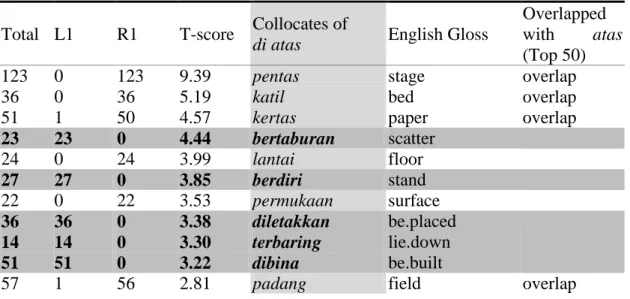
The few overlapped collocates between atas and di atas were pentas ‘stage’, katil ‘bed’, and kertas ‘paper’, which were also the top three (strong R1) collocates of di atas shown in Table 7 below. All of these refer to a locative meaning of ‘on the top of’ but with some subtle differences, exemplified in (10) below:
(10) a. inilah kali pertama beliau berucap di atas pentas berputar [DI ATAS
stage BER-rotate]. (11234.txt)
‘this is the first time he speaks on a rotating stage. ’
b. Malah penulis itu tidak pernah berada atas pentas politik [ATAS stage politics]. (9858.txt)
‘Nonetheless the writer has not been on the political stage. ’
It should be noted that a metaphorical meaning was often used without di and (10b) is a clear example of this. This finding is similar to what Sneddon et al. (2010:196) have said about figurative space in Indonesian prepositional phrases: “di is omitted before a locative noun [or relational noun, in our term] if figurative space is referred to” (e.g. tokoh dalam certita itu ‘the character in that story’; perbedaan antara kedua kata itu ‘the difference between those two words’) (ibid., p. 196). The less specificity of meaning when di is absent was also discussed in Chung (2013).
Compared to atas, R1 collocates of di atas in Table 7 below were mostly “concrete objects” (pentas ‘stage’, katil ‘bed’, kertas ‘paper’, lantai ‘floor’, permukaan ‘surface’, padang ‘field’, meja ‘table’, tikar ‘mat’, sofa ‘sofa’, mimbar ‘rostrum’, etc.). This means that di atas referred more to location compared with atas. Nonetheless, the boundary is not clear-cut, as there are also abstract nouns such as keprihatian ‘attention’ and sumbangan-nya ‘contribution-3rd Gen.’.
Table 7: Di atas and its collocates
Total L1 R1 T-score Collocates of
di atas English Gloss
Overlapped with atas (Top 50)
123 0 123 9.39 pentas stage overlap
36 0 36 5.19 katil bed overlap
51 1 50 4.57 kertas paper overlap
23 23 0 4.44 bertaburan scatter
24 0 24 3.99 lantai floor
27 27 0 3.85 berdiri stand
22 0 22 3.53 permukaan surface
36 36 0 3.38 diletakkan be.placed
14 14 0 3.30 terbaring lie.down
51 51 0 3.22 dibina be.built
57 1 56 2.81 padang field overlap
21 0 21 2.76 meja table
18 0 18 2.73 keprihatinan attention overlap
12 12 0 2.56 didirikan be.set.up
8 0 8 2.44 kanvas canvas
6 6 0 2.34 mencangkung squat
6 0 6 2.29 birai ledge
8 0 8 2.13 tilam mattress
6 0 6 2.10 sumbangannya contribution-3rd Gen.
5 5 0 2.00 bersanding side.by.side
6 0 6 1.96 mimbar rostrum
7 7 0 1.96 disebutkan be.mentioned
5 5 0 1.90 berkemban wear.‘sarong’
6 0 6 1.89 tikar mattress
6 6 0 1.85 tercampak be.scattered
6 0 6 1.72 sofa sofa
3 3 0 1.67 ditatah (jewel)be.
embedded
4 4 0 1.65 berbaring lie.down
7 7 0 1.64 melukis draw
7 7 0 1.63 terapung float
3 3 0 1.59 meniarap facing.down
3 0 3 1.58 keprihatinannya attention-3rd Gen.
5 5 0 1.56 diletak be.placed
3 3 0 1.55 bergelimpangan lie.down
11 0 11 1.53 bumbung roof
3 3 0 1.53 bersepah scatter
8 0 8 1.50 kesulitan difficulty
3 0 3 1.47 pusara cemetery
17 17 0 1.41 maaf apology overlap
2 2 0 1.39 terjelepok stumble
2 2 0 1.38 terpantasnya fastest
2 0 2 1.38 dashboard dashboard
3 3 0 1.36 tegak erect
14 0 14 1.36 bahu shoulder
2 2 0 1.35 berguling roll
2 2 0 1.35 berguling-guling roll
5 0 5 1.30 podium lectern
2 0 2 1.30 kuburan grave
5 5 0 1.28 dipertanggung-
jawabkan be.responsible
2 2 0 1.28 lonjong oval
In Table 7, L1 collocates (shaded rows) of di atas were mostly verbs, indicating states rather than law-related verbs like those for atas in Table 6. In other words, [verb + atas]
was used more often in referring to laws and regulations, while [verb + di atas] referred more to the state of something in a certain location (see (11) below).
(11) a. Akibatnya, wang yang dibawa bertaburan di atas lebuh raya [BER-scatter-An DI ATAS highway]. (11352.txt)
‘As a result, the money that was brought was scattered on the highway. ’ b. empat lelaki yang cedera parah terbaring di atas jalan raya
[TER-lie.down DIATAS road]. (15960.txt)
‘four men that were injured were lying on the road. ’
Another feature of di atas that is worth noting is its overall low frequency in the corpus, indicating that the uses of di atas are sparse in general. When they do occur, they show characteristics that are mostly locational, indicating the state of something.
4.3 Dalam and di dalam
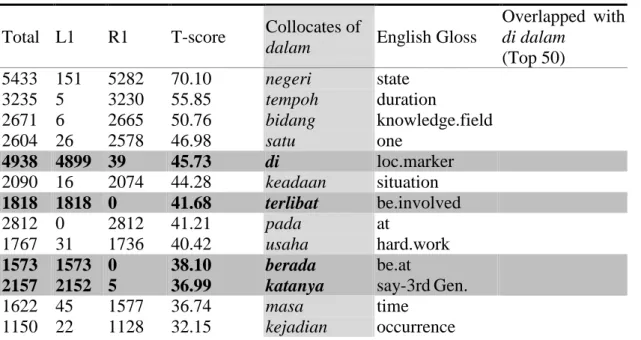
The data of dalam and di dalam are multiple in the corpus. From Table 8, it can be seen that none of the top 50 collocates of dalam overlapped with di dalam, indicating that the top collocates of di dalam in Table 9 (to follow) did not overlap. This finding clearly shows that dalam and di dalam display rather different uses, a characteristic distinctive from all other relational nouns, especially its antonym luar, to be discussed in the next section.
In Table 8, most of the strong collocates of dalam appeared in the R1 position (non-shaded rows), with only a few collocates of strong L1 collocates (shaded rows). For L1, apart from di and ke, five verbs were found, namely terlibat/terbabit ‘be.involved’, berada ‘be.positioned.at’ or ‘exist’, kata-nya ‘say-3rdGen.’, and hidup ‘live’. Only one L1 noun (perdagangan ‘business’, mostly perdagangan dalam negeri) and one L1 adjective (penting ‘important’) were found among the top 50 collocates. (Diri ‘self’ came from a different constituent.)
Table 8. Dalam and its collocates
Total L1 R1 T-score Collocates of
dalam English Gloss
Overlapped with di dalam
(Top 50) 5433 151 5282 70.10 negeri state
3235 5 3230 55.85 tempoh duration
2671 6 2665 50.76 bidang knowledge.field
2604 26 2578 46.98 satu one
4938 4899 39 45.73 di loc.marker
2090 16 2074 44.28 keadaan situation 1818 1818 0 41.68 terlibat be.involved
2812 0 2812 41.21 pada at
1767 31 1736 40.42 usaha hard.work 1573 1573 0 38.10 berada be.at
2157 2152 5 36.99 katanya say-3rdGen.
1622 45 1577 36.74 masa time
1150 22 1128 32.15 kejadian occurrence
1584 1584 0 30.90 ke loc.marker 844 17 827 27.60 industri industry
857 23 834 26.74 kes case
682 0 682 25.29 bentuk shape
727 727 0 25.19 penting important
669 23 646 24.40 bahasa language
666 32 634 23.84 perlawanan contest 607 18 589 23.76 perkembangan development
605 5 600 23.68 hal matter
639 46 593 23.39 kenyataan fact
605 0 605 23.32 proses process
686 406 280 23.29 diri self
571 14 557 23.04 perjalanan route 528 511 17 22.27 perdagangan business
544 9 535 22.26 acara event
659 150 509 22.00 dunia world
526 3 523 21.95 sektor sector
485 0 485 21.79 konteks context
543 285 258 21.49 hidup live
1043 407 636 21.34 negara country
552 33 519 21.33 filem film
519 1 518 20.84 kalangan among
476 49 427 20.72 sejarah history 574 21 553 20.58 pilihan selection 494 7 487 20.55 operasi operation
621 18 603 20.30 program program
460 23 437 20.09 kehidupan life 565 4 561 19.70 pelbagai several 401 15 386 19.31 saingan competition
379 5 374 18.78 talian online
460 27 433 18.67 isu issue
347 1 346 18.44 ucapannya speech-3rdGen.
374 23 351 18.28 kemalangan accident 505 104 401 18.23 masyarakat society
358 1 357 17.90 soal question
322 1 321 17.50 serbuan invasion
383 383 0 17.46 terbabit be.involved
Most of the R1 collocates were nouns. According to Chung (2013), most nouns following dalam are abstract nouns, or nouns in nominalized forms (keadaan ‘situation’, kejadian
‘occurrence’, perlawanan ‘contest’, and perkembangan ‘development’). In Chung’s (2013) examination of dalam, dalam-only seemed to collocate well with abstract or figurative terms. This same point was also stated in Sneddon et al. (2010) for Indonesian.
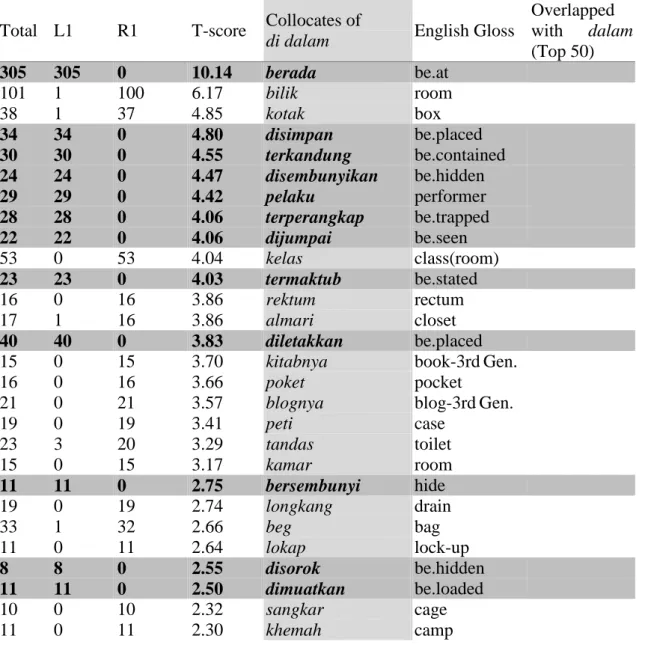
As for di dalam in Table 9, a majority of the L1 collocates were verbs indicating a state (berada ‘be.at’ or ‘exist’ (12a), disimpan ‘be.placed’, terkandung ‘be.contained’, disembunyikan ‘be.hidden’, etc.). The collocates of di dalam usually denoted a more specific location inside a certain space and these verbs may explain the actions that go
with this meaning. Furthermore, looking at the R1 collocates, most of them were concrete objects (bilik ‘room’, kotak ‘box’, almari ‘closet’, poket ‘pocket’, and kelas
‘class(room)’) with a three-dimensional space, while some, like for dalam, also denoted figurative space, such as kitabnya ‘book-3rd Gen.’, blognya ‘blog-3rd Gen.’ (12b), al-Quran ‘Quran’, tafsirnya ‘interpretation-3rdGen.’, etc.
(12) a. 22 pelajar lain yang turut berada di dalam bas tersebut [DI DALAM bus
TER-mention]. (0788.txt)
‘22 other students that were also in that bus. ’
b. Beliau berkata demikian dalam entri terbaru di dalam blognya [DI DALAM blog-3rdGen.]. (0116.txt)
‘He said so in the new entry in his blog. ’ [The gender of beliau was found from previous context.]
Table 9. Di dalam and its collocates
Total L1 R1 T-score Collocates of
di dalam English Gloss
Overlapped with dalam (Top 50)
305 305 0 10.14 berada be.at
101 1 100 6.17 bilik room
38 1 37 4.85 kotak box
34 34 0 4.80 disimpan be.placed
30 30 0 4.55 terkandung be.contained
24 24 0 4.47 disembunyikan be.hidden
29 29 0 4.42 pelaku performer
28 28 0 4.06 terperangkap be.trapped
22 22 0 4.06 dijumpai be.seen
53 0 53 4.04 kelas class(room)
23 23 0 4.03 termaktub be.stated
16 0 16 3.86 rektum rectum
17 1 16 3.86 almari closet
40 40 0 3.83 diletakkan be.placed
15 0 15 3.70 kitabnya book-3rdGen.
16 0 16 3.66 poket pocket
21 0 21 3.57 blognya blog-3rdGen.
19 0 19 3.41 peti case
23 3 20 3.29 tandas toilet
15 0 15 3.17 kamar room
11 11 0 2.75 bersembunyi hide
19 0 19 2.74 longkang drain
33 1 32 2.66 beg bag
11 0 11 2.64 lokap lock-up
8 8 0 2.55 disorok be.hidden
11 11 0 2.50 dimuatkan be.loaded
10 0 10 2.32 sangkar cage
11 0 11 2.30 khemah camp
6 6 0 2.28 disorokkan be.hidden
7 7 0 2.24 berendam dip
49 1 48 2.20 al-quran Quran
5 0 5 2.15 tafsirnya interpretation-
3rdGen.
5 5 0 2.09 disumbat be.stuffed
5 5 0 2.09 direndam be.dipped
5 0 5 2.06 bonet bonnet
7 0 7 2.02 bakul basket
5 5 0 1.94 tertanam be.planted
4 4 0 1.94 ‘tazkirah’ reminder
5 0 5 1.93 guinness Guinness
4 0 4 1.92 begnya bag-3rdGen.
5 5 0 1.92 dikurung be.caged
8 0 8 1.90 kesebelasan eleven
4 0 4 1.89 kamarnya room-3rdGen.
5 0 5 1.88 kelasnya class(room)-
3rdGen.
25 0 25 1.75 blog blog
9 0 9 1.75 petak compartment
31 1 30 1.72 hutan jungle
14 0 14 1.67 gua cave
5 5 0 1.65 berlindung shelter
3 0 3 1.65 Majma' al Zawaid (a hadith)
As also noted by Chung (2013), dalam usually denotes a figurative space or a bounded event (including time), while di dalam denotes a three-dimensional space that is mostly concrete in nature. A similar observation was also found in this study. Since di dalam often collocated with physical objects, the types of verbs it collocated with mainly referred to the existence of an entity in a certain location, as can be seen in (13a) and (13b).
Comparatively, dalam had fewer verbs but most of them were general verbs such as berada ‘be.at’ (13a), terlibat ‘be.involved’ (13d), and hidup ‘live’ (13e), all of which refer to abstract activities or a certain stage (comparing (13a) to (13c)).
(13) a. Ketika berada di dalam gua tersebut [BER-exist DI DALAM cave
TER-mention], tiba-tiba sebongkah batu yang besar jatuh dari gunung.
(10277.txt)
‘When (being) in that cave, suddenly a big stone dropped from the mountain. ’
b. 32 butir peluru yang disembunyikan di dalam [DI-hide-KAN DI DALAM] tong ikan …(10202.txt)
‘32 bullets that were hidden in the barrels of fish…’
c. kebanyakan pemain berada dalam kecergasan [BER-exist DALAM KE-agile-AN] yang memuaskan ketika ini (0149.txt)
‘most of the players are in the agility that is satisfying at this moment’