1
<ARTICLE>
GLOBAL LABOUR MIGRATION AND NEW DEVELOPMENTS IN JAPAN'S
REGIONAL COMMUNITIES
Shinichi Ishii
Foreword :
Despite the prolonged economic slowdown, there is no noticeable sign of the number of immigrant workers into Japan decreasing. Meanwhile, the outflow of Japanese work force is increasing as industrial communities
transfer part of their production bases offshore.
In 1994, registered immigrants and foreign workers with work permits increased by 10.7 percent from the previous year to 100,000, while Japanese business persons and their families overseas totalled 270,000. Japan is now emerging as a workers-exporting country, in an age of globalization and
Asianization of the labour market.
Against this backdrop, the government has come up with a new frame- work for receiving foreign workers, known as the Technical Intern Train- ing System, allowing them to study and work in Japan. This framework
could be regarded as the second attempt to accept unskilled workers, following the admission of ethnic Japanese from Brazil and Peru to make up for the labour shortage, amid the continued entry of unauthorized workers.
As the proportion of immigrant workers and other foreigners compared
2 M32 Vg 2 !-.7•
(431) to the total Japanese population is growing
, the question of the integration of foreigners into Japan's society and symbi
osis has developed into a matter of concern . In May 1996, Kawasaki City of Kanagawa Prefe
cture decided to make all categories of local public empl
oyment open to foreign residents in the city excepting the jobs of firefight
ers. One month earlier , the city was recommended by the study and rese
arch panel to set up a consultative body of foreign residents -the first such scheme in Jap
an-in a bid to reflect their opinions in the administration
. At the prefectural assembly in February 1996
, the Governor of Kochi Prefecture in southern Japan unveiled a plan to
make all categories of local public employment open to foreigners
. If final decision had been taken to this effect , Kochi would have been the first prefecture in Japan to abolish the pre-conditions of Japanese nationality for
clerlical and admin- istrative posts in the local government
.
I wonder whether these developments have raised th
e curtain of a closed society to foreigners
, and may help usher in an era of living together with foreign nationals , even though this is far behind such moves in Western industrial democracies .
In this regard, I will examine and analyze the past a
nd current experi- ences of Germany and France . After World War Two , many Western countries relied on foreign workers for their r
econstruction and they received unskilled workers under bilateral agree
ments. They are now restricting the entry of immigrant workers
, amid the prolonged recession , but Germany is now experiencing with a scheme wh
ereby migrants are accepted on a temporary basis though the scheme sh
ould ensure that temporary workers remain temporary and return h
ome after the expira- tion of the contracts .
Part I focusses on the recent trends of the inflo
w and outflow of
(430) GLOBAL LABOUR MIGRATION AND NEW DEVEL-
OPMENTS IN JAPAN'S REGIONAL COMMUNITIES
3
migrants.
Part II discusses new globalization and its impact on labour mobility.
Part Ill discusses the latest developments in Japan including learn-and- work scheme, called the Technical Intern Training system.
PartlV takes up foreigners and regional communities and tries to shed light on the new moves concerning the opening up of many local public work opportunities to foreigners and the setting up
of an advisory body of foreign representatives to reflect their
opinions in the administration.
PartV is an overview of the past and present experiences of Germany
and France, as good examples from which Japan can learn in formulating a new migration policy to live through the globali-
zing community.
PartVI argues the importance of how Japan can effectively deal with migration as we have already witnessed a wave of change in
Asia surging across the globe such as Asianization of labour
mobility.
To conclude this paper, I will propose short-term and long-term policies to cope with the coming millennium.
Part I INCREASING INFLOW INTO JAPAN OF FOREIGNERS
AND OUTFLOW OF JAPANESE
Part 1.1 The Largest Number of Registered Foreigners
Despite a continued economic slowdown after the burst of the bubble- economy in Japan, the number of foreign residents, and the inflow of foreigners into this country, are continuing to rise. The total number of registered foreign nationals marked a record high of 1,362,371 persons at the end of 1995. This represents at 1.08 percent of the total Japanese
4 atM32 2 -9-(
429) population. This is an increase of 0.6 percent from the previous year and a 27.7 percent increase from 1989 (see Table Part 1
.1.1). In the latest registra- tion total, Asian nationals numbered 1
,039,149, or 76.3 percent. Latin Amer- ican nationals , of which Brazilians and Peruvians are the two largest groups, totalled 221,865, or 16.3 percent. This was followed by North Americans and Europeans with 52
,681, 3.9 percent, and 33,283 , 2.4 percent respectively.
Table Part 1.1.1 Trends in the number of registered for
eign nationols
1974 1979 1984 1986 1987 1988 1989 1990 1991 1992 1993 1994 19 Sour Not
Total number
japan E oftheto
1,050,211 Americans
745,565 774,505 840,885 867,237 884,025 941,005 984,455
1,075,317 1,218,891 1,281,644 1,320,748 1,354,011 362,371
in Immigration Associi the total number of
or 77.6 percent.
0—Rate compared to
previous year Index % of population
100 104 113 116 119 126 132 144 163 172 177 182 183
0.68 0.67 0.70 0.71 0.72 0.77 0.80 0.87 0.98 1.03 1.06 1.08 1.08
Source : Japan Immigration Association
, Statistics on Foreign Residents in Japan , 1995, 1996 Note :Of the total number of registered foreign nationals in 1994
, Asians numbered 1,050,211 or 77.6 percent. This was followed by Latin Americans (15
.0%), North Americans (3.9%), Europeans (2.4%).
By nationality, Koreans numbered 666,376, with an occupation ratio of 48.9 percent of the total , Chinese numbered 222,991, with a ratio of 16 .4 percent, followed by Brazilians 176 ,440, or 13.0 percent and Phillipines 74,297, or 5.5 percent .
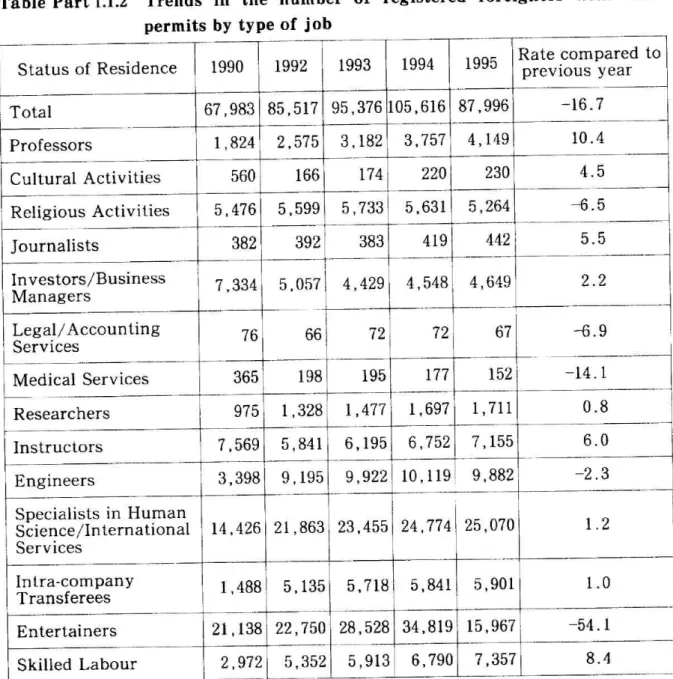
The number of legal foreign workers in Japan increased by 10
,240, to 105,616, in 1994, an increase of 10 .7 percent from the previous year though
(428) GLOBAL LABOUR MIGRATION AND NEW DEVEL- OPMENTS IN JAPAN'S REGIONAL COMMUNITIES it decreased to 87,996 in 1995. This is the first time that the number of legal foreign workers has surpassed the mark of 100,000-level (see Table Part
1.1.2.) This represents 0.15 percent of the total workforce in Japan.
Table Part 1.1.2 Trends in the number of registered foreigners with work permits by type of job
Status of Residence
Total Professors
Cultural Activities Religious Activities Journalists
Investors/Business Managers
Legal/Accounting Services
Medical Services Researchers Instructors Engineers
Specialists in Human Science/International Services
1990
67,983 1,824
560 5,476
382 7,334
1
Intra-company Transferees Entertainers
Skilled Labour
76 365 975 7,569 3,398
14,426
1,488 21,138 2,972
1992
85,517 2,575
166 5,599
392
1993 1994
95,3761105,616
3, 1821 3,757
5,0571
174 5,733
383 4.429
66 1 72 195 198
1,328 1,477 5,841 6 ,195 9,195 9,922
21 ,863 23 ,455
1995 Rate compared to previous year
87,996 -16 .7
4,149 10.4
220 5,631
419 4,548
177 1,697 6,752 10,119
24,774
r2 i
230 5,264 442
4,649
67
4.5 -6 .5
5.5 2.2
-6 .9
5,135 5,7181 5,841 22,750 28,5281 34,819
5,352 5,913 6,790
152 1,711 7,155 9,882
25,070
-14 0
6 -2
1 1 ,8 .0 .3
.2
5,901 1.0
15,967 -54 .1
7,357 8.4
Source : Japan Immigration Association, Statistics on Foreign Residents in Japan Note : Legal/Accounting Services-Lawyers and accountants
Instructors-Foreign language instructors Specialists in Human Science/International
Services-Interpreters, translators and others
, 1995, 1996.
6 ni M 32 M 2(427)
As the whole picture , OECD data show that the number of foreign workers is estimated by the Labour Ministry to have been approxim
ately 600,000 in 1993, about 1 percent of Japan's total work force of 66
,150,000.
This figure excludes permanent residents but include 297
,000 persons who overstayed their visas . Foreign Workers are also made up of registered foreign nationals with a work permit (95
,400), temporary and seasonal workers, most of whom are Japanese decent
, (approximately 150,000), and foreign graduates (2 ,200) and foreignstudents working g part-time (62 ,700).
Also, the number of foreign nationals visiting Japan has increased 70 percent during the last ten years due to the internationalization trend . In 1995, the number of new entrys into Japan by foreign nationals tot
alled
2 2,934,428, a decrease of 5 .3 percent over the previous year . But the number
of new arrivals in 1994 increased by 1 .7 percent over the previous year and it substantially levels off after it peaked in 1992 with 3
,251,753. According to the status of residence , temporary visitors top the list at 2 ,724,559, entertainers follow, with 59 ,833, and trainees 40,591. As compared to 1994 , entertainers decreased largely by 51 .3 percent, and temporary visitors by 4.7 percent while trainees increased by 9 .8 percent.
Part 1.2 The Outflow of Japanese Nationals
On the other hand, Japanese nationals staying overseas -permanent res- idents and long-term stays-totalled 689,895 in number, as of October 1st,
3 1994. This is an increase of 0.3 percent over 1993 . Of the total Japanese
overseas, 37.9 percent are permanent residents while 62.1 percent are long-term visitors. 270,824 , or 64.3 percent of these long-term visitors are from Japanese private sector industries and the self -employed . This indi- cates the need to contrast the legally permitted 100-thousand foreign workers in Japan with the 270-thousand Japanese business persons and
(426) GLOBAL LABOUR MIGRATION AND NEW DEVEL- OPMENTS IN JAPAN'S REGIONAL COMMUNITIES
their families staying overseas (see Table 1.2.1).
Table Part 1.2.1 Trends in the number of Japanese nationals overseas (long-term sojourners by occupation)
Asia Oceania
North America Central America Latin America Western Europe Eastern Europe &
NIS
Middle East Africa Antarctic World
Private Sector 83,474 10,481 103,309
2,545 3,950 53,105
1,149 3,003 1,926 0 .262,942
7
ournalists Self- Employed
Students Researchers
Instructors
Government
officials Others Total
514 26 1,209
17 33 724 123 30 75 0
794 98 2,002
98 281 4,217
146 40 206 0
7,176 3,717 54,866 296 291 31,238
615 125 171 0
6,681 1,003 3,020 1,219 1,672 4,245 727 966 2,085
0 7,292
2,090 7,840 480
715 8,371
170 292 527 40
105,931 17,415 172,246 4,655 6,942 101,900 2,930 4,456 4,990 40
2,751
7,882 98,495 21,618 27,817 421,505Source : Consular and Migration Policy Division, Consular and Migration Affairs Secretariat, Ministry of Foreign Affairs as of October 1st, 1994.
Note : NIS-Newly Independent States. Unidentified cases are excluded from the figure.
After the end of the Cold War, the cross-border flow of goods, ca and now personnel has been increasing and international labour m
Dept,
8 RtfilrvitM32 AM 2
(425)
Part II NEW GLOBALIZATION TREND AND ITS IMPACT ON
LABOUR MIGRATION
Part 11.1 Why the Migration Occurs
Why then is the international migration occurring ? In the case of J apan, it is widely considered that four major factors have affected the d
ecision to migrate.
(I) disparities in population growth between developed and developing
countries.
(2) wide gap in economic development among countries
, particularly in terms of income.
(3) imbalances between labour supply and demand among countries , (4) institutional mechanisms that promote international labour move -
ments.
These elements result in push and pull effects : the push effects incl ude civil wars and ethnic conflicts , like the disputes in Bosnia-Herzegovina and Cambodia. The pull effects include better social services
, labour standards and others . One commentator maintains , regarding the pull effect, that the inflow of migrant workers into Japan was not a re
sult of pressures by the outside communities but of capital and state activities
5 among capitalist countries including Japan . Rapid economic growth in
Asia, particularly NIEs-Newly Industrializing Economies is now providi ng the latest example of the pull effect . In this regard we should also observe the situation in which labour migration in Asia is underway as part
of global labour movements.
The labour-migration is taking place against a backdrop of global integration of the world labour market driven by certain factors
. Behind the emerging labour market integration are cross -frontier flows of capital
,
(424) GLOBAL LABOUR MIGRATION AND NEW DEVEL- OPMENTS IN JAPAN'S REGIONAL COMMUNITIES
goods, people and information propelled by technological evolution and falling transport and communication costs. Volumes of goods and services traded across borders have grown tremendously in recent years, account-
6 ing for about 45 percent of world GDP in 1990, up from 25 percent in 1970.
Capital and Goods have reportedly been moving quickly. In 1990, 17 percent of the labour force in developing and former centrally planned economies worked directly or indirectly in the export sector, with exports to the richer countries accounting for two-thirds of this employment effect. Gross capital flows also rose from 7 percent to 9 percent of GDP in
7 developing and transitional economies during the past two decades. Con-
trary to increasing flows of goods and capital, labour movement is rather slow due to political, economic and social factors, particularly depending on the degree of liberalization of the labour mobility.
Part 11.2 Intra-Asian Migration
However, new migration areas have begun to emerge. In the past, Asia and Eastern and Central Europe have been emigrating people mostly to the industrializecd countries, but now Asia is experiencing intra-regional migration. Asia has seen the largest rate of rapid economic growth of any region recently. Alongside the continuation of traditional flows from Asia
to the United States, Canada and Australia, one observes a tendency towards the diversification of countries of origin, a widening of the range
8 of receiving countries and a greater diversity in the means of entry.
Migration between East and South-East Asian countries emerged in the 1980s and still continues in the 1990s. The magnitude of these intra-Asian movements, essentially consisting of temporary workers, are a result of rapid economic growth, regional integration and structural change in the
9 labour markets within the region.
10 A 32 M 2 =
(423)
In the case of intra-Asian migration , although there has been a decline in the fertility rate, Asia has more than 3 billion inhabitants
, more than half of the global population . This suggests that Asia is abundant in resources of personnel despite a declining trend in the fertility rate . The income disparities between various groups of Asian countries remain substanti
al as push and pull effects . For example, gross national product per capita in Japan is 30 times that of the Philippines and 70 times that of China
, India and Pakistan. Due to these demographic and economic imbalances
, a
considerable international migration potential exists in Asia .
10Consequently the income differentials between Japan and other Asian countries represent a major pull effect . Japanese government data show that Koreans formed the largest group of registered foreigners in Japan
, but other countries' nationals-of China , Brazil, the Philippines, the United States, and Peru-followed suit . In addition, illegal migration in Japan is mostly from Asia. Japan now appears to be becoming a major migration pole in Asia. As a whole, we could say we are now experiencing another type of regional migration.
Despite the fact that a number of Asian countries such as Japan
, the Republic of Korea, Singapore and Taiwan are adopting strict regulations on the entry of unskilled workers , the number of unauthorized foreign workers-mostly staying after the expiry of their permits -has reportedly been growing, though the number shows a slight decline in 1994 in Japan
. In South Korea, foreign workers have grown from a few thousand in the early 80s to current estimates of anywhere from 60-thousand to 100-
11
thousand, almost all of whom are illegally . Malaysia, Singapore, Hong- kong and Taiwan also receive foreign workers .
Several developing North and South-East Asian countries have emerged as both sending and receiving countries for skilled and unskilled workers .
(422)GLOBAL OPMENTS IN JAPAN'S REGIONAL COMMUNITIES LABOUR MIGRATION AND NEW DEVEL- 1~
The pull effect stems from fast growth mostly resulting from labour intensive industries, which naturally also demand for foreign workers as well. In 1995, one of the latest developments in the region was Asian countries becoming each other's main trading partners in the world's
12
fastest growing region.
Part 11.3 The Intra-Regional Flow of Goods, Capital and then Labour ? We can assume that the rapid growth was ignited by the increasing number of new labour intensive industries which promote exports, and was also facilitated by technological transfer from Western multinational industries. Investment into South East Asia and China by Newly Industri- alizing Economies and other countries promote trade. The pace of change
in the past few years made the most remarkable advances hard to appre- ciate. It went largely unnoticed, but 1995 was almost certainly the first year in modern times when trade within Asia exceeded Asia'a trade with
13
the rest of the world.
It is likely that the Asian region will continue with, or likely expand its flows of trade and capital, as stipulated in the action agenda which were
adopted at the Osaka summit of APEC-Asia-Pacific Economic Cooperation forum in November 1995. In addition to bilateral economic developments, multilateral market-oriented growth triangle zones are already emerging such as the Growth Triangle of the Batam islet of Indonesia's Sumatra island-Singapore-Malaysia-Indonesian consortium development project.
This consortium project allows the free flow of capital and labour mobility and is expected to attract 100 industrial corporations and create 40-
14
thousand jobs. Another example of business alliance within Asia is the
China-Singapore consortium Suzhou Industrial township, an integrated
development with industrial, residential, commercial and social compo-
12 M 32 M 2(421)
nents. The projected township , which is scheduled to be completed in 20 years, is designed to support a population of 600 ,000 creating employment
15
for 360,000.
We can expect the increasing flow of goods from these zones to t ake advantage of the area's lower production costs . In the case of manufactur- ing industry, compensation for workers in Japan hit a new high
of 21.38 US dollars an hour in 1994 . In the Pacific Tiger economies , the labour cost in the Republic of Korea was 6.33 dollars, in Taiwan 5.47 dollars , and in Hong
16
Kong 4.79 dollars-nearly one-fourth of the figure for Japan .
Part 11.4 Tempoary Work Arrangement
Illegal employment has proved to be a very serious
, but also very intractable problem. Unskilled workers have been recruited in in - dustrialized democracies to meet labour demand . In Japan too, nearly 290 -thousand overstayers-mostly illegal migrants
-, though gradually declin- ing in number, are still in Japan engaging in
, or looking for, unskilled work. One significant recent phenomenon has been tempoary work ar - rangements. The demand for Filipina nurses
, Sri Lankan maids, and Korean construction workers has risen since organizatins have begun to
17
manage temporary migration on a more temporary basis
. Reportedly certain countries are encouraging the scheme of rotation basis in
an attempt to reduce the attachment of migrant workers to the host count
ry.
As a whole, the importance of international migration in the interna - tionalization of the labour markets must be analyzed by considering its consequences in influencing economic disparities between countries b
y reducing wage differentials , contributing to productivity increases , and demand for goods and services (by the consumption of the immigrants or
18
in the sending countries, through remittances) .
(420) GLOBAL LABOUR MIGRATION AND NEW DEVEL- OPMENTS IN JAPAN'S REGIONAL COMMUNITIES
13
Para II JAPAN-LATEST DEVELOPMENTS, THE TECHNICAL
INTERN TRAINING SYSTEM
PartII.1 Revision of the Immigration Control Act
The government has revised the Immigration Control and Refugee Recognition Act, enlarging the categories of status of residence from 18 to
28. The Act, that took effect on July 1st, 1990, bans the entry of unskilled workers and provides for sanctions against employers or brokers who hire or bring in unauthorized, illegal workers. The employers and the brokers will be fined up to two million yen or 20-thousand US dollars (calculated on 1 US dollar-=100 yen basis) or imprisoned for up to three years.
New status of residence categories cover :
(1) Legal/accounting services, such as lawyers and accountants
(2) Medical services, such as doctors and dentists
(3) Researchers
(4) Instructors, such as foreign language teachers
(5) Specialists, in human science fields, such as interpreters and trans- lators
(6) Intra-company transferees
(8) Cultural activities
(9) Pre-college students, such as people enrolled in Japanese language
schools
When the revised Immigration Control Act came into force in 1990, midsize industries strongly complained that there was no category for ordinary workers in field work and services. There is a kind of homogene- ous sentiment among the Japanese society and acceptance of large num-
bers of foreign workers may trigger fears in Japan that it might face the
difficulties similar to those experienced by Western countries after World
14 git 32 A M 2 5(
419) War Two when they accepted unskilled workers
. I would like to propose that Japan has already crossed the frontier from bei
ng a homogeneous society to becoming multiple , as foreign residents accounted for 1.08 percent of Japan's population at the end of 1995 .
PartIII.2 Ethnic Japanese and Non -Skilled Workers
Japan eased its grip on immigrant control and accepted ethnic Jap anese from Brazil and Peru , based on the new status of long-term resident . People of Japanese descent can work without conditions
once the Minister of Justice recognizes that one of their parents or grandpar
ents is Japanese.
Since 1990, the entry into Japan of people of Japane
se descent from Latin-America has increased remarkably . In 1992, the number of registered residents of ethnic Japanese from Brazil
, for example, nearly quadrupled as compared to 1990 , totalling 51,759. In 1994, the number increased by 7.2 percent, and in 1995 by 18.0 percent, over the previous year .These residents are admitted to stay in Japan by the Justice Minister for
a term of up to three years.
This trend is comparable to Germany's admission of eth
nic Germans called Aussiedler , from Eastern Europe. As is commonly known
, the codes of both the Japanese and German nationalities are based on ju
s sanguinis lineage. In the Japanese case the government paved th
e way for the acceptance of non-skilled foreign workers by favouring i
mmigrants of Japanese descent. In other words , ethnic Japanese are the first non-skilled foreign workers to be officially accepted into this country
, even though their language, customs and culture often differ from those of J
apanese nationals.
However, this tendency has not necessarily stemmed the inflow of unauthorized migrants , most of whom are believed to be working illegally .
(418)GLOBAL OPMENTS IN JAPAN'S REGIONAL COMMUNITIES LABOUR MIGRATION AND NEW DEVEL- 15 These are overstayers who entered Japan with the status of temporary
visitor with a legal period of stay of up to 3 months. They totalled 284,744 in Nov. 1995, a slight decrease from 288,092 in Nov. 1994. The largest number of 298,646 unauthorized migrants was recorded in May 1993. In
1994, the Ministry of Justice deported 65,618 foreign nation's because of illegal stay, illegal entry, illegal landing or other reasons (see Table PartIII 2.1) . More than 90 percent of these deportees were illegal workers. Most
illegal migrants came from the Asian region, including the Republic of Korea, Thailand, Malaysia, China, Iran, the Philippines and others in this
19
order. Of the 59,352 illegal workers deported in 1994, 26.7 percent were employed in the construction industry. The next highest percentage of 23.2 was for the manufacturing industry. 13.2 percent were hired as hosts or hostesses (see Figure PartIll.2.1). Here I will not detail new hiring trends, involving shifts from some industries to others, but will only refer
to a possible shift away from manufacturing towards labour-intensive
Table Part 111.2.1 Trends in the number of foreign nationals deported
~T ~
1990 1991 1992 1993 1994Rate compared tothe previous year
Total36,264 35,903 67,824 70,404 65,618 6.8%
Total
Illegal entry Illegal landing
Unauthorized activities Overstay
Violation of the la
2,320 357
ities 751
32,647 AV189
29,884
35,903 67,824 1,662 3,459
347 533
882 393
32,8201 63,265
192 1 32 ,908 62,161 f
70,404
5,2271
796 306' 63,905
1'
4~
65,618 5,598 697
455 58,692
176 ---
6.8%
7.1%
---12 .4%
+48.7%
— 8 .2%
+ 3.5%
Illegal workers,[ Z9,6641
Source : Immigration Bureau, Ministry of Justice, June 1995.
Note :Illegal entry :Entry into Japan without passports or with fake passports
Illegal landing : Landing without landing permission even if passports are valid Unauthorized activities: Engaging in activities other than those permitted under the
status of residerce
Violation of the law : Violation of criminal laws and ordinances(ie : the Narcotic Control Act etc.)
7.8%
16 Igt A4 32 M' 2
(417) Figure PartIII.2.1 The number of illegal migrant wo
rkes deported
Source : Immigration Bureau
Ministry of Justice
June 1995
construction and service sector .
tc
^r~r
^..
Construction Manufacturing Hosts& Hostesses
15.869
13,793 7.858 Other Manual Workers 4
.456 Waitresses &
Barmen Dish Washers Cooks Other Services Others Total
4,107 2,937 2.413 1,738 6,181 59, 352
Part III.3 Discriminatory Problem
As illegal workers are recruited mostly by midsized firms
, through
brokers which sometimes include organized crime syndi
cates, they often encounter discrimination : lower wages
, cuts in wages, work without pay , harsh working conditions , dismissal without notice and sometimes no compensation for injuries arising from labour -related accidents . There are cases where compensation is not provided for worker
s whose injuries were work-related , either out of fear of discovery as illegal workers
, fear of deportation, or fear of punishment on the part of employers
. In these cases, infringements of human rights , or discrimination, are major social issues to be resolved. Concerning more serious injuries due to work -accidents , an association for solidarity with foreign workers
, based in Yokohama, has
(416)GLOBAL OPMENTS IN JAPAN'S REGIONAL COMMUNITIES LABOUR MIGRATION AND NEW DEVEL- 17 20
urged that they should be granted the protection of human rights.
If employers were to take appropriate measures, according to labour- related laws, workers could be compensated for injuries. UN Convention
on the Protection of the Rights of Migrant Workers, adopted in Dec. 1990, stipulates in article 28 that migrant workers "...have the right to receive any medical care that is urgently required...". It says, "such emergency medical care shall not be refused to them by reason of any irregularity with regard to stay, or employment".
Seen from the standpoint of the countries of origin, migration represents an outflow of the able younger generation. Migrant workers, meanwhile, are not necessarily given opportunities which correspond to their abilities.
They end up doing the jobs referred to in Japan as "the three Ks" : kitanai (dirty), kitsui (demanding) and kiken (dangerous), which younger Jap- anese people don't want to do. It is true that they are contributing to the Japanse economy, yet this situation does not offer any opportunities for technology transfers, nor does it help in the development of the infrastruc-
21
ture of the countries of origin.
Those who are involved in learning and aquiring technological skills are called `kenshuusei'-trainees. Such trainees gained an official status of residence in 1982, and their entry into Japan has been increasing, particu- larly since 1985 when the high-yen and low-dollor rate was adopted in the Plaza agreement and the shortage of labour became an acute issue. They
are regarded as a supplementary workforce to alleviate the labour short- age. The entry of trainees peaked in 1991, at 43,649, and since then the total has shown a gradual decline, to 39,795 in 1993, 36,612 in 1994, 40,591 in
1995.
18 tf. a01 gs 32A0 2(4
15) PartlIL4 The Technical Intern Training System
With these labour situation in sight
, the government introduced a new training programme called the "Technical Intern Training P
rogramme" in April 1993. The Justice Ministry released a guideline on the i
ssues of immigration control relating to this program .
The Technical Intern Training Program is designed to pro
mote the practical technology, skills and knowhow to developing countries and
22
help cultivate human resources
, to assist their economic advancement . The applicants are required to engage in activities that n
urture skills or technologies that the sending countries will benefit from
, upon completion of their two-year stay . In accordance with the ministry guidline
, the Ministry of Labour announced a basic framework for the prog
ram. The training is to be provided in two stages : regular training includi
ng lec- tures, other off-the-job courses and intern training (the technic
al intern- ship). Acceptance for the on-the-job training will be granted only
after trainees have passed an evaluation test of expertise in the rel
ated technol- ogy, technical skills and relevant knowledge . If successful, the trainees' status of residence is changed from trainees to "designated
activities", paving the way for direct labour activities lasting up to 1.5 times the period of the preceding training period , and within 2 years. During the period of technical internship, the Labor Standards Law , Minimum Wages Law, the Workmen's Accident Compensation Insurance and other rel
ated law will apply. The technical intern training program is operated and managed by the Japan International Training Cooperation Orga
nization, known as JITCO, which was set up under the control of the minist
ries of justice, foreign affairs, international trade and industry and construction
(see Figure Part 1a.4.1) .
This program can be regarded as nominal governmental recog
nition of
GLOBALLABOURMIGRATIONAND̲NEWDEVEL‑ 19 OPMENTSINJAPAN'SREGIONALCOMMUNITIES
話2,口"︑バ5還男乱ε屋捲・・駄︒8暫自一酊h↑短=︒唱︒¢﹄⑳一信H嘗︒q邸う︑8ト弓H8﹂ゴoの
一
開一
胴...
ー
・b認量石2墜募霧目︒髭眉ぎ曽且塁唱冨評嚢§毫ヨ畠・お㌔爵島岩gρ琶き薯暴呂租﹂各2留旧・ぎ零ぷゼ萄田毎昌婁石歯呂琶こ︒虜伺艶岩盈§巳量盛8望舞寮巴尋璽も貯鴛函(冨ー頑︒尾至\屈整曇馨)麺・信雪奮名P望暑[三㎝碧揖︒ξ
θ ㊥ ㊥
睡葛廿︒石﹂ε葛で$臼璽騨= コ雪壽q偶o量島眉躁Φf・6琶怠琶蝟8
や>i‑,..‑ーV
〆.㌔'
一
[
}}あロ昌8①臼£岩頸搦&理母口o①想日E且震
一 徳且§﹄量留量と曾景甕量義︒̀︒月噸の石翼£,一に雲巳︒已︒=)F慧桂︒︒蓄艮︒胤墓鵠嵩弓崔"司垂\・︒器ヌρ舞︒・・7(弩遇璽}︒畳禽)程Σ髪麗・島密o日司島o占曽智世↑日3ム屈甲誉ト 一
二 く
巴o日﹂£﹄釜卜⁝占 ⁝剛⁝占 (窪量鴇零思賀眉仁旦,岩,δ\奉 韓訂甥鼠巳コ (8巳℃盤}o畏理︒Q)8仁層↑旦"・鮭o占警智層卜 麺"零§口国一.
一'.一...一.
圃 (量島︒歳⑳暑届﹄竃曇・一蚤{︒﹄富喜器﹄§8毫差曇﹄ε 一窺︒島︒出切三属田ト豊①ρ餌=響州聾8↑Oθ
一.
⁝一
一 肝「一 一‑
日国ぎ占曽囲︒占田︒と﹄Φ脇壽とL.因
1.
.一「.
一.
,智℃巴貯ぞ田恒名ごo田︒目﹂︒岬謡→の\﹁,零昼暫月田拙山石お20已﹂oミ一→・︒こ .召婁曽ε田お盤ご︒曾︒日﹂oミ︻→・,︑︑一 沼芒霞甘ε鴛蚤召鼠圏ぞ田与﹄︒噛,・︑ヨ,巷量謂5冨量﹁曽星量8﹂︒琶響で月﹂↑首歳⁝髭州畳署霊鼻娼舅羅4田暴b署餐汐 駕覇篇需弱曽名翌臼窪ε雪ゑご︒石ε屋8﹃㊥㊥㊥︒・ぎ毒痢旨珊・畳︒75さ貯日響塩o届運胡,量‑避ごδ・ 二匪コ凶毒畠島目﹄①西盈麗∂⁝巨巴名︒↑
や▽ ⁝⁝一
一.
一
︑
〜
琶尋§菌
}.
}倉信ゴ8①日o腐羅讐毬&理価属o ①ヨ8E謹 (響鼠留ヨ岡b岩凧︒盟τ︒ρ&)
層薯遷も畳理︒︒)翌層卜曽霊田与﹄♀超θ・⊆○ 一.一. 一
一
一
「一...四...一.
一...一.
一 一,...一
﹂ .
甦 田 ぎ よ
円.寸目 曽設昭と︑.一
廿£︒﹂乱己
∈巴OOよO葦量ト=杢二=O甚二8ト\§﹂OOよ①量一︒,﹂トち話δ
(414)
20 M 32 M 2 -9-(413)
the legitimacy of unskilled migrant workers
, who are effectively engaged in labour activities during their training
, though the program emphasizes the importance of the transfer of technology and skills to d
eveloping countries. Specifically , it is possible to say that this proposal represents the first instance of permission being given for workers to
enter Japan to aquire particular skills . The government has, in practice , invented a status of residence that allows trainees to work without further
revising the
23
Immigration Control Act .
Part111.5 Successful Candidates for the Technical Internship
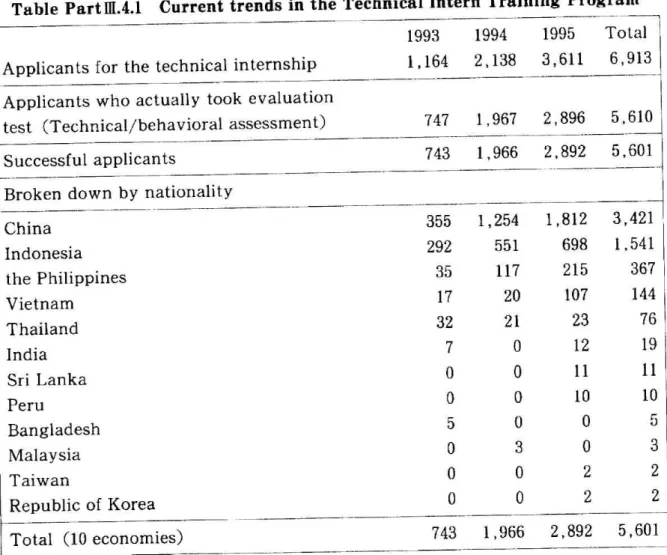
According to the Ministry of Labor , applicants for the technical intern- ship in 1993 numbered 747 trainees and those who passed the
evaluation test totalled 743. In 1994 there were 1,967 applicants with a pass total of 1,966. In 1995, applicants numbered 2
,896 and successful candicates were 2,892. Broken down by nationalitiy
, Chinese came top with 3,421, or, 61.1 percent, and Indonesians followed with 1,541, or 27.5 percent, of the total number of 5,601 successful candidates of three years ending in 1995 (
see Table PartIII.4.1).
Applicants and successful applicants for the technical inter
nship are rather small in number at present . The 2,892 technical interns who passed the evaluation test is small in number as compared to 40
,591-the number of registered foreign trainees as of the end of December 1995
. The inter- government liaison council on foreign workers issued a fundamental framework in March 1993, in which it said it was considering revising the status of residence from the current "designated activities" to "inter
ns". In view of these factors, it is better to wait a while before evaluating the
pros and cons of the new system now underway
, which represents the latest
development regarding personnel training in Japan .
(412)
Table Part Z.4.1
GLOBAL LABOUR MIGRATION AND NEW DEVEL- 21 OPMENTS IN JAPAN'S REGIONAL COMMUNITIES
Current trends in the Technical Intern Training Program
Applicants for the technical internship Applicants who actually took evaluation test (Technical/behavioral assessment) Successful applicants
Broken down by nationality China
Indonesia the Philippines Vietnam Thailand India
Sri Lanka Peru Bangladesh Malaysia Taiwan
Republic of Korea Total (10 economies)
1993 1,164
747 743
355 292 35 17 32 7
0 0 5 0 0 0 743
1994 2,138
1,967 1,966
1,254 551
117 20
21 0
0 0 0 3 0 0 1,966
1995 Total 3,611 6,913
2,896 5,610 2,892 5,601
1,812 3,421 698 1,541
215 367
107 144
23 76
12 19
11 11
10 10
0 5
0 3
2 2
2 2
2,892 5,601 Source : Human Resources Development Bureau, Ministry of Labour.
Note : Year 1995 is from April through September 1995.
However, we could say that this may be one step forward, in that the program aims to contribute toward developing human resources. Training
foreigners in Japan, and providing them with opportunities to learn and acquire skills and technological expertise is positive in that foreign work- ers, in addition to income, can hope for eventual promotion and increased social status. At the same time, critics say it is not natural for industries which have no connections with offshore joint ventures or relevant corpo-
24
rations, to ask government to ease the limits on trainees. Reportedly, some employers have conducted "on-the-job training" under the pretext of
"trainees" -a kind of disguised employment. The introduction of the two-
22 A 4 M32AO 2
year Technical Internship came amid these circumstances .
(411)
Part 11.6 The point at issue ?
One possible issue arising from this sytem will be the period of stay of two years. Under the basic framework of the system
, the Ministry of Labor states that the combined period of residence for regular training
and technical internship should not exceed two years . Interns should leave Japan when they are competent in the work they have trained in
, and show a well-developed potential . This raises some questions if the period is too uniform and inflexible , though jurisdiction should always be strictly applied. It is also my view that the designated period might have been influenced by the past experience of France and Germany
, where un- skilled workers tended to settle once they had been officially recognized as workers, soon after the end of World War Two .
Another point to consider is the absence of a limit to the number of technical interns. The program does not set a ceiling on receiving interns and the internship authorities-Japan International Training Cooperation Organization-will discuss restrictions in consultations with ministries and agencies concerned, taking into account the potential impact on the labor market and on people's lives . This indicates that the number of interns accepted may be influenced by business conditions negatively affecting the benefits of transferring technology and skills to the developing coun - tries.
Under demographic trends , Japan is likely to face an acute structural labor shortage in the future , reflecting the expected sharp decline in the birth rate. Between 1991 and 2006 the proportion of the population aged between 15 and 24 is expected to fall by 25 percent . Keidanren, the Federation of Economic Organizations in Japan
, has estimated that the
(410)GLOBAL OPMENTS IN JAPAN'S REGIONAL COMMUNITIES LABOUR MIGRATION AND NEW DEVEL- 23
25
labour shortage will reach 5 million in 2000. In the globalization of the labour market, there is a new trend whereby, in some western nations,
there has been a shift in the pattern of labour demand, against unskilled and manual workers and in favour of college-educated and white-collar workers, and from full-time work, dominated by men to more flexible or
26
temporary work, with a rising participation of women. It is high time for Japan to focus on future labor trends from a wider perspective, not simply
continuing discussions about illegal workers, but also examining the possible acceptance of foreign workers, and looking into working and living together within regional communities.
PartIV FOREIGNERS AND REGIONAL COMMUNITIES : THE
EXAMPLE OF KANAGAWA PREFECTURE
PartN.1 Opening Public Job Opportunities
The foreign population registered in Japan in 1995 totaled 1 million 360- thousand, equivalent to 1.08 percent of the total population. By prefecture, the Tokyo metropolis had the largest number of foreign residents with 247-thousand, or 18.1 percent of the total population, followed by Osaka, Aichi, Kanagawa and Hyogo prefectures. As for migrant workers, the number of arrivals has also been growing, with new arrivals totalling 97,101 in 1993 and 111,665 in 1994. Japan is facing a wave of international- ization in many ways. It goes without saying that the state has a funda- mental role to play to this issue, but the national consensus is equally important. There are several remarkable reactions to the migration prob- lem.
Kanagawa Prefecture-the site of the opening of the nation from its 260- year isolation in 1854-is noted for its policy of symbiotic-living and work- ing together based on the philosophy of what it calls "thinking globally
24 OffOffUSAI 32
(409) Figure PartIV.1.1
11
10
9
8
7
6
5
4
3
2
1
Unit : 10,000 people
0
Registered (as of the
foreigners in Kanagawa end of June, each year)
105. 435
41,474 41.497
29
Vietnam
1,855 (1.7%) USA 4,725 (4.996) Peru 6,189 (5.8%) the Philippines
8,065 (7.6%)
other140 c:ouutries
16.654
Brazil 14,333 (13.6%)
Korea 33,423 (31.7%)
China 20,181 (19.1%)
registered foreigners in kanagawa as of June 30,
1995
1975 1980 1985 1986 1987 1988 1989 1990 1991 1992 1993 1994 1995
Source : Kanagawa Prefecture. Japan 1996
(408)GLOBAL OPMENTS IN JAPAN'S REGIONAL COMMUNITIES LABOUR MIGRATION AND NEW DEVEL- 25 and acting locally". In the prefecture, registered foreign nationals totaled
105,435 at the end of June 1995 (see Figure PartIV.1.1). This accounted for 1.28 percent of the total prefectural population of 8,258,718. Kanagawa Prefecture is equal to Sweden and Austria in terms of population-size and to Sweden in terms of gross domestic product. By nationality, Koreans top the ratio followed by Chinese and Brazilians. The population of refugees from Indo-chinese countries of Vietnam and Cambodia and Laos in Kanag- awa is the largest in Japan on a prefectural basis.
In April 1989, the prefecture launched a special project to promote the creation of a community where Japanese residents live together with foreigners. Adopting certain recommendations from its advisory body, Kanagawa Prefecture provided some opportunities for foreigners to become local public employees. 70 out of a total 97 types of job are open to foreigners in 1995, bringing opportunities for foreigners to become local public employees within the community on a prefectural basis. Although
clerical and administrative jobs were excluded, this liberal policy is re- garded as the limit of what is permissible within the governmental frame- work whereby foreigners are not entitled to hold official power nor participate in the creation of official policy in this country. This position implies a negative stance toward the adoption by prefectures, or major cities, of a more liberal policy toward the recruitement of foreigners for
these types of jobs.
PartIV.2 Overtures to Removing Barriers to Jobs in Kawasaki
An official of the personnel affairs division of Kanagawa Prefecture says that the 70 types of jobs made available are professional and field work positions that don't yet include clerical and administrative jobs.
In this regard, there was a significant development in Kawasaki City,
26 AO. A XM32 M 2 g
(407)
Kanagawa Prefecture, in May 1996. Kawasaki City, a major city adjacent to the Metropolitan Tokyo , removed conditions attached to the recruit- ment of foreigners for positions as local public employees excludin
g firefighters. Under these conditions
, the administering of official power and participation in the creation of official policy is normally onl
y open to those who have Japanese nationality . This is usually called the "national- ity clause", though it is not a law , and the Ministry of Home Affairs has taken this position. In an attempt to meet the conditions
, the city adopted a rule preventing foreign employees from being promoted to section chief
, or higher posts.
Earlier, in January 1995, Governor Daijiro Hashimoto of Kochi Prefec- ture had come up with a plan to open prefectural job opportunities
, excluding certain positions such as police officers
, tax collectors, to for- eigners with permanent resident status . Governor Hashimoto, brother of then Prime Minister Ryutaro Hashimoto , expressed the hope in his policy speech before the prefectural assembly session in February 1996 that the prefectural pesonnel commission would lift the nationality restriction . But the commission failed to reach agreement .
Therefore, among the nation's 47 prefectures and ordinance -designated big cities, Kawasaki became the first major city to make almost all local public servant jobs open to foreigners. Although the latest move invited criticism from the Ministry of Home affairs , but this can be regarded as another example of opening doors to Koreans and other foreign residents in the city. Six such candidates took exams for local public servant jobs
, including clerical and administrative positions in June 1996
, for the first time.
It is significant to note that initiatives to remove barriers to jobs in
Kawasaki coincided with the Supreme Court ruling on the right to vote in
(406) GLOBAL LABOUR MIGRATION AND NEW DEVEL- OPMENTS IN JAPAN'S REGIONAL COMMUNITIES
27
local assemblies, in February 1995, and Japan's ratification of the Interna- tional Convention on the Elimination of All Forms of Racial Discrimina- tion, in January 1996.
PartIV.3 Emergency Medical Care
In 1990, Kanagawa Prefecture also set up an advisory council on migrant workers that comprised scholars, representatives of labour and manage- ment and government officials. It was asked to recommend policies from the standpoint of local autonomy, providing a view different from that of the state. In 1991, the council recommended that it is necessary to create a
community in which foreign workers will not be treated as merely as a work force but as human beings, making it possible to co-live in harmony.
As regards undocumented workers, while it referred to the need for legal action to be taken sometimes-such as the deportation of these workers- it also advocated that they should be treated on an equal basis with Japa-
27
nese workers as concerns social security and labour accidents.
Medical expenses incurred by migrant workers with no legal status has surfaced as one of the important issues that they face. Naturally, they are not qualified to receive benefits from official medical facilities. They have to pay their own medical expenses and are unable to pay hospitals when the expenses involved are beyond their means. As a result unpaid and outstanding expenses owed to medical institutions have been increasing and this has developed into a major social concern.
The health care issue was particularly noteworthy in the case of labour accidents. A survey by non-governmental organizations said that 80 per- cent of labour accidents involving foreign workers, the workers had no
28
official work status. Article 73 of the Immigration Control Act enforces penal codes against employers of illegal workers and brokers who help