negat i ve s pher e c l as s es i n E( 1)
著者
Tange M
ot oo
j our nal or
publ i c at i on t i t l e
Topol ogy and i t s appl i c at i ons
vol um
e
202
page r ange
160- 182
year
2016- 04
権利
( C) 2016. Thi s m
anus c r i pt ver s i on i s m
ade
avai l abl e under t he CC- BY- N
C- N
D
4. 0 l i c ens e
ht t p: / / c r eat i vec om
m
ons . or g/ l i c ens es / by- nc - nd/ 4
. 0/
U
RL
ht t p: / / hdl . handl e. net / 2241/ 00142357
doi: 10.1016/j.topol.2015.12.067
THE E8-BOUNDINGS OF HOMOLOGY SPHERES AND NEGATIVE SPHERE CLASSES IN E(1).
MOTOO TANGE
Abstract. We define topological invariants of homology 3-sphere, ds
and ds, which are the maximal and minimal second Betti number di-vided by 8 among definite spin boundings of the homology sphere. We also define similar invariants g8 and g8 by the maximal (or minimal)
product sum of the quadratic form E8 of bounding 4-manifolds. The
aim of these invariants is to measure the size of bounding definite spin 4-manifold. We give several ways to construct definite spin boundings. In particular, we construct uncommonE8-boundings for Σ(2,3,12n+ 5)
by using handle decomposition. As a by-product of this construction, we show that some negative 2nd homology classesk[f]−[s] inE(1) are represented by a sphere, wheref andsare a fiber and sectional class of E(1).
1. Introduction
1.1. The spin definite bounding and related invariants. It is well-known that any closed 3-manifoldY is the boundary of a spin 4-manifoldX. Furthermore, if we set some conditions of the intersection form of X, it be-comes unclear whether there exists the bounding with those conditions. The Rokhlin theorem says that homology sphere Y with the Rokhlin invariant
µ(Y) = 1 cannot bound any smooth spin 4-manifold withσ(X)≡0 mod 16. Let X be a spin bounding of a homology sphere Y. We can construct a new spin bounding increasing the one positive and negative eigenvalues of the intersection form by taking connected-sum X#S2×S2. In this paper
we focus on the construction of spin boundings without positive or negative eigenvalues of the intersection matrix, i.e.,b2(X) =|σ(X)|. Such boundings
of homology spheres are called spin negative- (or positive-) definite bound-ings.
Ozsv´ath and Szab´o in [17] defined the integer-valued homology cobordism invariant d(Y) for any homology sphere Y. It is called the correction term
or d-invariant. By using this homology cobordism invariant they obtained the following:
Date: January 14, 2016.
1991Mathematics Subject Classification. 57R55, 57R65.
Key words and phrases. Definite spin 4-manifold, Brieskorn homology 3-sphere, mini-mal genus surface,E8-plumbing.
Theorem 1.1 ([17]). Let Y be an integral homology 3-sphere. Then any negative-definite bounding X of Y satisfies the inequality
(1) ξ2+rk(H2(X;Z))≤4d(Y)
for each characteristic vector ξ∈H2(X,Z).
Furthermore, ifY has a spin negative-definite bounding X, then the in-equality (1) implies
(2) b2(X)≤4d(Y).
Here, Elkies’ result in [4] guarantees that for an n-dimensional negative-definite unimodular quadratic form (V, Q), the inequality
max
ξ∈Ξ(V)Q(ξ, ξ) +n≥0
holds, where Ξ(V) is the set of the characteristic vectors in the from (V, Q). Hence, the condition d(Y) ≥ 0 is a necessary condition for the integral homology 3-sphere Y to have a negative-definite bounding.
We introduce another condition for spin negative-definite bounding. Let
µbe the Neumann-Siebenmann invariant defined in [15]. In [18], Ue shows the following:
Theorem 1.2 ([18]). Suppose that a Seifert rational homology 3-sphere
Y with spin structure c bounds a negative-definite 4-manifold X with spin structure cX. Then
b2(X)≡ −8¯µ(Y, c) mod 16,
−8¯µ(Y, c)
9 ≤b2(X)≤ −8¯µ(Y, c).
Hence, µ(Y, c) ≤ 0 is a necessary condition for a Seifert spin rational homology 3-sphere to have a spin negative-definite bounding. On the other hand, the inequality does not guarantee the existence of such boundingX. A topological spaceXis said to behomologically 1-connected, if it is con-nected and H1(X,Z) = {0}. In this article, we assume that the bounding
4-manifolds are homologically 1-connected. If a 4-manifold X is homologi-cally 1-connected, then what X is a spin manifold is equivalent to what X
has an even intersection form. There exists a non homologically 1-connected 4-manifold which is non-spin and has an even intersection form.
We define the following invariants.
Definition 1.1. Let Y be a homology 3-sphere. If Y has a definite spin bounding, then we define ϵ(Y) as follows:
ϵ(Y) =
1 Y has a positive-definite spin boundingX withb2(X)>0
−1 Yhas a negative-definite spin bounding X with b2(X)>0 0 Y has a boundingX withb2(X) = 0.
THE E8-BOUNDINGS OF HOMOLOGY SPHERES AND NEGATIVE SPHERE CLASSES INE(1).3
The invariant ϵ is well-defined. In fact, if a homology 3-sphere Y has two boundingsX1, X2 for two among {1,−1,0}, thenX=X1∪(−X2) is a
definite spin closed 4-manifold withb2(X)>0. Donaldson’s diagonalization theorem in [3] denies the existence ofX.
Definition 1.2. Let Y be a homology 3-sphere. We define invariants ds,ds
on homology 3-spheres as follows:
ds(Y) =ds(Y) =∞ ⇔ϵ(Y) =∞.
and otherwise,
ds(Y) = max
{
b2(X)
8 |∂X =Y, b2(X) =|σ(X)|, w2(X) = 0 }
ds(Y) = min
{
b2(X)
8 |∂X =Y, b2(X) =|σ(X)|, w2(X) = 0 }
.
We assume the spin boundings are all homologically 1-connected.
These invariants ds and ds measure the size of definite spin bounding
4-manifolds. The rank of unimodular definite quadratic forms with even type is divisible by 8. Even type means that the square for any element is even. Thus, the values of these invariants are in N∪ {0,∞}. By the defintion
0≤ds(Y)≤ds(Y) holds. We do not know whether there exists a homology
3-sphere withds(Y)̸=ds(Y). The property (14) in Theorem 2.1 in Section 2
proves that the difference is bounded byds.
The invariantsdscan be taken arbitrarily large. The examples below will
be computed in Section 3.2.
For positive integern, Brieskorn homology 3-spheres
Σ(4n−2,4n−1,8n−3), Σ(4n−1,4n,8n−1) Σ(4n−2,4n−1,8n2−4n+ 1), Σ(4n−1,4n,8n2−1) have ds=n. This will be proven in Theorem 1.3.
Suppose that a homology 3-sphere Y has a homologically 1-connected boundingX satisfying
∂X =Y, QX =nE8,
where n is a negative integer, then nE8 is a direct product of (−n)-copies
of the negative-definite quadratic form with E8-type. Then, we call the spin boundingX (homologically 1-connected) E8-bounding. If the bounding
is positive-definite, we call the bounding positive E8-bounding, and if the bounding is negative-definite, the boundingnegative E8-bounding.
Definition 1.3(E8-genera). LetY be a homology 3-sphere with finiteϵ(Y). If Y has an E8-bounding, then we define the E8-genera as follows:
g8(Y) = max{|n||Y =∂X, w2(X) = 0, H1(X) ={0}, and QX =nE8} g8(Y) = min{|n||Y =∂X, w2(X) = 0, H1(X) ={0}, and QX =nE8},
If Y does not have any E8-bounding, then we define g8(Y) to be
Even if a homology 3-sphere Y has finite ϵ(Y), it is not known whether
Y has an E8-bounding or not.
These invariants, g8, g8 are different fromds,ds in terms of the
classifica-tion of the quadratic unimodular form, because there are tremendous varia-tions of even definite unimodular forms, unlikely even indefinite unimodular forms, which are classified as aE8⊕bH for some integers a, b. In the 8, 16,
and 24-dimensions, there are 1, 2 and 24 isomorphism types respectively. However, for example in 32-dimension, the number of isomorphism types of even, definite, unimodular forms are more than 8×10⁷. It is non-trivial
whether Y has a bounding with QX ∼= nE8. That is the reason why we define two types of invariants that measures the dimension of even definite 4-manifolds bounding a homology sphere.
We introduce other related invariants due to the definition by Y. Mat-sumoto.
Definition 1.4 (Matsumoto,[13]). Let Y be a homology 3-sphere. Then the bounding genus |Y| of Y is defined to be
|Y|:= {
min{n|∂X=Y, QX =nH} µ(Y) = 0,
∞ µ(Y) = 1,
where the bounding 4-manifold X is restricted to homologically 1-connected
4-manifold and H is the quadratic form represented by
( 0 1 1 0 )
.
This invariant is considered as an homology cobordism invariant
| · |: Θ3Z→N∪ {0,∞}.
Even when we impose to being simply-connected, we can give a homol-ogy cobordism invariant. That is, we define |Y|π to be the minimal n which QX = nH and X is simply-connected. If we have a homologically 1-connected bounding with QX = nH, by a surgery of X, we can give a simply-connected boundingX′ with the intersection form several direct sum
ofH. However, in generalb2(X) may not be different fromb2(X′). Since by the surgery we may have to increase the H-component of the intersection form of the bounding 4-manifold, in general the following is satisfied:
|Y| ≤ |Y|π.
In [12] theξ-invariant for any homology sphere Y is defined as follows:
ξ(Y) = max{p−q|p, q∈Z, q >0, p(−E8)⊕qH =QX and w2(X) = 0, ∂X =Y}.
Bohr and Lee’s m in [2] andm are defined as follows:
m(Y) = max {
5
4σ(X)−b2(X)|∂X =Y, and w2(X) = 0 }
m(Y) = min {
5
THE E8-BOUNDINGS OF HOMOLOGY SPHERES AND NEGATIVE SPHERE CLASSES INE(1).5
Here, the relationship between m andξ are as follows:
m(−Y)/2 = max {
b2(N)
8 −q|q ∈Z, ∂X =Y, QX ∼=N ⊕qH, w2(X) = 0 and N : even negative-definite form}.
Thus we have
m(−Y)/2≤ξ(Y) + 1,
as seen in [12].
1.2. Some connection to (11/8)-conjecture. We state the (11/8)-conjecture by Y. Matsumoto and a similar conjecture in terms of ds and bounding
genus.
Conjecture 1.1 (Y. Matsumoto ((11/8)-conjecture)). If X is a closed, oriented, smooth, spin 4-manifold and QX is equivalent to 2k(−E8)⊕lH,
thenl≥3|k| holds.
Conjecture 1.2. Suppose thatY is a homology 3-sphere withµ(Y) = 0and
ds(Y)<∞. Then the following is satisfied:
|Y| ≥ 3
2ds(Y).
Proposition 1.1. Suppose that Y is a homology 3-sphere with µ(Y) = 0
and ds(Y)<∞. If (11/8)-conjecture is true, then the following is satisfied:
|Y| ≥ 3
2ds(Y).
Under the same condition of Y as above, if Conjecture 1.2 is true, then for any simply-connected 4-manifolds (11/8)-conjecture holds.
These invariants ds, ds, g8 and g8 might be useful to construct
coun-terexamples for (11/8)-conjecture, by finding an example not satisfying the above inequality. Conversely, for the (11/8)-conjecture to be true, homology 3-spheres with bounded bounding genus must have at least bounded ds, or ds=∞ (Proposition 1.1).
1.3. Examples of negative-definite spin boundings. The aim of this paper is to find negative-definite spin boundings orE8-boundings for some
types of Brieskorn homology 3-spheres Σ(a1, a2,· · · , an). In this section we list the several results below which are proven later. Theds-invariants of all
the examples are 0≤ds<∞.
In the subsection 3.1 we obtain examples of spin definite boundings by the Milnor-fiber construction, we get the following:
Theorem 1.3. For any integern, we setMn= Σ(2,3,6n−1)#(−Σ(2,3,6n− 5)) thenϵ(Mn) =−1 and g8(Mn) = 1.
Theorem 1.4. If the minimal resolution of Brieskorn singularity gives a bounding with g8 = 1 and ϵ = −1, then the homology 3-sphere is one of
Σ(2,3,5), Σ(3,4,7), Σ(2,3,7,11), Σ(2,3,7,23)or Σ(3,4,7,43).
We give some examples of minimal resolutions of the Brieskorn singularity with largeds:
Theorem 1.5. For any integer n, we have
ds(Σ(4n−2,4n−1,8n−3)) =ds(Σ(4n−1,4n,8n−1)) =n ds(Σ(4n−2,4n−1,8n2−4n+ 1)) =ds(Σ(4n−1,4n,8n2−1)) =n.
In the last section we will post a question (Question 5.5) related to the (11/8)-conjecture and the bounding genus.
Even if the minimal resolution itself of a Brieskorn singularity does not give a spin manifold, in some cases the additional blow-downs of the 4-manifold can give a spin 4-manifold.
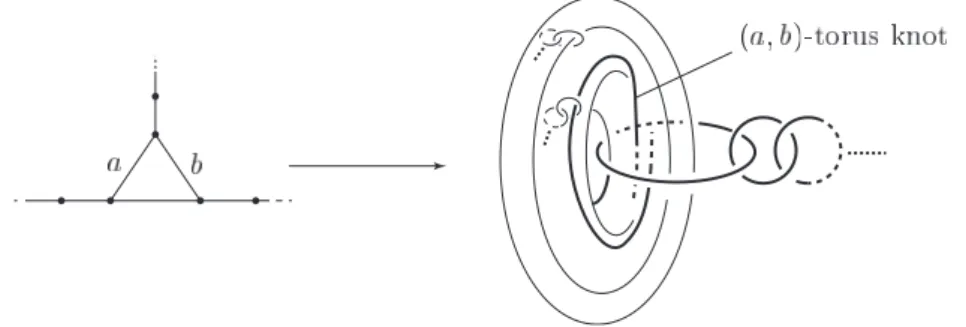
Let (G, a, b, c) be a 1-cycled weighted graph Gas in the left of Figure 9. The labels on two edges on G are given by 3 integers labeled by a, b with gcd(a, b) = 1 as drawn in the figure and the other (unlabeled) edges are labeled by 1. The weight on the vertex intersected by the two edges witha
and bis−2c and the other (unweighted) vertices are weighted by−2. Such a graph can give a smooth 4-manifold with a boundary. This description by a weighted graph is just a short hand to describe a bounding 4-manifold. It is similar to the plumbing graph with cycles, however, they are different objects each other.
The handle diagram of the manifold is drawn in Figure 9. The component weighted by −2cis the (a, b)-torus knot.
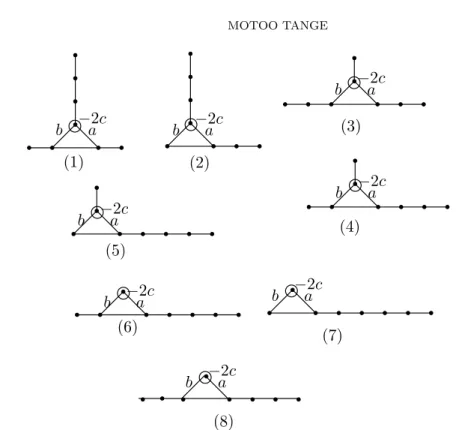
Theorem 1.6. A quadruple (G;a, b, c) in Table 1 with gcd(a, b) = 1 gives a Brieskorn homology 3-sphere Σ with g8(Σ) = 1 and ϵ(Σ) = −1. Here G
(from (1) to (8)) is one of graphs in Figure 1.
In the case of ((1); 1, b, c), for some non-negative integerm the homology 3-spheres Σ(p, q, r) with the pairs p, q, r in Table 2 have boundings with
g8= 1 and ϵ=−1.
Hence, any Brieskorn 3-sphere above satisfies g8(Σ) = 1.
TheseE8-boundings are constructed by blow-downs of minimal,
negative-definite resolutions of Brieskorn singularities.
1.4. Other examples. LetYn− denote Σ(2,3,6n−1). Then the Neumann-Siebenmann invariant ¯µis computed as follows:
(3) µ¯(Yn−) =
{
−1 n≡1 mod 2 0 n≡0 mod 2.
As a corollary of Theorem 1.2 [18], if ds(Yn−)<∞, theng8(Y−
THE E8-BOUNDINGS OF HOMOLOGY SPHERES AND NEGATIVE SPHERE CLASSES INE(1).7
G a b c
(1) 3k−2ℓ±2 −2k+ 3ℓ∓2 3k2−4kℓ+ 3ℓ2±2(2k−2ℓ) + 2 (2) 4k−ℓ±2 −3k+ 2ℓ∓2 6k2−3kℓ+ℓ2±2(3k−ℓ) + 2 (3) 4k−3ℓ±2 −3k+ 4ℓ∓2 6k2−9kℓ+ 6ℓ2±2(3k−3ℓ) + 2
(4) 5k−2ℓ±2 −4k+ 3ℓ∓2 10k2−8kℓ+ 3ℓ2±2(4k−2ℓ) + 2
(5) 6k−ℓ±2 −5k+ 2ℓ∓2 15k2−5kℓ+ℓ2±2(5k−ℓ) + 2
(6) 12k−4ℓ±3 −10k+ 6ℓ∓3 60k2−40kℓ+ 12ℓ2±6(5k−2ℓ) + 4
(6) 12k−4ℓ±5 −10k+ 6ℓ∓5 60k2−40kℓ+ 12ℓ2±10(5k−2ℓ) + 11
(6) 12k−4ℓ±1 −10k+ 6ℓ 60k2−40kℓ+ 12ℓ2±10k+ 1 (6) 12k−4ℓ±3 −10k+ 6ℓ∓2 60k2−40kℓ+ 12ℓ2±2(15k−4ℓ) + 4 (7) 14k−2ℓ±3 −12k+ 4ℓ∓3 84k2−24kℓ+ 4ℓ2±6(6k−ℓ) + 4 (7) 14k−2ℓ±5 −12k+ 4ℓ∓5 84k2−24kℓ+ 4ℓ2±10(6k−ℓ) + 11 (7) 14k−2ℓ±2 −12k+ 4ℓ∓1 84k2−24kℓ+ 4ℓ2±2(12k−ℓ) + 2 (7) 14k−2ℓ±4 −12k+ 4ℓ∓3 84k2−24kℓ+ 4ℓ2±6(8k−ℓ) + 7 (8) 4k−3ℓ 4ℓ±1 16k2+ 6ℓ2±3(2k+ℓ) + 1 (8) 4k−3ℓ±1 4ℓ±3 16k2+ 6ℓ2±(26k+ 9ℓ) + 14
Table 1. The negative-definiteE8-boundings for (G;a, b, c)
inFigure1
p q r
10i+ 7 15i+ 8 120i2+ 148i+ 45 10i+ 3 15i+ 2 120i2+ 52i+ 5 20i−8 30i−17 480i2−464i+ 109 20i+ 8 30i+ 7 480i2+ 304i+ 45 30i−13 45i−27 1080i2−1116i+ 281
30i−7 45i−18 1080i2−684i+ 101 30i+ 7 45i+ 3 1080i2+ 324i+ 17 30i+ 13 45i+ 12 1080i2+ 756i+ 125
20i+ 2 30i−7 480i2−64i−11
20i−2 30i−23 480i2−256i+ 21
10i+ 7 15i−2 120i2+ 68i−365
10i+ 13 15i+ 7 120i2+ 212i+ 73
60i−28 90i−57 4320i2−4752i+ 1277 60i−8 90i−27 4320i2−1872i+ 173 60i+ 8 90i−3 4320i2+ 432i−19 60i+ 28 90i+ 27 4320i2+ 3312i+ 605
Table 2. Brieskorn homology 3-spheres Σ(p, q, r) from the blow-downs of the minimal resolution of negative-definite plumbings.
Theorem 1.7. For 0 ≤ k ≤ 12 or k = 14, we have ds(Y−
2k+1) < ∞. In
(1)
a
b −2c b −a2c
−2c a b
−2c a b
−2c a b
−2c a b
−2c a b
(2)
(3)
(4) (5)
(6)
(7)
b −a2c
(8)
Figure 1. The 8 possible configurations with −E8
-intersection form. All the unweighted components are −2 and all the labels with unlabeled is +1.
The boundings cannot be obtained by the minimal resolution or blow-downs of minimal resolutions. Actually, these boundings can be embedded inE(1) and the complements are Gompf’s nuclei N2k+1.
1.5. Embedded spheres in E(1). LetE(1) be an elliptic fibration diffeo-morphic toCP2#9CP2. According to Li and Li’s result in [7], the spherical
realization of the following negative classes in E(1) has been studied:
Theorem 1.8 (Li-Li [7]). InH∗(CP2#nCP2) with 1≤n≤9 all classes ξ
with 0> ξ2 >−(n+ 7), have minimal genus0.
As a by-product of Theorem 1.7 we can obtain the following theorem:
Theorem 1.9. Let f and s be the general fiber and a section of elliptic fibration in E(1). We put ak:=k[f]−[s]∈H2(E(1)). For any 0≤k≤12
or k= 14, the class ak represents an embedded sphere in E(1).
This intersection number of ak is −2k −1. Theorem 1.9 can be also compared with following Finashin and Mikhalkin’s theorem:
Theorem 1.10 (Finashin-Mikhalkin[9]). There exists a smooth embedding ofS2 into anE(2)with the normal Euler number equal tonfor any negative
even n≥ −86.
THE E8-BOUNDINGS OF HOMOLOGY SPHERES AND NEGATIVE SPHERE CLASSES INE(1).9
k≤42. We will post a question (Question 5.7) on the sphere class ofak in
E(n) in the last section.
Acknowledgements. The results in this article are partially done when I visited in Michigan State University in 2013 spring. I am grateful for useful comments by S. Akbulut and the hospitality of the institute.
2. Basic properties of invariants ds and g8.
We will prove the basic properties ondsandg8. Let Θ3Z denote the group
of the homology 3-spheres up to homology cobordism.
Theorem 2.1. Let ds′ be one of ds, ds and g8′ denote g8, or g8. Then the
following properties are satisfied:
(1) The ds′ and g8′ are homology cobordism invariants i.e., ds′ : Θ3Z → N∪ {0,∞}.
(2) ds(Y) = 0 or g8(Y) = 0, if and only if [Y] = 0 in Θ3Z.
(3) If ds(Y), g8(Y)<∞, then µ(Y)≡ds′(Y)≡g8′(Y)≡0 mod 2
(4) If ϵ(Y1)ϵ(Y2) = 1, then ds(Y1) +ds(Y2)≤ds(Y1+Y2).
(5) If ϵ(Y1)ϵ(Y2) = 1, then ds(Y1+Y2)≤ds(Y1) +ds(Y2).
(6) If ds(Y) = 1, then g8(Y) = 1.
(7) ds(−Y) =ds(Y) and ds(−Y) =ds(Y).
(8) g8(−Y) =g8(Y) and g8(−Y) =g8(Y).
(9) If 0<ds(Y)<∞, then ϵ(Y)d(Y)<0 and ds(Y)≤ |d(Y)|/2.
(10) If ds′(Y) or g8′(Y) is odd, then |Y|=∞.
(11) If ds(Y) is even, then we haveds(Y) + 1≤ |Y|.
(12) If |Y|= 1,2, then ds(Y) =∞.
(13) If ϵ(Y)̸=∞, then 2ds(Y)≤m(ϵ(Y)Y)≤m(ϵ(Y)Y)≤18ds(Y).
(14) If ϵ(Y)is finite andds(Y)<ds(Y), thends(Y)−ds(Y)≤8(ds(Y) +
1) holds.
(15) Suppose that Y is a Seifert homology 3-sphere. If ds(Y)<∞, then
¯
µ(Y)ϵ(Y)>0 andds(Y)≤ |µ¯(Y)|.
Proof. (1) Suppose that Y, Y′ are homology cobordant homology
3-spheres. If ds′(Y) < ∞, then there exists a definite spin bounding W of Y with maximal (or minimal) b2. Connecting between Y and Y′ by the
cobordism, we get bounding W′ of Y′ with a maximal (or minimal) b 2. If ds′(Y) =∞ andds′(Y′) is finite, then we get a definite spin bounding ofY.
This is contradiction. Thus, if ds′(Y) =∞, then ds′(Y′) =∞
(2) SupposeY is a homology 3-sphere withds(Y) = 0. ThenY bounds a
homology 4-ball W. Puncturing W, we get a homology cobordism between
Y andS3.
(3) Suppose that W is any definite spin bounding of Y. Then by the definition ofµ we haveb2(W)/8≡µ(Y) mod 2.
(4,5) From the properties of maximal and minimal, we have the inequal-ities by taking the boundary sum of the two definite bounding.
(7,8) The definition ofds and g8 does not depend on the orientation.
(9) From the inequality (2) the inequalities hold.
(10) If ds′(Y) or g8′(Y) is odd, then µ(Y) = ds(Y) ̸= 0 mod 2, thus we
have |Y|=∞.
(11) If ds(Y) is even, then |Y|<∞ holds. Then we get a closed spin
4-manifold by gluing the two boundings. The intersection form is isomorphic tods(Y)·(−E8)⊕ |Y| ·H. Furuta’s inequality implies|Y| ≥ds(Y) + 1.
(12) If |Y| = 1,2 and ds(Y) is finite, then due to Furuta’s inequality
2≥ds(±Y) + 1 holds. Sinceds(Y) is even, thends(Y) = 0 namely [Y] = 0
in Θ3Z. This contradicts to|Y|>0.
(13) Let Y be a homology sphere with ϵ(Y) ̸= ∞. We denote ||Y|| :=
ϵ(Y)(Y). Then ||Y|| has a positive definite spin boundingX and
m(||Y||)/2 ≥ max{5σ(X)/8−b2(X)/2|∂X =||Y||and σ(X) =b2(X)}
= ds(||Y||) =ds(Y)
m(||Y||)/2 ≤ min{5σ(X)/8 +b2(X)/2|∂X =||Y|| and σ(X) =b2(X)}
= 9ds(||Y||) = 9ds(Y)
(14) LetX1, X2 be two negative-definite spin boundings withb2(Xi) =βi and 0 < β1 < β2. Then the invariants of the capped closed spin manifold X =X2∪(−X1) are b2(X) =β1+β2 and σ(X) =β2−β1. From Furuta’s
inequality in [5], we haveβ2 ≤9β1+ 8.
ds(Y)<ds(Y)≤9ds(Y) + 8
Consequently, ds(Y)−ds(Y)≤8(ds(Y) + 1) holds.
(15) By the result in Theorem 1.2, we get the bound of theds-invariant.
□ Here one of motivations for studying invariantsds, andg8 is to give
coun-terexamples to the (11/8)-conjecture. We give a proof of Proposition 1.1. Proof of Proposition 1.1. Suppose Y is a homology 3-sphere with
µ(Y) = 0,ds(Y)<∞and 2|Y|<3ds(Y). LetX1, X2 be two spin bounding
4-manifolds satisfying∂X1 =Y and ∂X2=−Y, whereX1 is a definite spin
4-manifold and QX2 ∼= nH. Gluing X1 and X2 along Y we get a closed
spin 4-manifold with QX1∪X2 ∼=mE8⊕nH. In particular, we may assume
n = |Y| and m = ds(Y). Thus, n < 3|m|
2 holds. The manifold X violates
the (11/8)-conjecture.
Let X be a closed, smooth, oriented, spin, simply-connected 4-manifold with QX = 2k(−E8) ⊕ lH. Then according to [10] there exists a ho-mology 3-sphere Y cutting the intersection form, i.e., X = X1 ∪Y X2
and QX1 ∼= 2k(−E8) and QX2 ∼= lH and ∂X2 = Y. Thus Y satisfies
µ(Y) = 0 and ds(Y) < ∞ and Xi is homologically 1-connected. Hence, l≥ |Y| ≥ 3
2ds(Y)≥ 32|2k|= 3|k|. This implies (11/8)-conjecture for
simply-connected 4-manifolds. □
THE E8-BOUNDINGS OF HOMOLOGY SPHERES AND NEGATIVE SPHERE CLASSES INE(1).11
3.1. Milnor-fiber construction. The Milnor-fiberM(p, q, r) is the 4-manifold defined as the compactification of
{(x, y, z)∈C3|xp+yq+zr=ϵ},
whereϵis some constant. The boundary is the Brieskorn rational homology 3-spheres Σ(p, q, r). If each two elements in {p, q, r} are relatively prime, then the Brieskorn 3-sphere is a homology 3-sphere. The Milnor-fibers are nice examples of spin bounding. As mentioned at the Exercise 7.3.18. in Section 7.3, in [11] p.265, for integersp, q, r, p′, q′, r′ withp≤p′,q ≤q′ and
r ≤ r′, there exists the inclusion M(p, q, r) ֒→ M(p′, q′, r′). This gives a
cobordism between Σ(p, q, r) and Σ(p′, q′, r′).
Proof of Theorem 1.3. Here, consider the following natural inclusion:
M(2,3,6n−5)֒→M(2,3,6n−1).
The induced cobordism Xn between Σ(2,3,6n−5) and Σ(2,3,6n−1) has intersection form −E8. In fact, from Novikov’s additivity, σ(M(2,3,6n−
1)) = σ(M(2,3,6n−5) + σ(Xn) holds, hence, σ(Xn) = −8. Since the boundary ofXnis diffeomorphic to−Σ(2,3,6n−5)∪Σ(2,3,6n−1), andXnis spin,QXn must be isomorphic to−E8 from the classification of unimodular
definite even quadratic forms.
By removing one 3-handle fromXn, we get a cobordismWnfrom a punc-tured Σ(2,3,6n−5) to punctured Σ(2,3,6n−1). The manifold Wn satis-fies ∂Wn = Mn and QWn ∼= −E8. From the construction of Wn we have
H1(Wn,Z) ∼= H1(Xn,Z) clearly. Since Xn is obtained by attaching 8 2-handles on the boundary of Σ(2,3,6n−5)×I, there exists a surjection
{0} = H1(Σ(2,3,6n−5),Z) → H1(Xn,Z). Therefore Wn is homologically 1-connected.
On the other hand, sinced(Mn) =d(Σ(2,3,6n−1)−d(Σ(2,3,6n−5) = 2−0 = 2, we get ds(Mn) =g8(Mn) =ϵ(Mn) = 1. □
3.2. The minimal resolution. LetW(G) be a plumbed 4-manifold asso-ciated with a graphG, which is a tree weighted by integers.
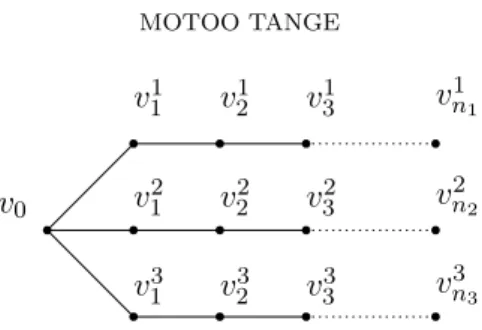
Definition 3.1. Let Gbe a connected star-shaped graph as in Figure 2. The ‘star-shaped’ means the graph has at most one n-valent vertex with n≥ 3. Let {v0, vji} be the vertices andm0 and m
j
i be the weights of the vertices v0
and vij. That is, the unique vertex v0 is at least 3-valent and the valencies
of the other vertices are all 1 or 2. If G satisfies the following properties, we call the graph G is minimal:
(1) The incidence matrix is negative-definite.
(2) m0 ≤ −1.
(3) mji ≤ −2.
v0
v1
1 v21 v31 vn11
v12 v22 v32 vn22
v3
1 v23 v33 vn33
Figure 2. A Seifert diagram with three branches.
LetGbe a weighted graph. We give a lemma for finding types ofGwhich give homology spheres. Let Vert(G) be the set of vertices of G. Let det(G) be the determinant of the incident matrix of G.
Lemma 3.1. Let v ∈ Vert(G) be a 1-valent vertex with weight m(v) and
Gp the graph from G obtained by adding the weight m(v) by p > 0. Then det(G)≡det(Gp) modp.
Let w be the vertex connecting to v and G0 a graph obtained by deleting v and w. If m(v)≡0 modp, det(G)≡ −det(G0) modp.
Proof. Let m(v) be the weight of v and ˜G the graph obtained by deleting v fromG. Expanding the determinant det(G), we have
det(G) =m(v) det( ˜G)−det(G0) mod≡ p(m(v)+p) det( ˜G)−det(G0) = det(Gp).
The latter assertion follows from
det(G) =m(v) det( ˜G)−det(G0) mod≡ p−det(G0).
□ If the lengths of branches of the Seifert diagram aren1, n2,· · · , nk, we say that the Seifert diagram haslength type(n1, n2,· · · , nk). For example, Fig-ure2 has length diagram (n1, n2, n3). LetG(n1,···,nk)be a weighted graph of
the length type (n1,· · · , nk) with all weights even. G(1) is a weighted graph
having one vertex with weight even, namely det(G(1))≡0 mod 2. Note that the following lemma holds.
Lemma 3.2.
det(G1∪G2) = det(G1) det(G2).
det(G(n,1,1,···,1))≡0 mod 2
Proof. Since anyv∈G1andw∈G2are not connected, the determinant is computed as det(G1∪G2) = det(G1) det(G2). By using Lemma 3.1, we
have
det(G(n,1,1,···,1))≡det(G(1,1,···,1))≡det(G(1)∪ · · · ∪G(1))≡0 mod 2.
THE E8-BOUNDINGS OF HOMOLOGY SPHERES AND NEGATIVE SPHERE CLASSES INE(1).13
Proposition 3.1. Let Σ(p, q, r) be a Brieskorn homology 3-sphere whose minimal resolution with negative-definite gives an E8-bounding with b2 = 8.
Then Σ(p, q, r) = Σ(2,3,5)or Σ(3,4,7).
Proof. The minimal resolution graph of the Seifert structure we require is rank= 8, unimodular, negative-definite and even. Since the graph is even, the weight of the central vertex is−2.
In general, consider negative definite resolutions graph for Σ(a1,· · ·, an)
with all vertices ≤ −2 except at the central vertex. Let ebe the weight of the central vertex of the graph. It is well-known that e has the restriction
−1−n < e≤ −1. This inequality is obtained by computing the 1st homology of the Brieskorn homology sphere. In this case since n= 3 and eis even,e
must be −2.
The three possible lengths n1 ≥ n2 ≥ n3 of branches are (n1, n2, n3) =
(4,2,1),(3,2,2), in fact other ones (5,1,1),(3,3,1) cannot be unimodu-lar. Because det(G(5,1,1)) ≡ 0 mod 2 and G(3,3,1) ≡ G(1,1,1) ≡ 0 mod 2
(Lemma 3.1).
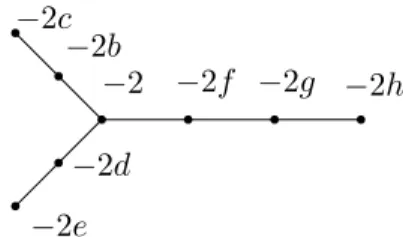
Let us consider Seifert manifolds with length type (3,2,2) as in Figure 3, where b, c, d, e, f, g, h are positive integers. Then we put an integer D as follows:
X:= 2− 4gh−1
2(4f gh−f−h) − 2c
4bc−1 − 2e
4de−1 =
D pqr.
Dis the determinant of the resolution graph andp, q, rare the multiplicities of the Seifert manifolds, namely, p = 2(4f g−f −h), q = 4bc −1 and
r= 4de−1. We find cases where the Seifert manifold is a homology sphere. Since the Seifert manifold is a homology sphere, any two ofp, q, ris coprime andDis one. HereXis a function of variablesb, c, d, e, f, g, h. The maximal value of D/pqrfor the Brieskorn homology spheres Σ(p, q, r) is 1/30, which is the case of the Poincar´e homology sphere.
Here−2(4f gh4gh−−1f−h),− 2c
4bc−1, and−4de2e−1 are increasing functions, because
all partial derivatives inb, c, d, e, f, gare positive functions on the each point. Since f, g, h are natural numbers, −2(4f gh4gh−−1f−h) ≥ −34 holds. Now, we as-sume bc≥2 andde≥2. then we have
X ≥ 5
4− 4 7b−
4 7d ≥
5 4 − 8 7 = 3 28 > 1 30
Thus, this case is not a homology sphere. From the symmetry of the graph we may assumed=e= 1. This means thatr= 3 holds.
Then, further, if b≥2, then
X≥ 5
4 − 2c
8c−1 − 2 3 ≥ 7 12 − 2 7 = 25 84 > 1 30. Thus, this case does not occur.
Suppose that b=d=e= 1. If c >2, then we have
X ≥ 7
12− 2c
Thus we havec= 1,2. Ifc= 2 holds, thenq = 7 and
X≥ 7
12 − 4 7 =
1 84,
hence p≤4 holds. Further, since p= 2(4f gh−f−h)≥4, we have p= 4. Hence f = g = h = 1. This case corresponds to the Brieskorn 3-sphere Σ(3,4,7).
If we supposec= 1, then q= 3 holds. This is contradiction to what p, q
are relatively prime.
In the case of (4,2,1),Xtakes the minimal value among negative definite quadratic even forms, when all weights are −2. This is the Σ(2,3,5) case. On the other hand, the Σ(2,3,5) takes the maximal value 1/30 in all the Brieskorn homology spheres Σ(p, q, r)̸=S3. Thus, this means that all Seifert homology spheres with even form and lengths (4,2,1) is (p, q, r) = (2,3,5)
only. □
−2 −2f −2h
−2b
−2c
−2g
−2d
−2e
Figure 3. The resolution graph with type (3,2,2).
Proposition 3.2. Let Σ(a1, a2,· · · , an) be a Brieskorn homology 3-sphere
with n≥4. Suppose that the minimal resolution graph is even and rank 8. Then n= 4 and the Brieskorn 3-spheres are Σ(2,3,7,11), Σ(2,3,7,23), or
Σ(3,4,7,43).
Proof. The partitions of 7, the number of whose parts is more than 3, are the following 7 types. (4,1,1,1), (3,2,1,1), (2,2,2,1), (3,1,1,1,1), (2,2,1,1,1), (2,1,1,1,1,1), and (1,1,1,1,1,1,1). By using Lemma 3.2, the determinants of G(4,1,1,1), G(3,1,1,1,1), G(2,1,1,1,1,1), G(1,1,1,1,1,1,1) are even. In
the casesG(3,2,1,1) and G(2,2,1,1,1), since
det(G(3,2,1,1))≡det(G(3,1,1))≡0 mod 2
det(G(2,2,1,1,1))≡det(G(2,1,1,1))≡0 mod 2,
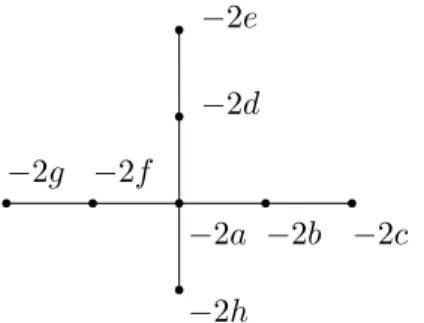
these do not occur. The type (2,2,2,1) has det = 1 mod 2. Let D be the determinant for the graph of type (2,2,2,1) in Figure4. We may assume the type (2,2,2,1). The parametersa, b, c, d, e, f, g, h are positive numbers.
(4) X:= 2a− 1
2h −
2c
4bc−1 − 2e
4de−1 − 2g
4f g−1 =
D pqrs
where p= 2h,q = 4bc−1,r = 4de−1, ands= 4f g−1. Since any two of
p, q, r, sis coprime, we have pqrs≥2×3×7×11 = 462.
THE E8-BOUNDINGS OF HOMOLOGY SPHERES AND NEGATIVE SPHERE CLASSES INE(1).15
−2a −2b −2c
−2d
−2e
−2f
−2g
−2h
Figure 4. Resolution graph with type (2,2,2,1).
First, the central weight −2a is −2 or −4, because the above inequality
−1−4<−2a <0 impliesa= 1 or 2. We may assume that q≤r≤sfrom symmetry of the graph.
[The case of a = 2.] Suppose that a = 2. Note that −4f g2g−1 is an increasing function off, g. By usingb, c, d, e, f, g, h≥1, we have
X≥4−1
2 −3× 2 3 ≥
3 2. This case does not satisfyD= 1.
[The case of a= 1.]
Suppose that h≥3. Then we have
X≥2−1
6 − 2 3 − 4 7 − 6 11 ≥ 23 462 > 1 924. Thus we haveh= 1,2.
We assume that h = 2, i.e., p= 4. Suppose that bc ≥2. Then we have
de≥3,f g≥4 and
X≥ 7
4 − 4 7− 6 11− 8 15 ≥ 461 4620 > 1 924.
Hence, we have bc= 1 holds, then b=c= 1 and q = 3. If de≥3, then we have f g≥4 and
X≥ 7
4 − 2 3 − 6 11 − 8 15 ≥ 1 220 > 1 924.
Hence, we have de = 2. Thus r = 7 and (d, e) = (1,2) or (2,1). If (d, e) = (2,1), then −4de2e−1 =−27. Since f g≥3,
X≥ 7
4 − 2 3 − 2 7− 6 11 ≥ 233 924 > 1 924.
Thus we must have (d, e) = (1,2). Suppose thatf g≥3 andf ≥2, then
X≥ 7
4 − 2 3 − 4 7− 3 11 ≥ 221 924 > 1 924. Thusf = 1 holds. Ifg≥12 holds, then
X≥ 7
When 3≤g≤11, in the case of D= 1 we have g= 11 only. The case of (b, c, d, e, f, g, h) = (1,1,1,2,1,11,2) corresponds to Σ(3,4,7,43).
We assume that h= 1. Then the maximal value of D/pqrsof homology spheres with type (2,2,2,1) is 1/(2·3·7·11) = 1/462.
Suppose that bc≥2. Then we have de≥3,f g≥4. Furthermore, we suppose thatb≥2,d≥2, orf ≥2.
X≥ 3
2 − 4 7b −
6 11d−
8 15f >
1 462.
Thusb=d=f = 1 holds, andc≤e≤g holds. Then, we have
X= 3 2−
2c
4c−1− 2e
4e−1 − 2g
4g−1 ≤ 3 2 −
6g
4g−1 <0. Hence,bc= 1 holds, i.e.,q= 3 holds.
Suppose that bc= 1, i.e., b=c = 1 and q = 3. If de≥3, then we have
f g≥4 and
X≥ 3
2 − 2 3 − 6 11 − 8 15 ≥ 1 220 > 1 462. Hence, we havede= 2. Thusq = 7 and (d, e) = (1,2) or (2,1).
If (d, e) = (2,1), then − 2e
4de−1 =−27. Sincef g≥3, X≥ 3
2 − 2 3 − 2 7− 6 11 = 1 462.
Hence, the required only case is the one satisfying the equality. Thus (b, c, d, e, f, g, h) = (1,1,2,1,1,3,1) and (p, q, r, s) = (2,3,7,11).
If (d, e) = (1,2) and f = 1, then
X= 3 2 − 2 3− 4 7− 2g
4g−1 < 11 42−
1 2 =
−5 21 <0. Thus we assume that f ≥2. Iff g≥7, then we have
X≥ 3
2 − 2 3 − 4 7 − 14 27f ≥
1 378 >
1 462.
Hence, this case does not occur. Suppose thatf ≥2 andf g≤6. Computing
X, we obtain (f, g) = (2,3) only. This case corresponds to (p, q, r, s) = (2,3,7,23).
□ Proof of Theorem 1.4. The rest part in the assertion is the computation ofds. From the inequality (2) by Ozsv´ath and Szab´o, the required assertion
follows. In fact, the d-invariants of those Brieskorn homology 3-spheres below are all 2 by N´emethi’s algorithm in [14],
Σ(2,3,5), Σ(3,4,7), Σ(2,3,7,11), Σ(2,3,7,23), Σ(3,4,7,43).
Hence, these manifolds are allg8 = 1. □
In the following, we prove Theorem 1.5.
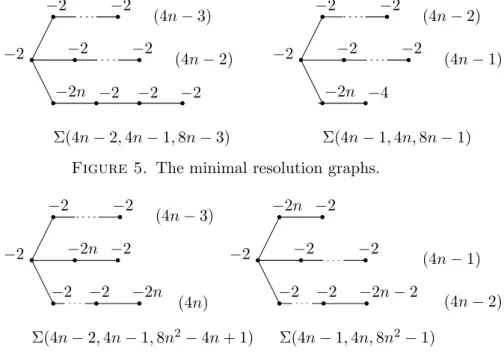
Proof of Theorem 1.5. The minimal resolution graphs of Σ(4n−2,4n−
1,8n−3), Σ(4n−1,4n,8n−1), Σ(4n−2,4n−1,8n2−4n+ 1), and Σ(4n−
1,4n,8n2−1) are Figure5 and 6. The numbers of the parentheses are the
THE E8-BOUNDINGS OF HOMOLOGY SPHERES AND NEGATIVE SPHERE CLASSES INE(1).17
−2 −2
−2 −2
−2n −2 −2 −2
−2 (4n−2)
Σ(4n−2,4n−1,8n−3)
−2 −2
−2 −2
−2n −4
−2
(4n−2)
(4n−1)
Σ(4n−1,4n,8n−1) (4n−3)
Figure 5. The minimal resolution graphs.
−2 −2
−2n −2
−2
(4n)
Σ(4n−2,4n−1,8n2−4n+ 1)
−2n −2
−2 −2
−2
(4n−2) (4n−1)
Σ(4n−1,4n,8n2−1)
−2n
−2 −2
(4n−3)
−2 −2 −2n−2
Figure 6. The minimal resolution graphs.
The intersection forms of these minimal resolution graphs are not isomor-phic to n(−E8) forn >1. It follows from the argument below. Any vector
with square−2 inn(−E8) is contained in a−E8-component, because−E8is
a definite matrix. Furthermore, there exists no 9 vectorsx1,· · · , x9in−nE8
satisfyingx2i =−2 andxi·xi+1 = 1 (i= 1,· · · ,8). In fact such vectors must
be in a common−E8-component in−nE8, becausexi·xi+1= 1 implies that xi andxi+1 are in a same−E8-component. However since these vectors are
linearly independent, they cannot be embedded in a−E8. Therefore, any of
4 minimal resolution graphs inFigure5 and 6 is not isomorphic ton(−E8)
when n > 1. We do not know whether the homology 3-spheres have other boundings withg8=nand ϵ=−1.
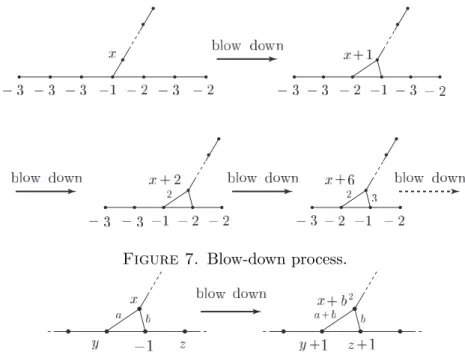
3.3. Blow-downs of the minimal resolution. In general, any minimal resolution is a negative-definite bounding with possibly not even. But there are some−1-spheres in the bounding 4-manifold. By performing blow-downs of the spheres we can get a smaller bounding. The new bounding is not a resolution any more. In this section, we give several E8-boundings with g8 = 1 and ϵ = −1 by using the blow-down of the minimal resolutions of
between the two components. In the same way we get the fourth diagram. Here the (x+ 6)-framed component is the (2,3)-torus knot. Here we deal with the diagram as in the left of Figure 9. This diagram stands for the handle diagram in the right of the Figure 9. In this paper such a graph is called a configuration and any graph obtained by several blow-downs of a Seifert plumbing graph is calleda blow-downed configuration. The integer associated with any vertex is called a weight and that with any edge is called alabel. The incidence matrix for the configuration naturally gives the quadratic form for the bounding 4-manifold.
Each step of the blow-down performances is based on the formula in Figure 8. Here, if the x-framed component in the figure is the (a, b)-torus knot, then the next (x+b2)-framed component is the (a+b, b)-torus knot.
Figure 7. Blow-down process.
Figure 8. A blow-down formula on configurations.
Let G0 be a 1-cycled graph with three edges with labels {a, b,1}. The
weight of the vertex intersecting two edges with a, bis−2c. The graphGis the union ofG0 and linear edges connecting the three vertices. See the right
ofFigure9. We call the graphGabranched triangular configuration. Here, we must note that this graph represents not a usual plumbing graph but a simply-connected 4-manifold constructed by attaching 2-handles according to the graph.
Proposition 3.3. Let G be a branched triangular configuration. The pair
(G;a, b, c) with gcd(a, b) = 1 in Table 1 is the blow-downed configurations with type (1) to (8) in Figure 1, whose intersection form is presented by
THE E8-BOUNDINGS OF HOMOLOGY SPHERES AND NEGATIVE SPHERE CLASSES INE(1).19
Note that configurations (1) to (8) are not all the blow-downed, branched triangular configurations with−E8 intersection form.
Figure 9. The actual handle diagram with branched trian-gular configuration.
Proof. We consider configurations in Figure 1. Other branched triangular configurations with rank 8 cannot be a unimodular form. Let
G(−2c, a, b;n1, n2, n3) be a branched triangular configuration as in Fig-ure 10 with all weights −2. Then in the case of G(−2c, a, b; 5,0,0), we have
det(G(−2c, a, b; 5,0,0)) =−15−12a2−12ab−12b2+ 36c≡0 mod 3.
This case does not occur. In the case ofG(−2c, a, b; 4,1,0), we have det(G(−2c, a, b; 4,1,0)) =−16−15b2−20ab−20a2+ 40c≡ −1 mod 5.
This case also does not occur. In the cases ofG(−2c, a, b; 2,3,0) orG(−2c, a, b; 2,2,1), the determinants are all divisible by 3. Thus these cases do not occur.
−2c n1
n3 n2
a b
Figure 10. The definition ofG(−2c, a, b;n1, n2, n3).
Computing the determinants of the 8 examples, we obtain the equations:
Figure 11. Blow-up process by the Euclidean algorithm.
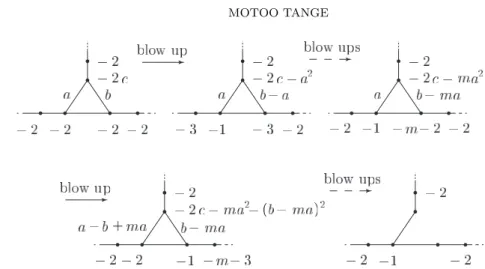
The positive integral solutions {a, b, c}in these equations give the negative-definite E8-boundings with configurations from (1) to (8). If a and b are
relatively prime, then these pairs (G;a, b, c) are blow-downed configurations by iterating several blow-ups in accordance with the Euclidean algorithm for relatively prime (a, b) as inFigure 11.
Suppose that {a, b} is a relatively prime solution with a < b. Let m
denote the minimum positive number satisfyingb−ma < a. We iterate the blow-up process (the inverse of Figure 8) m-times at the left bottom angle in the triangle as in the first configuration inFigure11. Next, exchanging the role of a and b−ma, we continue to perform the blow-up at the right bottom angle. Applying the Euclidean algorithm to this blow-up process in this way, we obtain the star-shaped graph which all labels are +1 and all weights are smaller than or equal to−2 except for the central vertex of weight −1.
In consequence, the pair (a, b, c) in the Table1 with relatively primea, b
can give a Brieskorn homology 3-sphere withE8-bounding withϵ=−1. □
Proposition 3.4. Let G be the configuration (1) in Figure 1. The integral solutions a, b, c in Table 1 with a≤6 are Table 3:
Proof. Let us take a= 1 in the case of (1). Then for some integer m
we have k= 2m+ 1,ℓ= 3m±1 + 1 andb= 5m+ 1±1. Thus we get
c= 15m2+ 16m+ 5, or 15m2+ 4m+ 1
THE E8-BOUNDINGS OF HOMOLOGY SPHERES AND NEGATIVE SPHERE CLASSES INE(1).21
a b c a b c
1 5i−3 15i2−14i+ 4 1 5i 15i2+ 4i+ 1 2 10i−7 60i2−68i+ 21 2 10i+ 1 60i2+ 28i+ 5 3 15i−11 135i2−162i+ 52 3 15i−8 135i2−108i+ 25
3 15i−1 135i2+ 18i+ 4 3 15i+ 2 135i2+ 72i+ 13
4 10i−5 60i2−28i+ 9 4 10i−7 60i2−52i+ 17
5 5i−4 15i2−4i+ 9 5 5i−1 15i2+ 14i+ 12
6 30i−23 540i2−684i+ 229 6 30i−13 540i2−324i+ 61
6 30i−5 540i2−36i+ 13 6 30i+ 5 540i2+ 324i+ 61 Table 3. The pairs (a, b, c) (i≥0) are blow-downed config-urations with (1) with−E8intersection form and witha≤6.
Thus, by using Theorem 1.2 we have g8 =g8 =ds=ds = 1. These data
give Brieskorn homology 3-spheres as in Table 2. □
3.4. The negativeE8 boundings ofΣ(2,3,6n−1). We restrict ourselves
to Σ(2,3,6n±1). Let denoteY−
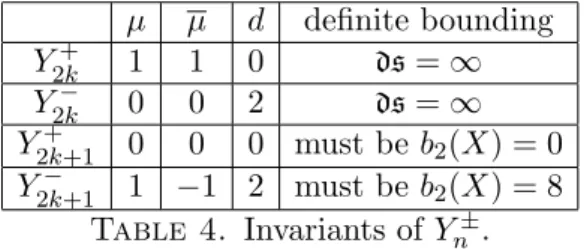
n = Σ(2,3,6n−1) andYn+= Σ(2,3,6n−5). The invariants µ,µand dfor Yn± are represented as in Table 4. We focus on bounding 4-manifolds of Y2−k+1. The minimal resolution Rn for Yn− is
µ µ d definite bounding
Y2+k 1 1 0 ds=∞ Y2−k 0 0 2 ds=∞ Y2+k+1 0 0 0 must beb2(X) = 0 Y2−k+1 1 −1 2 must beb2(X) = 8
Table 4. Invariants ofYn±.
Figure 12. The intersection form of Rn is isomorphic to −E8 ⊕n−1 ⟨−1⟩.
−2
−2
−2
−2
−2
−2 −2 −2 −3 −2 −2
n−2
Figure 12. The minimal resolution graph of Yn−.
Any square −1 class in Rn cannot be realized as a sphere, in other words the following holds:
Proposition 3.5. The 4-manifoldRn can be never blow-downed any more.
Namely, the minimal genus of any square −1 class inRn is positive. Proof. Since by replacing any component in Figure12 with a Legen-drian knot as in Figure13, we can get a Stein surface onRn.
the Thurston-Bennequin invariant. Here we use the formula
tb(K) =w(K)−λ(K),
for the computation of tb(K). Here w is the writhe of the Legendrian knot andλis the number of left corners of the Legendrian knot. For example, in the cases of Figure13, the first and the second examples are as follows:
tb(K1) = 0−1 =−1, tb(K2) = 0−2 =−2.
On the other hand, any Stein structure does not contain any (−1)-sphere due to the result in [8] by Lisca and Mati´c. This means that Rn can be
never blow-downed any more. □
Figure 13. Deformations into Stein structure.
Y2−k+1 has another spin boundingSk as in Figure 14 with the intersection
form isomorphic to −E8⊕
(
0 1 1 0
) .
The direct sum−E8⊕H implies the existence of a homology 3-sphereY
separating −E8 and H. The H-summand corresponds to a 4-manifold X
with QX ∼=H and ∂X =Y. Can such a homology 3-sphere Y be taken as one satisfying [Y] = 0 in the homology cobordism group Θ3
Z? We post the
following question, which is equivalent to ds(Y−
2k+1) = 1 for any k.
−2 −2 −2 −2 −2 −2 −2 −2
−2
2k
Figure 14. The plumbing graph forSk.
Question 3.1. Let k be a positive number. Can any homology 3-sphere Y
in Sk separating the intersection form QSk =−E8 ⊕H (i.e., ∂X =Y and QX ∼=H) bound an acyclic 4-manifold?
3.5. The embedding of Y2−k+1 in E(1). Question 3.1 is unknown, al-though, we can give several negativeE8 boundings forY2−k+1.
In the case ofn= 0, it is well-known thatY1−= Σ(2,3,5) is the boundary of the E8-plumbing. In the case of n= 1, since Y3+ = Σ(2,3,13) bounds a
contractible 4-manifold, we have a homology cobordism
THE E8-BOUNDINGS OF HOMOLOGY SPHERES AND NEGATIVE SPHERE CLASSES INE(1).23
where Mn is defined in Section 3.1. By use of Theorem 1.3, we can give a negative E8-bounding ofY3− with g8 = 1.
Proposition 3.6. For some integer k with 0 ≤ k ≤ 12,14, E(1) can be decomposed along Y2−k+1 so that E(1) = Wk∪Y−
2k+1 N2k+1. Here Wk is a
simply-connected,E8-bounding of Y2−k+1 with g8= 1 andϵ=−1.
Proof. We start from a well-known decomposition E(1) =M(2,3,5)∪
N1, where N1 is the nuclei, which is defined in [11]. Figure 15 (Figure 16
in [1]) is the handle diagram for the decomposition. In the following, we
Figure 15. Figure16 in [1] and the embedding ofN1.
deform the decomposition into other ones via the following 2-handle slide of α in Figure 16. The handle slide by a straight band keeps the framing (the left picture in Figure 16). On the other hand, the handle slide by a twisting band (the right picture inFigure 16) decreases the framing by 4. Therefore, the framings ofαbecome−1 and−5 respectively. We iterate this process to the linear 7-component link connecting the −2-framed 2-handle except the−2-framed 2-handle adjacent to another−1-framed 2-handle. We can realize 2-handleαwith the framings of −1,−5,−9,−13,−17,−21,−25, and −29. These attaching spheres are all unknots. The 2-handles with framing−3,−7,−11,−15,−19, and−23 are obtained by sliding linear
sub-k-chain (0≤k≤5) and the unknot in the 7-component link. For example, Figure 17 realizes a −7-framed unknot by sliding −5-framed 2-handle to an un-connecting−2-framed 2-handle.
This process gives other decompositionE(1) =Wk∪Y−
2k+1N2k+1, wherek is 0≤k≤12 or 14. In fact Wk is a 4-manifold with intersection form −E8 and the boundary is Y2−k+1. The process above preserves the intersection form of the complement. As a result, Wk is a simply-connected 4-manifold with intersection form−E8whose boundary isY2−k+1(0≤k≤12 or 14). The
Figure 16. The straight handle slide and twisting handle slide.
Figure 17. A realization of −7-framed 2-handle.
Proof of Theorem 1.7. The 4-manifoldWk is a negative E8-bounding
ofY2−k+1 for 0≤k≤12 or 14. Thus, for the integerk, we haveg8(Y2−k+1) = 1
and ϵ(Y2−k+1) =−1. □
There exists a homology cobordism Y2+k+1 ≃h (−M2k+1)#Y2−k+1, where≃h
stands for homology cobordant. The homology 3-sphereY2+k+1#(−Y2−k+1) =
−M2k+1 has a ‘positive’ E8-bounding withg8 = 1 by Theorem 1.3. Even if Y2−k+1 has a ‘negative’ E8-bounding with g8 = 1, we do not know whether Y2+k+1 bounds a contractible 4-manifold or not. In general, what condition for homology spheres Y1, Y2 with ϵ(Y1) +ϵ(Y2) = 0 and g8(Yi) = 1 can cancel out the intersection formE8⊕(−E8) into∅? We pose a more general
question (Question 5.8) in the final section.
4. The several sphere classes in E(1).
Theorem 4.1. The classes k[f]−[s] (1≤k≤13 or k= 15) in H∗(E(1))
THE E8-BOUNDINGS OF HOMOLOGY SPHERES AND NEGATIVE SPHERE CLASSES INE(1).25
Proof. Let Ql be the quadratic form by representing by the matrix (
−l 1
1 0
)
. The decomposition Wk ∪Y2k+1 N2k+1 in Proposition 3.6 gives QE(1)=QWk⊕QN2k+1 ∼=−E8⊕Q2k+1. Letα denote the same class as the one in Proposition 3.6. This class is the first class (1,0) in the N2k+1-part.
By applying an isomorphism (Z2, Q2k+1)→(Z2, Q1) that the class (1,0)∈ Z2 is mapped to (1,−k), we obtain an isomorphism
(Z10,−E8⊕Q2k+1)∼= (Z10,−E8⊕Q1)∼= (Z10,⟨1⟩ ⊕9⟨−1⟩).
Here the element for α is mapped to (−3k, k,· · · , k, k + 1) by this iso-morphism, because (0,1) ∈ (Z2, Q1) is the class for the general fiber of N1 ⊂E(1).
By using the result in [19], this isomorphism induces a diffeomorphism
E(1)∼=CP2#9CP2. The element α is mapped to
−3k·[h] +k 9
∑
i=1
[ei] + [e9] =−k[f] + [s],
where {[h],[ei]|1≤i≤9}is the generator in H2(CP2#9CP2). The classes
[f] and [s] correspond to the fiber and the section of E(1) respectively. In the case of 0 ≤ k ≤ 12,14, α, that is, −k[f] + [s] can be represented as a
sphere. □
5. Some questions and problems.
Here we post several questions and problems.
Question 5.1. Let Y be a homology 3-sphere.
(1) When does Y have a definite spin bounding?
(2) If ds(Y)<∞, then does Y have an E8-bounding?
(3) When the equality m(−Y)/2 =ds(Y) or m(−Y)/2 =ds(Y) hold?
Question 5.2. Does there exist any homology 3-sphere Y with g8(Y) > g8(Y), ds(Y)̸=g8(Y) or ds(Y)̸=g8(Y)?
Question 5.3. LetY be a Brieskorn homology 3-sphere. If4d(Y) =−8µ(Y)>
0, then is ds(Y) = 4d(Y) true?
Question 5.4. Let Y be a Brieskorn homology 3-sphere with finite E8
-genus. Then isg8(Y) =g8(Y) true?
We post some inequalities for bounding genus which are presumed by (11/8)-conjecture and Theorem 1.5.
Question 5.5. For positive integer n, do the inequalities:
|Σ(8n−2,8n−1,16n−3)|, |Σ(8n−1,8n,16n−1)| ≥3n
|Σ(8n−2,8n−1,32n2−8n+ 1)|, |Σ(8n−1,8n,32n2−1)| ≥3n
If one of these inequalities does not hold, then the (11/8)-conjecture does not hold.
Question 5.6. Do these homology 3-spheres above give some E8-boundings with g8 = 2n?
Question 5.7. Let ak denote the 2nd homology class k[f]−[s] in E(n),
where f is the general fiber and s is a section. Does there exist an upper bound ofk for ak to be represented by an embeddedS2?
Question 5.8. For two homology 3-spheres with ds(Xi)<∞ (i= 1,2), let
us denote ds˜(Y) =ϵ(Y)ds(Y). Then when does the equality
˜
ds(X1) + ˜ds(X2) = ˜ds(X1#X2)
hold?
Although, in the case ofX1 = Σ(2,3,17) andX2 = Σ(2,3,13)#(−Σ(2,3,17)),
the equality holds, this equality seems unlikely, in general. In order to satisfy this equality, some geometrically special condition would be necessary.
Finally, we post future’s direction for this paper’s topic.
Problem 5.1. Find more general constructions of positive (or negative)
E8-boundings for many homology 3-spheres.
References
[1] S. Akbulut, The Dolgachev surface, Comm. Math. Helv., vol 87, issue 1 (2012) pp. 187-241
[2] C. Bohr and R. Lee, Homology cobordism and classical knot invariant, Comment. Math. Helv., 77(2002), no.2, 363-382
[3] S. K. Donaldson,An application of gauge theory to four-dimensional topology, Differ-ential Geom. 18 (1983), no. 2, 279-315.
[4] N.D. Elkies,A characterization of theZn lattice, Math. Res. Lett. 2(3)(1995)321-326 [5] M. Furuta, 11/8-conjecture and monopole equation, Mathematical Research Letters,
Vol. 8, No 3, 2001, 279-292
[6] Y. Fukumoto, M. Furuta, and M. Ue, W-invariants and Neumann-Siebenmann in-variants for Seifert homology 3-spheres, Topology and its Applications 116(2001) 333-389.
[7] B-H Li, and T-J Li,Smooth minimal genera for small negative classes inCP2
#nCP2 withn≤9, Topology and its Applications, 132, (2003), 1-15.
[8] P. Lisca, and G. Mati´c, Stein 4-manifolds with boundary and contact structures, Topology Appl. 88 (1998), no. 1-2, 55-66
[9] S. Finashin and G. Mikhalkin,A(−86)-Sphere in the K3-surface, Turkish journal of Math, 21, (1997), 129-131.
[10] M. Freedman and L. Taylor, Λ-splitting 4-manifolds, Topology 16 (1977), no. 2, 181-184.
[11] R. Gompf and A. Stipsicz,4-manifolds and Kirby calculus, Graduate Studies in Math-ematics, 20. American Mathematical Society, Providence, RI, 1999.
[12] C. Manolescu,On the intersection forms of spin four-manifolds with boundary, Math. Ann. 359 (2014), no. 3-4, 695-728
[13] Y. Matsumoto,On the bounding genus of homology 3-spheres, J. Fac. Sci. Univ. Tokyo Sect. IA Math. 29 (1982), no. 2, 287-318
THE E8-BOUNDINGS OF HOMOLOGY SPHERES AND NEGATIVE SPHERE CLASSES INE(1).27
[15] W. D. Neumann,An invariant of plumbed homology spheres, Topology Symposium, Siegen 1979 (Proc. Sympos., Univ. Siegen, Siegen, 1979), pp. 125-144, Lecture Notes in Math., 788, Springer, Berlin, 1980.
[16] W.D. Raymond, and F. Raymond,Seifert manifolds, plumbing,µ-invariant and ori-entation reversing maps, Algebraic and geometric topology (Proc. Sympos., Univ. California, Santa Barbara, Calif., 1977), pp. 163-196, Lecture Notes in Math., 664, Springer, Berlin, 1978.
[17] P.Ozsv´ath and Z. Szabo, Absolutely graded Floer homologies and intersection forms for four-manifolds with boundary, Advances in Math. 173(2003)179-261
[18] M.Ue, The Fukumoto-Furuta and the Ozsv´ath-Szab´o invariants for spherical 3-manifolds, Algebraic topology old and new, 121-139, Banach Center Publ., 85, Polish Acad. Sci. Inst. Math., Warsaw, 2009
[19] C. T. C. Wall,Diffeomorphisms of 4-manifolds, J. London Math. Soc. 39(1964), 131-140.
Motoo Tange
University of Tsukuba, Ibaraki 305-8502, Japan. [email protected]
Institute of Mathematics, University of Tsukuba, 1-1-1 Tennodai, Tsukuba, Ibaraki 305-8571, Japan