Clostridioides ( Clostridium ) difficile 感染症 治療薬の最新知見
森 伸晃
国立病院機構東京医療センター総合内科・感染症センター* 受付日:2018 年 9 月 18 日 受理日:2018 年 11 月 28 日
2000 年以降Clostridioides (Clostridium )difficile 感染症(CDI)は欧米を中心にその罹患率や死亡 率の高さから問題となり,医療関連感染症として問題となっている。これまで CDI の治療薬は,metron- idazole(MNZ)と vancomycin(VCM)の 2 薬剤だけであったが,近年新規抗 CDI 薬や非薬物療法で ある糞便移植療法(FMT)など新規治療法の開発や臨床試験が行われるようになり,その成果が報告さ れている。わが国では,この 1 年間で fidaxomicin(FDX)と bezlotoxumab の 2 薬剤が新たに販売承 認された。第 3 の抗 CDI 薬としてすでに欧米で使用されている FDX は,RNA ポリメラーゼによる転写 を阻害することにより効果を発揮するマクロサイクリック抗菌薬である。芽胞形成抑制効果を認め,臨 床試験では VCM と比較して治療効果は非劣性で,再発率の低いことが報告されている。またトキシン B に対するヒトモノクローナル抗体である bezlotoxumab は臨床試験においてプラセボに比べて再発率 が低いことを示した。またその他にも現在 cadazolid,surotomycin,ridinilazole,ramoplanin,LEF571,
CRS3123 など複数の新規抗 CDI 薬の臨床試験が行われている。これらの薬剤は共通して経口抗菌薬で あり,腸管からはほとんど吸収されず腸管内で高濃度に達するという特徴を有している。さらに近年 FMT が良好な治療成績をあげていることから RBX2660 や SER109 などの生菌を利用した薬剤の有用性 も報告されている。これら CDI に対する新規治療法の確立は待たれるところであるが,その一方でわ が国の CDI に関する疫学データは不十分であり,実際にどのような治療が行われ,その治療成績がど うなのかはよくわかっていない。そのため新規治療法も含めて今後どのような治療戦略をたてていくか ということについては議論していく必要がある。
Key words: Clostridioides (Clostridium)difficile,antimicrobial agent,fidaxomicin,bezlotoxumab
● ● ● ● ● ● ● ● ● ● ● ● ● ● ● ● ● ● ● ● ● ● ● ● ● ● ● ● ● ● ● ● ● ● ● ● ●
はじめに
1978
年にBartlett
らによりClostridioides
(Clos-
tridium
)difficile
が抗菌薬関連腸炎の原因として報 告 さ れ て 以 来1),約
40
年 間C. difficile
感 染 症(CDI)に対する治療薬は
metronidazole(MNZ)と vancomycin(VCM)の 2
薬剤のみであった。2000 年代前半に欧米を中心に広がった強毒素 産 生 株(BI/NAP1/027)の出現以降,罹患率の増加や高い 死亡率が報告されるようになり2),Centers for Dis-
ease Control Center and Prevention(CDC)は CDI
を最も脅威となる感染症の一つとして通達した。近 年CDI
に対する新規薬物療法や非薬物療法[糞便 移植療法(FMT)など]の開発や臨床試験が行わ れるようになり,その成果が報告されている。本稿 は2017
年11
月に行われた第64
回日本化学療法学 会東日本支部総会・第66
回日本感染症学会東日本 地方会学術集会合同学会にて行われたシンポジウムC. difficile
感染症の最新知見―C. difficile
感染症 の治療― にて発表した内容に一部加筆し,FMT*東京都目黒区東が丘 2―5―1
を除く新規薬剤を用いた
CDI
治療に関して述べて いくこととする。I. C. difficile治療の現状―各国 CDI ガイドライ ン―
現在各国の学会を中心に
CDI
ガイドラインが発 行されている3〜7)。それらに記載されている治療方 法は概ね共通しており,まずは不必要な抗菌薬の使 用を中止すること,そして適切な補液や電解質の補 正,抗腸管運動薬の中止,制酸薬(ヒスタミンH2
拮抗薬,プロトンポンプ阻害薬)の中止を検討し,非重症例には
MNZ
を,重症例にはVCM
の内服も しくはVCM
の内服に加えてMNZ
の静注もしくはVCM
の注腸を行うことが推奨されている。また治 療効果を比較したメタアナリシスにて非重症例ではMNZ
とVCM
の臨床効果は変わらないが8),重症例 で は 治 癒 率 や 副 作 用 の 少 な さ に お い てMNZ
はVCM
に比べて劣ることが報告されている9〜12)。さ らに2018
年に発表された米国感染症学会・米国病 院疫学学会(Infectious Diseases Society of Amer-ica:IDSA/Society for Healthcare Epidemiology of America:SHEA)
3)とカナダ(Association of Medi-cal Microbiology and Infectious Diseases
:AMMI)
13)のCDI
ガイドラインでは,第一選択薬が これまでのMNZ
からVCM
に変更され,代替薬は 後述する新規抗CDI
薬であるfidaxomycin(FDX)
となり,MNZは
VCM
やFDX
がアレルギーや費 用の面で使用できないときに限るという位置づけに 変更されている。II. わが国における CDI 治療の現状と課題 わが国で
CDI
に 対 し てMNZ
やVCM
が ど の よ うに使い分けられているのかはよくわかっていない が,MNZやVCM
の使用割合についてはいくつか の報告がある。2010〜2011年に国立病院機構47
施 設にて行われた多施設共同研究14)では,CDIに対す る初期治療薬は,MNZ
が25.6%
(237/924人),VCM
が46.8%
(433/924人)であり,約半数の症例でVCM
が選択されていた。またこの研究では無治療に比べ てVCM
による治療は死亡のリスクを減らすことが 報告されている。ただしわが国でMNZ
がCDI
の 治療薬として承認されたのが,経口薬は2012
年,静 注薬は2014
年であることを加味する必要がある。加 えて2013
年12
月から2014
年3
月に28
の国公立大 学病院で行われたCDI
の分子疫学調査15)では,MNZ
が
40.9%(88/215
人),VCMが37.7%(81/215
人)であり,治療失敗は
3
例でいずれもMNZ
使用患者 であった。これらの結果からは,MNZとVCM
は ほぼ同じ割合で使用されていることが推測される。また
MNZ
やVCM
の用法用量にばらつきがあるこ とや16),海外における既存のCDI
ガイドラインが 推奨する治療薬選択の遵守率は低いこと(遵守率:33〜43%)
17)などの報告もされている。わが国のCDI
の治療指針に関しては,JAID/JSC感染症治療ガイ ドライン2015―腸管感染症―に加えて
18),2018年 秋 にClostridioides
(Clostridium
)difficile
感 染 症 診療ガイドラインが刊行予定である(2018年10
月 に初版発行済)。しかしながら,重症度分類は国内 外で標準化されていないことや,わが国ではCDI
の疫学が限られていること,後述する新規薬剤の位 置づけなどのエビデンスが十分でないことを考慮し たうえで,今後適切なCDI
マネジメントについて はさらにデータを蓄積し検討していく必要がある。III. わが国に導入された新規薬剤について
MNZ
とVCM
以外でCDI
に関する薬剤は,ここ1
年で2
つが承認されている。1
つ目の薬剤はFDX
である。この薬剤はすでに 米国や欧州では承認使用されており,第3
の抗CDI
薬として位置づけられる。わが国では2018
年7
月 に販売承認された。MNZやVCM
との特徴の比較 をTable 1
に示す。FDXはマクロサイクリック系 抗菌薬で,RNAポリメラーゼによる転写を阻害す る。経口薬で腸管からはほとんど吸収されず,Bac-
teroides
属などのグラム陰性菌や嫌気性菌に対する活性は低く狭域なスペクトラムを特徴としている。
また
MNZ
やVCM
にはない芽胞形成を抑制すると いう効果が報告されている19)。第三相試験では20,21),VCM
と比較して治癒率において非劣性を示し,再 発率が低く,治癒維持率が高かった。FDXとVCM,
MNZ
の3
薬剤の比較を行ったシステマティックレ ビュー22)では,FDXはVCM,MNZ
それぞれに対 してオッ ズ 比(95%信 頼 区 間),0.47(0.34〜0.65),0.42(0.18〜0.96)と低い再発率を示した。わが国
で行われた臨床試験23)では,治癒維持率(治療終了 時に治癒し28
日間再発なし)はFDX
が67.3%
(70/104
人)とVCM
の65.7%(71/108
人)を上回る結 果となっているが,はじめに設定した非劣性マージ ン に は 達 し て い な い。再 発 率 に 関 し て は,FDXTable 1. Comparison of the characteristics of anti-Clostridioides difficile drugs
Metronidazole Vancomycin Fidaxomicin
Efficacy against CDI Yes* Yes Yes
Inhibition of spore production ND ND Yes
Activitiy against gram-negative aerobes and anaerobes High Low Low
Absorption from intestinal tract Highly Poorly Poorly
Cost Low High Very high
* The clinical response of severe CDI to metronidazole was inferior to the response to vancomycin.
Abbreviations: CDI, Clostridioedes difficile infection; ND, no data
This table shows the characteristics of antibiotics for Clostridioides difficile from the point of view of the efficacy for C. difficile, inhibi- tion of spore production, activity against gut microbiota, degree of absorption from the intestinal tract and cost. The new antibiotic, fi- daxomicin, is a narrow-spectrum antibiotic that is the first reported antibiotic to inhibit spore production, but is expensive.
(19.5%)が
VCM(25.3%)と比べて低い結果となっ
ている。海外では薬価が高いことが指摘されている が(日本での1
日薬価7,887.60
円),費用対効果に 関するシステマティック レ ビ ュ ー24)で はFDX
はVCM
と比べて費用対効果が高いことが報告されて いる。既存の薬剤に比べて狭域スペクトラムで,再 発抑制効果が期待される薬剤であるが,今後どのよ うな症例で使用していくかについては検討していく 必要がある。もう
1
つは2017
年9
月に販売承認されたbezlo- toxumab
である。これはC. difficile
の ト キ シ ンB
に対するヒトモノクローナル抗体であり,CDI再 発予防を目的としている。第二相試験25)では,MNZ もしくはVCM
の治療に加えてトキシンA
とトキ シンB
のヒトモノクローナル抗体を投与すること によりプラセボに比べて有意な再発率の低下を認め た(7% vs 25%,p<0.001)。第三相試験26)では,ト キシンA
とトキシンB
の抗体,トキシンA
抗体,トキシン
B
抗体,プラセボにてCDI
の発生率を比 較した検討が行われ,トキシンB
抗体単独群の再 発率(17%)がトキシンA
とトキシンB
の抗体を 併用した群の再発率(15%)と変わらないという結 果であった。この検討のサブグループ解析では,65 歳以上,免疫抑制状態,重症CDI(Zar
らのスコア の項目9):年齢,体温,血清アルブミン値,白血球 数,偽膜性腸炎やICU
管理),アジア・パシフィッ ク地域の患者にて再発予防効果がみられている。ま たin vitro
でPCR
リボタイプ001/072,002,003,
012, 014, 017, 018,023,027,052,053,063, 077,
078,081,087,106,198,396
において ト キ シ ンB
による細胞障害作用抑制効果がみられた。なお,わが国で多く分離される
PCR
リボタイプ(018,369,002,014)もこの中に含まれている。これらをふま
え添付文書上は,免疫不全状態,重症CDI,強毒
株(PCRリボタイプ027,078,244),過去 3
回以 上の既往歴,その他の理由により重症化または再発 のリスクが高いと判断できる場合のいずれかに該当 する患者が対象となっている。一方で,1回の投与 でどれくらいの期間効果が持続するのか,費用対効 果に見合った効果が得られるのか(1瓶330,500
円)など今後データの蓄積が必要である。
IV. その他臨床試験中の薬剤
CDI
に対する有用な治療法として抗菌薬,FMT,免疫学的薬剤(ワクチンや抗体),非トキシン産生
C. difficile
などがあげられている27)。その中で現在複数の新規抗
C. difficile
薬の臨床試験が行われている28〜31)(Table 2)。これらの薬剤は共通して経口
抗菌薬であり,腸管からはほとんど吸収されず腸管 内で高濃度に達するという特徴を有している。さら に表中に記していないが
CRS3123, DA-2969b, NVB 302, thuricinCD, lactin3147, auranofin, acyldepsti-
peptide
などの薬剤の研究もすすめられている。これらの中で第三相試験が終了しているのは
suroto- mycin
とcadazolid
で あ る。Surotomycinはdapto-
mycin
に類似したカルシウム依存性の細胞膜の脱分極を促す半合成のリポペプチドである。トキシンや 芽胞に対する効果はないが,腸管からはほとんど吸 収されず腸管内で高濃度に達し,time killing assay にて
MNZ
やVCM
と比較して殺菌性のあることが 示されている。2つの第三相試験32,33)のうち,1つの 試験でVCM
に非劣性を示している。また50
日目 ま で の 再 発 抑 制 効 果 に 関 し てVCM
と 比 較 し てsurotomycin
が優位であるという結果が出ている。しかしながら
1
つの試験で非劣性を示せなかったたTable 2. Characteristics of novel anti-Clostridioides difficile drugs
Drugs Mode of action Chemical structure
MIC ranges (mg/L)
Sporula- tion inhibi-
tion
Toxin inhibi- tion
Phases of clinical research
Clinical Trials gov. identifier Cadazolid DNA and protein synthesis
inhibition
A quinolone phacophore incorporated in an oxazolidi- none ring
0.06―0.25 Yes Yes III NTC01987895,
NCT01983683 Surotomycin Calcium-dependent cell
membrane depolarizing agent
13-amino acid semisynthetic lipopeptide
0.125―0.25 No No III NCT01598311,
NCT01597505 Ridinilazole DNA synthesis inhibition Heterocycic antibacterial 0.125―0.25 Yes Yes II NCT02784002 LFF571 Bacterial protein synthesis
disruption by inhibition of elongation factor Tu
Thiopeptide antibiotic 0.06―0.5 No Yes II NCT01232595
Ramoplanin Indirect inhibition of peptidoglycan biosynthesis
Glycoplipodepsipeptide 0.25―0.5 Yes No II NCT02106338,
NCT01551004 A list of novel drugs against Clostridioides difficile in the clinical trial phase is shown. These are orally administered drugs and have dif- ferent mechanisms of action.
め,メルク社は
surotomycin
の開発中止を決定し ている。一方,Cadazolidは,fluoroquinoloneを 中 心にオキサゾリジノン環が周囲を取り囲む構造をし ている。作用機序はタンパク合成阻害であり,トキ シンA
とトキシンB
や芽胞形成を阻害する。VCM 耐性腸球菌やメチシリン耐性黄色ブドウ球菌を含む グラム陽性菌や嫌気性菌に対して活性をもっている。Linezolid
やmoxifloxacin
に対して高いMIC
を示す 臨床分離株でもcadazolid
のMIC
は低値であった34)。2
つ の 第 三 相 試 験[IMPACT(IM1)・(IM2)]の 結果は,第28
回European Congress of Clinical Mi- crobiology and Infectious Diseases(2018
年)で発 表され,そのうち1
つの試験でVCM
に対して非劣 性が証明された。フォローアップ1
カ月間の治癒維 持率に関してはcadazolid
が優位であったが統計学 的な差はみられていないことも報告されている。ま たすでに他の微生物に対して効果を認め て い るfusidic acid
やrifaximin,tigecyclyne,nitazoxanide
などを用いてCDI
に対する臨床試験も行われてい る。新規薬剤と既存のMNZ
やVCM
との効果を比 較した研究は数多くあるが,最近ネットワークメタ アナリシスを用いて新規薬剤を含めた抗CDI
薬を 比較した検討35)が行われた。それによると13
薬剤(MNZ,VCM,FDX,tolevamer,surotomycin,ri-
faximin,nitazoxanide,cadazolid,ridinilazole,tei- coplanin,fusidic acid,bacitracin,LFF571)のう
ち初回もしくは1
回までの再発CDI
に対する長期間治癒率に関して高いエビデンスレベル な の は
FDX
であった。近年
FMT
の再発抑制効果から,腸内細菌叢の多 様性に注目が集まっている。そこで腸内細菌叢を活 かした薬剤についても開発がなされ,RBX2660(標 準化した腸内細菌叢の懸濁液)やSER109(精製し
たFirmicutes
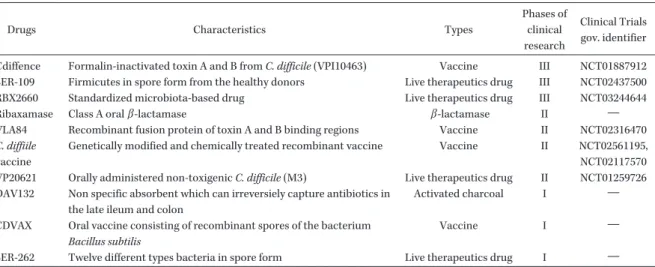
の芽胞)などの有用性についても報 告されている28,31,36)(Table 3)。また予防を目的に不 活化トキシンを標的としたワクチンが開発されてい るが,第三相試験まで進んでいたCdiffence
は中止 となっており,他のワクチンの結果が待たれる。Ribaxamase
は静注β
ラクタム系抗菌薬を投与する 際に服用することにより,小腸内に分泌されるβ
ラクタム系抗菌薬を分解するというこれまでの薬剤 にない特徴をもっている。また近年ナノボディと呼 ばれる単一ドメイン抗体が注目されている。通常抗 体は重鎖と軽鎖からなっているが,ラクダの抗体の 中に1
種類の重鎖で構成された抗体がある。この抗 体を断片化し,特有の可変領域だけを残したものは ナノボディと呼ばれ,通常の抗体よりも結合親和力 が高く,熱や極端なpH
などにも強く,安定性の高 い可溶性タンパク質としてさまざまな研究に用いら れている。このナノボディを用いてC. difficile
のsurface layer protein
を標的とした研究もなされて おり,今後の進展が期待される37)。Table 3. Other anti-CD drugs
Drugs Characteristics Types
Phases of clinical research
Clinical Trials gov. identifier Cdiffence Formalin-inactivated toxin A and B from C. difficile (VPI10463) Vaccine III NCT01887912 SER-109 Firmicutes in spore form from the healthy donors Live therapeutics drug III NCT02437500
RBX2660 Standardized microbiota-based drug Live therapeutics drug III NCT03244644
Ribaxamase Class A oral β -lactamase β -lactamase II ―
VLA84 Recombinant fusion protein of toxin A and B binding regions Vaccine II NCT02316470 C. diffiile
vaccine
Genetically modified and chemically treated recombinant vaccine Vaccine II NCT02561195, NCT02117570 VP20621 Orally administered non-toxigenic C. difficile (M3) Live therapeutics drug II NCT01259726 DAV132 Non specific absorbent which can irreversiely capture antibiotics in
the late ileum and colon
Activated charcoal I ―
CDVAX Oral vaccine consisting of recombinant spores of the bacterium Bacillus subtilis
Vaccine I ―
SER-262 Twelve different types bacteria in spore form Live therapeutics drug I ―
● ● ● ● ● ● ● ● ● ● ● ● ● ● ● ● ● ● ● ● ● ● ● ● ● ● ● ● ● ● ● ● ● ● ● ● ●
おわりに
こ れ ま で
CDI
に 対 す る 治 療 薬 は2
薬 剤 し か な かったが,近年新たな治療選択肢が増えてきた。特 に既存の薬剤にはない特徴を有しており,今後CDI
のマネジメントが変わる可能性がある。その一方で,わが国の
CDI
に関する疫学データはまだ不十分で あり,新規治療法も含めてどのような治療戦略をた てていくかということについては今後議論していく 必要がある。利益相反自己申告:申告すべきものなし。
文献
1) Gorbach S L: John G. Bartlett: Contributions to the discovery of Clostridium difficile antibiotic- associated diarrhea. Clin Infect Dis 2014; 59 (Suppl 2): S66-70
2) Pépin J, Valiquette L, Alary M E, Villemure P, Pelletier A, Forget K, et al: Clostridium difficile -associated diarrhea in a region of Que- bec from 1991 to 2003: a changing pattern of disease severity. CMAJ 2004; 171: 466-72 3) McDonald L C, Gerding D N, Johnson S,
Bakken J S, Carroll K C, Coffin S E, et al: Clini- cal PRACTICE GUIDELINES for Clostridium difficile Infection in Adults and Children: 2017 Update by the Infectious Diseases Society of America (IDSA) and Society for Healthcare Epidemiology of America (SHEA). Clin Infect Dis 2018; 66: 987-94
4) Surawicz C M, Brandt L J, Binion D G, Anan- thakrishnan A N, Curry S R, Gilligan P H, et al:
Guidelines for diagnosis, treatment, and preven- tion of Clostridium difficile infections. Am J Gastroenterol 2013; 108: 478-98
5) Sartelli M, Malangoni M A, Abu-Zidan F M, Griffiths E A, Di Bella S, McFarland L V, et al:
WSES guidelines for management of Clostrid- ium difficile infection in surgical patients.
World J Emerg Surg 2015; 10: 38
6) Trubiano J A, Cheng A C, Korman T M, Roder C, Campbell A, May M L A, et al: Australasian Society of Infectious Diseases updated guide- lines for the management of Clostridium diffi- cile infection in adults and children in Australia and New Zealand. Intern Med J 2016; 46: 479-93 7) Debast S B, Bauer M P, Kuijper E J, European Society of Clinical Microbiology and Infectious Diseases: European Society of Clinical Microbi- ology and Infectious Diseases: update of the treatment guidance document for Clostridium difficile infection. Clin Microbiol Infect 2014; 20 (Suppl 2): 1-26
8) Igarashi Y, Tashiro S, Enoki Y, Taguchi K, Matsumoto K, Ohge H, et al: Oral vancomycin versus metronidazole for the treatment of Clos- tridioides difficile infection: Meta-analysis of randomized controlled trials. J Infect Che- mother 2018; 24: 907-14
9) Zar F A, Bakkanagari S R, Moorthi K M L S T, Davis M B: A comparison of vancomycin and metronidazole for the treatment of Clostridium difficile -associated diarrhea, stratified by dis- ease severity. Clin Infect Dis 2007; 45: 302-7 10) Musher D M, Aslam S, Logan N, Nallacheru S,
Bhaila I, Borchert F, et al: Relatively poor out- come after treatment of Clostridium difficile colitis with metronidazole. Clin Infect Dis 2005;
40: 1586-90
11) Pepin J, Alary M E, Valiquette L, Raiche E,
Ruel J, Fulop K, et al: Increasing risk of relapse
after treatment of Clostridium difficile colitis in
Quebec, Canada. Clin Infect Dis 2005; 40: 1591-7
12) Johnson S, Louie T J, Gerding D N, Cornely O
A, Chasan-Taber S, Fitts D, et al: Vancomycin,
metronidazole, or tolevamer for Clostridium dif-
ficile infection: results from two multinational,
randomized, controlled trials. Clin Infect Dis
2014; 59: 345-54
13) Loo V G, Davis I, Embil J, Evans G A, Hota S, Lee C, et al: Association of Medical Microbiol- ogy and Infectious Disease Canada treatment practice guidelines for Clostridium difficile in- fection. Journal of the Association of Medical Microbiology and Infectious Disease Canada 2018; 3: 71-92
14) Takahashi M, Mori N, Bito S: Multi-institution case-control and cohort study of risk factors for the development and mortality of Clostridium difficile infections in Japan. BMJ Open 2014; 4:
e005665
15) Tokimatsu I, Shigemura K, Osawa K, Kinu- gawa S, Kitagawa K, Nakanishi N, et al: Mo- lecular epidemiologic study of Clostridium diffi- cile infections in university hospitals: Results of a nationwide study in Japan. J Infect Che- mother 2018; 24: 641-7
16) Yamagishi Y, Mikamo H: Recent epidemiology of Clostridium difficile infection in Japan. Jpn J antibiot 2015; 68: 345-58
17) Kobayashi K, Sekiya N, Ainoda Y, Kurai H, Imamura A: Adherence to clinical practice guidelines for the management of Clostridium difficile infection in Japan: a multicenter retro- spective study. Eur J Clin Microbiol Infect Dis 2017; 36: 1947-53
18)
大西健児,相野田祐介,今村顕史,岩渕千太郎,奥田真珠美,中野貴司:JAID/JSC感染症治療 ガイドライン