Switching Synchronization State of System Including Time Delay in One Direction
Seiya KITA, Yoko UWATE and Yoshifumi NISHIO (Tokushima University)
1. Introduction
The generation of chaos has been reported in all self- excited oscillation systems containing a time delay [1].
In this study, we devise coupled systems that take ad- vantage of the features of time-delayed chaotic circuits.
The novel coupled systems utilize the characteristics of circuits having time-delayed feedback. We investigate the synchronization state in coupled time-delayed chaotic cir- cuits. By carrying out computer simulations, it is shown that the time delay of subcircuits changes the synchro- nization state.
2. Circuit Model
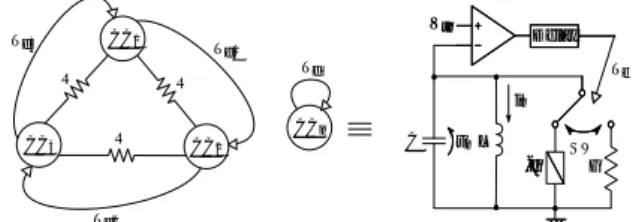
The circuits in this study employ characteristic time de- lay methods. We have devised the coupled system shown in Fig. 1. This system is coupled by resistorsR. This sys- tem includes a time delay in one direction. The normal- ized circuit equations of the system are given as follows:
(A) In the case that the switch is connected to the neg- ative resistor
{ x˙n = yn
˙
yn = −xn+ 2αyn+γ(yn−1−2yn+yn+1) (1) (B) In the case that the switch is connected to the pos- itive resistor
{ x˙n = yn
˙
yn = −xn−2βyn+γ(yn−1−2yn+yn+1) (2) wheren= 1,2,3 andy0=y3,y4=y1. Generally, switch- ing synchronization can be observed when the system in- cluding a time delay in one direction is coupled by resis- torsR. The amplitude alternately diverges and converges with different divergence and convergence times.
3. Simulation Results
The result shown in Fig. 2 can be obtained from the difference in the coupling strengthγ and the time delay Tdn. The time waveform in Fig. 2(a) shows in-phase syn- chronization and the amplitude ofxnis switched sequen- tially. However, whenγis larger than 0.05, the switching synchronization state is lost and a full in-phase synchro- nization state can be observed. Furthermore, the syn- chronization state is changed by time delay. The cycle of synchronization state shows in Fig. 3. When the time delayTdnare asymmetric, the cycle approaches stable regardless of the time delay.
4. Conclusions
In this study, we investigated the synchronization state of novel coupled systems of time-delayed chaotic ring cir- cuits coupled by various methods. As a result, some spe- cial synchronization states were observed. In the case of a ring circuit coupled by resistors, we observed an in-phase synchronization state. Switching of the amplitude of the
SW Vth
Vth
-g
-g G
C v
i
Td
L Delay Td
CC
n n n
CC1
CC2
CC3 R
R R
Td1
Td2 Td3
Figure 1: System including time delay in one direc- tion.
(a)γ= 0.05 andTdn=π.
(b)γ= 0.01 andTdn=π.
(c)γ= 0.01 andTdn= 0.5π.
(d)γ= 0.01 ,Td1= 0.5πandTd2=Td2=π.
Figure 2: Time waveform α= 0.015,β = 0.5.
Figure 3: Cycle of switching synchronization.
voltage in addition to the in-phase synchronization state was observed from the difference of coupling strength and time delay. Furthermore, the cycle of switching synchro- nization state is changed by combination of the time delay.
Reference
[1] T. Maruyama, N. Inaba, Y. Nishio and S. Mori, “Chaos in an Auto Gain Controlled Oscillator Containing Time Delay,”
Trans. IEICE, vol. J 72-A, pp. 1814-1820, Nov. 1989.
平成28年度電気関係学会四国支部連合大会 講演論文集(2016徳島大学) 2016 SHIKOKU-SECTION JOINT CONVENTION RECORD OF THE INSTITUTES OF ELECTRICAL AND RELATED ENGINEERS (TOKUSHIMA)
1-7
7