Crete Island, Greece, 5–10 June 2016
FLOW FIELD ESTIMATION IN OPEN CHANNEL BASED ON KALMAN FILTER FINITE ELEMENT METHOD
T. Yoshiara
1, T.Kurahashi
2, Y.Kobayashi
3and T.Eto
41
Graduate school of Nagaoka University of Technology, 1603-1 Kamitomioka, Nagaoka, Niigata, 940-2188, Japan.
e-mail: [email protected]
2
Department of Mechanical Engineering, Nagaoka University of Technology, 1603-1 Kamitomioka, Nagaoka, Niigata, 940-2188, Japan.
e-mail: [email protected]
3
Department of Mechanical Engineering, Nagaoka University of Technology, 1603-1 Kamitomioka, Nagaoka, Niigata, 940-2188, Japan.
e-mail: [email protected]
4
National Institute of Technology Nagaoka college, 888 Nishikatakai, Nagaoka, Niigata, 940-8532, Japan.
e-mail: [email protected]
Keywords: Finite element method, Kalman filter theory, Estimation of flow field
Abstract. The Kalman filter developed by R. E. Kalman and R. S. Bucy is states estimation theory in the target domain and has been employed in various field of engineering. In general, observation data in any system include observation noise and the computational model in- cludes system noise. The finite element equation is applied to derive the state transition ma- trix in the system equation of the Kalman filter. We can estimate state values after the time progress of spatial models. On the other hand, tidal power generation has the potential to contribute significantly as one of the clean energy. In tidal power generation, propellers of generator are rotated by tidal current and tidal power is converted to electric energy. There- fore, the generator should be placed in the fast point of tidal current to produce more electric energy. Thus, we focused on the flow field estimation using the observation data at limited observation points to find out the fast point of tidal current. As the fundamental study, the es- timation of the flow field in open channel is carried out based on the finite element method and the Kalman filter theory. As the governing equation, the shallow water equations are em- ployed, and the finite element and the selective lumping methods are applied to discretize the governing equations in space and time, respectively. The estimation of the distribution of the velocity vector and the water elevation is carried out by using the discretized equation. The open channel model is employed in the numerical experiment, and some examinations are carried out by changing the observation variables, number and position of observation points.
In addition, numerical experiments using practical observed values are carried out.
tions are carried out by changing the observation variables, number and position of observa- tion points.
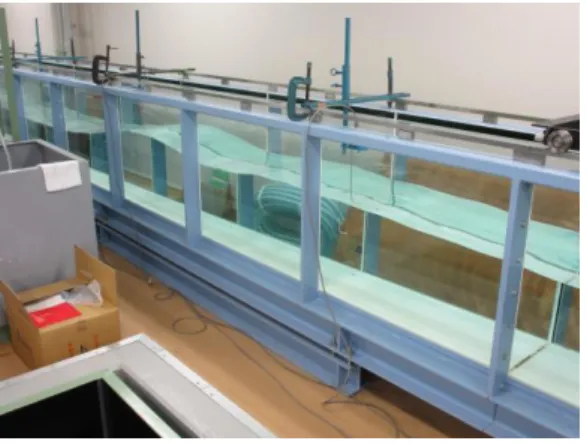
Figure 1: Open channel.
2 DISCRETIZATION OF GOVERNING EQUATIONS
The shallow water equations are used as a governing equations, which is represented as equation (1) and (2) in the two-dimensional plane. u , , g , and h are flow velocity, water elevation from the average water depth, the gravitational acceleration and water depth.
0 ,
ii
g
u (1)
0 ,
hu
i (2)
The governing equations are discretized to apply the Galerkin method and the selective lumping method. The finite element equation can be written as equation (3). This equation is summed for all the elements, and written as equation (4).
n n n
y x
y x
n n n
v u
M S
t h S
t h
S t g M
S t g M
M M M v
u
~
0 ~
~ 0
0 0
0 0
0
0
11 1 1
(3)
ˆ
n1 A ˆ
n(4)
where, t , h , S
i, M , M and M ~ are time increment, average water depth in the ele-
ment, the matrix for the pressure, mass matrix and diagonal mass matrix. M ~ is represented
as Equation (5) by ramping parameter e 0 e 1 , it called the mixed mass matrix.
M ~ 1 e M e M
(5) In the Kalman filter theory, the sum of the equation (4) and the vector multiplied by the drive matrix and the system noise vector q
nis the system equation. The system equa- tion is represented as equation (6). Time progress of the true value is represented by the equa- tion (6). In addition, the observation value z
n1is the sum of the vector multiplied by the observation matrix H and the true value vector
n1and the observation noise vector
r
n1, written as Equation (7). In the observation matrix H , components corresponding to the observation value are 1, other components are 0.
n1 A
n q
n(6)
z
n1 H
n1 r
n1(7)
3 COMPUTATIONAL ALGORITHM
It shows the numerical calculation algorithm by Kalman filter below.
1. Set input data : A , P
(0), ˆ
(0)
, , Q , R , , z
n1(n = 0~imax)
2. Calculation of estimated error covariance matrix : P
() A P
() A
T Q
T3. Calculation of Kalman gain matrix :
1
( )
( )
1
P H H P H R
K
T T4. Calculation of predicted error covariance matrix : P
() P
() K
1H P
()5. Check of convergence : if
k T k
k
k
P P P
P
tr
( )1 ( ) ( )1 ( )then go to 6, else go to 2.
6. Calculation of estimated value :
n A
(n) 1)
(
ˆ
ˆ
7. Calculation of optimal estimated value :
( )1
1 1 1 ) ( 1 )
(
ˆ ˆ
ˆ
n
n
nn
K z H
4 EXMINATION BY NUMERICAL EXPERIMENT
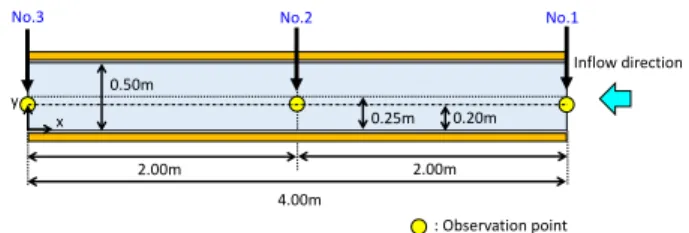
This examination is carried out by changing the observation variables, number and location of observation points. The computational conditions in this study is shown in Table 1. Com- putational model is shown in Figure 2.
Time increment t , s 0.001
Time steps 2000
Number of nodes 153
Number of elements 200
Gravitational acceleration g , m/s
29.8
Lumping parameter e 0.8
Initial of estimated error covariance P
(0)1.0
Initial of estimated value ˆ
(0)
0
Convergence determination constant 0.01
Table 1: Computational conditions.
Figure 2: Computational model.
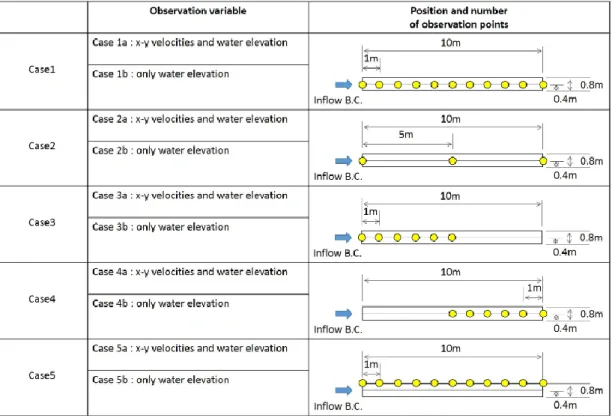
When the water elevation in amplitude 1.0m and period 2.0 s are given for the equation (5), the shallow water flow analysis is carried out. The results by this analysis are used as the artificial observation values. In this computation, the covariance for the system noise and ob- servation noise is set 0.0001 and 0.1, respectively. The system noise covariance matrix Q and observation noise covariance matrix R are the diagonal matrix that diagonal component are 0.0001 and 0.100. In addition, case ‘a’ represents that observation variables are flow ve- locity for x-y direction u , v and water and case ‘b’ of setting that observation variable is only. These cases are distinguished by subscript ‘a’ or ‘b’, number of observation points and position of observation points are shown in Figure 3. Experimental results are shown in Fig- ure 4 - 7.
Figure 3: Numerical test conditions.
In Cases 1-4, the observation points are set on center line of the channel, and number and
position of the observation points are changed. In Case 5, the observation points are set on
one side of the wall boundary.
Case 1a and 1b Case2a and 2b
Case 3a and 3b Case4a and 4b
Case5a and 5b
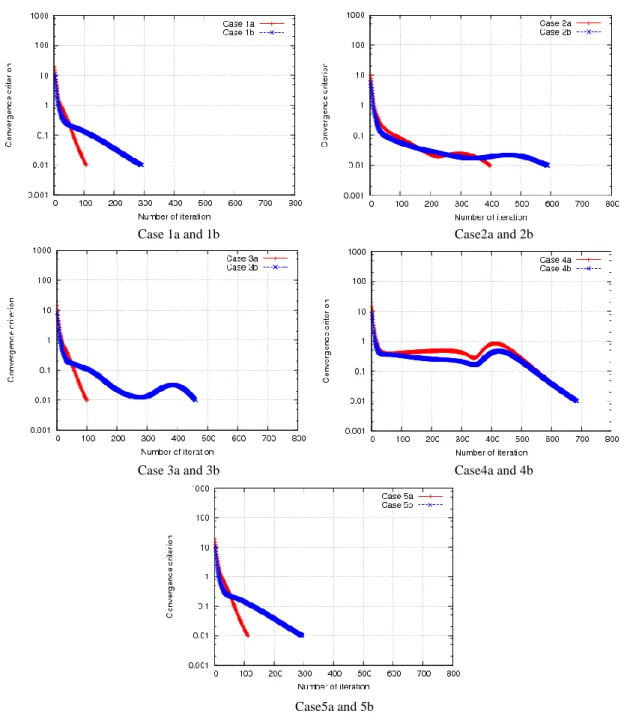
Figure 4: Comparison of variation of convergence criterion.
Figure 4 shows comparison of variation of convergence criterion expressed by the Frobeni-
us norm. The equation of the Frobenius norm is shown in the flow chart of section 3.The con-
vergence criterion ε is set 0.01. This convergence criterion follows to the reference by
Heemink [3]. From this result, it was found that convergence rate in Case ‘a’ is faster than
that in Case “b” in the iterative computation of the predicted error covariance matrix.
Case 1a Case 1b
Case 2a Case 2b
Case 3a Case 3b
Case 4a Case 4b
Case 5a Case 5b
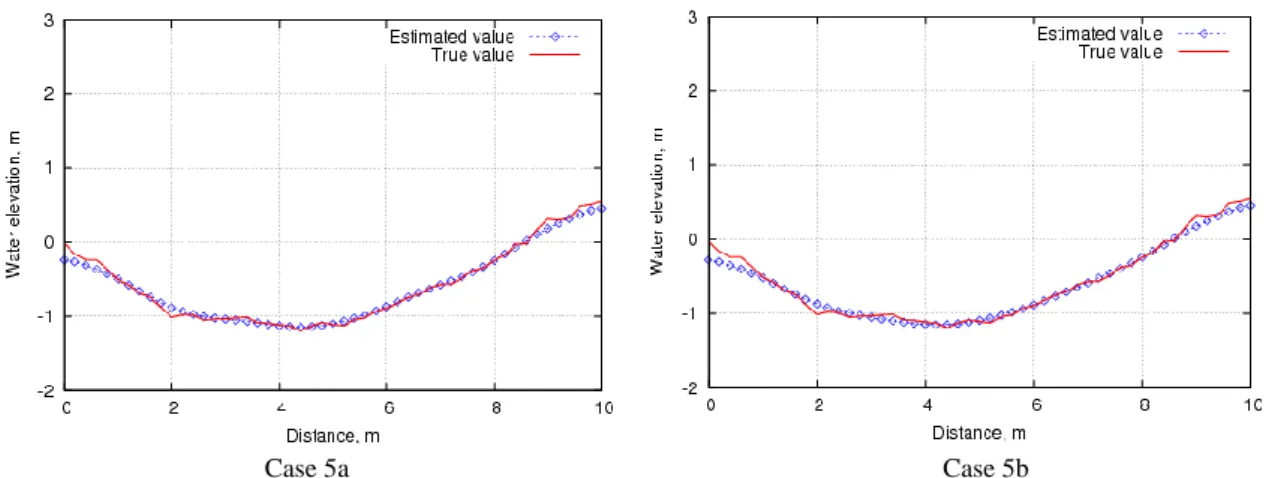
Figure 5: Comparison of distribution of estimated water elevation at T =2.0s.
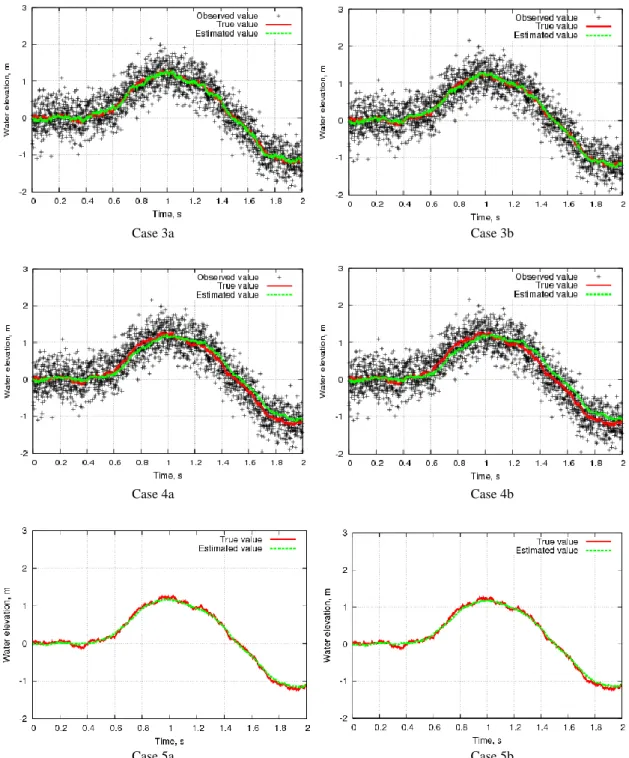
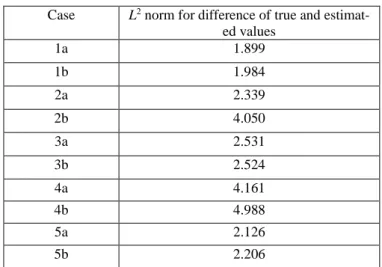
Figure 6 shows the distribution of estimated water elevation of the channel center line at T =2.0s. In Case 1 and Case 2, estimated values are good agreement with the true value. In Case 3, when the observation points are set on the inflow boundary side, the estimated value is good agreement with the true value in the outflow boundary side region, but, In Case 4, when the observation points are set on the outflow boundary side, it was found that it is diffi- cult to estimate the distribution of the water elevation in inflow boundary side region. In Case 5, when the observation points are set on one side of the wall boundary, it was confirmed that the distribution of the water elevation is similar to that in Case 1.
Case 1a Case 1b
Case 2a Case 2b
Case 3a Case 3b
Case 4a Case 4b
Case 5a Case 5b