ELUCIDATION OF RESISTANCE MECHANISMS TO ABIOTIC STRESSES AND THE APPLICATION FOR
MOLECULAR BREEDING
Report of Symposium held on
July 14-15, 2009
Institute of Radiation Breeding NIAS
Hitachi-Ohmiya, Ibaraki-ken Japan
I
The lecturers and the members of the Symposium Committee
II
Abe Tomoko RIKEN
Akemi Shimizu NIAS
Fujimori Masahiro Yamanashi Prefectural Daily Experiment Station
Fujino Kenji HOKUREN
Fujiwara Toru The University of Tokyo Fukaki Hidehiko Kobe University
Fukazawa Yoshitaka IBARAKI Prefectural Livestock Research Center Fukuda Akari National Agriculture and Food Research Organization
Fukuda Atsunori NIAS
Furukawa Koji Mukoyama Orchids Co. Ltd
Harada Kyuya NIAS
Hattori Kazumi Nagoya University
Hayashi Yoriko RIKEN
Hirochika Hirohiko NIAS
Horie Toshiya Fukui Prefecture
Inoue Eiichi Ibaraki University
Inukai Yoshaki Graduate School of Nagoya University
Ishige Teruo NIAS
Ishii Takuro NARO
Itoh Jun-ichi The University of Tokyo
Kanbe Takashi Niigata Agricultural Research Institute
Kazama Yusuke RIKEN
Kazuyuki Koide Society for Techno-Innovation of Agriculture, Forestry and Fisheries
Kobayashi Toru NIAS
Kobayashi Isao NIAS
Koike Setsuo National Agricultural Research Center Tohoku Region Konisho Kunihiko Nagano Nanshin Agricultural Experiment Station Kosuke Kazumasa IBARAKI Agricultural Center Plant-Biotechno1ogy Kuboyama Tsutomu Ibaraki University
Kurita Manabu Forest and Forest Products Research Institute Kusaba Makoto Hiroshima University
Mase Nobuko National Institute of Fruit Tree Science Masuda Tetsuo National Institute of Fruit Tree Science
Matsui Tsutomu Gifu University
Matsuo Youichi Saga Prefectural Fruit Tree Experiment Station Momnoki Yoshie Tokyo University of Agriculture
Morita Ryouhei NIAS
Muramatu Noboru NIAS
Nagamura Yoshiaki NIAS
Nagato Yasurou The University of Tokyo
Nakagawa Hitoshi National Institute of Agrobio1ogical Sciences
Nakagawa Mayu RIKEN
List of Participants
(48
thGF Symposium)
III
N
ARUMIIssay Japan Atomic Energy Agency
Nishihara Kiyoshi RIKEN
Nishimura Minoru NIAS
Nishio Takeshi Tohoku University
Nishizawa Naoko.K. Ishikawa Prefectural University
Nomoto Momoyo NIAS
Nozawa Shigeki Japan Atomic Energy Agency
Ohbu Sumie RIKEN
Ohmiya Yasunori Forest and Forest Products Research Institute Okazaki Keiichi Niigata University
Okumoto Yutaka Kyoto University
Sano Yoshio Hokkaido University
Sato Yutaka NIAS
Sekiguchi Fumihiko Japan Women’s University
Shibukawa Tomiko RIKEN
Sugimoto Kazuhiko NIAS
Takehisa Hinako NIAS
Takyu Toshio NIAS
Tamaki Katsutomo Hyogo Prefectural Institute for Agriculture Taniguchi Tohru Forestry and Forest Products Research Institute Tanisaka Takatoshi Kyoto University
Tsutsumi Nobuhiro University of Tokyo
Uga Yusaku NIAS
Ukai Yasuo
Yamanouchi Hiroaki NIAS
Yoshiaki Hitoshi Ishikawa Agricultural Research Center
IV
Mutation breeding through chronic gamma-ray irradiation of growing plants in large irradiation facilities, such as our Gamma Field in Institute of Radiation Breeding, NIAS (Hitachi-Ohmiya, Ibaraki, Japan) has been expanding in Asia. In 2009, a Gamma Greenhouse was established for the facilitation of mutation breeding through chronic gamma-ray irradiation to growing plants and in vitro materials in Agrotechnology & Biosciences Division of Malaysian Nuclear Agency (Bangi 43000 Kajang, Selangor, Malaysia). A “Mutation induction using chronic irradiation with gamma greenhouse” Training/Workshop was conducted for the opening of the facility with Prof.
Siranut Lamseejan of Kasetsart University and Dr. Hitoshi Nakagawa, IRB, NIAS with lecturers provided on 3-7 August 2009 for the promotion of this technology at the new facility. Although the history of mutation breeding is more than 50 years old and has been useful for the improvement of crops, the differences in the induced mutations between acute and chronic irradiation are not well defied or understood. The application of chronic irradiation to growing plants in the field or controlled greenhouse will be useful to elucidate the point and provide an outlet for the development of new crop varieties.
On 12-15 August 2008, “the FAO/IAEA International Symposium on Induced Mutation in Plant” was held for celebrating the 80
thanniversary of mutation induction in plant in Vienna, Austria. The symposium was organized by IAEA and FAO through the Joint FAO/IAEA Division of Nuclear Techniques in Food and Agriculture cooperated with Bhabha Atomic Research Center, Chinese Society of Agricultural Biotechnology, European Association for Research on Plant Breeding, Indian Society of Genetics and Plant Breeding, and National Institute of Agrobiological Sciences, Japan. More than 400 persons from 83 countries attended the symposium. The proceedings are published as a book, “Induced Plant Mutations in the Genomic Era” edited by Q. Y. Shu from Food and Agriculture Organization of the United Nations, Rome, in 2009. The 458 page of proceedings provide details regarding accomplishments, progress and the future directions of mutation breeding.
The 1
stGamma Field Symposium was held in 1962 at Conference Room in the Institute of Radiation Breeding for exchanging information and discussions among scientists in national agricultural experiment stations and institutes of Ministry of Agriculture and Forestry, national universities and institutes of Ministry of Education, and seed companies in this new research area of mutation breeding, and for providing a seminar to students of the universities. During its 48-year history, the symposium committee has selected various themes related to mutation and breeding, and has invited leading scientists with expertise in these areas as lecturers to provide results of their research on a wide variety of related topics.
The 48
thGamma Field Symposium entitled “Elucidation of resistance mechanisms to abiotic stresses and the application for molecular breeding” was held on July 15-16, 2009 in Mito, Ibaraki, Japan. The keynote address, Genes involved in ion-acquisition and their application for developing new crops” was presented by Prof. N. K.
Nishizawa, Professor of Ishikawa Prefectural University. Prof. Nishioka was a professor of Graduate School of Agricultural and Life Science, The Univerity of Tokyo, and regarded as one of the most renowned scientists regarding mechanism of abiotic stresses in plants. Seven lecturers were also invited to present results of their research results:
Prof. T. Fujiwara (The University of Tokyo: Molecular mechanisms of boron transport in plants and generation of plants tolerant to boron stress); Prof. H. Fukaki (Kobe University: Genetic regulation of lateral root development in Arabidopsis -The role of auxin signaling-); Prof. Y. Inukai (Nagoya University: Genetic improvement of root system formation for adaptation to soil moisture fluctuation stress in rice); Prof. T. Matsui (Gifu University: Heat- induced floret sterility in rice: Mechanisms of occurrence and tolerance); Dr. K. Sugimoto (National Institute of Agrobiological Sciences: Genetic control of seed dormancy in rice); Prof. Y. S. Momonoki (Tokyo University of
Forward
V
Agriculture: Characterization of the plant acetylcholine-mediated system); and Dr. I. Narumi (Japan Atomic Energy Agency: Survival strategy of a radioresistant bacterium: a review).
This publication includes the contributed papers from these invited lecturers and subsequent questions and discussions (in Japanese) addressed to the invitees following their presentations during the symposium.
It is our sincere hope that the series of Gamma Field Symposia, including this issue, will assist plant breeders and researchers to realize the contribution that mutation breeding has made to the plant sciences.
The most recent and previous volumes of Gamma Field Symposia series have been placed on line and can be accessed at the link http://www.nias.affrc.go.jp/eng/gfs/index.html .
We express our sincere thanks to the lectures, chairpersons and attendees
Symposium Committee Hitoshi Nakagawa, Chairperson Yasuro Nagato
Hirohiko Hirochika
Tetsuo Masuda
Yoshio Sano
Takatoshi Tanisaka
Nobuhiro Tsutsumi
Minoru Nishimura, Secretary
Noboru Muramatsu, Editor
VI
Special lecture Chairperson: N. T
SUTSUMIGenes Involved in Iron Acquisition and Their Application for Developing New Crops ……… N. K. N
ISHIZAWASession Ⅰ
Chairperson: T. M
ASUDAMolecular Mechanisms of Boron Transport in Plants and Generation of Plants Tolerant to Boron Stress.
……… T. F
UJIWARASession Ⅱ Chairperson: Y.N
AGATOGenetic Regulation of Lateral Root Development in Arabidopsis
– The Role of Auxin Signaling – ……… H. F
UKAKISession Ⅲ Chairperson: M. K
USABAGenetic Improvement of Root System Formation for Adaptation to Soil Moisture Fluctuation Stress in Rice.
………Y. I
NUKAISession Ⅳ Chairperson: T. T
ANISAKAHeat-induced Floret Sterility in Rice: Mechanisms of Occurrence and Tolerance. ……… T. M
ATSUISession Ⅴ
Chairperson: H. H
IROCHIKAGenetic Control of Seed Dormancy in Rice ……… K. S
UGIMOTOSession VI
Chairperson: H. N
AKAGAWACharacterization of the Plant Acetylcholine-Mediated System ……… Y. S. M
OMONOKISession VII
Chairperson: T. A
BESurvival Strategy of a Radioresistant Bacterium ……… I. N
ARUMISession VIII Chairperson: Y. S
ANOGeneral Discussion Closing address: Y. N
AGATOPROGRAM
Opening address: H. N
AKAGAWACongratulatory address: M. I
SHIGEVII CONTENTS
T. K
OBAYASHGenes Involved in Iron Acquisition and Their Application for
H. N
AKANISHIDeveloping New Crops ……… 1 N. K. N
ISHIZAWAT. F
UJIWARAMolecular Mechanisms of Boron Transport in Plants and Generation of
Plants Tolerant to Boron Stress. ……… 17 H. F
UKAKIGenetic Regulation of Lateral Root Development in Arabidopsis
– The Role of Auxin Signaling – ……… 27 Y. I
NUKAIGenetic Improvement of Root System Formation for Adaptation to
Soil Moisture Fluctuation Stress in Rice. ……… 35 T. M
ATSUIHeat-induced Floret Sterility in Rice: Mechanisms of Occurrence and Tolerance. …… 43 N. L. M
ANIGBASE. R
EDOÑAX. T
IANM. Y
OSHIMOTOK. S
UGIMOTOGenetic Control of Seed Dormancy in Rice ……… 53 S. M
ARZOUGIM. Y
ANOY. S. M
OMONOKICharacterization of the Plant Acetylcholine-Mediated System ……… 61 K. Y
AMAMOTOI. N
ARUMISurvival Strategy of a Radioresistant Bacterium: a Review ……… 69
General Discussion (in Japanese) ……… 77
1
Gamma Field Symposia, No. 48, 2009 Institure of Radiation Breeding NIAS, Japan
Genes Involved in Iron Acquisition and Their Application for Developing New Crops
Takanori K
OBAYASHI1, Hiromi N
AKANISHI1and Naoko K. N
ISHIZAWA1,21
Graduate School of Agricultural and Life Science, The University of Tokyo, 1-1-1 Yayoi, Bunkyo-ku, Tokyo 113-8657, Japan
2
Research Institute for Bioresources and Biotechnology, Ishikawa Prefectural University, 1-308 Suematsu, Nonoichi-machi, Ishikawa 921-8836, Japan
Abstract
Iron deficiency is a major cause of reduced crop yields worldwide, particularly in calcareous soils. Un- like barley, rice is highly susceptible to iron deficiency because of a low capacity to secrete phytosiderophores in the mugineic acid (MA) family, which are iron chela- tors secreted by graminaceous plants. In this paper, we present an approach to the generation of transgenic rice lines exhibiting increased tolerance to iron deficiency, along with the results of field trials with these lines.
Cloning barley genes that encode biosynthetic enzymes for MAs enabled us to produce transgenic rice plants that contained these genes. We tested three transgenic lines possessing barley genomic fragments responsible for biosynthesis of MAs in a paddy field experiment on calcareous soil, and demonstrated tolerance of these lines to low iron availability. We also applied new ap- proaches to generate iron-deficiency-tolerant rice lines, including the introduction of an engineered ferric-che- late reductase gene and manipulation of transcription- factor genes that regulate the iron-deficiency response.
1. Introduction
Iron (Fe) is essential for most living organisms, including plants. Although it is abundant in mineral soils, Fe is sparingly soluble under aerobic conditions at high soil pH, especially in calcareous soils, which ac- count for about 30% of the world’s cultivated soils. Fe deficiency is a widespread agricultural problem that re-
duces plant growth and crop yields (M
ARSCHNER1995;
M
ORI1999). To take up and utilize Fe from the rhizo- sphere, higher plants have evolved two major strategies (M
ARSCHNERet al. 1986): reduction (Strategy I) and chelation (Strategy II). The mechanism of Strategy I, which is utilized by non-graminaceous plants, includes the production of ferric-chelate reductase to reduce Fe at the root surface to the more soluble ferrous (Fe[II]) form, and transport the ferrous ions generated by this process across the root plasma membrane. In contrast, the mechanism of Strategy II, which is specific to gram- inaceous plants, is mediated by natural Fe chelators, the mugineic acid (MA) family of phytosiderophores.
Graminaceous plants synthesize and secrete MAs from their roots to solubilize Fe(III) in the rhizosphere (T
AK-AGI
1976), and the resulting Fe(III)–MA complexes are taken up by roots through a specific transporter in the plasma membrane (C
URIEet al. 2001; T
AKAGI1976).
In calcareous soils, Strategy II is more efficient than Strategy I (M
ARSCHNER1995). Tolerance of Fe deficiency differs among graminaceous plants and is thought to depend on the amount and kinds of MAs that they secrete. Rice (Oryza sativa L.), sorghum (Sorghum bicolor L.), and maize (Zea mays L.) secrete only small amounts of 2’-deoxymugineic acid (DMA) among the MAs, and thus are susceptible to low Fe availability.
In contrast, barley (Hordeum vulgare L.) secretes large
amounts of compounds in the MA family, including
MA, 3-epihydroxy-2’-deoxymugineic acid (epiHDMA)
and 3-epihydroxymugineic acid (epiHMA), in addition
to DMA, under Fe deficiency; therefore, barley is more
2
Takanori KOBAYASHI, Hiromi NAKANISHI and Naoko K. NISHIZAWAtolerant of Fe deficiency than other graminaceous plants (M
Aet al. 1999; M
ORIand N
ISHIZAWA1987; R
ÖMHELDand M
ARSCHNER1986; T
AKAGI1976).
We therefore hypothesized that introducing the barley genes responsible for biosynthesis of MAs into rice would lead to enhanced production of MAs and tolerance of Fe deficiency in calcareous soils. We suc- cessfully produced various transgenic rice lines with enhanced tolerance of low Fe availability by introduc- ing barley biosynthesis genes for MAs. Using selected lines, we carried out field trials in a calcareous soil that demonstrated the tolerance of these lines to low Fe availability. We also produced Fe-deficiency-toler- ant rice lines using two other strategies: introduction of a reconstructed ferric-chelate reductase gene and manipulation of transcription-factor genes that control the expression of Fe-deficiency-induced genes. Based on these results, we discuss future perspectives on gen- erating agriculturally beneficial transformants that are also acceptable to the public.
2. Generation of Fe-deficiency-tolerant transgenic rice by introducing barley biosynthesis genes for MAs 2.1. Identification of genes responsible for biosyn-
thesis of MAs
The biosynthetic pathway for MAs (Fig. 1) has been clarified through extensive biochemical and phys- iological studies (K
AWAIet al. 1988; M
Aand N
OMO- TO1993; M
Aet al. 1999; M
ORIand N
ISHIZAWA1987;
S
HOJIMAet al. 1990). Methionine is the precursor of MAs (M
ORIand N
ISHIZAWA1987) and is adenosylated by S-adenosylmethionine (SAM) synthetase (SAMS).
Nicotianamine synthase (NAS) catalyzes the trimeriza- tion of SAM into nicotianamine (NA) (H
IGUCHIet al.
1994). All higher plants, including non-graminaceous plants, have a biosynthetic pathway that lets them syn- thesize NA (L
INGet al. 1999; N
OMAand N
OGUCHI1976), which serves as a common metal chelator in- volved in the internal transport of various micronutri- ents, including Fe and zinc (Zn) (H
ELLand S
TEPHANFig. 1. Biosynthetic pathways of phytosiderophores in the mugineic acid (MA) family.
SAMS, S-adenosylmethionine synthetase; NAS, nicotianamine synthase; NAAT, nicotianamine aminotransferase; DMAS, deoxymugineic acid synthase; IDS2, iron-deficiency-specific clone no. 2; IDS3, iron-deficiency-specific clone no. 3;
DMA, 2’-deoxymugineic acid; MA, mugineic acid; HMA, 3-hydroxymugineic
acid; epiHDMA, 3-epihydroxy-2’-deoxymugineic acid; epiHMA, 3-epihydroxy-
mugineic acid.
3
GENES INVOLVED IN IRON ACQUISITION AND THEIR APPLICATION FOR DEVELOPING NEW CROPS2003; T
AKAHASHIet al. 2003). NA aminotransferase
(NAAT) catalyzes the first step specific to gramina- ceous plants: transamination of NA to produce the 3’’- oxo intermediate (K
ANAZAWAet al. 1995; S
HOJIMAet al. 1990). DMA synthase (DMAS) subsequently reduc- es the 3’’-oxo form into DMA (B
ASHIRet al. 2006). All MAs share the same biosynthetic pathway from me- thionine to DMA, which is then hydroxylated to form other MAs in some species, including barley.
Attempts to isolate the genes responsible for bio- synthesis of MAs have included “direct” approaches via enzyme purification and “indirect” approaches through screening the genes and proteins specifically induced in Fe-deficient roots. The former approach has been applied to NAS and NAAT. NAS genes were first isolated from barley (HvNAS1-7) through the es- tablishment of an NAS activity assay (H
IGUCHIet al.
1994) and enzyme purification from Fe-deficient barley roots (H
IGUCHIet al. 1999). Two barley NAAT genes, HvNAAT-A and HvNAAT-B, were also cloned through the establishment of an enzyme activity assay (O
HATAet al. 1993) and enzyme purification (K
ANAZAWAet al.
1995; T
AKAHASHIet al. 1999). Expression of HvNAS1, HvNAAT-A, and HvNAAT-B is strongly induced by Fe deficiency and occurs almost exclusively in the roots (H
IGUCHIet al. 1999; T
AKAHASHIet al. 1999), suggest- ing direct involvement of these genes in the biosynthe- sis of MAs to increase the acquisition of Fe from the rhizosphere. Quantification of NAS and NAAT enzyme activities in Fe-deficient roots of various graminaceous species have revealed that NAS and NAAT activities are positively correlated with both the amounts of MAs secreted and with Fe-deficiency tolerance (H
IGUCHIet al. 1996; K
ANAZAWAet al. 1994).
In the indirect approach, the differential hybrid- ization method was applied with mRNA from Fe-de- ficient and Fe-sufficient barley roots. We cloned IDS (iron-deficiency specific) genes specifically expressed in Fe-deficient barley roots (N
AKANISHIet al. 1993;
O
KUMURAet al. 1991, 1994). Among these, IDS2 and IDS3 are homologous to 2-oxoglutarate-dependent di- oxygenases, suggesting their possible involvement in the hydroxylation of MAs. By interspecies correlation
between the expression of IDS2 and IDS3 and the ca- pacity to secrete hydroxylated MAs, we deduced that IDS3 is the enzyme that hydroxylates the C-2’ positions of DMA and epiHDMA, whereas IDS2 hydroxylates the C-3 positions of DMA and MA (Fig. 1; N
AKANI-SHI
et al. 2000). IDS3 was further confirmed to be MA synthase by introducing the barley IDS3 gene into rice (K
OBAYASHIet al. 2001): transgenic rice plants secreted MA in addition to DMA, whereas non-transformants secreted only DMA.
We also compared proteins in Fe-sufficient and Fe-deficient barley roots using two-dimensional poly- acrylamide gel electrophoresis. Peptide sequencing of the proteins produced under Fe deficiency revealed that formate dehydrogenase (FDH) and adenine phosphori- bosyltransferase (APRT), as well as the IDS3 protein, were produced in Fe-deficient roots (K. S
UZUKIet al.
1998). The corresponding genes, HvFDH and HvAPT, were subsequently cloned (I
TAIet al. 2000; S
UZUKIet al. 1998). Both FDH and APRT are thought to function in scavenging the by-products (formate and adenine) that are released during the methionine cycle (M
ORI1999), thus supporting the production of MAs. Indeed, the methionine cycle works vigorously in roots to meet the increased demand for methionine to support the synthesis of MAs (M
Aet al. 1995). We also applied a revised differential-hybridization screening, and identi- fied iron-deficiency-induced (IDI) genes in barley roots (Y
AMAGUCHIet al. 2000a, 2000b, 2002). IDI1 and IDI2 putatively encode enzymes that catalyze steps in the methionine cycle (K
OBAYASHIet al. 2005; M. S
UZUKIet al. 2006).
Recent application of microarray techniques re-
confirmed the induction of the abovementioned genes
involved in biosynthesis of MAs in Fe-deficient barley
roots (N
EGISHIet al. 2002; M. S
UZUKIet al. 2006). The
microarray approach also resulted in cloning of DMAS
genes from rice (OsDMAS1), barley (HvDMAS1), wheat
(Triticum aestivum L.; TaDMAS1), and maize (ZmD-
MAS1). All of the corresponding encoded proteins were
confirmed to possess the reductase activity required to
produce DMA (B
ASHIRet al. 2006).
4
Takanori KOBAYASHI, Hiromi NAKANISHI and Naoko K. NISHIZAWA2.2. Introduction of barley genes responsible for bio- synthesis of MAs into rice
To produce transgenic rice plants with enhanced tolerance of Fe deficiency by increasing their capacity for the production of MAs, we introduced barley Hv- NAS1, HvNAAT-A, HvNAAT-B, or IDS3 genes, or some combination of these genes, using either their genomic fragments or the IDS3 gene promoter to confer induc- ibility under Fe deficiency. To introduce barley genomic fragments, we utilized the pBIGRZ1 vector (A
KIYAMAet al. 1997), which was developed as a modified binary vector capable of transferring large DNA fragments into the rice genome. Rice cultivar Tsukinohikari was subjected to Agrobacterium-mediated transformation (H
IEIet al. 1994). The transformants included lines in which the following genes or gene fragments were introduced: (a) a 13.5-kb genome fragment of the Hv- NAS1 gene (H
IGUCHIet al. 2001), designated “gNAS1”;
(b) an 11-kb genome fragment of HvNAAT in which the HvNAAT-A and HvNAAT-B genes are present in tandem (Takahashi et al. 2001), designated “gNAAT”; (c) a 20- kb genome fragment of the IDS3 gene (K
OBAYASHIet al. 2001), designated “gIDS3”; (d) a 7.6-kb genome fragment of HvNAS1 plus an 11-kb genome fragment containing the HvNAAT-A and HvNAAT-B genes, des- ignated “gNAS1-gNAAT”; (e) an HvAPT cDNA frag- ment fused downstream of the 2.2-kb IDS3 promoter;
(f) HvNAS1, HvNAAT-A, and HvAPT cDNA fragments, each fused downstream of the 2.2-kb IDS3 promoter;
and (g) an IDS3 cDNA fragment fused downstream of the cauliflower mosaic virus (CaMV) 35S promoter (K
OBAYASHIet al. 2001). Expression analysis revealed that Fe-deficiency-induced expression was strongly conferred by genome fragments of the HvNAS1, Hv- NAAT-A, HvNAAT-B, or IDS3 genes (H
IGUCHIet al.
2001; K
OBAYASHIet al. 2001; T
AKAHASHIet al. 2001), confirming the potency of the barley promoter elements included in the genome fragments and their ability to drive Fe-deficiency-induced expression in rice plants.
Although the barley promoters cause induction of gene expression almost exclusively in Fe-deficient roots in their native barley, they induced moderate expression in Fe-deficient leaves and prominent expression in Fe-
deficient roots when introduced into rice.
To examine whether the transformants have en- hanced tolerance of low Fe availability, the plants were cultured in pots filled with calcareous soils (pH 8.5 to 9.0; T
AKAHASHIet al. 2001) under controlled condi- tions in a greenhouse. Of the 36 gNAAT lines that we evaluated, 10 showed remarkable tolerance of calcare- ous soils (T
AKAHASHIet al. 2001). Non-transformants exhibited reduced growth and severe leaf chlorosis caused by Fe deficiency, whereas the gNAAT lines had greener and larger shoots. At harvest, the gNAAT lines possessed 4.2 and 4.1 times the shoot dry weight and grain yield per pot that we found in the non-transfor- mants (T
AKAHASHIet al. 2001). We also examined tol- erance of calcareous soils for the other transformants.
We found rice lines that showed some tolerance of cal- careous soils among lines containing any of transgenes (a) through (g). In these lines, increased amounts or kinds of secreted MAs appear to have contributed to enhanced Fe availability under Fe-limiting conditions.
3. Field trials of Fe-deficiency-tolerant rice lines A calcareous subsoil from Toyama Prefecture con- taining fossil shells (pH ~9.2; M
ORIKAWAet al. 2004) was used to establish a paddy field in the quarantine area of the Field Science Center of Tohoku University (Osaki, Miyagi, Japan; 38°44’N; 140°45’E). The paddy field in the first-year experiment was 7 m long by 14 m wide, and had soils 0.5 m deep, with the external ridges completely covered with a vinyl sheet to avoid con- tamination from the surrounding Andosol at the site.
The first-year experiment was conducted from April to October 2005, using the six transformant lines (a) through (f) and a non-transformant cultivar (Tsukinohi- kari). The following year, from April to October 2006, the second-year experiment was performed using the three most promising lines: gNAS1 (a), gIDS3 (c), and gNAS1–gNAAT (d). Experimental procedures for the second-year experiment were described by M. S
UZUKIet al. (2008). The paddy field in the second-year ex-
periment was 6 m long by 4 m wide (Fig. 2a), and the
experimental plots were arranged in a completely ran-
5
GENES INVOLVED IN IRON ACQUISITION AND THEIR APPLICATION FOR DEVELOPING NEW CROPSdomized design (Fig. 2b) that included the three trans-
genic rice lines (gNAS1, gIDS3, and gNAS1–gNAAT) and the non-transformant (NT). Germinated seeds were grown for 45 days in a greenhouse, and seedlings were then transplanted (three per hill) into the calcareous paddy field.
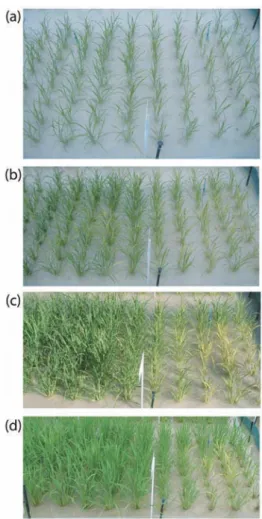
Sixteen days after transplanting (DAT), chlorosis and growth retardation began to appear. By 42 DAT, the three transgenic rice lines were clearly superior to the NT (Fig. 2a) both in leaf color and in growth, although differences in performance were also observed within individual plots. Using gIDS3 as an example, we saw no evident difference from the NT on 16 DAT (Fig.
3a); chlorotic symptoms appeared in the NT but not in gIDS3 at 30 DAT (Fig. 3b). The clearest difference be- tween gIDS3 and the NT was evident at 42 DAT (Fig.
3c). One week later (50 DAT), leaf chlorosis began to disappear, especially in NT plants close to the plot
boundary that were adjacent to the transgenic gIDS3 rice plants (Fig. 3d), which suggests that the NT plants may have benefited from MAs secreted by the trans- genic rice.
From 16 to 42 DAT, plant height and the SPAD value (leaf color) of the three transformant lines were higher than those of the NT. In addition, the number of tillers per plant was higher in gIDS3 than in the other lines. By 42 DAT, however, all lines had about 15 til- lers per plant. After 42 DAT, when soil redox poten- tial (E
h) fell below 0 mV, all plant lines recovered their leaf color, and consequently, the SPAD value of the NT plants increased to levels similar to those in the trans- formants. The decrease in soil E
hwith time is thought to have resulted in the absorption of ferrous ions via the ferrous transporter OsIRT1 (see section 4.1 for details;
I
SHIMARUet al. 2006).
At the time of grain harvesting, the number of
Fig. 2. (a) Photograph (42 days after transplanting) of the rice lines tested in a paddy field in the quarantine area of the Field Science Center of Tohoku University (Osaki, Miyagi, Japan) and (b) layout of the field experi- ment. Each population contained five 1.2-m-long rows of rice with 20 cm between rows and 15 cm between hills. The box in the upper left in- dicates the two plots that were photographed on several occasions (Fig.
3). NT, non-transformant. Original figure: S
UZUKIet al. (2008).
6
Takanori KOBAYASHI, Hiromi NAKANISHI and Naoko K. NISHIZAWAgrains, 1000-grain weights, and the grain yield of gNAS1 were higher than those of the NT plants and the other lines. Plant height and the proportion of fully ma- tured grains showed no significant difference among the lines. The timing of the decrease in soil E
hmight account for the relatively small differences in grain parameters between the transformants and NT, despite the clearly inferior performance of NT plants during early growth.
Indeed, in a prior experiment, NT seedlings grown in the same calcareous paddy field showed severe chloro- sis, and many seedlings died in the early stages before E
hfell below 0 mV (M
ORIKAWAet al. 2004). Therefore, it is crucial for rice in calcareous paddy fields to survive the early stages of growth, when enhanced production
of MAs greatly supports Fe acquisition.
Interestingly, the concentrations of Fe and Zn in the rice grains of gIDS3 were significantly higher than those in NT plants and the other lines, suggesting that MA synthesized by IDS3 contributed not only to im- proved Fe uptake from the soil but also to increased translocation to the grains.
Our field trial of the transformants therefore dem- onstrated that a transgenic approach to increase the tol- erance of rice to low Fe availability is a practical way to improve agricultural productivity in calcareous paddy soils.
4. Production of other transgenic rice plants toler- ant of Fe deficiency
4.1. Introducing an engineered ferric-chelate reduc- tase gene into rice
In Strategy I plants, Fe uptake from the rhizo- sphere is mediated by ferrous ion transporters. E
IDEet al. (1996) isolated the Arabidopsis IRT1 gene, which is the dominant ferrous Fe transporter in the Fe-up- take process (V
ERTet al. 2002). Rice, in spite of be- ing a Strategy II plant, possesses homologs of the Arabidopsis IRT1 gene, namely OsIRT1 and OsIRT2, and the ferrous transport capacity of these genes was demonstrated by means of functional complementation in yeast (B
UGHIOet al. 2002; I
SHIMARUet al. 2006).
OsIRT1 expression is strongly induced in Fe-deficient roots, and OsIRT2 is expressed similarly but at lower levels. Promoter-β-glucuronidase (GUS) analysis indi- cated that OsIRT1 is mainly expressed in the epidermis, exodermis, and inner layer of the cortex in Fe-deficient roots, as well as in shoot companion cells. Moreover, an analysis using a positron-emitting tracer-imaging system (PETIS) revealed that rice is able to take up both Fe(III)-DMA and Fe
2+. Thus, rice plants possess a system other than Strategy II for Fe uptake, which is based on the secretion of MAs (I
SHIMARUet al. 2006).
In contrast to their ferrous transporting ability, Fe-de- ficient rice roots do not show increased ferric-chelate reductase activity (I
SHIMARUet al. 2006), which is a hallmark of the Strategy I response.
Fig. 3. Visual comparison between gIDS3 (left) and NT
(right) plants from 16 to 50 DAT, as illustrated in
Figure 2 but photographed from the opposite di-
rection. (a) 16 DAT, (b) 30 DAT, (c) 42 DAT, and
(d) 50 DAT. Original figure: S
UZUKIet al. (2008).
7
GENES INVOLVED IN IRON ACQUISITION AND THEIR APPLICATION FOR DEVELOPING NEW CROPSThe ability to take up ferrous ions directly using
OsIRT1, without reducing ferric chelates, seems to be a consequence of rice’s adaptation to waterlogged soils, in which the concentration of soluble ferrous Fe increases as the soil E
hdecreases (I
SHIMARUet al. 2006; S
UZUKIet al. 2008). Because of the presence of OsIRT1, severe Fe deficiency is relatively rare in irrigated rice systems.
Nevertheless, rice plants grown in calcareous soils ex- hibit Fe-deficiency symptoms even under waterlogged conditions (as noted previously) because of their inabil- ity to increase ferric-chelate reductase production and their low capacity to synthesize MAs. Therefore, we hypothesized that introducing a ferric-chelate reductase gene into rice would enhance its Fe-deficiency toler- ance by creating a complete Strategy I system in addi- tion to rice’s endogenous Strategy II.
To ensure functional expression in the rice plants, we modified and completely reconstructed the yeast ferric reductase gene, FRE1, to produce refre1 (recon- structed FRE1; O
KIet al. 1999). Since ferric-chelate reductase activity is inhibited by high pH, we then screened plants to detect reductases with improved en- zymatic activity at high pH (O
KIet al. 2004). Through screening of randomly mutagenized refre1 derivatives, we obtained a variant that we designated refre1/372, which encoded a protein that maintained strong reduc- tase activity at pH 8 to 9. Transgenic tobacco (Nicotiana
tabacum L.) plants with the introduced refre1/372 gene under control of the CaMV 35S promoter exhibited en- hanced ferric-chelate reductase activity in the roots and better growth when grown in calcareous soils (O
KIet al. 2004).
Another concern in relation to the introduction of exogenous reductase genes into rice was the choice of an appropriate promoter. V
ASCONCELOSet al. (2004) in- troduced the Arabidopsis ferric-chelate reductase gene FRO2 with its own promoter, but observed no transgene mRNA production. In Arabidopsis, the production of ferric-chelate reductase FRO2 and ferrous transporter IRT1 is similarly and coordinately regulated at tran- scriptional and post-transcriptional levels (C
ONNOLLYet al. 2003; V
ERTet al. 2003). Therefore, we chose the promoter of the rice ferrous transporter gene (OsIRT1) to drive the exogenous ferric-chelate reductase gene re- fre1/372 (I
SHIMARUet al. 2007).
Transgenic rice plants with the introduced OsIRT1 promoter, refre1/372, successfully produced ferric-che- late reductase and activity in Fe-deficient roots, leading to higher Fe uptake than by vector controls, as revealed by a PETIS analysis. The transformants exhibited en- hanced tolerance of low Fe availability in both hydro- ponic culture (data not shown) and calcareous soil (Fig.
4a). When grown in calcareous soil until harvest, the transformants had 7.9 times the grain yield of the vector
Fig. 4. Tolerance of Fe deficiency in transformants with the introduced OsIRT1 promoter-refre1/372 grown
in calcareous soil. (a) Transformants (TF, left) and vector controls (V, center) after 4 weeks of growth
in a calcareous soil, and vector controls (V, right) in a bonsol (a normal cultivated soil). (b) Transfor-
mants (TF, left) and vector control (V, right) after 17 weeks of growth in calcareous soil. (c) Grain
yield after cultivation for 17 weeks in calcareous soil. Original figure: I
SHIMARUet al. (2007).
8
Takanori KOBAYASHI, Hiromi NAKANISHI and Naoko K. NISHIZAWAcontrols (Fig. 4b, c; I
SHIMARUet al. 2007), demonstrat- ing that creating a complete Strategy I system in rice by enhancing ferric-chelate reductase activity is extremely effective in improving Fe-deficiency tolerance.
4.2. Manipulating the transcription factors that reg- ulate the Fe-deficiency response
The abovementioned studies have shown that in- troduction of only a single gene or a few genes can ef- fectively confer Fe-deficiency tolerance if one or more appropriate promoters and genes are utilized. How- ever, further enhancement of Fe availability might be achieved by engineering multiple genes to operate in a coordinated manner. The genetic enhancement of a wide range of related genes requires manipulation of basal regulatory systems, including transcription fac- tors. Therefore, we also aimed to clarify the regulatory mechanisms that control the Fe-deficiency response in graminaceous plants.
Under low Fe availability, graminaceous plants in- duce the expression of various genes, many of which are involved in Fe acquisition and utilization (B
ASHIRet al. 2006; K
OBAYASHIand N
ISHIZAWA2008; K
O-BAYASHI
et al. 2005; M
ORI1999; N
EGISHIet al. 2002).
Despite the number of Fe-deficiency-inducible genes that have been isolated, little is known about the regula- tion of gene expression in response to Fe deficiency.
Therefore, we applied a stepwise strategy to identify the molecular components that regulate the expression of Fe-deficiency-responsive genes: the establishment of a promoter assay system, identification of cis-acting elements, and identification of trans-acting factors that interact with the cis-acting elements.
We introduced the promoter region of the barley IDS2 gene connected to the GUS gene as a reporter into tobacco plants (Y
OSHIHARAet al. 2003). Transgenic tobacco plants exhibited GUS expression in Fe-defi- cient roots, basically reflecting the regulation pattern in the gene’s native barley. Precise deletion and mutation analyses using numerous lines of transgenic tobacco identified two novel Fe-deficiency-responsive cis-acting elements, IDE1 and IDE2 (iron-deficiency-responsive elements 1 and 2; K
OBAYASHIet al. 2003); these are the
first identified elements that are related to micronutri- ent deficiencies in plants. IDE1 and IDE2 synergisti- cally induce the expression of Fe-deficiency-responsive genes in tobacco roots. When introduced into rice, the pair IDE1 and IDE2 can induce the expression of Fe- deficiency-responsive genes in both roots and leaves (K
OBAYASHIet al. 2004). Sequences similar to IDE1 or IDE2 have been found in various Fe-deficiency-induc- ible promoters in barley, rice, tobacco, and Arabidop- sis (D
UCOSet al. 2005; K
OBAYASHIet al. 2003, 2005).
This suggests that gene regulation mechanisms involv- ing IDEs are not only conserved among graminaceous (Strategy II) plants but are also functional in non-gram- inaceous (Strategy I) plants.
Next, we searched for transcription factors that interact with IDEs. We recently successfully identi- fied two rice transcription factors, IDEF1 (IDE-binding factor 1) and IDEF2, which specifically bind to IDE1 and IDE2, respectively (K
OBAYASHIet al. 2007; O
GOet al. 2008). IDEF1 and IDEF2 belong to uncharacter- ized branches of the plant-specific transcription factor families ABI3/VP1 and NAC, respectively, and exhibit novel sequence-recognition properties. IDEF1 rec- ognizes the CATGC sequence within IDE1, whereas IDEF2 predominantly recognizes CA[A/C]G[T/C][T/
C/A][T/C/A] within IDE2 as the core binding site. Both IDEF1 and IDEF2 are constitutively expressed in rice roots and leaves.
In an attempt to improve Fe-deficiency tolerance by modulating IDEF1 expression, we introduced IDEF1 cDNA fused to either the constitutive CaMV 35S pro- moter or the Fe-deficiency-inducible IDS2 promoter.
Transgenic rice seedlings with the introduced CaMV 35S promoter–IDEF1 construct showed severe growth retardation during early growth, whereas those carrying the IDS2 promoter–IDEF1 construct showed healthy growth. Notably, the IDS2 promoter–IDEF1 transfor- mants exhibited slower progression of leaf chlorosis in Fe-free hydroponic culture, and also showed better growth when germinated on calcareous soil (Fig. 5; K
O- BAYASHIet al. 2007).
To clarify the molecular mechanisms that regulate
Fe acquisition, we also characterized the Fe-deficiency-
9
GENES INVOLVED IN IRON ACQUISITION AND THEIR APPLICATION FOR DEVELOPING NEW CROPSinduced transcription factors. Microarray analyses re- vealed the upregulation of several transcription factor genes in barley and rice (N
EGISHIet al. 2002; O
GOet al.
2006), among which a bHLH transcription factor gene, IRO2, is of particular interest because of its pronounced transcriptional upregulation by Fe deficiency in shoots and roots of barley and rice (O
GOet al. 2006). The core sequence for OsIRO2 binding was determined to be CACGTGG (O
GOet al. 2006).
We produced transgenic rice plants with enhanced or repressed OsIRO2 expression by introducing the CaMV 35S–OsIRO2 cassette or using the RNA inter- ference (RNAi) technique (O
GOet al. 2007). In Fe- deficient hydroponic culture, OsIRO2-overexpressing lines showed enhanced secretion of MAs and slightly better growth compared to non-transformants, where- as OsIRO2-repressed lines showed lower secretion of MAs and hypersensitivity to Fe deficiency. Microarray and northern blot analyses revealed that the expres- sion level of OsIRO2 was positively related to that of various Fe-deficiency-induced genes in roots, including those responsible for biosynthesis of MAs (OsNAS1, OsNAS2, OsNAAT1, OsDMAS1, and various genes in- volved in the methionine cycle) and Fe(III)-MA uptake (OsYSL15). OsIRO2 also affects the expression of some Fe-deficiency-inducible transcription factor genes that possess OsIRO2-binding core sequences in their pro- moter regions (O
GOet al. 2007). Importantly, OsIRO2 itself possesses multiple IDEF1-binding core sequenc- es in its promoter region and is positively regulated by
IDEF1 (K
OBAYASHIet al. 2007). Based on these results, we have proposed a sequential link in the Fe-deficiency response that involves IDEF1, IDEF2, OsIRO2, and downstream Fe-deficiency-inducible transcription fac- tors (Fig. 6; K
OBAYASHIet al. 2007; O
GOet al. 2007, 2008).
In contrast to the growth retardation observed in the CaMV 35S promoter–IDEF1 transformants, the CaMV 35S promoter–OsIRO2 transformants were healthy, and Fig. 5. Tolerance of Fe deficiency in seedlings with the
introduced IDS2 promoter–IDEF1 construct ger- minated in a calcareous soil (lines 9, 12, and 13) compared to non-transformant (NT) plants 17 days after sowing. Original figure: K
OBAYASHIet al. (2007).
Fig. 6. Proposed regulatory network for the induction of Fe-deficiency-responsive genes
via IDEF1, IDEF2,and OsIRO2. Under Fe-deficiency conditions, IDEF1 and IDEF2 transactivate the expression of Fe-deficiency-responsive genes by binding to the IDE1-like and IDE2-like elements, respectively (K
OBAYASHIet al. 2007; O
GOet al. 2008). OsIRO2 expression, which is induced by Fe-deficiency and is positively regulated by IDEF1, produces OsIRO2 that binds to CACGTGG elements to ac- tivate another subset of Fe-deficiency-responsive genes, including two transcription factor genes:
OsNAC4 and the gene that contains an AP2 do-
main. These transcription factors may then regu- late Fe-deficiency-responsive genes that lack IDEs and CACGTGG in their promoter regions (O
GOet al. 2007). The induced expression of IDEF1 in
transgenic rice plants would effectively strengthen
the overall regulatory pathway to confer tolerance
of Fe deficiency.
10
Takanori KOBAYASHI, Hiromi NAKANISHI and Naoko K. NISHIZAWAexhibited no obvious defects. These differences in the phenotypes of the transformants appear to be related to the distinct nature of the two transcription factors.
5. Future perspectives
In the research described in this paper, we pro- duced various lines of transgenic rice plants with en- hanced tolerance of low Fe availability. Among these lines, three selected lines (gNAS1, gIDS3, and gNAS1- gNAAT) demonstrated tolerance of Fe deficiency in calcareous soil in field trials (Fig. 2, 3). The avail- ability of Fe in rice fields can be severely affected by soil type and redox potential, as well as by numerous other environmental factors. An elaborate combina- tion of previously adopted or new strategies will be needed to produce rice lines with greater tolerance of low Fe availability in problematic soils without a loss of favorable agricultural traits. Manipulation of DMAS genes, which were recently cloned and thus have not been genetically modified, during the biosynthesis of MAs (B
ASHIRet al. 2006) would be of special inter- est. In addition, further clarification of the underlying mechanisms involved in Fe homeostasis is extremely important, including expressional regulation, secretion of MAs, and metal translocation inside the plants.
Understanding metal homeostasis also paves the way to fortifying rice grains with Fe and Zn. Previous efforts to enhance Fe content in rice grains focused on overproduction of ferritin, a common Fe storage pro- tein in rice grains (G
OTOet al. 1999; Q
Uet al. 2005;
V
ASCONCELOSet al. 2003). Our field trials revealed that the gIDS3 line is capable of accumulating more Fe in grains in both calcareous and Andosol paddy fields (S
UZUKIet al. 2008; M
ASUDAet al. 2008). Production and characterization of transgenic rice lines with intro- duced biosynthetic genes for MAs and ferritin genes in combination to enhance both Fe uptake and storage is in progress (M
ASUDAH et al., Ishikawa Prefectural University, unpublished data). Other advanced appli- cations of our knowledge of Fe nutrition include the production of novel antihypertensive substrates. NA, the precursor of MAs, inhibits angiotensin I–convert-
ing enzyme in humans and consequently reduces high blood pressure (K
INOSHITAet al. 1993; S
HIMIZUet al.
1999). We produced a yeast strain that highly accumu- lates NA by introducing the Arabidopsis NAS gene, AtNAS2 (W
ADAet al. 2006). Production and selection of rice lines with elevated levels of NA in the grains by introducing the HvNAS1 gene under the control of a seed-specific promoter of the rice glutelin gene was also achieved (U
SUDAet al. 2009).
Public acceptance of genetically modified organ- isms is still low. As a technical way to improve public acceptance, we modified the “marker-free vector” of the Cre/loxP DNA excision system (Z
UOet al. 2001) to construct a high-capacity binary vector for the trans- formation of rice, from which the sequence sandwiched between two loxP sites (including the selectable mark- er) can be removed by administration of 17β-estradiol ((U
SUDAet al. 2009). Many other approaches may in- crease public acceptance of transgenic plants, which have such high potential to increase food production, preserve the environment, and improve human health.
Note added in proof
More recent progress in this area of research has been reviewed by K
OBAYASHIT, N
AKANISHIH and N
ISHIZAWANK (2010), “Recent insights into iron ho- meostasis and their application in graminaceous crops”, Proceedings of the Japan Academy Series B, Vol. 86, 900-913.
References
1. AKIYAMA, K., NAKAMURA, S., Suzuki, T., WISNIEWSKA, I., SASAKI, N. and KAWASAKI, S. 1997. Development of a system of rice transformation with long genome inserts for their functional analysis for positional cloning. Plant and Cell Physiology Supplement 38: s94.
2. BASHIR, K., INOUE, H., NAGASAKA, S., TAKAHASHI, M., NAKANISHI, H., MORI, S. and NISHIZAWA, N.K. 2006.
Cloning and characterization of deoxymugineic acid synthase genes from graminaceous plants. Journal of Biological Chemistry 43: 32395-32402.
3. BUGHIO, N., YAMAGUCHI, H., NISHIZAWA, N.K., NAKAN-
11
GENES INVOLVED IN IRON ACQUISITION AND THEIR APPLICATION FOR DEVELOPING NEW CROPSISHI, H. and MORI, S. 2002. Cloning an iron-regulated metal transporter from rice. Journal of Experimental Botany 53: 1677-1682.
4. CONNOLLY, E.L., CAMPBELL, N.H., GROTZ, N., PRICH- ARD, C.L. and GUERINOT, M.L. 2003. Overexpression of the FRO2 ferric chelate reductase confers tolerance to growth on low iron and uncovers posttranscriptional control. Plant Physiology 133: 1102-1110.
5. CURIE, C., PANAVIENCE, Z., LOULERGUE, C., DELLAPOR- TA, S.L., Briat, J.F. and Walker, E.L. 2001. Maize yellow stripe1 encodes a membrane protein directly involved in Fe(III) uptake. Nature 409: 346-349.
6. DUCOS, E., FRAYSSE, Å.S. and BOUTRY, M. 2005. Nt- PDR3, an iron-deficiency inducible ABC transporter in Nicotiana tabacum. FEBS Letters 579: 6791-6795.
7. EIDE, D., BRODERIUS, M., FETT, J. and GUERINOT, M.L.
1996. A novel iron-regulated metal transporter from plants identified by functional expression in yeast. Pro- ceedings of the National Academy of Sciences USA 93:
5624-5628.
8. GOTO, F., YOSHIHARA, T., SHIGEMOTO, N., TOKI, S. and TAKAIWA, F. 1999. Iron fortificaton of rice seed by the soybean ferritin gene. Nature Biotechnology 17: 282- 286.
9. HELL, R. and STEPHAN, U.W. 2003. Iron uptake, traffick- ing and homeostasis in plants. Planta 216: 541-551.
10. HIEI, Y., OHTA, S., KOMARI, T. and KUMASHIRO, T. 1994.
Efficient transformation of rice (Oryza sativa L.) me- diated by Agrobacterium and sequence analysis of the boundaries of the T-DNA. The Plant Journal 6: 271- 282.
11. HIGUCHI, K., KANAZAWA, K., NISHIZAWA N.K., CHINO, M. and MORI, S. 1994 Purification and characterization of nicotianamine synthase from Fe deficient barley roots.
Plant and Soil 165: 173-179.
12. HIGUCHI, K., KANAZAWA, K., NISHIZAWA, N.K. and MORI, S. 1996. The role of nicotianamine synthase in response to Fe nutrition status in Gramineae. Plant and Soil 178: 171-177.
13. HIGUCHI, K., SUZUKI, K., NAKANISHI, H., YAMAGUCHI, H., NISHIZAWA, N.K. and Mori, S. 1999. Cloning of nicotianamine synthase genes, novel genes involved in the biosynthesis of phytosiderophores. Plant Physiology 119: 471-479.
14. HIGUCHI, K., WATANABE, S., TAKAHASHI, M., KAWASA- KI, S., NAKANISHI, H., NISHIZAWA, N.K. and MORI, S.
2001. Nicotianamine synthase gene expression differs in barley and rice under Fe-deficient conditions. The Plant Journal 25: 159-167.
15. ISHIMARU, Y., KIM, S., TSUKAMOTO, T., OKI, H., KO- BAYASHI, T., WATANABE, S., MATSUHASHI, S., TAKA- HASHI, M., NAKANISHI, H., MORI, S. and NISHIZAWA, N.K. 2007. Mutational reconstructed ferric chelate re- ductase confers enhanced tolerance in rice to iron de- ficiency in calcareous soil. Proceedings of the National Academy of Sciences USA104: 7373-7378.
16. ISHIMARU, Y., SUZUKI, M., TSUKAMOTO, T., SUZUKI, K., NAKAZONO, M., KOBAYASHI, T., WADA, Y., WATANABE, S., MATSUHASHI, S., TAKAHASHI, M., NAKANISHI, H., MORI, S. and NISHIZAWA, N.K. 2006. Rice plants take up iron as an Fe3+-phytosiderophore and as Fe2+. The Plant Journal 45: 335-346.
17. ITAI, R., SUZUKI, K., YAMAGUCHI, H., NAKANISHI, H., NISHIZAWA, N.K., YOSHIMURA, E. and MORI, S. 2000.
Induced activity of adenine phosphoribosyltransferase (APRT) in Fe-deficient barley roots: a possible role for phytosiderophore production. Journal of Experimental Botany 51: 1179-1188.
18. KANAZAWA, K., HIGUCHI, K., NISHIZAWA, N.K., FUSH- IYA, S., CHINO, M. and MORI, S. 1994. Nicotianamine aminotransferase activities are correlated to the phyto- siderophore secretions under Fe-deficient conditions in Gramineae. Journal of Experimental Botany 45: 1903- 1906.
19. KANAZAWA, K., HIGUCHI, K., NISHIZAWA, N.K., FUSHI- YA, S. and MORI, S. 1995. Detection of two distinct iso- zymes of nicotianamine aminotransferase in Fe-deficient barley roots. Journal of Experimental Botany 46: 1241- 1244.
20. KAWAI, S., TAKAGI, S. and SATO, Y. 1988 Mugineic acid- family phytosiderophores in root-secretions of barley, corn and sorghum varieties. Journal of Plant Nutrition 11: 633-642.
21. KINOSHITA, E., YAMAKOSHI, J. and KIKUCHI, M. 1993.
Purification and identification of an angiotensin I-con- verting enzyme inhibitor from soy sauce. Bioscience, Biotechnology and Biochemistry 57: 1107-1110.
22. KOBAYASHI, T., NAKANISHI, H., TAKAHASHI, M., KAWA- SAKI, S., NISHIZAWA, N.K. and MORI, S. 2001. In vivo evidence that Ids3 from Hordeum vulgare encodes a di- oxygenase that converts 2’-deoxymugineic acid to mugi- neic acid in transgenic rice. Planta 212: 864-871.
23. KOBAYASHI, T., NAKAYAMA, Y., ITAI, R.N., NAKANISHI, H., YOSHIHARA, T., MORI, S. and NISHIZAWA, N.K. 2003.
Identification of novel cis-acting elements, IDE1 and IDE2, of the barley IDS2 gene promoter conferring iron- deficiency-inducible, root-specific expression in hetero- geneous tobacco plants. The Plant Journal 36: 780-793.
12
Takanori KOBAYASHI, Hiromi NAKANISHI and Naoko K. NISHIZAWA24. KOBAYASHI, T., NAKAYAMA, Y., TAKAHASHI, M., IN- OUE, H., NAKANISHI, H., YOSHIHARA, T., MORI, S. and NISHIZAWA, N.K. 2004. Construction of artificial pro- moters highly responsive to iron deficiency. Soil Science and Plant Nutrition 50: 1167-1175.
25. KOBAYASHI, T. and NISHIZAWA, N.K. 2008. Regulation of iron and zinc uptake and translocation in rice. In Bio- technology in agriculture and forestry 62. Rice biology in the genomics era, ed. HIRANO, H.Y., HIRAI, A., SANO, Y. and SASAKI, T., 321-335. The Netherlands: Springer.
26. KOBAYASHI, T., OGO, Y., ITAI, R.N., NAKANISHI, H., TAKAHASHI, M., MORI, S. and NISHIZAWA, N.K. 2007.
The transcription factor IDEF1 regulates the response to and tolerance of iron deficiency in plants. Proceedings of the National Academy of Sciences USA 104: 19150- 19155.
27. KOBAYASHI, T., SUZUKI, M., INOUE, H., ITAI, R.N., TAKAHASHI, M., NAKANISHI, H., MORI, S. and NISHIZA- WA, N.K. 2005. Expression of iron-acquisition-related genes in iron-deficient rice is co-ordinately induced by partially conserved iron-deficiency-responsive elements.
Journal of Experimental Botany 56: 1305-1316.
28. LING, H.Q., KOCH, G., BÄUMLEIN, H. and GANAL, M.W.
1999. Map-based cloning of chloronerva, a gene involved in iron uptake of higher plants encoding nicotianamine synthase. Proceedings of the National Academy of Sci- ences USA 96: 7098-7103.
29. MA, J.F. and NOMOTO, K. 1993. Two related biosynthetic pathways of mugineic acids in Gramineous plants. Plant Physiology 102: 373-378.
30. MA, J.F., SHINADA, T., MATSUDA, C. and NOMOTO, K.
1995. Biosynthesis of phytosiderophores, mugineic ac- ids, associated with methionine cycling. Journal of Bio- logical Chemistry 270: 16549-16554.
31. MA, J.F., TAKETA, S., CHANG, Y.C., IWASHITA, T., MAT- SUMOTO, H., TAKEDA, K. and NOMOTO, K. 1999. Genes controlling hydroxylations of phytosiderophores are located on different chromosomes in barley (Hordeum vulgare L.). Planta 207: 590-596.
32. MARSCHNER, H. 1995. Mineral Nutrition of Higher Plants. 2nd edn. London: Academic Press.
33. MARSCHNER, H., RÖMHELD, V. and KISSEL, M. 1986.
Different strategies in higher plants in mobilization and uptake of iron. Journal of Plant Nutrition 9: 695-713.
34. MASUDA, H., SUZUKI, M., MORIKAWA, K.C., KOBAYASHI, T., NAKANISHI, H., TAKAHASHI, M., SAIGUSA, M., MORI, S. and NISHIZAWA, N.K. 2008. Increase in Iron and Zinc Concentrations in Rice Grains Via the Introduction of Barley Genes Involved in Phytosiderophore Synthesis.
Rice 1: 100-108.
35. MORI, S. 1999. Iron acquisition by plants. Current Opin- ion in Plant Biology 2: 250-253.
36. MORI, S. and NISHIZAWA, N. 1987. Methionine as a dom- inant precursor of phytosiderophores in Graminaceae plants. Plant and Cell Physiology 28: 1081-1092.
37. MORIKAWA, C.K., SAIGUSA, M., NAKANISHI, H., NISHIZA- WA, N.K., HASEGAWA, K. and MORI, S. 2004. Co-situs application of controlled-release fertilizers to alleviate iron chlorosis of paddy rice grown in calcareous soil.
Soil Science and Plant Nutrition 50: 1013-1021.
38. NAKANISHI, H., OKUMURA, N., UMEHARA, Y., NISHIZA- WA, N.K., CHINO, M. and MORI, S. 1993. Expression of a gene specific for iron deficiency (Ids3) in the roots of Hordeum vulgare. Plant and Cell Physiology 34: 401- 410.
39. NAKANISHI, H., YAMAGUCHI, H., SASAKUMA, T., NISHIZA- WA, N.K. and MORI, S. 2000. Two dioxygenase genes, Ids3 and Ids2, from Hordeum vulgare are involved in the biosynthesis of mugineic acid family phytosiderophores.
Plant Molecular Biology 44: 199-207.
40. NEGISHI, T., NAKANISHI, H., YAZAKI, J., KISHIMOTO, N., FUJII, F., SHIMBO, K., YAMAMOTO, K., SAKATA, K., SASAKI, T., KIKUCHI, S., MORI, S. and NISHIZAWA, N.K.
2002. cDNA microarray analysis of gene expression during Fe-deficiency stress in barley suggests that polar transport of vesicles is implicated in phytosiderophore secretion in Fe-deficient barley roots. The Plant Journal 30: 83-94.
41. NOMA, M. and NOGUCHI, M. 1976. Occurrence of ni- cotianamine in higher plants. Phytochemistry 15: 1701- 1702.
42. OGO, Y., ITAI, R.N., NAKANISHI, H., INOUE, H., KO- BAYASHI, T., SUZUKI, M., TAKAHASHI, M., MORI, S. and NISHIZAWA, N.K. 2006. Isolation and characterization of IRO2, a novel iron-regulated bHLH transcription factor in graminaceous plants. Journal of Experimental Botany 57: 2867-2878.
43. OGO, Y., ITAI, R.N., NAKANISHI, H., KOBAYASHI, T., TAKAHASHI, M., MORI, S. and NISHIZAWA, N.K. 2007.
The rice bHLH protein OsIRO2 is an essential regulator of the genes involved in Fe uptake under Fe-deficient conditions. The Plant Journal 51: 366-377.
44. OGO, Y., KOBAYASHI, T., ITAI, R.N., NAKANISHI, H., KA- KEI, Y., TAKAHASHI, M., TOKI, S., MORI, S. and NISHIZA- WA, N.K. 2008. A novel NAC transcription factor IDEF2 that recognizes the iron deficiency-responsive element 2 regulates the genes involved in iron homeostasis in plants. Journal of Biological Chemistry 283: 13407-