REGULAR ISSUE FEATURE
A PRACTICAL APPROACH TO MONITORING
MARINE PROTECTED AREAS
An Application to El Bajo Espíritu Santo Seamount Near La Paz, Mexico
Some fish species observed at El Bajo Espíritu Santo Seamount are typical of rocky reefs in the Gulf of California. The larger blue fish are king angelfish (Holacanthus passer), and the smaller white fish are scissortail damselfish (Chromis atrilobata). Both species were pre- sumed to be too close to the seabed to be sampled acoustically.
By Héctor Villalobos, Juan P. Zwolinski, Carlos A. Godínez-Pérez, Violeta E. González-Máynez, Fernando Manini-Ramos, Melissa Mayorga-Martínez, William L. Michaels, Mitzi S. Palacios-Higuera,
Uriel Rubio-Rodríguez, Airam N. Sarmiento-Lezcano, and David A. Demer
INTRODUCTION
The creation of marine protected areas (MPAs) worldwide has outpaced the application of tools to monitor their marine resources and essential habitats and to preserve ecosystems to bolster fish production. Innovative approaches are needed to delineate and monitor MPAs using combined technologies to estimate fish abundances and distributions. The survey operations should simultaneously map and monitor other components of
the MPA ecosystem, such as zooplankton, oceanographic features, and seabed habi- tat. Acoustic-optical surveys (e.g., Demer, 2012; Michaels et al., 2019; Demer et al., 2020), using widely available instruments and software, offer a practical solution.
MPA waters might be surveyed period- ically using a scientific echosounder, a conductivity- temperature- depth probe (CTD), and underwater cameras deployed on the CTD and by scuba divers. The results could include descriptions of the
bathymetry, oceanographic habitat, dis- tributions of zooplankton and fishes, determination of the dominant fish spe- cies, and estimates of their biomasses.
An example of such an MPA sur- vey is one carried out at El Bajo Espíritu Santo Seamount (EBES). EBES is part of the MPA Parque Nacional Zona Marina del Archipielago de Espíritu Santo (PNZMAES), located in the south- west Gulf of California, Mexico, which together with other islands and pro- tected areas in the region is a UNESCO World Heritage Site (https://whc.unesco.
org/en/ list/ 1182). In 2007, PNZMAES was granted protected status to con- serve and protect its ecosystem, which is representative of islands in the Gulf of California (Secretaría de Medio Ambiente y Recursos Naturales, 2007).
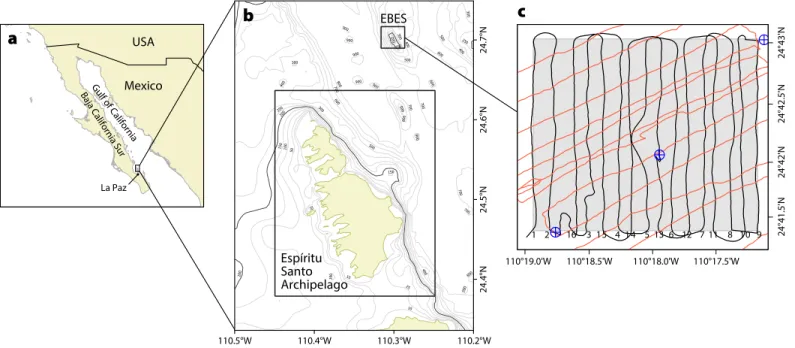
The MPA is delineated by two rectan- gles, one around the archipelago and a smaller one around EBES ( Figure 1 ).
While no-fishing areas are established within the larger rectangle, sportfishing and commercial fishing with handlines are permitted in most of the PNZMAES, which is the most productive area in the La Paz region (Hernández-Ortiz, 2013).
ABSTRACT. Worldwide, marine protected areas (MPAs) are increasingly created to protect and restore selected parts of the ocean and to enhance recreation, fishing, and sustainable resources. However, this process has outpaced the development and imple- mentation of methods for assessing and monitoring these habitats. Here, we combine data from an echosounder, a conductivity-temperature-depth probe, and underwater cameras to efficiently survey El Bajo Espíritu Santo Seamount, located in the southwest Gulf of California, Mexico. Results include a bathymetric map detailing a ridge with three peaks; oceanographic profiles showing a 35 m deep mixed layer and anoxic con- ditions below 200 m; mean target strength estimates for Pacific creolefish, Paranthias colonus (–34.8 dB re 1 m
2, for mean total length ~33 cm), and finescale triggerfish, Balistes polylepis (–39.8 dB re 1 m
2, 38 cm); baseline estimates of biomass for both spe- cies (55.7 t, 95% CI = 30.3–81.2 t and 38.9 t, 95% CI = 21.1–56.6 t, respectively) found only in the oxygenated water near the top of the seamount; and indications that these reef fishes grazed on zooplankton in the mixed layer. We conclude that acoustic- optical sampling is a practical approach for obtaining baseline information on MPAs and to efficiently monitor changes resulting from natural and anthropogenic processes.
FIGURE 1. (a) Macrolocalization of the (b) Parque Nacional Zona Marina del Archipielago de Espíritu Santo (PNZMAES), with rectangles delineating the marine protected area (MPA), including the Espíritu Santo Archipelago and El Bajo Espíritu Santo Seamount (EBES). The coarse-scale bathymetry (GEBCO_2019) highlights the 200 m isobath (black). (c) At EBES, acoustic transects (black lines, numbered by transect) and CTD casts (blue symbols) were conducted on April 21, 2018. Red lines are acoustic sampling transects conducted on April 16, 2019.
Gulf of California Baja California Sur
La Paz
Mexico USA
Espíritu Santo Archipelago
110.4°W
110.5°W 110.3°W 110.2°W
24.4°N24.5°N24.6°N24.7°N
EBES
110°19.0'W 110°18.5'W 110°18.0'W 110°17.5'W
24°41.5'N24°42'N24°42.5'N24°43'N
1 2 16 3 15 4 14 5 13 6 12 7 11 8 10 9
a b c
From 2008 to 2009, 350 t to 500 t of fish were caught there (Comisión Nacional de Áreas Naturales Protegidas, 2014).
EBES is northeast of the Bay of La Paz, Baja California Sur, about 13 km north of the Espíritu Santo Archipelago ( Figure 1 ).
It is a submarine ridge ~2.5 km long and
~0.8 km wide that rises from 1,000 m to ~18 m depth. Spring-tide currents
>0.5 m s
–1can cause twin eddies >1 km diameter in the lee (Klimley et al., 2005).
The area may also have cyclonic gyres, one observed with a 100 km diameter and an average west-periphery speed of 56 cm s
–1(Emilsson and Alatorre, 1997). Mixing brings nutrients to the surface, promotes primary production, and aggregates plankton on the ridge.
The biomasses of plankton and macro- zooplankton exceed those at nearby sites (González-Armas et al., 2002; González- Rodríguez et al., 2018). This produc- tion attracts reef fishes, pelagic fishes, and other vertebrates to the seamount (Klimley et al., 2005) and makes EBES both ecologically and economically important (Klimley and Butler, 1988).
Transitions in the fish assemblage at EBES correspond with seasonal varia- tions in the Gulf of California hydrogra- phy (Robles and Marinone, 1987). During winter conditions (water temperature 16°–20°C), pelagic fishes at the seamount include mostly yellowtail, amberjack, and red snapper; during summer condi- tions (24°–26°C), there are green jacks, hammerhead sharks, dolphinfish, and yellow snapper (Klimley et al., 2005).
Hammerhead sharks routinely con-
gregate at EBES. A decline in their abun- dance (Klimley et al., 2005) corresponded to an increase in fishing for all hammer- head shark species worldwide during the past 50 years (Saldaña-Ruiz et al., 2017;
Gallagher and Klimley, 2018), and the likely extirpation of some species from the Gulf of California (Pérez-Jiménez, 2014). With the depletion of larger fishes, the fisheries diversified (Erisman et al., 2010) and increasingly targeted Pacific creolefish (Paranthias colonus) and fine- scale triggerfish (Balistes polylepis) for human consumption rather than for fish bait (Sala et al., 2003). Between 1998 and 2012, catches of these species in the PNZMAES each averaged ~10 t yr
–1(Hernández-Ortiz, 2013).
After more than a decade as an MPA, in November 2018 the PNZMAES became the first Mexican MPA to obtain the International Union for Conservation of Nature Green List Certificate, after meet- ing several criteria related to governance, design and planning, effective manage- ment, and conservation results (Ortega- Rubio et al., 2019). However, most of the
monitoring efforts focus on the archipel- ago, and the status and recovery of the ecosystem at EBES have yet to be assessed and monitored. Here, we demonstrate a practical acoustic-optical surveying method and provide information that may be useful to researchers and man- agers. First, we describe the collection of echosounder data for mapping bathym- etry and estimating the abundances of fish and zooplankton, as well as the col- lection of photographic images and video
to identify fish species. Next, we present a map of the seamount and estimates of target strengths and biomass for Pacific creolefish and finescale triggerfish. Then we discuss these results in the context of local hydrographic conditions, in partic- ular, the effect of dissolved oxygen on the vertical distribution of fish. Finally, we demonstrate how the integrated echo- sounder and optical sampling represents a cost-effective and practical approach for MPA monitoring.
METHODS Overview
Acoustic sampling was executed along equally spaced transects spanning the EBES rectangle in April 2018 and April 2019, following the guidelines in Simmonds and McLennan (2005). The seabed and fish with gas-filled swim- bladders created high-intensity echoes, indicating bathymetric features and fish- school locations, sizes, and densities, as described by Foote (1980). Plankton echoes were weaker but were of suffi- cient intensity to indicate their distri- bution and abundance, as in Hewitt and Demer (1991). The shapes of the fish and zooplankton aggregations, and bathymet- ric features, coupled with concurrently collected oceanographic information, allowed the separation and characteriza- tion of echoes from various taxa along the survey path. The identities of species contributing to the fish echoes were fur- ther refined using optical sampling with underwater cameras (e.g., Demer, 2012).
The densities of the most abundant spe- cies were estimated by dividing their summed echo intensities by their average echo energy, estimated for representa- tive animals (Simmonds and McLennan, 2005). Abundance was estimated by multiplying the average estimated fish density and the survey area. These steps are elaborated below.
Acoustic-Optical Survey
On April 21, 2018, the fishery research vessel BIP XII sampled 16 north- south parallel- line transects spaced 0.1 nmi
“ The work at EBES demonstrates that integrated
acoustic, optical, and environmental sampling can be
used to efficiently monitor fish populations and their
essential habitats at MPAs. ”
apart spanning the rectangular 2.6 nmi
2EBES area ( Figure 1 ) at an average speed of 6.5 kt. The survey was conducted during daytime hours, ending at sunset, 19:46 MDT. Transects 1–9 progressed from west to east, from 12:07 to 15:15, then interstitial transects 10–16 progressed from east to west, from 15:52 to 17:55.
Along the transects, acoustic back- scatter was measured with an echo- sounder (Simrad EK60) equipped with a 120 kHz split-beam transducer (Simrad ES120-7C) pole mounted port-side amid- ships, 3.19 m below the water surface.
Measurements were made using 1,024 μs duration sound pulses transmitted every 0.65 s. The acoustic data were indexed with time (GMT), geographic position, and ship speed; bearing data were mea- sured with a GPS receiver.
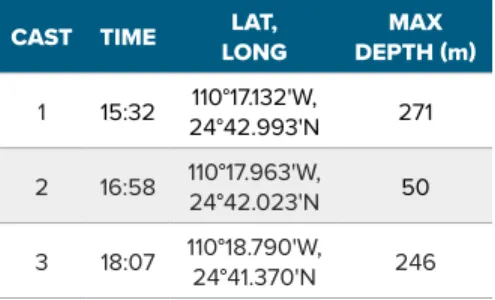
At the northeast and southwest cor- ners and center of the study area, a probe (SBE 19plus) was deployed to measure seawater salinity (S), temperature (T, °C), and dissolved oxygen (O
2, mL L
–1) versus depth ( Table 1 ).
During Cast 2, near the top of the seamount, an underwater video cam- era (GoPro Hero 4 Black Edition) was attached to the probe and deployed to 50 m depth. To minimize poten- tial reactions of fish to the probe, lights were not used. The images were exam- ined to identify the species that con- tributed to the concomitantly measured acoustic backscatter.
On the top of the seamount (24°42.069'N, 110°18.052'W), five scuba divers collected underwater video and photographic images to identify and count fish species and observe their behaviors.
The dives, to a maximum depth of 23.8 m, lasted 43 min with a “bottom time” of 36 min. The video cameras used during the dives were configured for 16 × 9 aspect, 1,920 × 1,080 pixels, 69.5° × 118.2° field of view, and 60 frames s
–1. To minimize potential reactions of fish to the divers, lights were used sparingly. Images were collected at depths ranging from 16.5 m to 23.8 m. The video-sampling dis- tance, ~12–14 m, was limited by depth
and water clarity. The photographic images (Nikon D500 camera and Sea &
Sea DY-D2J strobes, 5600 K) provided detailed images with correct color to bet- ter identify fish species. The images also provided relative estimates of fish length.
A 10 mm to 17 mm lens (Tokina) pro- vided a 100° × 180° field of view. The sam- pling range, ~5–8 m, was limited by the strobe illumination.
Because BIP XII had to divert around the dive boat, the shallowest portion of EBES was not sampled with the 120 kHz echosounder. Therefore, on April 16, 2019, the mapping of bathymetry on the top of EBES was completed using an echo- sounder (Simrad EK80 Portable) with a 38 kHz transducer (ES38-18). The 6 m long boat surveyed 12 transects spaced 0.1 nmi to 0.2 nmi, oriented southwest to northeast (60°) and vice versa (240°) ( Figure 1 ). The 1,024 μs pulses were trans- mitted every 1.5–0.25 s, depending on the seabed depth.
Bathymetric Mapping
The 120 kHz data were analyzed using commercial software (Echoview v8), and the 38 kHz data were processed using open-source software (ESP3 v1.2.1;
Ladroit et al., 2020).
The mean temperature (14.7°C) and salinity (34.8) over 0 m to 280 m depth were used to estimate sound speed (1,525.24 m s
–1) (Fofonoff and Millard, 1983) and acoustic absorption at 120 kHz (0.048056 dB m
–1) and 38 kHz (0.006287 dB m
–1) (Francois and Garrison, 1982). The continuous noise power (≤–125 dB re 1 W) and tran- sient noise were removed (details in De Robertis and Higginbottom, 2007;
Ryan et al., 2015). For each transmission, the range to the seabed was estimated, indexed by date, time, and geographic position, and exported (.csv format).
The two bathymetry data sets were combined as overlapping data differed by
<1 m. Depth contours were interpolated on a 50 m grid using ordinary kriging (geoR; Ribeiro and Diggle, 2018) in R (R Core Team, 2020).
Hydrographic Characterization To obtain cross-sectional views of isolines spanning the area, the CTD data were interpolated using distances defined by variograms and correlograms. To iden- tify the water masses present in the sur- vey area, potential temperature and salin- ity versus depth were used to construct a T–S diagram. The anoxic depth was defined by a dissolved oxygen concentra- tion of <0.5 mL L
–1(Serrano, 2012).
Echo Classification
A –61 dB threshold on 120 kHz volume backscattering strength (S
v; dB re 1 m
–1) was used to classify the echoes as either zooplankton (≤ –61 dB) or fish (> –61 dB).
The threshold was identified from itera- tive inspections of the distributions of S
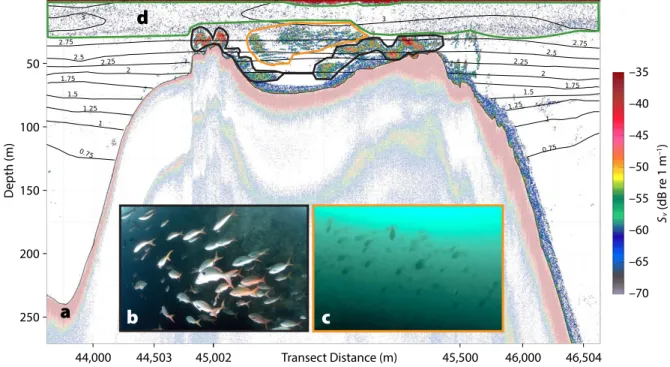
vwithin polygons drawn around echoes from aggregations of putative fish and then zooplankton ( Figure 2 ).
To calculate the nautical area scatter- ing coefficients (s
A; m
2nmi
–2) for each taxon, the resulting zooplankton and fish echograms were each gridded into 3 m deep by 25 m long cells and depth- integrated. Results were mapped, the for- mer as interpolated contours (50 m grid) and the latter transformed to fish biomass (see Biomass Estimation below).
Target Strength Estimation
Using an algorithm with default param- eters (Echoview), target strength (dB re 1 m
2) measurements of individual fish were obtained from the 120 kHz data collected at the location and time of CTD Cast 2. The echogram and video images from this period indicated aggregations
TABLE 1. Time, location, and depth of CTD casts.
CAST TIME LAT,
LONG MAX
DEPTH (m) 1 15:32 110°17.132'W,
24°42.993'N 271 2 16:58 110°17.963'W,
24°42.023'N 50 3 18:07 110°18.790'W,
24°41.370'N 246
of two predominant species above the top of the seamount. Boundaries were drawn around the data ( Figure 2 ) close to the seabed (identified as Paranthias colonus in the images) and farther above it (Balistes polylepis), and target strength values for these regions were exported separately. To determine whether the data from these regions were represen- tative of fish atop other areas of the sea- mount, they were compared visually to the overall target strength distribution of single targets over the seamount. The mean target strength (TS) and corre- sponding mean backscattering cross sec- tions (σ
bs= 10
TS/10) for the two princi- pal species were calculated in the linear domain and assumed to be representative of all of the fish of the same species sur- veyed over the seamount.
Fish Mass Estimation
The distributions of total length (L
t; cm) for each species of fish observed during the survey were assumed to be similar to those captured by fisherman at EBES from 2011 through 2017 (unpublished data from Sociedad de Historia Natural
Niparajá): for finescale triggerfish, root mean square total length (– L
t) was 38 cm (24 ≤ L
t≤ 50 cm), and for Pacific creole- fish, – L
twas 33 cm (26 ≤ L
t≤ 40 cm). These lengths were converted to mass (m; g) using the equation m = 0.0547 L
t2.66for triggerfish (Barroso-Soto et al., 2007) and m = 0.0547 L
t2.86333for creolefish (Balart et al., 2006). The average mass per species is the arithmetic average of the individual mass estimates.
Biomass Estimation
For each grid cell, the s
Aattributed to fish was apportioned to each of the two pre- dominant species, Paranthias colonus and Balistes polylepis, using factors equal to the mean backscattering cross sec- tions measured for each species, and the backscatter- weighted proportion for that species, estimated from σ
bsand the num- ber of each species observed in the video.
For grid cells within the 200 m iso- bath, fish densities by species (fish nmi
–2) were calculated by dividing the nauti- cal area scattering coefficients by a fac- tor equal to the corresponding individual backscattering cross section multiplied by
D epth (m)
50
100
150
200
250
44,000 44,503 45,002 Transect Distance (m) 45,500 46,000 46,504 –35 –40 –45 –50 –55 –60 –65 –70
S
v(dB r e 1 m
–1)
a b c
d
FIGURE 2. An example 120 kHz volume backscattering strength (S
v) echogram for transect 5 (see Figure 1 for location), showing echoes from: (a) the seabed (red band), (b) Paranthias colonus (inside the black line), (c) Balistes polylepis (inside the orange line), and (d) zooplankton (inside the green line). The plot is overlaid with isolines of dissolved oxygen concentration (mL L
–1), calculated by Data-Interpolating Variational Analysis (Ocean Data View V.4; Schlitzer, 2015).
4π. Biomass densities (kg nmi
–2) for each species were calculated by multiplying these densities by the average-fish mass (kg fish
–1) for that species (Simmonds and MacLennan, 2005). These values, summed for both species and scaled to kg × 100 m
−2, were overlaid on a map of the depth contours and the interpolated zooplankton s
A. Total biomass (B; t) was calculated for each species by multiplying the mean fish biomass density (t nmi
–2) by the area (nmi
2) within the 200 m isobath.
The variance of the fish nautical area
scattering coefficient in the survey area
was calculated using geostatistical meth-
ods implemented in Estimation Variance
software (EVA; Petitgas and Prampart,
1995). A model was fit to the experi-
mental variogram of the mean fish den-
sity, which was then used to compute the
estimation variance of the mean biomass
taking into account the geometry of the
area, the length of the cell grid, the tran-
sect lengths, and the inter-transect dis-
tance (Petitgas, 1993). The standard error
of the mean biomass was used to approx-
imate the 95% confidence intervals (CIs)
for the biomass.
800 700 600
500 4 00
400 300
300 250
250
200 150 100 80 60
60 50
45 40 35
N
110°19.0'W 110°18.5'W 110°18.0'W 110°17.5'W
24°41.5 ' N 24°42.0 ' N 24°42.5 ' N 24°43.0 ' N
0 0.25 0.5nmi818 800 700 600 500 400 300 250 200 150 Depth (m)
100 80 60 50 45 40 35 30 25
FIGURE 3. Bathymetry throughout the El Bajo Espíritu Santo MPA. The ridge has three peaks, consistent with measurements by Klimley et al. (2005).
FIGURE 4. (a) Salinity, temperature, and dissolved oxygen versus depth at EBES, measured with three CTD casts conducted on April 21, 2018. The bot- tom of the mixed layer is at ~35 m depth, and the oxygen concentration is nearly anoxic (~0.5 mL L
–1) below ~200 m depth. (b) Water masses present at EBES on April 21, 2018, included Gulf of California Water (GCW), indicated by S > 35 and T > 12°C, and Subtropical Subsurface Water (SSW), indicated by 100 m < D < 500 m, 34.5 < S < 35.0 and 9.0° < T < 18.0°C (Torres-Orozco, 1993; Amador-Buenrostro et al., 2003). Not observed, but potentially in the area, were Equatorial Surface Water (ESW) characterized by 0 m < D < 100 m, S < 35, and T > 18.0°C, and Pacific Intermediate Water (PIW) characterized by D > 500 m, 34.5 < S < 34.8, and 4.0° < T < 9.0°C (Amador-Buenrostro et al., 2003).
300 250 200 150 100 50
0 12 14 16 18 20 22 Temperature (°C)
34.6 34.8 35.0 35.2 Salinity
0.5 1.0 1.5 2.0 2.5 3.0 Oxygen (mL L
–1)
Cast 1 Cast 2 Cast 3
Depth (m)
50 100 150 200 250
Depth (m)
34.6 34.8 35.0 35.2
12 14 16 18 20 22
Salinity
a b
Potential Temperature (°C) 26.5 26.0 25.5 25.0 24.5
24.0
27.0
ESW
SSW
GCW
σ 0
RESULTS Bathymetry
The bathymetry model for EBES indicates a shallow peak at ~25 m depth, and two deeper peaks at ~32 and ~43 m ( Figure 3 ). To the west of the seamount the bottom depth exceeds 800 m, and to the east no more than 500 m. The ridge at the top of the seamount, defined here by the 200 m isobath, is about ~2.5 km long and ~0.8 km wide.
Oceanographic Environment
The CTD data indicate uniform conditions across EBES, with 34.6 < S < 35.3, 11° < T < 22.5°C, and 0.5 < O
2< 3 mL L
–1. The high- est values for the three variables were found in the upper mixed layer.
Across the study site, the surface mixed layer was ~35 m deep. A sub- surface mixed layer, ~100 m to ~125 m depth, has S ~34.8, T ~14.5°C, and O
2~0.75 mL L
–1. Casts 1 and 3 indicate nearly anoxic condi- tions (0.54 mL L
–1and 0.55 mL L
–1, respectively) at depths >200 m ( Figure 4a ).
During the survey, there were two predominant water-mass types at EBES ( Figure 4b ). Below the surface mixed layer, between
~25 m and ~70 m depths, the salty Gulf of California Water (GCW;
S ≥ 34.9, T ≥ 12.0°C; Torres-Orozco, 1993) results from evapora- tion of Equatorial Surface Water (ESW). Between depths of ~70 m and ~250 m, Subtropical Subsurface Water (SSW; 34.5 < S < 35.0;
9.0° ≤ T ≤ 18°C; Torres-Orozco, 1993) originates from the Pacific
Ocean (Castro et al., 2006).
Fish Species
Images from just one camera were used for identifying and counting fish to avoid overlap with imagery collected by the other four divers. Fish counts by species were estimated from 122 images, one from each 15 s segment of video. From these images, a total of 16 fish species were identified ( Table 2 and Figure 5 ). The predominant species observed in the video, and more clearly identified in the still images are: Scissortail damsel- fish (Chromis atrilobata), Pacific creole fish (Paranthias colonus), yellowtail surgeonfish (Prionurus punctatus), finescale trigger- fish (Balistes polylepis), Cortez rainbow wrasse (Thalassoma lucasanum), and king angelfish (Holacanthus passer). Of these, P. colonus and B. polylepis accounted for 79.1% and 20.9% of the fish thought to be sufficiently above the seabed to be detected acoustically (see Demer et al., 2009). Though the fish were not measured, the still images taken during this study indicate that the B. polylepis were larger than the P. colonus.
FIGURE 5. Some fish species observed at EBES are typical of rocky reefs in the Gulf of California. (a) Aggregations of yellowtail surgeonfish (Prionurus punctatus) were feeding near the seabed on top of the sea- mount. This species was also presumed to be too close to the seabed to be sampled acoustically. Pacific creole fish (Paranthias colonus), which were generally observed farther off the seabed, are also shown. (b) Pacific creole fish (Paranthias colonus; orange tails), seen here schooling above the seabed near the top of the seamount, were the most common pelagic species observed by divers. (c) Finescale triggerfish (Balistes polylepis;
light color) were the second most common pelagic species observed by the divers. Mexican hogfish (Bodianus diplotaenia; black-spot stripes with yellow tail) were observed less frequently (see Table 2).
a
c b
TABLE 2. Number of individuals (n) and the species percentage observed (p) in 122 images. One image was extracted from each 15 s video segment collected during one scuba dive on the EBES seamount. Also indicated are the percentages of the two species that aggregated sufficiently above the reef to be sampled acoustically (P).
COMMON NAME SPECIES n p (%) P (%) Scissortail
damselfish
Chromis
atrilobata 1,174 42.77
Pacific creolefish Paranthias
colonus 681 24.82 79.1
Yellowtail surgeonfish
Prionurus
punctatus 305 11.11
Finescale
triggerfish Balistes
polylepis 180 6.56 20.9
Cortez rainbow wrasse
Thalassoma
lucasanum 179 6.52
King angelfish Holacanthus
passer 132 4.81
Barberfish Jhonrandalia
nigrirostris 33 1.20
Yellow snapper Lutjanus
argentiventris 15 0.55
Moray eel Gymnothorax spp. 14 0.51
Mexican hogfish Bodianus
diplotaenia 12 0.44
Cortez damselfish Stegastes
rectifraenum 6 0.22
Leopard grouper Mycteroperca
rosacea 5 0.18
Starry grouper Epinephelus
labriformis 4 0.15
Azure parrotfish Scarus
compressus 2 0.07
Large-banded
blenny Ophioblennius
steindachneri 2 0.07
Purple surgeonfish Acanthurus
xanthopterus 1 0.04
2,745 100.00
Target Strength
The target strength distribution shown in Figure 6 largely includes measurements of individual Pacific creolefish and finescale triggerfish that were made throughout the survey. In addition, the distribution includes two small modes with higher values that may be from yellowtail surgeonfish (Prionurus punctatus) and king angelfish (Holacanthus passer), which were infrequently observed above the seabed ( Table 2 ).
The mean target strength for in situ Pacific creolefish was –34.8 dB re 1 m
2(σ
bs= 0.0003309 m
2) (n = 141), assumed to correspond with – L
t= 33 cm; and for in situ finescale triggerfish, mean target strength = –39.8 dB re 1 m
2(σ
bs= 0.0001038 m
2; n = 238; – L
t= 38 cm) ( Figure 6 ).
Echo Classification and Biomass Estimation
The two dominant species of fish that were deemed sufficiently above the seabed to be detected acoustically were P. colonus (~79.1%) and B. polylepis (~20.9%) ( Table 2 ). Both spe- cies were assumed to contribute all of the fish acoustic back- scatter, nearly all of which (mean = 1,292 m
2nmi
–2; max- imum = 63,002 m
2nmi
–2) was near the top of the seamount, at depths <200 m, in seawater with dissolved oxygen concen-
FIGURE 6. Distribution of target strengths (dB re 1 m
2) measured from all resolvable individual fish detected above the seamount (gray bars) and a fit probability density distribution (black line) compared to target strength distributions for Pacific creolefish (blue line) and finescale triggerfish (red line) concomitantly observed acoustically and optically during the second CTD cast. Based on their behaviors and numbers observed by the divers, the small third and fourth modes at ~ –29 dB and ~ –23 dB (arrow) may be from yellowtail surgeonfish (Prionurus punctatus) and king angelfish (Holacanthus passer).
Target Strength (dB re 1 m
2)
Density
−50 −45 −40 −35 −30 −25 −20 −15
0.00 0.02 0.04 0.06 0.08 0.10 0.12
a b
FIGURE 7. Distributions of fish biomass density (blue circles), equaling the sum of estimates for P. colonus and B. polylepis for 25 m distances along the survey transects, and interpolated zooplankton backscatter in the 35 m deep surface layer (gray contours) for transects 1–9 (see Figure 1 for transect locations). The 200 m isobath (black), delimiting the biomass- estimation area, is distinguished from the other isobaths (white).
30 40 50 60 70 80
800 700
600 500
400
400 300
300 250
250
200 150 100 80
60 60 50
45 40 35
00 00 00 00 80
80 80 880 80 8 5 00 0 55
60 600000000 600000000 88888
8888
40000 40 4440 404000 40 40 40 40 40 440400400040 40 40440040040 4444 444440000000
600 660 60 60 60 60
0 00000 00 00 00 00 0 000 00 0 0 0 0 44
50 50 50 50 50 50 5 5
660 50
50 50 50500 50 50 50 5055500 50 50
6666666 666 666 66666 6 60 66 66 66 66 66 66 66 6 6 66 66 66 6 66 66 4
4 44 444 4 40 4 4 44 44 44 44 4 4444 44 44 44
000 6 66 6 6 6 6 44
44 4 44 0 5 44 4 0
0 55 50505005505000
50550500
20,000 10,000 5,000
110°19.0'W 110°18.5'W 110°18.0'W 110°17.5'W
24°41.5'N 24°42.0'N 24°42.5'N 24°43.0'N
s
A(m
2nmi
–2) kg × 100 m
–2tration >0.5 mL L
–1( Figure 2 ). The fish backscatter outside of this polygon was negligible (mean = 3.7 m
2nmi
–2, maximum
= 461 m
2nmi
–2). When converted to biomass, the maximum combined biomass densities were 23.15 t × 100 m
–2(mean = 475 kg × 100 m
–2) inside the polygon, and 169 kg × 100 m
–2(mean = 1.35 kg × 100
–2) in the remainder of the area. For the relatively oxygenated area within the 200 m isobath where most of the fish were observed, the estimates of total biomass are 55.7 t (95% CI = 30.3–81.2 t) for P. colonus (92% of total fish back- scatter), and 38.9 t (95% CI = 21.1–56.6 t) for B. polylepis (8%
of total fish backscatter) ( Figure 7 ). The estimation variance was 95,021, and the coefficient of variation was 23.3%.
During the first pass, at midday, zooplankton backscatter was relatively homogeneously distributed throughout the MPA, mostly confined to the upper mixed layer ( Figure 2 ), though it appeared to be lower above the top of the seamount ( Figure 8a ).
Considering only transects 1–9, the mean and maximum zoo-
plankton backscatter measures in the 35 m deep surface mixed
layer were 58 m
2nmi
–2and 97 m
2nmi
–2, respectively. In the sec-
ond acoustic pass, late in the day ( Figure 8b ), plankton back-
scatter increased toward the west. This pattern is attributed to
plankton migrating from deeper waters at the end of the day.
DISCUSSION
This study exemplifies the procedure for integrating acoustic, optical, and oceano- graphic data collection to cost-effectively survey and monitor a marine protected area. The echosounder, CTD, and camera sampling of the 2.6 nmi
2EBES MPA was conducted during a ~7 hr period (exclud- ing travel time), but with refinements, the survey could either be completed in less time or expanded to cover the entire PNZMAES. This combination of sam- pling methods provided data to charac- terize the seabed and oceanographic hab- itats for pelagic fishes above the seamount and to identify the predominant species present and estimate their abundances.
The following sections provide a synopsis of the survey findings and suggestions for improving the efficiency and effectiveness of future surveys.
Bathymetry
Our bathymetric map of EBES ( Figure 3 ) provides more detail than previously pub- lished maps, including that used to estab- lish the MPA (Comisión Nacional de Areas Naturales Protegidas, 2006). Other maps of the area are on larger scales (e.g., Klimley and Nelson, 1984; Amador- Buenrostro et al., 2003) or their data sources and analysis methods are not
described (e.g., González-Armas et al., 2002; Trasviña-Castro et al., 2003; Valle- Levinson et al., 2004). A notable differ- ence between our bathymetry model and those of Klimley and Nelson (1984) and Amador-Buenrostro et al. (2003) is the shallowest depth (25.5 m vs 18 m, respec- tively). This may be due to different loca- tions of the sampling transects, the grid- ding procedures and scales used, or both.
To resolve this discrepancy, a multibeam echosounder should be used to con- struct a comprehensive map of EBES bathymetry (Kenny et al., 2003).
Environment
The oceanographic characteristics of EBES have not been thoroughly defined (González-Rodríguez et al., 2018), but seasonal variation is apparent (Klimley et al., 2005). During December to April, the sea surface temperature (SST) ranges from 19° to 24°C, and between May and November, it ranges from 25° to 29°C (Trasviña-Castro et al., 2003). During an El Niño event, SST tended towards the higher end of the latter range (Amador- Buenrostro et al., 2003). From July 2002 to April 2017, remotely sensed SST was lowest (~20°C) between February and March, and greatest (~30°C) during September to October (González-
Rodríguez et al., 2018). Our measure- ments of SST during April (~22°C) are consistent with these published ranges of SST during spring.
During the transition from winter to summer conditions, the EBES area is increasingly stratified, and mixed layer depth decreases. Our measurements showed a 35 m deep mixed layer in April, compared to 20 m in June (Trasviña- Castro et al., 2003) and 19 m in May (Verdugo-Díaz et al., 2006). The salin- ity that we measured in the upper 100 m in April (34.8 to 35.3) is similar to that measured in the same area in June 1999 (Trasviña-Castro et al., 2003).
Our measurements of dissolved oxy- gen concentration may be the first pub- lished values for the EBES area. We observed a decrease in oxygen from
>2.5 mL L
−1above 50 m depth to
<1 mL L
−1at 100 m depth, and near hypoxic levels (~ 0.5 mL L
−1) deeper than 200 m. Throughout the Gulf of California, the depth of the oxygen mini- mum zone (OMZ) ranges from 100 m to 1,000 m (Hendrickx, 2001), and shoaling of the OMZ in the eastern Pacific may compress the potential habitat of marine organisms (Prince and Goodyear, 2006) compared to other areas in the world (Serrano, 2012).
FIGURE 8. Comparison of interpolated zooplankton acoustic density between transects (a) 1–9 and (b) 10–16 con- ducted on April 21, 2018. The first pass progressed from west to east, between 12:07 and 15:15 MDT, while the second pass progressed east to west from 15:52 to 17:55 MDT.
40 60 80 100 120 140
800 700
600
500 400
400 300
300 250
250
200 150 100 80 60
60 50
45 40 35
800 700
600
500 400
400 300
300 250
250
200 150 100 80 60
60 50
45 40 35