CITATION
Meyer-Gutbrod, E.L., and C.H. Greene. 2014. Climate-associated regime shifts drive decadal-scale variability in recovery of North Atlantic right whale population. Oceanography 27(3):148–153, http://dx.doi.org/10.5670/oceanog.2014.64.
DOI
http://dx.doi.org/10.5670/oceanog.2014.64
COPYRIGHT
This article has been published in Oceanography, Volume 27, Number 3, a quarterly journal of The Oceanography Society. Copyright 2014 by The Oceanography Society. All rights reserved.
USAGE
Permission is granted to copy this article for use in teaching and research. Republication, systematic reproduction, or collective redistribution of any portion of this article by photocopy machine, reposting, or other means is permitted only with the approval of The Oceanography Society. Send all correspondence to: [email protected] or The Oceanography Society, PO Box 1931, Rockville, MD 20849-1931, USA.
OceanographyTHE OFFICIAL MAGAZINE OF THE OCEANOGRAPHY SOCIETY
DOWNLOADED FROM HTTP://WWW.TOS.ORG/OCEANOGRAPHY
Oceanography | Vol. 27, No.3 148 Oceanography | Vol. 27, No.3 148
B R E A K I N G WAV E S
Climate-Associated Regime Shifts Drive Decadal-Scale Variability in Recovery of North Atlantic Right Whale Population
B Y E R I N L . M E Y E R - G U T B R O D A N D C H A R L E S H . G R E E N E
North Atlantic right whale (Eubalaena glacialis) with calf. Photo credit: Florida Fish and Wildlife Conservation Commission/NOAA
ABSTR ACT. Despite an elevated mortality rate from lethal interactions with humans, the North Atlantic right whale population has continued to grow during the first decade of the new millennium. This unexpected population growth is the result of a 128% increase in female-specific reproduction relative to the 1990s. Here, we demonstrate that the recent increase in annual right whale calf production is linked to a dramatic increase in the abundance of its major prey, the copepod species Calanus finmarchicus, in the Gulf of Maine. The resurgence of C. finmarchicus was associated with a regime shift remotely forced by climatic changes in the Arctic. We conclude that decadal-scale variability in right whale reproduction may be largely driven by fluctuations in prey availability linked to climate-associated ecosystem regime shifts.
Oceanography | September 2014 149
INTRODUCTION
Humans began hunting the North Atlantic right whale (Eubalaena glacialis) nearly a millennium ago. By the end of the nineteenth century, the population was so depleted that it was of little commercial value to the whaling industry (Allen, 1908). In 1935, the right whale population first received protected status from the League of Nations, and, since 1949, a complete moratorium on hunting has been in place and overseen by the International Whaling Commission (Best et al., 2001). Despite the end of com- mercial whaling in the mid-twentieth century, the recovery of this endangered population has been gradual and highly variable. Accurate demographic studies only became possible after an extensive and ongoing effort was initiated during the 1970s to photograph and catalog all individuals in the population (Kraus et al., 1986). Subsequent analyses of the demographic data indicated that the population’s growth rate increased grad- ually during the 1980s, but then declined sharply during the 1990s (Fujiwara and Caswell, 2001). Demographic projections based on data from the early1990s suggested that the population was on a trajectory that would lead to its eventual extinction in less than 200 years (Fujiwara and Caswell, 2001).
As news of these demographic projections spread within the right whale research community, a consensus view emerged that the population would con- tinue to decline unless the right whale’s elevated mortality rates associated with ship strikes and entanglement in fishing gear could be significantly reduced (Fujiwara and Caswell, 2001; Kareiva, 2001; Waring et al., 2012). In contrast to this expectation, the right whale population began to recover during the following decade. Despite high mortality
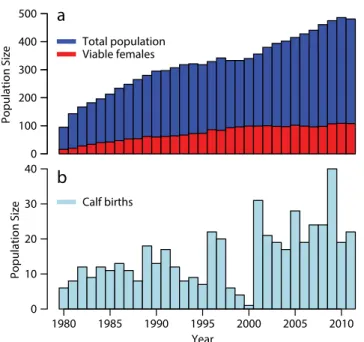
rates and even more dire demographic projections during the first decade of the 2000s (Kraus et al., 2005), the pop- ulation grew from ~ 340 animals at the beginning of the decade to ~ 486 animals by 2010 (Figure 1a). A major factor in this recovery was the 128% increase in female-specific average annual calf pro- duction between 2001 and 2010 relative to the previous decade (Figure 1b). Here, we use a data-driven, stochastic repro- duction model to explore the ecological underpinnings for this dramatic increase in right whale reproduction.
METHODS
Right Whale Population Data North Atlantic right whales have been photographically cataloged in a consis- tent manner since 1980 and are identi- fied using unique markings, scars, and callosities (rough patches of tissue found on the animals’ heads) (Kraus et al., 1986). Population growth rates reported in this paper use what are considered to be the best estimates of the total pop- ulation and numbers of reproductively viable female whales. The North Atlantic Right Whale Consortium (http://www.
narwc.org) provided us with a list of all known whales along with the years in which they died or were last sighted.
Six years missing is the standard used by the Consortium to define a whale that is presumed to have died. Annual estimates of the total number of whales presumed to be alive therefore include any whales on the list that are not known to have died or have not gone missing for six or more years without a subsequent sighting. Because of the potential for bias in using this six-year rule, we only used population data up until 2007 in our models. Among whales presumed to be alive, females considered reproductively viable are those known to have given birth or to have reached nine years of age, the average age of first parturition (Hamilton et al., 1998). Whales catego- rized as senescent are also removed from the time series of reproductively viable females (Knowlton et al., 1994).
The time series of annual calf pro- duction used in this study includes all known calf births, regardless of whether the mother was known and/or whether the calf survived its first year of life. Due to high survey effort in the mid-Atlantic
Population Size
0 100 200 300 400 500
Total population
a
b
Viable females
Population Size
0 10 20 30 40
1980 1985 1990 1995 2000 2005 2010 Calf births
Year
Figure 1. Time series of North Atlantic right whale population size from 1980 to 2010. (a) Total number of all whales (dark blue), num- ber of reproductively viable females (red). (b) Number of calf births (light blue).
Oceanography | Vol. 27, No.3 150
region, mother/calf pairs have an especially high sighting probability;
therefore, it is assumed that all newborn calves have been observed.
Right Whale Reproduction Model The stochastic reproduction model used in this study assigns repro- ductively viable females into three states: (1) recovering, (2) pregnant, or (3) nursing (Figure 2a). Recovering females can remain in the resting state (1 – Ø21) or become pregnant (Ø21).
Pregnant females can give birth and enter the nursing state (Ø32) or abort the pregnancy and reenter the recovering state (1 – Ø32). Nursing females can only transition to the recovering state (Ø13 = 1). Using this sequence of three reproductive states, we constructed the following transitional probability matrix:
A =
1 – Ø21 Ø21
0
1 – Ø32 0 Ø32
1 0 0
Each element Aij in the matrix is the probability of a reproductively viable female transitioning from state j to state i in a year. Projection matrix A is mul- tiplied by the female abundance vector Nt–1, or the number of living viable females in each of the three reproductive states during year t–1, to estimate the female abundance vector Nt during the following year t:
Nt = [A] * Nt–1
The two probabilities optimized in this study are Ø21 and Ø32, which represent the probability of a female transitioning from the recovering state (1) to the pregnant state (2), and the probability of a female transitioning from the pregnant state (2) to the nursing state (3), respec- tively. Transitional probabilities were estimated as logistic functions dependent on C. finmarchicus abundance. Model parameter vectors were optimized to yield a predicted calf production time series that best fits the observed time series provided by the North Atlantic Right Whale Consortium (Box 1).
Calanus finmarchicus abundance indices were estimated from Gulf of Maine Continuous Plankton Recorder (CPR) survey data (Greene et al., 2013) collected from 1980 to 2007. Despite the sampling limitations of the CPR and the averaging out of spatial and temporal patchiness, this index has proven to be a remarkably useful proxy for char- acterizing interannual to interdecadal variability in C. finmarchicus abundance (MERCINA Working Group, 2001,
2004; Greene et al., 2008). Six bimonthly C. finmarchicus abundance indices were determined for the entire Gulf of Maine region and for each of four geographical subregions: Massachusetts Bay (MB), Western Gulf of Maine (WGOM), Eastern Gulf of Maine (EGOM), and Scotian Shelf (SS) (Figure 2b). An annual average C. finmarchicus abundance index was also determined for the entire Gulf of Maine region and for each subregion.
Combinations of all indices were added and evaluated in a stepwise fashion to determine the best overall model fit to the annual calf production time series.
RESULTS
Annual calf production estimates from our model demonstrate the tight cou- pling between right whale reproduction and prey abundance over the past three decades (Figure 3a,b). Results from the model incorporating bimonthly and regional variations in prey abundance (Figure 3b) fit the observed data better than results from a temporally and spatially averaged version of the model
Erin L. Meyer-Gutbrod (elg82@
cornell.edu) is a PhD candidate, and Charles H. Greene ([email protected]) is Director and Professor, both in the Ocean Resources and Ecosystems Program, Earth and Atmospheric Sciences, Cornell University, Ithaca, NY, USA.
Figure 2. (a) North Atlantic right whale reproduction model. Reproductive females can be (1) in the recovering state between pregnancies, (2) pregnant, or (3) in the nursing state. Transitional probabilities between states are determined as functions of Calanus finmarchicus abundance in the Gulf of Maine.
(b) Gulf of Maine Continuous Plankton Recorder (CPR) survey area used to characterize prey availability to right whales. The CPR survey area is divided into four geographical subregions: Massachusetts Bay (MB), Western Gulf of Maine (WGOM), Eastern Gulf of Maine (EGOM), and Scotian Shelf (SS).
CPR survey sampling (black dots) in the Gulf of Maine occurs at approximately monthly intervals.
Recovering
a
Nursing Pregnant
(1 – Ø21)
(1 – Ø32) Ø21
Ø32
1
2 3
b
WGOM EGOM SS 43°N MB
41°N 42°N 44°N 45°N
71°W 70°W 69°W 68°W 67°W 66°W 65°W 64°W
Oceanography | September 2014 151
(Figure 3c) that is similar to the one previously reported by Greene et al.
(2003). The additional information on prey temporal and spatial distributions incorporated in the new model are con- sistent with independent observations of whale foraging patterns (Kenney et al., 2001), increasing confidence that the new model captures the relevant features of this predator-prey interaction.
In our best-fit model, the proba- bility of reproductively viable females transitioning from the resting state to the pregnant state is driven primarily by C. finmarchicus abundance in the WGOM during November/December.
This timeframe spans the peak mating season for right whales, and the western and central Gulf of Maine have been identified as a likely mating ground (Cole et al., 2013). The probability of reproductively viable females transi- tioning from the resting state to the pregnant state is driven secondarily by C. finmarchicus abundance in the entire Gulf of Maine during March/April. This timeframe corresponds to a period when high right whale abundance is observed in Cape Cod Bay (Pendleton et al., 2009), Massachusetts Bay (Schevill et al., 1986), and the Great South Channel (Kenney et al., 1995). Finally, the probability of reproductively viable females transi- tioning from the pregnant state to the nursing state is driven by C. finmarchicus abundance in the EGOM during July/
August. Because right whales are typi- cally found nearby in the lower Bay of Fundy during late summer (Mate et al., 1997), this relationship suggests that the EGOM subregion may be a significant feeding ground for pregnant females.
The close relationship between annual calf production and C. finmarchicus abundance in the Gulf of Maine is reflected in the decadal variability
observed for both (Figure 3a,b). Since complete records began in 1980, statistically significant changes in calf production and C. finmarchicus abun- dance were observed at the beginning of each decade (Greene et al., 2013).
Corresponding, statistically significant changes were also observed each decade in calf production per 100 reproductive females (Figure 4). During the 1980s, C. finmarchicus was abundant, and right whale calf production averaged 28 calves · 100 females–1 · year–1. During the 1990s, there was a large decline in C. finmarchicus abun- dance, and the average right whale calf production rate decreased to 14 calves · 100 females–1 · year–1. During the 2000s, C. finmarchicus abundance surged again, and the average right whale calf production increased to 24 calves · 100 females–1 · year–1.
DISCUSSION
These correlated changes in C. finmar- chicus abundance and right whale calf production have been linked to Gulf of Maine ecosystem responses to both basin- and hemispheric-scale climate forcing (Greene et al., 2013). The elevated abundance of C. finmarchicus in the Gulf of Maine during the 1980s was due to a favorable combination of high local productivity and sufficient advective supply into the region from upstream source regions (MERCINA Working Group, 2004). At the end of the 1980s, the Arctic climate system underwent a regime shift that triggered a large-scale export of freshwater out of the Arctic Ocean and into the North Atlantic (Greene et al., 2008; MERCINA Working Group, 2012). The resulting Great Salinity Anomaly of the 1990s led to a sequential reduction of salinities in shelf ecosystems throughout the Northwest
Box 1. Estimating Reproductive Transitional Probabilities
The two probabilities optimized in this study are Ø21 and Ø32, which represent the probability of a female transition- ing from the recovery state (1) to the pregnant state (2), and the probability of a female transitioning from the pregnant state (2) to the nursing state (3), respectively. The transitional probabilities were estimated as logistic functions to constrain the probabilities between 0 and 1 while offering flexibil- ity in the shape of the function:
Ø21 =
1 + eβ21* X eβ21* X Ø32 =
(1) 1 + eβ32* X (2)
eβ32* X
where the vector notations β21* X and β32* X each represent a linear combination of an intercept and coefficient(s) multiplied by the independent prey variable(s) X. These transitional probabilities were fit into a demographic matrix model, and the parameter vectors β21 and β32 were estimated to yield a predicted annual calf production time series most closely resembling the observed time series.
The model estimates of β21 and β32 predict different functional responses of the transitional probability Ø21 and the transitional probability Ø32 as func- tions of prey abundance. Ø21 increases gradually with increasing values of the Calanus finmarchicus abundance index, yielding a relatively linear relationship.
However, Ø32 behaves like a quasi-step function, with the transition to nursing a calf changing abruptly from highly improbable to highly probable over a narrow range of C. finmarchicus abun- dance values. This abrupt transition occurs at abundance values slightly below the climatological average for that bimonthly time period.
Oceanography | September 2014 151
Oceanography | Vol. 27, No.3 152
Atlantic (Greene et al., 2008; MERCINA Working Group, 2012). In the Gulf of Maine, the low-salinity waters altered the timing and extent of water-column stratification, which subsequently impacted the production and seasonal cycles of phytoplankton, zooplankton, and higher-trophic-level consumers in the ecosystem (Greene and Pershing, 2007; Greene et al., 2008; MERCINA Working Group, 2012). The abundance of C. finmarchicus declined precipitously after this climate-driven ecosystem regime shift, and right whale annual calf production also soon declined after a one- to two-year time lag (Figure 3a,b).
During the late 1990s, C. finmarchicus abundance declined even further following the twentieth century’s largest drop in the North Atlantic Oscillation (NAO) Index observed during the winter of 1996. Large-scale circulation changes in the slope and shelf waters of the
Northwest Atlantic were observed during the subsequent two years (MERCINA Working Group, 2001; Greene and Pershing, 2003), and these were hypoth- esized to have been major contributing factors to the crash of C. finmarchicus in 1998 and the subsequent reproductive failure of right whales in 1999 and 2000 (Figure 3a,b; Greene et al., 2003; Greene and Pershing, 2004).
At the end of the 1990s, the Arctic climate system underwent another regime shift, this time entering a period
favoring enhanced freshwater storage in the Arctic Ocean that persisted throughout the first decade of the 2000s (MERCINA Working Group, 2012). The corresponding reduction in freshwater export from the Arctic Ocean resulted in elevated salinities throughout Northwest Atlantic shelf ecosystems. In the Gulf of Maine, the plankton shifted back to resemble the assemblage characteristic of the 1980s regime, including a resurgence of C. finmarchicus abundance. Primed with a large number of females that had not reproduced during the poor prey conditions of the late 1990s, the relatively large portion of resting females responded with a rapid increase in annual calf production during the very early 2000s, and this production continued at an elevated level through 2010. Rather than facing the prospect of eventual extinction, as was forecast at the beginning of the decade, the right whale population in 2010 was on a positive trajectory towards recovery. It should be noted, however, that continued elevated rates of right whale calf production are contingent upon favorable future prey conditions.
CONCLUSION
The North Atlantic right whale popula- tion’s recovery during the past decade demonstrates that factors affecting both reproduction and mortality must be con- sidered when projecting the fate of an
-1.0 -0.5 0.0 0.5
abundance indexCalanus finmarchicus
0 5 10 15 20 25 30
Annual calf production (calves · year -1)
Observed Model predictions 95% Confidence interval
1980 1985 1990 1995 2000 2005
0 5 10 15 20 25 30
Year Annual calf production (calves · year-1)
Observed Model predictions 95% Confidence interval
a
b
c
Figure 3. (a). Time series of C. finmarchicus annual abundance index (Greene et al., 2013) estimated for the entire Gulf of Maine CPR survey area.
(b,c) Time series of annual calf production (calves · year–1) observed (black lines in b and c) and predicted by a model driven by bimonthly- and geographic-specific abundance estimates of C. finmarchicus in the Gulf of Maine (red line in b) and predicted by a model driven by annual abundance estimates of C. finmarchicus averaged for entire Gulf of Maine (blue line in c). The pale red and blue shading surrounding the model predictions correspond to the 95% confidence intervals.
Figure 4. Time series of female-specific annual calf production (calves · 100 females–1
· year–1). Decadal averages of female-specific annual calf production are shown with blue lines.
0 10 20 30 40
Female-specific annual calf production (calves · 100 females–1 · year–1)
1980 1985 1990 1995 Year
2000 2005 2010
Oceanography | September 2014 153
endangered species. In retrospect, there is evidence supporting the hypothesis that climate-associated ecosystem regime shifts drive decadal-scale vari- ability in the population’s recovery rate.
Specifically, this variability is a reflection of large fluctuations in annual calf production as it responds to changes in the ecosystem that affect prey availability.
This conclusion does not mean that anthropogenic sources of mortality are unimportant and that their mitigation should not be adopted as major elements in a conservation management plan. In fact, a plan that can reduce mortalities associated with ship strikes and entan- glement in fishing gear will only serve to hasten the population’s recovery.
What our conclusion does mean is that climate variability and change will introduce a level of uncertainty into demographic projections that must be taken into consideration when the goals of a conservation management plan are set and evaluated.
ACKNOWLEDGMENTS
We are very grateful to Phil Hamilton and the North Atlantic Right Whale Consortium (http://www.narwc.org) for providing the population data analyzed and reported in this paper.
Support for this research was provided by the National Science Foundation, through the US Global Ocean Ecosystem (GLOBEC) Program, and by the Department of Defense, through a National Defense Science and Engineering Fellowship to E.M.G.
We thank the Whitely Center at the University of Washington’s Friday Harbor Laboratories for providing C.H.G. with an inspiring setting during the preparation of this paper. E.M.G. and C.H.G. contributed equally to the devel- opment and writing of this paper.
REFERENCES
Allen, J.A. 1908. The North Atlantic right whale and its near allies. Bulletin of the American Museum of Natural History 24:277–329, http://digitallibrary.amnh.org/dspace/
handle/2246/1957.
Best, P.B., J.L. Bannister, R.L. Brownell, and G.P. Donovan, eds. 2001. Right Whales:
Worldwide Status, Journal of Cetacean Resource Management Special Issue 2. http://iwc.int/
journalspec02, 309 pp.
Cole, T.V.N., P.K. Hamilton, A.G. Henry, P. Duley, R.M. Pace III, B.N. White, and T. Frasier.
2013. Evidence of a North Atlantic right whale Eubalaena glacialis mating ground. Endangered Species Research 21:55–64, http://dx.doi.org/
10.3354/esr00507.
Fujiwara, M., and H. Caswell. 2001. Demography of the endangered North Atlantic right whale. Nature 414:537–541, http://dx.doi.org/
10.1038/35107054.
Greene, C.H., E.L. Meyer-Gutbrod, B.C. Monger, L.P. McGarry, A.J. Pershing, I.M. Belkin, P.S. Fratantoni, D.G. Mountain, R.S. Pickart, A. Proshutinsky, and others. 2013. Remote climate forcing of decadal-scale regime shifts in Northwest Atlantic shelf ecosystems. Limnology and Oceanography 58:803–816, http://www.aslo.
org/lo/toc/vol_58/issue_3/0803.html.
Greene, C.H., and A.J. Pershing. 2003. The flip-side of the North Atlantic Oscillation and modal shifts in slope-water circulation patterns.
Limnology and Oceanography 48:319–322, http://dx.doi.org/10.4319/lo.2003.48.1.0319.
Greene, C.H., and A.J. Pershing. 2004.
Climate and the conservation biology of North Atlantic right whales: The right whale at the wrong time? Frontiers in Ecology and the Environment 2:29–34, http://dx.doi.org/10.1890/1540-9295(2004) 002[0029:CATCBO]2.0.CO;2.
Greene, C.H., and A.J. Pershing. 2007. Climate drives sea change. Science 315:1,084–1,085, http://dx.doi.org/10.1126/science.1136495.
Greene, C.H., A.J. Pershing, T. Cronin, and N. Ceci. 2008. Arctic climate change and its impacts on the ecology of the North Atlantic.
Ecology 89:S24–S38, http://dx.doi.org/
10.1890/07-0550.1.
Greene, C.H., A.J. Pershing, R.D. Kenney, and J.W. Jossi. 2003. Impact of climate variability on the recovery of endangered North Atlantic right whales. Oceanography 16(4):98–103, http://dx.doi.org/10.5670/oceanog.2003.16.
Hamilton, P.K., A.R. Knowlton, M.K. Marx, and S.D. Kraus. 1998. Age structure and longevity in North Atlantic right whales Eubalaena glacialis and their relation to reproduction.
Marine Ecology Progress Series 171:285–292, http://dx.doi.org/10.3354/meps171285.
Kareiva, P. 2001. When one whale matters.
Nature 414:493–494, http://dx.doi.org/
10.1038/35107167.
Kenney, R.D., C.A. Mayo, and H.E. Winn. 2001.
Migration and foraging strategies at varying spatial scales in western North Atlantic right whales: A review of hypotheses. Pp. 251–260
in Right Whales: Worldwide Status, Journal of Cetacean Research and Management Special Issue 2. P.B. Best, J.L. Bannister, R.L. Brownell, and G.P. Donovan, eds, http://iwc.int/
journalspec02.
Kenney, R.D., H.E. Winn, and M.C. Macaulay.
1995. Cetaceans in the Great South Channel, 1979–1989: Right whale (Eubalaena glacialis). Continental Shelf Research 15:385–414, http://dx.doi.org/
10.1016/0278-4343(94)00053-P.
Knowlton, A.R., S.D. Kraus, and R.D. Kenney.
1994. Reproduction in North Atlantic right whales (Eubalaena glacialis). Canadian Journal of Zoology 72:1,297–1,305, http://dx.doi.org/
10.1139/z94-173.
Kraus, S., M. Brown, H. Caswell, and C. Clark.
2005. North Atlantic right whales in crisis.
Science 309:561–562, http://dx.doi.org/10.1126/
science.1111200.
Kraus, S.D., K.E. Moore, C.A. Price, M.J. Crone, W.A. Watkins, H.E. Winn, and J.H. Prescott.
1986. The use of photographs to identify indi- vidual North Atlantic right whales (Eubalaena glacialis). Report of the International Whaling Commission (Special Issue) 10:145–151.
Mate, B.R., S.L. Nieukirk, S.D. Kraus. 1997.
Satellite-monitored movements of the northern right whale. The Journal of Wildlife Management 61:1,393–1,405.
MERCINA Working Group. 2001. Oceanographic responses to climate in the Northwest Atlantic.
Oceanography 14(3):76–82, http://dx.doi.org/
10.5670/oceanog.2001.25.
MERCINA Working Group. 2004. Supply-side ecology and the response of zooplankton to climate-driven changes in North Atlantic Ocean circulation. Oceanography 17(3):60–71, http://dx.doi.org/10.5670/oceanog.2004.31.
MERCINA Working Group. 2012. Recent Arctic climate change and its remote forcing of Northwest Atlantic shelf ecosystems. Oceanography 25(3):208–213, http://dx.doi.org/10.5670/oceanog.2012.64.
Pendleton D.E., A.J. Pershing, M.W. Brown, C.A. Mayo, R.D. Kenney, N.R. Record, and T.V.N. Cole. 2009. Regional-scale mean cope- pod concentration indicates relative abundance of North Atlantic right whales. Marine Ecology Progress Series 378:211–225, http://dx.doi.org/
10.3354/meps07832.
Schevill, W.E., W.A. Watkins, and K.E. Moore.
1986. Status of Eubalaena glacialis off Cape Cod. Pp. 79–82 in Right Whales: Past and Present Status, Report of the International Whaling Commission Special Issue 10.
R.L. Brownell Jr., P.B. Best, and J.H. Prescott, eds, http://iwc.int/pubpre1999.
Waring, G.T., E. Josephson, K. Maze-Foley, and P.E. Rosel, eds. 2012. US Atlantic and Gulf of Mexico Marine Mammal Stock Assessments–2011. NOAA Technical Memorandum NMFS-NE-221, 330 pp., http://
www.nmfs.noaa.gov/pr/pdfs/sars/ao2011.pdf.