The Basic Policy of
Critical Information Infrastructure Protection (3rd Edition)
(Draft)
(Tentative Translation)
May XX, 2014
Information Security Policy Council
資料3-4(参考)
(This page intentionally left blank.)
Contents
I. INTRODUCTION ··· 1
1. BACKGROUND ··· 1
2. CLARIFICATIONOFTHEPURPOSEOFCIIP ··· 3
3. LESSONSLEARNEDFROMACTIVITIESUNDERTHESECONDEDITION4 3.1 Outcome ··· 4
3.2 Issues ··· 5
4. DISCUSSIONOFISSUES ··· 7
5. REVIEWOFTHESCOPEOFCII ··· 9
5.1 Results ··· 9
5.2 Relationship between existing CII sectors and added sectors ··· 10
6. REVIEWOUTPUTTOREVISEBASICPOLICYOFCIIP ··· 11
II. EXECUTIVE SUMMARY OF THE BASIC POLICY ··· 13
III. POLICIES FOR CIIP ··· 15
1. MAINTENANCEANDPROMOTIONOFTHESAFETYPRINCIPLES··· 15
1.1 Continual improvement of the Guides for safety principles ··· 15
1.2 Continual improvement of the safety principles ··· 15
1.3 Promotion of the safety principles ··· 16
2. IMPROVEMENTOFINFORMATIONSHARING ··· 17
2.1 Information sharing system during the term of this Basic Policy ··· 17
2.2 Promotion of information sharing ··· 18
2.3 Promotion of CII operators activities ··· 19
2.4 Responsibilities of each stakeholder in the information sharing ··· 19
3. IMPROVEMENTOFINCIDENTRESPONSE ··· 22
3.1 Improvement of cross-sectoral exercises ··· 22
3.2 CEPTOAR communication training ··· 24
4. RISKMANAGEMENT ··· 25
4.1 Basic view of risk management ··· 25
4.2 Support for risk management ··· 26
4.3 Mutual reflection of the results of this policy and other policies ··· 28
5. ENHANCEMENTOFTHEBASISFORCIIP ··· 29
5.1 Public relations activities ··· 29
5.2 International cooperation ··· 29
5.3 Maintenance of reference of standards and guides ··· 30
IV. ITEMS TO BE UNDERTAKEN BY STAKEHOLDERS··· 32
1. ACTIVITIESFORCABINETSECRETARIAT ··· 32
2. ACTIVITIESFORRESPONSIBLEMINISTRIESFORCIIP ··· 35
3. ACTIVITIESFORINFORMATIONSECURITYMINISTRIES ··· 36
4. ACTIVITIESFORCRISISMANAGEMENTMINISTRIES ··· 37
5. VOLUNTARYACTIVITIESFORCIIOPERATORS ··· 38
6. VOLUNTARYACTIVITIESFORCEPTOAR ··· 39
7. VOLUNTARYACTIVITIESFORTHECEPTOARCOUNCIL ··· 41
8. VOLUNTARYACTIVITIESFORSECURITYSUPPORTORGANIZATIONS41
9. VOLUNTARYACTIVITIESFORIT/ICS/SECURITYVENDORS ··· 42
V. ASSESSMENT, VERIFICATION AND REVISION ··· 43
1. GOALSOFTHETERMOFTHISBASICPOLICY ··· 43
1.1 All stakeholders ··· 43
1.2 CII operators ··· 44
1.3 Cabinet secretariat··· 45
2. CONTINUALIMPROVEMENTBASEDONASSESSMENTAND VERIFICATIONDURINGEACHFISCALYEAR ··· 46
3. METHODOLOGYFORASSESSMENTANDVERIFICATIONDURINGEACH FISCALYEAR ··· 47
3.1 Indexes for the assessment and verification by CII operators ··· 47
3.2 Indexes for the assessment and verification by government agencies ··· 48
4. RIVISIONFORTHEBASICPOLICYBASEDONASSESSMENTOF OUTCOMES ··· 51
ATTACHMENT: INFORMATION SHARING TO NISC AND INFORMATION SHARING FROM NISC ··· 52
1. INFORMATIONRELATEDTOITFAILURES,ETC ··· 52
2. INFORMATIONSHARINGTONISCFROMCIIOPERATORS ··· 53
2.1 In case of information sharing to NISC ··· 53
2.2 Contents of information sharing to NISC ··· 53
2.3 Framework of information sharing to NISC ··· 53
2.4 Handling of information sharing to NISC ··· 53
3. INFORMATIONSHARINGFROMNISCTOCIIOPERATORS ··· 55
3.1 Scope of CII operators subject to information sharing from NISC ··· 55
3.2 Contents of information sharing from NISC ··· 55
3.3 Framework of information sharing from NISC ··· 55
3.4 Cooperation for information sharing from NISC ··· 56
3.5 Improvement of the quality of the information ··· 56
ANNEX 1. SCOPE OF CII OPERATORS AND CRITICAL INFORMATION SYSTEM EXAMPLES ··· 57
ANNEX 2. CII SERVICES AND SERVICE MAINTENANCE LEVELS ··· 58
ANNEX 3. EVENT CATEGORIES AND CAUSE CATEGORIES IN INFORMATION SHARING TO NISC ··· 62
ANNEX 4-1. INFORMATION SHARING (NORMAL CIRCUMSTANCES) ··· 63
ANNEX 4-2. INFORMATION SHARING (IT CRISES) ··· 64
ANNEX 5. COMMUNICATION CHANNELS UNDER IT OUTAGES ··· 65
ANNEX 6. DEFINITIONS / GLOSSARIES ··· 68
I. INTRODUCTION 1. BACKGROUND
I. INTRODUCTION
1. BACKGROUND
The Basic Policy for Critical Information Infrastructures (Hereinafter abbreviated as "CII") is a shared action plan for the government, which bears responsibility for the protection of the CII, and CII providers, which carry out independent measures. The plan was established to serve as the basis for a policy related to information security measures for Japan's critical infrastructure, such as the enactment of the "Special Action Plan on Cyber-terrorism Countermeasures for Critical Infrastructure (concluded in the December 2000 Information Security Measure Promotion Meeting)" from before the establishment of the National Information Security Center (NISC).
For the action plan after the establishment of the NISC, in 2005, the "First Action Plan on Information Security Measures for Critical Information Infrastructures" (hereinafter referred to as the First Action Plan) was established based on the "Basic Orientation for Countermeasures Necessary for Protecting Critical Infrastructure from IT Outages and Ensuring Business Continuity of Critical Infrastructure Providers" presented in the Information Security Policy Council of the same year. Based on this First Action Plan, measures were begun by the stakeholders including the government and 10 CII sectors aimed at reducing IT outages at CII to zero.
Further, the "Second Action Plan on Information Security Measures for Critical Information Infrastructure (hereinafter referred to as the "Second Action Plan") was established in 2009 indicating policies to be implemented by the nation based on the basic measures for CIIP and public-private information sharing framework constructed in the First Action Plan. The Second Action Plan continues the implementation of the "maintenance and promotion of the safety principles", "improvement of information sharing", "common threat analysis1 " and
"cross-sectoral exercises" from the First Action Plan and also newly adds policies for "response to environmental change" in order to reliable deal with ever changing social and technological environments.
In this manner, the protection of Japan's CII has a history of 13 years from the Special Action Plan and even 8 years from the action plan in its current form, and it can be judged that measures have been steadily developed based on 5 policies, beginning with the construction of a clear-cut information sharing system.
As such, while continuing to keep in accord with the "Cyber Security Strategy" (determined at the June 2013 Information Security Policy Council), the knowledge gained from the
1 In the First Action Plan this policy was referred to as "interdependency analysis".
I. INTRODUCTION 1. BACKGROUND
assessment of the Second Action Plan policy groups, including positive examples and items requiring improvement, were also appropriately reflected in the determination of the current action plan.
Furthermore, in addition to the knowledge, etc. gained in dealing with system outages and data loss during the Great East Japan Earthquake, the plan also reflects appropriate handling for the ever changing social and technological environments and trends of increasingly sophisticated and complex cyber-attacks.
I. INTRODUCTION
2. CLARIFICATION OF THE PURPOSE OF CIIP
2. CLARIFICATION OF THE PURPOSE OF CIIP
Presupposing the implementation of this Basic Policy, it is necessary to clarify the purposes of the protection of CII and share awareness among stakeholders.
For Cyber Security Strategy, "Assuring Free Flow of Information", "New Measures against Increasing Serious Risk", "Strengthening of Risk-based Response" and "Activities and Mutual Aid based on Social Responsibility" are indicated in the Basic Principles and the purpose of the Second Action Plan conforms with the Cyber Security Strategy.
As such, in addition to inheriting the purposes of the Second Action Plan, "carrying out the continued provision of CII services" was also added and the purpose of CII protection was further clarified.
Purpose of "CII protection" (referred as "CIIP")
In order to provide continuously CII services and to prevent serious effects on the public welfare and socioeconomic activities from IT outages resulting from natural disasters, cyber-attacks or other causes, all stakeholders protect CII by reducing the risk of IT outages as much as possible and recovering from IT outages quickly.
Basic Principles for CIIP
The CII operators should implement measures for CIIP at their own responsibility.
In addition, activities through public-private cooperation should be aimed at fostering a sense of security in the people, social development, resilience and promoting international competitiveness.
・ The CII operators, as the primary implementing bodies and at the position in charge of social responsibility, should respectively take measures and work for continual improvement.
・ Government should support for CII operators' activities related to the measures for CIIP.
・ Each CII operator should cooperate and coordinate with other stakeholders, because each CII operator can hardly handle various threats by itself.
I. INTRODUCTION
3. LESSONS LEARNED FROM ACTIVITIES UNDER THE SECOND EDITION
3. LESSONS LEARNED FROM ACTIVITIES UNDER THE SECOND EDITION
The Second Action Plan is composed of the following 5 policies.
[1] Maintenance and promotion of safety principles [2] Improvement of information sharing
[3] Common threat analysis [4] Cross-sectoral exercises
[5] Response to environmental change
The results and issues of each policy are summarized below.
3.1 Outcome
On the occasion of the assessment of these policy groups, taken into account that the Second Action Plan was determined based on the most recent information surrounding CII as of 2009, assessment of results was carried out according to the assessment indexes in the Second Action Plan for the 5 policies. Consequently, for the expected targets, it can be said that the assessment showed the following definite results were achieved.
For maintenance and promotion of the safety principles, as a result of the stakeholders involved in measures for CIIP understanding the measures which they were required to implement themselves and aiming to carry out those measures under periodic self-inspection, an integrated and stable review cycle was able to be established for guides and safety principles, and the promotion, etc. of measures for CIIP was reinforced.
For improvement of information sharing, for the purpose of handling the ever-changing social and technological environments surrounding CII security measures and increasingly complex and sophisticated cyber-attacks, frameworks for sharing information to and from NISC were constructed and established through public-private partnerships, the operation of the relevant frameworks was stabilized, systems for sharing information within and between CEPTOARs were prepared, and the reception and effective utilization of required information was realized at CII operators.
For common threat analysis, as a result of carrying out examinations of common threat analysis based on determinations and analysis of cross-sectoral conditions indispensable for the maintenance and improvement of protective capability for overall CII, basic data was provided which contributed to the establishment of business continuance plans for CII operators and a portion of the analysis results were reflected in guides.
For cross-sectoral exercises, as a result of providing an opportunity for verification of
I. INTRODUCTION
3. LESSONS LEARNED FROM ACTIVITIES UNDER THE SECOND EDITION
systems for mutual contact and collaboration through simulated exercises with each public-private stakeholder covering all sectors against IT outages participating, the number of organizations and individuals participating in exercises is on an upward trend, and contributions have been made to information security measures through verification of CII operator early recovery methods and business continuance plans in the event of an IT outage based on the knowledge gained through the exercises.
Regarding public relations activities in particular among the response to environmental change, materials on the results of CII information security policy, CII Specialist Committee meeting materials and other materials were posted and published on the Cabinet Secretariat website, and in addition information security policy related lectures and other events were held.
For development of risk communication, opinion exchanges were held with CIIP supporting agencies and a CEPTOAR council mutual understanding WG was held. For promotion of international cooperation, cooperation with various countries through participation, etc. in Meridian2 and Cyber Storm exercises3. Efforts were made to improve capabilities to perceive threats accompanying environmental change.
3.2 Issues
Through the implementation of each policy, issues were identified which required improvement/reinforcement based on environmental change in social/technological aspects.
The principal issues for each policy are described below.
An issue for maintenance and promotion of the safety principles is reexamination based on conformity with measures for continued improvement in line with the PDCA cycle of measures for CIIP at CII operators because measures for CIIP also have an effect on the maintenance and improvement of protective capability for overall CII and not just CII operators themselves, and because there have been requests from CII operators for the presentation of guides prioritized based on the actual conditions of measures.
For improvement of information sharing, issues include building an effective information sharing system by eliminating the disparity in the frequency of information sharing between sectors, segmenting "threat patterns", constructing an information sharing system for times of IT crises positioned as an extension of the normal system, coordination of modes of cooperation with other stakeholders, etc.
For common threat analysis, issues include the detailed analysis of threats based on
2 An international forum where CII supervisors from various countries meet and carry out discussions specialized for CII protection.
3
A large scale exercise held by the U.S. government. Japan participates as a member of the IWWN (International Watch and Warning Network) when promoting international measures for handling vulnerabilities, threats and attacks.
I. INTRODUCTION
3. LESSONS LEARNED FROM ACTIVITIES UNDER THE SECOND EDITION
actualization of changes over time and environmental changes in order to improve effects and examinations related to operation in addition to handling investigations of serious threats which may have a major effect on all sectors, and not just limited to common threats across all sectors which are subject to investigation, aimed at the application and positioning of common threat analysis and review of the frequency of implementation, etc.
For cross-sectoral exercises, there are limitations to the design of exercise environments because the IT usage and information management of each organization differ, so major expansion of participant numbers for specific exercises is not feasible. For this reason, for the purpose of providing opportunities to identify CIIP measure issues at CII operators, the issue is to plan for further propagation and promotion of exercise results for the CII sector as a whole, rather than depending on expansion in the number of participants. Additional issues include, qualitative improvement of operation based on exercise assessments, study of the conditions for stakeholders taking into account handling during times of CII IT outages, and examination of cooperation with exercises and training sponsored by ministries responsible for CIIP and disaster prevention related ministries.
Regarding public relations activities in particular among the response to environmental change, issues include reexamination of public relations activities according to the scope of information disclosure and purpose under coordination with these policies and other policies in the next term action plan. For development of risk communication, issues include definition of risk management which conforms to international standards, reexamination of information sharing with regard for maintaining a balance between the secrecy of sensitive information and the information's usefulness, and continued mid to long term examination and study related to the theme of environmental change as it applies to new IT technologies, etc., for which the effect of threats is predicated to be major upon the mid to long term realization and use of said IT technologies, etc. For promotion of international cooperation, issues include continued promotion of cooperation with various countries in order to be able to quickly respond to intensifying/increasingly globalized risks in a cyberspace that transcends national borders, in addition to improvement of international cooperation through active utilization of bilateral, inter-regional and multilateral frameworks in and with the Asia-Pacific Region as well as the US and Europe, such as ASEAN.
I. INTRODUCTION
4. DISCUSSION OF ISSUES
4. DISCUSSION OF ISSUES
In addition to compiling the issues in the previous section and the issues requiring examination in Cyber Security Strategy, the following examinations were also carried out regarding the orientation of this Basic Policy based on the aforementioned issues.
<Orientation>
* Items noted should not be idealistic items which are difficult for CII operators to realize practically, but should rather take into account actual conditions, and be "accomplishable"
items which are realistic. For example, expressions such as "absolute security is expected"
and "100% perfection is anticipated" should be avoided.
* Basic items should be noted in the Basic Policy so that the executives and senior managers who hold the keys to measures for CIIP at CII operators are able to sufficiently understand the necessity of the items.
* What is expected of each stakeholder should be able to be discerned by reading the Basic Policy in consideration of the fact that some stakeholders may not be "experts".
* Clarify maintenance and improvement of protective capability for CII, especially the PDCA cycle which contributes to effective and independent activity by CII operators still mid-process as well as small to medium scale CII operators.
* Explain in detail regarding the importance of risk management and the necessity of its adoption as CII operators in order to allow for flexible response to environmental changes.
* Package the hierarchal regulations, etc. which CII operators are required to know and understand and format structure and content so that succession is easy to manage even for stakeholders affected by severe change.
* Continue to developer public relations activities even further after the determination of the Basic Policy in order to make possible the appropriate handling of ever-changing environments and the continued collection and provision of appropriate information.
Issue 1 While CII protection continues to mature as a system, in regard to the "Measures for CIIP are fundamentally items which CII operators must implement at their own responsibility" indicated in the Basic Principles, CII operators are still found which are lacking in this implementation and in the knowledge required for said implementation. What approach is suitable for promoting effective and independent activity from these types of CII operators?
I. INTRODUCTION
4. DISCUSSION OF ISSUES
<Orientation>
* Required parties from among cyberspace-related operators shall also be added as stakeholders and information sharing shall be developed to an even greater degree.
* Promote greater recognition that there is potential of the activities of CII operators in cyberspace being targeted and used as springboards, and awareness related to the responsibility and liability related to these weaknesses.
* To recognize that threats and vulnerabilities vary for each individual CII sector and even for each CII operator, and that social and technological environments are ever-changing, and to implement investigations of priority risk sources4 as well as to continually implement investigations of the mid to longer term changes in new technologies, systems, etc.
<Orientation>
* Increase the efficacy of exercises, training, etc., implemented by stakeholders, through interlinking of said exercises, training, etc.
* In addition to constructing a mechanism that recognizes that when IT crises occur, the relevant incident requires special warnings for CII operators, clarify to the greatest degree possible who shall be added to the response system and how they are to be added during normal times (conditions other than during IT crises response) (In addition, it is not realistic to setup an entirely new system in the when an incident occurs).
4
According to "JIS Q 31000:2010", these are defined as "elements which possess the innate potential to cause risk, either as a result of the element itself or through a combination of the element with other factors".
Issue 2 In regard to ever-changing social and technological environments and threats which intensify year to year, there are concerns that instruction for measures which allow for appropriate and quick response, however what type of activities, both public and private, are required in order to appropriately respond to these environmental changes and threats? In addition, is it not necessary to verify if a given party should or should not be a stakeholder?
Issue 3 For handling of IT outages, while a variety of activities have been started among stakeholders, there are concerns that the management and systems (public-private and public-public) in the event of a severe IT outage have not been sufficiently prepared, however isn't the coordination of information which needs to be shared to and from public-private agencies and the improvement of the clear statement of each individual response and inter-agency cooperation systems necessary in the event of such a severe IT outage?
I. INTRODUCTION
5. REVIEW OF THE SCOPE OF CII
5. REVIEW OF THE SCOPE OF CII
On the occasion of the determination of this Basic Policy, verification was carried out on the validity of the CII scopes prescribed as 10 sectors in the Second Action Plan, and further study was carried out on the addition of new sectors.
In addition, for the CII scopes, etc. which are subject to examination according to the Cyber Security Strategy5, continued reexamination will be implemented based on coordination with relevant parties in accordance with environmental changes.
5.1 Results
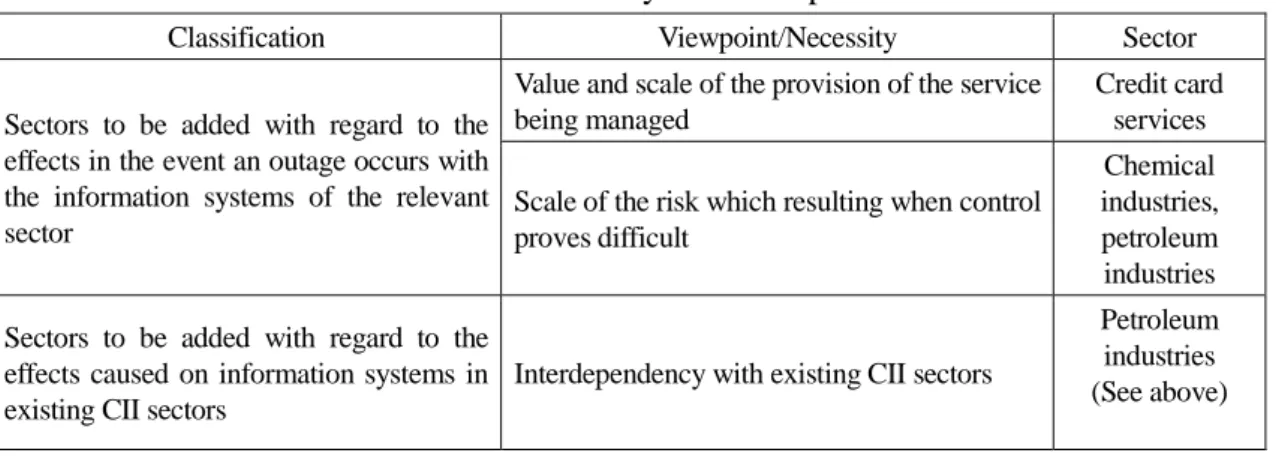
Verification was carried out, with reference to the knowledge gained from past handling, such as during the Great East Japan Earthquake, on the validity of the CII scopes in the Second Action Plan, including sectors which are not positioned as CII in the Second Action Plan but which have the same or similar potential to have a serious effect on the public welfare and socioeconomic activities as existing CII sectors in the event of an IT outage in the relevant sector, and through this verification several sectors were identified as being required to be added as new CII as shown in Table 1.
Table 1. Results of study on the scope of CII
Classification Viewpoint/Necessity Sector
Sectors to be added with regard to the effects in the event an outage occurs with the information systems of the relevant sector
Value and scale of the provision of the service being managed
Credit card services Scale of the risk which resulting when control
proves difficult
Chemical industries, petroleum industries Sectors to be added with regard to the
effects caused on information systems in existing CII sectors
Interdependency with existing CII sectors
Petroleum industries (See above)
As a result, in this Basic Policy, the CII sectors are 13 sectors consisting of "information and communication services", " financial services", "aviation services", "railway services", "electric power supply services", "gas supply services", "government and administrative services (including local government)", "medical services", "water services", "logistics services",
"chemical industries", "credit card services" and "petroleum industries".
With the participation of these added sectors as CII, it is important to eradicate doubts such as why the concerned sectors were added as CII and if there is any merit to the participation of
5 Refer to "2. Basic Policy" - "(3) Roles of Multi-Stakeholder" - "② Roles of critical infrastructure providers" (p. 20).
I. INTRODUCTION
5. REVIEW OF THE SCOPE OF CII
said sectors, and cultivate understand of the necessity of these sectors carrying out activities on their own initiative.
For ministries with jurisdiction over added sectors and industry groups which are potential candidates for CEPTOAR secretariats, which are central to the information sharing system, explanations are provided on the above viewpoints, agreement is obtained regarding the participation of the concerned sectors as CII and for the relevant industry groups, target critical information systems and service maintenance levels are defined and CEPTOAR establishment preparation is carried out.
5.2 Relationship between existing CII sectors and added sectors
7 years have passed since the construction of the information sharing system in FY2007, and at present each CEPTOAR has an experience amount for measures for CIIP as well as other unique qualities stemming from the nature of their operations and other factors.
In these circumstances, in the event an added sector is admitted as a new CEPTOAR, there is concern that the activities of existing CEPTOARs already active will shrink, so it is necessary for added sectors to be given advice by the Cabinet Secretariat, keeping in mind that cooperation with other CII operators in the same CII sector and CII operators in other CII sectors is important. In addition, it is also expected that at CEPTOAR council, CEPTOARs in added sectors will be provided with advice in a spirit of mutual support, leading to maintenance and improvement of protective capability for overall CII.
I. INTRODUCTION
6. REVIEW OUTPUT TO REVISE BASIC POLICY OF CIIP
6. REVIEW OUTPUT TO REVISE BASIC POLICY OF CIIP
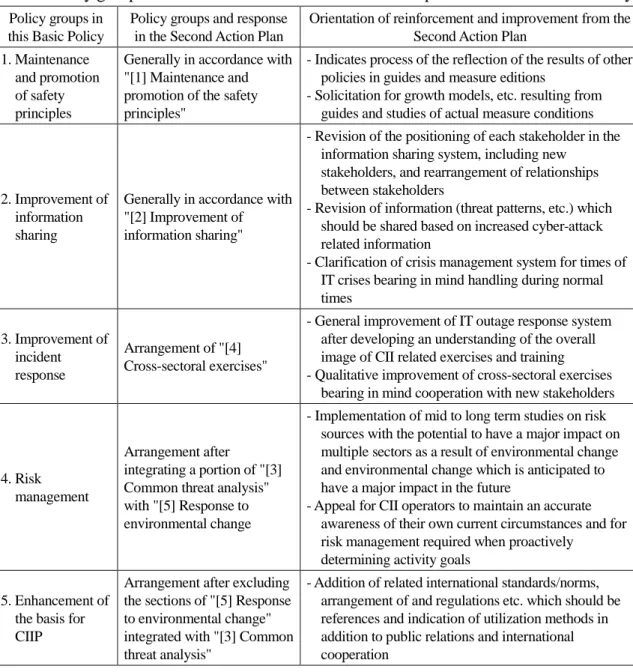
Based on the issues identified and orientations arranged up to the preceding section, upon the determination of this Basic Policy the basic framework of the Second Action Plan, which conforms with the Cyber Security Strategy, is maintained, however individual policies and the implementation systems have been revised, and after carrying out the necessary reinforcement and improvement, the policy group structure shown in Table 2 was settled.
Table 2. Policy groups and orientation of reinforcement and improvement in the Basic Policy
Policy groups in this Basic Policy
Policy groups and response in the Second Action Plan
Orientation of reinforcement and improvement from the Second Action Plan
1. Maintenance and promotion of safety principles
Generally in accordance with
"[1] Maintenance and promotion of the safety principles"
- Indicates process of the reflection of the results of other policies in guides and measure editions
- Solicitation for growth models, etc. resulting from guides and studies of actual measure conditions
2. Improvement of information sharing
Generally in accordance with
"[2] Improvement of information sharing"
- Revision of the positioning of each stakeholder in the information sharing system, including new
stakeholders, and rearrangement of relationships between stakeholders
- Revision of information (threat patterns, etc.) which should be shared based on increased cyber-attack related information
- Clarification of crisis management system for times of IT crises bearing in mind handling during normal times
3. Improvement of incident response
Arrangement of "[4]
Cross-sectoral exercises"
- General improvement of IT outage response system after developing an understanding of the overall image of CII related exercises and training - Qualitative improvement of cross-sectoral exercises
bearing in mind cooperation with new stakeholders
4. Risk management
Arrangement after
integrating a portion of "[3]
Common threat analysis"
with "[5] Response to environmental change
- Implementation of mid to long term studies on risk sources with the potential to have a major impact on multiple sectors as a result of environmental change and environmental change which is anticipated to have a major impact in the future
- Appeal for CII operators to maintain an accurate awareness of their own current circumstances and for risk management required when proactively
determining activity goals 5. Enhancement of
the basis for CIIP
Arrangement after excluding the sections of "[5] Response to environmental change"
integrated with "[3] Common threat analysis"
- Addition of related international standards/norms, arrangement of and regulations etc. which should be references and indication of utilization methods in addition to public relations and international cooperation
Also, in order to allow for appropriate response even in the event of major environmental change after the determination of the Basic Policy, it is necessary to continually monitor environmental change, identify threats from the information gathered, and construct systems that allow for flexible response. In addition, it is also important for the systems to be able to seamlessly shift from normal times to times of IT crises response while ensuring that initiatives
I. INTRODUCTION
6. REVIEW OUTPUT TO REVISE BASIC POLICY OF CIIP
related to the improvement of outage response systems are solid, rather than just the proactive prevention on which priority was previously placed.
II. EXECUTIVE SUMMARY OF THE BASIC POLICY
II. EXECUTIVE SUMMARY OF THE BASIC POLICY
The key points for this basic policy are as follows;
(1) Purpose of "CII protection" (referred as "CIIP")
In order to provide continuously CII services and to prevent serious effects on the public welfare and socioeconomic activities from IT outages resulting from natural disasters, cyber-attacks or other causes, all stakeholders protect CII by reducing the risk of IT outages as much as possible and recovering from IT outages quickly.
(2) Basic Principles for CIIP
The CII operators should implement measures for CIIP at their own responsibility.
In addition, activities through public-private cooperation should be aimed at fostering a sense of security in the people, social development, resilience and promoting international competitiveness.
- The CII operators, as the primary implementing bodies and at the position in charge of social responsibility, should respectively take measures and work for continual improvement.
- Government should support for CII operators' activities related to the measures for CIIP.
- Each CII operator should cooperate and coordinate with other stakeholders, because each CII operator can hardly handle various threats by itself.
(3) Responsibility of the stakeholders; CII operator/government agency/CIIP supporting agency
- All the stakeholders periodically verify the progress of own measures and policies in each required initiative and correctly recognize their current circumstances, and proactively determine the goals of activities. Also, they proactively cooperate with each other, recognizing of the activity conditions of other stakeholders.
- All the stakeholders understand the 5W1H of IT outage response in accordance with its scale and can calmly cope in the event of signs or occurrence of an IT outage. They can cooperate with other stakeholders and carry out cooperated response in addition to having enough communication between various stakeholders that carry out proactive response.
(4) Responsibility of CII operator's executives and senior managers
In addition to the above responsibility, the executives and senior managers should also recognize the necessity of and be capable of implementing the following.
- Recognizing risk sources focusing on information security for the above purpose.
- Assessing the above risk sources and determining policy including prioritization.
- Determining plans necessary for the establishment and operation of systems and implementation of relevant policies in addition to continually ensuring management resources; budget, human resources, infrastructure and etc.
- Verifying the execution of relevant policies through monitoring of the system operation.
- Verification and improvement of incident response including information sharing with other stakeholders through exercises and trainings.
II. EXECUTIVE SUMMARY OF THE BASIC POLICY
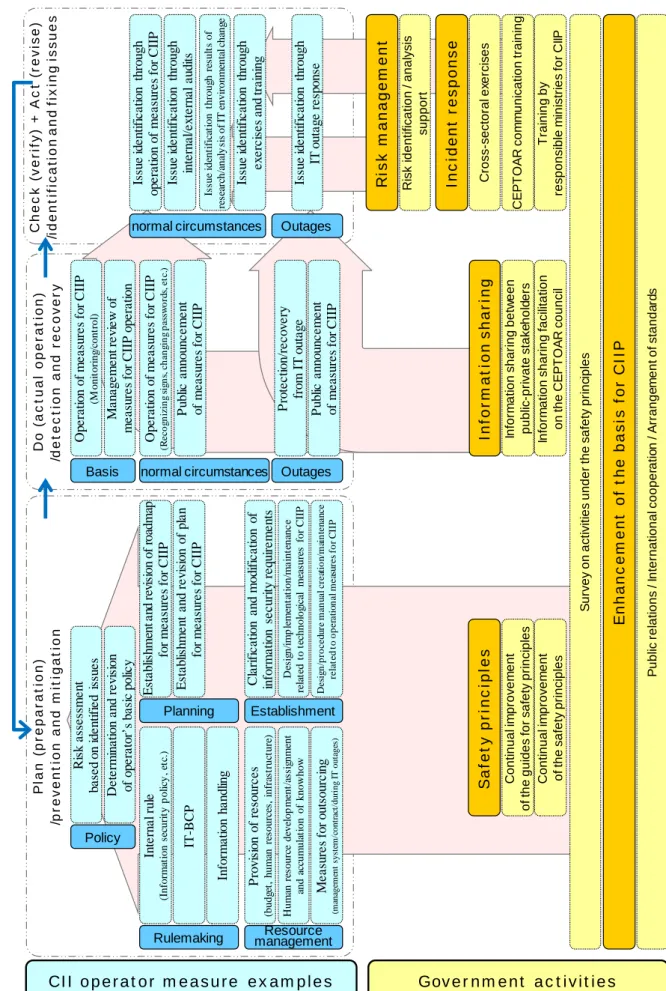
Figure 1. "CII operator measure examples" and "Government activities" Plan (preparation) /prevention and mitigationCheck (verify) + Act (revise) /identification and fixing issuesDo (actual operation) /detection and recovery
CII operator measure examples Government activities
Internal rule (Information security policy, etc.) IT-BCP Information handling Provision of resources (budget, human resources, infrastructure) Human resource development/assignment and accumulation of knowhow Measures for outsourcing (management system/contract/during IT outages)
Establishment and revision of roadmap for measures for CIIP Establishment and revision of plan for measures for CIIP Clarification and modification of information security requirements Design/implementation/maintenance related to technologicalmeasures for CIIP Design/procedure manual creation/maintenance related to operational measures for CIIP
Basis Operation of measures for CIIP (Monitoring/control) Management review of measures for CIIP operation
normal circumstances
Protection/recovery from IT outage Public announcement of measures for CIIP
Outages Issue identification through internal/external audits
normal circumstances
Issue identification through results of research/analysis of IT environmental change Issue identification through exercises and training Issue identification through IT outage response
Outages
Safety principles Continual improvement of the guides for safety principles Continual improvement of the safety principles
Information sharing Information sharingbetween public-privatestakeholders Information sharingfacilitation on the CEPTOAR council
Incident response Cross-sectoralexercises CEPTOAR communication training Training by responsible ministries for CIIP
Risk management Risk identification / analysis support
Risk assessment based on identified issues Determination and revision of operator’s basic policy Operation of measures for CIIP (Recognizing signs, changing passwords, etc.) Public announcement of measures for CIIP Issue identification through operation of measures for CIIP
Resource management Establishment
Rulemaking Planning
Policy
Survey on activities under the safety principles Enhancement of the basis for CIIP Public relations / International cooperation / Arrangement of standards
III. POLICIES FOR CIIP
1. MAINTENANCE AND PROMOTION OF THE SAFETY PRINCIPLES
III. POLICIES FOR CIIP
1. MAINTENANCE AND PROMOTION OF THE SAFETY PRINCIPLES During the term of this Basic Policy, the Cabinet Secretariat carries out the review the Guides for safety principles and related surveys so that they would conform with the PDCA cycle of CII operators and would enhance the cooperation with other policies, in order to strengthen the ability of CIIP.
Also, CII operators continuously and steadily work on measures for CIIP in accordance with their PDCA cycle, in view of importance of the measures.
1.1 Continual improvement of the Guides for safety principles
The Cabinet Secretariat carries out the review the Guides in FY 2014, in order to strengthen the ability of CIIP, especially in order to contribute to effective and autonomous activities of mid-process or small-and-medium-sized CII operators.
In detail, it arranges the orders of the items in the Guides in accordance with the PDCA cycle of CII operators, and adds some items, if necessary, based on knowledge from other policies etc. in this Basic Policy.
In addition, some example views on prioritization of measures for CIIP in case CII operators execute these measures, ways of gradual addition of measures for CIIP, and ones on balancing with pre-active measures and post-active measures, are described as “growth-model”.
Further, the Guides appeal the importance of the responsibility of CII operator’s executives and senior managers regarding policy, rulemaking, planning, resource management and establishment that are essential to gradually and constantly strengthen CII operators' measures.
After FY 2015, social trends changes and newly obtained knowledge is released each fiscal year, and the revision of the Guides is executed every 3 year or as necessary.
1.2 Continual improvement of the safety principles
Responsible ministries for CIIP and CII operators continually improve safety principles based on knowledge learned from experiences when taking the measures, in order to maintain or strengthen the abilities of not only individual CII operator but also overall CII.
In detail, they approach continual improvement of safety principles through risk assessment, by identifying issues from operation of measures for CIIP, internal/external audits, environmental change studies, exercises, training and incident responses.
III. POLICIES FOR CIIP
1. MAINTENANCE AND PROMOTION OF THE SAFETY PRINCIPLES
In addition, when verifying the safety principles, the Guides as well as social trend changes and newly knowledge released by the Cabinet Secretariat is used.
The Cabinet Secretariat carries out survey on the improvement of safety principles by the responsible ministries for CIIP each fiscal year and releases the results of survey.
1.3 Promotion of the safety principles
The Cabinet Secretariat carries out survey the CII operators' activities, in order to recognize the status of promotion of the safety principles at CII operators. In addition, in order to contribute to CII operators' effective and autonomous activities, survey operations will also be revised so that responses to the survey will serve as self-checks of measures.
With regard to survey itself, the activities include addition of survey items that can identify more detail conditions in CII operators and ones that can detect degrade of measures in CII operators which have excellent conditions through periodical survey, with some expansion of the coverage of the target CII operators.
With regard to survey operations, the activities include an arrangement of the questionnaire items in the survey in accordance with the PDCA cycle so that the measures and process to be enforced become explicit.
In addition, in order to supplement the survey using the questionnaire method, the Cabinet Secretariat conducts visit to CII operators.
With regard to the visit, the activities include extraction of issues from detail conditions of measures and collection of best practices, through the interviews with detail items based on the questionnaire.
For the results from the questionnaires and the visit, in principal, these will be released each fiscal year, and in addition, the obtained improvement issues reflected on each of the policies of this Basic Policy.
Survey items can be changed flexibly to the degree that such change does not impair the periodical survey.
III. POLICIES FOR CIIP
2. IMPROVEMENT OF INFORMATION SHARING
2. IMPROVEMENT OF INFORMATION SHARING
While the social and technological environments surrounding CII constantly change, it is necessary to determine these environmental changes accurately and then reflect these changes in the measures for CIIP in order to maintain the effectiveness of measures for CIIP. In addition, it becomes more important to raise the level of measures in CIIP and cyber-attack response capability due to increasing complexity, sophistication of cyber-attacks.
As described in the Basic Principles in "I.2. CLARIFICATION OF THE PURPOSE OF CIIP", CII operators should fundamentally implement measures for CIIP at their own responsibilities, however, it is difficult to verify whether a response by only itself to various threats is sufficient or not. For this reason, it is important to work on necessary measures for CIIP through cooperation by carrying out information sharing within sectors, between sectors and through public private partnership.
Based on these conditions, in the term of this Basic Policy, the Cabinet Secretariat manages the information sharing system among stakeholders including added sectors and stakeholders, and further promotes information sharing, in addition to working towards further vitalization of information sharing activities by CII operators.
2.1 Information sharing system during the term of this Basic Policy
When establishing this Basic Policy, for the purpose of enhancement of the information sharing system during IT crises, the Information Security Policy Council (referred as “ISPC”
hereinafter) decides to add disaster prevention related ministries for disaster management, and also add cyberspace-related operators, consisting of system vendors, which are engaged in the design, construction operation and maintenance of information systems required for providing CII services, security vendors, which provide measures for CIIP and platform vendors, which provide the platforms which serve as foundations. The information sharing system after these addition is represented in "ANNEX 4-1. INFORMATION SHARING (NORMAL CIRCUMSTANCES)" and "ANNEX 4-2. INFORMATION SHARING (IT CRISES)" as extended system of the former one.
In addition, the ISPC reviews CII sector critical information systems and service maintenance levels including those in newly added sectors. The results are shown in "ANNEX 1. SCOPE OF CII OPERATORS AND CRITICAL INFORMATION SYSTEM EXAMPLES"
and "ANNEX 2. CII SERVICES AND SERVICE MAINTENANCE LEVELS".
During the term of this Basic Policy, the stakeholders operate the information sharing system according to their respective position and role. In addition, it is expected that cyberspace-related operators implement measures required for the maintenance of information
III. POLICIES FOR CIIP
2. IMPROVEMENT OF INFORMATION SHARING
security, if necessary, such as sharing of vulnerability information and preventing spread of damages in the event of IT outages resulting from cyber-attacks, etc.
2.2 Promotion of information sharing
For arrangement of information to be shared, it is important to identify and arrange information that should be shared among stakeholders, including government agencies and CII operators, from aspects of "proactive prevention of IT outages", "prevention of the spread damages and quick recovery from IT outages", and "prevention of recurrence through analysis and verification of IT outage causes".
When establishing this Basic Policy, the Cabinet Secretariat has carried out revision of
"ATTACHMENT: INFORMATION SHARING TO NISC AND INFORMATION SHARING FROM NISC" and "ANNEX 3. EVENT CATEGORIES AND CAUSE CATEGORIES IN INFORMATION SHARING TO NISC" based on the above 3 aspects regarding the information sharing system during normal times and during IT crises, in order to contribute to CIIP including proactive prevention of IT outages.
In detail, the ISPC has revised event6 items based on the information security C.I.A7 viewpoint and formed detailed cause items based on new threats, etc. in "ANNEX 3. EVENT CATEGORIES AND CAUSE CATEGORIES IN INFORMATION SHARING TO NISC", in order to grasp situation of IT outage rapidly and accurately. In "ATTACHMENT:
INFORMATION SHARING TO NISC AND INFORMATION SHARING FROM NISC", the ISPC has clarified the coverage of information sharing, including handling of IT outage predictive information, in order to eliminate the disparity in the frequency of information sharing between sectors.
During the term of this Basic Policy, the Cabinet Secretariat carries out information sharing to and from NISC in accordance with the attachment, cooperate with stakeholders and promote this information sharing system, with the expectation that information sharing among stakeholders contribute to CII operation and their verification of measures, and proactive prevention of IT outages. In addition, in the event any environmental change occurs, it attempts to review the information system as appropriate.
6 An Information Security Event is defined as "The occurrence of a specific condition in systems, services or networks. Specific condition refers to an unknown condition which may be related to potential violations of information security policy, management measure failures or security." in "ISO/IEC 27000:2013".
7 Stands for Confidentiality, Integrity and Availability.