博士学位申請論文
2019
年12
月9
日Transfer and Causation:
A Cognitive Construction Grammar Approach to English Ditransitive Constructions
(所有変化と使役:英語二重目的語構文への認知構文論的アプローチ)
西南学院大学大学院
文学研究科英文学専攻博士後期課程
19DC003
植田 正暢(指導教授:川瀬 義清 先生)
TRANSFER AND CAUSATION:
A COGNITIVE CONSTRUCTION GRAMMAR APPROACH TO ENGLISH DITRANSITIVE CONSTRUCTIONS
A DISSERTATION
SUBMITTED IN PARTIAL FULFILLMENT OF THE REQUIREMENTS OF THE
DEGREE OF DOCTOR OF PHILOSOPHY
AT
SEINAN GAKUIN UNIVERSITY
by
Masanobu UEDA
December 9, 2019
Acknowledgements
My knowledge on linguistics was created and expanded through the interactions of my teachers, colleagues and friends. Among them, the first person to whom I would like to express my deepest appreciation is Professor Yoshikiyo Kawase. Since I started this project with him, he has always listened to me and helped unravel my tangled lines of thought. Without him, I could not finish weaving my dissertation from the long, winding threads I obtained through discussions with him. I would also like to express my gratitude to Professor Shigeyuki Fujimoto and Professor Akihiro Ito, my thesis committee members, for their helpful and friendly comments on the manuscript of this thesis.
The writing of this thesis was made possible through sabbatical leave granted in 2018 by the University of Kitakyushu, and I acknowledge the generosity of the university. My thanks are also due to the staff members of the Center for Funda- mental Education, who have encouraged me to attempt to write this thesis. Particu- larly, I wish to thank Professor Yasushi Nakao, the then dean of the Center for Fundamental Education, for giving me permission to study at Seinan Gakuin Univer- sity while working full-time. I would also like to express my special thanks to Roger Prior and Anne Crescini. They always kindly answered my inquiries about the data I used for recent studies, including this thesis. I thank Naoki Kiyama for his valuable suggestions on my ideas in the early stage of this thesis project.
The starting point of this dissertation project goes back to some collaborative research with Noriko Nemoto in 1996 (Parts of the results were presented in Nemoto and Ueda (1997) and Ueda and Nemoto (1998)). Some ideas for chapter 3 were first given at the Symposium on Constructional Meaning and Verb Meaning, organized by Seizi Iwata, held at the 18th Conference of the English Linguistic Society of Japan in 2000. The ideas were published in 2004 inTsukuba English Studies, 22, after I made a presentation at the Second International Conference on Construction Grammar in 2002. Chapter 3 is revised and extended from the 2004 paper.
My studies leading to chapter 4 originated from a comment I received from Seizi Iwata in personal communication after the abovementioned symposium. His comment that verbs of refusal (refuse and deny) seem somehow different from other ditransitive verbs instigated my research into the verbs that are scrutinized in
chapter 4. The results of my quantitative studies were based on my series of studies under the Institute of Statistical Mathematics (ISM) Cooperative Research Programs from 2013 to 2019 (2013-ISMCRP-2026, 2014-ISMCRP-2028, 2015-ISMCRP-2025, 2016- ISMCRP-2025, 2017-ISMCRP-2025, 2018-ISMCRP-2028, 2019-ISMCRP-2038). For these seven years, I have had opportunities to discuss the results of my research with members of the program. I particularly thank Professor Tadahiko Maeda for his helpful comments on statistical methods of analysis. Part of my discussion on language and cognition in section 1.3 is based on a simple question of innateness of language from Professor Shin’ichiro Ishikawa at the conference dinner of the annual meeting “Language Studies and Statistics,” held on March 20, 2019.
My foundations in linguistics was founded while I was studying at the Univer- sity of Tsukuba from 1990 to 1999. Although I should express my gratitude to every professor that taught me the ABCs of linguistics, I would particularly like to thank Professor Emeritus Minoru Nakau. I learned from him the importance of observing data by finding minimal pairs in terms of form and meaning. I also thank Professor Yukio Hirose and Professor Nobuhiro Kaga. The papers I read in their classes formed the basis of the theoretical framework I adopt in this thesis. Professor Ryuichi Washio, who now teaches at Gakushuin University, taught me the fun of studying language.
During my career at Fukuoka Jogakuin University Junior College, I had much support from the faculty members there. I gratefully acknowledge the helpful discus- sions with Hirofumi Hosokawa, Daryl Sherriff, Jack Brajcich, J Lake and Troy Doucette on several points in the papers I wrote then, from which this thesis is devel- oped. In 2005, I was given the chance to stay at the University of California, Berkeley.
I would like to thank Fukuoka Jogakuin for their generous financial assistance. I also thank Professor Yoko Hasegawa for hosting me as a visiting researcher at the Center for Japanese Studies. I explored the knowledge of the Japanese commercial transac- tion frame while staying there.
I am greatly indebted to the members of Fukuoka Cognitive Linguistics Society who provided opportunities to present and discuss my half-baked ideas. I thank Kanako Cho, who encouraged me to study at Seinan Gakuin Univeristy.
Last but not least, I feel profound gratitude for my family’s wholehearted support.
Table of Contents
Acknowledgements...i
Table of Contents...iii
Chapter 1. Introduction...1
1.1 Ditransitive constructions...1
1.2 Objectives of the thesis...6
1.3 Language and human cognition...9
1.4 Theoretical assumptions ...13
1.5 Methodology ...15
1.6 Overview...17
Chapter 2. Theoretical Framework and Assumptions ...20
2.1 Language as a reflection of our views and construals ...21
2.1.1 Profile and base ...25
2.1.2 Prototype ...28
2.1.3 Metaphor ...30
2.1.4 Reference-point relationship ...32
2.1.5 Levels of specificity...35
2.1.6 Summary ...41
2.2 Syntax and lexicon: toward a view of lexicon as determining syntactic patterns...41
2.2.1 Syntactic account of dative alternation ...42
2.2.2 Verbs’ meanings at center stage...43
2.2.3 Lexical rules and syntactic realization ...44
2.2.4 Ditransitivizable verbs and nonditransitivizable verbs ...49
2.2.5 Alternations as gestalt shift, not semantic change ...52
2.2.6 Summary ...54
2.3 Constructions and Construction Grammar ...55
2.3.1 Construction Grammar ...58
2.3.2 Frame Semantics...59
2.3.3 Goldberg’s (1995) Construction Grammar approach to argument structure...64
2.3.4 Theoretical problems with Goldberg’s Construction Grammar approach ...70
2.3.5 Constructions and verbs in the usage-based model of language...72
2.4 Semantic roles and role archetypes...77
2.4.1 The semantic range covered by semantic roles...77
2.4.2 Role archetypes...81
2.4.3 Defining the prototypical ditransitive construction...83
2.5 Two types of causation ...85
2.5.1 Causal/action-chain model ...86
2.5.2 The driving-force type and the barrier type of causation ...89
2.6 Summary of chapter 2 ...95
Chapter 3. Ditransitive Constructions and Transfer of Possession...97
3.1 The variety of meanings conveyed by ditransitive constructions...99
3.2 A Cognitive Construction approach to caused-possession ditransitive constructions...101
3.2.1 Goldberg’s Construction Grammar approach to caused-possession ditransitive constructions...101
3.2.2 Problems with Goldberg (1995) ...105
3.2.3 Verb meaning and scope of predication ...109
3.2.3.a Verbs of instantaneous causation of ballistic motion ...110
3.2.3.b Verbs of cooking...110
3.2.3.c A case study of bake...111
3.2.3.d A case study of get and obtain...114
3.2.4 Ditransitive construction senses and verb senses...117
3.2.5 Re-examining successful transfer of possession ...118
3.2.5.a The nature of transfer of possession ...119
3.2.5.b Spatial domain and possessional domain ...122
3.2.5.c Redefinition of successful transfer of possession...124
3.2.6 Commonalities between verbs of classes A and F...127
3.2.6.a Prior intentionality...127
3.2.6.b Entailment of promise...130
3.2.6.c A case study of donate...132
3.2.7 Summary ...134
3.3 Network structure of caused-possession ditransitive constructions ...135
3.4 Verb classes C and E...138
3.5 Summary of chapter 3 ...140
Chapter 4. Causative Ditransitive Constructions ...142
4.1 Two types of causative ditransitive construction and causation metaphors ...144
4.1.1 The driving-force type of causation and the CAUSATIONISTRANSFER metaphor...144
4.1.2 The barrier type of causation: where a barrier stems from...145
4.1.3 Understanding the driving-force type and the barrier type of causation in the paradigm of causation in general...148
4.1.4 The CONTROLISHOLDING metaphor...149
4.1.5 Two functions of the hand in giving ...152
4.1.6 Summary ...154
4.2 Verbs of permission/enablement...155
4.2.1 Causer-oriented relations and Experiencer-oriented relations ...156
4.2.2 Experiencer-oriented relations and intrinsic relations...159
4.2.3 The PERMISSION frame ...163
4.2.4 Summary ...165
4.3 A corpus-based analysis of verbs of permission/enablement...168
4.3.1 Data ...169
4.3.2 Frequency of direct object nouns ...171
4.3.3 Predominance of grant and refuse in the passive voice ...175
4.3.4 Correspondence analysis of verbs of permission/enablement and give...180
4.3.4.a Data visualization and correspondence analysis ...180
4.3.4.b Correspondence analysis of verbs of permission/enablement....183
4.3.4.c Verbs of permission/enablement and give...192
4.4 Summary of chapter 4 ...196
Chapter 5. Conclusion...198
Bibliography...202
Appendix ...215
Chapter 1. Introduction
1.1 Ditransitive constructions
This dissertation explores the ditransitive (or double-object) construction in English. The ditransitive construction has the sentence pattern consisting of a ditran- sitive (dtr) verb with a subject (Subj) and two grammatical objects, i.e., the direct object (DObj) and the indirect object (IObj). The pattern is illustrated in (1):
(1) Example: John gave his wife a diamond ring
Syntactic categories: NP1 Vdtr NP2 NP3
Grammatical functions: Subj Verb IObj DObj
Typical ditransitive constructions express transfer of possession. I call this type of ditransitive construction the caused-possession ditransitive construction when I need to distinguish it from other types of ditransitive constructions. The noun phrase in the Subj position (NP1) is understood as a person who causes a change of possession.
The NP in the IObj position (NP2) refers to the person who receives the transferred object that is referred to by the NP in the DObj position (NP3).
Different facets of this construction have been studied in various linguistic frame- works. Previous studies of the English ditransitive construction include Allerton (1978), Cattell (1984), Colleman and De Clerck (2011), Dixon (1991), Fillmore (1965), Goldberg (1992, 1995, etc.), Green (1974), Gropen et al. (1989), Hawkins (1981), Iwata (2006, 2012), Jackendoffand Culicover (1971), Jackendoff(1990), Kaga (2007), Kawase (2004), Kay (1996, 2005), Koenig and Davis (2001), Langacker (1987, 1991a, 1991b, etc.), Langendoen et al. (1974), Larson (1988), Mukherjee (2005), Nemoto (1998), Newman (1996), Oehrle (1976), Ohashi (2004), Pinker (1989), Rappaport Hovav and Levin (2008), Takami (2003), Thompson and Koide (1987), Ueda (2001, 2004, 2005, etc.), Van Der Leek (1996) and Wierzbicka (1988). Some of the issues discussed in these studies are (i) the polysemous aspects of the construction, (ii) the verb classes that can and cannot enter into the construction, (iii) semantic differences between the ditransitive construction and the corresponding prepositional dative construction, (iv) the metaphorical senses conveyed by the ditransitive construction, and (v) the information structure affecting the construction choice. This thesis deals mainly with
(i), (ii) and (iv) and briefly touches on (iii). Issue (v) is outside the scope of this thesis.
I give an overview of issues (i) to (iv) below.
The first issue is the polysemous aspects of the construction. The ditransitive construction is associated with a variety of meanings. It is widely held that the proto- typical caused-possession ditransitive construction entails successful transfer of possession (cf. Green (1974) and Goldberg (1995)). The example in (2) is infelicitous because the successful transfer entailment is canceled:
(2) * My aunt gave/lent/loaned my brother some money for new skis, but he never got it.1
(Rappaport Hovav and Levin (2008: 146)) Not all ditransitive sentences have the successful transfer entailment, as exemplified in (3):
(3) a. Sarah promised Catherine her old car, but then gave it to her son instead. (Rappaport Hovav and Levin (2008: 146)) b. We baked you a cake, but we ate it!
(https://www.youtube.com/watch?v=VO7dBXkTbJI; Accessed September 6, 2019)
Among researchers, there has been a debate over the successful transfer entail- ment. Some previous studies (Jackendoff(1990), Kay (1996, 2005), Oehrle (1976, 1977) and Rappaport Hovav and Levin (2008)) doubt the view that the successful transfer entailment stems from the constructional meaning. Rappaport Hovav and Levin (2008) provide examples such as those in (4) and state that the successful transfer entailment is not attributable to the constructional meaning but rather depends on each verb’s semantic property. Compare the sentences in (4) with the sentences in (2) and (3a):
1. Rappaport Hovav and Levin (2008) use the hash mark (#) instead of the asterisk (*) in front of the example, which indicates that the sentence is semantically anomalous even though it is syntactically good. I will use the asterisk for the sake of simplicity. See footnote 5.
(4) a. * My aunt gave/lent/loaned some money to my brother for new skis, but he never got it.
b. Sarah promised her old car to Catherine, but then gave it to her son instead.
(Rappaport Hovav and Levin (2008: 146)) Then, the following research questions arise as to the first issue:
i. Given the semantic varieties of the ditransitive construction, how are the senses related to each other? Do the varieties stem from the constructional polysemy (Goldberg (1995)) or the idiosyncratic features of the verbs that appear in the ditransitive construction?
ii. Can the successful transfer entailment be a feature that characterizes the proto- typical ditransitive construction?
The second issue is the distinction between the verb classes that can and cannot enter into the ditransitive construction, as exemplified in (5):
(5) a. John gave/donated/presented a painting to the museum.
b. John gave/*donated/*presented the museum a painting.
(Pinker (1989: 45)) Even though the verbs give, donate and present appear similar in meaning, some of them cannot be permitted in the ditransitive construction. The third question concerns this fact:
iii. What distinguishes the verbs that can appear and cannot appear in the ditran- sitive sentence?
The third question is about the dative alternation. It seems that the ditransitive sentences and their prepositional dative counterparts in (2) through (4) have the same semantic values. As the pairs of examples in (6) and (7) show, however, there are some semantic differences between the two constructions:
(6) a. He sent his sweetheart the package. (ditransitive) b. He sent the package to his sweetheart (dative)
(Nakau (1994: 334)) (7) a. * He sent Boston the package. (ditransitive)
b. He sent the package to Boston. (dative)
(Nakau (1994: 335)) The fourth question refers to the relation between the ditransitive construction and the prepositional dative construction:
iv. If the ditransitive construction and the prepositional dative construction are semantically different, how different are they?
The last issue is the metaphorical senses associated with the ditransitive construc- tion. The ditransitive construction can designate different types of events that are extended by metaphor from transfer of possession. Some examples are provided in (8):
(8) a. My secretary will be able to give you more details.
b. No one gave the woman in the grey uniform a second glance.
c. Luke, take Emma out and give her a look at the ranch while I clean up in here.
d. He has given me permission to use his library.
((a) and (b) from LDOCE; (c) from Hope Flames, p. 137; (d) from Kenkyusha)
Although this thesis does not deal with the type of sentence in (a), the example is cited to show how metaphor is involved in the ditransitive construction. The sentence illustrates the conduit metaphor (Reddy (1979)), by which the concept of communication is described as a conduit conveying ideas from the speaker to the addressee. It is widely accepted that metaphor structures our conceptual systems (cf.
Lakoffand Johnson (1987)). The conduit metaphor helps us understand communica- tion in terms of the transfer of an object. The conveyed messages are viewed as
objects traveling from the sender to the receiver.
The types of sentences that fall within the scope of this thesis are the sentences in (8b) to (8d). Each sentence exemplifies a subtype of the causative ditransitive construction. The (b) sentence is an example of direct causation. The DObj entity a second glance, which refers to an act of looking, is understood as the object that was directly transferred to the IObj entitythe woman in the grey uniform, and the woman is interpreted as the entity that was looked at. This thesis calls this type of causation the driving-force type of causation. The (8c) sentence is an example of indirect causation, which I call the barrier type of causation. The DObj entity a look at the ranch is metaphorically understood as an object, but unlike in the (b) sentence, it is not inter- preted as moving from the Subj entity to the IObj entity. The addressee in the example (i.e., the Subj entity) made it possible for Emma to look at the farm by taking her to a place that afforded a good vista. The (8d) sentence illustrates the third type of causation: permission. The concept of permission is understood as a moving object, as in the (b) sentence denoting direct causation. The permission type of sentence is also similar to the indirect causation type of sentence in that the Subj entity makes it possible for the applicant to perform the act that she has been permitted to do. The permission type of ditransitive construction exhibits hybrid characteristics of the driving-force type and the barrier type of causation.
If the permission type can be analyzed by combining the features of the two types of causation, it is sufficient to study the driving-force type and the barrier type of causation. Given that the three causation senses are grasped through some metaphors, just as the understanding of (8a) is based on the conduit metaphor, the fifth research question can be posited as follows:
v. If the ditransitive construction designates the two types of causation, what metaphor motivates each causation? What experiential basis is provided for the metaphors?
The ditransitive constructions with allow, deny, grant, permit and refuse show characteristics similar to the barrier type and the permission type of causative ditran- sitive construction. Since the permission type of causation is partially analogous to the barrier type of causation, this thesis deals with the verbs listed above together
under a single broad category: verbs of permission/enablement. Some examples are provided in (9):
(9) a. The airline allows passengers two pieces of luggage.
b. The goalkeeper denied him a hat trick.
c. I was granted permission to visit the palace.
d. They refused him a visa.
((a) and (b) adapted from information cited on the Internet; (c) and (d) from OALD)
In (9a), for example, the DObj entity luggage is not transferred to the airline passen- gers. Similarly, sentence (9b) does not mean that the goalkeeper did not transfer the metaphorical object hat trick. The remarkable feature of this type of ditransitive construction is that the DObj entity is in an intrinsic relation to the IObj entity in the sense that the DObj entity does not originate from the Subj entity.
Sentences (9c) and (9d) are examples of the permission type, as indicated by the DObj nouns permission and visa (a kind of permission granted by a country). While the profiled scene in which the concept of permission is understood as a movable object from the Subj entity to the IObj entity is akin to the scene described by the driving-force type of causation, the process just after the profiled scene is similar to the barrier type of causation. The granted permission makes it possible for the IOBj entity to do what she wants to do.
1.2 Objectives of the thesis
This thesis takes a Cognitive Construction Grammar approach to study caused- possession ditransitive constructions and causative ditransitive constructions. It adopts an introspection-based method that exploits intuitions solicited from native speakers of English to conduct a qualitative examination of contrastive pairs of examples and contextual information. The method makes it possible to reveal the nature of the possessional domain and other related domains, and on the basis of it, I characterize the prototypical caused-possession ditransitive construction and its family members with a usage-based view. This thesis also sheds light on the key metaphor that motivates two types of causative ditransitive construction. I discuss
the common experiential basis on which we understand the two types of causal relations designated by the construction. This thesis also adopts quantitative research methods to examine the semantic relationships among the verbs of permission/
enablement and give, using data collected from the British National Corpus (BNC).
The methods make clear the similarity and difference among the target verbs. I inter- pret the results provided by the statistical tests and explore the semantic properties of the verbs by scrutinizing collocating nouns in the DObj. The following six claims are made:
1. Since verbs and constructions cannot be divided due to the usage-based nature of grammar, it does not make sense to discuss the division of labor between constructions and verbs. Each verb’s semantic structure is characterized in relation to the frame in which its semantic elements participate. Thus, the verb’s semantic structure is complicated enough to be construed as an instance of the construction. The polysemous nature of the caused-possession ditransi- tive construction is the consequence of generalizations over the idiosyncratic properties of the ditransitive verbs.
2. The successful transfer entailment should be characterized in terms of the discontinuous nature of the possessional domain. Due to this discontinuous nature, transfer of possession is always successful. What matters is that transfer of possession is successful even though the transferred object is not physically with its Recipient. The successful transfer entailment seems to hold only with change-of-possession verbs such asgive, but the notion of successful transfer is involved even in the meanings of verbs of change of possession accompanying physical transfer, such asthrow. It is an important feature that characterizes the prototypical ditransitive verbs and their constructional schema.
3. The ditransitive construction forms a network consisting of lower-level specific constructions (i.e., ditransitive uses of verbs) and higher-level abstract constructions. The network of constructions that share a family resemblance is organized by the schema-instance relationship. The prior intentionality that embraces the transfer-of-possession component and the “precondition”
component is ascribed to the superschema of caused-possession ditransitive
constructions. The superschema can be instantiated in three ways: First, the prototypical constructions elaborate the transfer-of-possession component;
second, verbs of creation/obtaining instantiate the “precondition” component;
and last, verbs such as promise give details of the prior-intention component.
4. The English ditransitive construction can designate two types of causation––
the driving-force type and the barrier type of causation. Both types of causa- tion share the same experiential basis: the hand-to-hand transfer. The two types of causation are characterized by salient different functions of the hand.
If the “push” function is highlighted in the base structure, the event structure is construed as the driving-force type of causation; if the “grasp” function is profiled, the focus is on the hand as the barrier that prevents an object in the hand from going out.
5. The quantitative research reveals that the row frequencies of the DObj nouns used with the verbs of permission/enablement exhibit similar collocation patterns. They tend to take as DObj nouns abstract concepts such as “permis- sion,” “opportunity” and “moral or legal entitlement.” Moreover, correspon- dence analysis, a statistical technique, indicates thatallow, denyandpermitform one cluster and grant and refuse are located in another cluster. When we compare these verbs with give, it is obvious that give behaves differently in terms of the frequencies of the DObj noun types and the results of the corre- spondence analysis.
6. The ditransitive construction with the verbs of enablement, allow, deny and permit, is probably an instance of the barrier type of causation. DObj entities tend to be in Experiencer-oriented relations, which can be defined as intrinsic relations of DObj entities to IObj entities. The verbs of permission, grant and refuse, can be characterized in terms of the PERMISSION frame. The phase profile by the verbs is the process of granting permission, the event structure of which is an instance of the driving-force type of causation. The verbs also entail the subsequent phase in which the Experiencer (or the Applicant), gaining permission, has the opportunity to do some action. This phase is similar to the barrier type of causation. I conclude therefore that the verbs of permission have the hybrid characteristics of the driving-force type and the barrier type of causation.
While seeking a generalization that accommodates a broader range of aspects of human language is essential to linguistics, studies of grammar specific to a language, such as this thesis, are required to describe precise details of particular phenomena––
in my case, the English ditransitive construction. However, if such studies focus on describing only trivial details of the phenomena, they cannot achieve the wider generalization required for linguistic studies. This thesis devotes most of its pages to elaborate details of the caused-possession and causative ditransitive constructions, but what is described herein has a theoretical basis, that is, Cognitive Construction Grammar (Boas (2003) and Goldberg (1995, 2005)), which takes a usage-based, symbolic view of language (Langacker (1987, 1991a, 1991b, etc.)) with the cognitive commitment (Lakoff(1990)). I hope that what this thesis tries to reveal can contribute to the development of the theoretical framework.
This thesis emphasizes the description of lower-level specific constructions more than the extraction of higher-level abstract constructions. This is significant because lower-level constructions bear some marked characteristics that are observable only at the level of low specificity. Such characteristics bring to light the hidden properties of the target linguistic expressions.
1.3 Language and human cognition
“A theory is like a window” (Pike (1982)). Just as different windows frame different scenes in different ways, any theory provides a certain way of viewing data.
Through the windows opened by Cognitive Linguistics and the branch of Construc- tion Grammar that is influenced by Cognitive Linguistics, this thesis looks at the English ditransitive constructions that designate transfer of possession and causa- tion. Here I detail what general view can be seen through the windows.
Cognitive Linguistics is a broad movement that has developed as a school of approaches to language as an indispensable part of cognition (Fillmore (1982, 1984), Johnson (1987), Lakoff (1987), Lakoff and Johnson (1987), Lakoff and Turner (1989), Langacker (1987, 1991a, 1991b), Sweetser (1990), Talmy (1978, 1988a, 1988b), etc.).
This school takes a skeptical view of the emphasis of Chomsky’s Generative Grammar on extremely formalistic syntactic analyses and its assumption that
language is independent of other forms of cognition.2
Generative Grammar is a linguistic theory whose ambitious enterprise is to reveal the nature of human language. Chomsky (1957) challenges structural linguis- tics, which was influenced by the overall approach of structuralism, which attempts to understand human behavior by means of structures in relation to a larger encom- passing system. He argues that the aim of studying language is not simply to classify corpora of utterances but to unveil the grammar of languages with respect to human cognition. (In this sense, the Chomskyan Generative Grammar is also cognitive linguistics, but not Cognitive Linguistics!) Chomsky’s revolution in linguistics opened the door to the development of modern linguistics, including Cognitive Linguistics.
While Chomsky argues that the study of language is a branch of cognitive science and supposes that the specific properties of a language are determined by “the nature of the mind/brain” (cf. Chomsky (1988)), his view of the relationship of language with the whole cognitive system is totally different from that of Cognitive Linguistics. The Chomskyan Generative Grammar hypothesizes that humans are innately equipped with learning mechanisms exclusive to language, i.e., a universal grammar (or UG). It is believed to be independent of other cognitive “modules”
under the strongest interpretation of the autonomy of language (see footnote 2). The goal of Generative Grammar is to reveal the internal structure of the UG, which provides an adequate account of the acquisition of a particular language. Basic assumptions behind the UG stem from the poverty of the stimulus hypothesis. It is a fact that children can acquire grammar in very short periods. Based on this fact, Generative Grammar hypothesizes that children cannot access a great enough quantity of linguistic inputs to build up their systematic knowledge of a first language and therefore rejects empiricism, the idea that a language is acquired
2. As is pointed out in the introduction section to Chomsky (2004), written by Naoki Fukui and Miho Zushi, the autonomy of the linguistic faculty is controversial even within the Generative Grammar community. The strongest interpretation of this autonomy is that
“various essential properties of the language faculty are truly specific to language and cannot be found in any other cognitive domain outside of language” (p. 10). Under the weaker interpretation, “one might derive the fundamental features of human language (which had been assumed to be specific to this cognitive capacity) from more general principles that are more or less independent of language” (p. 11).
through experience only. This does not mean that Generative Grammar denies that experience plays an important role in language acquisition, especially the acquisition of the idiosyncratic properties of a language. As Rosalind (2016) summarizes,
“[k]nowledge of language cannot be learned through experience alone but is guided by a genetic component.”
Cognitive Linguistics, which has developed as the antithesis of Generative Grammar, rejects the Generative Grammar hypothesis about the autonomy of language. From a Cognitive Linguistics view, language is inseparable from general cognitive mechanisms, as in the following quotation from Langacker (1987: 12-13):
Language is an integral part of human cognition. An account of linguistic structure should therefore articulate with what is known about cognitive processing in general, regardless of whether one posits a special language
“module” (Forder (1983)), or an innate faculté de langage. If such a faculty exists, it is nevertheless embedded in the general psychological matrix, for it represents the evolution and fixation of structures having a less specialized origin. Even if the blueprints for language are wired genetically into the human organism, their elaboration into a fully specified linguistic system during language acquisition, and their implementation in everyday language use, are clearly dependent on experiential factors and inextricably bound up with psychological phenomena that are not specifically linguistic in character.
In this quotation, Langacker states that the Generative Grammar hypothesis about the innateness of language may or may not hold. Thus, even if we are innately endowed with the faculty for language, it is not a self-contained system but is open to other cognitive faculties. As Langacker (2000) illustrates, many cognitive abilities are crucial to our language use. Our cognitive faculties, such as directing and focusing attention, imposing figure/ground organization and invoking a reference point, structure the scenes that we describe with language.
Suppose that our linguistic competence is not isolated from other cognitive abili- ties. Then, a question may be posed immediately by Generative Grammarians: How does Cognitive Linguistics deal with the hypothesis of the poverty of the stimulus?
Remember that this hypothesis is based on the fact that children master grammar in
a very short period. The fundamental premise of the hypothesis is that the amount of linguistic inputs available to children during that period is small and not well balanced. Seeming evidence in support of this hypothesis is that every child learning a particular language is capable of understanding sentences she has never heard before (cf. Chomsky (1988: 12-17)). Before discussing the question concerning the poverty of the stimulus, however, we should consider the quality and quantity of the inputs to which children are exposed from the fetal period to the end of the “critical”
period, not only consciously but also unconsciously. We cannot judge whether the amount and type of inputs are truly poor for language acquisition until comprehen- sive qualitative and quantitative studies of the linguistic stimuli to children are conducted.3
Furthermore, the poverty of the stimulus hypothesis is implicitly based on the view that our learning mechanisms are not powerful and thus that our cognitive load of learning should be restricted. Recent studies in cognitive psychology, neuro- psychology and artificial intelligence, however, have suggested that our learning mechanisms are more powerful than was previously believed. Our cognitive capacity is highly developed and complicated enough to process vast amounts of inputs of any kind, from linguistic inputs to visual inputs to any other kind. From an AI researcher’s viewpoint, for example, Kurzweil (2012) demonstrates that our mind learns and recognizes patterns from vast amounts of inputs in redundant but slightly different ways and organizes recursive patterns within patterns.
Moreover, studies in developmental psychology and cognitive science have contemplated the possibility that children can acquire language without recourse to the UG. Tomasello (2003) challenges Generative Grammar’s Continuity Assumption that the child grammar has basically the same formal system as the adult grammar developed from the UG (cf. Pinker (1984)) and states that the adult grammar is assumed to comprise a structured inventory of constructions and displays character- istics similar to children’s item-based learning. I do not claim that our knowledge of language originates only in experience. (If so, every animal that has been given vast
3. Choi et al. (2017), for example, study how the knowledge of language is affected by the linguistic environment of adoptees in the fetal period. Though their study is not directly connected to the poverty of the stimulus hypothesis, it enables us to obtain a glimpse of the rich linguistic environment surrounding children. See also Klass (2017).
amounts of linguistic inputs could use a language!4) However, I believe that experi- ence contributes far more to language acquisition than Generative Grammar assumes. I am not sure whether we are innately equipped with what Chomsky calls the faculty of language, but even if our brain incorporates such a faculty, it is integrated and interconnects with the general cognitive faculties, as Langacker argues in the above quotation.
1.4 Theoretical assumptions
“The natural condition of a language is to preserve one form for one meaning, and one meaning for one form” (Bolinger (1977: x)). The one-meaning-one-form principle emphasizes the pairing of form and meaning. The idea of linguistic units as form-meaning pairings is the central principle that governs Construction Grammar enterprises and the symbolic view of grammar in Cognitive Linguistics, particularly Langacker’s Cognitive Grammar (Langacker (1987, 1991a, 1991b, etc.)).
A classic example in favor of the one-meaning-one-form principle is the morning star and the evening star. Both stars were named by the ancient Greeks, who noticed the bright stars showing up shortly before sunrise and after sunset. At present, both names are known to refer to the same planet, Venus. Given that the meaning of a word is based on reference, both words have the same semantic value (cf. Frege (1982)). The morning star and the evening star should be defined with reference to the context in which they are found.
The one-meaning-one-form principle also applies to sentences. Early models of Generative Grammar attempted to relate two sentence patterns, or constructions, that are syntactically different but truth-conditionally the same by transformation because of the (partial) denial of empiricism and the assumed limited memory capacity of the brain. Many data have refuted this transformational view of grammar, however. Well-known pairs of examples are provided by Bolinger:
(10) a. The stranger approached me.
b. I was approached by the stranger.
(Bolinger (1975: 68))
4. This statement is based on Yoshikiyo Kawase (in personal communication).
(11) a. The train approached me.
b. * I was approached by the train.
(ibid.) The contrast in (11) proves that the passive construction has a semantic feature that is distinguishable from the active counterpart. Therefore, each form should be explained on its own terms.
This thesis advocates the one-meaning-one-form principle. In current linguistic theories, Construction Grammar approaches that incorporate the cognitive commit- ment (Boas (2003), Goldberg (1995, 2005), Iwata (1998, 2008) and Croft (2001, 2012), among others) and Cognitive Grammar (Langacker (1987, 1991a, 1991b, etc.)) imple- ment the principle in full. This thesis draws on the ideas and spirit of those theories and is based on the following underlying assumptions (cf. Boas (2013: 248-249) and Goldberg (2013)):
• Grammar is nonmodular and nonderivational.
• Grammar is symbolic and meaningful. Thus, grammar accounts for the continuum of regularity from fully idiomatic expressions to general syntactic patterns. There is no distinction between syntax and lexicon.
• Grammar is usage-based. Constructional schemas, or constructions, are general- izations over actual expressions. A higher-level construction is a general repre- sentation that abstracts from a collection of lower-level constructions. The existence of constructions is motivated by more general properties of human cognition and experience.
• Meaning is empirical. The meaning of a word is defined with reference to our knowledge and experience. “Meanings are relativized to scenes” (Fillmore (1977/2003: 209)).
When I refer to my theoretical strand throughout this thesis, I use the name Cogni- tive Construction Grammar.
1.5 Methodology
The usage-based model takes a bottom-up approach to data analysis. In Cogni- tive Linguistics and Construction Grammar with a usage-based view, grammar is modeled on actual usage events, i.e., “actual utterances in the full richness of their phonetic detail and contextual understanding” (Langacker (1991b: 2)). This view makes the theories compatible with quantitative data analyses. Since the occurrence of the quantitative turn in the journal Cognitive Linguistics, Janda (2013) reports that the number of articles using quantitative data is increasing.
An advantage of quantitative research methods is that they allow linguists to describe data objectively. Although the introspection-based analysis on which linguists have long depended is useful in revealing meaningful contrasts between minimal pairs of sentences and finding clues to conditions for differentiating between felicitous and infelicitous linguistic expressions, analysis using linguists’
intuitions has caused some problems: there are disagreements between linguists, and linguists’ intuitions may be biased by their theoretical commitments (cf. Janda (2013)).
However, some care is required in conducting quantitative research. First, no corpus provides negative evidence. The nonexistence of a certain sequence of words in a corpus does not support the ungrammaticality of the sequence. Second, corpus data may include “wrong” data, i.e., wrongly tagged data and instances uttered or written mistakenly. A third issue is representativeness. Representativeness means whether a corpus is representative of the language variety in that it consists of a wide range of text categories (cf. Biber (1993)). Before conducting research, we must deter- mine whether a corpus is suitable for our intended research.
For this project, I use the BNC as the main data source because of its representa- tiveness. I also used the Corpus of Contemporary American English (COCA) only to find examples that make my points easy to understand. In addition, I cite some examples from dictionaries, novels and the Internet when no examples that illustrate the points at issue appear in the corpora. Most of the examples cited from the novels are found in Google books (https://books.google.co.jp).
“There should be a healthy balance between introspection and observation in any scientific inquiry” (Janda (2013: 6)). This thesis adopts introspection-based research methods as well as quantitative research methods. It contains the datasets for which
native speakers of English judged the acceptability; in addition, the results of their intuitions were solicited. The datasets include the examples I constructed, but many of the data consist of corpus attestations.
In chapter 4, I report the results of my quantitative research. The research was conducted on the BNC. The BNC is “a 100 million word collection of written and spoken English from a wide range of sources, designed to represent a wide cross- section of British English from the later part of the 20th century, both spoken and written” (“What is the BNC?” http://www.natcorp.ox.ac.uk/corpus/index.xml?ID
=intro). I used different interfaces to access the BNC. I used SARA, provided on the BNC World Edition (2001), for refuse in Ueda (2005) and XAIRA, provided on the BNC XML Edition (2007), fordeny in Ueda (2014). The data for the verbsallow,grant, give and permit were obtained through BNCweb (http://corpora.lancs.ac.uk/
BNCweb).
I used the chi-square test (X2 test) to determine whether there is a significant difference in distribution between the active form and the passive form of the verbs of permission/enablement (allow, deny, grant, refuse and permit) and the prototypical ditransitive verbgive. The chi-square test can be used for a matrix of data to explore the relationship between two variables. It “evaluates the distribution of observations in relation to what would be expected in a random distribution given the totals for the rows and the columns” (Janda (2013: 9)). Another statistical model used in this thesis is correspondence analysis. Correspondence analysis is a statistical technique
“that allows the user to graphically display row and column categories and provide a visual inspection of their ‘correspondences,’ or associations, at a category level” (Beh and Lombardo (2014: 20)). I conducted these statistical analyses on R, a language for statistical computing and graphics available in source-code form as free software under the terms of the Free Software Foundation’s GNU General Public License (for more details, see the official R webpage at https://www.r-project.org), through the user-friendly interface MacR, offered by Yasuhiro Imao. I used MacR because I have little knowledge of writing scripts for R. As Janda (2013) argues, we are required to share the data and the statistical codes used to analyze them. The data are included in the appendix, although the codes are not made public because MacR processed the data for me.
1.6 Overview
I have thus far described the theoretical framework and the methodology that I adopt in this thesis. The subsequent chapters are organized as follows.
Chapter 2 presents the theoretical framework and presuppositions on which this thesis is based. Section 2.1 presents basic ideas on which the theoretical framework of this thesis is founded––models of saliency, categorization, reference points and metaphor on the basis of the Cognitive Linguistics view of language as an integral part of cognition (Langacker (1987, 1991a, 1991b, 2000, 2008), Lakoff (1987, 1990, 1993), Lakoff and Johnson (1987), Johnson (1987) and Taylor (2003)). Section 2.2 reviews two approaches to the dative alternation in Generative Grammar and argues that the target construction should be analyzed on its own terms, not in relation to other semantically related constructions. In the Generative Grammar framework, the transformational approach accounts for the alternation with transformational rules at the syntactic level; the lexical rule approach relates the alternating structures by modifying the verb’s semantic structure at the lexical level. Both approaches fail to explain individual cases satisfactorily. Another problem is that such approaches seek to relate the alternating syntactic forms while they belittle the commonalities shared by instances in the same syntactic form (i.e., the surface generalization (Goldberg (2006)). Following the Construction Grammar view, I conclude that each of the polysemous syntactic patterns should be dealt with independently. I pursue the strong semanticist hypothesis that meaning determines form and emphasize a precise, exhaustive analysis of verb semantics. Section 2.3 presents the grammatical framework for this thesis. This thesis adopts a Cognitive Construction Grammar approach that provides a symbolic and usage-based view of language. In the symbolic view, every linguistic unit is assumed to be a form-meaning pairing (i.e., a symbolic structure). Thus, a linguistic theory with the symbolic view accommodates the spectrum of regularity from idiomatic expressions to general analyzable patterns.
The usage-based view takes a bottom-up approach in which generalizations emerge from actual usage. I argue that it is important to focus on lower-level generalizations and their instances and conduct an in-depth study of verb meanings. Section 2.4 deals with Langacker’s idea of role archetypes, which are defined in relation to the scenes in which they participate. Then, I unify the ideas of role archetypes and reference-point relationships to define the meaning of the prototypical caused-
possession ditransitive construction. Section 2.5 provides the basis for analyzing causative ditransitive constructions, which are discussed in chapter 4. On the basis of Talmy’s force dynamics, I use the action/causal-chain model to characterize the two types of causation that can be designated by ditransitive constructions––the driving- force type of causation and the barrier type of causation.
Chapter 3 focuses on the caused-possession ditransitive construction. Section 3.1 reviews the family of senses denoted by the caused-possession ditransitive construc- tion. Section 3.2 explores the semantic properties of the ditransitive construction vis-à-vis the verbs that appear in the construction. I argue that since verbs and constructions are in a schema-instance relationship, ditransitive constructions, whether higher-level schematic constructions or lower-level specific constructions, are no more than generalizations over their instances. The ditransitive construction does not include the additional elements that are not found in the instances. Thus, the ditransitive construction should not be granted the power to augment the valency of a two-place predicate (i.e., the number of grammatical elements that a verb takes). I also discuss the notion of successful transfer. I argue that the notion is the natural consequence of the discontinuous nature of the possession domain and that it should be attributed to an important feature that characterizes the prototypical caused-possession ditransitive construction. I demonstrate that the cancelability of the notion is influenced by another factor involved in the spatial domain. Section 3.3 presents a part of the network structure of the caused-possession ditransitive construction, based on the usage-based view. I present the highly abstract schema of the caused-possession ditransitive construction. It specifies intentionality on the part of the Giver.
Chapter 4 concerns the causative ditransitive construction. Section 4.1 presents the semantic structures of the two types of causation designated by the ditransitive construction––the driving-force type and the barrier type of causation. I argue that both types of causation can be motivated by the CONTROL IS HOLDING metaphor and that the metaphor has an experiential basis in the hand-to-hand transfer. Two functions of the hand are the key to relating both types of causation to the single ditransitive form. Section 4.2 applies the causation analysis to the verbs of permis- sion/enablement allow, deny, grant, permit and refuse. I introduce the notions of Causer-oriented and Experiencer-oriented relations and describe the difference
between the verbs of enablement,allow, denyand permit, and the verbs of permission, grant and refuse. The verbs of enablement are instances of the barrier type of causa- tion, and their DObj entities tend to be Experiencer oriented. On the other hand, the event structure profiled by the verbs of permission is captured by the driving-force type of causation, and the DObj entities of the verbs of permission tend to be Causer oriented. However, the phase subsequent to the profiled portion shows similarities to that of Experiencer-oriented relations found with the barrier type of causation. I conclude that the permission type has features of both the driving-force type and the barrier type of causation. In section 4.3, I employ quantitative methods to reveal the lexical properties of the verbs of permission/enablement and the prototypical ditran- sitive verb give. First of all, I report the raw frequencies of the target verbs and the DObj nouns. I find two things: First, the variation of DObj nouns taken by give is greater than that of the verbs of permission/enablement; second, the verbs of permis- sion appear more frequently in the passive voice. The first finding is due to the semantic nature of give. Give is generally assumed to be a schematic verb whose meaning fits various scenes properly, while the verbs of permission/enablement, as the name indicates, refer to specifically defined scenes. The second finding can be accounted for by our frame-semantic knowledge of PERMISSION. In the PERMIS- SION frame, the Applicant for Permission exists before the Permission is granted.
The verbs prefer to choose the passive voice, probably because the Applicant is more likely to be introduced in the preceding discourse. I also present the results of the correspondence analysis performed in Ueda (2018b) and Ueda (2019). They indicate that give and the verbs of permission/enablement are differentiated and that the verbs of permission grantand refuseare distinguished from the verbs of enablement allow, denyand permit. The results confirm two things: First,giveshould be character- ized independently of the verbs of permission/enablement; second, the verbs of permission and the verbs of enablement should be distinguished. The division between the two verb classes is newly identified in my study.
Chapter 5 makes concluding remarks and indicates some still unsolved problems for future work.
Chapter 2. Theoretical Framework and Assumptions
Language is not an abstract computational system installed independently of other cognitive faculties. It is inseparable from our general cognitive mechanisms.
Our experience and knowledge rooted in culture, customs and society are indispens- able to language. Language is part of a highly complicated system of our cognition and reflects our way of seeing and understanding our surroundings.
This chapter presents the theoretical framework and assumptions on which this thesis is premised. The underlying principle governing my linguistic analyses stem from the central claim of Cognitive Linguistics: Language is an integral facet of cognition. This principle guides us to approach language in terms of our cognitive systems and abilities.
Section 2.1 gives general ideas of how our cognitive mechanisms manifest themselves in language. We see mainly the relationship of cognitive saliency and linguistic structures, the choice of linguistic variants based on the alternative construals of a scene, the prototype theory of categorization, and metaphors and their experiential basis (Langacker (1987, 1991a, 1991b, 2000, 2008), Lakoff (1987, 1990, 1993), Lakoff and Johnson (1987), Johnson (1987) and Taylor (2003), among others).
From sections 2.2 to 2.5, our focus shifts more to linguistic aspects. Section 2.2 reviews two approaches to the dative alternation––the transformational approach and the lexical rule approach––in Generative Grammar. Both approaches attempt to relate the two syntactic forms by derivation but fail to explain individual cases satis- factorily. Another problem is that such approaches seek to relate the alternating syntactic forms while they overlook the commonalities shared by the instances with the same syntactic form (i.e., the surface generalization (Goldberg (2006)). I advocate the Construction Grammar view that each of the polysemous syntactic patterns should be dealt with independently. Furthermore, I argue that a minutely detailed analysis of verb meaning is necessary for the study of the ditransitive construction.
Section 2.3 provides the details of the theoretical framework upon which this thesis is founded, following the ideas and conditions in sections 2.1 and 2.2. The framework makes the cognitive commitment (Lakoff (1990)) and assumes that constructions are motivated by human cognition and experience. It is also required to
accommodate the continuum from idiomatic expressions to general analyzable patterns. This thesis therefore adopts a Cognitive Construction Grammar approach that regards every linguistic unit as a form-meaning pairing (i.e., symbolic structure) (Boas (2003), Goldberg (1995, 2005), and Iwata (1998, 2006), among others, and additionally, Langacker’s Cognitive Grammar). It takes the usage-based view and emphasizes that verb meanings must be defined with reference to our rich, compli- cated background knowledge.
Section 2.4 deals with semantic roles, which play a central role in defining verbs’
meanings and accounting for the verbs’ syntactic behavior. I follow Langacker’s idea of role archetypes. He assumes that semantic roles are relativized to the scenes in which they participate. This assumption is consistent with my position that verbs’
semantics should be analyzed in more detail. The definition of the prototypical ditransitive construction is given in terms of role archetypes and a reference-point relationship.
Section 2.5 presents how language encodes causal relationships. My focus is on the two types of causation that can be designated by ditransitive constructions––the driving-force type of causation and the barrier type of causation. The driving-force type of causation is a kind of direct causation and can be easily captured by the causal/action-chain model. On the other hand, the barrier type of causation is not straightforward because this type of causation has more than one causal chain. I show how the driving-force type of causation and the barrier type of causation are structured in terms of force dynamics (Talmy (1988, 2000)).
2.1 Language as a reflection of our views and construals
Language is part of cognition. Linguistic expressions are not the products of mathematical computation with abstract rules and principles. They reflect how we view and construe the world around us.
To illustrate this general idea, let us consider binding, the distribution of anaphoric elements. Compare the following pair:
(12) a. John painted him.
b. John painted himself.
The pronominal him cannot refer to the subject nominal John, but its antecedent is found outside the sentence in (12a), say,Jack. On the other hand, the anaphorhimself should be coindexed withJohn in (12b). Generative Grammarians assume that these relations are purely syntactic. Conditions A and B of the Binding Theory are defined by Chomsky (1986: 166) as follows:
(A) an anaphor is bound in a local domain (B) a pronominal is free in a local domain
The precise definition of the local domain is needed, but for the sake of argument, I read it as a clause. Condition A says that himself should be bound (i.e., find its antecedent) in a clause in (12b); thus, it refers to the subjectJohn. Condition B applies to (12a) with the result that him refers to a person other than John.
In an out-of-the-blue context, the Binding Theory works well with such examples as those in (12). However, things are not always so simple. Compare the examples in (13) and (14), both of which are quoted from Harry Potter and the Prisoner of Azkaban:
(13) ‘Come on!’ he muttered, staring about. ‘Where are you? Dad, come on––’
But no one came. Harry raised his head to look at the circle of Demen- tors across the lake. One of them was lowering its hood. It was time for the rescuer to appear––but no one was coming to help this time––
And then it hit him––he understood. He hadn’t seen his father––he had seen himself––
(p. 442, emphasis original; underline added) (14) Hermione listened to what had just happened with her mouth open yet
again.
'Did anyone see you?'
'Yes, haven't you been listening?I saw me but I thought I was my dad!
It's OK!'
(p. 443, emphasis original; underline added)
In the scene described in (13), the present Harry, using a magical item, went back to the past and saw his past self being helped by a person whom the present Harry had believed to be his dead father. The past Harry could not identify who helped him, but he believed his father came and helped him. In reality, the person who helped the past Harry was the present Harry. The present Harry noticed later that he had helped his past self. The underlined sentencehe had seen himself meets condition (A). The reflexive pronoun is bound to the subject.
The quotation in (14) refers to the scene described in (13). In this quotation, Hermione, one of Harry’s close friends, asked whether anyone had seen him because Harry had to avoid being seen by anybody while he was in the past. The underlined sentence I saw me refers to the underlined sentence in (13), and the subjectI and the object me are coreferential. Then, this example violates condition (B) because the object me is a pronominal but is bound to the subject I.
To understand the two sentences properly, we have to figure out how to view the described scene. In (13), we understand that the present Harry saw himself through the eyes of his past self. The anaphora himself is bound within a single domain formed from the individual viewpoint. On the other hand, in (14), we comprehend that the subject I refers to the past Harry, while the object me refers to the present Harry. That is, the past Harry and the present Harry are construed as different individuals. As the sentence that follows suggests, the past Harry did not notice that the person he saw was himself and believed that he saw his father. The objectme is interpreted as someone other than Harry from the past Harry’s vantage point. There- fore, the subjectI and the objectmeare not coreferential. Without taking into consid- eration the characters’ vantage point from which the story is narrated, we cannot fully comprehend the examples in (13) and (14). (For details of the theoretical background, see Fauconnier (1997), Hirose (1997), Van Hoek (1997), Zribi-Hertz (1989), and so forth.)
Some may think that the Harry Potter cases are special. However, there are plenty of ordinary sentences that reflect our ways of viewing and construing a situation. The following examples, cited from Langacker (2008: 71), illustrate this point:
(15) a. The lamp is above the table.
b. The table is below the lamp.
The argument below follows Langacker (2008). When we view a scene, our atten- tion is focused on a portion of the scene. Both sentences in (15) refer to the same spatial relationship between the two objects with respect to the vertical axis. In (15a), we put the primary focus on the lamp, thereby conceptualizing it as salient. In (15b), we view the table as a salient entity. The sentences in (15) impose different construals on the conceptualization of the relationship. The difference can be made clear by giving a discourse context:5
(16) Where is the lamp?
a. The lamp is above the table.
b. * The table is below the lamp.
(17) Where is the table?
a. * The lamp is above the table.
b. The table is below the lamp.
The examples in (16)-(17) illustrate that the sentences describe different objects as being located. Put another way, each sentence puts the primary focus on a different entity. Langacker defines the most prominent participant within a relationship as the trajector (tr). Another entity that is given secondary focus is called a landmark (lm).
The prepositions above and below have the same content, but they make different choices of trajector and landmark. The preposition above chooses the entity that is located higher, i.e.,the lamp,as the trajector, whereas the trajector ofbelowis the entity located lower, i.e., the table. A similar relationship is true of before and after. See Langacker (2008: 70-73) for more details.
In the following subsections, I present some theoretical assumptions within the Cognitive Linguistics framework. Section 2.1.1 explains the distinction between the notions of profile and base. These notions are closely related to alternate construals of the same scene. The profile and base alignment plays an important role in relating two causative ditransitive constructions, as we see in section 4.1.
Section 2.1.2 presents the prototype theory. This theory explains how the category
5. The asterisk before the sentences in (16b) and (17a) indicates that the sentences are not grammatically and/or semantically appropriate. I also use the symbols ?, ??and ?* to indicate that appropriateness varies from relatively high (?) to relatively low (?*).
is structured. Unlike the classical view of category, the prototype theory assumes that the members of a category are not equal in status and that the boundaries between categories are fuzzy. We see in chapter 3 that the category of caused-possession ditransitive constructions includes the prototypical members that entail successful transfer of possession and the nonprototypical members without such an entailment.
Section 2.1.3 provides an overview of metaphor. Metaphor helps us comprehend an abstract concept by mapping the elements in the more concrete domain onto those in the target domain. The mapping relationship is motivated by our perceptual, physical or cultural experience. In my discussion, the premise that metaphor is grounded in our experience is the key to revealing the relationship between two different types of causative ditransitive constructions, as we see in chapter 4.
Section 2.1.4 outlines reference-point relationships. These relationships are used to describe possessive relations among participants. They characterize the transfer of possession that is designated by the caused-possession ditransitive construction.
Finally, in section 2.1.5, I will cite my research on “bouncing off,” a usage of the prepositionoff, and argue that a lower level of specificity is essential to the study of word meanings. This argument suggests the importance of studying lower-level constructions.
2.1.1 Profile and base
The trajector/landmark alignment is a reflection of how we construe a scene and structure it with language. The alignment chooses salient participants in a scene.
There is another way of conceptualizing a portion of a scene as salient. It is the profile/base organization (aka the figure/ground organization in gestalt psychology). The organization implies that the conceptualization of a part needs to refer to the whole. The meaning of a linguistic expression cannot be defined without recourse to the whole background information. Textbook examples are the set of words elbow, hand, arm and body (Langacker (2008: 63-64)). The word elbow evokes (i.e., “bring in the speaker/hearer’s mind broader background knowledge associated with the meaning of a word”) the arm and the whole body. The definition ofelbowin an English dictionary illustrates this point. The following definition is cited from LDOCE:
(18) elbow: the joint where your arm bends
(LDOCE, s.v. elbow) The definition in (18) suggests that we need to mention the arm to define elbow.
Similarly, the definition of hand in (19) mentions the arm:
(19) hand: the part of your body at the end of your arm, including your fingers and thumb, that you use to hold things
(LDOCE, s.v. hand) Our lexical knowledge about the body parts is organized in terms of part-whole relationships. The fingers and thumb are the parts of the hand, which is part of the arm, which is part of the body. A similar organization exists for elbow.
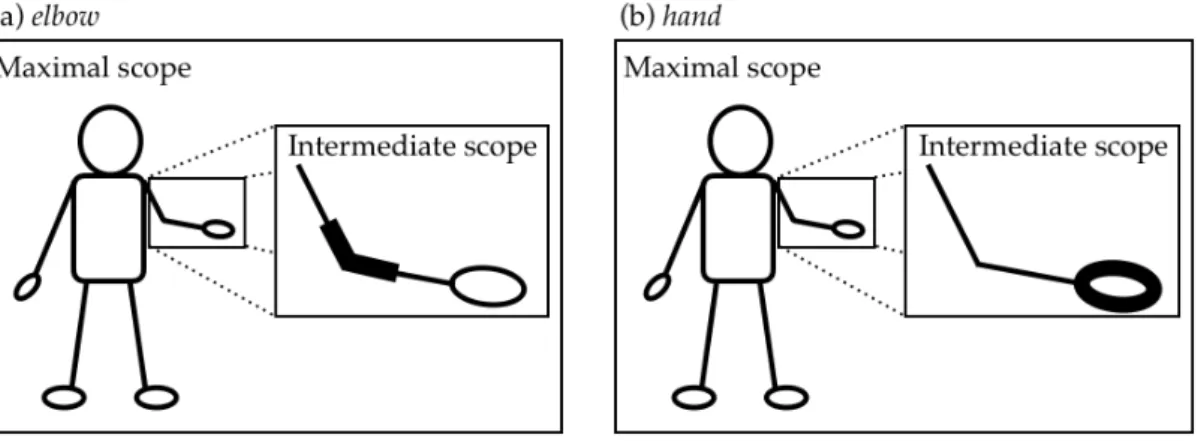
As the definitions in (18) and (19) indicate, the body part relevant to character- izing elbow and hand is the arm. The whole body bears direct relevance to the arm and indirect relevance to the elbow and the hand. In Langacker’s terms, forhandand elbow, the whole body functions as maximal scope, and the arm functions as immediate scope. These relations are diagrammed in Figure 1:
Figure 1: Schematic representations of the relations between elbow, hand, arm and body (after Langacker (2008: 64))
Let us compare elbowand hand. Their maximal scope extends to the body. Within the maximal scope, the arm is defined as the immediate scope, or the “onstage”
region (i.e., “foregrounded in relation to the maximal scope”) on which our general
attention is focused. The wordselbowand handare characterized in the same base. In the immediate scope, each word singles out a different part as its profile. The profiled portions are indicated by the heavy lines in Figure 1.
The profile/base organization is also relevant to linguistic units larger than words. The dative alternation, as illustrated in (20), can be explained in terms of the profile/base organization:
(20) a. Bill sent a walrus to Joyce.
b. Bill sent Joyce a walrus.
(Langacker (1991a: 13)) Following Langacker (1991a), the event structure described by each sentence is diagrammed in Figure 2:
Figure 2: Different construals of the interaction among Bill, Joyce and a walrus (after Langacker (1991a: 14))
In Figure 2, the small circles labeledB, Jand Wrepresent the event participants, Bill, Joyce and a walrus, respectively. The large circles represent the regions over which Bill and Joyce can exert control, i.e., Bill’s and Joyce’s dominions (section 2.1.4). The two diagrams (a) and (b) portray the same event in which the walrus is transferred from Bill’s dominion to Joyce’s dominion while the profiled portions are different. In Figure 2(a), the preposition to profiles the process of moving the walrus, which is indicated by the bold arrow; Figure 2(b) profiles the resultant state of the walrus being with Joyce. The profiled state is indicated by the bold circle. In short, the two constructions share the same base but profile different aspects of the base. This
“reflects our ability to construe a conceived situation in alternate ways” (Langacker