INVITED PAPER
Special Section on Advanced Log Processing and Office Information SystemsTrend and Factor Analysis of O ffi ce Related Research in LOIS Technical Committee
Toshihiko WAKAHARA†a),Fellow, Toshitaka MAKI†,Student Member, Noriyasu YAMAMOTO†,Member, Akihisa KODATE††, Manabu OKAMOTO†††,andHiroyuki NISHI††††,Senior Members
SUMMARY The Life Intelligence and Office Information System (LOIS) Technical Committee of the Institute of Electronics, Information and Communication Engineers (IEICE) dates its origin to May 1986. This Technical Committee (TC) has covered the research fields of the office re- lated systems for more than 30 years. Over this time, this TC, under its mul- tiple name changes, has served as a forum for research and provided many opportunities for not only office users but also ordinary users of systems and services to present ideas and discussions. Therefore, these advanced technologies have been diffused from big enterprises to small companies and home users responsible for their management and operation. This pa- per sums up the technology trends and views of the office related systems and services covered in the 30 years of presentations of the LOIS Technical Committees by using the new literature analysis system based on the IEICE Knowledge Discovery system (I-Scover system).
key words: office study, LOIS, technical committee, technology trend, lit- erature retrieval, I-Scover
1. Introduction
New technologies have been often introduced in advanced offices or big enterprises pursuing improved business effi- ciency. In order to solve office issues, an academic society named the Office Automation (OA) Society was founded in 1979 whose main goal was searching for efficient improve- ment of the office work. Later, the name of this Society was changed to Japan Society for Information and Manage- ment[1] in 2007. The main focus on the research of this society includes management, enterprise and social infor- mation systems in the office. Then the various technologies have been developed and experienced in the offices. Along with these activities, the Japan Society for Office Studies[2]
was founded in 1999 to study the work style in the office and office environments, etc.
Since there was no study group related to the systems or network technologies of office matters, a new study group was established called Office System (OS) in the IEICE[3]
in 1986. As the research viewpoint of each society is dif- ferent, each study group has been progressed in each stand-
Manuscript received November 14, 2016.
Manuscript revised June 6, 2017.
Manuscript publicized July 21, 2017.
†The authors are with Fukuoka Institute of Technology, Fukuoka-shi, 811–0295 Japan.
††The author is with Tsuda University, Tokyo, 151–0051 Japan.
†††The author is with NTT Media Intelligence Laboratory, Yokosuka-shi, 239–0847 Japan.
††††The author is with Sojo University, Kumamoto-shi, 860–0082 Japan.
a) E-mail: [email protected] DOI: 10.1587/transinf.2016OFI0001
Table 1 TCs and Societies in IEICE.
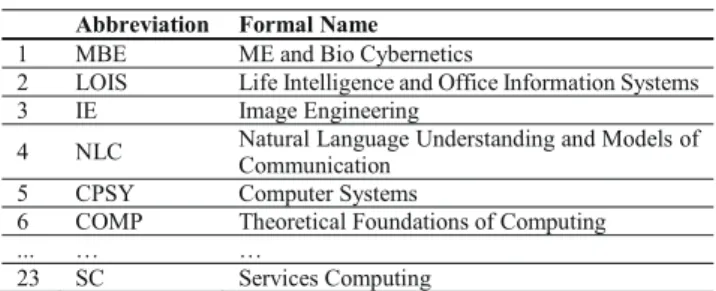
Table 2 Technical Committees in the ISS.
point.
This paper presents the activities of the LOIS Techni- cal Committee[4]of the Information and Systems Society (ISS) in the IEICE. This LOIS TC is derived from the above OS Technical Committee and has been developed. It is easy to get the office related research papers submitted in the IEICE by using the recently developed I-Scover system[5].
There are five societies in the ICICE as shown in Table 1.
This Institute is composed of Engineering Sciences Society (ESS), Communications Society (CS), Electronics Society (ES), Information and Systems Society (ISS) and Human Communication Group (HCG). The LOIS TC is within the ISS. There are 23 Technical Committees in the ISS as shown in Table 2.
This paper is organized as follows. The outline and history of the LOIS TC is presented in Sect. 2. In Sect. 3, we present the new system for literature analysis which utilizes the I-Scover system along with the trends of the LOIS TC and conferences in recent 10 years. Then the factors of the trends, various time series analysis and keyword network graphs are also described in Sect. 3. In the final section, the conclusions for this paper are summarized.
2. Outline of LOIS Technical Committee
As stated in the previous section, the LOIS Technical Com- mittee was initially founded as a special interest group known as the Office System (OS) Technical Committee. In
I-Scover is a registered trademark of the IEICE.
Copyright c⃝2017 The Institute of Electronics, Information and Communication Engineers
Table 3 Keywords of LOIS Technical Committee.
this OS TC, the document related systems, multimedia com- munication systems in the offices or network application were mainly dealt with in the 1980 and 1990 era.
However, since the name of the OS TC was often con- fused with OS acronym standing for ‘Operating System’, the abbreviation was changed to the OFfice System (OFS) TC in 1999. In the following years, the topics of the pre- sentation in the OFS TC have contained application of in- formation systems and advanced systems using computer, so the name of the OFS TC was changed to Office Informa- tion System (OIS) in 2002. Furthermore, it was renamed as the Life Intelligence and Office Information Systems (LOIS) TC since the contents being discussed in the TC included the systems or services not only for business users but also for daily life activities for ordinary consumers. The keyword
“Lifelog” is commonly used in the related presentations.
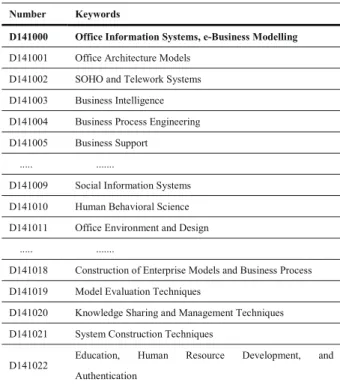
The main keywords for technical field classified in the LOIS TC are shown in Table 3[6]. However, the keywords related to lifelogs are not included, so a revision of the ta- ble is necessary in the near future. On the other hand, the related fields are located in the number D140500 (Data en- gineering and Web information system), number D140600 (Information network), D140800 (Artificial Intelligence and Data mining) and D140900 (Human computer interaction) So the arrangement of the keyword table is also needed.
3. Trend and Factor Analysis Based on the I-Scover System
The activities of the Office related Technical Committee can be obtained by the new analysis system based on the I- Scover system in this section.
Fig. 1 System configuration of the new analysis system.
Table 4 I-Scover dataset.
3.1 The New Literature Analysis System
We developed the new literature analysis system in order to identify the characteristic trend[7]. This system utilizes the Wikipedia Link API[8]together with I-Scover system to improve tracking over time given the fluctuation in no- tation commonly used. The first stage of I-Scover system was developed in April 2013. In this system, the papers are linked to another research papers by the metadata (Linked Open Data) in the external sites like CiNii[9].
The process flow of the new literature analysis system is shown in Fig. 1. Since the I-Scover system can only re- trieve the literature from the metadata[10], the analysing function and visualizing functions are added through the I- Scover system. The Wikipedia Link API is introduced in order to reduce the impact of changing terminology.
If the keywords are entered into this system, the no- tation fluctuation is eliminated and the literature which is identified by the keywords are searched and presented.
The I-Scover dataset for this new literature analysis system is shown in Table 4. There are about 234,364 ar- ticles and 946,808 keywords in this archive. The specifi- cations of the new analysis system are shown in Table 5.
In this system, MySQL is used as the database, Apache 2
Table 5 Specifications of the new literature analysis system.
Fig. 2 Time series analysis of “Lifelog”.
is used as a Web server and the programming language is PHP5. JpGraph[11]is used as a graph library.
3.2 Trend Analysis of LOIS Technical Committee By using this system, the time series trends of the technical papers of the LOIS Technical Committee, the Society Con- ference, General Conference and the FIT (Forum on Infor- mation Technology), papers from the International Confer- ence, and IEICE Transactions on the Information and Sys- tems Society were extracted and analyzed by the inputted keywords[12]. Figure 2 shows the results of time series analysis of the keyword “Lifelog” in the interval 2000 to 2013 in the LOIS TC literature. (The name of the TC had been changed from OIS to LOIS in 2009.) The results are normalized with the total volume of literature and has still greatly increased during that period. Then time series trends of other keywords co-occurring with “Lifelog” are also shown in this figure. These keywords include “GPS”,
“API”, “Mashup”, etc.
The time series analysis for the special keywords,
“Lifelog” and “Web application”, from 2000 to 2013 is shown in Fig. 3. This figure shows the co-occurring fre-
Fig. 3 Time series analysis of the special plural keywords.
Fig. 4 Technology factor analysis.
quency characteristics of the two keywords. Although the frequency of the keyword “Lifelog” increases from about 2005, the keyword “Web application” doesn’t display a sim- ilar trend to the increase in “Lifelog”. It is presumed that the various lifelog services are increasing year by year, but web application technology is in use from about 2000 and this well-established and saturated in 2010 era.
The technology factor analysis ( ) is shown in Fig. 4. This shows the examples of the analysis results from the abstracts of the papers.
The results are classified into 4 categories, namely, the technological Trend, Explanation, Problem and Attention.
The trend of technological factor can be estimated or at least a hints of solutions may be obtained from the article ab- stract.
Table 6 Keywords ranked top 10 in the LOIS TC paper.
Then the keywords registered in the paper are very im- portant. Table 6 shows the top 10 ranked keywords in the papers of the LOIS TC for past 5 years as obtained through the new literature analysis system. From this table, it is evi- dent that the keyword “Lifelog” appears most frequently and can be considered the most important in LOIS TC. After the change of the name of the TC, “Lifelog” and related key- words, “GPS”, “Location information”, “Mashup”, “Smart phone”, “Mobile phone”, “Food log” etc., are frequently uti- lized in the presented literature.
Then the recent time series analysis of the literature and number of authors per year are shown in Fig. 5.
From this figure, the numbers of articles and authors have been increasing after 2009 and it can be said that re- search activities have been invigorated since 2009.
The LOIS TC is ordinarily held every two months and cooperated with other TCs or other such as Document Com- munication (DC) TC of the Information Processing of Japan (IPSJ).
Figure 6 shows the number of articles per two month interval. Before 2009, the number of articles was typically 10 or less. But the number of articles has increased, espe- cially in March. This is because the venue had been moved from Tokyo to Okinawa and the conference became popular destination as a graduation trip for students.
Table 7 shows the topics and keywords which are dis- cussed in the LOIS TC. This is shown in the Web page of LOIS TC. The topics are composed of 8 topics, namely,
“Lifelog”, “Office model”, “Communication”, “Data min- ing”, “System architecture”, “Network”, “Security” and
“Human interface”. The top 10 ranking keywords in the pe- riod of between 2009 and 2013 are shown in Table 6. These keywords are obtained from the system and useful for re- searchers to select the presenting conference.
Figure 7 shows the number of articles in each field for approximately ten years. In this figure, because there are various systems and services in the “System architecture”
field, these make up the largest in total articles. The sec- ond largest category is “Network”. Thus the literatures cov- ering “Lifelog” field is the third largest. We can assume
Fig. 5 Time series analysis of LOIS TC.
Fig. 6 Time series literature number of the LOIS TC.
Table 7 Topics and major keywords handled by LOIS TC.
that the explanatin is that there are many services, such as food logging services, telephone logging services, receipt logging services, etc., which have been proposed and their experimental results are often reported. The big challenges, however, are privacy and security protection issues around the use of private personal information. Therefore the liter- atures covering lifelogs has been decreasing. Three figures (Fig. 5, 6 and 7) are presented as generated by an ordinary spreadsheet software from the dataset of the retrieval sys- tem.
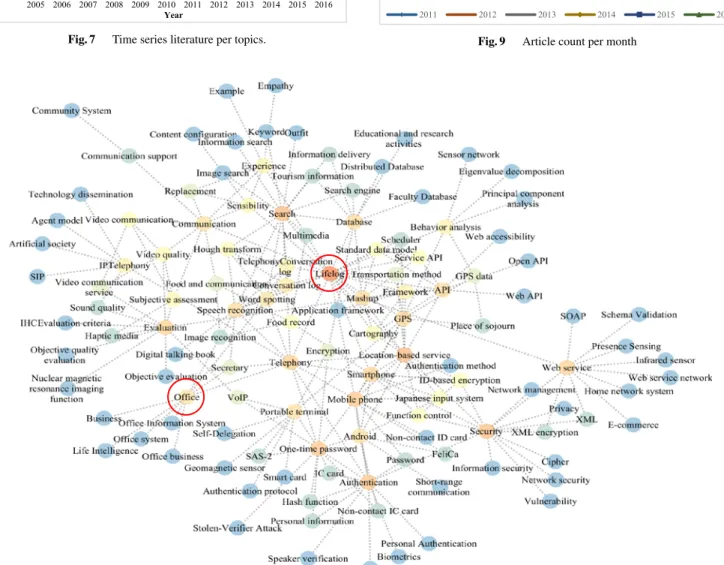
The relation among the keywords are shown as a Key-
word Network Map as persented in Fig. 8. In this figure,
“Lifelog” is located around the center and this is related to other keywords, such as “Conversation log”, “Telephony”,
“Multimedia”, “Database”, “Word spotting”, and so on.
Then the keyword “Office” is also linked to the keywords, such as “Business”, “Office Information system”, “Secre- tary”, “Telephony”, and so on.
This figure is drawn by the principle that the co-
Fig. 7 Time series literature per topics.
Fig. 8 Keyword network in the LOIS TC
occurring keywords with “Lifelog” are linked by the edge with each other. Figure 9 shows the numbers of literatures in each LOIS TC per month. It has held in January, March, May, July, September and November. In January, the Infor- mation Management Network (IMN) TC is co-located and so as Groupware and Network Service (GN) TC and Se- curity Psychology and Trust (SPT) TC in May. This TC is co-located with Document Communication (DC) TC in
Fig. 9 Article count per month
Fig. 10 Joint conference relation with other TCs
Fig. 11 Main contributors in the LOIS TC.
July. These cooperating TCs are shown in Fig. 10. Since the number of articles in July is rather small, the joint confer- ence with Mobile Network and Application (MONA) TC in Communication Society is scheduled to start from 2017.
The main contributors of the LOIS TC are from NTT Laboratories, Kobe Univ., Kochi Univ. of Tech., Fukuoka Inst. of Tech. and so on. The top 15 contributors are shown in Fig. 11.
The keyword network graph linked with keyword
“Lifelog” in 2004 is shown in Fig. 12. In this figure, there are no keywords related to “Lifelog”. Then the similar key- word graph in 2008 is also shown in Fig. 13. In this fig- ure, the keyword appears in the upper right area. The graph in 2014 is shown in Fig. 14. Comparing these graphs from
Fig. 12 Keyword network connected to Lifelog in 2004.
Fig. 13 Keyword network connected to Lifelog in 2008.
Fig. 14 Keyword network connected to Lifelog in 2012.
Fig. 12 to Fig. 14, the number of the keyword links with
“Lifelog” has gradually increased and spread. This corre- sponds to the increase in the quantity of literature and cross- referencing with each other. It can be said that the research related to “Lifelog” has develops gradually and is in the de- velopment phase.
Figure 2 to Fig. 4 were drawn with the new literature analysis system. Other figures were drawn by using ordinary software such as, Excel and Cytoscape[13]with the datasets of I-Scover system.
4. Conclusions
It has been about 30 years since the OS Technical Commit- tee was founded. During this period, technologies for office systems have developed significantly and the name of the technical committee was changed from OS to OFS, OIS and LOIS.
• Examining the activity trends of the LOIS TC with the new literature analysis system using the I-Scover sys- tem, it is found that the TC was on a gradual decline until 2008. After the name was changed from OIS to LOIS in April 2009, it has become very active. After that, more than 70 presentations were observed over the next five years, and it can be said that the change contributed greatly to revitalization.
• Since the venue was changed from Tokyo (Machine Promotion Center) to Okinawa in March 2009, the number of presentations has increased by more than 20 and is still continuing. The conferences in March are hosted by LOIS TC alone. It seems that the March conference has become established as an event for graduation presentation for university students and re- searchers.
• The conference in July is held jointly with the Doc- ument Communication (DC) TC of Information Pro- cessing Society of Japan, but the number of research presentations has been small. Therefore, new strate- gies, such as inviting tutorials, encouraging lectures and panel discussions, will be introduced.
The LOIS TC will continue to regularly hold 6 con- ferences a year (in the odd months) and semi-annual FIT (Forum on Information Technology) and general confer- ences. It will also further invigorate research presenta- tions by choosing the timely topics across wider society.
The joint conference with Mobile Network and Applications (MONA) TC is expected to start from July 2017 as the first of its expansion strategies. Special issues of the ISS Jour- nal (in Japanese) have been published 5 times over the past 15 years and the first one in English is being published with this volume. Finally, the authors hope further development of office related systems and technologies via LOIS TC.
Acknowledgements
The authors would like to express the thanks for contribu- tion of all the Office related Technical Committee members and for being offering the IEICE literature datasets to the I-Scover projects[14].
References
[1] Japan Society for Information and Management, http://www.jsim.gr.jp/ en/index.html, Accessed on Oct. 25, 2016.
[2] Japan Society for Office Studies, http://www.jos-japan.jp/, Accessed on Oct. 25, 2016.
[3] IEICE, http://www.ieice.org/eng/index.html, Accessed on Oct. 25,
2016.
[4] IEICE Life Intelligence and Office Information Systems Tech- nical Committee, http://www.ieice.org/iss/eng/TechnicalGroups/ introduction/Type1 2.html, Accessed on Oct. 25, 2016.
[5] IEICE Knowledge Discovery, http://i-scover.ieice.org/iscover/
?lang=en, Accessed on Oct. 25, 2016.
[6] Keywords in the Technical fields table (IEICE), http://www.ieice.or.jp/ jpn/shiori/pdf/furoku f.pdf, Accessed on Oct. 25, 2016.
[7] T. Maki and T. Wakahara, Time Series and Technology Factor Anal- ysis using I-Scover Literature Metadata, IEICE Trans. Inf. & Syst., vol.J99-D, no.10, pp.1002–1012, 2016 (in Japanese).
[8] T. Maki, K. Takahashi, and T. Wakahara, Study on Similarity Eval- uation of Papers Data Using Wikipedia Link API for Automatic Metadata Annotation, IEICE Trans. Inf. & Syst., vol.J97-D no.12, pp.1705–1708, 2014 (in Japanese).
[9] CiNii Articles, http://ci.nii.ac.jp/en, Accessed on Oct. 25, 2016.
[10] F. Nishino, I-Scover -IEICE Article Search System based on Linked Data, IEICE Communication Society Magazine, no.25, pp.49–53, Summer 2013.
[11] JpGraph, http://www.asial.co.jp/jpgraph/examples.php, Accessed on Oct. 25, 2016.
[12] T. Wakahara, T. Maki, M. Okamoto, N. Yamamoto, M. Motegi, and A. Kodate, Trend Analysis of LOIS Technical Study (3), IEICE Technical Report, vol.114, no.32, LOIS2014-9, pp.97–102, 2012 (in Japanese).
[13] Cytoscape, http://js.cytoscape.org/, Accessed on Oct. 25, 2016.
[14] IEICE I-Scover Park, http://iscover-p.ieice.org/cms/i-scover- promotion/Accessed on Oct. 25, 2016.
Toshihiko Wakahara received B.E., M.E.
and D.E. degrees from Tokyo Institute of Tech- nology, Tokyo, Japan in 1970, 1972 and 1998, respectively. He joined NTT Electrical Com- munication Laboratories in 1972 and developed PCM-FDM system and ATM application, etc.
He was a Visiting Professor at the Global In- formation and Telecommunication Institute of Waseda University from 1999 to 2003. He moved to Fukuoka Institute of Technology as a Professor in 2003. He received the ISS Distin- guished Service Award in 2015. He is a Fellow of IEICE, a Fellow of IIEEJ and a member of IEEE, and IPSJ.
Toshitaka Maki received B.E. and M.E. de- grees in Communication and Information Net- working from Fukuoka Institute of Technology, Fukuoka, Japan, in 2013 and 2015. He is cur- rently pursuing a Ph.D. degree with the Grad- uate School of Engineering, and is receiving the JSPS research fellowship for young scien- tists from April 2017 to March 2019. He re- ceived awards at the I-Scover Challenge contest in 2013, 2014 and 2017, and received Young Re- searcher’s Award in 2014. He is a student mem- ber of IEICE.
Noriyasu Yamamoto received B.E. de- gree from the University of Nagasaki, Japan, in 1990. He received M.E. and Ph.D. degrees from the University of Kyushu, Japan, in 1992 and 1998, respectively. He is currently a Profes- sor in the Fukuoka Institute of Technology. He conducts active research in various information technology related areas including computer vi- sion, distributed (massively parallel) image pro- cessing, security on the network and logging system for human (Life-Log). He is a member of IEICE and IPSJ.
Akihisa Kodate received his Bachelor of Engineering in 1992, Master of Engineering in 1994 and Doctor of Engineering in 2000, all from Waseda University, Tokyo, Japan. He was a researcher at University of Hannover, Ger- many and a visiting Associate Professor at the Global Information and Telecommunication In- stitute of Waseda University. Since 2012, he has been a Professor and the Director of the Cen- ter for Women in Research of Tsuda University.
He has been engaged in the research of multi- media signal processing and its applications and information systems, such as video content analysis and personal life-logging services. He is a senior member of IEICE and a member of IEEE and IPSJ.
Manabu Okamoto received M.Design de- gree from Kyushu Institute of Design, Japan, in 1991 and Doctor of Design from Kyushu Uni- versity, Japan, in 2007. In 1991, he joined NTT Electrical Communication Laboratories. Since then, he has been researching the acoustic de- sign of various kinds of teleconferencing sys- tems and the system design of ICT services. He is currently engaged in speech recognition re- search. He is a senior member of IEICE and a member of ASJ and IEEE.
Hiroyuki Nishi received B.E. and M.E.
degrees in electronics from Kyushu University in 1977 and 1979, respectively. He worked at NTT’s laboratories from 1979 to 2002 and received a Ph.D. from Tsukuba University in 2003. He is a professor of Sojo University and Dean of Faculty of Computer and Information Sciences. He is currently interested in observa- tion systems for elderly people using acoustic recognition and machine learning. He is a senior member of IEICE and the chair of the LOIS TC.