1. Introduction
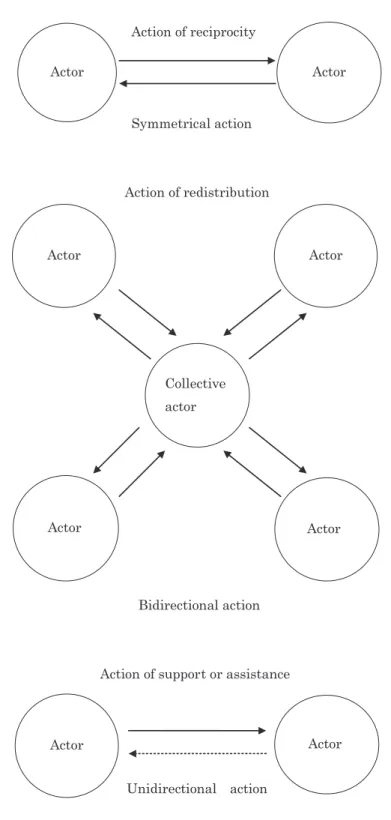
This paper examines how mutual help networks contribute to indigenous development in the face of globalization conducted through the influence of finance capitalism. Mutual help actions are divided into three categories (Onda, 2006). One is reciprocity, for example in helping to plant rice and re-roof houses by exchanging labor. The second is redistribution. In exchange for the right to get goods from a common store, local people have the obligation to maintain a common pool of resources. Finally, unidirectional help refers to support in funeral or wedding ceremonies and requires no monetary exchange.
While these customs have almost disappeared from Japanese modern life, they can still be clearly identified in other Asian developing countries. There were many rotating credit systems in Japanese villages. Especially we focus on these systems that function, at first sight, indifferent to modern finance capitalism. The Japanese rotating credit system is based on redistributive actions. Money would be gathered among local people to help the needy and it was distributed to them according to priority of the degree of distress, although funds would sometimes be gathered in good times too, simply to accumulate a reserve for some future unstated need.
The aim of such a rotating credit system would be not only to give economic help, but also to build friendships among members. Mutual help networks are important for social solidarity if public aid is not sufficient or does not function properly. Indigenous development through mutual help institutions might be recognized as movement toward localization because the system is based on local customs. Trust among local people gives security and stability to a rotating credit system in a regional society 論 文
Mutual Help Networks in Globalization:
Reconsideration of a Rotating Credit System in Modern Capitalism
Morio ONDA
in spite of changing economic and social circumstances surrounding it. Small, but reliable mutual help networks can function as ‘breakwaters’ against the wave of the globalization. We might solve the financial crisis of capitalism through the ‘wisdom of life’ by using such a rotating credit system.
2. Small Finance Systems as Mutual Help Networks
( 1 ) Types of Mutual Help Actions
Mutual help action was traditionally divided into three types in Japan (Figure 1).
One is yui, which mainly refers to the exchange of labor in helping to plant rice, cut rice and re-roof houses. Laborers participated on the condition of later receiving help themselves. The labor unit was a family. It was a rational exchange in that the givers always got the same volume and quality of labor in return. When one family needed a lot of labor, another family helped by providing it. That family then got the right to return labor from the family it helped. Yui is reciprocity where one gives labor to another and reaps the reward of the other’s labor at another time.
The second is moyai, which refers to redistribution of goods and services among local people. Historically, those who had commons of mountain, forest and sea distributed the resources among themselves. The practice covered not only goods, but also the labor that local people had to provide to maintain the commons. They were bound by the rule of villages to be engaged in public works (mura shigoto, literally ‘work of the village’) to clean roads and canals, as well as remove grass from the roads. Local people could then use the roads and canals as a reward for public or communal service through mura shigoto. In exchange for the right to get goods and services from a common store, local people have the obligation to maintain a common pool of resources. The commons was indispensable to their lives and was not only the symbol of protecting environment from destruction (Hardin, [1968] 1998), but also social solidarity.
Finally, tetsudai refers to unidirectional support in wedding or funeral ceremonies in lieu of labor or monetary exchange, which otherwise would have been expected under yui rules of reciprocity. This mutual help system is structured as one-way aid in which people do not expect reciprocal help from either the chronic poor or people in temporary trouble. However, even people in these categories would often still try to give goods or labor in return. For this purpose many people who were helped would record the nature and amount of what they received and would sometimes reciprocate
Figure 1: Direction of Mutual Help Action Action of reciprocity
Actor Actor
Symmetrical action
Action of redistribution
Collective actor
Bidirectional action
Action of support or assistance
Actor Actor
Unidirectional action
Figure
㸯
: Direction of Mutual Help ActorActor Actor
Actor
these efforts, occasionally giving tetsudai a reciprocal cast. However, in principle it refers to help without the expectation of reciprocity. Though the first and the second types operate through equal social relationships, tetsudai is done both horizontally and vertically. The latter operated as a patron-apprentice (client) relationships. While there are few traditional examples remaining, we can still see them in some Japanese villages.
( 2 ) ‘Money moyai ’ as a Rotating Credit System
Moyai refers to the action of redistributing labor, goods and money among members.
The most common example of labor occurred when villagers worked together to repair a road or to clean a reservoir, which were duties of villagers in a regional society. Villagers could use the mountains and sea as the commons equally. However, the right could be gotten by participating in communal work, which was undertaken by one member of each family. The rewards from the commons were redistributed among the members in a village. If a family did not participate in the common work, it was condemned as a destroyer of village order. However, a family or an individual could be excused from this work by paying a monetary penalty. These redistributive actions can be still seen in a modern society.
Not only labor, but also goods and money were gathered and redistributed under the moyai system. In contrast to labor, goods or money were provided to help the poor. Such commodities as harvested crops, household goods and Japanese pampas grasses for roofing would be gathered to give to people who could not otherwise afford them on their own. After providing for the poor, remaining goods were often distributed among all other members of the moyai. Later recipients in this round would get additional goods as a kind of interest because they were at a disadvantage compared to those who got to choose first. This might be called ‘goods moyai’ like a rotating credit system. Although all members ostensibly had the duty to contribute, the very first recipients, the poor, were sometimes exempted from giving back. These
‘goods moyai’ were popular before the spread of currency or when there were little money to prepare in villages.
Villagers supported the life of the poor by providing the land of the commons so that all villagers could live independently (Onda, 2006). However, money, too, is necessary for living, for it has convenient functions such as exchange, pooling and measure of value. The ‘money moyai’ became popular as a rotating credit system after the spread of currency to villages. Some money was distributed among members
each period after gathering it according to the rules in a circle of months or years.
‘Rotating’ meant money would gathered at a place around which members circulated and that the right to get the money is exchangeable at a certain cycle of every month.
After all members had gotten money, the organization dissolved temporarily and would often reconstitute itself for another round. The system functioned in the same way as a ‘goods moyai’, which has virtually disappeared in Japan. However, the ‘money moyai’ lives on, and has remained especially popular in Okinawa prefecture. Though the purpose has sometimes been simply to accumulate funds for some future unstated need, the system is not only economic, but also social, with the purpose of deepening relationships among members. The rotating credit system is based not on an explicit contract of obligation, like commercial law, but tacit confidence among members.
3. Case Study of Micro-Finance Systems
( 1 ) Japanese Case Study
① Organizations of a Rotating Credit System
The money moyai originated from religious activity, especially the reading of Buddhist scripture in an organization called a kou. The group of believers who gathered to study the spirit became an organization of mutual help at the same time.
Kou became associated with the raising of funds to help people. The organization gathered money to maintain itself and later to contribute to the material as well as spiritual relief of the poor. Local people helped a troubled person by collecting money, as well as donating goods and labor. Kou functioned as micro-finance.
In Japan there were two types of organizations, formal and informal. An organization tended to be called a kou if it had a religious or an economic purpose. As an informal organization, participation was not always obligatory. A kumi might be called a formal organization in which participation was obligatory as members of a regional society to maintain the commons or support funeral ceremonies, though it was autonomous from local government. Both kinds of organizations helped local people who suffered from poverty. The economic kou had two different manifestations. One was a tanomoshi that lent money to the poor without interest. The other was muzin that lent money with interest. Tanomoshi and muzin spread as rotating credit associations in later times. Both tanomoshi and muzin can still be found in local society with even the names of the practices remaining intact.
Although there are nowadays many kous functioning as religious organizations with
the purpose of pilgrimage or supporting belief in local indigenous land gods in regional societies, we can still also see these traditional institutions functioning for non-religious purposes in spite of modern finance organizations such as banks or post offices in some local societies. The ways of these rotating credit systems differ among localities.
Because the system has been inherited according to the ‘wisdom of life’ of local people.
These rotating credit systems often give not only aid, but also encouragement to people. Some help inspires self-help (Smiles, 1859). This is a spur to improvement in living a sustainable life.
② How Rotating Credit Systems Function
In the Japanese rotating credit system, making a contribution of additional money in the form of bidding in order to receive an immediate payment was and is popular. For example, if there are 10 members, each may pay 10,000 yen per month. Any member who wants money immediately because of current problems can get the total (100,000 yen). After that, how is the order of payout determined? There are two methods of paying a fee for the privilege of immediate access for this purpose. One is adding some money to the standard 10,000 yen. Whoever bids the highest amount over 10,000 yen in a particular month can receive the month’s total contribution, including any additional funds bid by others trying for that month’s payout. The recipient must then continue future payments at the higher rate that won him the payout, until the end of the 10 (1 month per member) month cycle.
The other method is to receive a less-than-full-payout, but continue to pay the standard amount (10,000) until the end of the cycle. Because all 10 members will receive a payout sooner or later, those who wait stand to get larger sums by paying less money. These are interest-directed methods. As the way of helping the poor, the first receiver often do not have to pay interest or money. This would be called oya tanomoshi. Oya refers to a person who would be in urgent need and would ask other members to gather a sum of money. Tanomoshi without oya would be organized from the first with the sole purpose of getting monthly interest.
Generally speaking, some part of the accumulated interest was used for drinks and food through which members deepened friendships with each other. It should be reiterated here that this economic organization was sustained by mutual trust and reliance as it originated from a religious purpose and was a societal organization at the same time. Social solidarity in such an organization is strong and not always based on economic rationality (Olson, 1965; Hechter, 1987), but rather social rationality. The
functioning of the rotating credit system is economic, but the management is social from the viewpoint of economic sociology (Smelser and Swedberg, [1994] 2005).
( 2 ) A Comparative Case Study from Southeast Asia
① The Vietnamese Rotating Credit System
We can see something of the Japanese moyai in Southeast Asian villages. Geertz already described the rotating credit system in Indonesia (Geertz, 1962). Vietnamese call the system hội1 )(Onda, 2007: 2008b). The hội is a mutual help system in which members gather goods or money to help one another. In the case of goods, the minority Muong people, for example, give a certain volume of rice at each of the two yearly harvests. Each of 12 persons provides 300kg of rice per year. Any two members who want money to build or repair a house, or buy a motorcycle, for example, can receive the rice from the yearly cycle. At another Moung village members of a group donate 100kg per season. Each in a group consisting of 10 persons provides 200kg per year and the group distributes the rice among them.
In the case of money, each of 10 members gives 100,000 VND (Vietnamese Đồng)
per season. One member can get a total of 2,000,000 VND per year. Who can get the rice or money? They draw lots represented by cards for turns. Each card has either a 1 or 0 written on it. The person who draws card no.1 can have the right to get rice or money. Once again, the aim of this rotating credit system is not only to give economic help, but also to build friendships among members. In contrast to the Japanese institution, every person in the hội can get or give only the same volume of rice or money as every other member. Members who receive their distributions later in the cycle still get the same volume of them, without additional interest.
Naturally, some people in the Vietnamese system sometimes want to get rice or money first, but drawing lots means that everyone has the equal right to take it. The next person to receive a distribution is also determined by drawing lots. However, in the event that it is recognized that any particular member is especially needy in any round of distribution, he will be given the available distribution without a drawing. Those who got later distributions in the Japanese system could receive additional money or goods because those who had to wait were placed at a relative disadvantage. This suggests that Japanese micro-finance system might be more interest-directed than Vietnamese and the mutual help networks of Vietnam stronger than Japan2 ).
② Other Institutions of Moyai in Southeast Asia
There are other mutual help systems in Southeast Asian developing countries. A typical case from Thailand is a ‘rice bank’ from which a villagers’ cooperative lends farmers rice gathered by member contributions, voluntary donations or a communal crop from common land. Thai people can borrow rice at low interest. A ‘buffalo bank’
established by villagers’ donations lends water buffalos to farmers too poor to own one. After borrowed cows bear some offspring, the mother cows, which are kept for a feeding period, are returned and lent to other farmers, for one cow can bear 5 or 6 calves over time. Farmers then raise the calves for their own use and some of the resulting cows either given to the buffalo bank or sold, with the proceeds given to the buffalo bank as payment for the loan. Bulls would be used to work the farm.
Indigenous development indifferent to modern finance capitalism has been functioning through mutual help networks in regional societies. These local bank systems can be seen in Vietnam too.
The systems might be said the moyai type. As in the case of moyai, labor, goods or money is redistributed to each member after it has been gathered by an organization of peers. The vector of the bidirectional action is toward the center from the periphery and vice versa including labor given to cooperative works in which villagers are obliged to be engaged. Moyai is different from both yui reciprocity in helping to plant rice by exchanging labor and tetsudai of unidirectional (non-reciprocal) action that requires no monetary exchange. In Japan there were also systems like ‘rice banks’ called shasou or gisou for saving rice in the husk for emergencies. The former refers to the storehouse of a community and the latter to the obligation of giving to others. The system has been thought to have been imported from China in the 8th century along with other political systems. Some of China’s other neighbors also seem to have imported its mutual help systems along with other Chinese cultural influences, demonstrating that a local system sometimes can spread internationally.
Naturally mutual help is indispensable for societies to survive (Kropotkin, 1902).
There is an indigenous, spontaneous occurrence of a social order such as mutual help networks in each country. However, after another country’s institution is imported, the original system sometimes evolves in response to its new surroundings. As seen from these examples of East and Southeast Asia, while there are similar mutual help networks employing a rotating credit system, each system continues to keep its distinctive characteristics, as well as to evolve. These distinctive mutual help systems may well continue to elaborate indigenously in the face of the clash of civilizations
(Huntington, 1996) or the threat of globalization (Wallerstein, 2000). Mutual help strengthens both self-empowerment and community- empowerment (Friedmann, 1992;
Onda, 2001).
4. The Small, but Reliable Power of Localization against Globalization
( 1 ) Confidence and Betrayal
① Visible Help and an Invisible Money Game
It goes without saying that a money market is based on mutual trust between a borrower and a lender, although backed by laws. Generally speaking, banks lend money gathered from depositors on security to people who are relied upon according to certain borrowing standards. Stock or bond markets are also connected by confidence between investors and companies through market information. However, this trust is relatively weak and unstable, because markets can become a target of speculators pursuing high return through high risk. In the case of a rotating credit system, the one who needs help is known personally to other members. It means that the members help others out of both sympathy for their need (Smith, [1759: 1790]
2000) and the commitment to involvement in the association. This renders the system both stable and sustainable. Confidence is indispensable for a social system consisting of personal actions (Parsons and Smelser, 1956) and trust makes social networks strong (Putnam, 1993: 2001).
In an impersonal market the actions of depositors and investors are indirect with respect to gathering money to stimulate a company’s activities because they are interested only in capital gains. In other words, money and stock or bond markets are anonymous to the general public. Unknown people participate in the money game without exchanging tangible goods or even intangible services, save for the temporary provision of capital. It is the reason why it is termed the non-substantive economy.
On the other hand, though people do expect to get some interest from small financial organizations like moyai, it is not their only purpose. This system has also the purpose of deepening mutual friendship.
As mentioned above, complete mutual trust is typically placed on members of a rotating credit system. Therefore the members are restricted to local people in a regional society, or others known personally such as relatives, coworkers or friends.
In Okinawa prefecture, which consists of islands, local papers do report from time to time a moyai’s collapse because a member has fled to the mainland with no intent to
repay his borrowed funds. However, such betrayals of the institution are relatively few and far between, because of strong mutual trust, although recipients are sometimes asked to provide some kind of bond as security in the case of a high payout. It is great confidence among members that makes the system sustainable. The small finance organization disbands after all members receive a payout, but, in such systems, trust makes more trust and a new cycle is usually established among the same members.
② Transformation of the Capitalist Spirit
Hilferding says that the money capital continues to propagate itself indefinitely
(Hilferding, 1910)3 ). Fictive capital grows in proportion to human wants and produces non-substantive interest. Compared with the rotating credit system, money and stock or bond markets as a non-substantive economy are oriented to, and vulnerable to speculation. As Polanyi says, it is not based on our livelihood as is a substantive economy (Polanyi, 1977). They are far from goods directly manufactured as a result of industrial capital. Capital gains are the main purpose of the actions in these markets.
Hedge funds in particular have played a great role in stimulating the appetites of investors in finance capitalism in the USA.
Capitalism does have an ethical base (Weber, 1905). While we acknowledged that it is intensely motivated through commercial interest, we also knew that its original spirit includes the cores of both commercialism and charity, which refers to social solidarity and social coexistence (Figure 2). The continuing process of capitalism has been based on mutual checks inherent in the limitations of both cores. If commercial interests became too strong, the necessity for charity acted as a brake on its excesses.
If the core of charity came to be powerful, suitable gains in commercial interests were accepted as the social price to support it. Capitalism had proceeded as erratically as a bouncing rugby ball, at least partly as a result of this interaction. However, different from its original spirit, modern capitalism has evolved to be dominated by commercialism and the core of charity is almost nowhere to be seen. It has been rolling straight as a soccer ball. The ascetic core of the spirit of capitalism’s ‘professional ethic’ seems absent in modern economic activities.
Following the predictions of Veblen, the leisure class continues to manifest conspicuous consumption and entrepreneurs continue to pursue commercial ends
(Veblen, 1899: 1904). However, an economy based on conspicuous consumption is not substantive. The more factories employ robots instead of people, the greater the negative influence on the spirit of labor and the more habits of thought become
unitized and standardized. Veblen also foresaw that stock ownership would spread and forecast that economies would fall in the face of the conspicuous wants of consumers and commercial wants of entrepreneurs. In fact the Great Depression of 1929 demonstrated that the contradiction between the substantive economy and the non-substantive economy would cause a panic4 ). In reconsidering the nature of a suitable world economy, especially one featuring money capitalism, the indigenous rotating credit system might offer us certain useful lessons.
( 2 ) Small, but Stable Power
① A Rotating Credit System as Substantive Economy
Modern capitalism is reflected not only locally, but also globally, involving all people in the world. Therefore the impact of any panic is now enormous. This is the reason why it is called global capitalism. After the American finance crisis began in 2008, in confronting the worldwide economic panic scholars, economists and policymakers have been exploring the causes of the current economic decline and what might be the best
Original spirit of capitalism
Commercial wants Charity
࣭ ࣭
Solidarity and coexistence
Present spirit of capitalism
Commercial wants
࣭
Figure 2: Transformation of the Spirit of Capitalism
working models to weather the continuing economic upheaval. Too much confidence in making a fetish of money, represented by hedge fund managers as alchemists, was a primary cause of crisis. We came to believe that we needed money from the entire world to develop any individual economy. However, an economy should be based on local livelihoods (Onda, 1997). As Schumacher says, a suitable economy is necessary not only on a national, but also a global level (Schumacher, 1973). Human beings are small, therefore we might do well to lead lives proportional to our own stature. He means that we should have a livelihood appropriate to the human scale of our personal environments.
It is, therefore, necessary for us to analyze whether a particular economy is substantive or non-substantive. A rotating credit system is based on a substantive economy in the sense of improving the real livelihood of each member. Members’
trust in the system proves this more than anything. If someone loses his status as a reliable member, he will be condemned and ostracized (mura hachibu in Japanese regional parlance). He might even never be able to rejoin the system in his lifetime.
This sanction has functioned to maintain mutual confidence among people (Ostrom, 1990). Though the credit system as a mutual help network has limited power to help the poor and the volume of money is not so much, it has great power to stimulate local people in trouble to revitalize their lives in a regional society.
What is the best model for the transition to a new regulatory regime or the management of post-financial capitalism that can weather the current fall of finance capitalism? The problems lie in the real livelihood of people. It should be noted that we might regain a suitable livelihood based on mutual trust. Our reliable livelihoods are the origin of wealth (Ruskin, 1862)5 ). In the past we have created and maintained each other’s confidence through mutual help networks. Although institutions such as a rotating credit system have all but disappeared in recent years in Japan, the spirit of mutual help has revived whenever there has been an earthquake. Anyone can help others and is needed for others. There are no more throw-away people (Cahn, 2000). The ‘wisdom of life’ accumulated in small finance systems should be consulted in analyzing prospective institutional changes in the world and solving the problems generated by a non-substantive economy. There are not a few teachings in primitive or archaic societies (Sahlins, 1972).
② Control of Wants and Revival of Mutual Help Networks
Industrialization represented by mechanization has weakened labor exchange
through mutual help networks in Japan. People have come to depend on public or private aid rather than mutual help. Local or regional governments have taken over road repair and maintenance of the commons of mountain and forest, in whose work local people had been engaged as village duties. People purchase goods and services that were previously provided through mutual help. So communal help can seldom be seen in regional Japanese society, as people tend more and more to pursue their interests privately. The non-substantive economy has been undermining social solidarity much more than substantive economy brought by industrialization has done.
It seems to stimulate human wants, rather than needs. While the regime of post- financial capitalism is important, more attention should be focused on fundamental human nature (Hume, [1739-40] 2003)6 ). Greed might cause financial economic crises.
The transformations brought by globalization have been influencing economic and social systems of both developing and developed countries. The relation between human wants and economic development has become a serious problem. Needs have not changed, but wants have, following the development of modern civilization and culture in general. We have been changing our wants looking for a convenient lifestyle, for example using an air conditioner as a substitute for cooling water or fire. The need for coolness or warmth is universal while the wants for convenient tools such as fans, fireplaces and so on has changed in accordance with evolution of technology. Our wants has been stimulated through economic development, especially the worship of money that has the universal function to buy all goods and services.
Financial engineering or computational finance education for how to generate profit through maximum leverage, allowing for enormous profits using little capital might be the cause of the fetish. This fictitious money capital has been arousing our wants more than necessities. We cannot contain our desire for such wants. Self-control would be necessary according to a substantive livelihood7 ). We need not freedom from unlimited wants but freedom to pursue suitable wants, which means to overcome desire for the former and get the latter8 ).
There are local societies with which global economic crisis has no relation. These societies have trustworthy and stable mutual help networks. There, a suitable enconomic and social system functions according to a substantive livelihood. People say what kind of regime we adopt ? The simplistic choices ‘capitalism’ or ‘socialism’
have been out of date since the fall of the Berlin wall. If so, should we try market- oriented ‘new liberalism’ in the face of the failure of some governments’ excessive state intervention, or regulation-oriented ‘social democracy’ in the face of the failure
of the market that allowed unbridled activities of corporations that have led to the current crisis? The solution does not lie in the wholesale adoption of one or the other of these ideologies. The promulgation of policy should be done according to national and local, economic and social conditions. To reiterate, our solution can be reduced to the reconsideration of a suitable control of our wants based on a livelihood and the revival of mutual help networks. It starts from a local society that has an indigenous social order and functions as a ‘breakwater’ against the wave of the globalization. This solution has been called ‘glocalization,’ maintaining an original lifestyle as localization and receiving suitable benefit like a ‘shock absorber’ from globalization.
5. Conclusions
The ‘wisdom of life’ of a rotating credit system as a spontaneous occurrence of a social order should be revisited with an eye to learning how it can aid both developed and developing societies to absorb and benefit from globalization. It is the Asian traditional small institutions that could be said to have the sounder, more complete and original spirit of capitalism in comparison to modern finance organizations. These informal systems have supplemented modern banks and stock or bond exchange systems through the solidarity of local people and coexistence in a regional society.
Of course this does not mean that modern economic institutions are unnecessary or useless. Some of them are indispensable to modern life. In order that developed societies continue to accumulate wealth, less developed societies have to become rich to demand our goods and services. In order that others become rich, we have to maintain our wealth to demand their goods and services. However, the revival of asceticism of both the entrepreneur and the consumer are also necessary.
Joining both modernization and globalization, our lives would continue to develop.
Now is the good time for us to remember the original spirit of capitalism including both commercial wants and charity of solidarity and coexistence. At the same time, we should not forget that mutual help is unselfish and has been keeping a suitable livelihood in some regional societies. If we are forced to say, communal help networks based on our real lives should be revived. Regional or even worldwide funds that operate like a rotating credit system might be needed in the future for countries that are poor and in urgent trouble to get appropriate help. The developed countries as members could provide some money, not as ‘aid’ but rather assistance among members, because self-help would be needed to qualify for payout. Of course, the
idea of a ‘global commons’ that every country could use to help each other with the obligation to behave as a member of a ‘global family’ might be impractical. Such an institution would require not fictitious but real trust.
We can understand the importance of building mutual help networks from the
‘wisdom of life’ based on the traditional actions of local people in historical and developing societies. Mutual help like a rotating credit system contributes today to the indigenous and sustainable development in regional societies. There is no age when certain morals based on each community are more necessary than present time
(Etzioni, 1996). We should reconsider not economic choice as individualistic action but social choice as corporate action in decision making (Coleman, 1990)9 ) and determine the right action according to norms as ethical standards based on justice (Rawls, 1971). One of them is the norm of reciprocity which makes a new network (Gouldner, 1960; Sugden, 1984). Special attention should be paid that the spirit of capitalism is also that of mutual help, that we could learn the wisdom of local economic and social systems and that we need to rebuild mutual help networks in the age of globalization.
Acknowledgements
This paper was presented at the 21st Annual Meeting of SASE(Society for the Advancement of Socio-Economics) in July 16-18, 2009, Science Po Paris, France. I would like to thank my faculty colleague Professor Robert B. Spenser for his helpful comments and suggestions, and The Japan Society for the Promotion of Science which gave me travel grant of participation in this international conference.
(本論文は2009年パリで開催された国際学会SASE〈Society for the Advancement of Socio-Economics〉の第21回年次大会で報告されたもので,この学会には平成21年度の 日本学術振興会国際学会等派遣事業の第Ⅰ期採択により出席した)。
Notes
1 )The interview survey on mutual help networks was conducted with a series of prepared questions about mutual help and lasted about 30 minutes to an hour. Using questionnaires that allowed free responses, we interviewed 21 people of 6 villages in 4 communes including Dông Lai, Thanh Hoi and Trong Hoa in Hòa Bình province and Tam Son in Bac Ninh province in 2007. At the same time, we also conducted a written questionnaire survey with 149 respondents (Onda, 2008b).
2 )Socialism does not always contribute to strong mutual help networks. In east-north Chinese villages, where a few hearing surveys were cnoducted by in March, 2009, there are few rotating credit systems. Socialism might stimulates excess public aid in spite of
spontenious mutaul help networks. Local people become to expect not communal help, but governmental aid.
3 )Hilferding had tried to integrate the theory of financial capital into that of industrial and commercial capitals introduced in Das Kapital (1894) by Marx. Even nowadays Das Finanzkapital (1910) by Hilferding is effective in analyzing the fall of finance capitalism.
4 )Veblen’s forecast became true. He also predicted that socialism would prevail in mechanical industry in accordance with standardization in human habits of thinking through machine processes and cause the fall of capitalism. However, the forecast was not right. After the Great Depression, capitalism has been continuing to develop.
5 )Ruskin insists that the then existing economy did not function and it produced injustice by unfair means (Ruskin, [1862] 1986). His criticism was that capital produced only more (financial) capital, so that such an economy perverted the course of justice.
6 )Hume had already analyzed human nature referring to sympathy and conspicuousness before Smith and Veblen insisted on (Hume, [1739-40] 2003).
7 )Human development is necessary to control our wants. Not exclusively economic, but social development, which can be seen in Asian developing countries, reduces the incentive to fall into temptation (Onda, 2001).
8 )Positive ‘freedom to’ is more important than negative ‘freedom from’ (Berlin, 1969).
9 )Coleman says that consensus is important for collective decision making in small groups and close communities (Coleman, 1990, p.385). Local people participating in a rotating credit system make a decision on how to help a member or how to structure payouts through a consensus of opinion. The process needs a lot of time to reach a conclusion.
However, there is little power in the system. Power of a decision-making process could be seen in larger groups and open communities rather than small and close-knit ones.
References
Berlin, Isaiah.1969. Four Essays on Liberty. London: Oxford University Press.
Cahn, E. (2000) No More Throw-Away People: The Co-Production Imperative. Washington:
Essential Books
Coleman, J.S. (1990) ‘The Problem of Social Choice’, Foundations of Social Theory. Cambridge and London: Harvard University Press, pp.371-396.
Etzioni, A. (1996) The New Golden Rule: Community and Modernity in a Democratic Society.
Philadelphia: Basic Books.
Friedmann, J. (1992) Empowerment: The Politics of Alternative Development. Cambridge:
Blackwell.
Geertz, C. (1962) ‘The Rotating Credit Association: A “Middle Rung” in Development’, Economic Development and Cultural Change 10: 241-63.
Gouldner, A.W. (1960) ‘The Norm of Reciprocity: A Preliminary Statement,’ American Sociological Review. 25(2): 161-178.
Hardin, G. [1968] (1998) ‘The Tragedy of the Commons’, in J.A.Baden and D.S. Noonan (eds)
Managing the Commons, 2nd edn. pp.3-16. Bloomington and Indianapolis: Indiana University Press (in Science.162:1243-48).
Hechter, M. (1987) Principles of Group Solidarity. Berkeley: University of California Press.
Hilferding, R. 1910. Das Finanzkapital (Kinyushihonnron translated by Jiro Okazaki, 1982)
Tokyo: Iwanami shoten.
Hume, D. [1739-40] (2003) A Treatise of Human Nature. London: Thomas Longman (Mineola, NY: Dover Publications).
Huntington, S.P. (1996) The Clash of Civilizations and The Remaking of World Order. New York: Simon & Schuster.
Kropotkin, P.A. (1902) Mutual Aid: A Factor of Evolution. London: Heinemann.
North, D.C. (1990) Institutions, Institutional Change and Economic Performance. Cambridge:
Cambridge University Press.
Olson, M. (1965) The Logic of Collective Action: Public Goods and the Theory of Groups.
Harvard: Harvard University Press.
Onda, M. (1997) Hatten no Keizaisyakaigaku (Economic Sociology of Development). Tokyo:
Bunshindo.
Onda, M. (2001) Kaihatsusyakaigaku (Development Sociology). Kyoto: Minerva Publishing.
Onda, M. (2002) Gurokarujidai no Chiikizukuri(Regional Planning in Glocal Age) Tokyo:
Gakubunsya.
Onda, M. (2006) Gozyosyakairon (Mutual Help Society) Kyoto:Sekaishisousya.
Onda, M. (2007) ‘Comparison of Mutual Help Networks in Japan and Vietnam’, Ryutsu Keizai Daigaku Shakaigakubu Ronso 18(1): 1-20.
Onda, M. (2008a) Kyozyo no Chiikizukuri(Regional Planning of Communal Help) Tokyo:
Gakubunsya.
Onda, M. (2008b) ‘Vietnamese Consciousness of Society: A Survey of Lives in Vietnamese Villages’, Ryutsu Keizai Daigaku Shakaigakubu Ronso 19(1): 1-90.
Ostrom, E. (1990) Governing the Commons: the Evolution of Institution for Collective Action.
Cambridge: Cambridge University Press.
Parsons, T. and Smelser, N. J.(1956) Economy and Society. London: Routlege and Kegan Paul
(Free Press).
Polanyi, K. (1977) The Livelihood of Man (Pearson, H.W. (ed.)). New York: Academic Press.
Putnam, R. (1993) Making Democracy Work. Princeton: Princeton University Press.
Putnam, R. (2001) Bowling Alone. New York: Simon & Schuster.
Rawls, J. (1971) A Theory of Justice. Cambridge: Harvard University Press.
Ruskin, J. [1862] (1986). Unto This Last.(Unto This Last and Other Writings). New York:
Penguin Classics.
Sahlins, M. (1972) Stone Age Economics. New York: Aldine De Gruyter.
Schumacher, E. F. 1973. Small is Beautiful. London: Muller, Blond and White.
Smelser, N.J., and R.Swedberg(eds) [1994] 2005. Handbook of Economic Sociology.
Princeton: Princeton University Press.
Smiles, S. (1859) Self-Help: with Illustrations of Conduct and Perseverance. London: John Murray.
Smith, A. [1759: 1790] (2000) The Theory of Moral Sentiments. London: Printed for A. Millar, in the Strand; And A. Kincaid and J. Bell in Edinburgh. MDCCLIX [6th edn. London:
A. Millar](Amherst, New York: Prometheus Books).
Sugden, R. (1984) ‘Reciprocity: The Supply of Public Goods through Voluntary Contributions’, The Economic Juouranal(94): 772-787.
Veblen, T. 1899. Theory of the Leisure Class. New York: Macmillan.
Veblen, T. 1904. The Theory of Business Enterprise. New York:Charles Scribner’s Sons.
Wallertein, I. 2000. ‘Globalization or the Age of Tansition? A Long-Term View of the Trajectory of the World System’, International Sociology 15(2):249-265.
Weber, M. [1905](1988) “Die protestantische Ethik und der Geist des Kapitalismus”, Gesammelte Aufsätze zur Religionssoziologie (Bd.1). Tübingen: J.C.B. Mohr
(Stuttgart: UTB, More Siebeck).