Successful Transition from Phosphodiesterase-5 Inhibitors to Riociguat without a Washout Period in Patients with Pulmonary Arterial
Hypertension and Chronic Thromboembolic Pulmonary Hypertension: a Pilot Cohort Study
Kazuhiro Kuroda, MD1,2; Satoshi Akagi, MD, PhD1; Kazufumi Nakamura, MD, PhD1;
Toshihiro Sarashina, MD, PhD1; Kentaro Ejiri, MD1; Hiroshi Ito, MD, PhD1
1Department of Cardiovascular Medicine, Okayama University Graduate School of Medicine,
Dentistry and Pharmaceutical Sciences, and 2Department of Cardiovascular Medicine,
Okayama City General Medical Center, Okayama, Japan.
Running title: Transition from PDE5i to riociguat Source of grants: None
Correspondence: Satoshi Akagi, MD, PhD
Department of Cardiovascular Medicine, Okayama University Graduate School of Medicine,
Dentistry and Pharmaceutical Sciences, 2-5-1 Shikata-cho, Kita-ku, Okayama 700-8558,
Japan. ; e-mail: [email protected]
Total number of tables and figures: Two tables and two figures
Summary
Transition of pulmonary arterial hypertension (PAH)-specific drugs are considered in patients
with no response to combination therapy or with side effects to these drugs in those with PAH
and chronic thromboembolic pulmonary hypertension. Riociguat directly stimulates soluble
guanylate cyclase independently of nitric oxide. Therefore, transition from a
phosphodiesterase 5 inhibitor (PDE5i), which requires nitric oxide to exert its effects, to
riociguat might be effective. The length of time of washout periods for transition is important
because hemodynamic instability sometimes occurs during washout periods or during
transition in no washout periods. We investigated the feasibility of transition from PDE5i to
riociguat without washout periods in 6 patients with PAH and 1 with chronic thromboembolic
pulmonary hypertension who had already received dual or triple combination therapy. Causes
of transition were due to headache caused by a PDE5i in 3 patients and an inadequate
response to combination therapy in 4 patients. Transition succeeded in all patients without
hemodynamic instability. Pulmonary vascular resistance (797 ± 241 to 518 ± 230 dyne/s/cm-5)
and systemic blood pressure (121 ± 13 to 100 ± 15 mmHg) were significantly reduced
immediately after transition. There were no significant differences in the tricuspid
regurgitation pressure gradient and systemic blood pressure between post-transition and
follow-up. Headaches caused by a PDE5i were diminished after transition to riociguat.
Transition from a PDE5i to riociguat without washout periods is safe. This transition may be a
viable option for patients with headaches caused by a PDE5i or an inadequate response to
combination therapy including PDE5is.
Key words: sildenafil, tadarafil, soluble guanylate cyclase stimulator, headache
Pulmonary arterial hypertension (PAH) is a rare, life-threatening disease, which is defined by
chronically elevated pressure in the pulmonary arteries. The pathophysiology of PAH is
multifactorial and includes upregulation of vasoconstrictors and downregulation of
vasodilators. Persistent pulmonary vascular hypertension causes remodeling of vascular
structures, and results in reversible or irreversible thickened vessel walls and narrowing of the
arterial lumen1. As this disease progresses, persistent hypertension of pulmonary vessels
induces compensatory stress on right ventricular muscles, ultimately resulting in right heart
failure.
Therapy for patients with PAH has progressively developed in the past decade,
accompanied by clinical drug development and numerous studies for improving the efficacy
of treatment strategies. Prostacyclin, endothelin receptor antagonists, phosphodiesterase 5
inhibitors (PDE5is), soluble guanylate cyclase (sGC) stimulators, and IP receptor agonists are
available in treatment for PAH2, 3. The current treatment algorithm for PAH suggests
combination therapy with PAH-specific drugs, which have different mechanisms of action4. In
case of inadequate clinical responses to initial combination therapy or side effects of
PAH-specific drugs, transition of PAH-specific drugs to other drugs with the same mechanism
of action are considered5-7. PDE5is and sGC stimulators work on the nitric oxide (NO)
pathway. PDE5is inhibit degradation of cyclic guanosine monophosphate and this results in
vasodilation with NO8, 9. However, sGC directly stimulates cyclic guanosine monophosphate
and results in vasodilatation without NO10, 11. Although these drugs have the same mechanism
of action, their points of action are different. Because sGC cannot be co-administered with a
PDE5i because of the risk of systemic hypotension12, transition of drugs is considered in
patients with intolerance or an inadequate clinical response to PDE5is.
The length of required time for the washout period for transition is important. This is
because hemodynamic instability sometimes occurs during washout periods or during
transition in no washout periods. Previous study suggested that selected patients with PAH
may benefit from switching from PDE5i to riociguat with washout period of PDE5i13.
However, the feasibility of transition from a PDE5i to a sGC stimulator and washout periods
required for transition have not been clearly established.
Therefore, this study aimed to investigate the feasibility of a safe transition from a
PDE5i (sildenafil and tadarafil) to sGC (riociguat) without washout periods. We monitored
hemodynamics under right heart catheterization in patients with PAH and chronic
thromboembolic pulmonary hypertension (CTEPH).
Methods
Study design
This study was a pilot cohort study. The present study was conducted according to the
principles expressed in the Declaration of Helsinki and approved by Okayama University
Graduate School of Medicine, Dentistry, and Pharmaceutical Sciences and Okayama
University Hospital Ethics Committee (1710-002). Written informed consent was obtained
from all of the patients.
Selection of patients
We selected patients with PAH and CTEPH for this study using the following criteria: 1)
patients who had dual or triple combination therapy, including a PDE5i, between 2000 and
2017; 2) patients who had side effects caused by a PDE5i or those who had no adequate
response with combination therapy; 4) World Health Organization functional class
(WHO-FC) II or nearly III; and 5) systemic blood pressure greater than 100 mmHg. Six
patients with PAH and 1 patient with CTEPH were eligible for this study.
Outcome
The primary outcome of this study was a change in mean pulmonary artery pressure (PAP)
before and after transition. Secondary outcomes of this study were a change in pulmonary
vascular resistance (PVR), the cardiac index (CI), systolic blood pressure (SBP), heart rate
(HR), the tricuspid regurgitation pressure gradient (TRPG), tricuspid annular plane systolic
excursion (TAPSE), and brain natriuretic peptide (BNP) levels. Headache, dyspepsia,
diarrhea, dizziness, nasopharyngitis, vomiting, peripheral edema, and hemoptysis are the most
frequent adverse side effects in patients treated with a PDE5i and riociguat. Therefore, we
examined the incidence of side effects after transition from PDE5i to riociguat.
Protocol of transition
The protocol of transition from a PDE5i to riociguat is shown in Figure 1. PDE5is were
stopped before the first administration of riociguat to allow a PDE5i treatment-free period of
12 hours for patients who received sildenafil and 24 hours for those who received tadalafil.
Patients who received endothelin receptor antagonists and prostacyclin continued with the
same dose, and other supportive drugs were also continued. Riociguat was initiated at a daily
dose of 3.0 mg under hemodynamic monitoring with a Swan-Ganz catheter (Edwards
Lifesciences, Irvine, CA, USA). Cardiopulmonary hemodynamic parameters (PAP, CI, PVR,
SBP, and HR) were measured before and after riociguat administration 3 times after initiation
of riociguat. The CI was calculated with Fick’s method. We followed all of the patients after
discharge from our hospital. At each visit, we checked medications, WHO-FC, potential
side-effects of therapy, and vital signs. We increased the dose of riociguat if side effects were
not observed.
Echocardiographic parameters and blood examination
The TRPG and TAPSE were measured before and 1 week after administration of riociguat
and at follow-up. A blood examination, including BNP levels, was performed before and 1
month after administration of riociguat and at follow-up.
Statistical analysis
All statistical analyses were performed with SPSS software version 25.0 (SPSS Inc., Chicago,
IL, USA). All data are expressed as mean ± standard deviation or median (interquartile range).
Results before and after transition were analyzed using the paired t-test. Results before and 1
week after transition and at follow-up were compared using 1-way repeated ANOVA,
followed by the post-hoc Bonferroni test and Wilcoxon signed-rank test. P values less than
0.05 were considered significant.
Results
Patients’ characteristics
The patients’ characteristics are shown in Table 1. Three men and 4 women were included in
this study. The patients’ mean age was 50 ± 20 years old. Two patients had idiopathic PAH, 3
patients had PAH associated with congenital heart diseases, 1 patient had PAH associated with
collagen tissue disease, and 1 patient had CTEPH. Five (71%) patients had WHO-FC II and 2
patients had a WHO-FC of nearly III. Three patients were treated with sildenafil and 4
patients were treated with tadalafil. All of the patients were treated with dual or triple
combination therapy. Endothelin receptor antagonists were administered in 6 patients (3
patients with bosentan, 2 patients with ambrisentan, and 1 patient with macitentan). Six
patients were treated with beraprost and 1 patient was treated with treprostinil. The reason for
transition from a PDE5i to riociguat was because of side effects caused by PDE5i in patient
nos. 1, 2, and 3. The reasons for transition was due to an inadequate response to combination
therapy in patient nos. 4, 5, 6, and 7.
Hemodynamics during transition
Hemodynamics before and immediately after transition are shown in Figure 2. PVR
significantly decreased from 797 ± 241 to 518 ± 230 dyne/s/cm-5 (P = 0.01). SBP also
significantly decreased from 121 ± 13 to 100 ± 15 mmHg (P = 0.03). There were no
significant changes in mean PAP (41 ± 9 to 39 ± 5 mmHg), the CI (from 3.3 ± 0.9 to 3.7 ± 0.9
l/min/m2), and HR (79 ± 10 bpm to 82 ± 10 bpm).
Follow-up
Two patients were withdrawn for assessment of chronic effects. We could not confirm
continuous administration of riociguat in patient no. 3 because this patient did not visit our
hospital after transition for the long term. Patient no. 6 was withdrawn because we changed
PAH-specific drugs from bosentan to macitentan immediately after transition from a PDE5i to
riociguat. We evaluated chronic effects in 5 patients.
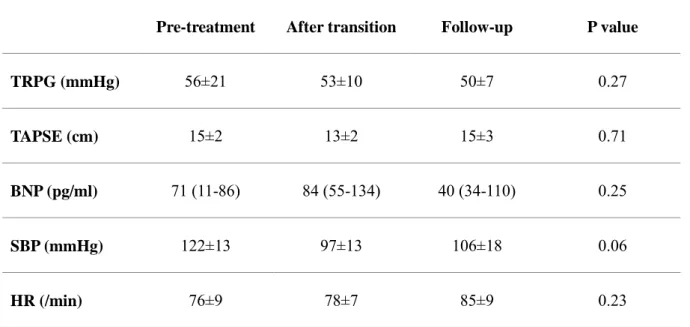
SBP, HR, the TRPG, TAPSE, and BNP levels at follow-up are shown in Table 2. The
median follow-up period was 265 days (49–271 days). The mean dose of riociguat was 5.7 ±
2.2 mg/day at follow-up. Four patients had WHO-FC II and 1 patient had a WHO-FC of
nearly III before transition. All of the patients had WHO-FC II at follow-up. There were no
significant differences in the TRPG, TAPSE, BNP levels, SBP, and HR among pre-treatment,
after transition, and at follow-up.
Tolerability and safety
The most frequent side effects were not observed after transition from a PDE5i to riociguat.
SBP was significantly decreased immediately after transition from a PDE5i to riociguat.
However, SBP tended to increase from 97 ± 13 mmHg to 106 ± 18 mmHg at follow-up in
patients who could be evaluated for chronic effects. Patient nos. 1 to 3 had a severe headache
caused by the PDE5i. Severe headache was diminished in these patients after transition from a
PDE5i to riociguat.
Discussion
We successfully transitioned PAH-specific drugs from a PDE5i to riociguat by our protocol
without a washout period in patients with PAH and CTEPH. Transition from a PDE5i to
riociguat without a washout period led to decreased PVR and SBP immediately after
transition. There were no significant differences in the TRPG and SBP between post-transition
and follow-up. Headache caused by a PDE5i was diminished after transition from a PDE5i to
riociguat.
Some clinical studies and one case report have reported transition from a PDE5i to
riociguat as follows. Hoeper et al. studied switching to riociguat in 61 patients with PAH and
an inadequate response to a PDE5i (RESPITE study)13. Switching from a PDE5i to riociguat
significantly increased the 6-minute walk distance, decreased N-terminal-pro BNP levels, and
improved the WHO-FC. Ten patients experienced serious adverse events. Ten patients had
episodes of hypotension and 6 patients experienced clinical worsening. Yamamoto et al.
studied the transition from a PDE5i to riociguat in 8 patients with CTEPH and an inadequate
response to PDE5is14. BNP levels were significantly improved, and the 6-minute walk
distance, mean PAP, PVR, and the CI were improved, but this was not significant. Davey et al.
studied the transition from PDE5i to riociguat in 12 patients with pulmonary hypertension.
The CI was significantly increased and PVR was decreased after transition from a PDE5i to
riociguat15. One case report showed that a patient with PAH transitioned from sildenafil to
riociguat16. This transition was well tolerated, but there were no significant changes in
echocardiographic parameters. In the present study, PVR was significantly decreased
immediately after transition. However, the TRPG and BNP levels tended to be decreased, but
this was not significant at follow up. Transition from a PDE5i to riociguat might be beneficial
in select patients with PAH and CTEPH who have an inadequate response to combination
therapy. Headache caused by a PDE5i was diminished by transitioning from a PDE5i to
riociguat in the present study. Therefore, transition from a PDE5i to riociguat might be
beneficial in patients who have a headache caused by a PDE5i. Transition of PAH-specific
drugs is not described in the present guideline of PAH. Further studies are required to confirm
the effect of transition of PAH-specific drugs.
Whether a washout period should be provided is an important issue. Washout periods
of 24 hours for sildenafil and 72 hours for tadarafil were used before administration of
riociguat in the RESPITE study13. Although no clinical worsening events occurred during the
washout period in this previous study, temporarily stopping PAH-specific drugs remains a
matter of concern because hemodynamic and pulmonary hypertension sometimes worsen
during the washout period. However, no washout periods are also a matter of concern because
overlap of drug exposure might excessively cause adverse effects. In the present study, we
transitioned from a PDE5i to riociguat without washout periods by monitoring hemodynamics
during transition. Although SBP was significantly decreased, it was not decreased when less
than 90 mmHg. There was no excess hemodynamic response during transition. Criteria for
inclusion of patients in our study included WHO-FC II or nearly III, receipt of combination
therapy, and SBP greater than 100 mmHg before transition. Although further study is
required, transition without a washout period is feasible in patients who are satisfied with our
criteria.
The present study has several limitations. First, our study was a retrospective,
single-center study and the sample size was small. To confirm our findings, a multicenter,
prospective study with a large sample size is required. Second, hemodynamic assessment
using right heart catheterization was lacking at follow-up. Although our study has several
limitations, our findings should help physicians with the treatment strategy for patients with
PAH who have an inadequate response to combination therapy or have side effects caused by
PDE5is.
Conclusion
Transition from a PDE5i to riociguat without washout periods is safe. This transition may be a
viable option for patients with PAH and side effects, such as headache, caused by PDE5is or
an inadequate response to combination therapy including PDE5is.
Disclosures
Conflicts of interest:
S. Akagi has received lecture fees from Actelion Pharmaceuticals Japan, AOP Orphan
Pharmaceuticals, Bayer Yakuhin, and Nippon Shinyaku. K. Nakamura has received lecture
fees from Actelion Pharmaceuticals Japan, AOP Orphan Pharmaceuticals, Bayer Yakuhin,
Nippon Shinyaku, and Pfizer Japan. H. Ito has received lecture fees from Mochida
Pharmaceutical and research grants from Mochida Pharmaceutical, Actelion Pharmaceuticals
Japan, AOP Orphan Pharmaceuticals, Bayer Yakuhin, and Nippon Shinyaku. The other
authors have no conflicts of interest.
Acknowledgments: We thank Ellen Knapp, PhD, from Edanz Group
(www.edanzediting.com/ac) for editing a draft of this manuscript.
Figure legends
Figure 1. Protocol of transition. Transition from phosphodiesterase-5 inhibitors to riociguat under monitoring from a Swan-Ganz catheter. The washout period was 12 hours for patients
who received sildenafil and 24 hours for patients who received tadalafil.
Figure 2. Hemodynamic changes before and after transition. A. Mean pulmonary artery pressure (mPAP). B. Cardiac index (CI). C. Pulmonary vascular resistance (PVR). D. Systolic
blood pressure (SBP). E. Heart rate (HR).
References
1. Akagi S, Matsubara H, Nakamura K and Ito H. Modern treatment to reduce
pulmonary arterial pressure in pulmonary arterial hypertension. J Cardiol. 2018.
2. Akagi S, Nakamura K, Miyaji K, Ogawa A, Kusano KF, Ito H and Matsubara H.
Marked hemodynamic improvements by high-dose epoprostenol therapy in patients with
idiopathic pulmonary arterial hypertension. Circ J. 2010;74:2200-5.
3. Akagi S, Matsubara H, Miyaji K, Ikeda E, Dan K, Tokunaga N, Hisamatsu K,
Munemasa M, Fujimoto Y and Ohe T. Additional effects of bosentan in patients with
idiopathic pulmonary arterial hypertension already treated with high-dose epoprostenol. Circ
J. 2008;72:1142-6.
4. Galie N, Humbert M, Vachiery JL, Gibbs S, Lang I, Torbicki A, Simonneau G,
Peacock A, Vonk Noordegraaf A, Beghetti M, Ghofrani A, Gomez Sanchez MA, Hansmann
G, Klepetko W, Lancellotti P, Matucci M, McDonagh T, Pierard LA, Trindade PT, Zompatori
M and Hoeper M. 2015 ESC/ERS Guidelines for the diagnosis and treatment of pulmonary
hypertension: The Joint Task Force for the Diagnosis and Treatment of Pulmonary
Hypertension of the European Society of Cardiology (ESC) and the European Respiratory
Society (ERS)Endorsed by: Association for European Paediatric and Congenital Cardiology
(AEPC), International Society for Heart and Lung Transplantation (ISHLT). Eur Heart J.
2015.
5. Shlobin OA, Brown AW, Weir N, Ahmad S, Lemma M and Nathan SD. Transition of
PH patients from sildenafil to tadalafil: feasibility and practical considerations. Lung.
2012;190:573-8.
6. Shapiro S, Traiger G, Hill W, Zhang L and Doran AK. Safety, tolerability, and
efficacy of overnight switching from sildenafil to tadalafil in patients with pulmonary arterial
hypertension. Cardiovasc Ther. 2013;31:274-9.
7. Gong SG, Wang L, Pudasaini B, Yuan P, Jiang R, Zhao QH, He J, Zhang R, Wu WH,
Liu JM and Zhou CC. Transition from Ambrisentan to Bosentan in Pulmonary Arterial
Hypertension: A Single-Center Prospective Study. Can Respir J. 2018;2018:9836820.
8. Galie N, Ghofrani HA, Torbicki A, Barst RJ, Rubin LJ, Badesch D, Fleming T,
Parpia T, Burgess G, Branzi A, Grimminger F, Kurzyna M and Simonneau G. Sildenafil
citrate therapy for pulmonary arterial hypertension. N Engl J Med. 2005;353:2148-57.
9. Galie N, Brundage BH, Ghofrani HA, Oudiz RJ, Simonneau G, Safdar Z, Shapiro S,
White RJ, Chan M, Beardsworth A, Frumkin L, Barst RJ, Pulmonary Arterial H and Response
to Tadalafil Study G. Tadalafil therapy for pulmonary arterial hypertension. Circulation.
2009;119:2894-903.
10. Ghofrani HA, Galie N, Grimminger F, Grunig E, Humbert M, Jing ZC, Keogh AM,
Langleben D, Kilama MO, Fritsch A, Neuser D and Rubin LJ. Riociguat for the treatment of
pulmonary arterial hypertension. N Engl J Med. 2013;369:330-40.
11. Ghofrani HA, D'Armini AM, Grimminger F, Hoeper MM, Jansa P, Kim NH, Mayer
E, Simonneau G, Wilkins MR, Fritsch A, Neuser D, Weimann G, Wang C and Group C-S.
Riociguat for the treatment of chronic thromboembolic pulmonary hypertension. N Engl J
Med. 2013;369:319-29.
12. Galie N, Muller K, Scalise AV and Grunig E. PATENT PLUS: a blinded, randomised
and extension study of riociguat plus sildenafil in pulmonary arterial hypertension. Eur Respir
J. 2015;45:1314-22.
13. Hoeper MM, Simonneau G, Corris PA, Ghofrani HA, Klinger JR, Langleben D,
Naeije R, Jansa P, Rosenkranz S, Scelsi L, Grunig E, Vizza CD, Chang M, Colorado P, Meier
C, Busse D and Benza RL. RESPITE: switching to riociguat in pulmonary arterial
hypertension patients with inadequate response to phosphodiesterase-5 inhibitors. Eur Respir
J. 2017;50.
14. Yamamoto K, Tanabe N, Suda R, Sasaki A, Matsumura A, Ema R, Kasai H, Kato F,
Sekine A, Nishimura R, Jujo T, Sugiura T, Shigeta A, Sakao S and Tatsumi K. Riociguat for
patients with chronic thromboembolic pulmonary hypertension: Usefulness of transitioning
from phosphodiesterase type 5 inhibitor. Respiratory investigation. 2017;55:270-275.
15. Davey R, Benza RL, Murali S and Raina A. Phosphodiesterase type 5 inhibitor to
riociguat transition is associated with hemodynamic and symptomatic improvement in
pulmonary hypertension. Pulmonary circulation. 2017;7:539-542.
16. Poch DS. Case report: a patient with pulmonary arterial hypertension transitioning
from a PDE-5 inhibitor to Riociguat. BMC Pulm Med. 2016;16:82.
Table 1. Patients’ characteristics.
Patient No. 1 2 3 4 5 6 7
Sex M F M F F M F
WHO-FC, World Health Organization functional class; PDE5i, phosphodiesterase inhibitor-5;
ERA, endothelin receptor antagonist; M, male; F, female; VSD, ventricular septal defect;
ASD, atrial septal defect; PDA, patent ductus arteriosus, PH, pulmonary hypertension; SSc,
systemic sclerosis; CTEPH, chronic thromboembolic pulmonary hypertension; IPAH,
idiopathic pulmonary arterial hypertension.
Age 23 47 31 66 62 78 43
Diagnosis VSD-PH ASD-PH PDA-PH SSc-PH CTEPH IPAH IPAH
WHO-FC II II II II II III III
Pre-treatment
PDE5i Tadalafil Sildenafil Tadalafil Sildenafil Sildenafil Tadalafil Tadalafil
Dosage 20 mg 60 mg 40 mg 40 mg 40 mg 40 mg 40 mg
ERA Macitentan Bosentan Ambrisentan Bosentan - Bosentan Ambrisentan
Dosage 5 mg 250 mg 10 mg 250 mg - 250 mg 10 mg
Prostacyclin Treprostinil Beraprost Beraprost Beraprost Beraprost Beraprost -
Dosage 40 ng/kg/min 120 µg 120 µg 120 µg 120 µg 120 µg -
Side effects
Headache + + + - - - -
Joint pain - + - - - - -
Table 2. Parameters before and after transition and at follow-up.
Pre-treatment After transition Follow-up P value
TRPG (mmHg) 56±21 53±10 50±7 0.27
TAPSE (cm) 15±2 13±2 15±3 0.71
BNP (pg/ml) 71 (11-86) 84 (55-134) 40 (34-110) 0.25
SBP (mmHg) 122±13 97±13 106±18 0.06
HR (/min) 76±9 78±7 85±9 0.23
TRPG, tricuspid regurgitation pressure gradient; TAPSE, tricuspid annular plane systolic
excursion; BNP, brain natriuretic peptide; SBP, systolic blood pressure; HR, heart rate.