Numerical Existence Proofs
and
Guaranteed Error Bounds for
Solutions to Two-Point
Boundary Value
Problems
早稲田大学基幹理工学研究科 高安 亮紀 (Akitoshi Takayasu)1
Graduate School of Fundamental Science and Engineering,
Waseda University
早稲田大学 大石 進一 (Shin‘ichi Oishi)2
筑波大学 久保 隆徹 (Takayuki Kubo)3
Abstract –In this article,
a
numerical method ispresented forverifying theexistenceand the uniquenessofsolutions to two-point boundary value problems of second order
ordinary differential equations. By solving the bilinear form of the problem,
a
weaksolution is
a zero
point ofa
certain nonlinear map. The Fr\’echet differentiability ofthis nonlinear map isshown. Based
on
the Newton-Kantorovich theorem,a
numericalexistence and local uniqueness theorem is presented for a zero point of the nonlinear
map. It is shown that taking into account all
errors
of numerical computations suchas discretization errors and rounding errors, conditions of this theorem canbe checked
by numerical computations with result verification. Finally, an illustrative numerical
result is presented for showing the usefulness ofthe method.
1 Introduction
Let $(0,1)$ be
an
open interval. This article is concerned with the two boundary value problemof the second order ordinary differential equation:
$\{\begin{array}{ll}-(pu’)’=f(u) 0<x<1,u(0)=u(1)=0, \end{array}$ (1)
where $p(x)$ is a smooth function on $(0,1)$ with$p(x)\geq p_{0}>0$ for some $p_{0}$
.
Here, $f$ : $H_{0}^{1}(0,1)arrow$$L^{2}(0,1)$ is assumed to beFr\’echet differentiable. For example, the following function
$f(u)=-qu’-c_{1}u+c_{2}u^{2}+c_{3}u^{3}+\ldots+c_{N}u^{N}+g$
with $N\in \mathbb{N},$ $q(x),$$c_{i}(x)\in L^{\infty}(O, 1),$ $(i=1, \ldots, N)$ and $g(x)\in L^{2}(0,1)$ satisfies this condition. We
shall propose anumericalverification method for proving the existence of solutions to problem (1).
Studies on this type of computer assisted proofs for the existence of solutions to two point
boundary value problems have been started by pioneering works of Kantorovich [1] and Urabe [2].
Theworks of McCarthy and Tapia [3] andof Kedem [4] $hav\overline{e}$followed. In 1988, M. T. Nakao [5] has
presented
a
method ofa
computer assisted prooffor the existence of solutions to elliptic problemsincluding the problem (1). This method has shown to be quite useful to generate tight numerical
inclusion of solutions [6]. Nakao’s method can be considered as an interval extension of the finite
element method based on some fixed-point theorem. In 1991, Plum [7] has also presented another
ltakitoshiOsuou.waseda.jp
2Departmentof Applied Mathematics, Faculty ofScienceand Engineering, Waseda University&CREST, JST
method of proving the existence and uniqueness of solutions for the problem (1). In his method,
the norm of the inverse of linearlized operator is bounded by an eigenvalue enclosing technique
based
on
the homotopy method. Inthese two decades, both Nakao’s method and Plum’s methodhave been demonstrated to be quite usefulfor the computer assisted existence proof of solutions of
variousboundary valueproblems of differential equations.
This article presents another method of a computer assisted proofprocedure for the existence
of solutions to the problem (1). In the verification theory, a weak formulation is led from the
original problem. A weak solution is defined
as
a zero
point ofa
certain nonlinear map from$H_{0}^{1}(0,1)$ into $H^{-1}(0,1)$ in this formulation. Then the Fr\’echet differentiability of this nonlinear
map is shown. Based on the Newton-Kantorovich theorem [1], a numerical existence and local
uniqueness theorem is derived for a zero point of this nonlinear map. This method is based on
the theorem of estimating operator norm of inverse. This theorem makes it possible to obtain
a
numerical existence and local uniqueness theorem. It is also shown that taking into account all
errors
of numerical computations suchas
discretizationerrors
and rounding errors, conditions ofthis theorem applied to this nonlinear map
can
be checked by numerical computations with resultverification. One offeatures inthis method is that verification conditions
can
be derivedbya
pureanalytic way.
2 Verification Theory
Inthis section,
we
shallpresenta
numerical method for verifyingthe existence and theunique-ness
of solutions to two-point boundary value problems of the second order ordinary differentialequation (1).
2.1 Preliminary
Throughoutthis article, let $L^{2}(0,1)$ denotethefunctional space of Lebesgue-measurable
square-integrable functions with $L^{2}$-inner product and $L^{2}$
-norm
$(u, v)= \int_{0}^{1}u(x)v(x)dx$ and $\Vert u\Vert_{L^{2}}=\sqrt{(u,u)}$, $(u, v\in L^{2}(0,1))$,
respectively. Let $H^{m}(0,1)$ denote $L^{2}$-Sobolev space oforder $m$ with the inner product
$\langle u,$$v\rangle_{m}=(u, v)+(u’, u’)+\cdots+(u^{(m)}, u^{(m)})$
and the norm [8]
$\Vert u\Vert_{H^{m=\sqrt{\langle uu\rangle_{m}}=}}\sqrt{\Vert u\Vert_{L^{2}}^{2}+\Vert u’\Vert_{L^{2}}^{2}++\Vert u^{(m)}\Vert_{L^{2}}^{2}}$
.
Here, both ’ and $\frac{d}{dx}$ denote the differentiation with respect to $x$ and $u^{(m)}$ is the m-th derivativeof
$u$ with respect to $x$
.
Let further$H_{0}^{1}(0,1)=\{u\in H^{1}:u(O)=u(1)=0\}$
with theinner product $(u’, v’)$ and the norm $\Vert u\Vert_{H_{0}^{1}}=\Vert u’\Vert_{L^{2}}$. Let $H^{-1}(0,1)$ bethe topological dual
space of $H_{0}^{1}(0,1),$ $i.e$
.
the space of linear continuous functionals on $H_{0}^{1}(0,1)$.
Let $T\in H^{-1}(0,1)$and $u\in H_{0}^{1}(0,1)$
.
We denote$Tu\in \mathbb{R}$ as $<T,$$u>$.
The norm of$T\in H^{-1}(0,1)$ is defined asLet $L^{\infty}(O, 1)$ denote the space of functions that are essentially bounded on $[0,1]$ with the norm
$\Vert u\Vert_{\infty}=ess\sup_{0\leq x\leq 1}|u(x)|$
.
Let $X$ and $Y$ be Banach spaces. The set of bounded linear operators is denoted by $\mathcal{L}(X, Y)$ with
the operator norm
$\Vert \mathcal{T}\Vert_{\mathcal{L}(X,Y)}=\sup_{u\in X\backslash \{0\}}\frac{\Vert \mathcal{T}u\Vert_{Y}}{||u\Vert_{X}}$, $(\mathcal{T}\in \mathcal{L}(X, Y))$
.
Here, $\Vert\cdot\Vert_{X}$ is the
norm
of$X$ and $\Vert\cdot\Vert_{Y}$ is thenorm
of$Y$.
The Sobolev embedding theorem states[6, 8] that
(1) for $(k>l)$ theembedding $H^{k}(0,1)arrow H^{l}(0,1)$ is compact and continuous,
(2) the embedding $H_{0}^{1}(0,1)arrow C^{0}(0,1)$ is compact and continuous,
(3) and $H_{0}^{1}(0,1)\subset L^{p}(0,1)$ for$p\geq 2$ with
$\Vert v\Vert_{Lp}\leq C_{e,p}\Vert v\Vert_{H_{0}^{1}}$, $(v\in H_{0}^{1}(0,1)$ ex. $C_{e,p}=( \frac{2}{p+2})^{\frac{1}{p}})$
.
(2)2.2 Weak Formulation and its Fr\’echet Differentiability
Let
us
be concerned with the two-point boundaryvalue problem ofthe form$\{\begin{array}{ll}-(pu’)’=f(u) 0<x<1,u(0)=u(1)=0. \end{array}$ (3)
In this part,
we
shall presenta
numerical verification method of proving the existence of weaksolutions for Eq. (3). For $u,$$v\in H_{0}^{1}(0,1)$ let us define a continuous bilinear form $a(u, v)$
as
$a(u, v)=(pu’, v’)$
.
If we fix $u\in H_{0}^{1}(0,1)$, then $a(u, \cdot)\in H^{-1}(0,1)$
.
Thus, we can define an operator $\mathcal{A}$ : $H_{0}^{1}(0,1)arrow$$H^{-1}(0,1)$ by
$<\mathcal{A}u,$$v>=a(u, v)$,
which
can
beseen as a
weak form of thedifferentialoperator- $\tau_{x}d(p_{Tx}d)$.
It is noted that thebilinearform $a$ is coercive, i.e., $a(u, u)\geq p_{0}\Vert u\Vert_{H_{0}^{1}}^{2}$
.
Then, for $v\in H_{0}^{1}(0,1)$ Lax-Milgram’s theorem statestheexistence of
a
unique solution for the following equation:$a(u, v)=<T,$$v>$, $(T\in H^{-1}(0,1))$
.
(4)Ifwe denote the operator which maps $T$ to the solution $u$ of Eq. (4) by $\mathcal{K}$ : $H^{-1}(0,1)arrow H_{0}^{1}(0,1)$,
then this theorem also declares that $\mathcal{K}$ becomes an isomorphism between $H^{-1}(0,1)$
and $H_{0}^{1}(0,1)$
.
It is easy to see that
$A\mathcal{K}=\mathcal{I}_{H^{-1}}$ and
$\mathcal{K}\mathcal{A}=\mathcal{I}_{H_{0}^{1}}$
.
Here, $\mathcal{I}_{H^{-1}}$ and $\mathcal{I}_{H^{1}}$ are identity operators on $H^{-1}(0,1)$ and $H_{0}^{1}(0,1)$, respectively. In
the rest
of this article, we $d_{enote}$ the identity operator by
$\mathcal{I}$ omitting the subscript. Thus, we see $\mathcal{K}$ :
$H^{-1}(0,1)arrow H_{0}^{1}(0,1)$ is theinverse of$\mathcal{A}$ : $H_{0}^{1}(0,1)arrow H^{-1}(0,1),$ $i.e$
.
$\mathcal{K}=\mathcal{A}^{-1}$.
Similarly, for $u,$$v\in H_{0}^{1}(0,1)$
we can
define an operator$\mathcal{N}:H_{0}^{1}(0,1)arrow H^{-1}(0,1)$ byThen, a weak form ofEq. (3) canbe written as
$\mathcal{A}u=\mathcal{N}u$
.
(5)In the following, we will discuss how to verify the existence and the uniqueness of the solution
ofEq. (5), the weak solution of the problem (3). Here,
we
notethat the bilinear form $a(u, v)$ isan
inner product on $H_{0}^{1}(0,1)$ and there exist positive constants $C_{a}$ and $c_{a}$ satisfying
$c_{a}\Vert u\Vert_{H_{0}^{1}}\leq\Vert u\Vert_{a}\leq C_{a}\Vert u\Vert_{H_{0}^{1}}$ for $u\in H_{0}^{1}(0,1)$, (6)
where $\Vert u\Vert_{a}=\sqrt{a(u,u)}$
.
In fact, we can choose $c_{a}=\sqrt{p_{0}}$ and $C_{a}=\sqrt{\Vert p\Vert_{L}\infty}$.
We define theoperator $\mathcal{F}:H_{0}^{1}(0,1)arrow H^{-1}(0,1)$ by$\mathcal{F}u=(\mathcal{A}-\mathcal{N})u$
.
Then, Eq.(5) can be written as$\mathcal{F}u=0$
.
(7)Definitely, the weak solution of (3) is defined as a zero point ofthisnonlinear map $\mathcal{F}$
.
Next, we now show that $\mathcal{F}$ : $H_{0}^{1}(0,1)arrow H^{-1}(0,1)$ is Fr\’echet differentiable. For a fixed $u,\hat{u}\in$
$H_{0}^{1}(0,1)$ we can define $N’(\hat{u})(u, v)$ for $v\in H_{0}^{1}(0,1)$. It is clear that $N’(\hat{u})(u, \cdot)\in H^{-1}(0,1)$
.
Thus,we candefine anoperator $\mathcal{N}’(\hat{u})$ : $H_{0}^{1}(0,1)arrow H^{-1}(0,1)$ by
$<\mathcal{N}’(\hat{u})u,$$v>=N’(\hat{u})(u, v)=(f’(\hat{u})u, v)$
.
Here, $f’(\hat{u})$ : $H_{0}^{1}(0,1)arrow L^{2}(0,1)$ is the Fr\’echet derivative of $f$ : $H_{0}^{1}(0,1)arrow L^{2}(0,1)$ at $\hat{u}$
.
Wenow show that for a given $u\in H_{0}^{1}(0,1)$ the \ddagger he’chet derivative $\mathcal{F}’(u)$ : $H_{0}^{1}(0,1)arrow H^{-1}(0,1)$ of
$\mathcal{F}:H_{0}^{1}(0,1)arrow H^{-1}(0,1)$ is given as
$\mathcal{F}’(u)v=(\mathcal{A}-\mathcal{N}’(u))v$
.
In fact, for $u,$$v\in H_{0}^{1}(0,1)$, we have
$|<\mathcal{N}(u+v)-\mathcal{N}u-\mathcal{N}’(u)v,$ $w>|$
$\Vert \mathcal{F}(u+v)-\mathcal{F}(u)-(\mathcal{A}-\mathcal{N}’(u))v\Vert_{H^{-1}}=$ $\sup$
$w\in H_{0}^{1}(0,1)\backslash \{0\}$ $\Vert w\Vert_{H_{0}^{1}}$
$|(f(u+v)-f(u)-f’(u)v, w)|$
$= \sup_{w\in H_{0}^{1}(0,1)\backslash \{0\}}$ $\Vert w\Vert_{H_{0}^{1}}$
$\leq\Vert\mu(u, v)\Vert_{L^{2}}$
.
Here, $\mu(u, v)=f(u+v)-f(u)-f’(u)v$
.
From theFr\’echetdifferentiabilityof$f$ : $H_{0}^{1}(0,1)arrow L^{2}(0,1)$,we have
$\frac{\Vert\mu(u,v)\Vert_{L^{2}}}{\Vert v\Vert_{H_{0}^{1}}}arrow 0$, $(\Vert v\Vert_{H_{0}^{1}}arrow 0)$
.
This shows the Fr\’echet differentiability of$\mathcal{F}$ : $H_{0}^{1}(0,1)arrow H^{-1}(0,1)$ at $u\in H_{0}^{1}(0,1)$ and
$\mathcal{F}’(u)=\mathcal{A}-\mathcal{N}’(u)$
.
Now, we define the naturalembedding operator $i_{L^{2}rightarrow H^{-1}}$ : $L^{2}(0,1)arrow H^{-1}(0,1)$ by
$i_{L^{2}-H^{-1}}w=T_{w}$, $T_{w}(v)=(w, v)$ for $v\in H_{0}^{1}(0,1)$.
Since$i_{L^{2}arrow H^{-1}}$ : $L^{2}(0,1)arrow H^{-1}(0,1)$ is compact and $f’(\hat{u})$ : $H_{0}^{1}(0,1)arrow L^{2}(0,1)$ is continuous, the
composite operator
$\mathcal{N}’(\hat{u})=i_{L^{2}\sim H^{-1}}\circ f’(\hat{u})$ : $H_{0}^{1}(0,1)arrow H^{-1}(0,1)$
is compact.
Now, we assume that an approximate solution $\hat{u}\in H_{0}^{1}(0,1)$ is given for Eq.(7). In order to
prove theexistence and the uniqueness of solution of Eq.(7) in theneighborhood of$\hat{u}$, the following
Theorem 1 (Newton-Kantorovich Theorem). Let $\hat{u}\in H_{0}^{1}$
.
Let $\mathcal{F}$ : $H_{0}^{1}(0,1)arrow H^{-1}(0,1)$ beFrechet
differentiable
at$\hat{u}$.
Assume that the Frechet derivative$\mathcal{F}’(\hat{u})$ is nonsingular andsatisfies
$\Vert \mathcal{F}’(\hat{u})^{-1}\mathcal{F}\hat{u}\Vert_{H_{0}^{1}}\leq\alpha$,
for
a
certainpositive$\alpha$.
Then, let$\mathcal{F}:H_{0}^{1}(0,1)arrow H^{-1}(0,1)$ beFr\’echetdifferentiable
on
$B(\hat{u}, 2\alpha)=$$\{v\in H_{0}^{1}(0,1):\Vert v-\hat{u}\Vert_{H_{0}^{1}}\leq 2\alpha\}\subset H_{0}^{1}(0,1)$ and
assume
thatfor
a
certain positive $\omega$ andfor
any$v,$ $w\in B(\hat{u}, 2\alpha)$, the following holds:
$\Vert \mathcal{F}’(\hat{u})^{-1}(\mathcal{F}’(v)-\mathcal{F}’(w))\Vert_{\mathcal{L}(H_{0}^{1},H_{0}^{1})}\leq\omega\Vert v-w\Vert_{H_{0}^{1}}$
.
If
$\alpha\omega\leq\frac{1}{2}$,
then there is a solution$u^{*}\in H_{0}^{1}(0,1)$
of
$\mathcal{F}u=0$ satisfying$\Vert u^{*}-\hat{u}\Vert_{H_{0}^{1}}\leq\rho:=\frac{1-\sqrt{1-2\alpha\omega}}{\omega}$
.
Furthermore, the solution $u^{*}$ is unique in $B(\hat{u}, \rho)$
.
This form of Newton-Kantorovich Theorem is called
an
affine invariant form. Verificationconstants $\alpha$ and $\omega$ have aninvariance. Namely, we consider $\alpha$ which is defined by
$\Vert \mathcal{F}’(\hat{u})^{-1}\mathcal{F}\hat{u}\Vert_{H_{0}^{1}}\leq\alpha$
.
Ifwe define $\mathcal{G}$ : $H_{0}^{1}(0,1)arrow H_{0}^{1}(0,1)$ by
$\mathcal{G}=\mathcal{A}^{-1}\mathcal{F}=\mathcal{I}-\mathcal{A}^{-1}\mathcal{N}$,
then
$\Vert \mathcal{G}’(\hat{u})^{-1}\mathcal{G}\hat{u}\Vert_{H_{0}^{1}}=\Vert \mathcal{F}’(\hat{u})^{-1}\mathcal{A}\mathcal{A}^{-1}\mathcal{F}\hat{u}\Vert_{H_{0}^{1}}=\Vert \mathcal{F}’(\hat{u})^{-1}\mathcal{F}\hat{u}\Vert_{H_{0}^{1}}$
.
This invariance also holds for $\omega$
.
Thus,$\mathcal{G}u=0$ (8)
is equivalent to Eq. (7) if
one
tries to prove the existence and uniqueness ofsolution ofEq. (8) inthe neighborhood of$\hat{u}$ by the Newton Kantorovich theorem. Eq. (8)
has been proposed by Nakao [5].
2.3 Finite Element Approximation
Let$X_{n}$ denote afinite-dimensional spacespannedbylinearly independent $H_{0}^{1}$-conforming finite
element basis functions $S_{h}=\{\phi_{1}, \phi_{2}, \cdots, \phi_{n}\}$ dependingon the mesh size $h,$ $(0<h<1)$ :
$X_{n}=$span$\{\phi_{1}, \phi_{2}, \ldots, \phi_{n}\}\subset H_{0}^{1}(0,1)$
.
The Ritz-projection$\mathcal{P}_{n}:H_{0}^{1}(0,1)arrow X_{n}$ is defined by
$(p(x)(u’-(\mathcal{P}_{n}u)’), v’)=0$, $\forall v\in X_{n}$
.
(9) Since$\mathcal{P}_{n}$ is the orthogonal projection with respect to the bilinear form$a(\cdot,$ $\cdot),$ $\Vert \mathcal{P}_{n}u\Vert_{a}\leq\Vert u\Vert_{a}$ holds.
Now, let us consider a finite dimensionalapproximation ofEq. (7) ofthe following form:
Let $u_{h}\in X_{n}$ be
a
solution of$\mathcal{P}_{n}(u_{h}-\mathcal{A}^{-1}\mathcal{N}\mathcal{P}_{n}u_{h})=0$
.
(10)From Eq. (10),
we
have$(p(x)(u_{h}-\mathcal{P}_{n}\mathcal{A}^{-1}\mathcal{N}u_{h})’, \phi_{i}’)=0$, $(i=1,2, \cdots, n)$
.
(11)Theleft hand side ofEq.(ll) can be rewritten as
$(p(x)u_{h}’-p(x)(\mathcal{P}_{n}\mathcal{A}^{-1}\mathcal{N}u_{h})’, \phi_{i}’)$
Thus, it turns out that Eq. (10) becomes
$=$ $(p(x)u_{h}’-p(x)(\mathcal{A}^{-1}\mathcal{N}u_{h})’, \phi_{i}’)$
$=$ $(p(x)u_{h}’, \phi_{i}’)-(f(u_{h}), \phi_{i})$
.
$(p(x)u_{h}’, \phi_{h}’)=(f(u_{h}), \phi_{h})$, $(\forall\phi_{h}\in S_{h})$,
which is nothing but the finite element approximation [9] ofthe nonlinear equation (7).
2.4 Norm Estimation ofInverse Operator
Let $\hat{u}\in H_{0}^{1}(0,1)$
.
For the estimation of $\Vert(\mathcal{I}-\mathcal{A}^{-1}\mathcal{N}’(\hat{u}))^{-1}\Vert_{\mathcal{L}(H_{0}^{1},H_{0}^{1})}$,we
present the followingtheorem, which is a modification of the main theorem in [10, 11] presented by
one
of authors (S.Oishi):
Theorem 2. Let $\hat{u}\in H_{0}^{1}(0,1)$
.
Letfurther
$\mathcal{N}’(\hat{u})$ : $H_{0}^{1}(0,1)arrow H^{-1}(0,1)$ be a linear compactoperator. Let $X_{n}$ be a
finite
dimensional subspaceof
$H_{0}^{1}(0,1)$ spanned by thefinite
element bases$S_{h}=\{\phi_{1}, \phi_{2}, --, \phi_{n}\}$
.
Let $P_{n}$ : $H_{0}^{1}(0,1)arrow X_{n}$ be the Ritz-projection and $\mathcal{T}=\mathcal{A}^{-1}\mathcal{N}’(\hat{u})$.
Weassume
that $\mathcal{P}_{n}\mathcal{T}$ :$H_{0}^{1}(0,1)arrow H_{0}^{1}(0,1)$ is bounded andsatisfies
$\Vert \mathcal{P}_{n}\mathcal{T}\Vert_{\mathcal{L}(H_{0}^{1},H_{0}^{1})}\leq K$,
the
difference
between $\mathcal{T}$ and $\mathcal{P}_{n}\mathcal{T}$ is bounded and enjoys$\Vert \mathcal{T}-\mathcal{P}_{n}\mathcal{T}\Vert_{L(H_{0}^{1},H_{0}^{1})}\leq L$
and the
finite
dimensional operator$\mathcal{P}_{n}(\mathcal{I}-\mathcal{T})|_{X_{n}}$ : $X_{n}arrow X_{n}$ is invertible with$\Vert(\mathcal{P}_{n}(\mathcal{I}-\mathcal{T})|_{X_{n}})^{-1}\Vert_{C(H_{0}^{1},H_{0}^{1})}\leq M$
.
Here, $\mathcal{P}_{n}(\mathcal{I}-\mathcal{T})|x_{n}$ : $X_{n}arrow X_{n}$ is the restriction
of
the operator$\mathcal{P}_{n}(\mathcal{I}-\mathcal{T}):H_{0}^{1}(0,1)arrow X_{n}$ on$X_{n}$
.
If
$(1+MK)L<1$ , then$\mathcal{I}-\mathcal{T}$ : $H_{0}^{1}(0,1)arrow H_{0}^{1}(0,1)$ is invertible and enjoys$\Vert(\mathcal{I}-\mathcal{T})^{-1}\Vert_{\mathcal{L}(H_{0}^{1},H_{0}^{1})}\leq\frac{1+MK}{1-(1+MK)L}:=C_{1}$
.
口
Proof. Since
$u=(\mathcal{I}-\mathcal{T})u+(\mathcal{T}-\mathcal{P}_{n}\mathcal{T})u+\mathcal{P}_{n}\mathcal{T}u$,
we have
$\Vert u\Vert_{H_{0}^{1}}$ $\leq$ $\Vert(\mathcal{I}-\mathcal{T})u\Vert_{H_{0}^{1}}+\Vert(\mathcal{T}-\mathcal{P}_{n}\mathcal{T})\Vert_{\mathcal{L}(H_{0}^{1},H_{0}^{1})}\Vert u\Vert_{H_{0}^{1}}+\Vert \mathcal{P}_{n}\mathcal{T}u\Vert_{H_{0}^{1}}$
From
$\mathcal{P}_{n}(\mathcal{I}-\mathcal{T})\mathcal{P}_{n}\mathcal{T}u$ $=$ $\mathcal{P}_{n}(\mathcal{I}-\mathcal{T})(P_{n}\mathcal{T}-\mathcal{T})u+\mathcal{P}_{n}(\mathcal{I}-\mathcal{T})\mathcal{T}u$
$=$ $\mathcal{P}_{n}\mathcal{T}(\mathcal{T}-\mathcal{P}_{n}\mathcal{T})u+\mathcal{P}_{n}\mathcal{T}(\mathcal{I}-\mathcal{T})u$
and the invertibility of$P_{n}(\mathcal{I}-\mathcal{T})|x_{n}$ : $X_{n}arrow X_{n}$ with
$\Vert(\mathcal{P}_{n}(\mathcal{I}-\mathcal{T})|_{X_{n}})^{-1}\Vert_{\mathcal{L}(H_{0}^{1},H_{0}^{1})}\leq M$,
we have
$\Vert \mathcal{P}_{n}\mathcal{T}u\Vert_{H_{0}^{1}}\leq\leq MKL||uM\Vert \mathcal{P}_{n}\mathcal{T}||_{|_{H_{0}^{1}}+MK\Vert(\mathcal{I}-\mathcal{T})u||_{H_{0}^{1}}.(13)}^{\mathcal{L}(H_{0}^{1},H_{0}^{1})}\Vert(\mathcal{T}-P_{n}\mathcal{T})||_{\mathcal{L}(H_{0}^{1},H_{0}^{1})}\Vert u\Vert_{H_{0}^{1}}+M\Vert \mathcal{P}_{n}\mathcal{T}\Vert_{\mathcal{L}(H_{0}^{1},H_{0}^{1})}\Vert(\mathcal{I}-\mathcal{T})u\Vert_{H_{0}^{1}}$
Substitutingthe inequality (13) into the inequality (12), we have
$\Vert u\Vert_{H_{0}^{1}}\leq(1+MK)\Vert(\mathcal{I}-\mathcal{T})u\Vert_{H_{0}^{1}}+(1+MK)L\Vert u\Vert_{H_{0}^{1}}$
.
Thus, if $(1+MK)L<1$ , then weobtain
$\Vert u\Vert_{H_{0}^{1}}\leq\frac{1+MK}{1-(1+MK)L}\Vert(\mathcal{I}-\mathcal{T})u\Vert_{H_{0}^{1}}$
.
(14)From the inequality (14), if $(\mathcal{I}-\mathcal{T})u=0,$ $u=0$ follows. This implies the operator $(\mathcal{I}-\mathcal{T})$ :
$H_{0}^{1}(0,1)arrow H_{0}^{1}(0,1)$ is injective. Sincethe the operator$(\mathcal{I}-\mathcal{T})$ : $H_{0}^{1}(0,1)arrow H_{0}^{1}(0,1)$ is of Redholm
type with the index $0$, it is also surjective. Thus, $\mathcal{I}-\mathcal{T}$ : $H_{0}^{1}(0,1)arrow H_{0}^{1}(0,1)$ is invertible and
enjoys
$\Vert(\mathcal{I}-\mathcal{T})^{-1}\Vert_{\mathcal{L}(H_{0}^{1},H_{0}^{1})}\leq\frac{1+MK}{1-(1+MK)L}$
.
口
2.5 Estimating Constants $K$ and $L$
Let $\hat{u},$$v\in H_{0}^{1}(0,1)$
.
By (6), we have$\Vert \mathcal{P}_{n}\mathcal{T}(\hat{u})v\Vert_{H_{0}^{1}}^{2}\leq\frac{1}{c_{a}^{2}}(p(x)(\mathcal{P}_{n}\mathcal{T}(\hat{u})v)’, (\mathcal{P}_{n}\mathcal{T}(\hat{u})v)’)$
.
Here, $\mathcal{T}(\hat{u})=\mathcal{A}^{-1}\mathcal{N}’(\hat{u})$
.
From the definition of the Ritz-projection (9), it follows$(p(x)(\mathcal{P}_{n}\mathcal{T}(\hat{u})v)’, (P_{n}\mathcal{T}(\hat{u})v)’)$
We note here that
$=$ $(p(x)(\mathcal{T}(\hat{u})v)’, (\mathcal{P}_{n}\mathcal{T}(\hat{u})v)’)$
$=$ $(f’(\hat{u})v, \mathcal{P}_{n}\mathcal{T}(\hat{u})v)$
.
$(f’(\hat{u})v, \mathcal{P}_{n}\mathcal{T}(\hat{u})v)$ $\leq$ $\Vert f’(\hat{u})v\Vert_{L^{2}}\Vert \mathcal{P}_{n}\mathcal{T}(\hat{u})v\Vert_{L^{2}}$
$\leq$ $\Vert f’(\hat{u})\Vert_{\mathcal{L}(H_{0}^{1},L^{2})}\Vert v\Vert_{H_{0}^{1}}C_{e,2}\Vert \mathcal{P}_{n}\mathcal{T}(\hat{u})v\Vert_{H_{0}^{1}}$,
where $C_{e,2}$ is anembedding constant defined by (2). Thus, it turns out that
which implies
$\Vert \mathcal{P}_{n}\mathcal{T}(\hat{u})\Vert_{\mathcal{L}(H_{0}^{1},H_{0}^{1})}\leq\frac{C_{e,2}}{c_{a}^{2}}\Vert f’(\hat{u})\Vert_{\mathcal{L}(H_{0}^{1},L^{2})}$
.
Consequently, one canput $K$ as
$K= \frac{C_{e,2}}{c_{a}^{2}}\Vert f’(\hat{u})\Vert_{\mathcal{L}(H_{0}^{1},L^{2})}$
.
Now, we derive the constant $L$
.
For $w\in L^{2}(0,1)$ we define $T_{w}\in H^{-1}(0,1)$ by$T_{w}(v)=(w, v)$ for $v\in H_{0}^{1}(0,1)$
.
We
assume
for $w\in L^{2}(0,1)$$\Vert(\mathcal{A}^{-1}-\mathcal{P}_{n}\mathcal{A}^{-1})T_{w}\Vert_{H_{0}^{1}}\leq C_{0}(h)\Vert w\Vert_{L^{2}}$ (15)
holds. In case of $p(x)=1$, one can take $C_{0}(h)= \frac{h}{\pi}$ for one-dimensional piecewise linear hat
functions. From Eq. (15), for $v\in H_{0}^{1}(0,1)$ we have
$\Vert(\mathcal{A}^{-1}-\mathcal{P}_{n}\mathcal{A}^{-1})\mathcal{N}’(\hat{u})v\Vert_{H_{0}^{1}}$ $=$ $\Vert(\mathcal{A}^{-1}-\mathcal{P}_{n}\mathcal{A}^{-1})T_{f’(\hat{u})v}\Vert_{H_{0}^{1}}$
$\leq$ $C_{0}(h)\Vert f’(\hat{u})v\Vert_{L^{2}}$
$\leq$ $C_{0}(h)\Vert f’(\hat{u})\Vert_{\mathcal{L}(H_{0}^{1},L^{2})}\Vert v\Vert_{H_{0}^{1}}$ ,
which implies
$\Vert \mathcal{T}(\hat{u})-\mathcal{P}_{n}\mathcal{T}(\hat{u})\Vert_{\mathcal{L}(H_{0}^{1},H_{0}^{1})}\leq C_{0}(h)\Vert f’(\hat{u})\Vert_{\mathcal{L}(H_{0}^{1},L^{2})}$ .
Thus,
as
the constant $L$,one can
put$L=C_{0}(h)\Vert f’(\hat{u})\Vert_{\mathcal{L}(H_{0}^{1},L^{2})}$
.
2.6 Method of Calculating $M$
Let $\hat{u}\in H_{0}^{1}(0,1)$
.
We shall show how to calculatethe constant $M$ defined by $\Vert(\mathcal{I}-\mathcal{P}_{n}\mathcal{T}(\hat{u}))|_{X_{n}}^{-1}\Vert_{\mathcal{L}(H_{0}^{1},H_{0}^{1})}\leq M$.
Let $\phi,$$\psi\in X_{n}$ be relatedby $(\mathcal{I}-\mathcal{P}_{n}\mathcal{T}(\hat{u}))|_{X_{n}}^{-1}\phi=\psi$
.
Since $\phi,$$\psi\in X_{n}$, wecan
put$\phi=\sum_{j=1}^{n}s_{j}\phi_{j}$, $\psi=\sum_{j=1}^{n}t_{j}\phi_{j}$
.
From $(\mathcal{I}-\mathcal{P}_{n}\mathcal{T}(\hat{u}))\psi=\phi$, we have
$(p(x)(\psi-\mathcal{P}_{n}\mathcal{A}^{-1}\mathcal{N}’(\hat{u})\psi)’, \phi_{i}’)=(p(x)\phi’, \phi_{i}’)$, $(i=1,2, \cdots, n)$
.
(16)The left hand side ofEq.(16) canbe rewritten as
$\sum_{j=1}^{n}t_{j}(p(x)\phi_{j}’-p(x)(\mathcal{P}_{n}\mathcal{A}^{-1}\mathcal{N}’(\hat{u})\phi_{j})’, \phi_{i}’)$ $=$ $\sum_{j=1}^{n}t_{j}(p(x)\phi_{j}’-p(x)(\mathcal{A}^{-1}\mathcal{N}’(\hat{u})\phi_{j})’, \phi_{i}’)$
The right hand side ofEq.(16)
can
be rewrittenas
$\sum_{j=1}^{n}s_{j}(p(x)\phi_{j}’, \phi_{i}’)$
.
(18)Let $D$ and $G$ be$n\cross n$ real matrices whose i-j elements
are
given by $(p(x)\phi_{j}’, \phi_{i}’)$ and $(p(x)\phi_{j}’, \phi_{i}’)-(f’(\hat{u})\phi_{j}, \phi_{i})$, respectively. Then, from (17) and (18) it turns out that$G\tau=D\sigma$,
where$\sigma=(s_{1}, s_{2}, \cdots, s_{n})^{t}$and$\tau=(t_{1}, t_{2}, \cdots, t_{n})^{t}$
.
Here,thesuperscript ‘$t$ ‘denotes thetranspose.Since stiffness matrix $D$ is symmetric positive definite, there exists a lower triangular matrix $\hat{L}$
forming the Cholesky decomposition, $D=\hat{L}\hat{L}^{t}$
.
We denote the Euclideannorm
of$\sigma$
as
$\Vert\sigma\Vert_{2}=$ $\sqrt{s_{1}^{A}+s_{2}^{l}++s_{n}^{2}}$.
Then,we
have$\Vert\phi\Vert_{a}^{2}=\sigma^{t}D\sigma=\sigma^{t}\hat{L}\hat{L}^{t}\sigma=\Vert(\hat{L}^{t}\sigma)^{t}(\hat{L}^{t}\sigma)\Vert_{2}=\Vert\hat{L}^{t}\sigma\Vert_{2}^{2}$
.
Thus, it turns out that $\Vert\phi\Vert_{a}=\Vert\hat{L}^{t}\sigma\Vert_{2}$
.
Similarly,we
have $\Vert\psi\Vert_{a}=\Vert\hat{L}^{t}\tau\Vert_{2}$.
The invertibility of$G$can
bechecked by the numerical computation with result verification. Here, assuming theexistenceof$G^{-1}$, we consider
$\Vert\psi\Vert_{a}^{2}=\tau^{t}D\tau=\tau^{t}DG^{-1}D\sigma=(\hat{L}^{t}\tau)^{t}(\hat{L}^{t}G^{-1}\hat{L})(\hat{L}^{t}\sigma)$
.
(19)UsingSchwarz$s$ inequality for n-dimensional vectors$w,$$y,$ $w^{t}y\leq\Vert w\Vert_{2}\Vert y\Vert_{2}$, from Eq. (19)
we
have$\Vert\psi\Vert_{a}^{2}\leq\Vert\hat{L}^{t}\tau\Vert_{2}\Vert(\hat{L}^{t}G^{-1}\hat{L})(\hat{L}^{t}\sigma)\Vert_{2}\leq\Vert\psi\Vert_{a}\Vert\hat{L}^{t}G^{-1}\hat{L}\Vert_{2}\Vert\phi\Vert_{a}$
.
Thus, it turns out that
one can
put$M= \frac{C_{a}}{c_{a}}\Vert\hat{L}^{t}G^{-1}\hat{L}\Vert_{2}$
.
(20)We note that this kind of arguments
can
be found in Nakao, Hashimoto and Watanabe [12]. Thespectral normof (20)
can
beobtained by the method in [13], which is suggested by Prof. Rump atHamburg Institute of Technology.
2.7 Method of Calculating Norm of Residual
Let $\hat{u}\in X_{n}\subset H_{0}^{1}(0,1)$be
an
approximate solution of the problem (1). In this subsection,we
shall show how to calculate the upper bound of the norm of the residual:
$\Vert \mathcal{G}\hat{u}\Vert_{H_{0}^{1}}$ $=$ $\Vert\hat{u}-\mathcal{A}^{-1}\mathcal{N}\hat{u}\Vert_{H_{0}^{1}}$
$=$ $\Vert\hat{u}-\mathcal{P}_{n}\mathcal{A}^{-1}\mathcal{N}\hat{u}-\mathcal{A}^{-1}\mathcal{N}\hat{u}+\mathcal{P}_{n}\mathcal{A}^{-1}\mathcal{N}\hat{u}\Vert_{H_{0}^{1}}$
$\leq$ $\Vert\hat{u}-\mathcal{P}_{n}\mathcal{A}^{-1}\mathcal{N}\hat{u}\Vert_{H_{0}^{1}}+\Vert(\mathcal{A}^{-1}-\mathcal{P}_{n}\mathcal{A}^{-1})\mathcal{N}\hat{u}\Vert_{H_{0}^{1}}$
$\leq$ $\Vert\hat{u}-P_{n}\mathcal{A}^{-1}\mathcal{N}\hat{u}\Vert_{H_{0}^{1}}+C_{0}(h)\Vert f(\hat{u})\Vert_{L^{2}}=:C_{2}$
.
We show now how to calculate $\Vert\hat{u}-\mathcal{P}_{n}\mathcal{A}^{-1}\mathcal{N}(\hat{u})\Vert_{H_{0}^{1}}$
.
Since $\hat{u}\in X_{n}$, onecan
put $\hat{u}=\sum_{j=1}^{n}\hat{u}_{j}\phi_{j}$.
Let $\hat{u}^{h}=(\hat{u}_{1},\hat{u}_{2}, \cdots,\hat{u}_{n})$
.
From$\hat{u}-\mathcal{P}_{n}\mathcal{A}^{-1}\mathcal{N}(\hat{u})\in X_{n}$, we putand $r^{h}=(r_{1}, r_{2}, \cdots, r_{n})^{t}$
.
For $\phi_{i},$ $(i=1, \ldots, n)$,we
have$(p(x)( \hat{u}-\mathcal{P}_{n}\mathcal{A}^{-1}\mathcal{N}(\hat{u}))’, \phi_{i}’)=\sum_{j=1}^{n}r_{j}(p(x)\phi_{j}’, \phi_{i}’)$, $(i=1,2, \cdots, n)$
.
(21)The left hand side ofEq.(21) can be rewritten as
$\sum_{j=1}^{n}\hat{u}_{j}(p(x)\phi_{j}’, \phi_{i}’)-(f(\hat{u}), \phi_{i})$
.
Put $f^{h}=(f_{1}, f_{2}, \cdots, f_{n})^{t}$ with $f_{i}=(f(\hat{u}), \phi_{i}),$ $(i=1,2, \cdots, n)$
.
Then, Eq.(21) reduces to$Dr^{h}=D\hat{u}^{h}-f^{h}$
.
Thus, we have $r^{h}=D^{-1}(D\hat{u}^{h}-f^{h})$, which implies
$\Vert\hat{u}-\mathcal{P}_{n}\mathcal{A}^{-1}\mathcal{N}\hat{u}\Vert_{H_{0}^{1}}=\frac{1}{c_{a}}\sqrt{(r^{h})^{t}Dr^{h}}\leq\frac{1}{c_{a}}\sqrt{\Vert D^{-1}\Vert_{2}}\Vert D\hat{u}^{h}-f^{h}\Vert_{2}$
.
2.8 Estimation ofLipschitz Constant
Finally, we estimate the Lipschitz constant of $\mathcal{T}(u)$ by assuming $f’$ : $H_{0}^{1}(0,1)arrow L^{2}(0,1)$ is
Lipschitz continuous on $B(\hat{u}, 2\alpha)$
.
We note that for $u,$ $v,$$w\in H_{0}^{1}(0,1)$ we have$\Vert(\mathcal{T}(v)-\mathcal{T}(w))u\Vert_{H_{0}^{1}}^{2}$ $\leq$ $\frac{1}{c_{a}^{2}}\Vert \mathcal{A}^{-1}(\mathcal{N}’(v)-\mathcal{N}’(w))u\Vert_{a}^{2}$
$=$ $\frac{1}{c_{a}^{2}}((f’(v)-f’(w))u, \mathcal{A}^{-1}(\mathcal{N}’(v)-\mathcal{N}’(w))u)$
$\leq$ $\frac{1}{c_{a}^{2}}\Vert(f’(v)-f’(w))u\Vert_{L^{2}}\Vert \mathcal{A}^{-1}(\mathcal{N}’(v)-\mathcal{N}’(w))u\Vert_{L^{2}}$
.
Thus, it follows that
$\Vert(\mathcal{T}(v)-\mathcal{T}(w))u\Vert_{H_{0}^{1}}\leq\frac{C_{e,2}}{c_{a}^{2}}\Vert(f’(v)-f’(w))u\Vert_{L^{2}}$
.
Here, if $f’$ : $H_{0}^{1}(0,1)arrow L^{2}(0,1)$ is Lipschitz continuous on $B(\hat{u}, 2\alpha)$, i.e., there exists a positive
constant $C_{L}$ satisfying
$\Vert f’(v)-f’(w)\Vert_{\mathcal{L}(H_{0}^{1},L^{2})}\leq C_{L}\Vert v-w\Vert_{H_{0}^{1}(0,1)}$, $(v, w\in B(\hat{u}, 2\alpha))$,
then
we
have$\Vert \mathcal{F}’(v)-\mathcal{F}’(w)\Vert_{\mathcal{L}(H_{0}^{1},H_{0}^{1})}\leq\frac{C_{e,2}}{c_{a}^{2}}C_{L}\Vert v-w\Vert_{H_{0}^{1}}$ , $(v, w\in B(\hat{u}, 2\alpha))$
.
2.9 Computer Assisted Existence Algorithm
In this subsection, we present an algorithm of verifying the existence and the uniqueness of
solution ofEq.(8) in theneighborhood of$\hat{u}$ by the NewtonKantorovich theorem. The followingis
Algorithm 1 (TWO-POINT BOUNDARY VALUE PROBLEMS
4).
(Existence and uniqueness testof
solutions
for
two-point boundary value problemsof
nonlinear ordinarydifferential
equations (1). $)$1. Compute an approximate solution$\hat{u}$
of
theproblem (1) by any numerical method.2. Compute rigorous upper bound
of
$\Vert(\mathcal{I}-\mathcal{T})^{-1}\Vert_{\mathcal{L}(H_{0}^{1},H_{0}^{1})}$ by thefollowing steps:2.1 Compute $\Vert\hat{u}\Vert_{\infty}$ and calculate $K$ and $L$ by
$K= \frac{C_{e,2}}{p_{0}}\Vert f’(\hat{u})\Vert_{\mathcal{L}(H_{0}^{1},L^{2})}$ and
$L=C_{0}(h)\Vert f’(\hat{u})\Vert_{\mathcal{L}(H_{0}^{1},L^{2})}$,
respectively.
2.2 Let $D$ and$G$ be $n\cross n$ matrices whose i-j elements
are
given by$(p(x)\phi_{j}’, \phi_{i}’)$ and $(p(x)\phi_{j}’, \phi_{i}’)-(f’(\hat{u})\phi_{j}, \phi_{i})$,
respectively. Let a lower triangular matrix$\hat{L}$
be the Cholesky decomposition
of
$D,$ $D=$$LL^{t}$
.
If
$G$ is invertible, then set$M= \frac{C_{a}}{c_{a}}\Vert\hat{L}^{t}G^{-1}\hat{L}\Vert_{2}$
.
When$G$ is not invertible, stop with
failure.
2.3 Check whether $(1+MK)L<1$ holds or not.
If
this holds, then by Theorem 2we
have$\Vert(\mathcal{I}-\mathcal{T})^{-1}\Vert_{\mathcal{L}(H_{0}^{1},H_{0}^{1})}\leq\frac{1+MK}{1-(1+MK)L}=:C_{1}$
.
Otherwise, stop with
failure.
3. Calculate the residual by the
formula
$C_{2}:=\Vert\hat{u}-\mathcal{P}_{n}\mathcal{A}^{-1}\mathcal{N}(\hat{u})\Vert_{H_{0}^{1}}+C_{0}(h)\Vert f(\hat{u})\Vert_{L^{2}}$
.
Set$\alpha=C_{1}C_{2}$
.
4.
Calculate the Lipschitz constant $C_{3}$ by$C_{3}:= \frac{C_{e,2}}{p0}C_{L}$
.
Set$\omega=C_{1}C_{3}$
.
5. Check the condition $\alpha\omega\leq\frac{1}{2}$
.
If
this conditionis satisfied, there is a solution$u^{*}\in H_{0}^{1}(0,1)$of
$\mathcal{F}u=0$ satisfying$\Vert u^{*}-\hat{u}\Vert_{H_{0}^{1}}\leq\rho:=\frac{1-\sqrt{1-2\alpha\omega}}{\omega}$
.
Furthermore, the solution $u^{*}$ is unique in$B(\hat{u}, \rho)$
.
Otherwise, stop with
failure.
$\overline{4Linear}$
case$(ex. C:=0, (i=2, \ldots, N))$canbe treated bymoredirect estimate of theerroranalysis: $\Vert u-\hat{u}\Vert_{H_{0}^{1}}\leq$3 Computational Results
As a numerical example, we consider the following quadratic nonlinear two-point boundary
valueproblem [6]:
$\{\begin{array}{l}-u’’=u^{2} 0<x<1,u(0)=u(1)=0.\end{array}$ (22)
Anapproximate solution$\hat{u}$is calculated by the finite element method with
bases as
one-dimensionalpiecewise linear hat functions. The proposal verification method is applicable to Eq. (22). Our
computer assisted proof method yields
$K=2.391,$ $L=0.005,$ $M=1.852$, $C_{1}=5.568,$ $C_{2}=0.059,$ $C_{3}=0.226$
.
Then we have $\alpha=0.333$ and $\omega=1.254$ so that $\alpha\omega<0.417$
.
Consequently, it follows that thereexists an unique solutionin the ball $B(\hat{u}, \rho)$ with the radius
$\Vert u-\hat{u}\Vert_{H_{0}^{1}}\leq\rho=0.472$
.
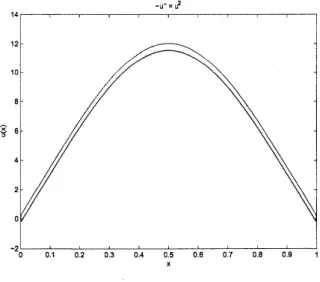
Figure 1 shows the guaranteed inclusion of the exact solution of Eq. (22). It is proved that
there exists a unique solution between two
curves.
Since $H_{0}^{1}(0,1)arrow C^{0}(0,1)$, we can obtain theguaranteed error bound in maximum norm by Poincar\’e$s$ inequality.
$x$
Figure 1: Guaranteed Inclusion ofthe Exact Solution (Mesh size $\frac{1}{512}$)
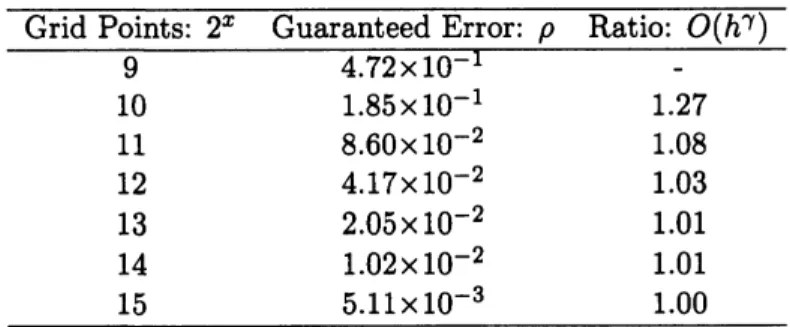
By increasing grid points, guaranteed error bounds are improved with $O(h)$
.
The guaranteederror and the ratio are presented in Table 1. All computations are carried out on Mac OS X,
Intel Core2 Duo 1.$86GHz$ by using MATLAB $2009a$ with a toolbox for verified computations,
Table 1: VerificationResults for Problem (22) $\overline{\frac{GridPoints:2^{x}GuaranteedError:\rho Ratio:O(h^{\gamma})}{94.72\cross 10^{-1}-}}$ 10 $1.85\cross 10^{-1}$ 1.27 11 $8.60\cross 10^{-2}$ 1.08 12 $4.17\cross 10^{-2}$ 1.03
13
$2.05\cross 10^{-2}$ 1.01 14 $1.02\cross 10^{-2}$ 1.01 15 $5.11\cross 10^{-3}$ 1.00 References[1] L. V. Kantorovich and G.P.Akilov, FunctionalAnalysis in Normed Spaces, translated from the
Russian by D. E. Brown, Pergamon Press, 1964.
[2] M.Urabe, Galerkin‘sprocedurefor nonlinear periodic systems, Arch.Rat. Mech. Anal. 20, 1965,
pp.120-152.
[3] M.A. McCarthy and R.A.Tapia, Computable
a
priori $L^{\infty}$-error
bound for the approximatesolution of two-point boundary value problem,
SIAM
J. Numer. Anal. 12, 1975, pp.919-937.[4] G. Kedem, A posteriori errorbounds for two-point boundary value problems, SIAM J. Numer.
Anal., 18, 1981, pp.431-448.
[5] M. T. Nakao, A numerical approach to the proof of existence of solutions for elliptic problems,
Japan Journal of Applied Mathematics 5, 1988, pp.313-332.
[6] M.T. NakaoandN. Yamamoto, NumericalVerification, Nihonhyouron-sya, 1998, (in Japanese).
[7] M. Plum, Computer-Assisted Existence Proofs forTwo-Point BoundaryValueProblems,
Com-puting 46, 1991, pp.19-34.
[8] R. A. Adams, Sobolev spaces, Academic Press, New York, 1975.
[9]
S.C.
Brenner and L.R. Scott, The MathematicalTheory ofFinite Element Methods, Springer, 2008.[10] S. Oishi, Numerical verification of existence and inclusion of solutions for nonlinear operator
equations, Journal of Computational and Applied Mathematics (JCAM), 60, 1995, pp.171-185.
[11] S. Oishi, Numerical Methods with Guaranteed Accuracy, Corona-sya, 2000, (in Japanese).
[12] M. T.Nakao, K.Hashimoto and Y.Watanabe, Anumerical method to verify the invertibilityof
linear elliptic operators with applications tononlinear problems, Computing, 75, 2005, pp.1-14.
[13] S. Oishi, A. Takayasu, T. Kubo, Numericalverification of existence for solutions to Dirichlet
boundary value problems of semilinear elliptic equations, submitted to publication.
[14] S.M.Rump,INTLAB-INTerval LABoratory, aMatlab toolboxforverifiedcomputations,