The Japanese Psychonomic Society
NII-Electronic Library Service
The JapanesePsychonomic Society
TheJlaPaneseJbumalofk.vehonumicSctence
2eO:r,,VoL24,No.1.121-122
Summaryof
Awarded
PresentationIP53
Tickle
sensationinducedby
hearing
a
soundi
Norimichi
KJTAGAwA*
andNTT Communication Science
Laboratories*,Yuka
IGARAsHI**
Tohyo
MetroPolitan U}iiversit],**
In
thepresent study we report an illusioninwhich sound prcsented near tothe head inducesa tactileexperience.
We
stroked thelcft
ear of adummy
head
with a paintbrush and recorded theseund and the scene. We thcn prcsented the sound, theimages, or
the
both
to
participants.The
participantsrated theirsubjective tactileexperience by answering a questionnaire.
The
resultsrevealed
that
the participantsfelt
a ticklingsensation when the sound was presented near to thehead,butnot when itwas presented
distant
from
thehead.
Viewtng
thescene hadlittle
or no effecton the tactileimpressiQn, The results suggest thataudiotactile
interactions
occur predominantlyin
a regionimmediately
surrounding the head,Key words: multisensory interactions;ticklesensation; auditory peripersonal space;
Imagine
amosquito isapproaching your neckfrom
your back.
You
prebabLy noticeit
byits
flyingsoundand might simultaneously
feel
itchy
on theback
ofyour neck. This example might imply the existence
of audiotactile
interactions
occurrcd near thebody,
However, while visuotactiIe interactionsin
per{per-sonal space are now well-documented farfewer
stud-ies
have
attempted toexamine audiotactileinterac-tionsinperipersonal space,
In
the present study wereport an
illusion
in
which only hearing a soundinduces
a subjective tactileexperience.Metheds
Fifty students participated in
this
experimenLEach participant was randomly assigned to one of
five
conditions:A-Near,
AV-Near,
A-Far,AV-Far, andv.
A microphone, which was
inserted
into
theleftearof a
dummy
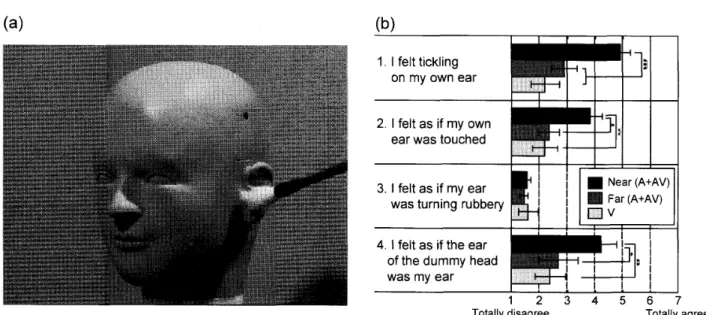
head,recorded thesound as we strokcdthe ear with a paintbrush, as
if
to
tickle
the ear(Figure
Ia).The
scene was also recorded onvideo-i The title
has
been
changedfrom
theoriginal tit]eofthe posterpresentation
"The
effect of auditorystimuli prcsented near tothe
body
on tactiLecriminationperformance,"
* NTT
Communication
Science Laboratories,NTT
Corporation,
3-1 Morinosato Wakarniya, Atsugi,Kanagawa 243-0918,
Japan
** Department of Psychology, Tokyo Metropelitan
University,
1-1 Minami-Osawa, Hachioji,Tokyo
192-0397
tape. We presented either the sound
(A
condition),theimages
(V
condition), or theboth
(AV
condition)tothe participants
for
30 seconds. The sound waspresented either through headphone$
(Near
condi-tion)or a
loudspeaker
placed at adistance
of 80cmfrom the participant's
reft
ear(Far
condition). TheLeq sound
ievel
was measured atthe
leftear and set at54
dB
(A)
for
each condition.This
levelwas al-rnost the sarne as thatof the actual stroke.
After
the presentation of one of thefive
conditionstheparticipants rated theiragreement with each
sta-tement ofa questionnaire on a
7-peint
scale rangingfrom
totallydisagree(1)
totorallyagree(7}.
Thequestionnaire inc]uded four statements
(see
Figure
1b).
Statements
1
and2
related to ourinterest
ofwhether a tacti]e
impression
was induced by thesound.
Statement
3 was included to controlfor
demand characteristics.
Statement
4
was notin-cluded in the
A
condition. The sentences were pre-sented oneby
one on adisplay
in
a random order.Results
andDiscussion
The mean ratings inthe
V
condition were smal!overall, suggesting that viewing the scene of the
tickling
had
little
or no effect on the tactileimpres-sion. Because the mean ratings forall of the state-ments in the
AV
condition were not significant}ydifferentfrom thoseintheA condition,
the
data
from
the
A and AV conditions were pooled so that wecould assess theeffect of the
distance
factor
on theThe Japanese Psychonomic Society
NII-Electronic Library Service
The JapanesePsychonomic Society
122
TheJapanese
Journal
of-
PsvchonomicScience
V
ol,24,
No,
1
(a)
(b)
1.1felttickling onmyownear・・////t
m
111..tttttttt 2.1feltasifmyown earwastouched ,l・i・,,g,:a
lt 3.Ifeltasifmyearll
wasturningrubberyIi11-Near{A+AV)
eeFar(A+AV)
pmv
4-S,ff,ita,s,iktZ?e,2r.,b
wasmyear //////////ttttttttttt//.t/tt////t//t/1/1111 11'1}1l1l +11Figure
1.
{u)
A
frame
of themovie presented tothe participantsshowing hthe dummy head with a brush. A rnicrophone was insertedintothe ]eftear and recorded thcsound
the
brush
stroke,(b)
Questionnaire
results. Each bar indicatesthcmean ratingthe Near and Far conditions) or 1O participants
(in
th
va]ues are indicatedwith asterisks
<*
p<O.1;
**p<
O.05;***p1234567
Totallydisagree Tetallyagree ow we stroked
the
left
ear ofof
of 2Q participants
(in
e
V
conditien} with standard errors.Significance
<O,Ol;Tukey'sHSD).
tactileimpression
{Figure
lb).A two-way ANOVA of the rating data,with
thc
between-participants factoruf the presentation
con-dition
(Near,
Far,
andV}
and the within-participantsfactor
oi the four statements, reveared significantmain effects of
the
presentation condition[F(2,
47>=
6,06,
P<O.O1],
and ot thestatements factorrF(3,
121) =23.21,P<O.OOI]. There were also significantinter-action
between
them[F(6,
121)=4.56,p<O.OOI].
The
participants inthe Near condjtion responded more
positivelythan the participants in the Far and V
conditions to
the
statement 1,Similar
trends wcreobserved for thestatements 2 and 4,
but
notfor
thestatement
3
as expected. These results suggest thatsound presented close to the head could inducc a
tactileimpression, but sound prc6ented at some
dis-tance
from
thehead
could not,One may argue thatirnagcry ¢euld be involved in
thc
phenomenon,That
is,
when the participantsheard
the sound, theyimagined
a situationin
whichthey werc tickledby something and they inturn felt
ticklingon theirear. However none of the
partici-pants in thc
A
condition was aware of what thesound was, and so they could not
imagine
such asituation.
Therefore
irnagery
cannot fullyexplainthis
illusion.
Our results suggest thata ticklescnsation, thathas
to
date
been
censidered unique tothesomatosensory system(e.g.
Stein & Mcredith,1993),
in fact can occurfrom
hearing
a sounddelivered
near to thehead.
Our results also provide support fortherecentsuggestion, based on psychophysical
(Kitagawa,
Zampini, & Spence, in press>,neurophysiologica]
(Graziane,
Reiss,&
Gross, 1999) andneuropsycho-logicaldata
(Farnb
& Ladavas, 2002),thataudiotac-tilespatial interactionsoccur predominantly
in
theregion immediately surrounding the head
(Le.,
peri-head
space).References
Farne,
A.
&
Ladavas,E.
2002 Auditory peripersonalspace inhumans,
lburnat
of
CognitiveIVeuroscienee,
14,
1030-1043,
Graziano,M. S,A,,Reiss,L.
A
J,,
&
Gross,
C.
G.
1999
A ncuronal representation of the
]ocation
ofby sounds.
Alature,
397,
428-430.Kitagawa,
N.
Zampini,
M.,& Spence, C. inpressdiotactile
interactions
innear and farspace.EttPeri-mentat BrainResearch,