Vol. 43, No. 3, September 2000
ON A COMPETITIVE INVENTORY MODEL WITH A CUSTOMER'S CHOICE PROBABILITY
Hitoshi Hohjo Yoshinobu Teraoka Osaka Prefecture University
(Received March 8, 1999; Revised August 16, 1999)
Abstract In this paper we consider a model in which a customer chooses one of two retailers with a choice probability depending on the distance from the customer's position t o the retailer's position over a line segment market. We study an optimal strategy for two retailers in a competitive inventory model by using an equilibrium point in the context of the game theory. We find an equilibrium point concerned with the optimal ordering quantity to minimize the total cost.
1. Introduction
In the studies concerned wit h inventory control problems there are many research works finding the optimal strategy for a single retailer. Studies on an equilibrium point for many retailers have been published in recent years. For instance Parlar [S] has proved the exis- tance and uniqueness of the Nash solution for an inventory problem with two substitutable products having random demands. Lippman and McCardle [6] have examined the relation between equilibrium inventory levels and the splitting rule and provide conditions under which there is a unique equilibrium point for a competitive version of the classical newsboy problem. A model represented in this paper is considered as one of special cases of their problems.
We are interested in a problem finding the optimal strategy for many retailers such that they are related with something each other. In this paper we consider a model in which a customer chooses a retailer with a choice probability depending on the distance from the customer's position to the retailer's position over a line segment market and we discuss on the ordering policy including a state of customer's choice. The probability represented in
Huff model [4] gives us more realistic model. However it is numerically complicated, so we use a very simple probability here. We study an optimal strategy for two retailers in a competitive inventory model by using an equilibrium point in the context of game theory. Our purpose is to find an equilibrium point concerned with the optimal ordering quantity to minimize the total cost, i.e. the sum of the ordering cost, the holding cost and the penalty cost.
The remainder of the paper is organized as follows. In Section 2 we describe the model in our study. In Section 3 we concretely provide the equilibrium point in this model formulated as a two-person nonzero-sum game. It is obvious that the results obtained in this paper differs from those for a single retailer. Section 4 deals with a numerical example. And finally, this paper ends with some conclusions in Section 5.
2 . Model Description
We consider a single period model where customers go to buy a kind of product to two retailers with a probability. T h e problem discussed in this paper is formulated as a two- person nonzero-sum game on the inventory control. Two retailers, called Player I and Player
11, begin t o sell products a t the same time. All customers are shared by two players. Player
I locates his position a t point 0 in the interval [O, l] and Player I1 does a t point 1. It is possible for the players to place an order only once a t the beginning of the period. They receive products t o sell without lead-time. If the products are in short supply, they are not backlogging after t h a t . They purchase the products a t an ordering cost per unit and sell them a t a selling price per unit. If players have some stock to sell, then they are charged holding costs. On t h e other hand, if they do not have any stock and have occurred demand, then they are charged penalty costs.
he customers uniformly distribute in the interval [O, l]. The customer who stays at
,
l] first visits Player I1 with the probability U to go to buy one of productsayer
I
with the remaining probability 1 - U . If a player he has first visited does not have inventory to sell on his hand, he must visit another player. T h e customers start from their positions a t the same time as their sales and transfer with the same speed. Then the arrival time taken from each of their positions to the firms is in proportion to the transference distance. Lett
denote the unit transference time. We assume that their planning period is 2t if players are very kind a d wait for them until t h a t time the last possible customers may come t o purchase it. For instance, if a customer stays a t point 0 first visits Player I1 and he has nothing to sell, he will travel to Player I in order to satisfy consider the planning period I t as a single period and we deal with a single period inventory problem in this paper. T h e customers do not know inventory quantities which players have on hand at any time.We assume that they know mutual unit ordering, holding and penalty costs and they are non-cooperative. T h e aim of each player is to minimize the personal total cost, i.e. the sum of the ordering cost, the holding cost and the penalty cost. Which strategies should they take t o achieve their purposes? How much inventory quantities should they order at the beginning of the period? We study their strategies in a competitive inventory model using an equilibrium point in the context of game theory.
We make use of t h e following notations.
: the number of customers on a market
: the ordering quantity for Player I, which is a decision variable : the ordering quantity for Player 11, which is a decision variable : the ordering cost per unit
: the selling price per unit : the holding cost per unit : the penalty cost per unit
: the inventory quantity a t time T : the average quantity in inventory
: the average shortage quantity in inventory : the total cost per period
Here subscript z denotes the player's number and j denotes the number of situations de- scribed below. We give a natural a,ssumption ri
2
c, because of getting their rewards. The ordering quantities X and y are independently decided.quantities X , y and demand b. The total costs in each situation are calculated as follows.
From these calculations we find that C g x , y ) are continuous in X and y on [ O , b] X [O, b].
Situation 1. We consider the situation on X
>
1
and y>
1
in the model. Playerscan supply the products to all customers when they first visit a player. Both of players do not yield the shortages in inventory. All demands of customers are satisfied by the time t. Q l ( T ) , the inventory quantity for Player I , is represented by
QlV)
={
X - J T t ( 1 - u ) b d u , 0 < T < tX - f i ( 1 - u)b du, t < T < 2 t
Then the average quantity I}, the average shortage quantity I; and the total cost C } ( X , y )
are calculated as follows:
and
On the other hand Q 2 ( T ) , the inventory quantity for Player I 1 at time T , is represented
by
Calculating the total cost Cf ( X , y ) for Player
I 1
as well as C x x , y ) , we obtainSituation 2. We next consider the situation on 0
<:
x<
t,
y>
1
and X+
y>
b. Thissituation supplies the products for all customers as well as Situation 1. It yields the shortages in inventory on Player
I
side, however they atre sa,tisfied by residual stock on hand of PlayerI1
side. The inventory quantity Q l ( T ) for PlayerI
is given by Equation (2.1). Given a realnumber X , let tl denote the time T satisfying 0
5
T<
t and X - $b+
Sb
= 0. Then weregard
tl
as a function of X and let it write t l ( x ) . Using the equation X - y b + wb= 0and calculating C z x , y ) , we have the following equation:
5
On t h e other hand, the inventory quantity Q 2 ( T ) is represented by
T h e total cost C i ( x , y ) is given by
Situation 3. We consider t h e situation on 0
<
X<
^y
>
$
and X+
y<
b. In thissituation it yields the shortages in inventory on Player I side and not all the customers who have been not satisfied on Player I side asre satisfied by stock on hand of Player I1 side. For Player I we obtain the similar results to those on Situation 2. On the other hand, the inventory quantity Q 2 ( T ) is given by Equation ( 2 . 6 ) . Given real numbers X and y , let
t 2
denote t h e time T satisfyingt
+
ti
<
T<
2 t and X+
y - $b+
z b+
b = 0.
Then 2 twe can regard
t2
as a function of X and y and let it write t 2 ( x , y ) . Using the equationsX - y b + q b= 0 and X
+
y - T b+
w b + b = 0 and arranging C : ( x , y ) , weIt
have t h e equation
t 2 ( x 7 Y ) ( X
+
y - b ) .+
(h2+
m)-,r-
Situation 4. We consider the ~ i t u a ~ t i o n on 0
5
X<
1-
and 0<
y<
k.
In this situationonly customers who have visited players earlier a8re sakisfied their demands. If they are not satisfied by a player they have first visited, they amre not satisfied after this. The inventory quantity Q l ( T ) is represented by X - J O l t ( l - u ) b d u , 0 < T < t X -
G(\
- u ) b d u ,t < T < t + t 3
X - m - u ) b d u + Q ^ { T - t ) ,t + t 3
< T<'it
X - $b+
$h, O < T < t ={
X - i b , t < T < t + t 3 ( 2 . 9 ) x + y - p + g b + b , t + t 3 < T 5 2 t .Q 2 ( T ) , the inventory quantity for Player I1 at time T , is given by Equation (2.6). Let
t3
denote the time T satisfying 0
<
T<
t
and y - T b+
3
= 0 . Then we can regardt3
as a function of y and let it write t 3 ( y ) . Using the equations X - y b
+
wb= 0 anda b
+
b = 0 and arranging C f i x , y ) , they are given byAlso we calculate C a x , y) likewise and we have
Situation 5. We consider the situation on X
2
k ,
0<:
y<
$
and X+
y2
b. Thissituation supplies the products for all customers as well as Situations 1 and 2. It yields the shortages in inventory on Player I1 side. However all the customers who have been not satisfied on Player I1 side are satisfied on Player I side. This case is the situation exchanged a role between Player I and I1 on Situation 2. Therefore the total costs C i ( x , y ) and C j { x , y )
are given as follows:
Situation 6. At last we consider the situation on X
2
I-,
0<
y<
I-
and X+
y<
b. Inthis situation it yields the shortages in inventory on Player I1 side and not all the customers who have been not satisfied on Player I1 side are satisfied them on Player I side. This is the situation exchanged a role between Player I and I1 on Situation 3. Therefore the total costs
CA(x, y) and C a x , y ) are given as follows:
Here t d x , y ) denotes the time
T
satisfying t+
t3
<,
T<
2t and X+
y - y b+
3
+
b = 0.3. Equilibrium Point
In this section we formulate our model as a two-person non-zero-sum game and we find an equilibrium point in this model. Because a player becomes to have useless quantity in inventory if he orders products more than b, he never take such a behavior. Therefore we restrict his behavior to the interval [O, b]. Including all possibility in the range [O, b] X [O, 61,
we find an equilibrium point in the concepts of a mixed strategy with continuous strategies. Let the cdf F ( x ) consist of a mass part a\
>
0 at point 0 , a density part f ( X )>
0 overan interval ( 0 , b) and a mass part
>
0 at point b; and let the cdf G ( y ) consist of a mass part ,O1>
0 a t point 0 , a density part g ( y )>
0 over an interval ( 0 , b) and a mass part,&
>
0at point b. Here it must hold that a ,
+
f ( x ) d x+
% = 1 and+
~ ~ ( ~ ) d y+
,02 = 1. We suppose that PlayerI1
uses the mixed strategy G ( y ) such that Player I1 orders y products with cdf G ( y ) if Player I orders X products. The expected payoff kernel M l ( x , G) for PlayerI is given by
M,[x7G)
=Also we suppose thak Player
I
uses the mixed stra,tegyF(x)
such that Player I orders Xproducts with cdf F ( x ) if Player I1 orders y products. The expected payoff kernel
M 2 ( F ,
y) for Player I1 is given byTo find the minimizer X we differentiate Equation (3.1) with respect to
X .
Using the equa-we have
Therefore we see t h a t Ml(x, G ) is a strictly convex function, so there uniquely exists the optimal strategy for Player I. Here we consider three cases.
Case on limX+b12-0
?&!p
>
0:Now we find the optimal ordering quantity X* that is satisfied = 0. Setting the
partial derivatives of
Ml
(X, G ) as zero, we obtain the valueh-l+Pl
As it must follow 0
<
t*
<
t, we have a sufficient condition 0<
r l - cl<
7.
t * ) 2
Substituting Equation (3.6) for X* = ^-b t - k b , we have the optimal ordering quantity
aMl(x7G)
>
0: Case on limx+b12-ov
5
0 and lirnx+b,2+o axIt is easy t o see t h a t t h e optimal strategy X* is equal t o
1
for Player I.l l
<
0:c a s e on limx+b/2+0 gx
It must follow 0 <, y
<
b / 2 in this case. Using a uniqueness of the optimal strategy y* for Player I1 under the similar analysis onMfi
y), Equation (3.4) is rewritten as follows:Because
b - X , it
Ml ( X , G) is a n increasing linear function in
x
if y* is greater than or equal t ois clear that he had better have less inventory quantity. Hence Player I chooses
X* = b - y* for his optimal strategy. Otherwise, we find the minimizer X* on Equation
(3.8). Setting the partial derivatives of
Mi
(X, G ) as zero, we ha,ve the valueAs it must follow t
+
tg5
ti
<
2 t , we have sufficient conditions+
(h1+p1)(r2-c2+p2)h-2+~2
<
2 ~ z - c z + P ~ )
rl - cl
<
hl and 0<
r 2 - c2<
v.
Here we use the value ( h2+p2t
for tg. Substituting* 2
where we have made use of y* = 2 ( c 2 - r 2 + h 2 ) ( r 2 - c 2 + ~ 2 )
(h2+~2)~ b with respect to y.
T h e above considera,tions lea,d us to the following theorem.
Theorem 1. For nonzero-sum game M l ( x , y),M^(x, y)'O
<
X , y<
b, there exist values v:and
v:
such thatwhere
This pair (X*, y*) is an equilibrium point. Then we obtain the following equilibrium points
as a result of this paper.
(i) If it follows the sufficient conditions 0
5
r; - c,<
e,
I = 1,2, then the equilibrium2 cl-ri+hi ri-ci+~i) 2(cz-rz+hz)(rz-~z+~z
point is
(
( ( h 1 z 1 ) 2h
(h2+~2)' )"
(ii) If it follows the sufficient conditions 0
<
7-1 - cl<
and h 2 ; p 2 I ( ~ z + P z ) ( ~ I - C I + P I ) h1 +p15
r2 - c2
<
h 2 , then the equilibrium point is(2(c1-r1(/I~f~~)2c1*p1)b,
'^
+
( 2 r 1 - 2 c 1 - h 1 + p 1 ) 2 2(h1 +PI )2 b- 2 ( r 2 - ~ 2 - h 2 ) ~
(h2+~2)~ b ) ,
tl=a and
<
r2 - c2<
(iii) If it follows the sufficient conditions 0
<
rl - cl<
h 2 - p 2 + (h2+~2)(~-cl+Pl)
,
then the point is( 2 ( c l - r l ( + t ~ ~ l ) 2 - - c l + ~ l )
2 hl+Pl 6,
J )
;and r2 - c2
2
hi, then the(iv) If it follows the sufficient conditions 0
<
rl - cl<
7equilibrium point is ( 2 ( c 1 - r i + h i ) ( ~ i - ~ l + ~ l ) b, b - 2(cl-rl+hl)(rl -cl+pl) .
(h1 +P1 )2 (h1 +P1 )2 6 )
(v) If it follows the suficient conditions
9
+
1-<
rl - cl<
h1 andh 2 + ~ 2 - .
2r2-2~2-h2+~2)~ 2 ( q -cl -hi)'
0
<
7-2 - c2<
9,
then the equilibrium point is(i
+
(2 ( h 2 + p 2 ) 2 v (h1+plI2 b ,
~ ( c z - ? - z + ~ z ) ( ~ z - c z + P z )
.
( h z + ~ z ) ~ b ) 7h1 -p1 ( ~ ~ + P ~ ) ( ' - z - c z + P z )
(vi) If it follows the sufficient conditions
9
5
rl - cl<
7+
h 2 p 2
,
then the equilibrium point is(t
,
2 ( c 2 - r 2 + h 2 ) ( r 2 - c 2 + p 2 )0 < r 2 - C S < ? (h2 +p2 )2
then the
(vii) If it follows the sufficient conditions ri - cl
>
hi and 05
7-2 - c2<
7equilibrium point is
(b -
~(cz-rz+hz)(rz-cz+pz) 2(cz-rz+hz)(~z-cz+pz)
(h2+~2)~ b, (h2+P2l2 6 ) ; and
(viii) If it follows the sufficient conditions r,i - c;
>
v,
I = l , 2) then the equilibrium pointi.3
(i,
J ) .
4. A Numerical Example
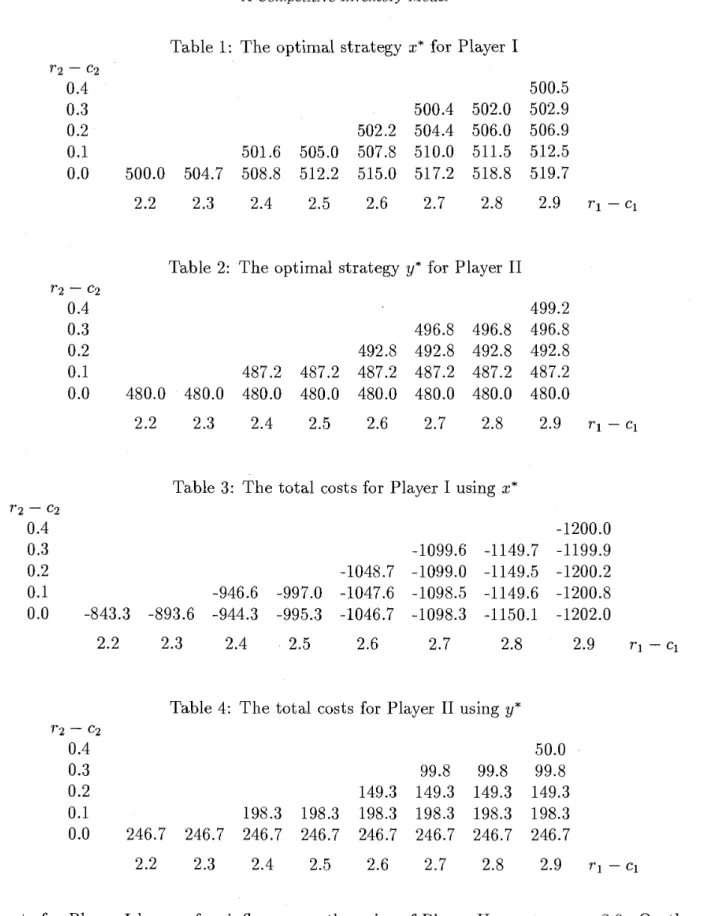
In this section we give a numerical example of equilibrium points and their total costs for some fixed values h;, p; and r; - c,. The values
i,
2 ( c i - r i + h i ) ^ r i - c ~ + p i ) ( / l i + ~ i ) ~ b l~a~ving obtained inthe previous section yield the similax results to the ordering quantities that we obta,in in the model when a player is not affected by another player at all. Hence we are interested in the cases which we cannot obtain in a single player's model, particularly Cases (ii) and (v). Since Player I and I1 play their symmetrical roles in this model, we deal with Case (ii) in a numerical example. We give the results on Table 1 through 4 by using the values
hi = 3, pi = 5, hi = 3,p2 = 2, b = 1000. We consider negative values of total costs as his
rewards on Table 3.
Now we are interested in Pla,yer I side representing the values which we cannot obtain when a player does not have a n influence on atnother player. For instance we see the total
Table 1: The optimal strategy X* for Player I
Table 2: The optimal strategy y* for Player I1
Table 3: The tota,l costs for Player I using X*
Table 4: The total costs for Player I1 using y*
7-2 - c2 0.4 50.0 0.3 99.8 99.8 99.8 0.2 149.3 149.3 149.3 149.3 0.1 198.3 198.3 198.3 198.3 198.3 198.3 0.0 246.7 246.7 246.7 246.7 246.7 246.7 246.7 246.7 2.2 2.3 2.4 2.5 2.6 2.7 2.8 2.9 q - c l
costs for Player
I
have a few influence on the price of Player I1 on r i - cl ==-- 2.9. On theother hand, Player I1 does not have an influence on Player I at all. Because they have the strategies with the other player under consideration, it is nothing that the sum of their strategies is over b.
5. Concluding Remarks
In this paper we deal with a single period competitive inventory model with the choice probability proportional t o distance on a line segment market. Cases (ii), (iv), (v) and (vii) are new results having obtained in this work. This inventory problem was formulated as one of games with pure strategies of continuous cardinary. Consequently the mixed strategy was consistent with the pure strategy. Since all of costs were linear, the total cost became a strictly convex function, so we uniquely had the solution.
We
are also able to use this method in t h e non-linear case. Hence we will be able t o find equilibrium points by means of the mixed strategy for more complicated models. Also this model will be able to be extended t o a multi-period model and it will be compared with models changed assumptions. They are further research problems and we hope this paper becomes a stepstone of research on competitive inventory problems.Acknowledgements
The authors would like to thank the referees for their helpful comment S.
References
[l] D.P. Heymand and M.J. Sobel: Handbooks in Operations Research and Management
Science Vol.2: Stochastic Models (North-Holland, Amsterdam, 1990).
[2] H. Hohjo: A competitive inventory model with reallocation under uniform demand dis- tribution. Mathematica Japonica, 49 (1999) 51-64.
[3] H. Hotelling: Stability in competition. Economic Journal, 39 (1929) 41-57.
[4] D.L. Huff: Defining and estimating a trading area. Journal of Marketing, 28 (1964) 34-38.
51 M. Kodama: The Basis of Production and Inventory Control Systems (in Japanese) (Kyushu University Press, Japan, 1996).
[6]
S.A.
Lippman and K.F. McCardle: The competitive newsboy. Operations Research, 45(1997) 54-65.
[7] M. Nakanishi: The Theory and Measurement of the Retailer Attraction (in Japanese) (Chikura Publishing Company, Japan, 1983).
[8] M. Parlar: Game theoretic analysis of t h e substitutable product inventory problem with random demand. Naval Research Logistics, 35 (1988) 397-409.
[g] Y. Teraoka: A two-person game of timing with random termination. Journal of Opti-
mization Theory and Applications, 40 (1983) 379-396.
Hitoshi Hohjo
Department of Mathematics and Informat ion Sciences Osaka Prefecture University
1-1, Galwen-cho Sakai-city, Osaka 599-8531, Japan E-mail: ho j oQmi