Foreign and Domestic Capital in Indonesian
Industrialization*
THEE Kian Wie** and Kunio YOSHlHARA***
I Industrial Development since the Late 19608
The unsettled political conditions of the 1950s and first half of the 1960s were not favorable to economic development 10
general and industrial development 10
particular. With the Indonesian economy steadily deteriorating during the first half of the sixties, the small manufacturing sector was burdened with under-utilized capacity, as the flow of imported raw materials and parts and components slowly dwindled to a trickle as a result of steadily declining foreign exchange reserves.
With the advent of a new government
*
In May 1986. we conducted a number of interviews with Japanese businessmen in Jakarta. Although we cannot name them individually, we would like to record our appreciation to those who gave us their valuable time. We would like also to express our appreciation to JETRO for letting us use their Indonesian collection. Also at lETRO, Mr. Sori Harahap often provided us with information on Indonesian businesses, for which we are very grateful. Lastly, we would like to thank Dr. Dorodjatun Kuntjorojakti of Universitas Indonesia for letting us use liberally his files on Indonesian businesses and industries. Without this help, this study would have been impossible.**
Economic and Development Studies Center, LIP!, Indonesia***
s}jj{?\C::::R:, The Center for Southeast Asian Studies, Kyoto Universityin 1966 which, unlike the previous govern-ment, was strongly committed to economic development, industrial development started in earnest for the first time since indepen-dence. In the period 1966-1968 the average annual growth rate of the manufacturing sector reached 6. 02 percent, and accelerated to 12.44 percent during the following three years.
We can divide industrial growth since the late 1960s into three phases: a) the phase of 'easy' import substitution (1968-1975), b) the phase of 'moving upstream'
(1975-1982), and c) the phase of slowdown (1982-present) .
a) The first phase (1968-1975) : 'easy' import substitution. During this period a wide range of locally made consumer goods (including light consumer goods and con-sumer durables) gradually replaced imported goods. The firms which produced these consumer products were set up by domestic
(i.e., national) and foreign investors who were spurred by highly protective import substitution policies as well as by the Foreign Investment Law of 1967 and the Domestic Investment Law of 1968 [Thee 1983 : 2J. This pattern of investment is quite similar to that of other Southeast Asian countries. such as the Philippines, Thailand, and Malaysia, which experienced
a surge of foreign and domestic invest-ment to set up 'tariff factories' (behind highly protective tariff walls).
Most, if not all, of these factories merely undertook 'final assembling' or 'end process' activities. For example, completely knocked down kits (CKD kits), containing a set of inter-related parts and components, were imported from abroad and assembled locally into final consumer goods. The bulk of these imported parts and components were often supplied by the parent companies located in the home countries.
b) The second phase (1975-1982) : mov-ing upstream. After 1975 the domestic market for most basic consumer goods gradually became saturated, signaling the completion of the relatively easy phase of import substitution industrialization. Spurred by the example of the newly industrializing countries (NICs) and buoyed by vastly increased oil revenues, particularly after the second oil boom of 1978/79, Indonesia's policy makers opted to push the process of industrialization one stage further by moving upstream into basic industries, resource processing industries, capital goods and intermediate goods indus-tries, and a few strategic high technology industries (notably the aircraft assembly industry).
In pushing this 'backward integration,' the Indonesian government, through man-datory 'local content' programs (in Indo-nesia referred to as 'deletion programs'), required assembler firms, particularly in the automotive industry (specifically com-mercial vehicles), the diesel engine indus-try, the electric generator indusindus-try, the
828
rice huller industry, and the household electric appliance industry, to manufacture locally a specified percentage of parts and components which until then had been imported. While in the case of certain components, the assemblers were allowed to make the components themselves
(in-house manufacture), other parts and com-ponents had to be procured locally from independent, unaffiliated firms, preferably from small subcontractors (out-house manu-facture) [Thee 1984: 35].
The 'deletion programs' stipulated that the number or proportion of locally made parts and components have to be reached within a specified period of time. For instance, in the motor vehicle industry, it is stipulated that commercial vehicles (i. e., buses and trucks) have to be 'fully manufactured' by 1987/88 [Ministry of Industry 1984]. This implies that these locally assembled commercial vehicles will eventually have to use all locally made parts, including engines [Thee 1984: 15]. To a large extent the decision to move upstream was influenced by the perceived -need "to maintain the growth momentum of the manufacturing sector as well as to 'deepen' Indonesia's industrial structure through the generation of as many back-ward and forback-ward linkages as possible with a view to strengthen the manufactur-ing sector and to transform the pattern of Indonesia's foreign trade so as to decrease the share of manufactured imports as well as increase the share of manufactured exports" [CSIS 1982: xx]. These strong views of the major decision-makers of industrial policy were reflected in the
extension of protection against imported intermediate and capital goods.
Stimulated by rising domestic demand for a wide range of intermediate and capital goods as well as by the strongly protectionist policies of the Indonesian government, industrial development dur-ing the latter half of the 1970s led to a substantial change in the structure of the manufacturing sector. While the tradi-tional, relatively labor-intensive, light con-sumer goods industries, such as food products, beverages, and tobacco, began to grow less rapidly during the latter half of the 1970s more capital- and technology-intensive industries producing a wide range of intermediate and capital goods (includ-ing consumer durables) came to the fore [Roepstorff 1985 : 35J.
According to a UNIDO study conducted by Roepstorff, the share of consumer goods (excluding consumer durables) in total manufacturing value added (MVA) dropped steeply from 80.8 percent in 1971 to 47.6 percent in 1980. On the other hand, dur-ing the same period the share of inter-mediate goods rose from 13. 1 to 35. 5 percent, while the share of capital goods (including consumer durables) rose from 6. 1 to 16. 9 percent. The study also reveals that the share of the more traditional, labor-intensive food products, beverages, and tobacco dropped by almost one half during the decade, from 63. 8 to 31. 7 percent. However, the shares of inter-mediate industries, namely wood products (excluding furniture), industrial chemicals, other chemicals, rubber products, and other nonmetallic minerals (particularly
cement) rose respectively from 1.4 to 7.0 percent, 0.8 to 4.3 percent, 3.8 to 7.1 percent, 1. 3 to 4.8 percent, and 2.5 to 5.9 percent. The iron and steel industry emerged during this period, producing 3.1 percent of total MVA in 1980 (com-pared to 0 percent in 1971) [ibid.:
36-37].
The structural change which has taken place in Indonesia's manufacturing sector is also reflected in the striking changes which have taken place in the composition of imports. While the share of imported consumer products amounted to 22. 1 percent (US$ 180. 7 million, cif) of total imports (excluding the imports of oil and gas) in 1969/70, this share had declined to 5. 6 percent (US$ 603. 5 million) by 1984/ 85. On the other hand, during the same period the share of imported intermediate goods increased slightly from 48. 8 percent (US $399. 7 million) to 53. 1 percent (US$ 5, 749. 8 million), while the share of im-ported capital goods rose from 29. 1 percent (US$ 238. 7 million) to 41. 3 percent (US$ 4,477.8 million) [Republic of Indonesia 1986 : 209-212].
c) The third phase (1982-present) : slowdown since 1982. Since 1982 Indo-nesia's economic growth in general and industrial growth in particular have slowed down considerably as a result of the weakening of the world oil market. As a result, considerable concern has arisen about the gross inefficiency of the manu-facturing sector and its general inability to achieve international competitiveness, which would be necessary if the manu-facturing sector were to replace the oil
sector as the engine of Indonesia's economic growth and as the major source of foreign exchange earnings.
The Fourth Five Year Development Plan (Repleta IV) for the period 1984/85-1988/89 had actually targetted manufactur-ing growth at 9. 5 percent. However, in view of the protracted sluggishness of industrial growth, widespread concern has emerged, particularly after a spate of lay-0ffs by a number of manufacturing firms. Critics of current industrial policy have therefore suggested that the government abandon, or at least postpone, the highly capital- and technology-intensive industries which were promoted during the two oil booms of the 1970s, and shift to a more outward-looking and less protectionist policy that would encourage the more labor-intensive, export-oriented industries in which Indonesia has a comparative advan-tage.
II The Agents of Industrialization Who then undertook Indonesia's indus-trialization? In asking this question, we are really asking who organized necessary inputs for industrial production in the country. Here, we are not particularly interested in individual people and in-stitutions, however, but in certain cate-gories.
The categories we are interested in are 'the state,' 'Indonesian entrepreneurs,' and 'foreign capita!.' And we call the compa-nies owned by the first, state enterprises; by the second, private Indonesian compa-nies; and by the third, foreign companies.
330
Below we will discuss primarily these three categories of companies, and treat them as the agents of industrialization, even though the actual agents are the people and organizations behind them.
In some ASEAN countries, there is no interest in the first category, since the state is not directly involved in industrial-ization. But in Indonesia, since the Sukarno period, the state has been an active par-ticipant and dominates certain sectors. So, in order not to attribute the rise of Indonesian capital completely to private Indonesian capital, we decided to separate state from private capital.
As usual, foreign companies include 100 percent foreign-owned companies and joint ventures--that is, the companies in which there is foreign equity.I) In addition, however, we include the private Indonesian companies which depend heavily on foreign licensing.
What constitutes 'heavy dependency' is somewhat a matter of subjective judg-ment. Many of the large companies we regard as private Indonesian companies use foreign technology. But they are not regarded as foreign companies, because their dependency on foreign technology is not crucial.
The companies which depend 'crucially' or 'heavily' on foreign technology produce foreign-brand products. For example, all automobile assemblers are owned by Indonesian capital: by law, foreign equity 1) At present, there are few 100 percent foreign-owned companies in Indonesian industry. The only exceptions are garment manufacturers in the bonded warehouse zone in Tanjung Priok, Jakarta.
is not allowed in this sector. These assem-blers, under the technical assistance of foreign (largely Japanese) auto makers, make foreign-brand motor vehicles. We also find similar examples in household electrical appliances.
These companies are considered foreign, because they depend almost totally on foreign companies for operation. If their licenses were withdrawn, they would hardly survive.2) However, there are Indonesian
companies which make products under both foreign and their own brands. In this case, unless the 'own brand' products are really minor, they are considered to be private Indonesian companies. For ex-ample, a tire manufacturer, a few cigarette manufacturers, and a number of pharma-ceutical companies fall in this category.3)
Therefore, foreign companies in this paper include some in which there is no foreign equity, but exclude others in which foreign equity is involved. In the case of a joint venture with minority foreign equity, foreign control may be negligible. Such a company has to be excluded. Thus, a foreign company in this paper simply means one that depends on foreign equity and/or foreign technology 'heavily' or 2) One example is the once prominent Indokaya
group which virtually vanished after it lost the Nissan license.
3) Besides producing their own brand products, the tire manufacturer, Gadjah Tunggal, pro-duce the 'Yokohama' brand of tires and the 'Inoue' brand of tire tubes; the cigarette manufacturer, Sumatra Tobacco Trading, pro-duce the 'Salem' and 'Winston' brands of cigarettes ; and the kretek cigarette manufac-turer, Bentoel, produces the 'Marlboro' brand of cigarettes. (To be more exact, Bentoel's subsidiary produces the 'Marlboro' brand.)
'substantively'.
III Industrial Structure
It is beyond the bounds of endeavor for us to cover the entire manufacturing industry. What we intend to do is to take the industries in which foreign capital tends to be important,4) and investigate the relative importance of the state enterprises, private Indonesian companies, and foreign companies.
The typical method in this type of in-vestigation is to use an industrial census as the major data source.S
) However,
be-cause of the problem of the reliability of the census data, and because what has been published is too aggregative for an in-depth analysis, we decided to use a different approach. For each of the in-dustries in which we are interested, we identified the major companies involved and classified them according to the categories just discussed. And from market share, production or production capacity (depend-ing on the availability of data), we tried to compute their relative importance.
We focus on major companies, since they are the vanguard of industrialization, and there is a great deal of interest in 4) One of the authors studied Singapore and
the Philippines. See Yoshihara [1976; 1985]. From these studies, we had a rough idea of what industries might have a high foreign share.
5) In V. N. Balasubramanyam [1984J, the 1974 industrial census are used to compute the relative importance of the three categories of companies. Also, the same data is used in Peter McCawley [1979: 29J, and Hal Hill [1985: Tables 20 and 21].
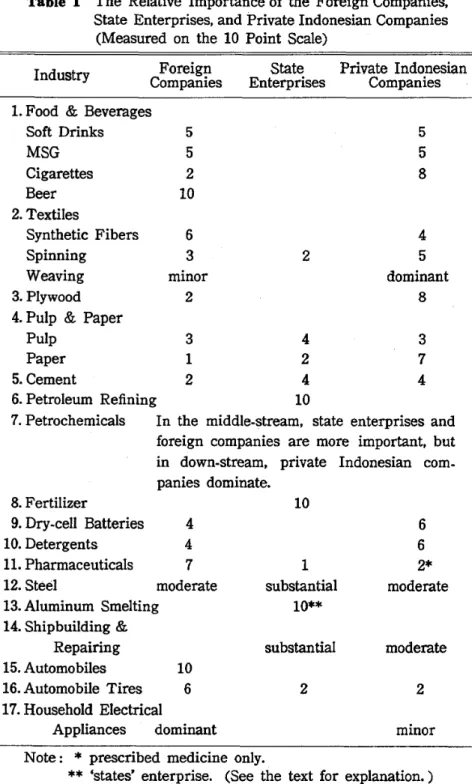
Table 1 The Relative Importance of the Foreign Companies. State Enterprises. and Private Indonesian Companies
(Measured on the 10 Point Scale)
the in listed dustries
table.
companies with large ship-yards--the companies which are usually regarded as the modernizers of the industry.
Table 1 is the result of our findings. In an industry in which it was possible to quantify the relative importance of the three categories of com-panies, this was shown by distributing a total of 10 points over the three. When it was difficult to quantify, the relative im-portance is indicated in words. In the rest of this section. we will briefly discuss in turn the
in-1. Food and Beverages Soft Drinks
In the area covered by P. T. Djaya Beverages Bottling Co., the major bottler of Coca Cola, the area which accounts for60 3 7 4 5 5 8 minor 2 6 6 2* moderate
6) Interview with Mr. Yoshiaki Hatanaka of P. T. Djaya Beverages Bottling Co. (May 1986).
4 5 dominant
8
moderate
percent of total soft drink consumption in Indonesia, foreign companies' market share is only about 45 percent (in terms of quantity).6) There is an Indonesian
company called Teh Botol 80sm, which sells as many bottles as all the foreign Private Indonesian Companies 2 10 2 1 substantial 10** substantial State Enterprises 6 3 2 5 5 2 10 10 6 minor Foreign Companies Industry
Note:
*
prescribed medicine only.** 'states' enterprise. (See the text for explanation.) Source: See the text.
knowing how domestic response has been in this upper stratum. For example, in the shipbuilding and repairing industry, there are numerous companies catering for the need of fishermen and small shippers, but by excluding them, we can focus on the 1.Food & Beverages
Soft Drinks MSG Cigarettes Beer 2. Textiles Synthetic Fibers Spinning Weaving 3. Plywood 4. Pulp & Paper
Pulp 3 4
Paper 1 2
5. Cement 2 4
6. Petroleum Refining 10
7. Petrochemicals In the middle-stream. state enterprises and foreign companies are more important. but in down-stream. private Indonesian com-panies dominate. 8. Fertilizer 9. Dry-cell Batteries 4 10. Detergents 4 11. Pharmaceuticals 7 12. Steel moderate 13. Aluminum Smelting 14. Shipbuilding& Repairing 15. Automobiles 16. Automobile Tires 17. Household Electrical Appliances dominant 332
brands combined. This company, which began production only about 10 years ago, has made spectacular progress by focussing on non-carbonated drinks (foreign brands are usually carbonated) and offering the consumers a much lower price (at present, about half the price of Coca Cola). In this industry, there are no state enter-prises.
Monosodium Glutamate (MSG)
In the other ASEAN countries, the Japanese company Ajinomoto has a virtual monopoly over this product, but in Indo-nesia, its market share is about 37 percent, which is a little smaller than that of the Indonesian brand 'Sasa' [Technomic Con-sultants 1984: IV-146] . There is another foreign brand 'Miwon' (a Korean brand), but its market share, about 13 percent, is much smaller than Ajinomoto's. For a food industry, the MSG industry is capital-intensive, and is difficult for a Southeast Asian company to succeed, but the company producing 'Sasa' (Sasa Fermentation, a member of the Roda Mas Group) has been quite successful.
Cigarettes
There are two foreign companies (BAT Indonesia and Faroka) producing prestig-ious foreign brands, but they do not domi-nate the cigarette industry.T) They produce what the Indonesians call 'rokok putih' (white cigarettes), and even in this field, there are two large private Indonesian companies (Sumatra Tobacco Trading and Kisaran Tobacco, both at Medan) compet-7) BAT's well known foreign brands are 'Benson,' 'Ardath,' 'State Express: and 'Lucky Strike,' and Faroka's are 'Dunhill' and 'Pall Mall.'
ing with them. Furthermore, 'rokok putih' are less popular than clove cigarettes ('rokok kretek'). The giants in the clove cigarette industry are three private Indo-nesian companies: Gudang Garam, Djarum Kudus, and Bentoel. In 1981, these three companies accounted for about two thirds of the clove cigarettes sold [ICN May 2, 1983 : 8]. In this industry, there are no state enterprises.
Beer
Three companies are producing beer in Indonesia today (Multi Bintang Indonesia, Delta Djakarta, and San Miguel Brewery Indonesia). All of them are foreign com-panies.8
) There are no Indonesian
com-panies in this industry. This contrasts with the situation in Thailand and the Philippines, where local beer companies are strong. In Indonesia, beer is one of the few nondurable consumer goods where foreign brands dominate.
2. Textiles
Synthetic Fibers
In this industry, Japanese companies dominated for some time since production began in 1972. However, their position has recently been eroded by the entry of an increasing number of private Indonesian companies.
In nylon filaments, two Japanese com-panies, Indonesia Toray Synthetics and Indonesian Asahi Chemical Industry, 8) The foreign investors in these companies are
Heineken of Holland (Multi Bintang), NV. De Brouwerij De Drie Hoefijzer of Holland (Delta Djakarta), and San Miguel of the Phil-ippines (San Miguel Brewery Indonesia).
monopolize production. In the more impor-tant polyester fibers, however, some private Indonesian companies have made inroads into the market. They first moved into the polyester filament market (starting in 1979), then into the polyester staple fiber market. In polyester filaments, the Japanese com-pany Tifico is the only foreign comcom-pany involved, and its capacity was only about 30 percent of the total in early 1986.9
) In
polyester staple fibers, the only Indonesian company operating then was Tri Rempoa at Tangerang, but by the middle of 1987, two more private Indonesian companies are scheduled to commence production. In early 1986, Tri Rempoa accounted for about 25 percent of the total installed capacity.10)
Spinning
In early 1986, 86 companies belonged to the Indonesian Spinners Association, and the total number of spindles was about 2. 4 million. Of these, state enterprises accounted for 21 percent, private Indo-nesian companies 48 percent, and foreign companies 27 percent (Japanese 10, Hong Kong 7, and Indian 10 percent).11) In this sector, private Indonesian companies were weak in the early 1970s, but by 1984 there were 35 private Indonesian spinning mills, some of them quite large. (The largest was Agropantes, which owned about 90, 000 spindles. This was bigger than any foreign 9) To move into polyester filament was easier
since the optimum scale of production is smaller.
10) The data for this paragraph were supplied by Indonesia Toray Synthetics.
11) The data source is ASPI (Indonesian Spin-ners Association).
33~
or state spinning mill.) Weaving and Garments
In weaving, although there are no official statistics, evidence indicates that private Indonesian companies are dominant. For-eign companies, except those engaged in spinning at the same time, are not al-lowed in this sector. Out of the 29 foreign companies engaged in spinning, 15 were also engaged in weaving.12) The other 14
companies sold all of their yarn to private Indonesian weavers. The 15 companies which were also engaged in weaving did not consume all of their yarn. On average 40 percent of their yarn seems to have been sold.lS) So, their share in fabric
production must have been much smaller than in spinning. In the case of garments, although there are a few foreign companies in the bonded warehouse zone at Tanjung Priok, and some of the Indonesian com-panies obtain technical assistance from foreign companies, this sector is almost completely dominated by private Indonesian companies.
3. Plywood
In the early 1970s, practically no plywood was produced; but in the mid 1970s, prog-ress began under the encouragement of the government, which wanted some pro-12) The data source is ASPI.
13) This percentage was computed by assuming that one spindle produces roughly 20 pounds of yarn per month and one loom consumes 700 pounds of yam per month. (The number of spindles and the number of looms of for-eign textile companies were available at ASPI.) The yarn produced in excess of what could be consumed by their own looms was consid. ered to have been sold.
cessing on logs being exported. Then came the so-called SKB Tiga Menteri (Surat Keputusan Bersama Tiga Menteri), a joint ministerial decree issued by three ministers, which banned log exports from 1980. After this decree, the increase of plywood production accelerated, and in 1984, production reached a level of 3.9 million cubic meters. In mid 1985, 98 mills were operating, of which 15 were foreign companies and the rest were private Indonesian companies. In terms of capacity, the 15 foreign companies accounted for 16 percent of the total [ICN August 12, 1985: 15-26].
4. Pulp and Paper
Although the government is involved m this industry, its relative importance m paper production is not large. In 1984, five state enterprises produced about 90, 000 tons, which was about 22 percent of the total production. A foreign (Taiwanese) company (Indah Kiat) accounted for an-other 13 percent, and the rest was pro-duced by private Indonesian companies.14l
Many of the Indonesian companies produce paper with purchased pulp, so in pulp production, their share is smaller. On the other hand, all the five state enterprises are integrated and produce pulp. The total capacity of pulp produc-tion in 1984 was 317, 000 ton per annum. Of this, the five state enterprises accounted for 39 percent, the one foreign company 28 percent, and the seven private Indo-nesian companies the remaining 33 percent. 14) The data source is Indonesian Pulp and
Paper Association.
5. Cement
There are 10 companies in this industry (to be exact, nine companies and one group (Indocement) of companies). In 1985, about 10. 5 million ton of cement was produced. The five state enterprises (Semen Padang, Semen Gresik, Semen Tonasa, Semen Baturaja, and Semen Ku-pang) produced 3. 9 million tons, whereas the three foreign companies (Semen Cibinong, Semen Nusantara, and Semen Andalas Indonesia) produced 2.3 million tons. Indocement Group (including Cirebon Cement, which is an affiliated company of Indocement) accounted for the rest (38 percent).15) This group is controlled by
the famous Indonesian entrepreneur Liem Sioe Liong. Recently, the Indonesian government bought 35 percent of Indo-cement Group's equity, but since this is a minority holding and there is such a powerful figure as Liem Sioe Liong, this can be still regarded as a private group.
6. Petroleum Refining
Unlike the other ASEAN countries, there are no multinational companies operating refineries in Indonesia. Petroleum refining is the monopoly of the state oil company Pertamina.
In the early 1960s, Shell and Stanvac were operating refineries, but the Sukarno government decided to nationalize the oil industry (exploration, refining, and market-ing) in 1961 (Law No. 44) and began negotiating with the two companies on the terms of take-over. Shell's refineries were 15) The data source is ASI (Asosiasi Semen
transferred to Permina (a predecessor of Pertamina) by 1966, and Stanvac's to Per-tamina by 1969. Since Stanvac's transfer was completed, there have been no private (national or foreign) refineries in Indo-nesia.16)
7. Petrochemicals
There is no integrated petrochemical industry in Indonesia. Naphtha, from which ethylene, propylene, and other major petro-chemical products are made, is produced in Pertamina's refineries, but all of it is exported. Indonesia's petrochemical plants are in the middle-stream and downstream sectors.
There are six plants in the middle-stream sector today. Three of them are owned by Pertamina. One plant produces PTA (purified terephthalic acid) at Plaju, Palembang, which is used for synthetic fiber production. The paraxylene needed for PTA production is imported. Another plant produces methanol from natural gas at Pulau Bunyu, Kalimantan. Methanol is used for production of synthetic glue (needed in the plywood industry) and paint. The third plant began producing polypropylene in 1973. Production stopped in 1982, however, since production costs were too high, and the plant has remained inactive since then [ICN October 22, 1984 : 6].
There are two plants producing PVC (polyvinyl chloride) from imported VCM (vinyl chloride monomer) . Both are 16) For the history of the nationalization of the
oil industry, see Anderson G. Bartlett III et al. [1972].
338
Japanese companies (Standard Toyo Poly-mer and Eastern PolyPoly-mer). And there is one private Indonesian company produc-ing polystyrene from imported styrene monomer (Polychem Lindo).
There are a number of companies pro-ducing final plastic products (PVC pipes, PVC film, polypropylene film, plastic bags, etc.) . Here there are no state enterprises. There are some foreign companies (for example, Pralon producing PVC pipes, and Meiwa Indonesia producing PVC printed film and sheets), but their market shares are small. In this sector, private Indonesian companies dominate. Many of them are, however, small, although there are several companies with investment of US $ a few million.
8. Fertilizer
There are six fertilizer companies, all of them state-owned. The largest
com-pany, Pupuk Srivijaya, is typical of fertilizer production in Indonesia. It is located at a site where natural gas is available. From natural gas, ammonia is obtained, and from ammonia, urea is produced. Four other companies use the same method. The only exception is Petro Kimia Gresik. Since there is no natural gas in the vicinity, it buys ammonia or takes ammonia from the naphtha it buys, and produces ammonium sulphate. Also, it imports phosphate to produce phosphatic fertilizer, and potassic fertilizer to produce mixed fertilizer.
Fertilizer production is related to oil and natural gas, and could be part of Pertamina's operation, but the fertilizer companies are separate state enterprises.
Pusri (Pupuk Srivijaya) was set up as an independent organization as early as 1959, well before Pertamina came into existence. This enabled the fertilizer industry to re-main independent of the oil industry in the 1970s when Sutowo, head of Pertamina, was diversifying rapidly with large oil revenues.
9. Dry-cell Batteries
While Union Carbide's 'Eveready' is the dominant brand in the other ASEAN coun-tries, in Indonesia its market share is lowest. The best selling brand is the Indonesian brand 'ABC,' which is owned by Inter-callin, a member of the ABC group, which is also known as a food producer. Accord-ing to one estimate, its share is about 65 percent. The second best-selling brand, 'National' (owned by Matsushita Electric of Japan), accounts for another 20 percent, and 'Eveready' for the rest (15 percent).17> Local brands are often sold at lower prices, but this is not true of 'ABC' batteries. They compete with the foreign brands on quality.
10. Detergents
Although several companies produce detergents, two of them dominate the in-dustry. One is the ubiquitous multinational company, Unilever, which is known for 'Rinso' in Indonesia. The other is a private Indonesian company (Dino Indonesia, a member of the Roda Mas Group), which sells its detergents under the brand name
17) The data source is National Gobel. A similar figure (70 percent) is given in CISI Raya Utama [1986: 1].
'Dino.' At present, 'Rinso' seems to have the upper hand over 'Dina,' but not by much. Dina Indonesia is offering strong competition to Unilever.
11. Pharmaceuticals
There are two kinds of modern medi-cine. The first is available only with a doctor's prescription, the second is sold freely over the counter. Foreign companies are not allowed to produce the seGond category of medicine, but in terms of value, the former is far more important. In this category. according to one estimate, foreign companies account for about 70 percent of the market.181
There are numerous foreign companies involved, and none is dominant. The largest foreign company around 1985 was Ciba-Geigy, but its market share was not much more than 3 percent [SCRIP March 24. 1986 : 23J. The 70 percent market share of the foreign companies is spread much more evenly than in other industries domi-nated by foreign companies.
There are a few state enterprises in-volved in this industry (the major one being Kimia Farma), but private Indonesian companies are far more important in terms of market share. In 1985. the largest private Indonesian company was Kalbe Farma. whose market share of 4.9 percent was bigger than Ciba-Geigy's (3.4 percent). Interbat was the second largest. with a market share of 3.1 percent. These large Indonesian companies produce medicines under license through technical tie-up 18) Interview with Mr. Motoo Kusaka of Takeda
with foreign manufacturers who have not invested in Indonesia. They also produce their own medicines, sometimes using ex-pired foreign patents. Also, the fact that it is legally possible to 'pirate' foreign patents sometimes helps Indonesian phar-maceutical companies.
There is also traditional medicine called 'jamu.' It is not prescribed by doctors who have received modern medical educa-tion, but for a large number of poor people who go to see 'dukun,' jamu is the major medicine. Itis also taken as a health drink. We do not know exactly how important this is compared with modern medicine, but in view of the large number of stores sell-ing jamu medicine (some of them located in modern buildings). sales must be sub-stantial. Three Indonesian companies. Air Mancur, ]ago, and Nyonya Meneer, domi-nate this field.
12. Steel
Unlike most of the other ASEAN coun-tries, there is an integrated steel mill in Indonesia. Itis a state enterprise, Krakatau Steel.19)
Krakatau is active in strengthening the upstream portion of the steel industry. At present, it can supply steel for construction and shipbuilding, but cannot produce thin steel plates used in industries such as automobiles and household electrical appli-ances. To fill this vacuum. it has set up Cold Rolling Mill Indonesia Dtama, together with the Liem Sioe Liong Group and a 19) The basic data source of this section is Nippon
Tekko Renmei [1984]. Nippon Tekko Renmei is the association of steelmakers in Japan.
338
Western steel company (Sestriacier SA of Luxemburg, contributing 20 percent equity). Production is scheduled to start in 1987. In tin plate, Krakatau Steel has set up Pelat Timah Nusantara with Tam-bang Timah (a state mining company) and a private group (Nusamba, 24 percent). Construction of the plant was completed in 1985. and commercial production has begun.
There are a number of melting plants (which produce steel from scrap iron) . The largest melting plant is an Indian company (Ispat Indo) which accounts for about a third of the total melting capacity. The rest are private Indonesian companies. Being an integrated steel mill, Krakatau produce most major steel products. The only exception is GI sheets. which are produced only by private companies. In this sector. although technology is relatively simple. one third of the total capacity is owned by foreign companies. The rest is owned by private Indonesian companies.
In structural steels and steel pipes. both Krakatau Steel and private (foreign and Indonesian) companies are involved. In these products. the only foreign producer is the Indian company mentioned above. So. Indonesian companies dominate. and of Krakatau Steel and private Indonesian companies, the latter are far more impor-tant.
In tin cans, there were about 10 relatively large companies operating in the early 1980s. Of these. only one was foreign (United Can). This was, however, the biggest. and its market share seems to have been substantial. It has factories not
only in Java, but also in Bali, Sumatra, and Sulawesi, and caters to the needs of factories located in those places.
13. Aluminum Smelting
This is the monopoly of Indonesia Asahan Aluminium. Since its major shareholders are Japanese, it should be regarded as a foreign (Japanese) company; but certain factors make use reluctant to do so. One is that the amount of investment is huge for a foreign investment. The equity of the company is US$ 400 million, and the total amount invested is US$ 2 billion. The major reason for such large invest-ment is that the electricity needed for aluminum smelting was not available, and the company therefore had to construct a dam, a hydro-electric power plant, and transmission facilities.20)
The Indonesian government has 25 percent equity in this company, and the rest is held by Japanese investors. This is not, however, a typical Japanese invest-ment : half of the Japanese equity is held by a financial institution of the Japanese government, the Overseas Economic Coop-eration Fund (OECF). The rest is held by 12 Japanese companies (five aluminum smelters and seven trading companies). This company is thus a 'states' company in that the Japanese and Indonesian govern-ments hold a majority (62.5 percent), and cannot therefore be treated like a private foreign company.
20) The data in this paragraph were supplied by Indonesia Asahan Aluminium.
14. Shipbuilding and Repairing
This is one of the weakest industries in Indonesia. In the late 1970s, none of the shipyards had built a ship exceeding 1, 000 tons [nCA 1979 : 34J. In the past several years, the situation has improved some-what, and now a few yards can build ships up to 3, 500 tons, but all large ocean-going vessels are still built abroad.
There are no foreign companies involved in this industry. Of the 12 largest shipyards, seven are state enterprises, and the rest are private Indonesian companies.211 In
terms of technological sophistication, state enterprises are more advanced, and their operation is, on average, bigger than that of the private companies. Most private companies thrive on orders placed by the Indonesian oil company, Pertamina, for which they have built tug boats, small oil tankers (used for inter-island shipping), offshore structures, platforms, and derricks.
15. Automobiles
All motor vehicles produced in Indonesia carry foreign brands. Japanese brands are dominant, accounting for more than 90 percent of the motor vehicles sold in 1985.22
)
In this year, the four best-selling brands were Daihatsu, Mitsubishi, Suzuki, and Toyota.
21) The 12 shipyards are Dok & Perkapalan Tanjung Priok, Dok & Perkapalan Surabaya, Ippa Gaya Baru, Kodja, Pelita Bahari, PAL Surabaya, Industri Kapal Indonesia, Adiguna Shipyard, Dumas, Inggom Shipyard, Menara, and Intan Sengkunyit. The first seven are state enterprises, and the last five are private companies.
Unlike such goods as TV sets, it is difficult for an Indonesian company to make inroads into this industry, because major parts (except tires, batteries) are not standardized, which makes it impossible to shop around for them. In particular, the key part of an automobile, the engine, is not available .in the market, since every major auto manufacturer produces its own engines. Even if an Indonesian manu-facturer managed to obtain engines and other parts and to produce automobiles, they would be of .poorer quality and not acceptable to consumers. So, the typical pattern. in Indonesia. as in other ASEAN countries, is for a local company to tie up with a major foreign company and produce its products under license.
16. Automobile Tires
Bridgestone Tire Indonesia, Goodyear Indonesia, Gadjah Tunggal, and Intirub are the four major tire producers, account-ing for about 95 percent of the market. The first two are foreign companies, the third an private Indonesian company, and the forth a state enterprise. In mid-1984, in terms of installed capacity, the two for-eign companies accounted for almost 60 percent of the total, while the state enter-prise and the private Indonesian company split the remainder [leN June 25, 1984:
4J.
Tire manufacturing does· not seem to present insurmountably high technical barriers to Indonesian companies, since production know-how is not new and capital requirement is not terribly high. But there are some new technologies
which foreign companies can use to offer better quality products, and a local· com~ pany cannot effectively compete in price, for the consumers are willing to pay for quality. After all, they do not want an accident at high speed due to an inferior tire.
17. Household Electrical Appliances
There are no reliable estimates on the market share of foreign companies in this industry, but there is no question that they dominate. Among the foreign com-panies, Japanese companies are by far the more important.
Household electrical appliances can be divided into two categories: wireless goods and white goods. The former consist largely of electronic goods, such as radio, TV, and video, while the latter include airconditioners, refrigerators, and washing machines. In the second category, one estimate puts the Japanese market share at about 90 percenU31 It is difficult for an
Indonesian company to penetrate this market. One major problem is that much larger investment is necessary for the pro-duction of these goods than for the first category. For the first category, production consists primarily of assembling, but for the second, metal working machines and other processing facilities are needed. These machines in turn require a number of skilled workers, most of whom have to be trained within a firm.
In the wireless goods, the Japanese share is lower (probably around 60-70 23) Interview with Mr. Iwao Nishimura of Sanyo
percent). In addition, there is a European share, and Indonesian companies (no state enterprises) have also made some inroads. For example, the major kretek producer, Djarum Kudus, set up Hartono Istana Electronic, which assembles 'Polytron' color TV sets. In addition, there are a few other Indonesian brands competing with well established Japanese brands. This is possible because the necessary components can be imported cheaply from Taiwan, Hong Kong, and Korea. The rapid revaluation of the Japanese yen in the first half of 1986 offers Indonesian pro-ducers a good chance to increase their share, because the Japanese producers depend on Japan for major components.
IV Overall Characteristics
1. The belief that foreign capital domi-nates Indonesian industry is a myth. In the capital-intensive material industries, where foreign capital is often present in the other ASEAN countries, there is no foreign capital in Indonesia. There are no multinationals in petroleum refining, and no foreign integrated steel mills and fertilizer plants. Shipyards are also all Indonesian-owned. Even in the less capital-intensive processing industries, there are a number of large Indonesian companies
(for example, cement and spinning). There are, however, sectors where for-eign companies dominate. In sheet glass (which we did not discuss in the previous section), a Japanese company (Asahimas) has a monopoly. In PVC production, two Japanese companies are the only producers.
In pharmaceuticals, European and American companies dominate. In some food pro-ducts, foreign share exceeds 50 percent. However, it is in consumer durables, espe-cially automobiles and household electrical appliances that foreign domination is espe-cially noticeable. However, one should bear in mind that there are anumber of other industries in which foreign capital is of minor importance or not involved at all.
2. Foreign companies are strongest in the fields where the following three con-ditions are met. a) There is proprietary knowledge involved in production, so that an Indonesian company cannot make up for its technological deficiency by buying machines. b) There is an economy of scale in production, so that a large part of output has to be exported to make up for the deficiency of domestic demand. c) There is a problem of safety involved, so that it is difficult to make up for lower quality with lower prices. The automobile industry, for example, meets these three conditions.
While a well-established brand gives a foreign company an advantage, this alone is not enough to deter Indonesian companies from entering the field. It has proved possible for Indonesian companies to compete with well-established foreign brands by offering lower prices and / or undertaking vigorous sales campaigns. (A case in point is the success of the Roda Mas group in detergents and MSG.)
Capital intensity alone is not also suffi-cient to deter Indonesian companies. First of all, the Indonesian government
under-Ta'ble 2 Foreign Investment in the Indonesian Manufacturing Industry (as of March 31, 1983)
Note: The figures include foreign loans (in addition to equity investment) and are realized amount.
Source: Bank Indonesia.
include Indonesian companies which are licensees of foreign brand products. A number of Indonesian companies produce under license Japanese consumer durables (especially automobiles and household electrical appliances). Since the Indo-nesian companies which we regard as heavily dependent on foreign technology are concentrated in consumer durables, which Japanese products dominate. the inclusion of such companies further in-creases the importance of Japanese com-panies.
In some of the sectors where foreign capital is important, there is little or no involvement by Japanese companies. There are no Japanese companies in soft drinks, beer. cigarettes, pulp and paper, detergents, or melting of scrap iron. In pharmaceuti-cals, Japanese companies are involved, but European and American companies domi-took a number of capital-intensive projects.
There are also a number of private plants in which a few million US dollars or more have been invested. Unless a project re-quires a really large investment. Indonesia can usually undertake it alone.24l
In the early phase of industrialization under President Suharto, Indonesia was short of capital, and foreign investment moved into various fields where capital requirements were the major barriers to their development. Textiles is one such example. As the Indonesian economy im-proved, however, more Indonesian capital moved in, and the field was gradually closed to foreign investment. As a result, the share of foreign capital declined.
3. Among foreign companies, Japanese companies dominate. Table 2 shows the amount of investment in the manufactur-ing industry by country, includmanufactur-ing foreign loans. Japan is by far the biggest inves-tor, even if its investment in basic metals (which includes investment in aluminum smelting) is excluded.
The importance of Japanese companies is in fact greater than indicated by Table 2. In our classification, foreign companies 24) The ability of Indonesia to undertake capital-intensive projects (especially in steel and petrochemicals) has somewhat declined in the past few years due to the decline of oil price. (Oil revenues are the major source of income for the Indonesian government.) The govern-ment had to put off large investgovern-ment pro-jects, and also invite foreign and private Indonesian capital to undertake capital-in-tensive projects. but so far, foreign invest-ment in such projects has not materialized, except that in Cold Rolling Mill Indonesia Utama by a European company on a minority basis.
842
Country Japan
(excluding basic metals) Hong Kong Taiwan Singapore India Australia USA Netherlands West Germany Unit: US$ million Amount 1,901.1 990.7 170.4 8.2 21.5 3.3 42.9 151.2 66.2 58.7
nate.
4. In no other ASEAN country has the government been so actively involved in industrialization as in Indonesia. The state oil company, Pertamina, has a mono-poly over petroleum refining and is at present the only producer of methanol and PTA. The government-owned Krakatau Steel is the only integrated steel mill in Indonesia. In fertilizer, there are no pri-vate companies. In shipbuilding, state enterprises are bigger and have better facilities. In cement, pulp, and yarn pro-duction, the share of state enterprises is substantial.
Government involvement In industry
began in 1957, when President Sukarno took over Dutch companies. Many of these operate today, mostly under new names. This government take-over is one important reason for the direct government involvement in industry today, but it is not the only reason. There has also been a streak of socialist thought influencing the economic policy of post-Independence Indonesia that is partly the result of the independence process itself. Unlike the other ASEAN countries, Indonesia had to fight for independence. The enemy was Dutch colonialism, which was really an extension of Dutch capitalism. Thus, Indo-nesian independence fighters were attracted to socialism, as the other polar economic system which negates capitalism. However, people like Sukarno did not go all the way toward socialism. They preferred a mixture of socialism and capitalism.
While the fervor of independence grad-ually faded, socialist influence remained
alive. Under President Suharto, it took the form of economic nationalism, and with the abundance of oil money, the government undertook a number of large investment projects. For example, the integrated steel mill, Krakatau Steel, was one of these projects. Others include new petroleum refineries, fertilizer plants, and cement factories. There were also ambi-tious petrochemical projects (for example, the construction of olefin and aromatic centers), but except for the recently com-pleted PTA and methanol plants, the others have had to be shelved due to the recent decline of the oil price.
There are small state enterprises which were formerly Dutch companies, but the importance of state enterprises lies in the capital-intensive, material-producing sector. In the less capital-intensive process-ing or finished-products sector, private companies, including foreign companies, are predominant. Thus, we can charac-terize the Indonesian industrial structure as 'upstream socialism, downstream capi-talism.'25)
5. In view of the fact that private capital was stifled during the Sukarno period and little capital was available for industrial 25) The term 'state capitalism' is often used in-stead of 'socialism.' However, 'state capitalism' is a contradiction in terms. One of the key foundations of capitalism is private ownership of the means of production, especially capital. In socialism the means of production is owned by the state. So, a state enterprise is alien to capitalism, and the term 'state capitalism' does not make sense. It can be best re-garded as a form of socialism.
One might object to our use of the term 'socialism,' for it is often associated with egalitarianism and it can be hardly said that /'
development when President Suharto began rebuilding the economy, the response of Indonesian entrepreneurship in the last 20 years has been impressive.
For example, consider the Indocemenf Group. In about 10 years, a huge cement complex was built in Cibinong, a suburb of Jakarta, and it is estimated that about one billion dollars was invested there.26) At full
capacity, it can produce 7.7 million tons of cement per annum, which is more than any single cement complex in Japan can produce. The Indocement complex is probably biggest in Asia.27>
This may be an exceptional case, but there are a number of other relatively '" the Indonesian power elites are committed to
egalitarian ideals. But a socialist state need to be no more egalitarian than a capitalist state. For example, Japan seems more eg3,litarian than the Soviet Union. State ownership of the means of production can make the distri-bution of income and wealth more equal, but does not necessarily do so. Thus, the fact rather than the effect of state ownership should be the criterion of socialism.
26) Semen Nusantara has a capacity of 750, 000 tons per year, and the investment needed . was about US $ 100 million [leN April 4, 1983]. Today, Indocement's capacity is about 10 times as large as Semen Nusantara's (ASI). From this, the figure of US $ one billion was derived.
27) Liem Sioe Liong, who controls Indocement . Group, is a close associate of President Suharto, and has used this connection for his businesses, and thus some people are re-luctant to regard him as a private entre-preneur. But if we exclude politically con-nected entrepreneurs, very few are left in the capitalist sector of Indonesia today. The fact is that in Indonesia, both business acu-men and .political connections are required to become big. Liem Sioe Liang is the most politically connected businessman, but on this account alone, we cannot exclude him from
large investments. Nien Kin constructed two large steel plants and several integrated textile mills. There are several other large mills. Recently, Dan Liris, Maligi, and Sandratex--spinners owning at least 60,000 spindles each--joined together to set up a plant to produce polyester fiber, partly as a step for backward integration. In the plastic industry, there are several plants in each of which at least several million US dollars has been invested (for example, Polychem Lindo producing polystylene and Argha Karya Prima In-dustry producing polypropylene film).
How these investments were financed is not entirely clear. Some must have come from the companies' own funds, but an important part must have come "from state banks. It is conceivable' that since the government had large revenues in the 1970s due to the high oil price, part was chan-nelled into state financial institutions and made available for private. investment. In the case of plywood, part of financing seems to have come from prospective foreign buyers who were willing to advance neces-sary capital against future delivery.
The other question is how the necessary technology was obtained. In the mid-1960s, the level of technology and the number of
the group of entrepreneurs.
In the case of Indocement, he invested his money on the conviction that it would pay off. There was a great deal. of risk involved, and this we regard as the essence of entre-preneurship. Contrary to what some argue, he could not monopolize the industry. For example, he could not prevent other plants from being established, nor could he take away demand from those whose plant utilization is higher. (That of Indocement is ,lowest today.)
skilled personnel seem equally as serious a problem as capital. This problem, however, turned out to be less serious than expected. Many new technologies are embodied in machines, so that their introduction into Indonesia was largely a matter of finance. If an Indonesian company did not know how to set up a plant, a foreign engineering company could be employed to do it, and if it did not know how to operate it, the engineering company could give the necessary training. When foreign technicians were needed on a long -term basis, they could be hired as individuals or obtained through a company offering technical assistance.
What is surprising is the strength of local· brands. In no other ASEAN country do local brands compete with established foreign brands as well as they do in Indo-nesia. Strong local brands are, for example, Gudang Garam, Djarum, Bentoel (the three are clove cigarette brands), Teh Botol (soft drinks), Dino (detergent), Sasa (MSG), and ABC (dry-cell batteries).
Some local brands have taken adavantage of the traditional tastes of the Indonesian people. Teh Botol took advantage of the tea drinking habits of the people, and jamu medicine producers used to their advantage the reliance of many Indonesians on local herbs. Also, the clove cigarette manufacturers realized the potential appeal to the Indonesian people of clove cigarettes,
which had been produced on a much
smaller scale before cigarettes were brought in from the West.
Some successful local brands targetted on the lower income classes, which could
not afford to buy foreign brands. In this case, there was initially not much com-petition between Indonesian and foreign brands. But once Indonesian companies succeeded in establishing their brands among the lower classes, they began using this as a base to compete with foreign brands for the higher income classes. The most spectacular success story of this type in recent years has been the rise of local brands of cosmet-icS.28l As a result, foreign brands have
been losing their share of the cosmetics market. Clove cigarettes pioneered this, and now cosmetics is following the same path. Teh Botol today does not compete much with Coca Cola in the same market (Coca Cola is consumed largely by people in higher income brackets), but in the future it may follow the path of clove cigarettes and cosmetics.29l
In some cases, local brands had an early start, and had an advantage over foreign companies in getting accepted by con-sumers and setting up a solid distribution network. Ajinomoto, for example, was a few years behind Sasa, and this put it at a serious disadvantage. For one thing, Ajinomoto found it difficult to sell its prod-ucts to consumers who were accustomed to the taste of Sasa.
A puzzling question is why those con-ditions which helped local brands in In-28) Popular local brands are 'Viva,' 'Marbella,'
'Sariayu,' and 'Mustika Ratu.'
29) Coca Cola is not unbeatable. Once it domi-nated the soft drink market in Japan, but in the past several years a large number of Japanese brands have appeared, and Coca Cola's share is no longer large.
donesia did n.ot prevail in the other ASEAN countries. One important reason seems to be the economic chaos and the absence of multinational companies before around 1970, when industrialization got off the ground. The public were less exposed to foreign brands, partly because there were no foreign multinationals and partly because economic deterioration narrowed their choice. And because the foreign companies were cut off from Indonesia for a number of years, they could not strengthen their position in the country and take advance measures to prevent the entry of local producers.
The strength of local brands should not be over-emphasized. Where the techno~ logical superiority of foreign brands is obvious (in safety, reliability, service, etc.), these are quite strong. This is particularly true in consumerdurables, where foreign" especially Japanese, brands are strong. It
is also true, however, that in the areas where foreign-brand products are less technically superior or where quality is not of overriding importance and can be overcome by lower prices, Indonesian brands are fairly strong. This situation is somewhat unique among the ASEAN countries.
6. Among the private Indonesian com-panies we studied, only a handful could be identified as pribumi companies. One is in steel pipes (Bakrie), a few are in shipbuilding (for example, the Ibnu Sutowo family), a few in textiles, and several in plywood. We' may have missed some, but there is no question that practically almost all major manufacturing companies are
owned by Chinese.30)
In the Indonesian economy, the Chinese dominate the private sector. This situa-tion can be partly attributed to government policy. For one thing, the government has not taken serious measures to nurture major pribumi companies. Here and there, one can find exceptions, but the govern-ment seems to have felt that even if the Chinese dominate the private sector, as long as there is a large state-enterprise sector, the overall· economy will not be dominated by the Chinese.
Even in the private sector, the govern-ment does not allow the Chinese a free hand. In granting concessions and ex-tending financial support, the government requires that if a Chinese is involved, he has to tie up with a pribumi. What hap-pens, however, is that the pribumi be-comes a sleeping partner, leaving manage-ment to the Chinese. Of course, the pri-bumi demands a share of the profits, but he is usually quite happy to let the Chinese 'do the donkey work.' The government agency in charge simply examines whether the application fulfills its requirements, but rarely investigates whether the pribumi who appears on the application will be really involved in management as a fully-30) A person is considered as Chinese if his father
was Chinese. So, under this definition, people like .Bob Hasan, who have been fairly well integrated into Indonesian society, become Chinese.
Our definition centers on the father, since identification was easier for the prewar period. All Chinese then carried Chinese names, and we consider those who did as Chinese. This may not be a rigorous definition, but it suffices for our purposes.
fledged partner. So, even in the sectors where, in some ASEAN countries, indig-enous entrepreneurship is strong because of government support, in Indonesia the Chinese dominate.
In the ASEAN countries, including Indonesia, business tends to be dominated by the Chinese. One reason for this is the fact that an indigenous businessman does not have the kind of business net-work that his Chinese competitor can make use of. At least until a few decades ago, it was difficult for him to get a bank loan, since banks were owned by Chinese or foreigners. It was difficult for him to buy on credit, since the suppliers were all Chinese or foreigners. Today, the sit-uation has somewhat improved for the pribumi, especially in the field of finance, but the distribution network is still domi-nated by the Chinese. There is also the question of work ethic. For the Chinese, because of social discrimination, business is virtually the only field left where he can excel, and he usually works hard to succeed. In this situation, if the government adopts a laissez-faire attitude, business becomes dominated by the Chinese. Certainly, the Indonesian government is far from laissez-faire ; but it did not do much to nurture pribumi entrepreneurs who could take the lead in the private sector.3l)
As a consequence, pribumi entrepreneur-ship is underdeveloped, but it is more noticeable outside industry. There are large 31) Specifically, the government has not done
much to help pribumi businessmen in the capitalist sector. It has done considerably more to help small businessmen through KIK and KMKP loans.
pribumi businessmen in shipping, banking, oil-related fields, life insurance, construc-tion, hotel, air transportaconstruc-tion, and publish-ing, but only a few are involved in industry. Why this is so is not clear, although two possible reasons suggest themselves. One is the weakness of pribumi entrepreneur-ship in distribution. Usually, the producers have to have a distribution network in order to sell their products, but since such networks are mostly controlled by Chinese who are reluctant to accept the pribumi manufacturers, the pribumi manu-facturers are at a disadvantage in compet-ing with the Chinese manufacturers, even if their products are of comparable quality. The few relatively large pribumi manu-facturers we found are usually in areas where a distribution network linking the producer to the consumer is not neces-sary. (For example, the major purchaser is the government, as in the case of ship-building.) The only exception is textiles, in which there has been a long tradition of pribumi involvement in distribution.
The other problem for the pribumi in industry is that of technology. For a pri-bumi entrepreneur contemplating going into industry, it was probably difficult for him to get pribumi engineers (they had to be pribumi since the Chinese in general did not want to work for them), since those available wanted to work for state enterprises (and those in state enterprises did not want to risk their careers by moving to a company whose success was uncertain) . For a Chinese entrepreneur, this was less of a problem since Chinese engineers were not happy to go to state
enterprises (for fear of discrimination). And if domestic skill was not sufficient, a Chinese entrepreneur could hire techni-cians from Hong Kong or Taiwan. A pribumi entrepreneur could also hire foreign technicians, especially from .Japan and Europe, but for a number of categories of skill needed in Indonesia, Taiwan, and Hong Kong technicians were probably cheaper for similar service rendered. To a pribumi entrepreneur, these people were not available primarily for cultural reasons.
V Concluding Comments
We divided major industrial companies into state enterprises, foreign companies, and" private Indonesian companies, and examined their relative positions in 17 industries. We found that state enter-prises dominate the capital-intensive mate-rial industry (the 'upstream sector'), and the private (foreign and Indonesian) com-panies dominate the less capital-intensive finished products industry (the 'down-stream sector'). Thus, we characterized the industrial-structure of the Indonesian industry as 'upstream socialism, down-stream capitalism.'
In the downstream sector, there is substantial foreign involvement, but it is largely ,in automobiles and household elec~ tricalappliances that foreign companies are dominant. In pharmaceuticals, foreign companies are also strong, but their supe-riority has been somewhat eroded by the challenge of Indonesian companies, espe-cially the jamu makers, who exploit the traditional mentality of the Indonesian
34.8
people. In other fields (except beer and a few other minor products we did not cover),321 private Indonesian companies
are quite strong. Even in the fields where several million US dollars is needed as a minimum investment, there are a number of Indonesian companies, and foreign com-panies, which dominated such fields ini-tially when Indonesia lacked capital, have been losing importance in recent years. Textiles is a typical· example of this.
From a nationalist point of view, the presence of foreign companies may be still too large. The major way to reduce their importance is to raise the level of technology in Indonesia, because in the fields where foreign companies dominate, Indonesia does not possess the· necessary know-how. To raise the level of technology, it may be important to train people in high-tech fields; but at the same time, Indonesia still has to train people in mature areas, such as spinning, weaving, and finishing. In such areas, there are still a substantial number of foreign technicians hired by Indonesian companies.
The importance of state enterprises in the upstream sector has serious implica-tions concerning the question of industrial efficiency. In general, state enterprises are not efficient, and Indonesia's state enter-prises are no exception. For example, recently, one state cement company re-32) They are margarine (Dnilever), instant coffee
(Indofood Jaya Raya (Nestle», powdered and condensed milk (Food Specialities Indo-nesia (Nestle), Indomilk (Australian Dairy Corp.), Friesche Vlag Indonesia), and shoes (Sepatu Bata Indonesia).
ported huge losses.33) Krakatau Steel and
Pertamina's petrochemical plants are also known not to be very efficient. But Indo-nesia cannot privatize them, because pri-vatization means 'Chinesenization' or 'for-eignization,' for there are no 'genuine' pribumi businessmen who are ready to take over them. So, the government is stuck with most of the state enterprises. (Small ones may be sold in the future, but this does not change our argument.) Yet, if such enterprises dominate the upstream sector, the downstream sector has to buy expensive inputs from them since their products are protected from import com-petition. As a consequence, its products not only become expensive to the consum-ers but also cannot be exported. In fact, the present 'high cost' structure of the Indonesia economy is due partly to the dominance of state enterprises in the upstream sector. Unfortunately, since the government is stuck with state enterprises for the reason pointed out above, there will be no wayout from this in the forseeable future. So, though industrialization will go on, it will continue to be plagued with the problem of inefficiency.
References
Balasubramanyam, V. N. 1984. Factor Proportions and Productive Efficiency of Foreign Owned Firms in the Indonesian Manufacturing Sector.
Bulletin of Indonesian Economic Studies.
33) Semen Kupang.
December.
Bartlett, Anderson G., III et al. 1972. Pertamina: Indonesian National Oil. Jakarta: Amerasian. CISI Raya Utama. 1986. Major Company Groups
in Indonesia. Jakarta.
CSIS.1982. Industrialisasi Dalam Rangka Pemban-gunan Nasional. Jakarta.
Hill, Hal. 1985. Foreign Investment and Industri-alization in Indonesia. (Unpublished) ICN (Indonesian Commercial News).
JICA (Japan International Cooperation Agency).
1979. The Comprehensive Study for Shipbuild-ing Industry Development in Indonesia. Vol. 2. McCawley, Peter. 1979. Industrialization in Indo-nesia: Development and Prospects. Occasional Paper No.13. Development Studies Centre, Australian National University.
Nippon Tekko Renmei. 1984. Indonesia. (Unpub-lished)
Republic of Indonesia. 1986. Nota Keuangan dan Rancangan Anggaran Pendapatan dan Belanja Negara Tahun 1986/87. Jakarta.
- - - " Ministry of Industry. 1984. Deletion Programs for Basic Metals Industries. Jakarta. Roepstorff, Torben. 1985. Industrial Development in Indonesia: Performance and Prospects.
Bulletin of Indonesian Economic Studies. SCRIP.
Technomic Consultants. 1984.A Strategic M arket-ing Analysis of the Southeast Asian Processed Food Industry: Indonesia.
Thee Kian Wie. 1983. Regulating Foreign Direct Investment in Indonesian Manufacturing.
(Unpublished)
- - - . 1984. Subcontracting the Engineering Subsector in Indonesia--A Preliminary Survey. (Unpublished)
Yoshihara, Kunio. 1976. Foreign Investment and Domestic Response: A Study of Singapore's Industrialization. Singapore: Eastern Univer-sities Press.
1985. Philippine Industrialization: Foreign and Domestic Capital. Singapore: Oxford University Press.