
The Next-to-Shortest Path in Undirected Graphs with Nonnegative Weights
8
0
0
全文
(2) Vol.2011-AL-137 No.5 2011/11/18. IPSJ SIG Technical Report. ∞ if G has no uv-path. Let s and t be designated vertices in G. Since the edge weights are nonnegative, we have d(s, u; G) + w({u, v}) ≥ d(s, v; G) and d(u, t; G) + w({u, v}) ≥ d(v, t; G) for all u, v ∈ V . In particular, d(s, u; G) = d(s, v; G) and d(u, t; G) = d(v, t; G) for each zero-edge {u, v} ∈ E. For notational convenience in describing st-paths, we assume without loss of generality that s and t have only one incident edge (we add extra edges to s and t if necessary). A positive-edge is called inner if it is in a shortest st-path in G, and is called outer otherwise. Let E0 be the set of zero-edges, E1 be the set of inner edges e ∈ E−E0 , i.e., E1 = {{u, v} ∈ E − E0 | d(s, u; G) + w({u, v}) = d(s, v; G), d(u, t; G) = w({u, v}) + d(v, t; G)}, and E2 denote the set E − E0 − E1 of outer edges. A path P with E(P ) ⊆ E0 ∪ E1 is called pure. Clearly every impure st-path is not a shortest st-path. 3.1 Finding Shortest Impure st-Paths This subsection reviews the result by Krasikov and Noble to find a shortest impure st-path containing a specified outer edge. They use the next result.. 2. Disjoint Paths in Mixed Graphs For two vertices u and v, an undirected edge joining them is denoted by {u, v}, and an arc (directed edge) that leaves u and enters v is denoted by (u, v). A graph with arcs and edges is called a mixed graph, denoted by G = (V, A ∪ E) with a set V of vertices, a set A of arcs and a set E of edges. We use V (G) and E(G) to denote the set of vertices and the set of arcs/edges in G, respectively. A walk P in G from u to v means a subgraph of G whose vertices are given by v1 (= u), v2 , . . . , vp (= v) such that, for each i = 1, . . . , p − 1, P has either an arc (vi , vi+1 ) ∈ A or an edge {vi , vi+1 } ∈ E, and P has no other arc/edge, where v1 and vp are called the start and end vertices of P . Such walk P is denoted by (v1 , v2 , . . . , vp ). A walk in G is called a path if there are no repeated vertices, and is called a cycle if the start vertex is equal to the end vertex. A path from u to v is called a uv-path. We say that a mixed graph is acyclic if there is no cycle which contains an arc in A. Given k pairs (s1 , t1 ), . . . , (sk , tk ) of vertices in a mixed graph, the k vertex-disjoint paths problem is to find k vertex-disjoint si ti -paths, i = 1, . . . , k. We show that the problem is polynomially solvable for a fixed k in acyclic mixed graphs.. Lemma 2. Given an undirected graph G = (V, E, w) with nonnegative edge weights, and specified vertices s, t and a, there is a polynomial time algorithm to find a shortest st-path passing through a. The problem in the lemma can be regarded as a minimum cost flow problem with flow value 2 in G with a vertex capacity 1, where a source a has demand 2 and sinks s and t have demand −1, respectively. The graph is then converted into a digraph D, where the vertex capacity is realized as an edge capacity 1. The problem can be solved by the standard method for the minimum cost flow algorithm, since any cycle in D has a nonnegative length and the cost of an optimal flow is equal to the shortest length of an st-path passing through a. By Lemma 2, we can find a shortest st-path passing through a specified outer edge {u, v} ∈ E2 by subdividing the edge with a new vertex a. Hence by solving |E2 | such problems, we can find a shortest impure st-path (if any). In what follows, we only consider how to find a shortest pure st-path of length larger than the shortest one.Lemma 3 Hence we ignore all the outer edges unless stated otherwise.. Theorem 1. For each fixed k, there exists a polynomial-time algorithm for the k vertex-disjoint paths problem for acyclic mixed graphs. We can prove Theorem 1 by a technical extension of the proofs for the vertexdisjoint paths problem in DAGs due to Fortune et al. and Schrijver so that it can include the result on the undirected graph version by Robertson and Seymour. See [15] for the detail of the proof. 3. Next-To-Shortest Paths Let G = (V, E, w) be an undirected graph with a vertex set V , an edge set E and a nonnegative edge weight function w. An edge of weight 0 is called a zero-edge, and an edge of a positive weight is called a positive-edge. For a path P in G, let w(P ) denote the total weight of edges in P . Let d(u, v; G) denote the length of a shortest uv-path in a graph G, where d(u, v; G) =. 2. ⓒ 2011 Information Processing Society of Japan.
(3) Vol.2011-AL-137 No.5 2011/11/18. IPSJ SIG Technical Report. 3.2 Finding Shortest Pure st-Paths with Reversing Components For an ordered pair (u, v) of the end vertices of an inner edge {u, v} ∈ E1 is called an forward edge if d(s, u; G) < d(s, v; G), and is called a backward edge otherwise. Note that a zero-edge is neither forward nor backward. Let A be the set of forward edges (u, v), {u, v} ∈ E1 . For a pure v1 vk -path P = (v1 , . . . , vk ), an ordered pair (vi , vi+1 ) with {vi , vi+1 } ∈ E1 is called a forward edge of P if (vi , vi+1 ) ∈ A, and is called a backward edge of P otherwise. A connected component in the graph (V, E0 ) with only zero-edges is called a zero-component of G if it contains at least one zero-edge. Let Z denote the set of all zerocomponents of G.. s to uj (resp., uj+1 ). Since Pj is a shortest suj -path by the induction hypothesis 0 and it holds w(Pj ) ≤ w(Qj ), we have w(Pj+1 ) = w(Pj ) + w({uj , uj+1 }) ≤ w(Qj ) + w({uj , uj+1 }) = w(Qj+1 ). Since there is no suj+1 -path shorter than 0 0 Qj+1 , uj+1 cannot be a repeated vertex in Pj+1 (otherwise Pj+1 would contain 0 such a shorter path). Hence Pj+1 is a desired shortest suj+1 -path. This completes the induction. By the lemma, a pure st-path is not a shortest st-path if and only if it has a backward edge. Hence we only need to investigate pure st-paths containing at least one backward edge. Let P = (v1 , . . . , vk ) be a pure st-path in G. A vertex vi with 2 ≤ i ≤ k − 1 is called a reversing vertex of P if (vi−1 , vi ), (vi+1 , vi ) ∈ A or (vi , vi−1 ), (vi , vi+1 ) ∈ A (i.e., (vi−1 , vi ) and (vi , vi+1 ) have different directions in the sense of forward/backward edges). Krasikov and Noble also showed how to find a shortest pure st-path which contains a reversing vertex by using Lemma 2. We choose a pair of forward edges (u, a) and (v, a) for a vertex a, and then remove all other edges incident to a except for (u, a) and (v, a) to obtain a new graph in which vertex a has only two edges. By Lemma 2, we can find a shortest st-path P passing through a in which exactly of (u, a) and (v, a) appears as a backward edge, and vertex a is a reversing vertex. Similarly for a pair of forward edges (a, u) and (a, v), we can find a shortest st-path P passing through exactly of (a, u) and (a, v) as a backward edge. By applying the procedure for all the above pairs of forward edges, we can find a shortest pure st-path which contains a reversing vertex (if any). In fact, if a given graph G has no zero-edge, then no other case happens and this completes a proof for the fact that the next-to-shortest path problem in undirected graphs with only positive edge weights is polynomially solvable. On the other hand, if G has zero-edges, then the above method may find only a shortest st-path, since a zero-edge {u, a} may appear as (u, a) and (a, u) in two shortest st-paths in G, respectively. Let P = (v1 , . . . , vk ) be a pure st-path. A subpath Q of P is called a zerosubpath if Q consists of vertices and zero-edges in a zero-component Z and is maximal subject to this property (Q may contain only one vertex in Z). For. Lemma 3. Let P = (u1 , u2 , . . . , uk ) be a pure path in which there is no backward edge. Then P is a shortest u1 uk -path in G. In particular, if P contains a positive edge, then u1 and uk do not belong to the same zero-component Z. Proof. The second statement follows from the first one, since Z contains a u1 uk path Q with w(Q) = 0, implying that a u1 uk -path P with w(P ) > 0 cannot be a shortest one. To show the first statement, we can assume that G has no zero-edges, since the distance of two vertices remains unchanged after contracting each zerocomponent into a single vertex and any path in the resulting graph corresponds a path with the same length in G. We first observe that, for a shortest st-path P ∗ = (v1 , v2 , . . . , vp ), any subpath from vi to vj is a shortest vi vj -path in G, because if G has a shorter vi vj -path Q then we see that the union of Q and P ∗ contains an st-path with length shorter than P ∗ due to nonnegativeness of edge weights. Hence, it suffices to prove by induction that, for each ui , i = 2, . . . , k in the path P , some shortest sui -path Pi contains (u1 , u2 , . . . , ui ) as its subpath (for i = k, P is a subpath of Pk , which will be shown to be shortest). For i = 2, there exists such a shortest su2 -path P2 since (u1 , u2 ) is a forward edge in P . For i = j (2 ≤ j < k), assume that there is a shortest suj -path Pj which contains 0 (u1 , u2 , . . . , uj ) as its subpath. Let Pj+1 = [Pj , (uj , uj+1 )] be the walk from s to uj+1 obtained from Pj by adding edge {uj , uj+1 }. There is a shortest st-path Q containing the edge {uj , uj+1 }, and let Qj (resp., Qj+1 ) denote its subpath from. 3. ⓒ 2011 Information Processing Society of Japan.
(4) Vol.2011-AL-137 No.5 2011/11/18. IPSJ SIG Technical Report. each Z ∈ Z, let ρ(Z) denote the number of zero-subpaths Q of P such that Q is contained in Z. A zero-component Z with ρ(Z) = 1 is called reversing if its zero-subpath Q = (vi , vi+1 , . . . , vj−1 , vj ) satisfies (vi−1 , vi ), (vj+1 , vj ) ∈ A or (vi , vi−1 ), (vj , vj+1 ) ∈ A, and is called trivial otherwise. The zero-subpath of a trivial zero-component is also called trivial. Finding a shortest pure st-path P which has a reversing zero-component Z ∈ Z can be computed in a similar manner with the case of reversing vertices after we contract Z into a single vertex a, which can be treated as a reversing vertex. By definiton so far, we can classify non-shortest st-paths as follows.. i = 1, 2, . . . , r = ρ(Z) (each Pj may contain a zero-edge in another zerocomponent Z 0 ). See Fig.1. Then (i) If Z contains a path Q connecting two zero-subpaths Qa and Qb (1 ≤ a < b ≤ r) such that Q is vertex-disjoint with any Qi with i < a or b < i, then all the backward edges of P appear between Qa and Qb along P . (ii) ρ(Z) = 2.. P1. Q1. P2. Qr-2. Pr-1. Qr-1. Pr. Qr. s. Pr+1. t Cr-1. Lemma 4. Any st-path P which is not a shortest st-path in G satisfies one of the following conditions (i)-(iv). (i) P is an impure path; (ii) P is a pure path in which there is a reversing vertex; (iii) P is a pure path in which there is a reversing zero-component; and (iv) P is a pure path in which there is a backward edge, but no reversing vertex/zero-component.. Z. Fig. 1. Cr. Illustration of a zero-component Z for a pure st-path P = [P1 Q1 P2 · · · Qr Pr+1 ], where each Qi is a zero-subpath of Z.. Proof. (i) By short-cutting with Q, we can obtain another folding st-path P 0 . Note that w(P 0 ) < w(P ) since the short-cutting skips at least one positive-edge in the subpath between Qa and Qb . Therefore, if P has a backward edge which does not appear between Qa and Qb , then P 0 still contains a backward edge, and hence it is a folding st-path which has shorter length than P , a contradiction. Therefore all the backward edges of P must appear between Qa and Qb along P . (ii) To derive a contradiction, assume that r ≥ 3. By applying (i) with a = 1 and b = r, we see that there is a subpath Pj with 2 ≤ j ≤ r which contains a backward edge. Assume without loss of generality that j ≤ r−1 (the case of j ≥ 3 can be treated symmetrically). To see that Qr−1 remains connected to some Qh within Z − V (Qr ), we consider the graph Z 0 obtained from Z by removing the vertices in zero-subpaths Qi with 1 ≤ i ≤ r − 2, i.e., Z 0 = Z − ∪1≤i≤r−2 V (Qi ). In Z 0 , let Ci , i = r − 1, r be the component containing Qi (see Fig.1). Note that Cr−1 6= Cr since otherwise applying (i) to a = r − 1 and b = r would not allow Pj to contain a backward edge. Now the graph Z − V (Cr ) contains a path Q0 connecting Qr−1 and Qh for some h = 1, 2, . . . , r − 2. Hence by applying (i) with a = h and b = r − 1, we see that Pr contains no backward edge. Since Pr contain only forward edges or. Therefore, the remaining task is to find an st-path with minimum length which satisfies condition (iv) in the lemma. We call such a path which satisfies condition (iv) folding. In the next subsection, we only consider folding st-paths. 3.3 Finding Shortest Folding st-Paths In this subsection, we first examine structure of folding st-paths before we finally design an algorithm for computing a shortest folding st-path. By definition, any folding st-path P has a zero-component Z with ρ(Z) ≥ 2, which is called arching. We denote the zero-subpaths of an arching zerocomponent Z by Q1 (Z), Q2 (Z), . . . , Qr (Z), r = ρ(Z) in the order from s to t along P . We say that an arching zero-component Z surrounds a subpath P 0 of P if Qi (Z)P 0 Qi+1 (Z) is a subpath of P (where P 0 may contain a zero-edge which belongs to another zero-component Z 0 ). Lemma 5. Let P be a folding st-path that has the minimum length among all folding st-paths, and Z be an arching zero-component Z for P . Denote P by an alternating sequence of subpaths, P = [P1 Q1 P2 . . . Qr Pr+1 ], where Qi = Qi (Z),. 4. ⓒ 2011 Information Processing Society of Japan.
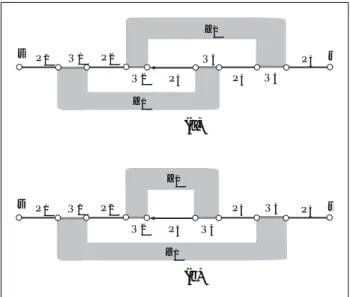
(5) Vol.2011-AL-137 No.5 2011/11/18. IPSJ SIG Technical Report. zero-edges and connects two vertices in Z, this contradicts Lemma 3. Therefore r = 2 holds.. Proof. (i) Let Z be an arching zero-component, which has exactly two zerosubpaths by Lemma 5(ii). If the path P 0 surrounded by Z has no zero-subpath of another arching zero-component, then all the positive-edges in P 0 are backward edges, and P 0 connects two vertices in the same zero-component, contradicting Lemma 3. Hence P has another arching zero-component. Next assume that there are two arching zero-components which do not cross each other. Hence P is denoted by P = [P1 Q1 P2 Q2 P3 Q3 P4 Q4 P5 ] such that Q1 and Q4 are the zero-subpaths of an arching zero-component Z1 and Q2 and Q3 are those of another Z2 (see Fig.2(b)). By Lemma 5 applied to Z2 , there is no backward edge in the subpaths P2 and P4 along P from s to t. Hence the subgraph consisting of P2 , Z2 and P4 contains a pure path P 0 from the last vertex in Q1 to the first vertex of Q4 such that no backward edge appears along P 0 . Since P 0 connects two vertices in the same zero-component Z1 , this contradicts Lemma 3. Therefore any two arching zero-components cross each other. (ii) By definition, a folding st-path P is given as an alternating sequence P1 Q1 · · · Q2q P2q+1 of subpaths Pi and nontrivial zero-subpaths Qi such that all positive edges in each Pi have the same direction, either forward or backward (Pi may contain trivial zero-subpaths). By definition there is at least one subpath Pj which consists of only backward edges and trivial zero-subpaths. Assume that P has three arching zero-components. Then zero-subpaths Qj−1 and Qj must be contained in distinct arching zero-components, say Z1 and Z2 , since otherwise the one containing both zero-subpaths cannot cross any other one, contradicting (i). Again by (i), Z1 and Z2 cross each other. The third zerocomponent Z3 needs to surround Pj and cross both Z1 and Z2 by (i) of this lemma and Lemma 2 (i). For simplicity, we here consider the case of r = 3 first. Hence the zero-subpaths of Z1 , Z2 and Z3 must appear in the order of Q1 (Z1 ), Q1 (Z3 ), Q1 (Z2 ), Q2 (Z1 ), Q2 (Z3 ), Q2 (Z2 ) along P , as shown in Fig.3(b). For other zero-components, we can assume without loss of generality that their first zero-subpaths appear in the order of Q1 (Z3 ), Q1 (Z4 ), . . . , Q1 (Zq ) along P . Since each Zi crosses all Z1 , Z2 , . . . , Zj−1 , we see that all the zero-subpaths of arching zero-components satisfy the ordering in (i).. For an st-path P , we say that two arching zero-components Z1 , Z2 ∈ Z with ρ(Z1 ) = ρ(Z2 ) = 2 cross each other if for each i = 1, 2, the subpath between Q1 (Zi ) and Q2 (Zi ) contains a zero-subpath of Zj , j ∈ {1, 2} − {i} (see Fig.2(a)).. Z2. s. P1. Q1. P2. Q3 Q2. P3. P4. Q4. P4. Q4. P5. t. P5. t. Z1. (a). Z2. s. P1. Q1. P2 Q2. Q3. P3 Z1. (b) Fig. 2. Illustration of two zero-components Z1 and Z2 : (a) crossing Z1 and Z2 ; (b) noncrossing Z1 and Z2 .. Lemma 6. Let P be a folding st-path that has the shortest length among all folding st-paths. Then (i) If P has an arching zero-component, then it has another arching zerocomponent, and they cross each other. (ii) Assume that P has q ≥ 3 arching zero-components, then they can be indexed as Zi , i = 1, 2, . . . , q so that their zero-subpaths appear in the order Q1 (Z1 ), Q1 (Z3 ), Q1 (Z4 ), . . . , Q1 (Zq ), Q1 (Z2 ), Q2 (Z1 ), Q2 (Z3 ), Q2 (Z4 ), . . . , Q2 (Zq ), Q2 (Z2 ) along P (see Fig.3(a)).. Let us call the zero-components Z1 and Z2 in the lemma the source and sink. 5. ⓒ 2011 Information Processing Society of Japan.
(6) Vol.2011-AL-137 No.5 2011/11/18. IPSJ SIG Technical Report. and s2 s3 -path Ps2 s3 ; In the subgraph Gt of (V, E0 ∪ E1 ) induced by the vertices v with d(s, t1 ; G) ≤ d(s, v; G), there are two vertex-disjoint paths, t1 t2 -path Pt1 t2 and t3 t-path Pt3 t ; and (iii) In the subgraph G0 of (V, E0 ∪ E1 ) induced by the vertex set {s1 , s2 , s3 } ∪ {v ∈ V | d(s, s1 ; G) < d(s, v; G) < d(s, t1 ; G)} ∪ {t1 , t2 , t3 }, there are three vertex-disjoint paths, si ti -paths Psi ti , i = 1, 2, 3 (we treat Gs , Gt and G0 as mixed graphs by regarding each positive edge {u, v} with d(s, u; G) < d(s, v; G) as an arc (u, v)). Note that the three graphs Gs , Gt and G0 are vertex-disjoint except for the six vertices. We call any set of six vertices s1 , s2 , s3 ∈ V (Z) (possibly s2 = s3 ) and t1 , t2 , t3 ∈ V (Z 0 ) (possibly t1 = t3 ) satisfying the above conditions (i)-(iii) feasible to (Z, Z 0 ). (ii). Zq. ... .. components of the folding st-path P . See Fig.3(c), which illustrates the same configuration of all arching zero-components Z1 , . . . , Zr in Fig.3(a).. Z4 Z3 s. Q1(Z1) P2. Pq Q1(Z2) Q2(Z1) Pq+2 Pq+3 P2q-1 P2q Q2(Z2) t P2q+1 Pq+1 Q2(Z3) Q2(Z4) Q2(Zq). P4. P3. Q1(Z3) Q1(Z4) Q1(Zq). P1. Z2. Z1 (a). Z3 s. Q1(Z1). Q2(Z2). Q1(Z2) Q2(Z1) Q1(Z3). t. Q2(Z3). Lemma 7. There is a folding st-path with source and sink components Z, Z 0 ∈ Z if and only if there is a feasible set of vertices s1 , s2 , s3 ∈ V (Z) and t1 , t2 , t3 ∈ V (Z 0 ).. Z2. Z1 (b). Z=Z1. s1 P2. P1. Zq Z3 P Z4 P4 3 Pq. s3. t3. Pq+2. s s2. Gs. Z’=Z2. t1. .... Pq+3. P2q-1. Pq+1 G’. P2q. Proof. We have observed the “only if” part. We show the “if” part. Given a feasible set of six vertices and disjoint paths in (i)-(iii), a folding st-path P can be obtained as the concatenation. P2q+1 t. t2. Gt. (c). Fig. 3. Pss1 Ps1 t1 Pt1 t2 Ps2 t2 Ps2 s3 Ps3 t3 Pt3 t ,. (a) Crossing r arching zero-components; (b) crossing three zero-components; (c) disjoint-path problem instances (Gs , {(s, s1 ), (s2 , s3 )}), (Gt , {(t1 , t2 ), (t3 , t)}), and (G0 , {(s1 , t1 ), (s2 , t2 ), (s3 , t3 )}).. where Ps2 t2 denotes the t2 s2 -path obtained from Ps2 t2 by reversing the direction. Note that the length of P (if any) is always given by w(P ) = d(s, t; G) + 2d(s, t1 ; G) − 2d(s, s1 ; G), indicating that P is a shortest one with the specified source and sink components Z and Z 0 . The resulting path P may pass though arching zero-components in a different way from the configuration in Lemma 5(ii) (for example, an arching zero-component may have one of its zero-subpaths in Ps2 t2 ). However, it is always a folding st-path with the source and sink components Z and Z 0 .. We now show how to find a shortest folding st-path with specified source and sink components Z, Z 0 ∈ Z. Given a shortest folding st-path P , which admits the structure in Lemma 6(ii), we let s1 , s2 and s3 be the initial end points of P2 , Pq+2 and Pq+1 and t1 , t2 and t3 be the last end points of Pq , Pq+1 and P2q , as shown in Fig.3(b). Then these six vertices s1 , . . . , t3 satisfy the following conditions: (i) In the subgraph Gs of (V, E0 ∪ E1 ) induced by the vertices v with d(s, v; G) ≤ d(s, s1 ; G), there are two vertex-disjoint path, ss1 -path Pss1. For each choice of such six vertices, we can determine whether such disjoint paths in (i)-(iii) exist or not in polynomial time by using Theorem 1 with k ≤ 3. Since the total number of all possible choices of source and sink components and. 6. ⓒ 2011 Information Processing Society of Japan.
(7) Vol.2011-AL-137 No.5 2011/11/18. IPSJ SIG Technical Report. six vertices in them is O(n6 ), we can find a shortest folding st-path (if any) in polynomial time. The algorithm based on the proof of Lemma 7 is described as follows.. A natural question in this line would be whether finding an st-path with the strictly third shortest length can be again reduced to the k vertex-disjoint paths problem with a fixed k.. Algorithm Shortest-Folding-Paths Input: The graph (V, E0 ∪ E1 ) for an undirected graph G = (V, E) with a nonnegative edge weight w, and two vertices s, t ∈ V . Output: A shortest folding st-path in G (if exists). for each ordered pair of zero-components Z, Z 0 ∈ Z do if there is a feasible set of six vertices s1 , s2 , s3 ∈ V (Z) and t1 , t2 , t3 ∈ V (Z 0 ) then µ(Z, Z 0 ) := d(s, t; G) + 2d(s, t1 ; G) − 2d(s, s1 ; G); Let Pss1 and Ps2 s3 be vertex-disjoint ss1 -path and s2 s3 -path in Gs in (i); Let Pt1 t2 and Pt3 t be vertex-disjoint t1 t2 -path and t3 t-path in Gt in (ii); Let Psi ti , i = 1, 2, 3 be vertex-disjoint si ti -paths in G0 in (iii); Let P(Z,Z 0 ) := [Pss1 Ps1 t1 Pt1 t2 Ps2 t2 Ps2 s3 Ps3 t3 Pt3 t ]; else µ(Z, Z 0 ) := ∞ endif endfor; (Z ∗ , Z ∗∗ ) := argmin{µ(Z, Z 0 ) | Z, Z 0 ∈ Z}; Output P(Z ∗ ,Z ∗∗ ) if µ(Z ∗ , Z ∗∗ ) < ∞, or report that G has no folding st-path otherwise.. References 1) Barman, S.C., Mondal, S., and Pal, M.: An efficient algorithm to find nextto-shortest path on trapezoid graphs, Adv. Appl. Math. Anal. 2, 97–107 (2007). 2) Eppstein, D.: Finding the k shortest paths, SIAM J. Comput. 28, 652–673 (1998). 3) Fortune, S., Hopcroft J. E., and Wyllie, J.: The directed subgraph homeomorphism problem, Theoret. Comput. Sci. 10, 111–121 (1980). 4) Katoh, N., Ibaraki, T., and Mine, H.: An efficient algorithm for K shortest simple paths, Vol. 10, No. 2, pp. 287–302 (1982). 5) Kao, K.-H., Chang, J.-M., Wang, Y.-L., and Juan, J. S.-T.: A quadratic algorithm for finding next-to-shortest paths in graphs, Algorithmica 61, 402– 418 (2010). 6) Krasikov, I., and Noble, S. D.: Finding next-to-shortest paths in a graph, Inf. Process. Lett. 92, 117–119 (2004). 7) Lalgudi, K. N., and Papaefthymiou, M. C.: Computing strictly-second shortest paths, Inf. Process. Lett. 63, 177–181 (1997). 8) Lalgudi, K. N., Papaefthymiou, M. C., and Potkonjak, M.: Optimizing systems for effective block-processing, ACM Trans. on Design Automation of Electronic Systems 5, 604–630 (2000). 9) Li, S., Sun, G., and Chen, G.: Improved algorithm for finding next-toshortest paths, Inf. Process. Lett. 99, 192–194 (2006). 10) Mondal, S., and Pal, M.: A sequential algorithm to solve next-to-shortest path problem on circular-arc graphs, J. Phys. Sci. 10, 201–217 (2006). 11) Robertson, N., and Seymour, P. D.: Graph minors. XIII. the disjoint paths problem, J. Combinatorial Theory, Series B 63, 65–110 (1995). 12) Schrijver, A.: Combinatorial Optimization, Polyhedra and Efficiency, Springer-Verlag, Berlin (2003). 13) Wu, B.-Y.: A simpler and more efficient algorithm for the next-to-shortest. From the arguments in this and previous subsections, we finally obtain the next result. Theorem 8. The next-to-shortest path problem in undirected graphs with nonnegative edge weights can be solved in polynomial time. 4. Concluding Remarks In this paper, we showed that the next-to-shortest path problem in undirected graphs with nonnegative edge weights can be solved by reducing the problem to the k vertex-disjoint paths problem in acyclic mixed graphs with a fixed k ≤ 3.. 7. ⓒ 2011 Information Processing Society of Japan.
(8) Vol.2011-AL-137 No.5 2011/11/18. IPSJ SIG Technical Report. path problem, W. Wu and O. Daescu (Eds.): COCOA 2010, Part II, LNCS 6509, 219–227 (2010). 14) Yen, J.-Y.: Finding the K shortest loopless paths in a network, Manag. Sci. 17, 712–716 (1971). 15) Zhang, C., Nagamochi. H.: A polynomial-time algorithm for the next-toshortest path in undirected graphs with nonnegative weights, Technical report 2011-12, Graduate School of Informatics, Kyoto-university (2011).. 8. ⓒ 2011 Information Processing Society of Japan.
(9)
図
![Fig. 1 Illustration of a zero-component Z for a pure st-path P = [P 1 Q 1 P 2 · · · Q r P r+1 ], where each Q i is a zero-subpath of Z.](https://thumb-ap.123doks.com/thumbv2/123deta/6237529.1601090/4.1262.650.1145.127.365/fig-illustration-zero-component-pure-path-zero-subpath.webp)
関連したドキュメント
In a previous paper [1] we have shown that the Steiner tree problem for 3 points with one point being constrained on a straight line, referred to as two-point-and-one-line Steiner
In [4] it was shown that for an undirected graph with n nodes and m (undirected) edges, more than 2m - n chips guarantee that the game is infinite; fewer than m chips guarantee that
For example, random geometric graphs are formed by randomly assign- ing points in a Euclidean space to vertices and then adding edges deterministically between vertices when
We present sufficient conditions for the existence of solutions to Neu- mann and periodic boundary-value problems for some class of quasilinear ordinary differential equations.. We
Using the multi-scale convergence method, we derive a homogenization result whose limit problem is defined on a fixed domain and is of the same type as the problem with
The next lemma implies that the final bound in (2.4) will not be helpful if non- negative weight matrices are used for graphs that have small maximum independent sets and vertices
Based on properties of vector fields, we prove Hardy inequalities with remainder terms in the Heisenberg group and a compact embedding in weighted Sobolev spaces.. The best constants
[Mag3] , Painlev´ e-type differential equations for the recurrence coefficients of semi- classical orthogonal polynomials, J. Zaslavsky , Asymptotic expansions of ratios of
