北 陸 大 学 紀 要 第38号(2014年12月)抜刷
ISSN 2186 - 3989
北陸大学紀要 第 38 号(2014) pp. 51 - 80 [原著論文]
The Interface between Culture and Mind:
A Systemic Functional Account of Nominality
Hiroshi Funamoto
*Received December 8, 2014
Abstract
Naming of experience is a basic capacity of our mind. This involves the process of conceptualizing the different types of awareness. A ‘concept’ reflects the orderliness of relations among various things, including physical objects, abstract ideas, facts, actions or whatever, which are acknowledged as such in a given culture. Nominality is such a potentiality of language that enables us to verbalize the range of concepts in a nominal expression as a meaningful unit. The present study is the first attempt of the author to give an account of the treatment of this culturally-based aspect of nominality in Japanese.
1
Introduction
Nominality is one of the powerful resources which enrich the expressivity of a language to realize a range of functions in the nominal expressions. The purpose of this paper is to demonstrate how this key notion is implemented in the socio-cognitive model of language and its use that I am trying to develop to describe the grammar for Japanese.
However, the treatment of nominality for Japanese is almost an unprecedented area of study in the tradition of Systemic Functional Linguistics (SFL), which is used as the core theoretical framework for the present study. As we shall see in the unfolding sections, it is a challenging task to investigate how we utilize the expressive power of ‘naming’ the concepts by employing a range of language-specific resources for generating Japanese texts.
This paper consists of two parts. Section 3 presents the overall picture of the model to be used here, which I refer to as the cyclic cog-wheel model. This is intended to show how the cultural factors impinge on the formation of the awareness of the ‘orderliness of relations’ in our mind. Section 4 illustrates how this model works in dealing with nominality, and tries to make a systemic functional account of the lexicogrammatical structure of the nominal expressions in Japanese.
*未来創造学部 School of Future Learning
Preceding these two parts, however, Section 2 provides the historical background, which explains why I take the position that is put into practice throughout this paper.
2
Background
A fundamental principle that has served as the backbone of the rise of modern science in Japan is, among other things, to ‘learn from the West’. New ideas learned from such an example to follow in a range of disciplines are generally acknowledged as ‘imported art and science (yunyū gakumon 輸入 学問)’. Alternatively, it would be appropriate to look at the phenomenon as involving at least two steps of (i) ‘emulation (moho 模倣)’ (i.e. the step of one-way absorption of received knowledge) and (ii) ‘assimilation (juyō 受容)’ (i.e. the step of reconciliation between received knowledge and intrinsic knowledge)1
. These concepts usually refer to advanced science that was originally developed in the Western academia. This trend goes back to the climactic era of so-called ‘cultural enlightenment’ in Japan in the late 19th century. Indeed, innumerable Japanese scholars working in almost all areas of study have made tremendous efforts to translate into Japanese the seminal books and articles of the key thinkers in the then leading countries of science and technology — i.e. mainly in the Western Europe and North American —, which played a decisively important role in civilizing Japan.
Linguistics is no exception to the passing of the era. Early Meiji period was gaining momentum to refurbish the old-fashioned grammar of Japanese in the way that an alternative grammar is modelled on the ideas as developed in the grammars of European languages, especially Latin, Greek, Dutch, Portuguese, French, German and English2
. In other words, such a modern Japanese grammar is characterized as the re-Japanized version of the normative grammars of European languages, as typified by Lindley Murray’s English Grammar (1795)3
. This is generally referred to as a ‘Western style grammar (yōshiki bunten 洋式文典)’. In a writing on Japanese grammar, Yoshikado Tanaka’s statement in the editorial notes is worthy of remark:
編輯の順序は、西洋諸国の規矩に習ひて、詞品を多種に分つと雖も、其実は、我国先彦の論に 従て、毫も国語の法則を變することなし。
(Although, following the norms of Western countries, the chapters of the book are compiled on the basis of different word classes, each of them in fact fits the body of our predecessors’ view on the patterns of Japanese without the lest leftover. [Translation mine]) (Tanaka 1874)
Obviously the major concern in such an attempt has dedicated itself to the classification of words in terms of the traditional characterization of ‘classes’ which are recognized for English and other European languages, as Tanaka’s treatment of seven ‘word classes’ for Japanese typically illustrates.
3
affects the view on the essential nature of language. This is the prioritization of speech over writing, which is demonstrated in incorporating two strands of linguistic ‘forms’4
.
On the one hand, the units of language are introduced as a kind of the ‘consist of ’ relationship between elements of structure. That is, a sentence is analyzed in terms of the multi-layered structure, comprising the abstract units of phrases, words, morphemes, and syllables. And entities that expound the segmented elements in each of these units are essentially embodied by the ‘phonemic forms’. The question is: ‘How do we establish the presence of such theoretical concepts for a particular language?’ For example, the concept of ‘constituency’ in the ‘consists of ’ relationship between units is the basis of Halliday’s ‘total accountability’ — the principle that every item has to be accounted for at all ‘ranks’. But, as we shall see in Section 4, we shall find it problematic to impose this ‘consists of ’ relationship on the syntactic structure of Japanese clauses. On the other hand, ‘mood’ is incorporated into the patterns of verbal conjugations in Japanese in the early stage of the westernization of Japanese grammar. For instance, Tanaka (1874) applies the orthodox classification of ‘mood types’ to the various patterns of agglutination between a conjugating predicate and some dependent items (i.e. those that are so-called ‘sentence-final particles (shūjoshi 終助詞)’ and ‘auxiliary verbs (jodōshi 助動詞)’), which typically signify one’s certain attitude toward (i) the proposition (such as ‘certainty’, ‘prediction’ or ‘ability’) and (ii) the addressee (such as ‘giving’ or ‘requesting’ information, or ‘prompting’ action) in spoken discourse (see also Tanaka 1874).
A notable fact is that, amongst various views, the ‘re-Japanized Western style grammar’ is, by and large, accepted as the basic model of the school grammar of Japanese ever since Meiji era. This means that Japanese grammar taught at school tends to be viewed as the set of prescribed rules for grammatical sentences that are essentially designed to work in English sentences. And it has been a compulsory subject at elementary and secondary schools for more than a century as the standardized way of understanding how the Japanese language — whether it is spoken and written — is structured for use5
. Indeed the immense influence of the education of Japanese in this way has been anchored in our conscious or unconscious assumptions that the coined terms translated from such extraneous notions as ‘subject (shugo 主語)’, ‘phrase (ku 句)’ and other grammatical categories including ‘case (kaku 格)’, ‘tense (jisei 時制)’, ‘person (ninshō 人称)’, ‘voice (tai 態)’, ‘mood (hō 法)’ and ‘modality (hōsei 法性)’ — as well as the parts of speech mentioned above — are well-grounded, and so fossilized in the description of the relevant parts of Japanese. Specificity associated with the real nature of Japanese will then be handled by some minor adaptation of these ideas (e.g. the omission of ‘gender’ and ‘number’ from the system for nouns).
Under the circumstances, our prevalent assumption of describing Japanese grammar in terms of the grammar for another language, such as English, is deeply rooted in the Western-oriented way of pursuing the scientific study of language. In fact, the output of this rooted convention does not go a
2
Preceding these two parts, however, Section 2 provides the historical background, which explains why I take the position that is put into practice throughout this paper.
2
Background
A fundamental principle that has served as the backbone of the rise of modern science in Japan is, among other things, to ‘learn from the West’. New ideas learned from such an example to follow in a range of disciplines are generally acknowledged as ‘imported art and science (yunyū gakumon 輸入 学問)’. Alternatively, it would be appropriate to look at the phenomenon as involving at least two steps of (i) ‘emulation (moho 模倣)’ (i.e. the step of one-way absorption of received knowledge) and (ii) ‘assimilation (juyō 受容)’ (i.e. the step of reconciliation between received knowledge and intrinsic knowledge)1
. These concepts usually refer to advanced science that was originally developed in the Western academia. This trend goes back to the climactic era of so-called ‘cultural enlightenment’ in Japan in the late 19th century. Indeed, innumerable Japanese scholars working in almost all areas of study have made tremendous efforts to translate into Japanese the seminal books and articles of the key thinkers in the then leading countries of science and technology — i.e. mainly in the Western Europe and North American —, which played a decisively important role in civilizing Japan.
Linguistics is no exception to the passing of the era. Early Meiji period was gaining momentum to refurbish the old-fashioned grammar of Japanese in the way that an alternative grammar is modelled on the ideas as developed in the grammars of European languages, especially Latin, Greek, Dutch, Portuguese, French, German and English2
. In other words, such a modern Japanese grammar is characterized as the re-Japanized version of the normative grammars of European languages, as typified by Lindley Murray’s English Grammar (1795)3
. This is generally referred to as a ‘Western style grammar (yōshiki bunten 洋式文典)’. In a writing on Japanese grammar, Yoshikado Tanaka’s statement in the editorial notes is worthy of remark:
編輯の順序は、西洋諸国の規矩に習ひて、詞品を多種に分つと雖も、其実は、我国先彦の論に 従て、毫も国語の法則を變することなし。
(Although, following the norms of Western countries, the chapters of the book are compiled on the basis of different word classes, each of them in fact fits the body of our predecessors’ view on the patterns of Japanese without the lest leftover. [Translation mine]) (Tanaka 1874)
Obviously the major concern in such an attempt has dedicated itself to the classification of words in terms of the traditional characterization of ‘classes’ which are recognized for English and other European languages, as Tanaka’s treatment of seven ‘word classes’ for Japanese typically illustrates.
Through the acceptance of this ‘Western style grammar’, however, there is another feature that
single step out of mere emulation of the description of English grammar in any tradition of linguistics. This is mainly because, unlike other disciplines, it is very likely that English used as the medium in working on linguistics is the object of study in itself. And the attitude of ‘learning from the West’ is crystalized in our linguistic habits throughout our activities in the pursuit of linguistics. The logical consequence of the repeated practice of such a Western style activities in describing Japanese grammar turns out to be the development of an ‘unnatural’ grammar, the prominent feature of which involves a lot of anomalies with respect to the normative English grammar. So it tends to manifest itself as a uniquely idiosyncratic one in this sense. Here is the question to be addressed: ‘Is this kind of argumentation scientific at all?’
To summarize, the education policy of Japan has been realized to meet our desire for catching up with the forefront science and technology in the West since Meiji era. In linguistics, it had not been long before the ideas in Western style grammar were, by its nature, developed from the means of mastering English skills for practical uses to the object of study. The intention of this shift is clearly to apply the well-established concepts to Japanese grammar, the outcome of which is characterized as what I refer to as ‘re-Japanized version of the normative grammars of European languages’. One of the problems of this attempt is that such grammar is elaborated to fill the gap between phenomena observed in the uses of Japanese and normative English grammar at the expense of explaining the phenomena themselves in their own terms.
3
Modelling culture, mind and language
3.1 Theory and description
At the starting point of the scientific study of language lies the distinction between THEORY and
DESCRIPTION. As I mentioned above, the description of a language in the 21st century should be constructed on a faithful analysis of the reality of the systems of present-day Japanese and its use in its own terms. Perhaps this is the most neglected part of work in linguistics so far. But this does not mean that the findings of the grammar in this way can only be valued in isolation from those of other languages. Besides, the tenets that push forward this direction provide a basis of comparing the different descriptions of two (or more) languages on the coherent, universal principles.
Note, however, that it will not be valid and feasible to restore a Japanese grammar which was ‘intact’ before 1860s, because the traits of Japanese in the earlier period are obsolete in terms of grammar, vocabulary, and other conventions of their use. Assuming that a language changes as the society and the lifestyle of its member change, our capacity to produce the grammatical structure of a meaningful expression should be accounted for by incorporating non-linguistic factors into the overall
5
model of language and its use, as I shall demonstrate in Section 3. The present-day Japanese has naturally evolved into what it is now, so that it is equipped with the systems that accommodate themselves with the options that make sense in the relevant social settings.
What is the implication of the issue raised from a quick note in Section 2 — about the basic stance of treating Japanese grammar as an extension of English grammar? One possible direction of linguistics in the 21st century will be that sweeping changes need to be made in the description of individual languages, so that the pieces of evidence from these fine descriptions of different languages will be used as the resources for developing a framework of linguistic typology. So the primary task for this goal is, amongst others, to discount various assumptions on which ‘Western style grammar’ is based in the description of a language.
3.2 The socio-cognitive aspect of the model
Let us begin by assuming that society is a unit ― or, perhaps, more specifically the multilayered realm of units ― in which culture develops and prevails. The substantial reality of culture is the ubiquitous macrocosm of the possible relations between all beings. A ‘situation’ is the series of instances of these relations, each of which may cause the subsequent situation. The immediate situations, in which we take up our stand, are the only interface between our mind and a culture. Thus, a situation is necessary condition for our behaviour, including using a language, in accordance with the culture, and, at the same time, new cultural values are created by reducing our behaviour.
3.2.1
Situation and culture
Situation, by its nature, involves us in the circulative effects of all creative possibilities AND created matters. It is always in the protean changes of the universe. To enumerate some typical examples of the created matters, they include (i) nature, i.e. (a) natural objects, such as stones, mountains, rivers, trees, oxygen, etc., and (b) natural phenomena, such as raining, temperature, earthquake, seasons, light-dark change, etc.; (ii) creature, or various living things including, of course, human beings; and (iii) artefacts, such as (a) physical objects (e.g. buildings, transportation, tools, mass communication media, etc.), (b) institutional arrangements (e.g. the law, the rights, educations, and the responsibilities, etc.), and (c) the various kinds of things in the imaginative world (fantasy, fiction, dream, lie, etc.).
On the other hand, creative possibilities are sustained by the orderliness of relations among various matters, and this kind of orderliness is, I maintain, the essential nature of culture that pervades throughout the social units; this holds true not only between people in some institutional
4
single step out of mere emulation of the description of English grammar in any tradition of linguistics. This is mainly because, unlike other disciplines, it is very likely that English used as the medium in working on linguistics is the object of study in itself. And the attitude of ‘learning from the West’ is crystalized in our linguistic habits throughout our activities in the pursuit of linguistics. The logical consequence of the repeated practice of such a Western style activities in describing Japanese grammar turns out to be the development of an ‘unnatural’ grammar, the prominent feature of which involves a lot of anomalies with respect to the normative English grammar. So it tends to manifest itself as a uniquely idiosyncratic one in this sense. Here is the question to be addressed: ‘Is this kind of argumentation scientific at all?’
To summarize, the education policy of Japan has been realized to meet our desire for catching up with the forefront science and technology in the West since Meiji era. In linguistics, it had not been long before the ideas in Western style grammar were, by its nature, developed from the means of mastering English skills for practical uses to the object of study. The intention of this shift is clearly to apply the well-established concepts to Japanese grammar, the outcome of which is characterized as what I refer to as ‘re-Japanized version of the normative grammars of European languages’. One of the problems of this attempt is that such grammar is elaborated to fill the gap between phenomena observed in the uses of Japanese and normative English grammar at the expense of explaining the phenomena themselves in their own terms.
3
Modelling culture, mind and language
3.1 Theory and description
At the starting point of the scientific study of language lies the distinction between THEORY and
DESCRIPTION. As I mentioned above, the description of a language in the 21st century should be constructed on a faithful analysis of the reality of the systems of present-day Japanese and its use in its own terms. Perhaps this is the most neglected part of work in linguistics so far. But this does not mean that the findings of the grammar in this way can only be valued in isolation from those of other languages. Besides, the tenets that push forward this direction provide a basis of comparing the different descriptions of two (or more) languages on the coherent, universal principles.
Note, however, that it will not be valid and feasible to restore a Japanese grammar which was ‘intact’ before 1860s, because the traits of Japanese in the earlier period are obsolete in terms of grammar, vocabulary, and other conventions of their use. Assuming that a language changes as the society and the lifestyle of its member change, our capacity to produce the grammatical structure of a meaningful expression should be accounted for by incorporating non-linguistic factors into the overall
realm, but also other created matters mentioned above. Thus, culture is — tentatively — defined here as the ubiquitous orderliness of relations that exists in the society. As we shall see in the next subsection, there are different types of orderliness of relations, and they are the main factors for the formation of our mind, which I refer to specifically as the types of ‘awareness’, or ‘shiki 識’ in Japanese.
3.2.2
The eight types of awareness
I recognize eight types of awareness. These are (i) ‘affair (monogoto 物事)’, (ii) ‘locale (shozai 所 在)’, (iii) ‘trait (zou 像)’, (iv) ‘affect (jou 情)’, (v) ‘associate (en 縁)’, (vi) ‘scale (sokushaku 測尺)’ (vii) ‘alignment (ben 弁)’, and (viii) ‘connection (yoshi 由)’. Figure 1 shows these types and the names of their typical subtypes of relations.
As I mentioned, each of these types of awareness is the creative possibilities in a society. We recognize ― consciously or unconsciously ― them through the exposure of ourselves to the situation. The awareness through the experiences of our continuous commitment to the situation forms the ‘culturally-based’ mindset. But here we need to ask how these types of awareness in our mind work. In what follows, for want of space, I shall consider this aspect by focusing on some cases that we are likely to encounter in our daily life.
Figure 1: The eight types of awareness
AWARENESS
事物 AFFAIR 慣習 customs 作法 manners 道具 tools 現象 phenomena 弁 ALIGN MEN T 定石 s t a b ilit y まくら set epi thet 係り rel evance 縁 ASSOCIATE 内と外 insider/outsider 本音と建前hon’ne and tatemae 義理 moral obligation 敬いr es pe ct 像 TRAIT 趣 a u r a わび s im p lic it y さび tranqui l i ty 粋 smartness 性 nature7
When we generate an action on purpose in a particular situation, the state of our mind is usually actively inclined toward our concern, which is associated with a specific type of awareness. For instance, when you are walking on a street alone, your attention will be paid for (i) moving your body and (ii) the place on which you can step, i.e. the pathway. Other things, which should also entre your field of vision, hardly have some relevance to your concern at hand, so that the awareness of the properties of these ‘background’ things is inactivated. This implies that the conscious state of our mind is easy to activate some type(s) of awareness of relations instead of others. In this case, the material aspects of ‘affair’ ― (i) a physical phenomenon of ‘movement’ of your body and (ii) a constructed tool for ‘transportation’, i.e. the street ― are more important than other types of awareness. In other words, ‘unbalancing’ among the types of awareness is the typical characteristic of our state of conscious mind. In this sense, the ‘conscious mind’ involves the reaction to the situation in a way of causing unbalanced awareness, the state of which is generally referred to as ‘recognition (ninshiki 認識)’.
However, it is significant to note that the process of recognition is not the operation of choosing one of the types of awareness. Indeed, the active state of consciousness incorporates the very complex procedure of activating / inactivating of features in various relations in each of the awareness types.
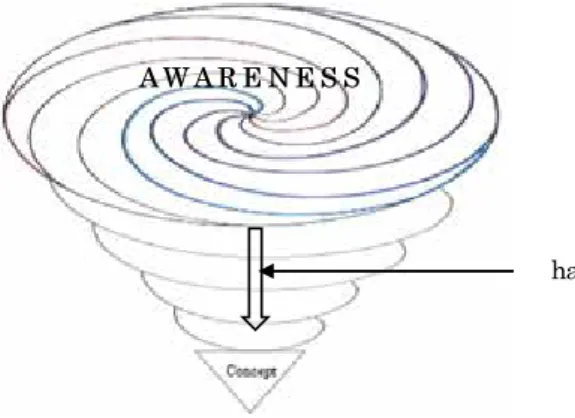
Figure 2: Concept as the instance of awareness through harmonization
For instance, if you are in a situation where a pleasant thing happens, a certain type of emotion, such as ‘joy’, will saliently come to mind. However, in the first place, in order to react to the thing, you need to know what is pleasant and what is not. So you will simultaneously (i) recognize another thing ― a person, a thing, an event or whatever ― that has something to do with the pleasant thing, (ii) see the property of the pleasant thing in relation to your standing (e.g. the parent whose child wins the first prize in a big competition), (iii) estimate the quality and extent of the emotion, and (iv) relate it with the preceding and/or subsequent context of situation. A ‘concept’ is the output of the set of ‘what are recognized’ in the relevant areas of awareness. The operation that interfaces between a concept
harmonize A W A R E N E S S
6
realm, but also other created matters mentioned above. Thus, culture is — tentatively — defined here as the ubiquitous orderliness of relations that exists in the society. As we shall see in the next subsection, there are different types of orderliness of relations, and they are the main factors for the formation of our mind, which I refer to specifically as the types of ‘awareness’, or ‘shiki 識’ in Japanese.
3.2.2
The eight types of awareness
I recognize eight types of awareness. These are (i) ‘affair (monogoto 物事)’, (ii) ‘locale (shozai 所 在)’, (iii) ‘trait (zou 像)’, (iv) ‘affect (jou 情)’, (v) ‘associate (en 縁)’, (vi) ‘scale (sokushaku 測尺)’ (vii) ‘alignment (ben 弁)’, and (viii) ‘connection (yoshi 由)’. Figure 1 shows these types and the names of their typical subtypes of relations.
As I mentioned, each of these types of awareness is the creative possibilities in a society. We recognize ― consciously or unconsciously ― them through the exposure of ourselves to the situation. The awareness through the experiences of our continuous commitment to the situation forms the ‘culturally-based’ mindset. But here we need to ask how these types of awareness in our mind work. In what follows, for want of space, I shall consider this aspect by focusing on some cases that we are likely to encounter in our daily life.
Figure 1: The eight types of awareness
AWARENESS
事物 AFFAIR 慣習 customs 作法 manners 道具 tools 現象 phenomena 弁 ALIGN MEN T 定石 s t a b ilit y まくら set epi thet 係り rel evance 縁 ASSOCIATE 内と外 insider/outsider 本音と建前hon’ne and tatemae 義理 moral obligation 敬いr es pe ct 像 TRAIT 趣 a u r a わび s im p lic it y さび tranqui l i ty 粋 smartness 性 nature 7(57)and awareness of all creative possibilities is termed ‘harmonization’, as illustrated in Figure 2. In the next section, we shall see that the way of forming the complex systems of meaning in a specific language is optimized to reflect the concepts in linguistic expressions. The key notion is, again, a kind of possible relation between meaningful features, yet in this component it is an exclusive relation between them.
3. 3
The theories of meaning
3.3.1
Belief in the actualizing power of verbalizing thoughts (
言霊思想)
It is not possible to say something which has no usable means (e.g. language, gesture, picture, music) to convey the ‘something’. Otherwise, the ‘something’ is merely ‘nothing’, and so simply ‘silence’. Language is, amongst various semiotic systems, the most basic faculty for achieving the ‘meaning-making’. In this sense, its system has to have the mutually dependent components of meaning and form. Therefore, it is reasonable to assume that the meanings which are dealt with in a linguistic component are those that are reflected in the forms of the text.
In describing the semantic system of a language, the question to be addressed is: ‘What is the factor of forming the meanings that have a validity of making sense in the relevant culture?’ In pursuing Japanese semantics, the important factor is, surprisingly, the reception of Chinese characters and the development of them into the Japanese-specific writing system, i.e. the kanji-kana system.
The introduction of Chinese characters ― together with the continental thoughts and technologies ― into the then Japanese society was the first enlightenment that evoked and deepened the innate culture of Japanese. The writing system enabled Japanese people not merely to use kanji and kana as a recording tool of information, but also to adapt the intellect of new ideas to their own cultural values. Besides, more importantly, from a linguistic point of view, it has created a new style of textuality in discourse, or a pattern of communication.Section 4.2 illustrates how the character-based resources of augmenting the complex systems for nominal expressions are integrated in the overall model of Japanese grammar.
The Japanese writing system is, then, not simply one of the mediums of communication, nor the symbols of transcribing the phonetic sounds of Japanese. Using kanji and kana should be seen as the active and direct commitment to enculturation in the society. Verbalism, or act of ‘wording’, is the act of engendering the thought as part of the actual situation. In fact the idea of such belief in the actualizing power of verbalizing a thought, ‘kotodamashiso 言霊思想’, is, as with ‘animism’, an aspect of the religious faith in ancient Japan.
9
Kotodamashiso itself is a primitive belief from ancient times in Japan, rather than presenting a particular category in the body of theory. However, this idea has some features that contribute to forming the basis of academic disciplines of humanities in Eastern academia. The important implication in this idea is that using a language is seen as an active, meaningful engagement in the social environment through the conceptualization of cultural awareness in the human mind.
3.3.2
Apoha theory
Notice that a concept is the instance of a conscious state of the unbalanced relations in cultural awareness. It manifests itself as a mode of intelligence which is recognized through one’s interaction with the situation where he or she is involved. At this stage, A CONCEPT IS NOT SUCH A THING THAT IS
ENCODED AS A CONVEYABLE FORM IN VERBAL COMMUNICATION.
Apoha theory, or the Buddhist theory of meaning, will be one of the approaches to an understanding of meaning of language. Kataoka (2012: 190) states:
仏教において、個々の牛に共通するものは、実在する牛性という普遍ではなく、他者の排除
anyāpoha、すなわち、非牛(馬等)の排除に他ならない。「牛」という語は、全ての牛に共通
する牛性や個々の牛ではなく、非牛の排除に限定されたものを表示する。
(In Buddhism, the common property of cattle is not the universality that resides in its being as cattle but the exclusion, anyāpoha, of others, i.e. the exclusion of ‘non-cattle’ (such as horse). The word ‘cattle’ does not refer to the common nature of cattle or individual cows and bulls, but to the one that can only be obtained from excluding ‘non-cattle’.)
I suggest that the notion of ‘exclusion in a meaningful relation’, the core notion of this theory, is useful in incorporating it to the overall model of language and its use that I shall use here. I assume that, metaphorically speaking, the system of meaning acts both as an acceptor of the orderliness of relations at a conceptual level and as the dynamic force to engender the concept through using a language in a context of situation. That is, the principle of meaning-making should include the process of articulating different kinds of orderliness of relations in a systematic way AT THE LEVEL OF MEANING.
3.3.3
Choice and systemic functional theory of meaning
The view on meaning as one that can be obtained from excluding others has much in common with the theory of meaning in Systemic Functional Linguistics (SFL), as developed by Halliday. Following Firth’s notion of ‘system’, Halliday regards meaning as the set of options in the paradigmatic relation. In SFL, however, the system is not a formalism that represents the state of mutual exclusivity
8
and awareness of all creative possibilities is termed ‘harmonization’, as illustrated in Figure 2. In the next section, we shall see that the way of forming the complex systems of meaning in a specific language is optimized to reflect the concepts in linguistic expressions. The key notion is, again, a kind of possible relation between meaningful features, yet in this component it is an exclusive relation between them.
3. 3
The theories of meaning
3.3.1
Belief in the actualizing power of verbalizing thoughts (
言霊思想)
It is not possible to say something which has no usable means (e.g. language, gesture, picture, music) to convey the ‘something’. Otherwise, the ‘something’ is merely ‘nothing’, and so simply ‘silence’. Language is, amongst various semiotic systems, the most basic faculty for achieving the ‘meaning-making’. In this sense, its system has to have the mutually dependent components of meaning and form. Therefore, it is reasonable to assume that the meanings which are dealt with in a linguistic component are those that are reflected in the forms of the text.
In describing the semantic system of a language, the question to be addressed is: ‘What is the factor of forming the meanings that have a validity of making sense in the relevant culture?’ In pursuing Japanese semantics, the important factor is, surprisingly, the reception of Chinese characters and the development of them into the Japanese-specific writing system, i.e. the kanji-kana system.
The introduction of Chinese characters ― together with the continental thoughts and technologies ― into the then Japanese society was the first enlightenment that evoked and deepened the innate culture of Japanese. The writing system enabled Japanese people not merely to use kanji and kana as a recording tool of information, but also to adapt the intellect of new ideas to their own cultural values. Besides, more importantly, from a linguistic point of view, it has created a new style of textuality in discourse, or a pattern of communication.Section 4.2 illustrates how the character-based resources of augmenting the complex systems for nominal expressions are integrated in the overall model of Japanese grammar.
The Japanese writing system is, then, not simply one of the mediums of communication, nor the symbols of transcribing the phonetic sounds of Japanese. Using kanji and kana should be seen as the active and direct commitment to enculturation in the society. Verbalism, or act of ‘wording’, is the act of engendering the thought as part of the actual situation. In fact the idea of such belief in the actualizing power of verbalizing a thought, ‘kotodamashiso 言霊思想’, is, as with ‘animism’, an aspect of the religious faith in ancient Japan.
between meanings. What characterizes SFL as a distinguished theory of language is the introduction of the concept of ‘choice’ to the systems of ‘meaning potential’ of language. At the level of human behaviour, choices in meaning are the vital part of our active engagement in the social activities mainly through using a language. So it is essentially generative rather than interpretive. Accordingly, SFL successfully integrates (i) the systems of the paradigmatic relations between meanings and (ii) the operation of ‘choice’ at the heart of the holistic model of language and its use.
The question is: ‘What is the fundamental principle of constructing valid choice systems in Japanese?’ The answer to this question may be found in Halliday’s insightful observation of the multifunctionality of language. Halliday recognizes four general functions, or ‘metafunctions’ of language, viz. the experiential, the logical, the interpersonal and the textual (the first two are subsumed with the general category of the idational). And simultaneous choices between meanings are made through the traversal of the vast networks of systems in these functional components.
I agree that multifunctionality is a universal nature of language, but should the universality here be applied to the kinds and the number of general functions, or areas of meaning, in a specific language? From a linguistic viewpoint, a possible criterion for delineating the areas of meaning will be the scope of the availability of linguistic devices that have a particular effect on our understanding and/or creating an incidence that takes on some distinctive value in the society.6
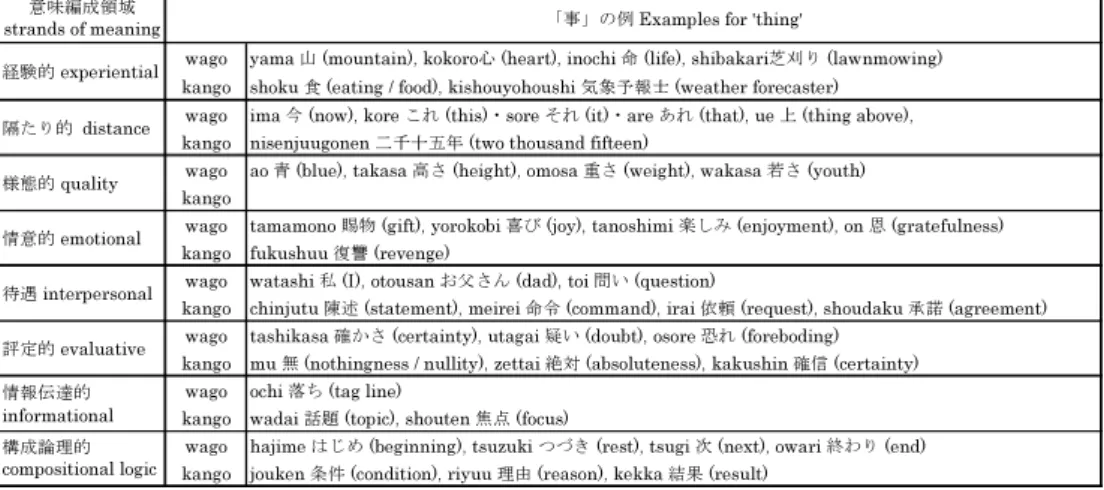
In exploring the treatment of ‘nominality’ in Japanese texts, let us tentatively acknowledge eight areas of meaning, which can be associated with eight types of awareness: the experiential 経験的, distance 隔たり的, quality様態的, emotional 情意的, interpersonal 待遇的,assessment 評定的, informational 情報伝達 的, compositional logic 構成論理的. It is necessary to emphasize here that these types of meanings are elaborated on the basis of the rather unsubstantiated criterion mentioned above, so they are presented as a tentative distinction between the major areas of meaning for Japanese. However, as we shall see in Section 4.3, it is found that each of them has its unique expressions of nominal meanings, and that the nominal expressions from the different areas of meaning exhibit particular behaviour to serve the relevant function in a text (as a clause typically does). At this point it may be useful to have a quick look at Table 2 in Section 4.3 in advance, which provides some representative examples of nominal expressions that are obtained for the eight strands of meaning.
3.3.4
Meaning and form: The Cardiff model of grammar
As Fawcett (2008: 63-64) rightly points out, a direction that is taken in the functional approach to the semantic description of a language pushes the system networks as ‘meaning potential’ in all strands of meaning towards the fully semanticized tier in the model of grammar. The Cardiff model of language and its use, as developed by Fawcett and other scholars, is currently the most advanced
11
grammar in SFL. Indeed, the present study is intended as an attempt to explore the possibility of implementing the Japanese grammar in the Cardiff version of SFL.
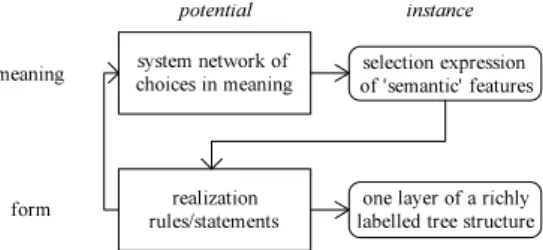
At the heart of the Cardiff model of language has a framework in place for the distinction between the semantic level and the syntactic level. In fact, the model provides the organic whole of relating four components, the concept that accommodates the ‘realization’ of meanings into the appropriate form of expression, i.e., the relationship between the two levels of ‘meaning’ and ‘form’. The other concept brings about an ‘instantiating’ relationship between the components of a potential and an instance at each level. Figure 1 provides a general picture of modelling the semiotic system, and also situates necessary theoretical concepts in SFL.
sy stem network of choices in meaning selection expression of ' semantic' features realization rules/statem ents
one lay er of a richly labelled tree structure potential instance
meaning
f orm
Figure 3: The main components grammar in the Cardiff model (based on Fawcett 2000: 36)
A prominent feature of this model — and the major reason for basing the description of JSFG illustrated here on the Cardiff model — is that the view on the compartmentalized levels of language paves the pre-eminent way for implementing the cross-linguistic comparison, in that it disambiguates criteria for judging what will count for much as being compared across languages. And the absolute requirement for implementing this model is to develop fully ‘semanticized’ system networks and fully integrated structures of syntax. Besides, this has a practical effect on simplifying the descriptive framework for analyzing texts, which is among the first to develop grammars of other languages than English, as I am trying to do here for Japanese.
3.4 Communicative Decision: The interface between recognition and natural choices
A question still remains: ‘Is the entrance to the choice systems between meanings automatically determined by the nature of a “concept” to be expressed by a language?’ If, at the conceptual level, the referent is an event which involves both a certain change of a state (e.g. ‘ripening’) and the participant (e.g. ‘apricots’) in it, it will TYPICALLY lead to entering the system networks that comprise the whole unit of a ‘situation’, which in turn will TYPICALLY be realized by a ‘clause’ at the level of form. So we get such an instance as The apricots ripened. Notice, however, that the concept of “the apricots’ ripening”
10
between meanings. What characterizes SFL as a distinguished theory of language is the introduction of the concept of ‘choice’ to the systems of ‘meaning potential’ of language. At the level of human behaviour, choices in meaning are the vital part of our active engagement in the social activities mainly through using a language. So it is essentially generative rather than interpretive. Accordingly, SFL successfully integrates (i) the systems of the paradigmatic relations between meanings and (ii) the operation of ‘choice’ at the heart of the holistic model of language and its use.
The question is: ‘What is the fundamental principle of constructing valid choice systems in Japanese?’ The answer to this question may be found in Halliday’s insightful observation of the multifunctionality of language. Halliday recognizes four general functions, or ‘metafunctions’ of language, viz. the experiential, the logical, the interpersonal and the textual (the first two are subsumed with the general category of the idational). And simultaneous choices between meanings are made through the traversal of the vast networks of systems in these functional components.
I agree that multifunctionality is a universal nature of language, but should the universality here be applied to the kinds and the number of general functions, or areas of meaning, in a specific language? From a linguistic viewpoint, a possible criterion for delineating the areas of meaning will be the scope of the availability of linguistic devices that have a particular effect on our understanding and/or creating an incidence that takes on some distinctive value in the society.6
In exploring the treatment of ‘nominality’ in Japanese texts, let us tentatively acknowledge eight areas of meaning, which can be associated with eight types of awareness: the experiential 経験的, distance 隔たり的, quality様態的, emotional 情意的, interpersonal 待遇的,assessment 評定的, informational 情報伝達 的, compositional logic 構成論理的. It is necessary to emphasize here that these types of meanings are elaborated on the basis of the rather unsubstantiated criterion mentioned above, so they are presented as a tentative distinction between the major areas of meaning for Japanese. However, as we shall see in Section 4.3, it is found that each of them has its unique expressions of nominal meanings, and that the nominal expressions from the different areas of meaning exhibit particular behaviour to serve the relevant function in a text (as a clause typically does). At this point it may be useful to have a quick look at Table 2 in Section 4.3 in advance, which provides some representative examples of nominal expressions that are obtained for the eight strands of meaning.
3.3.4
Meaning and form: The Cardiff model of grammar
As Fawcett (2008: 63-64) rightly points out, a direction that is taken in the functional approach to the semantic description of a language pushes the system networks as ‘meaning potential’ in all strands of meaning towards the fully semanticized tier in the model of grammar. The Cardiff model of language and its use, as developed by Fawcett and other scholars, is currently the most advanced
may have different ways of expression, including such ‘nominal’ expressions as the ripe apricots, ripening of the apricots, or the apricots’ ripening, and each of these instances may well be used as a
TYPICAL expression in a given type of text.
Each of the examples above can be typical in a certain text, if it carries the relevant function that is expected to contribute to an effective use of it in the text to achieve the intended goal. The technical term for this aspect of feature is ‘texture’. A texture is, then, the instance of decisions, or ‘communicative decisions’. It is obtained through optimizing the linguistic resources to be used, which are incorporated as part of a coherent text.
Unfortunately, a systematic account of this area can hardly be found in a systemic functional approach to Japanese texts. In fact, this is beyond the scope of the present study, but it will be useful to show an informal observation of the variability of a concept in linguistic expressions. Consider the following Examples (the English translations may be odd to the native speakers, but the literal translation is intended to demonstrate what is happening in the structure of the Japanese text):
(1) 頭 が 痛い atama ga ita-i head PCL hurting-NPST
[My] head is painful. [= I have a headache.]
(2) 頭痛 (を 治す)
zutsuu ( o naos-u ) headache PCL cure-NPST (to cure) a headache
(3) a. 頭 が 痛い 問題
atama ga ita-i mondai head PCL hurting-NPST problem
an issue that induces headache [= a thorny issue] b. 頭痛 の 種
zutsuu no tane PCL cause
a cause of headache [= a nagging concern]
All of Examples (1) to (3) above are concerned with the phenomenon of a “pain in one’s head”. (1) presents it as an ‘event’, where “one’s head” is qualified as carrying an attribute of “painfulness” or “aching”. In (2), the phenomenon of the “headache” is described as a ‘thing’ (i.e. the name of a target symptom) that is embedded in the Participant of the Process of “curing”. In (3a) the portion that denotes the “pain in one’s head” is, like (1), expressed in a clause, yet in this case it is embedded in the unit filling the modifier of another thing, “a problem”. Likewise, (3b) demonstrates the use of (2) as the unit that fills the modifier of the thing of a “cause”.
13
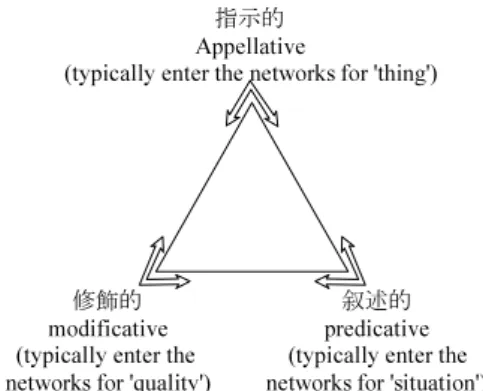
指示的 Appellative
(typically enter the networks for 'thing')
修飾的 modificative (typically enter the networks for 'quality')
叙述的 predicative (typically enter the networks for 'situation')
Figure 4: The optimization of a concept for the possible semantic types
Any language avails itself of various devices to fulfill the needs of expressing various meanings, which in fact may indicate the same concept. The decision to make the full use of resources that generate Examples above includes the optimization of (i) a ‘predicative’ operation as instantiating the concept by ‘unfolding’ it as a ‘situation’ (as in (1)), (ii) an ‘appellative’ operation as instantiating the concept by ‘naming’ (as in (2)), and (iii) a ‘modificative’ operation as instantiating the concept by assigning a ‘qualifying’ function to it (as in (3a and b)), as illustrated in Figure 4 above.
(1) 頭が痛い My head aches (2) 頭痛 headache (3) a. 頭の痛い問題 a t horny issu e b. 頭痛の種 a nagging co nce rn
SITUATION
Situation Thing Quality
C lause N ominal Gro up Qu alit y Grou p
AWARENE SS
COMMUNICATIVE DECISION
S EMANTICS
S YNTAX
Figure 5: Communicative decision for entering the possible variations
12
may have different ways of expression, including such ‘nominal’ expressions as the ripe apricots, ripening of the apricots, or the apricots’ ripening, and each of these instances may well be used as a
TYPICAL expression in a given type of text.
Each of the examples above can be typical in a certain text, if it carries the relevant function that is expected to contribute to an effective use of it in the text to achieve the intended goal. The technical term for this aspect of feature is ‘texture’. A texture is, then, the instance of decisions, or ‘communicative decisions’. It is obtained through optimizing the linguistic resources to be used, which are incorporated as part of a coherent text.
Unfortunately, a systematic account of this area can hardly be found in a systemic functional approach to Japanese texts. In fact, this is beyond the scope of the present study, but it will be useful to show an informal observation of the variability of a concept in linguistic expressions. Consider the following Examples (the English translations may be odd to the native speakers, but the literal translation is intended to demonstrate what is happening in the structure of the Japanese text):
(1) 頭 が 痛い atama ga ita-i head PCL hurting-NPST
[My] head is painful. [= I have a headache.]
(2) 頭痛 (を 治す)
zutsuu ( o naos-u ) headache PCL cure-NPST (to cure) a headache
(3) a. 頭 が 痛い 問題
atama ga ita-i mondai head PCL hurting-NPST problem
an issue that induces headache [= a thorny issue] b. 頭痛 の 種
zutsuu no tane PCL cause
a cause of headache [= a nagging concern]
All of Examples (1) to (3) above are concerned with the phenomenon of a “pain in one’s head”. (1) presents it as an ‘event’, where “one’s head” is qualified as carrying an attribute of “painfulness” or “aching”. In (2), the phenomenon of the “headache” is described as a ‘thing’ (i.e. the name of a target symptom) that is embedded in the Participant of the Process of “curing”. In (3a) the portion that denotes the “pain in one’s head” is, like (1), expressed in a clause, yet in this case it is embedded in the unit filling the modifier of another thing, “a problem”. Likewise, (3b) demonstrates the use of (2) as the unit that fills the modifier of the thing of a “cause”.
The four dotted lines in Figure 5 indicate the possible paths that may be followed in accordance with the appropriate decision-making in the course of proceeding discourse. The component of ‘communicative decision’ serves an interface that enables us to enter the relevant system network to verbalize a concept in a coherent discourse. Accordingly, the concept cannot be the semantic referent that can be directly realized by a particular form of expression. In other words, recognizing a concept itself is not the determining factor of entering the relevant system network.
3.5 Writing and speech
Lexicogrammar generates the structures of various units and the items that expound the elements of structure. Note that this is an operation in our mental capacity. That is, the set of operations in the lexicogrammatical components is not the final step of producing a text. What makes the use of language viable in our social activities is the articulation of the string of items through the systems of speech sounds and writing.
The pieces of text are the instances of this perceptive form of linguistic expression in use. They are not merely the medium of communication, but the text itself has an effect on the actual situation in our continuous social life, which in turn may be the driving force behind the subsequent use of language or other meaningful activities of human beings.
3.6 Summary so far
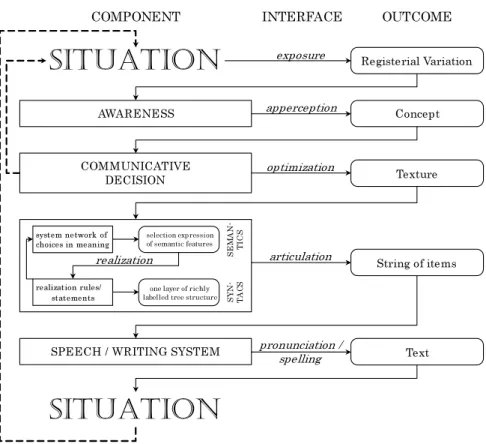
Figure 6 summarizes the whole process of generating a text that has been presented above. This is the overall model that is employed in the present study. I shall refer to it as a ‘cyclical cog-wheel model’ of communication, because this model works through the interlocking operations between components.
15
Registerial Variation
selecti on expr essi on
of semanti c featur es syst em ne twork of
choices in mean ing
S EM A N -TI C S one l ayer of r ic hl y
l abel l ed tree structur e realizat ion rules/
stat emen ts S YN -T A C S realization exposure apperception C oncept AWARENE SS
COM M UNIC ATIVE DECISION
Texture optimization
String of items articulation
SPE ECH / WR ITING SYSTEM Text pronunciation /
spelling
COMPONENT INTERFACE OUTCOME
SITUATION
SITUATION
Figure 6: The cyclical cog-wheel model of Communication
4 Demonstrating the ‘cyclical cog-wheel model’: A case of the lexicogrammar of
nominality
4.1 The notion of nominality
Perhaps the earliest provision of the notion of ‘nominality’ by Halliday is found in his observation of language in 1966 ‘from the outside’ in the social settings. Beginning with the interim assumption that ‘Nominality [...] has something to do with nouns’, he sees it as something like involving three factors of (i) ‘some entities other than simple nouns’ and (ii) ‘some aspect of the functioning of nouns’, as well as (iii) ‘their density of occurrence’ in a text (Halliday 1966/2003: 53).7
In an interview by Herman Parret, Halliday shows an advanced interpretation of this notion as one of the resources of meaning-making from the inside of the configuration of the strands of function of language. Halliday considers ‘nominality’ to be an entity that embodies the potential of realizing meanings associated with any of the three types of functions or ‘metafunctions’, to use Halliday’s term, viz. the ideational, the interpersonal and the textual. Halliday (1974: 105) states: ‘it [= Nominality]
14
The four dotted lines in Figure 5 indicate the possible paths that may be followed in accordance with the appropriate decision-making in the course of proceeding discourse. The component of ‘communicative decision’ serves an interface that enables us to enter the relevant system network to verbalize a concept in a coherent discourse. Accordingly, the concept cannot be the semantic referent that can be directly realized by a particular form of expression. In other words, recognizing a concept itself is not the determining factor of entering the relevant system network.
3.5 Writing and speech
Lexicogrammar generates the structures of various units and the items that expound the elements of structure. Note that this is an operation in our mental capacity. That is, the set of operations in the lexicogrammatical components is not the final step of producing a text. What makes the use of language viable in our social activities is the articulation of the string of items through the systems of speech sounds and writing.
The pieces of text are the instances of this perceptive form of linguistic expression in use. They are not merely the medium of communication, but the text itself has an effect on the actual situation in our continuous social life, which in turn may be the driving force behind the subsequent use of language or other meaningful activities of human beings.
3.6 Summary so far
Figure 6 summarizes the whole process of generating a text that has been presented above. This is the overall model that is employed in the present study. I shall refer to it as a ‘cyclical cog-wheel model’ of communication, because this model works through the interlocking operations between components.
shows how each of the functions is represented, or rather how meanings derived from each of the functions are represented, in the total structure’.
Following Halliday’s insightful characterization of ‘nominality’, I regard this notion as the potential of rendering a range of concepts appellative, so that it typically utilizes the rich resources for generating nominal units that carry one or more different types of functions.
4.2 Morpho-graphological resources for nominal expressions
As I mentioned above, nominality is a type of expressivity of a language in two folds: (i) an expressivity of a nominal unit, such as a word or a group, to realize one of the features that are chosen from any of the eight strands of meaning, (ii) an expressivity of it to integrate more than one function simultaneously in a single nominal unit (as with the typical property of a clause).
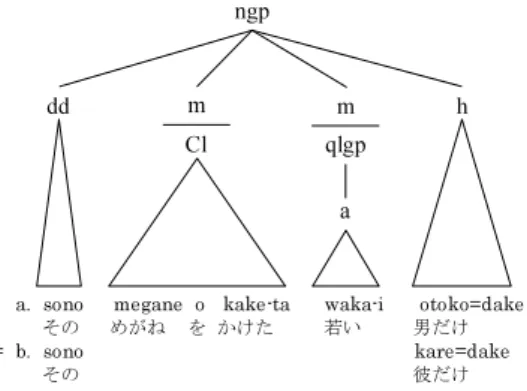
Let us assume that a ‘noun’ refers to a class of words, or a word class. Traditionally, the Japanese nouns are said to be a word that consists of at least one free morpheme, such as kodomo (‘a child’ or ‘children’). The morpheme may be attached by suffixes, such as -tachi for a type of explicit ‘plurality’ of living things (as in tachi, ‘children’) or -dake for a ‘confinement’ of the thing (as in kodomo-tachi-dake, ‘only children’), but, unlike verbs or adjectives, the word as a whole can never change its
form by conjugation. However, as the subsequent sections will demonstrate, this definition is problematic, since numerous nouns in fact consist of two (or more) parts, each of which has its lexical meaning, and yet none of them can be a free morpheme as such. Besides, I shall take other steps to argue that the notion of ‘morpheme’ ― if it essentially presupposes the patterns of sequential sounds ― does not work to account for the formation of nouns of most of such cases, so that a character-based articulation of a word, called ‘grapheme’, is introduced as another ‘smallest meaningful unit’. In this paper, then, a noun is characterized as a class which is the core constituent of the unit that typically fills the element of a clause.
In my view, a main factor that equips nominality with multifunctionality is the rich ‘morpho-graphological’ resources of nouns in Japanese. In Japanese, the writing system has substantial implications for the expressivity of nominality, which has developed through the history of the reception of the writing system from China. The ‘naturalization’ of the Chinese ideographic characters into the localized writing system of ‘kanji 漢字’ in Japanese enriched the reading-styles of Japanese words, i.e. ‘wago 和語’, words of the pronunciation of Japanese origin and ‘kango 漢語’, words of the Chinese-based pronunciation of kanji, and they have certain effects on the different ways of using nominal expressions in Japanese.
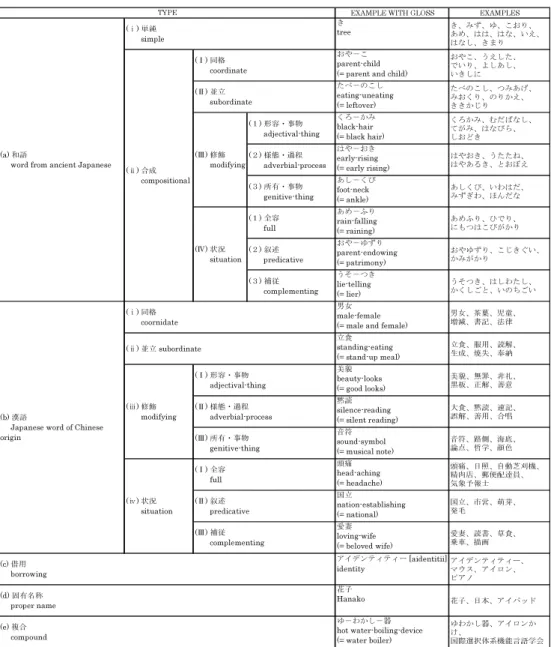
Table 1 shows five major types of nouns, which are basically distinguished in terms of the etymological classification of Japanese words: (a) ‘wago 和語’, words from ancient Japanese, (b) ‘kango
17
漢語’, Japanese words of Chinese origin, (c) ‘shakuyōgo 借用語’, borrowings from other languages than Chinese, (d) ‘koyūmeishi 固有名詞’, proper names and (e) ‘fukugōgo 複合語’, compounds of any types of (a) to (d).
‘Wago’ include many simple items that are often employed in comparative linguistics. Most of them originate in pure classical Japanese, which had no developed writing system. The pronunciation of these words, therefore, is not based on the Chinese pronunciation of kanji. In other words, a wago typically consists of a simple free morpheme.
‘Kango’, on the other hand, typically consist of two kanjis, and their referents involve complex semantic relations. For instance, ‘seisei 生成’ (‘generation’ or ‘genesis’) denotes the sequential combination of two events of ‘birth’ in ‘sei 生’ and ‘formation’ in ‘sei 成’. Note that neither of these characters can solely occur as a word, although each functions as the ‘smallest meaningful unit’. In this sense, the words of this kind contains no ‘free morpheme’. As a consequence, I refer to this kind of unit as ‘grapheme’.
It is these graphemes that have extremely powerful expressivity of new ideas, such as various technical terms or abstract notions used in scientific disciplines. Besides, it is productive in that kango (and some other types of words) typically combine with each other to form a very long lexical item, which behaves exactly in the same way as a simple noun. Consider the following Example:
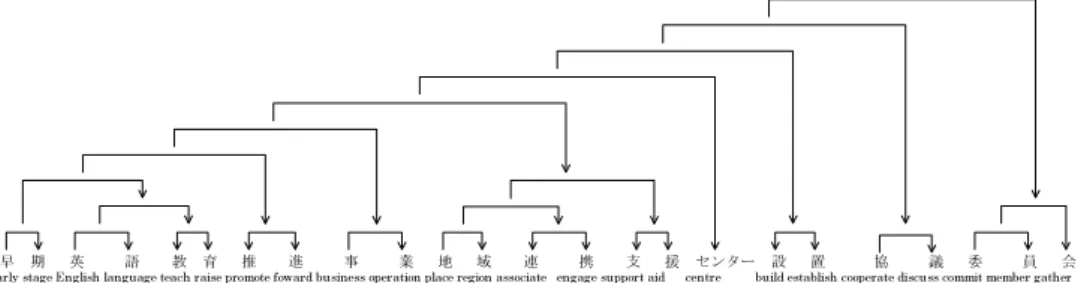
(4) 早期英語教育推進事業地域連携支援センター設置協議委員会
soukieigokyouikusuishinjigyouchiikirenkeishiensentasecchikyougiiinkai
(the deliberative committee of establishing the support centre for a regional partnership in the undertaking of promoting early education of English)
As Figure 7 shows, this very long word involves the combination of various relations, which are made in terms of the dependency between the graphemic units.
早 期 英 語 教 育 推 進 事 業 地 域 連 携 支 援 センター 設 置 協 議 委 員 会
early stage En glish lan gu age teach raise promote f oward bu siness operation place region associate en gage su pport aid centre bu ild establish cooperate discu ss commit member gath er
(the deliberative committee of establishing the support centre for a regional partnership in the undertaking of promoting early education of English)
Figure 7: The semantic dependence in a single compound word
This word can be ‘unpacked’ by supplementing the relevant grammatical items, as in:
16
shows how each of the functions is represented, or rather how meanings derived from each of the functions are represented, in the total structure’.
Following Halliday’s insightful characterization of ‘nominality’, I regard this notion as the potential of rendering a range of concepts appellative, so that it typically utilizes the rich resources for generating nominal units that carry one or more different types of functions.
4.2 Morpho-graphological resources for nominal expressions
As I mentioned above, nominality is a type of expressivity of a language in two folds: (i) an expressivity of a nominal unit, such as a word or a group, to realize one of the features that are chosen from any of the eight strands of meaning, (ii) an expressivity of it to integrate more than one function simultaneously in a single nominal unit (as with the typical property of a clause).
Let us assume that a ‘noun’ refers to a class of words, or a word class. Traditionally, the Japanese nouns are said to be a word that consists of at least one free morpheme, such as kodomo (‘a child’ or ‘children’). The morpheme may be attached by suffixes, such as -tachi for a type of explicit ‘plurality’ of living things (as in tachi, ‘children’) or -dake for a ‘confinement’ of the thing (as in kodomo-tachi-dake, ‘only children’), but, unlike verbs or adjectives, the word as a whole can never change its
form by conjugation. However, as the subsequent sections will demonstrate, this definition is problematic, since numerous nouns in fact consist of two (or more) parts, each of which has its lexical meaning, and yet none of them can be a free morpheme as such. Besides, I shall take other steps to argue that the notion of ‘morpheme’ ― if it essentially presupposes the patterns of sequential sounds ― does not work to account for the formation of nouns of most of such cases, so that a character-based articulation of a word, called ‘grapheme’, is introduced as another ‘smallest meaningful unit’. In this paper, then, a noun is characterized as a class which is the core constituent of the unit that typically fills the element of a clause.
In my view, a main factor that equips nominality with multifunctionality is the rich ‘morpho-graphological’ resources of nouns in Japanese. In Japanese, the writing system has substantial implications for the expressivity of nominality, which has developed through the history of the reception of the writing system from China. The ‘naturalization’ of the Chinese ideographic characters into the localized writing system of ‘kanji 漢字’ in Japanese enriched the reading-styles of Japanese words, i.e. ‘wago 和語’, words of the pronunciation of Japanese origin and ‘kango 漢語’, words of the Chinese-based pronunciation of kanji, and they have certain effects on the different ways of using nominal expressions in Japanese.
Table 1 shows five major types of nouns, which are basically distinguished in terms of the etymological classification of Japanese words: (a) ‘wago 和語’, words from ancient Japanese, (b) ‘kango
(5) 早期に英語を教育することを推進する事業において地域が連携することを支援するセンターを設置 することを検討する委員の会
(the deliberative committee of establishing the support centre for a regional partnership in the undertaking of promoting early education of English)
Table 1: The classification of the five word types of nouns in Japanese
Note that Example (4) above and all of the examples in Table 1 fully meet the four requirements of the lexical integrity, so that they all can be used as a single lexical item:
EXAMPLE WITH GLOSS EXAMPLES
き tree き、みず、ゆ、こおり、 あめ、はは、はな、いえ、 はなし、きまり おや-こ parent-child (= parent and child)
おやこ、うえした、 でいり、よしあし、 いきしに たべ-のこし eating-uneating (= leftover) たべのこし、つみあげ、 みおくり、のりかえ、 ききかじり (1) 形容・事物 adjectival-thing くろ-かみ black-hair (= black hair) くろかみ、むだばなし、 てがみ、はなびら、 しおどき (2) 様態・過程 adverbial-process はや-おき early-rising (= early rising) はやおき、うたたね、 はやあるき、とおぼえ (3) 所有・事物 genitive-thing あし-くび foot-neck (= ankle) あしくび、いわはだ、 みずぎわ、ほんだな (1) 全容 full あめ-ふり rain-falling (= raining) あめふり、ひでり、 にもつはこびがかり (2) 叙述 predicative おや-ゆずり parent-endowing (= patrimony) おやゆずり、こじきぐい、 かみがかり (3) 補従 complementing うそ-つき lie-telling (= lier) うそつき、はしわたし、 かくしごと、いのちごい 男女 male-female (= male and female)
男女、茶菓、児童、 増減、書記、法律 立食 standing-eating (= stand-up meal) 立食、服用、読解、 生成、焼失、奉納 美貌 beauty-looks (= good looks) 美貌、無罪、非礼、 黒板、正解、善意 黙読 silence-reading (= silent reading) 大食、黙読、速記、 誤解、善用、合唱 音符 sound-symbol (= musical note) 音符、路側、海底、 論点、哲学、顔色 頭痛 head-aching (= headache) 頭痛、日照、自動芝刈機、 精肉店、郵便配達員、 気象予報士 国立 nation-establishing (= national) 国立、市営、萌芽、 発毛 愛妻 loving-wife (= beloved wife) 愛妻、読書、草食、 乗車、描画 アイデンティティー [aidentitii] identity アイデンティティー、 マウス、アイロン、 ピアノ 花子 Hanako 花子、日本、アイパッド ゆ-わかし-器 hot water-boiling-device (= water boiler) ゆわかし器、アイロンか け、 国際選択体系機能言語学会 TYPE (Ⅰ) 形容・事物 adjectival-thing (Ⅱ) 様態・過程 adverbial-process (Ⅰ) 全容 full (Ⅱ) 叙述 predicative (ⅱ) 並立 subordinate (Ⅲ) 補従 complementing (c) 借用 borrowing (e) 複合 compound (d) 固有名称 proper name (a) 和語
word from ancient Japanese
(Ⅲ) 修飾 modifying (Ⅳ) 状況 situation (ⅱ) 合成 compositional (Ⅰ) 同格 coordinate (Ⅱ) 並立 subordinate (ⅰ) 単純 simple (Ⅲ) 所有・事物 genitive-thing (b) 漢語
Japanese word of Chinese origin (ⅲ) 修飾 modifying (ⅳ) 状況 situation (ⅰ) 同格 coornidate