56:486 はじめに 近年,硬膜の欠損あるいは異常により神経症状を呈する疾 患群として「duropathy」という概念が提唱され1),脳表ヘモ ジデリン沈着症(superficial siderosis; SS)の出血源としても 注目されている.今回われわれは剖検にて duropathy の一つ とされる髄腔と交通する多房性前仙骨髄膜瘤が出血源になっ た可能性が示唆された SS の 1 例を経験したので報告する. 症 例 症例:死亡時 77 歳,女性 主訴:視覚異常,歩行障害 既往歴:40 歳頃,神経線維腫症 1 型(neurofibromatosis type 1; NF1)の診断.62 歳,卵巣囊腫に対する貯留液吸引術. 70歳,左白内障の手術. 家族歴:特記事項なし. 現病歴:1999 年(72 歳)から歩行時のふらつきを自覚し, 目の前がチラチラするなどの視覚異常が出現した.その後, 徐々に歩行障害が悪化し,めまい,両下肢脱力感,両足底しび れ感も訴えるようになった.2000 年 11 月に当院に入院した. 入院時現症:身長 145 cm,体重 34 kg,体温 36.6°C,血圧 111/62 mmHg,脈拍 95/ 分・整.全身に神経線維腫による結 節状皮膚隆起が多発し,右下腿にカフェ・オ・レ斑を認めた. 神経学的には軽度の両側聴力低下と四肢より体幹にめだつ 失調症状を認めた.Mini-mental state examination(MMSE)は
26点(計算で 1 失点,遅延再生で 2 失点,文の復唱で 1 失点)
であった.
検査所見:C 型肝炎ウイルス(hepatitis C virus; HCV)抗体 陽性で HCV 核酸定量(real-time polymerase chain reaction 法) では 74 Log IU/ml と上昇していた.その他の血液・尿一般検 査に異常を認めなかった.髄液検査では外観は淡黄色で,初圧 75 mmH2O,細胞数 1/μl(単核球 1),蛋白 88 mg/dl,糖 50 mg/dl (血糖 92 mg/dl)と蛋白上昇を認めた.髄液細胞診では Class I で悪性所見はなく,明らかな鉄貪食像は認められなかった. 頭部 MRI の T2*強調画像で小脳,脳幹,前頭葉,側頭葉,視
床の表面に低信号を認めた(Fig. 1A~E).頭部 MRA では明 らかな動脈瘤は指摘できなかったが(Fig. 1F),脳血管造影検 査で右内頸動脈-後交通動脈分岐部に動脈瘤様所見を認めた (Fig. 1G).99mTc-ethyl cysteinate dimer single-photon emission
computed tomographyでは両側前頭葉・側頭葉の集積低下を 認めた(Fig. 1H).骨盤部 X 線写真,骨盤部 CT,腰仙椎 MRI で仙骨欠損,多房性前仙骨髄膜瘤を認めた(Fig. 2A~D). 臨床経過:頭部 MRI の所見から SS と診断した.右内頸動 脈-後交通動脈分岐部の動脈瘤様所見から小出血を繰り返し たことが SS の原因と推測された.2001 年には MMSE 19 点 (日付で 4 失点,計算で 4 失点,遅延再生で 3 失点)と認知機 能障害が悪化し,爬虫類が見えるなどの幻視,不眠,易怒性,
症例報告
神経線維腫症 1 型に多房性前仙骨髄膜瘤を合併した
脳表ヘモジデリン沈着症の 1 剖検例
松本 有史
1)*
鈴木 博義
2)飛田 宗重
3)久永 欣哉
1) 要旨: 症例は死亡時 77 歳の女性.40 歳頃に神経線維腫症 1 型と診断され,また C 型肝炎ウイルスのキャリアー であった.72 歳時に視覚異常と歩行障害,74 歳時に両側聴力低下と小脳失調症状を呈し,頭部 MRI の T2*強調画 像にて小脳,脳幹,前頭葉,側頭葉,視床の表面に低信号の所見を認め,脳表ヘモジデリン沈着症と診断した.剖 検では画像検査で確認された病変部位のほかに脊髄下部優位に鉄沈着が認められた.本例では duropathy の一つと される髄腔と交通する多房性前仙骨髄膜瘤の合併があり,神経線維腫症 1 型による血管壁脆弱性も加わって,脳 表ヘモジデリン沈着症の出血源となった可能性が示唆された. (臨床神経 2016;56:486-494)Key words: 脳表ヘモジデリン沈着症,duropathy,前仙骨髄膜瘤,神経線維腫症 1 型,C 型肝炎ウイルス
*Corresponding author: 独立行政法人国立病院機構宮城病院神経内科/臨床研究部〔〒 989-2202 宮城県亘理郡山元町高瀬字合戦原 100〕
1)独立行政法人国立病院機構宮城病院神経内科/臨床研究部
2)独立行政法人国立病院機構仙台医療センター臨床検査科/病理診断科
3)独立行政法人国立病院機構米沢病院神経内科
(Received February 8, 2016; Accepted May 11, 2016; Published online in J-STAGE on June 30, 2016) doi: 10.5692/clinicalneurol.cn-000876
神経線維腫症 1 型に多房性前仙骨髄膜瘤を合併した脳表ヘモジデリン沈着症の 1 剖検例 56:487 拒否的態度が出現した.2002 年に出血性膀胱炎で入院し,尿 道カテーテルを留置した.以後,仙骨部褥瘡,肺炎などで入 退院を繰り返し,車椅子への移乗には全面介助が必要となっ た.2004 年 5 月に腎盂腎炎による敗血症性ショックのため死 亡し,親族からの同意を得て剖検が施行された. 全身病理所見:右下葉の気管支肺炎,重度の両肺浮腫,肥 厚を伴った重度の胸膜癒着,両側水腎症,軽-中等度の脾腫 を認めた.仙骨皮質は欠損し,多房性前仙骨髄膜瘤(8×6× 6 cm)のために仙骨前面は囊胞状に膨隆し,囊胞壁は半透明の 硬膜と考えられる線維性結合組織で形成されていた(Fig. 2E). 髄膜瘤は透明な髄液と考えられる液体で充満し,内面は平滑 で感染所見はなかった(Fig. 2F).脊髄馬尾,仙髄との間には 広い間隙が見られ癒着はなく,異常な血管の増生を含め出血 源と考えられるような構造物は確認できなかった.
Fig. 1 Neuroradiological images at admission.
A–E: Gradient echo T2*-weighted magnetic resonance imaging (1.5 T; TR = 1,070.0 ms, TE = 27.0 ms) of the axial (A–D) and sagittal (E)
sections shows a rim of hypointense lesions surrounding the surface of the cerebellum, brainstem, frontal and temporal lobes, and thalamus that is considered as hemosiderin deposition. F: Brain magnetic resonance angiogram (1.5 T; TR = 37.0 ms, TE = 6.1 ms) shows no apparent abnormality in the right internal carotid-posterior communicating artery bifurcation. G: Cerebral angiography shows aneurysm-like dilatation (arrow) at the right internal carotid-posterior communicating artery bifurcation. H: 99mTc-ethyl cysteinate dimer single-photon emission
臨床神経学 56 巻 7 号(2016:7) 56:488 神経病理所見:(肉眼的所見)脳重量は 1,200 g であった. 前頭・側頭葉下面,側頭葉鈎部,視交叉下面,橋前部と延髄, 小脳下面に強い黒~褐色の変色を認めた(Fig. 3A).大脳上面 では両側前頭葉はやや萎縮し,脳溝の軽度拡大は認められた が高度の大脳萎縮はなく,脳表の変色は明らかでなかった (Fig. 3B).高度の黒~褐色の変色が中脳では全周性に,小脳 では上面,特に虫部に認められ,変色部の大部分は軟化して 一部は崩壊していたが,大脳脚,中脳被蓋に萎縮はなく,黒 質は保たれていた(Fig. 3C).延髄(Fig. 3D),および脊髄 (Fig. 3E)でも全周性に黒~褐色の変色が認められたが,変色 は表面だけに留まらず実質深くまで及んでいた.変色は頸髄 よりも胸髄,腰髄でより顕著であった(Fig. 3E). 血管の所見としてはウィリス輪に強い動脈硬化所見を認 め,右内頸動脈-後交通動脈分岐部に壁の硬化を伴う動脈の 囊状の拡張が認められたが,陳旧性および新鮮出血所見は認 められず,破裂した形跡はなかった(Fig. 4A). (組織学的所見)褐色の変色が強かった小脳虫部には上面 を主体に小脳回の萎縮と変性が認められた(Fig. 5A).同部は 鉄沈着(Fig. 5B)とグリオーシス(Fig. 5C, F)が高度であっ たが,リン酸化タウの免疫染色は陰性であった(Fig. 5D).小 脳虫部皮質拡大像では褐色のヘモジデリン沈着が認められ, プルキンエ細胞と顆粒細胞の脱落が顕著であった(Fig. 5E). 小脳白質全体もグリオーシスが進行していた(Fig. 5C).脳幹 部も表層に全周性の鉄沈着が認められ,聴神経の神経根部に も鉄沈着,髄鞘の消失,および軸索の変性所見が認められた が,明らかな神経細胞の脱落は認められなかった.黒質や青 Fig. 2 The sacral defect and the anterior sacral polycystic meningocele.
A–D: Pelvic plain X-ray (A), pelvic computed tomography (B, C), and T2-weighted sagittal scan of the lumbosacral magnetic resonance imaging
(1.5 T; TR = 4,000.0 ms, TE = 111.0 ms) (D) show the sacral defect and the anterior sacral polycystic meningocele communicating with the spinal subarachnoid space. E, F: Macroscopic findings of the meningocele. The size was 8 × 6 × 6 cm. The cortical bone defect of sacrum was observed where the meningocele was present. The pelvic surface of sacrum presented with cystic swelling due to the meningocele and was covered with translucent fibrous connective tissue considered as dura mater (E; arrow). The inside of the meningocele was exposed after removal of the anterior part of sacrum and spinal cord (F; arrow). The surface of the meningocele lumen was smooth and did not show signs of bacterial infection or abnormal vessels.
神経線維腫症 1 型に多房性前仙骨髄膜瘤を合併した脳表ヘモジデリン沈着症の 1 剖検例 56:489 斑核に α シヌクレイン免疫染色陽性の好酸性球状体がごく少 数出現していたが,層状構造は認められずレビー小体として は非典型的であった.大脳では底面に鉄の沈着があり,脳表 では神経基質(主に神経線維)に粗鬆化を認め,脳表と白質 にグリオーシスが強く認められた(側頭葉;Fig. 6A, D~F). マイネルト基底核を含む前脳基底部,側頭葉前方内側部,海 馬,嗅内野,扁桃体には広範な神経原線維変化が出現し,同 部ではリン酸化タウの免疫染色が陽性で,アストロサイトに Fig. 3 Macroscopic findings of the brain and spinal cord.
A: Severe brownish discoloration on the surfaces of the basal part of the frontal and temporal lobes, the uncus, the optic chiasm, the anterior part of the pons and medulla, and the inferior part of the cerebellum. B: Discoloration was not apparent at the surface of upper part of the cerebral cortex. Mild atrophy was observed at the bilateral frontal lobes. C: Severe brownish discoloration surrounding the surface of the midbrain and at the superior part of the cerebellum, especially at the cerebellar vermis. A part of the cerebellar vermis necrotized and disappeared. The cerebral peduncle, the midbrain tegmentum, and the substantia nigra were preserved. D, E: Severe brownish discoloration surrounding not only the surface but also the outer layer of the medulla (D), and spinal cord (E). The discoloration showed infiltration from the surface deep into the parenchyma. Discoloration of the thoracic and lumbar spinal cord was stronger than that of the cervical spinal cord (E). C = cervical spinal cord. Th = thoracic spinal cord. L = lumbar spinal cord.
臨床神経学 56 巻 7 号(2016:7) 56:490
鉄の沈着が認められた(側頭葉;Fig. 6B, C, G).大脳底部で は神経細胞にも鉄の沈着が認められた.海馬では鉄沈着が 強い部位とリン酸化タウ染色性が強い部位に解離が認められ (Fig. 6E, G),CA1~CA2 の神経細胞脱落が認められた(Fig. 6H).
神経原線維変化とリン酸化タウ沈着の分布と程度,海馬の神 経細胞脱落はいずれも加齢による変化で説明し得る範囲内で あった.大脳皮質に β アミロイドの沈着はなく,老人斑の出 現は認められなかった.検索した範囲の血管壁には β アミロ イドの沈着は認められず,アミロイドアンギオパチーは否定 的であった.頸髄は全体的に扁平化し,後索も含めて表面に 近い領域の白質全体に髄鞘の脱落が認められ(Fig. 7A),その 脱落部位に一致して広範な鉄沈着が認められた(Fig. 7B).頸 髄前角の運動神経細胞脱落は認められなかった(Fig. 7C).頸 髄後索の髄鞘脱落部分の拡大像では褐色のヘモジデリンを貪 食したと思われるマクロファージと多数の泡沫細胞浸潤,背 景のアストロサイト増生とグリオーシスを認めた(Fig. 7D).髄 鞘の脱落が強い部分には著しい神経線維の脱落を認めたが (Fig. 7E),髄鞘が保たれている部分の神経線維の密度は比較 的保たれていた(Fig. 7F). 右内頸動脈-後交通動脈分岐部の囊状拡張部は粥状硬化に よる中膜の変性が高度で中膜平滑筋はほとんど消失していた が,動脈壁の 3 層構造は確認され真性動脈瘤の所見はなく, 壁の断裂や出血所見は認められなかった(Fig. 4B). 考 察 本例では多房性前仙骨髄膜瘤が SS の出血源である明らか な病理学的所見を呈示することはできなかったが,他に出血 源として可能性のある病変は認められず,脊髄では頸髄より も前仙骨髄膜瘤に位置が近い胸腰髄に変色が強く,出血源は 脊髄下部に近い部位と考えられること,これまでに脳表ヘモ ジデリン沈着症の出血源として duropathy という概念が導入 されていることから,duropathy の一つである多房性前仙骨髄 膜瘤が SS の出血源である可能性が示唆された. さらに本例は NF1 を合併しているが,NF1 の遺伝子産物, neurofibrominの機能障害は血管内皮・平滑筋の異常を引き起 こし,脳血管・心血管障害を発生させると考えられている2)3). 本例では NF1 に伴う血管壁の異常が易出血性として加わり, SSの病態を増悪させた可能性がある. NF1は高率に骨異常を呈すると言われており3)4),骨欠損 部から髄膜瘤が発生することもあるが,前仙骨髄膜瘤を伴 う NF1 の症例は検索した範囲では 5 例しか報告されていな い4)~8).さらに NF1 に SS を合併した症例報告も非常に少な い2)9)10).これまで NF1 に前仙骨髄膜瘤,SS を合併した症例 の報告はなく,本例は貴重な症例と考えられた. 髄腔内への慢性出血が必ずしも脳表ヘモジデリン沈着症を 続発するとは限らない.患者には脳脊髄内での鉄処理能力が Fig. 4 Pathological findings of the right internal carotid-posterior communicating artery bifurcation.
A: The circle of Willis exhibited severe arteriosclerotic changes. The saccular aneurysm-like dilatation was observed in the right internal carotid-posterior communicating artery bifurcation (red arrow). B: Microscopic findings of the saccular aneurysm-like dilatation. Although the tunica media was severely degenerated due to atherosclerosis and nearly the entire vascular smooth muscle in the tunica media had disappeared, the three layers of the arterial vessel wall were preserved. The saccular dilatation was determined not to be a true aneurysm; findings associated with rupture such as tear of the vessel walls and persistent bleeding were not observed. Elastica-Masson staining. Scale bar = 500 μm.
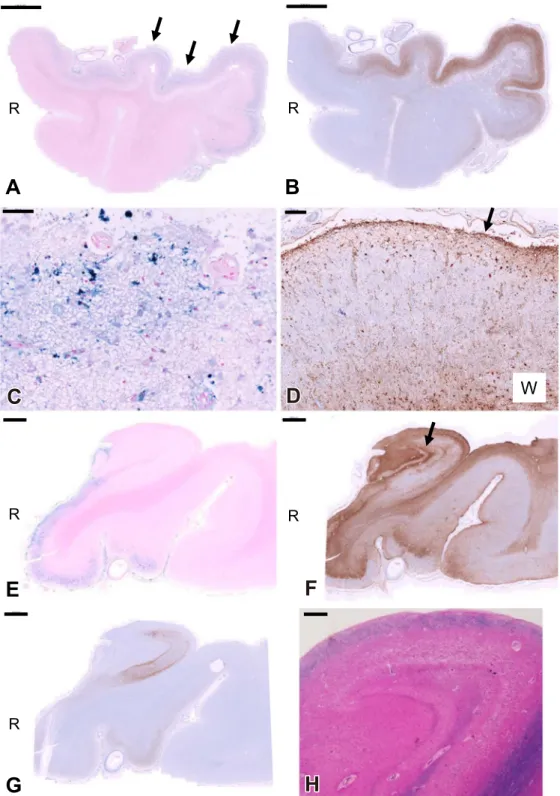
神経線維腫症 1 型に多房性前仙骨髄膜瘤を合併した脳表ヘモジデリン沈着症の 1 剖検例 56:491 飽和してヘモジデリン沈着が発生してしまう何らかの遺伝的 または環境的素因があって発症するものと考えられるが詳細 は明らかになっていない.この点で本例が HCV に感染して いたことは大変興味深い.C 型慢性肝疾患では鉄利用抑制性 の鉄代謝関連蛋白質ヘプシジンの産生低下が報告されてい る11).ヘプシジンの産生が低下すると十二指腸上皮や網内系 マクロファージの細胞膜に存在する鉄排出蛋白質フェロポー チンの発現量が上昇し,これらの細胞から血液中へ鉄排出が 促進するため鉄の吸収や再利用が亢進する12).HCV 持続感染 が中枢神経系においても鉄代謝に影響するかどうかに関して の報告はなく,本例での関与についても不明であり,今後多 数例での検討を要すると思われた. 本例では大脳皮質に β アミロイドの沈着はなく,黒質や青 斑核にごく少数出現した好酸性球状体はレビー小体としては 非典型的であり,アルツハイマー病やレビー小体型認知症の 合併は否定的と考えられた.神経原線維変化やリン酸化タウ の沈着は加齢による変化の範囲内であり,本例の認知機能障 害を全てタウ沈着の病巣からだけでは説明できないと思われ た.神経細胞やアストロサイトに鉄の沈着,脳表と白質にグ リオーシスが認められたことなどから,本例では神経細胞や グリアの機能障害が総合して認知機能障害を引き起こしてい る可能性が考えられた. 脳表ヘモジデリン沈着症とタウおよび α シヌクレインの蓄 積との関連を示唆する興味深い剖検例が報告されている13). 本例でも側頭葉先端部で鉄沈着が強い部位とリン酸化タウの 免疫染色陽性部位に相関性が認められた.一方で,小脳虫部 や海馬では必ずしも相関せず,この点についても今後のさら なる検討を要するものと思われた. SSの病態については不明な点も多く,また治療については 出血源の外科的治療の他,止血剤14)~16)やキレート剤17)18)の 投与が試みられることもあるが確立されていない.病態の解 明および新たな治療法の開発が待たれる.
Fig. 5 Microscopic findings of the cerebellar vermis.
A–D: The atrophy and degeneration of the cerebellar sulci were observed mainly at the upper surface of the cerebellar vermis (A, arrows). Severe iron deposits (B) and gliosis (C) were observed; however, immunoreactivity for phosphorylated tau was not detected (D) in the same regions. Gliosis of the cerebellar white matter was also prominent (C). E, F: High-magnification images of the atrophied regions of the cerebellar vermis (the rectangle frame E and F in Fig. 5A and C). Hemosiderosis was present, and severe loss of Purkinje and granular cells was observed (E). Prominent gliosis was observed (F). A, E; Hematoxylin-eosin staining. B; Berlin blue staining. C, F; Immunostaining for glial fibrillary acidic protein. D; Immunostaining for phosphorylated tau (AT8 antibody). A–D; scale bar = 5,000 μm. E, F; scale bar = 100 μm.
臨床神経学 56 巻 7 号(2016:7) 56:492
Fig. 6 Microscopic findings of the temporal lobe.
The sections of the temporal lobe tip (A–D). The sections including the hippocampus (E–H). A: Abundant iron deposits were observed throughout all the layers of the medial side of the cortex (arrows). B: In the regions with abundant iron deposits, immunoreactivity for phosphorylated tau was observed. C: High-magnification image of Fig. 6A where the iron deposits were abundant. The glial cells with dendrite, presumed to be astrocytes, were stained by Berlin blue. D: Prominent gliosis was observed on the surface of the cortex (arrow). Diffuse gliosis was also observed in the white matter (W). E: Abundant iron deposits were observed in the entorhinal cortex, subiculum, and parahippocampal gyrus. F: Prominent gliosis was observed in the region of CA4 (dentate gyrus) (arrow). G: Immunoreactivity for phosphorylated tau was observed along with the subiculum to the region of CA1, which were within an age-appropriate range. Discrepancy between the immuno-reactivity for phosphorylated tau and the iron deposition was observed in the hippocampus. H: The loss of neurons was observed in the region of CA1 to CA2, which was within the age-appropriate range. A, C, E; Berlin blue staining. B, G; Immunostaining for phosphorylated tau (AT8 antibody). D, F; Immunostaining for glial fibrillary acidic protein. H; Hematoxylin-eosin and Luxol fast blue staining. A, B; scale bar = 5,000 μm. C; scale bar = 50 μm. D; scale bar = 200 μm. E–G; scale bar = 2,000 μm. H; scale bar = 500 μm.
神経線維腫症 1 型に多房性前仙骨髄膜瘤を合併した脳表ヘモジデリン沈着症の 1 剖検例 56:493 本報告の要旨は,第 94 回日本神経学会東北地方会で発表し,会長 推薦演題に選ばれた. 謝辞:脳血管造影検査を施行していただいた宮城病院脳神経外科 仁村太郎先生に深謝致します. ※本論文に関連し,開示すべき COI 状態にある企業,組織,団体 はいずれも有りません. 文 献
1) Kumar N. Beyond superficial siderosis: introducing “duropathies”. Neurology 2012;78:1992-1999.
2) Leschziner G, Connor S, Wroe SJ, et al. An unusual case of hearing loss in a patient with neurofibromatosis type 1. Clin Neurol Neurosurg 2012;114:735-737.
3) Ferner RE. Neurofibromatosis 1 and neurofibromatosis 2: a twenty first century perspective. Lancet Neurol 2007;6:340-351.
4) Polat AV, Belet U, Aydin R, et al. Anterior sacral meningocele mimicking ovarian cyst: a case report. Med Ultrason 2013; 15:67-70.
5) Aygun C, Tekin MI, Tarhan C, et al. Neurofibroma of the bladder wall in von Recklinghausen’s disease. Int J Urol 2001;8:249-253. 6) Mellion BT, George RE, Fischer DK, et al. Anterior sacral
meningocele and tuberculous spondylitis of the sacrum in a patient with neurofibromatosis. Case report and review of the literature. Neurofibromatosis 1989;2:299-308.
7) Green WJ, Green AE, Jr. Large pelvic mass in a patient with neurofibromatosis. Invest Radiol 1988;23:772-774.
8) Oren M, Lorber B, Lee SH, et al. Anterior sacral meningocele: report of five cases and review of the literature. Dis Colon Rectum 1977;20:492-505.
9) Yamana T, Suzuki M, Kitano H. Neuro-otologic findings in a case of superficial siderosis with bilateral hearing impairment. J Otolaryngol 2001;30:187-189.
10) Manfredi M, De Togni L, Beltramello A. Superficial siderosis of the central nervous system in a patient with neurofibromatosis type I. Eur Neurol 2000;43:121-122.
11) 日野啓輔,仁科惣治,是永匡紹.慢性肝障害における鉄代謝 異常と除鉄療法.日内会誌 2010;99:1248-1254.
12) 張替秀郎.鉄代謝―最近の知見―.日内会誌 2013;102:2699-2704.
Fig. 7 Microscopic findings of the cervical spinal cord.
A: The cervical spinal cord was generally flattened. The loss of myelin was found throughout the white matter near the surface including the posterior column. B: Severe and extensive iron deposits were observed in the regions of the cervical spinal cord where the loss of myelin was remarkable. C: Intermediate-magnification image of the cervical spinal cord anterior horn. The loss of motor neurons was not observed. D: High-magnification image of the cervical spinal cord posterior column where the loss of myelin was remarkable. Hemosiderin-laden macrophages and numerous foamy cells were observed. Astrocytosis and gliosis can be observed in the background. E: Severe loss of nerve fibers was observed in the regions where the loss of myelin was remarkable (represented by the rectangle frame E in Fig. 6A). F: The density of nerve fibers was relatively preserved in the regions where the loss of myelin was unremarkable (represented by the rectangle frame F in Fig. 6A). A, C, D; Hematoxylin-eosin and Luxol fast blue staining. B; Berlin blue staining. E, F; Immunostaining for neurofilament protein. A, B; scale bar = 1,000 μm. C; scale bar = 200 μm. D–F; scale bar = 50 μm.
臨床神経学 56 巻 7 号(2016:7) 56:494
13) Takao M, Murayama S, Yoshida Y, et al. Superficial siderosis associated with abundant tau and alpha-synuclein accumulation. BMJ Case Rep 2011;2011:bcr1020114925. 14) 南里悠介,薬師寺祐介,雪竹基弘ら.止血剤の点滴および内 服加療で改善をみとめた脳表ヘモジデリン沈着症の 1 例.臨 床神経 2013;53:470-473. 15) 山崎公也,米澤久司,高橋弘明ら.脳表ヘモジデリン沈着症 の 2 例―髄液所見,MRI,ポジトロン CT 所見の検討―.臨 床神経 1995;35:1125-1130. 16) 足立 正,植田圭吾,鞁嶋美佳ら.小脳壊死性病変を呈した 脳表ヘモジデリン沈着症の 1 例.神経内科 2008;69:292-294. 17) Levy M, Llinas RH. Deferiprone reduces hemosiderin deposits
in the brain of a patient with superficial siderosis. AJNR Am J Neuroradiol 2011;32:E1-2.
18) River Y, Honigman S, Gomori JM, et al. Superficial hemo-siderosis of the central nervous system. Mov Disord 1994;9: 559-562.
Abstract
An autopsy case of superficial siderosis of the central nervous system accompanied
by anterior sacral polycystic meningocele in neurofibromatosis type 1
Arifumi Matsumoto, M.D., Ph.D.
1), Hiroyoshi Suzuki, M.D., Ph.D.
2),
Muneshige Tobita, M.D., Ph.D.
3)and Kinya Hisanaga, M.D., Ph.D.
1)1)Departments of Neurology and Clinical Research Center, National Hospital Organization, Miyagi Hospital 2)Department of Pathology and Laboratory Medicine, National Hospital Organization, Sendai Medical Center
3)Department of Neurology, National Hospital Organization, Yonezawa Hospital