Interaction between Protein and Sugar during
Frozen Storage
著者
HIRONAKA Yasumasa, HAYASHI Seiichi, OSHIRO
Zentaro
journal or
publication title
鹿児島大学水産学部紀要=Memoirs of Faculty of
Fisheries Kagoshima University
volume
25
number
1
page range
101-105
別言語のタイトル
凍結保存中におけるタンパクと糖の相互作用
Interaction between Protein and Sugar during Frozen Storage
Yasumasa Hironaka,* Seiichi Hayashi* and Zentaro Ooshiro*
Abstract
Interaction between protein and sugar during frozen protein was described from the view
points of gel-filtration of protein solution containing sugar, effect of glucose on salting-out
of actomyosin and effect of cryoprotectant on changes of secondarystructure of protein. From these investigation it was assumed that the initial denaturation of protein by freezing was oc-cured by exposinghydrophobic side chainsofprotein and then thiol bond made protein insoluble.
It was found that the protective effect of sugar on protein during frozen storage was affected by the molecular weight, structure and number of hydroxyl group of
sugar.1)
However very little is known about the mechanism of protective effect.
Noguchi2) pointed out that when cryoprotectant having OH-group attached the side chain of protein molecule, hydration of protein was increased. Namely he concluded that the protective mechanism of sugar on protein during frozen storage
was to protect the side chain of protein.
On the other hand it was found from the
experiments performed by authors that the effect of sorbitol was different from that
of inositol. So it was investigated whether protein formed a complex with sugar.
This report describes about a trial of the separation of the complex by gelfiltration, the effect of sugar on salting-out of actomyosin and the effect of cryoprotectant on changes of secondary structure of protein.
Experimental Procedure
Experimental procedure except determination of radioactivity was described in previous report.1^
Determination of radioactivity. Sample (0.5 ml) was added to 5 ml of toluene containing 4g of 2, 5-diphenyloxazole (PPO), 0.1 g of 1, 4-bis[2-(5-phenyloxazol)] benzen (POPOP) and 500 ml of Triton X-100 per litre and the radioactivity was determined in a liquid scintillation spectrometer (Beckman LS-230).
Results
Gel-filtration of protein solution containing 14C-glucose. Glucose at a concentration of 3.24 mg/m/ and trace amounts of u C-glucose were added to protein
102 Mem. Fac. Fish., Kagoshima Univ. Vol. 25, No. 1 (1976)
solution (3.5 mg protein/m/) and stirred slowly overnight in a refrigerator. 0.5 ml
of the mixture was applied to a column of Sephadex G-50 and eluted with 0.6 M
KC1 (pH 6.8) at a flow rate of 10ml of per hr. Fractions of 10ml were collected.
Result was shown in Fig. 1.
tube number
Fig. 1. Gel-filtration of protein containing14C-glucose (38.2 x 10⁴cpm/mg)
by Sephadex G-50. Column size: 1.5 x 75 cm.
Gel-filtration of protein solution containing N-acetyl glucosamine.
It
was assumed that hydrophobic area of sugar binded to hydrophobic area of protein.
So N-acetyl glucosamine containing hydrophobic group (acetyl group) was added to
protein solution as cryoprotectant.
N-acetyl glucosamine at a concentration of
2.21 mg/m/ was added to protein solution (3.45 mg protein/m/) and stirred slowly
overnight in a refrigerator. 0.5 ml of the mixture was applied to a column of
Sephadex G-50. Result was shown in Fig. 2.
f-acetyl glucosamine
Fig. 2. Gel-filtration of protein containing N-acetyl glucosamine by
Sephadex G-50. Column size: 1.5 x 75 cm.
Experimental of salting-out. It is presumed that sugar makes to dissolve
protein in salt solution easy.
So experiments of salting-out of protein which was
dissolved in 0.6 M KC1 (pH 6.8) were performed.
Saturated ammonium sulfate solution was added to the solution (2 ml) containing
3.5 mg of protein and 36.0 mg of glucose per ml. The sample was stirred to aboid
bubbling slowly and the turbidity of the sample was determined by the absorbance
at 640 m^. The degree of salting-out was observed by the turbidity. Result was
Table 1. Effect of glucose on salting-out.
Glucose Saturated Ammonium Sulfate (ml)
mM 0.0 0.5 1.0 2.0
0 0.2132 0.1898 0.3615 0.2958
20 0.2147 0.1851 0.2888 0.1979
O. D. at 640 mfi
Effect of cryoprotectant for changes of secondary structure of protein.
It was presumed that protective effect of sugar did not depend on the direct interac
tion between protein and sugar.
So thiol group numbers of soluble and precipitated
protein, fluorescent analysis as hydrophobic index of protein and intrinsic viscosity
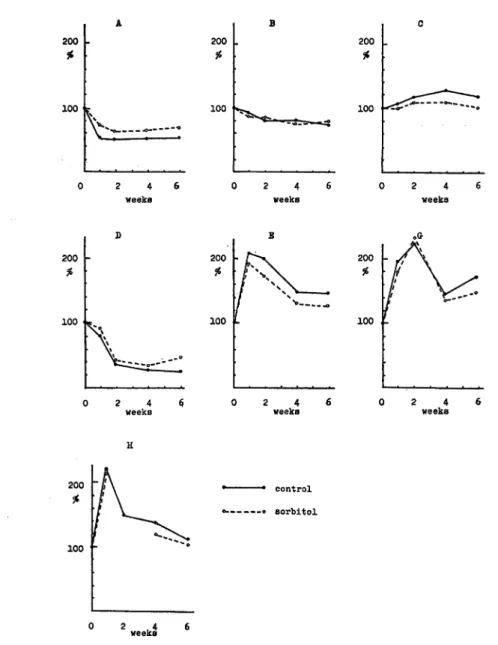
of protein were determined. Results were shown in Fig. 3.
Discussion
As shown in Fig. 1, protein was separated from glucose clearly and trace amounts
of glucose did not bind to protein. The same result was obtained in the experiment using frozen protein for 1 week. It can be presumed that glucose does not affect the denaturation of protein directly, and that the interaction between glucose and water
affects the denaturation of protein during frozen storage.
It was found from Fig. 2 that N-acetyl glucosamine did not bind to protein, and that the frozen protein for 1 week did not also bind to N-acetyl glucosamine. As shown in Fig. 1 and 2, both sugars, glucose and N-acetyl glucosamine, did not bind to protein.
Salting-out of protein was prevented by sugar (Table 1). It is said that the mecha nism of salting-out is the phenomenon following the increased soluvation. Taking into consideration that sugar did not bind to protein, the mechanism to prevent the denaturation of fish muscle protein containing substantial quantity of salt during frozen storage by sugar was the prevention of increasing of solvation by salt.
The quantity of soluble protein decreased rapidly during initial frozen storage and then scarecely changed (Fig. 3-A). Sorbitol prevented apparently protein from aggregation.
Numbers of thiol group of the whole sample containing sorbitol were little difference from that of the sorbitol-free sample (Fig. 3-B) and decreased gradually in both sam ples. However numbers of thiol group of the supernatant protein increased gradually. Furthermore it was assumed that SH-group in supernatant protein obtained from the sample containing sorbitol was protected (Fig. 3-C). On the other hand numbers of thiol group of the precipitated protein decreased rapidly initial 2 weeks and de creased gradually. As shown in Fig. 3-E, changes of quantity of hydrophobic area was significantly large and occured quickly. It was presumed that freezing of protein brought about exposure of hydrophobic area of protein and disintegration of secondary
104 Mem. Fac. Fish., Kagoshima Univ. Vol. 25, No. 1 (1976) 200 100 AN—-~—~ 0 2 4 6 weeks D 200 % 100 V» • —- ° 200 100 -2 4 $ weeks 200 100 2 4 weeks B 200 • r x *
/ NSs
/ v -» 100 £ 0 2 4 weeks -• sorbitol 200 100 0 2 4 weeks 0 2 4 6 weeksFig. 3. Effect of cryoprotectant for changes of secondary structure of protein.
Protein containing 3.6 mg of sorbitol per ml and the sorbitol-free protein as control were
frozen for appropriate periods of weeks. Whole sample was the suspension containing
soluble protein and insoluble protein. After centrifugation of whole sample at 5,000 x g for 20 min, the supernatant was used as fraction of soluble protein. Precipitated protein
was obtained by calculation.
A: Soluble protein, B: SH-group in whole protein C: SH-group in supernatant
protein D: SH-group in precipitated protein E: Hydrophobic area in whole protein F: Hydrophobic area in supernatant protein G: Hydrophobic area in precipitated
structure of protein occured. Then thiol group of the supernatant protein was exposed.
The authors consider about the denaturation of protein during frozen storage as follows. Hydrophobic side chains of protein are exposed by freezing. Protein solubility decreases quickly owing to the aggregation of protein. Then protein precipitates step by step. The precipitated protein is combined successively each other by thiol bond.
References
1) Ooshiro, Z., Y. Hironaka and S. Hayashi (1976): Mem. Fac. Fish. Kagoshima Univ., 25, 91-99.