Minority Language Endangerment and Ethnic
Identity: A Case Study of Pumi in Yunnan,
China
著者
An Jing
学位授与機関
Tohoku University
学位授与番号
11301甲第18345号
Doctoral Dissertation
Minority Language Endangerment and Ethnic Identity:
A Case Study of Pumi in Yunnan, China
少数民族の消滅危機言語と民族意識に関する研究
—中国雲南省プミ族を例として—
Jing An
i
ACKNOWLEDGEMENT
First of all, I would like to present my sincere thanks to my supervisors, Professor
Jeong Soo Yu, Associate Professor Peter John Wanner, and Professor Naoyuki Ono, for
their professional research suggestions and cultivation during my Ph.D. program in Tohoku
University. It would not be possible to finish this thesis without their encouragements and endless advice. I thank them for their care and help in my life and learning procedure. Also, I thank them for their support, I also got precious opportunities to carry out research activities in the international conferences and the international organizations.
My thanks also go to Human Security Program of Tohoku University, thanks for Ms.
Yukiko Koyama, Professor Shinichi EGAWA, Associate Professor Daisuke KOMORI,
and other all of the professors who gave me advice and valuable classes regarding Human
Security research. Furthermore, I would like to thank Associate Professor Toshiaki AOKI,
Associate Professor Masahiro Sato, Professor Dinil Pushpalal, and the other professors and
classmates of my lab room, who gave me help and encouragement. I will never forget all
of you!
I must deeply thank my husband, Dr. Bai Yanbing. Because of his encouragement
and support during these three years,I overcame one difficulty after another.
In addition, I also would like to thank the kind Pumi people in Yunnan, China, for
their active participation and assistance in the investigation. And, this work was supported
by and the Ministry of Education, Culture, Sports, Science, and Technology (MEXT), so I
express my thanks to the Japanese government for providing the scholarship to support my
ii
TABLE OF CONTENTS
ACKNOWLEDGEMENT i
TABLE OF CONTENTS ii
LIST OF TABLES vi
LIST OF FIGURES viii
CHAPTER 1. Introduction 1
1.1 Background 1
1.2 Research Objective 5
1.3 Research Significance 5
1.4 Structure of Thesis 5
CHAPTER 2. The Minority Languages in China 9
2.1 The Minority Languages in China 9
2.2 The Minority Characters in China. 12
2.3 Summary of This Chapter 13
CHAPTER 3. Language Endangerment and Ethnic Identity 15
3.1 Introduction 15
3.2 The Overview of Language Endangerment 15
3.2.1 The background and international research of language endangerment. 15 3.2.2 The important international conferences on language endangerment research. 18 3.2.3 The international organizations and foundations of language endangerment
iii
3.2.4 The representative research of language endangerment in China 20
3.3 The Overview of Ethnic Identity 21
3.4 The Relationship between Language Endangerment and Ethnic Identity 22
3.5 Summary of This Chapter 22
CHAPTER 4. Assessing the Linguistic Vitality of Pumi: An Endangered
Sino-Tibetan Language of Yunnan, China 24
4.1 Introduction 24
4.2 The Pumi Ethnic and Pumi Language 24
4.3 Language Vitality Assessment 28
4.3.1 The previous assessing language vitality method 28 4.3.2 The previous Pumi language vitality assessment 30 4.3.3 The factors of proposed Pumi language vitality assessment method 31
4.4 Methodology 32
4.5 Questionnaires and Interviews 34
4.6 Results and Discussion Using EGIDS and LEI Method 35
4.6.1 Expanded Graded Intergenerational Disruption Scale 35
4.6.2 The Language Endangerment Index (LEI) 38
4.7 Analyzing the Proposed Factors for Pumi Language Vitality Assessment 43
4.7.1 Intergenerational Transmission 44
4.7.2 Speaker Proportion and Language Proficiency 46
4.7.3 Domains of Language Use 48
4.7.4 Community members’ attitudes towards their own language 50 4.7.5 Governmental Language Attitudes and Policies 55
4.7.6 Expectation of Bilingual Education 59
4.7.7 Availability of Materials for Language Education and Literacy 60
4.7.8 The Ethnic Distribution 61
4.7.9 Geographical Features and Traffic Conditions 62
iv
4.8.1 The proposed language vitality assessment method. 63
4.8.2 Comparison of Language vitality Assessment 65
4.9 Summary of This Chapter 67
CHAPTER 5. Ethnic Identity, Language Use Aad Language Attitude of The Pumi
in Yunnan, China 68
5.1 Background 68
5.2 The Objective of This Study 69
5.3 Questionnaires and Interviews 69
5.3.1 Ethnic Identity Questionnaire 70
5.3.2 Language Attitude Questionnaire 70
5.3.3 Language Proficiency Questionnaire 71
5.4 Methodology 71
5.5 Results and Discussions 71
5.5.1 The Ethnic Identity of Pumi People 71
5.5.2 The Language Proficiency of Pumi People 77
5.5.3 The Language Attitude of Pumi People 78
5.5.4 Correlation Analysis of Pumi Ethnic Identity, Language Level, and Language
Attitudes 79
5.5.5 Interviewer Analysis of Pumi Ethnic Identity, Language Level, and Language
Attitudes 81
5.6 Summary of This Chapter 84
CHAPTER 6. The Courses and Protection of Endangered Languages in China 85
6.1 Introduction 85
6.2 The Causes and Protection Countermeasures of Pumi Language 86
6.2.1 The previous literature on language endangered causes 86
6.2.2 Causes of Pumi Language Endangerment 87
6.2.3 Proposed Protection Countermeasures of Pumi language 88
v
6.4 Summary of This Chapter 92
CHAPTER 7. Conclusions 94
7.1 Summary of Achievements 94
7.1.1 Assessing the Linguistic Vitality of Pumi language: An Endangered
Sino-Tibetan Language of Yunnan, China 94
7.1.2 Ethnic Identity, Language Use and Language Attitude of the Pumi in Yunnan, China. 97
7.1.3 The Causes and Protection Countermeasures of Endangered Languages in China. 100
7.2 Originality of Thesis 101
7.3 Final Conclusion and Recommendations for Future Work 102
REFERENCES 104
APPENDIX A. Questionnaire 113
vi
LIST OF TABLES
Table 4-1 Summary of the main language vitality assessment models (1)
Fishman’s (1991) GIDS; (2) the UNESCO’s nine factors (Brenzinger et al., 2003); (3) Lewis and Simons’ (2010) Expanded Graded Intergenerational Disruption Scale (EGIDS); (4) Lee and Van Way’s (2016) Language Endangerment Index
(LEI). ... 30
Table 4-2 The introduction of Pumi population (proportion) of four towns and their main investigated villages. ... 34
Table 4-3 Expanded Graded Intergenerational Disruption Scale Model ... 36
Table 4-4 The Language Endangerment Index (Lee &Van Way 2014) ... 40
Table 4-5 LEI Formula and Level of Certainty based on available evidence ... 41
Table 4-6 The Pumi language evaluated results using the Language Endangerment Index ... 42
Table 4-7 LEI score interpretation (Lee & Van Way 2014) ... 43
Table 4-8 Pumi villages included in the survey evaluated using the proposed method ... 65
Table 5-1 Mean Scores of the ethnic identity dimension of the Pumi people ... 73
Table 5-2 Percentage of the language proficiency of the Pumi people(%) ... 77
Table 5-3 Mean scores of the language attitude dimension of the Pumi people ... 79
Table 5-4 Spearman’s Correlation Coefficient of Ethnic Identity and Language Attitude ... 80
vii
Table 5-5 Spearman’s Correlation Coefficient of Ethnic Identity and Language Use ... 80 Table 5-6 Spearman’s Correlation Coefficient of language attitude and language proficiency. ... 81
viii
LIST OF FIGURES
Figure 1.1 Structure of the thesis. ... 8 Figure 4.1 Photos of Pumi architecture and mural which were taken by the author ... 27 Figure 4.2 Photo of the gate of Xiagaoping Village which was taken by the author ... 27 Figure 4.3 Location of Lanping County and four counties of identified Pumi villages. .. 33 Figure 4.4 The background information of Pumi investigated respondents ... 35 Figure 4.5 EGIDS Diagnostic Decision Tree (Lewis & Simons 2010) ... 37 Figure 4.6 Investigated results of Pumi language in EGIDS Diagnostic Decision Tree (Lewis & Simons 2010) ... 38 Figure 4.7 The proportion of different degree of Intergenerational Transmission in LEI 41 Figure 4.8 The proportion of different degrees of Speaker Number Trends in LEI ... 42 Figure 4.9 The proportion of different degrees of Domains of Use in LEI ... 42 Figure 4.10 The oldest Pumi villager of Guadeng Village, and she also can’t speak Pumi language (the photo was taken by the author). ... 44 Figure 4.11 The proportion of population of different Choices of Intergenerational
Transmission ... 45 Figure 4.12 The proportion of population of Intergenerational Transmission in different age groups ... 46 Figure 4.13 The proportion of different language proficiency of the respondents ... 47 Figure 4.14 The proportion of different language proficiency of the respondents in different age groups ... 48 Figure 4.15 The proportion of domains of language use of the respondents ... 50
ix
Figure 4.16 The proportion of domains of language use of respondents in different age
groups ... 50
Figure 4.17 Language attitudes towards Pumi language of the respondents in different age groups ... 51
Figure 4.18 Language euphonious of different languages in different age groups ... 53
Figure 4.19 Language cordial of the respondents in different age groups ... 54
Figure 4.20 Language practical of the respondents in different age groups ... 54
Figure 4.21 Language social influence of the respondents in different age groups ... 55
Figure 4.22 The proportion of different education mode of respondents’ choices ... 59
Figure 4.23 The proportion of different education mode of respondents’ choices in different age groups ... 60
Figure 4.24 Terrain and landscape of the investigated area (the photo was taken by the author). ... 62
Figure 5.1 Age Distribution of Pumi Ethnic Identity ... 74
Figure 5.2 Age Distribution of Pumi Ethnic Identity ... 75
Figure 5.3 Age Distribution of Pumi Ethnic Identity. ... 76
Figure 6.1 Percentage (%) of respondents who chose different factors in endangered causes of Pumi language. ... 87
Figure 6.2 Percentage (%) of respondents who chose different factors in protection countermeasures of Pumi language ... 89
Figure 7.1 Flowchart of language vitality evaluation framework... 95
Figure 7.2 Flowchart of the correlation analysis between Ethnic Identity, Language Use and Language Attitude ... 98
1
CHAPTER 1.
INTRODUCTION
1.1 Background
With the acceleration of globalization, human society has become more and more international, and the communication across the world has become increasingly important and frequent. In particular, with the development of science and technology, and the improvement of transportation and communication conditions, the distance between different regions and countries is gradually shortening, resulting in violent collisions of different cultures. Language, as a carrier of culture, also changed dramatically. Under such circumstances, the different cultures and languages face different living spaces. The culture and language of some stronger ethnic groups are rapidly expanding with their advantages of political economy, education, science, technology, and military, and they occupy the living space of many weaker ethnic groups. As the balance of the world is broken, many weak languages have disappeared or become endangered, and cultural diversity of the world has also been jeopardized, all of which have also threatened our human survival and development.
As a large united multi-national state, China is composed of 56 ethnic groups. Among them, Han Chinese account for 89.9% and the other 55 minorities make up the remaining 10.1% (Yang, Peterson, & Cai, 2003). The various minorities in China are distributed all around the country, whose identities represent arts and other manifestations of intellectual achievements.
Chinese culture also has a rich heritage and it plays a vital role in ethnic and cultural diversity. Unfortunately, in last decade, China also faces a series of new problems caused
2
by social change and economic development. In particular, because of the cultural reorganization, many of China’s ethnic minorities face two serious issues-- ethnic identity and language endangerment.
As we all know, language is not only the informational tool of human communication but it is also the carrier of cultural transmission. Since the formation of ethnic groups, the ethnic minority language has become a sign of maintaining the unity and identity of the ethnicity. In the context of inter-ethnic communication, the recognition of language naturally shows more common ethnic culture and universal psychological qualities (Mei, 2006). This indicates that language and ethnic identity are closely related. However, because the relationship is very complicated, the relationship between ethnic identity and language endangerment can help us to understand the problems of language endangerment, which are important for solving the ethnic problems.
As a sizeable multi-national state, China is composed of 56 ethnic groups, and the total population is 1.37 billion. Currently, about 60 million people out of China's minority use the minority languages (Upholding, 2010). According to the report of UNESCO Atlas of the World's Languages in Danger, 144 minority languages are accelerating towards becoming endangered and extinct. Minority languages are an important cultural heritage, the multiculturalism derived from minorities plays an indispensable role in promoting cultural diversity, and language is the central element of expression of identity and it is the key to keeping a group’s identity. The intensification of an endangered language threatens the inherent balance of the language system, which is a serious challenge to the pattern of language and culture, and thus it triggers a language crisis locally and all over the world. Therefore, it is imperative to take action to protect the endangered languages.
3
A quantitative assessment of the vitality index of minority languages provides an intuitive and effective way to monitor trends of language status and shift trends, cognitive and psychological analysis in terms of endangered language use can effectively help us understand the inductive factors behind language endangerment. These two aspects of research can provide a basis for us to formulate language protection countermeasures. Many kinds of research have been carried out regarding language vitality assessment, as well as cognitive and psychological analysis of language based on fieldwork data. However, previous research has problems in terms of accuracy, comprehensiveness, and versatility of analysis, and has not reached the level applicable to China's unique conditions.
There are two reasons:
First, the language situation in China is very complicated. China has more than 100 languages. These languages respectively belong to the world's five language families. Moreover, there are many language groups in each language family and many language branches in each language group. In fact, so far, the investigations of languages have not been completed, because some languages have not been discovered or identified. Besides, these languages also have their characteristics in the speaker population, historical culture, internal language differences, language vitality, and having characters or not (Qingxia, 2015). For example, in mixed ethnic areas of Yunnan, many ethnic people can speak three or four languages, including the major languages and the secondary languages.
4
In addition, there are many cross-border languages1 in China. For example, Jingpo language is distributed in some countries such as Myanmar and India, and Korean is also distributed in North Korea and South Korea. These are the unique situations in the Chinese languages. Therefore, in 2011, based on China's ethnic condition, the Chinese Academy for Social Sciences (CASS) proposed three additional factors to UNESCO (UNESCO Model) for China assessing linguistic vitality. It includes Distribution of the language community, Degree of internal variation of the language, and Distribution of languages transnationally (UNESCO, 2011).
Second, China’s language endangerment research has been developing for more than 20 years, but language vitality assessment still is a very weak part. There are few related systematic studies--more are simple investigation reports. In the limited previous research, the majority usually copies some factors of the UNESCO Method, which leads to single evaluated methods and very incomprehensive results. The Pumi language, so far, has very little related literature available. Almost all the relevant studies have a certain degree of one-sidedness to them. They generally paid attention to one or two factors as their criteria for assessing the language vitality of the Pumi language. For example, some researchers focus on speaker population and proportion (Wenming, Jiangmei, & Yilan, 2007), some prefer language use situation (Yan, 2011), and others only explore language attitude (Qingxia & Weidong, 1993). In this case, it is particularly important to put forward a
1 Cross-border language is a different variant of the same language distributed in different countries. Its
variation is caused by social, historical, cultural, geographical, institutional and other factors of different countries. It is a language model formed by national border factors. See Qingxia, D. (2016). Cross-border Languages in China. Contemporary Linguistics, 18(2), 233.
5
comprehensive vitality assessment criterion for the Pumi language that suits China's ethnic conditions.
1.2 Research Objective
The objective of this thesis is as follows: 1) developing an accurate and comprehensive language vitality evaluative method that is in accordance with China's conditions, 2) investigating the endangered language use from the perspective of ethnic identity, and 3) proposing the reasons of language endangerment and strategies for responding to the language endangerment.
1.3 Research Significance
This research has great significance. First, language is the representation of culture; this will help protect endangered languages and further promote cultural heritage and cultural diversity. Second, language is the central element of expression of identity and a key to keeping a group’s identity. Especially in multi-ethnic countries, the protection of linguistic minority rights and ethnic identity are an essential component of good governance, which will prevent tensions and conflict, and promote ethnic harmony, and the construction of an equal and stable society. Third, it helps provide a reference for the minority studies and ethnic identity theoretical studies as well as provide reference and enlightenment for the Yunnan minority language and policy.
1.4 Structure of Thesis
This thesis is organized into 6 chapters. The structure of this thesis is as shown in Fig.1.1.
6
Chapter 1 provides the description of the background for this research and proposes
the objective of this research, specifically, the structure of this thesis is introduced.
Chapter 2 presents a literature review of the minority languages in China with a
focus on the Sino-Tibetan language family.
Chapter 3 presents the representative research of language endangerment as well as
the state-of-the-art research in ethnic identity. In terms of language endangerment, the study introduces and analyzes in detail the current international mainstream language assessment methods, UNESCO (Sebastian. et al. 2003), EGIDS (Lewis & Simons, 2010), and LEI (Lee & Van Way, 2016). In addition to this, the conceptualization and measurement of ethnic identity: current status and future directions are also summarized, specifically, we introduced the Phinney & Ong MEIM-R scale framework.
Chapter 4 presents a new language vitality evaluated method that is in accordance
with China's conditions. The new language vitality evaluated method was derived from a series of sociological factors and sociolinguistic factors related to language endangerment based on latest fieldwork data in a Pumi community of Yunnan province, China. The vitality assessment result is obtained through the new language vitality assessment method through which it was compared and analyzed with that of EGIDS (Lewis & Simons, 2010), and LEI (Lee & Van Way, 2016).
Chapter 5 investigates the relationship between the ethnic identity, language use and
language attitude based on the case of Pumi language in Yunnan province, China. In particular, we used Spearman correlation coefficients to quantify correlation coefficients between different factors; the most relevant factors are analyzed in detail regarding
7
language endangerment causes from the perspective of language cognition and language psychology.
Chapter 6 presents a literature review of the protection of endangered languages in
China with a focus on 1) Achievements of Endangered Language Protection in China, 2) Dilemmas of Endangered Language Protection, and 3) Suggestions for Endangered Language Protection.
Chapter 7 gives a summary of achievements as well as the recommendations for the
8
9
CHAPTER 2.
THE MINORITY LANGUAGES IN CHINA
As a multi-ethnic country, China has 56 ethnic groups with a total population of 1,370,536,875. Among them, the Han population is 1,225,932,641, accounting for 91.51%; the population of ethnic minorities is 113,792,211, accounting for 8.49% (NBS, 2011). Large-scale scattered living and small settlements characterize the distribution of ethnic minorities in China. Therefore, although the total population of ethnic minorities is small, the total area of distribution accounts for about 64% of the country's total area. Most ethnic people are located in the border areas of China, and many of them are cross-border ethnic groups. Generally, these areas are relatively remote and economically backward, but they often have abundant natural resources. The diverse ethnic environment has made China rich in language resources. According to the "Language Atlas of China "(Baker & Hugh, 1993), China has more than 130 languages. Most of these are languages used by ethnic minorities, and a few are minority languages used by Han people.
2.1 The Minority Languages in China
Since the founding of the People's Republic of China in 1949, the Chinese government has begun vigorously conducting investigations into the social history and language of ethnic minorities and carrying out ethnic identification work. There are currently 56 ethnic groups that have been formally identified. Among the 56 ethnic groups, the Han ethnic group use Chinese, while the other 55 ethnic minorities have their ethnic languages except for the Hui and Manchu ethnic, whose primary language has been shifted into Chinese. Also, some ethnic groups use different languages within their different branches. For example, different branches of the Gaoshan ethnic group use a total of 13
10
languages, which are Taiyal language, Saydy language, Zou language, Shah Rua language, Kanakanab language, Paiwan language, Amis language, Bunun language, Rukai language, Puyam language, Shao language, Sastre language, and Yimei language, respectively (Xinghua, 2005).
In the long history of thousands of years for China, with the changes and migration between Chinese and foreign nationalities, the five major language systems of Chinese minority languages have slowly formed, which are the Sino-Tibetan language family, South Asian language family, Austronesian family, Altai language family, and Indo-European language family. These are according to "The languages of China" (Sun, Hu, & Huang, 2007), the major languages that consist of these five language families.
There are 31 ethnic groups in the Sino-Tibetan language family, which are divided into the following: 1) Zhuang and Dong language family, including Zhung-Dai branch, Dong-Shui branch, and Li branch, mainly has Zhuang language, Dong language, Dai language, Buyi language, Shui language, Mulam language, Maonan language, Lakkia language, Gelao language, and Li language; 2) Tibetan-Burmese language family, including Tibetan branch, Yi branch, Jingpo branch, and Qiang branch, mainly has Tibetan language, Jiarong language, Monba language, Lhoba language, Tujia language, Qiang language, Pumi language, Dulong language, Nu language ,Yi language, Susu language , Naxi language, Hani language, Lahu language, Bai language, Jino language, Jingpo language, Zaiwa language, and Achang language; 3) Miao language family, including Miao language branch and Yao language branch, mainly has Miao language, Bunu language, Mian language, and She language; and 4) Chinese.
11
There are altogether 19 ethnic groups in the Altai language family, which is divided into the following: 1) Turkic language family, mainly includes Uighur language, Kazakh language, Kyrgyz language, Uzbek language, Tatar language, Salar language, Tuvan language, and Western Yugur language; 2) Mongolian language family, mainly includes Mongolian language, Daur language, Dongxiang language, Eastern Yugur language, Tu language, and Baoan language; and 3) Manchu -Tungusic language family, including the Manchu language branch, Tungusic language branch, which mainly includes Manchu language, Xibo language, Hezhe language, Evenk language, and Oroqen language.
There are three ethnic groups in the South Asian language family, including the Wa ethnic, Deang ethnic and Bulang ethnic in Yunnan. They all belong to the Mon–Khmer languages, including Wa language, Deang language, and Brown language.
The Austronesian family only consists of the Gaoshan ethnic group, belonging to the Indonesian language branch such as the Paiwan Language, Bunun language, and Ameis language.
The Indo-European language family consists of two nationalities— Tajik Nationality has spoken the Tajik language of Iranian Group and Russian Nationality who speak the Russian language of Slavic Group (East Slavic branch). In addition, some other languages whose affiliations have not yet to obtain a unified opinion, exist such as the Korean language, and Jing language.
12
2.2 The Minority Characters in China.
The ethnic minority characters, which are a writing symbol that record and convey language, play an essential role in the social and cultural life of ethnic minorities.
Actually, before the founding of the People's Republic of China, some ethnic groups had their own ethnic characters, such as Tibetan ethnic, Mongolian ethnic, Uighur ethnic, Kazakh ethnic, Kirgiz ethnic, Korea ethnic, Tai ethnic, Yi ethnic, Russia ethnic, Miao ethnic, Naxi ethnic, Shui ethnic, Lahu ethnic, Jingpo ethnic and Xibo ethnic. Later, the established government of the People's Republic of China further promoted the development of cultural and educational undertakings for ethnic minorities and helped some ethnic minorities improve or create their own scripts. For instance, it reformed the writings of the Tai ethnic, Yi ethnic, Jingpo ethnic and Lahu ethnic, and used the Latin alphabet to help the Zhuang ethnic, Buyi ethnic, Miao ethnic and other ethnicities more than a dozen ethnic groups designed 14 kinds of characters. At present, 19 ethnic minority languages have been formally used and approved. They are respectively the writings of Mongolian, Tibetan, Uyghur, Korean, Zhuang, Kazakh, Xibo, Tai, Yi, Uzbek, Kirgiz, Tatar, Russian, Naxi, Miao, Jingpo, Lisu, Lazhao, and Wa. However, these ethnic groups, such as Ewenki ethnic, Blang ethnic, Deang ethnic, Pumi ethnic, Baoan ethnic, Yugu ethnic, Nu ethnic, Mengba ethnic, Loba ethnic, and She ethnic still have no characters (Xinghua, 2005).
To be specific, at present, there are roughly three types of minority languages and character usage: the first type, such as the Mongolian, Tibetan, Uighur, Kazakh, and North Korean ethnic groups, which have a large area of concentration, with a population of more
13
than one million have a long history of writing. Their languages are not only used in the family, neighbors, and friends, but also used in the political, economic, cultural, and educational fields in their ethnic areas—even sometimes used in some other neighboring or mixed ethnic groups. The second type, are languages such as the Dai and Yi ethnic. Although they also have a large concentration of settlements and traditional characters, there is no uniform norm for the characters, and the differences between dialects are immensely greater. In social effect, the use of these ethnic languages is not as broad as the groups of the Mongolia ethnic, Uygur ethnic, Kazakh ethnic, and Korea ethnic. The vast differences of internal languages have prevented the formation of the universal language of the entire nation, making the scope of some languages tiny, such as the Zhuang language, Lisu language, Lahu language, Jingpo language, and Zaiwa language. These internal ethnic languages form the third type and they are often only used in their ethnic internal daily life, and other languages (such as Chinese or other minority languages) are used in the context of political life and school education. In this case, there are no characters consistent with the ethnic language, so the ethnic people generally use Chinese to replace the writings of the language of their ethnic groups. The ethnic minority languages that belong to this type are quite numerous, accounting for about three-quarters or more of the total number of languages, and the population of speakers’ accounts to more than half of the total population of ethnic minority people (Daobu, 1998).
2.3 Summary of This Chapter
The situation in China provides indications that the conditions of China’s ethnic groups and ethnic languages are very complicated. Since each ethnic group has different cultural backgrounds and different populations, it is also influenced by external factors
14
such as various customs and national policies. The development of different ethnic languages in China is very different and relatively unbalanced. What is particularly noteworthy is that for those ethnic languages which have no characters, a small number of speakers, and a very few use domains, they often become weaker languages in language competition, and are more likely to experience language endangerment, especially in the current social environment where economic integration and migration are strengthened. Moreover, the number of languages is also quite huge, accounting for about three-quarters or more of the total languages. Therefore, under such circumstances, the study of such languages will be of great significance to the protection and development of Chinese minority languages.
15
CHAPTER 3.
LANGUAGE ENDANGERMENT AND ETHNIC
IDENTITY
3.1 Introduction
Language and ethnicity accompany each other. Language is an important part of the ethnic culture, and it is an inherent feature of the nation. The common language connects ethnic members closer together to form cultural ownership and ethnic identity, which in turn forms ethnic states. Language is an essential factor for self-identification of ethnic members. It is a way of transmitting ethnic culture and one of the foundations for maintaining ethnic identity. Since the formation of an ethnic group in human society, the ethnic language has become a symbol of maintaining the sense of ethnic unity and ethnic identity (Xinren, 2008). The relationship between language and ethnic identity is complicated. In the modern era of accelerated globalization, with the invasion of a strong culture and the large-scale immigration, the problems of endangered languages and ethnic identity have become severe global issues. In view of this, this section will focus on the literature review of endangered languages, especially Chinese minority languages and the ethnic identity, and on this basis, further, explore the research results of the relationship between them.
3.2 The Overview of Language Endangerment
3.2.1 The background and international research of language endangerment.
With the development of globalization, an increasing number of the weak languages are replaced by the strong languages. This severe phenomenon has received much attention
16
by linguists. In the1970s, the concept of Endangered Languages was put forward. Up until the 1990s, the discussion of language endangerment quickly extended to the worldwide scale and became a global hot topic. The research of linguists mainly focuses on two aspects: the analysis of the specific language cases and the theoretical exploration of the universal law.
From the 1990s to now, the language endangerment studies in international linguistic circles mainly included two aspects: one is the investigation of endangered language and the record keeping of data; the other is related with theoretical discussions and research. These two aspects have deepened people's understanding of this issue from practical and theoretical perspectives and have promoted the application and theoretical development of this field.
First, the linguists from all over the world have done a lot of work on long-term field visits and follow-up surveys, and have accumulated rich and systematic information of the languages that are in danger. At the 1995 International Endangered Language Symposium, participating linguists provided reports of the world’s endangered languages (Matsumura, 1998). They included the language conditions of South America (Willem Adelaar), Africa (Matthias Brenzinger), Southeast Asia (David Bradley), India (E. Annamalai), Russia (VY Mikhalchenko), Thailand (Suwilai Premsrirat), Japan's Ainu languages (Osami Okuda, Harumi Sawai) and European Aleutian and Sami language (Knut Bergsland). Later, linguists also purposefully studied the languages that are experiencing sharp declines, such as Australia's Dyribal (Dixon, 1997) and Syria's Aramaic (Daniszewski, 2007), and the extinct language, such as Warrungu language in North Queensland, Australia (Matsumura, 1998), Western Caucasian Ubykh language (Anderson, 1998), Kasabe language in the
17
Mambila area, Adamawa Province, Cameroon (Connell, 1997), and the Bo language in Andaman Islands, India.
Second, linguists not only investigated these language situations, but also collected, recorded, and preserved them, such as using a digital recording and video recording to describe language systems and then compile dictionaries or electronic files to make these precious materials well preserved. For example, David Harrison and Gregory Anderson of the Institute of Salem Endangered Languages, Oregon, U.S, established an online dictionary that contains eight languages that are on the verge of disappearing, collecting more than 32,000 words and more than 24,000 audio recordings.
Finally, linguists have conducted extensive and in-depth theoretical discussions on the phenomenon of language endangerment. These mainly include areas such as: the concept and defining criteria of an endangered language (Bauman, 1980; Fishman, 1991, 2000); The importance of linguistic diversity ( Skutnabb-Kangas & Philipson, 1994; Thieberger , 1990; Skutnabb-Kangas, 2000), the type and hierarchy of endangered languages (Bauman, 1980; Kincade, 1991; Stephen, 1998; UNESCO, 2003), the reasons for the endangerment and their order of priority (Fishman et al., 1985; Kibrik & Eulenberg, 1991; Edwards, 1992; Grenoble & Whaley, 1998); the relationship between language and ecological environment (Harmon, 1996; Krauss, 1996; Maffi et al., 1999; Mühlhäusler, 2002), the protection and Revival of Endangered Languages (Fishman , 2001; Crystal, 2000).
18
3.2.2 The important international conferences on language endangerment research.
In 1992, the International Council for Philosophy and Human Sciences (CIPSH) of the United Nations Educational, Scientific, and Cultural Organization (UNESCO) put forward a proposal to publish a red book of problems in endangered languages. In August of the same year, the international linguistic circle held the 15th International Congress of Linguists (ICL15) in Quebec, Canada, which first emphasized the issue of endangered languages as the main topic of the conference.
In 1993, the UNESCO General Conference Plenary Session in Paris adopted a resolution accepting the "Endangered Languages Project" as UNESCO directly managed projects to collect information and research situation of the endangered languages in the world. In the same year, UNESCO has identified the year as the “Endangered Languages Year”.
In 1994, Tokyo established the “International Clearing House for The Endangered Languages”. The following year, in Japan, Tokyo University held an International Symposium on Endangered Languages.
In 1996, the “Universal Declaration of Linguistic Rights” was adopted in Barcelona. In 2000, the International Conference on Endangered Languages was held in the University of Cologne, Germany. The experts and scholars assembled together and engaged in endangered languages from various countries and regions of the world. The conference ranked the sequence of studies and records of endangered languages.
19
In October 2001, at the 31st Session of UNESCO General Conference, the “Universal Declaration on Cultural Diversity” was adopted, confirming the interrelationship between cultural diversity, linguistic diversity, and biodiversity. Based on these specific areas of diversity, the “Main Lines of An Action Plan for The Implementation of The UNESCO Universal Declaration on Cultural Diversity” was developed that requires cooperation between member states and linguistic groups.
In March 2003, UNESCO held an international expert meeting in Paris. More than 60 official representatives from more than 40 countries, as well as representatives of the endangered languages fund and major linguistic institutions, attended this meeting. They discussed the mechanisms for maintaining endangered languages and the possibility of international cooperation and exchanged the methods and countermeasures of protecting endangered languages.
The United Nations and related agencies decided to expand the social impact of the endangered languages problem, hence the topic of endangered languages has become a new popular topic in the linguistics academy. The linguistic academy sparked a research boom that has never been seen before.
3.2.3 The international organizations and foundations of language endangerment research.
1995.1.27, Bristol University’s Foundation for Endangered Language (FEL)
1994 Tokyo University’s International Clearing House for Endangered Languages (ICHEL)
20
1996 US. The Terralingual: Partnerships for Linguistic and Biological
Diversity
Yale University, the Endangered Language Fund (ELF)
University of California, the Society for the Study of the Indigenous Languages of the Americas (SSILA)
University of Cologne, Society for Endangered Languages
3.2.4 The representative research of language endangerment in China
Since the 1990s, the Chinese linguists have paid close attention and done major in-depth research on issues related to language endangerment compared to other countries. The first stage is the discovery and investigation of China’s minority languages from the early 1970s to the late 1980s. Chinese linguists discovered some new minority languages, most of which are endangered. They began to carry out a preliminary survey of endangered languages description and provided an analysis as well. The second stage, 1990’s till now, is further development of professional study and discussion on China’s Endangered Languages. During this period, the large-scale field investigation and theoretical analysis of some of the endangered minority languages in China began. The theoretical discussions mainly include the definition of an endangered language (Qingxia & Youling, 2001), research on the causes of endangered languages (Jinfang, 2005; Shixuan, 2002; Qingxia, 2004), the evolution and trends of endangered language (Qingxia, 2006; Li Jinfang, 2005), and the protection of endangered languages (Jinfang, 2005; Qinghua, 2008). In addition, there are many case studies of endangered languages, mainly including the Tujia language, Xiandao language, Gelao language, Hezhe language, Man language, Buyiang language,
21
Chadong language, Bugan language, Hu language, Laji language, Rouruo language, Kangjia language, Lai language and Anung Language (Guoyan, 2005; Hongkai, 1999; Jinfang, 2006; Qingxia, 2004; Xuejuan, 2005; Yuanxin, 2004). In addition, in recent years, many researchers have started to pay attention to the topic of language filing (Suqing & Bingjun, 2012; Xin, 2014). However, many studies are still in their infancy. Coupled with China's complicated national conditions, there is still considerable room for development in China's endangered language research and practice.
3.3 The Overview of Ethnic Identity
The concept of ethnic identity initially appeared in the 18th century Enlightenment. Malinowski (1944) argues that the idea of "ethnic identity" derives from the meaning of "identity" in the field of ethnic studies. In addition, many other scholars have also given a variety of definitions (Carla, 1998; Miville, 2000). Among them, the concept of ethnic identity proposed by Phinney (1990) is widely recognized by the academic community. Phinney insists that ethnic identity is a complex structure that constitutes ethnic self-identity, a sense of belonging, ethnic attitudes, and ethnic involvement. He proposed four elements for assessing ethnic identity, ethnic self-identification, a sense of belonging, ethnic attitudes, and ethnic involvement. Furthermore, he developed a Multi-group Ethnic Identity Measure (MEIM) scale. Other studies also commonly refer to Phinney’s MEIM scale (Umaña, 2003; Lee & Yoo, 2004; Sneed, 2006). The study of ethnic identity mainly focuses on three fields: “Social Identity from the Perspective of Social Psychologists,” “Cultural adaptation from the perspective of social psychologists, sociologists, and anthropologists” and “Identity formation from the perspective of psychologists”. The
22
Chinese scholars paid more attention to studying the ethnic identity of ethnic minorities in China (Huiying, 2007; Zhilong, 2010; Suping, 2012).
3.4 The Relationship between Language Endangerment and Ethnic Identity
Generally speaking, language is an important symbol of ethnic identity and an essential basis for ethnic identity. The native language recognition is strongly characterized in various ethnic groups, and thus often becomes the primary symbol of different minorities (Mei, 2006). Based on the analysis of the language identity and ethnic identity of the Tu ethnic people of Tong Ren in Qinghai, Wang Yuanxin (2009) concludes that the language identity and ethnic identity of the Tu ethnic in Tongren, Guizhou are inseparable; behind the ethnic identity, mainly language and its cultural identity are at work. Chengfeng (2011) found that the degree of ethnic identity has the relationship of the linguistic and cultural differences, the frequency and the scope of communication. If the language and cultural differences are large, and external community is widespread, the contrast of each of them will be stronger, the perception of their ethnicity is clearer, and will more likely produce a strong dependence on their ethnic feelings.
3.5 Summary of This Chapter
From the discussion in this chapter we can deduce that the relationship between ethnic identity and language endangerment can help us to understand the problems of language endangerment, which are of great importance for solving the ethnic problems (Ashmore, 2004; Cokley, 2007). However, most of the previous studies focus on investigating the ethnic identity or the relationship between language and ethnic identity generally. There is still an area of research exploring the relationship between endangered
23
language and ethnic identity. Therefore, the objective is to combine the areas of study for language endangerment, such as exploring the relationship between ethnic identity, language attitude, and the language proficiency aiming to provide a useful reference for China’s language protection and policy.
24
CHAPTER 4.
ASSESSING THE LINGUISTIC VITALITY OF
PUMI: AN ENDANGERED SINO-TIBETAN LANGUAGE OF
YUNNAN, CHINA
4.1 Introduction
The Pumi language, mainly spoken in Yunnan Providence, China, is one of the minority languages, which is currently in danger of coming extinct (Hong-kai, 2006). Although so far, the research on language ontology and sociolinguistics of Pumi language has an increasing trend (Ying, 2013). The Pumi language is still one of the Chinese minority languages with very few studies on. Its Language vitality research is very fragmented and lacks a very comprehensive evaluation. The purpose of this paper is to assess the language vitality of the Pumi language in a Pumi-inhabited area of China-- the Lanping Bai and Pumi Autonomous County of Yunnan Province. This research will try to construct the framework of Pumi Language endangerment and further refine the Pumi Language vitality evaluation methods. This research will explore the particular factors, such as sociolinguistic and sociological factors, relevant to Pumi language’s endangerment.
4.2 The Pumi Ethnic and Pumi Language
This research is a case study of the Pumi language. The Pumi ethnicity is (普米族) recognized as an official minority ethnicity and has a very long history. The ancient Pumi ethnicity is called "Xifan"(西番) and "Baju" (巴苴) (Shaozun, 2001), which is one of the branches of the ancient Qiang people. Its ancestors mainly lived in the Qinghai-Tibet Plateau. They were the nomadic people of Qinghai, Gansu, Northern Sichuan areas, and
25
later gradually migrated to Southern China. In the 7th century AD, they lived in West Sichuan Province, such as the Hanyuan, Mianning, Shimian, and Jiulong area. In the middle of the 13th century, the Pumi ethnicity migrated to Yunnan Province with the Mongolian army. Therefore, at present, the Pumi people in the Yunnan Province are concentrated in counties of Lanping, Lijiang, Weixi, and Yongsheng, as well as in the Yi Autonomous County of Ninglang. Others live in Muliand Yanyuan County of the Sichuan Province and Tibetan Autonomous County. The Pumi live on the hillside and in wood houses. They believe in several gods. The Pumi people of Ninglang County practice cremation and the Pumi people of Lan Ping, Lijiang and Yongsheng area implement both cremation and the burial ceremony. According to China's sixth census in 2010, the number of Pumi people in the country was 42,861, accounting for 0.0032% of the proportion of China's total population, which still is one of China's less populous minority ethnic groups (Ying, 2010).
The Pumi language belonging to the Tibetan-Myanmese language family of the Chinese-Tibetan system has no characters. Only a few Pumi people in the Muli and Ninglang areas once used an engraved symbol for the wizard to record religious ceremonies, called Han Gui or Ding Ba characters. The Pumi language is divided into two dialects in the North and South, and each dialect is divided into several languages. There are also some differences in speech and vocabulary between the two dialects. The southern dialect is located in Lanping, Weixi, Lijiang, Yongsheng, Yunxian and Ninglang County of Yunnan Province. The number of the users was about 22,000 people. The northern dialect is located in Ninglang county of Yunnan Province and the Muli Tibetan Autonomous County, Yanyuan County and Jiulong County of Sichuan Province. The number of users
26
was about 55,000 people, 7,000 people for the Pumi ethnic, the rest of the Tibetan (Shaozun, 1983). In fact, because the core language part of the two Pumi dialects is still relatively close, in addition to Pumi language variation it has a reasonably regular correspondence; it is easy for the speakers from the South and the North to communicate with each other through their native language. Sizhi Ding, a scholar of the Hong Kong University, has said that Pumi languages are excellent examples of preservation because their characteristic efficiently prevents it from changing too much, causing it to not break down into various dialects (Ding,2007).
From the 1990s onward, large-scale field investigations and analysis of some of the endangered minority languages in China began. Some other larger minority languages, such as Tujia language, Xiandao language, Gelao language, Hezhe language, and the Man language, have many in-depth language case studies (Shixuan, 2001; Hongkai, 2001; Qingxia, 2004). However, the Pumi language with a tiny population and belonging to the Qiang languages has few studies (most of the research pays attention to the Yi or Mian languages) that rarely are related to literature on language case.
27
Figure 4.1 Photos of Pumi architecture and mural which were taken by the author
28
4.3 Language Vitality Assessment
4.3.1 The previous assessing language vitality method
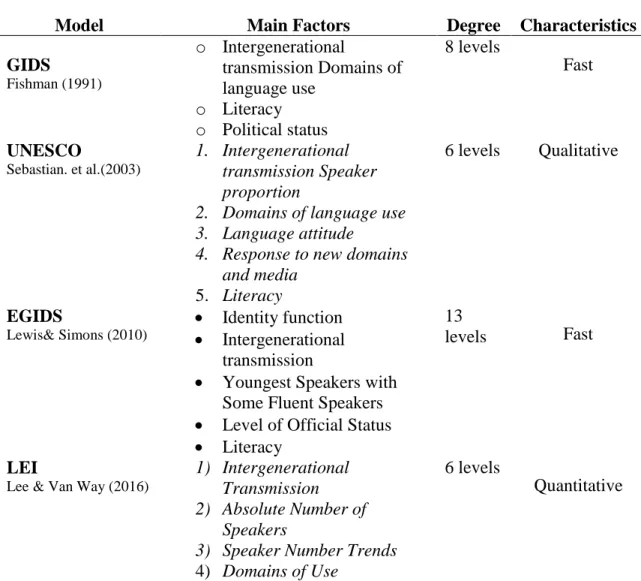
Assessing the vitality of endangered language is a prerequisite for the protection of endangered languages (Dorian, 1992). At the international level, there are many evaluating language vitality models, such as the eight-level Graded Intergenerational Disruption Scale or GIDS (Fishman,1991), the UNESCO’s nine factors assessing language vitality (Brenzinger, et al.,2003), the Expanded Graded Intergenerational Disruption Scale or EGIDS (Lewis, & Simons, 2010), and the Language Endangerment Index or LEI (Lee,& Van, 2016) . Table 4-1 shows the main assessment models of language vitality, which include both quantitative measures and qualitative analysis of various factors of language vitality.
GIDS is one of the very first language vitality methods which is still not very sound, for instance, GIDS has been criticized for failing to describe all possible states of a language adequately. It is a single-table language assessment tools with eight levels. The EGIDS Model improved correcting some of its problems and increased to 13 levels. The most advantages of EGIDS is helping to fast evaluate the language vitality, but because of including only 5 factors, actually, its assessment is still not very comprehensive. In 2003, the UNESCO put forward to the UNESCO’s Nine Factors. They are the qualitative analysis and they emphasizes the importance of different situations of speech communities. The sociological factors and internal factors also were considered, hence making the language evaluation more comprehensive. In 2006, based on UNESCO’s factors, a new model— LEI, was proposed by Lee and Van. They found the UNESCO Model had some
29
shortcomings, for instance, they thought someone cannot be sure if the type and quality of documentation directly affect the vitality of a language, and the result of UNESCO’s method can’t give an overall vitality score, making it difficult to compare accurately across different languages. This is because only the first factor in UNESCO’s list of nine factors appears to be utilized when comparing levels of endangerment across different languages in the online atlas. Therefore, based on the four most important factors and a calculation formula they considered, they put forward their own method, which quantifies the results of the language assessment thereby to achieve a comparison between different languages. However, the four factors of LEI purely relate to the current condition of language use of linguistics, so the assessment of language vitality is relatively single and does not give enough reference information.
Among all the models above, the UNESCO Model is considered the broadest method (Janhunen & Salminen, 1993; Moseley, 2010). Most of the vital research of China’s minority languages has adopted the UNESCO model. Actually, Due to China's particularity, some of the evaluation criteria are not very suitable for China’s national conditions. Chinese scholar Sun Hongkai once clearly pointed out that UNESCO's vitality indicators "are generally applicable, but some do not exactly match with China's situation" (Hongkai, 2006).
30
Table 4-1 Summary of the main language vitality assessment models (1) Fishman’s (1991) GIDS; (2) the UNESCO’s nine factors (Brenzinger et al., 2003); (3) Lewis and Simons’ (2010) Expanded Graded Intergenerational Disruption Scale (EGIDS); (4) Lee
and Van Way’s (2016) Language Endangerment Index (LEI).
Model Main Factors Degree Characteristics
GIDS Fishman (1991) o Intergenerational transmission Domains of language use o Literacy o Political status 8 levels Fast UNESCO Sebastian. et al.(2003) 1. Intergenerational transmission Speaker proportion
2. Domains of language use 3. Language attitude 4. Response to new domains
and media 5. Literacy 6 levels Qualitative EGIDS Lewis& Simons (2010) Identity function Intergenerational transmission
Youngest Speakers with Some Fluent Speakers Level of Official Status Literacy
13
levels Fast
LEI
Lee & Van Way (2016)
1) Intergenerational Transmission 2) Absolute Number of
Speakers
3) Speaker Number Trends 4) Domains of Use
6 levels
Quantitative
4.3.2 The previous Pumi language vitality assessment
With regard to the linguistic vitality assessment of Pumi language in the field of sociolinguistics, so far, there is very little related literature available. Almost all the relevant studies have a certain degree of one-sidedness to them. They generally paid attention to one or two factors as their criteria for assessing the language vitality of the Pumi language (Qingxia & Weidong, 1993; Weidong, 1996; Yan & Jialin, 2008; Yan,
31
2011). In this case, it is particularly important to put forward a comprehensive vitality assessment criterion for the Pumi language that suits China’s ethnicity conditions.
4.3.3 The factors of proposed Pumi language vitality assessment method
In this article, we conducted a comprehensive vitality assessment of the Pumi language in terms of the following criteria:
1) Sociological factors and sociolinguistic factors considered equally important. The sociological factors, such as language attitudes, geographic environment, and education expectation, affect language state and reveal the language future trend. Whereas the sociolinguistic factors, such as Intergenerational language transmission, Speaker Proportion, Language Proficiency and Domains of Language Use are merely the descriptions of the language current condition, which does not provide more information.
2) Community members’ attitudes towards their language and Education are expectation considered as two essential factors, which show the self-assessment and the mass foundation of language protection.
3) Ethnic distribution and Geographical Features and Traffic Conditions are two linguistic influence factors that are significantly constrained by the local Chinese conditions.
4) The speaker-related variables, such as age, are expected to show significant differences in language dynamism and therefore will be analyzed.
32
Consequently, we identify three factors to evaluate a language use condition, two factors to assess language attitudes, two factors for education expectation and two factors related to the particular location.
Therefore, after determining the most important impact factors of Pumi language vitality, this study compiled the following nine assessed factors for investigation and analysis: 1) Intergenerational language transmission. 2) Speaker Proportion & Language Proficiency. 3) Domains of language use. 4) Governmental language attitudes and policies. 5) Community members’ attitudes towards their own language. 6) Educational expectations. 7) Availability of materials for language education and literacy. 8) Ethnic distribution. 9) Geographical Features and Traffic Conditions.
4.4 Methodology
This study administered a questionnaire and conducted interviews (See details in Appendix A and B) to obtain the updated indicator information that is related to language vitality assessment. Then the statistical information of each indicator was analyzed. Moreover, finally, the endangerment degree of each indicator were evaluated for how they quantify according to the criterion of UNESCO’s Language Vitality and Endangerment framework for the Language Vitality of the Pumi language. Thus, this paper mainly includes three different research methods: first, the Literature Research Method where the researcher collects and analyzes literature to identify the terms, and clarifies a series of indicators that can be used to evaluate the vitality of the Pumi Language. Second, the Field Investigation and Statistical Analysis Method involves the researcher visiting the minority regions in China to collect data through semi-structured interviews and questionnaires and
33
then evaluate the Pumi language situation based on the statistical analysis of the field investigation datasets. Third, the Comparative Analysis Method involves comparing the situations in the different study areas (Xiagaoping Village and Luoguqing Village) to conclude the language vitality results and further get the reasons for the endangered language.
34
4.5 Questionnaires and Interviews
Table 4-2 The introduction of Pumi population (proportion) of four towns and their main investigated villages.
The investigation was carried out among Pumi people of Lanping town in Yunnan Province, China respectively in December of 2016 and in December of 2017(Table 4-2). In the case of the lack of investigation partners, harsh objective conditions and limited time, the survey finally received a total of 130 questionnaires and 12 interviews from 7 representative villages, which respectively are Shangshuifeng Village, Luoguqing Village, Dagumei Village, Ahuoji Village, Yushichang Village, Guadeng Village, and Xiagaoping Village. Among these seven villages, Luoguqing Village and Xiagaoping Village are our first investigated region, and the other five villages are the second. Figure 4.4 shows the diversity of gender, age, and educational background. The sample contains enough variety to judge it as a representative sample of the populations of the two villages. In the interview, the author emphatically visited 12 Pumi people, including village heads, civil servants, schoolteachers, reporters and Pumi culture heritage workers. They gave the comprehensive
Towns of Lanping county Pumi Population (Proportion) Investigated Village committee Investigated villages
Tongdian 5072 (14.4%) Longtang Shangshuifeng
Desheng Luoguqing
Hexi 7337 (44%) Dayang Dagumei
Lianhe Ahuoji
Jinghua Yushichang
Lajing 986 (4.1%) Guadeng Guadeng
35
introductions regarding the Pumi language situation and their opinion of the reasons for Pumi language endangerment and possible future countermeasures.
Figure 4.4 The background information of Pumi investigated respondents
4.6 Results and Discussion Using EGIDS and LEI Method
4.6.1 Expanded Graded Intergenerational Disruption Scale
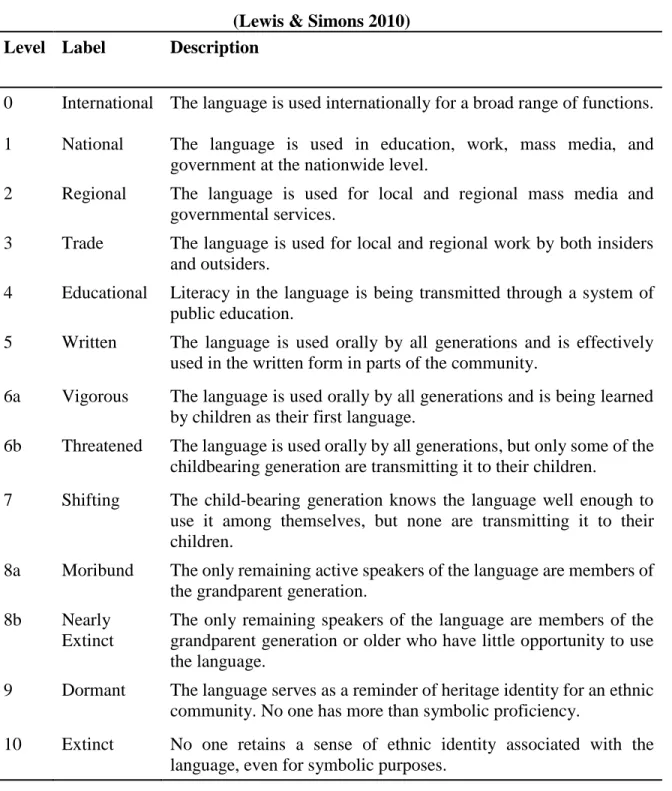
For a horizontal comparison of different methods, this paper also conducted fieldwork based on the EGIDS Method. The EGIDS addressed some critical problems, therefore, it is the Expanded Graded Intergenerational Disruption Scale of Fishman. As shown in the Table 4-3 below, there are 13 levels in it and the lower the level, the safer the language, and vice versa.
36
Table 4-3 Expanded Graded Intergenerational Disruption Scale Model
(Lewis & Simons 2010)
Level Label Description
0 International The language is used internationally for a broad range of functions. 1 National The language is used in education, work, mass media, and
government at the nationwide level.
2 Regional The language is used for local and regional mass media and governmental services.
3 Trade The language is used for local and regional work by both insiders and outsiders.
4 Educational Literacy in the language is being transmitted through a system of public education.
5 Written The language is used orally by all generations and is effectively used in the written form in parts of the community.
6a Vigorous The language is used orally by all generations and is being learned by children as their first language.
6b Threatened The language is used orally by all generations, but only some of the childbearing generation are transmitting it to their children.
7 Shifting The child-bearing generation knows the language well enough to use it among themselves, but none are transmitting it to their children.
8a Moribund The only remaining active speakers of the language are members of the grandparent generation.
8b Nearly Extinct
The only remaining speakers of the language are members of the grandparent generation or older who have little opportunity to use the language.
9 Dormant The language serves as a reminder of heritage identity for an ethnic community. No one has more than symbolic proficiency.
10 Extinct No one retains a sense of ethnic identity associated with the language, even for symbolic purposes.
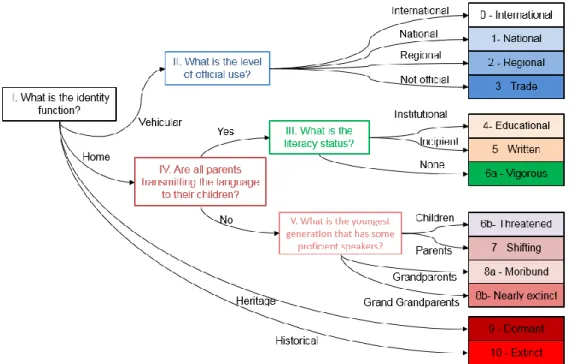
This article draws an EGIDS Diagnostic Decision Tree to make it easier to understand the EGIDS model and present its findings (Figure 4.4). Figure 4.5 shows the field survey results. In the question "What is the identity function", most people chose "Home", which means that family communication is the main function of the Pumi
37
language. Then, in the family, the dominant choice of "Are all parents transmitting the language to their children?” is "Yes". In this case, when they are answering the next question "What is the literacy status?" the vast majority of the remaining respondents selected "Incipient" from the three choices of "Institutional", "Incipient", and "None", which points to the level of "Written" . Based on the description of EGIDS Model, the "Written" refers to "the language that is used orally by all generations and is effectively used in the written form in parts of the community". It is obvious that this assessment is very inconsistent with the Pumi language without characters.
Figure 4.5 EGIDS Diagnostic Decision Tree (Lewis & Simons 2010)
38
Figure 4.6 Investigated results of Pumi language in EGIDS Diagnostic Decision Tree (Lewis & Simons 2010)
4.6.2 The Language Endangerment Index (LEI)
The Language Endangerment Index (LEI) is a model based on the UNESCO Nine Factors and it can be used to complete the quantity assessments of language vitality to compare different language situations. To ensure the certainty of the assessment results, it chose four factors that have universal significance. Among them, the intergenerational transmission was considered the most crucial factor. The LEI Model represents four factors on a scale of 0-5, where 0 is "safe," and 5 is "extremely endangered." Then the total score of the assessment is calculated based on an LEI calculation formula. Table 4-4 shows the degree and description of different factors of Language Endangerment Index and Table 4-5 is its formula for the final score and level of certainty based on the available evidence.
39
The following section will use the LEI model to assess the endangered level of the Pumi language based on the new data which was provided in the survey.
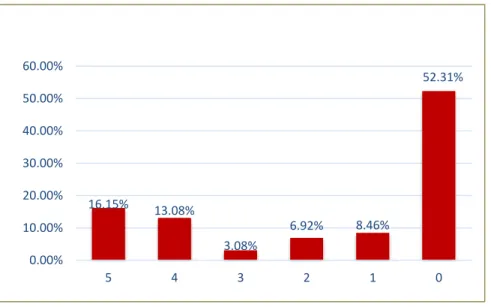
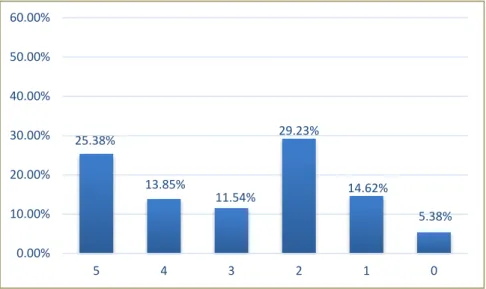
Figures 4.6 and 4.7 show that both factors of intergenerational transmission and speaker number trends show that the proportion of people who chose 0-degree (safe) is the highest, which exceeds 50 percent. Of course, the phenomenon of polarization also appeared -- the ratio of the 5 degrees (extremely endangered) are still highest in the remaining grades. Regarding the proportion of different degrees of domains of use in LEI (Figure 4.8), degree 2(Threatened), which is a little higher than the degree 5(extremely endangered), is the degree with the largest proportion of people. Therefore, Table 4-6 shows that regarding the level of certainty based on the available evidence, it is not possible to get an absolute number of Pumi language speakers from all Pumi language communities, which means only three of these factors can be determined, with 20 points possible (80% certain). Therefore, the calculated result is 45%. Correspondingly the LEI score interpretation (Table 4-7), the final assessment of the Pumi language is "endangered".
This final result reflects the conditional use of the Pumi language better than the EGIDS. However, due to limited evaluation factors selected, the results have a certain one-sidedness, and only show some aspects of the Pumi language in its linguistic scope.