Decentralization and Regional Disparities:
Experiences of OECD Countries and Explorations
of the Situation in China
著者
Li Meng
学位授与機関
Tohoku University
学位授与番号
11301甲第16711号
PhD Thesis
Decentralization and Regional Disparities:
Experiences of OECD Countries and
Explorations of the Situation in China
Legal and Political Studies
Graduate School of Law
Tohoku University
B2JD1010 Li Meng
ABSTRACT
Decentralization as a method for tackling regional disparities has been implemented in countries throughout the world in the last two decades. Some scholars have noticed that decentralization is a multi-dimensional concept. However, there is still no consensus about the dimensions’ selection. In this dissertation, based on the measurable and comparable principles, the relationships between three dimensions – fiscal, administrative and welfare decentralization – are considered, and the evolution of regional inequalities in OECD countries and in China are explored. Economic data of 26 OECD countries - 19 relatively rich countries, and 9 relatively poor countries - during the period from 1996 to 2009 was used to formulate regression models. It was found that fiscal decentralization, especially the decentralizing of tax authorities in relatively backward countries, has been associated with a significant rise in regional disparities. Moreover, according to the statistical results for the countries in the sample, welfare centralization and suitable local government size can lead to a reduction in regional disparities. In the case of China, data analysis and institutional analysis were paired in order to assess the dynamic relationships between decentralization and regional disparities (from the three dimensions mentioned above). An unstable, nonstandard and asymmetrical fiscal decentralization system directly results in regional disparities, which can be strengthened by a highly decentralized public service delivery system. In addition, rigid government size, segmented government structures and ‘yardstick’ competition mechanisms (used for creating competition among local governments) hinder coordination and cooperation in and among regions, and further exacerbate regional disparities.
CONTENTS
ABSTRACT ... I CONTENTS ... II LIST OF FIGURES ... IV LIST OF TABLES ... V ACKNOWLEDGMENTS... VII Chapter 1 Introduction ... 11.1 Reasons for the Research Project ... 1
1.2 Literature Review ... 3
1.3 Tentative Academic Innovations ... 14
1.4 Key Concepts ... 16
1.5 Structure of the Dissertation ... 35
Chapter 2 Decentralization and Regional Disparities: Experiences of OECD Countries ... 39
2.1 The paradigm shift of regional governance in OECD countries ... 39
2.2 Decentralization and Regional Inequality:Literature review ... 51
2.3 Measurement of Decentralization and Regional Inequality ... 54
2.4 Regression Model ... 60
2.5 Results and Advice ... 66
Chapter 3 Fiscal Decentralization and Regional Disparities: an Exploration of China ... 69
3.1 Fiscal Decentralization under the Strategy of Regional Balanced Development ... 71
3.2 Fiscal Decentralization under the Strategy of Regional Unbalanced Development ... 91
3.3 Fiscal Decentralization under the Strategy of Regional Balanced and Coordinated Development ... 106
3.4 Introspections on Fiscal Decentralization and Regional Development Based on the Exploration of China ... 124
Chapter 4 Administrative Decentralization and Regional Disparities: an Exploration of China ... 138
4. 1 Local Government size and Regional Balanced Development ... 140
4.3 Government Incentive Mechanism and Regional Balanced Development ... 184 4.4 Explorations and Reflections on Administrative Decentralization and Regional Development ... 203 Chapter 5 Decentralization of Public Services and Regional Disparities: an Exploration of China ... 215
5.1 Historical Changes of Chinese Public Service Supply Mode ... 219
5.2 Current Decentralization of Public Services and Regional Disparities . 232
5.3 Public Service Decentralization and Regional Development -
Exploration and Reflection ... 246 Conclusions ... 254 REFERENCES... 263
LIST OF FIGURES
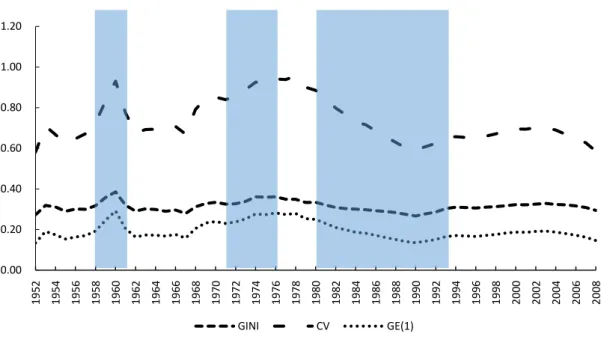
Figure 2-1 The administrative structure of the French regional planning ... 43 Figure 2-2 The relationship between the regional government and ERVET ... 50 Figure 3-1 Regional disparities and decentralization (blue shadow) of
china,1952-2008 ... 72 Figure 3-2 The Theil index of China’s urban and rural development during the fen zao chi fan period ... 104 Figure 3-3 The Theil index of China’s urban and rural development disparity between regions during the fen zao chi fan period ... 105 Figure 3-4 The relationship between the industrial tax rate, agricultural tax rate and GDP per capita of China ... 114 Figure 5-1 Proportion of China’s national fiscal expenditure on national
science, education, culture and health before the reform and opening-up policy era ... 223 Figure 5-2 Proportion of national fiscal expenditure on local science,
education, culture and health prior to the reform and opening-up era ... 224 Figure 5-3 Proportion of national fiscal expenditure on national science,
education, culture and health during the period of the financial contra ct ... 227 Figure 5-4 Proportion of national fiscal expenditure on local science,
education, culture and health during the era of “serving meals to different
diners from different pots” ... 227 Figure 5-5 Proportion of total expenditure on science, education, culture and health expenditures by provinces with net emigration, 1997- 2008 ... 245
LIST OF TABLES
Table 1-1 Different dimensions of decentralization and measurement methods ... 24 Table 2-1 Traditional top-down and new model bottom-up policies and
institutions ... 48 Table 2-2 Different measurement of regional inequalities of OECD countries: 1996-2000 ... 55 Table 2-3 Regional inequalities of OECD countries measured by population weighted CV and CV: 1996-2009 ... 57 Table 2-4 Correlations between different measures of inequality ... 58 Table 2-5 Correlation of Decentralization Measures Based on OECD Countries ... 60 Table 2-6 The impact of decentralization on regional inequality: cross-section regression ... 61 Table 2-7 The impact of decentralization on regional inequality: panel
regression ... 63 Table 3-1 Financial conditions of national and central government during the first fiscal decentralization... 79 Table 3-2 Amount of industrial enterprises and industrial output of provinces, 1957-1959 ... 81 Table 3-3 Financial conditions of the national and central government, during the first fiscal decentralization ... 84 Table 3-4 Amount of industrial enterprises and industrial output of provinces , 1970-1976 ... 87 Table 3-5 Comparison of state-owned industrial enterprises between the
coastal regions and third-line regions in 1978 ... 89 Table 3-6 The regional opening process during the 6th five-year plan ... 93 Table 3-7 The distribution of Investment in Fixed Assets during 7th, 8th and 9th five-year plan ... 95 Table 3-9 Different financial contract systems ... 98 Table 3-10 The financial condition of the national and central government during the third wave of fiscal decentralization ... 100 Table 3-11 Amount of industrial enterprises and industrial output of provinces from 1980-1993 ... 101 Table 3-12 The division of the revenue and expenditure boundary between the central government and local governments in the revenue-sharing System .. 108
Table 3-13 China per capita revenue gap between provinces after
revenue-sharing system ... 110
Table 3-14 The FDI comparison between cities with preferential tax policy and other cities, 1984-1991 ... 112
Table 3-15 The average tax rate of industrial enterprises within each region and province, 1998-2008 ... 113
Table 3-16 The average agricultural tax rate for each region and province of 1999 ... 115
Table 3-17 China per capita financial expenditure gap between provinces after revenue-sharing system ... 117
Table 3-18 Differences of regional financial expenditure structure after revenue sharing reform ... 119
Table 3-19 Overview of China’s transfer payment system after the reform of revenue-sharing system ... 120
Table 3-20 The conditions of provincial revenue and transfer payment acceptation in 1995 ... 122
Table 4-1 Fiscal size of local government in 2011 ... 152
Table 4-2 Number of public organization staff of provinces in 2011 ... 154
Table 4-3 Average salary of government officials and social staffs ... 157
Table 4-4 Non-tax revenue and administrative charges accounted to total budgetary revenue ... 161
Table 4-5 Chinese contiguous poverty-stricken area and involving provinces and cities ... 202
Table 5-1 Main expenditures of Chinese governments at all Levels ... 228
Table 5-2 Proportions of main national and local expenditures from 2010 to 2011 ... 230
Table 5-3 Proportion of regional public expenditure on science, education, culture and health across China in the total expenditure, 1997- 2008 ... 234
Table 5-4 HDI of all provinces/cities of China in 2010 ... 235
Table 5-5 Ranking of urban local government expenditure on education and science in 2009 ... 239
Table 5-6 Populations registered in other provinces based on educational status ... 242
ACKNOWLEDGMENTS
Writing this dissertation has been a difficult but enjoyable journey. I am highly indebted to my supervisor, INUZUKA Hajime-Sensei, who manages to give me precious advice at critical times. This dissertation would have never been accomplished without his perspicacious guidance and brilliant insights. I would like to thank the Professors who contribute to my understanding of academic
research and advised me along this journey: ONISHI Hitoshi and KABASHIMA
Hiroshi. I wish to thank School of Law, Tohoku University for giving me the precious opportunity to study at Sendai and for their useful and meaningful graduate classes and seminars. I would like to thank the entire faculty from whom I have learnt both academic and non-academic knowledge. I am also thankful for all the help from MISUMI Taeko-san.
Special thanks go to my Chinese supervisor, Professor Yang Haijiao. He is
like a stern but gentle father who give me so many assistance both at studying
and living. I would also like to thank Professor Zhao Xiuling and Professor Han Dongxue for their valuable instructions at the proposal stage. My appreciation also goes to Political Institute of Chinese Academy of Social Science.
Chapter 1 Introduction
1.1 Reasons for the Research Project
Internal regional disparities are common challenges, which are faced by almost all countries. Specifically in China, as a large country, there are major differences between regions, such as in terms of population, level of economic development, resource endowments, social culture and developmental potential. Regional disparities always present challenges for China’s policy makers. Since the foundation of the PRC (The People's Republic of China), regional balanced development has always been one of the most important strategic targets.
From the 1950s to the 1970s, the primary regional development strategy was based on heavy industry, which was learned and developed based on the Soviet Union model. The Chinese central government endeavored to redistribute industrial production, so as to reach a target of regional balance. Several resources were provided to the western regions and mountainous areas. One
typical project was the Third Front Movement ( 三線 建設 ).1 In general, the
efficiency of the regional developmental strategy led by the central government was inadequate. Much resource was wasted in the remote mountain areas; however, the factories, roads and other infrastructure improvements located in the western and mountainous regions laid the foundation for the future development of the less developed regions.
Because of these inefficiencies, the regionally balanced development strategy was changed to one targeting an imbalanced development. Mr. Deng Xiaoping proposed the idea of “two overall situations” (2 つの戦略), which meant that most resources should be applied to the eastern region in order to establish firmly the development of the eastern region first. Afterwards, through the industrial gradient transfer, the eastern region should then be expected to
1 Notes: “Third Front” is a geo-military concept. It was motivated by national defence considerations .The Third Front
Movement was a massive industrial development by China in its interior which started in 1964. It involved large-scale investment in national defense, technology, basic industries (including manufacturing, mining, metal, and electricity), transportation and other infrastructure investments.
selflessly support the development of the western region. Led by this imbalanced development strategy, China’s overall GDP grew rapidly; however, the regional development gap enlarged rapidly.
To ease the economic contradictions and in order to reduce the gap between the eastern and western regions, policy makers then decided to implement the
“regional coordinated development strategy” at the beginning of the 21st
Century. This is based on the “grand western development” (西部大開発 ) program, with the developmental focal point now being transferred from the eastern region to western and other regions. A significant amount of fiscal and other resources were transfused into the western region. Much strategic infrastructure was built in order to enhance the linkage between the eastern and western regions, including highways, railways, transmission lines and gas pipelines. Thus, the widening trend of regional disparities was successfully
curbed.2 Until now, the new coordinated development strategy has displayed some
positive effects.
However, the regional convergence trend is slow compared to the rapid expansion which took place over the past three decades; these regional disparities reflect a long-term risk for China’s future development. In addition to the regional economic development gap, various other new challenges have begun to appear. Firstly, the need for capital, human resources and other factors of production continues to increase in the eastern region. Secondly, even though the regional economic data reflects a trend of growth, the quality of public service has not significantly improved in drawback regions. Thirdly, there is an un-constructive competitiveness between different regions which wastes resources; also the coordinating mechanisms still exhibit no significant effects.
According to the regional governance experience of OECD countries in the 1980s, large-scale regional programs, financial transfer payments and infrastructure construction led by the central government may not produce the real and anticipated effects of regional balancing.3 The top-down regional intervention policy cannot be
2 Wang, X., & Fan, G. (2004). Analysis on the Regional Disparity in China and the Influential Factors. Economic
Research Journal, 1, 33-44.
3 Roura, J. R. C. (2011). Regional development policies in OECD Countries. Investigaciones Regionales, (19),
fully adapted to the diversity of different regional problems and the new and ongoing issues emerging in this globalized world. Thus, many OECD countries have attempted to move away from top-down regional intervention policy to a regional governance model, by decentralizing relevant powers to localities or regions. This decentralizing model is thought to have several advantages, such as encouraging innovation, maintaining a closer relationship with the citizenry, and promoting democracy. The aim is for the regional gap to be erased by the process of positive and progressive regional competition.
Overall, the regional challenges now faced by China are similar to the problems that were faced by OECD countries in the 1980s. An important question facing the Chinese scholars and policy makers is now whether China should extrapolate from the experience of OECD countries and so convert the centralized model to a decentralized model. Some scholars postulate that the decentralized regional governance model may tend to undermine the control of the central government, intensify the regional contradictions and eventually even threaten the unity and harmony of China.4 Some other scholars posit that decentralization can stimulate local governmental momentum by stimulating creative development, encouraging voluntary interaction and cooperation between local governments, and benefit the
coordinated development strategy. 5
There is no consensus. Thus, based on the experience of OECD countries and the exploration of related issues in China, in this dissertation, possible answers are presented to the following questions: first, should China apply a decentralized model in order to more effectively manage increasingly complicated regional issues? Second, what category of powers should be decentralized, and what authority or powers should be centralized?
1.2 Literature Review
1.2.1 Theories about Regional Development: from Centralization to Decentralization
4 Wang, S., & Hu, A. (1999). The political economy of uneven development: The case of China. ME Sharpe. 5 Landry, P. F. (2008). Decentralized authoritarianism in China. Cambridge University Press, p31.
Regional development is often a focus of academic research. Natural resources and human activities are distributed across different places, which cause particular disparities between different regions. Before the industrial revolution, natural factors, such as the condition of the land, the distance from the transport hub and the distance between production sites and consumer sites, accounted for the main reasons for regional differentiation, which were determined by the actual cost of production, transportation and trade. Some regions became central, while others became the marginal areas, which eventually led to the “Regional Autocracy” and caused regional inequalities.6
After the industrial revolution, the effect of natural factors on regional issues was weakened, due to the increase in production efficiency, and the lower costs of production and improvements in transportation systems. However, the divisions in the production system and the expansion of industries became the novel factors which also affected various regional issues. In some regions, those where more industries were located, people, as well as capital, became the central players within these systemic divisions, while other regions became, more or less, vassals to the centre. Regional inequalities grew sharply during the industrial era. The “edge-central” structure became a nigh-universal phenomenon affecting most industrialized countries.
Currently, in today’s globalized world, the older regional disparities have not disappeared, but have also spread all over the world with the expansion of transnational corporations, the international flow of capital and the development of an international division of labor. In the processes of global competition, only a few regions have the opportunity to succeed, such as the metropolitan areas, the new industrial areas, as well as scenic areas.7 The old transport hubs, industrial regions, agriculture areas and resource extraction areas have tended gradually to lose their competitiveness, while the polarization of regional development appears to be irreversible.
6 Pike, A., Pose, A. R., & Tomaney, J. (2006). Local and regional development. Routledge.
7 Taylor, P. J., & Walker, D. R. F. (2001). World cities: a first multivariate analysis of their service complexes. Urban
From the industrial era to the age of globalization, there is ever a key question for scholars to investigate: that of regional disparities. Economists were among the first who have tried to answer this question and, in the beginning, they were not interested in the regions within the sovereign state. They regarded the state as a collective unity, where the factors relating to production could be assumed to flow freely. Thus, to them, there were no issues relating to differences between regions. The primary question, the one to which they paid close attention, was in the competition between countries; this was their primary concern.
Based on this understanding, David Ricardo proposed the theory of comparative advantage.8 Since the theory of comparative advantage could not be used to adequately explain the differences between the regions in a country, some scholars then tried to add the cost of transportation to the analysis and so they proposed the location theory.9 Although the location theory concentrates its attention upon regions, the focal point is on micro-enterprises, instead of on the macro-regional economy.
At the beginning of the industrial era, the most significant issue was on the optimal siting of industrial enterprises. However, with the advance of the industrial revolution, some old industrial bases in industrialized countries began to show signs of decline and various new industrial centers began to appear. Regional inequalities were aggravated, due to the Great Depression in the 1930s. Since the location theory could not either to explain or address the regional issues, scholars proposed regional theories systematically, by combining the space thought from location theory and other economic theories, such as trade theory, price theory, transaction cost theory, and so on. Thus, the focus of their studies transferred from micro-enterprises to macro-regions. Typical theories include the following:
(1) Regional balanced development theory, based on neoclassical economics.10 The theory assumes that the factors of production are able to flow freely between regions; thus, seeking a high return on investment, which can lead to a reverse flow of capital and labor force. The mechanism of reverse flow will drive towards regional
8 Hunt, S. D., & Morgan, R. M. (1995). The comparative advantage theory of competition. The Journal of Marketing,
59(2), 1-15.
9 North, D. C. (1955). Location theory and regional economic growth. The Journal of Political Economy, 64(2),
243-258.
10 Barro, R. J., Mankiw, N. G., & Sala-I-Martin, X. (1995). Capital mobility in neoclassical models of growth. The
convergence in the long term. Thus, the methods utilized to promote regional equality are to reduce market regulation, and to encourage the free flow of labor through selective regional assistance.
(2) Regional unbalanced development theory is based on Keynesian economic theory. The theory argues that “regional income will tend to diverge, because of market forces, if left to their own devices, are spatially dis-equilibrating. Economies of scale and agglomeration of capital, labor, and output in certain regions at the expense of others: uneven regional development is reinforcing rather than self-correcting”.11 Regional convergence cannot completely rely on the market, but must
rely on other factors, such as comprehensive regional aid and regional intervention from the central government. Active regional policy and large-scale infrastructure construction are seen as good policy choices.12
(3) Regional development theories of structural and temporal change. The theories are different from neo-classical and Keynesian theories, as they present regional development as being neither a convergent nor a divergent process, but as historical changing processes. “Theories have used metaphors of stages, cycles and waves to conceptualize the geographically uneven character of local and regional development.”13 One of the leading theories of structural and temporal change is the
regional development theory; based on Marxism. Uneven spatial division of labor and geographical fragmentation leads to the differences between core and peripheral regions.14 With the change of production structure and methods, the uneven spatial divisions change episodically, as is seen in the shifting of industry from the north eastern ‘rustbelt’ to the southern and western ‘sunbelt’ of the United States.
(4) Regional development theories are based on new institutionalism. Former regional development theories are primarily concerned with macro-spatial and macro-structural issues. These related studies have considered regions as units, which have no internal differences. Therefore, the specific and particular attributes of localities and regions become neglected in the longer term. Due to particular
11 Martin, R., & Sunley, P. (1998). Slow Convergence? The New Endogenous Growth Theory and Regional
Development. Economic Geography, 74(3), 201.
12 Armstrong, H., & Taylor, J. (2000). Regional economics and policy (3rd edn). Oxford: Blackwell, p211. 13 Pike, A., Pose, A. R., & Tomaney, J. (2006). Local and regional development. Routledge, p78.
14 Massey, D. B. (1995). Spatial divisions of labor: Social structures and the geography of production. Psychology
drawbacks, some scholars have argued that it is the differences in institutional environments and arrangements between regions which results in the disparities in economic performance.15 Thus, the formal and informal institutions are taken as the
foundation of local economic capabilities and potentials, and as the basis of local and regional competitiveness. The regional theories, based on institutionalism, have a clear microscopic orientation. Local networks, social trust, social capital, regional innovation, historical trajectories and institutions16 are key words used in the theories. The methods for correcting regional inequalities do not rely on central government's macro-control and comprehensive intervention, but instead they rely on decentralizing power to the localities and stimulating the innovation of institutions in order to foster momentum and inspire an enhanced innovation capacity.
(5) Throughout the last two decades, many other new theories have been introduced in response to increasingly complex regional issues. For example, endogenous growth theory does not consider factors of production as being external or exogenous, but as being endogenous and ‘spill-overs’. Therefore, the regional development policy is no longer considered one of redistribution from rich regions to backward regions, but as the common development of both the growing and
under-performing regions.17 Also, sustainable development has become an important idea
and has had a significant impact on regional policy. By challenging the economic-central notion of previous regional theories, sustainable development theory argues that social inequalities, ecological crises, and environmental problems are equally important as income inequality. “Local and regional quality of life can vary substantially even when places appear to have similar levels of GDP per capita and
income”.18 Therefore, the scholars who support sustainable development, not only
seek economic growth, but also seek a more harmonious, equitable and sustainable relationship between person and person, region and region, people and environment, as well as the well-being of present and future generations.19 The key notions of
15 Martin, R. (2000). Institutional approaches in economic geography. A companion to economic geography, 77-94. 16 Cooke, P., Gomez Uranga, M., & Etxebarria, G. (1997). Regional innovation systems: Institutional and
organisational dimensions. Research Policy, 26(4), 475-491.
17 Aufhauser, D. D. (2003). Terrorist financing: foxes run to ground. Journal of Money Laundering Control, 6(4),
301-305.
18 Pike, A., Pose, A. R., & Tomaney, J. (2006). Local and regional development. Routledge, p114.
19 Hudson, R., & Weaver, P. (1997). In search of employment creation via environmental valorization: exploring a
regional sustainable policies are health, happiness, education, top-down, grass-root, localization, self-reliance and mutual aid.20 Recently, post-developmentalism theory has challenged the popular notion of “development” based on capitalism. Contemporary “development” has posited that “eurocentrism” or western industrialization is the “one-best-way’ or the only route to adequate development.21
The values, rights and diversities of backward regions and countries are neglected and constrained. Therefore, the aspirations by this theory aim toward de-westernization, decentralization, empowering, grass-root leadership, self-identity and locally appropriate forms of development.
Historically, the theories about regional disparities have undergone major change since the 1800s. Recently, scholars have begun not only to pay attention to regional economic issues, but also to those of social justice, environment crises, welfare inequality, human rights and diversified development paths. Policies to correct uneven regional development are not only reliant upon the use of top-down redistribution and intervention by central government, but also on local networks, regional partnerships, grass-roots democracy, citizen participation and multi-level governance. In general, the latest theories appear to be compatible with decentralization or devolving power to regional, local, civil society, citizens or to other lower-level organizations, as an effective method in order to confront the increasingly complicated regional issues, such as those mentioned above, including new institutionalism, sustainable development, post-developmentalism, and endogenous theories.
1.2.2 Models to Reach Regional Equality: centralization vs decentralization Even though there are many theories about regional issues, contemporary nation states principally use the following methods to achieve regional balanced development.
(1) The model of allocation of productive forces is based on absolute centralization. Productive forces is a central idea in Marxism, which covers all the factors applied
20 Chatterton, P. (2002). 'Be Realistic: Demand the Impossible'. Moving Towards' Strong’ Sustainable Development in
an Old Industrial Region? Regional Studies, 36(5), 552-561.
21 Gibson‐Graham, J. K. (2005). Surplus possibilities: post development and community economies. Singapore
by people in the production process, such as human labor, tools, machinery, land, infrastructure. In order to manage regional disparities, some countries - particularly the Soviet Union and other socialist countries - tried to evenly redistribute the productive forces nationwide, by means of a planned economy.22 The model has many remarkable features, such as absolute centralization, absolute obedience of local government of regional development plans enacted from the central government. By using the structure of the productivity model, many comprehensive resources can be gathered and redistributed in a short period of time. The backward regions can then gather sufficient labor force, capital, technology and other resources to sufficiently create the foundations for further development, without the need for cooperation by the wealthy regions.
However, the disadvantages of the model are distinct. The disciplines of the market, the differences between regions, the real needs of specific regions and the creativity of the local population are neglected. The subjective regional development plans cannot be used to fulfill the diverse needs of different regions, which may then lead to the waste of resources. According to the experiences in the Soviet Union and China during that economic period, the price of allocation of productive forces was too high to realize regional equality. Although this model had been proved to be ineffective, it had a significant impact on many countries’ regional policies, including western capitalist countries. Before the 1980s, regional policy had been conducted as a top down instrument of central government in most of the developed countries. Financial aid, transfer payment, infrastructure construction and other large-scale public investments were the main methods used to correct regional disparities.23 Since the 1980s, large allocations of money for regional programs became unaffordable in times of economic recession and financial austerity. Therefore, some countries began to change from a model of top-down intervention to the bottom-up approach. Although new forms of policy have proved to be more effective, the options of financial aid, investment in infrastructure and other classical methods of allocating productive forces, are still on the list of many countries’ policy options. The methods
22 Dian-hua, W. (2006). Changes of theory in Russian productivity layout and meaning to china. Economic
Geography, 26(6), 908-911.
23 Author, S. (Ed.). (2009). Regions matter: Economic recovery, innovation and sustainable growth. OECD
of redistribution and assistance have shifted from a planned economy to a market economy, from subjective decisions to scientific planning.
(2) The model of the welfare state, with the trend toward decentralization. The central idea of this model is welfare equality. The central government should formulate policies for universal welfare standards and supply the relevant support mechanisms, such as funding, justice, institutions, and human resources. This model presents a scenario where it is a near impossible task to realize equity of economic development levels. Therefore, the principal way to eliminate regional disparities is through welfare equality, which can offer the same rights and opportunities for each citizen, which can facilitate the elimination of locational differences. Otherwise, smoothing out the regional economic disparities may raise serious questions regarding efficiency losses, viciousness of competition, regional conflicts and other similar policy failures. By using the model of the welfare state, these questions can be avoided, and the state can strengthen national identity, maintain national unity,
and promote democracy through welfare equality.24 Generally, the welfare state is
connected closely to the notion of centralization, where the central government dominates the policy process and distributes the resources equally, and local and regional governments are in a subordinate position.
In practice, many welfare states are federal states, such as Switzerland and Germany. Decentralization is a common trend for welfare countries. Though different countries’ local governments have different functions and powers, most local governments implement the welfare policies established by the central government.25 The autonomy of local governments are strictly constrained and supervised by the central government. The model of the welfare state employs a different approach, so as to avoid the pitfalls of reshaping the economic landscape. The effects of narrowing regional developmental inequalities are also clear; however, many scholars have concluded “regional productivity differences prove to be the
main determinant behind observed welfare inequality in the European context.”26
24 Pierson, P. (1994). Dismantling the welfare state? Reagan, Thatcher and the politics of retrenchment. Cambridge
University Press, p3.
25 Sellers, J. M., & Lidström, A. (2007). Decentralization, local government, and the welfare state. Governance, 20(4),
609-632.
26 Ezcurra, R., Gil, C., & Pascual, P. (2005). Regional welfare disparities: the case of the European Union. Applied
Though the welfare model is a positive one for promoting human equality, alleviating regional disparities and strengthening national identities, this model does not confront the differences in regional productivity, as it’s focus is on the treatment of the symptoms and not the root cause. Moreover, the welfare state model is dependant on the ability to develop economic policies effectively, while redistributing resources fairly, and continually collecting high taxes. In an age of economic slowdown, aging populations, a high cost of supplying welfare, and with forces tending towards localisation, the welfare state model is facing many challenges. Indeed, many scholars have predicted that the golden age of the welfare state now is over.27 The crises impacting upon the welfare state are not confined to financial crises, for there are also structural crises.28 Furthermore, the justification, reasonableness and fairness of the welfare model are questioned by neo-liberalism and other -isms.29
(3) The model of federalism. Sub-national units, such as provinces, states and cantons are the central component of this model. The sub-national units should have comprehensive autonomous powers, such as the direct election of leaders, independent administration, tax powers and a financial authority. These units are also responsible for promoting economic development, supplying public services, distributing resources and providing welfare, while the responsibilities of the central government are redistribution and coordination. The supporters of federalism argue that regional disparities are inevitable and also represent normal phenomena in the
development of human society. 30 Because of information asymmetry, the
interventions from central government may intensify regional disparities and cause various other new problems. Therefore, the responsibilities of the central government are to guarantee the normal operation of the regional market and the free movement of production factors. The mechanisms of regional competition, market and voting will achieve the dynamic equilibrium of regional development.31 In contrast to the
27 Pierson, P. (1994). Dismantling the welfare state? Reagan, Thatcher and the politics of retrenchment. Cambridge
University Press.
28 Wahl, A. (2011). The rise and fall of the welfare state. Pluto Press.
29 Hong, Z. (2001). Where Will the Welfare States Go? Social Sciences in China, 3, 009.
30 Oates, W. E. (1999). An essay on fiscal federalism. Journal of economic literature, 37(3), 1120-1149. 31 Martin, R., & Sunley, P. (1998). Slow Convergence? The New Endogenous Growth Theory and Regional
welfare state model, which advocates equality and universality, the federalism model stands for the values of diversity and efficiency.
Within the framework of federalism, the fiscal federalism theory, which can be used in unitary and centralized countries, has been widely discussed and considered since the 1970s.32 Fiscal federalism emphasizes the autonomy of power over tax and spending of the sub-national units; this is not a comprehensive autonomy. The financial competitions between regions not only enhance national economic efficiency, but also promote diversified development and supply, as well as diversified public services. The main functions of the central government are transfer payment and redistribution, which can guarantee that all regions have an approximate financial income per capita and equal access to public services.33 Theoretically, the model of federalism has some of the above mentioned advantages; however, the preconditions of this model - such as free competition, free movement of people, equal development opportunities, and equal political rights - are difficult to achieve thus the issue of regional economic inequality is difficult to correct using this particular model. Furthermore, the issue of welfare disparity between regions may deteriorate, because of a weak central government and the lack of a redistribution capacity. Thus, centralization - particularly fiscal centralization - is now a common trend in federal countries.
There are no simple distinctions between the above models. Therefore, countries always use more than one model to control and manage regional issues during particular times. Historically, every model has had some positive effects on correcting regional disparities. However, as discussed above, the defects of each model are also clear and apparently insurmountable. In the era of globalization, regional development is not only affected by central and local governments, but also by individual entrepreneurs, enterprises, firms, NGOs, international organizations, multinational corporations and international financial institutions, which originate from both within and outside national boundaries.34 A country cannot solely rely on
32 Ter-Minassian, M. T. (Ed.). (1997). Fiscal Federalism in Theory and Practice. International Monetary Fund. 33 Oates, W. E. (2005). Toward a second-generation theory of fiscal federalism. International Tax and Public
Finance, 12(4), 349-373.
34 Cheema, G. S., & Rondinelli, D. A. (2007). Decentralizing governance: emerging concepts and practices.
central government or any other single body and policy to effectively deal with the increasingly complicated regional challenges. Moreover, because of successive economic recessions and budget restraints after the 1980s, large allocations for regional programs and subsidies have become unsustainable and effectively invalid.35
The ambitious target of reducing regional disparities has been changed to a less distinct target - “regional competitiveness”. Regional growth and regional coordination are more favored by many national governments over regional redistribution; this policy approach reflects a new trend of decentralization to regional and local levels. Decentralization is considered to be flexible, inclusive, effective and adaptive. Decentralization can be used to stimulate endogenous development, exploit regional potential, and foster innovation-oriented initiatives with a relatively low cost factor. “Decentralization for past one and half decade or so has become the most favored policy priority among the policy makers”.36 The
paradigm of decentralization is widely adopted by western developed countries, such as Finland, Sweden, Switzerland, Canada, Australia, Japan.37 Some scholars have determined that “decentralization in high income countries has, if anything, been linked with a reduction of regional inequality”.38
However, some other scholars have argued that decentralization can increase regional disparities. They have determined that “the conclusion that emerges from both the analytical and empirical research is that national budgets tend to reduce regional disparities.”39 In general, most scholars and policy makers support this new
and high-potential model, and increasingly more developing countries have begun the process of decentralization under the influence of international organizations and developed countries. “The phenomenon is geographically widespread, occurring simultaneously in Latin America, Africa, Asia, and Eastern Europe”.40 However,
35 Roura, J. R. C. (2011). Regional development policies in OECD Countries. Investigaciones Regionales, (19),
205-208.
36 Sharma, C. K. (2006). Decentralization dilemma: measuring the degree and evaluating the outcomes. The Indian
Journal of Political Science,67(1), 49-64.
37 Author, S. (Ed.). (2009). Regions matter: Economic recovery, innovation and sustainable growth. OECD
Publishing, p51.
38 Rodríguez-Pose, A., & Ezcurra, R. (2009). Does decentralization matter for regional disparities? A cross-country
analysis. Journal of Economic Geography, 619–644.
39 Prud'Homme, R. (1995). The dangers of decentralization. The World Bank Research Observer, 10(2), 201-220. 40 Bardhan, P. K., & Mookherjee, D. (2006). Decentralization and local governance in developing countries: a
whether the model of decentralization can be used in order to ease the regional conflicts and reduce regional disparities in developing countries is still an unresolved question.
1.3 Tentative Academic Innovations
Through the literature review presented above, the global trend of decentralization is clear, not only according to theoretical research studies and reports, but also regional governance practices. However, there remains no general consensus on the relationship between decentralization and regional disparity, although much research has been done to investigate this relationship as a topic. For example, Calamai states that he had identified a clear relationship between the process of devolution and the reduction of spatial inequalities in a case study on Italy.41 In the case of the EU, the centralization trend has fostered a catching-up by lagging countries and has reduced the overall range of disparities.42 Other researchers have also presented the view that decentralization can reduce regional disparities; examples include Costa-Font’s research on Spain,43 and Albrechts’ research on Belgium.44
However, other researchers have denied finding a positive relationship between decentralization and regional disparities. Bonet’s research on Colombia revealed strong evidence that the fiscal decentralization process has led to an increase in regional income disparities.45 Chakravorty’s research on India,46 and Hill’s research on Indonesia and the Philippines also supported this conclusion. As for China, most researchers state that a strong central government is the key factor in reducing regional disparities. For example, Fan et al. suggest that the fiscal decentralized
comparative perspective (Vol. 1). The MIT Press, p1.
41 Calamai, L. (2009). The link between devolution and regional disparities: evidence from the Italian regions.
Environment and Planning. A, 41(5), 1129.
42 Geppert, K., & Stephan, A. (2008). Regional disparities in the European Union: Convergence and agglomeration.
Papers in Regional Science, 87(2), 193-217.
43 Costa-Font, J. (2010). Does devolution lead to regional inequalities in welfare activity? Environment and Planning.
C, Government & Policy, 28(3), 435.
44 Albrechts, L. (2001). Devolution, regional governance and planning systems in Belgium. International Planning
Studies, 6(2), 167-182.
45 Bonet, J. (2006). Fiscal decentralization and regional income disparities: evidence from the Colombian experience.
The Annals of Regional Science, 40(3), 661-676.
46 Chakravorty, S. (2000). How Does Structural Reform Affect Regional Development? Resolving Contradictory
process, with the reforms and opening-up, may be an important reason for the increased regional disparities.47 From the examples mentioned above, it can be seen that there is still no consensus regarding the relationship between decentralization and regional disparities based on case studies. Some scholars have presented a valid answer by using cross-countries’ data.
However, the same conflicting conclusions are apparent across the different research studies. For instance, after analysing data collected from 14 developing and developed countries, Shankar and Shah 48stated that decentralized countries perform better in restraining regional disparities. Ecurra et al. studied 26 developing and developed countries, and concluded “for the whole sample decentralization is completely dissociated from the evolution of regional disparities.” 49
One of the reasons why these studies came to different conclusions is directly related to the definitions of decentralization and inequalities. Scholars still have not reached a basic agreement on the meaning of and measurement methods for decentralization. Most scholars regard fiscal decentralization as the entire concept of decentralization. Even here researchers diverge on how to measure the “fiscal” issue. Some scholars use local expenditure as a proportion of total expenditure as a measure of fiscal decentralization, while others use local revenues as a proportion of total revenue as the same measurement task. Furthermore, there are confusion and conflicting views over the meaning of decentralization, such as the difference between decentralization and democratization; the correlation and divergence between decentralization; deconcentrating; and devolution and federalism.
Thus one of the tentative innovations of this study has been to define a clearer definition of decentralization, based on the rules on what is measurable, inclusive, and accurate. Specifically, in this dissertation, the opinion that decentralization is a multidimensional concept is presented. This concept includes basic structural
47 Fan, S., Kanbur, R., & Zhang, X. (2011). China's regional disparities: Experience and policy. Review of
Development Finance, 1(1), 47-56.
48 Shankar, R., & Shah, A. (2003). Bridging the economic divide within countries: A scorecard on the performance of
regional policies in reducing regional income disparities. World Development, 31(8), 1421-1441.
49 Ezcurra, R., Gil, C., & Pascual, P. (2005). Regional welfare disparities: the case of the European Union. Applied
Economics, 37(12), 1423-1437. Ezcurra, R., & Pascual, P. (2008). Fiscal decentralization and regional disparities:
evidence from several European Union countries. Environment and Planning A, 40(5), 1185. Rodríguez-Pose, A., & Ezcurra, R. (2009). Does decentralization matter for regional disparities? A cross-country analysis. Journal of
dimensions such as fiscal decentralization, administrative decentralization, welfare decentralization, and political decentralization. Each of these dimensions can be evaluated by data collated in national statistics.
Another reason why scholars cannot reach a consensus on the relationship between decentralization and regional disparities is because of the complexity and diversity of each country’s conditions. There are different effects of liberal democracy on different countries. Likewise, decentralization, as a recent development concept, in practice is based on different reasonings, and follows different evolutionary processes and targets towards different goals. For example, the decentralizing process in most of the developed countries is an active and ongoing adjustment which is used in order to meet the challenges of economic slowdown and centrally-set fiscal austerity. The aims of decentralization are to increase the effectiveness and competitiveness of regional development. However, in some developing countries, decentralization is a passive choice because the central government lacks adequate control over local governments or regions.
The goals of decentralization are to strengthen national identity and raise people’s faith in central government. Due to the differences in levels of development and types of systems, decentralization will produce different results. The above case studies and transnational data analyses on this topic led to distinct conclusions. Therefore, another aim of this study was to draw conclusions after combining findings from transnational data analyses and case studies. First, the effects of decentralization in OECD countries was checked, based on transnational data. Then the results were tested via a comparative analysis of the situation in China. It should be noted that the case study of China was evaluated using both data analysis, and a study of the historical evolution of its decentralizing system.
1.4 Key Concepts
1.4.1 Debates around Decentralization
Over the past two decades, decentralization has been a significant topic among scholars and policy makers: “Almost everyone has been in favor of it, from the centralized French to the already decentralized Germans; from the majoritarian
British to the consensual Danes and Dutch; from the West (USA) to the East (Japan), and from the North to the European South (Italy) and, indeed global south (New Zealand)”,50 among both developed countries and developing countries.51 In
addition, decentralization also has been supported by different political factions. In many countries, decentralization programs are supported by political coalitions of right-wingers in order to reduce the excessive intervention of the central government, to strengthen the role of market mechanisms, and to reduce the cost of various welfare programs.52 In other countries, such as Spain and the UK, decentralization is supported by left-wing parties since they seek an enhancement of regional autonomous powers, e.g. abolition of charges for social care.53
There are many reasons presented in support of decentralization. The most common reason is that decentralization can be used to transfer power nearer to the people, promote the quality of democracy, and make the politicians more visible and accountable.54 From the perspective of political administration, decentralization is able to significantly reduce the hierarchies of government, raise the responsiveness of policies, and inspire innovations.55 Another common argument in support of decentralization is that a decentralizing system can increase the efficiency of resource allocation and the rate of economic growth.56 Furthermore, since some countries are affected by localization forces, they have undergone a passive decentralization process. Some scholars have concluded that “it can promote a sense of autonomy in citizens, enhance social order by promoting the legitimacy of the state, and limit pressures for separatism by diverse regions or ethnic groups”.57 Supporters of
decentralization argue that this system is able to curtail long-standing regional
50 Pollitt, C. (2005). Decentralization. A central concept in contemporary public management. The Oxford Handbook
of Public Management, 371.
51 Grindle, M. S. (2007). Going local: decentralization, democratization, and the promise of good governance.
Princeton University Press.
52 Costa-Font, J. (2010). Does devolution lead to regional inequalities in welfare activity? Environment and Planning.
C, Government & Policy, 28(3), 435.
53 Keating, M. (2002). Devolution and public policy in the United Kingdom: Divergence or convergence. Devolution
in Practice: Public Policy Differences within the UK, 3-21.
54 Kaufmann, D., Kraay, A., & Zoido-Lobatón, P. (2000). Governance matters. Finance Dev, 37(2), 10. 55 Balaguer-Coll, M. T., Prior, D., & Tortosa-Ausina, E. (2010). Decentralization and efficiency of local
government. The Annals of Regional Science, 45(3), 571-601.
56 Martinez-Vazquez, J., & McNab, R. M. (2003). Fiscal decentralization and economic growth. World
Development, 31(9), 1597-1616.
57 Bardhan, P. K., & Mookherjee, D. (2006). Decentralization and local governance in developing countries: a
inequalities.58 Competitive and decentralized institutions tend to lead people to view regional inequalities and divergences as a “necessarily unjust”59 feature in long
historical processes.
Criticisms about decentralization abound. Prud'Homme60 summarized the dangers
of decentralization. First, decentralization can increase disparities, because of unequal development at the starting point, destructive competition, missing or limited redistribution capabilities, and failure of regional coordination systems. Second, decentralization can jeopardize macro-economic stability brought about by the selfishness and exclusiveness at a local government level and by various special interest groups. Third, decentralization can undermine efficiency, since there are too many players within the fragmented system, and each of them will do their best to deter any policy which may harm their interests, rather than enhance collective welfare. Fourth, decentralization may lead to widespread corruption. Elitist control is easier at local and regional levels than at the central level, where the politicians and bureaucrats can succumb to the pressures and inducements of local special interest groups. Also, stable interest networks are easier to establish at lower levels. Moreover, some scholars have argued that it is difficult to adequately define the location of responsibility in a decentralized system as there are too many reasons and opportunities offered for “blame-shifting”.61
There remains no consensus about the specific functions of decentralization. One reason for this may be the complexity of the definition of decentralization. Historically, the conception of decentralization emerged after the Second World War, when most Western countries tried to centralize governmental power, so as to establish a universal welfare system and implement comprehensive economic projects. During this period, decentralization was not a popular concept. However, because of economic stagflation and financial austerity during the 1970s, most governments had to decentralize their hierarchical structures and transfer more
58 Pollock, A. M. (1999). Devolution and health: challenges for Scotland and Wales. BMJ: British Medical
Journal, 318(7192), 1195.
59 Costa-Font, J. (2010). Does devolution lead to regional inequalities in welfare activity? Environment and planning.
C, Government & Policy, 28(3), 435.
60 Prud'Homme, R. (1995). The dangers of decentralization. The World Bank Research Observer, 10(2), 201-220. 61 Pollitt, C. (2005). Decentralization. A central concept in contemporary public management. The Oxford Handbook
powers to local administrations, in order to reduce the cost of public services. The decentralizing process was focused on three methods during this time: deconcentration, devolution, and delegation.62
“Deconcentration sought to shift administrative responsibilities from central ministries and departments to regional and local administrative levels by establishing field offices of national departments and transferring some authority for decision-making to regional field staff. Devolution aimed to strengthen local governments by granting them the authority, responsibility, and resources to provide services and infrastructure, protect public health and safety, and formulate and implement local policies. Through delegation, national governments shifted management authority for specific functions to semiautonomous or parastatal organizations and state enterprises, regional planning and area development agencies, and multi- and single-purpose public authorities.”63
After the 1980s, due to the rising effects of globalization and democratization, decentralization was met with a new and popular appeal, as people increasingly desired for an end to authoritarian control of central government; and wanted democracy, a market economy, privatization, and development of local
government.64 Decentralization had also been connected with other concepts, such
as democracy and market reforms.65 Moreover, there was a rising profile of some
regional groups - such as ethnic, political, linguistic, religious and cultural groups - who began to fight for autonomous powers. Thus the drive towards decentralization was linked with local and regional autonomy. More importantly, in the age of globalization, powers now began to evolve into nation states with both international organizations and local organizations.
More activities were established and implemented at the local and regional levels.
62 Rondinelli, D. A., McCullough, J. S., & Johnson, R. W. (1989). Analysing decentralization policies in developing
countries: a political‐economy framework. Development and Change, 20(1), 57-87.
63 Cheema, G. S., & Rondinelli, D. A. (2007). Decentralizing governance: emerging concepts and practices.
Brookings Institution Press, p2.
64 Bird, R. M., Ebel, R. D., & Wallich, C. (Eds.). (1995). Decentralization of the socialist state: Intergovernmental
finance in transition economies. World Bank Publications.
65 Schneider, A. (2003). Decentralization: conceptualization and measurement. Studies in Comparative International
Foreign Direct Investment (FDI), international aid, global production chains and transnational exchanges strengthened local power. Decentralization has therefore become a popular institutional framework where different facets can cooperate together and establish new types of governance networks; and so decentralization has come to be connected with good governance. On the one hand, the proliferation of practices in decentralization has allowed this concept to prosper. On the other hand, there are so many meanings attached to this concept that it is difficult to coin a clear definition of decentralization.66 This is the reason why there are many opposing views over decentralization.
Scholars have taken a variety of different approaches in their attempts to redress the confusion associated with the different meanings of decentralization. However, researchers must first of all form a basic consensus on the meaning behind this concept. Schneider states that, “although there is disagreement about the meaning of decentralization, most would agree that transferring power and resources to national governments is not decentralization”.67 Macmahon investigated the meaning of decentralization from its Latin roots, which means “away from the centre”.68 Second,
researchers must acknowledge the diversity of meanings associated with this concept, since decentralization describes a process of spreading a higher authority to a lower level.
In practice there are many different methods that can be used to decentralize powers. Any single dimension, such as fiscal decentralization, cannot be taken to represent all the various dimensions of this complex concept. For example, Cheema and Rondinelli discussed four forms of decentralization: administrative, political,
fiscal, and economic. 69 Treisman defined and distinguished six types of
decentralization: vertical decentralization, decision-making decentralization, appointment decentralization, electoral decentralization, fiscal decentralization, and personnel decentralization.70
66 Treisman, D. (2002). Defining and measuring decentralization: a global perspective. Unpublished manuscript. 67 Schneider, A. (2003). Decentralization: conceptualization and measurement. Studies in Comparative International
Development, 38(3), 32-56.
68 Macmahon, A. W. (1962). Delegation and autonomy. Asia Publishing House, p15.
69 Cheema, G. S., & Rondinelli, D. A. (2007). Decentralizing governance: emerging concepts and practices.
Brookings Institution Press, p4.
70 Treisman, D. (2007). The architecture of government: rethinking political decentralization. Cambridge University
Third, the definition of decentralization should be one that is quantitative or measurable. A central reason for the conceptual confusion over decentralization is that there is no clear, reliable and commonly recognized measurement standard. In future research, “some basic questions about definitions and measurement need to be asked”.71
In general, decentralization is a complex concept which is utilized in different fields, such as sociology, economics, management science, political economics, and political science. In different research studies, across different countries and even between different languages, it has different meanings. 72At the most basic level,
decentralization is a process of transferring power from the traditional center of power, such as the central government (versus local government), government (versus society), state (versus market), and top management of a company (versus lower levels of a company), to the lower level, in order to bring the focus closer to the people, citizens or work practices. In political science, scholars have not reached a generally accepted consensus, which has led to some conceptual confusion. For example, in some studies, democratization and market-oriented reform are included in the definition of decentralization,73 but in other studies it is only taken to mean the more narrow definition of fiscal federalism theory, a system in which local expenditure is performed by the local government, and is based on local taxes.74
For this research project and dissertation, the meaning of decentralization is confined to the relationship between the central and local governments. The report focuses on the powers transferred from a central government to a local government. Nonetheless, even when using this limited definition, it is difficult to confidently measure the degree of decentralization. This is because there are many and diverse conditions in different countries; so researchers in the field tend to adopt different indexes and methodologies in order to evaluate the different dimensions of
71 Rodden, J. (2004). Comparative federalism and decentralization: On meaning and measurement. Comparative
Politics, 482.
72 Pollitt, C. (2005). Decentralization. A central concept in contemporary public management. The Oxford handbook
of public management.
73 Balaguer-Coll, M. T., Prior, D., & Tortosa-Ausina, E. (2010). Decentralization and efficiency of local
government. The Annals of Regional Science, 45(3), 571-601. Fukasaku, K., & de Mello, L. R. (Eds.). (1999). Fiscal
decentralisation in emerging economies: governance issues. OECD Publishing.
74 Davoodi, H., & Zou, H. F. (1998). Fiscal decentralization and economic growth: A cross-country study. Journal of
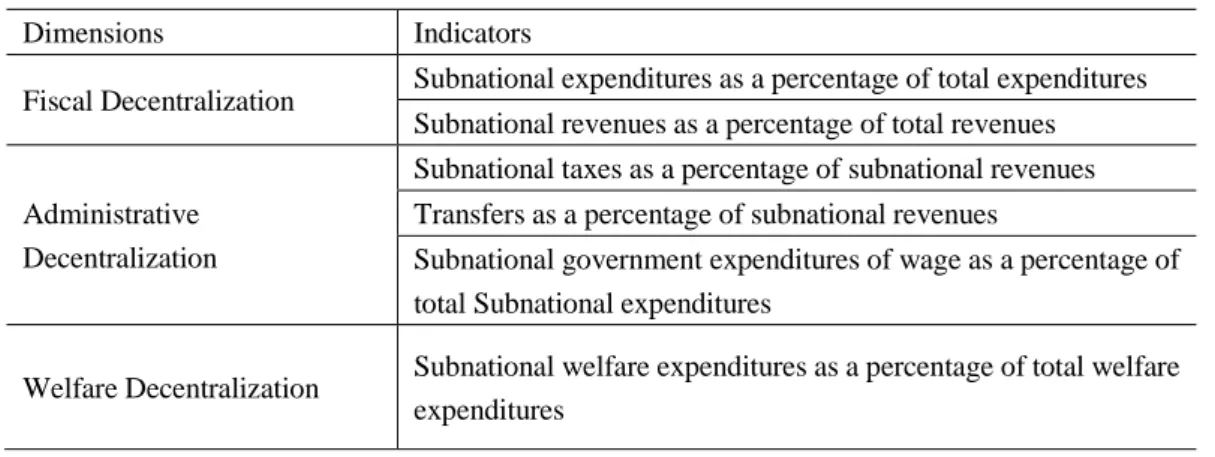
decentralization. According to the literature surveys by some scholars, 75 decentralization can always be reduced to fiscal decentralization, which then can be measured easily through economic statistics. The share of subnational expenditures and revenues in total are considered to be the best indicators.76 However, other scholars have argued that this is problematic when used to describe decentralization by only using expenditure or revenue-based data.77 Such data cannot be used to
determine whether the economic rights are controlled by the local government. Therefore, some scholars argue that a multi-perspective view on the concept should
be developed in order to overcome conceptual confusion.78
Within recently published research, almost all the scholars agree on the limitation of using “classical” decentralization measures, which are based solely on fiscal data. However, there are other problems. What dimensions should be included? What standards should be adopted for selecting dimensions? Schneider suggested that political, administrative and fiscal dimensions should be considered, 79but other scholars consider only the political and economic dimensions of decentralization.
80 Lessmann states that the measures should reflect de jure and de facto
decentralization.81 The institutional factors should not be ignored in the analysis, for example, whether a federal constitution exists (1) or does not exist (0) in a country; or the number of tiers in the country’s vertical structure.82
Given these overall descriptions above, it can be viewed that an economic dimension is the baseline for evaluating the degree of decentralization, even though this cannot cover all aspects of decentralization. Therefore, in this research study, the economic dimension, or more precisely, the fiscal dimension was taken to be the primary factor used to assess the condition of decentralization of OECD countries
75 Sharma, C. K. (2006). Decentralization dilemma: measuring the degree and evaluating the outcomes. The Indian
Journal of Political Science, 67(1), 49-64.
76 Voigt, S., & Blume, L. (2012). The economic effects of federalism and decentralization—a cross-country
assessment. Public Choice, 151(1-2), 229-254.
77 Schakel, A. H. (2008). Validation of the regional authority index. Regional and Federal Studies, 18(2-3), 143-166. 78 Schneider, A. (2003). Decentralization: conceptualization and measurement. Studies in Comparative International
Development, 38(3), 32-56.
79 Schneider, A. (2003). Decentralization: conceptualization and measurement. Studies in Comparative International
Development, 38(3), 32-56.
80 Rodríguez-Pose, A., & Ezcurra, R. (2011). Is fiscal decentralization harmful for economic growth? Evidence from
the OECD countries. Journal of Economic Geography, 11(4), 619-643.
81 Lessmann, C. (2009). Fiscal decentralization and regional disparity: evidence from cross-section and panel
data. Available at SSRN 936874.