Synthesis and Properties of Isolable
Unsaturated Organosilicon Compounds Protected
by a Bidentate Alkyl Group Featuring
3,5-Di-tert-butyl-4-methoxyphenyl Group
著者
Kobayashi Ryo
学位授与機関
Tohoku University
博士論文
Synthesis and Properties of Isolable Unsaturated Organosilicon Compounds
Protected by a Bidentate Alkyl Group
Featuring 3,5-Di-tert-butyl-4-methoxyphenyl Group
(
3,5−ジ−tert−ブチル−4−メトキシフェニル基を有する二座アルキル基
によって立体保護された単離可能不飽和有機ケイ素化合物の合成と性質)
東北大学大学院理学研究科化学専攻
小林 良
Contents
Page Chapter 1. General Introduction
1 Chapter 2. Synthesis and Structure of an Isolable Dialkylsilanone with a Genuine Si=O Bond
7 Chapter 3. Reactions of an Isolable Dialkylsilanone
41 Chapter 4. Synthesis and Properties of an NHC-stabilized Disilavinylidene
149 (Compounds are independently numbered in each chapter.)
Abbreviations Me: methyl Et: ethyl Ph: Phenyl t-Bu: tert-butyl i-Pr: isopropyl TMS: trimethylsilyl
NMR: nuclear magnetic resonance Mes*: 2,4,6-tri-tert-butylphenyl THF: tetrahydrofuran MTHP: 4-methyltetrahydropyrane DMAP: 4-(dimethylamino)pyridine KC8: potassium graphite NHC: N-heterocyclic carbene ItBu: 1,3-Di-tert-butylimidazol-2-ylidene
Chapter 1.
General Introduction
Whether silicon can form compounds similar to carbon or not has been a question for scientists since the development of the periodic table.1-4 In contrast to the organic compounds, most of unsaturated silicon compounds (e.g. silicon analogues of alkenes (disilenes), ketones (silanones) etc.) are highly reactive because the multiple bonds that involve silicon atom are weaker than carbon.5 Thus, the isolation of such silicon compounds had been regarded as impossible task until
the early 1980’s. However, West demonstrated the isolation of disilene 1 by utilizing steric protection in 1981 (Figure 1).6 Since this seminal study, various low-coordinate and unsaturated silicon compounds such as disilene, silylene and disilyne stabilized by kinetic stabilization and/or thermodynamic stabilization have been synthesized.7-10 These isolable silicon compounds enable us to reveal their characteristic properties and understand the nature of silicon compounds. Thus, the development of elaborate molecular design has been continued to open up new chemistry. It is very important task though challenging.
Figure 1. Examples of first isolable unsaturated silicon compounds that were stabilized by a
well-designed protecting group.
Our group isolated unsaturated silicon compounds such as silylene 4 by utilizing 1,1,4,4-tetrakis(trimethylsilyl)butane-1,4-diyl group A.11 4 is essentially stabilized by the steric demand of A, and hence 4 possesses unperturbed two-coordinate silicon atom that exhibit intrinsic properties of silylene.12 Furthermore, protecting group A enable us to isolate related silicon
unsaturated compounds and to reveal their structure and properties (Figure 2).13 Though A successfully provided many insights into the unsaturated silicon compounds, there is a room to improve; for instance, the steric demand of A is not enough in the case of isolable silanones (silicon analogues of ketones).14 N Si N t-Bu t-Bu Si Si Si Si i-Pr(Dsi)2Si Si(Dsi)2i-Pr Dsi = CH(SiHMe)2 2 1 3
Figure 2. Structure of 1,1,4,4-tetrakis(trimethylsilyl)butane-1,4-diyl group A and isolable
unsaturated silicon compounds protected by A
Inspired by the design of protecting group A, the author came up with the utilizing 3,5-di-tert-butyl-4-methoxy phenyl group that are more bulky and robust than silyl group. In this work, the author developed new protecting group: 1,1,4,4-tetrakis(3,5-di-tert-butyl-4-methoxy phenyl)butane-1,4-diyl group B and applied it for the isolation of unsaturated silicon compounds 10 to 13 that have not been isolated yet (Figure 3). Through the successful synthesis of unsaturated silicon compounds 10 to 13 by utilizing protecting group B and the exploration of their nature, the author clearly showed the usefulness of new protecting group B and confirmed that the elaborate molecular design open up new chemistry.
Figure 3. Structure of 1,1,4,4-tetrakis(3,5-di-tert-butyl-4-methoxy phenyl)butane-1,4-diyl group B
and isolable unsaturated silicon compounds protected by B
In chapter 2, the author describes the successful synthesis and structure analysis of the first isolable dialkylsilanone 11 that contains a genuine Si=O bond protected by B. The background, molecular design, and detailed synthesis of 11 from silylene 10 were described in this chapter.
In chapter 3, the author describes the reactions of silanone 11 which reflect the highly polarized nature of the genuine Si=O bond in 11.
In chapter 4, the synthesis and properties of an NHC-stabilized disilavinylidene 12 were
Si TMS TMS TMS TMS TMS TMS TMS TMS A 4 Si TMS TMS TMS TMS 5 Ch = S, Se, Te Ch Si TMS TMS TMS TMS 6 R = 2,6-diisopropylphenyl R = 1-adamantyl C NR Si Si TMS TMS TMS TMS TMS Si Si TMS TMS TMS TMS TMS 7 Si TMS TMS TMS TMS Si t-Bu Ar 8 Ar = 1-Napthyl Ar = 1-Phenanthryl Ar = 1-Anthryl TMS TMS TMS TMS Si TMS TMS TMS TMS Si Si 9 t-Bu
MeO t-Bu t-Bu OMe
t-Bu
t-Bu
MeO t-Bu t-Bu OMe
t-Bu Si Ar Ar Ar Ar Si Si Si Ar Ar Ar Ar Ar Ar Ar Ar Si Si Ar Ar Ar Ar Si N N t-Bu t-Bu Si Ar Ar Ar Ar O B 10 11 12 13 OMe t-Bu t-Bu Ar =
described. The author proved that the designed protecting group B is applicable for the isolation of another unsaturated silicon compounds such as 12. During this study, a new tetrasilicon analogue of bicyclo[1.1.0]but-1(3)-ene, 13, were also obtained.
Reference
1 C. Friedel, J. M. Crafts, Ann. Chim. Phys. 1866, 9, 5–51.
2 F. S. Kipping, L. L. Lloyd, J. Chem. Soc. Trans. 1901, 79, 449–459. 3 F. S. Kipping, J. E. Sands, J. Chem. Soc., Trans. 1921, 119, 830–847. 4 F. S. Kipping, Proc. R. Soc. London, Ser. A, 1937, 159, 139–148.
5 a) P. P. Power, Chem. Rev. 1999, 99, 3463–3503; b) R. West, Polyhedron 2002, 21, 467–676. 6 R. West, M. J. Fink, J. Michl, Science 1981, 214, 1343–1344.
7 M. Denk, R. Lennon, R. Hayashi, R. West, A.V. Belyakov, H.P. Verne, A. Haaland, M. Wagner, N. Metzler, J. Am. Chem. Soc. 1994, 116, 2691–2692.
8 A. Sekiguchi, R. Kinjo, M. Ichinohe, Science 2004, 305, 1755–1757.
9 Reviews for double and triple bond compounds of silicon, see: a) R. C. Fischer, P. P. Power,
Chem. Rev. 2010, 110, 3877–3923; b) T. Iwamoto, S. Ishida, Struct. Bonding (Berlin) 2014, 156
125–202; c) C. Präsang, D. Scheschkewitz, Chem. Soc. Rev. 2016, 45, 900–921; d) P. P. Power,
Chem. Commun. 2003, 2091–2101; e) M. Weidenbruch, Angew. Chem., Int. Ed. 2005, 44, 514–
516; f) A. Sekiguchi, M. Ichinohe, R. Kinjo, Bull. Chem. Soc. Jpn. 2006, 79, 825–832; g) E. Rivard, P. P. Power, Inorg. Chem. 2007, 46, 10047–10064; h) A. Sekiguchi, Pure Appl. Chem.
2008, 80, 447–457; i) M. Asay, A. Sekiguchi, Bull. Chem. Soc. Jpn. 2012, 85, 1245–1261.
10 Reviews for silylenes, see: P. P. Gaspar, R. West in The Chemistry of Organic Silicon
Compounds,Vol. 2, (Eds.: Z. Rappoport, Y. Apeloig), Wiley, Chichester, 1998, pp.2463–2568;
b) Y.Mizuhata, T. Sasamori, N. Tokitoh, Chem. Rev. 2009, 109, 3479–3511; c) M. Asay, C. Jones, M. Driess, Chem. Rev. 2011, 111, 354–396; d) B. Blom, M. Driess, Struct. Bonding
11 M. Kira, S. Ishida, T. Iwamoto, C. Kabuto, J. Am. Chem. Soc. 1999, 121, 9722–9723. 12 M. Kira, T. Iwamoto, S. Ishida, Bull. Chem. Soc. Jpn. 2007, 80, 258–275.
13 M. Kira, Chem. Commun. 2010, 46, 2893–2903.
14 T. Iwamoto, H. Masuda, S. Ishida, C. Kabuto, M. Kira, J. Am. Chem. Soc. 2003, 125, 9300– 9301.
Chapter 2.
Synthesis and Structure of
an Isolable Dialkylsilanone with a Genuine Si=O Bond
The contents of this chapter are published in part.
R. Kobayashi, S. Ishida and T. Iwamoto, Angew. Chem. Int. Ed. 2019, 58, 9425-9428. DOI: 10.1002/anie.201905198
In this chapter, the author has designed and synthesized the first example of an isolable silicon analogue of a ketone that contains an unperturbed Si=O double bond (Scheme 1). The author also succeeded in revealing the structure of the genuine Si=O bond by the single-crystal XRD analysis and DFT calculations. 1 has provided insight into the molecular and electronic structure as well as the properties of the unperturbed Si=O moiety, which should open new avenues in the chemistry of silicon analogues of carbonyl species. Moreover, 1 represents the missing member in the family of isolable compounds containing an unperturbed double bond between a group 14 element and a group 16 element such as an Si=S bond and a Ge=O bond.
The synthesis of 1 was achieved by the oxidation of cyclic dialkylsilylene 2 which was synthesized from 4-bromo-2,3-di-tert-butylphenol 3 (Scheme 1). The treatment of a solid of 2 with gaseous N2O at room temperature provided 1 in 100% yield as a white solid. The generation of 1
was confirmed by multinuclear NMR spectroscopy, high-resolution mass spectrometry (HRMS), elemental analysis (EA) and single-crystal XRD analysis.
Scheme 1. Synthesis of silanone 1.
OMe t-Bu t-Bu Br 4 84% Mg (2.0 eq.) THF, 2.0 M r.t., 2 h Ar Ar Ar OH Ar H3PO4 (10 eq.) toluene, 500 mM 80 °C, 18 h 6 71% 5 OMe t-Bu t-Bu Ar = EtOAc (0.5 eq.) 2.5 h OH t-Bu t-Bu Br MeI (2.0 eq.) KOH (2.5 eq.) DMF, 300 mM r.t., 16 h SiH2 Ar Ar Ar Ar 7 64% 1) Li (5.3 eq.) 2) Si(OMe)3H (1.5 eq.) 6 THF, 100 mM r.t. 9 h ICl (3.3 eq.) CCl4, 100 mM 0 °C, 1.5 h 8 62% Si Ar Ar Ar Ar I I KC8 (2.2 eq.) ether, 100 mM –10 °C, 5 days 3 Si 1 100% 2 71% N2O neat t-Bu
MeO t-Bu t-Bu OMe
t-Bu
t-Bu
MeO t-Bu t-Bu OMe
t-Bu
Si
t-Bu
MeO t-Bu t-Bu OMe
t-Bu
t-Bu
MeO t-Bu t-Bu OMe
t-Bu
The 29Si NMR resonance of the three-coordinate silicon nucleus in C
6D6 appears in the
low-field region (90.0 ppm, Figure 4).
Figure 4. 29Si NMR spectrum of 1 (C6D6, 500 MHz).
The IR spectrum of 1 was recorded in C6H6 to gain further insight into the structure of the
Si=O moiety; however, the band potentially assignable to the Si–O vibration was difficult to discern. Using DFT calculations, the calculated Si–O vibration frequency for the optimized structure of 1 (1opt; ~1168 cm–1) would overlap with the strong bands of the aryl groups (Figure 5a and b). The
UV-vis absorption spectrum of 1 in C6H6 exhibits strong π→π* transitions from the aryl moieties
(~300 nm), thus preventing the observation of the n(O)→π*(Si=O) transition band, which was predicted by DFT calculations to appear at ~260 nm (Figure 5c).
Figure 5. IR spectra of (a) 1 in benzene, (b) the simulated spectrum that was calculated at the
B3LYP-D3/6-31G(d) level of theory and scaled with a factor of 0.9613 and (c) UV spectrum of 1 (in benzene, c = 2.6 × 10⁻³ M, r.t.). –100 200 150 100 50 0 – 50 90.0 ppm ppm noise noise 1168 cm–1 (a) (b) 5000 0 350 400 450 500 nm 300 280 4000 3000 2000 1000 ℇ (L •mo l –1•cm –1) (c)
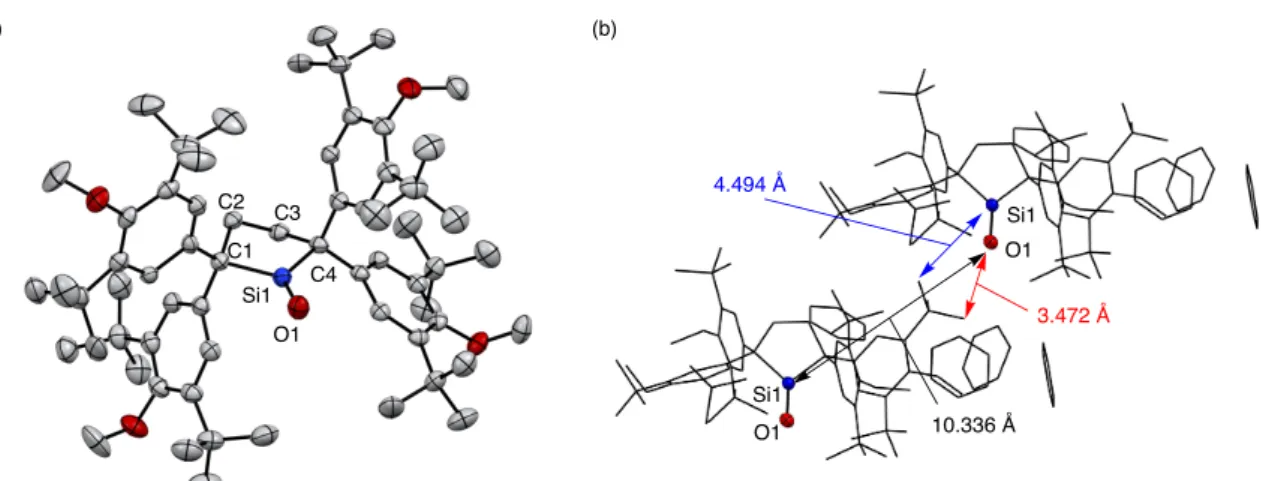
The molecular structure of 1 in the solid state was unequivocally determined by a single-crystal XRD analysis (Figure 6). The distances between the silanone Si and O atoms of the closest neighboring molecules [10.336 (2) Å] (Figure 6b) is much larger than the sum of the van der Waals radii of the Si and O atoms [Si+O: 3.40 Å]. The atoms intermolecularly closest to the Si1 and O1 atoms are carbon atoms in the t-Bu groups of a neighboring molecule, with distances [Si1···C: 4.494 (3) Å; O1···C: 3.472 (4) Å] that are significantly longer than the sum of the van der Waals radii [Si+C: 3.85 Å; O+C: 3.25 Å]. These results suggest that in the crystal, significant intermolecular interactions are absent between the Si=O moiety of 1 and its nearest neighbor or a molecule of C6H6. Accordingly, it is feasible to consider 1 as an isolated Si=O species. The angle
sum around the three-coordinate silicon atom [359.99 (14)°] indicates that the Si atom adopts a virtually ideal trigonal-planar structure. The Si–O distance [1.518 (2) Å] is much shorter than that in Si–O single bonds (1.63 Å) and represents the shortest hitherto reported Si–O bond for crystalline Si=O species with a three-coordinate silicon atom (1.526–1.543 Å). It is also very close to the Si–O bond length in H2Si=O (1.515 Å), which has been estimated based on the rotational spectroscopy.
Figure 6. Molecular structure of 1 in the solid state. a) Molecular structure of 1 with thermal
ellipsoids shown at 50%probability. b) Closest intermolecular contacts between the three-coordinate silicon atom and the terminal oxygen atom in the crystal. Hydrogen atoms are omitted for clarity. Selected bond lengths [Å] and angles [°]: O1–Si1 1.518(2), Si1–C1 1.887(3), Si1–C4 1.892(3), C1– C2 1.548(4), C2–C3 1.536(4), C3–C4 1.562(4); O1-Si1-C1 129.55(14), O1-Si1-C4 129.95(14), C1-Si1-C4 100.50(14), C2-C1-Si1 99.46(19), C3-C2-C1 110.3(2), C2-C3- C4 109.8(2), C3-C4-Si1 98.99(19). Si1 O1 C1 C2 C3 C4 (a) (b) 10.336 Å 3.472 Å 4.494 Å Si1 O1 Si1 O1
To obtain further insight into the nature of the Si=O bond in 1, DFT calculations were carried out on the optimized structure of 1 (1opt) at the B3LYP-D3/6-31G(d) level of theory. In 1opt,
the Si=O bond length (1.537 Å) and the angle sum around the three-coordinate silicon atom (359.9°) are in good agreement with those observed in the solid state [1.518 (2) Å; 359.99 (14) °]. The 29Si NMR chemical shift of 1 (90.0 ppm) was also reproduced well by gauge independent atomic orbital (GIAO) calculations on 1opt at the B3LYP/6-311+G(2df, p) level of theory (79.9
ppm). The HOMO-13, LUMO, and HOMO-8 orbitals correspond to the π- and π*-orbitals of the Si=O bond, as well as and the non-bonding orbital of the terminal oxygen atom, respectively (Figure 7). The natural population analysis of the charges at the silicon (2.08 e) and oxygen (−1.10 e) atoms of 1opt confirm a substantially polarized Siδ+–Oδ− bond, similar to those previously
predicted for other Si=O species. The results of these DFT calculations thus support the presence of a polar Si=O double bond in 1.
Figure 7. Selected Kohn-Sham orbitals of 1opt (a) HOMO–13 (No. 254, π(Si=O)), (b) HOMO–8
(No.259, n(O)), (c) LUMO (No. 268, π*(Si=O)) calculated at the B3LYP-D3/6-31G(d) level of theory.
Chapter 3.
Reactions of an Isolable Dialkylsilanone
The contents of this chapter are published in part.
R. Kobayashi, S. Ishida and T. Iwamoto, Angew. Chem. Int. Ed. 2019, 58, 9425-9428. DOI: 10.1002/anie.201905198
R. Kobayashi, S. Ishida and T. Iwamoto, Dalton Trans. in press. DOI: 10.1039/D0DT04240D
In this chapter, the author examined the reactions of 1 with various small molecules and investigated reactivity of the Si=O bond in 1. The bimolecular reactions of 1 with small molecules clearly indicate that the electron donation of the carbon-based substituents in 1 is substantially lower than that in the hitherto known base-coordinated Si=O species. Accordingly, the unperturbed Si=O moiety in 1 exhibits both an intrinsically high electrophilicity on the Si atom and nucleophilicity on the O atom of the genuine Si=O bond. Especially, 1 reacts with an ether to cleave the C-O/C-H bonds of the ether under mild conditions, which is in contrast to the fact that the electronically stabilized Si=O species are often synthesized in an ethereal solvent such as THF. The scope and mechanism of the reaction of 1 with ethers were revealed by experimental and theoretical studies.
1 readily reacts with hydrosilane, acetone, styrene and arylborane etc., indicating that the
intrinsic high reactivity of the Si=O bond (high electrophilicity of Si atom and nucleophilicity of O atom) remains in spite of the steric protection of the bulky substituent (Scheme 2).
Scheme 2. Bimolecular reactions of 1 with small molecule in benzene.
The reactions of 1 with ethers that contain methoxy, primary, secondary, or tertiary alkoxy
1 Si Ar Ar Ar Ar 3 51%* OH H Si Ar Ar Ar Ar OH OH 4 62%* Si Ar Ar Ar Ar OSiEtMe2 H 5 61%* Si Ar Ar Ar Ar OH O 6 63%* Si Ar Ar Ar Ar O 7 62%* EtMe2SiH H2O 1) LiAlH4 2) hydrolysis OMe t-Bu t-Bu Ar = in benzene *: NMR yield O Ar Ar Ar Ar Ar Ar Ar Ar O Si OSi heat in C6H6 2 59% Si Ar Ar Ar Ar O B(C6F5)2 C6F5 B(C6F5)3 9 69%* Si Ar Ar Ar Ar O Si Ar Ar Ar Ar OM Si Ar Ar Ar Ar MO KC8 or Na 8a: M = K, 28% 8b: M = Na, 14%
group were examined in C6D6 at room temperature (Table 1). In these reactions, the author observed
the formation of a dialkoxysilane, which is the formal product of the insertion of the Si=O moiety into the ethereal C–O bond, as well as alkoxysilanols and alkenes, which are the formal products of the C–O cleavage and the b hydrogen abstraction of the ether by the oxygen atom of the Si=O bond. The relative yields of these products are susceptible to the structure of the employed ether, especially the presence of the b C-H bonds and the steric hindrance around the a-carbon.
Table 1. Reactions of silanone 1 with ethers.
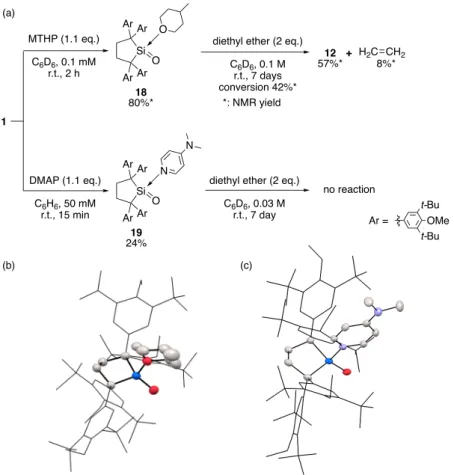
The reaction of 1 with 4-methyltetrahydropyran (MTHP), which is a rigid and bulky ether, provided the direct evidence for the formation of the ether complex of 1 as a key intermediate (Figure 8a). This reaction afforded 1:1 complex 18 as a sole product which was characterized by a combination of multinuclear NMR spectroscopy, high resolution mass spectrometry (HRMS), and single-crystal X-ray diffraction (XRD) analysis. The formation of 18 indicates that the coordination
Si Ar Ar Ar Ar OR’ OR’’ ether C6D6, 0.1 M r.t., 1 h Si Ar Ar Ar Ar O 1
Ether Product Yield
a Et OEt Ph O Et Ph O i-Pr MeO MeO t-Bu Ph OMe Si OEt OEt 11 32% 12 32% Si OEt OH Si OPh OEt 13 31% 14 23% Si OPh OH Si OPh Oi-Pr 15 10% 26%14 Si OPh OH Si OMe OH 16 64% Si OMe OH 16 26% H2C CH2 OH Si Si OPh OMe 10 67%
a The NMR yields were determined by integrals of 1H NMR spectra using
1,3,5-tri(t-butyl)benzene as an internal standard. b Reaction time: 1 day. c Reaction time: 5 h . d The reactions were performed at 0.09 M.
13% 52% 17 19% (1.3 eq.) (1.2 eq.) (1.2 eq.) (1.5 eq.) (1.6 eq.) (1.6 eq.) entry 1b 4b 5 6 3bd 2c not observed not observed dialkoxysilane alkoxysilanol OMe t-Bu t-Bu Ar = alkene
of the ethereal oxygen atoms to the three-coordinate electrophilic silicon atom in the Si=O bond should be the initial step of the reaction. The coordination of a typical strong donor, 4-(dimethylamino)pyridine (DMAP) to the Si atom of 1 also provides the proof of the aforementioned assumption (Figure 8a): the addition of DMAP to a benzene solution of 1 led to the quantitative formation of the DMAP complex of 1 (19) and pure 19 was isolated in 24% yield by recrystallization from benzene. The molecular structure of 19 was confirmed by preliminary XRD analysis (Figure. 8c). In contrast to 1, 19 did not react with diethyl ether, which confirms that the coordination of the ethereal oxygen atom to the Si atom of the Si=O bond is important to proceed the reaction. This is also consistent with the fact that the reactions of the electronically-stabilized isolable Si=O species and ethers have not been reported.
Figure 8. (a) Formation and reactions of silanone-Lewis base complexes 18 and 19. (b) and (c)
Molecular structure of 18 and 19 with thermal ellipsoids shown at 50% probability. Hydrogen atoms and solvents are omitted for clarity.
In contrast to 19, the reaction of 18 and diethyl ether (2 equiv.) in benzene proceeded very
1 DMAP (1.1 eq.) C6H6, 50 mM r.t., 15 min Si Ar Ar Ar Ar O 19 24% no reaction MTHP (1.1 eq.) C6D6, 0.1 mM r.t., 2 h Si Ar Ar Ar Ar O O 18 80%* 12 57%*
diethyl ether (2 eq.) C6D6, 0.03 M r.t., 7 day H2C CH2 8%* + N N
diethyl ether (2 eq.) C6D6, 0.1 M r.t., 7 days conversion 42%* (a) (b) *: NMR yield OMe t-Bu t-Bu Ar = (c)
slow compared with the reaction of 1. To our surprise, ethoxysilanol 12 and ethylene were gradually formed in 57% and 8% yield (conversion 42%) after 7 days and the formation of 11 was not observed. 12 was also preferentially formed in the reactions of 1 with diethyl ether under dilute conditions: when a benzene solution (0.01 mol/L) of 1 treated with diethyl ether, the yields of 11 (15%) and 12 (58%) was considerably changed from that obtained under the concentrated conditions [11 (32%), 12 (32%); Table 1, entry 2]. These results indicate that the concentration of an ether complex of 1 affects the selectivity of the reaction. As alkoxysilanols were obtained under both dilute and concentrated conditions, the formation of the alkoxysilanols should intramolecularly occur from the ether complex of 1. Conversely, the formation of dialkoxysilanes was significantly suppressed under dilute conditions, hence the intermolecular reaction between the ether complexes of 1 should mainly proceed. The intermolecular reaction to form the dialkoxysilanes was confirmed by the following crossover experiment. The reaction of 1 with a 1:1 mixture of ether/ether-d10
provided 11-d5 in addition to 11, 11-d10, 12, 12-d5, which were identified by HRMS analysis. The
exchange of the alkoxy groups during the reactions can be ruled out, as the reaction of diethoxysilane 11 and methoxysilanol 16 in the presence of 1 did not proceed at all. The reaction of
1-MTHP complex 18 with diethyl ether should start from the replacement of MTHP by diethyl ether
to form a diethyl ether complex of 1. Due to the low concentration of the ether complex, the intramolecular reaction products, 12 and ethylene, should be preferentially formed.
The reaction of 1 with THF afforded macrocyclic product 20 (21%), which is consistent with the formation of the corresponding THF complex of 1 (Scheme 3). 20 was isolated and fully characterized by a combination of multinuclear NMR spectroscopy, HRMS, elemental analysis and XRD analysis. When the reaction was carried out in benzene under diluted condition (0.05 mol/L), a complex mixture was formed and the yield of 20 decreased to 5%. 20 is considered to be formed from two molecules of the THF complex of 1. The formation of 20 and the concentration dependence of its yield also support that the dialkoxysilanes should be mainly formed via the intermolecular reaction of an ether complex of 1.
Scheme 3. The reaction of 1 with THF.
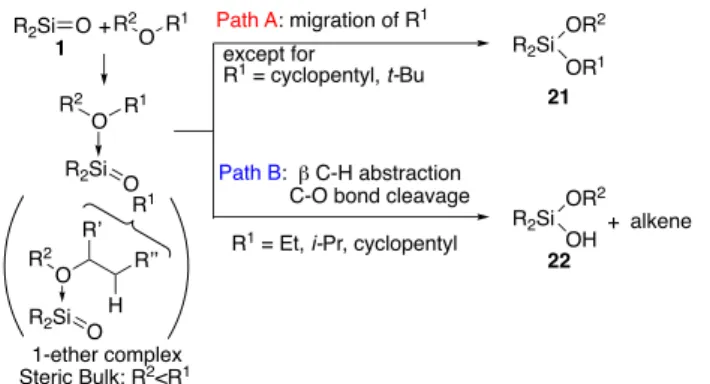
The possible mechanism for the reaction of 1 with ethers was depicted in Figure 9. As expected from the formation of base complexes 18 and 19, the initial step should be the coordination of the ethereal O atom to the Si atom of the Si=O bond to provide an ether complex of
1. The subsequent reactions provide a dialkoxysilane via the migration of an alkyl group (path A) or
an alkoxysilanol via the cleavage of C-O and b C–H bond with the elimination of an alkene (path B), which depend on the structure of the employed ether, especially the presence of the b C–H bond and/or the steric hindrance around the a-carbon. In the case of the ether that has less hindered alkyl group (Table 1 entries 1-3), the rearrangement of ether complex of 1 should proceed to provide dialkoxysilane 21 (path A). Path A should mainly proceed intermolecularly, as the formation of the dialkoxysilanes is substantially suppressed under diluted conditions and the intramolecular 4-endo-tet substitution is unfavorable. For an ether that possesses b C–H bonds, the cleavage of the C–O and b C–H bonds in the ether also occurs to afford alkoxysilanol 22 and alkene (path B). In contrast to path A, path B should proceed mainly intramolecularly because alkoxysilanol 22 was formed even under diluted conditions. As for the ether that contains a bulky a-carbon (Table 1 entries 4-6), path A should be suppressed, as the intra- and/or intermolecular migration of the alkyl group should be prohibited due to the steric demand. Although both cyclopentyl methyl ether and
tert-butyl methyl ether have less hindered methyl group (Table 1 entries 5-6), only methoxysilanol 16 was formed selectively. In both cases, when 1 forms a complex with the ether, the more bulky
alkyl group of the ether (R1 = cyclopentyl or tert-butyl, R2 = Me) should be oriented over the less-hindered terminal oxygen atom of the silanone, which should suppress path A to result in the
Si Ar Ar Ar Ar O 1 20 Si Ar Ar Ar Ar O O Si Ar Ar Ar Ar O O THF (2.1 eq.) in C6H6, r.t. THF conditions THF (excess, 118 eq.) r.t. yield of 20 21% 5%
selective formation of alkoxysilanol 22 probably via path B.
Figure 9. Possible routes for the reaction of 1 and an ether.
The formation of a dialkoxysilane as well as an alkoxysilanol and an alkene from the reaction of a silanone and an ether is also found theoretically by the DFT calculations of the more simple system such as dimethylsilanone (Me2Si=O) and ethyl methyl ether (Figure 10). After the
exergonic reaction to form the initial complex of Me2Si=O and ethyl methyl ether (23), which is
consistent with the formation of 10 and 11, two pathways, the migration of ethyl group affording ethoxylmethoxysilane 24 (path A) and the elimination of ethylene providing an methoxysilanol 25 (path B) are also exergonic with the moderate activation free energies (Figure. 10). Although, in reality, the steric effects of bulky substituents installed in silanone 1 and the corresponding intermolecular reactions should substantially contribute to the mechanism and selectivity for the reactions of 1 with an ether, the calculations of the model compounds indicate that the reaction of a silanone with an ether providing a dialkoxysilane as well as an alkoxysilanol and an alkene as observed for 1 is intrinsic to a genuine silanone.
Figure 10. A model reaction of Me2Si=O and ethyl methyl ether calculated at
B3LYP-D3/6-311G(d) level of theory (in benzene).
1 R2 OR 1 OR2 OH 22 Path A: migration of R1 + OR2 OR1 21 1-ether complex Path B: R2Si R2Si β C-H abstraction C-O bond cleavage
Steric Bulk: R2<R1
R1 = Et, i-Pr, cyclopentyl alkene
R2Si O except for R1 = cyclopentyl, t-Bu + R2 O R 1 R2Si O R2 O R2Si O R’ R’’ H R1 Si O O Me Me Me Me H H Si O H O Me Me Me (29.8) Me O OR2 OH 25 (–126.7) Path A + OR2 OR1 24 (–152.4) Path B Me2Si Me2Si alkene Me2Si O + Me2Si O Me Me O Me 23 (0.0) (137.7) (94.6)
Chapter 4.
In this chapter, synthesis and properties of an NHC-stabilized disilavinylidene were described. The author applied the designed protecting group of silanone to another silicon multiple bond and successfully isolated NHC-stabilized disilavinylidene 1. During this study, a new tetrasilicon analogue of bicyclo[1.1.0]but-1(3)-ene 3, were also obtained. Furthermore, we get first insight about the reactivity of heavier vinylidene to N2O. 1 showed both reactivities of double bond
and Si: moiety toward N2O and afforded a silicon analogue of an acetolactone (4) that was isolated
as a Lewis base and acid stabilized form.