Marriage as women's old age insurance :
evidence from migration and land inheritance
practices in rural Tanzania
著者
Kudo Yuya
権利
Copyrights 日本貿易振興機構(ジェトロ)アジア
経済研究所 / Institute of Developing
Economies, Japan External Trade Organization
(IDE-JETRO) http://www.ide.go.jp
journal or
publication title
IDE Discussion Paper
volume
368
year
2012-09-01
INSTITUTE OF DEVELOPING ECONOMIES
IDE Discussion Papers are preliminary materials circulated
to stimulate discussions and critical comments
Keywords:
Demography, Gender empowerment, Land ownership, Social custom, Social security, WidowhoodJEL classification:
J12, J14, K11, Q15, R23
* Research Fellow, Microeconomic Analysis Studies Group, Development Studies
IDE DISCUSSION PAPER No. 368
Marriage as Women's Old Age
Insurance: Evidence from Migration
and Land Inheritance Practices in
Rural Tanzania
Yuya KUDO *
Abstract
In a traditional system of exogamous and patrilocal marriage prevalent in much of Sub-Saharan Africa, when she marries, a rural woman typically leaves her kin to reside with her husband living outside her natal village. Since a village that allows a widow to inherit her late husband's land can provide her with old age security, single females living outside the village are more likely to marry into the village. Using a natural experimental setting, provided by the longitudinal household panel data drawn from rural Tanzania for the period from 1991 to 2004, during which several villages that initially banned a widow's land inheritance removed this discrimination, this study provides evidence in support of this view, whereby altering a customary land inheritance rules in a village in favor of widows increased the probability of males marrying in that village. This finding suggests that providing rural women with old age protection (e.g., insurance, livelihood protection) has remarkable spatial and temporal welfare effects by influencing their decision to marry.
The Institute of Developing Economies (IDE) is a semigovernmental,
nonpartisan, nonprofit research institute, founded in 1958. The Institute
merged with the Japan External Trade Organization (JETRO) on July 1, 1998.
The Institute conducts basic and comprehensive studies on economic and
related affairs in all developing countries and regions, including Asia, the
Middle East, Africa, Latin America, Oceania, and Eastern Europe.
The views expressed in this publication are those of the author(s). Publication does
not imply endorsement by the Institute of Developing Economies of any of the views
expressed within.
I
NSTITUTE OFD
EVELOPINGE
CONOMIES(IDE), JETRO
3-2-2, W
AKABA,
M
IHAMA-
KU,
C
HIBA-
SHIC
HIBA261-8545, JAPAN
©2012 by Institute of Developing Economies, JETRO
No part of this publication may be reproduced without the prior permission of the
IDE-JETRO.
Marriage as Women’s Old Age Insurance: Evidence from
Migration and Land Inheritance Practices in Rural Tanzania
∗
Yuya Kudo
†September 28, 2012
Abstract
In a traditional system of exogamous and patrilocal marriage prevalent in much of Sub-Saharan Africa, when she marries, a rural woman typically leaves her kin to reside with her husband living outside her natal village. Since a village that allows a widow to inherit her late husband’s land can provide her with old age security, single females living outside the village are more likely to marry into the village. Using a natural experimental setting, provided by the longitudinal household panel data drawn from rural Tanzania for the period from 1991 to 2004, during which several villages that initially banned a widow’s land inheritance removed this discrimination, this study provides evidence in support of this view, whereby altering a customary land inheritance rules in a village in favor of widows increased the probability of males marrying in that village. This finding suggests that providing rural women with old age protection (e.g., insurance, livelihood protection) has remarkable spatial and temporal welfare effects by influencing their decision to marry.
Keywords: Demography, Gender empowerment, Land ownership, Social custom, Social security, Widowhood
JEL classification: J12, J14, K11, Q15, R23
1
Introduction
Old age security is a global concern of paramount importance for men and women alike, in both developed and developing countries. Nonetheless, it has a far more serious impact on the welfare of women in the developing world, not only because social security programs provided by the government are often in their early stages in less advanced economies, but also due to the fact that, in such economies, women are highly discriminated against with respect to the access to political and socio-economic opportunities.
Despite its evident significance, during the last decade, this issue has not been high on the development agenda. Thus, only recently, the international society has devoted more effort to ∗I thank Yutaka Arimoto, Joachim De Weerdt, Christelle Dumas, Seiro Ito, Hyejin Ku, Tomohiro Machikita,
Momoe Makino, Tomoya Matsumoto, Kazunari Tsukada, and participants at the NEUDC Conference (New Haven, 2011), the CSAE Conference (Oxford, 2012), the 5th International Conference: Migration & Development (Paris, 2012), and seminars at GRIPS, Hitotsubashi and the IDE-JETRO for valuable comments and suggestions. Financial support from the IDE-JETRO for my field trip to Kagera is gratefully acknowledged. My great thanks in the field trip go to Privatus Karugendo, SAWAKA, and respondents in the survey. The findings, interpretations, and conclusions expressed in this paper are entirely those of the author and do not represent the views of the IDE-JETRO. All errors are my own.
†Institute of Developing Economies (IDE-JETRO), 3-2-2 Wakaba, Mihama-ku, Chiba-shi, Chiba 261-8545, Japan,
providing residents of low- and middle-income countries with better social protection, as reflected in the UN Social Protection Floor Initiative. One reason for this lack of prior interest may stem from a great difficulty in demonstrating empirically how providing old age security shapes socio-economic outcomes, which is likely associated with researchers’ inability to provide subjects with old age insurance in a randomly controlled experiment they conduct for their studies.1 As a result,
researchers have to patiently watch for the timing that the government in developing countries introduces social protection programs, such as pension plans, for the impact evaluation (Morduch, 1999, p.192). Hence, it is not surprising that there is paucity of research in this area, with only a few empirical studies exploring influence of social protection programs on, for example, children’s welfare outcomes and the pattern of a household’s labor supply and expenditures in Mexico (Nugent and Gillaspy, 1983) and South Africa (Bertrand et al., 2003; Case and Deaton, 1998; Duflo, 2000, 2003).
The pertinent literature indicates that there are essentially two strategies that may allow women in developing economies to obtain social protection in their old age, one of which is investing in their resources from human capital (e.g., children’s health and education) to physical capital (e.g., land) as well as social capital (e.g., social relationships with relatives and neighbors). In fact, most previous studies have explored, either empirically or theoretically, the relationship between parents’ old age concern and their investment in childbearing (fertility) or children’s health and education (Hoddinott, 1992; Jensen, 1990; Nugent, 1985; Seebens, 2009; Zhang and Nishimura, 1993). However, this strategy may not be sufficient for revealing the full extent of this issue, as in less advanced economies women tend to have weak bargaining power within a household. In such cases, household assets are rarely in the hands of females, who, in some societies, often need permission from their husbands just to go outside.
For single females, however, finding a prosperous spouse may be an alternative to the mother’s investment strategy. In fact, the relationship between women’s old age concern and the pattern of marital formation or dissolution is often observed in several countries. For instance, it seems that an increase in gold prices, associated with international sanctions against Iran’s Nuclear Program, has recently led Iranian women that were married against their will, yet were previously hesitant to seek divorce, to pursue marriage dissolution, as their circumstances had changed favorably. The main cause of this change in attitude is believed to be the increased value of mehr, a payment from a husband to a wife conditional on termination of marriage and, in Iran, usually stipulated in gold coins in prenuptial agreement (BBC, 2012; The New York Times, 2010).2 Another example
from Bangladesh indicates that the enactment of the Muslim Family Law Ordinance (MFLO) of 1961 increased the equilibrium level of mehr, as it provided a husband with a de facto incentive to officially divorce without altering the cost of divorce in case that he desires to separate (Ambrus et al., 2010). In contrast to the mother’s strategy, however, most of these examples only indicate that, in the developing world, good marriage, indeed, plays an institutional role as a means of women’s old age insurance and, based on the extensive literature review, it appears that, at present, there is no rigorous empirical research explicitly testing this view. Thus, the current study attempts to fill this knowledge gap.
1Another reason may be the government’s preference to allocate limited budget to a policy targeting young
generation over old generation.
2http://www.nytimes.com/2010/12/07/world/middleeast/07divorce.html?pagewanted=all for the New York
Data used in this study is drawn from a five-wave long-term household panel survey conducted in the rural region in northwest Tanzania, Kagera (Kagera Health and Development Survey, KHDS). The first four waves were carried out 6 to 7 months apart during the period between 1991 and 1994, with the final wave carried out in 2004. Historically, whether a widow can inherit her late husband’s land has depended upon a customary rule imposed by each village in rural Tanzania, generating some variation in application of the rule across villages. As the data suggests, although in 1991 (wave 1) some villages customarily prohibited widows from inheriting land, by 2004 (wave 5) the discrimination was removed in some areas, following the surge of national excitement about women’s land rights in the 1990s. This produces an ideal setting of natural experiment that fits the purpose of the current study.
In traditional marriage characterized by patrilocal residence and clan exogamy prevailing in much of Sub-Saharan Africa, when she marries, a rural woman often leaves her kin to reside with her husband living outside her natal village. Hence, in this region, the choice of partner is partly equivalent to a decision pertaining to the selection of residence. In addition, women who get separated from their husbands tend to experience difficulties in earning a living in (or even returning to) their natal villages, as this sometimes brings conflicts with their male siblings (and their wives). Moreover, in patriarchal societies, daughters are usually not allowed to inherit any properties from their fathers. Therefore, in these systems, it is quite likely that single females would attempt to marry into a village that allows widows to inherit land, because the rule can provide them with social protection in case of their husband’s death. Since external females may compete with local ones for marrying males living in such a progressive village, this competition may reduce the cost of getting married for those males (e.g., search cost, bride wealth payments from a man to a woman’s family, which is another prevailing tradition in Sub-Saharan Africa). As a result, it is expected that the probability of males marrying is higher in a village that permits a widow’s land inheritance than in a village that does not. In line with this view, by exploiting the above experimental situation, this paper will show that removing discrimination against widows regarding land inheritance in a village increased the marital probability of males living in the village.
Implicitly, this hypothesis builds upon an assumption that old age is a remarkable concern for females in rural Tanzania. Regarding this point, Figure 1 presents the proportion of wedded population by age and sex, based upon data sourced from Tanzania Population and Housing Census 2002. For example, approximately 24% of females aged 15-19 years were formally married or living together with their partners in contrast to the corresponding figure of 3% for males, suggesting that women marry younger than males do. However, there were fewer females aged 35 years or above that were in the wedded relationship compared to males, suggesting that women’s separation from their husbands starts around that age and is partly driven by a husband’s death resulting from commonly observed age differences between spouses3 and sexually transmitted diseases (STDs).4
Combining these findings with women’s life expectancy at birth, which was 51.04 years in 2002 (National Bureau of Statistics, 2006) and the median age at first marriage among women aged
3A husband was on average older than his wife by 8-10 years in Tanzania in 1996 (Westoff, 2003).
4Kagera is one of the areas most severely affected by HIV/AIDS. Beegle (2005) used the data drawn from the
first four waves of the KHDS to investigate how prime-age (15-50) adult mortality (past and future) affected the time allocation of household members. In a similar vein, the impact of adult mortality shocks on the consumption growth of household members was also investigated by using all the full dataset of the KHDS (Beegle et al., 2008).
20-49 years, 18.3 years in 2004-2005 (National Bureau of Statistics and ORC Macro, 2005),5 it
appears that women must anticipate relatively long periods of widowhood when they marry.6 This may suggest that old age security is a significant concern for females in this country.7 Another
serious example that may highlight the importance of women’s old age concern in this country is witch killing - a frequently reported social problem in northern Tanzania (BBC, 1999, 2002; Miguel, 2005), whereby the victims are often elderly widowed women.8
The analysis presented here is limited to the sample respondents who were (single) males aged 5 to 18 years in wave 1 that lived in a village throughout the sample periods, which prohibited widows from inheriting land in wave 1. Making a comparison of the subsequent marital probability of these males between villages - which eliminated the discrimination (treatment villages) and villages that did not (control villages) - enables this study to explore the pattern of women’s marriage-related relocation motivated by their old age concern. Despite this ideal natural experimental setting, it appears that changes in the inheritance rule were not randomly distributed across villages. To address this endogeneity, this research primarily takes a differences-in-differences (DID) approach, together with a two-step method, following Munshi and Rosenzweig (2006). The method the authors implemented allows this study to explicitly control for village-fixed effects, as well as identify the impact of removing the discrimination by using the differing effects by gender.
In rural societies in the developing world, women work very hard. They engage in predominantly domestic activities (e.g., preparation for meals, collection of firewood, and fetching of water), as well as agricultural work, which often considerably exceeds that performed by males. Therefore, their marriage-related migration implies a spatial allocation of productive labor-power as well as a formation of new production units (Fafchamps and Quisumbing, 2008). Moreover, their relocation could inter-temporally affect the distribution of welfare, because they reproduce the labor of next generation. Consequently, providing rural women with old age protection (e.g., insurance, livelihood protection) will have remarkable temporal and spatial welfare effects, by influencing their decision to marry, which is a primary policy implication from the current study.
Recent policy efforts for empowering women in developing countries may be broadly classified into those pertaining to social and cultural factors and those that act on their rational behavior, with the former emphasizing raising awareness, and the latter focusing on the role of economic incentives. In this context, the current study contributes to this policy debate by providing further support for the second approach (Jensen and Oster, 2009; Jensen, 2012), because it is expected that the findings of this study will show that women are highly responsive to the changes in (expected) economic returns in their old age (although this does not imply that the first approach is ineffective). However, when taking this approach, it should be noted that having a full understanding of the role played by existing social institutions is necessary. In the current context, it seems that reforming a land tenure system was not expected to affect marital sorting. Without an in-depth knowledge of local institutions (in this study, primarily clan exogamy and patrilocality), there would be danger
5Men’s life expectancy at birth was reported as 50.99 years in the 2002 census. These figures could vary by
the source of data. For example, life expectancy at birth in 2004 was 46 years, based upon Africa Development Indicators in 2004 (World Bank, 2006).
6These figures suggest that females who get married at the age of 20 years have to live as widows for almost half
of their life following their first husband’s death.
7When a husband dies early, following his death, women may not necessarily resume their ‘old’ life. However, as
few females would expect their husbands to die early when they get married, their concern about social security in their life following their husband’s death is primarily related to resuming their old life.
8http://news.bbc.co.uk/2/hi/africa/386550.stm for BBC (1999) and http://news.bbc.co.uk/2/hi/africa/
that any policy intervention unintentionally changes the pattern of economic development. Another policy implication may also reach practitioners challenging several traditional marital practices (e.g., early marriage, polygamy) often observed in Sub-Saharan Africa. As the current study will show that a marriage market operates across neighboring villages, any potential pol-icy interventions for addressing those issues should be spatially extensive, although an optimal geographical scope of those interventions could not be established in this study.
This paper mainly contributes to three strands of the extant literature.9 Firstly, this study will
suggest that political shocks to the cost of life security in the future change the current marital behavior of women and thus the pattern of matching in a marriage market. This view is taken, as the current study will show that providing widows with a right to inherit land can affect a marital decision of single females of the current generation by reducing the expected cost of being widowed. In this sense, this study reveals a parallel to the literature sources reporting the link between socio-economic shocks and adjustments in a marriage market (e.g., Gruber, 2004; Peters, 2011; Ueyama and Yamauchi, 2009). However, this similarity largely exists in terms of the quantity of matching (i.e., probability), rather than the quality (e.g., hypergamy) due to the limitations imposed by the data this study relies on for the analysis (Abramitzky et al., 2011).10 Secondly, the research on the manner in which traditional institutions can shape socio-economic outcomes in the modern world has been growing since the study conducted by Munshi and Rosenzweig (2006). For example, by exploiting a unique setting of tea plantation in South India, Luke and Munshi (2011) showed that effects of an increase in women’s bargaining power within a household, driven by economic globalization, on children’s educational attainment and marriage varied by caste groups. The current study follows this line of research by investigating how introducing a modern inheritance system influences the pattern of forming marital unions in agrarian societies where traditions of clan exogamy and patrilocality are still prevailing. Finally, a few studies have empirically explored the link between women’s marriage and migration, despite the significant correlation. For instance, Rosenzweigh and Stark (1989) showed that women’s migration motivated by marriage, which accounted for a significant proportion of migration in rural India, could be seen as an inter-household contractual arrangement, aimed at mitigating income risks as well as facilitating consumption smoothing. In contrast to their study, which was implicitly based on a unitary-household model, the current research will highlight the importance of a woman’s (rather than household’s) old age concern as a motivator behind her relocation driven by marriage in rural Tanzania.
The remainder of this paper is organized as follows. Section 2 provides institutional background on marital practices and land ownership in Tanzania. An empirical strategy is discussed in Section 3, followed by data overview given in Section 4. The findings of this paper are presented in Section 5, with conclusions summarized in Section 6.
[Here, Figure 1]
9More generally, this research also relates to many development studies, such as those examining impacts of
empowering women (e.g., Allendorf, 2007; Duflo, forthcoming); those exploring impacts of reforming a land tenure policy (e.g., Gibson and Gurmu, 2011; Roy, 2012); and those investigating the role of traditional institutions in the process of economic development (e.g., La Ferrara, 2007; Luke and Munshi, 2006).
2
Institutional Background
Largely sourced from Gopal and Salim (1998), Killian (2011) and Rwebangira (1996), this section briefly explains institutional background on marriage, land, rules of land inheritance, and women’s land rights movement in the 1990s.
2.1
Marriage and Land
In Tanzania, marriage tends to be patrilocal, with a wife moving into her husband’s family. In addi-tion, exogamous marriage, prevalent in much of Sub-Saharan Africa, prevents a man from marrying a woman from his own clan. This combination of patrilocal residence and exogamous marriage often forces a rural wife to move some distance away from her natal village to her husband’s home, with a customary payment of bride wealth in the hands of her parents.
Marriage can be seen as a formation of new production unit and rural women, who are respon-sible for almost all housework (e.g., preparing for food, gathering firewood and carrying water, weeding, sowing and harvesting crops, grinding, pounding and milling grains, and caring for chil-dren and ill household members), devote most of their productive time to the unit. Despite women’s significant contribution, historically, males were the sole custodians of matrimonial properties and children, whereby women would often receive minimal rewards from their efforts in their marital relationship. To overcome this disadvantages caused by married women’s legal status, the Law of Marriage Act (LMA) was enacted in 1971. This Act secured women’s basic rights in marriage and divorce by providing for forms of marriage, minimum age of marriage (18 for males and 15 for females), separate ownership of properties between spouses during marriage, child custody, and maintenance and division of matrimonial assets upon divorce or separation (Tenga and Peter, 1996). Although customary rules and traditional norms still continue to affect people’s attitudes and practices, the enactment of the LMA was seen as a landmark in an attempt to improve women’s legal status in Africa. However, as the LMA does not provide for inheritance of matri-monial properties by widowed women, their inheritance rights are excluded from the protection of this Act.
In contemporary Tanzania, all rights pertaining to land ownership, i.e. ‘radical title’, have been vested in the President in trust for the whole nation since the independence. This principle essentially stems from colonial land tenure policies exploited by the British Government (1922-1961), whereby there is no freehold form of land tenure, and landholders possess only leaseholds of a specified duration. Consequently, land matters of the people, such as acquiring, using, disposing of and bequeathing, are taken in the sense of the ‘right of occupancy’. Any disputes related to land are initially dealt with at a village council, which has substantial power at the local level, before they come before the primary court (and subsequently the district or high court, in case of an appeal).
2.2
Inheritance Law and Women’s Rights
Whilst the picture should not be over-simplified, the inheritance of estates is primarily governed by three different laws in Tanzania: Customary, Islamic, and Statutory laws. These laws provide for both testate and intestate succession and each of these legal systems is connected by ethnicity and religious affinity. In practice, however, Islamic and Statutory are superseded by Customary
Law, which applies to the majority of Africans living in rural areas.
Customary Law is essentially contained in the Customary Law Declaration Order (CLDO) 1963 (Government Notice No. 436 of 1963), which codifies rules relating to inheritance, although cus-tomary practices in the allocation, use, and transfer of land are more flexible than those stipulated in the CLDO. The CLDO applies to patrilineal communities, constituting about 80 percent of Tanzania’s ethnic diversity (Rwebangira, 1996, p.25), in which succession is passed down the male line.11
Together with unwritten social rules derived from shared values and traditions in a community, the CLDO discriminates against women with respect to the ownership and control of land, despite the fact that women provide 60 to 80 percent of labor required for farming activities in the country (Kameri-Mbote, 1992, p.7). With the deceased’s first son receiving the greatest share, followed by all the other sons, if any, daughters are least favored in the allocation and inheritance of clan or family land.12 This division is driven by the desire to retain clan or family land within the clan
or family, as well as the fear that daughters might transfer it to another clan or family when they marry out of their natal village. When no male heir exists, or when land was self-acquired by their late father, daughters have a chance to inherit land, even though this situation is not favored.
Widows are most vulnerable in any property ownership and control, as Rule 27 of the CLDO provides that “a widow has no share of the inheritance if the deceased left relatives of his own clan.” Since they receive no resources, they usually have to rely on their children for taking care of them. According to Rule 66A, for example, “(a widow) may claim the right to remain with her issue in a house of the deceased, and thus become one of the deceased’s kinsfolk.” However, tying a widow’s rights to her children’s rights in this way does not necessarily protect her, as it invariably brings practical conflicts in case of polygynous marriage and/or when a widow has daughters only. Alternatively, a widow has a right to be inherited to any relative of the deceased as a wife (Rule 66A). However, this forces her to be a dependant on her new family, irrespective of the number of years she has lived with her late husband and the size of her contribution to the wealth of her previous family. Some leniency in the CLDO protects a childless widow by enabling her to enjoy user rights pertaining to land, half of the perennial crops, and right of residence until she remarries or dies. However, this presumes a very rare case in which a married couple keeps a monogamous relationship in face of social pressure to produce an heir. Since a husband usually tends to beget children through polygamy or adultery, it must be difficult for a childless widow to obtain any form of protection. Moreover, in some societies, a childless widow might also face opprobrium as a witch. In sum, a widow is most discriminated against among members of Tanzanian society regarding the use and inheritance of properties by Customary Law.
2.3
Women’s Land Rights Movement
The introduction of a multi-party system in 1992 opened up opportunities for women to form inde-pendent civil society organizations (CSOs). Through advocacy and lobbying, these CSOs brought
11The remaining 20 percent is matrilineal, where the unmodified customary rules remain in force. In matrilineal
communities, a male heir inherits the property of his maternal uncle, rather than the property of his mother (Rwebangira, 1996, p.25).
12Based upon the CLDO, land can be classified as: clan land, family land, and self-acquired land, whereby the
clan land is a piece of land vested in the clan, the family land is a piece of land that an individual of the same family lineage held title to in the past, and the self-acquired land is a piece of land that an individual or family has obtained at the cost of their efforts.
gender-oriented perspectives in policies and legislation in various spheres, such as education, em-ployment, and political participation.13
Regarding women’s land rights, a coalition called the Gender Land Task Force (GLTF), consist-ing of the Tanzania Women Lawyers Association (TAWLA) and six other organizations, emerged in 1997 in the way of challenging the National Land Policy of 1995 and the Land Bill of 1996.14
The National Land Policy and the Land Bill were adopted as a result of the government’s efforts to introduce legal reforms in a land tenure system. Under the proposed new legal system, however, the radical title of land remained vested in the President, which continued to leave possibilities for the government to use any piece of land for the public interest (e.g., alienate land from indige-nous pastoralists and small-scale farmers to foreigners), and a pluralistic legal system - including Customary, Islamic, and Statutory laws - remained after the adoption. Consequently, these le-gal reforms did not take a fundamental departure from the existent principles, retaining women’s disadvantage in accessing and owning land.15
The GLTF adopted several strategies to lobby for the changes in the Land Bill. The Tanza-nian Media Women’s Association (TAMWA), one of those six organizations, for example, used the media, such as radio, television and newspapers, to inform the public of the deficiencies in the Land Bill. To agitate against a discriminatory customary land tenure system, other organiza-tions directed campaigns and distributed fliers and bulletins to a variety of stakeholders. Seminars and workshops involving various entities, including government officials, MPs, CSOs, and religious institutions, were also held in many places in the country to facilitate women’s land rights move-ment. Moreover, the GLTF collaborated with another lobbying group, the National Land Forum (NALAF).16 As the primary goal of the NALAF was to empower marginalized groups - primarily
pastoralists, peasants, children, the disabled and women - by removing the radical title vested in the President, the GLTF and NALAF overlapped in their aims and strategies. Religious organi-zations were also involved in the movement led by both the GLTF and NALAF. Whilst religious groups had to be very cautious in their actions, as the secular neutrality of the state bans political grouping along religious lines, they also contributed to encouraging a national debate about the Land Bill.17
13For example, through an affirmative action of special seats arrangement, the number of women in parliament
increased from 37 in 1995 to 48 in 2000, and 75 in 2005, resulting in 30 percent share of all the current MPs (Killian, 2011, p. 25).
14The six CSOs included the Tanzanian Media Women’s Association (TAMWA), the Women’s Advancement
Trust (WAT), the Women’s Legal Aid Centre (WLAC), the Tanzania Gender Networking Programme (TGNP), the National Organization for Children, Welfare and Human Relief (NOCHU), and the Tanzania Home Economics Association (TAHEA).
15 Before adopting the National Land Policy and the Land Bill, the government formed a Land Commission
in 1991, headed by Issa G. Shivji - one of Africa’s leading experts on law and development issues - to inquire into a land tenure system in the country. After a thoroughgoing investigation of all twenty regions of mainland Tanzania and a couple of neighboring countries, the Land Commission submitted to the President a two-volume report, including a series of recommendations. The essence of the report was to democratize land tenure systems by detaching land ownership and administration from civil servants. The report rejected the radical title currently vested in the President and recommended that land matters should be left to the parliament and village assemblies. The recommendations, therefore, had much potential to create room for people to take part in the administration of land (although these recommendations of the Land Commission did not explicitly address gender issues). However, since the Shivji report strongly criticized a statist top-down institutional structure in land management, many of its recommendations were finally disregarded in the Land Policy and the Land Bill (Manji, 1998).
16The NALAF aimed at pushing for the implementation of Shivji’s Land Commission recommendations (see
footnote 15) and was led by Haki Ardhi, a CSO founded by Shivji.
17Despite its diverse ethnicity and religions, Tanzania is a highly unified country, characterized by harmony and
civic peace, due to a number of contributing factors, one of which is the use of one national language, Swahili. In addition, Tanzanian constitution prohibits religious bodies from being a part of activities of the state authority. This secular neutrality of the state might also be another factor.
All these movements eventually succeeded in obtaining real improvements of the Land Act of 1999 and the Village Land Act of 1999, both characterized by a number of gender-neutral aspects. For example, it is provided that males and females should enjoy equal rights pertaining to acquisition, use and transfer of land. In addition, disposing of land is not allowed without the consent of both (or all) spouses as occupiers. Moreover, both acts override Customary Law, if the latter prohibits marginalized groups, such as women, children, and the disabled, from using, owning, and transferring land.
For these acts to be observed and enforced strictly, however, an appropriate monitoring system is needed. Further issues can also arise from the CLDO of 1963, as it has not yet been repealed in spite of numerous discriminatory rules related to land against women. This leaves some ambiguities in applying these acts to real life situations. Moreover, these improvements might not have fully mobilized rural women, who are most affected by customary rules detrimental to them, as the majority of them may not be well informed of these legal reforms. Despite the two acts of 1999, it is likely that it will take some time for the effect to be fully realized. Nevertheless, it is true that women’s land rights movement flourished in the 1990s and, since then, the ideology must have gradually reached out to the grassroots in a society.
3
Empirical Strategy
As noted in Section 4, the primary data used in this paper is drawn from the Kagera Health and Development Survey (KHDS), which is a longitudinal household panel survey that consists of five waves, with the first four waves carried out between 1991 and 1994 and the final wave conducted in 2004.18
While the panel data contains information on both individuals that moved out of their original villages between the waves 1 and 5 (migrants) and those who did not (non-migrants), this study limits focuses on male respondents aged 5 to 18 years in wave 1, who lived in a village throughout the sample periods, which customarily prohibited a widow’s land inheritance in wave 1.19 These
selection criteria yielded a sample comprising 281 non-migrant males living in 26 villages.20 The lower and upper bounds of age stem from the fact that, in Tanzania, 18 is the minimum legal marrying age for males, which ensures that all male study participants were single in wave 1 and that males under the age of 5 in wave 1 did not reach the marriageable age by wave 5. The sampled villages in the KHDS are located a great distance away from each other, thus covering the entire region of Kagera. Of these 26 villages, 21 enabled a widow to inherit land between waves 1 and 5, whereas 5 villages did not. The subsequent analysis explored the manner in which an improvement
18Wave 1, September 1991 to May 1992; wave 2, April 1992 to November 1992; wave 3, November 1992 to May
1993; wave 4, June 1993 to January 1994; wave 5, January 2004 to August 2004.
19Note that it is possible to include males who lived in villages that already allowed a widow’s land inheritance
in wave 1. However, their inclusion in the data analysis could be another source of bias in the estimations, as it is highly likely that those progressive villages differed from the other villages with respect to unobserved characteristics, which may affect the subsequent probability of males entering into marriages. In order to ensure that the sample villages used for the estimations are as similar at baseline as possible, the focus of this study is on males who lived only in non-progressive villages in wave 1. The estimation results based on data pertaining to males living in both progressive and non-progressive villages at baseline are available from the author if requested.
20The KHDS sample households were, with stratification based on geography and mortality risk, randomly selected
in two stages: selection of villages, followed by the selection of households. In the first stage, 550 geographical areas delineated by the 1988 Tanzanian Census were initially classified into eight strata defined over four agronomic zones and the level of adult mortality (high and low) in each zone. Next, six or seven villages were selected from each stratum. See U ser0s Guide to the Kagera Health and Development Survey Datasets (2004) and Kagera Health and Development Survey 2004− Basic Information Document (2006) for details of sampling design.
in a widow’s right between waves 1 and 5 affected the marital probability of those males over time. This section presents an empirical strategy by treating the waves 1 and 5 as periods t and t + 1, respectively.
For a (single) male i living in a village j in a period t, marital status in a period t + 1 (i.e., marital decision between the periods t and t + 1) is modeled as21
Mijt+1= I(vMijt∗> 0), (1)
where I(·) is an indicator function and Mijt+1takes one if he is married in the period t + 1 and zero otherwise. The variable vijtM∗ is the expected present value of net gains from marriage at baseline and can be modeled as
vMijt∗= αM1 + αM2 Dj+ α3M0xit+ αM4 0xjt+ ωjM+ ²ijt, (2)
where Dj is a dummy variable, equal to one for a village that made it possible between the periods
t and t + 1 for a widow to customarily inherit land under the surge of the previously explained
national excitement about women’s land rights in the 1990s; xitand xjt contain the determinants of marital costs and benefits specific to the male and his village at baseline; any time-invariant unobserved village-level characteristics determining the net gains are measured by ωM
j ; and ²ijt represents a stochastic error. Assuming that a village having a social rule regarding land inheritance in favor of widows attracts (young) single females from outside the village and that their attempts to marry males living in the village reduce the cost of marriage incurred by the males (e.g., search cost, bride wealth payments), it is expected that Dj increases the probability that males living in the village would enter into marriage (i.e., positive αM2 ).
For the sake of tractability, this paper primarily estimates the model of (1) and (2) by applying a linear probability model (LPM) of22
Mijt+1= αM1 + α
M
2 Dj+ αM3 0xit+ α4M0xjt+ ωjM+ ²ijt+1. (3) In contrast to standard discrete choice models, such as logit and probit, the linear specification chosen here enables the predicted probability to lie outside the unit interval. In the estimations, therefore, the proportion of the predicted values outside the unit interval will be evaluated to ensure that it does not seriously detract from the effectiveness of the LPM. Following Beegle et al. (2011) and McKenzie et al. (2010), equation (3) may also be seen as a variant of differences-in-differences (DID) specification, as it compares changes in marital status over time (either single to married or single to single) between treatment and control villages. In this sense, the unobserved ωMj can be seen as the growth-fixed effects operating at the level of villages.
3.1
Information on Local Settings
For the above hypothesis to be plausible, it must be assumed that, in rural areas, (a) women have limited access to formal insurance of protecting old age, (b) women are strategically able or willing to choose their husbands by themselves, and (c) the characteristics of destination villages are well
21Theoretically, it is possible that single males in wave 1 got married and immediately dissolved the marital
relationship between waves 1 and 5. However, since the present analysis is limited to young males (mainly, boys) in wave 1 and deals with a relatively short period of time (1991-2004), this is very unlikely.
known to women that are about to marry. While the assumption (a) is quite likely (Mboghoina and Osberg, 2010), this subsection reports on checks performed in order to verify the other assumptions, before discussing several empirical challenges in the subsequent subsections 3.2 to 3.5.
With a support from one of the supervisors of the KHDS project (wave 5) and a local NGO advo-cating with and for the rights of older people, in 2012, the author conducted a short questionnaire-based survey in Karagwe - one district in Kagera region. After stratifying the district into five groups of wards by characteristics of population (ethnicity, wealth, etc.), based upon conversations with the NGO, this survey selected at least one village from the respective group, resulting in seven villages, randomly drawn from a list of 114 villages existing in the district.23 In each village, the author asked 5 or 6 females aged 30 to 40 years about the manner in which their marriages were formed and conducted, spending half an hour to one hour on interviewing each woman in an environment where the respondent was alone with the author and the research assistant (for translation to Swahili), thus ensuring confidentiality and increasing data reliability. Almost all these women entered into marriage between 1991 and 2004. While this survey eventually resulted in approximately 40 interviews in all selected villages, the interviewed women were not randomly selected because of the author’s limited resources (i.e., convenience sampling). Although this non-random nature makes it difficult for the current study to generalize the findings from this survey, the obtained data still revealed a common picture about the process of marital formation in the surveyed area in those days of interest.
Based upon those interviews, marriages formally arranged by a groom’s and a bride’s parents hardly existed during the sample periods of the KHDS.24Commonly, a groom would be introduced to a bride at a church, a market, or his relatives’ residence, and would initiate a process of marriage by proposing to her. In those days, a woman would often receive many proposals - the interviewed women reported minimum of 2 and maximum exceeding 20 - from both her neighboring and distant villages; thus, it was common for females to refuse an unwanted offer of marriage.25 Most women
selected their husband despite not having many opportunities to meet or talk with him. For example, about 70% of the interviewed women said that, before getting married, they had met their husband fewer than 10 times or had known him for less than 3 months. When choosing a partner, instead, a woman carefully investigated a groom’s family through her friends and relatives living in the groom’s village.26 In some cases, a bride herself visited a groom’s natal village and
explored the groom’s family by talking to his neighbors.
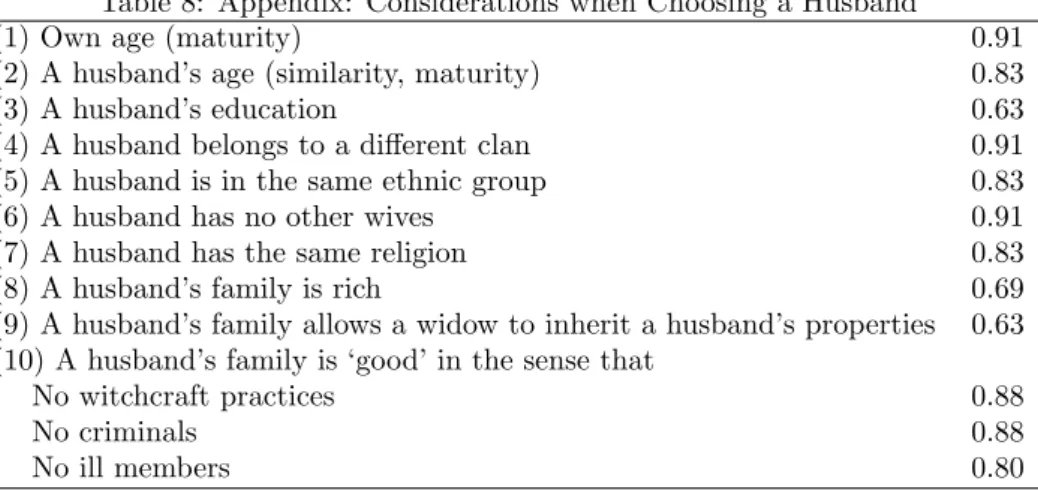
In this survey, the author asked respondents whether each item displayed in Appendix Table 8 was an important consideration when choosing a husband. For example, 91% of the interviewed women preferred a husband belonging to a different clan, suggesting the significance of clan ex-ogamy, which is associated with local preferences to avoid marrying somebody that has close blood relationship, and women’s marriage-related migration in this region.27 While the most important
23Consequently, the sampled villages were located a great distance away from each other, thus covering the entire
district.
24This is consistent with views of researchers and those shared by the NGO staff members in Dar es Salaam and
Kagera prior to the questionnaire survey.
25While less than half of the interviewed women asked for parents’ approval before accepting the marriage proposal,
parents did not have a strong power to force their daughter to choose a husband that they liked.
26When a groom makes a proposal and a bride responds, families on both sides commonly use go-betweens
(mushenga in Swahili), who would often be groom’s and bride’s relatives (e.g., aunt). During the sample period, the go-betweens played major roles in the process of marital formation as a messenger between families, a negotiator of bride prices, and an investigator about a groom’s family.
consideration, as indicated by questionnaire responses, was whether a husband’s family was ‘good’ - in the sense that it did not practice witchcraft and had no criminals or sick members - interest-ingly, approximately 63% of the interviewed women agreed that whether a husband’s family was considerate enough to allow them to inherit a husband’s properties in case of the husband’s death was one of their considerations. Although the author does not intend to place much emphasis on this answer because of potential response bias, it seems true that a bride did have a way of collecting information about a groom’s family living in a village different from her natal village and that she strategically chose the best partner. These findings provide a justification for the above assumptions (b) and (c). Taking into account this strategic behavior exhibited by women, it may be plausible to interpret the positive αM
2 in equation (3) as the confirmation that removing
discrimination against widows enabled males who had not previously been particularly attractive marriage candidates to obtain a wife by offering old age protection to women, and that women strategically accepted that offer.
In subsection 2.3, it was also argued that women’s land rights movement emerged in the 1990s and the ideology has gradually penetrated through the society. As a matter of fact, approximately 58% of the interviewed females were aware of some activities (e.g., workshops, seminars) aimed at removing discrimination against women in accessing land rights when their husband proposed to them, and almost all women recognized such activities during the interviews.
3.2
Measurement Issues about Land Inheritance
In all waves of the KHDS, the survey team asked a group of village leaders whether a wife could customarily inherit land in the village in the event of her husband’s death.28 As this information is a source of a measure of land inheritance used in this study, a widow’s inheritance right may be measured with noise, which could confound estimations. Thus, it should be noted that excessive noise may make the measure untenable to an empirical analysis.
Peterman (2011) provides support for the view that observed variation of land inheritance in the KHDS data is informative for an empirical analysis. By using the same information as the current study, she investigated the effects of a widow’s property and inheritance rights on labor force participation and earnings of women aged 15 to 55 years at baseline. In her preferred model that controls for an individual’s fixed effects and sample attrition, she found that securing a widow’s rights resulted in an increase in their employment opportunities outside home and their earnings. Nevertheless, this study cannot rule out the possibility that the rule of land inheritance is measured with errors. As a matter of fact, only a few groups of the village leaders changed their answer to the above question from ‘yes’ to ‘no’ (and further ‘yes’) in the first four waves - an inconsistency that may be associated with misunderstanding of the question and/or social desirability or irresponsibility for answering the question. While this discrepancy is difficult to interpret, this paper does not discriminate against such answers. Instead, the subsequent analysis performs all estimations by changing the base period t from wave 1 to 2, 3, and 4. In addition, even if some measurement errors exist, a key message from this study will be unaffected by this problem because the estimated positive impact of interest is the lower bound of true αM
2 , provided
that those errors are classical.
from their natal villages, and almost all those women lived in their husband’s natal village.
28According to the previously mentioned supervisor of the KHDS project (wave 5), approximately 7 to 8 villagers
Furthermore, altering the rule of inheritance at the village level will not necessarily mean that all households in a village strictly followed the new rule. As data does not contain information about the application of the new rule at the household level, the findings of this study are based on the village-level average of all individual impacts operating at the household level.
3.3
Simultaneity Bias: Correlation between D
jand ω
MjAnother empirical challenge arises from potential correlation between Dj and ωjM. For instance, assuming that males living in a village close to a city would opt to postpone marriage due to their exposure to urban attitudes and values, and that the villagers are more generous with women’s rights for the same reason, this generates downward bias on the estimated αM
2 , unless village-level
tastes and preferences for modernity are controlled for. One possible solution to this problem is to explicitly control for village-fixed effects. However, this strategy cannot simply be taken because of perfect multicollinearity between Dj and ωMj in equation (3).
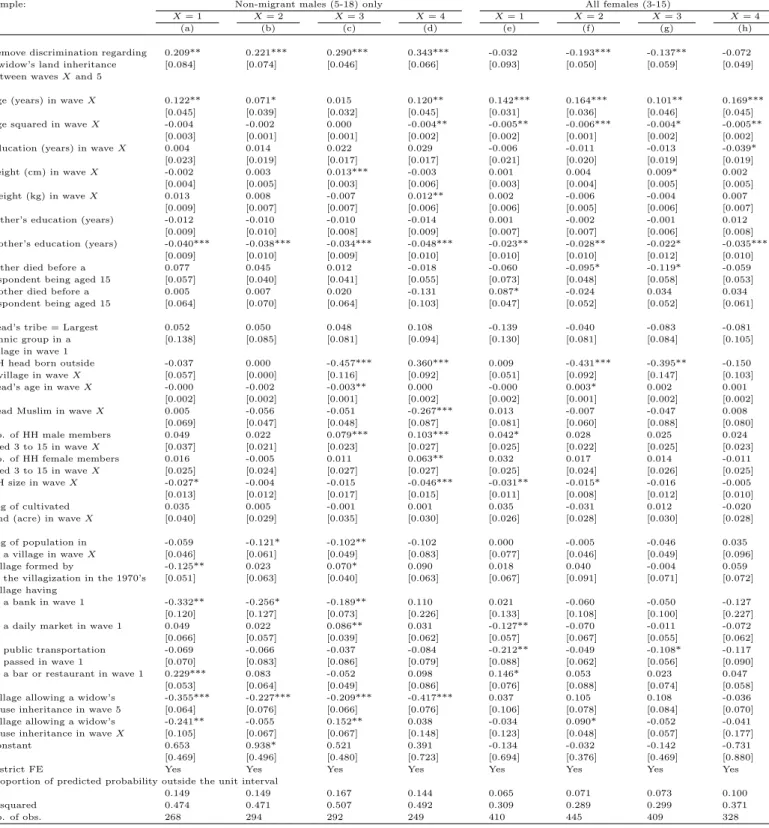
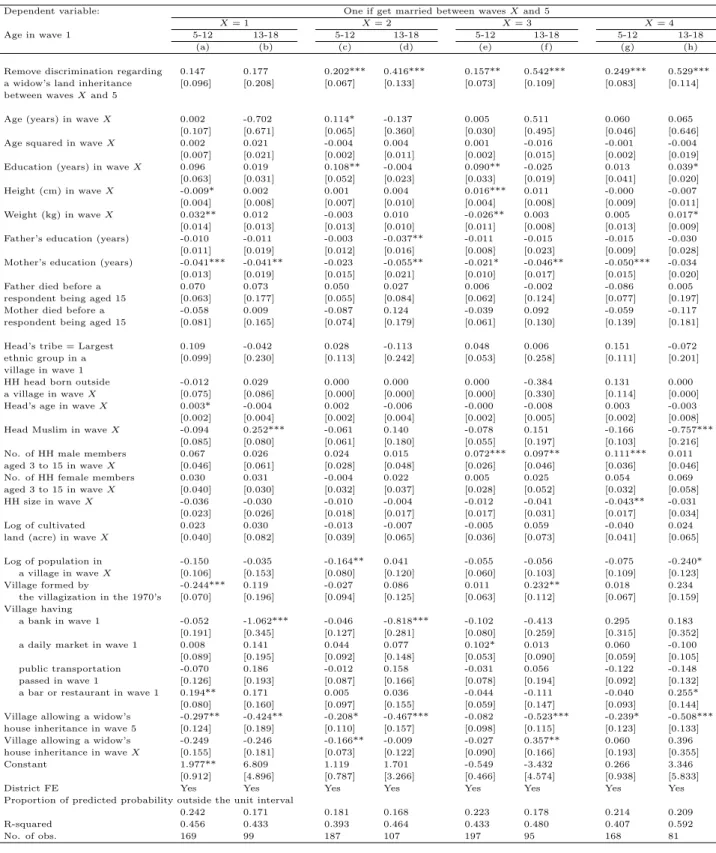
Alternatively, this paper takes a two-step approach by following Munshi and Rosenzweig (2006). In this approach, firstly, the same equation as (3) is modeled for females aged 3 to 15 years in wave 1 as
Mijt+1= αF1 + α
F
2Dj+ α3F0xit+ α4F0xjt+ ωFj + ²ijt. (4)
As the minimum legal age of marriage for females is 15 years, all females included in the analysis were single in wave 1 and those under the age of 3 years in wave 1 did not reach the marriageable age by wave 5. In contrast to the male sample, the analysis uses migrants as well as non-migrants, because the purpose of using this female sample is to explicitly control for unobserved village-level characteristics in the following second step that might affect the probability of marriage. Consequently, there is no strong reason to restrict the sample to non-migrant females.29 Another
reason for including female migrants as well as non-migrants is to mitigate a potential problem of sample selection, as discussed in subsection 3.4.
It is possible to anticipate the sign of the estimated impact of Dj, i.e., ˆαF2. Firstly, it is expected
that the ˆαF
2 is insignificantly different from zero. As seen in subsection 4.1, female marriage is
highly associated with leaving their natal village. To the extent that all women marry out of their natal village and that their decision to marry is primarily affected by living conditions at the
destination, altering the rule of land inheritance in their original village may not influence their
marital probability at all. However, as it should not be assumed that no woman would get married in her natal village, the estimated sign may alternatively be negative. This is because allowing a widow’s land inheritance in a village may intensify competition among local women by attracting single females from outside the village. Consequently, those females who intend to marry males living in their natal village would have difficulty in doing so due to the increase in the level of competition in a marriage market. All these arguments imply the non-positive ˆαF2.
29Apart from an advantage of mitigating a potential problem of sample selection discussed in subsection 3.4,
however, whether the analysis uses all females or just non-migrant females is irrelevant when applying this two-step approach, although limiting the sample only into non-migrant females is more likely to result in the negative ˆαF
2 in
the first step. This is because allowing a widow’s land inheritance in a village is likely to result in attracting single females from outside the village and encouraging competition in the village, which may make it difficult for the local females to find a marital partner in that village. As seen in subsection 4.1, female marriage is highly associated with leaving their natal village. If those females who fail to marry out in the presence of the increasing level of competition primarily stay in their natal village, limiting the sample into non-migrant females in modeling equation (4) might estimate the negative ˆαF
2 due to selection bias. In fact, this is true. The estimation results of both the
Given this presumption, the second step uses this gender difference in the impact of Dj by pooling both males and females as30
Mijt+1 = αF1 + (α M 1 − α F 1)gi+ (αM2 − α F 2)Dj· gi+ αF30xit (5) +(αM3 − αF3)0xit· gi+ (αM4 − α F 4)0xjt· gi+ (ωMj − ω F j )gi+ Vj+ ²ijt+1, where gitakes one for males and zero otherwise. Now, equation (5) can explicitly control for village-fixed effects by using a dummy variable for a village j, i.e., Vj ≡ αF2Dj+ α4F0xjt+ ωFj.
31 Whilst
αM
2 can no longer be identified in equation (5) independently, it is possible to draw inference about
it from the estimated αM
2 − αF2 by using the gender difference in the impact of Dj (within-village variation). Given that ˆαF2 = 0, as discussed in the first step, the coefficient on the interaction term between Dj and gi should identify the impact of altering the inheritance rule in a village on the marital probability of males living in the village. Even in case of the negative ˆαF2 in equation (4),
the estimated ˆαM
2 in (3) is likely to be free from bias arising from potential correlation between
Dj and ωjM, provided that ˆαM2 − ˆαF2 is close to the coefficient on the interaction term between Dj and gi in (5).
Similar to Munshi and Rosenzweig (2006), the validity of this approach relies on the assumption pertaining to the unobserved village-level characteristics that the impacts on an individual’s marital probability do not significantly differ by gender, i.e., ωM
j = ωjF.32 One major concern that may invalidate this assumption is the male-to-female ratio in a village, which is not contained in data. This is because the smaller number of males in a village may increase the marital probability of males, but decrease that of females (Becker, 1981). While the sex-ratio may indeed equally affect marital probability between males and females after controlling for an individual’s sex in the pooling equation - in fact, a few covariates will reveal differential effects by gender in subsequent estimations, the assumption may still be strong.
In order to make the assumption appear more plausible, in addition to the village-fixed effects, a variety of observed village-level characteristics (interacted with the male dummy), which may correlate with the sex-ratio, are also included in equation (5). To capture the levels of modernity and economic development in a village that might affect marital behavior - for example, population in a village; whether a village has a bank, a daily market, and a bar or restaurant; and whether public transportation passes by a village are controlled for. Moreover, the vector xjt also includes a dummy for a village formed by the villagization program in the 1970s. As described in subsection 4.2, this is expected to capture a village-level preference for women’s rights.
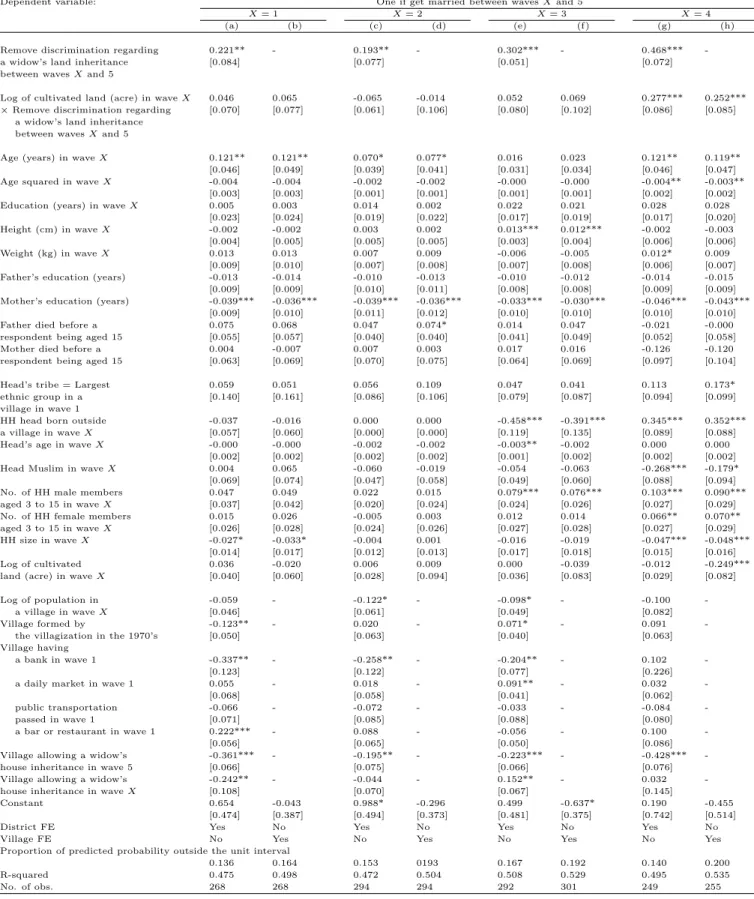
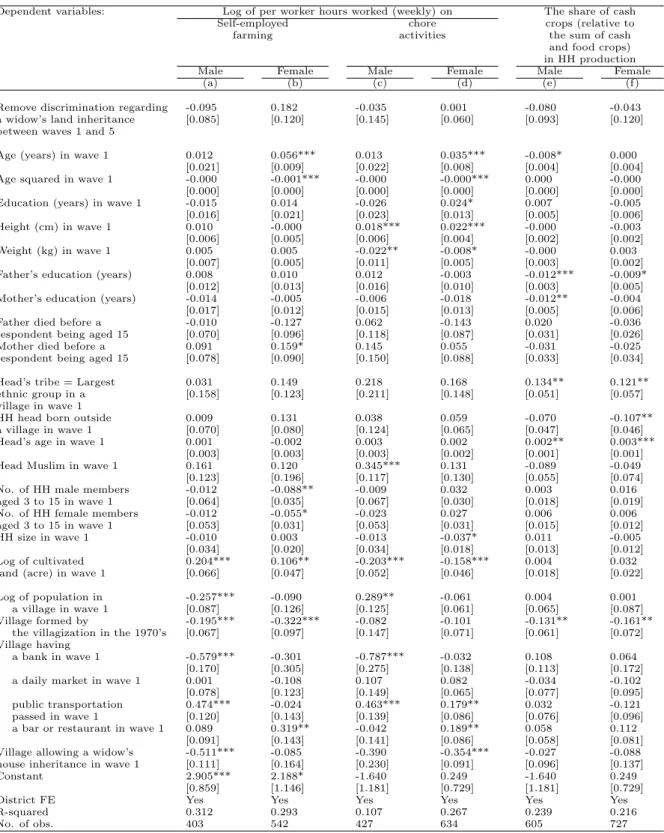
Furthermore, in columns (a) to (d) in Appendix Table 9, it was also assessed whether sample respondents in treatment villages engaged more in particular types of activities at baseline, given the assumption that the work pattern may be affected by the sex-ratio in a village. In the table, last week’s hours per person dedicated to two major activities - self-employed farming and chore activities (collecting firewood, fetching water, caring for ill household members, preparing meals,
30Equation (5) can be derived by pooling equations (3) and (4) as
Mijt+1 = (αM1 + αM2 Dj+ αM3 0xit+ αM4 0xjt+ ωMj + ²ijt)· gi
+(αF1 + αF2Dj+ αF30xit+ αF40xjt+ ωFj + ²ijt)· (1 − gi).
31Strictly speaking, the impacts of x
jt are not fixed effects, as the vector xjtis time-varying. Since estimating
(5) does not use any time variation across waves, however, it can be treated as fixed effects in this estimation.
32The jati fixed effects in their paper correspond to village-fixed effects in the current study. They assumed that
cleaning house, doing laundry, and shopping for food) - were estimated for males and females aged 7 years or older, separately. The results provided no evidence supporting the view that sample respondents in treatment villages engaged more or less in particular types of activities at baseline than those in control villages.
In rural Tanzania, most females engage in crop production and are, in particular, in charge of ‘female’ crops (e.g., food crops such as banana, beans, cassava, and maize), compared to ‘male’ crops (e.g., cash-yielding crops such as coffee, cotton, tea, and tobacco) predominantly controlled by males. As the differing level of sex-ratio in a village may generate the difference in crop choices among villages, the share of cash-yielding crops relative to the sum of cash and food crops in household production at baseline was also estimated in columns (e) and (f) in Appendix Table 9. The results revealed no significant difference between treatment and control villages. While all these discussions may not provide a fully convincing justification for the identification assumption, the empirical strategy explained above is the most feasible approach taken in this study, along with the DID framework.
Another potential concern is that a widow’s inheritance right to land might, in fact, be a proxy for an improvement in women’s access to other properties, which makes it difficult to attribute an increase in the marital probability of males in treatment villages solely to an improvement in a widow’s land right. To make a distinction between the land and other property effects, the analysis also controls for a village custom regarding a widow’s inheritance right to houses in both wave 5 and the base period, which appear to be another important asset in rural societies.
3.4
Sample Selection Bias
Since estimating equation (3) exploits only data pertaining to individuals who stay in their original village (i.e., male non-migrants) in the period t + 1 (wave 5), this selected sample can be another source of bias. For example, if changes in the land inheritance rules force males with great (little) appeal valued in a marriage market to move out of their original villages for some reason (which is difficult to identify precisely, though), this makes the estimated αM
2 biased downwards (upwards)
in equation (3). One simple way of avoiding this issue is by exploiting all panel individuals, irrespective of whether or not they were migrants in wave 5. However, this strategy cannot be adopted in this study because data does not include the information pertaining to specific social rule regarding a widow’s land inheritance that is enforced at migrants’ destination.
However, if males more or less appealing in a marriage market were indeed induced to migrate out by the change in the rule, it is highly likely that the probability of marriage systematically differs between migrants and non-migrants. As seen in subsection 4.1, however, the panel data does not support this view, indicating that male migrants and non-migrants were identical in terms of their marital probability. Drawn from the literature, moreover, the analysis controls for as many determinants of migration as possible, such as age, education and household demographic composition. Given these controls, non-migrant males may not be statistically different from migrants in a marriage equation (even though they are different in another equation such as earnings).33 Based upon these discussions, this study eventually assumes that migration-oriented
selection problem does not exist in estimating (3).
In contrast to (3), estimating equations (4) and (5) exploits female migrants as well as
migrants. Thus, the estimation results of (5) will not be negatively affected by selecting sample observations, as long as the identification assumption for the male sample holds.
3.5
Other Identification Issues
Some other concerns still exist. Firstly, while this study - by exploiting the two-step approach as well as the DID specification - attempts to control for growth-fixed effects (i.e., ωM
j ) in each village, some time-varying village characteristics assumed to be unobserved (i.e., ωM
jt) might still contaminate the estimations. Although this issue cannot be explicitly addressed in this study, this concern will be discussed more carefully in subsection 5.2 after presenting the main estimation results.
Another caveat for the estimations is that the estimated αM
2 may need to be interpreted as
a population-weighted average of ex-ante (expectation) and ex-post impacts of the change in the rule of land inheritance. This point will be explained more clearly in subsection 5.3.1.
4
Data
The KHDS started in the rural region in northwest Tanzania, Kagera, as a part of a research project on adult mortality in Sub-Saharan Africa launched by the World Bank in 1991. With 912 households drawn from the 1988 Tanzanian Census with a stratification based on geography and mortality risk,34 the first four surveys were conducted between 1991 and 1994 with a 6- or
7-month interval. After a 10-year gap from wave 4, approximately 91% of those 912 baseline households were recontacted in 2004 (wave 5), even if located outside their original villages. When previous members moved out of their original households, their new households were traced. This exercise generated 2719 household surveys in wave 5, which emerged from the 832 recontacted original households. Of the 2719 households, only half stayed in the village they resided in 10 years previously, suggesting a substantial demographic mobility in this region during one decade.
While the KHDS is a household panel survey, it enabled us to construct unbalanced panel data from wave 1 to 5 at the individual level, as it provided the information for all household members in all waves. The rate of sample attrition in the KHDS is very low even on an individual basis. Based upon the careful examination of sample attrition by Beegle et al. (2011), excluding individuals that died, approximately 82% of 5394 original respondents interviewed in the first four waves were successfully recontacted in wave 5. This significantly high recontact rate is one of many successes and contributions of this long-term panel survey. As throughout the waves, a standardized survey questionnaire was used (although several changes were made in wave 5), collected information is highly comparable across waves. In addition, the data contains a variety of information related to a household, its members, and a village from which sample households were chosen, making the KHDS highly valuable resource for an empirical study.
4.1
Marriage and Migration
Before providing summary statistics, the relationship between marriage and migration was overviewed by gender. Firstly, the reason for migration is reported in Table 1, where the first two columns
re-34The sampling procedures caused households with a high risk of an adult death to be oversampled; therefore,
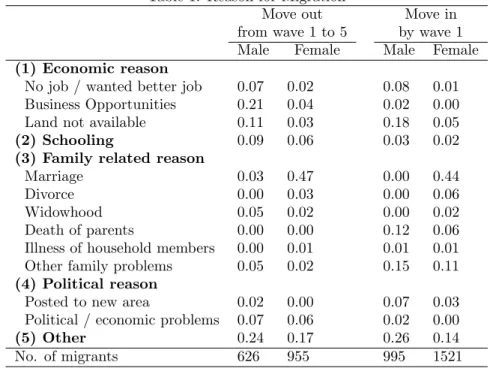
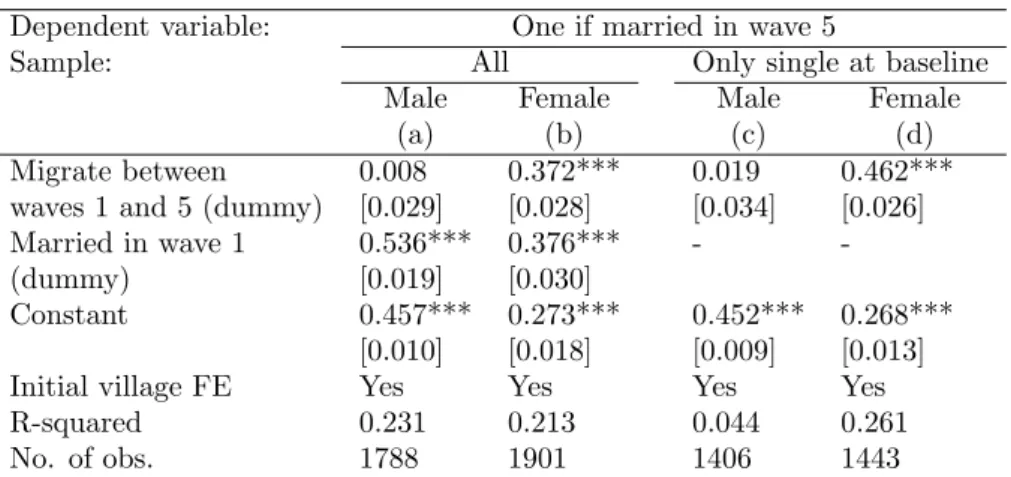
port data pertaining to migration that took place between waves 1 and 5, and the last two columns indicate individuals that moved into a surveyed village prior to wave 1. In accordance with the pre-conception that women typically relocate at marriage in much of Sub-Saharan Africa, almost half of female migration in this sample was driven by marriage. On the other hand, male migration was hardly related to marriage. Next, Table 2 reports marital status in wave 5 of men and women that were single in wave 1 in order to establish whether their status varies by relocation. While about 64% of females that migrated out between waves 1 and 5 were married in wave 5, the corresponding figure for female non-migrants was just 19%. This discrepancy between migrants and non-migrants confirms strong correlation between women’s marriage and migration. On the other hand, there is almost no difference in the proportion of married male migrants and non-migrants in wave 5, as in both groups approximately 37% were married in wave 5. Thus, it appears that migration did not affect male marital behavior. This difference in the relationship between marriage and migration by gender is formally evaluated by estimating the linear probability of being married in wave 5 with a control of a migration dummy between waves 1 and 5 by OLS in Appendix Table 10. The results indicate that, whilst female marital status in wave 5 positively and significantly correlates with migration, the correlation is insignificantly different from zero for males.
[Here, Tables 1 and 2]
4.2
Summary Statistics
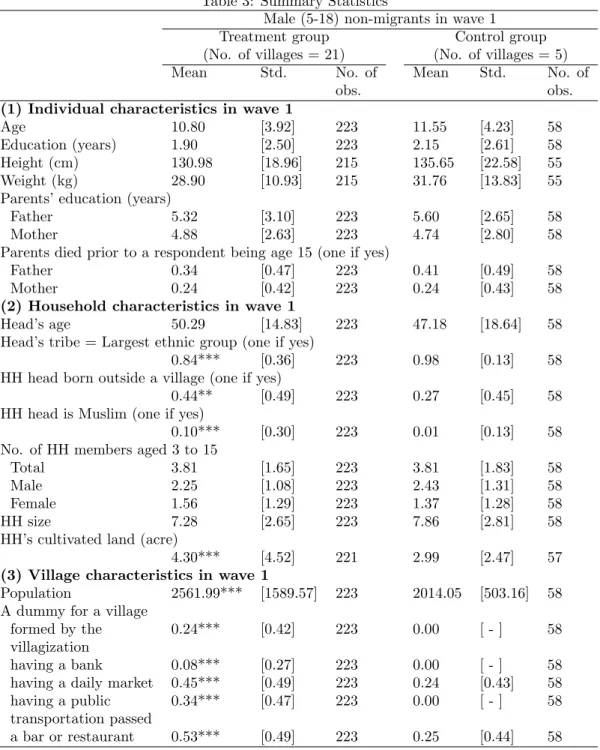
To assess whether males in villages with Dj= 0 (control villages) are a suitable control group for those in villages with Dj = 1 (treatment villages), Table 3 summarized key variables at baseline (wave 1) with a check of the equality of the mean between these two groups. In contrast to few individual and household attributes that differ between the two groups, many significant differences arise from village characteristics. For example, on average, a greater number of individuals lived in treatment villages in wave 1, where public transportation was available. In addition, treatment villages are more likely to have had a bank, a daily market, and a bar/restaurant in wave 1. Hence, this information might characterize treatment villages as more developed and modernized, compared to control villages. Moreover, a village formed by the villagization program in the 1970s was found only in the treatment group. Along the famous concept of U jamaa, an ideology of socialism and self-reliance introduced by the first post-independent President Julius Nyerere and the Tanganyika African National Union (TANU),35 the program intended to create communally
organized socialist villages in the country where people would live and work together, mutually respecting each other and sharing common basic goods and services (Hyden, 1980; McHenry, Jr., 1979). Whilst this program was terminated without yielding the expected success, women living in a village formed by this program were given an equal right to partake in some aspects of village life (McHenry, Jr., 1979; Swantz, 1985). Thus, no control villages formed by this program might suggest that males in treatment villages might have been more liberal with regard to women’s rights, compared to those in control villages. As, under a surge of national excitement about women’s land rights in the 1990s, these characteristics might have helped treatment villages remove discrimination against widows regarding land inheritance during the sample periods, controlling
35TANU became Chama cha Mapinduzi (CCM) in 1977, a leading party in the current multi-party political