The Impact of United States Sanctions on the
Myanmar Garment Industry
著者
Kudo Toshihiro
権利
Copyrights 日本貿易振興機構(ジェトロ)アジア
経済研究所 / Institute of Developing
Economies, Japan External Trade Organization
(IDE-JETRO) http://www.ide.go.jp
journal or
publication title
IDE Discussion Paper
volume
42
year
2005-12-01
INSTITUTE OF DEVELOPING ECONOMIES
Discussion Papers are preliminary materials circulated
to stimulate discussions and critical comments
Abstract
The United States imposed trade sanctions against the military regime in Myanmar in July 2003. The import ban damaged the garment industry in particular. This industry exported nearly half of its products to the United States, and more than eighty percent of United States imports from Myanmar had been clothes. The garment industry was probably the main target of the sanctions. Nevertheless, the impact on the garment industry and its workers has not been accurately evaluated or closely examined. The purpose of this paper is to evaluate the impact of the sanctions and to further understand the present situation. This is done using several sources of information, including the author’s field and questionnaire surveys. This paper also describes the process of selection and polarization underway in the garment industry, an industry that now has more severe competition fueled by the sanctions. Through such a process, the impact was inflicted disproportionately on small and medium-sized domestic firms and their workers.
DISCUSSION PAPER No. 42
The Impact of United States Sanctions
on the Myanmar Garment Industry
Toshihiro KUDO*
Keywords: Myanmar (Burma), United States, sanction, garment industry
JEL classification: F19, L60, O14
* Director, Economic and Technical Cooperation Studies Group, Inter-Disciplinary Studies Center, IDE ([email protected])
The Institute of Developing Economies (IDE) is a semigovernmental,
nonpartisan, nonprofit research institute, founded in 1958. The Institute
merged with the Japan External Trade Organization (JETRO) on July 1, 1998.
The Institute conducts basic and comprehensive studies on economic and
related affairs in all developing countries and regions, including Asia, Middle
East, Africa, Latin America, Oceania, and East Europe.
The views expressed in this publication are those of the author(s). Publication does not imply endorsement by the Institute of Developing Economies of any of the views expressed.
INSTITUTE OF DEVELOPING ECONOMIES (IDE), JETRO 3-2-2, WAKABA,MIHAMA-KU,CHIBA-SHI
CHIBA 261-8545, JAPAN
The Impact of United States Sanctions
on the Myanmar Garment Industry
∗[Contents] 1. Objectives
2. The Size of the Garment Industry (1) Export
(2) Firms (3) Employment (4) FDI
(5) Contribution to the National Economy 3. Measuring Impact
(1) The United States and EU Markets under the MFA Regime (2) Export Performance, CMP Charges, and Capacity Utilization 4. Who suffers?
(1) Brief History of the Entry of Firms (2) Selection and Polarization
(3) Workers 5. Conclusion
Appendix: Survey on Garment Industry in Myanmar (2005) References
Tables and Figures 1. Objectives
The purpose of this paper is to examine the impact of United States sanctions of July 2003 on the garment industry and its workers in Myanmar and to further understand the present situation.
United States President George W. Bush signed the Burmese Freedom and Democracy Act of 2003 into law and made an executive order on July 28, 2003. This was a strong move by the United States government. It had been promised by then Secretary of State Colin Powell in response to Black Friday of May 30 of the same year.
∗ The author wishes to thank U Myint Soe, Chairman of MGMA, Dr. Aung Win, Vice
Chairman of MGMA, U Moe Kyaw, Managing Director of MMRD, U Lutha Kyaw, Research Manager of MMRD, Ma Khin Sandy, Industrial Research Executive of MMRD, and Mr. Tomohiro Ando, Managing Director of the JETRO Yangon Office for their cooperation with survey administration.
On that date, the motorcade of Aung San Suu Kyi, the leader of the National League for Democracy (NLD), was attacked by a large number of thugs in central Myanmar. Among other things, the legislation bans all import of Myanmar products to the United States. The executive order freezes the assets of senior Myanmar officials and prohibits any United States financial institutions from making transactions with entities in Myanmar.
The embargo on all imports of “made-in-Myanmar” products damaged the garment industry in Myanmar in particular, since this industry exported nearly half of its products to the United States market. This industry was probably the biggest target of sanctions, because more than 80 % of total imports to the United Sates from Myanmar had been garments.1 Before sanctions were imposed, the garment industry in Myanmar
had exhibited strong growth throughout the 1990’s, particularly in the late 1990’s, and at the beginning of the new century. Between 1990 and 2002, Myanmar’s garment manufacturing sector developed 55 times its initial export activity. It is generally believed that the garment industry in Myanmar had 400 firms with more than 300,000 workers at its peak in the late 1990’s and up to 2001.
Many anecdotal reports regarding the impact of United States sanctions on the garment industry have been written. For example, Prof. David I. Steinberg, prominent expert on Myanmar issues, wrote:
Sixty-four textile factories have filed for closure in a two-week period. Some 80,000 jobs have already been lost and this will be followed by another 100,000, mostly young women who provide supplementary income for impoverished families. One recent academic inquiry in central Burma indicated that some of those let off are finding their way into the brothels. (Steinberg [2003])
The Myanmar government also criticized the United States indicating that more than 80,000 garment factory workers lost their jobs (Ko Lay [2005]). An April 2004 U.S. State Department Report on Myanmar estimated that more than 100 garment factories had closed, and 50,000 to 60,000 jobs had been lost (U.S. Department of State [2004]). There are big discrepancies in the reported number of lost jobs, and this makes it difficult to form an accurate evaluation of the impact of United States sanctions on the garment industry.
Apart from political intentions to manipulate the numbers, a major reason for such discrepancies is a lack of reliable statistics related to the industry’s situation. Further,
1 On the other hand, Myanmar’s exports to the United States constituted 26% in 2000,
very few studies or surveys have been done to measure the impact of United States sanctions on Myanmar’s garment industry and assess the present situation. Nevertheless, it is necessary for the two sides, the one that imposed the sanctions and the one that suffered from them, to know the real impact in order to evaluate the effectiveness of the sanctions and to consider either countermeasures for the side that suffered or future directions for the side that imposed them. The purpose of this paper is to develop knowledge and information in these areas of concern.
The second section includes an estimate of the size of the garment industry at its peak and at present. This estimate is made as accurately as possible by using several sources of information including the author’s field and questionnaire surveys.
The third section includes an examination of the actual impact of United States sanctions based on the estimated size of the garment industry determined in section two. The role that the United States market played in the growth of the garment industry in Myanmar is first reviewed so that the impact of its loss can be accurately evaluated. Impact is then examined in various aspects including export performance, processing charges (CMP charges), and capacity utilization.
Section four includes an examination of who actually suffered from sanctions. Sanctions did not have an equal impact on related parties. In order to identify the victims, players or enterprises in the garment industry are first examined. This is followed by a description of the process of selection and polarization underway in the industry, an industry that now has more severe competition fueled by the sanctions. This section concludes with an examination of the impact on workers, the main victims of the sanctions.
The conclusion includes a summary of arguments and an overall evaluation of the effectiveness of United States sanctions.
2. The Size of the Garment Industry
Dana, an established economic magazine in Burmese, featured an article on the garment industry in November 2000. It included an interview with U Myint Soe, Chairman of the Myanmar Garment Manufactures Association (MGMA). He said:
As of March 2000, there are about 400 factories including small, medium and big ones, with more than 300,000 workers. It means there are many more family members dependent on this industry. The garment industry in Myanmar is already quite big. (Tin Aung Kyaw [2000:85])
These figures were frequently quoted, and they became established thereafter.
government provides very limited socio-economic statistics, and these are often unreliable and outdated. Neither the Myanmar government nor garment enterprises themselves accurately know the size of the industry. This section includes an estimate of the size of the industry using various sources of information including the author’s field and questionnaire surveys.
(1) Export
Export serves as the most reliable performance index for the garment industry. Most garment industries in Myanmar, like those in other developing economies, operate on the basis of Cutting, Making, and Packing (CMP) arrangements. Overseas buyers do everything but production; they find customers, design clothes with detailed specifications, and procure and supply raw materials to apparel plants in Myanmar. These plants do the cutting, sewing, and packing. They then re-export all the products to overseas markets.2
Figure 2-1 shows the export performance of the garment industry in Myanmar. This is based on three different sources of information: (1) the United Nations Comtrade, (2) Myanmar government statistics, and (3) import data of 22 major countries that import Myanmar-made clothes. Statistics Canada constructs the World Trade Database based on UN Comtrade, and the database retrieval services were used for this paper. For developing Myanmar government statistics, the Statistical Yearbook (hereafter SY) and
Selected Monthly Economic Indicators (hereafter SMEI) were used. The export figures of these statistical books use the denomination of Kyats, Myanmar’s domestic currency. The official exchange rate was used for conversion.3 Twenty-two countries that are
thought to be major importers of Myanmar-made clothes were selected based on the author’s field surveys in Yangon in 2005.4 The author used the World Trade Atlas
(hereafter WTA) database retrieval services to determine imports of clothes from Myanmar to these selected countries.
According to the UN Comtrade, export of Myanmar-made clothes increased steadily through the 1990’s up to 1998, when it reached about US $270 million. The following two years, 1999 and 2000, witnessed remarkable growth that caused a garment industry “boom” in Yangon. At this time, garments occupied about 40% of total exports of the country, the top export item. This peaked in 2001 with an export value of US $868
2 See Kudo [2005a: 30-31] for more detailed explanation on the CMP arrangements. 3 The official exchange rate is pegged at about 6 Kyats per US$1, whereas the parallel
exchange rate is around 1200 and 1300 Kyats per US$1 in November, 2005.
million. However, it declined by 20% in the next year.
Export performance of the garment industry, according to data from the 22 selected countries, follows the pattern exhibited by the UN Comtrade. Figures for this performance are a bit lower than those of the UN Comtrade, probably because there are countries other than the selected 22 which import Myanmar-made clothes. The data series is available through 2004, and it shows a consecutive three-year decline for 2002, 2003, and 2004. It is noteworthy that in 2003, the year United States sanctions were imposed, only a slight decrease was experienced. Myanmar-made clothes were somewhere in the pipeline from ex-factory to market up to the 3rd quarter of 2003. It is
also noteworthy that 2002 witnessed a bigger decline (-19%) than 2004 (-17%). As early as 2001, the garment industry in Myanmar had been annoyed by increasing consumer boycotts in the United States and European markets. Accordingly, big buyers, who sell brand-name goods and tend to be conscious of social compliance, became hesitant to purchase Myanmar-made products. These buyers included renowned multinational retailers such as Levi Strauss, Reebok and British Home Stores (EIU [2004: 33]). This situation was further exacerbated by a general slowdown of the world economy, and in particular that of the United States. United States sanctions then deprived Myanmar’s garment industry of access to its markets in mid-2003. As a result, the export value recorded for 2004 was only 66% that of 2001.
In contrast to these two data series, Myanmar government statistics show quite a different picture. They show that the export value grew rather slowly but steadily up to FY 1998.5 It then grew by leaps and bounds in the following two years. The export
value in FY 1999 nearly doubled and that recorded in FY 2000 quadrupled.6 It started
to decline one year earlier than seen in the pattern derived from the other two data series. It witnessed big declines in FY 2001 (-24 %) and in FY 2002 (-29%), revealing big discrepancies between Myanmar statistics and the other two data series.
There may be many factors that cause discrepancies among the three information sources regarding trade terms such as FOB and CIF, commodity classifications7,
5 FY stands for Fiscal Year, starting from April and ending in March.
6 Such a jump in FY 2000 seems inconsistent even with figures in the same statistical
series of SMEI. According to SMEI, the unit price of an exported garment increased from US $1 per piece in FY 1999 to US $2.2 per piece in FY 2000. There seem to be no factors leading to such a considerable increase in the unit price for this year. On the contrary, the export volume (pieces) almost doubled in FY 2000 according to SMEI; this is more consistent with the UN Comtrade and WTA data series.
7 In this paper, SITC84 (articles of apparel and clothing accessories) are defined as
garments for the UN Comtrade. HS61 (knitted apparel) and HS62 (woven apparel) are defined as garments for World Trade Atlas. For Myanmar government statistics, the
recording points such as exports and imports, and methods of rectifying errors and omissions. Taking all these factors into account, however, it is still difficult to explain such big differences among information sources.
The export value recorded in Myanmar statistics is usually much lower than that in the other two data series. The export value reported by the UN Comtrade is larger than that in Myanmar statistics, specifically 1.3 times in CY2000/FY2000 and 3.6 times in CY1998/FY1998.8 One reason often given is that exporters attempt to evade export tax.
The so-called “export tax” is levied on almost all exports at the rate of 10%. This is legally composed of an 8% commercial tax and a 2% profit tax. Local businessmen claim that there is a considerable amount of under-reporting of garment exports in order to evade the export tax. Such practice surely contributes to discrepancies between the two sets of figures. Nevertheless, it does not seem sufficient to explain the gap, because wide differences existed before the introduction of the export tax in January 1999. Actually, the biggest gap occurred in CY1998/FY1998. Further, an export tax had been levied on CMP charges (processing charges) at the rate of 2% only up to October 2003 when the rate was increased to 10%, similar to that for other commodities. Until then, garment exporters were probably less motivated to evade the export tax due to the lowered rate.
Another reason for the discrepancy that is often pointed out is the exchange rate problem. There is a big gap between the official exchange rate and the parallel market rate. External transactions seem to be recorded at the official exchange rate of about 6 Kyats per US $1. At the same time, it is said that the customs offices had used different evaluation rates such as 100 Kyats per US $1 for priority goods and 120 Kyats per US $1 for luxurious goods since June 1996 (OECF [1996:46]).9 If these rates were used for
recording external transactions, the calculated export value would be about 17 to 20 times larger after 1996. This is unrealistic. The official exchange rate is probably used for recording external transactions, and this means that the almost fixed exchange rate has been applied for recording. It is difficult to find a single culprit to blame for the gaps. The problem may be more deeply rooted in collection of statistics and in the reporting systems of this country.
A general picture of the export performance of Myanmar’s garment industry is as follows: It steadily increased from the early 1990’s to 1998. The following couple of years witnessed rapid growth in exports, creating a garment industry boom in Yangon. column of “garment” is selected.
8 CY stands for Calendar Year, starting from January and ending in December.
9 These different exchange rates used at the customs offices were again increased to the
However, this did not last long. After having reached a peak in either FY 2000 or CY 2001, a considerable and consecutive decline followed to 2004.
(2) Firms
MGMA estimates that about 400 garment firms or factories existed at the peak of the industry around 2000 and 2001. This estimate included about 100 small factories that had a few tens of sewing machines and specialized in subcontracted works. Being affected by United States sanctions, many firms stopped production, dismissed workers, and went bankrupt. The number of garment firms or factories decreased to about 180 by mid-2005, and most small subcontractors were swept out.10 As mentioned before,
however, this estimate is not supported by reliable statistics.
There are several information sources available to determine the number of firms. These include registration data at the Directorate of Industrial Supervision and Inspection (hereafter DISI) of the Ministry of Industry (1)11, business directories,
company-wise export data, and the Survey on Garment Industry in Myanmar of 2005 (hereafter SGIM). 12
According to the Private Industrial Enterprise Law enacted in November 1990, any private industrial enterprises using the energy of three horsepower and above and/or employing ten or more wage-earning workers are required to register with the DISI. According to DISI data, there were 232 factories out of a total of 41,510 private industries that registered as garment factories as of August 2005.13 This number
probably includes factories producing only for the domestic market, and these are not of primary interest in this paper. According to DISI data, the average number of employees per factory was about 80 people in 2000. This is quite small compared to the SGIM figures that showed 433 people per firm in 2002. There may be many entities that do not register themselves with the DISI. According to SGIM, only 77 out of 142 firms registered themselves at the DISI. It is difficult to estimate the number of export-oriented garment factories using the DISI data.
The Myanmar Textile and Garment Directory (hereafter MTGD) is the most useful business directory. This directory was published for the first time in FY 2001 and for the
10 Interview with U Myint Soe, Chairman of MGMA, in Yangon in June 2005. 11 There are two ministries named Ministry of Industry (1) and (2). The former is
mainly in charge of light industry such as foodstuff and textiles; the latter is mainly in charge of heavy industry such as machineries and automobiles.
12 See Appendix: Survey on Garment Industry in Myanmar (2005) for details.
13 Kanaung Journal, Vol.7, No.43, October 26, 2005. The DISI registration figures are
second time in FY 2002. The latest version is now being compiled. MTGD includes not only garment factories but also longyi weavers, dyeing and printing services, traders of sewing and embroidery machines, forwarders, and others. The “garment factories” category is selected for analysis here. The list of garment factories includes company name, address, telephone and fax numbers, e-mail account, factory location, production items and volume, number of machines and employees, year established, export markets, and investment type.
There were 293 garment firms in MTGD for FY 2001 and 275 garment firms for FY 2002.14 Given no legal mandate to collect information, the directory naturally does not
thoroughly cover all the population of garment manufacturers. SGIM asked garment firms whether or not they were included in MTGD of FY 2001. Out of 142 firms questioned, 86 were included, 42 were established after the survey for MTGD of FY 2001, and 14 firms were not included even though they existed at that time. Taking such an omission ratio into account, it is estimated there were about 330 firms in FY 2001 and 310 firms in FY 2002. However, the number may include some micro and small entities that make clothes for domestic markets only. About 100 firms listed in MTGD of FY 2002 did not have information about export markets. They could have been subcontractors of garment exporters or manufactures for the domestic market or both.15
Export data is a good source for identifying garment firms in Myanmar. However, company-wise export data is not easily available in this country. It appears occasionally in domestic magazines, journals, pamphlets, and in other publications, but there is no consistency. The author gathered some data from these sources and combined them with other information such as SGIM. In this fashion, reconstructed company-wise export data for the period between FY 1998 and FY 2004 could be produced. JETRO [1999] provides company-wise export data for clothes in the period between FY 1993 and FY 1997. The two sets of data were connected to cover the whole period between FY 1993 and FY 2004. It is difficult to verify the accuracy of the reconstructed data. However, the total export value of garments shown in SY and SMEI almost equals the total sum of company-wise export data except for FY 1999 and FY 2000.16 It is
14 In the case of separate entries for head offices and factories, the author counted all of
these as one firm. Some firms engaging in different manufacturing processes like spinning and weaving were excluded from counting.
15 Of course, this could be just due to a lack of information on export markets of each
firm.
16 Except for FY1999 and FY2000, the differences between the two data sets are a
reasonably consistent with Myanmar government statistics. A careful interpretation of the data is required.
Based on the reconstructed export data, garment firms with exports are identified. Note that there are many non-garment firms that exported garments. Examples of companies exporting garments include: Myanmar Airways (an airline company), Myanmar Brewery (a beer brewer), Myanmar Korea Timber International (a wood-based industry) and several trading firms. They are excluded from the count, but due to a lack of company information, all non-garment firms could not be left out. Note also that companies that accumulated exports of only US $10,000 or less for the period between FY 1993 and FY 2004 are excluded as well. This presupposes that these companies did not have substantial production facilities as garment manufacturer.
Table 2-1 shows the number of garment firms with export year by year. There were only 12 garment firms with exports in FY 1993; this suggests that the industry was still in its rudimentary stage. The number of firms increased steadily up to FY 1997. The next year (FY 1998) saw rapid growth from 94 to 232, consistent with the export performance. Rapid growth in export value was made possible by the entry of new garment industries. After recording its peak in FY 1999, the number of firms declined consecutively for five-years. It is noteworthy that FY 2001 saw a big decline, even when compared to the one in FY 2004, a year obviously affected by United States sanctions. The “boom” in Yangon was gone two years before the sanctions.
It is only from the SGIM that the latest number of garment firms in Myanmar can be known. In order to do this survey, the author, with the cooperation of MGMA and a marketing research company in Yangon, sought to construct a complete list of existing garment firms in mid-2005. Original information gathered for MTGD was used, and 165 garment firms were identified as being in operation. The actual survey was done on 142 firms, however, because 22 firms declined requests for interviews, and one firm was already in liquidation. Out of 142 firms interviewed, only 78 had exports in FY 2004; 54 firms were engaged in both exports and subcontracting; 20 firms sold their products only in domestic markets in FY 2004.
In total, the number of garment firms was about 300 at its peak around 2000 and 2001. It shrunk to about 160 or 180 at most by 2004 after United States sanctions. A so-called “established” figure of 400 firms at peak is not supported by any data.
(3) Employment
of SY by 24%; as for FY2000, it is smaller by 39% on the contrary.
The estimated numbers of jobs lost due to United States sanctions varies greatly. Such variation is due to the lack of an accurate estimate of the size of employment in the garment industry in Myanmar. According to MGMA, more than 300,000 workers were employed in the garment industry at its peak. Being affected by the United States sanctions, the number of workers decreased to about 120,000 to 130,000 by mid-2005.17
However, as stated, such estimates lack supporting statistics.
The first information source used to assess employment was the DISI. The latest figures (from 2000) are rather outdated. There were 12,863 workers in 160 garment factories in 2000. However, the DISI data may fail to capture a picture of the entire industry under the scope of this paper because it includes factories producing for domestic markets only and also omits entities that should be registered. It is difficult to accept numbers from the DISI as an accurate base for estimation.
The second information source used was the survey conducted in 2005. In SGIM, the average number of workers employed by each firm in 2002, 2003, and 2004 was asked. There were 56,923 workers for 130 firms in 2002, 52,893 workers for 138 firms in 2003, and 47,501 workers for 142 firms in 2004. The number of workers dwindled by 17% for these years. Note, however, that SGIM questionnaires were sent only to firms that were operating in June 2005. It did not cover firms that had already exited the market by then. As Kudo [2005b] reported, there were probably many cases of immediate factory closure. Thus, SGIM likely underestimates the impact of United States sanction in terms of jobs lost.
For analysis, assume that data for the average number of workers per firm is valid. These numbers were 438 for 2002, 383 for 2003, and 335 for 2004.18 According to the
MTGD for FY 2002, the average number of workers per firm was 410, and this figure almost matches with that of SGIM. Suppose that the average number of workers per firm was 450 at its peak around 2000 and 2001, and the number of firms was 300. Then the total employment in the garment industry may be estimated to be about 135,000 people. Further suppose that the average number of workers per firm was 340 in 2004, and the number of firms was about 160 to 180. Then the total employment may be estimated to be about 55,000 to 61,000 people. A so-called “established” number of more than 300,000 workers at the peak of the garment industry cannot be endorsed.19
17 Interview with U Myint Soe, Chairman of MGMA, in Yangon in June 2005.
18 Note that 22 firms, including some big entities, declined to answer the questionnaires.
This may distort how representative samples are in terms of the distribution of number of workers.
19 If there were 300,000 workers in 400 firms, the average number of workers per firm
(4) FDI
The textile and clothing sectors can be seen as a supply chain consisting of a number of discrete activities (Norås [2004:3]). The garment industry located in a developing economy also forms a part of such a supply chain, and it is often integrated and controlled by multinational retailers. The nature of the textile and clothing industry is such that most garment firms are part of some larger multinational corporations. This takes the form of foreign direct investment in many developing countries such as Cambodia, Mauritius and Mongolia (Kee [2005:3]). Although domestic firms play a key role in the garment industry in Myanmar, the industry has also received a certain amount of foreign direct investment.
As of February 2005, 391 FDI projects worth US $7.7 billion had been approved. Among these, 152 projects belonged to the manufacturing sector and were worth US $1.6 billion. This sector ranked first in terms of number of projects and second in terms of the capital amount.20 Breakdown figures by sub-sectors are not available. Garment
firms with foreign equity based on the aforementioned reconstructed company-wise export data were counted. There were 45 garment firms with foreign equity; 31 of these had 100% foreign investment; and 14 companies had joint ventures with state-owned, military-related, or private firms. If each company has one FDI project (a likely scenario), the garment industry would constitute about 30% of all manufacturing based foreign investments in terms of the number of projects. The garment industry functions as a window open to foreign investment, associated technology transfer, and access to overseas markets.
(5) Contribution to the National Economy
The garment industry is said to play an important role in the early stage of economic development, and this is certainly the economic stage where Myanmar is located. It is labor-intensive, export-oriented, and it utilizes standardized technology. It can offer entry-level jobs for unskilled labor, it earns foreign exchange necessary to pay for imported raw materials and investment capital goods, and it requires relatively low investment and start-up costs for entrepreneurs. Such characteristics have made the garment industry suitable as a first rung on the industrialization ladder in developing economies. Some have actually experienced a very high output growth rate in the sector
20 The oil and gas sector consists of 65 projects worth US $2.5 billion and is ranked
(Nordås [2004]).
The industrial sector in Myanmar is extremely underdeveloped. Myanmar falls behind other new member ASEAN countries such as Cambodia, Laos, and Vietnam (CLV). These countries also embarked on a transition toward a market economy at about the same time as Myanmar. A glimpse at Table 2-2 clearly shows the industrial stagnation in Myanmar. 21 On the other hand, CLV countries increased their share of
the industrial sector throughout the 1990’s and at the beginning of the new century. Garment manufacturing was one of the leading industries in these countries.
The industrial sector in Myanmar constituted only 13% of the GDP in 2002. The contribution of the garment industry is no doubt much smaller, though no data is available to indicate its share. According to DISI data, as of August 2005, 232 garment factories constituted less than one percent of 41,910 total registered factories (Kanaung Journal [2005]). Rice mills ranked first with 15,260 factories (36%). This was followed by edible oil mills with 3,554 factories (8%), sawmills with 2,400 factories (6%), and textile weaving works with 1,587 factories (4%). Most of these are basic processing factories of primary products.
The garment industry has the potential to create large-scale job opportunities because it is so highly labor-intensive. To what extent does the garment industry contribute to the national economy in terms of job creation in Myanmar? The statistics on employment by sector has been publicly released only up to FY 1997 ([MNPED: 1998]). According to this, there were 18.4 million people employed: 63% in agriculture, 10% in trade, and 9% in processing and manufacturing. The estimated employment of the garment industry in and around 2000 and 2001 occupied less than 1% of the total employment and about 8% of employment in the processing and manufacturing sector. Since FY 1997, the labor force has been increasing, and the share of industrial sector has risen slightly. This means that the share of employment in the garment industry has grown even smaller in either the national economy or in the manufacturing sector. The garment industry has yet to alleviate the widespread unemployment and underemployment on the national level in Myanmar.
The garment industry is also expected to be a foreign exchange earner. As examined earlier, its exports were recorded as US $868 million at its highest. Until the mid-1990’s, when garment export surfaced, Myanmar’s main export commodities were primary products such as beans and pulses, fish and prawns, and teak (Table 2-3). Garments
21 Regarding the industrial policy and changes during the transitional period between
had ranked first in export since 1998, when the share reached 24%. Due to the decline in garment export in 2002, however, it lost top rank to a “non identified product”, most likely natural gas exported to Thailand through the pipeline. The garment industry assumed an important position in terms of export but this does not necessarily mean that it became a major foreign exchange earner. As mentioned earlier, most of the garment firms were operating on a CMP basis, where labor is the only major input into production. It is said that CMP charges or processing fees constitute only 10% of FOB prices. In spite of its apparently huge export value, garment exports generate less genuine foreign exchange revenue for the country than primary product export items such as beans and pulses or natural gas.
The garment industry is also a channel of technology transfer. It is often regarded as a low value-added industry, employing only unskilled labor with low wages and using conventional technology with no innovation. In reality, however, it is an important channel of technological and managerial transfer. As shown in the DISI data, most factories in Myanmar are engaged in basic processing of primary products rather than complex manufacturing of industrial goods. The garment industry is virtually the only modern mass-production-based manufacturer with a large number of organized workers. Myanmar entrepreneurs have learned the method of mass production and even “factory culture” by cutting, sewing and packing the clothes. Surveys in other developing economies also report a considerable technological and managerial transfer effect in this industry (Goto [2003]).
The garment industry has not yet developed enough to be a leading industry in Myanmar. Its contribution to the national economy is limited in terms of both job creation and foreign exchange earning. However, it is virtually the only industry that practices modern mass-production-based manufacturing as part of global supply chain of the textile and clothing industry. In this sense, the garment industry provides a starting point for industrial and technological upgrading in the future.
3. Measuring Impacts
As a whole, the garment industry in Myanmar lost about 70,000 to 80,000 jobs with the closure of about 150 firms/factories since its peak to mid-2005. Such loss was caused mainly by the Unites States sanctions of 2003. However, the garment industry started to decline one or two years before the sanctions. A pre-sanction decline may be regarded as part of the impact of United States sanctions. Buyers restrained themselves from buying made-in-Myanmar clothes for fear of prospective sanctions by the United States. This section focuses on more direct impacts of sanctions on the garment industry.
Such is viewed from various aspects including not only export performance but also CMP charges and capacity utilization. Before this, however, the role that the United States market played in the growth of Myanmar’s garment industry must be explored so that a fair evaluation can be made of the impact of its loss.
(1) The United States and EU Markets under the MFA Regime
Throughout the 1990’s, about 90% of the demand for Myanmar-made clothes had been provided by the markets of the United States and the EU. According to Table 3-1, the share of the United States market for Myanmar-made clothes was 45% in 1997; that of the EU was 50%. Since then, the share of the United States market had steadily increased to 54% in 2000. However, many buyers for the United States market had restrained themselves from purchasing Myanmar-made clothes because of concerns about the bad record of human rights and democracy in Myanmar as well as consumer boycott movements in the United States.
Why had the garment industry in Myanmar received orders from the United States and the EU markets? One important reason was that under the Multi Fiber Agreement (MFA), Myanmar had enjoyed an unrestricted quota position, either no quotas, or non-binding quotas. The MFA, which came into force in 1974, applied quantitative restrictions (quotas) to imports from developing countries. The MFA was followed by the Agreement on Textiles and Clothing (ATC); this came into force with the establishment of the WTO in 1995. The United States and the EU also applied quotas under the MFA/ATC regime (Norås [2004:13-15]).22 The MFA regime was abolished on 1 January
2005.
Myanmar enjoyed having no quotas for the EU market; it could export freely as long as orders came. The United States imposed quotas on only six woven items including men’s shirts and trousers. Knitwear had no quotas. Buyers came to Yangon searching for either no quota items or unfilled quota items. The export of no quota items certainly contributed to the rapid growth of the garment industry in Myanmar. As an example, the export of knitwear to the United States, on which no quotas had been imposed, occupied nearly 70% of the total export to that country during the rapidly growing period between 1997 and 2002.
At the same time, the export volume of six quota items also increased remarkably in 1999 and 2000. Such an increase was made possible by the improved use of quotas. According to Table 3-2, the filled ratio of quotas was also improved in the same years. It
is said that the quotas had long been monopolized by the Myanmar Textile Industry (MTI), a state-owned enterprise under the Ministry of Industry (1), the Union of Myanmar Economic Holdings Limited (UMEHL), a military-related enterprise, and their joint ventures with foreign firms. Even though there were no announced reforms in the allocation of quotas, there certainly were implicit changes so that private firms, including those that were 100% foreign, could have access to them. As a result, the export volume of items with quotas constituted about 20% of all export volume to the United States in 1999 and 2000. The garment industry in Myanmar certainly enjoyed the MFA regime for its support of rapid growth.23
(2) Export Performance, CMP Charges and Capacity Utilization
United States sanctions of 2003 substantially damaged the garment industry in Myanmar. The most obvious indication of this damage was the sharp decline in exports immediately after the sanctions were implemented. The export value as well as volume was cut in half due to the sanctions (Figure 3-1). The decrease was almost equal to the market share that the United States occupied. As of January 2005, the latest time for which export data is available, no sign of recovery has been observed.
To make the things worse, the real impact was probably larger than what seemed apparent in the indicated decline of export value and volume. As previously noted, CMP charges are the only genuine income for Myanmar’s garment firms, and they constituted about 10% of export value or FOB prices. A decline in the export of US $100 to US $90 means a decline by 10% in terms of export value. However, it may also mean a decline as high as 50% in terms of CMP charges that may drop from US$10 to US$5. What really mattered for garment firms in Myanmar was the sharp decline in CMP charges.
In SGIM, garment firms were asked whether or not CMP charges changed in 2005 as compared to 2004. Out of 79 responses, 47 firms (60%) answered that it “decreased”, while 26 firms (33%) replied that it was the “same”. The degree to which CMP charges decreased was in most cases less than 30%. Note, however, that CMP charges in 2004 had most probably already declined, having been affected by the United States sanctions of 2003. Many business people in the garment industry in Myanmar deplored the drastic decline of CMP charges after the sanctions (Kudo [2005b]). While garment
23 Note that the rapid growth of the garment industry in Myanmar was not due solely
to the MFA regime. To a certain degree, it also had an international competitiveness because of its abundant, cheap, and relatively well-educated labor force. See Moe Kyaw [2001] and Kudo [2002] [2005b].
firms in Myanmar craved orders to maintain their workforce and machines, buyers beat the price and took advantage of their plight.
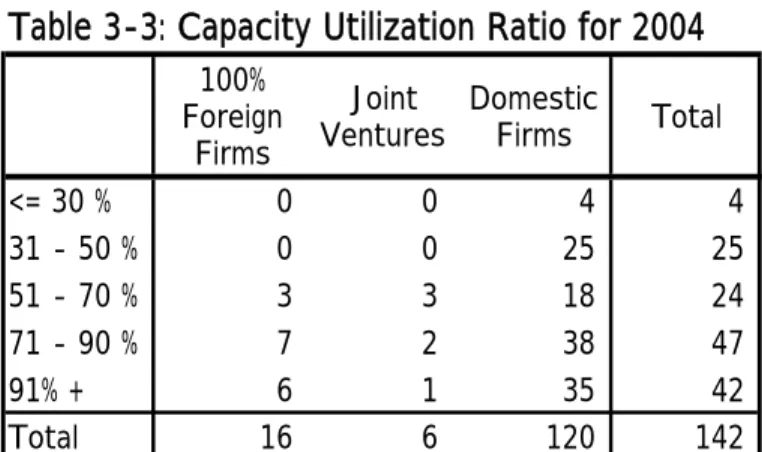
The capacity utilization ratio also declined after the sanctions. According to SGIM, the average capacity utilization ratio was 95% for 130 firms in 2002, and this fell to 77% for 142 firms in 2004. The number of firms with low capacity utilization ratios of 70% or less also increased from 8 firms in 2002 to 53 firms in 2004 (Table 3-3). Domestic companies in particular suffered from low capacity utilization ratios. There were 29 firms with operation utilization ratios of 50% or less, and they were all domestic firms. On the other hand, companies that were 100% foreign maintained relatively high capacity utilization ratios. United States sanctions made competition in the industry more severe, and this impacted garment firms unevenly.
4. Who Suffers?
United States sanctions damaged the garment industry in Myanmar in a serious manner. However, firms and workers did not feel the impact evenly. Those most affected were small and medium-sized domestic private firms and their workers, and these were obviously not the main target of the sanctions.
The garment industry in Myanmar experienced more severe competition under a hostile international economic environment. The process of selection and polarization progresses and is fueled by the sanctions. In such a process, some firms survive and some die. In order to know what entities were actually affected by the sanctions, current changes in the garment industry will be examined. Before this, however, it is important to review the history of the garment industry in Myanmar from the viewpoint of firms’ entries. In this way, knowledge about who were there before the sanctions can be gained.
(1) Brief History of the Entry of Firms
The military government initiated an open door policy immediately after its seizure of power in 1988. At this time, several garment firms were formed as joint ventures in the early 1990’s between state-owned24 and military-related enterprises in Myanmar and
Korean and Hong Kong companies (Table 4-1). MTI, a state-owned textile enterprise, established five joint ventures with Hong Kong companies by 1994 and one with a Singapore company in 1995. UMEHL set up two joint ventures with Daewoo group
24 Regarding the state-owned enterprises in Myanmar, see OECF [1996] and Nishizawa
companies (Daewoo Corporation and Segye Corporation) in 1990 and one with a Hong Kong company in 1992. According to the aforementioned export data, tabled by company, these joint ventures exported 95% of the total garments exported from Myanmar in FY 1993 (Table 4-2).
There seem to be several reasons why foreign companies chose state-owned and military-related enterprises as their counterparts. 25 First, state-owned and
military-related enterprises looked reliable and secure since they were in power. Foreign companies shunned political risk after the military government opened its door to foreign capital a couple of years ago. Second, private entrepreneurs and enterprises had not yet developed in those days. There were no capable private enterprises, in terms of both managerial and technological skills as well as financial capability. Third, these companies expected to enjoy the quota allocation for the United States market by forming joint ventures with public and semi-public entities. Fourth, and most importantly, 100% foreign investments in the garment industry were probably not yet allowed by the government. It is likely that the government did not allow 100% foreign investment in this industry at that time, even though it was legally permissible by the Foreign Investment Law of 1988.
The first 100% foreign investment in the garment industry was made possible in 1994. After this, many successors followed (Table 2-1). The military government advanced its open door policy and economic liberalization in the mid-1990’s. It is probably not a coincidence that the first 100% foreign investment was permitted in the garment sector in this period. FDI inflows had been spurred forward by the release of NLD leader Aung San Suu Kyi from her six-year house arrest in 1995. As a result, highest FDI inflows were recorded in 1996. The export share of 100% foreign enterprises accordingly increased, while that of MTI and UMEHL joint ventures declined (Table 4-2). There are 45 firms with foreign equity. Of these, 31 are wholly-owned by foreign entities, 9 are joint ventures with MTI and UMEHL, and 5 are joint ventures with private firms. Korea has the largest number of related firms (17 entities), followed by Hong Kong (13 entities).
Domestic private firms in Myanmar were rather slow to enter the garment industry. As far as can be ascertained, the first entry of domestic private enterprise into the
25 The account here is primarily based on the author’s interviews in September 2005 in
Yangon and Bago with Mr. S from Korea and Mr. W from Hong Kong. Mr. S was the managing director of Myanmar Daewoo from 1993 to 2000 and has become an advisor to a prominent business group in Myanmar. Mr. W arrived in Yangon in 1991 as chief engineer of a joint venture company with MTI and has become the managing director of one of the leading foreign garment firms in Myanmar.
garment industry was made in 1994.26 The number of domestic private firms has
gradually increased since then. It was only in 1998 that Myanmar entrepreneurs entered into the industry in full strength, causing a “boom” in Yangon. According to Table 2-1, the numbers of domestic private firms with export records jumped from 77 in FY 1997 to 213 in FY 1998 and further to 270 in FY 1999.
The garment industry boom arose from strong demands of United States and EU markets. However, markets conditions were not the only cause for the boom. Affected by the 1997 Asian financial and economic crisis, the Myanmar economy had been beset by huge trade and current deficits. The military government adopted a so-called “export first policy”, in which only those with “export earnings” were allowed to import. However, CMP arrangements remained a way to have imports without export earnings. As previously mentioned, overseas buyers with their own financing provide almost all raw materials such as fabrics and buttons to garment factories in Myanmar. Myanmar firms do not need to pay for their imports with their own “export earnings”. The actual external financial transaction occurs with the remittance of processing fees to the garment firms in Myanmar by overseas buyers after their receipt of products. The CMP arrangements made it possible for the garment industry in Myanmar to develop rapidly by providing a way for domestic enterprises to avoid “import” problems.27
However, some businessmen apparently misused it. Under CMP arrangements, they tried to import other goods besides raw materials for the production of clothes. Sales of imported goods were quite profitable under strict import restrictions. Businessmen often said, “They export in order to import”. By way of CMP arrangements, some people entered into the garment industry only because they wanted to import. Further the burst of bubbly real estate markets in 1997 pushed Myanmar businessmen forward to enter the garment industry. This industry was seen as one of the few somewhat feasible businesses at the time. As a result, as is often the case with booms, the garment industry “boom” in Yangon also had a bubble element that included enterprises without managerial skills, technology, capital and even access to markets. Sooner or later, they were destined to face difficulties.
(2) Selection and Polarization
The garment industry entered into more severe competition as orders sharply declined. Severe competition enhanced the process of selection and polarization among
26 There were several records of export for private firms in FY 1993. However, these
may be trading or similar firms without substantial production capacity.
firms in the industry. The Gini Concentration Ratio is useful to measure the degree of overall inequality present in an output distribution of an industry. “Export” will stand as good proxy for output of the garment industry in Myanmar, since all produced clothes are exported overseas. Based on the reconstructed company-wise export data, Gini Ratios were calculated for FY 2000 and FY 2004.28 The Gini Ratio was 0.75 for FY 2000
and 0.60 for FY 2004. A lower Gini Ratio generally indicates a more equal distribution. The question then arises as to whether or not the output distribution in the garment industry in Myanmar became more equal in the period between the time that United States sanctions were not in place and afterwards. It did not. An apparent equalization in the industry was caused by the demise of micro and small-scale firms with export records. There were 41 firms with export values of US $10,000 or less in FY 2000. The number of such firms decreased to only nine in FY 2004. Faced with dwindled demand and intensified competition, there was no room left for the weak to survive in the garment industry. At the same time, a concentration of top enterprises was observed. While the five top firms occupied 15% of total export in FY 2000, they occupied 20% in FY 2004.
SGIM also found polarization in progress. According to Table 4-3, there were eleven large-scale firms with more than 1,000 workers in both FY 2003 and FY 2004. The number of medium-sized firms with from 501 to 1,000 workers decreased from 22 in FY 2003 to 15 in FY 2004, but small-scale firms with 100 workers or less increased from 38 in FY 2003 to 51 in FY 2004. As a whole, on the one hand, large-sized firms successfully maintained their operations in spite of an unfavorable market environment, and on the other hand, medium-sized firms tended to reduce their workforce resulting in smaller sizes. It is also noteworthy that in contrast to domestic firms, firms with either whole or partial foreign equity seem to have been able to keep their labor force in the period between the time that sanctions were not in place and afterwards. Foreign-related firms had their parent companies, and these companies had market information, global sales networks, and could seek orders on behalf of their Myanmar subsidiaries. Domestic firms, which did not have any parent company, easily lost their buyers and markets. Many domestic firms had no choice but to reduce the number of workers or close their factories. Thus the share of exports from foreign firms increased since the garment industry entered a period of stagnation (Table 4-2).
28 Note that the author used all exports by all companies including apparent
non-garment firms and firms with accumulated export value of US $10,000 or less for the period between FY 1993 and FY 2004 for convenience of calculation. There were 313 firms with export records in FY 2000 and 147 firms in FY 2004. The numbers of identified firms are different from those in the previous section.
Last, productivity gaps among the different types of firms may be observed. Productivity is very important in markets with fierce competition. Table 4-4 shows productivity tabled by different types of firms. Note that 130 firms engaged mainly in sewing processes were selected, excluding four sweater knitters, six embroidery specialists and one dyeing firm.29 According to Table 4-4, foreign joint ventures show
the highest productivity, followed by wholly-owned foreign firms. The productivity of domestic private firms falls behind them. Interesting is the fact that the number of sewing machines30 per worker was almost same among the different types of firms, and
this was supposed to represent a capital equipment ratio. Workers’ skills, production management, and the order size in lots must be important factors in causing productivity gaps. Some domestic firms with low productivity were probably forced out of the market when competition increased following the sanctions.
(3) Workers
Obviously, it is workers who suffered most from the sanctions. The impact of sanctions on workers can be described by using the SGIM and a preliminary survey on workers in the garment industry and some other manufacturing sectors (hereafter Survey on Workers in Manufacturing Sector in Myanmar or SWMM). SWMM was conducted at the same time as the SGIM. A hundred workers were selected from garment factories for interviews in SGIM. Another hundred workers were selected from other manufacturing factories for comparison. With the permission of their employers, a group of ten workers or less was selected from 12 garment factories located in Yangon and Bago. These were again selected for convenience of interviews. Sampling was rather arbitrary and may not properly represent the general situation of workers in the garment industry. Another hundred workers were selected in the same way from 10 factories in Yangon. These factories included soft drinks, confectionery, peanut oil, flour, pharmaceuticals, fertilizer, detergent, paint, and electronics. Primary data used in this research included that gathered from workers employed in the garment industry. However, data on workers of other sectors is mentioned when relevant.
Before discussion, sample workers of SWMM will be described. Out of 100 workers who were employed in the garment industry, 87 were female; 76 of these were not married. This may be contrasted with the case of a hundred workers in other
29 A firm engaged in sewing was also excluded since its production volume was
disproportionately large.
30 The author counted only two kinds of sewing machines: straight lockstitch and
overlock. These two are the main kinds of sewing machines used in the garment industry in Myanmar.
manufacturing sectors. For this case, out of 100 workers, only 21 were female, and 17 of these were not married. It is considered common knowledge that the garment industry employs many young female workers. Most of them are Myanmar (Bamar), but there are some exceptions. These include ethnic minorities such as Mon, Kayin and Shan. The average term of employment at present establishments was 3.6 years, and this is almost same as that of workers in other manufacturing sectors. The majority of workers come from Yangon and its vicinity. Fifty workers came from Yangon City, and six came from Yangon Division other than Yangon City. Eighteen came from Bago Division, and eleven came from Ayeyarwaddy Division. Both of these divisions border Yangon. Forty-two workers migrated from elsewhere to their present places in Yangon and Bago. On average, they migrated 4.6 years ago. Sixty-two workers lived with their families, and 16 lived with their relatives and/or friends. The remaining 22 apparently lived alone, and they are most likely migrant workers.31 As for educational background, there were
no illiterate workers, but three workers had only primary education. Thirty-eight workers attended middle school; 39 attended high school, and 19 passed the matriculation examinations and/or attended university/college.32 They worked 54 hours
per week on average.
According to SGIM, the average wage of sewing-machine-operators in 2004 was 17,800 Kyats per month. This was about US $18 to US $20 at parallel exchange rates.33
This figure is supported by the data from SWMM as well. According to SWMM, the average wage of one hundred workers employed in garment factories, not necessarily sewing-machine-operators, was 21,600 Kyats per month in mid-2005. This was about US $18 to US $22 at the parallel exchange rates.34 Moe Kyaw [2001:154] also reported
that in late 2000, the average monthly wage of workers in the garment industry was about US $20. The average wage of workers in the garment industry, in US dollars to which international buyers tend to respond, does not seem to have declined, even after the sanctions. The above-mentioned figures included all compensation such as attendance and performance bonuses as well as overtime. It means that the “real”
31 Chaw Chaw [2003:207] presents a different observation, saying that “According to
informants long resident in the industrial zones, rural-to-urban migration has increased remarkably. Although there is no segregated data on the place of origin of workers in industrial zones, interviews with factory employees indicate that workers from rural areas constitute more than two-thirds of all employees in each factory.”
32 One attended a vocational school.
33 The parallel exchange rates were about 900 Kyats per US $1 to 1,000 Kyats per US
$1 in 2004.
34 The parallel exchange rates were about 1,000 Kyats per US $1 to 1,200 Kyats per US
income of workers did not decline in the period between the time that sanctions were not in place and afterwards. However, interviews as well as anecdotal data indicate that there was a lack of, or at least reduced, overtime. This diminished real income of garment workers considerably and prompted them to quit their jobs (Kudo [2005b]). No doubt there was a decline in real income of those who worked in factories that could not maintain their operations after the sanctions.
How much did earnings contribute to the entire household income? According to SWMM, on average, wages constituted nearly 60% of total household income. Even though wages are often regarded as supplementary income, as indicated earlier by Steinberg [2003], they were in reality the main income, and this was supplemented by secondary and tertiary income sources. These included jobs at factories and/or offices by other family members that generated 17%, family-owned businesses that earned 14%, and agriculture that provided 6% of total household income. If the samples are reasonably accurate in their representation of the general situation, a family that had members laid off from a garment factory, lost their main source of income. This had a substantial impact on the household.
Some workers send part of their income to their families in hometowns or villages. According to Chaw Chaw [2003:217], between one-third and one half of worker income was sent home. The rest was spent on the worker’s own food, accommodations, clothing, and savings. This account is supported by data from SWMM. Out of 100 workers, there were 27 who sent part of their income to their home families. On average, they sent 34% of their income; their remittances accounted for 20% of the total income of their home family. Out of 27 recipient family households, fourteen were farmers, four were local private factory workers, four were civil servants, and four had their own businesses.
In SWMM the fourteen farmer families were asked how many acres of agricultural land they held in their villages. Seven farmers did not hold any land to cultivate, and four families held 2 to 6 acres of land. Such a small amount of land would probably provide only a marginal level of subsistence, depending on land fertility. Only two families had 10 acres of land or more. Chaw Chaw [2003:217] also states:
Daughters [working in a garment factory] of better-off farmers, defined as having more than 20 acres of farmland, do not have to send their income home. … Daughters whose parents are small landholders (less than 5 acres), tenant farmers or engage in off-farm activities, have to support their parents every month.
Loss of such payments from daughters must have had a larger impact on poorer households in home villages than those with more land.
5. Conclusion
There are two issues related to the impact of United States sanctions. The first concerns whether or not the sanctions effectively punish the Myanmar military government. Is the impact of sanctions big enough? The second is whether or not sanctions effectively targeted only the military government and its compatriots rather than ordinary people. Did sanctions disproportionately impact the military and leave the people intact?
As far as the garment industry in Myanmar is concerned, research reported in this paper confirms a substantial adverse impact. The garment industry had grown with the United States and EU markets; the outright loss of one of these markets created considerable damage. It will no longer grow at a rapid rate similar to some LDC’s in Asia. Nevertheless, it will not die as long as it has access to EU and Asian markets, and the Japanese market in particular. The impact was just large enough to deprive it of the possibility of being a leading industry in Myanmar. United States sanctions actually harmed a potential growth industry that could alleviate widespread poverty in a least developed economy, where labor-intensive manufacturing industries were and are necessary to mobilize both the unemployed and the underemployed labor force in urban and rural areas.
How can the impact on people be evaluated? Burma Campaign UK [2004:5] says: The majority of Burma’s people, especially the poorest, work within the informal economy, which is generally not dependent on foreign investment or markets. The impact of sanctions that are targeted at the formal economy would therefore be minimal for the vast majority of Burma’s people.
It is true. Taking into account the insignificant size of the garment industry in Myanmar, sanctions did not damage the majority of the population, especially those residing in rural areas. Burma Campaign UK [2004:9] also claimed:
The nature of Burma’s economy is such that sanctions targeting foreign investments and international trade will impact on the regime while having a minimal impact on the majority of ordinary civilians.
In reality, it did not impact either the regime or the majority of population.
To be fair, however, the balance of impact weighed most heavily on the ordinary population, since these people lost their jobs and livelihood. In many cases, the loss of jobs for garment workers meant the loss of major income sources for their families in Yangon and their parents’ families in hometowns and villages. Moreover, even though sanctions were apparently targeted at governmental, military, and foreign companies, the most damaged entities were domestic private garment firms. Some critics say that
Myanmar domestic firms must have been swept away when they were faced with more severe competition following the abolishment of the MFA. Such may be true, but such prophecy is arguable itself. One certain fact is that sanctions did not have as much of an impact on military-related enterprises as they did on domestic private firms. Quite the opposite, foreign companies, including joint ventures with UMEHL, raised their relative importance in the garment industry under selection and polarization, a process fueled by the sanctions. It is ironic to see that enterprises originally targeted by the sanctions now play a more important role and are more entrenched in their position in the industry than they were before the sanctions.
Like many other sanctions of the United States, the Burmese Freedom and Democracy Act of 2003 had a disproportionately greater impact on the people than it did on the military regime. Though this paper does not include the argument that overall effects of the sanctions were behavior modification (Seekins [2005:440]), it must be stated frankly that there are no observed signs that the military intends to change its behaviors or attitudes on freedom and democracy.
It would be a bad joke to claim that it is the effectiveness of the sanctions that even now drives the military, together with all the administrative organs and civil servants, to a small rural town in central Myanmar.
APPENDIX: SURVEY ON GARMENT INDUSTRY IN MYANMAR (2005)
1. Objectives
The IDE study team conducted a survey of garment firms in Myanmar in 2005 with the aim of gaining an understanding of the current situation of the garment-manufacturing sector following implementation of United States sanctions. The questionnaire was prepared and tested by the author of this paper, and a market research company, in collaboration with MGMA, collected data.
2. Coverage and Surveys
The survey was designed to cover all export-oriented garment firms including those engaged in sub-contracting work. With the cooperation of MGMA and a market research company in Yangon, an attempt was made to construct a complete list of existing garment firms in mid-2005. Original information gathered for the latest version of
Myanmar Textile and Garment Directory (MTGD), now under compilation, was used. As a result, 165 garment firms were identified as operating firms. However, the actual survey was done on 142 firms, because 22 firms declined to answer the questionnaire, and one firm was already under liquidation.
Trained staff of the market research company conducted actual surveys for data collection for the period between June and September 2005. The author joined the survey administration twice in June and September 2005. The author conducted interviews with garment owners, managers, and workers during these surveys. These interviews were used in this paper.
[Profile of Firms Surveyed] a. Location
Yangon 141 Bago 1 b. Type of Firms
Domestic Private 120 100% Foreign-Owned 16 Foreign Joint Ventures 6
(with MTI) (1) (with UMEHL) (1) State-Owned Enterprise 0 c. Year of Establishment Before 1989 2 1990 – 1993 2 1994 – 1997 30 1998 – 2001 84 2002 – June 2005 24
REFERENCES
English
Asian Development Bank [2005] Key Indicators 2005.
Burma Campaign UK [2004] The European Union and Burma: The Case for Targeted Sanctions, March 2004, available at
http://www.burmacampaign.org.uk/reports/targeted_sanctions.htm.
Chaw Chaw [2003] “Rural Women Migrating to Urban Garment Factories in Myanmar” in Social Challenges for the Mekong Region, Chiang Mai: Chiang Mai University, the html version available at http://www.rockmekong.org/pubs/social/08_chaw.PDF.
Central Statistical Organization. Selected Monthly Economic Indicators, various numbers.
---. Statistical Yearbook, various numbers.
Economic Intelligence Unit (EIU) [2004] Country Profile 2004: Myanmar (Burma), London.
Kee, Hiau Looi [2005] “Foreign Ownership and Firm Productivity in Bangladesh Garment Sector,” paper presented at a seminar on FDI and Productivity in the Garment Industry in Bangladesh organized by the World Bank on August 22, 2005, available at the World Bank Website.
Ko Lay [2005] “Karaoke Nights,” the Irrawaddy Online Edition, available at http://www.irrawaddy.org/aviewer.
Kudo, Toshihiro ed. [2001] Industrial Development in Myanmar: Prospects and Challenges, ASEDP No.60, Chiba: Institute of Developing Economies, JETRO.
Kudo, Toshihiro [2001] “Transformation and Structural Changes in the 1990s” in Kudo, Toshihiro ed., Industrial Development in Myanmar: Prospects and Challenges, ASEDP No. 60, Chiba: Institute of Developing Economies, JETRO.
Kudo, Toshihiro [2005a] “Stunted and Distorted Industrialization in Myanmar.” IDE Discussion Paper Series No.38, Institute of Developing Economies, JETRO, available at http://www.ide.go.jp/English/index4.html.
Ministry of National Planning and Economic Development (MNPED) [1998] Review of the Financial, Economic and Social Conditions for 1997/98, Yangon.
MMRD Publication [2001-2002] Myanmar Textile and Garment Directory 2001-2002, Yangon.
--- [2002-2003] Myanmar Textile and Garment Directory 2002-2003, Yangon.
Moe Kyaw [2001] “Textile and Garment Industry: Emerging Export Industry” in Toshihiro Kudo ed. Industrial Development in Myanmar: Prospects and Challenges, ASEDP No.60, Chiba: Institute of Developing Economies, JETRO.
New Light of Myanmar (the state-run English newspaper)
Norås, Hildegunn Kyvik [2004] “The Global Textile and Clothing Industry post the Agreement on Textiles and Clothing.” Discussion Paper No.5, World Trade Organization.
Seekins, Donald M. [2005] “Burma and U.S. Sanctions: Punishing an Authoritarian Regime,” Asian Survey, Vol. XLV, No.3, May/June 2005.
Steinberg, David I. [2003] “Burma/Myanmar: The Triumph of the Hard-Liners,” South China Morning Post, August 15, 2003.
U.S. Department of State [2004] “Report on U.S. Trade Sanctions Against Burma: Congressionally mandated report submitted to Congress on April 28, 2004,” available at http://www.state.gov/p/eap/rls/rpt/32106.htm.
Burmese
Tin Aung Kyaw [2000] “Chouk Laik Cha Zo, Thunge Jin,” Dana, November 2000. Tin Aung Kyaw [2000] “Let’s Sew! Friends!” Dana, November 2000.
Japanese
海外経済協力基金 [1996] 『ミャンマー経済の現状と課題』OECF Research Papers No.13。 OECF [1996] The Myanmar Economy: Present Situation and Challenges, OECF Research Papers No.13.
工藤年博 [2005b]「米国による経済制裁発動後のミャンマー縫製産業」(『アジ研ワールド・ トレンド』第120 号、44∼51 ページ)。
Kudo, Toshihiro [2005b] “Myanmar’s Garment Industry after the United States Sanctions,” IDE World Trend, No.120, pp.44-51, Institute of Developing Economies, JETRO.
工藤年博 [2002]「ミャンマーの縫製業」(『アジ研ワールド・トレンド』第 77 号、39∼45 ページ)。
Kudo, Toshihiro [2002] “The Garment Industry in Myanmar,” IDE World Trend, No.77, pp.39-45, Institute of Developing Economies, JETRO.
後藤健太 [2003]「繊維・縫製産業―流通未発達の検証」(大野健一・川端望編著『ベトナム の工業化戦略―グローバル化時代の途上国産業支援』日本評論社)。
Goto, Kenta [2003] “The Textile and Garment Industry in Vietnam: An Examination of Undeveloped Distribution Networks,” in Kenichi Ohno and Nozomu Kawabata eds.
Vietnam’s Strategy for Industrialization: How to Support Industrial Development in a Developing Country, Tokyo: Nihon Hyoron-sha.
西澤信善 [2000]『ミャンマーの経済改革と開放政策―軍政10年の総括―』神戸大学経済 学叢書第6輯、勁草書房。
Nishizawa, Nobuyoshi [2000] Myanmar Economic Reforms and Open-Door Policy: Review of Military Rule, Kobe University Economic Research Series No.6, Tokyo: Keiso-Shobo.
日本貿易振興会[1999]『ミャンマー:繊維産業』(ローカル・トゥ・ローカル産業交流事業 案件発掘調査報告書、投資交流部)。
JETRO [1999] The Textile Industry in Myanmar, A Report on Local-to-Local Industrial Exchange Projects.