Marriage, dowry, and women's status in rural
Punjab, Pakistan
著者
Makino Momoe
権利
Copyrights 日本貿易振興機構(ジェトロ)アジア
経済研究所 / Institute of Developing
Economies, Japan External Trade Organization
(IDE-JETRO) http://www.ide.go.jp
journal or
publication title
IDE Discussion Paper
volume
534
year
2015-09-01
INSTITUTE OF DEVELOPING ECONOMIES
IDE Discussion Papers are preliminary materials circulated
to stimulate discussions and critical comments
Keywords: Dowry, Intrahousehold decision making, Women’s status, Marriage,
Pakistan
JEL classification: J12, J16, N35, Z13
* Research Fellow, Area Studies Center, IDE ([email protected])
IDE DISCUSSION PAPER No. 534
Marriage, Dowry, and Women’s
Status in Rural Punjab, Pakistan
Momoe MAKINO*
September 2015
Abstract
Dowry is a common custom observed in South Asian countries. It has been a target
of an opposition movement because it is assumed to be a root cause of women’s
mistreatment, for example, in the form of sex-selective abortion, girls’ malnutrition,
female infanticide, and domestic homicide called “dowry murder.” Despite its
alleged evil consequences and the legal ban or restrictions on it, the custom has been
extended, and recently, the dowry amount seems to be increasing. However, there is
little empirical evidence of dowry’s effects. This study empirically investigates the
effects of dowry on women’s status in rural Pakistan. We conducted a unique survey
in rural Punjab, Pakistan, to explore the marriage practices there and to answer the
research question. Results show that a higher dowry amount enhances women’s
status in the marital household. This implies that an outright ban on dowries does not
necessarily improve women’s welfare at this time.
The Institute of Developing Economies (IDE) is a semigovernmental,
nonpartisan, nonprofit research institute, founded in 1958. The Institute
merged with the Japan External Trade Organization (JETRO) on July 1, 1998.
The Institute conducts basic and comprehensive studies on economic and
related affairs in all developing countries and regions, including Asia, the
Middle East, Africa, Latin America, Oceania, and Eastern Europe.
The views expressed in this publication are those of the author(s). Publication does not imply endorsement by the Institute of Developing Economies of any of the views expressed within.
INSTITUTE OF DEVELOPING ECONOMIES (IDE), JETRO
3-2-2, WAKABA,MIHAMA-KU,CHIBA-SHI
CHIBA 261-8545, JAPAN
©2015 by Institute of Developing Economies, JETRO
No part of this publication may be reproduced without the prior permission of the IDE-JETRO.
1
Marriage, Dowry, and Women’s Status in Rural Punjab, Pakistan
∗Momoe Makino† September, 2015
Abstract
Dowry is a common custom observed in South Asian countries. It has been a target of an opposition movement because it is assumed to be a root cause of women’s mistreatment, for example, in the form of sex-selective abortion, girls’ malnutrition, female infanticide, and domestic homicide called “dowry murder.” Despite its alleged evil consequences and the legal ban or restrictions on it, the custom has been extended, and recently, the dowry amount seems to be increasing. However, there is little empirical evidence of dowry’s effects. This study empirically investigates the effects of dowry on women’s status in rural Pakistan. We conducted a unique survey in rural Punjab, Pakistan, to explore the marriage practices there and to answer the research question. Results show that a higher dowry amount enhances women’s status in the marital household. This implies that an outright ban on dowries does not necessarily improve women’s welfare at this time.
Keywords: Dowry, Intrahousehold decision making, Women’s status, Marriage, Pakistan JEL classification: J12, J16, N35, Z13
1. Introduction
Dowry, broadly defined as the transfer of wealth by the bride’s parents at the time of marriage,1 is often considered the root cause of unequal treatment of girls within the family, represented by sex-selective abortion, female infanticide, malnutrition of girls, under-education
∗
I thank Munenobu Ikegami, Norio Kondo, Yuya Kudo, Shelly Lundberg Tomohiro Machikita, Shinichi Shigetomi,Yoichi Sugita, Kazushi Takahashi, and seminar/conference participants at IDE and ESPE for valuable comments and suggestions. My special thanks to Tariq Munir and his assistants at the Faizan Data Collection and Research Centre for their sincere efforts in conducting the field survey in Punjab, Pakistan. The financial support of IDE-JETRO and JSPS (Grant-in-Aid for Scientific Research, Kakenhi-24730261) are gratefully acknowledged. Any errors, omissions, or misrepresentations are, of course, my own.
†
Institute of Developing Economies, JETRO, 3-2-2 Wakaba, Mihama-ku, Chiba-shi, Chiba 261-8545, Japan, [email protected], +81-43-299-9589.
1
Although the definition of dowry is controversial, there is no objection about the part that it is the transfer of wealth by the bride’s parents at the time of marriage (Kishwar 1988; Billig 1992; Srinivas 1994; Zhang and Chan 1999).
2
of girls, and so on. The notable phenomenon of “missing women,” referring to the unnaturally low female-to-male ratios in South Asia, can be associated with the practice of dowry (Sen 1990; Croll 2000; Anderson and Ray 2010). Advertisements for sex-selective abortion read “Better Rs. 500 now than Rs. 500,000 later (in dowry).” Especially in India, dowry is sensationally reported by the media, and academics indicate it to be a cause of domestic violence and homicide called “dowry murder” (Stone and James 1995; Rudd 2001; Bloch and Rao 2002; Sekhri and Storegard 2014). On the basis of the belief that dowry is an evil custom, the anti-dowry movement began at the end of the 1970s, led by female activists and NGOs. The stance on dowry issues has also become politically important.2 Dowry has been labeled an anti-social practice and is banned or restricted by law.3 Nevertheless, no legal, political, or social action seems effective in discouraging the practice of dowry; in fact, it seems recently to have intensified and extended.
Although dowry is claimed to be an abominable practice, especially in India, its real effects are not well known. There are a massive amount of case studies on dowry; however, many seem little more than a set of anecdotes and narratives, often focusing on worst cases, such as dowry murder.4 Some argue that most deaths recorded as dowry murder in India were unrelated to dowry (Kishwar 1988, 1989; Narayan 1997; Leslie 1998; Oldenburg 2002).5 Contrary to general belief, the ban’s consistent ineffectiveness implies that people have a sound rationale for practicing dowry. Dowry may enhance women’s status in the given context where women’s property rights and security are not sufficiently guaranteed in practice. Indeed, dowry may exemplify seemingly gender-discriminatory practices that actually function as an informal mechanism protecting women’s rights under a weak legal system.6 If dowry enhances women’s welfare in the given context, banning dowry may result in unexpected and undesired consequences such as reducing women’s welfare and disempowering them. Therefore, the current study aims at empirically investigating the effect of dowry on women’s welfare in the marital household.
2
For example, the left-wing parties attach political stigma to marriage with dowry (Palriwala 2009).
3
The Dowry Prohibition Act of 1961 and its amendments in India; the Dowry Prohibition Act of 1980 and its amendments in Bangladesh; the Dowry and Bridal Gifts (Restriction) Act of 1976, and the Marriages (Prohibition of Wasteful Expenses) Act of 1997 in Pakistan.
4
One empirical study on dowry murder exists (Sekhri and Storegard 2014); however, it cannot deny the possibility that reported dowry murders include all kinds of domestic homicide.
5
These sociological and anthropological studies argue that any kind of domestic homicide might be recorded simply as dowry murder on the basis of the fact that no data exist on general murder cases from domestic violence, while dowry murder is surprisingly visible, with tabulated data assembled by the National Crimes Bureau of the Government of India.
6
Watta satta (literally “give–take,” bride exchange) is an example of such an informal mechanism (Jacoby and Mansuri 2010).
3
The most important reason for a dearth of rigorous evidence may be scarce or inadequate data needed to conduct empirical analysis. Dowry is an illegal social practice in India and Bangladesh; therefore, it is often reported that people are unwilling to reveal the correct dowry amount. Besides, dowry usually consists of jewelry, clothing, furniture, household items, livestock, cash, and so on; thus, assessing dowry value at the time of marriage becomes even more difficult (Jejeebhoy 2000). For the exclusive purpose of examining dowry’s effect on women’s status, we have conducted a household survey in rural Punjab, Pakistan. We meticulously designed the survey questionnaire to obtain correct information on every single item of dowry.
The studies most closely related to ours are Zhang and Chan (1999) and Brown (2009), both showing that dowries have positive impacts on several measures of women’s welfare in East Asia. Empirical studies being scarce as a whole, to our knowledge, only one empirical study concerning dowry payments in Pakistan has been conducted to date (Anderson 2000 2004). Dowry’s effect on women’s welfare is an empirical question because its effects can be diverse, depending on the context. Jejeebhoy’s (2000) study shows that a larger size of dowries positively affects women’s decision-making power in the northern part of India, but not in south India. Dowry’s heterogenous effects may possibly be related to women’s property rights, which are relatively protected in southern India than in the north. If dowry compensates for institutional failure to protect women’s property rights, dowry’s effect on women’s welfare in rural Pakistan, where they are virtually not protected, may be positive.
Another obstacle in conducting an empirical study on dowry is the potential endogeneity problem. In particular, the unobserved characteristics of the bride’s parents may affect not only how the bride is treated in the marital household but also the amount of dowry. Better treatment of women in the marital household may not be due to a higher amount of dowry, but because of unobserved characteristics of the bride’s parents such as their greater awareness of women’s rights, which may also simultaneously increase the dowry amount. Among a limited number of empirical studies on dowry, only a few have paid attention to the endogeneity problem,7 for instance, Zhang and Chan (1999) and Brown (2009) use instrumental variables to deal with the endogeneity of dowry in their studies. Because any instrumental variables for dowries involve difficulty in convincingly satisfying the exclusion restriction on their own, in the current study, two methods are used to deal with the endogeneity problem. The first method is to include a rich set of observed characteristics concerning the marriage. We then follow Altonji et al. (2005) to demonstrate how large the effects of unobservables are in order to completely
7
4
eliminate the effects of dowry on women’s status.8 The second method is to construct instrumental variables for the dowry amount. We recognize non-existence of instruments that randomly assign dowry amount, but we do our best to assign instrumental variables that do not include unobserved household characteristics by construction.
In a broader perspective, the current study is related to the literature on the relationship between empowerment and economic development (e.g., World Bank 2011; Duflo 2010). In general, the positive association between women’s empowerment and economic development is observed. In South Asian countries, however, economic development does not necessarily accompany women’s equal treatment. For example, the skewed male-female ratio seems rather exacerbated recently (Croll 2000). Dowry practice, often a symbol of women’s disempowerment, is disappearing with the spread of modernization (Anderson 2003). The only exception is South Asia where the practice not only continues but is also expanding. In a context where women’s legal protection is underdeveloped, interpreting dowry as a symbol of women’s disempowerment may be misleading. Rather in such a context, dowry may empower women.
We cannot find any negative effects of dowry on women’s status in the marital household. Rather, empirical analysis reveals that in rural Punjab, Pakistan, higher dowry amounts are associated with increased status of women in the marital family. Our findings provide a foundation for policy debate concerning the custom of dowry in Pakistan, where dowry is not yet legally banned and is a hot policy topic because of its alleged negative consequences. In a society where women do not inherit parental land in practice, dowry might be the only asset that women can take into marriage and the only source of protection for them after marriage. Because dowry, in fact, increases women’s welfare at this moment, policies should not universally ban the practice of dowry without any real, pragmatic improvement of women’s inheritance rights.
The remainder of this paper is constructed as follows. Section 2 overviews related research and existing data. Section 3 describes our unique household survey and the dataset. Section 4 presents the empirical results. Section 5 concludes the study.
2. Overview of related research and existing data
The current paper is academically motivated by the fact that there is little empirical evidence while theoretical research has been active. The biggest obstacle to conduct empirical studies on dowry is the lack or inadequacy of data. In this section, we provide an overview of related research on dowry as well as the problems of existing data on dowry.
8
For examples of the same procedure, see Kingdon and Teal (2009) and Bellows and Miguel (2009).
5
2.1 Literature on dowry
Although empirical evidence is scarce, economists have actively conducted theoretical studies on dowry (Becker 1991; Botticini and Siow 2003; Boserup 2007; Anderson 2003; 2007). The two main interpretations of dowry are (1) the price determined in the marriage market (the price model), and (2) the pre-mortem inheritance (the bequest model). The definition of dowry has been an object of discussions that aim to interpret the nature of dowry. Following the price hypothesis, dowry is often defined as a transfer in cash or kind or both from the bride’s parents to the groom and his parents at the time of marriage, which is expected or even demanded by the groom and his family. However, following the bequest hypothesis, dowry is rather property taken by the bride to her new home or given to her during the marriage rituals by her parents.
These two interpretations of dowry are often considered as mutually exclusive (see Zhang and Chan 1999; Anderson 2003; Arunachalam and Logan 2015), and existing studies focus on the question of whether dowry is a price or a bequest. The reason is that the two hypotheses are believed to lead to opposite policy implications. If dowry is a pre-mortem bequest voluntarily offered by the bride’s parents, laws prohibiting dowry practice might not be necessary. If dowry is a price that can be driven up depending on the marriage market, it potentially decreases girls’ chance of survival and thus may be better prohibited by law.
Although these two models are often considered mutually exclusive, typical empirical studies construct an estimation model to test independently either the price or the bequest model; thus, such studies cannot reject one over the other even if they claim to do so. Those testing the price model typically regress the amount of dowry on the bride’s and the groom’s characteristics (Behrman et al. 1995; Deolalikar and Rao 1998; Behrman et al. 1999; Mbiti 2008), and most of them cannot find any strong evidence supporting the price model. Those testing the bequest model usually regress women’s welfare measures on the amount of dowry (Zhang and Chan 1999; Brown 2009). They claim that the finding that dowry enhances women’s welfare supports the bequest model; however, the finding does not necessarily reject the price model because women’s welfare could increase with a higher dowry amount under the price model. Possibly, dowry is determined in the marriage market, but the bride’s parents may voluntarily pay a higher amount so that the groom and his parents will treat their daughter better after marriage. This study is specifically interested in whether dowry enhances women’s welfare in the marital household under present circumstances.
The current study is not the first to empirically investigate dowry’s effect on women’s welfare and empowerment. Zhang and Chan (1999) originally incorporate assets brought into
6
marriage into the Nash model of household bargaining (Manser and Brown 1980; McElroy and Horney 1981; McElroy 1990; Lundberg and Pollak 1993). With the assumption that assets brought into the marital family increase one’s threat point,9 the theoretical implication of the model is that dowries, or any asset brought into marriage, have positive effects on one’s private consumption in the marital family.10 Zhang and Chan (1999) and Brown (2000) use East Asian datasets and show that dowries have positive effects on several measures of women’s welfare. Although the endogeneity of dowry amount is not taken into account, Jejeebhoy (2000) demonstrates that the size of dowries positively affects women’s decision-making power in north India, but this is not the case in the south. Bloch and Rao (2002) and Srinivasan and Bedi (2007), both using data from a few specific Indian villages, indicate that women with higher dowry amounts are less likely to suffer domestic violence from their husbands, while Suran et al. (2004) show a completely opposite effect from data in rural Bangladesh. In sum, the effect of dowry on women’s welfare is an empirical question because it likely varies depending on the social context.
2.2 Problems of existing data
Because dowry is legally banned in India and Bangladesh, people usually hesitate to provide the correct amount of dowry. The typical question on dowry in the Indian dataset asks about community-based dowry. For example, the India Human Development Survey asks “Generally in your community for a family like yours, what are the kind of things that are given as gifts at the time of the daughter’s marriage?” Community-based dowry is not necessarily the same as individual dowry, which is actually paid by the bride’s parents at the time of marriage. Alternatively, the question regarding dowry has only a binary answer, i.e., whether a positive amount of dowry is paid (e.g., Survey on the Status of Women and Fertility both in India and Pakistan). The binary answer, of course, does not provide much additional information. The norm of whether a positive dowry amount is provided corresponds to, and is largely explained by ethnic, religious, and caste background in South Asia.
Because dowry is not legally banned in Pakistan, the amount personally paid by the female respondent’s parents can be asked without reservation in a Pakistani dataset such as the Pakistan
9
A threat point can be determined by extra-household environmental parameters such as sex ratio in the marriage market and divorce laws, as well as non-cooperative equilibrium within marriage (Manser and Brown 1980; McElroy and Horney 1981; Lundberg and Pollak 1993).
10
Although Zhang and Chan (1999) call the derived theoretical implication “bequest model,” the term might be misleading. Dowry is likely to reflect parental assets, but it may not necessarily be equally divided between sisters—as is often the case with bequest. Furthermore, assets brought into marriage might be far less than the amount inherited by brothers. Thus, the term “trousseau” might more properly describe assets brought into marriage by the bride.
7
Rural Household Survey. Although Pakistani interviewees may not intentionally conceal true information on dowry, the survey may likely entail recall errors because they must retrospectively provide the dowry amount paid by their parents several years ago. Figure 1 plots the predicted amount of real dowry measured in Pakistani Rupees in 2004 onto years of marriage using the Pakistan Rural Household Survey. Because the consensus is that the real amount of dowry is increasing, or is at least in a non-declining trend, the figure implies the general tendency of recall errors. In other words, the longer the gap between the interviewees’ marriage and the recall time, the more likely they overestimate the dowry amount.
3. Data
To the best of our knowledge, data collected in this study is the first to consider explicitly a general tendency to overestimate the amount that was paid a long time ago. Similar to the characteristics of previously collected data, ours are also retrospective; however, based on this tendency, we particularly adopted certain efforts to minimize survey recall errors. For example, we asked both the community-based dowry amount (non-retrospective) and the personal dowry amount paid at the time of the respondent’s marriage (retrospective). Since Pakistani dowry consists of gold/jewelry, clothing, furniture, kitchen items, and so on, we queried dowry amounts by item. If we sensed a respondent’s overestimation of the dowry amount, especially in case of a marriage that took place a long time ago, because dowry is displayed, we could and did check the amount with those who attended the ceremony. Consequently, our data on predicted real amounts of dowry (Figure 2) do not show any decreasing trend, in contrast with Figure 1.
3.1 Survey
When conducting our survey between June and October 2013, we intended to capture the heterogeneous aspects of the Punjab province in Pakistan so that the survey represents the entirety of Punjab. First, we divided Punjab (36 districts) into five regions and selected one district from each region: Pothohar (or North), Central, East, West, and South Punjab. These five regions differ in terms of climate, culture including marriage/inheritance practice, and socioeconomic conditions. We randomly selected one district from each region, namely, Rawalpindi, Mandi Bahauddin, Narowal, Muzaffargarh, and Bahawalnagar (see Figure 3). We used the district census for 1998–1999, the latest census available in Pakistan, to randomly select six villages in rural areas in each of the five districts. We restricted sampling villages to those with population of at least 1,000 at the time of the census. In each village, we selected 22
8
households, following a stratified random sampling methodology. First, with assistance from the village chief, we made a profile of the village to pursue stratified random sampling. The strata are kammees11 (i.e., traditional service caste, with annual income ≤ PKR 200,000, >
PKR 200,000) and zamindars (i.e., landowning farmers with land < 5 acres, 5–12.5 acres, >12.5 acres). Second, we made a population of our survey and categorized it into each stratum. The eligible households of our survey are defined as those with an economically active husband and wife aged 15–65. Finally, we performed a stratified random sampling so that the percentage of each stratum of our sample corresponds to the percentage of each stratum of the village population (= households).
The questionnaire was carefully designed to comprehensively understand marriage practices in rural Punjab, Pakistan. The questionnaire consists of two parts, the first with questions to the husband and the second with questions to his wife. Because the second part contains sensitive questions to assess the wife’s status in the marital household, we attempted to maintain the wife’s privacy as much as possible, for example, by requesting a separate interview room so that the wife could answer without feeling any pressure from her husband.
3.2 Marriage practices
The summary statistics of husband and wife and their marriage characteristics are presented in Table 1. The average age of husbands is 40.6 years. Husbands, on average, completed primary education (5 years), and 56 percent of them are literate. The average age of wives is 35.8 years. Wives, on average, did not complete primary education, and only 30 percent of them are literate. The literacy rates seem much lower than official statistics on adult (15 years and older) literacy in rural Punjab, provided by the Pakistan Social and Living Standard Measurement Survey 2012–2013, which reports 63 percent and 40 percent for males and females, respectively. Official statistics are known to overestimate educational achievement, while we define literacy strictly: we asked respondents to write one sentence and defined them as literate if they could read and write at least a sentence; we did not consider them literate if they could read only the Qur’an. Kammee households account for 27 percent of total households surveyed. The average size of agricultural land per household is 3.24 acres, with almost 40
11
Kammees are of the traditional service caste in village society in Pakistan. They are landless and have provided various services to landowning farmers (zamindars), as carpenters (tarkhan), barbers (nai), blacksmiths (lohar), tailors (darzi), and so on. Muslims deny the caste system, but the hierarchical relationship does exist between zamindars and kammees, called the Seyp system (Hirashima 1977). Kammees are conceptually different from caste; however, effectively indicate social class, and thus, we call them caste in this study for descriptive purposes.
9
percent of households being landless.12 For almost 40 percent of wives, the village of birth is the same as that of their husbands, 66 percent of them are married to their cousins, and 17 percent are married in watta satta (bride exchange, or literally, “give–take”).13 All of these are unique features of marriage in Punjab, Pakistan. By contrast, the northwest part of India, including Indian Punjab, has been traditionally known for hypergamy, in which wives are married to husbands of higher status. Hypergamy contrasts with endogamy and cousin marriage.
Watta satta is also excluded from hypergamy because two families arranging watta satta cannot
technically observe hypergamy at the same time, and they are most likely to be from the same social class and economic condition.
The first part of the questionnaire asks the husbands about their marriage practices, including the amount of dowry. Because dowry is well known to be consisting of various items that enable a young couple to start their own life immediately after marriage, we asked about each item’s value within the dowry. The actual question is “Generally, in your community, for a family like yours, what is the approximate value of each item given as dowry at the time of the daughter’s marriage?” We explicitly asked about dowry as observed in their community because we are interested in the practice of dowry itself, as well as in the personal amount of dowry their parents paid. When asked about dowry in their community, their answer is likely to convey precise information about dowry practice. They might answer with how much they pay for each item if they are in the process of providing a dowry to their daughter. In either case, the answer is likely to provide more precise measures on the itemized value of dowry. Presumably, remembering every single item of their personal dowries from several years ago would be difficult. The second part of the questionnaire asks the wives about their personal dowries, i.e., “How much dowry did your parents provide at the time of your marriage?” These responses are used in the empirical analysis. Answers by husbands about community-based dowry amounts are used to check the wives’ answers about their personal dowries.
Figure 4 shows the itemized average value of dowry generally provided by a daughter’s parents at the time of her marriage. Contrary to our expectation, the amount of cash is not very large, and cash included in a dowry, especially cash to the groom, seems a token payment with the average negligible amount being PKR 3,759.14 The average value of gold/jewelry offered to the bride by her parents is the largest among all items, PKR 76,651. Both cash and gold/jewelry are offered by approximately 90 percent of brides’ parents. Also, somewhat to our surprise, the
12
“Landless” means those without agricultural land. Most of the respondents own residential land.
13
Watta satta usually involves a joint marriage in which a brother and a sister of one family marry a sister and a brother of another family. The composition of groom and bride from one family is not necessarily a brother–sister pair, but sometimes an uncle–niece pair.
14
10
average value of electronics, furniture, and kitchenware offered to the bride by her parents is large, and these items are offered by an even higher percent of the brides’ parents (95 to 100 percent). Although the average value of each item is less than that of gold/jewelry, the average value of furniture, electronics, and kitchenware combined amounts to PKR 136,389—much greater than that of gold/jewelry. Although we should carefully interpret gold/jewelry offered to the bride by her parents as gifts to the bride because such items can easily be converted into cash and might be taken by the groom and his parents, items such as furniture, electronics, and kitchenware can be safely interpreted as gifts to the bride by her parents. In India, reportedly, the groom’s parents often ask the bride’s parents for dowry to prepare future dowries for their daughters (circulating dowry). However, in rural Pakistani Punjab, the largest share of dowry being furniture/electronics/kitchenware makes it difficult to support the hypothesis of circulating dowry. Looking at items’ value in detail, dowry seems, in fact, trousseau that is voluntarily offered by the bride’s parents to their daughter at the time of her marriage and is at her disposal in the marital household.
Although dowry expense incurred by the bride’s parents is notoriously known, and in fact, is the single greatest expense in marriage, the expenses incurred by the groom’s parents are far from negligible. Figure 5 shows a comparison between the magnitude of marriage expenses incurred by both sides. In addition to the ceremony expense,15 the groom’s side also incurs the cost of gifts to the bride called bari, an indispensable part of the ceremony. Bari typically consists of jewelry and clothing offered to the bride and her female relatives, and it can be considered a customary bride price. These two major expenses in marriage incurred by the groom’s side, i.e., the ceremony expense and bari, together surpass the amount of dowry incurred by the bride’s side. Apparently, the expense of marriage in Pakistani Punjab is not disproportionally borne by the bride’s parents.
Also, notably, dowry is sometimes partially incurred by the groom’s side. We observed that in some communities, the groom’s side customarily bears 50–60 percent of the dowry expense. Although households bearing half the expense of dowry account for only 7 percent of the sample, this custom is far from negligible because it does not fit into either the price hypothesis or the bequest hypothesis. Under the price model, dowry payment should be one-sided, by the side gaining from marriage or by the side oversupplied in the marriage market (Zhang and Chan 1999). Under the bequest model, dowry should be paid entirely by the bride’s parents (Botticini
15
In the survey, we asked for itemized average expenses of a marriage ceremony, generally paid by both the groom’s and bride’s parents. On average, the groom’s parents incur more ceremonial expenses for each item. In particular, the groom’s parents usually pay a substantial amount for the procession ceremony (baraat) and feast (walima).
11
and Siow 2003). The fact that the groom’s side bears approximately half the expense of dowry can be consistent with the idea that dowry is a resource to help the new couple start their marital life. It also fits into the interpretation of dowry as trousseau, implied by Figure 4.
The amount of Islamic bride price, called mehr,16 whether its payment is immediate (moajel) or deferred (non-moajel), supports the view that bride price is nowadays a mere token payment (Figure 5). The major reason for mehr becoming merely symbolic in establishing a marriage in Pakistani Punjab, seems to be the shame felt about the perception of mehr, which reminds people of the sale of a daughter by a father to a husband (Eglar 1960; Oldenburg 2002); this is confirmed by our qualitative interviews. On average, a negligible amount is reported for
moajel, and only 17 percent of those interviewed answer that they generally specify non-moajel
in the marriage contract. We cannot find any strong correlation between the practice of writing any non-moajel into the marriage contract and household status (whether zamindars or
kammees) or household wealth (quality of living and size of land ownership). We observe some
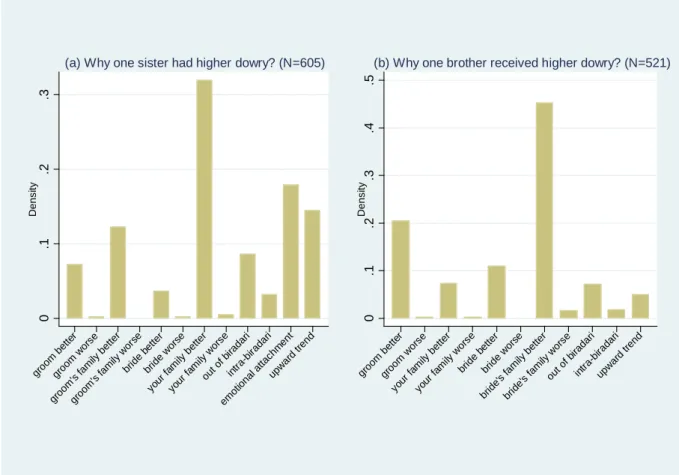
negative correlation between the practice of writing non-moajel and the Punjabi ethnicity. We asked wives why the real amount of dowry differed among siblings (Figure 6, panels (a) and (b)).17 We allowed multiple answers by the respondents, and thus, the number of observations is the total number of reasons given by the respondents. Panel (a) is the answers when the respondent’s parents were on the side of payment while panel (b) is the answers when her in-laws were on the side of payment. Excluding “emotional attachment” to one daughter, and “upward trend” of dowry, which are less meaningful answers in our study, dowry offered to the bride by her parents (panel (a)) tends to be higher when (1) the groom’s quality is better (higher education, higher earning ability), (2) the groom’s family’s status/economic condition is better, (3) the bride’s parents are in better financial condition (compared to the groom’s family and/or to the time of their other daughters’ marriages), and (4) the marriage is arranged out of
biradari (literally “brotherhood,” a group of male kin). Reasons for a difference in the dowry
amount received by the groom (panel (b)) are consistent with those for the bride. As determinants of the dowry amount, these answers seem to reinforce the importance of the groom’s quality and the bride’s parents’ financial capacity to pay. The idea that a higher quality of groom increases the dowry amount is better explained by the price model, while the idea that the financial capacity of the bride’s parents increases the dowry amount is close to the bequest
16
Mehr is required to conclude the marriage, which is a contract for Muslims. Mehr consists of two parts: one is moajel, the immediate transfer at the time of marriage from the groom’s to the bride’s side; the other is non-moajel, a deferred transfer promised for payment at the time of divorce.
17
We also asked husbands about any differences of future dowries they expect to pay or receive at the time of their children’s marriage. The reasons for a difference answered are consistent with wives’ answers.
12
model. Apparently, the two major hypotheses about dowry, the price and the bequest hypotheses, are not exclusive. To lead to effective policy implication aimed at improving women’s welfare in Pakistan (and South Asia), examining the effects of dowry on women’s welfare could be more useful rather than discussing the hypothesis that is true to the nature of dowry.
3.3 Measure of women’s status
The measures of women’s status/empowerment are all answered by wives and summarized in Figure 7. The first measure is women’s decision-making power; we asked wives who has the most say in decision making on (1) what to cook on a daily basis, (2) whether to buy an expensive item such as a television or refrigerator, (3) how many children to have, (4) what to do if a child falls sick, and (5) whom the children should marry. We construct an indicator variable for women’s decision making that equals one if the wife has the most say in deciding each item and zero otherwise. The summary of the five indicator variables is presented in Panel (a) of Figure 7. As expected, the majority of wives, 75 percent and 63 percent, have the most say on what to cook and what to do when a child falls sick, respectively. In contrast, only a small fraction of wives can decide on major household expenses, fertility, and children’s marriages.
The second measure is women’s autonomy; we asked the wife whether she has to ask permission of her husband to go to (1) the local health center, (2) the home of relatives/friends in the village, and (3) the neighborhood shop. We construct an indicator variable for women’s autonomy that equals one if the wife has to ask permission of her husband and zero otherwise. Panel (b) of Figure 7 summarizes these three indicator variables. Wives in Pakistani Punjab seem, on average, to have autonomy. Approximately 70 percent of wives do not have to ask permission of their husbands to go to the local health center, and approximately 75 percent of wives can visit their relatives/friends and a neighborhood shop without asking permission. The reason they have modest autonomy could partially be due to the prevalence of village endogamy, implying that the village people are relatives, and the practice of purdah18 is relatively relaxed within the village.
The third measure concerns the women’s level of son preference. We construct two indicator variables for son preference. One indicator variable takes the value one if the wife’s ideal number of boys is greater than her ideal number of girls and zero otherwise. Another indicator variable takes the value one if the wife believes that boys should be more educated
18
Purdah literally means “curtain” in Urdu. Purdah is the practice of gender segregation and the seclusion of women in public, observed in South Asian countries.
13
than girls and zero otherwise. These are summarized in Panel (c) of Figure 7.
The last measure is women’s work time. We report their work time separately with and without payment in Panel (d) of Figure 7. Women’s average work time without payment is 5.4 hours per day. Work without payment includes time for cooking, sewing, cleaning, laundry, childcare, and farming/livestock care. Women’s average work time with payment is only 0.43 hours per day. This is because a majority of women, approximately 80 percent, do not work for pay. Their average work time with payment conditional on that they work for pay is 2.1 hours per day. This might still seem a short time at first glance; however, this is the average for the entire year, and notably, women working as agricultural labor work only seasonally, approximately 3 to 4 months.
4. Estimation
4.1 The estimation model
We are interested in the effects of the amount of dowry on women’s status in the marital household, which is represented by
𝑌𝑖𝑖 = 𝛽0+ 𝛽1𝐷𝑖𝑖+ 𝛽2𝐵𝑖𝑖+ 𝜷𝟑′𝑿𝒊𝒊+ 𝑣𝑖+ 𝜀𝑖𝑖, (1)
where 𝐷𝑖𝑖 (𝐵𝑖𝑖) is the amount of dowry of the wife, personally paid by her parents (bari or bride price, personally offered to the wife by her in-laws) in household 𝑖 in village 𝑗 measured in 2013 Pakistani Rupees. 𝑿𝒊𝒊 is a set of covariates of household 𝑖, namely the wife’s age at marriage, the wife and her husband’s age and education level, the household’s wealth measured by the size of land owned, the household’s ethnicity, and the indicator variables of whether they belong to service caste (kammee), whether the marriage is endogamous, and whether the marriage is watta satta. The village fixed effects, 𝑣𝑖, are controlled. The outcome variable, 𝑌𝑖𝑖, is one of those measuring women’s status in the marital household, described in subsection 3.3. Because the dowry amount is presumably endogenous, we address the endogeneity problem in two ways. First, we follow the procedure developed by Altonji et al. (2005) to indicate how large the effects of unobservables should be in order to remove the effects of dowry. Second, we treat endogeneity using a set of instruments. In the literature, the “- 𝑖 method” is used to construct an instrument if no instrument exists (Aizer 2010; Vogl 2013). The basic idea is to develop an instrument that reflects the marriage market, excluding the own household unobservables by construction. In Punjab, Pakistan, the marriage market is defined
14
within relatives rather than within the village. Thus, the current study utilizes as instruments (1) the brothers’ average amount of dowry paid by the brothers’ in-laws and (2) the sisters’ average amount of bari paid by the sisters’ in-laws.The first stage equation is given by
𝐷� = 𝛼𝚤𝚤 0+ 𝛼1𝐷������ + 𝜶𝚤𝑏𝑏𝚤 𝟐′𝒁𝒊𝒊+ 𝜶𝟑′𝑿𝒊𝒊+ 𝑣𝑖+ 𝜖𝑖𝑖, (2)
where 𝐷������ is the average amount of the wife’s brothers’ dowries paid by the brothers’ in-laws. 𝚤𝑏𝑏𝚤 𝒁𝒊𝒊 includes other excluded variables, i.e., the wife’s natal family income at the time of her
marriage and the assets owned by the wife’s natal family at the time of her marriage; 𝑿𝒊𝒊 and 𝑣𝑖 are the same as in equation (1). Because of the prevalence of endogamy and strong
assortative mating in rural Pakistani marriage, the average dowries that the wife’s brothers’ in-laws paid are presumably positively associated with the dowry amount that the wife personally received from her parents; however, we assume that they do not affect the wife’s status in her marital household. The endogeneity of the wife’s bari offered by in-laws is similarly treated, simply replacing 𝐷� and 𝐷𝚤𝚤 ������ in equation (2) with 𝐵𝚤𝑏𝑏𝚤 � and 𝐵𝚤𝚤 ������ (the 𝚤𝑠𝑠𝑠𝚤 average amount of the wife’s sisters’ bari paid by sisters’ in-laws), respectively. Also, we assume that the wife’s natal family’s income and assets owned at the time of her marriage affect the wife’s status in her marital household only through her dowry brought into marriage. This seems a plausible assumption, given that transfer from the wife’s natal family to the husband’s family after marriage is negligible, at least in our sample. However, we do not ignore the possibility that the wife’s natal family’s status, usually represented by the assets owned, affects how she is treated in the marital family. Because of this concern, we check whether the 2SLS estimation results substantially change by dropping her natal family’s assets at the time of her marriage; we confirm that they do not.
The estimation results of the first stage regression are shown in Table 2. As expected, the average amount of dowries that the wife’s brothers’ in-laws paid is strongly associated with the wife’s own dowry paid by her parents. Likewise, the average amount of the wife’s sisters’ bari is strongly associated with the wife’s own bari paid by her in-laws. When the wife’s natal family has plenty of cash at the time of her marriage controlling for assets, the amount of dowry increases. Overall, results support assortative mating, which is reflected in the positive sign of the husband’s education on the wife’s own bari, and positive signs of the wife’s education on both. Also, the results seem to reflect the fact that marriage expenses, such as dowry and bari, depend simply on families’ available resources; this is reflected in the negative sign of lower
15
caste and the positive sign of size of agricultural land on the wife’s own bari.19
4.2 Main results
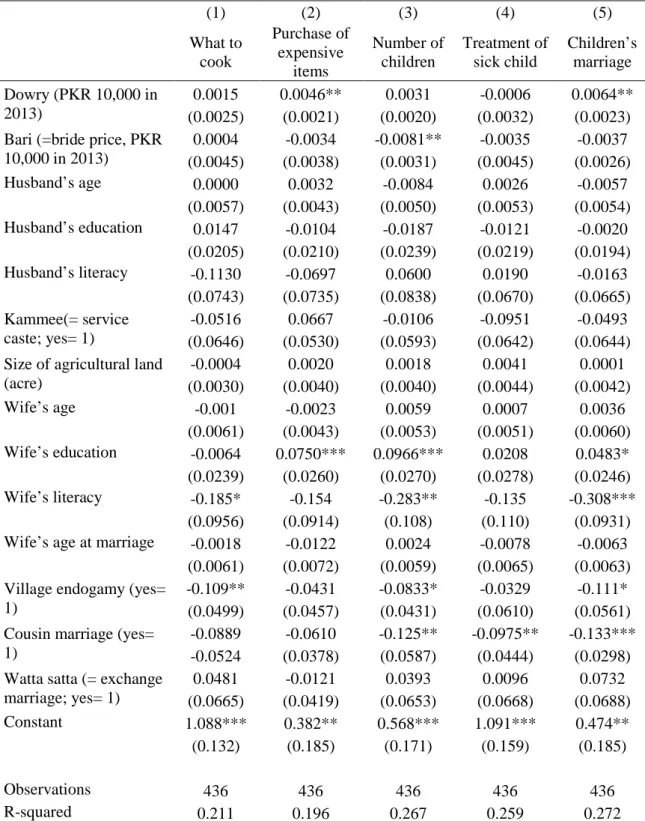
The estimated effects of dowry and bari on the wife’s decision-making power by linear probability model (LPM) are presented in Table 3. To maintain comparability with the 2SLS estimation, the sample includes only those who have at least one brother and one sister. The LPM estimates are not substantially different when using the full sample. The estimates show a significantly positive effect of the dowry amount on the wife’s decision making on purchases of expensive items and children’s marriages. One standard deviation above the mean of dowry (i.e., 16.49) increases the probability of the wife having decision-making power on the purchase of expensive items and on children’s marriages by 8 and 11 percentage points, respectively; these are large, given that the percentages of wives who have the most say on the purchase of expensive items and on children’s marriages are only 18 and 26, respectively. However, the amount of bari that the wife received from her in-laws significantly decreases her decision-making power on the number of children. As expected, higher education of the wife is associated with her higher decision-making power on three out of five decision-making matters, while the significantly negative effects of literacy are unexpected. A negative sign of the wife’s literacy might simply capture the fact that lower-caste wives are less oppressed than upper-caste wives and act relatively independently of their husbands in South Asia (Chacraborty and Kim 2010; Bidner and Eswaran 2015). Interestingly, endogamy, both marriage within the same village and marriage between cousins, is significantly associated with lower decision-making power of the wife.20
Following Altonji et al. (2005), we check how large the effects of unobservables should be in order to completely eliminate the dowry’s effects. Table 4 shows the LPM estimates without a set of observable covariates. In decision making on purchases of expensive items and children’s marriages, dowry effects magnify with inclusion of a set of observables. In decision making on fertility, dowry effects decrease by only 1.2 percentage points. These estimates
19
Although it is not the interest of this paper, the results do not seem consistent with the price model, as reflected by insignificant effects of wife’s age at marriage, husband’s education, and husband’s family’s status on the wife’s own dowry. Note that the results do not seem to be compatible with the bequest model or the circulating dowry hypothesis either. We check the first stage including the number of wife’s sisters and brothers. Both of them are insignificant on the wife’s own dowry; this is not in accordance with the bequest as well as the circulating hypothesis of dowry.
20
Although the current study is not about the relation between the endogamy and women’s status in the marital household, the estimation results do not support the classical Dyson and Moore (1983) hypothesis that endogamy explains a relatively higher status of women in the southern part of India than in the northern.
16
imply that the effects of unobservables should be at least 2.6 times larger than those of observables; this is unlikely given that the observables are exhaustive, ranging from the household’s demographic and socioeconomic characteristics to the village fixed effects.
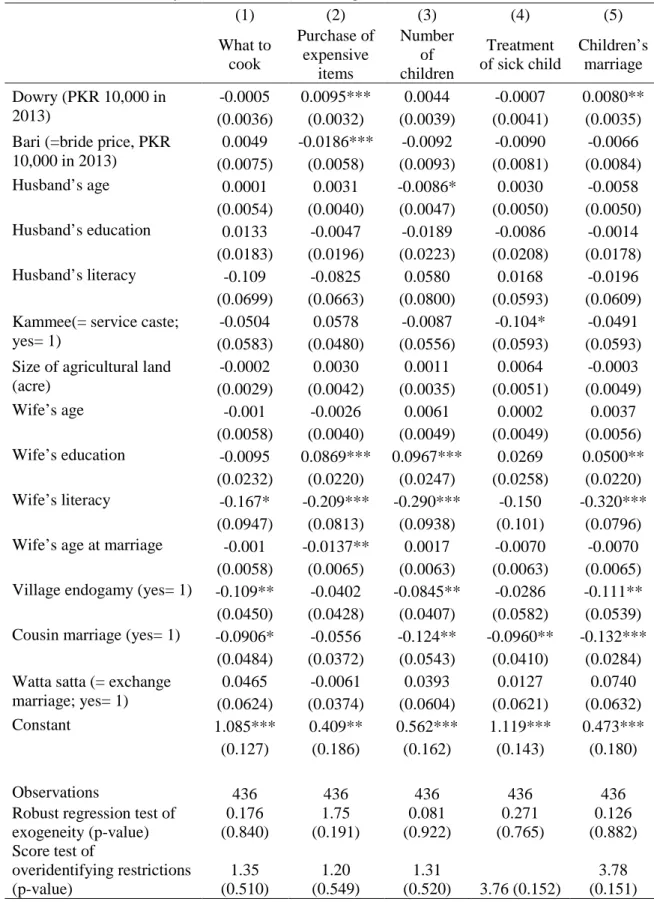
We estimate equation (1) by replacing 𝐷𝑖𝑖 (𝐵𝑖𝑖) with 𝐷� (𝐵𝚤𝚤 �) generated by equation (2), 𝚤𝚤 and the 2SLS estimation results are presented in Table 5. The score test of overidentifying restrictions cannot reject the null hypothesis that a set of instruments is valid. The results are not substantially different from those shown in Table 3. The magnitudes of the coefficients of interest (those of dowry) are slightly greater than the LPM estimates. Now, the amount of bari has a significantly negative effect on the wife’s decision making about the purchase of expensive items and not on the number of children; however, it does not affect the main implication suggested by Table 3. That is, a larger dowry is positively associated with the wife’s greater decision-making power, and a larger bari (or bride price) is negatively associated with her decision-making power. The estimates of other coefficients are very similar to those shown in Table 3.
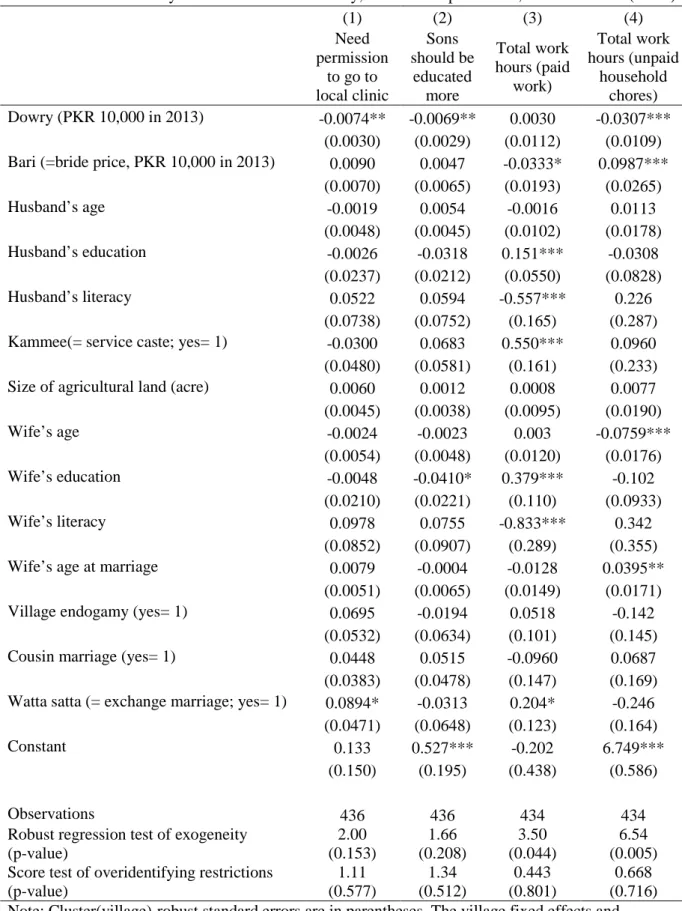
We repeat the estimation in Table 5 by replacing the measure of the wife’s decision-making power with other measures presumably reflecting her status in the marital household, explained in subsection 3.3.21 Two of them are indicator variables: one is the measure of the wife’s autonomy, taking the value one when the wife needs permission of her husband to go to the local clinic; another is the measure of her son preference, taking the value one when she thinks sons should be educated more than daughters. The remaining two are the wife’s work time only for pay and only for household chores, respectively. The 2SLS estimates are shown in Table 6. Overall, these estimates support the view that a higher amount of dowry is associated with higher women’s status, and a higher amount of bari is associated with lower women’s status. All the coefficient estimates of dowry, except for work time for pay, are significantly negative, implying that the greater the dowry, the less likely the wife is to obey her husband, to have son preference, and to spend time in household chores. The coefficient estimate of bari on the wife’s time for household chores is positive, meaning that when the wife receives a greater bride price from her in-laws, she spends more time on household chores. The magnitude of these coefficient estimates is not negligible. One standard deviation above the mean of dowry decreases the probability that the wife needs permission from her husband to go to the local clinic by 12 percentage points. Also, one standard deviation above the mean of dowry decreases her time for household chores by 30 minutes per day. Other coefficient estimates are also in accordance with our expectations. Higher education of wives is associated
21
17
with less son preference in education and more working hours for pay. A positive effect of
watta satta marriage on the wife’s lack of autonomy could also be claimed as expected. It is not
difficult to imagine that women in watta satta marriage are restricted in their behavior because of its reciprocal or even retaliatory nature.22
4.3 Robustness checks
One might argue that positive effects of dowry simply reflect affluence of households, and women in more affluent families are usually better treated and thus more empowered. However, if this argument makes sense, the effect of bari should be stronger and significant because it directly reflects the wealth of the groom’s household and thus the marital household. Overall, a higher amount of dowry seems to enhance women’s status, controlling for household wealth.
The possibility of other explanations is checked by replacing some of the explanatory variables with alternatives. Because of arranged marriage, positive assortative mating, especially similarity of socioeconomic status between the bride and the groom, is strongly maintained in rural Pakistan. However, age difference seems not to pose any difficulty as long as the groom is older than the bride. Possibly, a greater age or education difference might weaken the wife’s status in the marital household. Including age difference, as well as education difference (replacing the husband’s age and education), does not affect the main outcomes, and the coefficients of these variables are not significant.
One might argue that years since marriage are important because the effect of dowry (or bride price) might be greater soon after marriage. Including years since marriage and its interaction term with the amount of dowry (replacing woman’s age at marriage) does not alter the main estimation results concerning dowry. Interestingly, the base effects of bride price now have significantly negative effects on the wife’s decision-making power on children’s marriages and treatment of a sick child, although coefficients of the interaction term are insignificant. This implies that a greater bride price lessens the wife’s decision-making power in the marital household immediately after marriage; however, the effect becomes smaller with passage of years since marriage.
Muslim marriage officially requires mehr (bride price), but not dowry, and its amount might also affect women’s status in the marital household. A significant amount of mehr is
non-moajel, which means that payment is deferred, or never happens, unless divorce occurs.
Because the amount of mehr is written into the marriage contract and is binding, it might enhance women’s status in the marital household because their husbands cannot obtain a
22
Jacoby and Mansuri (2010) focus on the retaliatory nature of watta satta arrangement and show that it averts more marital strife.
18
no-fault divorce without incurring substantial costs corresponding to the amount of mehr.23 However, as discussed in subsection 3.2, mehr becomes a mere token payment in rural Pakistan, and therefore, it might not be a matter of importance in determining the wife’s status. Only 15 percent of wives in the sample respond that a positive amount of mehr was written into the marriage contract. As predicted, inclusion of mehr does not affect the main estimation results, and its coefficient shows no statistical significance.24
5. Conclusion
Dowry has been demonized as a root cause of women’s unfavorable treatment in South Asian countries and is universally banned or restricted there, despite little empirical evidence of its evil. We should not blame dowry alone on the basis of mere anecdotal evidence, as if it were the cause of all domestic homicides in South Asia. The fact that the Dowry Prohibition Act is completely ineffective across regions suggests that there exist good reasons for continuing the practice of dowry. If dowry has such a negative or even detrimental effect on women’s welfare, why would people not relinquish dowry, given that most parents have daughters? It seems more natural to admit that people recognize positive aspects of dowry and thus maintain its practice in a given context.
We cannot find any negative effects of dowry on women’s welfare. Rather, the estimation results consistently show that a higher amount of dowry increases women’s status in the marital household in rural Punjab, Pakistan. The effect seems to be robust with respect to measures of women’s status, ranging from decision-making power to time spent on household chores. After carefully examining the data, the dowry seems, in fact, a trousseau the parents offer their daughter, expecting that she will then have a better life in the marital household.
Given this empirical evidence, should we keep the practice of dowry without reservation? Not necessarily. On one hand, it is plausible that banning or restricting dowry might work against women’s interest, given the current circumstances that in actual practice, women do not have inheritance rights. On the other hand, if women are provided property rights equal to those of their brothers, dowry might not only be useless, but also harmful to women—as is now widely claimed. Phenomena concerning dowry practice can be a manifestation of a coordination failure in the society as a whole, as in the case of exchange marriage suggested by Jacoby and Mansuri (2010). Because most families are bride givers as well as bride recipients, if there is an effective way to commit not to give and receive dowry, all families might be better off.
Besides, the effects of dowry might vary across the regions of South Asia. The evidence in
23
For the expected functions of mehr to protect women, see Ambrus et al. (2010).
24
19
this study does not necessarily assure positive effects of dowry in urban areas or more modernized societies in South Asia. Furthermore, we cannot deny the possibility that the effects of dowry, in the near future, might become negative in rural Pakistan. The empirical evidence of this study alerts against simply claiming dowry as an evil practice and ignoring the environment in which women currently live. In other words, an outright ban on dowry is not necessarily a good policy.
20
References
Aizer, Anna. 2010. “The Gender Wage Gap and Domestic Violence,” American Economic
Review 100(4): 1847-1859.
Altonji, Joseph G., Todd E. Elder, and Christopher R. Taber. 2005. “Selection on Observed and Unobserved Variables: Assessing the Effectiveness of Catholic Schools,” Journal of
Political Economy 113(1): 151-184.
Ambrus, Attila, Erica Field, and Maximo Torero. 2010. “Muslim Family Law, Prenuptial Agreements, and the Emergence of Dowry in Bangladesh,” Quarterly Journal of
Economics 125(3): 1349-97.
Anderson, Siwan. 2000. “The Economics of Dowry Payments in Pakistan,” mimeo., Tilburg University.
Anderson, Siwan. 2003. “Why Dowry Payments Declined with Modernization in Europe but Are Rising in India,” Journal of Political Economy 111(2): 269-310.
Anderson, Siwan. 2004. “Dowry and Property Rights” BREAD Working Paper, 80.
Anderson, Siwan, 2007. “The Economics of Dowry and Brideprice,” Journal of Economic
Perspectives 21(4): 151-174.
Anderson, Siwan and Debraj Ray. 2010. “Missing Women: Age and Disease,” Review of
Economic Studies 77(4): 1262-1300.
Arunachalam, Raj, and Trevon Logan. 2015. “On the Heterogeneity of Dowry Motives,”
Journal of Population Economics forthcoming.
Becker, Gary S. 1991. A Treatise on the Family, Enl. Edition. Cambridge, MA: Harvard University Press.
Behrman, Jere R., Nancy Birdsall, and Anil, Deolalikar. 1995. “Marriage Markets, Labor Markets, and Unobserved Human Capital: An Empirical Exploration for South-Central India,” Economic Development and Cultural Change 43(3): 585-601.
Behrman, Jere R., Andrew D. Foster, Mark R. Rosenzweig, and Prem Vashishtha. 1999. “Women’s Schooling, Home Teaching, and Economic Growth,” Journal of Political
Economy 107(4), 682-714.
Bellows, John and Edward Miguel. 2009. “War and Local Collective Action in Sierra Leone,”
Journal of Public Economics 93 (11&12): 1144-1157.
Bidner, Chris and Mukesh Eswaran. 2015. “A Gender-based Theory of the Origin of the Caste System in India,” Journal of Development Economics 114: 142-158.
Billig, Michael S. 1992. “The Marriage Squeeze and the Rise of Groomprice in India’s Kerala State,” Journal of Comparative Family Studies 23(2): 197-216.
21
Bloch, Francis and Vijayendra Rao. 2002. “Terror as a Bargaining Instrument: A Case Study of Dowry Violence in Rural India,” American Economic Review 92(4): 1029-1043.
Botticini, Maristella and Aloysius Siow. 2003. “Why Dowries?” American Economic Review 93(4): 1385-1398.
Boserup, Ester. 2007. Women’s Role in Economic Development, London, UK: Earthscan.
Brown, Phillip H. 2009. “Dowry and Intrahousehold Bargaining: Evidence from China,”
Journal of Human Resources 44(1): 25-46.
Chacraborty, Tanika and Sukkoo Kim. 2010. “Kinship Institutions and Sex Ratios in India,”
Demography 47(4): 989-1012.
Croll, Elizabeth. 2000. Endangered Daughters: Discrimination and Development in Asia, London, UK: Routledge.
Deolalikar, Anil B. and Vijayendra Rao. 1998. “The Demand for Dowries and Bride Characteristics in Marriage: Empirical Estimates of Rural South-Central India,” in Maithreyi Krishnaraj, Ratna M. Sudarshan, and Abusaleh Shariff eds. Gender, Populations
and Development, London, UK: Oxford University Press.
Duflo, Esther. 2012. “Women Empowerment and Economic Development,” Journal of
Economic Literature 50(4): 1051-1079.
Dyson, Tim and Mick Moore. 1983. “On Kinship Structure, Female Autonomy, and Demographic Behavior in India,” Population and Development Review 9(1): 35-60.
Eglar, Zekiye. 1960. A Punjabi Village in Pakistan, New York, NY: Columbia University Press. H i r a s h i ma , S h i ge m o c h i 1 9 7 7 . “ E c o n o mi c A n a l ys i s o f n o n -F a r me r H o u s e h o l d s i n P a ki s t a n P u nj a bi V i l l a ge s , ” A s i a n E c o n om i e s 1 8 ( 6 & 7 ) : 1 3 5 – 15 4 ( i n J a p a ne s e ) .
Jacoby, Hanan and Ghazala Mansuri. 2010. “Watta Satta: Bride Exchange and Women’s Welfare in Rural Pakistan,” American Economic Review 100(4): 1804-1825.
Jejeebhoy, Shireen J. 2000. “Women’s Autonomy: Dimensions and Context,” in Harriet B. Presser, and Gita Sen eds. Women’s Empowerment and Demographic Processes, New York, NY: Oxford University Press.
Kingdon, Geeta and Francis Teal. 2010. “Teacher Unions, Teacher Pay and Student Performance in India: A Pupil Fixed Effects Approach,” Journal of Development
Economics 91(2): 278-288.
Kishwar, Madhu. 1988. “Rethinking Dowry Boycott,” Manushi 48: 10-13.
Kishwar, Madhu. 1989. “Towards More Just Norms for Marriage: Continuing the Dowry Debate,” Manushi 53: 2-9.
22
Leslie, Juliea. 1998. “Dowry, ‘Dowry Deaths’ and Violence against Women: A Journey of Discovery,” in Werner Menski ed South Asians and the Dowry Problem, New Delhi: Vistaar Publications, pp. 21-35.
Lundberg, Shelly and Robert A. Pollak. 1993. “Separate Spheres Bargaining and the Marriage Market,” Journal of Political Economy 101(6): 988-1010.
Manser, Marilyn and Murray Brown. 1980. “Marriage and Household Decision-Making: A Bargaining Analysis,” International Economic Review 21(1): 31-44.
Mbiti, Isaac M. 2008. “Monsoon Wedding? The Effect of Female Labor Demand on Marriage Markets in India,” mimeo., Southern Methodist University.
McElroy, Marjorie B. 1990. “The Empirical Content of Nash-Bargained Household Behavior,”
Journal of Human Resources 25(4): 559-583.
McElroy, Marjorie B. and Mary Jean Horney. 1981. “Nash-Bargained Household Decisions: Toward a Generalization of the Theory of Demand,” International Economic Review 22(2): 333-349.
Narayan, Uma. 1997. Dislocating Cultures: Identities, Traditions, and Third World Feminism, New York, NY: Routledge.
Oldenburg, Veena Talwar. 2002. Dowry Murder, New York, NY: Oxford University Press. Palriwala, Rajni. 2009. “The Spider’s Web: Seeing Dowry, Fighting Dowry,” in Tamsin
Bradley, Emma Tomalin, and Mangala Subramaniam eds. Dowry: Bridging the Gap
between Theory and Practice, New Delhi, India: Women Unlimited, pp. 144-176.
Rudd, Jane. 2001. “Dowry-Murder: An Example of Violence against Women,” Women’s
Studies International Forum 24(5): 513-522.
Sekhri, Sheetal and Adam Storeygard. 2014. “Dowry Deaths: Response to Weather Variability in India,” Journal of Development Economics 111: 212-223.
Sen, Amartya. 1990. “More than 100 Million Women are Missing.” New York Review of Books 37(20).
Srinivas, Mysore N. 1994. Some Reflections on Dowry. New Delhi, India: Oxford University Press.
Srinivasan, Sharada and Arjun S. Bedi. 2007. “Domestic Violence and Dowry: Evidence from a South Indian Village,” World Development 35(5): 857-880.
Stone, Linda and Caroline James. 1995. “Dowry, Bride-burning, and Female Power in India,”
Women’s Studies International Forum 18(2): 125-134.
Suran, Luciana, Sajeda Amin, Lopita Huq, and Kobita Chowdury. 2004. “Does Dowry Improve Life for Brides? A Test of the Bequest Theory of Dowry in Rural Bangladesh,” Policy
23
Research Division Working Paper 195, Population Council.
Vogl, Tom S. 2013. “Marriage Institutions and Sibling Competition: Evidence from South Asia,”
Quarterly Journal of Economics 128(3): 1017-1072.
World Bank. 2011. World Development Report 2012: Gender Equality and Development. Washington D.C.: World Bank.
Zhang, Junsen and William Chan. 1999. “Dowry and Wife’s Welfare: A Theoretical and Empirical Analysis,” Journal of Political Economy 107(4): 786-808.
24
Figure 1: Relationship between women’s years of marriage and real dowry amounts Source: Pakistan Rural Household Survey 2004.
2 00 00 4 00 00 6 00 00 8 00 00 10 00 00 d ow ry i n 20 04 P a k is tan i Rs . 1976 1985 1995 2004 marriage year
25
Figure 2: The relationship between the woman’s year of marriage and the real amount of dowry Source: Rural household survey conducted by the author in 2013.
5 00 00 10 00 00 15 00 00 20 00 00 d ow ry i n 20 13 P a k is tan i Rs . 1970 1980 1990 2000 2010 marriage year
26
27
Figure 4: Mean value of items included in dowry (PKR)
0 20,000 40,000 60,000 80,000 cash to groom
cash to bride livestock to bride sewing machine to bride kitchen items to bride furniture to bride electronics to bride vehicle to groom vehicle to bride land to bride clothing to groom clothing to bride gold/jewelry to groom gold/jewelry to bride
28
Figure 5: Average expenses incurred in marriage (PKR)
0 100,000 200,000 300,000
non-moajel mehr (moajel) total ceremony expense by g's side total ceremony expense by b's side gifts of jewelry/clothing by g's side dowry by g's side dowry by b's side
29
Figure 6: Reasons real dowry amounts differ across siblings
0 .1 .2 .3 D ens it y groom bet ter groom wor se groom 's fam ily bet ter groom 's fam ily w orse bride b etter bride w orse your fam ily bet ter your fam ily w orse out of biradar i in tra-biradar i emot ional attac hment upw ard t rend
(a) Why one sister had higher dowry? (N=605)
0 .1 .2 .3 .4 .5 D ens it y groom bet ter groom wor se your fam ily bet ter your fam ily w orse bride b etter bride w orse bride' s fam ily bet ter bride' s fam ily w orse out of biradar i in tra-biradar i upw ard t rend
30
Figure 7: Measures of women’s status and empowerment
0 .2 .4 .6 .8 frequency child ren' s m arriage sick chi ld's t reat men t num ber of chi ldren pur cha se of expens ive i tem s what to c ook
(a) Woman has the most say in deciding...
0 .1 .2 .3 frequency nei ghbor hood s hop hom e o f rel ativ es/fr iends local heal th c ent er
(b) Woman has to ask permision of her husband to go to...
0 .1 .2 .3 .4 frequency mor e educ ation for sons mor e sons
(c) Son preference of women
0 2 4 6 hour wor k tim e w ith pay ment wor k tim e w ithout pay ment tota l wor k tim e
31
Table 1: Summary statistics
Husband’s age 40.63 (11.35) Husband’s education 3.16 (1.91) Husband’s literacy 0.557 (0.497) Kammee(= service caste; yes= 1) 0.266 (0.442) Size of agricultural land (acre) 3.24 (6.33) Wife’s age 35.76 (10.45) Wife’s education 2.18 (1.77) Wife’s literacy 0.299 (0.458)
Wife’s age at marriage 19.99
(4.07)
Village endogamy (yes= 1) 0.39
(0.49)
Cousin marriage (yes= 1) 0.657
(0.475) Watta satta (= exchange marriage; yes= 1) 0.175 (0.380)
Dowry (PKR in 2013) 158011
(164876) Bari (= bride price, PKR in 2013) 73816
(85229)
Observations 659
Note: Standard deviations are in parentheses. The variable "education" takes discrete values: = 1 if no education, = 2 if below primary, = 3 if primary completed (5 years), = 4 if middle completed (8 years) , = 5 if matric completed (10 years), = 6 if intermediate completed (12 years), = 7 if degree or post graduate. Household-level variables such as kammee and size of
agricultural land are all about husband’s family due to patrilocality.
32
Table 2: First stage regression
(1) (2)
Dowry (PKR
10,000 in 2013)
Bari (PKR 10,000 in 2013) Wife’s brothers’ dowry (average PKR 10,000 in
2013)
0.504* 0.151
(0.252) (0.129)
Wife’s sisters’ bari (= bride price, average PKR 10,000 in 2013)
0.381*** 0.426***
(0.115) (0.108)
Wife’s natal family’s income at the time of marriage (PKR 10,000 in 2013)
0.492** 0.100
(0.180) (0.0802)
Wife’s natal family’s asset (acre) -0.157 -0.482*
(0.670) (0.254) Husband’s age 0.0986 0.00992 (0.100) (0.0851) Husband’s education 0.0677 0.735** (0.434) (0.309) Husband’s literacy 0.704 -1.347 (1.051) (1.073)
Kammee(= service caste; yes= 1) -1.809 -1.585**
(1.357) (0.718)
Size of agricultural land (acre) -0.00449 0.196** (0.203) (0.0899) Wife’s age -0.0955 0.00908 (0.127) (0.0985) Wife’s education 0.948* 0.929* (0.549) (0.468) Wife’s literacy 1.438 -2.638 (1.815) (1.717)
Wife’s age at marriage 0.428 -0.0321
(0.278) (0.166)
Village endogamy (yes= 1) 1.645 0.890
(1.419) (0.535)
Cousin marriage (yes= 1) -0.917 -0.689
(1.012) (0.727)
Watta satta (= exchange marriage; yes= 1) 0.0201 0.598
(1.334) (0.602)
Constant 4.757 3.131
(8.987) (5.013)
Observations 436 436
R-squared 0.677 0.480
Note: Cluster(village)-robust standard errors are in parentheses. The village fixed effects and ethnicity are controlled. *** significant at 1% level, ** at 5% level, * at 10% level.