Vietnamese families and the lives of family
members with disabilities : a case study in a
commune of the Red River Delta
著者
Teramoto Minoru
権利
Copyrights 日本貿易振興機構(ジェトロ)アジア
経済研究所 / Institute of Developing
Economies, Japan External Trade Organization
(IDE-JETRO) http://www.ide.go.jp
journal or
publication title
IDE Discussion Paper
volume
720
year
2018-06
INSTITUTE OF DEVELOPING ECONOMIES
IDE Discussion Papers are preliminary materials circulated to stimulate discussions and critical comments
Keywords: Vietnamese family, role and function of the family, people with disabilities, industrialization, modernization, international integration, survival, right of
independence
* Research Fellow, Area Studies Center, Institute of Developing Economies (IDE-JETRO).
IDE DISCUSSION PAPER No. 720
Vietnamese Families and the Lives of
Family Members with Disabilities:
A Case Study in a Commune of the
Red River Delta
MINORU TERAMOTO*
June 2018
Abstract
This paper examines the lives of people with disabilities living with their families in the Red River Delta region during the period of the promotion of industrialization, modernization, and international integration. Concretely, I am concerned with the roles played by Vietnamese families in the lives of family members with disabilities. The results show that the families play a vital role in maintaining the daily lives of family members with disabilities. However, the presence of these individuals in their family is often passive and may easily be influenced by the movement of family members such as marriage, having a child and getting a job, etc. .
The Institute of Developing Economies (IDE) is a semigovernmental, nonpartisan, nonprofit research institute, founded in 1958. The Institute merged with the Japan External Trade Organization (JETRO) on July 1, 1998. The Institute conducts basic and comprehensive studies on economic and related affairs in all developing countries and regions, including Asia, the Middle East, Africa, Latin America, Oceania, and Eastern Europe.
The views expressed in this publication are those of the author(s). Publication does not imply endorsement by the Institute of Developing Economies of any of the views expressed within.
INSTITUTE OF DEVELOPING ECONOMIES (IDE), JETRO
3-2-2, WAKABA,MIHAMA-KU,CHIBA-SHI
CHIBA 261-8545, JAPAN
©2018 by Institute of Developing Economies, JETRO
No part of this publication may be reproduced without the prior permission of the IDE-JETRO.
1
Vietnamese Families and the Lives of Family Members with
Disabilities: A Case Study in a Commune of the Red River Delta
Minoru Teramoto
†June 2018
AbstractThis paper examines the lives of people with disabilities living with their families in the Red River Delta region during the period of the promotion of industrialization, modernization, and international integration. Concretely, I am concerned with the roles played by Vietnamese families in the lives of family members with disabilities. The results show that the families play a vital role in maintaining the daily lives of family members with disabilities. However, the presence of these individuals in their family is often passive and may easily be influenced by the movement of family members such as marriage, having a child and getting a job, etc. .
Key Words: Vietnamese family, role and function of the family, people with disabilities, industrialization, modernization, international integration, survival,
right of independence
1. Introduction
In this paper, we consider the lives of people with disabilities who were living with their families in the Red River Delta region during the period of the promotion of industrialization, modernization, and international integration. In particular, this paper examine the roles played by Vietnamese families in the life of a disabled family
This paper is one of the result of FY2017/2018 Research Topic 2016_2_40_005
(IDE-JETRO): Dynamics and transformation of the Vietnamese family in the Doi Moi era.
2
member1 and further examine their existence (life) as an independent person. This
limited survey takes a qualitative approach and thinks about the subjects whom I met this time only. The result would be a hypothesis for the next study with certain reason and background.
Previous studies such as Teramoto 2010,Teramoto2013, Teramoto2014,Teramoto2016 focused on the relationships between the Vietnamese people with disabilities and
surrounding actors and the roles played by Vietnamese families. However, these works has never thought of life of the Vietnamese people with disabilities from the point of as a man or a woman who has a right of independence.
This paper is based on a field survey conducted at a commune (xã) that has an
industrial park in its administrative area within the Red River Delta region. In this study, the term “family” fundamentally means people who are married or have blood
relationships and who live and eat together in the same house.
The structure of this paper is as follows. First, we present the methods used in conducting the field survey. Second, we consider the results of a survey carried out in 2013 from the perspective of the relationship between the subjects and the people, actors around them 2. Thereafter, we examine the way of life of those subjects on the
basis of a comparison between the results of a survey conducted in 2006 and the results of a survey in 2013 3.After that, we discuss the results of the surveys.
As for charts and tables of this paper, I put on pp.23-34. Please forgive me for inconvenience.
2. Methodology
In the first part, the field survey was conducted during the period October 10–18, 2013. The survey area was a commune (xã)4 in the Ha Nam province in the Red River
Delta region.
As for the research place, distance between Ha Noi city and Phu Ly city that is the provincial capital of the Ha Nam Province is about 59 ㎞. Ha Nam Province is the second smallest province in the Red River Delta region with 862 ㎢. The population is
1 Here, causes of having disabilities are out of scope. I think that there are varieties among the
people with disabilities such as war-invalids, people that have disabilities because of diseases or accidents, the people who have disabilities by nature, etc. .
2 This part is result of reexamining the study in Teramoto 2016.
3 I also visited and interviewed with the subjects from 5th to 9th of September in 2017. 4 In this paper, a commune means an administrative village.
3
796,000 people in 2013 and as chart 1 show, urban population increasing gradually during the period between 2005-2013. And table 1 show us that agricultural production land, forestry land are decreasing. It is obvious that the Ha Nam province is under the current of urbanization. The location of the commune is in a place has long history. Bronze drums belongs to the Dong Son culture5 were excavated around the area (Tỉnh
ủy, Hội đồng Nhân Dân, Ủy ban Nhân Dân Tỉnh Hà Nam 2005).
The population of the commune was 6396 people in 20126.The size of the population
was 5471 people in 2000 so that we could say that the population was certainly increasing(Tỉnh ủy, Hội đồng Nhân Dân, Ủy ban Nhân Dân Tỉnh Hà Nam 2005). As a result of interview with the People’s Committee official in September 2017, about 10 % of labour forces work for agriculuture, and about 90% of labour forces work for service, business and factories in the industrial park7.
Then, we see my way of approach. I visited the subjects’ houses and interviewed them in person using a questionnaire.8 I tried to meet the subjects themselves because
this study took the approach of qualitative research. I interviewed 31 subjects, of whom 28 had a disability and three did not. The latter included in order to compare the cases of disabled people and those without a disability. However, this paper focuses only on people with disabilities. In cases where the subjects were unable to answer the interview questions, a family member was asked to respond. A total of 10 disabled subjects found it difficult to answer, and one subject did not participate in the interview.
In the second part, I compare the results of the October 2013 survey (mentioned above) and the results of a survey that I carried out in the same village during the period October 27–November 3, 2006. Among the 28 disabled subjects whom I interviewed in 2013, unintentionally, 17 subjects were whom I had already interviewed in 2006. The cases of these 17 subjects have been discussed further.9 Through a comparison, I try to
5 The Dong Son culture was a Bronze Age culture in ancient Vietnam in northern Vietnam from
B.C..
6 Based on the result of interview with an old doctor at medical station of the commune on 9th
October, 2013.
7 Interview was implemented on 5th September,2017.
8 Here, I partly use the results of my two-year research project (2013–2015) in IDE-JETRO on the
welfare regime in Vietnam. I received support from aVietnamese organization and a people’s committee at the grass roots level to implement the survey. A stuff of the Vietnamese organization and a stuff of the people’s committee are also participated because of Vietnamese regulation. The language used in the survey was Vietnamese. I wish to express my gratitude to these organization and stuffs of these organizations. Moreover, I wish to thank the subjects and their families for their generous cooperation.
9 Moreover, to support the analysis, I visited and interviewed these 17 subjects during the period
September 5–9, 2017. It was quite helpful to understand recent situations of these subjects, although the interview method had to be changed due to Vietnamese regulations. Moreover, in December 2016 and September 2017, I conducted a small survey in a commune in the south of Vietnam. I will
4
understand their existence (life) as an independent person.
3. Relations between the survival of people with disabilities and the role played by the people, actors around them
3.1 Subjects and family characteristics
This section considers the number of family members, the number of generations, and the types of disabilities.
Chart 2 provides the number of members in the subjects’ families. The arithmetic mean of the number of members in the subjects’ families is about 3.8 people and the median is four. Two subjects lived alone, and the largest family contained nine members.
Families with two members were the maximum in number (seven families). The second-largest bloc comprised families with four members (six families) while families with three members and those with five members made up the third-largest bloc (four families). Therefore, families falling in the range between two and five people constitute 75% of the families surveyed.
Chart 3 indicates the number of generations in a family. Eight families have one generation, 11 families have two generations, and nine families have three generations. In total, 19 families (67.9%) contained one or two generations. Thus, nuclear families are more prevalent than large families. However, we should note that even say “nuclear family”, here, parents and the child’s couple often live nearby. I mean that there are many cases the distance between the parent’s house and the house of the child’s couple were very near.
From these descriptive statistics, it can be concluded that two-to-five member and one-to-two-generation families are the common form of the subjects’ families10.
Chart 4provides information regarding the types of disabilities experienced by the subjects. The most common type of disability is a physical disability (17 subjects). The second most common type of disability is a mental/neurological disability (15 subjects). The third most prevalent type of disability is a visual disability (12 subjects), followed by intellectual disabilities and language disabilities (seven subjects) and hearing disabilities (four subjects).
Among the subjects with a disability, 14 have multiple disabilities. The 28 subjects
use the result in another chance.
5
with disabilities are split evenly between men and women, at 14 subjects each.
Chart5 provides the age distribution. The youngest subject was born in 1995 and the oldest in 1935. Chart 5 also shows 12 subjects (about 42.9%) clustered in the 1946– 1960 birth-year range. This period overlaps with the First Indochina War. And, five subjects (about 17.9%) are clustered in the 1966–1975 birth-year range, which overlaps with the Second Indochina War (Vietnam War).
3.2 Relations between subjects and the people, actors around them
Here, we consider the relations between the subjects and the people,actors around them, who may be immediate family members,11 more distant relatives, neighbors,
friends, and the state. The subjects were asked the following questions: (a) What kind of help do you require from your family (gia đình)? (b) What kind of help do you require from your relatives (họ hàng)? (c) What kind of help do you require from your neighbors (hàng xóm)? (d) What kind of help do you require from the state (nhà nước)?
(e) Do your friends (bạn) help you when you face any difficulties?12
The subjects’ responses to these questions are provided below. (a) What kind of help do you require from your family?
Chart 6 shows the subjects’ responses to question (a) above. Among the 28 subjects, 20 required help from their families, whereas eight answered “nothing.” Among those 20 subjects, seven answered “everything” (they require support in every aspect of daily life). The people who mainly help these seven subjects are as follows: mother (two subjects); parents (one subject); wife (two subjects); husband (one subject); and younger brother (one subject). With regard to gender, there were five women and three men, indicating that women play a larger role in caring for the subjects with disabilities than men do.
In addition, three subjects answered that they required help with “care,” and seven subjects mentioned daily activities, such as “cooking” and “washing clothes,” as well as support when moving,13 and in personal-hygiene activities such as “defecation” and
“bathing.”
11 As mentioned previously, in this study, the term “family” fundamentally means people who are
married or have blood relationships, and who live and eat together in the same house.
12 I put this question in a different section of the questionnaire. Therefore, it was asked differently
from the other questions and was included here.
6
With the exception of the answers above, one subject answered that they needed help in “bringing up a child.”14 Two subjects answered that they required “economic support”
(cho tiền, kinh tế) and one subject answered that they needed help with “visiting” (thăm
hỏi)15.
In addition to “family,” other people, actors around persons with disabilities can also provide “economic support.” However, activities such as “care” and “help with daily life” are particular needs because they must be provided in person. The families of all the 17 subjects who require “care” and “help with daily activities” had been undertaking these roles without hiring a helper.
(b) What kind of help do you require from your relatives? Chart 7 shows the subjects’ answers to question (b).
In total, 20 subjects (about 71.4 % of the subjects) answered “nothing,” whereas eight subjects answered “visiting” (thăm hỏi). In fact, “visiting” is one method of communication that can offer psychological support to subjects. However, it does not necessarily have a substantial impact on the subjects’ daily life.
One subject answered “help with work,” and another answered “when faced with economic difficulty, lend money.” “Help with work” and “lending money” would influence a subject’s daily life more than “visiting.” However, only two subjects gave those responses.
It is worth paying attention to answers such as “in the time of bao cấp,16 we helped
each other” because it indicates that time and the socioeconomic setting can affect relationships.
(c) What kind of help do you require from your neighbors? Chart 8 shows the subjects’ answers to question (c).
As with question (b), the most common answer was “nothing,” which was given by 18 subjects (about 64.3% of subjects).
Even though 10 subjects answered “visiting,” this number actually could be 14 subjects because four subjects who answered “nothing” also added the comment “visiting.” These four subjects thought that “visiting” by neighbors did not help them much.
One subject answered “help with work,” and another answered “help economically.”
14 This is the answer of a father who has a daughter with disabilities. The subject was assaulted
by someone and had a baby so that she had psychological difficulties to provide sufficient care for her baby.
15 “Visiting” (thăm hỏi) can offer psychological support and time for change to subjects.
16 Before the Đo i Mớ i policy was adopted in December 1986, there was a period during which
Vietnam adopted a centrally planned economy. During that time, the state tried to control and administer every aspect of society.
7
Other answers included “help psychologically,” “mobilize,” and “have fun.” These neighbors live near the subjects. But, their relatives do not necessarily live nearby.
Certainly, there are many cases in which relatives are also neighbors. However, although neighbors might not have a blood tie to the subjects, a good relationship with neighbors can help the subjects under certain circumstances.
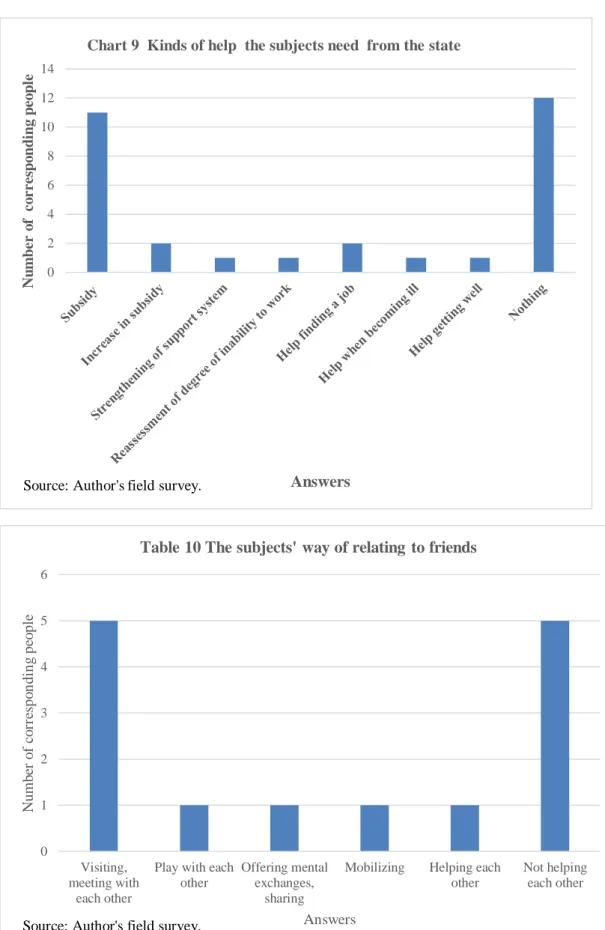
(d) What kind of help do you require from the state? Chart 9 indicates the subjects’ answers to question (d).
There are three groups of answers: (1) subsidization; (2) employment; and (3) health.
14 subjects’ answers concerned the extent of the government’s “subsidizing” behavior. These answers include a desire for a “reassessment of the degree of inability to work,” which was given by a Vietnam War veteran who had been wounded and suffered from disease during the War. He was not satisfied with the assessment of his health condition that the state used to decide the amount of subsidy he received.17
Two subjects provided answers relating to “employment.” They wanted a job in order to obtain an allowance. Further, two subjects provided answers related to “health.”
Interestingly, 12 subjects answered “nothing.” Compared with questions (a), (b), (c), and (e), question (d) received the second lowest number of responses. This suggests that the state is looked up to as one of the most needed actors, from whom subjects
expecting economic, material, and substantial support.
(e) Do your friends help you when you face difficulties?
I put this question here because I had previously included it in a different section of the questionnaire. Therefore, the way of asking it was also different. However, these issues did not prevent me from receiving answers similar to those in (a), (b), (c), and (d) above.
Among the 28 subjects, nine have friends and among those nine subjects, only two answered “yes” to question (e) above. One subject provided examples of help as “sharing” and “offering mental exchange,” and the other subject mentioned “mobilizing” and “helping each other.”
Chart 10 provides information regarding the exchanges between these nine subjects and their friends. I received these answers to question (e) above. However, most of the subjects think that their friends do not offer substantial material help with their
livelihood. (f) Remarks
Table 2 summarizes the answers given to questions (a) through (e).
8
On examining the questions that received the answer “nothing,” I could determine that the roles of the family and the state are higher than those of other actors.
The family plays a vital role in supporting the subjects’ survival in daily life. With the exception of family members, no other actors can take care of the subjects. Seven people (25%) require support from their families in every aspect of daily life. More than 50% of the subjects receive daily support from their families with tasks such as cooking, washing, and personal hygiene. These subjects’ families have not employed a helper .
With respect to the role of the state, 14 subjects require a subsidy or want an increase in the amount of subsidy they receive from the state. Two subjects require support with tasks related to employment, such as help in finding a job. In addition, two subjects need support when they fall ill. These answers indicate that the subjects require economic, medical, and material assistance from the state.
Compared with “family” and “state,” other actors (such as relative, neighbor, and friend) do not have distinct roles in supporting the subjects. The most common activity was “visiting.”
Therefore, on the basis of an analysis of the answers to from questions (a) and (e) above, it is possible to determine the following order of support:
Family, State > Neighbors, Relatives, Friends
3.3 Economic aspects of the subjects
This section focuses on economic aspects, specifically, the following matters: (a) subjects’ personal income and its distribution; (b) ratio of the subjects’ personal income to family income; and (c) whom the subjects look to for in case they do not have sufficient money
(a) Subjects’ personal income and its distribution
This subsection discusses subjects’ personal income and its distribution.
Table 3 provides results from the survey. There are basically three types of resources that provide a subject with personal income, with the exception of two persons who do not have any personal income. The sources of income are (1) a job, (2) a subsidy for people with disabilities (PD18), (3) a subsidy related to the War. Category (3) offers two
18 I will use abbreviation “PD”, only when the subjects do not have relation with war, although
we should be aware that causes of having disabilities are often ambiguous. For example, there is a subject who may belong to VAO 2. The father of this subject participated in the Vietnam War in the central parts of Vietnam, in which US and South Vietnamese troops used tactical herbicides.
9
types of subsidy: (a) a subsidy for victims of Agent Orange (tactical herbicides) 19
(VAO) and (b) a subsidy for wounded, diseased ex-soldiers (WDS)20. Moreover,
category (3) (a) has two types of subsidy: Agent Orange direct victims (VAO1) and Agent Orange indirect victims (VAO2).21
Among the 28 subjects, no one earns an income from a job.22 26 subjects receive
some form of subsidy. Of these, 17 subjects are cases of PD. Of the subjects receiving War-related subsidies, four are cases of WDS, and five are cases of VAO.23 Among the
cases of VAO, one case is VAO1 and four cases are VAO2.
Depending on the kind of subsidy received by the subjects, their income can be classified into three main categories.
The first category, containing 17 subjects, earns between 100,000 dong and 400,000 dong24. All of these subjects receive a subsidy for PD.
The second category, containing five subjects, earns between 600,000 dong and 1.9 million dong. These subjects receive a subsidy for VAO (one VAO1 and four VAO2).
The third category, containing four subjects, earns between 2.1 million and 4.2 million dong. All of these subjects receive a subsidy for WDS.
Finally, it should be noted that the financial resources of the 26 subjects who have an income, come from a state subsidy.25
(b) Ratio of the subjects’ personal income to family income
In this subsection, the ratio of subjects’ personal income to family income is discussed, as shown in Chart 11. The arithmetic average of the 28 families is about 37.4%. However, the median is about 17.4%.
On the basis of the ratio obtained, two groups can be identified as follows: (1) from 0% to 30% (17 subjects) = Group 1 and (2) from 40% to 100% (11 subjects) = Group 2.
19 There are several kinds of tactical herbicides that was used in the Vietnam War. Here, I use
term “Agent Orange” as a general term for the tactical herbicides.
20 After the Standing Committee of National Assembly adopted Ordinance on preferential
treatment of persons with meritorious services to the revolution in 2005, VAO became subject of this kind of ordinance.
21 VAO1 means ex-soldiers and war participants directly affected by defoliants (first generation).
VAO2 is children of VAO1 who are affected by defoliants through their parents (second generation). Moreover, many people expect the effects of such exposure to remain in the third generation.
22 Among the cases of three people without disabilities whom we decided to exclude, there were two
people who earn income from a job. One works for the cooperatives, and the other works for a social organization. The income level of the former is between 1 million and 1.1 million dong and that of the latter is between 2.5 million and 2.6 million dong.
23 One person is both a WDS and a VAO. However, in 2013 he said that he was a WDS and not a
VAO. In table 3, I followed his answer.
24“Dong (đồng)”is the official currency of Vietnam. In this time, one US dollar was worth of about
21000 dong.
10
The arithmetic average of Group 1 is 10.1% (median = 8.3%) and that of Group 2 is 79.5% (median = 85.7%).
It can therefore be concluded that subjects’ contributions to the family income should not be ignored although those contributions are limited in many cases. Regarding income resources, the state’s contribution to the subjects is quite significant in economic terms. It appears that a subsidy from the state helps maintain the position of the subjects within their family.
(c) Whom the subjects look to for in case they do not have sufficient money Chart 12shows the results of the survey. The most common answer is “brother and sister” (eight subjects). The second most common answer is “neighbor” (six subjects), and the third most common answer is “child” (five subjects).
Among those who answered “brother and sister,” only one subject lives with a brother or sister (in this case, with an older brother26) in the same house. Among those
who answered “child,” only two subjects live with a “child.”27 In addition, subjects who
answered “mother”28 and “grandparents”29 live in a different house from their “mother”
and “grandparents”.
These results indicate that living in the same house is not necessarily an important factor. Even though in this paper, “family” has been defined as people who are married or have blood relationships, and who live and eat together, it is still possible to think of “brother and sister” and “child” as being similar to families in the above mentioned sense because of the closeness of these relationships.
However, the six subjects who answered “neighbor” indicated that physical nearness is a factor that influences subjects’ attitudes.
(d) Remarks
Among the 28 subjects, 26 have an income. The financial resources of all these subjects are a subsidy from the state. As discussed, there are several different kinds of subsidies, which depend on the cause of the disability. The amount of money of the subsidy for people who have a disability related to the War is much higher than that for other disabilities.
Although there are limitations, all the 26 subjects who receive a subsidy from the state can contribute to the family income. This seems to help these people maintain their
26 This is based on a response of the subject’s mother because the subject could not answer. As I
noted before, in cases where the subjects were unable to answer, a member of the family was asked to answer. Moreover, there were also cases in which I could confirm that their brother and sister were living nearby.
27 But in other three cases, their children also lived nearby. 28 In this case, his mother lives nearby.
11 position within their own family.
Although I confirmed that the state’s contribution to the income of the subjects was quite large, there was still a high need for the families and people with kinship to offer a financial contribution to the subjects, as revealed in 3.3 (c).
3.4 Concluding remarks of Section 3.
In the first part, I concluded that the family’s role is of essential importance and serves a critical function in supporting the subjects’ daily lives, which is wide-ranging, from “take care of the subjects directly” to economic aspects, among other things. In this case study, none of the families employed a helper to perform their role for the subjects.
The state also plays an important part in the economic aspects of the subjects’ lives. Among the 28 subjects with disabilities, 26 subjects receive a subsidy from the state. For these 26 subjects, the state subsidy is only one source of income although there are many kinds of subsidies, such as those for PD, for WDS, and for VAO.
Although no subjects referred to health insurance in this research, all subjects with disabilities have received a health insurance card without paying the insurance fee.
Relatives, friends, and neighbors also play a role, and “visiting” is the most common answer the subjects gave to describe that role. In cases in which the subjects do not have enough money, neighbors often take a role. The proximity of their residence to others can be an important factor that influences the relationships between them and the people around them.
Finally, if the characteristics of the roles played by the family are considered, the difference between the family members and other actors consists of taking care of subjects directly (i.e., face-to-face).
4. The subjects’ life as an independent person
In this section, the results of the field research from 2013 are compared with that of the field research from 2006. Throughout the comparison, I try to understand the subjects’ life as a man or a woman who have right of independence.
Among the 28 subjects30 whom I had a chance to interview in 2013, 17 were people
whom I had already interviewed in 2006. I chose these 17 subjects randomly.
30 If the number of subjects without disabilities were counted, the total number of subjects would be
12
Regarding the cases of these 17 subjects, after considering (1) general information about the subjects, I focus on three matters: (2) changes in them; (3) changes based on the state; and (4) changes in their families.
4.1 General information about the subjects
Among the 17 subjects, seven are female and 10 are male, and all have disabilities. Depending on the cause, there are three types of people with disabilities31: (a) people
with disabilities who do not have relation to War (PD); (b) victims of Agent Orange (VAO); and (c) wounded, diseased ex-soldiers (WDS). VAO is further divided to Agent Orange direct victims (VAO1), and Agent Orange indirect victims (VAO2).
In this case, 10 subjects are PD, three subjects are VAO (all of them are VAO2), and four subjects are WDS.
Regarding the date of birth, before 1975 (not including 1975) are 10 subjects; between 1975 and 1986 are three subjects; and after 1986 (including 1986) are four subjects.
4.2 Regarding changes in the subjects themselves
This section focuses on three matters: (a) job (including housework); (b) relations with friends; and (c) personal change based on the will of the subjects themselves.
(a) Job (including housework)
Table 4 provides the results of the comparison. I classified the answers into three categories: (1) positive change, (2) negative change, and (3) no change.
First, I consider the number of subjects whose answers belong to category
(1)positive change , which is just one person. His family received work to do at home from a foreign company, he sometimes participates in this work.
Next, seven subjects provided answers belonging to category (2) negative change. These answers revealed that five subjects lost a job with an income and two lost the role of doing housework32. Among the five subjects who lost a job with an income, three
mentioned their hope for a job in 2006. For example, one veteran of the Vietnam War (WDS) who was running a small public bar (quán bia hơi) said that he desired to invest to expand business. Two of the others had craftsman skills, with one doing rattan craft making and another engaging in embroidery although the level of skill of each person was not so high. They wanted to develop their careers but they could not do so. The
31 I have already inferred these cases and abbreviation in 3.3 (a).
32 The subject who experienced decreasing number of jobs was engaged in agriculture but he
13
female who engaged in rattan craft making said, “There was no job within two years,” when I met her in 2013. She worked with a company, but if the company did not ask her to work, she could not receive any materials. Then, she found a role in housework including taking care of a little nephew and a newly born niece.
Therefore, four subjects who had some occupation in 2006 were in the situation of having no type of occupation in 2013. Moreover, number of the job of one subject decreased.
Finally, for category (3) no change, the most common answer was “Do not have anything to do from before” (eight subjects). However, one person, a blind female living alone33, answered, “Keep doing housework.”
Based on the total results, it appears that the situation of job (including housework) for the subjects relatively worsened during the period 2006–2013.
(b) Relations with friends
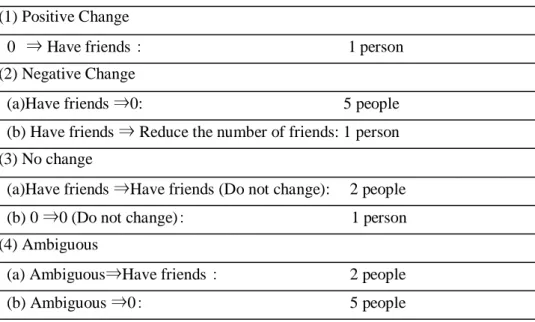
Table 5 indicates the results of the comparison. These answers can be classified into four categories: (1) positive change, (2) negative change, (3) no change, and (4) others. Regarding category (1) positive change, there was one subject who found friends during this period. This was a veteran of the Vietnam War (WDS) who often goes outside and walks around.
Regarding category (2) negative change, six subjects gave an answer related to (2). Their responses revealed that five subjects lost friends and the number of friends of one subject became fewer.
Among the five subjects who lost the relations with friends, the family structure of three of them substantially changed. For example, one subject with severe physical disabilities got married to a female with a physical disability in the right thumb and had two children. Thus, new responsibility made him lose time for his friends. In another case, the son of a subject with visual disabilities began to run a small shop that repairs and washes motorbikes and got married and had two children. The young husband and wife and the subject’s wife have to work at the shop so that he had to take care of his grandchildren. Moreover, one female subject with visual disabilities who lives alone and belongs to category (2) is the younger sister of the latter subject above. She also may have been affected by her older brother’s situation because when I visited her older brother’s house in 2017, she was with him and his grandchildren. In the third case, the subject was assaulted and had a child. In addition, the family members of the oldest brother started living together.34 In this case, the psychological problems of the subject
33 However, there are her elder brother’s house nearby. 34 I could not meet her in 2013 and 2017.
14 also occupy a large area.
In the case of the number of a subject’s friends becoming fewer, the subject’s family structure also substantially changed. This subject is a person with hearing and language disabilities. His youngest son, with whom he lives, had a wife and child and thus the subject assumed a new role of caring for his grandchild.
Thus, it can be seen that change in subjects’ family structure is one of the main reasons for them losing or decreasing the number of relationships with friends.
Regarding category (3) no change, the number of corresponding answers is three subjects. Those answers are (1) “Have friends ⇒ Have friends” (two subjects) and (2) “0 ⇒ 0” (one person). The subjects who answered “Have friends ⇒ Have friends” were all veterans of the Vietnam War (WDS). One had injured his right leg and uses a
prosthetic limb. Another subject died in 2014 but had injured his legs and been ill due to the War. Both of them could speak, hear, and communicate.
The case of “0 ⇒ 0” is a female with multiple disabilities such as physical,
mental/neurological, intellectual, visual, hearing, and language. She spends her time in bed all day long and thus has little chance to interact with people other than family members.
Regarding category (4) others, these are cases for which there were no clear answers in the research of 2006 but for which answers were obtained in 2013. The number of corresponding subjects is seven, i.e., (a) “Ambiguous ⇒ Have friends” (two subjects) and (b) “Ambiguous ⇒ 0” (five subjects).
Among the subjects in this category (4) (a) above, the one subject is a wounded, diseased ex-soldiers (WDS) who fought in the southeast area of Vietnam and injured his right leg. The other subject was affected by tactical herbicides through her father who fought in the Quang Nam province.35 She has physical disabilities, especially in her leg
(VAO2). However, both of them can speak, communicate, and have the ability to work (including housework).
Concerning subcategory (4) (b) above, among the five subjects in this subcategory, two can speak and communicate. One subject is affected by tactical herbicides through his father (VAO2). His father was an ex-soldier who fought in the Quang Tri province. Nevertheless, this subject can go outside of the house. The other is a female with physical (especially legs and hands), mental, and neurological disabilities. She usually spends all day in the house, and when she goes to the church, she uses a wheelchair.36
The other three subjects have difficulty in speaking, hearing, and communicating.
35 Her father also fought in the war with France (the Second Indochina War).
15 Their situation did not change much from 2006.
Thus, it can be concluded from the discussion above that the changes in family structure had a negative influence on the subjects’ relations with their friends. (c) Creating change on the basis of the will of the subjects themselves
In attempting to identify changes on the basis of the will of the subjects themselves, such as getting married, participating in vocational training, and working at a
company, it is possible to find just one case. In this case, a subject with severe physical disabilities got married to a female with a physical disability in her right thumb in 2008. Moreover, they had a son in 2009 and a daughter in 2012.
(d) Remarks
The results outlined above can lead to the conclusion of 4.2, which reveals that changes in the subjects mostly originate from a transformation in the family structure and the business conditions, not coming from will of the subjects.
4.3 Regarding changes based on the state
In this section, the following issues are discussed: (a) subsidy; (b) medical insurance; (c) help building a house (nhà tình nghĩa); and (d) pension.
(a) Subsidy
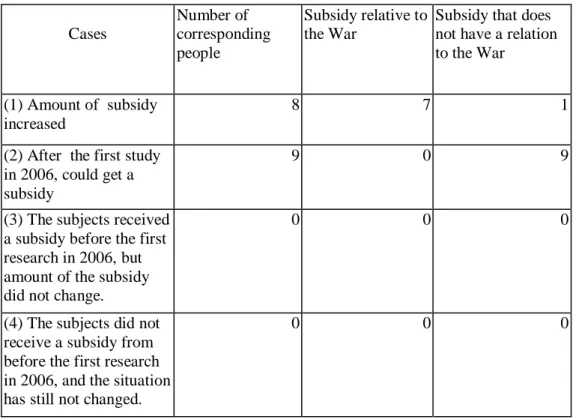
Table 6 shows the results of (a) above. When I interviewed the subjects in 2006, the number of subjects receiving a subsidy from the state was eight. Nine subjects were not receiving a subsidy. Among the eight subjects who had a subsidy from the state, seven had a subsidy related to the War. Of these, four subjects received a subsidy for WDS and three for being a VAO 2.37The remaining subject was a female with a visual
disability by nature (PD38). She lives alone next door to her older brother’s house.
Entering 2013, when I interviewed the nine subjects who were not eligible for a subsidy from the state in 2006, all of them could have already received a subsidy for PD. Moreover, the amount of the subsidy for the other eight subjects had increased.
Thus, we can be fairly certain that, in comparison with the situation in 2006, the subsidy policy for people with disabilities reached more people and was reinforced in 2013.
(b) Medical insurance
Table 7 shows the results of (b). Among the 17 subjects, 11held a medical insurance since before the first interview in 2006. 39
37 All of them were VAO2.
38 As seen in 3 (3) (a), PD means people who do not have a connection to the war. 39 All the subjects with disabilities related to the war belong to this group.
16
After the first interview, five subjects were also eligible to get a medical insurance, all of whom were PD. In addition, there was a subject who did not remember when she received a medical insurance.40
It therefore seems reasonable to conclude that compared with the situation in 2006, medical insurance became available to more subjects in 2013.
(c) Help building a house
One case corresponds with (c). The General Department of Logistics within the Ministry of Defense had built a house (nhà tình nghĩa) for the subject in 2009. The subject is a WDS who fought in the southern region of Vietnam, Laos, during the Vietnam War. He lost his left leg and became mentally ill due to the War. He uses a prosthetic foot.
(d) Pension
No subjects receive a pension. (e) Remarks
Therefore, it may reasonably be concluded 4.3 that the state’s policies to help these subjects, especially policies such as a subsidy and medical insurance, reached the subjects during the period 2006–2013.
4.4 Regarding changes in families
Here, the following matters are considered: (a) house; (b) structure of the family; (c) job of the family members; and (d) subsidy or pension for family members. (a) House
Regarding the houses of the subjects, among the 17 families, five had moved. According to my observations, all of their new residences were certainly better than before. For example, the house of one subject with severe disabilities, in 2006, was a shack constructed from galvanized iron sheets containing several holes; this house also did not have a toilet. After that, the family moved to a house in which they did not have to worry about rain and that had a toilet. Moreover, there was a room for the subject.41
Another example is a subject affected by tactical herbicides through her parents (VAO2). She lives with her mother. When I interviewed her in 2006, they lived in a
40 When I met her in 2006, I could not determine whether she had a medical insurance card. 41 When I visited the subject in 2017, I was told that the land for the new house belonged to the
maternal grandmother of the subject, who had died. Here, I give a little more explanation. They moved from the commune of the subject’s father to this commune that was home of the subject’s mother in 2006. The subject’s father was mentally ill so that they left him in his commune. After they moved to the new residence, the subject’s father also moved to the new residence.
17
house with a broken door. During the interview, her mother reiterated that she wanted to repair the house. After the first interview, they moved to another house in which they did not need to worry about repairing.42
However, it should be noted that all the subjects’ houses have not yet been made barrier-free.
(b) Structure of the family
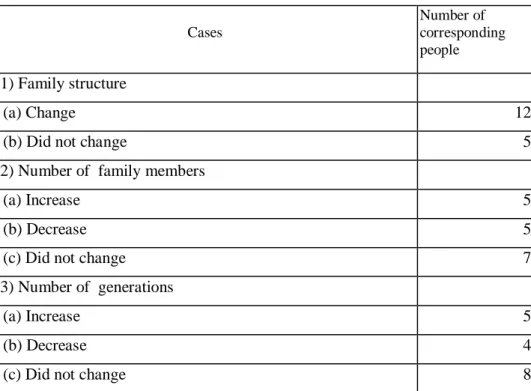
The structure of the family here means the composition of family members. First, Table 8shows the results of (b)above. 12 families experienced changes in the family structure. The other five families had not experienced changes in the family structure. Among the 12 families that had undergone changes, only one had changed due to the subject living with them. This is the case of the subject with severe physical disabilities who married a female with a physical disability in her right thumb in 2008 and had two children. In the other 11 cases, all the subjects had a passive position in the family, i.e., they have to adjust to the changes around them43.
Second, the number of family members in the subjects’ families is considered. Comparing the arithmetic mean of the family members between 2006 and 2013, the number in 2006 is about 4.1 and that in 2013 is about 4.2. In both the cases, the median is four and the mode is four or five. Moreover, in both cases, the number nearest to the standard score 50 is four subjects.44
Therefore, if the total results are considered, it seems reasonable to suppose that the number of family members in the subjects’ families did not change much during the period 2006–2013.
However,Table 8 indicates that there were some changes in the number of family members. There are five cases in which the number of family members increased and five cases in which the number of family members decreased. Moreover, although there were seven cases in which the number of family members did not change, some changes occurred that should not be ignored.
Among the five families in which the number of family members increased,
situations in the two families had a relationship with the movement of their brother, and situations in another three families had a relationship with the movement of their son. In the former case, for example, there was a case as follows: the couple of younger brother of the subject had a second child. Thus, the size of the family increased from six to seven people. In the latter case, an example was as follows: the subjects’ son whom the
42 I presume that the subject’s older sister, who ran a rice business, built the house. 43 I raised some examples at 4.2(b)(2).
18
subject and his wife were living with got married, and had a baby. In this case, the marriage of the son was one of the main causes of the increase in the number of family members.
Regarding the cases in which the number of family members decreased, the following are a few examples. In one subject’s family, which had four members in 2006, it had decreased to only two members—the subject and his wife—because their son and daughter graduated from school and got jobs in Ha Noi city45. In another case,
the subject’s mother had died so that the number of family members decreased from four to three, namely, the subject, his wife, and their son.
Concerning families in which the number of members did not change, there were five families that maintained the same family structure. However, the family structure did change in two other families. In one family, which had four members, including the subject, mother, older brother, and grandmother in 2006, the grandmother died, but the subject’s father returned to the family.46 In the other family, the family structure in 2006
comprised the subject, his wife, and three sons.47 Later, two of their sons moved out,
and the third son got married, and had one child. These things indicate that even though number of members in a family did not change, there may be certain changes in the family.
Finally, the number of generations within the subject’s family is considered here. Comparing the arithmetic mean of the number of generations within a family between 2006 and 2013, the number in 2006 is about 2.1, and the number in 2013 is about 2.2. In 2006 as well as 2013, both the median and the mode were two. Therefore, if the total results are considered, it seems reasonable to presume that the number of generations within the subjects’ families did not change much between 2006 and 2013.
However, Table 8 also shows that there were some changes relative to the number of generations.
In five cases, the generations within the family increased, and in four cases, the generations within the family decreased, although there are eight families in which the generations did not change .
Among the five families, the generations within four families increased because the subject’s son got married and had a child or children. In addition, the causes of the decreasing number of generations within the four families are as follows: the subjects got married and became independent formally; the children graduated from school, got
45 After the subject died, their daughter returned home and found a job in the commune. 46 The subject’s father is mentally ill, and he was living in a different commune.
19
job, and became independent formally; and the mother or the grandmother died. Finally, considering the eight cases in which the number of generations within the family did not change, three families experienced changes other than getting older, such as a brother had a second child, the subject divorced his wife48, and the brothers and
sisters became independent. (c) Jobs of family members
In this subsection, Job means occupation who can earn income49.
Table 9 shows the results of (c). There were six families with a member who changed jobs. For example, one subject’s mother changed her job from agriculture to being a seller of pork, and another subject’s son changed from work related to
electricity to a job selling second-hand sewing machines after repairing them.
And seven families had members who found a job50. For example, in two cases, the
subjects’ sons, who were students or trainees in 2006, grew up and started working as mechanics.
Contrary to the cases above, there were three families with members who lost a job. In all these cases, the subject’s father (two cases) and mother (one case) had been cultivating land. The reasons why they lost their jobs were their age and health conditions.
Among four families, the jobs of the family members did not change. This includes a case that the subject lives alone.
(d) Subsidy or pension for the family member
Among 17 families, the family members of the three families receive a subsidy. Three of the individuals receiving a subsidy were a father (two cases) and a mother (one case) of VAO2 subjects. Regarding these cases, the amount of the subsidy was
increased.
Regarding a pension, there is only one case. He is a subject’s father who worked at a state-owned enterprise related to food after the Vietnam War. He is an ex-soldier who fought in the First Indochina War and the Vietnam War.
(e) Remarks
On the basis of an examination of 4.4 (a)–(d), it is possible to determine that the number of members and the generations of the subject’s family did not change much. However, some changes related to the situation occurred, such as children growing up
48 When I visited the subject’s house in 2006, his wife was pregnant. However, his wife left
home with newly born baby.
49 In this subsection, “job” does not include “housework” like 4.2(a).
50 Here, includes one case that a son and a daughter who graduated the schools and found
20
and started to work, death of mother, grandmother and family members getting older, etc..
The condition of the subject’s house improved in many cases although no houses had been made barrier-free for the subjects. Moreover, in seven cases, a member of the subject’s family had found a job, compared with only one case among the subjects themselves. As for a subsidy from the state, the amount increased in all three cases in which a member of the family had received a subsidy.
4.5 Concluding remarks for Section 4
After investigating the general information about the subjects, I examined three matters, such as changes in the subjects themselves; changes in the subjects based on a state initiative; and changes in the subjects’ families. It seems reasonable to suppose that the following changes occurred between 2006 and 2013: (a)the number of members and the generations of the subject’s family did not change much, although certainly there were some changes within the subject’s family; (b) the changes in the subjects mostly originate from a transformation in the family structure, the business conditions, the state policies, not coming from will of the subjects; (c) many subjects lost their job; (d) many subjects faced difficulty finding a job; (e) subjects’ relations with friends decreased; (f) state policies to help people with disabilities reached the subject51; (g) the economic situation of subjects relatively improved; (h)the condition
of the subject’s house improved in many cases, although no houses had been made barrier-free for the subjects.
5. Concluding remarks
In this paper, we have considered the lives of people with disabilities living with their families in one commune of the Red River Delta region during the period of the promotion of industrialization, modernization, and international integration. This paper is the result of my study on the subjects whom I met in the commune this time.
First, I examined the relationship between the subjects with disabilities and the role of the surrounding people and actors based on the results of field research conducted in 2013. Second, I examined the subjects’ existence (life) as an independent person on the
51 However, it should be noted that there are differences between policies for war participants, their
21
basis of a comparison between the results of a survey in 2006 and in 2013.
Based on the results of the research conducted, first, it seems reasonable to presume that the subjects’ families play a vital role in maintaining the daily lives of the subjects. Without the help of family members, the subjects would face difficulty in surviving.
State also plays a large role in offering subsidy, medical insurance for the subjects. Moreover, relatives, neighbors and friends have some roles for the subjects depending on the situations, even though they don’t have critical role.
From Teramoto2010, Teramoto2013, Teramoto2014, Teramoto2016, I also had gotten similar results to this time.
Second, comparing between the results of a survey conducted in 2006 and the results of a survey in 2013, economic situation and living condition such as houses of the subjects have been relatively getting better. The subsidy and the health insurance policy for the subjects reached more people. However, the existence (life) of these subjects, especially PD, VAO2 within their family is often passive and they are easily influenced by the movement of family members and the changes of circumstances.
This result would be a hypothesis for my next study.
References
General Statistics Office (2007,2010,2011,2014,2015). Statistical Yearbook of Vietnam. Statistical Publishing House, Ha Noi.
Minoru, Teramoto 寺本 実,(2010). Betonamu no shougaisha no seikei―Gaibukankyou to no kakawari ni tuite no zireityousa wo tousita kousatu―ベトナムの障害者の生計―外部環境 とのかかわりについての事例調査を通した考察―[Livelihoods of Vietnamese People with Disabilities: Based on a Case Study focused on the Relationship Between the Vietnamese People with Disabilities and Surrounding Conditions]. In Soya, Mori ed. 森壮也 編, (2010).
Tojoukokusyougaisha no hinkon sakugen―Karerahadouseikei wo itonandeiruka―途上国
障害者の貧困削減―かれらはどう生計を営んでいるか― [Poverty Reduction for the People with Disabilities in Developing Countries: How do they live?] . Iwanamishoten.
―――.(2013)Betonamu no shougaisha no seikei ni kansuru itikousatu―Tainhoashou ni okeru torimakukankyou to no kankeisei ni kansuru zireikenkyuu wo tousite ―ベトナムの障 害者の生計に関する一考察―タインホア省における、取り巻く環境との関係性に関す る事例研究を通して―[The Lives of Vietnamese People with Disabilities: Based on a Case Study in Thanh Hoa Province from the Point of View of the Relationships between People
22
with Disabilities and the Surrounding Environment]」(Ajiakeizai Vol.54 No.3)
―――. (2014) Quan hệ giữa người khuyết tật và điều kiện cuộc sống xung quanh: Nghiên cứu trường hợp tại một thị trấn ở tỉnh Hà Nam [Relationship Between Vietnamese People with Disabilities: A Case Studies in a Town of Ha Nam Province]. Tạp chí Khoa học xã hội Thành phố
Hồ Chí Minh [Journal of Social Sciences in Ho Chi Minh City] Số 7 (191)2014.
―――. (2016). Roles and Functions of Vietnamese Families in Caring for a Member with Disabilities: Case Studies from the Red River Delta Region.
In: Minoru Teramoto, Nguyen Duc Chien, Misaki Iwai, Bui The Cuong (2016).
The Vietnamese Family during the Period of Promoting Industrialization, Modernization and International Integration(Interim Report). Institute of
Developing Economies, IDE-JETRO, Japan.
Tỉnh ủy, Hội đồng Nhân Dân, Ủy ban Nhân Dân Tỉnh Hà Nam(Party Committee, People’s Council, People’s Committee of Ha Nam Province). (2005) Địa chí Hà Nam [Geography of Ha Nam Province]. Nhà Xuất bản Khoa học Xã hội[Social Science Publishing House], Hà Nội.
23 Chart&Table 0 1 2 3 4 5 6 7 8 1 2 3 4 5 6 7 8 9 N u m b er of c or re sp on d in g m em b er s Number of members
Chart 2 Number of members in the family surveyed
Source:Author's field survey. 0 100000 200000 300000 400000 500000 600000 700000 800000 2005 2006 2007 2008 2009 2010 2011 2012 2013 N u m b er o f p o p u lat io n Years
Chart 1 Changes of urban, rural population in Ha Nam province
urban rural Source: General Statistics Office 2010,2011,2014.
24 0 2 4 6 8 10 12 1 2 3 N u m b er of th e cor re sp on d in g fa m il ie s Number of generations
Chart 3 Number of generations in the family surveyed
0 2 4 6 8 10 12 14 16 18 N u m b er of c or re sp on d in g p eop le Type of disability
Chart 4 Types of disability of the subjects
Source:Author's field survey. Source: Author's field survey.
25 0 1 2 3 4 5 6 1930-1935 1936-1940 1941-1945 1946-1950 1951-1955 1956-1960 1961-1965 1966-1970 1971-1975 1976-1980 1981-1985 1986-1990 1991-1995 1996-2000
Number of corresponding subjects
B ir th ye a rs
Chart 5 Distribution of the subjects' birth years
Source:Author's field survey.
0 1 2 3 4 5 6 7 8 9 N u m b e r o f c o r r e sp o n d in g p e o p le Answers
Chart 6 Kinds of help the subjects reqire from their own family
26
Note: *Including four people also answered "visiting" after giving their main Answer "nothing".
Source: Author's field survey. 0 5 10 15 20 25
Help with work Lending money Visiting Nothing In the time of the
bao cấp, we helped each other N u m b er o f c o rr es p o n d in g p eo p le Answers
Chart 7 Kinds of help the subjects require from their own relatives
Source:Author's field survey.
0 2 4 6 8 10 12 14 16 18 20 N u m b e r o f c o r r e sp o n d in g p e o p le Answers
27 0 2 4 6 8 10 12 14 N u m b er o f c o rr es p o n d in g p e o p le Answers
Chart 9 Kinds of help the subjects need from the state
Source: Author's field survey.
0 1 2 3 4 5 6 Visiting, meeting with each other
Play with each other
Offering mental exchanges,
sharing
Mobilizing Helping each other Not helping each other N um b er of co rr es po n di n g pe o pl e Answers
Table 10 The subjects' way of relating to friends
28 0 1 2 3 4 5 6 7 8 9 10 0 10 20 30 40 50 60 70 80 90 N u m b er o f co rr es p o n d in g p eo p le Ratio(%)
Chart 11 Ratio of personal income of the subjects to family income
Source: Author's field survey.
0 1 2 3 4 5 6 7 8 9 N u m b e r o f c o r r e sp o n d in g p e o p le Answers
Chart 12 When the subjects do not have enough money, to whom
do they look for help ?
29
Table1 Structure of used land in Ha Nam province ( K㎡) Years Total area Agricultural
production land
Forestry land Specially used land Homestead land Other land 2006* 860(100%) 466(54.2%) 84(9.8%) 119(13.8%) 50(5.8%) 141(16.4%) 2014** 862(100%) 428(49.7%) 63(7.3%) 165(19.1%) 58(6.7%) 148(17.2%)
Note:*As of 1 January 2006, ** As of 1 January 2014.
Source: Statistical Yearbook of Vietnam 2007, 2015.
Table 2 Role of the people, actors surrounding the subjects (people) Every- thing Care, support daily activti-ies Visit-ing Offering mental exchange, help psycholo-gically Have fun, play with Mobil-ize Help each other Help with work Help econo- mical-ly Employ-ment When beco-ming ill Rais-ing a child Nothing Family 7 10 1 2 1 8 Relative 8 1 1 20 Neighbor 14 1 2 1 1 1 18 Friend* 5 1 1 1 1 20 State 14 2 2 12
Note:* Only nine subjects have friends. Source: Author's field survey.
30 Table3 Distribution of subjects' personal income
Income level/month (10000 dong) Number of corresponding people Number of people who get a subsidy not based on the War
Number of people who get a subsidy based on the War
0 2 0 0 0-10 0 0 0 10 - 20 14(PD) 14 0 20 - 30 0 0 0 30 - 40 3(PD) 3 0 40 - 50 0 0 0 50 - 60 0 0 0 60 - 70 1(VAO2) 0 1 70 - 80 0 0 80 - 90 0 0 0 90 - 100 0 0 0 100-110 0 0 0 110-120 2(VAO2) 0 2 120-130 0 0 0 130-140 0 0 0 140-150 0 0 0 150-160 1(VAO2) 0 1 160-170 0 0 0 170-180 0 0 0 180-190 1(VAO1) 0 1 190-200 0 0 0 210-220 2(WDS*) 0 2 220-230 0 0 0 230-240 0 0 0 240-250 0 0 0 250-260 0 0 0
31 260-270 0 0 0 270-280 0 0 0 280-290 0 0 0 290-300 0 0 0 300-310 0 0 0 310-320 0 0 0 320-330 0 0 0 330-340 0 0 0 340-350 0 0 0 350-360 0 0 0 360-370 0 0 0 370-380 0 0 0 380-390 0 0 0 390-400 0 0 0 400-410 1(WDS) 0 1 410-420 1(WDS) 0 1 420-430 0 0 0 430-440 0 0 0 440-450 0 0 0 Total 31 17 9
Note: PD = Person with disabilities, WDS = Ex-wounded, diseased soldier, VAO1 = Victim of Agent Orange (first
generation).VAO2=Victim of Agent Orange (second generation) *When I met one person in this category in 2006, he claimed that he was a victim of Agent Orange (first generation). However, in 2013 he said that he was a WDS and not a VAO.
32
Table 4 Changes in job (including housework) of the subjects (1) Positive change
0⇒ Sometimes participates in work at home: 1 person (2)Negative change
(a) Jobs with income ⇒ housework : 1 person (b) Jobs with income ⇒ 0: 3 people * (c) Jobs with income, housework ⇒0: 1 person (d) Number of jobs decreased: 1 person (e) Housework ⇒ 0 : 1 person (3) No change
(a) Never had anything to do: 8 people (b) Keeps doing housework: 1 person
Note:* When I interviewed three of them in 2017, two of the three cases
seemed to be doing same job as in 2006. Source: Author's field survey.
Table 5 Changes in the subjects’ relations with friends (1) Positive Change
0 ⇒ Have friends : 1 person (2) Negative Change
(a)Have friends ⇒0: 5 people (b) Have friends ⇒ Reduce the number of friends: 1 person (3) No change
(a)Have friends ⇒Have friends (Do not change): 2 people (b) 0 ⇒0 (Do not change): 1 person (4) Ambiguous
(a) Ambiguous⇒Have friends : 2 people (b) Ambiguous ⇒0: 5 people Source: Author's field survey.
33 Table 6 Changes in subsidy for the subjects
Cases Number of corresponding people Subsidy relative to the War
Subsidy that does not have a relation to the War
(1) Amount of subsidy increased
8 7 1
(2) After the first study in 2006, could get a subsidy
9 0 9
(3) The subjects received a subsidy before the first research in 2006, but amount of the subsidy did not change.
0 0 0
(4) The subjects did not receive a subsidy from before the first research in 2006, and the situation has still not changed.
0 0 0
Source: Author's field survey.
Table 7 Changes in the subjects relative to medical insurance Cases
Number of corresponding people (1)The subjects who received medical insurance after the first
interview in 2006
5 (2)The subjects who received medical insurance before the first
interview in 2006
11 (3)The subjects who received medical insurance but do not
remember when it started*
1
Note: *When I met her in 2006, I could not affirm about that.
34
Table 8 Changes in the structure of the subject's family Cases Number of corresponding people (1) Family structure (a) Change 12
(b) Did not change 5
(2) Number of family members
(a) Increase 5
(b) Decrease 5
(c) Did not change 7
(3) Number of generations
(a) Increase 5
(b) Decrease 4
(c) Did not change 8
Source: Author's field survey.
Table 9 Changes in the Jobs of the family members Cases
Number of corresponding families
(1) Having a person who changed jobs 6
(2) Having a person lost a job 3
(3) Having a person who found a job 7
(4) Did not change 4* (5) Others 2
Note: *It includes a case of the subject living alone.