Development and institutionalization of
communitarian thought in Thailand
著者
Shigetomi Shinichi
権利
Copyrights 日本貿易振興機構(ジェトロ)アジア
経済研究所 / Institute of Developing
Economies, Japan External Trade Organization
(IDE-JETRO) http://www.ide.go.jp
journal or
publication title
IDE Discussion Paper
volume
423
year
2013-07-01
INSTITUTE OF DEVELOPING ECONOMIES
IDE Discussion Papers are preliminary materials circulated
to stimulate discussions and critical comments
Keywords: social movements, communitarianism, Thailand
IDE DISCUSSION PAPER No. 423
Development and Institutionalization
of Communitarian Thought in
Thailand
Shinichi SHIGETOMI*
July 2013
Abstract
In Thailand, communitarian ideas have been widely accepted and even institutionalized as a
principle of national development plans and the Constitution of Thailand. This paper
examines how and why the communitarian body of thought, described as “community
culture thought,” and originally created and shared within a small circle of social activists
and academics in the early 1980s, came to be disseminated and authorized in Thai society.
Contributors and participants, ways of expression, and avenues for disseminating this
paradigm are the main topics in this paper. The paper reveals that these thoughts and
concepts have been diversified and used as guiding principles by state elites, anti-state
activists, and social reformists since the late 1980s. These people with such different
political ideologies were connected through some key individuals. These critical
connections networked them onto the same side for promoting communitarian thought in
Thailand. When such leading advocates assumed key political positions, it was easy for
them to push communitarian ideas into the guidelines and principles of state administration.
The Institute of Developing Economies (IDE) is a semigovernmental,
nonpartisan, nonprofit research institute, founded in 1958. The Institute
merged with the Japan External Trade Organization (JETRO) on July 1, 1998.
The Institute conducts basic and comprehensive studies on economic and
related affairs in all developing countries and regions, including Asia, the
Middle East, Africa, Latin America, Oceania, and Eastern Europe.
The views expressed in this publication are those of the author(s). Publication does not imply endorsement by the Institute of Developing Economies of any of the views expressed within.
INSTITUTE OF DEVELOPING ECONOMIES (IDE), JETRO 3-2-2, WAKABA,MIHAMA-KU,CHIBA-SHI
CHIBA 261-8545, JAPAN
©2013 by Institute of Developing Economies, JETRO
No part of this publication may be reproduced without the prior permission of the IDE-JETRO.
Development and Institutionalization of Communitarian Thought in Thailand
*Shinichi SHIGETOMI
1. Introduction
In present-day Thailand, communitarian ideas are accepted as a virtue by a wide range of people. Not only academics, philosophers, and social activists but also bureaucrats, business people, and even the people at the grass roots are among those who advocate these ideas for building a better society. Communitarian thought has such an influence in politics that even those who want to legitimize their own political agenda can hardly stand against this popular paradigm.
Thai communitarian thought recognizes the negative side of the penetration of market mechanisms and state intervention in the different levels of society and places importance on associative interactions among people and harmonious relationships between humans and the natural environment. It assumes that such interactions and relationships originated in Thai culture that has long been cherished in traditional rural communities. Therefore, it is known in Thailand as “community culture” or
watthanatham chumchon in Thai.1
This cultural concept was developed in the early 1980s by some social practitioners and scholars. In their field experiences and academic pursuits, they focused on positive elements of rural life and the importance of local-level organizations. Since the late 1980s, these ideas have been developing into several versions that promote traditional Thai culture, protect the rights of ordinary people from state authority, and reform state and public administration. Since the late 1990s, the paradigm has been incorporated into laws and guidelines for public administration. For example, in 1997, a clause stating the rights of community appeared in the 1997 Constitution for the first time in the sixty-year history of the Thai constitutional monarchy. In the 2007 Constitution, more clauses were added to elaborate and strengthen community rights. Since the mid-1990s, the phrase “making strong communities” has frequently appeared in the national development plans. In the late 1990s, there was a new expectation that community would be an organizer of education in the national educational vision. In the 2000s, the communitarian idea has been embodied in some laws and policies authorizing and supporting the role of informal local organizations. These communitarian ideas do not remain as mere principles, but exert
*
This is a revised version of a paper originally published in Japanese in Ajia Keizai, vol. 50 no. 12 (Shigetomi, 2009a).
1
Watthanatham and chumchon refer to culture and community, respectively. In some preceding studies, watthanatham chumchon has been defined as anti-state and anti-capitalist, emphasizing village communities and peasant culture (Chatthip, 1991, p.133); a culture of anti-modernism, populism, and nationalism (Kitahara, 1996, p.72); and a culture criticizing development by the state and capitalism and believing in the capacity for self-administration by ordinary people (Yukti, 2005, p.2).
influence on the daily lives of Thai people.
This paper examines how this communitarianism, which was at first expressed by a limited number of practitioners and academics, became popular enough to be incorporated into the institutions of state administration. It identifies the actors, institutions, tools, and the ways communitarianism was expressed that led to its successful dissemination and institutionalization. This paper covers the period before the 1997 economic crisis, even though it is obvious that the King’s speech calling for a self-sufficient economy just after the crisis strongly backed these concepts.2 Since the 1997 Constitution and the Eighth National Economic and Social Development Plan were prepared well before the crisis, we assume that the period before 1997 should be studied to identify the process and factors that led to the institutionalization of Thai communitarianism.
This paper is organized as follows. Section 2 briefly reviews earlier studies of this concept and presents an analytical perspective. Section 3 presents some figures to demonstrate the state of dissemination of communitarian thought in Thai society. Section 4 describes how communitarian thought has emerged in Thailand. Three avenues of origin have been identified: non-government organization (NGO) workers for rural development, a scholar on rural economic history (Chatthip Natsupha), and a government hospital physician (Prawase Wasi). Section 5 examines how these ideas developed and diversified into three separate streams, that is, community as indigenous Thai culture, community as the rights of local people, and community as a principle of state administration. Section 6 examines the process of institutionalization using a detailed document survey. We track how this developing paradigm became integrated into the principles and documents of state administration, such as the national development plans and the Constitution. Then we discuss how such institutionalization was possible. We conclude that Thai communitarian thought was translated into guiding principles for state elites, anti-state activists, and social reformists and that these advocates, who often confronted each other over political issues, came together in support of this line of thinking by the connections of some key individuals.
2. Literature Review and Analytical Framework
A significant amount of literature has already reviewed communitarian thought in Thailand. There were early critiques from Thai scholars on rural society as communitarianism was first presented as the tool of rural development practice and rural society analysis. Kemp (1989) questioned the existence of area-based social organizations that could be called a “community” and a collective identity for Thai rural people. A staunch communitarian, Seri (1989), replied to Kemp that it did not matter whether such area-based social organizations existed, because the community existed in the culture. Rigg (1991)
2
This idea was delivered in his annual birthday speech on December 4, 1997. Referring to the severe economic crisis in July, the King asserted the importance of feeling sufficient with resources that were enough to make a living (Matichon, 1997). He called such an economy setthakit pho phiang, which he translated as “self-sufficient economy.”
claimed that the rural society, which the communitarians were describing, existed only in the romantic imaginations of intellectuals. Kitahara (1996) criticized that such communitarianism had no practical significance in the economic and political development of Thailand because it was not based on the real Thai society. Anan (2001) examined the works of Chatthip Natsupha, a guru of communitarian thinkers and criticized his evidence collection methodology and discussion.
After the communitarian idea had been expressed as principles of social movements and political advocacy, some political scientists joined in the discourse. Anek (1996) pointed out that this so-called community or communitarian sense among villagers worked as a tool used by the state to control villagers. Chairat (2002) and Yukti (1995, 2005) criticized the concept as a utopian structure created by intellectuals, rather than the daily culture of local people. Connors (2003) and Thongchai (2008) described the concept as an expression of nationalism. Recently, Nithi (2011) wrote that communitarian thought was used by statists to justify their oppressive control of democracy.
Comparing early reviews of the arguments about communitarian thought, few studies dealt with how and why it has been disseminated in Thailand. The first and most comprehensive work was done by Chatthip (1991) who was also an advocate of this type of communitarian thought. His work covered most of the early communitarians, such as Niphot Tianwihan, Bamrung Bunpanya, and Prawase Wasi. He also wrote about the Catholic movements as a backdrop to communitarian thought and presented his own communitarian ideas. However, his body of work does not deal with studies published after 1991 or analyze the development of his own thought. Another of Chatthip’s works in 2004 is a brief overview without an in-depth investigation (Chatthip, 2004). Yukti (1995) devoted one chapter to “the formation of community culture thought” in his thesis on the discourse on community culture. However, the discussion was focused on the development of non-governmental organizations, rather than on the paradigm itself. Pasuk (2005) explained the development of the concepts after seeing the impact of the 1997 economic crisis. Kitahara (2000) observed that, in the 1990s, communitarian culture came to be regarded as an ideology in general civil society, rather than referring to a small, closed world distancing itself from the greater outside society and its influences. The studies of Pasuk and Kitahara contributed to a better understanding of the development, but covered only the changes that occurred in the late 1990s. In sum, the preceding studies did not address or explain how and why this paradigm was popularized and even became a part of the formal institutions of this country.
Dissemination of a system of thought such as communitarianism is a type of cultural change. Wuthnow (1989) identifies two classical social theories that explain cultural changes. One is the cultural adaptation theory: it includes the theories of Durkhaim, Parsons, Luhmann, Bellah, Habermas, and Bourdiew and describes the dissemination of culture directly from social change. Another is the class legitimation theory (schools of Marxism and Weberian), which assumes that consciousness is a reflection of social status (class and religious affiliation) of individuals. These classical theories do not attend to intermediaries that may deliver the impact of social change into the psychological processes of individuals.
On the contrary, social constructionists take a more subjectivist position, asserting that actors are free to construct their thoughts. A thought can be disseminated when a group, which constructs and advocates the thought, has a strong political position in the society. The power relationship between
social groups is determined by the social structure (Burr, 1995).
Even with contrasting views of the role of actors who advocate the thought, the classical theorists and the social constructionists share the same position, which is the social structure that determines the dissemination of a culture or thought in a certain society.
However, the social structure itself is a grand design of environmental conditions. Wuthnow (1989) asserts that the actual process of discourse should be more carefully studied. Ideologies are produced, disseminated, and authorized by actors, as the social constructionists assert, but their discretion is exercised within the constraints of particular institutional settings and resource endowments. For example, a thought can be expressed and disseminated in various forms such as lectures, literature, electronic data, or even conversations. They may be facilitated by schools, classrooms, bookshops, internet and computers, and coffee shops. These mediums exist in particular institutional settings and resources of the society. Therefore, to understand how and why a certain ideology becomes popular and institutionalized, we need to investigate the process of dissemination and the types of mediums and resources available to the process. Thus, Wuthnow’s framework provides a guide for the case study of the dissemination of communitarian ideas in Thailand.
3. State of Dissemination
We examined the extent to which communitarian thought has been disseminated in the past two decades. Since there is no indicator that directly shows the level of dissemination, we had to create some proxies.
The first proxy is the number of publications dealing with community. I referred to literature with the word “chumchon” (community) in its title in the online catalogue of the Thammasat University Library, which has one of the best collections of literature on social science in Thailand.3 The number of items with the word “chumchon” in the title was divided by the total number of Thai collections in each publication year. Figure 1 shows that the percentage of items with “chumchon” in the title increased in the first half of the 1980s and again started to increase in the latter half of the 1990s. Even though the library does not necessarily contain all published items on this subject in this country, and there may be some bias in the collection policy, this figure suggests that literature on chumchon has been published more frequently since the 1980s and at a more accelerated pace after the late 1990s. It probably reflects the growing number of readers who are interested in chumchon.
Some public administration documents may reflect an idealized image of society shared by contemporary citizens. Since they have been published in a certain interval, public administration documents provide a good indicator of the state of popularity of communitarian thought. Fortunately, some of the documents have been converted into electronic form that facilitates counting the frequency
3
Chulalongkorn University Library also has an outstanding amount of literature on the subject. However, the author could not retrieve the total number of collections sorted by publication years through its online catalogue.
of appearance of the word “chumchon” in each document.
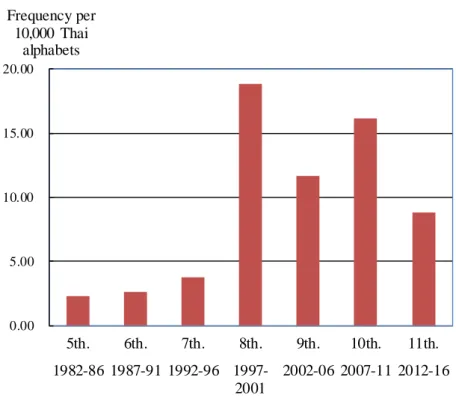
The five-year national development plan reports, which have been produced every five years since 1961, are good examples of such official documents.4 In Figure 2, the frequency of appearance of “chumchon” in each plan is calculated by dividing the results of a word count by the total count of Thai characters in the entire text. By doing this, we can compare reports of different length. The figure shows that the frequency abruptly increased in the eighth plan (1997–2001). In this plan, community as well as family and the individual are equally important as targets for development. For example, there is a chapter discussing how to strengthen family and community in the policies promoting human development. Until the seventh plan, the word “chumchon” was used in the context of referring to geographical areas, such as rural communities (chumchon chonnabot), urban communities (chumchon
muang), and slums (chumchon e-at). After the eighth plan, the word appeared in phrases, such as
strength of community (khwam khem kheng khong chumchon) and strong community (chumchon
4
The initial development plan was for six years.
Figure 1: Percentage of items with word "chumchon" in the title among all Thai collections in Thammasat Universtity Library by publication year
Source: Thammasat University Library, Online catalogue ( http://search.library.tu.ac.th) retrieved on May 13, 2013.
Note: The total number of collections in each year is retrieved by putting an asterisk in the title keyword. 0 0.5 1 1.5 2 2.5 3 1970-74 1975-79 1980-84 1985-89 1990-94 1995-99 2000-04 2005-09 % Year
khem kheng),5 which refer more to relationships between people. The government came to regard community as a social system rather than a social group or a space and regarded the system as a developmental target. The government generally begins drafting a plan two years before it takes effect, which suggests that the concept of community was already in the planners’ minds as an important idea by the mid-1990s. Although the frequency considerably declined in the eleventh plan, it was still much higher than the level of use before the eighth plan.
The Constitution also reflects the ideal image of a contemporary state and society to some extent. In Thailand, the Constitution has been rewritten often. There have been 18 Constitutions since the first one was proclaimed in 1932. Since the text of every Constitution is now electronically filed, we can easily count how often the word “chumchon” appears in each version of the Constitution. The term “chumchon” was used for the first time in the 1997 Constitution, where it appeared four times. In the next consecutive Constitution (2007), the word was used 18 times. These two Constitutions were of similar lengths, implying that the frequency of appearance is higher in the 2007 version than in 1997 version.
5
These phrases do not appear in the plans before the eighth plan.
Figure 2: Frequency of appearance of the word "chumchon" (community) in each National Economic and Social Development Plan
Source: National Economic and Social Development Board (NESDB), website (http://www.nesdb.go.th/). Retrieved in December 20, 2007 and April 28, 2013.
0.00 5.00 10.00 15.00 20.00 5th. 6th. 7th. 8th. 9th. 10th. 11th. 1982-86 1987-91 1992-96 1997-2001 2002-06 2007-11 2012-16 Frequency per 10,000 Thai alphabets
The writers of the 1997 Constitution intentionally used the word “chumchon” to emphasize its meaning as significant, especially in Article 46, which acknowledged the rights of local community to manage natural resources. This was one of the most important innovations in the 1997 Constitution. The rights of community have been more clearly defined in the 2007 Constitution. One part of the Constitution (Part 12) titled, “the Rights of Community,” has articles that assure that the community has the right to manage intellectual property and natural resources and to file suit against state institutions in order to protect these rights (Articles 66 and 67). A chapter on government policy claims the right for community participation in the development of public health and educational policies (Article 80).
The general policy speeches of new prime ministers reflect the prevailing ideas of state and society. Figure 3 shows that “chumchon” was frequently cited during the 1980s when Prem Tinsulanonda was
Figure 3:
(2) The data for Seni (Sep. 1976) and Anand (Jun. 1992) are not available.
Frequency of the usage of "chumchon" in General Policy Speech of each Prime Minister After October 1973
Source: Ritrieved from the homepage of the Secretariat of the Cabinet (www.cabinet.thaigov.go.th/cab_pol.htm) on April 16, 2008.
Note: (1) The frequency is calculated by the number of word "chumchon" appearance per 1000 letters of the text. 0.00 0.10 0.20 0.30 0.40 0.50 0.60 S a nya ( O ct . 19 73) S a nya ( M a y 19 74) S e ni ( F eb . 19 75) K ukr it ( M ar . 197 5) S e ni ( A p r. 197 6) T ha ni n ( O ct . 197 6) K ri ang sa k ( D e c. 197 7) K ri ang sa k (M ay 1 997 ) P re m (M ar. 1 9 8 0 ) P re m ( A pr . 198 3) P re m ( A ug . 19 86) C ha rt cha i ( A ug . 19 88) C ha rt cha i (D e c. 1 990 ) A na n d (M ar . 1 991 ) S uc hi n da ( A pr . 1 992 ) C hua n (S e p. 1 992 ) B an ha rn ( Jul . 199 5) C ha va li t ( N ov. 199 6) C hua n (N o v. 1 997 ) T ha ks in ( F eb . 20 01) T ha ks in ( M ar . 200 5) Frequency per 1000 Thai alphabets
the prime minister. After an interval of six years, the use of the term started to increase again after 1992 (Chuan administration) and further accelerated after 1995 (Banharn administration). The prime ministers after 1992—Chuan Leekpai, Banharn Silpa-archa, Chavalit Yongchaiyudh, and Thaksin Shinawatra—represented different political parties. Chuan tended to leave the market mechanism work to macroeconomic administration, while the other three emphasized government intervention in resource allocation. In spite of these differences, politicians continued to address the importance of community.
The national development plans and the Constitutions are documents that express the principles of state administration and are inevitably abstract to some extent. Even though communitarian thought was incorporated into these official documents, they do not necessarily affect the everyday lives of Thai people. However, in present day Thailand, communitarian thought is embodied in some laws and policies. For example, the Community Organizations Act of 2008 created an institution in which informal local leaders discuss local issues and it formalizes the role of this institution in the local administration.6 In 2007, the Community Forest Act, which aims to legalize collective management by local people in some parts of the national forests, was approved in parliament, but has not yet been enacted because the Constitution Court judged some clauses unconstitutional in November 2008 (Apinya, 2007; King-oua, 2008). In 2010, community land titles were issued by regulations of the Prime Minister’s Office.7 These laws assume that there are informal organizations and institutions that may represent benefits and opinions of local people. As opposed to the Constitutions and the national development plans, they directly affect local administration, forest management, and land administration.
In 2000, the government established the Community Organization Development Institute to fund collective activities of local people. In the field of educational administration, the 2001 educational guidelines, based on the 1999 National Education Act, indicated that curriculum should respond to the needs of the local community (DCID, 2002, p.49).
In summary, chumchon becomes ubiquitous in general publications and administrative documents in present Thai society. Some laws and official orders reflect the ideas of chumchon. This means that communitarian thought is in the institutions that influence the behaviors of government and people. Studying the frequency of the word’s appearance in several types of written materials, we can assume that people started to pay attention to the concept of community in the 1980s and supported the idea more eagerly after the mid-1990s. Then, just before the 1997 economic crisis, communitarian thought was incorporated into the institutions of the state.
4. Birth of Communitarian Thought
6
The Thai name of the law is Phra racha banyat sapha ongkon chumchon pho.so.2551 promulgated on January 31, 2008.
7
This regulation is Rabiap samnak nayok ratthamontri wa duai kan chat hai mi chanot chumchon pho.
To understand the development of communitarian thought in Thailand, we first must examine its origins. This section reviews the ideas of some rural development NGO workers, an economic historian (Chatthip Natsupha), and a social-minded medical doctor (Prawase Wasi). They separately reached the same communitarian concepts and, almost simultaneously, publicized them in the early 1980s. We review the political and socio-economic environment from the 1970s to the early 1980s to understand the background of each thinker’s ideas.
Political and Socio-economic Environment
The 1970s was the decade in which a large number of students and citizens struggled for the democratization of Thai politics. They successfully over-turned the authoritarian, military-backed government with a huge demonstration in October 1973. Farmers and workers became active in social movements in the new political environment. However, it was not long before the military regained power. In October 1976, the government implemented a severe crack-down on all dissidents. It was the end of the 1970s before they found another political space for their activities. Some young people, who wanted to make changes in society, joined NGOs and the number of NGOs in Thailand grew quickly in the early 1980s (Shigetomi, 2002). In the mid-1980s, there were about 60 NGOs, of which three-fourth worked for the development of poverty-stricken rural areas. Some graduate medical students volunteered to work in district-level hospitals, which were called “community hospitals” and devoted themselves to the improvement of medical treatment in rural areas (Suwit, 2003).
In academic society, which was apparently being influenced by Marxism, a new wave focused on class conflicts in Thai society. There was one special group of scholars who worked in Chulalongkorn University’s Social Research Institute (CUSRI) and Economics Faculty, studying contemporary Thai society from a critical viewpoint of political economy. This group was influential in both academia and journalism (Kanoksak, 2006).
Rural society was changing too. Villagers started to organize themselves as savings groups and rice banks to cope with economic problems brought about by the intrusion of the market economy (Shigetomi, 1998). Some successful cases of these self-organized activities among local people showed that they were capable of self-management and highlighted the self-disciplined actions of villagers.
New Perspectives on Rural Development Approach
In the early 1980s, some NGO workers in rural development began questioning their approach to local people (Seri, 2005). One such worker was Niphot Tianwihan, a Catholic priest who worked in the Chiang Mai Center of the Catholic Council of Thailand for Development (CCTD). He devoted himself to the development of villages of the hill tribes. From 1977 to 1979, Niphot emphasized economic development projects as did the other NGOs in those years. But he found that the hill tribe people (Karen) did not regard poverty as their main problem. Through close conversation with the villagers, he realized that their most serious concern was the loss of their indigenous culture (CCTD, 1981a). They
were worried that their children might not inherit their culture. In response to their concerns, Niphot tried to stimulate the collective identity of the Karen tribe and highlight the virtues of traditional Karen culture. He concluded that development workers thought about life differently from local people and that many NGO projects failed because the field workers simply did not understand the local people’s way of thinking.
Niphot’s findings were welcomed by young development workers in the CCTD, such as Wichit Nanthasuwan and Surachet Wechaphitak, and also Seri Phongphit who was a lecturer at Thammasat University and participated in CCTD activities. These people organized a seminar titled, “Thai Culture and Rural Development Work” in October 1981 to discuss Niphot’s conclusions in a public forum (CCTD, 1981a). They were also in charge of editing a CCTD journal, Sangkhom phatthana (Social Development).8 This journal was also a forum in which NGO workers exchanged ideas and experiences in those years.
In the first two editions of this journal in 1982, Bamrung Bunpanya wrote an essay titled, “Development Workers in the Two Cultural Traditions” (Bunphreng, 1982). Bamrung used to be a field worker in the Thailand Rural Reconstruction Movement (TRRM), which was the pioneer NGO for rural development in Thailand. He raised questions about the NGO’s major approach, which was to disseminate “progressive” technologies to peasants.9 In the essay, he asserted that past development programs were mostly unsuccessful and that the development workers themselves were partly responsible for these failures. This was because the workers were deeply influenced by Western culture, in other words, the culture of middle class, and did not understand the culture of local people.
A few months later in the same year, Apichart Thongyou’s essay, “Forming Organizations and Developing Consciousness,” appeared in the same journal (Apichart, 1982). Apichart was a field worker in a Norwegian NGO, Redd Barna, who took an innovative approach by living in the target village and working with the villagers for development.10 He pointed out that the activities of development workers, introducing projects and trying to organize local people, confused local people and sometimes caused confrontations between them. He proposed that outsiders “leave the matter to the villagers and let things go according to the traditional culture inherited in the village” (Apichart 1982, pp.36–37).
In this way, three NGO workers from different groups and backgrounds came to express similar assertions that there was a need to critically review the practices of development workers in those years. These ideas called into question the methodology of development and the ways of understanding rural society. Namely, they argued that (1) among rural populations, there was a salient culture (perspective) that was different from that of NGO workers, (2) this local culture emphasized the importance of mutual assistance, (3) economic development cannot be separated from cultural issues, and (4) the local culture should not be regarded as backward, rather reassessed positively (Bunphreng, 1983). These authors understood rural society as the place where local people accumulated their experiences
8
According to the imprint of this journal, Seri was the advisor in 1980 (CCTD, 1980) and Wichit was the editor (CCTD, 1981b).
9
Interview with Bamrung Bunpanya on September 6, 2008. See also Bamrung (2006).
10
and formed their culture and the cultural wisdom that guided their daily way of life.
The ideas of these individuals were soon shared by many other NGO workers. This was possible because the CCTD had people who responded to Niphot’s findings and tools, such as seminars and journals, which presented the ideas to the public. Outside of the CCTD, the rural development workers had formed a network called the Exchange Forum on Rural Development (EFORD), where they exchanged experiences and ideas through seminars starting in the late 1970s (Rueng, 1995, pp.62–63; Chachawan, 1997, p.27; Sanan, 1997, p.36). The main topic of their seminars between 1982 and 1983 was the local people’s way of thinking (EFORD, 1985). They called the rural culture, which had been long cherished by local people, watthanatham chumchon or community culture.11
Analysis of Village Socio-Economic Systems
When the NGO workers started to review their approach, Chatthip Natsupha of the Economic Faculty, Chulalongkorn University, studied rural societies to identify the factors hindering the development of Thai capitalism. He led the school of political economics and assumed the existence of traditional rural society as one of the reasons for an independent bourgeois not emerging in Thailand. He understood that the villagers had long relied on the mutual assistance of relatives and had not developed themselves by introducing new methods of production and handicrafts into their village economy (Chatthip 1981, pp.315–316; originally Chatthip, 1978). This was the perspective of an orthodox, Marxist, economic historian and political economist.
During 1979 - 1983, while Chatthip was conducting a series of interview surveys with senior villagers to understand traditional rural society, his perspective changed significantly. In his 1982 paper on peasant uprisings in Northeastern Thailand, he attributed traditional culture in village communities as the leading motivation for maintaining the independence of community against outside forces (Chatthip and Pranut, 1982). Chatthip published a seminal book in 1984 compiled of his finding on the historical development of Thai rural society. A summary of his conclusions is as follows (Chatthip, 1984, pp.91–95):
In the past, the Thai village economy was a self-sufficient one and the community had strong social ties. Community members were given land and practiced mutual support. However, the state and capitalism that developed outside of villages resulted in the exploitation of villagers. Therefore, villagers protested against the state and capitalism. This was how the village community survived in Thailand. The virtue of the village community should be maintained even in the future because the community was an organized way of life that provided villagers with
11
The author has not yet identified the person who used the term “watthanatham chumchon” for the first time. Niphot, Bamrung, and Apichart did not use this term as key terminology for their discussion in 1981 and 1982. This term appeared in another of Apichart’s essay in 1983 (Apichart, 1983), but he did not put much importance on the term yet. However, in the seminar organized by the Thai
Volunteer Service in May 1984, these three pioneers were categorized into the “watthanatham chumchon school” (TVS, 1984). This suggests that the term “watthanatham chumchon” was already shared by the NGO activists by 1983 or 1984.
happiness, identity, and political power.
Chatthip regarded community as a system existing in traditional rural society. His evaluation of the system changed from negative to positive in the 1980s. His positive appreciation of traditional culture did not differ much from that of the NGO workers, discussed in the previous section. However, Chatthip provided an academic framework for understanding rural society. His work stimulated academic discussion. In May 1984, the Thai Volunteer Service (TVS), an organization supporting development NGOs, held a seminar in which community culture was contrasted with political economics. The discussion that followed was an exchange of ideas between the two schools (TVS, 1984). In the same year, the Chulalongkorn University Social Research Institute, the center of the school of political economics, organized another seminar examining the relationship between development and culture among local people (CUSRI, 1984). Through these dialogs, the advocates of community culture formed their identity and received recognition as a school of thought among Thai intellectuals.
Community as a Key for Bureaucratic Decentralization
Another person who reached communitarianism in the same period was Prawase Wasi, a medical doctor and professor at Mahidol University’s Siriraj Hospital, the most prestigious university hospital in Thailand. In 1957, Prawase received the King’s private scholarship to study in the United States (RMAF, 1981). After accomplishing his study abroad, he worked for the Siriraj Hospital. Later, near the end of the 1960s, he moved to reform medical services and the education system of Thailand. (Prawase, 1991).
In a 1981 book, he described how hard it was for a poor patient in the provinces to receive necessary medical care. The patient had to make a long and expensive trip to Bangkok, and even if the trip was possible, physicians did not attend to the entire circumstance of the patient’s life, often leaving the real cause of illness unsolved (Prawase, 1981). According to Prawase, the main cause of these problems was the centralized bureaucratic administration (ibid, p.325). He asserted that authorizing the community to make decisions and allow them to practice was the only rational solution (ibid, p.349). On receiving the Magsaysay Award that same year, he told a Thai newspaper journalist, “Thailand cannot survive unless it changes the bureaucratic system. For this purpose, decentralization is critical and we have to leave more work to community” (Matichon, 1981).
In this manner, Prawase promoted community in the criticism against Thai bureaucracy in the early 1980s. In this context, he meant “community” as a local geographic unit that could be responsible for medical services administration after decentralization. In this assertion, he had an image of young physicians devoting themselves to work in district level hospitals in the provinces. Prawase even made a survey of such hospitals, which were called “community hospitals” in Thailand, and confirmed the significance of such hospitals for the health of the general public (Prawase 1991, p.106; 2000, p.6).
change in perspective of NGO workers for rural development. They found the positive aspects of the local people’s ways of thinking through their development practices. The second was the academic pursuits of Chatthip Natsupha. He proposed the concept of preserving the socio-economic system of rural society in the face of capitalist economic development. These two streams had opportunities to meet in the early 1980s. In the seminars of those years, scholars and development workers participated in presentations and dialog. Workers could share their practical experiences and attempt to improve their work by understanding the analytical framework provided by the attending scholars. Conversely, academics could learn about actual situations in the village society through dialogs with the workers. Together, they could validate their assertions. The third origin was the ideas of Prawase that fueled his reform activity in medical administration. These three avenues for understanding community culture were still limited to the specific issues of rural development, economic history, and medical system reform. The advocates and followers of this body of thought were also still limited to rural development practitioners and a few scholars.
5. Dissemination of Thai Communitarianism
During the late 1980s and the early 1990s, communitarian thought in Thailand expanded its meaning and, as a result, drew in people from other fields. The change in the socio-economic environment and the NGO sector was the backdrop for this expansion.
Socio-Economic Conditions and the NGO Sector
After stagnating in the early 1980s, the income of Thai farmers turned upward in the latter half of the 1980s, increasing about 40% from 1986 to 1990. This change was brought about by an increase in non-farming income, especially wages and salaries, due to the rapid growth of non-farming sectors. The GDP growth rate jumped from less than 6% per year during the first half of the 1980s to 9% in 1986 and leveled off at more than 10% between 1987 and 1989.
This rapid economic growth brought new problems to Thailand including the destruction of natural environments and a loss of traditional social norms. Serious flooding on a mountain side in the Southern Region revealed the problems of deforestation. Salt mining in a Northeastern province discharged over-salinated water that damaged agricultural production. Infrastructure construction projects such as large dams and concession for private projects such as eucalyptus plantations presented serious threats to local residents. The environmental problems stimulated conflict between local people and the state and/or business venturers and, as a result, local protest movements occurred far more frequently.
In the political arena, Chartchai Chunhavan, a party politician, took over the government as the prime minister in 1988 after the retirement of Prem Tinsulanonda, the former military leader. However, the civilian government did not last long. Citing corruptions among the ministers as its rationale,
military leaders staged a coup in 1991 and pulled down the civilian government. The people’s response to the coup was not critical at first because they saw that the politicians were indeed corrupt. However, when the Army Commander-in-Chief, Suchinda Kraprayoon, took the office of prime minister, people were afraid of the return of a military regime and there was a huge protest in the center of Bangkok in May 1992. The army put down the protesters with firearms and left many people dead or lost. People lost trust in the politicians and the military leaders. They felt that Thai politics had structural problems that urgently needed to be addressed and resolved. “Political reform” became the main political agenda after the May 1992 demonstration.
In the early 1980s, Thai NGOs were gradually forming informal networks, becoming more institutionally united enabling them to form a social movement sector. In 1985, they established an umbrella organization, the NGO Coordinating Committee on Rural Development (NGO-CORD). By the end of 1984, another NGO-supporting organization, the Local Development Assistance Program (LDAP) was setup (LDAP, c.1987). The LDAP received funds from the Canadian government and other sources and distributed them to NGOs that were too small to secure foreign funding on their own. It had Prawase and Saneh Chamarik on its executive board. Later in 1991, this organization became the Local Development Institute (LDI). Prawase was the chairman of the board of directors and Saneh was the executive director.12
Emphasizing Local Wisdom
From the late 1980s, some NGO activists and scholars focused their emphasis on Thai indigenous cultural and began to discover “local people’s wisdom” (phumi panya chao ban) and “local wise men” (prat chao ban) in various locations. Local wisdom means technologies and knowledge that local people have developed through their experiences. Local wise men are the people who retain and dispense this gathering of wisdom to use in their lives. This was a natural development of communitarian concept that gave value to traditional ways of thinking among local people. Now the emphasis began to shift from local unity or collective action by villagers to knowledge and technology that accumulated in local individuals.
Seri, Wichit, and Surachet, the early advocates of community culture in the CCTD began to focus on the importance of preserving and promoting local wisdom. In 1985, they broke with the CCTD and started a new program for finding and disseminating local wisdom. This program was institutionalized as the Village Foundation in 1988 (Seri, 2005, p.170). Phittaya Wongkul, a seasoned editor who had edited left wing newspapers and NGO newsletters, worked with the foundation to publicize local wisdom. In 1989, it published its first book titled, Careers of Unimportant Persons: Local Wise Men (Phittaya, 1989a). The book followed the work of two farmers in the northeastern region: one who practiced natural farming and made his living in harmony with the ecosystem and another who applied traditional technology to make his fish cultivation very successful. The foundation also publicized
12
More precisely, there was a foundation established for the management of LDI and Prawase was the chairman of this foundation’s board of directors.
stories about other similar individuals: Phai Soisakrang, a village headman who led a successful community development project (Seri, 1988), Wibun Khemchaloem who developed a technology for agro-forestry (Village Foundation, 1989), Priest Nan who devoted himself to community development (Phitthaya, 1989b), and Khiriwong Village which rebuilt their savings groups after a natural disaster (Pornpilai, 1989).
In 1989, the foundation organized an annual event titled, “Good Men in Society” (khon di si
sangkhom) to honor these local wise men. This project was a collaboration with the Thai Rath
Foundation owned by Thai Rath Daily, the newspaper with the largest circulation in Thailand. The chairman of the awards ceremony was Sanya Thamasak, the former prime minister and then Privy Council chairman (Village Foundation and Thai Rath Newspaper Foundation, 1989). Award winners for the first year were Wibun Khemchaloem, Phai Soisakrang, Triwut Pharaphan (the leader of Khiriwong Village), and Phra Athikanphongsak Techathommo (a monk who was devoted to forest conservation in Chiang Mai). The story of the awards ceremony was reported by TV news agencies and the Thai Rath Daily newspaper.13
Expressing the concepts of community culture in terms like “local wisdom” had positive consequences. First, communitarianism came to be recognized by the general public because speaking of local wisdom provided concrete evidence of community culture even for city dwellers. The advocates explained the concept of local knowledge and local wise men using examples of real people and practices. Describing the concepts of community culture this way also made it easily understood by people who might not be involved in rural issues. Another reason is that most local wisdom is knowledge and technology that works in harmony with the natural environment and, therefore, fitted the contemporary atmosphere of society that was conscious of and concerned about environmental problems.
A good example would be the life experience of Wibun Khemchaloem. Wibun had managed a large-scale farming operation of cash crops that failed leaving him with a large debt. In 1982, after this experience, he started to plant various crops and trees to secure only the basic needs of his family. He wrote in his book, “Such a self-sufficient method of cultivation should be based on the spirit of satisfaction. In other words, we should be satisfied with humble meals, be thrifty, and refrain from luxury as other people do … We do not have to seek happiness by material consumption. Rather, what important is to seek spiritual happiness.” (Wibun, 1989, p.19). In his remarks, the change in his farming technique and goals accompanied the change in his value system and ethics.
Second, the new terminology caused some government officials to become interested in the concepts of community culture opening an opportunity for NGO sectors and the government sectors to make valuable connections. Seri took Ekavidya Nathaland, then the secretary general of the National Cultural Commission (NCC), to meet some of the local wise men.14 The NCC was part of the Ministry of Education and was in charge of promoting and conserving Thai culture. Ekavidya himself was a bureaucrat of the Education Ministry and assumed the office of the secretary general of NCC in
13
Interview with Seri Phongphit on September 10, 2008 and Phittaya Wongkul on September 8, 2008.
14
October 1988. After learning about local wise men, Ekavidya started to disseminate local wisdom through his institution. During his term, the NCC organized seminars on local wisdom in 1990 and 1991.15 These seminars were the result of collaboration with the Village Foundation. Ekavidya and Seri, together with the staff of the Foundation, interviewed local wise men in the northeastern region. This field trip provided the basic information for organizing the seminars in 1990 (Ekavidya, 1991). The NCC and the Foundation were co-organizers of the 1991 seminar, which gathered local wise men nation-wide (NCC, 1991b). In this way, community culture was formally recognized by the state institution as culture to be promoted.
Community as Thai Culture
As mentioned, in his historical analysis of Thai capitalist development, Chatthip expressed regrets about the non-existence of an independent bourgeoisie. After discovering the positive values of traditional community, he began to think of community culture as the indigenous culture of the Thai people and the urban middle-class citizens in this culture as the independent bourgeoisie (Anan, 2001). He made comments that verify his thoughts at the presentations of communitarian NGO workers in the TVS seminar of 1984.
Finding and conserving the past culture is not enough to improve our lives in the future. Community culture has two aspects. First is the culture of the local people and how the culture is useful to them. Second is the dissemination of the culture outside of the local community. The middle-class people do not have their own culture. They have to develop it by finding it in the grassroots of local culture. Community culture can unite local and middle-class people (TVS, 1984, pp.325–328).
Chatthip expanded this idea further by surveying cultures of Thai ethnic groups who lived outside of Thailand and had experienced little impact from market economies and Western culture. He assumed that such groups maintained their original Thai culture (Chatthip and Murashima, 1997). In this way, community culture was expanded to mean Thai culture. “Community” in this context never meant local society, but rather “Thai-ness.” Community culture was no longer the ideology of only rural people who protested the state and capitalism as Chatthip described in his early works, nor was it only the culture for uniting the local and middle-class people. Rather, it was an ideology of the uniqueness of Thai culture, which expressed a nuance of nationalism (Thongchai, 2008). This ideology was welcomed by state elites for its ability to enhance the people’s sense of belonging to the state.
This expansion of implication and the field of study concerning community culture drew the interest of an even larger number of scholars. The political economists of Chulalongkorn University reorganized their circle and setup a formal institution, the Political Economy Centre, in the faculty of
15
The title, period, and place of the seminars were “Wisdom of Local People,” July 10–12, 1990 in Nakhon Ratchasima (NCC, 1991a); and “Knowledge and Culture of Local People, the Practice of Rural Development,” March 26, 1991 in Bangkok (NCC, 1991b).
economics (Kanoksak, 2006). In this Centre, a group of scholars gathered to study economics by applying community culture concepts (ibid, p.39). The Centre reissued its formerly renowned journal,
Political Economy, in 1997, but added a subtitle, “For Community.”
The institutional basis for community study was also expanding to higher educational institutions in the provinces. In Thailand, teacher training colleges had been established from the 1960s and, by 1980, the number of them rose to about 50 (NSO and MOE, c.1985). They were located mostly in provincial cities. The number of students enrolled in teacher colleges considerably decreased later in the 1980s, leading the government to revise the law for teacher colleges and allow the colleges to offer courses other than for training teachers.16 Most teacher colleges added a course for community development.17 Naturally, such a course needed staff, which meant that in the provinces, scholars of community studies increased as well.18
In 1993, the government established a funding agency for academic research, the Thailand Research Fund (TRF). In 1996, the TRF developed a section specializing in the promotion of community studies (Community Division).19 Up until 2007, the agency provided 813 million baht (about 21 million dollars by the average exchange rate of this period) for research projects related to community.20 Chatthip received funding from this source from 1995 to 2002 and implemented five projects and involved about 50 scholars in these projects (Chatthip, 2007). They published 14 books on the development of communal systems and 19 books on communities in present Thai society (ibid). In the 1990s, the creation and dissemination of knowledge about communitarian thought was supported by state funding and institutions, rather than by the personal interests or pursuits of scholars.
Community as a Right
As a reflection of environmental problems, the number of environmental NGOs increased starting in the late 1980s. Since many environmental problems were caused by projects of the state and private enterprises, the environmental NGOs had to work outside of their field in the community to negotiate, and sometimes confront, the government and business sectors. Consequently, the activities they worked on considerably differs from those of rural development NGOs, which mainly worked inside villages and tried to make the society as self-reliant as possible without the intervention of the state and market. In 1990, the NGO-CORD, the umbrella organization of NGOs, invited Saneh Chamarik to be its representative. Saneh is a political scientist and represented a human rights NGO in the 1970s. As
16
See Phra racha banyat withayalai khru (chabap thi 2) pho.so.2527 (Teachers College Law of Year 1984, The Second Revision).
17
By reviewing the homepages of Ratchaphat universities (former teacher colleges), the author confirmed that 34 of 41 colleges had courses or departments for teaching community development. These departments and courses belonged mostly to faculty in humanities and society and were established between the mid-1980s and circa 2000.
18
According to some homepages mentioned in the previous note, the number of lecturers in charge of community development course ranges from two to 12.
19
Interview with Silaporn Buasai on September 1, 2008.
20
mentioned, he was a board member of the LDAP, which provided funding for small-scale NGOs. Although Saneh had a long history of working with NGOs, he was not a rural development specialist or a communitarian. When he took the position of a NGO-CORD representative, Saneh felt that the NGOs paid too much attention to self-sufficiency and self-reliance and were too defensive about the impacts of outside influences on the local community.21 He thought that NGOs should engage in political movements and develop their political power against the state. Saneh was the right person for leading the NGO sector when NGOs had increasing engagement with the government about environmental issues.
In 1991, under Saneh, the NGO-CORD organized a forum of non-governmental actors, called the People’s Forum, in parallel with the annual conference of the World Bank and IMF in Bangkok. The theme of the forum was to change the direction of development from being growth centered to being people centered and to use human rights and freedom as the yardstick to evaluate the development policies (Saneh, 1992, p.13). The Thai NGOs as a social movement sector had begun to voice their ideas about the development policies of the state sector.
At the same time, Saneh was getting more involved in rural issues. In 1990, when he became the sub-committee chairman of the national committee to discuss the vision for the National Educational Plan of 1992, he implemented field surveys of local wise men and proposed an idea to build community-based schools (Saneh, 1990).22 Saneh also started a research project on community forests in 1991 with other scholars and NGOs with funding from the Ford Foundation (Saneh and Yos, 1993). Saneh was motivated to do this project because some scholars from the Chiang Mai University had already reported cases in which local people collectively and voluntarily managed the forests. The Chiang Mai scholars paid attention to such cases because there happened to be many cases where local people had confronted state agencies and business enterprises about the use of local common resources such as the forests and the water. By collecting a number of cases not only from the northern region but also from northeast Thailand, Saneh and his co-researchers concluded that community was also a unit local people could use to protect their rights to manage local resources. Recognizing community from the perspective of human rights, in 1992, they published the “Community Rights Declaration” (LDI, 1992) together with the study results of community forests in three volumes (Saneh and Yos, 1993; Chalatchai, Anan and Santhida, 1993; Mongkhon et al., 1993). A number of publications about the rights of community followed the works led by Saneh. These publications covered not only public resource issues but also the living environment and local radio broadcasting.23
Nithi Iamsriwong was especially important among the scholars and thinkers expressing these versions of “community.” He was a renowned historian who had written essays sharply analyzing
21
Interview with Saneh Chamarik on September 9, 2008.
22
According to Saneh, the community-based schools would create knowledge necessary to local people and community (Saneh, 1990, p.28). The teachers would be members of the community and local wisdom would be integral to its curriculum.
23
In the collections of Thammasat University and Chulalongkorn University libraries, the author checked literature with titles having the words “sitthi” (right) and “chumchon” (community). He found such literature appeared 41 times between 1992 and 2007 (checked May 16, 2009 at the OPAC of these university libraries).
society and politics since the late 1980s. His writings had a strong influence on intellectuals in Thailand. He lived in Chiang Mai and was well informed about natural resources issues and conflicts in the northern villages. Nithi had already written in a 1988 essay that community should be regarded as a legal entity that was qualified to control local resources (Nithi, 1989, p.290). He asserted that more efficient resource management would be possible if the community was authorized to manage the resources and local society had more say in the outside world about managing resources by local wisdom (Nithi, 1996).
In summary, community came to be regarded as an entity that represented the rights of local people. Community culture became an ideology for social activists resisting against state authority. It was no longer only the concern of NGOs and social activist involved in rural development, but was shared by a broader range of activists on social and political issues. Now, community did not merely mean a village or a local unit, but any type of group or social category that had a collective identity.24
Community as the State System
In the late 1980s, Prawase expanded the meaning and applicable field of his communitarian ideas. In 1987, he published a book titled, Buddhist Agriculture and the Tranquility of Thai Society (Prawase, 1987; English version, Prawase, 1988). Here is a summary of his assertions in the book.
Most Thai people are poor and communities are broken, which creates more urban slums and broken families. There are many prostitutes and murders. Those who want to study cannot go to school. The mental health is retarding. There is no way out seen in the confrontation in economic, political, military, and educational issues. In spite of being blessed with nature and Buddhism, Thailand faces critical situation. The reason is that the Western culture, new way of education, economic development, and commercialism intruded into Thai society (Prawase, 1987, pp.3–5, 11–18).
After evaluating the present situation, Prawase saw hope in the practices of wise men like Wibun Khemchaloem. He called Wibun’s practices examples of Buddhist agriculture (agriculture based on Buddhism).25 He understood that Buddhist agriculture realized mixed farming, harmony with nature, satisfaction in life and production, principles of community life, and ethics. These five elements were essential for saving Thai society and bringing it out of crisis. He asserted that “community culture is the treasure of society” (ibid, p.35) and praised local wise men as practitioners of community culture. In this context, Prawase discussed the meaning of community and regarded it as a social system, rather than as the tool to decentralize public administration. It is notable that the practices of local wise men led to changes in Prawase’s convictions.
24
Interview with Nithi Iamsriwong on September 11, 2008.
25
Prawase called the practices Buddhist agriculture because they had the following elements: (1) effort to perceive that all things were related to each other, (2) self-reliance, (3) discipline of life, (4) path to success, (5) simple life, (6) the way to train one’s mind, and (7) unity (Prawase 1988, p.29).
We can confirm these changes by tracing the changes in his publication titles. Figure 4 categorizes his books (including co-authoring and co-editing) into periods and topics.26 It shows that the number of Prawase’s publications rapidly increased after the mid-1980s. Most publications before 1986 were on medical or Buddhist issues. But from 1987 to 1991, he wrote an increasing number of books on rural issues, community, environment, and civil society. He also started writing about politics and democracy.
The political ideas of Prawase further developed after the May 1992 demonstration. When the clash between the demonstrators and military forces seemed inevitable, some people expected Prawase to alleviate the crisis by seeking the King’s intervention. Prawase was regarded as having personal ties to the King because he had received the King’s scholarship. (Prawase, 1993, pp.10–17). As the situation worsened, Prawase received more number of visits from people asking him to intervene. The day of the awful event, people who knew Prawase personally called him and beseeched him to directly report the situation to the King. Prawase also actively voiced his opinions about politics. Figure 4 indicates that his publications on politics and democracy continued to increase and eventually surpassed those on medical issues.
After the demonstration, when people spoke of Prawase, they added a sort of prefix to his name,
ratsadon auso (experienced citizen). A month after the incident, a Bangkok Post reporter wrote this
about Prawase, “In his office at Siriraj Hospital, the phone rings constantly and visitors keep streaming in to seek from this soft-spoken, self-effacing doctor a diagnosis of the country’s ills as well as his prescription of healing the wounds now afflicting our society” (Sanitsuda, 1992). This reporter even called Prawase “the moral torchlight of the democracy movement.” Prawase became a charismatic public figure after the May 1992 demonstration.
When Prawase did start to write a prescription for Thai society, it was natural for him to use the community concepts he had already developed by the late 1980s. In his book of 1994, he stated, “The Thai society should recognize the importance of strength of community and apply the strategy of community for the strategy of state” (Prawase, 1994a, p.38). For Prawase, “community” was the condition in which people enjoyed love, mutual help, study and work collaboration, and true democracy that provided happiness and personal development (Prawase, 1994b, p.15). Community might exist not only in local society but also in every association and institution. For example, university scholars had academic community, monks had communities of temples and religious organizations, and even in private companies people could have a community (Prawase, 1994a, p.38). Prawase asserted not only decentralization of administrative power to communities but also the reform of state governance. He proposed administrative reforms and creation of monitoring organizations for state governance (Prawase, 1994b, pp.16–18). He proposed a concept of prachakhom to identify community that might exist in higher levels of society than in local community (Prawase, 1998a). He conceptualized his civil society ideas as the network of community and the association of small groups.
26
The author used an electronic catalog of the Thailand university libraries (Thailis Union Catalog, http://uc.thailis.or.th) to list the publications of Prawase. Then reprinted and revised versions were excluded before counting the number in each category by judging whether the index word was in the title.
With these discussions, he tried to develop an idea of how grassroots communities could be united to form a higher level of public administration, and even state administration. Prawase’s vision was that communities were vertically integrated into a hierarchy with the monarchy at the top (Prawase and Chuchai, 1997, p.23).
To realize this new paradigm, there needed to be an institution for collaboration between the state and society, more concretely, between the actors of government and the private sectors. Prawase created the term, bencha phakhi (solidarity of five), to describe the collaboration of five sectors: bureaucrats, NGOs, local people (their leaders), business, and scholars (Prawes and Chuchai, 1997, p.24). Prawase felt the relationships between these five sectors were often at odds and should be transformed into collaborative ones. Indeed, after the May 1992 incident, some middle-class people, such as government officials, specialists, and business people in the provinces, who had not participated in political movements before, felt motivated to do something for society and started to form organizations and networks (Shigetomi, 2009b). The people in these social movements were not
Figure 4: Nnumber of Prawase Wasi's publication by category of topics
Source: The publications were retrieved by applying "Prawase Wasi" for the author in the online catalogue of Thailand university libraries (Thailis Unicon Catalogue; http://uc.thailis.or.th) in July 20, 2008.
Note: The categorization was done by the author from the title of literature. The number of issues does not include the revised and reprinted versions.
0 10 20 30 40 50 Before 1981 1981-86 1987-91 1992-97 1998-2007 Number of issues Year
Politics and democracy
Rural issues, community, environment, and civil society Buddhism and ethics
NGO activists or local people. Even though they were critical of government policies and administration, to improve governance and development they tried to cooperate with the government rather than confront it. Prawase was their ideological leader. For Prawase, these activists were the model for his bencha phakhi idea. The communitarianism of Prawase had become the ideology for reforming state governance in a collaborative way.
Summary of the Variation and Expansion of Communitarian Thought
In this section, we review the arguments of communitarian thinkers and how they diversified the concept in three directions.
First came some NGO activists who translated community culture into more concrete ideas based on local wisdom and local wise men. Chatthip expanded the meaning of community culture from traditional village culture to collective Thai culture. Once community culture was expanded to mean indigenous and genuine Thai culture, the concept attracted some elites in the state sector. The broader concept gained the support of state institutions such as the National Cultural Commission.
Second, communitarian thought became an ideology for social movements protecting the rights of local people. An increasing number of NGOs became involved in the struggle against the government and business entities to protect local people from suffering environmental problems. At the same time, it became known that local people had communal systems for conserving natural resources. The NGOs and some aligning scholars claimed that the local community had the right and capability to protect the environment in the local society. They applied communitarian thought to legitimize their struggle.
Third, Prawase started to recognize community as a social system rather than a concept to promote decentralization of state administration. Especially after the demonstration of 1992, he applied community concepts to describe the ideal structure of state administration. He asserted that actors in state and social sectors should collaborate to realize such an ideal state. Then, a new group of social activists emerged and implemented their social activities in the provinces. In this context, communitarian thought became an ideology for social movements that put more emphasis on collaboration rather than on confrontation with state and business sectors.
In summary, Thai communitarian thought had developed into three different subcategories, nationalist, anti-statist, and reformist ideologies. The advocates also became widely varied among social movement actors, scholars, and bureaucrats. Even in the social movement sector, communitarian thought was shared by those who emphasized the self-reliance of rural communities, protested against state authority, and collaborated with the state sector.
In spite of such wide variations in philosophies, they shared a common idea of communitarian thought that placed importance on indigenous culture and social systems among local people and on the participation of the general population in the public domain. Communitarian thought had expanded its advocates and supporters by making variations in the body of thought.
Seminars provided opportunities for a wide range of advocates and supporters to exchange ideas. Following the TVS seminar on community culture, similar seminars were organized by academic institutions such as the CUSRI of Chulalonglorn University in December 1984, Chiang Mai University