ORIGINAL
The clinical usefulness of a new hand-held device for fractional
exhaled nitric oxide measurement, NIOX VERO
®,
for diagnosing the etiology of cough
Masaki Hanibuchi1, Atsuro Saijo1, Atsushi Mitsuhashi2, Takashi Takeji3, and Tetsuya Kitagawa4
1Department of Respiratory Medicine, 3Department of Internal Medicine, 4Department of Cardiovascular Surgery, Shikoku Central Hospital
of the Mutual aid Association of Public School teachers, 2233 Kawanoe-cho, Shikoku-Chuo, 799-0193, Japan, 2Department of Respiratory
Medicine and Rheumatology, Graduate School of Biomedical Sciences, Tokushima University, 3-18-15 Kuramoto-cho, Tokushima, 770-8503, Japan
Abstract : Cough is one of the most common symptoms seen in clinical practice, however the differential di-agnosis is often difficult. The utility of fractional exhaled nitric oxide (FeNO) measurement in the differential diagnosis of the etiology of cough has been reported. NIOX VERO® (NOV) is a new hand-held device that will replace NIOX MINO®, but its diagnostic utility has not been fully elucidated in clinical practice. In this study, the performance of NOV for FeNO measurements was determined. We retrospectively analyzed 243 consecutive patients complaining cough. Among 243 patients, final diagnosis was cough variant asthma (CVA) in 74 (30.5%), bronchial asthma (BA) in 48 (19.8%), post-infectious cough (PIC) in 52 (21.4%), atopic chough (AC) in 24 (9.9%), gastroesophageal reflux disease (GERD) in 10 (4.1%), and Others in 35 (14.4%). FeNO values were significantly higher in CVA and BA as compared to PIC, AC, GERD, and Others. In the multivariate analysis, only FeNO value was identified as independent factors to discriminate CVA and non-CVA other than BA. These findings indicated that FeNO measured by using NOV could be used as a diagnostic marker of intractable cough, especially for the differential diagnosis of CVA from non-CVA. J. Med. Invest. 67 : 265-270, August, 2020
Keywords : fractional exhaled nitric oxide, NIOX VERO®, etiology of cough, cough variant asthma
INTRODUCTION
Cough is one of the most common symptoms for which pa-tients seek medical attention (1), however proper diagnosis of its etiology is often difficult (2). Morice et al. report that the most common diagnoses in patients with chronic cough are cough variant asthma (CVA), sinobronchial syndrome (SBS), and gas-troesophageal reflux disease (GERD), followed by eosinophilic bronchitis (EB) without bronchial asthma (BA), chronic bron-chitis, post-infectious cough (PIC), and angiotensin-converting enzyme inhibitor-induced cough (3). In Japan, the prevalence of CVA, atopic cough (AC), and SBS is reported to be high, whereas that of GERD as a cause of chronic cough tends to be low (4). For the adequate treatment and symptom relief of patients, the ac-curate diagnosis of the etiology of cough is an important clinical concern.
The tests required for diagnosing CVA and EB, such as bronchial challenge tests and induced sputum analyses, are technically demanding and require specialized instruments and personnel (5, 6). Thus, their use is restricted to specialist centers. Fractional exhaled nitric oxide (FeNO) measurement is consid-ered a useful surrogate marker of Th2-driven airway inflamma-tion (7). FeNO values correlate with sputum eosinophil count (8), and higher FeNO values have been reported in asthmatic patients compared with non-asthmatic subjects (9). The great advantage of measuring FeNO values is that it only requires a
simple, rapid, and noninvasive test (10), potentially enabling the test to be widely used in clinical practice. Although the utility of FeNO measurements in the differential diagnosis of prolonged or chronic cough has been reported (11), its diagnostic utility can vary with the target population, and no specific recommendation has been made for patients with chronic cough (10).
In Japan, three devices are used for the measurement of FeNO and are covered by insurance, namely, NIOX MINO®, NIOX VERO® (NOV) and NObreath®. NOV is a new device that will replace NIOX MINO®, and the use of NOV was previously limit-ed owing to its high cost. However, after being approvlimit-ed for cov-erage by the national health insurance in March 2015, the use of NOV has increased. Because NOV has not been used for many years in clinical practice, and few studies have been performed to measure FeNO values obtained using NOV, its diagnostic utility has not been fully elucidated.
In this study, we investigated the clinical utility of FeNO mea-surement obtained using NOV for the evaluation and differential diagnosis of allergic airway inflammatory disorders in patients with intractable cough.
MATERIALS AND METHODS
Patients
We retrospectively analyzed 243 consecutive patients who
The Journal of Medical Investigation Vol. 67 2020
Abbreviations
CVA, cough variant asthma ; SBS, sinobronchial syndrome ; GERD, gastroesophageal reflux disease ; EB, eosinophilic bronchitis ; BA, bronchial asthma ; PIC, post-infectious cough ; AC, atopic cough ; FeNO, fractional exhaled nitric oxide ; NOV, NIOX VERO® ; ppb, parts per billion ; IgE, immunoglobulin E ; SD, standard deviation ; BMI, body mass index ; ROC, receiver operating characteristic ; CI, confidence interval
Received for publication February 18, 2020 ; accepted March 25, 2020. Address correspondence and reprint requests to Masaki Hanibuchi, Department of Respiratory Medicine, Shikoku Central Hospital of the Mutual Aid Association of Public School teachers, 2233 Kawanoe-cho, Shikoku-Chuo, 799-0193, Japan and Fax : +81-896-58-3464.
visited the Department of Respiratory Medicine, Shikoku Cen-tral Hospital of the Mutual aid Association of Public School teachers from April 2018 through June 2019, with a chief com-plaint of cough. Inclusion criteria were as follows : 1) age ≥ 15 years, 2) being able to undergo FeNO measurement, and 3) providing informed consent to participate in the study. Patients were excluded if they : 1) were in lactation and breastfeeding, 2) were in a pregnancy, 3) had significant psychological problems, 4) had abnormal chest radiograph findings that may explain the cough, or 5) had taken systemic corticosteroids, antihistamines, anti-leukotriene agents, medications for cough within the previ-ous two weeks. Patients with respiratory symptoms other than cough, such as fever, sputum, shortness of breath, wheezes and stridor, were included. For the comparison of FeNO values, age-matched 30 healthy volunteers were also included.
The study was conducted in accordance with the Declaration of Helsinki and the study protocol was approved by the Institu-tional Review Board of our institution (approval number ; 2019-1-1, approval date ; 2019 / 5 / 16). The statement on consent to participate in this study was obtained from patients by the disclosure of information for participation.
Study Design
Questionnaires concerning past and/or present illness, occu-pation, cough duration, other respiratory symptoms and current smoking status including the number of cigarettes smoked per day and smoking duration were assessed. The smoking index was defined as multiplying the numbers of cigarette pack smoked per day by smoking years (pack-years), to estimate how the patients were exposed to smoking.
All patients underwent FeNO measurement. FeNO values were measured by NOV electrochemical analyzer (Aerocrine AB, Solna, Sweden) at a flow rate of 50 mL / seconds, according to the American Thoracic Society / European Respiratory Society recommendations (12) and were expressed as parts per billion (ppb). The patients were asked to empty their lungs and then inhale deeply through the filter to total lung capacity. Next, they exhaled slowly through the filter and regulated their exhaled flow rate through assistance by an animation display. The exha-lation time was adjusted to 10 seconds for all patients. Measure-ments were repeated until one acceptable value was obtained, as judged by the machine. Blood tests included peripheral blood white blood cell count, peripheral blood eosinophil count, serum non-specific immunoglobulin E (IgE), and serum antigen-specif-ic IgE as appropriate. A chest radiograph was also evaluated in order to exclude other undiagnosed diseases.
The diagnoses of the etiology of cough were made as follows. BA was diagnosed when patients had cough as the predominant symptoms while together with wheezes and/or dyspnea, and either positive airway reversibility or reversible airflow obstruc-tion (13). A diagnosis of CVA was based on the sole complaint of cough, not accompanied by wheezes or dyspnea, which was relieved by β2-agonists, and positive airway reversibility or re-versible airflow obstruction (4). AC was diagnosed based on the presence of atopic status and response of coughing to histamine H1 receptor antagonist, but not to inhaled β2-agonist (4, 14). PIC was diagnosed when cough was preceded by an acute respiratory tract infection that was not complicated by pneumonia and even-tually resolved spontaneously (4). SBS was diagnosed based on findings of chronic sinusitis on sinus imaging and improvement of cough and symptoms related to chronic sinusitis with macro-lide antibiotics (4, 15). GERD-related cough was suspected by the presence of 1) classic reflux symptoms of heartburn, indigestion, chest discomfort, throat clearing, dysphonia, dysphagia, and belching and/or 2) typical characteristics of cough that is trig-gered by phonation, rising, lying, eating, and intake of certain
food. A diagnosis was confirmed when cough was relieved by proton pump inhibitors with or without gastrointestinal proki-netic agents (16).
Statistical analysis
The significant differences between populations were eval-uated with Fisher’s exact test in categorized variables and Student’s t-test in continuous variables. Data are described as the means ± standard deviations (SDs), unless otherwise stated. Correlations between FeNO values and blood eosinophil counts and total serum IgE titers were analyzed by Spearman’s rank correlation test. Intended for 195 patients whose final diagnoses were other than BA, the univariate analysis was done to evalu-ate the patient characteristics that were significantly associevalu-ated with the diagnosis of CVA ; specifically, these factors were age, gender, body mass index (BMI), smoking status, smoking index, cough duration, past and / or present illness, blood eosinophil count, total serum IgE titer, and FeNO value. Variables that had a P-value of < 0.05 in the univariate analysis were included in the multivariate logistic regression analysis to evaluate which one predict the diagnosis of CVA. The cut-off value for distin-guishing CVA from non-CVA except for BA was determined by receiver operating characteristic (ROC) curve analysis. Two-tailed P-values of < 0.05 were considered significant. All analy-ses were performed using EZR (Saitama Medical Center, Jichi Medical University, Saitama, Japan), which is a graphical user interface for R (The R Foundation for Statistical Computing, Vienna, Austria) (17).
RESULTS
From April 2018 through June 2019, 243 consecutive patients with a chief complaint of cough were enrolled in this study. Their clinical characteristics are listed in Table 1. The mean age was 52.6 years, with a range of 16-89. Eighty-seven patients (35.8%) were male, and 156 (64.2%) were female. The mean cough dura-tion was 8.1 weeks (range ; 0.14-104 weeks), and the mean BMI was 23.2 ± 3.9 kg / m2 (range ; 14.8-37.1 kg / m2). Seventy-eight patients (32.1%) had smoking experience (current or former), and the mean smoking index was 8.0 ± 16.9 pack-year (range ; 0.0-87.5 pack-year). Seventy-five patients (30.0%) had the past his-tory of BA. The past and / or present illness of allergic diseases except for BA, SBS and GERD were observed in 112 (46.1%), 51 (21.0%), and 45 (18.5%) patients, respectively.
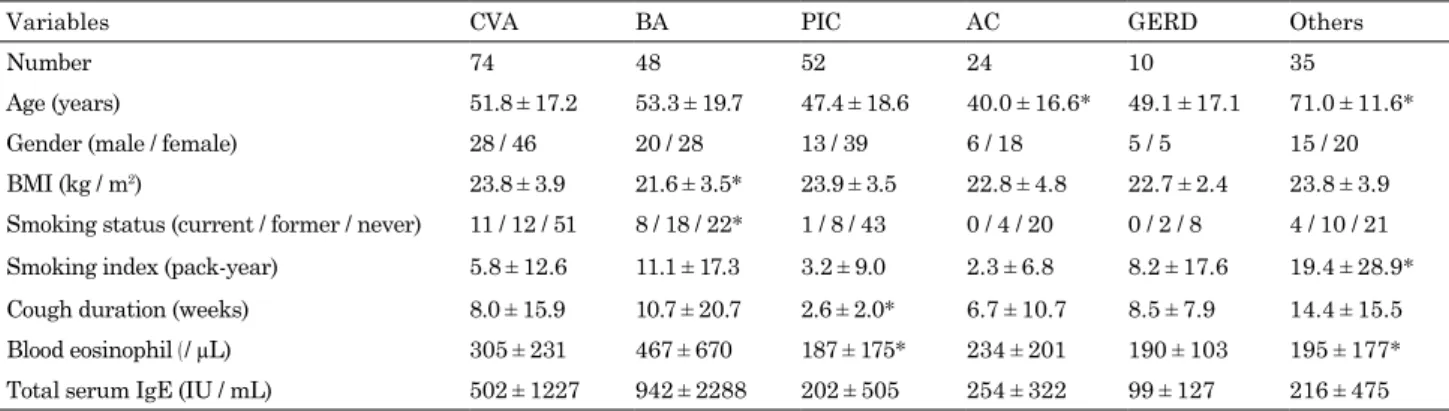
Among 243 patients, final diagnosis of the etiology of cough was CVA in 74 (30.5%), BA in 48 (19.8%), PIC in 52 (21.4%), AC in 24 (9.9%), GERD-related cough in 10 (4.1%), and Others in 35 (14.4%) (Table 2). BA and CVA constituted more than a half (50.2%) of the whole population. Comparison of patients with cough according to etiology is shown in Table 3. Compared with CVA group, BA group had significantly lower BMI and higher smoking experience, PIC group had significantly lower blood eosinophil count, and AC group were significantly younger. The cough duration in PIC group was significantly shorter than other etiologies. The earlier admission in this group seemed to be mainly attributed to their more serious symptoms such as fever, sore throat, chillness, other than cough.
FeNO values were significantly higher in patients with CVA (40.1 ± 26.0 ppb) and in those with BA (40.4 ± 33.3 ppb) than in PIC (15.6 ± 7.7 ppb), AC (17.9 ± 9.9 ppb), GERD (14.9 ± 4.7 ppb), and Others (17.1 ± 9.4 ppb ; P < 0.05 each). There was no signif-icant difference of FeNO values in patients with CVA and BA (Figure 1). FeNO values in 30 healthy volunteers (16.6 ± 6.5 ppb) were also significantly lower compared with CVA and BA, while no difference was observed from those in PIC, AC, GERD, and
Others (data not shown). FeNO values significantly correlated with blood eosinophil counts (r = 0.35, P < 0.01), and total serum IgE titers (r = 0.17, P = 0.03) (data not shown).
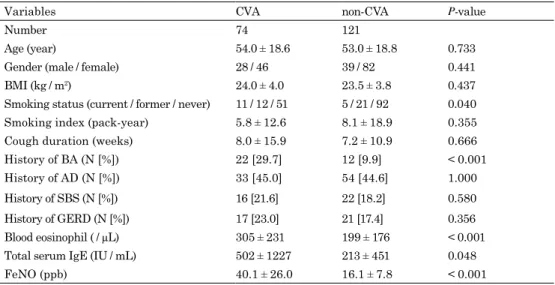
The proper diagnosis of the etiology of cough is often trouble-some (2). The diagnosis of BA is considered to be made easier than other etiologies of cough due to the existence of wheezes in chest auscultation, but the differential diagnosis of CVA from non-CVA other than BA is extremely difficult due to few positive findings in physical examination. To facilitate the differential di-agnosis of the etiology of cough and to identify the factors which predict the diagnosis of CVA, we next focused on 195 patients whose final diagnoses were other than BA. In the univariate analysis, which compared the patient characteristics that were significantly associated with the diagnosis of CVA, the factors that were identified to have significant effects (P < 0.05) were
smoking status, past history of BA, blood eosinophil count, total serum IgE titer, and FeNO value (Table 4). These five variables were included in the following multivariate logistic regression analysis to evaluate which one predict the diagnosis of CVA. In the multivariate analysis, only FeNO value was identified as independent factors associated with the diagnosis of CVA (Table 5).
Finally, we exploratory sought to determine the best cut-off point of FeNO to discriminate CVA and non-CVA other than BA. The overall diagnostic utility of FeNO value to distinguish these two groups was examined by ROC curve analysis, which revealed 23 ppb, with an area under the ROC curve of 0.87 (95% confidence interval (CI) ; 0.82-0.93), as the optimal cut-off value (Figure 2). This resulted in a sensitivity and specificity of 85.1% and 81.1%, respectively.
Table 1. Patient characteristics. Variables Number 243 Age, years 52.6 ± 19.1 (16-89)* Gender, N (%) Male 87 (35.8%) Female 156 (64.2%) BMI, kg / m2 23.2 ± 3.9 (14.8-37.1)* Smoking status, N (%) Current 24 ( 9.9%) Former 54 (22.2%) Never 165 (67.9%)
Smoking index, pack-year 8.0 ± 16.9 (0.0-87.5)*
Cough duration, weeks 8.1 ± 14.8 (0.14-104)*
Past and / or present illness, N (%)
BA 73 (30.0%)
AD 112 (46.1%)
SBS 51 (21.0%)
GERD 45 (18.5%)
Data are described as the means ± SDs.
*Numbers in parentheses indicated ranges of each variable. BMI, body mass index ; BA, bronchial asthma ; AD, allergic dis-eases ; SBS, sinobronchial syndrome ; GERD, gastroesophageal reflux disease
Table 2. Etiology of cough in our study population.
Diagnosis Number (%)
Cough variant asthma 74 (30.5)
Bronchial asthma 48 (19.8)
Post-infectious cough 52 (21.4)
Atopic cough 24 ( 9.9)
Gastroesophageal reflux disease 10 ( 4.1)
Others
Sinobronchial syndrome 9 ( 3.7)
Chronic obstructive pulmonary disease 8 ( 3.3)
Interstitial lung diseases 5 ( 2.1)
Chronic aspiration 4 ( 1.6)
Drug-induced cough 2 ( 0.8)
Chronic heart failure 2 ( 0.8)
Not otherwise specified 5 ( 2.1)
Table 3. Comparison of patients with cough according to etiology.
Variables CVA BA PIC AC GERD Others
Number 74 48 52 24 10 35
Age (years) 51.8 ± 17.2 53.3 ± 19.7 47.4 ± 18.6 40.0 ± 16.6* 49.1 ± 17.1 71.0 ± 11.6*
Gender (male / female) 28 / 46 20 / 28 13 / 39 6 / 18 5 / 5 15 / 20
BMI (kg / m2) 23.8 ± 3.9 21.6 ± 3.5* 23.9 ± 3.5 22.8 ± 4.8 22.7 ± 2.4 23.8 ± 3.9
Smoking status (current / former / never) 11 / 12 / 51 8 / 18 / 22* 1 / 8 / 43 0 / 4 / 20 0 / 2 / 8 4 / 10 / 21
Smoking index (pack-year) 5.8 ± 12.6 11.1 ± 17.3 3.2 ± 9.0 2.3 ± 6.8 8.2 ± 17.6 19.4 ± 28.9*
Cough duration (weeks) 8.0 ± 15.9 10.7 ± 20.7 2.6 ± 2.0* 6.7 ± 10.7 8.5 ± 7.9 14.4 ± 15.5
Blood eosinophil ( / μL) 305 ± 231 467 ± 670 187 ± 175* 234 ± 201 190 ± 103 195 ± 177*
Total serum IgE (IU / mL) 502 ± 1227 942 ± 2288 202 ± 505 254 ± 322 99 ± 127 216 ± 475
Data are described as the means ± SDs. *P < 0.05 compared with CVA.
CVA, cough variant asthma ; BA, bronchial asthma ; PIC, post-infectious cough ; AC, atopic cough ; GERD, gastroesophageal reflux dis-ease ; BMI, body mass index ; IgE, immunoglobulin E ; IU, international unit ; SD, standard deviation
Figure 1. Comparison of FeNO values in each group of patients with a chief complaint of cough. FeNO values were significantly higher in patients with CVA and BA than in those with PIC, AC, GERD, and Others (P < 0.05
each, by Student’s t-test). There was no significant difference of FeNO values in patients with CVA and BA. Data are shown as the means ± standard errors. *P < 0.05 compared with the patients with CVA and BA.
Table 4. Univariate analysis of factors affecting the diagnosis of CVA and non-CVA in patients with cough.
Variables CVA non-CVA P-value
Number 74 121
Age (year) 54.0 ± 18.6 53.0 ± 18.8 0.733
Gender (male / female) 28 / 46 39 / 82 0.441
BMI (kg / m2) 24.0 ± 4.0 23.5 ± 3.8 0.437
Smoking status (current / former / never) 11 / 12 / 51 5 / 21 / 92 0.040
Smoking index (pack-year) 5.8 ± 12.6 8.1 ± 18.9 0.355
Cough duration (weeks) 8.0 ± 15.9 7.2 ± 10.9 0.666
History of BA (N [%]) 22 [29.7] 12 [9.9] < 0.001
History of AD (N [%]) 33 [45.0] 54 [44.6] 1.000
History of SBS (N [%]) 16 [21.6] 22 [18.2] 0.580
History of GERD (N [%]) 17 [23.0] 21 [17.4] 0.356
Blood eosinophil ( / μL) 305 ± 231 199 ± 176 < 0.001
Total serum IgE (IU / mL) 502 ± 1227 213 ± 451 0.048
FeNO (ppb) 40.1 ± 26.0 16.1 ± 7.8 < 0.001
Data are described as the means ± SDs.
CVA, cough variant asthma; BMI, body mass index ; BA, bronchial asthma ; AD, allergic diseases ; SBS, sinobronchial syndrome ; GERD, gastroesophageal reflux disease ; IgE, immunoglobulin E ; IU, interna-tional unit ; FeNO, fracinterna-tional exhaled nitric oxide ; ppb, parts per billion ; SD, standard deviation
Table 5. Multivariate logistic regression analysis for prediction of CVA diagnosis in patients with cough.
Parameter Odds ratio (95% CI) P-value
FeNO (ppb) 0.868 (0.824-0.914) < 0.001
History of BA 0.318 (0.086-1.170) 0.085
Smoking status 2.600 (0.747-9.050) 0.133
Blood eosinophil ( / μL) 0.999 (0.997-1.000) 0.576 Total serum IgE (IU / mL) 1.000 (0.999-1.000) 0.966 CVA, cough variant asthma ; CI, confidence interval ; FeNO, frac-tional exhaled nitric oxide ; BA, bronchial asthma ; IgE, immuno-globulin E
Figure 2. The ROC curve analysis for distinguishing CVA from non-CVA other than BA as the etiology of cough. The overall optimal cut-off value was 23 ppb, with an area under the ROC curve of 0.87 (95% CI ; 0.82-0.93). This resulted in a sensitivity and specificity of 85.1% and 81.1%, respectively.
DISCUSSION
Since a new hand-held device for FeNO measurement, NOV, has not been used for many years in clinical practice, and few studies have been performed to measure FeNO values obtained using NOV, its diagnostic utility has not been fully elucidated. In this study, we sought to investigate the performance of NOV for the evaluation and differential diagnosis of the etiology of cough. FeNO values were significantly higher in patients with CVA and BA as compared to those with PIC, AC, GERD and Others, and significantly correlated with blood eosinophil counts and total serum IgE titers. Moreover, only FeNO value was identified as independent factors to discriminate CVA and non-CVA in the multivariate analysis. These findings indicated that FeNO val-ues measured by using NOV was a relevant diagnostic tool for the patients suffering from intractable cough.
It is well established that FeNO values are higher in patients with CVA and BA than in healthy controls (18). Kowal et al. re-ported the cut-off value to differentiate a chronic cough with and without BA was 40 ppb (sensitivity, 0.88 ; specificity, 0.83) (19). Matsunaga et al. demonstrated that the cut-off value of FeNO 22 ppb measured by using NIOX MINO® was associated with the highest combination of sensitivity (90.8%) and specificity (83.9%) to differentiate asthmatic patients and control subjects (20), which was comparable with our results obtained by using NOV. The present study indicated a cut-off value of 23 ppb (sen-sitivity, 0.85 ; specificity, 0.81) for differentiation between CVA and non-CVA other than BA. The discrepancies of cut-off levels among these studies may be attributed to different methods of selection of cases (category of BA and CVA) and control group (CVA, non-CVA or healthy control) and the varying patients’ characteristics. Lúdvíksdóttir et al. reported that atopic patients with BA had a significantly higher mean exhaled NO than non-atopic subjects with BA (21). In this study, FeNO values had a significantly positive correlation with blood eosinophil counts and total serum IgE titers. These data support that FeNO is a useful marker to monitor the eosinophilic inflammation in pa-tients with CVA and BA papa-tients.
The difference in FeNO values between BA and CVA seems controversial. Although our study demonstrated these signif-icant differences, other reports reported otherwise (22). Since a degree of mucosal and bronchoalveolar eosinophilia between BA and CVA are similar (23), there is a possibility that varying influences of confounding factors, such as atopic status (24), and disease severity may have affected the results. Several factors may affect the validity of FeNO measurements. In patients with BA, Matsunaga et al. proposed that FeNO values should be evaluated while considering the influence of allergic rhinitis and smoking (20). Previous studies also revealed that atopic status and diagnosis were independent determinants of FeNO values in patients with prolonged and chronic cough and that atopy itself was responsible for elevated FeNO values even among subjects without BA or lower airway symptoms (25), which may lead to misdiagnosis of asthma. Therefore, taking these factors into account seemed to be inevitable when evaluating FeNO values in prolonged and chronic cough.
There are now several manufacturers of FeNO analyzers. Consequently, reports of FeNO measurement have often used different equipment (26). Therefore, FeNO values were reported to be significantly different among the equipment used, while the procedure of FeNO measurement has been standardized. Inoue et al. demonstrated that NIOX devices (e.g., NIOX®, NIOX MINO® and NOV) showed higher FeNO values in the low-FeNO population, whereas NObreath® showed higher values in the high-FeNO population (27), indicating the effectiveness of the device appeared to be controlled by the FeNO value in the target
population. On the contrary, FeNO values measured by differ-ent devices were shown to have good correlation and clinically acceptable agreement between NIOX® and NIOX MINO® (28), NIOX MINO® and NOV (29), NObreath® and NOV (27), respec-tively. These findings indicated that each device was able to give clinical guidance with similar accuracy.
Several major limitations need to be considered in interpreting our findings. First, this is a retrospective study with somewhat small number of patients. Thus, it is difficult to draw definite conclusions about the utility of FeNO measurement obtained using NOV for diagnosing the etiology of cough in daily practice. Second, as this study was performed in only one institution, the results should not be universalized to the general population. Third, we did now specify cough duration in eligibility criteria. Thus, not only patients with prolonged and chronic cough but those with acute phase of cough were also included in this study. Forth, current diagnostic criteria for CVA might not be precise because 1) they are often based on positive airway reversibility and might not preclude post-viral cough and 2) are premised on good clinical response to asthma therapy and might not encom-pass refractory asthma. The present findings on CVA need to be interpreted cautiously. Further large-scale studies would be re-quired to show the more clinically significant data in the future. In conclusion, we investigated the clinical utility of FeNO measurement obtained using NOV for diagnosing the etiology of cough in this study. FeNO values were significantly higher in patients with CVA and BA as compared to those with PIC, AC, GERD and Others, and significantly correlated with blood eo-sinophil counts and total serum IgE titers. Moreover, only FeNO value was identified as independent factors to discriminate CVA and non-CVA in the multivariate analysis. These findings indi-cated that FeNO values measured by using NOV could be used as a diagnostic marker of cough, especially for the differential diagnosis of CVA from non-CVA.
CONFLICT OF INTEREST DISCLOSURE
All authors state that they do not have any financial or other relationships for the present study that might lead to a conflict of interest.
ACKNOWLEDGEMENTS
We thank our colleagues at Shikoku Central Hospital of the Mutual aid Association of Public School teachers, especially Hitomi Komoda for technical assistance to conduct this study. This study was partially supported by the grants-in-aid for oc-cupational area research of the Mutual aid Association of Public School teachers.
REFERENCES
1. Niimi A, Ohbayashi H, Sagara H, Yamauchi K, Akiyama K, Takahashi K, Inoue H, Wakayama T, Kobayashi H, Hasegawa M, Kimura G, Yokoe T, Adachi M : Cough vari-ant and cough-predominvari-ant asthma are major causes of persistent cough : a multicenter study in Japan. J Asthma 50 : 932-937, 2013
2. Irwin RS, Boulet LS, Cloutier MM, Fuller R, Gold PM, Hoffstein V, Ing AJ, McCool FD, O’Byrne P, Poe RH, Prakash UB, Pratter MR, Rubin BK : Managing cough as a defense mechanism and as a symptom : a consensus panel report of the American College of Chest Physicians. Chest
114 (Suppl.) : S133-S181, 1998
3. Morice AH, Fontana GA, Sovijarvi ARA, Pistolesi M, Chung KF, Widdicombe J, O’Connell F, Geppetti P, Gronke L, De Jongste J, Belvisi M, Dicpinigaitis P, Fischer A, McGarvey L, Fokkens WJ, Kastelik J ; ERS Task Force : The diag-nosing and management of chronic cough. Eur Respir J 24 : 481-492, 2004
4. Kohno S, Ishida T, Uchida Y, Kishimoto H, Sasaki H, Shioya T, Tokuyama K, Niimi A, Nishi K, Fujimura M, Matsuse H, Suzaki H ; Committee for the Japanese Respi-ratory Society guidelines for management of cough : The Japanese Respiratory Society guidelines for management of cough. Respirology 11 (Suppl. 4) : S135-S186, 2006
5. Crapo RO, Casaburi R, Coates AL, Enright PL, Hankinson JL, Irvin CG, MacIntyre NR, McKay RT, Wanger JS, Anderson SD, Cockcroft DW, Fish JE, Sterk PJ : Guidelines for methacholine and exercise challenge testing-1999. This official statement of the American Thoracic Society was adopted by the ATS Board of Directors, July 1999. Am J Respir Crit Care Med 161 : 309-329, 2000
6. Paggiaro PL, Chanez P, Holz O, Ind PW, Djukanovi_c R, Maestrelli P, Sterk PJ : Sputum induction. Eur Respir J 37 (Suppl.) : S3-S8, 2002
7. Taylor DR, Pijnenburg MW, Smith AD, De Jongste JC : Ex-haled nitric oxide measurements: clinical application and interpretation. Thorax 61 : 817-827, 2006
8. Tajiri T, Niimi A, Matsumoto H, Ito I, Oguma T, Otsuka K, Takeda T, Nakaji H, Inoue H, Iwata T, Nagasaki T, Mishima M : Prevalence and clinical relevance of allergic rhinitis in patients with classic asthma and cough variant asthma. Respiration 87 : 211-218, 2014
9. Kharitonov SA, Yates D, Robbins RA, Logan-Sinclair R, Shinebourne EA, Barnes PJ : Increased nitric oxide in ex-haled air of asthmatic patients. Lancet 343 : 133-135, 1994 10. Dweik RA, Boggs PB, Erzurum SC, Irvin CG, Leigh MW,
Lundberg JO, Olin AC, Plummer AL, Taylor DR ; American Thoracic Society Committee on interpretation of exhaled ni-tric oxide levels (FENO) for clinical applications : An official ATS clinical practice guideline: interpretation of exhaled nitric oxide levels (FENO) for clinical applications. Am J Respir Crit Care Med 184 : 602-615, 2011
11. Asano T, Takemura M, Fukumitsu K, Takeda N, Ichikawa H, Hijikata H, Kanemitsu Y, Uemura T, Takakuwa O, Ohkubo H, Maeno K, Ito Y, Oguri T, Nakamura A, Niimi A : Diagnostic utility of fractional exhaled nitric oxide in prolonged and chronic cough according to atopic status. Allergol Int 66 : 344-350, 2017
12. American Thoracic Society, European Respiratory Soci-ety : ATS/ERS recommendations for standardized proce-dures for the online and offline measurement of exhaled lower respiratory nitric oxide and nasal nitric oxide, 2005. Am J Respir Crit Care Med 171 : 912-930, 2005
13. Ohta K, Ichinose M, Nagase H, Yamaguchi M, Sugiura H, Tohda Y, Yamauchi K, Adachi M, Akiyama K ; Japanese Society of Allergology : Japanese guideline for adult asthma 2014. Allergol Int 63 : 293-333, 2014
14. Fujimura M, Ogawa H, Nishizawa Y, Nishi K : Comparison of atopic cough with cough variant asthma : is atopic cough a precursor of asthma? Thorax 58 : 14-18, 2003
15. Jinnai M, Niimi A, Ueda T, Matsuoka H, Takemura M, Yamaguchi M, Otsuka K, Oguma T, Takeda T, Ito I, Matsumoto H, Mishima M : Induced sputum concentrations of mucin in patients with asthma and chronic cough. Chest 137 : 1122-1129, 2010
16. Everett CF, Morice AH : Clinical history in gastroesophage-al cough. Respir Med 101 : 345-348, 2007
17. Kanda Y : Investigation of the freely available easy-to-use software ‘EZR’ for medical statistics. Bone Marrow Trans-plant 48 : 452-458, 2013
18. Sato S, Saito J, Sato Y, Ishii T, Xintao W, Tanino Y, Ishida T, Munakata M : Clinical usefulness of fractional exhaled nitric oxide for diagnosing prolonged cough. Respir Med 102 : 1452-1459, 2008
19. Kowal K, Bodzenta-Lukaszyk A, Zukowski S : Exhaled ni-tric oxide in evaluation of young adults with chronic cough. J Asthma 46 : 692-698, 2009
20. Matsunaga K, Hirano T, Akamatsu K, Koarai A, Sugiura H, Minakata Y, Ichinose M : Exhaled nitric oxide cutoff val-ues for asthma diagnosis according to rhinitis and smoking status in Japanese subjects. Allergol Int 60 : 331-337, 2011 21. Lúdvíksdóttir D, Janson C, Högman M, Hedenström H,
Björnsson E, Boman G : Exhaled nitric oxide and its re-lationship to airway responsiveness and atopy in asth-ma : BHR-Study Group. Respir Med 93 : 552-556, 1999 22. De Diego A, Martínez E, Perpiñá M, Nieto L, Compte L,
Macián V, Senent L : Airway inflammation and cough sensi-tivity in cough-variant asthma. Allergy 60 : 1407-1411, 2005 23. Niimi A, Amitani R, Suzuki K, Tanaka E, Murayama T,
Kuze F : Eosinophilic inflammation in cough variant asth-ma. Eur Respir J 11 : 1064-1069, 1998
24. Takemura M, Niimi A, Matsumoto H, Ueda T, Yamaguchi M, Matsuoka H, Jinnai M, Chin K, Mishima M : Atopic features of cough variant asthma and classic asthma with wheezing. Clin Exp Allergy 37 : 1833-1839, 2007
25. Ho LP, Wood FT, Robson A, Innes JA, Greening AP : Atopy influences exhaled nitric oxide levels in adult asthmatics. Chest 118 : 1327-1331, 2000
26. Kanazawa H, Shoji S, Yoshikawa T, Hirata K, Yoshikawa J : Increased production of endogenous nitric oxide in pa-tients with bronchial asthma and chronic obstructive pul-monary disease. Clin Exp Allergy 28 : 1244-1250, 1998 27. Inoue Y, Sato S, Manabe T, Makita E, Chiyotanda M,
Takahashi K, Yamamoto H, Yanagida N, Ebisawa M : Mea-surement of exhaled nitric oxide in children : a comparison between NObreath® and NIOX VERO® analyzers. Allergy Asthma Immunol Res 10 : 478-489, 2018
28. Alving K, Janson C, Nordvall L : Performance of a new hand-held device for exhaled nitric oxide measurement in adults and children. Respir Res 7 : 67, 2006
29. Alving K, Anolik R, Crater G : Validation of a new portable exhaled nitric oxide analyzer, NIOX VERO® : randomized studies in asthma. Pulmonary Therapy 3 : 207-218, 2017