ORIGINAL
Predictors of life skills in people with schizophrenia
Takeo Tominaga1, Masahito Tomotake2, Tomoya Takeda3, Yoshinori Ueoka4, Tsunehiko Tanaka5, Shin-ya Watanabe1, Naomi Kameoka6, Masahito Nakataki6, Shusuke Numata1, Yumiko Izaki7, Satsuki Sumitani8, Hiroko Kubo9,
Yasuhiro Kaneda10, and Tetsuro Ohmori1
1Department of Psychiatry, Graduate School of Biomedical Sciences, Tokushima University, Tokushima, Japan, 2Department of Mental Health, Graduate School of Biomedical Sciences, Tokushima University, Tokushima, Japan, 3Department of Psychology, Fukuyama University, Fukuyama, Japan, 4Department of Early Childhood Care and Education, Shikoku University, Junior College, Tokushima, Japan, 5Faculty of Education Specialized courses educational psychology, Niigata University, Niigata, Japan, 6Department of Psychiatry, Tokushima University Hospital, Tokushima, Japan, 7Health service, counseling and accessibility center, Tokushima University, Tokushima, Japan, 8Academic support office for students with special needs, Tokushima University, Tokushima, Japan, 9Department of Psychiatry, Aizato Hospital, Itano-gun, Japan, 10Department of Psychiatry, Iwaki Clinic, Anan, Japan
Abstract : Objective : The purpose of the present study is to examine clinical factors related to life skills in people with schizophrenia. Method : The participants were 51 stabilized outpatients with schizophrenia. Their mean age was 38.91 (SD = 10.73) years. Life skills were assessed using the Life skills profile (LSP). Cognitive function was evaluated with the Measurement and Treatment Research to Improve Cognition in Schizophrenia Con-sensus Cognitive Battery (MCCB). Clinical symptoms were assessed using the Positive and Negative Syndrome scale (PANSS), the Calgary Depression Scale for Schizophrenia (CDSS) and the Drug-Induced Extrapyramidal Symptoms Scale (DIEPSS). Results : Cognitive function was not correlated with the LSP scores at all. Among clinical symptoms, scores of the PANSS positive and negative syndrome scales, the CDSS, and the DIEPSS had negative correlations with the LSP total score and the subscales. Stepwise regression analyses showed that the CDSS and PANSS negative syndrome scale scores were independent predictors of the LSP total score and two of the subscales. Conclusions : These results indicate that cognitive function is not associated with life skills but clinical symptoms such as depressive and negative symptoms have considerable impacts on life skills in people with schizophrenia. J. Med. Invest. 67 : 75-82, February, 2020
Keywords : schizophrenia, life skill, depressive symptom, negative symptom, cognitive function
INTRODUCTION
Functional outcome is defined as wide-ranging real-world functions including independent living, financial management, employment and leisure/social activities (1,2), and it is known that poor functional outcome is common in patients with schizo-phrenia (3-7). Therefore, finding contributors to functional out-come is an important issue in schizophrenia research. Previous studies have shown that several clinical factors such as positive, negative, depressive and extrapyramidal symptoms are associat-ed with functional impairments (8-21).
Recently, much more attention has been paid to cognitive impairment of schizophrenia patients because it is considered to be a core feature of schizophrenia (22,23). Previous researchers have found that cognitive impairment persists throughout the illness and exists even in premorbid period (24,25). According to the previous reports, patients with schizophrenia have about 1-1.5 standard deviations deficits compared to healthy controls in several cognitive domains, particularly memory, attention, executive function and speed of processing (26-28). Previous studies also have indicated that neurocognition such as verbal memory, working memory, executive function and vigilance are related to functional outcome in people with schizophrenia (29-31), and that neurocognition may be a stronger predictor of
functional outcome than symptomatology, explaining 20-60% of variance of it (30,32,33). More recently, social cognition, referred to as an array of abilities that involve cognitive capability applied to social situations (34), has attracted attention as a predictor of functional outcome (35). However, some previous studies have demonstrated that symptomatology is more influential in func-tional outcome than cognitive function (20,36-38). The incon-sistency among the previous findings can be explained mainly by difference of study design, sample population, sample size, cognitive tests and functional outcome scales. Especially, as for assessing cognitive function and functional outcome, research-ers have used different neuropsychological tests and functional outcome scales. Therefore, comparisons across studies seem to be difficult.
In this situation, the National institute of Mental Health Measurement and Treatment Research to Improve Cognition in Schizophrenia (NIMH-MATRICS) Initiative developed a consensus cognitive battery for schizophrenia research that is the MATRICS Consensus Cognitive Battery (MCCB) (39). The MCCB is a comprehensive cognitive battery that contains not only neurocognitive domain but also social cognitive domain. On the other hand, as for functional outcome, there are no standard-ized scales at present. However, the six scales selected by the Validation of Everyday Real-word Outcomes (VALERO) study are often used (40). The six scales are as follows : the Quality of Life Scale (QLS), the Specific Level of Functioning, the Social Behavior Schedule, the Social Functioning Scale, the Indepen-dent Living Skills Schedule and the Life Skills Profile (LSP).
Regarding the direction of research in this area, it seems that interest has shifted from whether cognitive function is connected to functional outcome to how cognitive function is related to it.
The Journal of Medical Investigation Vol. 67 2020
Received for publication September 17, 2019 ; accepted December 2, 2019.
Address correspondence and reprint requests to Takeo Tominaga, Department of Psychiatry, Graduate School of Biomedical Sciences, Tokushima University, 3-18-15, Kuramoto-cho, Tokushima 770-8503, Japan and Fax : +81-88-633-7131.
Not all types of cognitive function are equally important when it comes to navigating the real world (22), and as far as we know, it seems unclear which cognitive domain is related to which aspect of functional outcome. Our research group has reported that particularly Symbol Coding test to evaluate speed of pro-cessing was correlated with the QLS scores (18,20). Besides our study, since the MCCB was developed, several studies have also reported the relationship between cognitive function measured by it and functional outcome (41-51). However, to our knowledge, among those studies, few studies evaluated functional outcome using the LSP (48).
Although one of the ultimate treatment goals of schizophrenia is thought to be an improvement in functional outcome such as employment and social activities, many of schizophrenia patients have not accomplished it. For example, the employment rate is as low as about 10-20% (52-54). Therefore, becoming able to live well in a community is a crucial first step to lead to good functional outcome. To assess the ability to complete the first step, the LSP is considered suitable because it was selected as one of the everyday living skills scales in the VALERO study (40).
The purpose of the present study was to clarify the relation-ship between life skills measured by the LSP and other clinical factors including cognitive function measured by the MCCB in people with schizophrenia.
METHODS
Participants
Fifty-one stabilized outpatients with a DSM-IV (55) diagnosis of schizophrenia were recruited from the Department of Psychi-atry, Tokushima University Hospital. Patients with any organic central nervous system disorders, substance-related disorders, mental retardation or severe somatic disorders were excluded. After receiving explanations on the content and possible dis-advantages of the study as well as confidentiality protection, participants gave written informed consent to participate in the current study. They had been receiving regular outpatient treat-ment and had not been hospitalized in the previous 6 months due to exacerbation of psychiatric symptoms.
This study was approved by the Ethics Committee of Tokushi-ma University.
Instruments
To assess life skills, we used the LSP that was developed by Rosen et al. (56) as a measure of functioning in chronic men-tal patients. The reliability and validity of the scale have been already confirmed (56,57). Family members, psychiatric pro-fessionals, or case workers can be used as the informant in the interview (40). This instrument consists of five subscales mea-sured by a total 39 items. Each item is rated from 1 to 4. The five subscales are self-care, non-turbulence, socialization, communi-cation, responsibility. Higher scores indicate a better functional outcome. In the present study, 50 of 51 cases were evaluated by family members living together, and one case by a home helper.
Regarding evaluation of cognitive function, we used the MCCB which has been developed as a comprehensive measure of cognitive domains significantly impaired in schizophrenia patients. The MCCB consists of ten tests that measure seven cognitive domains. They are as follows : speed of processing (Brief Assessment of Cognition in Schizophrenia-Symbol Coding [BACS-SC], Category Fluency Animal Naming [Fluency] and Trail Making Test Part A [TMT-A]), attention/vigilance (Con-tinuous Performance Test-Identical Pairs [CPT-IP]), working memory (Wechsler Memory Scale III Spatial Span [WMS-III
SS] and Letter Number Span [LNS]), verbal learning (Hopkins Verbal Learning Test-Revised [HVLT-R]), visual learning (Brief Visuospatial Memory Test-Revised [BVMT-R]), reasoning and problem solving (Neuropsychological Assessment Battery [NAB] Maze), and social cognition (Mayer-Salovey-Caruso-Emotional Intelligence Test [MSCEIT] Managing Emotions [ME]) (39). Each raw score for the ten subtests was standardized to the T-score (mean = 50, SD = 10). For the cognitive domain consist-ing of more than one test (speed of processconsist-ing and workconsist-ing mem-ory), the domain T-score was derived from a composite of the test scores within each domain, and for the other cognitive domains, T-score represents the domain score. The MCCB composite score gives equal weighting to each of the seven cognitive domains. The MCCB has good test-retest reliability, practicability and tolerability (39), and it is reported that the Japanese version of the MCCB (MCCB-J) has good psychometric properties and validity (58). In the present study, data were collected using the Japanese version by clinical psychologists who were well trained for the use of it.
Clinical symptoms were evaluated with the Positive and Nega-tive Syndrome Scale (PANSS) and the Calgary Depression Scale for Schizophrenia (CDSS). The PANSS is composed of 30 items and higher scores represent a greater level of symptom severity (59). Experienced psychiatrists conducted the interviews accord-ing to the Evaluation Manual for the PANSS (60). Particularly, depressive symptom was strictly evaluated with the CDSS that was specifically developed to distinguish depressive symptom from positive and negative symptom or antipsychotic-induced adverse effects. The scale is a 9-item questionnaire (depression, hopelessness, self-depreciation, guilty ideas of reference, patho-logical guilt, morning depression, early wakening, suicide and observed depression) and higher scores represent a greater level of depression. The reliability and validity of the scale have been already confirmed (61,62).
Drug-induced extrapyramidal adverse effects were evaluat-ed using the Drug-Inducevaluat-ed Extrapyramidal Symptoms Scale (DIEPSS). The scale consists of eight individual parameters (gait, bradykinesia, sialorrhea, muscle rigidity, tremor, akathi-sia, dystonia, and dyskinesia) and one global assessment. Higher scores represent a greater level of extrapyramidal adverse ef-fects. In this study, we evaluated the extrapyramidal symptom score by summing eight individual parameters. Experienced psychiatrists conducted the interviews according to the Rater’s Manual for the DIEPSS (63).
Statistical analysis
First, to clarify significant associations between the LSP scores and other clinical variables, Spearman’s rank correlation coefficients were calculated. We used the false discovery rate correction to adjust for multiple testing. Then the LSP total score and the subscale scores were chosen as dependent variables. Using the clinical variables that showed significant correlations with each dependent variable, stepwise regression analyses were performed to specify which clinical variables would be the best predictors of each dependent variable. Statistical analyses were carried out with IBM SPSS Statistics Version 22 for Windows (Japan IBM, Tokyo, Japan) and RStudio (RStudio Team. 2015. RStudio : Integrated Development for R. RStudio, Inc., Boston, MA. URL http://www.rstudio.com/.).
RESULTS
roughoTable 1 presents the demographic characteristics and clinical variables of the participants. All participants were Jap-anese, and 26 were men and 25 women. Their mean age was
38.91 years (SD = 10.73). Doses of antipsychotics were converted to chlorpromazine equivalents according to the conversion chart (64).
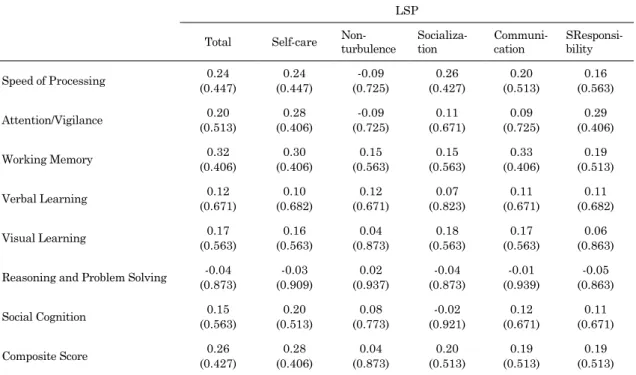
Spearman rank correlation coefficients were calculated to study the relationship between the LSP and clinical variables because most of the data were non-normal distribution. Table 2 shows the results of the correlation analyses between the LSP scores and the MCCB cognitive domain scores. Neither the MCCB cognitive domain score nor composite score was
signifi-cantly correlated with the LSP scores. In addition to that, each subtest score of the MCCB also have no significant correlation with the LSP scores.
The results of the correlation analyses between the LSP scores and other clinical variables are shown in Table 3. The PANSS positive syndrome scale score was significantly correlated with the LSP total score ( r = -0.38, p < 0.05) and communication
sub-scale score ( r = -0.47, p < 0.01). The PANSS negative syndrome
scale score had significant correlations with the LSP total score
Table 1. Demographic characteristics of participants
n (men/women) 51 (26/25)
Age (years) 38.91 ± 10.73
Duration of illness (years) 15.05 ± 9.10
Number of hospitalization 1.55 ± 1.49
Dose of antipsychotics (mg/day)* 545.14 ± 399.03
Type of schizophrenia (n) Paranoid
Residual Disorganized Catatonic Undifferentiated 40 8 2 0 1
Marital state (n) Married
Never married Divorced Widowed 8 40 2 1
Social state (n) Full time
Part time No employment 11 24 16 PANSS Total 75.39 ± 14.64 Positive syndrome 16.82 ± 4.53 Negative syndrome 20.39 ± 5.50 CDSS (Total) 3.51 ± 2.96 DIEPSS (Total) 1.12 ± 1.07
MCCB (T-score) Speed of processing
BACS-SC 17.51 ± 24.9825.37 ± 21.54 Fluency TMT-A 41.82 ± 11.3531.08 ± 16.16 Attention/vigilance (CPT-IP) 36.29 ± 10.52 Working memory WMS-III SS LNS 36.29 ± 14.34 37.84 ± 13.17 40.04 ± 12.76 Verbal learning (HVLT-R) 39.75 ± 13.25 Visual learning (BVMT-R) 42.92 ± 10.44
Reasoning and problem solving
(NAB Maze) 38.25 ± 9.82
Social cognition (MSCEIT ME) 26.61 ± 7.78
Composite score 19.10 ± 18.68 LSP Total 135.27 ± 11.97 Self-care 33.61 ± 4.18 Non-turbulence 44.90 ± 3.86 Socialization 16.49 ± 3.67 Communication 21.59 ± 2.44 Responsibility 18.69 ± 1.67
Note : Data are expressed as mean ± SD unless otherwise specified. *Chlorpromazine equivalent.
PANSS ; Positive and Negative Syndrome Scale ; CDSS : Calgary Depression Scale for Schizophrenia, DIEPSS ; Drug-Induced Extrapyramidal Symptoms Scale, MCCB Measurement and Treatment Research to Improve Cognition in Schizophrenia Consensus Cognitive Battery, BACS-SC ; Brief Assessment of Cognition in Schizophrenia-Symbol Coding, Fluency ; Category Fluency Animal Naming, TMT-A ; Trail Making Test Part A, CPT-IP ; Continuous Performance Test-Identical Pairs, WMS-III SS ; Wechsler Memory Scale III Spatial Span, LNS ; Letter Number Span, HVLT-R ; Hopkins Verbal Learning Test-Revised, BVMT-R ; Brief Visuospatial Memory Test-Revised, NAB ; Neuropsychological Assessment Battery, MSCEIT ME ; Mayer-Salovey-Caruso-Emotional Intelligence Test Managing Emotions, LSP ; Life Skills Profile
Table 2. Correlation between LSP scores and MCCB cognitive domain scores LSP
Total Self-care Non-turbulence Socializa-tion Communi-cation SResponsi-bility
Speed of Processing 0.24 (0.447) 0.24 (0.447) -0.09 (0.725) 0.26 (0.427) 0.20 (0.513) 0.16 (0.563) Attention/Vigilance 0.20 (0.513) 0.28 (0.406) -0.09 (0.725) 0.11 (0.671) 0.09 (0.725) 0.29 (0.406) Working Memory (0.406)0.32 (0.406)0.30 (0.563)0.15 (0.563)0.15 (0.406)0.33 (0.513)0.19 Verbal Learning 0.12 (0.671) 0.10 (0.682) 0.12 (0.671) 0.07 (0.823) 0.11 (0.671) 0.11 (0.682) Visual Learning 0.17 (0.563) 0.16 (0.563) 0.04 (0.873) 0.18 (0.563) 0.17 (0.563) 0.06 (0.863) Reasoning and Problem Solving (0.873)-0.04 (0.909)-0.03 (0.937)0.02 (0.873)-0.04 (0.939)-0.01 (0.863)-0.05
Social Cognition 0.15 (0.563) 0.20 (0.513) 0.08 (0.773) -0.02 (0.921) 0.12 (0.671) 0.11 (0.671) Composite Score 0.26 (0.427) 0.28 (0.406) 0.04 (0.873) 0.20 (0.513) 0.19 (0.513) 0.19 (0.513) Note : Spearman rank correlations (false discovery rate correction). *p < 0.05; **p < 0.01. Figures in the parentheses show p values.
MCCB ; Measurement and Treatment Research to Improve Cognition in Schizophrenia, LSP ; Life Skills Profile
Table 3. Correlation between LSP scores and other clinical variables LSP
Total Self-care Non-turbulence Socializa-tion Communi-cation Responsi-bility
Duration of illness 0.09 (0.683) 0.05 (0.754) -0.07 (0.694) 0.16 (0.444) -0.08 (0.690) 0.15 (0.471) Number of hospitalization (0.683)0.08 (0.694)0.07 (0.292)-0.20 (0.391)0.17 (0.754)0.05 (0.901)0.02 Dose of antipsychotics (0.458)-0.15 (0.250)-0.22 (0.487)-0.13 (0.683)-0.08 (0.487)-0.14 (0.683)-0.08 PANSS Positive syndrome (0.021)-0.38* (0.283)-0.21 (0.310)-0.20 (0.084)-0.31 -0.47(0.005)** (0.114)-0.29 Negative syndrome -0.45**(0.007) -0.48**(0.005) (0.950)0.01 -0.45**(0.007) (0.018)-0.39* (0.190)-0.25 CDSS -0.44** (0.007) -0.48** (0.005) -0.12 (0.567) -0.41* (0.011) -0.23 (0.223) -0.24 (0.212) DIEPSS -0.47(0.005)** -0.43(0.008)** (0.487)-0.14 -0.44(0.007)** (0.022)-0.38* (0.197)-0.25 Notes : Spearman rank correlations (false discovery rate correction). *p < 0.05; **p < 0.01. Figures in the parentheses show p values.
MCCB ; Measurement and Treatment Research to Improve Cognition in Schizophrenia, LSP ; Life Skills Profile, PANSS ; Positive and Negative Syndrome Scale, CDSS ; Calgary Depression Scale for Schizophrenia, DIEPSS ; Drug Induced Extrapyramidal Symptoms Scale
( r = -0.45, p < 0.01), self-care subscale score ( r = -0.48, p < 0.01), socialization subscale score ( r = -0.45, p < 0.01), and
commu-nication subscale score ( r = -0.39, p < 0.05). The CDSS total
score was significantly correlated with the LSP total score ( r =
-0.44, p < 0.01), self-care subscale score ( r = -0.48, p < 0.01), and
socialization subscale score ( r = -0.41, p < 0.05). The DIEPSS
score showed significant correlations with the LSP total score ( r = -0.47, p < 0.01), self-care subscale score ( r = -0.43, p < 0.01),
socialization subscale score ( r = -0.44, p < 0.01), and
communica-tion subscale score ( r = -0.38, p < 0.05). However, no significant
correlation was found between the LSP scores and duration of illness, number of hospitalization, and dose of antipsychotics.
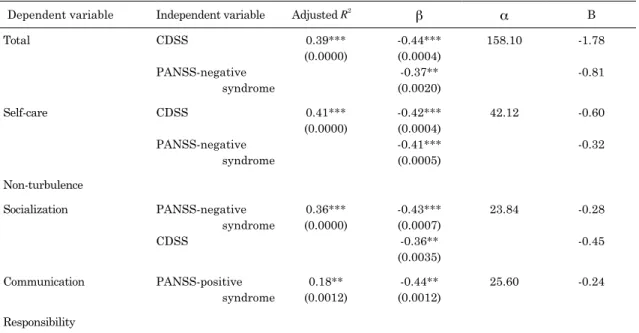
Table 4 shows the results of stepwise regression analyses on the LSP scores. The PANSS negative syndrome scale score sig-nificantly predicted the LSP total score, self-care subscale score, and socialization subscale score. The CDSS score significantly predicted the LSP total score, self-care subscale score, and so-cialization subscale score. The PANSS positive syndrome scale score significantly predicted the LSP communication subscale score. The CDSS score was stronger predictor of the LSP total score (β = -0.44, p = 0.0004) than the PANSS negative syndrome
scale score (β = -0.37, p = 0.0020).
DISCUSSION
As for the relationship between cognitive function and func-tional outcome, it is reported that verbal memory, working memory, executive function and vigilance were significantly associated with functional outcome (29-31). Moreover, in a recent meta-analysis study, Fett et al. (35) revealed that a variety of neurocognitive domains such as reasoning and problem solving, processing speed, attention and vigilance, working memory, ver-bal learning and memory, visual learning and memory, verver-bal fluency, and overall neurocognition are significantly associated with functional outcome. Concerning social cognition, their me-ta-analysis study also showed that social cognition, particularly
theory of mind was more strongly associated with functional outcome than neurocognition (35).
There are some existing literatures investigating the relation between cognitive function and life skills assessed with the LSP. Norman et al. (38) reported that neurocognitive functions evalu-ated by several cognitive measures were not correlevalu-ated with the LSP scores at all. Using the database of VALERO study Phase I, Sabbag et al. (48) showed that the LSP summary scores were not related to neurocognition evaluated by the modified MCCB which did not include the MSCEIT. Farreny et al. (65) reported that executive function evaluated by the Behavioral Assessment of the Dysexecutive Syndrome was not correlated with the LSP scores at baseline in the cognitive remediation study. On the other hand, Stratta et al. (66) showed that executive function evaluated by Wisconsin Card Sorting Test was related to the LSP scores. Considering those previous findings, the relation between cognitive function and life skills assessed with the LSP still seems unclear.
As for the studies using the QLS as a measure of functional outcome, our research group has reported that Symbol Coding subtest of the Brief Assessment of Cognition in Schizophrenia (BACS) and the MCCB to evaluate speed of processing was correlated with the QLS scores and this subtest was an inde-pendent predictor of the QLS scores (18,20). Other studies also suggest that speed of processing is closely related to QLS scores (45,67). Moreover, several previous studies showed that other cognitive domains such as executive function, verbal memory, working memory and social cognition were associated with the QLS (16,68-76). From these findings, it seems certain that the QLS is related to cognitive function to some extent. The QLS is composed of many items to evaluate high social functions such as work and social activities (77). On the other hand, the LSP evaluates life skills, especially rather basic ones that people need to have in daily life. Therefore, although cognitive function is re-lated to functional outcome (29-31,35), the results of the present study indicate that cognitive function may not play a function in basic life skills in people with schizophrenia.
Table 4. Results of stepwise regression analyses on LSP
Dependent variable Independent variable Adjusted R2
β α B Total CDSS PANSS-negative syndrome 0.39*** (0.0000) -0.44*** (0.0004) -0.37** (0.0020) 158.10 -1.78 -0.81 Self-care CDSS PANSS-negative syndrome 0.41*** (0.0000) -0.42*** (0.0004) -0.41*** (0.0005) 42.12 -0.60 -0.32 Non-turbulence Socialization PANSS-negative syndrome CDSS 0.36*** (0.0000) -0.43*** (0.0007) -0.36** (0.0035) 23.84 -0.28 -0.45 Communication PANSS-positive syndrome 0.18** (0.0012) -0.44** (0.0012) 25.60 -0.24 Responsibility
Note : *p < 0.05; **p < 0.01, ***p < 0.001. Figures in the parentheses show p values.
LSP ; Life Skills Profile, CDSS ; Calgary Depression Scale for Schizophrenia, PANSS ; Positive and Negative Syndrome Scale
Next, in regard to the clinical variables other than cognitive function, the results of the present study indicate that positive and negative symptoms, extrapyramidal symptom and depres-sive symptom are significantly related to low life skills. Partic-ularly, negative and depressive symptoms are considered key factors influencing wide range of life skills. These results are largely consistent with our research group’ previous study (8). Recently, Puig et al. (78) also reported that negative symptom is related to the LSP communication-social contact subscale score. Matsuda et al. (79) found that improvement on negative symptom was significantly related to improvement on the LSP socialization score in the follow-up study of first-episode schizo-phrenia patients. On the other hand, Norman et al. (38) showed that positive symptom is more tied to the LSP scores than neg-ative symptom.
The results of the present study clearly showed that cognitive function does not influence life skills and depressive symptom is a stronger predictor of low life skills than negative symp-tom. This is a novel finding in the present study. Considering these results, interventions to treat depressive symptom may be particularly important to improve life skills in people with schizophrenia.
The present study has some limitations. First, since it was a cross-sectional study, the causal relationship between clinical variables and life skills could not be identified. Second, the sample size is small. So, further research with larger sample size may be needed to confirm the results. Third, as the sample consisted entirely of stabilized outpatients, the results may not be able to apply to the whole schizophrenia patients.
In conclusion, the results of the present study indicate that cognitive function is not associate with life skills evaluated by the LSP, but clinical symptoms such as negative and depressive symptoms have significant impacts on the skills in people with schizophrenia.
CONFLICT OF INTERESTS
The authors declare that there is no conflict of interest.
ACKNOWLEDGEMENTS
We are grateful to Ms. Mai Doi, Ms. Atsuko Watanabe, Ms. Ayako Kamitani and Ms. Ayano Arai for their help with cogni-tive assessment.
REFERENCES
1. Harvey PD, Bellack AS : Toward a terminology for func-tional recovery in schizophrenia : is funcfunc-tional remission a viable concept? Schizophr Bull 35 : 300-306, 2009
2. Sumiyoshi T, Sumiyoshi C : Functional outcome in patients with schizophrenia : the concept and the measurement. Act Nerv Super 57 : 1-11, 2015
3. Bellack AS, Morrison RL, Wixted JT, Mueser KT : An anal-ysis of social competence in schizophrenia. Br J Psychiatry 156 : 809-818, 1990
4. Gupta S, Andreasen NC, Arndt S, Flaum M, Hubbard WC, Ziebell S : The Iowa Longitudinal Study of Recent Onset Psychosis : one-year follow-up of first episode patients. Schizophr Res 23 : 1-13, 1997
5. Hegarty JD, Baldessarini RJ, Tohen, M, Waternaux C, Oepen, G : One hundred years of schizophrenia : a
meta-analysis of the outcome literature. Am J Psychiatry 151 : 1409-1416, 1994
6. Robinson DG, Woerner MG, McMeniman M, Mendelowitz A, Bilder RM : Symptomatic and functional recovery from a first episode of schizophrenia or schizoaffective disorder. Am J Psychiatry 161 : 473-479, 2004
7. Wiersma D, Wanderling J, Dragomirecka E, Ganev K, Harrison G, An Der Heiden W, Nienhuis FJ, Walsh D : So-cial disability in schizophrenia : its development and pre-diction over 15 years in incidence cohorts in six European centres. Psychol Med 30 : 1155-1167, 2000
8. Aki H, Tomotake M, Kaneda Y, Iga J, Kinouchi S, Shibuya-Tayoshi S, Tayoshi SY, Motoki I, Moriguchi K, Sumitani S, Yamauchi K, Taniguchi T, Ishimoto Y, Ueno S, Ohmori T : Subjective and objective quality of life, levels of life skills, and their clinical determinants in outpatients with schizophrenia. Psychiatry Res 158 : 19-25, 2008 9. Browne S, Roe M, Lane A, Gervin M, Morris M, Kinsella A,
Larkin C, Callaghan EO : Quality of life in schizophrenia: relationship to sociodemographic factors, symptomatology and tardive dyskinesia. Acta Psychiatr Scand 94 : 118-124, 1996
10. Eack SM, Newhill CE : Psychiatric symptoms and quality of life in schizophrenia : a meta-analysis. Schizophr Bull 33 : 1225-1237, 2007
11. Fervaha G, Foussias G, Agid O, Remington G : Impact of primary negative symptoms on functional outcomes in schizophrenia. Eur Psychiatry 29 : 449-455, 2014
12. Hofer A, Rettenbacher MA, Widschwendter CG, Kemmler G, Hummer M, Fleischhacker WW : Correlates of subjective and functional outcomes in outpatient clinic attendees with schizophrenia and schizoaffective disorder. Eur Arch Psy-chiatry Clin Neurosci 256 : 246-255, 2006
13. Jin H, Zisook S, Palmer BW, Patterson TL, Heaton RK, Jeste DV : Association of depressive symptoms with worse functioning in schizophrenia : a study in older outpatients. J Clin Psychiatry 62 : 797-803, 2001
14. Rabinowitz J, Levine SZ, Garibaldi G, Bugarski-Kirola D, Berardo CG, Kapur S : Negative symptoms have greater im-pact on functioning than positive symptoms in schizophre-nia : analysis of CATIE data. Schizophr Res 137 : 147-150, 2012
15. Rocca P, Bellino S, Calvarese P, Marchiaro L, Patria L, Rasetti R, Bogetto F : Depressive and negative symptoms in schizophrenia : different effects on clinical features. Compr Psychiatry 46 : 304-310, 2005
16. Savilla K, Kettler L, Galletly C : Relationships between cognitive deficits, symptoms and quality of life in schizo-phrenia. Aust N Z J Psychiatry 42 : 496-504, 2008
17. Strejilevich SA, Palatnik A, Avila R, Bustin J, Cassone J, Figueroa S, Gimenez M, de Erausquin GA : Lack of extra-pyramidal side effects predicts quality of life in outpatients treated with clozapine or with typical antipsychotics. Psy-chiatry Res 133 : 277-280, 2005
18. Tominaga T, Tomotake M, Takeda T, Ueoka Y, Tanaka T, Watanabe SY, Kameoka N, Nakataki M, Numata S, Izaki Y, Sumitani S, Kubo H, Kaneda Y, Ohmori T : Relation-ship between social and cognitive functions in people with schizophrenia. Neuropsychiatr Dis Treat 14 : 2215-2224, 2018
19. Tomotake M, Kaneda Y, Iga J, Kinouchi S, Tayoshi S, Motoki I, Sumitani S, Yamauchi K, Taniguchi T, Ishimoto Y, Ueno S, Ohmori T : Subjective and objective measures of quality of life have different predictors for people with schizophrenia. Psychol Rep 99 : 477-487, 2006
Nakataki M, Numata S, Tayoshi S, Yamauchi K, Sumitani S, Ohmori T, Ueno S, Ohmori T : Quality of life and cogni-tive dysfunction in people with schizophrenia. Prog Neuro-psychopharmacol Biol Psychiatry 35 : 53-59, 2011
21. Yamauchi K, Aki H, Tomotake M, Iga J, Numata S, Motoki I, Izaki Y, Tayoshi S, Kinouchi S, Sumitani S, Tayoshi S, Takikawa Y, Kaneda Y, Taniguchi T, Ishimoto Y, Ueno S, Ohmori T : Predictors of subjective and objective quality of life in outpatients with schizophrenia. Psychiatry Clin Neurosci 62 : 404-411, 2008
22. Green MF, Harvey PD : Cognition in schizophrenia : Past, present, and future. Schizophr Res Cogn 1 : e1-9, 2014 23. Kraus MS, Keefe RS : Cognition as an outcome measure
in schizophrenia. Br J Psychiatry 191 (Suppl. 50) : s46-51, 2007
24. Kahn RS, Keefe RS : Schizophrenia is a cognitive ill-ness : time for a change in focus. JAMA Psychiatry 70 : 1107-1112, 2013
25. Palmer BW, Dawes SE, Heaton RK : What do we know about neuropsychological aspects of schizophrenia? Neuro-psychol Rev 19 : 365-384, 2009
26. Dickinson D, Ramsey ME, Gold JM : Overlooking the ob-vious : a meta-analytic comparison of digit symbol coding tasks and other cognitive measures in schizophrenia. Arch Gen Psychiatry 64 : 532-542, 2007
27. Reichenberg A : The assessment of neuropsychological func-tioning in schizophrenia. Dialogues Clin Neurosci 12 : 383-392, 2010
28. Reichenberg A, Harvey PD : Neuropsychological impair-ments in schizophrenia : Integration of performance-based and brain imaging findings. Psychol Bull 133 : 833-858, 2007
29. Green MF : What are the functional consequences of neu-rocognitive deficits in schizophrenia? Am J Psychiatry 153 : 321-330, 1996
30. Green MF, Kern RS, Braff DL, Mintz J : Neurocognitive deficits and functional outcome in schizophrenia : are we measuring the “right stuff”? Schizophr Bull 26 : 119-136, 2000
31. Green MF, Kern RS, Heaton RK : Longitudinal studies of cognition and functional outcome in schizophrenia: implica-tions for MATRICS. Schizophr Res 72 : 41-51, 2004 32. Christensen TØ : The influence of neurocognitive
dysfunc-tions on work capacity in schizophrenia patients : a system-atic review of the literature. Int J Psychiatry Clin Pract 11 : 89-101, 2007
33. Velligan DI, Mahurin RK, Diamond PL, Hazleton BC, Eckert SL, Miller AL : The functional significance of symptomatol-ogy and cognitive function in schizophrenia. Schizophr Res 25 : 21-31, 1997
34. Harvey PD, Penn D : Social cognition : the key factor pre-dicting social outcome in people with schizophrenia? Psychi-atry (Edgmont) 7 : 41-44, 2010
35. Fett AK, Viechtbauer W, Dominguez MD, Penn DL, van Os J, Krabbendam L : The relationship between neuro-cognition and social neuro-cognition with functional outcomes in schizophrenia : a meta-analysis. Neurosci Biobehav Rev 35 : 573-588, 2011
36. Ertuğrul A, Uluğ B : The influence of neurocognitive defi-cits and symptoms on disability in schizophrenia. Acta Psychiatr Scand 105 : 196-201, 2002
37. Mohamed S, Rosenheck R, Swartz M, Stroup S, Lieberman JA, Keefe RS : Relationship of cognition and psychopatholo-gy to functional impairment in schizophrenia. Am J Psychi-atry 165 : 978-987, 2008
38. Norman RM, Malla AK, Cortese L, Cheng S, Diaz K,
McIntosh E, McLean TS, Rickwood A, Voruganti LP : Symp-toms and cognition as predictors of community function-ing : a prospective analysis. Am J Psychiatry 156 : 400-405, 1999
39. Nuechterlein KH, Green MF, Kern RS, Baade LE, Barch DM, Cohen JD, Essock S, Fenton WS, Frese FJ 3rd, Gold JM, Goldberg T, Heaton RK, Keefe RS, Kraemer H, Mesholam-Gately R, Seidman LJ, Stover E, Weinberger DR, Young AS, Zalcman S, Marder SR : The MATRICS Consensus Cognitive Battery, part 1 : test selection, reliability, and validity. Am J Psychiatry 165 : 203-213, 2008
40. Leifker FR, Patterson TL, Heaton RK, Harvey PD : Vali-dating measures of real-world outcome : the results of the VALERO expert survey and RAND panel. Schizophr Bull 37 : 334-343, 2011
41. August SM, Kiwanuka JN, McMahon RP, Gold JM : The MATRICS Consensus Cognitive Battery (MCCB) : clinical and cognitive correlates. Schizophr Res 134 : 76-82, 2012 42. Durand D, Strassnig M, Sabbag S, Gould F, Twamley EW,
Patterson TL, Harvey PD : Factors influencing self-assess-ment of cognition and functioning in schizophrenia : impli-cations for treatment studies. Eur Neuropsychopharmacol 25 : 185-191, 2015
43. Gould F, McGuire LS, Durand D, Sabbag S, Larrauri C, Patterson TL, Twamley EW, Harvey PD : Self-assessment in schizophrenia : Accuracy of evaluation of cognition and everyday functioning. Neuropsychology 29 : 675-682, 2015 44. Kern RS, Gold JM, Dickinson D, Green MF, Nuechterlein
KH, Baade LE, Keefe RS, Mesholam-Gately RI, Seidman LJ, Lee C, Sugar CA, Marder SR : The MCCB impairment profile for schizophrenia outpatients : results from the MA-TRICS psychometric and standardization study. Schizophr Res 126 : 124-131, 2011
45. Lin CH, Huang CL, Chang YC, Chen PW, Lin CY, Tsai GE, Lane HY : Clinical symptoms, mainly negative symptoms, mediate the influence of neurocognition and social cognition on functional outcome of schizophrenia. Schizophr Res 146 : 231-237, 2013
46. Lystad JU, Falkum E, Haaland VØ, Bull H, Evensen S, Bell MD, Ueland T : Neurocognition and occupational function-ing in schizophrenia spectrum disorders : The MATRICS Consensus Cognitive Battery (MCCB) and workplace as-sessments. Schizophr Res 170 : 143-149, 2016
47. Lystad JU, Falkum E, Mohn C, Haaland VØ, Bull H, Evensen S, Rund BR, Ueland T : The MATRICS Consensus Cognitive Battery (MCCB) : performance and functional correlates. Psychiatry Res 220 : 1094-1101, 2014
48. Sabbag S, Twamley EM, Vella L, Heaton RK, Patterson TL, Harvey PD : Assessing everyday functioning in schizophre-nia : not all informants seem equally informative. Schizo-phr Res 131 : 250-255, 2011
49. Shamsi S, Lau A, Lencz T, Burdick KE, DeRosse P, Brenner R, Lindenmayer JP, Malhotra AK : Cognitive and symp-tomatic predictors of functional disability in schizophrenia. Schizophr Res 126 : 257-264, 2011
50. Sumiyoshi C, Harvey PD, Takaki M, Okahisa Y, Sato T, Sora I, Nuechterlein KH, Subotnik KL, Sumiyoshi T : Fac-tors predicting work outcome in Japanese patients with schizophrenia : role of multiple functioning levels. Schizo-phr Res Cogn 2 : 105-112, 2015
51. Torgalsbøen AK, Mohn C, Czajkowski N, Rund BR : Rela-tionship between neurocognition and functional recovery in first-episode schizophrenia : Results from the second year of the Oslo multi-follow-up study. Psychiatry Res 227 : 185-191, 2015
E : Prevalence, Employment Rate, and Cost of Schizophre-nia in a High-Income Welfare Society : A Population-Based Study Using Comprehensive Health and Welfare Registers. Schizophr Bull 42 : 476-483, 2016
53. Mangalore R, Knapp M : Cost of schizophrenia in England. J Ment Health Policy Econ 10 : 23-41, 2007
54. Marwaha S, Johnson S : Schizophrenia and employment - a review. Soc Psychiatry Psychiatr Epidemiol 39 : 337-49, 2004
55. American Psychiatric Association : Diagnostic and Statis-tical Manual of Mental Disorders. 4th Edition. American Psychiatric Association, Washington DC, 1994
56. Rosen A, Hadzi-Pavlovic D, Parker G : The life skills pro-file : a measure assessing function and disability in schizo-phrenia. Schizophr Bull 15 : 325-337, 1989
57. Hasegawa K, Ogawa K, Kondoh C, Iseda T, Ikebuchi E, Miyake Y : The reliability and validity of the Japanese ver-sion of the Life Skills Profile. Seishin Igaku 39 : 547-555, 1997 (in Japanese)
58. Kaneda Y, Ohmori T, Okahisa Y, Sumiyoshi T, Pu S, Ueoka Y, Takaki M, Nakagome K, Sora I : Measurement and Treatment Research to Improve Cognition in Schizophre-nia Consensus Cognitive Battery : validation of the Japa-nese version. Psychiatry Clin Neurosci 67 : 182-188, 2013 59. Kay SR, Fiszbein A, Opler LA : The positive and negative
syndrome scale (PANSS) for schizophrenia. Schizophr Bull 13 : 261-276, 1987
60. Kay SR, Opler LA, Fiszbein A : Positive and negative syn-drome scale (PANSS) rating manual. Seiwa Pub, Tokyo, 1991 (in Japanese)
61. Addington D, Addington J, Maticka-Tyndale E : Assessing depression in schizophrenia : the Calgary Depression Scale. Br J Psychiatry 163 (Suppl. 22) : 39-44, 1993
62. Kaneda Y, Fujii A, Ohmori T : Psychometric properties of the Japanese version of the Calgary Depression Scale for Schizophrenics. J Nerv Ment Dis 188 : 237-239, 2000 63. Inada T : Evaluation and diagnosis of drug-induced
extra-pyramidal symptoms : commentary on the DIEPSS and guide to its usage. Seiwa Pub, Tokyo, 1996 (In Japanese) 64. Inada T, Inagaki A : Psychotropic dose equivalence in
Japan. Psychiatry Clin Neurosci 69 : 440-447, 2015 65. Farreny A, Aguado J, Ochoa S, Haro JM, Usall J : The role
of negative symptoms in the context of cognitive remedia-tion for schizophrenia. Schizophr Res 150 : 58-63, 2013 66. Stratta P, Daneluzzo E, Riccardi I, Bustini M, Rossi
A : Metacognitive ability and social functioning are relat-ed in persons with schizophrenic disorder. Schizophr Res 108 : 301-302, 2009
67. Ojeda N, Sánchez P, Peña J, Elizagárate E, Yoller AB, Gutiérrez-Fraile M, Ezcurra J, Napal O : An explanatory
model of quality of life in schizophrenia : the role of pro-cessing speed and negative symptoms. Actas Esp Psiquiatr 40 : 10-18, 2012
68. Addington J, Addington D : Neurocognitive and social func-tioning in schizophrenia. Schizophr Bull 25 : 173-182, 1999 69. Addington J, Saeedi H, Addington D : Facial affect recogni-tion : a mediator between cognitive and social funcrecogni-tioning in psychosis? Schizophr Res 85 : 142-150, 2006
70. Addington J, Saeedi H, Addington D : Influence of social perception and social knowledge on cognitive and social functioning in early psychosis. Br J Psychiatry 189 : 373-378, 2006
71. Bozikas VP, Kosmidis MH, Kafantari A, Gamvrula K, Vasiliadou E, Petrikis P, Fokas K, Karavatos A : Communi-ty dysfunction in schizophrenia : rate-limiting factors. Prog Neuropsychopharmacol Biol Psychiatry 30 : 463-470, 2006 72. Fiszdon JM, Choi J, Goulet J, Bell MD : Temporal
relation-ship between change in cognition and change in functioning in schizophrenia. Schizophr Res 105 : 105-113, 2008 73. Lipkovich IA, Deberdt W, Csernansky JG, Sabbe B, Keefe
RS, Kollack-Walker S : Relationships among neurocogni-tion, symptoms and functioning in patients with schizophre-nia : a path-analytic approach for associations at baseline and following 24 weeks of antipsychotic drug therapy. BMC Psychiatry 9 : 44, 2009
74. Lysaker PH, Davis LW : Social function in schizophrenia and schizoaffective disorder : associations with personality, symptoms and neurocognition. Health Qual Life Outcomes 2 :15, 2004
75. Poole JH, Ober BA, Shenaut GK, Vinogradov S : Indepen-dent frontal-system deficits in schizophrenia : cognitive, clinical, and adaptive implications. Psychiatry Res 85 : 161-176, 1999
76. Poole JH, Tobias FC, Vinogradov S : The functional rele-vance of affect recognition errors in schizophrenia. J Int Neuropsychol Soc 6 : 649-658, 2000
77. Heinrichs DW, Hanlon TE and Carpenter WT Jr. : The Quality of Life Scale : an instrument for rating the schizo-phrenic deficit syndrome. Schizophr Bull 10 : 388-398, 1984 78. Puig O, Penadés R, Baeza I, De la Serna E, Sánchez-Gistau
V, Lázaro L, Bernardo M, Castro-Fornieles J : Assessment of real-world daily-living skills in early-onset schizophrenia trough the Life Skills Profile scale. Schizophr Res : 145 : 95-100, 2013
79. Matsuda Y, Sato S, Hatsuse N, Watanabe Y, Kishimoto T, Ikebuchi E : Neurocognitive functioning in patients with first-episode schizophrenia 1 year from onset in compari-son with patients 5 years from onset. Int J Psychiatry Clin Pract : 18 : 63-69, 2014