I. Introduction
This study describes the case of a third-grade girl who reduced the time spent crying at night through art therapy.
Hearing the story from her parents, I did not understand it completely. It is because I feel that school is not the cause of her crying at night where she excels as an honor-student. It is difficult to find the solution for this child's situation even if you grasp her circumstances. Possible limiting factor for the child's relaxation is that the writer accompanies the mother in picking the child up from school.
The circumstances were observed as the girl is accompanied before the session. Of course, accompanying the child to the elementary school is not considered a session. Art therapy session was not mentioned at all.
The writer just accompanied them to school as a simple attendant. The writer would just ask questions and get simple answers.
Sessions are enforced one on one, though participation is denied in the session. The mother and the child were a little hesitant in the clinic. It is a little exceptional, but in the child's room, her behavior went the natural way. Therefore, it depends upon the session. At times, it ended without drawing any pictures.
For confidentiality purposes, personal data has been altered after obtaining permission from the family to publish scientific information about the case.
Ⅱ. Practice
Subject is a nine-year old girl, attending primary school. The subject displays a desire for communication that cannot be fulfilled, partly because the subject's mother is suffering from Dysautonomia.
The subject's mother is constantly complaining about feeling ill. However, the father has not made any reports of such situation towards any medical facility.
The subject's parents displayed reluctance concerning getting involved with therapy under the grounds of claiming that the subject is not suffering from any medical condition.
The Effect of Art Therapy for Children
― A deep insight of a young girl's night crises issue ―
子どものアートセラピー夜泣きが軽減した一事例
Mari IMAI
Despite the situation at home, the subject's teacher reports that the subject is performing well at school, being at the top of the class, as well as having fully adjusted to school activities (both academic and extra-curricular.) In addition, she played in a lively manner with other children, so she was being active.
When there is a position to represent or lead others, she would volunteer immediately.
She displayed a strong involvement and commitment to school life. Her classmates appreciate her, so her overall school experience is positive.
The channel to find out these specifications is the report of her school teacher. There is a great discrepancy, however, between her active school life and the passive environment at home. She is forced into solitude, having to play by herself.
At night, she cries loudly. This also happens at daytime, allegedly because of the stressful environment at home (being forced to wake-up, and leaving for school without breakfast).
Frequently, she has no will to rise from her bed, and her father treats her in a hostile way. In the morning, she does not have a proper routine. At times, she could not have the chance to eat breakfast. And even when she is allowed in certain occasions, her mother's attitude is not a positive one. It is easy to observe the pressure she is facing by the stark look on her face.
The distance to school is short, around 5 minutes. However, this young lady can often be observed crying while on her way to school.
(Session 1)
School has ended and she played alone in her room. Her father went to work, while her mother slept after her part-time job, entering into their room directly. The child called outside her mother s room, but there was no reply. So then she returned to her room and started drawing a picture.
When she spoke, it seemed that her interest and focus shifted to her doll. She started drawing a picture while humming a song.
(Session 2)
After school, the child returned home quickly. She began playing alone in her room. Her mother went on with her sleeping session right after she entered their room. In the same way, she directly closed the door behind her. The child called for her mother again but there was no reply. She called for her mother's name obstinately from outside their door, but still there was no reply. She felt helpless and abandoned as she returned to her own room.
After that, she removed her toy doll's tight clothes. It creaked, and the cloth was torn. She gathered all the other dolls and torn their clothes as well.
She strongly bent and extended her doll's knee joints and elbows. Did you draw this picture? I asked. Naturally when we hear the word, you draw , we will be delighted with it.
in the upper body portion of her doll. This ripped the doll's clothes. She scribbled geometric patterns in the upper torso of her doll with a sign pen. After she finished scribbling geometric patterns into the upper torso of her two dolls, she suddenly threw them off to the wall of her room. The session of the day ended this way.
(Session 3)
When school was over, she returned to her house soon. She went straight to the kitchen, drank the juice from their refrigerator, and ran to the stairways of her room. Knowing that her mother who just finished work slept at the room next door, she called for her mother's name again in a small soliloquized voice before entering into her own room. She kept ongoing in and out of her room before stopping in front of her mother's room.
Then finally, she played with her doll while singing a song in a nasal voice. Time elapsed with throwing her doll's face towards the wall as what happened in session 2.
She was encouraged, "Let's draw a picture", which was only answered in a tepid response. She was also asked to put the room in order as described.
However, her focus stayed with the object, and not with the conversation. Then she started talking quietly, such as a monologue about the new pile of clothes that is all over the closet.
Again, she talked about the "cute clothes", she was trying to forcibly dress me. She said that "I may not wear it because it won t fit and the size was too small." However, she totally tried putting the clothes forcibly on me without worrying about it. So, I stopped her strongly because the cloth is about to break. Without trying to draw a picture, she moved interests from one thing to another, and she seemed not to concentrate.
(Session 4)
Her school ended for the day, and she went back home as usual. After she drank the juice out of the refrigerator, she ran up to the stairs alone. Her mother who just finished work was either sleeping or not in the next room. She patiently and quietly stood in front of her mother s room.
Then finally, she placed her ear close to the door just to check for the room's state. She seemed to be exploring whether her mother was there or not. Without calling her mother's name, she went straight to her room. She pulled her favorite doll out of the box and began to play with it. She talked to herself while doing it. Then she found a sketch book, and began drawing pictures, instead.
She drew pictures voluntarily while humming soliloquy. She drew a lot of pictures, one after another. She drew elongated dolls.
Since words did not come out easily, we concentrated on painting similar pictures on pieces of papers, instead.
(Session 5)
School ended again and as usual she went back to the house. Sweets were in the kitchen. After she drank the juice from the refrigerator, she ran up the stairs to her room. Her mother who finished work that day could be sleeping or not in their room. Again, she stood quietly in front of her mother's room. She leaned towards the room and moved her ear close to the door as if eavesdropping for the state of the room. She seemed to be exploring whether there were people in it.
Her sketchbook was placed there as usual. It portrayed a picture. She drew a lot of identical pictures of a woman in the same manner as in session 4. She drew numerous pictures of a similar woman to fill in the page. Upon completion of her drawing, she opened a new page and continued to draw. She threw the sketch book on the wall after she was done as in the previous session.
(Session 6)
The mother went to pick her child up from school. The child returned to the house with a delighted smile on her face. After that, she drank the juice taken out of the fridge. Then she ate the pasta that her mother made. The mother ate the pasta with her child.
After she tidied up her plate, she returned to her own room unnoticed. The child watched television in the living room after her meal. When the child noticed that her mother was not in the same room, she kept ongoing back and forth to her room.
The room was in a disorder. Despite of this, the child invited me to draw pictures with her. Can you even draw a picture? she asked. Dolls scattered on the floor. She picked one and placed it on my hands. The doll's clothes were chosen in various ways. She even made me choose one cloth for the doll.
The scribbles on the doll's body from the previous session remained to be seen. After dressing the doll and smoothing down its hair, I held it.
For the second time around she asked, Can you even draw a picture? With this, the sketch book emerged from the cluttered room. She started drawing the picture of the same girl from the last time. Similar pictures of the girl were buried in the sketchbook. She drew the same picture over and over again. When she was done drawing, she threw the sketch book on the wall.
(Session 7)
The mother went to pick her child up from school, just as in session 6. The child was able to hold her mother's hand, so she returned home feeling pleased. The author picked the child to be delighted as she went home together with her mother. As for the mother, a little ill-humor is visible so it was easy to catch her mother s ill-feeling, visually.
However, the child was so delightful. The mother entered her room directly as she arrived home. Her child, on the other hand, drank water from the refrigerator. She ate the candy that she produced somewhere, from a closet or from her pocket. After that, she sang a song nasally. She then entered her room after running the stairs. She did the usual way. She did not sing this time but she sat down gently. The room was still untidy.
While the child was in school, her mother tidied up. The child murmured that she kept on wearing the same clothes as she placed it in the closet. Will you draw this picture? She applied the same voice as she kept on piling up her own clothes. She kept on doing it as she soliloquized.
After she was done, she yelled. Clothes then dispersed. The room was in a scatter. She didn't draw any picture on that day.
(Session 8)
The mother went to pick her child up from school. She did it the same way as in the previous sessions. The writer also joined the mother in picking up her child. The mother just returned from her part-time job so it was tiring for her to walk towards the elementary school. She walked to the school with silence. When she emerged at the school gate, the child ran up to her so delightfully. At that time, a friend said "good bye" happily to the child. Since the child was delighted when her mother came, she spoke a lot of stuffs to her mother rapidly. Her mother just responded with a nod.
The child was dubious of the reason why the mother had been picking her up from school. She spoke of the fact that she might get accustomed to it. When they arrived home, she hurried to the fridge, filled a glass with drinking water and drank it. Her mother made her pasta, the same as in session 6. The mother did the same thing. She returned to her room immediately after seeing that her child was eating. The child ate the pasta tastily while watching television. After that, the child went to her own room while she soliloquized out loud. Then, she played with her doll. The writer asked, Shall we draw a picture? After hearing this, she produced the sketch book from somewhere. Again, she drew a big picture of
the same girl positioned as usual. She even began drawing a bigger picture of the girl on the next page. However, she lost her concentration. She got out of her room and went straight to the living room. There, she began playing alone.
(Session 9)
The mother picked the child from school, same routine as in session 8. As they returned home, ill-humor can be felt in the air. The same circumstances happened. The garrulous child kept talking in a vis-a-vis way to her taciturn mother. When they returned home, the child went directly for a beverage from the refrigerator. After drinking, she ate her candy snack. Her mother silently and unnoticed entered her own room. The child soliloquized when she entered her own room as well. Then she began playing alone with her doll. "Will you draw a picture? I asked. After hearing this, she placed her doll on the floor and brought up a lip tint from the drawer of her desk. Then, she painted it on her own mouth. She proposed to put on lipstick on my lips, too! Is this your lipstick? , I asked again. When she heard this, she answered, I got it from my mother .
I was not sure whether her mother knew about this or not. I doubted whether she really received the lipstick from her mother. It was kind of harsh to ask her the question, but I asked her anyway while she basted lipstick on her lips. "Did you truly receive this from your mom?" "She bought it for her own pleasure", she answered. I saw her beamed delightfully when the lipstick was applied to her lips. I asked her another question obstinately, Did you sketch an image today? She answered back, I did not draw . Then she started putting on lipstick to her doll and even on the floor. She drew a line with the red lipstick. Your mom might get angry, I said. She ignored me while drawing those thick red lines all the way. She exerted more power even to the point of breaking the lipstick. The session ended there. The lipstick broke apart and separated from its case. The room even became dirtier. Large quantities of heavy red marks were scribbled on the floor.
(Session 10)
Both the mother and the child did the same routine from the small school to their home until session 10. The mother remained as taciturn as she was on their route home, but the child had spoken so pleasantly about her school activities. The mother entered her room directly as they arrived home. The child tried to enter her mother's room, but her mom denied her entry. The child then entered her room disappointed. For a while, I couldn't hear any audible sound at all. I had no idea whether the child was in the room or not. I visited her room anyway. The child just showed a slight smiling face. Will you draw a picture today?" When she heard this, she kicked the doll and the other stuffs which scattered on the floor. The room was pretty dirty. She picked up her sketch book and colored pencil from the floor. Her sketchbook contained drawings of a long thin woman with long hair. The same kind of woman with long hair was drawn in the same way throughout the pages of her sketchbook. After she's done with one page, she would draw again in the following page. The child continued drawing the same picture in silence.
She was silent. When she was over, she sang a tune through her nose.
(Session 11)
The mother went again to pick up her child from the public school as in session 10. She returned home in a usual way. The mother kept silent and remained taciturn, but the child s story continued, telling facts about her school. She kept on talking to the air since her mother was unresponsive. Her mother made pasta for the child when they returned home. She boiled pasta in an instant. It was simple pasta with some basic ingredients. Despite of this, the child ate it so delightfully. The mother went to her own room directly. The writer also feasted on the pasta in the same way. She didn't want to appear too harsh, but she can't help it. She drank water in large quantities. Having seen it, the child laughed. She thought of the circumstances as being funny. She laughed so delightfully. After that, the child sang in a nasal tune as she returned to her own room. The writer entered after her. Then she asked, "Will you draw a picture?" With this, she answered by opening a new page of her sketchbook, started drawing and delightfully said, "Of course!" She had always drawn the woman in the same way. She drew two women on the center of the sketchbook and even colored their clothes. She colored the woman's clothes on the left side with purple, and painted her shoes in blue. She painted the background pink, too. On the other hand, she colored the clothes of the woman on the right side with orange, and painted her feet yellow green. However, I did notice a scribbled red paint carelessly painted on the woman's left foot, though, she had drawn it pleasantly.
(Session 12)
The mother picked her child from the elementary school the same way as in session 11. There was silence for quite some time. Then the child spoke about school with utmost effort to her mother. She mentioned that she's hungry. Because of what the child said, her mother made simple pasta the same as in session 11 as they returned home. She made her eat. The mother looked at how the child was doing before she entered her own room. After the child finished eating the pasta and drinking her juice, she hummed a song and entered her
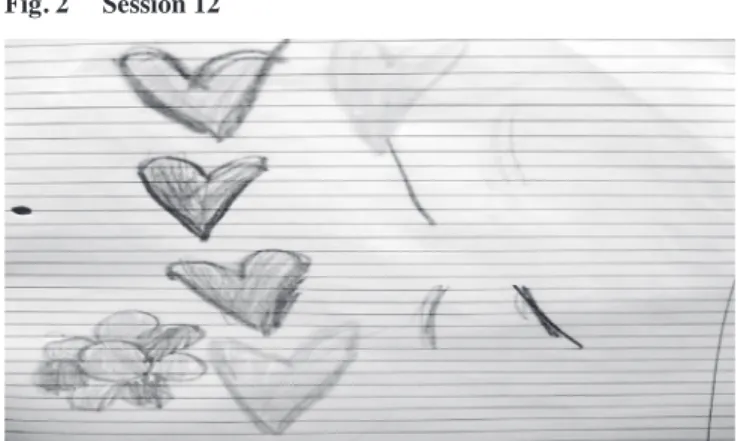
own room. Shall we draw a picture? Upon hearing this she answered, Sure". Then she wore a princess costume from the dresser of her room. She projected herself in front of the mirror. After enjoying what she saw, she drew shapes of heart all the way in her sketch book. She used a pink-colored and yellow-pink-colored
point pen in drawing shapes of heart from one page to another of her sketchbook. With that, the session ended.
Ⅲ. Result and discussion
As for this case, the child was very much active in her elementary school. Despite of her night cries, she remained a popular person in her class. She studied extremely well and achieved many things in school. This was where art therapy came in. We urged her mother to go to the therapy sessions. She was ill and she had the nerve to respond completely to others.
In addition, she would sleep and lay still in bed. But then, loud voices could be heard sometimes at night when she would quarrel with her husband. Such incidents occurred routinely, if not at night then at the early morning. As the father rose in the morning, it seemed that nothing happened the previous night because there was no reaction. The father would enter the little girl's room while she raised her hands. She seemed so frightened by him. There were times when she would occasionally dislike the situation. She would wail separately from crying at night and even in the early morning.
Because of this situation, she would run late for school. She would soon rush after eating half of her breakfast, while her mother would yell upon her. In school, she had been as vigorous as always because she can study really well. Circumstances in school and circumstances in the house were in exact opposite. The writer thought with great interest whether some kind of method can be used to solve such problem. She can encourage the child to embrace drawing. Before art therapy sessions started, the house of the candidate was visited. The state of the little girl was observed, too. There were times wherein some observations were done out of the usual art therapy sessions. As for the mother of the little girl, a feeling of inferiority was observed. Ill-humor had always been present with silence. Regardless of this, the little girl enjoyed the conversation with her mother after she had gone home from school. In addition, it was possible for the child to be vigorously bright in school as described by her homeroom teacher. Situations changed at home. Thus, resulting to frequent night cries. This was her life at home.
With session 1 the picture was drawn, but without full concentration, it simply ended. In addition, the place where the picture was drawn as in session 2 was not the sketch book, but the body of a doll. It bent strongly to the extent that the hand and foot may be broken. It also extended after tearing the clothes and making it nude. She drew geometric patterns on the naked body. The girl was facing cruel circumstances at home. Some of her things were thrown on the floor. Since she cannot concentrate on art therapy especially with session 3, she soliloquized everything the author explained. And when asked about surrounding objects, she could not start a conversation. And with regards to clothes placed in the closet, the child tried to dress the author in those clothes. Judging from the size of the clothes, adults were not expected to wear it. The child dressed clothes forcefully to the author.
Since the cloth may be torn, there were scenes in which I had to stop her strongly. With session 4, the child felt abandoned as ignored by her faith-based mother. With session 4, a picture of a woman was drawn differently from the rest of the drawings. As for the circumstances, full concentration was made in
drawing the picture unlike in session 3 after settling an argument. With session 5, many pictures were drawn voluntarily just like in session 4, feel. However, after drawing lots of pictures, the sketch book was thrown suddenly, a violent characteristic which disappeared in session 4 and expressed suddenly. With session 6, a simple meal was made for the child with an empty stomach by her mother. Her mom stayed on her side while she finished eating the pasta. It was a valuable time that the mother and the child shared while singing a song nasally. The child invited me to eat. Session started the natural way.
The circumstances of the child had been looked upon before asking her to draw pictures and to play with dolls. With session 2, pictures were drawn on the naked body of the doll thrown to the floor. The child picked up what had remained of the doll. She dressed the doll with clothes she chose. After that, she held the doll dearly. Love was expressed and projected to the doll. After that, the circumstances which led in drawing the picture naturally were moved by the appearance of a calm heart. Big numbers of sketches of the same girl were scribbled on the sketch book that was thrown on the wall. The unstable element was expressed and was recognized through the pictures of those circumstances. Session 7 was materialized the same way as in session 6. The mother entered into the child's room and tidied it up. She would clean up the mess and the clothes scattered on the floor. She would pile it up to the closet. Her mom's yell was put off without concentrating on the session. There was a repeated installation and removal of stuff. There was a session where clothes were looked the same way as in session 6. The session ended without drawing any pictures. Since pasta was made in session 8 as their meal, preparation time was not that long before the other sessions. After this, it was possible for the session to be enforced in a natural way. In addition, the child was in full concentration that many pictures were drawn, unlike in session 7. After becoming tired, she moved to the living room from her own room.
During session 9, the circumstances were ill-humored because her mother used her influence. The girl used the lipstick, which she took without her mother's permission and then used it to scribble on the doll.
I was wondering if she will draw anything. The writer mildly told the girl that she was not drawing anything and the girl persistently wanted to apply lipstick on the writer's lips.
And as for the circumstances, the floor was marked with a lipstick. Records of the school have never shown an excellent, wise, small school third grader who conducted something like this which cannot be thought. The floor was dirty because this excellent third grader made a lot of lipstick marks on it.
Session 10 was different from session 9. Pictures of many girls were drawn. The writer asked her whether she will play with her doll or draw anything. The girl started to use the previously thrown sketchbook for sketching.
She started drawing in front of me. As session started, the mother and the child were eating pasta, which the child likes, ever so delightfully because her mother made the past before the session. This influenced the child to the point where she started humming before the session and sat vis-vis with the writer. She answered "of course" to her request at the start of the session.
The drawing started the same way as in session 10. She drew shapes of women and then moved towards coloring the clothes one after another unlike in other sessions.
After using a purple color for the dress of the drawn woman, the girl started using the color blue for her shoes. But the background was painted in pink and that was in contrast of the stressful circumstances. The right side of the woman's clothing was painted in orange and foot was in yellow and green. But the foot was carelessly scribbled with a red color as well. So, session 11 was pretty pleasant.
In session 12, the mother made some pasta and just like in previous sessions, the contact with the mother was pretty long.
After that, the occasion where the session started was focused on the clothes which were in her room. The girl picked some clothes that made her look like a princess. Unlike in the previous sessions, the girl drew many yellow and pink hearts in her sketchbook and the session ended there.
Ⅳ. Conclusion
The mother had some kind of mental disorder, so her state was something to be concerned about. But, in spite of that she had a part-time job, and immediately after her work she went to her room directly. It meant that communication time with her daughter was limited by going straight to her room. The mother must go to the clinic at once, but nobody recognized this issue, not even her husband. The girl was intelligent, active at school and with good grades. In such kind of state, the mother was not capable of parenting.
In addition, she had many friends and very popular in school. But, when she returned home from school, her mood suddenly changed at once. When she was about to go to school in the morning, her father would personally wake her up, but had no effect. After that, her father lifted her up with his hands and then she would wake-up.
After that, because she had no time to eat her breakfast completely, so she would go to school still feeling hungry. Her mother would get angry because of these circumstances, so the girl would go to school running and crying.
At this time, I would like to try if art therapy was effective in such situation. From the first up to the third meeting, she quit in the middle of the session. As for the girl, it was not possible to concentrate on art therapy. The foot of the doll with which she usually plays, bent strongly in the extent of the hand and foot may be broken, or extended. After that, she ripped the clothes off. And after stripping the doll completely, she would draw geometric patterns on the naked body.
This seemed rather cruel. Without being able to concentrate on art therapy during each of our session, we ended the therapy after three sessions.
Circumstances at that time were unstable. In addition, the girl tries to put her small clothes on me. But, of course, adults cannot wear child-size clothes.
The girl has a sudden behavior change which shifted from a calm to a violent behavior pretty instantly. Even if she cannot focus during our sessions, I still felt that there was room for the
improvement of her mental state.
From session 4, it became possible for the girl to focus on drawing a picture. The girl was still quiet, and the picture of the tall woman was drawn. She hadn t drawn that kind of picture until this session. Unlike in session 3, other shapes appeared and drawn. The frequency of her night-cries, which used to be regular, started to decrease steadily. So when the writer started to think that circumstances have improved, she suddenly threw a sketchbook to the wall at the end of her fifth session. So the aggressive characteristics that disappeared on the fourth session reappeared in session 5. Parallel to that, her night cries which decreased were followed by day-cries. After session 6, it was possible for the girl to share some time with her mother, because her mother started to make pasta for her daughter. The girl picked the previously thrown doll and held it carefully. So the love from her mother was projected to the doll which she closely held.
We can see the situation, if we focus only on her drawings. Though it changed to an extreme action when the girl threw the sketchbook to the wall, the circumstances, although expressing the unstable element through the pictures brought together with the child's age as a psychological feature, were disordered simultaneously. In addition, the writer started to recognize the fact that observed circumstances changed as sessions progress. Perhaps, it started being visible as a presumption. Frequency of her night-cries became irregular. In addition, her mornings were not disrupted by her father. The girl now eats by herself.
From sessions 7 up to session 9, we could see that the mental and physical state of the mother was not good, so it had also reflected on the state of the child, even if the frequency of child's night-cries decreased.
In addition, after the tenth session, brightness returned to the child as she drew lots of pictures during that session.
――――――――――――――――――
References
1 .Karp,C.L.&Butler. Treatment strategies for Abused Children and The Activities Book for Treatment Strategies for Abused Children. Us: Sge Pubns.1999
2 .牛島定信(1977) 情緒発達の精神分析論 岩崎学術出版社
3 .Machover, K (1949) Personality projection in the drawing of the human figure.C.C.Thomas.
4 .ReisbergB, Borenstein J, Salob SP, (1987) Ferris.SH.Behavioural symptoms in Alzheimer s disease: Phenomenology and treatment. J Clinsychaiary, pp.9-51
5 .Wenger, R.N. (2001) Measurement corner. Use of children s drawing for measurement of developmental level and emotional status. Journal of Child and Family Nursing, 4(2), pp.139-149