Vapor flows with
evaporation and
condensation
in
the
continuum
limit:
Effect of
a
trace of
noncondensable gas
Kazuo Aoki (青木一生), Shigeru Takata (高田 滋), and SatoshiTaguchi (田口智清) Department ofAeronautics and Astronautics, Graduate SchoolofEngineering,
Kyoto University, Kyoto606-8501, Japan
Abstract
Steady flowsof avapor withevaporation andcondensation
on
theboundary consisting of the condensedphase of the vapor are considered in the following situation: (i) the boundary is of arbitrary smooth
shape; (ii) theKnudsen numberKn,the ratio ofthe typicalmean freepathof thevapor molecules to the characteristiclengthof thesystem, is small; (iii) asmall amount of anoncondensable gas iscontainedin the system; more specifically, the amount is such that the
average
concentration of the noncondensable gasis of the order ofKnin thecase of acloseddomain (thecase
ofan
infinite domain is alsodiscussed). The steady behavior of the vapor and the noncondensable gas, in particular, that in the continuumlimit $\mathrm{w}\mathrm{h}\mathrm{e}\mathrm{r}\mathrm{e}\cdot \mathrm{K}\mathrm{n}$ vanishes, is investigated by
means
ofasystematic asymptotic analysis based
on
kinetictheory. In this situation, the average concentration of the noncondensable gas becomes infinitely small in the continuum limit in thecaseof aclosed domain. However, it is shown that thenoncondensable
gas
accumulatesintheinfinitelythin Knudsen layerontheboundary wherecondensationis taking place and has asignificant effect on the global vaporflow in thecontinuum limit. Anexampledemonstratingsuch
aneffectis also given.
1Introduction
Vapor flows withevaporation
or
condensationon
theboundaryhavebeenone
of theimportant subjectsin
rarefied gas
dynamics. For single-component systems consisting ofapure
vapor and its condensedphase, many successful results have been obtained. For example,anewtypeofgas dynamics (i.e.,
fluid-dynamic equationsand theirboundary conditions)describingthevapor flows around the condensedphase
ofarbitrary shape inthe continuum limit has been established, togetherwith its correctionin the
near
continuum regime, by
means
ofasystematic asymptotic analysis of the Boltzmann equation for smallKnudsen numbers (Sone and Onishi [1], Onishi and
Sone
[2],Sone
[3, 4, 5], Aoki andSone
[6]). As forthe vaporflows at intermediate andlargeKnudsennumbers, we refer to Sugimoto and
Sone
[7],Sone
andSugimoto [8], and Takataet al. [9]
as
typicalexamples and to Kogan [10], Ytrehus [11], and Rebrov [12]as review papers.
In practical situations, however, evaporation and condensation often take place in the presence of other gasesthat neither evaporatenor condense (noncondensable gases). Such two or multi-component
systems(vapor-gas mixtures)have also beeninvestigated in the literature(e.g.,Pao [13],Matsushita [14],
Onishi $[15, 16]$, Bedeauxet al. [17]$)$
.
But, because of the complexityofthesystems, the level ofunder-standingis stillunsatisfactory. Forinstance,the behavior of the mixtures in the continuumlimit has not
fully been understoodyet.
In aseries of recent papers (Aoki et al. [18], Takata et al. [19], Takata and Aoki [20],
Aoki
[21]),weinvestigated the continuum limit ofamixture of avapor and anoncondensable
gas
in asimpleone-dimensionalproblem. Morespecifically,weconsidered themixturein the
gap
between two parallel planecondensed phases of the vapor withdifferentuniform temperatures(thecondensedphasesmay be moving with aconstant speed intheir surfaces) and clarified the featuresof the continuum limit by
means
ofasystematic asymptoticanalysisaswellas
an
accurate numerical analysisbasedon kinetictheory. Let$n_{r}$be
an
appropriatereference number density of the vapor molecules (e.g., thesaturation number density ofthe vapor molecules at the temperature ofone of the condensed phases), $n_{av}^{B}$ the average numberdensity of the noncondensable gas in the gap, and Kn the Knudsen number with respect to thevapor,
namely, the ratio ofthe mean free path of the vapor moleculesinthe referenceequilibrium state at rest
and Aoki [20], and Aoki [21], there are two different situations in the continuum limit, where Kn g.oes
to zero, depending on the amount ofthe noncondensable gas contained in the gaP, i.e., (i) the case of
$n_{av}^{B}/n_{r}=O(1)$, and (ii) the case of $n_{av}^{B}/n_{r}=O(\mathrm{K}\mathrm{n})$. In case (i), evaporation and condensation stop.
However, the vanishing (or nonexisting) evaporation and condensation have an important effect on the
flowfield (i.e., the profiles of the temperature,density, and flowvelocity) in thecontinuumlimit. This is
anexampleofthe ghost effect first pointed out bySone et al. [22] and thendiscussed inSoneet al. [23],
$\mathrm{s}_{011\mathrm{e}}[24,25,5]$, andBouchutet al. [26] for single-component systems. In case (ii),aulliform flowofthe
pure vapor is caused from the evaporating to the condensing surface. Because $n_{av}^{B}/n_{r}$ vanishes in the
limit, the amount of the
noncondensable
gas becomes infinitely small compared with that of the vapor(or the average concentrationof the
noncondensable
gas becomes infinitesimal ). However, the $\mathrm{t}\mathrm{r}\mathrm{a}\mathrm{c}\mathrm{e}$ofthe
noncondensable
gas still has asignificant effecton the vapor flow. This seeminglyparadoxical result is due to thefactthat theinfinitesimal amount
of thenoncondensable gas
isconcentrated
in theKnudsenlayerwith
an infinitesimal
thicknesson thecondensingsurface bythevaporflow,so
that itslocal numberdensity there becomes high enough (comparable to $n_{r}$) to affect the vapor flow (see Aoki et al. [18]).
Thus, the continuum limit is nothing obvious
even
in such asimpleone dimensional
problem.The continuum limit oftype (i) is discussedfor thegeneral geometryby Takataand Aoki [27]. That
is, themixture in contact witharbitrarilyshaped boundary at rest, consisting of the
condensed
$\mathrm{p}\mathrm{h}\mathrm{a}8\mathrm{e}$ofthevapor,isconsidered (themixture isassumedto be atrestatinfinityinthecaseof aninfinitedomain),
and thecorrect fluid-dynamic-tyPeequations and their boundaryconditionsfor thecontinuum limit
are
derived from the Boltzmann equation and its boundary condition for hard-sphere molecules. From thisfluid-dynamic system, the
cause
of theghost effect isclarified inthe caseof the mixture.The aim ofthe present study is to clarify the continuum limit of type (ii) for thegeneral geometry.
That is, we are going to carry out asystematic asymptotic analysis for small Knudsen numbers on
the basis of kinetic theory to derive an appropriate fluid-dynamic system that describes the effect of
asmall amount (or an infinitesimal average concentratioll) of a
noncondensable gas
in the continuumlimit. Actually, Aoki et al. [28] perform ed aMonte Carlo
simulation
ofatwodimensional vapor
flow forsmall
Knudsen
numbersin thecase
corresponding to type (ii) and found that the small amount ofthenoncondensable
gaschangesthe stream lines of thevaporflow significantlyfrom those in thepure vaporcase. This result also supports the necessity of the present study.
(a$=A$,$B$). Then theBoltzmann equation forabinarymixture(Kogan [29], Chapman and Cowling [30],
Hirschfelder et al. [31]$)$ in thepresent time-independent problem is
$\mathrm{w}$rittenas
$\zeta_{i}\frac{\partial\hat{F}^{\alpha}}{\partial x_{1}}=\frac{2}{\sqrt{\pi}}\frac{\mathrm{l}}{\mathrm{K}\mathrm{n}}\sum_{\beta=A,B}\hat{J}^{\beta\alpha}(\hat{F}^{\beta},\hat{F}^{\alpha})$, $(\alpha=A, B)$, (1)
$\hat{J}^{\beta\alpha}(f, g)=\int[f(\zeta_{*}’)g(\zeta’)-f(\zeta_{*})g(\zeta)]\hat{B}^{\beta\alpha}(|\mathrm{e}\cdot\hat{\mathrm{V}}|, |\hat{\mathrm{V}}|)\mathrm{d}\Omega(\mathrm{e})\mathrm{d}^{3}\zeta_{*}$, (2)
$\zeta’=\zeta+\frac{\hat{\mu}^{\beta\alpha}}{\hat{m}^{\alpha}}(\mathrm{e}\cdot\hat{\mathrm{V}})\mathrm{e}$, $\zeta_{*}’=\zeta_{*}-\frac{\hat{\mu}^{\beta\alpha}}{\hat{m}^{\beta}}(\mathrm{e}\cdot\hat{V})\mathrm{e}$, (3a) $\hat{\mu}^{\beta\alpha}=\frac{2\hat{m}^{\alpha}\hat{m}^{\beta}}{\hat{m}^{\alpha}+\hat{m}^{\beta}}$, $\hat{m}^{\alpha}=m^{\alpha}/m^{A}$, (3b) $\hat{\mathrm{V}}=\zeta_{*}-\zeta$, $\mathrm{d}^{3}\zeta_{*}=\mathrm{d}\zeta_{*1}\mathrm{d}\zeta_{*2}\mathrm{d}\zeta_{*3}$, (3c)
Kn$=\ell_{r}/L$, $(3\mathrm{d})$
where $\mathrm{e}$ is aunit vector, $\zeta_{*}$ is the variable of integration corresponding to
$\langle$, $\mathrm{d}\Omega(\mathrm{e})$is the solid angle
elementin the directionof$\mathrm{e}$,and
$\hat{B}^{\beta\alpha}(|\mathrm{e}\cdot\hat{\mathrm{V}}|, |\hat{\mathrm{V}}|)$are nonnegative functionsof$|\mathrm{e}\cdot$$\hat{\mathrm{V}}|$ and $|\hat{\mathrm{V}}|$ depending
onthe molecularmodel. The domain of integration in Eq. (2) is the wholespaceof$\zeta_{*}$ and all directions of $\mathrm{e}$
.
In Eq. $(3\mathrm{d})$,$\ell_{r}$ is the
mean
free path ofamolecule ofthe $A$-component(vapor) when it is in the equilibrium state at rest with molecular number density $n_{r}$ and temperature $T_{r}$, and Kn is thecorresponding Knudsen number, which represents the degree of rarefaction of the system. Here and in
what follows, the Greek letters $\alpha$ and $\beta$
are
used to represent the labels $A$ and $B$ of the components.Since
no confusionis expected, the notes such as $\alpha=A$,$B$ in Eq. (1) willmostly beomitted below. Asin theleft-hand side ofEq. (1), the summationconvention (i.e., $a_{\dot{\iota}}b_{i}= \sum_{i=1}^{3}a:b_{i}$) is usedthroughout the
paper.
It should be noted that the function $\hat{B}^{\beta\alpha}$ also depends on the dimensionless parameter $U_{r}^{\beta\alpha}/kT,$,
where $U_{r}^{\beta\alpha}$ is the characteristic size ofthe intermolecular potential for the interaction ofamolecule of
thea–component with amolecule ofthe$\beta$-component, though it is not shown explicitly inEq. (2). This
fact was pointed out by Sone for the collision term for asingle-component gas (Sone $[4, 5]$,
Sone
and Aoki [32]$)$.
When bothof the components arehard-spheregases,$\hat{B}^{\beta\alpha}$ and
$\ell_{r}$
are
given by$\hat{B}^{\beta\alpha}=\frac{1}{4\sqrt{2\pi}}(\frac{d^{\beta}+d^{\alpha}}{2d^{A}})^{2}|\mathrm{e}\cdot\hat{\mathrm{V}}|$, $\ell_{r}=\frac{1}{\sqrt{2}\pi(d^{A})^{2}n},$’ (4)
where d’ is the diameter of
amolecule
of the a-component. The$\hat{B}^{\beta\alpha}$does not dependon $U_{r}^{\beta\alpha}/kT_{r}$ in
this
case.
We
now
denote the temperature of theboundary by$T_{r}\hat{T}_{w}$, its velocityby $(2kT_{r}/m^{A})^{1/2}\hat{v}_{wi}$, andthesaturation pressure ofthe vapor at temperature$T_{r}\hat{T}_{w}$ by $p_{r}\hat{p}_{w}^{A}$
.
Further, since the problem is steady,$\hat{v}_{wi}n_{\mathrm{i}}=0$ is assumed, where $n_{i}$ is the unit vector normal to the boundary pointing to the gas region.
Then the boundary conditions
are
written as$\hat{F}^{a}=\sigma_{w}^{\alpha}\hat{T}_{w}^{-\theta/2}(\frac{\hat{m}^{\alpha}}{\pi})^{3/2}\exp(-\frac{\hat{m}^{\alpha}(\zeta_{i}-\hat{v}_{w\nu})^{2}}{\hat{T}_{w}})$ , $\zeta_{\dot{l}}n_{i}>0$, (5)
with
$\sigma_{w}^{A}=\hat{p}_{w}^{A}/\hat{T}_{w}$, (6a)
$\sigma_{w}^{B}=-2(\frac{\pi\hat{m}^{B}}{\hat{T}_{w}})^{1/2}\int_{\zeta_{i}n_{\mathrm{i}}<0}\zeta_{\mathrm{i}}n_{i}\hat{F}^{B}\mathrm{d}^{3}\zeta$
,
(6b)where$\mathrm{d}^{3}\zeta=\mathrm{d}\zeta_{1}\mathrm{d}\zeta_{2}\mathrm{d}\zeta_{3}$
.
Equation (5) with$\alpha=A$means
that thevapor
moleculesleaving theboundaryobeythe correspondingpart of the Maxwellian distribution
characterized
by $\hat{T}_{w},\hat{v}_{wi}$, and $\hat{p}_{w}^{A}$ (completegas
molecules reflected by the boundary obey the corresponding part of the Maxwellian distributioncharacterized
by$\hat{T}_{w}$ and $vwi$ and that there is no netmass
flow ofthis component across the boundary(diffuse reflection).
Next,we introduce macroscopic variables as the moments of thevelocity distribution functions. For
each component, we define its number density $n_{r}\hat{n}^{\alpha}$, density $n_{r}m^{A}\hat{\rho}^{\alpha}$, flow velocity
$(2kT_{r}/m^{A})^{1/2}\hat{v}_{i}^{\alpha}$,
temperature$T_{r}\hat{T}^{\alpha}$, and partial
pressure
$p_{r}\hat{p}^{\alpha}$ by$\hat{n}^{\alpha}=$
. $\int\hat{F}^{\alpha}\mathrm{d}^{3}\zeta$, $\hat{\rho}^{\alpha}=\hat{m}^{\alpha}\int\hat{F}^{\alpha}\mathrm{d}^{3}\zeta(=\hat{m}^{\alpha}\hat{n}^{\alpha})$ , (7a)
$\hat{v}_{i}^{\alpha}=\frac{1}{\hat{n}^{\alpha}}\int\zeta_{i}\hat{F}^{\alpha}\mathrm{d}^{3}\zeta$, $\hat{T}^{\alpha}=\frac{2}{3}\frac{\hat{m}^{\alpha}}{\hat{n}^{\alpha}}\int(\zeta_{i}-\hat{v}_{i}^{\alpha})^{2}\hat{F}^{\alpha}\mathrm{d}^{3}\zeta$, (7b)
$\hat{p}^{\alpha}=\frac{2}{3}\hat{m}^{\alpha}\int(\zeta_{i}-\hat{v}_{i}^{\alpha})^{2}\hat{F}^{\alpha}\mathrm{d}^{3}\zeta(=\hat{n}^{\alpha}\hat{T}^{\alpha})$
.
(7c)Hereandinwhat follows,thedomain of integrationwith respect to$\zeta_{i}$ isitswhole
space,
unless otherwisestated. For the total mixture, thenumber density$n_{r}\hat{n}$, density $n_{r}m^{A}\hat{\rho}$, flow velocity $(2kT_{r}/m^{A})^{1/2}\hat{v}_{i}$,
temperature$T_{r}\hat{T}$, and pressure$p_{r}\hat{p}$
are
defined by$\hat{n}=\int\sum_{\beta=A,B}\hat{F}^{\beta}\mathrm{d}^{3}\zeta$, $\hat{\rho}=\int\sum_{\beta=A_{\mathrm{I}}B}\hat{m}^{\beta}\hat{F}^{\beta}\mathrm{d}^{3}\zeta$
,
(8a)$\hat{v}_{i}=\frac{1}{\hat{\rho}}\int\zeta_{i}\sum_{\beta=A,B}\hat{m}^{\beta}\hat{F}^{\beta}\mathrm{d}^{3}\zeta$, $\hat{T}=\frac{2}{3\hat{n}}\int(\zeta_{i}-\hat{v}_{i})^{2}\sum_{\beta=A,B}\hat{m}^{\beta}\hat{F}^{\beta}\mathrm{d}^{3}\zeta$
, (8b)
$\hat{p}=\frac{2}{3}\int(\zeta_{i}-\hat{v}_{i})^{2}\sum_{\beta=A,B}\hat{m}^{\beta}\hat{F}^{\beta}\mathrm{d}^{3}\zeta(=\hat{n}\hat{T})$
.
(8c)
Thus the macroscopic variables for the total mixture
are
expressed in terms of those forindividual
components as follows:$\hat{n}=\sum_{\beta=A,B}\hat{n}^{\beta}$, $\hat{\rho}=\sum_{\beta=A,B}\hat{\rho}^{\beta}$, $\hat{\rho}\hat{v}_{i}=\sum_{\beta=A,B}\hat{\rho}^{\beta}\hat{v}_{i}^{\beta}$,
(9a)
$\hat{p}=\sum_{\beta=A,B}[\hat{p}^{\beta}+\frac{2}{3}\hat{\rho}^{\beta}(\hat{v}_{i}^{\beta}-\hat{v}_{i})^{2}]$. (9b)
In theliterature,the temperature$\hat{T}^{\alpha}$
and partial
pressure
$\hat{p}^{\alpha}$of each component areoftendefined inadifferentway, i.e., by the second equation ofEq. (7b) and Eq. (7c) with$\hat{v}_{i}^{\alpha}$ beingreplaced by
$\hat{v}_{\dot{l}}$ [the first
equation of Eq. (7b)$]$ (e.g., Kogan [29] and ChapmanandCowling [30]). Ifthesedefinitions
are
adopted, thepressure
$p\wedge$of thetotal mixture, defined by Eq. (8c), is expressedby the simplesum of$\hat{p}^{\alpha}$ instead of
Eq. (9b).
3Asymptotic
analysis
for small Knudsen
numbers
In thissection,wecarry out asystematicasymptoticanalysisof the boundary-valueproblem (1) and (5)
for small Knudsen numbers underthe situation
described
inSec. 2.1, namely,$n_{av}^{B}/n_{r}=O(\mathrm{K}\mathrm{n})$
.
(10)The basic guideline of the analysis is the asymptotic theory developed by Sone (Sone [33, 34, 3, 4, 5],
Sone and Onishi [1], Onishi and Sone [2], Aoki and Sone [6],
Sone
and Aoki [32], Soneet al. $[22, 35])$.
Inthe
course
of the analysis,we use
the smallparameter
$\epsilon$:$\epsilon=(\sqrt{\pi}/2)\mathrm{K}\mathrm{n}$, (11)
3.1
Hilbert
solution
Let us first seek the moderately varying solutions $\hat{F}_{H}^{\alpha}[\partial\hat{F}_{H}^{\alpha}/\partial x_{\iota}=O(\hat{F}_{H}^{\alpha})]$ ofthe Boltzmann equation
(1) inapower series of$\epsilon$:
$\hat{F}_{H}^{\alpha}=\hat{F}_{H0}^{\alpha}+\hat{F}_{H1}^{\alpha}\epsilon+\cdots$. (12)
Correspondingly, the macroscopicvariables are expanded as
$h_{H}^{\alpha}=h_{H0}^{\alpha}+h_{H1}^{\alpha}\epsilon+\cdots$ , (13a)
$h_{H}=h_{H0}+h_{H1}\epsilon+\cdots$ , (13b)
where $h$ denotes$\mathrm{n},$ $\rho\wedge,\hat{v}_{\dot{1}},\hat{T}$,
or
$\hat{p}$.
Here,$h_{H}^{\alpha}$ and $h_{H}$are
defined by Eqs. $(7\mathrm{a})-(7\mathrm{c})$ and $(8\mathrm{a})-(8\mathrm{c})$ with$\hat{F}^{\alpha}$replaced by$\hat{F}_{H}^{\alpha}$, and theexpansion
coefficients
$h_{Hm}^{\alpha}$and$h_{Hm}$are
obtainedbysubstituting the expansions(12)-(13b) into thedefinitions of $h_{H}^{\alpha}$ and $h_{H}$ and by equating the coefficients of the
same
power of $\epsilon$.
This solution (or expansion) is called the Hilbert solution (or expansion). Some examples of$h_{Hm}^{\alpha}$ azid
$h_{Hm}$
are
given in Appendix A. Ifwesubstitute Eq. (12) into Eq. (1), weobtain the followingsequenceof integralequations:
$\sum_{\beta=A_{1}B}\hat{J}^{\beta\alpha}(\hat{F}_{H0}^{\beta},\hat{F}_{H0}^{\alpha})=0$, (14)
$\sum_{\beta=A,B}[\hat{J}^{\beta\alpha}(\hat{F}_{Hm}^{\beta},\hat{F}_{H0}^{\alpha})+\hat{J}^{\beta\alpha}(\hat{F}_{H0}^{\beta},\hat{F}_{Hm}^{\alpha})]$
$=$ $\zeta_{i}\frac{\partial\hat{F}_{Hm-1}^{\alpha}}{\partial x_{i}}-\sum_{\beta=A,B}\sum_{n=1}^{m-1}\hat{J}^{\beta\alpha}(\hat{F}_{Hm-n}^{\beta},\hat{F}_{Hn}^{\alpha})$
,
(15)where $m=1,2$,$\ldots$, and $\sum_{1}^{0}=0$ when $m=1$ in Eq. (15). Equation (14) is the system of nonlinear
integral equations for $\hat{F}_{H0}^{\alpha}$, while Eq. (15) is that of inhomogeneous linear integral equations for$\hat{F}_{Hm}^{\alpha}$
.
Theseries of equations can, in principle, be solved successivelyfrom thelowest order.The solution of Eq. (14) is given by local equilibrium distributions (Chapman and Cowling [30]), namely, local Maxwellian distributions with
common
flow velocity and temperature, whichcan
beex-pressed
as
$\hat{F}_{H0}^{\alpha}=\hat{n}_{H0}^{\alpha}\hat{T}_{H0}^{-3/2}(\frac{\hat{m}^{\alpha}}{\pi})^{3/2}\exp(-\frac{\hat{m}^{\alpha}(\zeta_{i}-\hat{v}_{iH0})^{2}}{\hat{T}_{H0}})$, (16)
by theuse ofthe leading-0rder terms$\hat{n}_{H0}^{\alpha},\hat{v}_{iH0}$, and$\hat{T}_{H0}$of the expansions (13a) and(13b)[seeEqs. (Ala),
$(\mathrm{A}2\mathrm{b})$, and $(\mathrm{A}2\mathrm{c})]$
.
For this distribution, ofcourse, the flowvelocity and the temperatureofeach com-ponentare thesame as
thoseof the totalmixture, i.e.,$\hat{v}_{iH0}^{A}=\hat{v}_{\dot{\mathrm{a}}H0}^{B}=\hat{v}_{iH0}$, $\hat{T}_{H0}^{A}=\hat{T}_{H0}^{B}=\hat{T}_{H0}$
.
(17)Tobeconsistent withEq. (10),weneed toassumethat
$\hat{n}_{H0}^{B}\equiv 0$, (i.e., $F\wedge H0B\equiv 0$), (18)
because otherwise$n_{av}^{B}/n_{r}$ becomes of$O(1)$
.
Then, Eq. (15) with $\alpha=B$ and $m=1$ reducesto$\hat{J}^{AB}(\hat{F}_{H0}^{A},\hat{F}_{H1}^{B})=0$
.
(19)The solution to this equation is given by alocalMaxwelliandistribution withthe
same
flowvelocityandtemperatureas$\hat{F}_{H0}^{A}$ (Cercignani [36]), i.e.,
where $\hat{n}_{H1}^{B}$ appears because the first equation of Eq. (Ala) ($\alpha=B$ and $m=1$) has been used. Since
Eq. (20) also satisfies
$\hat{J}^{BA}(\hat{F}_{H1}^{B},\hat{F}_{H0}^{A})=0$, (21)
Eq. (15) with $\alpha=A$and $m=1$ reduces to
$\hat{J}^{AA}(\hat{F}_{H1}^{A},\hat{F}_{H0}^{A})+\hat{J}^{AA}(\hat{F}_{H0}^{A},\hat{F}_{H1}^{A})=\zeta_{i}\frac{\partial\hat{F}_{H0}^{A}}{\partial x_{i}}$ , (22)
which is the linear equationfor $\hat{F}_{H1}^{A}$ and is of the
same
form asthe corresponding equation in thepure
vapor
case
(Aoki and Sone [6]). The homogeneous equation of Eq. (22) has the independent nontrivialsolutions $\hat{F}_{H0}^{A}$, $\zeta_{i}\hat{F}_{H0}^{A}$, and $\zeta_{j}^{2}\hat{F}_{H0}^{A}$
.
Therefore, the inhomogeneous term of Eq. (22) should satisfy thefollowing solvabilitycondition in order for the equation to have asolution:
$\int(1, \zeta_{i}, \zeta_{j}^{2})\zeta_{\ell}\frac{\partial\hat{F}_{H0}^{A}}{\partial x_{\ell}}\mathrm{d}^{3}\zeta=0$. (23)
If
we
substituteEq. (16) with$\alpha=A$ into Eq. (23),weobtain$\frac{\partial\hat{\rho}_{H0}^{A}\hat{v}_{jH0}}{\partial x_{j}}=0$, (24a)
$\hat{\rho}_{H0}^{A}\hat{v}_{jH0_{\partial x_{j}}^{\mathrm{j}^{H0}}}+\frac{1}{2}\frac{\partial\hat{p}_{H0}^{A}}{\partial x_{\dot{\iota}}}=0\partial\hat{v}$ , (24b)
$\hat{v}_{jH0}\frac{\partial}{\partial x_{J}}(\frac{5}{2}\hat{T}_{H0}+\hat{v}_{lH0}^{2})=0$, (24c) $\hat{p}_{H0}^{A}=\hat{\rho}_{H0}^{A}\hat{T}_{H0}$, $(24\mathrm{d})$
where $\hat{\rho}_{H0}^{A}=\hat{n}_{H0}^{A}$
.
The set ofEqs. $(24\mathrm{a})-(24\mathrm{d})$ is the Euler set for anideal gas. In deriving Eqs. (24b)alld (24c) from Eq. (23), we have used Eq. (24a). Our next task is to derive the appropriate boundary condition for theEuler set. Thiswillbediscussed in the following subsections.
The
nonzero
$\hat{n}_{H1}^{B}$ does not contradictEq. (10). However,wecan
consistentlyassume
that$\hat{n}_{Hm}^{B}\equiv 0$
,
$(\mathrm{i}.\mathrm{e}.,\hat{F}_{Hm}^{B}\equiv 0)$, $(m=1,2, \ldots)$.
(25)That is, the analysis
can
becarried
out consistently withEq. (25). The reasoningofEq. (25), which isalsorelated to the discussions in
Sees.
3.2-3.4, is given inAppendix B.3.2
Knudsen-layer
correction
Sofar,
we
havepaidno
attention to the boundary condition. In order for theHilbert solution (16) (witha$=A$) to satisfy theboundarycondition (5) (with $\alpha=A$),we have to impose the following conditions
on the boundary:
$\hat{n}_{H0}^{A}=\hat{p}_{w}^{A}/\hat{T}_{w}^{A}$, $\hat{v}_{\iota H0}=\hat{v}_{wi}$, $\hat{T}_{H0}=\hat{T}_{w}$
.
(26)However, these conditions are too many for the Euler set of equations. In other words, we cannot
satisfy the boundary condition (5) only with the Hilbert solution. Therefore,we needto introduce the
Knudsen-layercorrection. Let usseek the solution in the form
$\hat{F}^{\alpha}=\hat{F}_{H}^{\alpha}+\hat{F}_{K}^{\alpha}$, (27)
where $\hat{F}_{K}^{\alpha}$ is the Knudsen-layer correction, which is
acorrection
term to the Hilbert solutionnear
theboundary. More precisely, $\hat{F}_{K}^{\alpha}$ is assumed to have the length scale of variation of the order of
$\epsilon$ (or
the
mean
free path in thedimensional
physical space) in the directionnormal
to the boundary, i.e.,6adjacent to the boundary. In order to analyze the $\mathrm{K}\mathrm{n}\mathrm{u}\mathrm{d}\mathrm{s}\mathrm{e}\mathrm{n}rightarrow \mathrm{l}\mathrm{a}\mathrm{y}\mathrm{e}\mathrm{r}$correction, we introduce the new
coordinate system $(\eta, \chi_{1}, \chi_{2})$ defined by
$x_{i}=\epsilon\eta n_{i}(\chi_{1}, \chi_{2})+x_{wi}(\chi_{1}, \chi_{2})$, (28)
where $xwi$ represents the boundary, $\eta$ is thecoordinate normal to theboundary stretched by $1/\epsilon(\eta=0$ corresponds to the boundary), and $\chi_{1}$ and $\chi_{2}$ are the coordinates on the boundary orthogonal to each
other. We consider $\hat{F}_{K}^{\alpha}$ to be afunction of
$\eta$, $\chi_{1}$, and $\chi_{2}[\partial\hat{F}_{K}^{\alpha}/\partial\eta=O(\hat{F}_{K}^{\alpha})]$,
as
well as (., vanishing rapidlyas $\etaarrow\infty$.
We assume that $\hat{F}_{K}^{\alpha}$ is also expanded in apower series of$\epsilon$as
$\hat{F}_{K}^{\alpha}=\hat{F}_{K0}^{\alpha}+\hat{F}_{K1}^{\alpha}\epsilon+\cdots$
.
(29)We
now
substituteEq. (27) with Eq. (29) intoEq. (1) and take into account the properties of$\hat{F}_{K}^{\alpha}$ aswellas the fact that $\hat{F}_{H}^{\alpha}$ is asolution of Eq. (1). In particular, we use $\hat{F}_{H0}^{B}=\hat{F}_{H1}^{B}=0$ [Eqs. (18) and (25)]
and the following rearranged expansionof$\hat{F}_{H}^{A}$ in the Knudsen layer:
$\hat{F}_{H}^{A}=(\hat{F}_{H0}^{A})_{b}+[(\hat{F}_{H1}^{A})_{b}+(\frac{\partial\hat{F}_{H0}^{A}}{\partial x_{i}})_{b}n_{i}\eta]\epsilon+\cdots$, (30)
where $()_{b}$ indicates that the quantity in the parentheses is evaluatedon the boundary. Then,weobtain
thesequence ofequations for $\hat{F}_{Km}^{\alpha}$ $(m=0,1, \ldots)$. Ifwe introducethe following $\hat{F}_{0}^{A}$ and$\hat{F}_{0}^{B}$:
$\hat{F}_{0}^{A}=(\hat{F}_{H0}^{A})_{b}+\hat{F}_{K0}^{A}$, $\hat{F}_{0}^{B}=\hat{F}_{K0}^{B}$, (31)
the equationsfor $m=0$
are
writtenas
$\zeta_{i}n_{i}\frac{\partial\hat{F}_{0}^{A}}{\partial\eta}=\hat{J}^{AA}(\hat{F}_{0}^{A},\hat{F}_{0}^{A})+\hat{J}^{BA}(\hat{F}_{0}^{B},\hat{F}_{0}^{A})$
,
(32a)$\zeta_{\dot{l}}n:\frac{\partial\hat{F}_{0}^{B}}{\partial\eta}=\hat{J}^{AB}(\hat{F}_{0}^{A},\hat{F}_{0}^{B})+\hat{J}^{BB}(\hat{F}_{0}^{B},\hat{F}_{0}^{B})$
.
(32b)The boundary conditions for Eqs. (32a) and (32b)
on
the boundary are, from Eqs. (5), (27) [withEqs. (12) and (29)$]$, and (31), given by
$\hat{F}_{0}^{\alpha}=\sigma_{w0}^{\alpha}\hat{T}_{w}^{-3/2}(\frac{\hat{m}^{\alpha}}{\pi})^{3/2}\exp(-\frac{\hat{m}^{\alpha}(\zeta\dot{.}-\hat{v}_{wi})^{2}}{\hat{T}_{w}})$, $\zeta_{i}n_{i}>0$
,
(33)with
$\sigma_{w0}^{A}=\hat{p}_{w}^{A}/\hat{T}_{w}$, (34a)
$\sigma_{w0}^{B}=-2(\frac{\pi\hat{m}^{B}}{\hat{T}_{w}})^{1/2}\int_{\zeta.n_{\mathrm{i}}<0}.\zeta_{i}n_{t}\hat{F}_{0}^{B}\mathrm{d}^{3}\zeta$
.
(34b)Onthe other hand, $\hat{F}_{K}^{\alpha}$ vanishesrapidlywhen
$\eta$ going to infinity. Therefore, as$\etaarrow\infty$,
$\hat{F}_{0}^{A}arrow(\hat{F}_{H0}^{A})_{b}$
$=( \hat{n}_{H0}^{A})_{b}(\hat{T}_{H0})_{b}^{-3/2}(\frac{1}{\pi})^{3/2}\exp(-\frac{[\zeta_{t}-_{\mathfrak{l}}(\hat{v}_{jH0})_{b}]^{2}}{(\hat{T}_{H0})_{b}})$, (35a) $\hat{F}_{0}^{B}arrow 0$
.
(35b)Equations $(32\mathrm{a})-(35\mathrm{b})$ form ahatf-space boundary-value problemofthe spatially
one-dimen-sional Boltzmann equation, which will be discussed in thenext subsection.
As
we will see, in order forthe problem to have asolution, the boundary values $(\hat{n}_{H0}^{A})_{b}$, $(\hat{v}_{aH0})_{b}$, and $(\hat{T}_{H0})_{b}$ ofthe Hilbert part
contained in Eq. (35a) and the quantities $\hat{T}_{w},\hat{v}_{wi}$, and $\hat{p}_{w}^{A}$ contained in Eq. (33) must satisfy certain
Ifwe integrate Eq. (32b) with respect to $\zeta_{\iota}$
over
its whole spaceand take into account Eq. (35b), we have$\Phi_{iK0}n_{i}=0$, for $0\leq\eta$, (36)
where $\Phi_{iKm}$ denotes the particle flux corresponding to $\hat{F}_{Km}^{B}$ (note that
$\hat{F}_{0}^{B}=\hat{F}_{K0}^{B}$), i.e.,
$\Phi_{\iota Km}=\int\zeta_{i}\hat{F}_{Km}^{B}\mathrm{d}^{3}\zeta$
.
(37)Since we are interestedin the behavior in the continuumlimit, Eqs. $(32\mathrm{a})-(35\mathrm{b})$ play the main role.
However, we need apiece of information from the first-0rder Knudsen-layer correction. The first-0rder
equation corresponding to Eq. (32b) is given by
$\zeta_{i}n_{i}\frac{\partial\hat{F}_{K1}^{B}}{\partial\eta}=\hat{J}^{AB}((\hat{F}_{H1}^{A})_{b}+(\frac{\partial\hat{F}_{H0}^{A}}{\partial x_{i}})_{b}n_{\dot{\iota}}\eta+\hat{F}_{K1}^{A},\hat{F}_{K0}^{B})$
$+\hat{J}^{AB}((\hat{F}_{H0}^{A})_{b}+\hat{F}_{K0}^{A},\hat{F}_{K1}^{B})$
$+\hat{J}^{BB}(\hat{F}_{K1}^{B},\hat{F}_{K0}^{B})+\hat{J}^{BB}(\hat{F}_{K0}^{B},\hat{F}_{K1}^{B})$
$- \zeta_{j}[(\frac{\partial\chi_{1}}{\partial x_{j}})_{b}\frac{\partial\hat{F}_{K0}^{B}}{\partial\chi_{1}},+(\frac{\partial\chi_{2}}{\partial x_{j}})_{b}\frac{\partial\hat{F}_{K0}^{B}}{\partial\chi_{2}}]$
.
(38) Ifwe integrate this equationwith respect to $\zeta_{\mathrm{i}}$over
its wholespace
anduse
Eq. (36),wehave$\frac{\partial}{\partial\eta}[\Phi_{iK1}n:]+\chi_{1,1}\frac{\partial}{\partial\chi_{1}}[\Phi_{iK0}t_{i}^{(1)}]+\chi_{2,2}\frac{\partial}{\partial\chi_{2}}[\Phi_{iK0}t^{(2)}.\cdot]$
$+g_{2}\Phi:K0t_{l}^{(1)}-g_{1}\Phi_{iK0}t_{\dot{l}}^{(2)}=0$
.
(39)Here, $t^{(1)}\dot{.}$ md$t_{i}^{(2)}$ are,respectively, unit tangentialvectors to theboundaryin the direction of increasing
$\chi_{1}$ and $\chi_{2}$ taken in such awaythat
$t_{i}^{(1)}$, $t_{i}^{(2)}$, and
niform aright-hand system,$\chi_{1,1}$ and $\chi 2,2$ are defined
by
$\chi_{1,1}=(\frac{\partial\chi_{1}}{\partial x_{j}})_{b}t_{j}^{(1)}$, $\chi_{2,2}=(\frac{\partial\chi_{2}}{\partial x_{j}})_{b}t_{j}^{(2)}$, (40)
and $g_{1}$ and $g_{2}$ are, respectively, the geodesic curvatures (Kreyszig [37]) (in the dimensionless
$x_{\dot{1}}$ space)
of the $\chi_{1}$ and $\chi_{2}$ coordinate lines on the boundary (see
Sone
et al. [35] for the details). Equation (39) is the continuity equation for the $B$-component in the Knudsen layer. Because ofthe diffuse reflectioncondition (5) (with $\alpha=B$) and (6b), the$\mathrm{c}\mathrm{o}\mathrm{n}\mathrm{d}\mathrm{i}\mathrm{t}\mathrm{i}\mathrm{o}\mathrm{n}/\cdot\zeta_{i}n_{i}\hat{F}^{B}\mathrm{d}^{3}\zeta=0$ , $\mathrm{i}.\mathrm{e}.$, / $\cdot$
$\zeta_{i}n_{\mathrm{i}}(\hat{F}_{Hm}^{B}+\hat{F}_{Km}^{B})\mathrm{d}^{3}(=0$,
is always satisfied on the boundary. Therefore, it follows from Eq. (25) that $\Phi_{iKm}n_{i}=0$ at $\eta=0$. The
same relationsalso hold at$\eta=\infty$ because$\hat{F}_{Km}arrow 0$ as $\etaarrow\infty$
.
Ifwe makeuse
$\circ \mathrm{f}$
$\Phi_{iK1}n_{i}=0$at $\eta=0$ and $\infty$, the integration ofEq. (39) with respect to$\eta$ from $\eta=0$ to
$\infty$yields
$\chi_{1,1}\frac{\partial}{\partial\chi_{1}}(\hat{N}_{i0}t_{\dot{1}}^{(1)})+\chi_{2,2^{\frac{\partial}{\partial\chi_{2}}(\hat{N}_{i0}t_{i}^{(2)})+g_{2}\hat{N}_{i0}t_{i}^{(1)}}}-g_{1}\hat{N}_{\dot{\iota}0}t_{f}^{(2)}=0$, (41)
where
$\hat{N}_{\dot{\iota}0}=\int_{0}^{\infty}\Phi:K0\mathrm{d}\eta=\int_{0}^{\infty}(\int\zeta_{i}\hat{F}_{0}^{B}\mathrm{d}^{3}\zeta)\mathrm{d}\eta$
.
(42)(Notethat $\hat{F}_{K0}^{B}=\hat{F}_{0}^{B}.$) Incidentally,$\hat{N}_{i0}n_{i}=0$ becauseofEq. (36).
In the
tw0-dimensional
case, we mayassume
the physical quantities to be independent of $\chi_{2}$.
Forsimplicity, let us denote $\chi_{1}$ by $\chi$ and $t!^{1)}$.by $t_{i}$. Then, because $g_{1}=g_{2}=0$ in this case,it follows from
Eq. (41) that
As wewill see, Eq. (41) or (43) (inthetw0-dimensional case) is apartofthe boundary conditionforthe
Euler set of equations $(24\mathrm{a})-(24\mathrm{d})$ on thecondensingsurface.
For convenience ofthe later use, weintroduce the following $\tilde{\Gamma}$
and$\hat{N}_{i0}^{*}$: $\tilde{\Gamma}=\int_{0}^{\infty}(\int\hat{F}_{0}^{B}\mathrm{d}^{3}\zeta)\mathrm{d}\eta=\int_{0}^{\infty}\hat{n}_{0}^{B}\mathrm{d}\eta$, (44) $\hat{N}_{i0}^{*}=\int_{0}^{\infty}[\int(\zeta_{i}-\hat{v}_{wi})\hat{F}_{0}^{B}\mathrm{d}^{3}\zeta]\mathrm{d}\eta=\int_{0}^{\infty}[\Phi_{iK0}-\hat{n}_{0}^{B}\hat{v}_{wi}]$
cb7
$=\hat{N}_{i0}-\hat{v}_{wi}\tilde{\Gamma}$, (45) where $\hat{n}_{0}^{B}=\int\hat{F}_{0}^{B}\mathrm{d}^{3}\zeta$, (46)and $n_{f}\hat{n}_{0}^{B}$ is the molecular number density of the noncondensable gas in the Knudsen layer. The
$(\sqrt{\pi}/2)n_{r}\ell_{r}\tilde{\Gamma}$, $(\sqrt{\pi}/2)m^{B}n_{r}(2kT_{f}/m^{A})^{1/2}\ell_{r}\hat{N}_{i0}$, and $(\sqrt{\pi}/2)m^{B}n_{r}(2kT_{r}/m^{A})^{1/2}\ell_{r}\hat{N}_{\dot{\iota}0}^{\mathrm{r}}$are, respectively,
thetotal number, totalmomentum,andtotalmomentum based
on
the velocity relative to the boundaryofthe$B$-molecules,contained inthe Knudsenlayerper unit
area
on theboundary.3.3
Half-space problem
of
evaporation
or
condensation
The boundary-value problem for the Knudsen-layer correction, consisting of Eqs. (32a) and (32b) and boundary conditions (33)-(35b), is equivalent tothefollowing half-space problem of (strong) evaporation
orcondensation.
Consider ahalf space $X_{1}>0$ filled with the vapor ($A$-component), bounded by
an
infinite planecondensed phaseof the vapor located at$X_{1}=0$and at rest,where $(X_{1}, X_{2}, X_{3})$ isasystemofrectangular
space coordinates. The condensed phase is kept at temperature T5, and the saturation vapor pressure at temperature $T_{s}$ is denoted by$p_{\mathit{8}}^{A}$
.
At infinity, there is auniform equi libriumflow ofthe vapor withpressure $p_{\infty}^{A}$, temperature $T_{\infty}$, and flow velocity $(v_{1\infty}, v_{2\infty}, 0)(v_{2\infty}\geq 0)$
.
On
the condensed phase,steady evaporation $(v_{1\infty}>0)$ or condensation $(v_{1\infty}<0)$ is taking place. The noncondensable gas $(B-$
component) may be present
near
the condensed phase. Investigate the steady behavior of the vapor and thenoncondensable gas
under the complete condensation condition for thevapor
and the diffusereflection condition for the noncondensable
gas
on
the condensed phase.In fact, the basic equation and the boundary condition for this problem are given by Eqs. $(32\mathrm{a})-$
$(35\mathrm{b})$ ifwe take into account the following correspondence between the parametersand variables ofthe
problem and those in Eqs. $(32\mathrm{a})-(35\mathrm{b}):T_{s}$, $p_{s}^{A}$, Too, $p_{\infty}^{A}$,
$v_{1\infty}$, V200, alld $X_{1}$ correspond to $T_{r}\hat{T}_{w}$,$p_{r}\hat{p}_{w}^{A}$,
$T_{r}(\hat{T}_{H0})_{b}$,$p_{r}(\hat{p}_{H0}^{A})_{b}$, $(2kT_{r}/m^{A})^{1/2}(\hat{v}_{jH0})_{b}n_{J}$, $(2kT_{r}/m^{A})^{1/2}|(\hat{v}_{iH0})_{b}-\hat{v}_{wi}-(\hat{v}_{jH0})_{b}n_{g}n:|$,and $(\sqrt{\pi}/2)\ell,\eta$,
respectively, and the direction ofthe positive $X_{1}$ axis corresponds to that of$n:$
.
First we consider the case where evaporation is taking place $(v_{1\infty}>0)$
.
In this case, being blownaway by the evaporating vapor flow, the noncondensable gas cannot stay
near
the condensed phaseor
in the Knudsenlayer, namely $\hat{F}_{0}^{B}=0$
.
Thisfact, which is intuitively obvious and is supported bysomenumerical results (the transition process in which the noncondensable gas initially occupying the half
spaceis swept away by the evaporating vapor is investigated numerically inDoiet al. [38]$)$, canbeshown
rigorously (Taguchi et al. [39]) for the Boltzmann equation for the Maxwellian molecules, as well as
for the model equations based on the Maxwellian molecules, such as the model proposed by Garzo et
al. [40]. Therefore, the problemis reduced to that ofan evaporating flow of the pure vapor, which has
beeninvestigated bymanyauthors(KoganandMakashev[41],Murakamiand Oshima[42],Ytrehus [43],
Sone $[44, 45]$, Sone and Sugimoto [46], Aoki et al. [47], Sone et al. [48], Bobylev et al. [49]$)$
.
There isasteady solution to the half-space problem only when the parameters $Ts$, $p_{s}^{A}$, $T_{\infty}$, $p_{\infty}^{A}$, vioo, and
$v_{2\infty}$
satisfy the followingrelations (Soneand Sugimoto [46]). $M_{t}=0$, $\frac{p_{\infty}^{A}}{p_{\epsilon}^{A}}=h_{1}(M_{n})$, where $M_{n}\leq 1$, $\frac{T_{\infty}}{T_{s}}=h_{2}(M_{n})$, (47) $M_{t}=v_{2\infty}(5k.T_{\infty}/3m^{A})^{-1/2}$, $M_{n}=v_{1\infty}(5kT_{\infty}/3m^{A})^{-1/2}$
.
(41)The $M_{t}$ and $NI_{n}$ are, respectively, the Mach number at infinity based
on
the tangential flow speed andthat based
on
the normal flow speed. The functions $h_{1}(M_{n})$ and $h_{2}(\Lambda f_{n})$ are obtained accurately bymeansof anumerical analysisof theBGKmodel (Bhatnagar et al. [50], Welander [51], and Kogan [52])
of the Boltzmann equation in Sone and Sugimoto [$46_{\mathrm{J}}^{1}$
.
The numerical values of these functions aregiven in Table I. The analytical form of these functions for $M_{n}<<1$was obtained bySone [44] (see also Sone $[45, 5]$ and Soneand Aoki [32]$)$.
The case where the condensation is taking place $(v_{1\infty}<0)$ is studied in Sone et al. [53] and Aoki
and Doi [54]. In Sone et al. [53], by considering the case where the molecule of the noncondensable
gas is mechanically identical with that of the vapor, the problem is successfully decomposed into two
problems,onefor tlie total mixture and theother forthenoncondensablegas. Theformer problem is the
same asthe half-space problem of condensationforapure vapor,whichhas extensively been investigated
in the literature (Kogan and Makashev [41], Sone $[44, 45]$, Sone et al. [55], Aoki et al. [56], Aoki et
al. [47], Kogan and Abramov [57], Kryukov [58],
Sone
et al. [59], Sone et al. [48], Bobylev et al. [49]$)$.
For example, the condition that allows asteady solution has beenclarified in aseries of analytical and numerical studies (Sone[44,45],Soneetal. [55],Aokiet al. [56],Aokietal. [47], Soneet al. [59]) (seealsoSone $[4, 5])$
.
Therefore, the abovedecompositionenables usto exploit the comprehensive resultsforthepure-vapor case obtained so far. Furthermore, this approach not only reduces the necessary amount of
computation drastically, but also gives the clearunderstanding of the basic structure of the solution. In
Soneetal. [53]and Aoki and Doi[54],thestudyisconcentrated onthecasewhere the vapor iscondensing
perpendicularly $(v_{2\infty}=0)$
.
Recently,thesameanalysiswas extendedto the generalcasewhere the vaporis condensing atincidence $(v_{2\infty}\neq 0)$ (Taguchiet al. [39, 60]). According to thisresult, under the above
condition that the moleculesofthe two componentsareidentical,the solution tothe half-space problem exists only when the parameters $Ts$,$p_{s}^{A}$, $T_{\infty}$,$p_{\infty}^{A}$,
$v_{1\infty}$
.
and $v_{2\infty}$ satisfy thefollowing relation.$\frac{p_{\infty}^{A}}{p_{s}^{A}}=F_{\epsilon}$
(
$|M_{n}|$,$NI_{t}$,$\frac{T_{\infty}}{T_{w}}’\Gamma$),
$(|M_{n}|<1)$, (49a) $\frac{p_{\infty}^{A}}{p_{s}^{A}}>F_{b}$(
$|NI_{n}|$,$NI_{t}$,$\frac{T_{\infty}}{T_{w}}$,$\Gamma$),
$(|NI_{n}|>1)$, (49b)where
$\Gamma=(2/\sqrt{\pi})(N^{B}/n_{\infty}^{A}\ell_{\infty})$, $N^{B}= \int_{0}^{\infty}n^{B}\mathrm{d}X_{1}$
.
(50)Here, $M_{t}$ and $M_{n}$ aredefinedby Eq. (48) ($|M_{n}|$ is the Mach number based on the normal flow speed at
infinity); $n_{\infty}^{A}=p_{\infty}^{A}/kT_{\infty}$ is the number density of thevapor molecules at infinity;
$\ell_{\infty}$ is the mean free path of thevapor molecules in the equilibrium state at rest with number density$n_{\infty}^{A}$ and temperature
$T_{\infty};n^{B}$ is themolecular number densityof the noncondensable gas; and $N^{B}$ is the totalnumber ofthe
noncondensable-gas moleculescontained inthe semi-infinite column $(X_{1}>0)$ with the base of unit
area
standingperpendicularly
on
the condensedphase. The$\Gamma$is aparameter to be specified and isameasure
of the
amount
of thenoncondensable gas
contained in the halfspace.
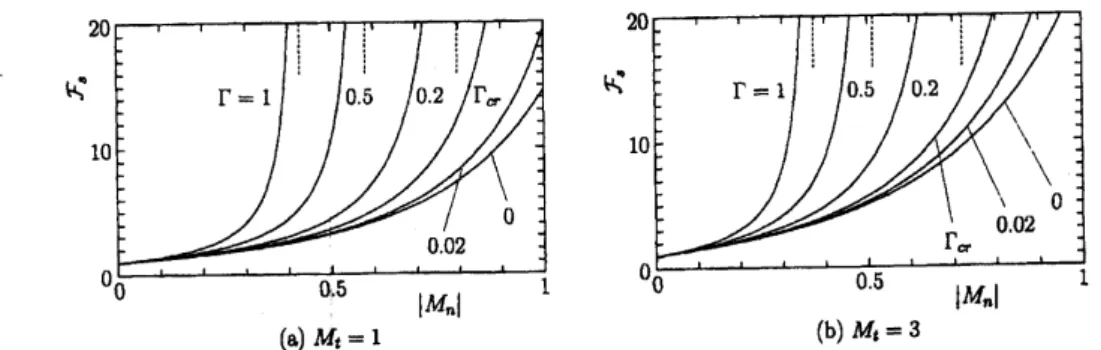
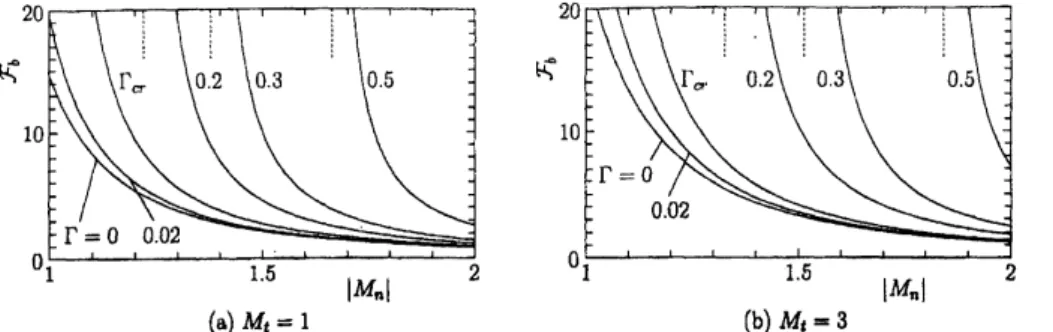
The functions$F_{s}$ and $F_{b}$are, respectively, monotonically increasinganddecreasingfunctionsin $|M_{n}|$
.
For $0\leq\Gamma<\Gamma_{cr}$, where $\Gamma_{cr}$ is acritical value depending on $T_{\infty}/T_{w}$ and $M_{t}$, the
$F_{s}$ and $F_{b}$ meet at
$|M_{n}|=1$
,
i.e., $F_{s}(1_{-}, M_{t}, T_{\infty}/T_{w}, \Gamma)=F_{b}(1_{+}, \mathrm{A}’I_{t}, T_{\infty}/T_{w}, \Gamma)$.
In this case, Eqs. (49a) and (49b)shouldbe supplementedby
$\frac{p_{\infty}^{A}}{p_{\epsilon}^{A}}\geq F_{B}$
(
$1_{-}$,$M_{t}$,$\frac{T_{\infty}}{T_{w}}$,$\Gamma$),
$(|M_{n}|=1)$.
(51) For $\Gamma\geq\Gamma_{\mathrm{c}r}$, the $F_{\delta}$ and $F_{b}$ increase infinitelyas
$|M_{n}|arrow c_{S}(\leq 1)$ and $|\Lambda’I_{n}|arrow c_{b}(’-\backslash 1)$, respectively,where $c_{s}$ and $c_{b}$ depend
on
$M_{t}$, $T_{\infty}/T_{w}$, and$\Gamma$, and $\mathrm{c}_{S}=c_{b}=1$ when $\Gamma=\Gamma_{cr}$. The functions $F_{s}$ and $F_{b}$
were
constructed numerically inSone et al. [53],Aoki and Doi [54], Taguchi et al. $[39, 60]$, where thenumerical dataofthe corresponding functionsfor the
pure-vapor case
(Sone et al. [55], Aoki et al. [56],Aoki et al. [47]$)$, obtained by using the BGK model,
were
exploited, and additional computationswere
carriedout by theuse ofthemodel Boltzmann equation foramixture proposed by
Garz6
et al. [40]. (Itshould benoted that the $\Gamma$-dependence of$F_{s}$ and $F_{b}$ is obtainedexplicitly.) As an example, $F_{s}$ and$F_{b}$
the
case
of $T_{\infty}/T_{w}=1$ (see Taguchi et al. [39, 60] for the details). The numerical results in Taguchi etal. $[39, 60]$show that the dependence of$F_{\epsilon}$ and$F_{b}$ on $\mathrm{J}/I_{t}$ and$T_{\infty}/T_{w}$ is weak, as in thepurevapor
case
$(\Gamma=0)$ (Aoki et al. [47]). Some data obtained by aDSMC computation for hard-sphere gases indicate
that arelation of the same form as Eq. (49a) holds in the general case where themolecules ofthe two
components aredifferent (i.e., different masses anddiameters) (see Taguchi et al. [39]).
The numericalresultsbyTaguchiet al. $[39, 60]$showthat in this half-spaceproblemofcondensation,a
macroscopic flow ofthenoncondensablegasiscausedalongthe condensedphaseinthe positive$X_{2}$
direc-than when $v_{2\infty}>0$, but it is notwhen $v_{2\infty}=0$
.
That is, the direction of theflow of thenoncondensablegas along the condensed phase is the
same
as the direction of the component of the flow velocity of thevapor parallel to thecondensed phaseat infinity. Let$N_{f}$ be the particle flow of the noncondensablegas
in the positive$X_{2}$ directionper unit time and unit width in$X_{3}$ and$\hat{N}_{f}$ be its dimensionless counterpart
definedby
$\hat{N}_{f}=(2/\sqrt{\pi})[n_{\infty}^{A}\ell_{\infty}(2kT_{\infty}/m^{A})^{1/2}]^{-1}Nf$
.
(52)Notethat$m^{B}N_{f}$ is the totalmomentum of the$B$-molecules contained in the column usedin thedefinition
of$N^{B}$ [seethe sentence below Eq. (50)].
Since
$\hat{N}_{f}$ isdeterminedbyasolutionof thehalf-space problem, its dependence of the parameters is given as follows.$\hat{N}_{f}=G_{s}$
(
$|M_{n}|$,$M_{t}$,$\frac{T_{\infty}}{T_{w}}$,$\Gamma$),
$(|M_{n}|<1)$, (53a)$\hat{N}_{f}=G_{b}$
(
$|M_{n}|$,$NI_{t}, \frac{T_{\infty}}{T_{w}})\frac{p_{\infty}^{A}}{p_{s}^{A}}$,$\Gamma)$, $(|M_{n}|\geq 1)$, (53b)where $G_{s}=G_{b}=0$at $NI_{t}=0$because$\hat{N}_{f}$ vanishes when $v_{2\infty}=\mathrm{C}1$ The functions $G_{s}$ and $G_{b}$ obtained
numericallyaregiven inTaguchi etal. $[39, 60]$
.
To bemore precise, $G_{b}$ has beenobtainedinarestrictedmanner
because it is afunction of five variables. On the otherhand, $G_{s}$ turns out to beoftheform $G_{s}=\Gamma \mathcal{G}(|l\mathcal{V}I_{n}|, M_{t}, T_{\infty}/T_{w})$, (54)in the
case
where themolecules ofthe two componentsaremechanically thesame.
Thefunction$\mathcal{G}$basedon the model Boltzmann equation by
Garz6
et al., whichwas
found to be almost independent of $|M_{n}|$and$T_{\varphi}/T_{w}$, is shown for $|\Lambda/I_{n}|=0.1$ and$T_{\infty}/T_{w}=1$ in Fig. 3.
3.4
Boundary
condition
for the Euler equations
The relations (47), (49a), and (49b) [and (51)]giveninSec.3.3essentiallyprovide theboundarycondition
for the Euler set of equations $(24\mathrm{a})-(24\mathrm{d})$
.
One onlyneeds to rewrite thembytheuse
of the variables inSec.
3.1.
First,noting that$n^{B}$ in Eq. (50) corresponds to$n_{r}\hat{n}_{0}^{B}$, we obtainthe following relation between$\Gamma$ and $\tilde{\Gamma}$
[Eq. (44)]:
$\Gamma=\frac{\ell_{r}}{(\hat{n}_{H0}^{A})_{b}\ell_{b}}\int_{0}^{\infty}(\int\hat{F}_{0}^{B}\mathrm{d}^{3}\zeta)\mathrm{d}\eta=\frac{\ell_{r}}{(\hat{n}_{H0}^{A})_{b}\ell_{b}}\tilde{\Gamma}$, (55)
where, $\ell_{b}$ is the mean free path of the vapor molecules in the equilibrium state at rest with number
density $n_{r}(\hat{n}_{H0}^{A})_{b}$ and temperature $T_{r}(\hat{T}_{H0})_{b}$
.
Since
$\Gamma-$
does not depend
on
the local state of thevapor[such as $(\hat{n}_{H0}^{A})_{b}$ and $l_{b}$], it is preferable to use
$\tilde{\Gamma}$
rather than $\Gamma$ as aquantity related to the amount of thenoncondensable gasin theKnudsen layer. Then,the boundary conditions canbesummarized in the following form: the conditions
on
the evaporating surface, where$M_{n}>0$,are
$M_{t}=0$, $M_{n}\leq 1$,
(52)
$(\hat{p}_{H0}^{A})_{b}/\hat{p}_{w}^{A}=h_{1}(M_{n})$, $(\hat{T}_{H0})_{b}/\hat{T}_{w}=h_{2}(M_{n})$,
andthose
on
the condensingsurface,where $M_{n}<0$, are$\frac{(\hat{p}_{H0}^{A})_{b}}{\hat{p}_{w}^{A}}=F_{\epsilon}$
(
$|M_{n}|$,
$M_{t}$,
$\frac{(\hat{T}_{H0})_{b}}{\hat{T}_{w}}$,$\frac{\ell_{r}}{(\hat{n}_{H0}^{A})_{b}\ell_{b}}\tilde{\Gamma}$
),
$(|M_{n}|<1)$,
(57a) $\frac{(\hat{p}_{H0}^{A})_{b}}{\hat{p}_{w}^{A}}>F_{b}$(
$|M_{n}|$,
$M_{t}$,
$\frac{(\hat{T}_{H0})_{b}}{\hat{T}_{w}}$,Here,
$\mathbb{J}I_{n}=\sqrt{6/5}(\hat{T}_{H0})_{b}^{-1/2}(\hat{v}_{jH0})_{b}n_{\gamma}$ , (58a)
$I\mathrm{v}I_{t}=\sqrt{6/5}(\hat{T}_{H0})_{b}^{-1/2}|(\hat{v}_{vH0})_{b}-\hat{v}_{wi}-(\hat{v}_{jH0})_{b}n_{j}n_{i}|$
.
(58b)Equations (57a) and (57b) are supplemented by
$\frac{(\hat{p}_{H0}^{A})_{b}}{\hat{p}_{w}^{A}}\geq F_{s}$
(
$1_{-}$,$M_{t}$,$\frac{(\hat{T}_{H0})_{b}}{\hat{T}_{w}}$,$\frac{\ell_{r}}{(\hat{n}_{H0}^{A})_{b}\ell_{b}}\tilde{\Gamma}$),
$(|M_{n}|=1)$, (59) when $\tilde{\Gamma}<(\hat{n}_{H0}^{A})_{b}\ell_{b}\ell_{r}^{-1}\Gamma_{cr}$.
In the
case
of apure vapor (or in the case of $\overline{\Gamma}=0$), Eqs. (56)-(57b), and (59)are
known to beconsistent boundary conditions (Aoki and Sone [6], Sone [4, 5]). Inthe spatially $\mathrm{o}\mathrm{n}\mathrm{e}rightarrow \mathrm{d}\mathrm{i}\mathrm{m}\mathrm{e}\mathrm{n}\mathrm{s}\mathrm{i}\mathrm{o}\mathrm{n}\mathrm{a}\mathrm{l}$case,
such as the tw0-surfaceproblem of evaporation and condensation, $\tilde{\Gamma}$
is
aconstant
that can be specified(see Aoki et al. [18] and Aoki [21]), and therefore thesituation is essentiallythesame as thatin the pure
vapor case. However,in thegeneralgeometry, $\overline{\Gamma}$
isnot a
constant
buta
function of$\chi_{1}$ and $\chi_{2}$, as isseen
fromEq. (44). Inotherwords, $\tilde{\Gamma}$varies
along theboundary. Therefore, an additional relation is required
as theboundary condition on the condensing surface. This relation isprovided by Eq. (41) [or Eq. (43)
forthe
tw0-dimensional
case], i.e.,$\chi_{1,1}\frac{\partial}{\partial\chi_{1}}(\hat{N}_{\mathrm{t}0}t_{i}^{(1)})+\chi_{2,2}\frac{\partial}{\partial\chi_{2}}(\hat{N}_{i0}t_{i}^{(2)})+g_{2}\hat{N}_{i0}t_{i}^{(1)}-g_{1}\hat{N}_{i0}t_{i}^{(2)}=0$ , (60)
if we havethe relation between$\hat{N}_{i0}$ and $\tilde{\Gamma}$
.
Here, letus note thefollowing correspondence between$\hat{N}_{i0}^{*}$ [Eq. (45)] and $\hat{N}_{f}$ [Eq. (52)]:
$(\sqrt{\pi}/2)n_{r}(2kT_{r}/m^{A})^{1/2}\ell_{r}|\hat{N}_{i0}^{*}|\Leftrightarrow(\sqrt{\pi}/2)n_{\infty}^{A}(2kT_{\infty}/m^{A})^{1/2}\ell_{\infty}\hat{N}_{f}$
.
(61)UsingEqs. (53a) and (53b) andtakingintoaccount thestatement above Eq. (52), we canwrite
$\hat{N}_{i0}=\hat{v}_{wi}\overline{\Gamma}+\frac{\ell_{b}}{\ell_{r}}(\hat{n}_{H0}^{A})_{b}(\hat{T}_{H0})_{b}^{1/2}G_{s}(|NI_{n}|,$ $M_{t}$,$\frac{(\hat{T}_{H0})_{b}}{\hat{T}_{w}}$,$\frac{\ell_{r}}{(\hat{n}_{H0}^{A})_{b}\ell_{b}}\tilde{\Gamma})a_{i}$, $(|\mathbb{J}/I_{n}|<1)$, (62a)
$\hat{N}_{i0}=\hat{v}_{w\mathrm{i}}\tilde{\Gamma}+\frac{\ell_{b}}{\ell_{r}}(\hat{n}_{H0}^{A})_{b}(\hat{T}_{H0})_{b}^{1/2}G_{b}(|M_{n}|,$ $M_{t}$,$\frac{(\hat{T}_{H0})_{b}}{\hat{T}_{w}}$,$\frac{(\hat{p}_{H0}^{A})_{b}}{\hat{p}_{w}^{A}}$,$\frac{\ell_{r}}{(\hat{n}_{H0}^{A})_{b}\ell_{b}}\overline{\Gamma})a_{i}$, $(|M_{n}|\geq 1)$, (62b) where $a_{i}$ is aunit vectordefined by
3.5
Continuum
limit
Now let us discuss the continuum limit where $\epsilon$ (or Kn) goesto zero. In this limit, the thickness of the
Knudsen layer vanishes, and thevelocitydistribution function ofeachcomponent reduces to the
leading-order term of the Hilbert expansion except on the boundary, i.e., $F\wedge Aarrow\hat{F}_{H0}^{A}$ and $\hat{F}^{B}arrow 0$
.
The $\hat{n}_{H0}^{A}$$(=\hat{\rho}_{H0}^{A}),\hat{v}_{iH0}$, and$\hat{T}_{H0}$ occurring in $\hat{F}_{H0}^{A}$ [Eq. (16)] are determined by the Euler set, Eqs. $(24\mathrm{a})-(24\mathrm{d})$,
and the boundary conditions, Eqs. (56), (57a), (57b), $[(59)]$, (60), (62a), and (62b). Onthe other hand,
it follows from Eq. (10) that $n_{av}^{B}/n_{r}arrow 0$ in this limit. In otherwords, the average concentration of the
noncondensable gas over the whole domain becomes infinitelysmall. (This is consistent with $\hat{F}^{B}arrow 0.$)
Therefore, it would
seem
that the effect ofthe noncondensable gas disappears in this limit. However, ifwe look at the boundary condition on the condensing surface, Eqs. (57a), (57b), and (59), then wenotice that it depends
on
$\tilde{\Gamma}$, which is related to the noncondensable gas and is of the order of unity, independent of$\epsilon$
.
Thismeans that in the continuumlimit, the overall vapor flow is stillaffected by thenoncondensablegasthrough theboundary condition on the condensing surface, inspite of the fact that the averageconcentrationof the noncondensable gas is infinitesimal.
The physical picture ofthis situationis as follows. Beingblown bythe overwhelmingvaporflow, the
noncondensable gas ofan infinitesimal concentration accumulates in athickless Knudsen layer on the
condensing surface, where itslocal number density becomes comparable tothat ofthevapor, and has a
significanteffectonthe condensing vapor flow. This factwaspointed outbyAoki et al. [18]for the simple
twosurface problem, i.e., avapor flow caused by evaporation and condensation inthe gap betweentwo
parallelplanecondensedphases. Inconnection with the two surfaceproblem,itshouldbementioned that
an
interesting experiment tomeasure
the temperature distribution between the two condensed phaseswasperformed byShankarand Deshpande$[61, 62]$
.
Their aimwas
to perform themeasurementinapurevapor flow, butthe effect of the impurity, i.e., the presence of asmall amountofthenoncondensable
gas,
is alsodiscussed in Shankarand Deshpande [62].
3.6
Case
of
an
infinite
domain
In thissubsection,we give ashort commentonthecaseofaninfinite domain. As is
seen
from thecourse
of analysis, the results obtained in Sees. 3.1-3.5 are also valid in the case of an infinite domain, more
precisely,in the
case
where there isaflowof the vaporin an infinitedomain, andthenoncondensable gasisconfined inthe Knudsenlayeron (apart of) the boundarywherecondensationis taking place. That is,
the
vapor
flowin thissituation is described by the Euler set$(24\mathrm{a})-(24\mathrm{d})$ andtheboundaryconditions (56)on
theevaporatingsurfaceand $\backslash /57\mathrm{a}$)and (57b) [and (59)] with (60), (62a), and (62b) on thecondensingsurface, supplemented by the boundary condition at infinity. Only the difference is that $n_{av}^{B}$ has
no
more sense, so that the amount ofthe noncondensable gas should be specified in adifferent way. For example, letus suppose thatthenoncondensable
gas
is presentonly in the part$\mathrm{S}$withafiniteareaoftheboundary. Then, we canobtain suchasolutionof the Eulersystem byspecifying thetotalnumberof the
noncondensable gas molecules,say $M^{B}$
.
In fact, it is related to $\tilde{\Gamma}$as$M^{B}=( \sqrt{\pi}/2)n_{r}\ell_{r}L^{2}\int_{\mathrm{S}}\tilde{\Gamma}\mathrm{d}a$, where
da isasurface elementon the boundary inthedimensionless $x_{i}$ space, andthis gives aconstraint
on
$\tilde{\Gamma}$
.
However, asin thecaseof aclosed domain, aspecified value of$M^{B}$ does not guarantee aunique solution.
In the continuum limit, the average concentrationof thenoncondensable gas becomesinfinitesimal in a
subdo main with the extent of$L$ thatcontains thepart $\mathrm{S}$of the boundary.
4Application
Inthissectionwegive
an
applicationofthe Euler set of equations and their boundaryconditions derived in the previous section. Theproblemthatwe are
going to investigate isas
follows.Consider avapor ($A$-component)inagap betweentwocondensed phasesat rest,
one
is of sinusoidalshape located at $X_{1}=A\cos(\pi X_{2}/L)$
,
and the other is aplane located at $X_{1}=L$, whereXi
is a(dimensional) coordinate system (Fig. 4). Let the temperatureofthe sinusoidal condensed phasebe$T_{I}$
and that of the plane
one
be$T_{II}$, and let the saturation vapor pressure at temperature$T_{I}$ be$pI$ andthatat temperature $T_{II}$ be$p_{II}$
.
Asmallamount of anoncondensablegas ($B$-component)iscontained in thegap,
as
specified below. Let $n_{av}^{B}$denote theaverage molecularnumber densityofthe noncondensablegas
condensedphases and the effect of thenoncondensable gas on the vapor flow when the Knudsen number
Kn (with respect to thevapor) going tozero (continuum limit).
Here, we take $L$ as the reference length and $T/$, $p_{I}$, and $n_{I}=p_{I}/kT_{I}$ as the reference quantities
($T_{r}=T_{I}$,$p_{r}=p_{I}$,and$n_{r}=n_{I}$). The problem is characterizedbythefollowingdimensionless parameters:
$\frac{T_{II}}{T_{I}}$, $\frac{p_{II}}{p_{I}}$,
$\frac{A}{L}$, $\mathrm{K}\mathrm{n}=\frac{\ell_{r}}{L}$, $\frac{n_{av}^{B}}{n_{I}}$, (64)
where $\ell_{r}$ is the mean free path of the molecules of thevapor when it is in the equilibrium state at rest
with temperature $T_{I}$ andpressure$p_{I}$
.
Tobe consistent with Eq. (10),weput$n_{av}^{B}/n_{I}=\Delta \mathrm{K}\mathrm{n}$, (65)
and specify $\Delta$rather than$n_{av}^{B}/n_{I}$
.
We
assume
that the flow field is periodic(with period$2L$) in the$X_{2}$ direction and issymmetric withrespect to the $X_{1}$ axis. Therefore,
we
may consider the problem in the closed domain$A$$\cos(\pi X_{2}/L)\leq X_{1}\leq L$, $0\leq X_{2}\leq L$, (66)
imposingthe specular reflection condition
on
$X_{2}=0$and$L$.
Now let us apply the Euler set of equations and its boundary conditions to the present problem.
We considerthecase where evaporation ofthe vaporis taking placeon the plane condensed phase and
condensation
on
the sinusoidal condensed phase. In this two dimensionalproblem, Eq. (43) holds along the lattercondensed phase. But$\hat{N}_{i0}t_{t}=0$ at $X_{2}=0$ and$L$ (or $x_{2}=0$ and 1) becauseofthe specularly reflecting boundary. Therefore, $\hat{N}_{i0}t_{i}=0$ holds identically. It follows from Eqs. (62a) and (62b) (with $\hat{v}_{wi}=0)$ and the property of $G_{s}$ and $G_{b}$ that $NI_{t}=0$on
the condensingsurface if$\tilde{\Gamma}\neq 0$there. Let us
restrictourselves to thecasewhere $|M_{n}|<1$
.
ThentheboundaryconditionfortheEuler set $(24\mathrm{a})-(24\mathrm{d})$is Eq. (56), i.e.,
$M_{\mathrm{t}}=0$, $( \hat{p}_{H0}^{A})_{b}arrow-\frac{p_{II}}{p_{I}}h_{1}(NI_{n})$, $( \hat{T}_{H0})_{b}=\frac{T_{II}}{T_{I}}h_{2}(M_{n})$, (67)
on the planecondensed phase ($x_{1}=1$;note that $\hat{p}_{w}^{A}=p_{II}/p_{I}$ and $\hat{T}_{w}=T_{II}/T_{I}$ there) and Eq. (57a)
with $M_{\mathrm{t}}=0$, i.e.,
$(p_{H0}^{A})_{b}=F_{s}(|M_{n}|$,0,$(\hat{T}_{H0})_{b}$
,
$\frac{\ell_{r}}{(\hat{n}_{H0}^{A})_{b}\ell_{b}}\tilde{\Gamma})$, (68)on the sinusoidal
condensed
phase [$x_{1}=(A/L)\cos(\pi x_{2})$;note that$\hat{p}_{w}^{A}=\hat{T}_{w}=1$ there]. It shouldbenoted that$\tilde{\Gamma}$
canbezero in acertain partofthe sinusoidal condensed phase, where weshould use
$(\hat{p}_{H0}^{A})_{b}=F_{s}(|M_{n}|$,$M_{t}$,$(\hat{T}_{H0})_{b}$,$0)$, (69)
no
restriction being imposedon
$M_{t}$.
These boundary conditions are supplemented by the condition$\hat{v}_{2H0}=0$, which correspondstothe specular reflectioncondition,
on
$x_{2}=0$ and 1. Finally we need therelation betweenA and $\tilde{\Gamma}$
, which is,as described below,given by
A$= \frac{\sqrt{\pi}}{2}\int\tilde{\Gamma}\mathrm{d}\mathrm{s}$, (70)
where $\mathrm{d}s$ is the line element along the sinusoidal boundary in the
dimensionless
$x_{1}x_{2}$ pkne, md therange
of integration is from $x_{2}=0$ to 1. This relation isobtained
by noting that $(\sqrt{\pi}/2)n_{r}\ell_{\mathrm{r}}\tilde{\mathrm{r}}$ isthe total number of the
noncondensable
gas in the Knudsen layer per unitarea
of the boundary [aee Eq. (44) and the sentence following Eq. (46)$]$ and that itstotal number in the entire domain per unit widthin X3, i.e., $n_{av}^{B}L^{2}$, is therefore given by $( \sqrt{\pi}/2)n_{r}\ell_{r}L\int\overline{\Gamma}\mathrm{d}s$.
The ratio$\ell_{r}/\ell_{b}$ occurring inEq. (68)
dependson the molecular model; for example, $\ell_{r}/\ell_{b}=(\hat{n}_{H0}^{A})_{b}$ for hard-sphere molecules [cf. Eq. (4)],
and $\ell_{r}/\ell_{b}=(\hat{n}_{H0}^{A})_{b}/(\hat{T}_{H0})_{b}^{1/2}$for the BGK model.
We solve this boun $\mathrm{a}\mathrm{r}\mathrm{y}$-value problem for the Euler set of equations numerically. In Fig. 5, the stream
lines of$\hat{v}.\cdot H0$ forA $=0$ (pure vapor case)and 2are shown in thecasewhere$A/L=0.2$,
$p_{II}/p_{I}=2$. Figure 6, where theresult for $\Delta=4$ is alsoincluded, shows thedistribution of$\overline{\Gamma}$
alongthe
sinusoidalcondensed phase in thesame case as Fig. 5. Here, we have assumed that thevapor molecules
are
mechanically identical with the noncondensable-gas molecules and used the numerical data ofthe functions$h_{1}$ and $h_{2}$ based ontheBGK model (TableI) and those of thefunction $F_{s}$ based onthe modelBoltzmann equation by Garzo et $\mathrm{a}1$, which is consistent with the BGK model for asingle component
case
(see Fig. 1forsome
examplesof$F_{s}$). Therefore,we
have used the relation$\ell_{r}/\ell_{b}=(\hat{n}_{H0}^{A})_{b}/(\hat{T}_{H0})_{b}^{1/2}$in Eq.
{68).
Ifthe explicit form of the boundary is used, Eq. (70) becomes$\Delta=\frac{\sqrt{\pi}}{2}\int_{0}^{1}\overline{\Gamma}\sqrt{1+(\pi A/L)^{2}\sin^{2}(\pi x_{2})}\mathrm{d}x_{2}$, (71)
where $\tilde{\Gamma}$
is considered to be afunction of$x_{2}$
.
Figure 5showsthe leading-0rderflow field of the vapor for small Kn, whichis at the
same
time the flowfield in the continuumlimit, $\mathrm{K}\mathrm{n}arrow \mathrm{O}$.
In this limit, theaverageconcentrationofthenoncondensablegas becomes infinitesimal because of Eq. (65). However, the flow properties still depend on $\tilde{\Gamma}$,
which is the $\mathrm{t}\mathrm{r}\mathrm{a}\mathrm{c}\mathrm{e}$ofthe noncondensable gas. In fact, the stream lines for $\Delta=2$ are distinct from those for
the
pure vapor flow
$(\Delta=0)$.
In the former case, thestream lines enterthe sinusoidal condensed phase perpendicularly because of the condition (68), i.e., $M_{t}=0$, whereas in the latter case, they enter thesame condensedphaseobliquely because of Eq. (69),whichis theconditionthere in thepure vapor
case.
The pattern of the stream lines for $\Delta=4$, which are not shown in Fig. 5, is quite similar to that for
$\Delta=2$, but the flow speeds at the corresponding points
are
different. Inthis way,an
infinitesimalaverage
concentration (orthe$\mathrm{t}\mathrm{r}\mathrm{a}\mathrm{c}\mathrm{e}$) of thenoncondensable gas has adramatic effect
on
the overall vapor flow.Adirect numerical simulation, based on the original Boltzmann system, of the
same
problem has been carried out for relatively small Kn byAoki et al. [28], where bothcomponents are assumed to behard-sphere gases, and the direct simulation Monte Carlo (DSMC) method (Bird [63, 64]) is employed
as the solution technique. Although it is hard to draw adefinite conclusion about the behavior in the
continuum limit from the DSMC computation,the result isconsistent with the present result; in fact, it
gave aproper guideline for the asymptotic analysis in Sec. 3. The difficulty in the simulation for small
Kn in the problem arises from the fact that,
as
Kn becomessmall, thenoncondensable gas is localized inside the Knudsen layer, the thickness of which becomes small as well.Since
the overall flow field isaffected by the localized noncondensable
gas,
its accurate description is required. For this purpose,we
need avery finecellnear the condensing surface with asufficientnumber of simulationparticles for the
noncondensable gas. This makes the size of the simulation system very large. This fact confirms the
usefulnessof the fluid-dynamic descriptionbased onthe Euler set and its boundary condition.
5Concluding remarks
In the present paper, we have investigated,
on
the basis of kinetic theory, steadyflows of avaporwithevaporation and condensation on the boundary, consisting of the condensed phase of thevapor, in the
presenceofanoncondensable gas under the condition thattheKnudsennumber withrespectto the vapor
is small and that the average concentration of the noncondensablegas is also small and is ofthe order
of the Knudsen number (see Sec. 2.1). The conventional boundary condition (complete condensation
condition) for the vapor and the diffusereflection condition for thenoncondensable
gas
were employedas theboundarycondition
on
theboundary. Aftertheformulationof theproblemin Sec. 2,asystematicasymptotic analysis for small Knudsen numbers
was
carried out inSec.
3, where the fluid-dynamicequations (the Euler set of equations) for thevapor and their appropriate boundary conditions on the
boundary
were
derivedforthe leading-0rder (orzeroth-0rder) terms in theKnudsen number. In deriving the boundary conditions,the previously known results for half-space problems have been exploited. Onthe basis of this system, we discussed the behavior of the continuum limit, i.e., the limit where the Knudsennumbervanishes, inSec. 3.5. There, it was shown thatan infinitesimal averageconcentration of
thenoncondensable gas mayhave asignificant effectontheoverall vaporflow. Anexampledemonstrating
suchan effectwasgiven inSec. 4.
The Euler set of equations and its boundary condition presented here give aclear understanding of
the behavior of the vapor and the noncondensable
gas
in thenear
continuum regime as well as in thecontinuumlimit. Forexample,thedistribution of thenoncondensable
gas
(orits$\mathrm{t}\mathrm{r}\mathrm{a}\mathrm{c}\mathrm{e}$),which is confinedtheboundarycondition there. The Euler systemis also usefulin practical applicationsbecausethedirect numerical computationbasedonthe kinetic syste$\mathrm{m}$for thistype ofproblem israther hard ingeneral. For
themoment,the available numericalboundary condition onthe condensingsurface hassomelimitations.
More specifically, the numerical values of the functions $F_{s}$, $F_{b}$, $G_{s}$, and $G_{b}$ occurring in the boundary
condition areavailableonlyfor amodel Boltzmannequation and in aspecialcasewhere the moleculeof thevaporand that of thenoncondensable gas are mechanicallyidentical. But the qualitative structureof
the boundary condition is most likely tobe the same in the general case. Theextension and enrichment
ofthe numerical data for these functions would upgrade the applicability of thefluid-dynamic system.
Acknowledgements
Some ofthe results of this work
were
presented at theconferencein honorofClaudeBardos, HydrodynamicLimits: Results aPerspectives, heldat InstitutHenriPoincare (IHP) in ParisonSeptember 24-28, 2001.
$\mathrm{K}.\mathrm{A}$
.
expresses
his cordial thanks to Prof. F.Golse
for the invitation to IHP valuable discussions, and hospitality. This paper was finished while $\mathrm{K}.\mathrm{A}$.
was visiting theDepartment ofMathematics, Chalmers University of Technology in Goteborg. He alsoexpresses
his hearty thanks to Prof. L. Arkeryd fortheinvitation, stimulating discussions, and hospitality. $\mathrm{K}.\mathrm{A}$
.
also wishes to thank Prof. A. V. Bobylevforvaluable discussions. Th anks of the authorsarealso due toProf. Y.Sonefor hiscontinued encouragement and support.
Appendix AHilbert expansion of
the
macroscopic
quantities
In this appendix,
we
givesome of the expressions ofthecoefficients
$h_{Hm}^{\alpha}$ and $h_{Hm}$ intermsof$\hat{F}_{Hm}^{\alpha}$
.
$\hat{n}_{Hm}^{\alpha}=\int\hat{F}_{Hm}^{\alpha}\mathrm{d}^{3}\zeta$, $\hat{\rho}_{Hm}^{\alpha}=\hat{m}^{\alpha}\hat{n}_{Hm}^{\alpha}$, $(m=0,1, \ldots)$, (Ala)
$\hat{v}^{\alpha_{H0}}.\cdot=(1/\hat{n}_{H0}^{\alpha})\int\zeta:\hat{F}_{H0}^{\alpha}\mathrm{d}^{3}\zeta$, (Alb) $\hat{p}_{H0}^{\alpha}=\hat{n}_{H0}^{\alpha}\hat{T}_{H0}^{\alpha}=\frac{2}{3}\hat{m}^{\alpha}\int(\zeta_{i}-\hat{v}_{tH0}^{\alpha})^{2}\hat{F}_{H0}^{\alpha}\mathrm{d}^{3}\zeta$, (Alc) $\hat{v}_{iH1}^{\alpha}=(1/\hat{n}_{H0}^{\alpha})\int\zeta_{t}\hat{F}_{H1}^{\alpha}\mathrm{d}^{3}\zeta-(\hat{n}_{H1}^{\alpha}/\hat{n}_{H0}^{\alpha})\hat{v}_{iH0}^{\alpha}$, (Ald) $\hat{p}_{H1}^{\alpha}=\hat{n}_{H0}^{\alpha}\hat{T}_{H1}^{\alpha}+\hat{n}_{H1}^{\alpha}\hat{T}_{H0}^{\alpha}=\frac{2}{3}\hat{m}^{\alpha}\int(\zeta_{i}-\hat{v}_{iH0}^{\alpha})^{2}\hat{F}_{H1}^{\alpha}\mathrm{d}^{3}\zeta$, (Ale)
. . .
’$\hat{n}_{Hm}=\sum_{\beta=A,B}\hat{n}_{Hm}^{\beta}$, $\hat{\rho}_{Hm}=\sum_{\beta=A,B}\hat{\rho}_{Hm}^{\beta}$, $(m=0,1, \ldots)$,
$(\mathrm{A}2\mathrm{a})$ $\hat{v}_{iH0}=(1/\hat{\rho}_{H0})\sum_{\beta=A_{1}B}\beta_{H0}^{\beta}\hat{v}_{\dot{\iota}H0}^{\beta}$, $(\mathrm{A}2\mathrm{b})$ $\hat{p}_{H0}=\hat{n}_{H0}\hat{T}_{H0}=\sum_{\beta=A,B}[\hat{p}_{H0}^{\beta}+\frac{2}{3}\hat{\rho}_{H0}^{\beta}(\hat{v}_{iH0}^{\beta}-\hat{v}_{\dot{n}H0})^{2}]$ , $(\mathrm{A}2\mathrm{c})$ $\hat{v}_{iH1}=(1/\hat{\rho}_{H}0)\sum_{\beta=A,B}(\hat{\rho}_{H0}^{\beta}\hat{v}_{iH1}^{\beta}+f_{H1iH0}\wedge\hat{v}^{\beta})-(\hat{\rho}H1/\hat{\rho}_{H}0)\hat{v}_{iH0}$ , $(\mathrm{A}2\mathrm{d})$ $\hat{p}_{H1}=\hat{n}_{H0}\hat{T}_{H1}+\hat{n}_{H1}\hat{T}_{H0}$ $= \sum_{\beta=A,B}\{\wedge l_{H1}+\frac{2}{3}[\hat{\rho}_{H1}^{\beta}(\hat{v}_{\dot{\iota}H0}^{\beta}-\hat{v}_{jH0})^{2}+2^{\wedge}f_{H0}(\hat{v}_{iH0}^{\beta}-\hat{v}_{\dot{\mathrm{t}}H0})(\hat{v}_{\dot{\mathrm{t}}H1}^{\beta}-\hat{v}_{iH1})]\}$ , $(\mathrm{A}2\mathrm{e})$
Here, $\hat{T}_{H0}^{\alpha},\hat{T}_{H1}^{\alpha},\hat{T}_{H0}$, and $\hat{T}_{H1}$
are
defined by Eqs. (Ale), (Ale),Appendix B
Reasoning of assumption (25)
Suppose that the leading-0rder vapor flow $\hat{v}_{iH0}$ has beenestablished. FromEqs. (18) and (Aid) $(\alpha=B)$
multipliedby$\hat{n}_{H0}^{B}$, thefirst-0rderparticle flux ofthenoncondensable gasis
$\hat{n}_{H1}^{B}\hat{v}_{iH0}^{B}=\int\zeta_{i}\hat{F}_{H1}^{B}\mathrm{d}^{3}\zeta$, which
turns out to be equal to $\hat{n}_{H1}^{B}\hat{v}_{iH0}$ ifEq. (20) is used. Let us suppose that $\hat{n}_{H1}^{B}$ is not identically zero.
Then, wehave$\hat{v}_{iH0}^{B}=\hat{v}_{iH0}$ in the regionwhere$\hat{n}_{H1}^{B}\neq 0$(note that the leading-0rder flowvelocity
$\hat{v}_{iH0}^{B}$ is
determinedthrough thefirst-0rdervelocitydistribution function $\hat{F}_{H1}^{B}$). This corresponds to the physical
situation that asmall amount of the noncondensable gas $(\hat{n}_{H1}^{B}\epsilon)$ is carried by the leading-0rder vapor flow $(\hat{v}_{iH0})$. Ifwe integrateEq. (15) with $\alpha=B$ and$m=2$ overthewhole space of
$\langle$, we obtain
$\int\zeta_{J}\frac{\partial\hat{F}_{H1}^{B}}{\partial x_{J}}\mathrm{d}^{3}\zeta=0$, (B1)
bec $\mathrm{n}\mathrm{e}\hat{J}^{\beta\alpha}$does not contribute to this integration. [Equation (B1) is apartofthe solvability condition
fortheequations for $\hat{F}_{H2}^{\alpha}.$] Equations (20) and (B1) give the continuity equation
$\frac{\partial\hat{n}_{H1}^{B}\hat{v}_{fH0}}{\partial x_{j}}=0$
.
(B2) Because ofEq. (24a),we can transform Eq. (B2) into$\hat{v}_{jH0^{\frac{\partial}{\partial x_{j}}(\frac{\hat{n}_{H1}^{B}}{\hat{n}_{H0}^{A}})}}=0$, (B3)
which
means
that $\hat{n}_{H1}^{B}/\hat{n}_{H0}^{A}=const$, along astream line. Therefore, if$\hat{n}_{H1}^{B}$ vanishes at apoint ona
stream line, then $\hat{n}_{H1}^{B}=0$ holds
on
the entire stream line.Astream line of the leading-0rder vapor flow Vino either (i) starts from the evaporating surface
or
(ii) forms aclosed loop in the case of aclosed domain. Let us consider the case (i). Since
we
havenot assumed that $\hat{n}_{H1}^{B}\equiv 0$ (or $\hat{F}_{H1}^{B}\equiv 0$) in the present discussion, the $\hat{F}_{K1}^{B}$ in the right-hand side of
Eq. (38) should be replaced by $(\hat{F}_{H1}^{B})_{b}+\hat{F}_{K1}^{B}$
.
However, this replacement does not affect Eq. (39). Letus
recallthat, on the evaporating surface where$v\wedge\dot{\mathrm{t}}H0n_{i}>0$, the Knudsen layer in the leading order doesnot containthe
noncondensable
gas, namely$\hat{F}_{K0}^{B}=0$ (see the fourth paragraph inSec. 3.3). Therefore,Eq. (39) reducesto $\partial(\Phi_{iK1}n:)/\partial\eta=0$, whichleads to $\Phi_{iK1}n_{i}=\int\zeta_{\dot{1}}n_{i}\hat{F}_{K1}^{B}\mathrm{d}^{3}\zeta=0$because$\hat{F}_{Km}^{B}arrow 0$
as
$\etaarrow\infty$
.
Further, $\int\zeta:n_{i}(\hat{F}_{Hm}^{B}+\hat{F}_{Km}^{B})\mathrm{d}^{3}\zeta=0$ holdson
the boundary becauseofthe diffuse reflectioncondition (5) (with$at=B$) and (6b). Therefore,
we
have$\int\zeta_{i}n_{\iota}\hat{F}_{H1}^{B}\mathrm{d}^{3}\zeta=\hat{n}_{H1}^{B}\hat{v}_{iH0}n_{i}=0$, (B4)
on
the evaporating surface. But, since Vin\^o $i>0$on
the evaporatingsurface, $\hat{n}_{H1}^{B}$ should vanish there.In consequence,$\hat{n}_{H1}^{B}=0$holds along astream line incase (i). If we considerthe problemsin whichthere
is noclosed stream lines [type (ii)] of the vapor flow orthose in which closed stream lines of the vapor
flow, if any, do not carry any noncondensable gas, we can put
$\hat{n}_{H1}^{B}\equiv 0$, (i.e., $\hat{F}_{H1}^{B}\equiv 0$). (B3)
By repeatingthe
same
argument successivelyfor $m=2,3$, $\ldots$,we can
show that Eq. (25) is aconsistentassumption.
In thecaseofan infinitedomain (Sec. 3.6), streamlines starting frominfinitymay also exist. But, it isobvious that $\hat{n}_{H1}^{B}=0$holds along such astream line because there is
no noncondensable
gasat infinity.Therefore, Eq. (25) is consistentalso in this case.
References
[1] SoneY.,