Numerical
Study
of
the
Formation
of
Star Dunes With
Three and
Four
arms
鳥取大学乾燥地研究センター 張汝岩 (Ruyan ZHANG)
Arid Land Research Center,Tottori University
お茶の水女子大学人間文化研究科 河村哲也 (Tetuya KAWAMURA)
Graduate School of Humanities and Sciences,Ochanomizu University
Two kinds of Star dunes
are
simulated
numerically in orderto
make
clear themechanism of their formation. The flow above the sand dune has been
investigated by using Large-Eddy Simulation (LES) method. The numerical
method employed in this study
can
be divided inthree parts: (i)Calculation
of theairflowabove the sand dune by using standard MACmethod with ageneralized
coordinatesystem; (ii)Estimationof the sandtransfercaused by the flow through
the friction; (iii) Determination of the shape of the sand surface. Since the
computational domain is changed due to step (iii), these procedures
are
repeated until typical shape of thesand dune is formed. Two
cases
ofdunesare
simulated. $\ln$ thefirst case, when the winds blow from th$\mathrm{r}\mathrm{e}\mathrm{e}$directions, the sand
dune kiends at three directions and becomes the shape of astar with three
arms.
$\ln$ the second case, when the winds blow from three pairs of opposing directions,the sand dune extends infourdirections, becomes the shapeof astar withfourarms.
1. INTRODUCTION
Fig.l Typical sand $\mathrm{d}\mathrm{u}\mathrm{n}\mathrm{e}\mathrm{s}^{2)}$(Arrowsshow thewinddirections)
Various shapes of sand dunes
can
be fond in the desert. Most dunescan
be classified intobarchan dunes, transverse dunes, linear dunes and star $\mathrm{d}\mathrm{u}\mathrm{n}\mathrm{e}\mathrm{s}^{1)}$. Barchan
dunes and transverse
dunes
are
formed whenwind blows fromone
direction (Fig 1aandFig.1 $\mathrm{b}$).Thedifference betweethemisinthesand supply. When sandsupply isabundant,transverse dunes
are
formed, otherwise,barchan dunes
are
formed. Linear dunesare
formed from barchan dunes by two directional windsand extends atthe converging direction (Fig.l $\mathrm{c}$). Star dunes
are
formed by winds blowfrom severaldirections.They commonlyhave
a
high central peak andthreeor
more arms
extending radially. The.
of transverse dunes and linear dunes in $2003^{4)}$. $\ln$ this study, two types of the star dunes
are
simulated in order to make clear the mechanism of the $\mathrm{f}\mathrm{o}\ulcorner \mathrm{m}\mathrm{a}\mathrm{t}\mathrm{i}\mathrm{o}\mathrm{n}$ of them. If the flow feld
over
the
sand dune iscomputed, the friction ofthe wind
can
be determined. Using the formula between thesurface friction and the sand transfer derived by Bagnold, the
mass
of the sand transfercan
beestimated quantitatively. Therefore it is possibleto compute thechange ofthe shape and to predict
themovement of thesand dunes caused by the wind.
2. NUMERICAL METHODS
The numerical methodemployed inthisstudyconsistsof thefollowing three parts.
$(\mathrm{i})$ Calculation of theairflow above the sand dunes.
(\"u) Estimationof the sand transfer caused by the air flow through the friction between the airflow
and the sand suffice.
(\"ui) Determination ofthe shapeofthe sand dunes.
Because the shape of the sand suffice is changed due to step (i\"u), steps $(\mathrm{i} )$-(\"ui)
are
repeateduntiltypical shapesofthe sand dunes
are
formed. Wewill explaintheprocedures below.2.1 Calculation oftheAirFlow
Because the strength of the wind in the saltation layer which
can
transfer the sand ismore
than$0.02\mathrm{m}/\mathrm{s}$, the Reynolds number of theair flow
over
the sand sufface ishighenough that theflowis in turbulence regime. Therefore,we
use
LES method to compute turbulent flowover
the complexgeometry. Standard MAC method isemployed tosolve 3-dimensional Navier-Stokesequations.
The shape of the sand dune is rather complex and is changing with time. $\ln$ order to impose
boundary condition accurately along the sand sufface, the time dependent body fitted
coordinate system
$\xi=\xi(x,y,z,t)$, $\eta=\eta(x,y,z,t)$, $\sigma$ $=\sigma(x,y,z,t)$
isusedin this study.Then the computation
can
bedoneon
thetimeindependent rectangular$\mathrm{g}\dot{\mathrm{n}}\mathrm{d}\mathrm{s}^{5)}$.2.2 Estimation of the SandTransfer
According to the study of $\mathrm{B}\mathrm{a}\mathrm{g}\mathrm{n}\mathrm{o}1\mathrm{d}^{6)}$
, there
are
three types of sand transfer. Theyare
surfacecreep,
saltation and suspension. Theseprocesses
are
dependingon
the radius of the sandgranularity and the strength of the wind. Observationof the sand transfer shows that saltationis
dominant. In thisstudy,
we assume
that the sand is transferred only by saltation. $\ln$ theprocessofsaltation,therelation between the sand transfer and the friction velocity $u_{\mathrm{r}}$ isgiven
$\mathrm{b}\mathrm{y}^{6\rangle}$
$q=cu\underline{\rho}.3$ $g$
3
where $u_{*}$ isthe friction velocity, $\rho$ is the density of theair, $q$ |s the
mass
transfer of the sand.$c$
is
experimentalconstant.
Thefrlction velocityis given by$|\mathrm{u}.|\approx$$\sqrt{v\frac{d|\mathrm{U}|}{d_{-}^{-}}},\mathrm{u}.//\mathrm{L}$
’ (2)
where $\mathrm{U}$ is the velocityparalleltothe sand sufface and $v$ isthe turbulenteddyviscosity.
2.3 Determinationof the Shapeof the Sand Dune
The sand dunes
are
changing its shape by the sand transfer estimated by equation (1).Considering the local coordinate system along the sand surface, continuity equation of sand
becomes
$p$,$\frac{dh}{dt_{h}}\approx$$- \frac{dq_{1}}{dY}-\frac{dq_{2}}{dV}$. (3)
Where $\rho_{\backslash }$ isthe density ofthe sand and
$h$ isthenormaldistance from the base plane parallel
to
the sand sufface,whereas $q_{1}$ ,$q_{2}$are
the $X,\mathrm{Y}$ componentsofthevector $q$.
Axes $X$ and$\mathrm{Y}$
are
determined by the base plane and the originalx-z
plane andy-z
plane respectively (Fig.3).Eq.3 shows that the incrementof $h\mathrm{w}.\mathrm{K}\mathrm{h}$ timeequals
to
thenet
influx ofthesand intothesmallregion. By discretizing Eq.3, the shape of the sand dunes
are
determined inevery
time step.Because thetime scale of the change of airflow is quite differentfrom that of the change of
the sand surface, the time increment to integrate Eq.3 is
2000
times greaterthan theone
usedto integrate the Navier-Stokes equation $(\Delta t_{h}\fallingdotseq 2000\Delta t)$. It
means
thatwe
estimate the sandtransfer
every
$2000\mathrm{A}/$.
.If the slope ofthe sand exceeds the maximum angle ofabout $32^{0}$, the height ofthe sand at
the grid point is changed artificially both to keep the maximum value and to satisfy the
conservation of the sand. Namely, $\Delta h_{1}$ and $\Delta h_{2}$
are
determined by using the relation$S_{AX_{1}JX_{1}^{1}}‘=S_{BX_{2}OX_{2}}$, (Fig.4)
–
before
avalanche
—–
after
avalanche
A
Fig.4 Sand avalanche
3.1 Star dunes with three
arms
The initial sand dune is shown
on
Fig.5. A hill with circularcross
section parallel tox-y
planeand parabolic
cross
section parallelto
bothx-z
andy-z
planes is considered |n the simulationanalysis. The height of the hill is $25\mathrm{m}$ and the radius of the base is $30\mathrm{m}$. The number of grid
pointsis139 in $\mathrm{x}$-direction, 117 in$\mathrm{y}$-direction and
20
inz-direction.Initial uniform wind is applied in velocity of$\mathrm{y}$-direction with lntensity
$|\mathrm{u}_{1}|=8\mathrm{m}/\mathrm{s}$ (Fig.5). After 10
hours the wind velocity is changed with $|\mathrm{u}_{2}|=10\mathrm{m}/\mathrm{s}$and the angle between negative$\mathrm{x}$-axisand
wind direction is $60^{0}$.After another 10 hours, the wind veloclty is changed to $|\mathrm{u}_{3}|=10\mathrm{m}/\mathrm{s}$and
the angle between $\mathrm{x}$-axisandwind direction is $60^{0}$ Thereafter, identicalsetof winds isapplied
again. It is assumed that the wind blow
over
thewhole region.Fig.5 Computational domain (left) and the grid
near
the hill (right)The flow feld
over
the fixed sand dune is calculated withoutmovement
during the first1000
steps (20 seconds) in order
to
obtain the initial conditions. Time increment $\Delta t$ for theNavier-Stokes equation is
set to
$0.02\mathrm{s}$. By using these initial conditions, the steps $(\mathrm{i} )$-(\"ui)are
repeated
as
mentioned insection 2and the changeofthe shapeof the sand duneiscomputed.AKhough the shape of the sand sulface changes with time, n0-slip condition is imposed
because the sand
moves
very
slowly.Tme development of sand surface
contours
are
presentedon
Fig.6. When wind is changedevery
10 hours, the simulated dune, which has circularcross
section parallelto x-y
plane andparabolic
cross
section parallel to bothx-z
andy-z
planes, extendsat
three directions andFig.6Contours of sandsurface
3.2 Star dunes with four
arms
Fig.7 Computatlonal domain (left)and the grid
near
the hill(right)The initial sand duneis shown
on
Fig.7,a
hill with circularcross
section parallelto x-yplaneandparabolic
cross
section parallel tobothx-z
andy-z
planes. The height ofthe hill is $20\mathrm{m}$ andtheradius ofthe base is $30\mathrm{m}$
.
The number of grid points is137
in$\mathrm{x}$-direction,139
iny-direction and6
$\ln$ this simulation, the wind is assumed blow from three pairs of opposing directions. The
lntensity of the wind |s shown
on
Table 1 and the direction of the wlnd is shownon
Fig.8 (g).Time
duration is10
hours.As in the prevlous case, the initial conditions
are
calculated for the first 1000 steps (20seconds). Thetime increment $\Delta t$ for the Navier-Stokesequation isset to$0.02\mathrm{s}$. Byusing these
lnitial conditions,
we
repeat steps $(\mathrm{i} )$-(iii)as
mentioned in sectlon 2 and compute the changeof the shape of the sand dune. As the
same reason as
mentioned in section 3.1, n0-s|ipcondition isimposed
on
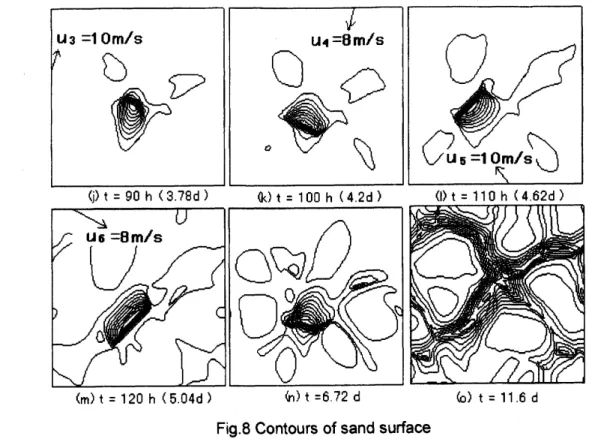
thesand surface.Fig.8 shows the time development of sand surface contours. When winds
are
blowing formthree pairs ofopposing directions, the simulated dune, which has circular
cross
section parallelto
x-y
plane and paraboliccross
section parallel to bothx-z
and y-z planes, extends at four7
Fig.8Contours of sand surface
When the sand supply is increased to two times
as
shown in Fig.9, another shape of stardunes–complex lineardunes
are
$\mathrm{f}\mathrm{o}$rmed. ltis explained inour
anotherpaper
$\mathrm{c}1\mathrm{e}\mathrm{a}\mathrm{r}1\mathrm{y}^{7)}$.
$\ovalbox{\tt\small REJECT} \mathrm{o}\mathrm{o}$
[$\mathrm{a})\mathrm{t}\underline{-}$ od
Fig. 9 Contours of sand surface ofcomplex linear dunes
4.CONCLUDING
REMARKS$\ln$ this study, the formation of
star
dunesare
simulated and the flow above the sand dunesare
investigated. Onehill is placedon
the sand suffaceas
the initialcondition.When the winds blow from three directions, the simulated dune extends
at
three directions,becoming the shape of
a
high central peak and threearms
extending radially. When the windsblow from three pairs of opposing directions, the simulated dune extends
at
four directions,becoming theshapeof
a
high central peakandfourarms
extending radially.Further problem is to investigate the factors that affect the number of the
arms
ofstardunesand the relationshipbetween thestardunes$\mathrm{w}.\mathrm{R}\mathrm{h}$ four
arms
and the complex linear dunes.REFERENCES
1) $\mathrm{R}.\mathrm{A}$. Wasson and R. Hyde, “Factors determining desert dune typ\"e, Nature
8
$(\mathrm{f}983)$,
pp.
337-339.2) $\mathrm{E}$ D. Mckee, 11Astudy of global sand seas, Introduction to
a
study of global sand seas”
L1S Geological Survey Professional Paper
1052
(1979), pp.1-19.3) M. Kan and T. Kawamura, “Numerical simulation ofthe formation of the barchan sand
dun\"e,Theoretical and Applied Mechanics, $\mathrm{V}\mathrm{o}\mathrm{l}.48$(1999), pp.349-354.
4) R. Zhang, Y. Sato, M. Kan and T. Kawamura$\mathrm{f}4$
Numerical study of the effectof flow fields
on
the shape of sand dune” Theoretical and Applied Mechanic, $\mathrm{V}\mathrm{o}\mathrm{l}.52$ (2003),pp.205-210.
5) $\mathrm{J}.\mathrm{F}$. Thompson, Z.U.A Warsi, C.W Mastin, “Numerical grid generation foundations and
applications”, Elsevier Science Pubulishing Co. Inc. (1985).
6) R. A. Bagnold, “The movementof desertsand”, Proc. Roy. Soc.A157(1963).
7) Ruyan ZHANG, Makiko KAN and Tetuya KAWAM$\mathrm{U}\mathrm{R}\mathrm{A}$, Numerical Simulation of the
Formation of the Complex Linear Dunes, Proceedings of the Sixth World Congress
on
Computational Mechanics in conjunction with the Second Asian-Pacifc Congress