ON VOLUME PRESERVING MOVES ON GRAPHS WITH PARABOLIC MERIDIANS
HIDETOSHI MASAI
1. INTRODUCTION
A spatial graph $G$ in a closed 3-manifold $M$ is a topological embedding of a graph
into $M$
.
By abusing notation, we also regard $G$ as the image of the embedding. Weconsider hyperbolic structures of $M\backslash G$ with totally geodesic boundary and of finite volume. $A$ hyperbolic structure is determined once we fix whether the meridian of each
edgecorresponds toa hyperbolicor aparabolicisometry. Note that every choice dose not necessarily give
a
hyperbolicstructure, however,the hyperbohcstructure, ifany, isunique i.e. rigidity theorem still holds (see [5], [3], and [10]). Heard has developed a computerprogram named Orb [4], which computes hyperbolic structures and many hyperbolic
invariants of spatial graph complements. Orb is based
on
Weeks’ computer programSnapPea. By using Orb, in [5], Heard, Hodgson, Martelli and Petronio enumerated many
hyperbolic graphs with parabohc meridians i.e. the meridian of each edge corresponds to
a
parabolic isometry. However unlike hyperbolic knots and links, not so many works have been done about hyperbolic graphs. In thispaper, weconsiderthehyperbolicgraphs withparabolicmeridians and discussarelation betweenhyperbolic planar graphsand fully augmented links (seesection 3for thedefinition). $\mathbb{R}om$ nowon, by the word”hyperbolic graph”,we
alwaysmean a
hyperbolic graph with parabolic meridians. In section 2,we
introduce moves which preserve volume. These moves correspond to cutting or gluing along a thrice punctured sphere. By this move, we can obtain a hyperbohc link from a
hyperbolic graph of the
same
volume. In particular, wecan
get afully augmented hnk ifwe
apply thosemoves
suitablyon
planar graphs. Then in section 3,we
discuss Lackenby’svolume estimates [7] in terms of the twist number. Lackenby (also
an
improvement by Agol-Thurston,see
appendixof[7]$)$ has usedfully augmented linksto getan
upper boundof the volume of
a
given hyperbolic link. By the above moves,we
havea
corresponding planar trivalent simple graph for a given fully augmented link. There are only finitely many such graphs with$n$verticesand hence the bestpossibleupper bounds$B_{n}$ isattainedbyone ofsuch graphs.
In the latter half of section 3 we compute approximated value of the best possible upper bounds for twist number $n=2,3,$ $\ldots,$
$8$
.
Firstwe
see
that a given planar graphis a hyperbolic graph if and only if the graph is cyclically $m$-connected for some $m\geq$ $3$ (see section 3 for the definition of the cyclically connectedness). Then to compute
approximated value, we observe that ifa planar graph is cyclically 3-connected, then the computation of the volume can be reduced to the
case
of fewer vertices. Hence we only need to investigate cyclically $m$-connected graphs with $m\geq 4$.
We used plantri [2] toenumerate graphs with given number ofvertices and withcertain connectedness and Orb
[4] to compute the approximated value of the hyperbolic volume. ReceivedDecember 26, 2012.
Acknoledgement. The author would like to thank Craig Hodgson and Sadayoshi Kojimafor helpful conversations. This work was supported by JSPS Research Fellowship for Young
Scientists.
2. VOLUME PRESERVING MOVES ON HYPERBOLIC GRAPHS
$\mathbb{R}om$ now on, we consider spatial graphs in $S^{3}$. We first recall a topological definition
ofa hyperbohc graph i.e. a hyperbohc graph with parabolic meridians (see also [5], [9]). Let $G$ be a trivalent spatial finite graph in $S^{3}$ and $V\subset S^{3}$ the set of vertices of $G$
.
Wedefine $N_{G}$
as
$S^{3} \backslash G\backslash (\bigcup_{v\in V}\mathcal{N}(v))$where$\mathcal{N}(v)$ is anopen regular neighborhood of$v.$ $N_{G}$ is a 3-manifold with thrice punctured sphere boundary components, one corresponds to each vertex of G. $G$ is said to be hyperbolic if $N_{G}$ admits a hyperbolic metric of finitevolumewith totally geodesic boundary.
Thefollowing lemma relates hyperbolic graphs with hyperbolic links. The same proof
can
be found in [6], butwe
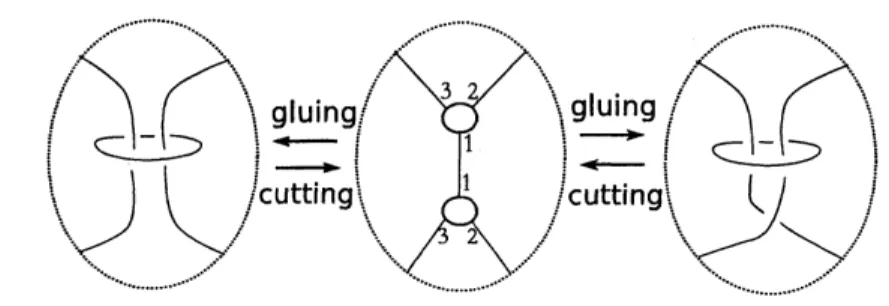
include this for the completeness.Lemma 2.1. Forhyperbolic graphs, the moves
from
theleft
(or right) to center (cutting), and center toleft
$(or r’ight)$ (glueing)of
Figure 1 are volume preserving.FIGURE 1. Volume preserving
moves
on hyperbolic graphs with parabolic meridiansProof.
Note that each vertex in graphs corresponds to a totally geodesic thrice punc-tured sphere and each edge corresponds to an annulus cusp. Moreover, the hyperbolic structure on a thrice punctured sphere is unique and hence any orientation preserving homeomorphism between hyperbolic thrice punctured spheres is isotopic to an isometry.Since homeomorphisms between thrice punctured spheres are uniquely determined byits action on cusps, we maydenote homeomorphisms
as
elements of$S_{3}$, the symmetrygroupof degree 3. Fix labels of the cusps of thrice punctured sphere
as
in Figure 1. We glue the thrice punctured boundary components via the homeomorphism corresponding to$(\begin{array}{lll}1 2 31 2 3\end{array})$
.
Then we get the tangle in the left of Figure 1. When we glue the thricepunctured boundarycomponentsvia the homeomorphism corresponding to $(\begin{array}{lll}1 2 31 3 2\end{array}),$
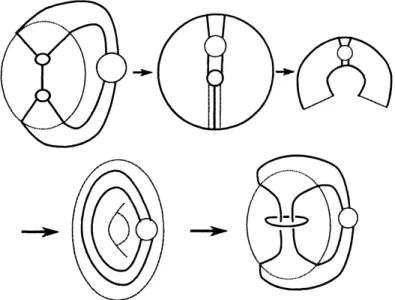
we get the tangle in the right of Figure 1. To see this, we regard $S^{3}=B^{3}\cup B^{3}$, and
reverse
the inside and the outside withrespect toone
ofthe boundary components. Aftergluing, we get a linkor graph in $S^{2}\cross S^{1}$. The component coming from the cusp labelled
by 1 is going to be a loop which corresponds to agenerator of the fundamental group of
$S^{2}\cross S^{1}$
.
Therefore itscomplementis homeomorphic toa sohd torus. Figure2 depicts the argument. Thus we get a tangle in the left or right of Figure 1. The inverse move (left
2-punctured disk) in hyperbolic manifolds is totally geodesic ([1]). Since
we are
dealing with hyperbolic graphs, the 2-punctured disk in the left or right of Figure 1 is essential(see [8] Lemma 2.1). $\square$
FIGURE 2. Glueing by a automorphism
Remark 2.2. In [9], van der Veen has demonstrated above moves for planar diagrams.
3. SOME APPLICATIONS OF VOLUME PRESERVING MOVES
In this section,
we
apply Lemma2.1
to fully augmented links. Firstwe
recall thedefinition ofa fully augmented link (see also [8]). Let $D$ be a diagram of
a
hnk in $S^{3}.$Definition 3.1. $A$ twist of $D$ is either a connected collection ofbigon regions arranged
in a row, which is maximal inthe
sense
that it is not part of a longer row of bigons, or a single crossing adjacent tono
bigon regions. The twist number ofa
diagram $D$ is itsnumber of twists and is denoted by tw$(D)$
.
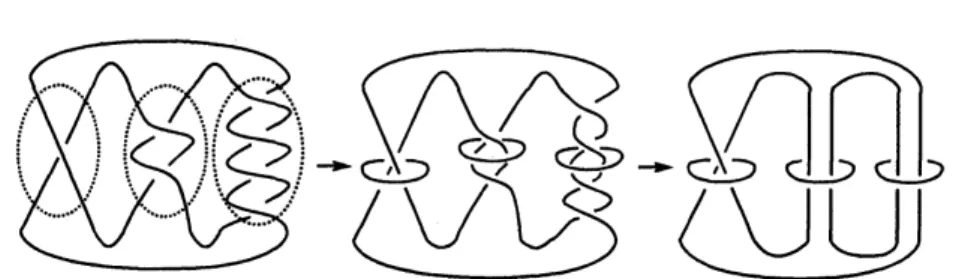
Definition 3.2. $A$ fully augmented link is a hnk obtained by encirchng each twist by
a
single unknoted component and removing full-twists (see Figure 3). We call each added unknotted component a crossing circle. $A$ component which is not a crossing circle is
called a knot component.
The fully augmented link obtained from
a
diagram $D$ hasas
many crossing circlesas
thetwist number tw$(D)$
.
In [7] Lackenby (improved by Agol-Thurston) has proved the following theorem Theorem 3.3 ([7]). Let $L$ be
a
hyperbolic $hnk$ in $S^{3},$ $D$a
diagramfor
L. Then,$Vol(S^{3}\backslash L)<10v_{3}(tw(D)-1)$
FIGURE 3. (left) ahnk diagram and its twists. (center) the augmented link diagram. (right) $A$ diagram of a fullyaugmented link
Thanks to Thurston’s Dehn surgery theorem (see [10]),
we
see
that this inequalitycan
be obtained by estimating the volume of the fully augmented link which we get from $D.$
From now on, we will give more precise estimates of such volume by using graphs. By lemma 2.1, we get atrivalent graph from a fully augmented hnk. Moreover, Proposition 3.4. Let$L$ be afully augmented link, and let $G_{L}$ denote the spatial trivalent
graph which we get by applying the cutting
move
in Lemma 2.1 to each 2-punctured diskbounded by a crossing circle. Then $G_{L}$
(1) is trivalent with $2c$ vertices,
(2) is simple, and
(3) has aplanar diagram.
Proof.
By theconstruction, the graph $G_{L}$ is trivalent and has a planar diagram. If $G_{L}$ is not simple then it has self-loop or multi-arcs. By lemma 2.1, if it has self-loop then the$L$ is splittable and if it has multi-arcs, then the complement of$L$ has
an
incompressibleannulus. These contradict the assumption that $L$ is hyperbolic. $\square$
Since for given$n\in \mathbb{N}$, there are only finitelymany trivalent simple planar graphs with
$n$ vertices, we can enumerate all ofthem.
Example 3.5. There
are
onlyone
simple planar trivalent graph with 4 or 6 vertices. Their volumes are $2v_{8}$ and $4v_{8}$ respectively. Where $v_{8}$ is the volume of regular idealoctahedron. Therefore, if a link has a diagram with 2 (resp. 3) twist regions, its volume is lessthan $2v_{8}$ (resp. $4v_{8}$).
$\cap=4$
FIGURE 4. Simple planar trivalent graph with 4 or 6 vertices.
Fromnowon, weonlyconsider planargraphs and regard each planar graph
as
adiagram of a spatial graph in $S^{3}$.
In order to compute the upper bounds, we do not have toenumerate all planar graphs. The cychcally connectivity of graphs allows us to reduce the target ofenumeration.
Definition 3.6. $At$-cutof
a
graph isa collection of$t$edges whoseremovalisdisconnected.$At$-cut is nontrivial if each component ofits removal graph contains
a
cycle. $A$ graph iscychcally $k$-connected if it has no non-trivial $t$-cuts for $0\leq t\leq k-1.$
Ifa planar graph has a nontrivial 1 or 2-cut, then its complement (as a spatial graph with a planar diagram in $S^{3}$) has a disk which compresses the meridian ofthe cut edge
or
an
essential annulus respectively. Therefore those graphs can not be hyperbolic and hence,we
only need to enumerate cyclically -connected graphs. Moreover, byThurston’suniformization theorem, it turns out that
a
trivalentplanargraph is hyperbolic if and only if it is simple and cychcally -connected (see [5], Theorem 2.4).Let $P$ be a planar graph with $n$ vertices such that $N_{P}$ admits a hyperbolic metric of finite volume. Let $\omega(P)=Vol(N_{P})/n$ and $U_{m}= \max\{\omega(Q)|Q$ trivalent planar graph
with $m$
vertices}.
We call $\omega(P)$ the normalized volume of $P.$Proposition 3.7.
If
$P$ has a non-trivial 3-cut, thenfor
some $4\leq k\leq n-2,$ $\omega(P)\leq U_{k}.$Proof.
By [1], any essential thrice punctured sphere in $N_{P}$ is isotopic to totally geodesic one. We claim that the thrice punctured sphere $E$ determined by thenon-trivia13-cut isessential. Ifithasaboundary compressingdisk$F$, thenwemay
assume
that the boundary$\partial F$encircles exactly 1 puncture. Therefore $F$gives adisk which compresses themeridian
of the edge corresponds to the encircled puncture. This contradicts the hyperbohcity of $N_{P}$
.
Hence $F$ is a totally geodesic thrice punctured sphere and we may cut along $F$ toget two graphs with planar diagram whose number of vertices
are
less thanor
equal to$n-2.$ $\square$
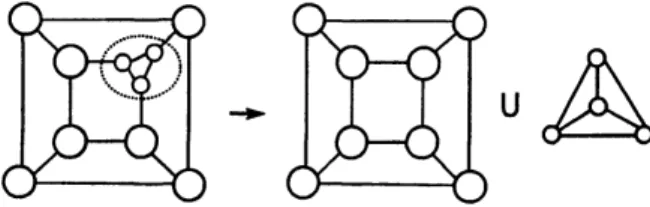
Example 3.8. The graph in the left of Figure 5 has
a
non-trivia13-cut. The dotted hne depictsa
thrice punctured sphere that may cut the complement into two pieces. Each piece is homeomorphic to the complement ofa graph. The graphs in the middle and the right in Figure 5are
the corresponding graphs.FIGURE 5. Graph with nontrivia13-cut.
Thus, putting all the discussion above together, we get
Theorem 3.9. Let $B_{n}$ denote the best possible upper bound
of
the volumesof
hyperbolic links that have diagrams with$n$ twists. Then we have$B_{n}=2nU_{2n}$. hrther, $B_{n}$ is attainedby some cyclically 4-connected graph$P_{2n}$
if
we have $\omega(P_{2n})\geq U_{2k}$for
all $2\leq k\leq n-1.$Remark 3.10. It seems quite likely that $B_{n}$ is attained by some -connected graph for
all $n.$
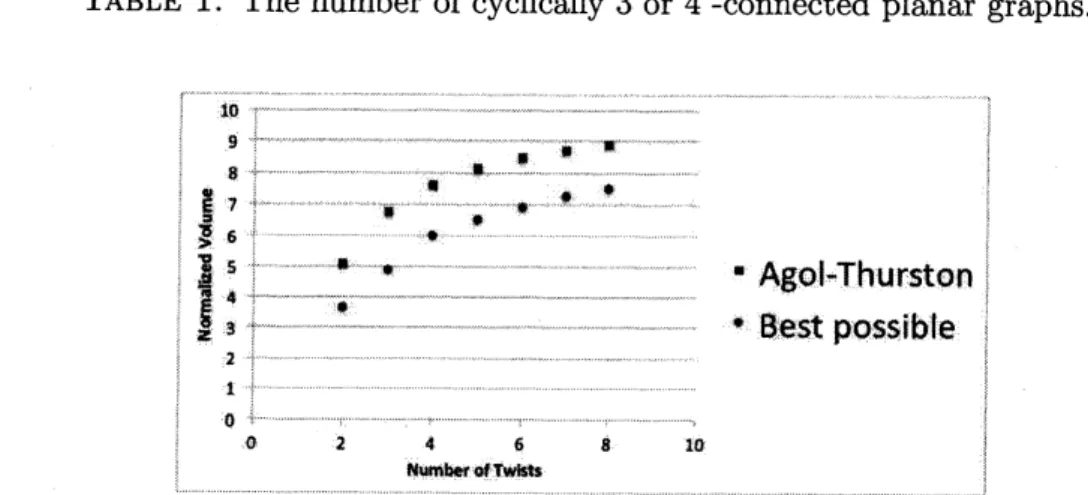
In Table 1,
we
collect the number of cychcally 3 or 4 connected graph.By plantri [2], we enumerate all planar cyclically -connected trivalent graphs and estimate the volume by Orb[4]. We computed an approximate value of $U_{2n}$ for $n\leq 8$
TABLE 1. The number ofcyclically 3 or 4-connected planar graphs.
$1\theta ^{--}$
$B_{6}\not\in?\Leftrightarrow\underline{i}g\cdot\cdot\ldots.’\cdots\cdots l\frac{*;^{\backslash }*-}{*\underline{l*}}9\cdots\underline{...\cdot\cdot\cdot\cdot\cdot}$
$\underline{8}^{\epsilon}$
$-l$
$–$
$\cdot$ Agol-Thurston$z_{2--}^{s*\wedge_{-}}\xi\overline{\wedge}$ Best possib$\uparrow e$
$1-$
$0$
$\sigma$ 2 4 6 $\epsilon$ 10
$uumb*r$ fTwlst
FIGURE 6. The values of $10v_{3}(n-1)/n$ (the upper bounds by
Agol-Thurston) and $U_{2n}.$
So far, $U_{n}$ is monotonically increasing
as a
function of $n$.
It is interesting to computeexact values of $U_{n}$ and observe the difference between $10v_{3}(n-1)/n$ and $U_{n}$ for general
$n.$
REFERENCES
[1] C. Adams, Thrice-punctured spheres in$hyperbolic\backslash$$3$-manifolds, Trans. Amer. Math. Soc. 287(1985)
645-656.
[2] G. Brinkmann and B. McKay,plantriand fullgen,computerprograms for generation of certaintypes
ofplanar graph, available fromhttp://cs.anu.edu.au$/^{\sim}bdm/plantri/.$
[3] R. Frigerio, C.Petronio, Constructionandrecognitionofhyperbolic 3-manifoldswithgeodesic
bound-ary, Trans. Amer. Math. Soc. 356 (2004), 3243-3282.
[4] D. Heard, Orb, a computerprogramforfindinghyperbolicstructures onhyperbolic 3-orbifolds and 3-manifolds, available fromwww. ms.unimelb. edu.$au/^{\sim}$snap/orb. html.
[5] D. Heard, C. Hodgson,B. Martelli, C. Petronio, Hyperbolic graphs ofsmall complexity,Exp. Math.
19 (2010),211-236.
[6] C. Hodgson and H. Masai, On the numberofhyperbolic 3-manifolds ofagiven volume,to appearin Proceedings ofConference “Geometry and Topology DownUnder”, arXiv:1203.6551.
[7] M. Lackenby, The volume ofhyperbolic altemating link complements, Proc. London Math. Soc. (3)
88 (2004), 204-224,$arXiv:math.GT/0012185$, withan appendix by I. Agol andD. Thurston.
[8] J. Purcell, An introduction to fully augmented links, Interactions Between Hyperbolic Geometry,
Quantum Topology, andNumber Theory, American Mathematical Soc., 2011
[9] Roland vander Veen, The volume conjectureforaugmentedknotted trivalentgraphs, Algebr. Geom.
Topol. 9 (2009),691-722.
[10] W.P. Thurston, “Geometry and Topology of3-Manifolds”, mimeographednotes, Princeton
Univer-sity, 1979, available frommsri.org/publications/books/gt3m/.
DEPARTMENT OF MATHEMATICAL AND COMPUTING SCIENCES, TOKYO INSTITUTE OF
TECHNOL-$OGY,$ $O$-OKAYAMA, MEGURO-KU, TOKYO 152-8552 JAPAN