JAIST Repository
https://dspace.jaist.ac.jp/Title
Swapping Colored Tokens on Graphs
Author(s)
Yamanaka, Katsuhisa; Horiyama, Takashi;
Kirkpatrick, David; Otachi, Yota; Saitoh,
Toshiki; Uehara, Ryuhei; Uno, Yushi
Citation
Lecture Notes in Computer Science, 9214: 619-628
Issue Date
2015-08-05
Type
Journal Article
Text version
author
URL
http://hdl.handle.net/10119/13768
Rights
This is the author-created version of Springer,
Katsuhisa Yamanaka, Takashi Horiyama, David
Kirkpatrick, Yota Otachi, Toshiki Saitoh, Ryuhei
Uehara and Yushi Uno, Lecture Notes in Computer
Science, 9214, 2015, 619-628. The original
publication is available at www.springerlink.com,
http://dx.doi.org/10.1007/978-3-319-21840-3_51
Description
Algorithms and Data Structures, 14th
International Symposium, WADS 2015, Victoria, BC,
Canada, August 5-7, 2015. Proceedings
Swapping Colored Tokens on Graphs
Katsuhisa Yamanaka1, Takashi Horiyama2, David Kirkpatrick3, Yota Otachi4, Toshiki Saitoh5, Ryuhei Uehara4, and Yushi Uno6
1
Iwate University, Japan. [email protected] 2 Saitama University, Japan. [email protected]
3
University of British Columbia, Canada. [email protected] 4 Japan Advanced Institute of Science and Technology, Japan.
[email protected], [email protected] 5 Kobe University, Japan. [email protected] 6
Osaka Prefecture University, Japan. [email protected]
Abstract. We investigate the computational complexity of the following
problem. We are given a graph in which each vertex has the current and target colors. Each pair of adjacent vertices can swap their current colors. Our goal is to perform as small numbers of swappings as possible so that the current and target colors agree at each vertex. When the colors are chosen from {1, 2, . . . , c}, we call this problem c-Colored Token Swapping since the current color of a vertex can be seen as a colored token placed on the vertex. We show that c-Colored Token Swapping is NP-complete for every constant c ≥ 3 even if input graphs are restricted to connected planar bipartite graphs of maximum degree 3. We then show that 2-Colored Token Swapping can be solved in polynomial time for general graphs and in linear time for trees.
1
Introduction
Sorting problems are fundamental and important in computer science. In this paper, we consider a problem of sorting on graphs. Let G = (V, E) be an undi-rected unweighted graph with vertex set V and edge set E. Suppose that each vertex in G has a color in C ={1, 2, . . . , c}. A token is placed on each vertex in
G, and each token also has a color in C. Then, we wish to transform the current
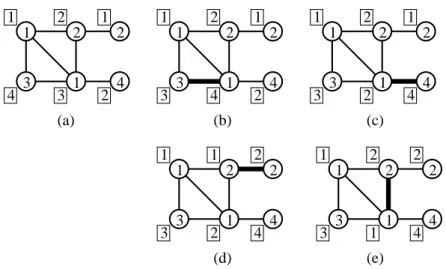
token-placement into the one such that a token of color i is placed on a vertex of color i for all vertices by swapping tokens on adjacent vertices in G. See Fig. 1 for an example. If there exists a color i such that the number of vertices of color
i is not equal to the number of tokens of color i in the current token-placement,
then we cannot transform the current token-placement into the target one. Thus, without loss of generality, we assume that the number of vertices of color i for each i = 1, 2, . . . , c is equal to the number of tokens of the same color. As we will see in the next section, any token-placement can be transformed into the target one by O(n2) token-swappings, where n is the number of vertices in G.
We thus consider the problem of minimizing the number of token-swappings to obtain the target token-placement.
1 1 3 1 4 2 2 2 1 3 4 2 1 1 3 1 4 2 2 2 1 3 2 4 1 1 3 1 4 2 2 1 2 3 2 4 1 1 3 1 4 2 2 2 2 3 1 4 (a) 1 1 3 1 4 2 2 2 1 4 3 2 (b) (c) (d) (e)
Fig. 1. An example of 4-Colored Token Swapping. Colors of vertices are
written inside circles and tokens are drawn as rectangles with their colors. We swap the two tokens along each thick edge. (a) An initial token-placement. (b)– (d) Intermediate token-placements. (e) The target token-placement.
If vertices have distinct colors and tokens also have distinct colors, then the problem is called Token Swapping [11]. This has been investigated for several graph classes. Token Swapping can be solved in polynomial time for paths [7, 8], cycles [7], stars [10], complete graphs [1, 7], and complete bipartite graphs [11]. Heath and Vergara [6] gave a polynomial-time 2-approximation algorithm for squares of paths, where the square of a path is the graph obtained from the path by adding a new edge between two vertices with distance exactly two in the path. For squares of paths, some upper bounds of the minimum number of token-swappings are known [3, 4, 6]. Yamanaka et al. [11] gave a polynomial-time 2-approximation algorithm for trees. Token Swapping is solved for only restricted graph classes. However no hardness result is known, even if input graphs are general graphs, to the best of our knowledge.
The c-Colored Token Swapping problem is a generalization of Token Swapping. We investigate c-Colored Token Swapping and clarify its com-putational complexity in the sense that we found the boundary of easy and hard cases with respect to the number of colors. For c = 2, the problem can be solved in polynomial time for general graphs and in linear time for trees. However, the problem for c = 3 is hard even if input graphs are quite restricted. We show that the problem is NP-complete for connected planar bipartite graphs with maximum degree 3.
2
Preliminaries
In this paper, we assume without loss of generality that graphs are simple and connected. Let G = (V, E) be an undirected unweighted graph with vertex set
V and edge set E. We sometimes denote by V (G) and E(G) the vertex set and
the edge set of G, respectively. We always denote|V | by n. For a vertex v in G, let N (v) be the set of all neighbors of v. Each vertex of a graph G = (V, E) has a color in C = {1, 2, . . . , c}. We denote by c(v) the color of a vertex v ∈ V . A token is placed on each vertex in G, and each token also has a color in C. For a vertex v, we denote by f (v) the color of the token placed on v. Then, we call the function f : V → C a token-placement of G. Two token-placements f and
f′ of G are said to be adjacent if the following two conditions (a) and (b) hold: (a) there exists exactly one edge (u, v)∈ E such that f′(u) = f (v) and f′(v) =
f (u); and
(b) f′(w) = f (w) for all vertices w∈ V \ {u, v}.
In other words, the token-placement f′is obtained from f by swapping the tokens on the two adjacent vertices u and v. Note that swapping two tokens of the same color gives the same token-placement. Thus, to eliminate redundancy, we assume that tokens of the same color are never swapped. For two token-placements f and f′ of G, a sequenceS = ⟨f0, f1, . . . , fh⟩ of token-placements is a swapping
sequence between f and f′ if the following three conditions (1)–(3) hold: (1) f0= f and fh= f′;
(2) fk is a token-placement of G for each k = 0, 1, . . . , h; and (3) fk−1 and fk are adjacent for every k = 1, 2, . . . , h.
The length of a swapping sequence S is defined to be the number of token-placements in S, and denoted by len(S). For two token-placements f and f′ of G, we denote by OPT(f, f′) the minimum length of a swapping sequence between f and f′. As we will prove in Lemma 1, there always exists a swapping sequence between any two token-placements f and f′ if the number of vertices of color i for each i = 1, 2, . . . , c is equal to the number of tokens of the same color. For the two token-placement f and f′, OPT(f, f′) is well-defined.
Given two token-placements f and f′of a graph G and a nonnegative integer
ℓ, the c-Colored Token Swapping problem is to determine whether or not
OPT(f, f′) ≤ ℓ holds. From now on, we always denote by f and f′ the initial and target token-placements of G, respectively, and we may assume without loss of generality that f′ is a token-placement of G such that f′(v) = c(v) for all vertices v∈ V .
We show that the length of any swapping sequence need never exceed n2. This claim is derived by slightly modifying the proof of Theorem 1 in [11].
Lemma 1. For any pair of token-placements f and f′ of a graph G,
OPT(f, f′)≤ n2.
Proof. Let T be any spanning tree of a graph G = (V, E). Choose an arbitrary
leaf v of T . Then, we move a nearest token of color c(v) in T from the current position u to its target position v. Note that there is no token of color c(v) placed
on a vertex of the path in T from u to v except u. Let (p1, p2, . . . , pq) be a unique path in T from p1 = u to pq = v. Then, we swap the tokens on pk and pk+1 for each k = 1, 2, . . . , q− 1 in this order, and obtain the token-placement f of G such that f (v) = c(v). We then delete the vertex v from G and T , and repeat the process until we obtain f′.
Each vertex obtains a token of the same color via a swapping sub-sequence of length in n. Therefore, the swapping sequenceS above between f and f′satisfies len(S) ≤ n2. Since OPT(f, f′)≤ len(S), we have OPT(f, f′)≤ n2. ⊓⊔
From Lemma 1, any token-placement for an input graph can be transformed into the target one by O(n2) token-swappings, and a swapping sequence of length
O(n2) can be computed in polynomimal time.
3
Hardness results
In this section, we show that c-Colored Token Swapping problem is NP-complete for any constant c ≥ 3 by constructing a polynomial-time reduction from Planar 3DM [2]. To define Planar 3DM, we first introduce the following well-known NP-complete problem.
Problem: 3-Dimensional Matching (3DM) [5, SP1]
Instance: Set T ⊆ X × Y × Z, where X, Y , and Z are disjoint sets having the
same number m of elements.
Question: Does T contain a matching, i.e., a subset T′⊆ T such that |T′| = m
and it contains all elements of X, Y , and Z?
Planar 3DM is a restricted version of 3DM in which the following bipartite graph G is planar. The graph G has the vertex set V (G) = T∪ X ∪ Y ∪ Z with a bipartition (T, X∪ Y ∪ Z). Two vertices t ∈ T and w ∈ X ∪ Y ∪ Z are adjacent in G if and only if w∈ t. Planar 3DM is NP-complete even if G is a connected graph of maximum degree 3 [2].
Theorem 1. 3-Colored Token Swapping is NP-complete even for con-nected planar bipartite graphs of maximum degree 3.
Proof. By Lemma 1, there is a polynomial-length swapping sequence for any
initial token-placement, and thus 3-Colored Token Swapping is in NP. Now we present a reduction from Planar 3DM. Let (X, Y, Z; T ) be an instance of Planar 3DM and m = |X| = |Y | = |Z|. As mentioned above, we construct a bipartite graph G = (T, X ∪ Y ∪ Z; E) from (X, Y, Z; T ). We set
c(x) = 1 and f (x) = 2 for every x ∈ X, set c(y) = 2 and f(y) = 3 for every y∈ Y , set c(z) = 3 and f(z) = 1 for every z ∈ Z, and set c(t) = 1 and f(t) = 1
for every t∈ T . See Fig. 2. From the assumptions, G is a planar bipartite graph of maximum degree 3. The reduction can be done in polynomial time. We prove that the instance (X, Y, Z; T ) is a yes-instance if and only if OPT(f, f′)≤ 3m.
To show the only-if part, assume that there exists a subset T′of T such that
x
1x
2x
3y
1y
2y
3z
1z
2z
3t
1t
2t
3t
4t
5X
Y
Z
T
1 1 1 2 2 2 3 3 3 1 1 1 1 1 1 1 1 1 1 2 2 2 3 3 3 1 1 1Fig. 2. The graph constructed from an instance (X = {x1, x2, x3}, Y = {y1, y2, y3}, Z = {z1, z2, z3}, T = {t1 = (x1, y1, z3), t2 = (x3, y2, z1), t3 = (x1, y1, z2), t4= (x3, y3, z2), t5= (x2, y2, z1)}). 1 2 3 1 1 2 3 1 2 1 3 1 1 2 3 1 3 1 2 1 1 2 3 1 1 1 2 3 1 2 3 1
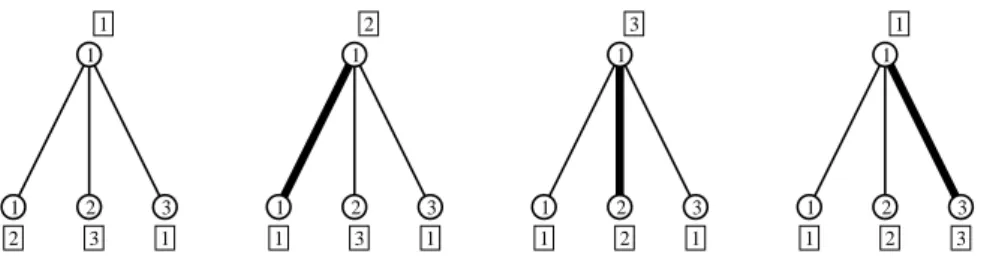
Fig. 3. A swapping sequence to resolve the token-placement of a triple.
T′ are pairwise disjoint, we can cover the graph G′ with m disjoint stars of four vertices, where each star is induced by an element t of T′and its three elements. To locally move the tokens on the target place in such a star, we need only three swappings. See Fig. 3. This implies that a swapping sequence of length 3m exists. To show the if part, assume that there is a swapping sequenceS from f to
f′ with at most 3m token-swappings. Let T′⊆ T be the set of vertices such that the tokens on them are moved in S. Let G′ be the subgraph of G induced by
T′∪ X ∪ Y ∪ Z. Let w ∈ X ∪ Y ∪ Z. Since c(w) ̸= f(w) and N(w) ⊆ T , the
sequenceS swaps the tokens on w and on a neighbor t ∈ T′ of w at least once. This implies that w has degree at least 1 in G′. Since each t∈ T′ has degree at most 3 in G′, we can conclude that |T′| ≥ 1
3|X ∪ Y ∪ Z| = m. In S, the token
placed on a vertex in X ∪ Y in the initial token-placement is moved at least twice, while the token placed on a vertex in Z∪ T′ is moved at least once. As a token-swapping moves two tokens at the same time,
len(S) ≥ 1
2(2|X| + 2 |Y | + |Z| + |T
′|) ≥ 3m.
From the assumption that len(S) ≤ 3m, it follows that |T′| = m, and hence each
w∈ X ∪ Y ∪ Z has degree exactly 1 in G′. Therefore, G′ consists of m disjoint stars centered at the vertices of T′ which form a solution of Planar 3DM. ⊓⊔ The proof above can be extended for any constant number of colors. It is known that we can assume that G has a degree-2 vertex [2]. We add a path (p4, p5, . . . , pc) to G, and connect p4 to a degree-2 vertex in G. We set c(pi) = i and f (pi) = i. The proof still works for the new graph, and hence we obtain the following corollary.
Corollary 1. For every constant c≥ 3, c-Colored Token Swapping is NP-complete even for connected planar bipartite graphs of maximum degree 3.
Note that the degree bound in the corollary above is tight. If a graph has maximum degree 2, then we can solve c-Colored Token Swapping in polyno-mial time for every constant c as follows. A graph of maximum degree 2 consists of disjoint paths and cycles. Observe that a shortest swapping sequence does not swap tokens of the same color. This immediately gives a unique matching between tokens and target vertices for a path component. For a cycle compo-nent, observe that each color class has at most n candidates for such a matching restricted to the color class. This is because after we guess the target of a token in a color class, the targets of the other tokens in the color class can be uniquely determined. In total, there are at most nc matchings between tokens and tar-get vertices. By guessing such a matching, we can reduce c-Colored Token Swapping to Token Swapping. Now we can apply Jerrum’s O(n2)-time algo-rithms for solving Token Swapping on paths and cycles [7]. Therefore, we can solve c-Colored Token Swapping in O(nc+2) time for graphs of maximum degree 2.
4
Polynomial-time algorithms
In this section, we give some positive results. We first show that 2-Colored Token Swapping for general graphs can be solved in polynomial time. We next show that 2-Colored Token Swapping problem for trees can be solved in linear time without constructing a swapping sequence.
4.1 General graphs
Let C ={1, 2} be the color set. Let G = (V, E) be a graph, and let f and f′ be an initial token-placement and the target token-placement. We construct a weighted complete bipartite graph GB = (X, Y, EB, w), as follows. The vertex sets X, Y and the edge set EB are defined as follows:
X ={xv| v ∈ V and f(v) = 1}
Y ={yv| v ∈ V and c(v) = 1}
(a)
v1 1 1 1 1 1 1 1 1 2 2 2 2 2 2 2 2 2 2 v2 v3 v4 v5 v9 v8 v7 v6(b)
v1 1 1 1 1 1 1 1 1 2 2 2 2 2 2 2 2 2 2 v6(c)
v3 v4 v5 v7 v5 v9 v1 v3 1 1 2 2 1 1 1 1 1 1 1 1 v2 v3 v5 v9 v8 v7 v4Fig. 4. (a) An initial token-placement. (b) The target token-placement. (c) The
weighted complete bipartite graph constructed from (a) and (b) (the weight of each edge is omitted).
Intuitively, X is the copies of vertices in V having tokens of color 1, and Y is the copies of vertices in V of color 1. The weight function w is a mapping from
EB to positive integers. For x ∈ X and y ∈ Y , the weight w(e) of the edge
e = (x, y) is defined as the length of a shortest path from x to y in G. Fig. 4
gives an example of an initial token-placement, the target token-placement, and the associated weighted complete bipartite graph.
We bound OPT(f, f′) from below, as follows. LetS be a swapping sequence between f and f′. The swapping sequence gives a perfect matching of GB, as follows. For each token of color 1, we choose an edge (x, y) of GB if the token is placed on x ∈ X in f and on y ∈ Y in f′. The obtained set is a perfect matching of GB. A token corresponding to an edge e in the matching needs w(e) token-swappings, and two tokens of color 1 are never swapped inS. Therefore, for a minimum weight matching M of GB, we have the following lower bound:
OPT(f, f′)≥ ∑ e∈M
w(e).
Now we describe our algorithm. First we find a minimum weight perfect matching M of GB. We choose an edge e in M . Let Pe =⟨p1, p2, . . . , pq⟩ of G be a shortest path corresponding to e. We have the following lemma.
Lemma 2. Suppose that the two tokens on endpoints of Pehave different colors.
The two tokens can be swapped by w(e) token-swappings such that the color of the token on each internal vertex does not change.
Proof. Without loss of generality, we assume that f (p1) = 2 and f (pq) = 1 hold. We first choose the minimum i such that f (pi) = 1 holds. We next move the token on pi to p1 by i− 1 token-swappings. We repeat the same process to the
subpath⟨pi, pi+1, . . . , pq⟩. Finally, we obtain the desired token-placement. Recall that there are only two colors on graphs, and so the above “color shift” operation works. Since each edge of Pe is used by one token-swapping, the total number
of token-swapping is w(e) = q− 1. ⊓⊔
This lemma permits to move the two tokens on the two endpoints p1 and pq of Pe to their target positions in w(e) swappings. Let g be the token-placement obtained after the token-swappings. We can observe that f (v) = g(v) for every v ∈ V \ {p1, pq} and g(v) = c(v) for v ∈ {p1, pq}. Then we remove
e from the matching M . We repeat the same process until M becomes empty.
Our algorithm always exchanges tokens on two vertices using a shortest path between the vertices. Hence, the length of the swapping sequence constructed by our algorithm is equal to the lower bound.
Now we estimate the running time of our algorithm. The algorithm first constructs the weighted complete bipartite graph. This can be done using Floyd-Warshall algorithm in O(n3) time. Then, our algorithm constructs a minimum weight perfect matching. This can be done in O(n3) time [9, p.252]. Finally, for each of the O(n) paths in the matching, our algorithm moves the tokens on the endpoints of the path in linear time. We have the following theorem.
Theorem 2. 2-Colored Token Swapping is solvable in O(n3) time. Fur-thermore, a swapping sequence of the minimum length can be constructed in the same running time.
4.2 Trees
In this subsection, we show that 2-Colored Token Swapping for trees can be solved in linear time without constructing a swapping sequence.
Let T be an input tree, and let f and f′ be an initial token-placement and the target token-placement of T . Let e = (x, y) be an edge of T . Removal of e disconnects T into the two subtrees. We denote by T (x) the subtree containing
x and denote by T (y) the subtree containing y.
Now we define the value diff(e) for each edge e of T . Intuitively, diff(e) is the number of tokens of color 1 which we wish to move from T (x) to T (y) along e. More formally, we give the definition of diff(e), as follows. Let n1t be the number of tokens of color 1 in T (x), and let n1v be the number of vertices of color 1 in
T (x). Then, we define diff(e) = n1t− n1v . (Note that, even if we count tokens and vertices of color 1 in T (y) instead of T (x), the value diff(e) takes the same value.) See Fig. 5 for an example. For each edge e of T , we need to move at least diff(e) tokens of color 1 from a subtree to the other one along e. Therefore, OPT(f, f′) is lower bounded by the sum D =∑e∈E(T )diff(e).
To give an upper bound of OPT(f, f′), we next show that there exists a swapping sequence of length D. The following lemma is key to construct the swapping sequence.
Lemma 3. If D ̸= 0, then there exists an edge e such that the token-swapping on e decreases D by one.
Proof. We first give an orientation of edges of T . For each edge e = (x, y), we
orient e from x to y if the number of tokens of color 1 in T (x) is greater than the number of vertices of color 1 in T (x). Intuitively, the direction of an edge means that we need to move one or more tokens of color 1 from T (x) to T (y). If
1 2 1 1 1 2 2 1 1 2 1 2 1 1 2 2 0 1 0 2 1 0 0 2 2 1 1 1 2 2 1 1
Fig. 5. An example of diff(e). For each edge e, the value diff(e) is written beside e.
the two numbers are equal, we remove e from T . Let T′be the obtained directed tree. For an edge e = (x, y) oriented from x to y, if x has a token of color 1 and
y has a token of color 2, swapping the two token decreases D by one. We call
such an edge a desired edge. We now show that there exists a desired edge in T′. Observe that if no vertex u with f (u) = 1 is incident to a directed edge in T′, then indeed T′ has no edge and D = 0. Let u be a vertex with f (u) = 1 that has at least one incident edge in T′. If u has no out-going edge, then the number of the color-1 tokens in T exceeds the number of the color-1 vertices in T . Thus we can choose an edge (u, v) oriented from u to v. If f (v) = 2 holds, the edge is desired. Now we assume that f (v) = 1 holds. We apply the same process for
v, then an edge (v, w) oriented from v to w can be found. Since trees have no
cycle, by repeating the process, we always find a desired edge. ⊓⊔ From Lemma 3, we can find a desired edge, and we swap the two tokens on the endpoints of the edge. Since a token-swapping on a desired edge decreases
D by one, by repeatedly swapping on desired edges, we obtain the swapping
sequence of length D. Note that D = 0 if and only if c(v) = f (v) for every
v∈ V (T ). Hence, we have OPT(f, f′)≤ D.
Therefore OPT(f, f′) = D holds, and so we can solve 2-Colored Token Swapping by calculating D. The value diff(e) for every edge e, and thus the value D, can be calculated in a bottom-up manner in linear time in total. We have the following theorem.
Theorem 3. 2-Colored Token Swapping is solvable in linear time for trees.
5
Conclusions
We have investigated computational complexity of c-Colored Token Swap-ping. We first showed the NP-completeness for 3-Colored Token Swapping by a reduction from Planar 3DM, even for connected planar bipartite graphs of maximum degree 3. We next showed that 2-Colored Token Swapping can be solved in O(n3) time for general graphs and in linear time for trees.
We showed that c-Colored Token Swapping for every constant c can be solved in polynomial time for graphs of maximum degree 2 (disjoint paths and
cycles). If c is not a constant, can we solve c-Colored Token Swapping for such graphs in polynomial time? For Token Swapping on cycles, Jerrum [7] proposed an O(n2)-time algorithm. As mentioned in [7], the proof of the
cor-rectness of the algorithm needs complex discussions.
A standard dynamic programming technique based on our algorithm for trees may give a polynomial-time (but not necessarily fixed-parameter tractable) algo-rithm on graphs of bounded treewidth for c-Colored Token Swapping. De-signing a fixed-parameter tractable algorithm parameterized by treewidth would be interesting future work.
References
1. A. Cayley. Note on the theory of permutations. Philosophical Magazine, 34:527–529, 1849.
2. M.E. Dyer and A.M. Frieze. Planar 3DM is NP-complete. Journal of
Algo-rithms, 7:174–184, 1986.
3. X. Feng, Z. Meng, and I.H. Sudborough. Improved upper bound for sort-ing by short swaps. In Proc. IEEE Symposium on Parallel Architectures,
Algorithms and Networks, pages 98–103, 2004.
4. X. Feng, I.H. Sudborough, and E. Lu. A fast algorithm for sorting by short swap. In Proc. IASTED International Conference Computational and
Sys-tems Biology, pages 62–67, 2006.
5. M.R. Garey and D.S. Johnson. Computers and Intractability: A Guide to
the Theory of NP-Completeness. Freeman, 1979.
6. L.S. Heath and J.P.C. Vergara. Sorting by short swaps. Journal of
Compu-tational Biology, 10(5):775–789, 2003.
7. M.R. Jerrum. The complexity of finding minimum-length generator se-quence. Theoretical Computer Science, 36:265–289, 1985.
8. D.E. Knuth. The art of computer programming, volume 3. Addison-Wesley, 2nd edition, 1998.
9. B. Korte and J. Vygen. Combinatorial Optimization: Theory and Algo-rithms. Springer, 2nd edition, 2005.
10. I. Pak. Reduced decompositions of permutations in terms of star transposi-tions, generalized catalan numbers and k-ary trees. Discrete Mathematics, 204:329–335, 1999.
11. K. Yamanaka, E.D. Demaine, T. Ito, J. Kawahara, M. Kiyomi, Y. Okamoto, T. Saitoh, A. Suzuki, K. Uchizawa, and T. Uno. Swapping labeled tokens on graphs. Theoretical Computer Science, 2015. accepted.