Physics and
Mathematics
in
Quantum
Stochastic
Process
Toshihico
ARIMITSU
(
有光敏彦)
University
of Tsukuba,
Institute
of Physics
Ibaraki
305,
Japan
Internet:
[email protected]
December
$26_{\ovalbox{\tt\small REJECT}}$1995
Abstract
It is shown thatthetime-evolutionofadissipative system canbeinterpretedas
a traverse of the systemin asetof the unitarilyinequivalent representationspaces.
It is also shown that there exists uncountable number of different descriptions of
the system ofquantum differential equa$\iota \mathrm{i}_{0}\mathrm{n}\mathrm{s}_{i}$ and that the physical meaning of
the different descriptions can be attributed to how much one $\mathrm{r}\mathrm{e}\mathrm{n}\mathrm{o}\mathrm{r}\mathrm{m}\mathrm{a}_{\mathrm{z}\mathrm{e}\mathrm{d}}$ the
line-width in an energy spectrum caused by $n\mathrm{n}\mathrm{c}\mathrm{o}\mathrm{n}\mathrm{l}\mathrm{m}\mathrm{u}\mathrm{t}\mathrm{a}\mathrm{t}\mathrm{i}_{\mathrm{V}\mathrm{e}}$ part of a random
force operator.
A talk given for the seminar Quantum
Information
Theor.
$y$ and Open Systems heldat Research Institute for Mathematical
Sciences
(RIMS) ill Kyoto during the period$\frac{\approx}{\Leftrightarrow}\mp\ovalbox{\tt\small REJECT}^{\underline{T_{\backslash }}}’.\llcorner \mathrm{E}\backslash ’\ovalbox{\tt\small REJECT}^{\Pi}\backslash \omega\equiv\#\emptyset\iota \mathrm{E}\ \Phi^{r}\mp$
(Physics and Mathematics in
Quantum Stochastic
Process)
$\mathrm{J}\dot{\tilde{\pi}}\mathrm{R}\lambda\theta\nabla\pi\Phi\#\#\succ\Psi iTi_{\vee}^{\geq}/$
(Toshihico ARIMITSU)
Internet: [email protected]
1
Introduction
Recently we succeeded to construct a unified framework of the canonical operator
for-malism for quantum stochastic differential equations within Non-Equilibrium Thermo
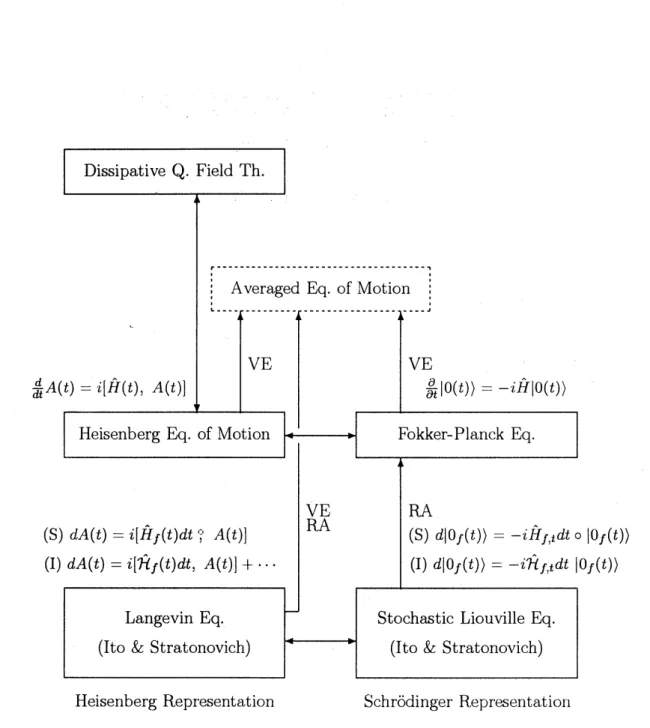
FieldDynamics (NETFD) $[1]-[9]$ for the first timeto put all the formulations of
stochas-tic differential equations for quantum systems, i.e., the Langevin equation and the
stochastic Liouville equation [10] together $\mathrm{w}\mathrm{i}\mathrm{t}^{-}\mathrm{h}$ corresponding quantum master
equa-tion, into a unified method (see Fig. 1). It was possible only within the formalism of
NETFD.
In this paper, we will show that the time evolution ofa dissipative system can be
interpreted as a traverse ofthe system in a set of the unitarily inequivalent
represen-tation spaces. We believe that the set constitutes a measured space which corresponds
to the $\Gamma$ phase-space of classical
statistica,1
mechanics. We will also show that thereexists uncountable number of different descriptions of the system of quantum
differ-ential equations, and that the physical meaning of the different descriptions can be
attributed to how much
one
renormalized the line-width in an energyspectrum causedby uncommutative effects ofa random force operator.
Wewilltreat in thispaper a non-stationary system of astochasticsemi-freeparticles. The hat-Hamiltonianforthe stochastic
semi-free
field is $\mathrm{b}\mathrm{i}$-linear in$a,$ $a^{\uparrow},$ $dF(t),$ $dF\dagger(t)$
and their tilde conjugates, and is invariant under the phase transformation $aarrow a\mathrm{e}^{i\theta}$,
and $dF(t)arrow dF(t)\mathrm{e}^{i\theta}$. Here, $a,$ $a^{\uparrow}$ and their tilde conjugates are stochastic operators
of a relevant system satisfying the canonical commutation relation
$[a, a^{\uparrow}]=1$, $|\tilde{a},\tilde{a}^{\uparrow}]=1$, (1)
whereas $dF(t),$ $dF^{\uparrow}(t)$ and their conjugates $\mathrm{a}r\mathrm{e}$ random force operators. The tilde and
non-tilde operators are related with each other by the relations
$\langle$$1|a^{\uparrow}=\langle 1|\tilde{a}_{:}$ (2) $\langle$$|dF^{\uparrow}(t)=\langle|d\tilde{F}(t)$, (.3)
where $\langle$$1|$ and $\langle$$|$ are respectively the thermal $\mathrm{b}\mathrm{r}\mathrm{a}$-vacuum ofthe relevant system and of
Heisenberg Representation Schr\"odinger $\mathrm{R}\mathrm{e}\mathrm{p}_{\Gamma}\mathrm{e}\mathrm{S}\mathrm{e}\mathrm{n}\mathrm{t}\mathrm{a}\mathrm{t}\mathrm{i}\mathrm{o}11$
Figure 1: Structureof the Formalism. RA stands for the random
average.
VE$\mathrm{s}\mathrm{t}\mathrm{a}11\mathrm{d}_{\mathrm{S}}$forThe tilde $conjugati_{\mathit{0}}n\sim \mathrm{i}\mathrm{s}$ defined by:
$(A_{1}A_{2})^{\sim}=\tilde{\mathrm{A}}_{1}\tilde{A}_{2}$, (4) $(c_{1}A_{1}+c2A_{2})\sim=c_{1}^{*}\tilde{A}_{1}+C\tilde{A}_{2}2*$, (5)
$’(\tilde{A})^{\sim}=A$, (6)
$(A^{\uparrow})^{\sim}=\tilde{A}^{\uparrow}$, (7)
where $c_{1}$ and $c_{2}$
are
$c$-numbers. Any operator $A$ inNETFD
is accompanied by itspartner (tilde) operator $\tilde{A}$
.
2
Representation
Space
of
Random
Force
Opera-tors
2.1
Fock’s
Space
We take the vectors:
$|t_{1},$ $t_{2},$ $\cdots,$$t_{n} \rangle=\frac{1}{\sqrt{n!}}b\uparrow(t_{1})b^{\dagger}(t2)\cdots b^{\dagger}(t_{n})|0\rangle$, (8)
as a set ofbases for a Fock
space.
The argument $t$ represents time. Thevacuum
$|0\rangle$ isdefined by
$b(t)|0\rangle=0$
.
(9)The annihilation and creation operators $b(t),$ $b^{\uparrow}(t)$ satisfy the canonical commutation
relation:
$[b(t), b^{\uparrow}(t^{J})]=\delta(t-\cdot. t’)$
.
(10)The bases form an ortho-normal and complete set:
$\langle t_{1}, \cdots, t_{n}|t^{J/}1’\cdots,t_{m}\rangle=\delta_{n,m^{\frac{1}{n!}}}\sum_{)(P}\delta(t1^{-t^{J}}1)\cdots\delta(t_{n}-t)\prime n$’ (11)
$\sum_{n=0}^{\infty}(\prod_{l=1}^{n}\int^{\infty}0\ell dt)|t_{1},$$\cdots,$$t_{n}\rangle\langle t_{1},$
$\cdots,$$tn|=I$. (12)
The Fockspace $\Gamma(\mathcal{H})$ over a Hilbert space$\mathcal{H}$ is the infinite Hilbert space directsum
$\Gamma(\mathcal{H})=\oplus_{n=0}^{\infty}’ \mathcal{H}^{\otimes n}\wedge$, where$\mathcal{H}^{\otimes n=}\wedge 0=C$, and, for $n\geq 1,$
$\mathcal{H}^{\otimes n}\wedge$
is the symmetric subspace
of the $n$-fold Hilbert space tensor product of$\mathcal{H}$ (the
Wiener-Ito
expansion).For $|’\psi\rangle$ $\in\Gamma$(-?), we have
$|’ \psi\rangle=\sum_{n=0}^{\infty}(\prod_{\ell=1}^{n}\int^{\propto\rangle}\mathrm{o}dt\ell)|t_{1},$
$\cdots,$ $t_{n}\rangle\psi n(t_{17l}, \cdots, t)$, (13)
where $\psi_{n}(t_{1}, \cdots , t_{n})=\langle t_{1}, \cdots, t_{n}|\psi\rangle\in \mathcal{H}^{\oplus n}\wedge$. This situation is similar to the one in
quantum field theory when expanding a state in a Fock space in terms of the state
vectors in the $n$-particle subspace. In that case, $\psi_{n}$ is the wave-function of n-particle
2.2
Quantum
Brownian Motion
Introducing the operators
$B(t)= \int_{0}^{\mathrm{t}}dtb’(t’)$, $B^{\dagger}(t)=- \int_{0}^{t}dt’b^{\uparrow}(t’)$, (14)
for $t\geq 0$, we see that they satisfy
$B(\mathrm{O})=0$, $[B(s), B^{\dagger}(t)]= \min(s, t)$. (15)
This shows that $B(t)$ and $B^{\uparrow}(t)$ are the operators
$\mathrm{r}\mathrm{e}\mathrm{p}\mathrm{r}\mathrm{e}\mathrm{s}\mathrm{e}\mathrm{n}\mathrm{t}\mathrm{i}\mathrm{l}$ quantum Brownian
motion $[11, 12]$.
The definition and the existence of the operators $b(t)$ and $b^{t}(t)$ are guaranteed by
Hida and Obata $[13, 14]$.
2.3
Ito’s Stochastic Product
When a stochastic integral $I(t)$:
$I(t)= \int_{0}^{t}dt’\{dB^{\mathrm{t}}(t’’)F(t)+G(t’)dB(t’)+H(t’)dt\}_{7}$’
(16)
with $t\geq 0$ exists, it
can
be written in a $\mathrm{d}\mathrm{i}\mathrm{f}\mathrm{i}\cdot \mathrm{e}\mathrm{I}^{\cdot}\mathrm{e}\mathrm{n}\mathrm{t}\mathrm{i}\mathrm{a}\mathrm{l}\mathrm{f}\mathrm{o}\mathrm{I}^{\cdot}\mathrm{m}$$dI(t)=$
. $dB^{\uparrow}(t)F(t.).+G(t)dB(t)+H(t)dt$, $I(\mathrm{O})=0$. (17)
For
$dI_{i}(t)=dB\dagger(t)F_{i}(t)+G_{i}’(t)dB(t)+H_{i}(t)dt$, $I_{i}(0)=0$, (18)
$(i=1,2)$, we have the Ito stochastic product [15]
$d(I_{1}I_{2})=dB^{\uparrow}(F_{1}I_{2}+I_{1}F_{2})+(G_{1}I_{2}+I_{1}G_{2})dB(t)+(H_{1}I_{2}+I_{1}H_{2}+G_{1}F_{2})dt$
$=dI_{1}I_{2}+I_{1}dI_{2}+dI_{1}dI_{2}$. (19)
Here we used
$dB(t)dB^{\dagger}(t)=dt$, (20)
which can be shown by the commutation relation $[dB(t), dB\dagger(t)]=dt$. Note that the
commutation relation is
a
consequence of (15). In precise, the Ito formula (19) is proven in the represelltation of the exponential vectors.2.4
Thermal
Space
Now, put the above materials in the Hilbert space into the thermal space within
NETFD. The approach seems somewhat related to the one by $[16\rfloor$.
The operators representing the quantum Brownian motion annihilate the
vacuums
$|0\rangle$ and $\langle$$0|$:
Let us introduce a set of
new
operators by the relation$d\mathcal{B}(t)^{\mu}=\overline{B}(t)\mu\iota_{d}\text{ノ}B(t)^{\mathcal{U}}$, (22)
with the Bogoliubov transformation defined by
$\overline{B}(t)^{\mu\nu}=$
, (23) where theone particle distribution function $n(t)$ isspecified by the $\mathrm{B}\mathrm{o}\mathrm{l}\mathrm{t}\mathrm{z}\mathrm{m}\mathrm{a}\mathrm{l}\ln$ equation$\frac{d}{dt}n(t)=-2\kappa(t)n(t)+i\Sigma^{<}(t)$. (24)
The function $\Sigma^{<}(t)$ is given when the interaction
hat-Hamiltonian
is specified. Weintroduced the thermal doublet:
:
$\backslash$’
$dB(t)^{\mu=}1=dB(t)$, $dB(t)^{\mu=2}=d\tilde{B}^{\uparrow}(t)$, $d\overline{B}(t)^{\mu=}1d=B^{\dagger}(t)$, $d\overline{B}(t)^{\mu=}2=-d\tilde{B}(t)$,
(25) and the similar doublet notations for $d\mathcal{B}(t)^{\mu}$ and $d\overline{\mathcal{B}}(t)^{\mu}$. The
new
operators annihilatethe new
vacuums
$\langle$$|$ and $|\rangle$:$df?(t)|\rangle=0$, $d\mathcal{B}(t)|\rangle=0_{g}$. $\langle$$|d\mathcal{B}^{\mathrm{f}}(t)=0$,
$\langle$$|d\tilde{\mathcal{B}}\uparrow(t)=0$. (26)
2.5
Unitary
Inequivalence
The generator $\hat{U}$ inducing the Bogoliubov transformation (23) in the form
$dB(t)^{\mu}=[r^{-1}dB(i)^{\mu}\iota\wedge\wedge I,$ (27)
is given by
$\hat{U}=\exp[^{-\int_{0}^{\infty}}dt(n(t)+\frac{1}{2\kappa(t)}\frac{dn(t)}{dt})b\uparrow(t)\tilde{b}\dagger(t)]\exp[\int^{\infty}0\backslash tdb(t)\tilde{b}(t)]$ . (28)
Then, we see formally that
$|\rangle=\hat{U}^{arrow 1}|0\rangle$
$= \exp[-\delta(0)\int_{0}\propto td\ln(1+\frac{i\Sigma^{<}(t)}{2_{h}(t)})]$
$\exp[\int_{0}^{\infty}dt\frac{i\Sigma^{<}(t)}{2\kappa(t)+i\Sigma<(t)}b\dagger(t)\tilde{b}^{\uparrow(}t)]|0\rangle$. (29)
The
vacuum
$|\rangle$ and $\langle$$|$can
be decomposed into an infinitedirect product ofunitarily inequivalentvacuums:
$|\rangle=\hat{U}^{-1}|0\rangle$ $= \prod_{t=0}^{\infty}\exp[-\delta(0)\int_{t}^{t+}dtdt\mathrm{l}/\mathrm{n}(1+\frac{i\Sigma^{<}(t’)}{2\kappa(t’)})]$ $e \mathrm{x}\mathrm{p}[\int_{t}^{t+dt}dt’\frac{i\Sigma^{<}(t’)}{2\kappa(t’)+i\Sigma^{<}(t’)}b^{\uparrow(t’})\tilde{b}\dagger(t’)]|0\rangle$ $= \prod_{t=0}^{\propto)}|t,$$t+dt\rangle$, (30) $\mathrm{c}$ $\langle|=\langle 0|\hat{U}$ $= \prod_{0t=}^{\infty}\langle 0|e\mathrm{x}\mathrm{p}[\int_{t}^{t+dt}dtb’(t’)\tilde{b}(t’)]$ $= \prod_{t=0}^{\infty}\langle t,$$t+dt|$.
(31) We see that $\langle t, t+dt|t, t+dt\rangle=1$, (.32) $\langle t’, t’+dt|t, t+dt\rangle=\exp[-\delta(0)\int_{t}^{t+}dtdt’\mathrm{l}/\mathrm{n}(1+\frac{i\Sigma^{<}(t^{\prime/})}{2\kappa(t’)},)]$, (33)for$t\neq t’$
.
The last equation (33) indicates theunitary inequivalencebetween the Fock’sspaces labeled $t,$$t+dt$ and $t’,$$t’+dt$
.
2.6
Random Force Operators
In the following,
we
will use the representation space constructed on thevacuums
$\langle|$and $|\rangle$. Then,
we
have, for example,$\langle|dB^{\mathrm{t}}(t)dB(t)|\rangle=(n(t)+\frac{1}{2\kappa(t)}\frac{dn(t)}{dt})dt$,
$\langle|dB(t)dB^{\uparrow}(t)|\rangle=(n(t)+1+\frac{1}{2\kappa(t)}\frac{dn(t)}{dt})dt$, (34)
which
was
derived by inspecting $\langle|d\tilde{B}(t)dB(t)|\rangle$ with the help of the thermal stateconditions (26).
For a practical $\mathrm{c}\mathrm{o}\mathrm{n}\mathrm{e}\mathrm{n}\mathrm{i}\mathrm{e}\mathrm{l}\mathrm{l}\mathrm{c}e$, we $\mathrm{i}_{11\mathrm{t}\mathrm{r}}\mathrm{o}\mathrm{d}\mathrm{u}\mathrm{c}\mathrm{e}$ the random force
operators by
Then,
we
have $\langle dF(t)\rangle=\langle d\tilde{F}(t)\rangle=\langle dF\dagger(t)\rangle=\langle d\tilde{F}^{\uparrow}(t)\rangle=0$, and$\langle dF^{\uparrow}(t)dF(_{S})\rangle=(2\kappa(t)n(t)+\frac{dn(t)}{dt})\delta(t-s)dtds$,
$\langle dF(t)dF^{\dagger}(\mathit{8})\rangle=(2\kappa(t)(n(t)+1)+\frac{dn(t)}{dt})\delta(t-S)dtds$, (36)
and
zero
forothercombinations (see (34)). Here we introducedan
abbreviation $\langle\cdots\rangle=$$\langle|\cdots|\rangle$
.
The thermal state condition (26) reads
$(1+n(t)+ \frac{1}{2\kappa(t)}\frac{dn(t)}{dt})dF(t)|\rangle=(n(t)+\frac{1}{2\kappa(t)}\frac{dn(t)}{dt}\mathrm{I}^{d\tilde{F}}\dagger(t)|\rangle$, (37)
and (3).
3
Stochastic
Semi-Fkee System
3.1
Model
A non-stationary stochasticsemi-free system (astochastic model of a damped harmonic
oscillator) is specified by the stochastic Liouvilie equation of$\mathrm{s}_{\mathrm{t}\mathrm{I}\mathrm{a}}\mathrm{t}\mathrm{o}\mathrm{n}\mathrm{o}\mathrm{v}\mathrm{i}\mathrm{C}\mathrm{h}\mathrm{t}\mathrm{y}\mathrm{P}^{\mathrm{e}:}$
$d|0_{f}(t)\rangle=-i\hat{H}_{f,t}dt\circ|0_{f}(t)\rangle$, (38)
with the stochastic hat-Hamiltonian
$\hat{H}_{f,t}dt=\hat{H}_{S,t}dt+i\hat{\Pi}_{R,t}dt+dl\hat{\mathcal{V}}I_{t}$ (39) $=\hat{H}_{S,t}dt+[\alpha^{\mathrm{p}}(id\alpha+[\hat{H}s,\mathrm{t}dt, \alpha])-\mathrm{t}.\mathrm{c}.]$ , (40)
where the operator $\hat{\Pi}_{R,t}$ representing a relaxation effect, the martingale
$d\hat{M}_{t}$ and the
flow operators $d\alpha,$ $d\tilde{\alpha}$
are
specified, respectively, by$\hat{\Pi}_{R,t}=-\kappa(t)(\alpha^{*}\alpha+\mathrm{t}_{\mathrm{C}}..)$, (41)
$d\hat{M}_{t}=i(\alpha^{*}dW(t)+\mathrm{t}.\mathrm{c}.)$ , (42)
$da=i[\hat{H}_{S,t}dt, \alpha]-\kappa(t)\alpha dt+dW(t)$ , (43)
and its tilde conjugate.
We introduced a set of$\mathrm{c}\mathrm{a}11\mathrm{o}\mathrm{n}\mathrm{i}_{\mathrm{C}}\mathrm{a}1$ stochastic operators
with$\mu+\nu=1$, which satisfy the commutation relation
$[\alpha, \alpha^{*}]=1$. (45)
The random force operators $dW(t),$$d\tilde{W}(t)$ are of the quantum stochastic Wiener
process satisfying
$\langle dW(t)\rangle=\langle d\tilde{W}(t)\rangle=0$, (46)
$\langle dW(t)dW(S)\rangle=\langle d\tilde{W}(t)d\tilde{W}(S)\rangle=0$, (47)
$\langle dW(l)d\tilde{W}(S)\rangle=\langle d\tilde{W}(s)dW(t)\rangle$
$=(2 \kappa(t)(n(t)+\nu)+\frac{dn(t)}{dt}\mathrm{I}^{\delta(t-}S)dtdS$, (48)
where the random force operator $dW(t)$ is defined by
$dW(t)=\mu dF(t)+\nu d\tilde{F}^{\dagger}(t)$, (49)
with $\mu+\nu=1$. The original random force operators $dF(t)$ and $dF\dagger(t)$
are
of thenon-stationary Gaussian white process derived in the previous section.
Within the stochastic
convergence,
these correlations reduce $\mathrm{t}\mathrm{o}^{1}$$dW(t)=d\tilde{W}(t)=0$, (51)
$dW(t)dW(s)=d\tilde{W}(t)d\tilde{W}(s)=0$, (52)
$dW(t)d\tilde{W}(s)=d\tilde{W}(s)dW(t)$
$=(2 \kappa(t)(n(t)+l\text{ノ})+\frac{d?\tau(t)}{dt})\delta(t-s)dtds$
$=(i\Sigma^{<}(t)+2\nu\kappa(t))\delta(t-s)dtds$. (53)
We introduced the symbol $\circ$ in order to indicate the Stratonovich stochastic
multipli-cation [17].
The quantum stochastic Liouville equation (38) preserves the characteristics of the stochastic Liouville equation [10] of classical systems, i.e., the stochastic distribution
function satisfies the conservation of probability within the phase space of a relevallt
system. This means in NETFD that
$\langle 1|0_{f}(t)\rangle=1$, (54)
leading to
$\langle$$1|\hat{H}_{ft})dt=0$
.
(55)Here the thermal $\mathrm{b}\mathrm{r}\mathrm{a}$-vacuum
$\langle$$1|$ is of the relevant system.
lForequal $\mathrm{t}\mathrm{i}_{1}\mathrm{n}\mathrm{e}t--^{s},$ (53) reads
3.2
Quantum
Langevin Equations
Forthedynamical quantity$A(t)$ ofthe relevant system, thequantum Langevin equation
of the
Stratonovich
type is given by the stochastic Heisenberg equation as [4]$dA(t)=i[\hat{H}_{f}(t)dt^{\mathrm{o}}, A(t)]$ (56)
$=i[\hat{H}_{S}(t), A(t)]dt$
$+\kappa(t)\{[\alpha^{*}(t)\alpha(t), A(t)]+[\tilde{\alpha}^{+}\cap(t)\tilde{\alpha}(t), A(t)]\}dt$
$-\{[\alpha^{*}(t), A(t)]\circ dW(t)+[\tilde{\alpha}(+t), A(t)]\circ d\tilde{W}(t)\}$.
(.57)
3.3
Solving the
Stochastic Liouville Equation
The quantum stochastic Liouville equation of the present system in the Ito type
ex-pression is given by
$d|0_{f(t})\rangle=-i\hat{\mathcal{H}}_{f,t}dt|0_{f}(t)\rangle$, (58)
with
$\hat{\mathcal{H}}_{f,t}dt=\hat{H}_{t}dt+d\hat{M}_{t}$, (59)
where $\hat{H}_{t}$ is given by
$\hat{H}_{t}=\hat{H}_{S,t}+i\Pi_{t}\wedge$. (60) Here, $\hat{\Pi}_{t}$ is defined by $\hat{\Pi}_{t}\Rightarrow\hat{\Pi}_{R,t}+\hat{\Pi}_{D,t}$, (61) with $\hat{\Pi}_{D.t}=2(\kappa(t)(n(t)+l\text{ノ})+\frac{dn(t)}{dt}\mathrm{I}^{a}**\tilde{\alpha}.$ (62)
The diffusive time-evolution operator $\hat{\Pi}_{D,t}$ contains the information how much the
unitarily inequivalent Fock’s spaces for the random force operators overlaps with each
other in the time axis.
Note that the orthogonality
$\langle|d\hat{M}_{\mathrm{t}}|\mathrm{o}_{f}(t)\rangle=0$. (63)
3.4
Fokker-Planck
Equation
Taking the random average of the stochastic Liouville equation (58), we obtain the
Fokker-Planck equation
$\frac{\partial}{\partial t}|0(t)\rangle=-i\hat{H}t|0(t)\rangle$, (64)
with $|0(t)\rangle=\langle|0_{f}(t)\rangle$
.
It can be solved to giveThe creation operators $\gamma^{*}$ and $\tilde{\gamma}^{\#_{\mathrm{a}\mathrm{r}}}\mathrm{e}$defined through
$\alpha^{\mu}=\gamma^{\nu}$, (66)
with the thermal doublet:
$\gamma^{\mu=1}=\gamma_{t}$, $\gamma^{\mu=2}=\tilde{\gamma}^{*}$, $\overline{\gamma}^{\mu=1}=\gamma^{*}$, $\overline{\gamma}^{\mu=2}=-\tilde{\gamma}_{t}$, (67) and the similar definition for $\alpha^{\mu}$. These creation and annihilation operators annihilate
the
vacuurns:
$\gamma_{t}|0(t)\rangle=0$, $\tilde{\gamma}_{\mathrm{t}}|0(t)\rangle=0$, $\langle$$1|\gamma^{*}=0$, $\langle$$1|\tilde{\gamma}^{*}=0$. (68)
The solution (65) of the Fokker-Planck equation shows that the dissipative time
evolution of the relevant systemcanbe interpreted asa condensation of$\gamma^{+}\tilde{\gamma}^{*}\backslash$-pairs into
the thermal vacuum.
4
Renormalization of the
Uncommutative
Part of
the
Random
Force Operators
We introduce here the generalized stochastic hat-Hamiltonian ofthe Stratonovich type
by
$\hat{H}_{f,t}^{\lambda}dt=\hat{H}_{S,t}dt+i\lambda\hat{\Pi}_{R,t}dt+d\hat{M}_{i}^{\lambda}$, (69)
with
$d\mathit{1}\hat{\mathcal{V}}I_{t}^{\lambda}=i\{[\alpha^{*}dW(t)+\mathrm{t}.\mathrm{c}.]-(1-\lambda)[\alpha dW^{*}(t)+\mathrm{t}.\mathrm{c}.]\}$, (70)
where $\lambda$ is a real number satisfying $0\leq\lambda\leq 1$.
In addition to the random force operators $dW(t)$ and its tilde conjugate, we need
to introduce
$dW^{*}(t)=dF^{\uparrow}(t)-d\tilde{F}(t)$, (71)
and its tilde conjugate which annihilate the $\mathrm{k}\mathrm{e}\mathrm{t}$-vacuum $\langle$$|$:
$\langle$$|dW^{*}(t)=0$, $\langle$$|d\tilde{W}*(t)=0$. (72)
The additional random force operators satisfy
$dW^{*}(t)=d\tilde{W}^{*}(t)=0$, $dW^{*}(t)dW(s)=d\tilde{W}^{*}(t)d\tilde{W}(s)=0$, (73)
$dW(t)dW\#(s)=d\tilde{W}(t)d\tilde{W}^{\not\simeq}(S)=2\kappa(t)\delta(t-S)dtds$, (74)
within the stochastic
convergence.
In the generalized description, the conservation ofthe probability is satisfied in the
form:
where $\langle\langle 1|=\langle|\langle \mathrm{I}|$.
We can show that the stochastic hat-Hamiltonian of the Ito type reduces to
$\hat{\mathcal{H}}_{f,t}dt=\hat{H}_{t}dt+d\hat{M}_{t}^{\lambda}$, (76)
$(\mathrm{c}.\mathrm{f}.,$(59)$)$. Therefore, the Fokker-Planck equation remains the
same as
(64).When $\lambda=1$, the random force operators become commutative, leading to the
system given in the previous section.
On
the other hand, when $\lambda=0$, thegeneral-ized hat-Hamiltonian (69) becomes hermitian. This version is intimately related to
the approaches $\mathrm{p}e$rformed by mathematicians [11, 12, 16, 18] based on the stochastic
Schr\"odinger equation (see also [19, 20]). For the intermediate $\lambda$, the relaxation rate
function in $\lambda\hat{\Pi}_{R.t}$ is partially renormalized, i.e., $\lambda\kappa(t)$, within the Stratonovich
descrip-tion. Within the Ito description, the relaxation rate function is fully renormalized in the stochastic hat-Hamiltonian ofthe Ito type.
We can interpret that the translation to the Ito description is to orthogonalize the
martingale part to the
thermal
vacuum, and to renormalize the spectrum of thesemi-free particle to have an observable (physical) line-width.
5
Summary
We showed that the time evolution of
a
dissipative systemcan
be interpreted asa
traverse ofthe system in a set of the unitarily inequivalent representation spaces. We
believe that the set constitutes a measured space which corresponds to the $\Gamma$
phase-space ofclassical statistical mechanics. Now, we
are
trying to input ameasure
into thespace which
may
provideus
with anew
concept of entropy.We also showed that there exists uncountable number of different descriptions of
the system of quantum differential equations, and that the physical meaning of the
different descriptions can be attributed to how much
one
renormalized the line.widthin
an energy
spectrum caused by uncommutative effects of a random force operator.We
are
investigating the deeper meaning ofthe renormalization within the present newcont$e\mathrm{x}\mathrm{t}$ which was revealed only by the formalism ofNETFD.
Acknowledgment
The author would like to thallk Dr. T.
Saito
and Mr. T. Imagire for their collaboration with helpful discussions, andMessrs. T. Motoike and H. Yamazaki forfruitfulcomments.References
[1] T. Arimitsu andH. Umezawa, Prog. Theor. Phys. 74 (1985) 429.
[2] T. Arimitsu andH.
Umezawa:
Prog. Theor. Phys. 77 (1987) 32; 53.[3] T. Arimitsu. Phys. Lett. A153 (1991) 163.
[5] T. Arimitsu. Lecture Note of the Summer School
for
Younger $Phy_{\dot{\mathfrak{R}}C}\iota StS$ in Condensed MatterPhysics [published in ’ Bussei Kenkyu’ (Kyoto)
60 (1993) 491, written inEnglish\rfloor .
[6] T. Arimitsu and N. $\mathrm{A}\mathrm{r}\mathrm{i}_{1}\mathrm{n}\mathrm{i}\mathrm{t}_{\mathrm{S}}\mathrm{u}$. Phys. Rev. E50
(1994) 121.
[7] T. Arimitsu. RIMS Report (Kyoto), 874 (1994) 63.
[8] T. Arimitsu. $\mathrm{c}_{\mathrm{o}\mathrm{n}}^{\mathrm{t}}\mathrm{d}\mathrm{e}\mathrm{n}\mathrm{s}\mathrm{e}\mathrm{d}$ Matter Physics (Lviv.
Ukraine) 4 (1994) 26. and thereferences therein.
[9] T. Arimitsu, RIMS Report (Kyoto), 923 (1995) 16.
[10] R. Kubo. M. Todaand N. Hashitsume. StatisticalPhysics II(Springer. Berlin 1985).
[11] R. L. Hudson and K. R. Parthasarathy, $\mathrm{C}_{01}\mathrm{n}\mathrm{n}\mathrm{l}\mathrm{u}\mathrm{n}$. Math. Phys. 93 (1984)
301.
[12] K. R. Parthasarathy, An Introduction to Quantum Stochastic $CalCul\gamma\underline{\prime}S$, Monographs in $\mathrm{M}\mathrm{a}\mathrm{t}\mathrm{l}\mathrm{u}\mathrm{e}-$
matics 85 (Birkh\"auser Verlag. 1992).
[13] N. $\mathrm{O}\mathrm{b}\mathrm{a}\mathrm{t}\mathrm{a}_{i}$Bussei Kenkyu 62 (1994) 62. in Japallese.
[14] N. Obata, RIMS Report (Kyoto) 874 (1994) 156., and thereferences therein.
[15] K. Ito, Proc. Imp. Acad. Tokyo 20 (1944) 519.
[16] R. L. Hudson and J. M. Lindsay, Ann. Inst. H. Poincar\‘e43 (1985) 133.
[17] R. Stratonovich. J. SIAM Control 4 (1966) 362.
[18] L. Accardi. Rev. Math. Phys. 2 (1990) 127.
[19] T. Saito. A System
of
Quantum StochasticDifferential
Equations in te7Vnsof
Non-Equikb$r\dot{\mathrm{v}}u$’
Therrno Field Dynamics. Ph. D. Thesis (University ofTsukuba. 1995) unpublished.
[20] T. Saitoand T. $\mathrm{A}\mathrm{r}\mathrm{i}_{1}\mathrm{n}\mathrm{i}\mathrm{t}_{\mathrm{S}}\mathrm{u}$. (1996)