Japan Advanced Institute of Science and Technology
JAIST Repository
https://dspace.jaist.ac.jp/
Title
An efficient power supply system using phase
control in 2D communication
Author(s)
Zhang, Bing; Lim, Azman Osman; Kado, Youiti;
Itai, Hiroto; Shinoda, Hiroyuki
Citation
Sixth International Conference on Networked
Sensing Systems (INSS), Pittsburgh, USA: 110-113
Issue Date
2009-06
Type
Conference Paper
Text version
publisher
URL
http://hdl.handle.net/10119/10329
Rights
Copyright (C) 2009 IEEE. Reprinted from Sixth
International Conference on Networked Sensing
Systems (INSS), Pittsburgh, USA, 2009, 110-113.
This material is posted here with permission of
the IEEE. Such permission of the IEEE does not in
any way imply IEEE endorsement of any of JAIST's
products or services. Internal or personal use of
this material is permitted. However, permission
to reprint/republish this material for
advertising or promotional purposes or for
creating new collective works for resale or
redistribution must be obtained from the IEEE by
writing to [email protected]. By choosing
to view this document, you agree to all
provisions of the copyright laws protecting it.
Description
An Efficient Power Supply System Using Phase
Control in 2D Communication
Bing Zhang*, Azman Osman Lim*, Youiti Kado*
Hiroto Itait and Hiroyuki Shinoda
t*National Institute of Infonnation Communications Technology 3-5 Hikaridai, Seika-cho, Soraku-gun, Kyoto 619-0289, JAPAN
tCellcross Co. Ltd., Entrepreneur Plaza 204, 7-3-1 Hongo, Bunkyo-ku, Tokyo 113-0033, JAPAN t The University of Tokyo, 7-3-1 Hongo, Bunkyo-ku, Tokyo 113-0033, JAPAN
Email: *{zhang.aolim.kado}@[email protected][email protected]
Abstract-The two-dimensional (2D) communication is a
novel physical form of communication that utilizes the surface as a communication medium to provide data communication and power supply services to the devices placed on top of it.
In the previous works, we have developed 2D communication systems that allow the devices to simultaneously perform both data and power transmission wherever it is placed on the 2D sheet. Instead of spreading the microwave thoroughly in the thin 2D sheet, we can also concentrate it only on the place where the device is put, by adjusting the phase of the multiple input signals. To largely strengthen the efficiency of power supply in the 2D communication, in this paper, we build up an efficient power supply system by using phase control to converge the microwave on a specific area in the 2D sheet, and evaluate its performance by measuring the output power over the developed 2D communication system.
1. INTRODUCTION
The ubiquitous communication are fast growing area in recent years, and many innovative researches and devel-opments in this area have brought the idea and concept to real applications beneficial to our daily life. The two-dimensional (2D) communication technology has a huge potential as an epoch-making technology for realizing the ubiquitous home networks, because the novelty of 2D communication systems combine the best features of both technologies of wired and wireless networking. The 2D communication system allows a 2D sheet as a communi-cation medium to provide room-size communicommuni-cations and other services to devices placed on top of it. The devices may include sensors, laptops, PDAs, mobile phones, home appliances, and other types of device habitually placed on the sheet. This new fonn of 2D communication medium is not just able to establish a communication connection between two devices, but it also can provide other services including high-speed transmission, power supply provision, high security, high accurate estimation of the device's location, and efficient spatial reuse, etc.
The 2D communication system (2DCS) utilizes the sur-face as the communication medium to perfonn both data and power transmission, which is achieved by confining the microwave in the thin sheet. When a connector is put on the top of sheet, a electromagnetic proximity connection is
obtained, and thus a connector can injects/extracts the elec-tromagnetic signal to/from the sheet. The communication sheet is simply composed of three layers: conductive layer, dielectric layer and mesh conductive layer. In the previous works, we have developed 2D communication systems that allow the device to simultaneously perfonn both data and power transmission wherever it is placed, because the microwave spreads thoroughly in the communication sheet. However, from the viewpoint of the power supply efficiency, it is not desirable that the microwave spreads over the place where the device does not put. In this paper, we thu~ propose an efficient power supply system by using phase control to converge the microwave to a specific area in the 2D communication sheet. We also evaluate the system perfonnance by. measuring the output power over the developed 2D communication system.
The rest of this paper is organized as follow. Section II briefly reviews the related works, and Section ill overviews the 2D communication system. Section N describes the proposed efficient power supply system in the 2D com-munication. The experiment settings, scenarios, results are described in Section V. The last section concludes the paper.
II. RELATED WORKS
The concept of "Networked Surface" was first proposed by Scott et al. in October 1998 at the Laboratory for Communications Engineering, Cambridge University [1]-[2]. The Network Surface is composed of cleverly placed tiles. Objects can be connected to the surface through circular pads designed to map with connection points onto the tiles. Besides the power and connection to the objects, the Networked surface can also provide infonnation about position and orientation of objects. The drawback of the Networked Surface is the. complexity: the network has to manage a large number of tiles in the surface, which leads to complex negotiation in between tile's connection points and objects.
Lifton and Paradiso have proposed Pushpin Computing system [3]. They use a surface with pushpins and layered conductive sheets, where direct contact to the conductive layers in the board is used to obtain power. Networking
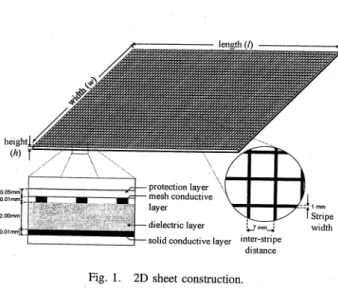
solid conductive layer
Fig. 1. 2D sheet construction.
is established locally via infrared and capacitive coupling, with neighboring pushpins in a closed (about 10 cm) range. In this concept, push pins features as explicit computational elements to create a new type of architecture, based on a huge collection of computing elements. The pins are required to be close to each other, and the network routing needs to be completely handled in a distributed fashion, which increases the complexity a 'great deal for use as a network in home environments.
III. 2D COMMUNICATION SYSTEM
The 2DCS consists of two components: a sheet and a connector. Figure 1 illustrates the basic structure of the 2D sheet, which composes of three layers: solid conductive (S-) layer, dielectric (D-) layer, mesh conductive (M-) layer. The conductive fabric is usually copper or aluminum, whereas the dielectric material is polystyrene. The purpose of protection layer in Fig. 1 is to protect human directly in contact with the M-Iayer. With this layered composition, an electromagnetic (EM) wave can be confined within the 2D sheet depending on the relative permittivity of D-Iayer and the mesh size of M-Iayer. The inter-stripe distance and the stripe width of M -layer are 7 mm and 1 mm for a 2.4 GHz EM wave. However, the EM wave still can seep out from the surface of 2D sheet. We call this phenomenon as 'evanescent wave', as shown in Fig. 2 The evanescent wave is formed when the EM wave inside the 2D sheet is reflected off the surface. The term "Evanescent" means "tending to vanish." This is because the intensity of evanescent waves decays exponentially with distance from the surface of 2D sheet to the air. The energy flow of evanescent wave is parallel to the input direction of the EM wave. Meanwhile, the connector is an antenna that an electromagnetic wave is extracted from or inserted into the 2D sheet. Since the connector is one type of antenna, the design of the connector is not described in this paper.
IV. ,AN EFFICIENT POWER SUPPLY SYSTEM IN 2D COMMUNICATION
In the previous works, we have developed the 2D com-munication systems [4]- [7], which provide the data
trans-III
Electromagnetic wave propagating Inslde the 2D sheet
Evanescent wave
Fig. 2. The electromagnetic wave seeping out from the surface of 2D sheet.
mission and power supply services to the devices wherever they are placed on the top of the 2D sheet. To strengthen the efficiency of power supply for 2D communication system, we develop a power supply system using phase control of multiple input signals.
It is known that in the three-dimensional (3D) space, the electromagnetic wave can be settled to a specific area by arranging the transmission electrode array at equal intervals. In the 2D sheet, the electromagnetic wave can theoretically be converged to a specific area by adjusting the phases of two or more input signals. Based on this thinking, we build up a 2D communication system that concentrates the power on a specific position by controlling the phase of every input signal. Meanwhile, in order to achieve a relatively big output power to activate the devices, it is needed to raise the input power. However, when the input power is increased, the leakage of the electromagnetic wave from the 2D sheet becomes a problem [7], and especially the peak value of electromagnetic wave is severely limited. To alleviate this problem, we here increase the number of input signal, and then the magnitude of every inputcan be decreased.
Figure 3 shows the outline chart of the proposed phase ,control system. To make the electromagnetic wave converge on a specific area in the 2D sheet, the output power is measured with multiple input signals. Through changing the phase of every input signal, the optimal phase value for every input signal can be obtained to maximize the output power. The procedure finding the optimal phase value for every input signal is described in Fig. 4. Since the electrodes located around the center may largely affect the output power, their phases should be first decided. We here start the adjustment from the 4th electrode by turning it on, and fix its phase to O. We then tum on the next electrode
Transmission electrodes
Turn on the first transmission electrode (here we first turn on the 4th electrode )
Fix the phase of the first electrode to 0
Turn on the next electrodes
(here we turn on in order of 3-->5-->6-->2-->7-->1-->8) Change the phase value and detect the optimal phase
(Phase_Max) to maximize the output power
No
No
Fig. 4. The flow chart to obtain the optimal input phase.
(3th), and change its phase to find the optimal value that maximizes the output power. In the similar way, we turn on the input electrode in order to 5 ~ 6 ~ 2 ~ 7 ~ 1 ~ 8, and find the optimal phases of the input signals one by one. Therefore, the maximum output power can be finally obtained when the last electrode is turned on and its optimal phase value is found.
V. EXPERIMENTAL PROCEDURES AND RESULTS In this section, we actually develop a power supply system using phase control, in order to verify the feasibility of the proposed 2D communication system. We investigate the performance of the developed 2D communication sys-tem, focusing on the center point, and adjust the phase of every input signal to converge the electromagnetic on it. To confirm whether the output power is concentrated on the center point, we also measure the output power over the whole sheet.
A. Experimental Setup and Description
Figure 5 shows the experiment setup that mainly consists of a signal generator, input electrodes, a connector plate and a power meter. An anti-reflection edged sheet is used to diminish the effect of standing wave, which is a resultant of the reflected waves and the original wave. The size of the 2D sheet is 1147 mmx580 mm. An input signal is generated from the generator, which consists of eight small generators. The small generator has a phase controllable switch that initiates the start of input signal in the phase range from 0 to 315 degree with the step of 45 degree. The input signal frequency that is set to 2.4 GHz is sent to a SMA connector via a coaxial cable. The SMA connector
112
Fig. 5. Experiment setup.
is directly clipped on the side of 2D sheet. Eight SMA connectors are arranged into an array and construct the overall of power supply unit. These input signals that are optimally inserted into the 2D sheet are propagating in the same direction inside the 2D sheet. The size of connector plate is 100 mmx200 mm, and the measured signal is sent to the power meter via a GP-IB cable. Since the tension of the GP-IB cable can leave up the connector plate from the 2D sheet, we use a plastic cube as a weight to make sure the connector plate is in-touch with 2D sheet.
B. Measurement Results and Discussion
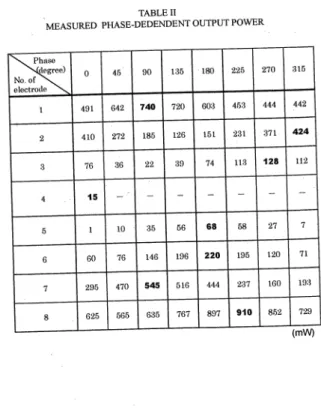
To find the optimal phase that maximizes the output power for every transmission electrode, we first adjust the phase in order to P3·~ P5 ~ P6 ~ P2 ~ P7 ~ PI ~ P8, in accordance with the procedure shown in Fig. 4. Table 2 shows the measured phase-dependent output power in the center point of 2D sheet, based on· the procedure shown in Fig. 4. From the table, we know that the optimal phase set is {90, 315, 270, 0, 180, 180,90, 225} for the input
TABLE II
MEASURED PHASE·DEDENDENT OUTPUT POWER
I~
degree) 0 45 90 1:35 180 225 270 315 No. of electrode 1 491 642 740 720 60:) 453 444 442 2 410 272 185 126 151 2:31 371 424 3 76 36 22 :)9 74 113 128 112 4 15_
... - - - -5 1 10 :)5 56 68 58 27 7 6 60 76 146 196 220 195 120 71 7 295 470 545 516 444 237 160 19:) 8 625 565 6:l5 767 897 910 852 729 (mW) &4'&1
signals from the first to 8th input signal, respectively. It can be easily seen that the more the number of input signals is turned on, the larger the output power becomes, and the maximum output power finally obtained is 910m W.
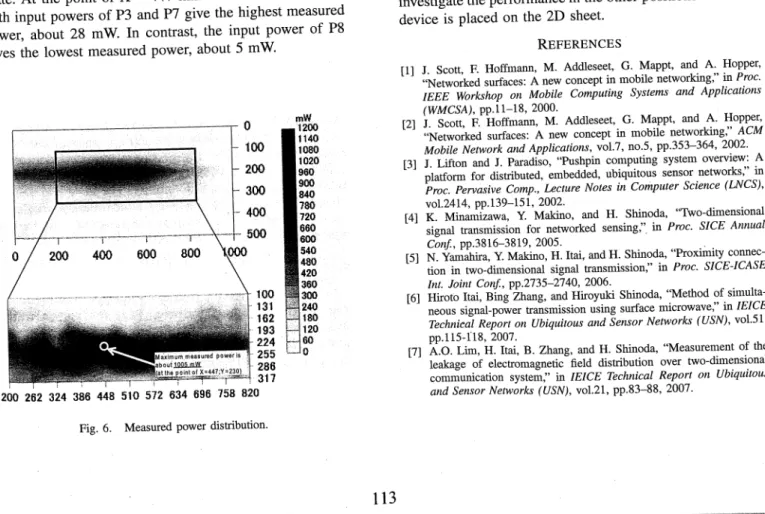
By using the optimal phase value for every input signal, we then measure the entire area and the selected area of 2D sheet, to confirm whether the microwave in the 2D sheet concentrates on the center area. In the entire area case, the connector plate is moved with the measurement step of 20 cm for X-axis and 10 cm for Y-axis. Figure 6 shows the measured power distribution of the entire and selected areas of the 2D sheet, by using the optimal input phase values obtained from Table 2. For the entire area, we can clearly identify the power is condensed around the central area of the 2D sheet. To measure the output power around the center more in detail, we move the connector plate with the measurement step of 31 mm (this value is equivalent to the quarter of the wavelength of the input signal) for both X- and Y- axes over the selected area. It is obviously identified the pattern of measured power contours for the selected area. The maximum measured power is in the range of 960,...,1020 mW. At the point of X = 447 mm and Y
=
230 mm, the maximum measured power is about 1005 m W. Based on the measured power distribution, we can summarize that supplying poweris concentrated on the center point of 2D sheet through using 8 input power points. Figure 7 shows the measured power versus the phase when only one small generator is turned on. We realize that the measured power does not depend on the phase of the input signal, but depends on the position of the connector plate. At the point of X = 447 mm and Y = 230 mm, the both input powers of P3 and P7 give the highest measured power, about 28 m W. In contrast, the input power of P8 gives the lowest measured power, about 5 m W.,---,-0 100 200 300 400 I-'---f.-.--r---r---····--··,-~-···--_,__··~\·--f_ 500
o
100 131 162 193 224 255I
~~~:;:~"I 286 317 200 262 324 386 448 510 572 634 696 758 820Fig. 6. Measured power distribution. mW 1200 1140 1000 1020 960 900 840 780 720 660 600 540 480 420 360 300 240 180 , 120 r~O 30 ",
...
;t:
:i; Ii! - - = $ ::$ 25§'
.s
20*
H if ~ Je )( if II _P1 _P2 _P3 _P4...
CIl ~ 0 15 Q. "'C I!! ,,*"P5 _P6 - P 7 - -P8/IF iii
re:=
I
:
:
:
1
~ I/) 10 III
..
•
•
I•
I I -CIl ::!!! 5 I - - -•
•
•
• • • • •
-0
o
45 90 135 180 225 276 315 Phase [degree] Fig. 7. Measured power versus phase.VI. CONCLUDING REMARKS
In this paper, we developed an efficient power supply system by using phase control in 2D communication. The developed system aims at enhancing the efficiency of power supply in 2D communication by converging the microwave on the place where the device is placed. The experiment results revealed that the output power is concentrated on the center point of 2D sheet by adjusting the phases of all input signals. Since at the present stage, we only confirmed the performance in the center point of the 2D sheet where the microwave is converged, a future work is required to investigate the performance in the other positions where the device is placed on the 2D sheet.
REFERENCES
[1] J. Scott, F. Hoffmann, M. Addleseet, G. Mappt, and A. Hopper, "Networked surfaces: A new concept in mobile networking," in Proc.
IEEE Workshop on Mobile Computing Systems and Applications (WMCSA), pp.11-18, 2000.
[2] J. Scott, F. Hoffmann, M. Addleseet, G. Mappt, and A. Hopper, "Networked surfaces: A new concept in mobile networking," ACM
Mobile Network and Applications, vo!.7, no.5, pp.353-364, 2002.
[3] J. Lifton and J. Paradiso, "Pushpin computing system overview: A platform for distributed, embedded, ubiquitous sensor networks," in
Proc. Pervasive Comp., Lecture Notes in Computer Science (LNCS),
vo!.2414, pp.139-151, 2002.
[4] K. Minarnizawa, Y. Makino, and H. Shinoda, "Two-dimensional signal transmission for networked sensing,". in Proc. SICE Annual C01!f, pp.3816-3819, 2005.
[5] N. Yamahira, Y. Makino, H. ltai, and H. Shinoda, "Proximity connec-tion in two-dimensional signal transmission," in Proc. SICE-ICASE
Int. Joint Con!, pp.2735-2740, 2006.
[6] Hiroto Itai, Bing Zhang, and Hiroyuki Shinoda, "Method of simulta-neous signal-power transmission using surface microwave," in IEICE
Technical Report on Ubiquitous and Sensor Networks (USN), vo!.51,
pp.115-118,2007.
[7] A.O. Lim, H. Itai, B. Zhang, and H. Shinoda, "Measurement of the leakage of electromagnetic field distribution over two-dimensional communication system," in IEICE Technical Report on Ubiquitous