Japan Advanced Institute of Science and Technology Title
Small- and medium-sized enterprise
internationalization: Towards the knowledge-based model
Author(s) Mejri, Kais; Umemoto, Katsuhiro
Citation Journal of International Entrepreneurship, 8(2): 156-167
Issue Date 2010-04-16
Type Journal Article
Text version author
URL http://hdl.handle.net/10119/9131
Rights
This is the author-created version of Springer, Kais Mejri and Katsuhiro Umemoto, Journal of International Entrepreneurship, 8(2), 2010, 156-167. The original publication is available at www.springerlink.com,
http://dx.doi.org/10.1007/s10843-010-0058-6 Description
Small and medium-sized enterprise internationalization:
Towards the knowledge-based model
Kais Mejri ‧ Katsuhiro Umemoto
Abstract Firm internationalization research has grown throughout the last 50 years,
resulting in a number of theories and models. Although each theory and model enables us to see some parts of the picture, a holistic approach is needed to provide us a full picture. The so-called knowledge-based models proposed so far drew upon the transaction-cost theory, the social capital theory, and the knowledge management models. This paper reviews previous research and builds a more comprehensive knowledge-based model of small and medium-sized enterprises internationalization. The model includes ‘knowledge factors’, which we identified from internationalization literature. These includes the market knowledge, and the experiential knowledge composed of network knowledge, cultural knowledge, and entrepreneurial knowledge. Acquisition as well as utilization of each kind of knowledge during the different phases of internationalization is presented. The model is a step towards deeper understanding of the role of knowledge in SME internationalization.
Keywords Internationalization, SME, knowledge-based model, market, network,
experience, culture, opportunity recognition.
Introduction
Small and medium-sized enterprise internationalization has been studied from a variety of perspectives. Theories and models have been proposed to explain the international involvement of the firm, including: the economic theory, the process or stages models, the innovation-related models (I-models), the pre-export and export-start models, the network theory, and the international entrepreneurship theory. Each of these theories and models has shed light on some aspect of internationalization and provided us with some insightful results.
However, previous research in this field has limitations mainly concerning the focus of many studies on some aspect of internationalization and the neglect to consider other aspects. This has resulted in clarifying some aspects, but still the full picture of internationalization needs to be clarified. Indeed, some research that reviewed the literature about firm internationalization has suggested a holistic approach (Coviello and McAuley 1999; Leonidou and Katsikeas 1996; Ruzzier, Hisrich, and Antoncic 2006) to clarify a complex phenomenon such as internationalization.
K. Mejri ( ) . K.Umemoto
Graduate School of Knowledge Science, Japan Advanced Institute of Science and Technology 1-1 Asahidai, Nomi-City, Ishikawa 923-1292 - Japan
The attempts to create a holistic approach about internationalization have already been started (i.e. Bell et al. 2003; Etemad 2004). But, there is still a need for models that succeed to integrate the main findings of previous literature.
This paper is an attempt to present SME internationalization from a knowledge perspective, trying to be more integrative of previous findings. The aim is to present a knowledge-based model of SME internationalization.
To attain that objective, we will answer three questions: (1) what are the theories and models of firm internationalization that have been proposed so far? (2) Why there is a need for a new perspective to explain internationalization and particularly for the knowledge-based perspective? and (3) What are the ‘knowledge factors’ and the model proposed?
Theories and models of firm internationalization
For few decades, authors concerned with internationalization of companies have attempted to define internationalization. One stream sees internationalization as a process in which firms increase their involvement in foreign markets (Johanson and Vahlne 1977; Welch and Luostarinen 1988)1. For another stream, internationalization is the adaptation of firms’ operations to international environments (Calof and Beamish 1995; cited in Prashantham, 2005).
While the debate about a precise definition of internationalization is still continuing, the stance adopted in this paper is that internationalization is the expansion of the firm’s operations to foreign markets. Internationalization is not necessary a process, it could be resulting from punctual and independent action. Accordingly, the review of papers about firm internationalization will cover their different actions as internationalization
Before reviewing some important research work about SME internationalization, it is important to see the theories and models that have been proposed to explain the international business. Actually, studies about SME internationalization are relatively new comparing to those about multinational companies or about trade between nations. While economic theories have been proposed since more than two centuries, theories about SME internationalization have started about two decades ago.
Economic theories are the first to explain international trade between nations. (i.e. Smith 1776; Ricardo 1817). From the middle of the 20th century, research began to focus on the microeconomic level. Economic theories have studied the internationalization of multinational enterprises (MNEs).These theories are mainly the product life cycle theory (Vernon 1966), the transaction cost theory (Williamson 1975), the internalization theory (Buckley and Casson 1976), and the eclectic theory (Dunning 1977).
Meanwhile, in the sixties, a behavioural theory of the firm was proposed by Cyert and March (1963) opening new explanations of firm internationalization. Building on that theory, Aharoni (1966) proposed the foreign investment theory, explaining the decision of U.S. MNEs to invest abroad. During the seventies, research was carried out in Nordic countries (i.e. Johanson and Vahlne 1977; Johanson and Wiedersheim-Paul 1975) about internationalization patterns. This research has resulted in Uppsala models (U-models)2.
1
The definition of Welch and Luostarinen (1988) is widely used in the literature on firm internationalization.
2
Other research studies, drawing on Roger’s (1962) work about the diffusion of innovations, proposed innovation-related models (I-models) (i.e. Lee and Brasch 1978; Reid 1981; Simmonds and Smith 1968). Another stream tried to explain pre-export (i.e. Olson and Wiedersheim-Paul 1978; Wiedersheim-Paul, Olson & Welch 1978) and export-start phases (i.e. Dichtl et al. 1984; Simpson & Kujawa 1974). In the 1980s, studies began to use network theory (i.e. Johanson and Mattsson 1986; Johanson and Vahlne 1990) as a framework to explain firm internationalization. Around the late 1980s and the beginning of the 1990s, as a growing number of small entrepreneurial firms, also called international new ventures, internationalized from their inception, a new stream has emerged, that is, the international entrepreneurship (i.e. McDougall and Oviatt 2000).
At the beginning of the 21st century, some integrative models of firm internationalization were proposed (i.e Bell et al. 2003; Etemad 2004). The most recent models are the knowledge-based models of internationalization (i.e. Kuivalainen et al. 2003; Saarenketo et al. 2004).
These theories and models have clarified different aspects about firm internationalization. However, there is still a need to see the whole picture.
The need for a new perspective to internationalization
The need for a new perspective to explain firm internationalization is mainly due to the complexity of internationalization. Each perspective proposed so far only explains partly the phenomenon.
Internationalization is a complex phenomenon. Complexity is ‘the state of having many different parts connected or related to each other in a complicated way’ (Collins Cobuild 2006). Related literature, as presented in the previous section, shows that internationalisation is a phenomenon influenced by a number of factors. These include decision-maker, network, firm characteristics, culture, environment and so.Therefore, to understand internationalization, it is necessary to understand the factors that make it happen or at least the main ones. This leads to the integration of different perspectives. This idea is supported by number of reviews about this subject.
In fact, a number of studies reviewing SME internationalization literature support the integration of findings of different theoretical perspectives for a better understanding of the phenomenon. For instance, Coviello and McAuley (1999), based on a review of empirical studies carried out between 1989 and 1998 about the SME internationalization process, concluded that integrating three theoretical approaches, which are the stage model approach, network perspective, and foreign direct investment theory, could better explain SME internationalisation. Similarly, in a more recent study reviewing SME internationalization research, Ruzzier, Hisrich, and Antoncic (2006) suggest the integration of five perspectives, namely process models, innovation models, network approach, resource-based perspective, as well as international entrepreneurship theory, in order to understand internationalization. In the same way, Leonidou and Katsikeas (1996) carried out a review of export model-building studies of manufacturing SMEs between 1975 and 1995. Based on criticisms addressed to these models by other research work, they concluded that ‘existing models provide only a partial, and sometimes misleading, explanation of the export development process, thus limiting theoretical advancement in this field of international business’. Likewise, Leonidou, Katsikeas and Piercy (1998), based on a review of research work done between 1960 and 1995 about managerial influences on exporting, suggested that future studies should include not only managerial but also
firm and environment influences on exporting. In the same fashion, Fillis (2001) in his review of small firm internationalization concluded that ‘the majority of frameworks fail to readily explain small firm internationalization behaviour’. Furthermore, Etemad and Wright (1999) state that ‘no single, established model adequately explains the success of these small firms (in their internationalization). Rather, their behaviour must be regarded as a holistic process in which insights are drawn from a variety of theoretical models, including the stage models, FDI theories, and network theories’.
The attempts to integrate findings about SME internationalization have already been started, and some models have been proposed. For example, Fletcher (2001) proposed a conceptual framework of a holistic approach of firm internationalization. The framework presents three different forms that could take the internationalization activities: outward (i.e. direct export), inward (i.e. import) and linked (i.e. strategic alliances). These three forms are influenced by each other, and are under the influence of internal and external environment. In his survey of Australian firms, mostly SMEs, the results showed the validity of some propositions in the framework. Another integrative model is that of Bell et al. (2003), in which they presented the different “pathways” that could follow the internationalization of small firms. Three pathways were identified: the first one is the penetration of foreign markets incrementally (‘traditional’ firms); the second one is the internationalization in a very fast pace (‘born globals’); and the third one is entering into foreign markets at first like ‘traditional’ firms, but due to some improvements the pace of penetration become faster (‘born-again global’). In this model, knowledge as a source of competitive advantage is crucial for ‘born-globals’. Worthy to note also that the manager’s characteristics and his mental model influence directly which pathway to choose. Also, Etemad (2004) presented an integrative framework in which the internationalizing SME is under three forces: the pushing forces to internationalize, which are entrepreneurial; the pull forces which are external to the firm and pull it towards internationalization; and the mediating forces which are resulting from the interactions between push and pull forces. The influences of these three forces depend on the internal characteristics of the SME.
In other research studies, integrative models adopted a knowledge-based perspective. To begin with, Kuivalainen et al. (2003), adapting Blomqvist et al.3 s’ model (2000), presented a framework for firm internationalization. Furthermore, Saarenketo et al.’s (2004), based on evolutionary economics, presented a knowledge management model for internationalization. In this model, the entrepreneur’s role is to find new combinations (variation) from internal as well external knowledge determinants that lead to a sustainable international competitive advantage. In an another study, Prashantham (2005), based mainly on Yli-Renko’s (2002) model, presented two factors that influence internationalization. The first one is the social capital which influence internationalization directly and indirectly (through market knowledge and knowledge-intensity). The second one is information technologies like Internet which is influential on internationalization through information dissemination, acquisition and sharing.
To summarize, the holistic models presented so far provided interesting results in terms of variables and processes included in internationalization. Each of these studies
3
Blomqvist et al. (2000), based on the evolutionary theory of the firm, proposed an evolutionary knowledge management model. Using transaction cost economics, the authors emphasized the nature of knowledge relevant for partnership decisions.
has seen holism in a particular way: inclusion of different modes of internationalization (Fletcher 2001), presenting the internationalization pathways (Bell et al. 2003), explaining push, pull and interaction factors behind it (Etemad 2004), adapting a knowledge management model to the internationalization framework (Kuivalainen et al. 2003), proposing an evolutionary knowledge management for internationalization (Saarenketo et al. 2004) and integrating social capital and Internet as driving forces of internationalization (Prashantham 2005).
A knowledge perspective to internationalization
While debate exists regarding how to integrate the findings about SME internationalization in one model, the stance adopted in this paper is that a knowledge perspective enables to be more integrative in explaining the phenomenon. That means previous explanations of firm internationalization are seen through the lens of knowledge.
Before tackling the issue of seeing internationalization from the knowledge perspective and presenting our knowledge-based model, it is essential, we think, to present the knowledge based-view of the firm. The knowledge-based view of the firm is considered as an extension of the resource-based view.
It is commonly recognized that the resource-based view of the firm is originated from the seminal work of Penrose (1959) about the growth of the firm. In her treatise, the focus was on the firm internal resources as she mention `in all the discussion the emphasis is on the internal resources of a firm-on the productive services available to a firm from its own resources, particularly the productive services available from management with experience within the firm’ (p5).Differently from preceding strategy literature, Barney (1991), building on assumptions of heterogeneity of resources between firms and stability of these differences over the time, explained the sustainable competitive advantage by the firm resources. These resources have to be: valuable, rare, imperfectly imitable and sustainable. Prahalad and Hamel (1990), based on a study of a number of corporations, considered core competencies as the `roots’ of the competitive advantage of the firm. In their definition of core competence, it is noticeable the link between core competence and knowledge such as considering core competence as `the collective learning in the organization’ or that it `does not diminish with use’ or the `embedded skills’.
During the nineties, the knowledge-based view of the firm emerged. In this stream, knowledge constitutes the most critical resource for surviving and developing. While some research work focuses on organizational knowledge creation (Nonaka and Takeuchi, 1995), other views focus on individual knowledge and knowledge application such as Grant (1996).
In this paper, the choice of knowledge perspective is explained by mainly three reasons. First, SMEs compared to big companies have relatively less resources, which makes knowledge very vital for their survival and growth. The lack of tangible resources has to be compensated by intangible resource, that is knowledge, or it will be difficult to compete. Second, in our view, knowledge has been since thousands of years the core of Human achievements. With this stance, we share Grant’s (2000) view that the recent changes have only emphasized more the role of knowledge, but still its importance has been always the same since the very old ages. The recent developments in environment towards what is so-called ‘knowledge economy’, makes knowledge more valuable for being competitive, yet it has been valuable even before these development. Building on that, we see internationalization as resulting from
knowledge. Third, it has been found in literature that knowledge is central for understanding SME internationalization.
A knowledge-based model of internationalization
The scope of the knowledge-based model presented below is one particular market and not all the markets in which the firm is involved in4. The criterion based on which the phases were proposed is the level of experience: pre-internationalization (no experience), novice internationalization (short experience), and experienced internationalization (long experience).
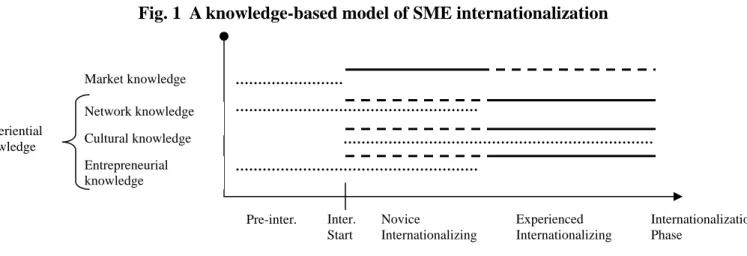
As it is shown in figure 2, our knowledge-based model of internationalization consists of three phases during which four kinds of knowledge impact these phases. These phases are the pre-internationalization phase, the novice internationalizing phase and the experienced internationalizing phase. As the border between novice internationalizing and experienced internationalizing is difficult to delineate, so we did not make a clear separation between them. Here, by novice, it is meant the person who is just experiencing for the first time the internationalization in that particular market. After some time, when accumuling some knowledge, the firm goes gradually to be experienced in internationalization.
Turning now to knowledge factors, based on literature about SME internationalization, four factors have been found to be influential on the internationalization process. These includes market knowledge, and experiential knowledge, which is composed of network knowledge, cultural knowledge, and entrepreneurial knowledge.
We will discuss first the point of the categorization of knowledge. In fact, the categorization of knowledge is useful for understanding the effect of knowledge on the internationalization of the firms. A possible categorization is based on the source of acquisition of knowledge. Accordingly, there are two types of knowledge: one is the most objective or explicit and one is more tacit or experiential (Nonaka and Takeuchi, 1995). The objective knowledge comes from written documents, reports and explicit materials. The experiential knowledge comes only from experience. In this research, in relation with the internationalization, the first type of knowledge is what we call here the market knowledge. The second one is the experiential knowledge which includes different types of knowledge.
Fig. 1 A knowledge-based model of SME internationalization
Experienced Internationalizing Novice Internationalizing Inter. Start Pre-inter. Internationalization Phase Network knowledge Cultural knowledge Entrepreneurial knowledge Experiential knowledge Market knowledge 4
The discussion about the effect of the experience in one market on the phases in another market is not under the scope of this model.
High-intensity utilization Low-intensity utilization Acquisition
In what follows, we will explain the acquisition and the utilization for each kind of knowledge.
Market knowledge
Market knowledge refers to objective or explicit information about foreign markets. It includes the information about for instance the market size, the competitors, the regulations, and so.
It has been found in a number of researches that market information acquired during the pre-internationalization phase is critical for internationalization start and its first phase. Before internationalizing, the firm tries to acquire the maximum of market information because of the high risk of the first entry. In pre-export and export-start models, market knowledge is the starting point from which to consider internationalization. An example of pre-export models is that of Wiedersheim-Paul, Olson & Welch (1978) in which pre-export information activities precedes export phase. Similarly, in Dichtl et al.’s (1984) export start model, information seeking is essential for generating alternatives from which the decision-maker would choose. We illustrate the acquisition of market knowledge by the thinnest dot line during the pre-internationalization phase.
The firm uses intensively the market knowledge acquired during the first phase of internationalization. Among all the factors, it is the most intensively used during this phase. It is to note also that the intensity of utilization of market knowledge decreases as the firm progress in the internationalization path. Instead, other kinds of knowledge are more relied on such as network, cultural and entrepreneurial knowledge.
Experiential knowledge
Experiential knowledge of foreign markets has been considered as essential for firm internationalization. This type of knowledge results from practice, and ‘can only be learned through personal experience (Penrose, 1966).
Based on the literature review on internationalization, experiential knowledge includes cultural knowledge (knowledge of language, habits, norms, laws, behaviour…), network knowledge (social and business network; knowledge as the network itself) and the entrepreneurial knowledge (knowledge of the existence of opportunities and exploiting them). We see experiential knowledge, in the internationalization context, as a triad of these above-mentioned types of knowledge.
The acquisition of experiential knowledge, as it is shown in the figure, starts in the pre-internationalization stage (network knowledge and entrepreneurial knowledge). It continues when the firm makes its first step in internationalization.
The more the firm has experience, the more it tends to use it in later stages of internationalization. This is supported by process models, in which experiential knowledge has been considered as critical for more involvement in the foreign market. (Johanson and Vahlne, 1977; Wiedersheim-Paul’s, 1975; Cavusgil’s, 1980; Wortzel and Wortzel, 1981)
Cultural knowledge
Hofstede and Hofstede (2005) define culture as the “software of the mind”. Cultural knowledge of a foreign market refers to the knowledge of values, manners, and ways of thinking of people in that market.
The acquisition of cultural knowledge, as the experiential knowledge, starts when the firm begins its internationalization. The firm gradually knows about how to deal, from a cultural perspective, with partners in the foreign market. As the firm acquire more and more cultural knowledge, the intensity of its utilization increases.
During the novice internationalization stage, there is a low-intensity of utilization of cultural knowledge, which turns into a high-intensity when the firm becomes more experienced in a foreign market. In fact, it has been found in previous studies (i.e. process models) that psychic distance is influential when considering which foreign country to enter in. Accordingly, a firm would enter the closest market because of the low psychological distance comparing to local market. As the firm accumulates cultural knowledge in some market, it could seek entering in other culturally-close markets.
Network Knowledge
There is growing evidence from previous studies showing that SME network is influential on internationalization in both manufacturing (Holmund and Kock (1998) as well as service sector (Sharma and Johanson, 1987).
Network knowledge involves both social and business networks that facilitate the internationalization of the firm. The network knowledge here refers the network itself (as the locus of knowledge).
As it is shown in the figure, network knowledge acquisition starts in the pre-internationalization stage and continues during the novice pre-internationalization phase.
Network knowledge has been shown to be used in the different phases of internationalization. However, previous findings show that the degree of use of network knowledge, as the other kinds of knowledge, is different depending on the internationalization stage.
Interestingly, it has been found in previous literature that network built in pre-internationalization stage was critical for the pre-internationalization start. The network can `force’ or encourage the firm to start to internationalize. This was the case of two Finnish technical consultancy firms; While the internationalization of one firm was a kind of pull from clients operating in foreign markets, the internationalization of the other one was encouraged by others consultants partners of the firm (Sharma and Johanson, 1987). Furthermore, in high-tech industries, it has been found that having a network stimulated firms to initiate internationalization (Zain and Ng, 2006)
Some findings show that domestic as well as foreign social network do influence firm internationalization during its first stage. In a study of Finnish SMEs that were in their initial phase of internationalization, Holmund and Kock (1998) found that social network in the home country and abroad were considered as from the most influential factors on internationalization
There is growing evidence showing that firms while increasing their involvement in foreign markets, their use of network knowledge increases as well. It was found that experienced firms having been internationalizing in many countries relied heavily
on knowledge gained from their network to enter into a new foreign market (Blomstermo et al. 2004). While new exporters try to acquire network knowledge, experienced firms use more their knowledge already acquired. For example, in a study about the usefulness of trade missions, Spence and Crick (2004) found that SMEs that already visited a market at least three times have rated the benefits of trade missions lower than that of new exporting SMEs. That is because the experienced internationalizing SMEs use more intensively their networks acquired in previous stages.
For that reason, it has been presented in the figure that during the novice internationalization, the intensity of utilization of network knowledge is low. However, in the experienced stage, that intensity incrases.
Entrepreneurial knowledge
Entrepreneurial knowledge refers to knowledge of the existence of opportunities and how to exploit them. In fact, oopportunity recognition is critical for the survival and the growth of the firm. Shane (2004) defines entrepreneurial opportunity as “a situation in which a person can create a new means-ends framework for recombining resources that the entrepreneur believes will yield a profit” (p.18). Opportunity recognition can be considered as a skill, but it becomes useful only when knowing how to exploit that opportunity.
Some propositions have been put forward to explain the factors that lead to the identification of opportunities. Kirzner (1973) relates the identification of opportunities to the alertness of the entrepreneur, while Casson (2003) relates it to the access to new information that renders the present allocation of resources inefficient. Shane (2004) proposes that two factors are behind the recognition of opportunities: the absorptive capacity (prior knowledge) and the cognitive processes (intelligence). For Baron (2004), opportunity recognitions results from a cognitive process of identification of something new with a potential value.
Opportunity recognition and exploitation constitutes in many cases the reason behind the internationalization of the firm. Accordingly, detecting an opportunity related to the possibility to sell to foreign markets can lead the firm to think about engaging in internationalization.
The opportunity recognition ability and its exploitation is acquired from the start of the firm, meaning in the pre-internationalization phase. During operations in the domestic market, the decision-maker acquires some clues about how to recognize opportunities which might be useful when operating in foreign markets. Even if the circumstances in the domestic market could be very different from those which prevail in the foreign market, the way to detect opportunities or how to process information acquired before internationalizing could be very useful when operating in foreign markets.
During the novice internationalization phase, the acquisition of the opportunity recognition ability and how to exploit it continue. The firm starts to get in touch with the foreign markets and begins to acquire some clues, as on how to recognize opportunities in the market.
During the novice internationalization stage, the firm gradually applies the acquired opportunity recognition and exploitation ability. The intensity of utilization of that ability in this stage is low. However, as the firm becomes more experienced in internationalization, decision-makers use more intensively their ability to detect and exploit opportunities.
Conclusion
SME internationalization literature has been growing over the second half of the 20th century. Theories and models have explained some aspects about internationalization. From about the beginning of the 21st century, some holistic models have been proposed. Building on the assumption that knowledge constitutes a valuable resource for the activities of the firm, a knowledge-based model is proposed. In this model, we included knowledge-related factors which have been shown to be significant in explaining SME internationalization.
Four factors have been proposed, which are market knowledge, network knowledge, cultural knowledge, and entrepreneurial knowledge. The acquisition and the intensity of utilization of each one during the phases of internationalization is presented in the model.
This model is a step added to previous steps done so far in order to understand SME internationalization from a knowledge perspective. Future research could tackle the aspect of the degree of tacitness of the knowledge factors proposed in this model. It could be possible to test the impact of the variables in the model by conducting an empirical study. A case study strategy would be more suitable since it allows a deep understanding of the factors that explain internationalization, and therefore test the model proposed.
References
Aharoni Y (1966) The foreign investment decision process. Harvard University, Boston.
Axinn CN, Matthyssens P (2002) Viewpoint: Limits of internationalization theories in an unlimited world. Int Mark Rev 19(4/5):436-450.
Baron RA (2004) Opportunity Recognition: Insights from a Cognitive Perspective. In: Butter EJ (Ed). Opportunity Identification: Entrepreneurial Behavior, 1st Edn. Connecticut: IAP pp 47-73.
Barney JB (1991) Firm resources and sustained competitive advantage. J Manag 17:99-120.
Bell J, McNaughton RB, Young S, Crick D (2003) Towards an integrative model of small firm internationalization. J Inter Entrep 1:339-362.
Blomstermo A, Eriksson K, Lindstrand A, Deo Sharma D (2004) The perceived usefulness of network experiential knowledge in the internationalizing firm. J Inter Manag 10:355-373.
Buckley PJ, Casson MC (1976) The future of the multinational Enterprise. Home and Meier, London.
Casson M (2003) The Entrepreneur: An Economic Theory. Edward Elgar Publishing, Massachusetts.
Cavusgil T (1980) On the internationalisation process of firms. Eur Res 8(6):273-281. Child J, Ng SH, Wong C (2002) Psychic distance and internationalization: Evidence
from Hong Kong firms. Inter Stud Manag Org 32(1):36-56.
Collins Cobuild (2006) Advanced Learner’s English Dictionary. Harper Collins Publishers, Glascow.
Coviello NE, McAuley A (1999) Internationalisation and the smaller firm: A review of contemporary empirical research. Manag Inter Rev 39(3):223-256.
Coviello N, Munro H (1997) Network relationships and the internationalization process of small software firms. Inter Bus Rev 6(4):361-386.
Coviello N, Munro H (1995) Growing the entrepreneurial firm: Networking for internal market development. Eur J Mark 29(7):49-61.
Crick D, Spence M (2005) The Internationalisation of ‘high performing’ UK high-tech SMEs: A study of planned and unplanned strategies. Inter Bus Rev 14:167-185. Cyert RM, March JG (1963) A behavioral theory of the firm. Prentice-Hall, New
Jersey.
Dichtl E, Leibold M, Kolglmayr H-G, Muller S (1984) The export-decision of small and medium-sized firms: A review. Manag Inter Rev 24:49-61.
Dunning JH (1977) Trade, location of economic activity and the MNE: A search for an eclectic approach. In: Ohlin B, Hesselborn P, Wijkman M (Ed) The International Allocation of Economic Activity. Mcmillan, London, pp 395-418.
Elo M (2005) SME Internationalization from a Network Perspective: Empirical Study on a Finnish-Greek Business Network. Abo Akademi University Press, Abo.
Etemad H (2004) Internationalization of small and medium-sized enterprises: A grounded theoretical framework and an overview. Can J Adm Sci 21(1):1-21. Etemad H, Wright RW (1999) Internationalization of SMEs: Management responses
to a changing environment. J Inter Mar 7(4):4-10.
Fillis I (2001) Small firm internationalization: An investigative survey and future research directions. Manag Decis 39(9):767-783.
Fletcher R (2001) A holistic approach to internationalisation. Inter Bus Rev 10:25-49. Fletcher R, Bohn J (1998) The impact of psychic distance on the internationalisation
of the Australian firm. J Glob Mark 12(2): 47-68.
Grant RM (2000) Shifts in the world economy. In: Despres C, Channel D (Ed) Knowledge Horizons: The Present and the Promise of Knowledge Management, Butterworth-Heinemann, Boston, MA, pp.27-54.
Grant RM (1996) Toward a knowledge-based theory of the firm. Strateg Manag J 17:109-122.
Hofstede G, Hofstede GJ (2005) Cultures and Organizations: Software of the Mind. McGraw-Hill, New York.
Holmlund M, Kock S (1998) Relationships and the internationalization of Finnish small and medium-sized companies. Inter Small Bus J 16(4):46-63.
Johanson J, Mattsson LG (1986) International marketing and internationalization processes – A network approach. In: Turnbull PW, Paliwada SJ (Ed), Research in International Marketing, Croom Helm, London, pp 234-265.
Johanson J, Vahlne J-E (1990) The mechanism of internationalization. Inter Mark Rev 7 (4):11-24.
Johanson J, Vahlne J-E (1977) The internationalization process of the firm- A model of knowledge development and increasing foreign market commitments. J Inter Bus Stu 8 (1):23-32.
Johanson J, Vahlne J-E (2003) Business relationship learning and commitment in the internationalization process. J Inter Entrep 1:83-101.
Johanson J, Wiedersheim-Paul F (1975) The internationalization of the firm– Four Swedish cases. J Manag Stu 12 (3):305-322.
Kirzner I (1973) Competition and Entrepreneurship. The University of Chicago Press, Chicago, London.
Kuivalainen O, Kylaheiko K, Puumalainen K, Saarenketo S (2003) Knowledge-based view on internationalization: Finnish telecom software suppliers as an example. In: Von Zedtwitz M et al. (Ed) Management of Technology: Growth through Business, Innovation and Entrepreneurship, Pergamon Press, Oxford, pp 239-264.
Lee W-Y, Brasch JJ (1978) The adoption of export as an innovative strategy. J Inter Bus Stu 9:85-94.
Leonidou LC and Katsikeas CS (1996) The export development process: An integrative review of empirical models. J Inter Bus Stu 27(3):517-551.
Leonidou LC, Katsikeas CS, Piercy NF (1998) Identifying managerial influences on exporting: Past research and future directions. J Inter Mark 6(2):74-102.
Liesch PW, Knight GA (1999) Information internalization and hurdle rates in small and medium enterprise internationalization. J Inter Bus Stu 27(3):383-394.
McDougall PP, Oviatt BM (2000) International entrepreneurship: The intersection of two research paths. Acad Manag J 43(5):902-908.
Nonaka, I. and Takeuchi H (1995) The Knowledge-creating Company. Oxford Press, New York.
Olson HS, Wiedersheim-Paul E (1978) Factors affecting the pre-export behavior of Non-exporting Firms. In: Ghertman M, Leontiades J (Ed) European Research in International Business, North-Holland Publishing Company, Amsterdam, New York, Oxford, pp 283-305.
Penrose ET (1966) The Theory of the Growth of the Firm. Blackwell, Oxford.
Prahalad CK, Hamel G (1990) The core competencies of the corporation, Harv Bus Rev May-June:79-91.
Prashantham S (2005) Toward a Knowledge-Based Conceptualization of Internationalization. J Inter Entrep 3(1):37-52.
Prashantham S (2006) Foreign network relationships and the internationalization of small knowledge-intensive firms. Inter J Entrep and Innov Manag 6(6):542-553. Reid SD (1981) The decision-maker and export entry and expansion. J Inter Bus Stu
12:101-112.
Ricardo D (1817) Principles of Political Economy and Taxation. Cosimo classics, New York.
Roger EM (1962) Diffusion of innovations. Free press of Glencoe, New York; Macmillan, New York.
Roy DA, Simpson CL (1981) Export attitudes of business executives in the smaller manufacturing firms. J Small Bus Manag 19(2): 19-22.
Rutashobya L, Jaensson J-E (2004) Small firms’ internationalization for development in Tanzania: Exploring the network phenomenon. Inter J Soc Eco 31(1/2):159-172. Ruzzier M, Hisrich RD, Antoncic B (2006) SME internationalization research: Past,
present, and future. J Small Bus Enterp Dev 13(4):476-497.
Saarenketo S, Puumalainen K, Kuivalainen O, Kylaheiko K (2004) Dynamic knowledge-related learning processes in internationalizing high-tech SMEs. Inter J Prod Eco 89:363-378.
Shane S (2004) A General Theory of Entrepreneurship. Cheltenham, UK; Edward Elgar, Northampton, MA, USA.
Sharma DD, Johanson J (1987) Technical consultancy in internationalization. Inter Mark Rev 4:20-29.
Simmonds K, Smith H (1968) The first export order: A marketing innovation. Br J Mark 2:93-100.
Simpson CL, Kujawa D (1974) The export decision process. J Inter Bus Stu 5(1):107-117.
Smith A (1776) The Wealth of Nations. Bantam Classic, New York.
Spence M, Crick D (2004) Acquiring relevant knowledge for foreign market entry: The role of overseas trade missions. Stra Change 13(5):283-292
Vernon R (1966) International investment and international trade in the product cycle. Q J Eco 80:190-207.
Wiedersheim-Paul F, Olson HC, Welch LS (1978) Pre-export Activity: The first Step in Internationalization. J Inter Bus Stu 9(1):47-58.
Williamson O (1975) Market and Hierarchies. Free Press, New York.
Wortzel LH, Wortzel HV (1981) Export marketing strategies for NIC and LDC-based firms. Columbia J World Bus 16(1):51-60.
Yli-Renko H, Autio E, Tontti V (2002) Social capital, learning and the international growth of technology-based new firms. Manag Inter Rev 11:279-304.
Zain M, Ng SI (2006) The impacts of network relationships on SMEs’ internationalization process. Thunderbird Inter Bus Rev 48(2):183-205.