The Eastern Buddhist 47/2: 41–81
©2019 The Eastern Buddhist Society
V
ictorS
ōgenH
oriS
uzuki Daisetsu Teitarō 鈴木大拙貞太郎, or D. T. Suzuki, was born in 1870 and died in 1966. While he was alive, his many admirers lauded him highly, sometimes describing him as the living embodiment of Zen Buddhism. But in the decades after his death, academic critics in the West have castigated him severely. Robert Sharf has charged that Suzuki’s account of Zen is not only a historically inaccurate “invention of tradition,”1but also an expression of Japanese nationalism extolling the cultural superior-ity of Japan as a nation and the Japanese as a race.2 Bernard Faure conducted
a critique of Suzuki’s account of Zen from the point of view of rhetoric rather than doctrine; this critique on the one hand revealed Suzuki’s sectarian biases and logical inconsistencies3 and on the other hand exposed Suzuki’s account
of Zen as a “secondary Orientalism.”4 Brian Victoria has argued that although
Buddhism is supposed to be a pacifist religion, the Zen school in Japan will-ingly supported the Japanese military’s war efforts during World War II and that Suzuki actively supported the Japanese military aggression.5
Is Suzuki guilty of these offences? How just are these criticisms? In this paper, I would like to examine Robert Sharf’s claim that Suzuki’s exposition
AN EARLY version of this paper was presented at the World Congress of the International Association of the History of Religions held in Erfurt, Germany, in 2015. At that time, I received valuable feedback from Professors John Harding, Alec Soucy, André van der Braak, Jessica Main, and Donald Lopez. I also thank Heather Midori Yamada, Michael Pye, and
The Eastern Buddhist anonymous reviewer for useful comments and advice.
1 Sharf 1995a, p. 246. 2 Sharf 1993, p. 5. 3 Faure 1993, pp. 54–60. 4 Faure 1993, p. 5. 5 Victoria 1997.
of Zen is an invention of tradition and revisit Faure’s notion of second-ary Orientalism. I will not be dealing with the criticisms levelled by Brian Victoria.6 My discussion divides into two parts, the first dealing with the
critique of Zen experience and the second dealing with authentic Buddhism and cultural nationalism.
I. THE CRITIQUE OF “EXPERIENCE”
In his writings, D. T. Suzuki emphasized that the experience of satori, or enlightenment, was absolutely essential to Zen. Suzuki wrote, “At all events there is no Zen without satori, which is indeed the Alpha and Omega of Zen Buddhism. Zen devoid of satori is like the sun without its light and heat. Zen may lose all its literature, all its monasteries, and all its paraphernalia; but as long as there is satori in it it will survive to eternity.”7 This statement
is just one example of many such statements asserting the unique character and essential role of satori. Satori, he said, is not a fact of information or an idea explainable in words or a concept understood by the intellect. Satori cannot be conveyed by one person to another person through language; “Zen defies explanation”;8 “Satori can thus be had only through our personally
experiencing it.”9
Where Did Suzuki’s “Satori” Come From?
This picture of Zen, centered around the satori awakening experience, is the conventional way we think of Zen today. Sharf, however, argues that Suzu-ki’s claims about the importance and nature of satori are not part of tradi-tional Zen/Chan but in fact are part of a modernist reconstruction of Zen which has been projected back in time so that we now unthinkingly assume it to be history. He has rightly pointed out that Suzuki’s exposition of Zen arose as part of a larger movement by Japanese Buddhists to create a “new Buddhism” in the face of the advance of the West into Asia. The historical background is well known but it is important to recall the political context in which this happened. We need to remind ourselves of how directly the search for a new Buddhism was triggered by the fear of being colonized by the Western powers and the desire to be respected by the Western nations.
6 See the reply to Brian Victoria in Satō 2010. 7 Suzuki (1927) 1970, pp. 229–30.
8 Suzuki (1927) 1970, p. 243. 9 Suzuki (1927) 1970, p. 230.
In 1853, Commodore Matthew Perry sailed his “black ships” into Uraga 浦賀 Bay, forcefully breaking the Japanese policy of national isolation. Thereafter, the Tokugawa government was coerced into signing unequal treaties with the Western powers. In the technical language of international diplomacy at the time, Japan was formally categorized as a “barbarian” state; it was not considered “civilized” as European states were. When the Tokugawa shogunate fell in 1868 and the Meiji emperor assumed the throne, the new Japanese government sought to modernize the country by studying the Western nations and selectively adopting Western institutions and practices. The Meiji government, alive to Western notions of rationality and science, considered Buddhism corrupted by superstition and thus sub-jected it to a persecution (haibutsu kishaku 廃仏毀釈, or “abolish Buddhism, destroy Śākyamuni”), which forced ordained monks and nuns back into secular life, confiscated temple property, and destroyed temple buildings and artifacts.10 Although there were local players who had their own
rea-sons for shutting down Buddhist temples, the persecution was motivated by the desire to get the classification of Japan in international diplomatic terms upgraded from “barbarian” state to “civilized” state. At the same time, the new Meiji government also promoted Shinto as a national ideology. Japa-nese Shinto nationalists ignored the long history of Buddhist adaptation to Japanese culture and criticized it as a foreign religion imported from the foreign countries of China, Korea, and India.11 In this crisis for survival,
defenders of Japanese Buddhism needed a new formulation of Buddhism, a Shin Bukkyō 新仏教 or “New Buddhism,” which on the one hand would satisfy Western conceptions of modernity and scientific rationality while on the other hand stake a claim to the new Japanese national identity then under construction.12
As a young man, Suzuki had spent the years from 1897 to 1909 in Illi-nois working as an assistant to Paul Carus, a scholar and publisher who, in order to bridge the gap between science and religion, was advancing the “Religion of Science.” In Carus’s vision, when religion is purified of its superstitious and irrational elements, and when science is purified of its atheism and materialism, then religion and science will point at the “unity of the realm of spirit and the realm of scientific truth.”13 Sharf says
10 Ketelaar 1993.
11 Ketalaar 1993, pp. 48, 55, 241. 12 Sharf 1993, pp. 3–6.
that D. T. Suzuki’s answer to the need for a new Buddhism in Japan was to borrow Paul Carus’s vision of the religion of science and to promote it under the label of Zen. In addition, during his eleven-year stay in America, Suzuki was exposed to the then current trends in Western thought, and on his return to Japan, he brought back William James’s idea of pure experi-ence and conveyed this to his friend, the philosopher Nishida Kitarō.14
Nishida then employed the concept of pure experience ( junsui keiken 純粋經驗) as the foundation for his first book, Zen no kenkyū 善の研究 (A Study of the Good).15 In that book, Nishida says, “By pure I am referring
to that state of experience just as it is without the least addition of delibera-tive discrimination.”16 Pure experience is pure in the sense that it contains no
intellectual discrimination, no dualistic conceptualization. Sharf says that, in philosophical terms, this is what Suzuki meant by satori.17 Thus, he concludes
that D. T. Suzuki’s exposition of Zen and satori, “with its unrelenting empha-sis on an unmediated inner experience, is not derived from Buddhist sources so much as from his broad familiarity with European and American philo-sophical and religious writings.”18 On this account, Suzuki’s concept of satori
is not originally derived from traditional Buddhism. It has an American origin. Did Monks Meditate for Enlightenment?
Contrary to the picture painted for us by D. T. Suzuki, Sharf denies that traditional Chan/Zen practice was directed toward the attainment of an enlightenment experience: “In point of fact, traditional Ch’an and Zen prac-tice was oriented not towards engendering ‘enlightenment’ experiences, but rather to perfecting the ritual performance of Buddhahood. . . . The mod-ern notion that Ch’an and Zen monks were required to experience satori before they could ‘inherit the dharma’ is simply inaccurate.”19 Similarly he
says that our image of Buddhist monks leading lives centered on medita-tion practice is also mistaken. “In fact, contrary to the image propagated by twentieth-century apologists, the actual practice of what we would call meditation rarely played a major role in Buddhist monastic life.”20
14 Sharf 1993, p. 22.
15 Nishida 1911. For an English translation, see Nishida 1990. 16 Nishida 1990, p. 3.
17 Sharf 1993, pp. 21–23. 18 Sharf 1998, p. 101. 19 Sharf 1995a, p. 243.
What is the evidence for these assertions? In support of these claims, Sharf marshals several arguments. First, he claims that the key Japanese terms for experience, keiken 經驗 and taiken 體驗, are rarely found in pre-modern Japanese texts and that they only start to be used in the early Meiji period.21 A second argument concerns mārga texts, texts outlining the path
of practice. Here Sharf’s critique of Zen broadens to include Buddhism in general. Mārga texts are often taken to be guidebooks through the stages of consciousness that a practitioner encounters when advancing into deeper and deeper meditation. But Sharf argues that they are not based on the per-sonal experiences which a master practitioner has had during meditation. Mārga texts are “first and foremost scholastic compendiums, compiled by monks of formidable learning who were attempting to systematize and schematize the confused and often conflicting descriptions of practices and stages found scattered throughout the canon.”22 When unusual states
of consciousness do get mentioned in these texts, they turn out to be the kind which modern people cannot accept: “They are filled with detailed accounts of the supernatural attainments (siddhi) that accompany particular meditative trances, including such powers as walking through walls, flying through the air, becoming invisible, reading minds, recalling past lives, and so on.”23
A third argument introduces a theory of language that similarly applies not just to Chan/Zen but to all of Buddhism. Sharf says the vocabulary of meditation and experience in Buddhism—śamatha, vipassanā, sotāpatti, satori, etc.—does not actually refer to or denote states of consciousness. If it did, then one could expect that meditation teachers would agree on what these terms labelled. But “the lack of consensus among prominent Buddhist teachers as to the designation not only of particular states of consciousness, but also of the psychotropic techniques used to produce them (e.g., śamatha versus vipassanā) belies the notion that the rhetoric of Buddhist meditative experience functions ostensively.”24 That is, words for states of
conscious-ness in Buddhism do not get their sense by referring to “experiences.” Such vocabulary does not “function ostensively.”25 When people use such
lan-guage, what are they doing? Sharf seems to be saying we need to shift our attention away from the content of the language toward its function or its
21 Sharf 1993, pp. 21–22; 1998, p. 102. 22 Sharf 1995a, p. 238.
23 Sharf 1995a, p. 238. 24 Sharf 1995a, p. 265.
performance. He finds “such discourse turns out to function ideologically and performatively—wielded more often than not in the interests of legiti-mation and institutional authority.”26 Sharf’s comments about language,
contrasting ostensive meaning with ideological performance, recalls Witt-genstein’s private language argument.27 Unfortunately there is not enough
space here to give this topic the attention it deserves.
Suzuki’s account of Zen practice as founded on the experience of satori is, says Sharf, an “invented tradition,” inspired by William James’s con-cept of pure experience. But the evidence he has adduced so far—that the terms keiken and taiken do not appear in classical texts, mārga texts are not accounts of personal experience, the Buddhist vocabulary for personal expe-rience is not used “ostensively”—is indirect circumstantial evidence, so to speak. Is there no more direct evidence for judging whether the Chan/Zen tradition is founded on the notion of satori? Is the satori experience part of an invented tradition, or is it part of the historical tradition itself? Instead of pro-viding more direct evidence, Sharf moves to putting forth an alternate theory. Enlightenment: Experience or Ritual?
Where Suzuki talks of Zen enlightenment as a sudden experience, Sharf offers an account of enlightenment as ritual performance. That is, when traditional Chan texts speak of enlightenment, these texts are not thinking of enlightenment as the attainment of a state of consciousness, or “phenom-enological” experience.
One searches in vain for a premodern Chinese or Japanese equivalent to the phenomenological notion of “experience.” Nor is it legitimate to interpret such technical Zen terms as satori (to understand) or kenshō (to see one’s original nature) as denoting some species of unmediated experience in the sense of Nishida’s junsui keiken. In traditional Chinese Buddhist literature such terms are used to denote the full comprehension and apprecia-tion of central Buddhist tenets such as śūnyatā, Buddha-nature, or dependent origination. There are simply no a priori grounds to conceive of such moments of insight in phenomenological terms. Indeed, Chinese Buddhist commentators in general, and Ch’an
26 Sharf 1995a, p. 228; see also Sharf 1998 pp. 96, 103.
27 The “private language” argument centers on §§244–71 of Ludwig Wittgenstein’s
exegetes in particular, tend to be antipathetic to any form of phe-nomenological reduction.28
That is to say, when traditional Chan texts say of someone that he is enlightened, it does not mean that he had a sudden flash of insight, or was consumed by the experience of nirvana, or for a moment experienced the emptiness of all phenomenal existence. This way of thinking about enlight-enment is “phenomenological reduction” and it is a mistake. Rather, to say of a person that he is enlightened is to say that he has mastered the ritual of acting like a Buddha.
In a Chinese Ch’an monastery, the abbot was treated as if he were the Buddha himself. The abbot’s primary religious duty consists in ritually enacting the role of Buddha. Indeed, according to Ch’an tradition the central Buddha icon in the Buddha Hall— the focal point of Chinese Buddhist monastic ritual—came to be replaced in Ch’an monasteries by the living person of the abbot, thereby obviating the need for a Buddha Hall altogether.29
In addition to the abbot himself, the monks under him were ritually trained to act as if they were in the presence of the Buddha himself.30 The duties
of the abbot were many and were prescribed in great detail. Chief among them was “ascending the hall” (Ch. shangtang 上堂; Jp. jōdō) and giving a lecture. The entire event was highly choreographed. The lecture itself was given in the Chan style of language with its numerous rhetorical conven-tions and although completely scripted, it was taken as the spontaneous utterance of a Buddha.31 A monk candidate for abbot had to train for many
years studying Buddhist texts, mastering the rhetorical style of Chan dis-course, rehearsing the performance of the many rituals, and so on. It is for this reason that enlightenment cannot be thought of as a single event, a reli-gious experience.
Years of rigorous training and rehearsal were necessary to master the repertoire before one could do a flawless rendering of enlight-ened discourse. . . . Thus, the goal of Chan monastic practice can-not be reduced to some private “inner transformation” or “mystical
28 Sharf 1993, p. 22. 29 Sharf 1992, p. 6. 30 Sharf 2005, p. 263.
experience.” It lies rather in the practical mastery of buddha-hood—the ability to execute, day in and day out, a compelling rendition of liberated action and speech, and to pass that mastery on to one’s disciples.32
In other words, in Sharf’s explanation, to say that a person is enlightened is to say that he has mastered the ritual of “being enlightened.”
Enlightenment is not so much a “state of mind” as a form of knowledge and mode of activity, acquired through a long and arduous course of physical discipline and study. Advancement within the ecclesiastical hierarchy is not associated with fleet-ing moments of insight or transformative personal experiences so much as with vocational maturity—one’s ability to publicly instantiate or model liberation. In short, while notions such as satori and kenshō may play an important role in the mythology and ideology of Zen, their role in the day-to-day training of Zen monks is not as central as some contemporary writings might lead one to believe.33
These are the two halves of Sharf’s position, the first half critiquing the current concept of satori or enlightenment as a religious experience, and the second half advancing the claim that enlightenment is the mastery of ritual behavior. It is time now to evaluate these claims.
Enlightenment in Premodern Texts
First, is enlightenment a “phenomenological” experience? What distinc-tion is there between enlightenment conceived phenomenologically and enlightenment conceived as ritual mastery? One feature of enlightenment conceived as a phenomenological experience is that it is an event, an occur-rence. An event happens on a certain day and at a certain time; it has a beginning, lasts for a certain amount of time, and then ends. In contrast, enlightenment conceived as vocational maturity, the full comprehension of central Buddhist tenets and mastery of Buddhist ritual, is not an event. It does not happen all at once on a certain day at a certain hour. If one could measure the amount of time a person spends attaining ritual maturity, it would be measured in years and there would probably be no precisely
32 Sharf 2005, p. 266. 33 Sharf 1995b, p. 418.
defined starting point or end point. Typically, reaching full maturity in any discipline happens so gradually that one speaks of it not so much as an event but as a process. This is one signal difference between enlightenment conceived as a phenomenological experience (event) and enlightenment conceived of as ritual maturity (process). Of course, there are other differ-ences between these two conceptions of enlightenment but this distinction between event and process is all we need for the moment.34
Our question can now be reframed: In traditional Chinese Buddhist liter-ature, is enlightenment depicted as an event (phenomenological experience) or as a process (ritual maturity)? What is the “traditional” way in which enlightenment is depicted—event or process? The answer to this question will help us answer the larger question: Is D. T. Suzuki’s way of depicting enlightenment an “invention of tradition”?
With the compilation of the Chinese Buddhist Electronic Text Associa-tion (CBETA) database which contains the entire Taishō daizōkyō (T) and the Zoku zōkyō (ZZ) canons, it is now possible to conduct searches for the terms used to refer to Zen enlightenment in classical texts. For these terms, I conducted two kinds of searches on the CBETA database, one “open search” covering the entire Taishō daizōkyō and Zoku zōkyō canons, and one “restricted search” where the search field was limited to Chan materi-als (Ch. Chanzong bulei 禪宗部類).35 First, we can comment on the point raised by Sharf about the Japanese terms for “experience,” keiken and tai-ken. Our searches showed that although these terms do occur, they occur infrequently and hardly at all in Chan/Zen texts (see table 1).
34 The distinction between “event” and “process” is not a hard ontological distinction.
It is a “common sense” distinction reflected in language. That is all that is required for the present argument.
35 See CBETA 中華電子佛典協會 (Chinese Buddhist Electronic Tripiṭaka Collection). http://www.cbeta.org/. tranSlation cHineSe cHaracterS PronunciationS no. HitS oPen SearcH no. HitS reStricted SearcH
“experience” 經驗 Ch. jing yan;
Jp. keiken 61 15
“experience” 體驗 Ch. tiyan;
Jp. taiken 21 9
So Sharf is quite right in his claim that these terms for “experience” do not occur frequently in traditional Chan literature.
But what does this fact prove? It does not prove that there is no phenom-enological conception of “experience” in classical Chan texts. It is not to be expected that modern philosophical terminology should occur in premodern classical literature; it is not to be expected that Chan texts from, for exam-ple, the Tang and Song periods (seventh to thirteenth centuries) should use the modern twentieth- and twenty-first century philosophical terminology for “experience.” Chan texts from the Tang and Song periods had their own vocabulary for talking about awakening or enlightenment. The common character for Zen awakening or enlightenment in early Chan texts is wu 悟. This is pronounced in Japanese either as “satori” as a standalone word, or as go in compounds. The character occurs in a great variety of expressions, and searches on the CBETA database show that these expressions occur many times in early Chan texts. Table 2 shows the number of hits for sev-eral expressions containing this character.
In these expressions, wu is treated “phenomenologically,” that is, as an event and not as a ritual process. In the term “sudden awakening,” for example, the adjective “sudden” 頓 (Ch. dun 頓; Jp. ton) clearly indicates an event and not a process extended over a period of time. In the other expressions, the adjective and adverb modifiers make it clear that the phrase describes an event and not a process. Wu happens “suddenly”; it is triggered “at this” or “at these words.” It happens “at once.” In these contexts, it is implausible to think that wu refers to mastery of ritual performance. One cannot naturally say “suddenly he had great ritual maturity.”
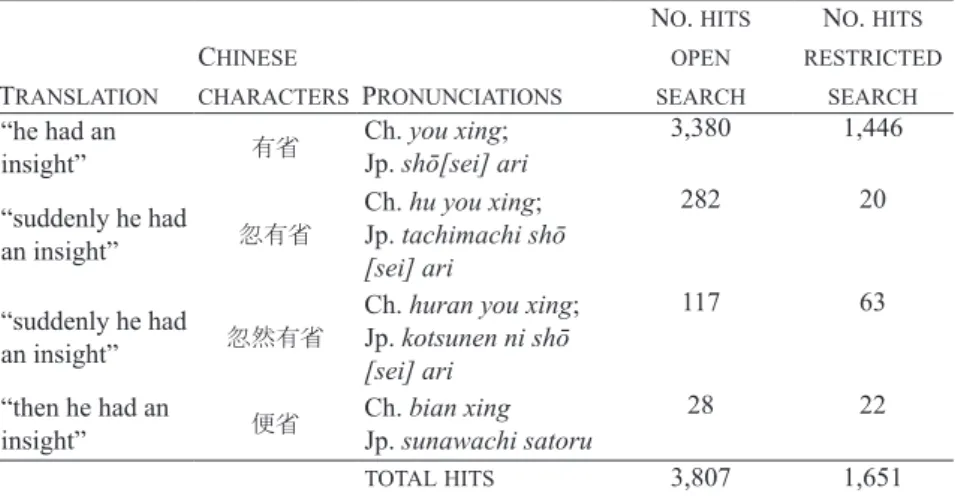
There are other expressions which do not use the character wu but which in context imply that the person had an awakening experience, for example the word for “insight” or “realization,” xing 省 (Jp. shō or sei; see table 3).
One might argue that “had insight” 有省 is a word with a broad mean-ing and does not necessarily refer to an event, the moment of Zen enlight-enment, in every case. Indeed, there are probably instances where “had insight” could be given a ritualist interpretation, but there are many instances where “had insight” must be given an event interpretation. For example, this phrase is used in one of the classic accounts of Zen awak-ening. In this story, Deshan 德山 (Jp. Tokusan; 782–865), the scholar of the Diamond Sutra, has just been humiliated by an old woman selling tea snacks; she had asked him a question he could not answer. Following her instructions, he sought out Longtan 龍潭 (Jp. Ryūtan; n.d.). He spoke with Longtan for a long time and when he went to leave, it was already dark.
tranSlation cHineSe cHaracterS PronunciationS no. HitS oPen SearcH no. HitS reStricted SearcH “sudden awakening” 頓悟 Ch. dunwu; Jp. tongo 3,114 930
“at once he was awakened”
忽悟 Ch. hu wu; Jp.
tachimachi go su 280 128
“at once he was awakened”
忽然悟 Ch. huran wu; Jp.
kotsunen ni go su 49 40
“he was vastly awakened”
豁然悟 Ch. huoran wu;
Jp. katsuzen ni go su 95 28
“at this he was awakened”
於此悟 Ch. yuci wu; Jp. kore ni
oite go su 102 47 “at these words, he was awakened” 於言下悟 Ch. yuyanxia wu; Jp. gonka ni oite go su 37 22 “at once he was greatly awakened” 忽大悟 Ch. hu dawu; Jp. ta-chimachi daigo su 270 57
“at once he had an awakening” 當下悟 Ch. dangxia wu; Jp. tōka go su 19 19 “at once he was greatly awakened” 忽然大悟 Ch. huran dawu; Jp. kotsunen ni daigo su 251 243
“he had a great vast awakening” 豁然大悟 Ch. huoran dawu; Jp. katsuzen ni daigo su 584 288 “at once he had certain awakening” 忽然領悟 Ch. huran lingwu; Jp. kotsunen ni ryōgo su 7 5 “at this he was greatly awakened”
於此大悟 Ch. yuci dawu; Jp. kore
ni oite daigo su 71 51
“at these words, he was greatly awakened”
於言下大悟 Ch. yuyanxia dawu; Jp.
gonka ni oite daigo su 497 294
“at these words, he had a sudden awakening”
於言下頓悟 Ch. yu yanxia dunwu; Jp. gonka ni oite tongo
su 71 25 “at once he had a great awakening” 當下大悟 Ch. dangxia dawu; Jp. tōka daigo su 73 47 totalHitS 5,520 2,224
Longtan lit a paper lantern and gave it to Deshan. When Deshan took it and turned to go outside, Longtan blew out the lantern. Deshan suddenly had an insight (Ch. huran you xing 忽然有省; Jp. kotsunen ni shō [sei] ari).36 A search for you xing 有省, “he had an insight,” restricted to Chan materi-als yields 1,446 hits. In some of these hits, it is possible the phrase is used to mean the monk “had ritual maturity” and could enact the role of Buddha. It would be necessary to examine each instance of use to decide this. But as the story of Deshan and Longtan makes clear, “he had an insight” ( you xing) was certainly used “phenomenologically” to mean awakening as a sudden event.
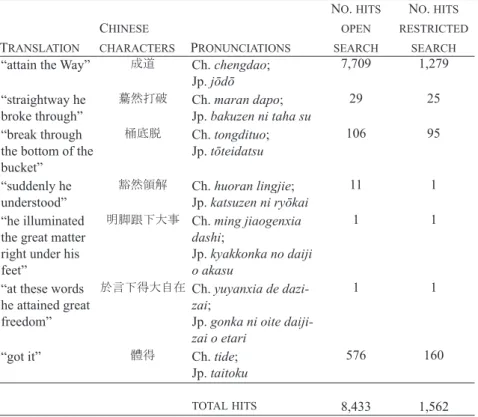
There are several more expressions which do not literally mean “he was enlightened,” but which can certainly have that meaning in a particular con-text (see table 4).
These miscellaneous expressions are all similar in that they do not liter-ally say “he experienced enlightenment.” But they are often used in con-texts which clearly imply the attainment of a sudden enlightenment. For example, the term, “attain the way” (a possible candidate for the ritualist interpretation of enlightenment) in case 22 of the Blue Cliff Record (Ch. Biyan lu 碧巌録; Jp. Hekiganroku) refers to the moment of awakening.
36 See case no. 28 of the Wumen guan 無門關 (Jp. Mumon kan; hereafter, Gateless Gate), and case no. 4 of the Foguo yuanwu chanshi biyan lu 佛果圓悟禪師碧巖錄 (Jp. Bukka engo
zenji hekiganroku; Blue Cliff Record of Chan Master Foguo Yuanwu, hereafter Blue Cliff Record). See, respectively, T no. 2005, 48: 296b20–c16, and T no. 2003, 48: 143b4–144c24.
tranSlation cHineSe cHaracterS PronunciationS no. HitS oPen SearcH no. HitS reStricted SearcH “he had an
insight” 有省 Ch. you xing; Jp. shō[sei] ari 3,380 1,446 “suddenly he had an insight” 忽有省 Ch. hu you xing; Jp. tachimachi shō [sei] ari 282 20 “suddenly he had an insight” 忽然有省
Ch. huran you xing; Jp. kotsunen ni shō
[sei] ari
117 63
“then he had an
insight” 便省 Ch. bian xingJp. sunawachi satoru 28 22
totalHitS 3,807 1,651
There, the Chinese sentence “今日始是鰲山成道 jinri shi shi an shan cheng dao”37 is literally translated, “Today on Tortoise Mountain, I’ve finally
attained the Way,” but note that Cleary translates it, “Today on Tortoise Mountain I’ve finally achieved enlightenment,” as if it were an event.38 For
the expression “straightway he broke through,” (Ch. maran dapo 驀然打破; Jp. bakuzen ni taha su), see the letter that Gaofeng Yuanmiao 高峰原妙 (Jp. Kōhō Genmyō; 1238–1295) wrote to his master, which clearly describes a sudden event in consciousness and not the gradual ripening of ritual maturity.
In the middle of the second month, I returned to the [monk’s] hall. In the following month on the night of the sixteenth, I was
37 T no. 2003, 48: 145a19. 38 Cleary 1998, p. 127. tranSlation cHineSe cHaracterS PronunciationS no. HitS oPen SearcH no. HitS reStricted SearcH
“attain the Way” 成道 Ch. chengdao;
Jp. jōdō 7,709 1,279 “straightway he broke through” 驀然打破 Ch. maran dapo; Jp. bakuzen ni taha su 29 25 “break through the bottom of the bucket” 桶底脱 Ch. tongdituo; Jp. tōteidatsu 106 95 “suddenly he understood” 豁然領解 Ch. huoran lingjie; Jp. katsuzen ni ryōkai 11 1 “he illuminated the great matter right under his feet” 明脚跟下大事 Ch. ming jiaogenxia dashi; Jp. kyakkonka no daiji o akasu 1 1
“at these words he attained great freedom”
於言下得大自在 Ch. yuyanxia de
dazi-zai;
Jp. gonka ni oite
daiji-zai o etari
1 1
“got it” 體得 Ch. tide;
Jp. taitoku 576 160
totalHitS 8,433 1,562
deep in sleep when suddenly I recalled the question Master Duanqiao raised in his room, “The ten thousand things return to one. What does one return to?” From this, a feeling of doubt sud-denly arose and consumed me. Immediately I became unable to distinguish east from west. I completely forgot about eating and sleeping. Six days I passed like this until one morning, as I was walking down a corridor, just then the assembled monks came out of the monk’s hall; without thinking, I joined them. On arriv-ing at the Pavilion of the Three Stupas, we chanted sutras. Sud-denly I saw the mounted verse dedicated to Master Wuzu Fayan, the last two lines of which read, “In a hundred years, there are 36,000 mornings; fundamentally all that leaves and returns is this fellow here.” Previously I had been asked by the Master, “Who drags this corpse around?” Straightway I broke through. At once my spirit flew off leaving my flesh to mourn, and completely exhausted I was reborn. It was just as if I had put down a one-hundred-twenty-pound carrying pole.39
The expression “suddenly he understood” (Ch. huoran lingjie 豁然領解; Jp. katsuzen ni ryōkai su) again need not always refer to a “phenomenological” Zen enlightenment experience but in case 19 of the Blue Cliff Record, it definitely does.40 Whenever Master Juzhi 倶胝 (Jp. Gutei; n.d.) was asked
anything, he would always just raise one finger. When his servant boy was asked what his master taught, the boy just raised one finger. On learning of this, Master Juzhi cut off the servant boy’s finger with a knife. As the boy ran away screaming, Master Juzhi called to him. When the boy looked back, Master Juzhi raised his finger and the boy suddenly understood (huoran lingjie). Here “understood” clearly is meant to imply that the boy had an understanding as a sudden event; it certainly does not mean that he attained ritual maturity and could thus enact the role of an abbot in a monastery.
Finally, the term taitoku 體得 (Ch. tide) has been included in this list because, according to the late centenarian Zen teacher, Sasaki Jōshū Rōshi,
39 二月半歸堂。忽於次月十六夜夢中。忽憶斷橋和尚室中所舉萬法歸一一歸何處話。自
此疑情頓發。打成一片。直得東西不辨。寢食俱忘。至第六日辰巳間。在廊下行。見眾僧堂
內出。不覺輥於隊中。至三塔閣上諷經。擡頭忽覩五祖演和尚真贊。末後兩句云。百年三萬
六千朝。返覆元來是遮漢。日前被老和尚所問拖死屍句子。驀然打破。直得魂飛膽喪。絕
後再甦。何啻如放下百二十斤擔子. Gaofeng Yuanmiao chanshi yulu 高峰原妙禪師語錄 (Jp.
Kōhō Genmyō zenji goroku; Recorded Sayings of Chan Master Gaofeng Yuanmiao) (italics
added); ZZ no. 1400, 70: 690b8–15.
the common word for Zen experience in Japanese Rinzai monasteries prior to the war was not taiken or keiken, but taitoku.41 Taitoku is a compound
of tai “body” and toku “acquire, master, make one’s own.” As the CBETA search indicates, there are numerous occurrences of this term, thus showing that modern Zen practice discourse shares some vocabulary with classical Chan/Zen texts. Taiken and keiken may not be part of the Chan/Zen tradi-tional vocabulary, but taitoku is.
One term which lends itself to a process interpretation is the term kenshō 見性 (Ch. jianxing), “see one’s nature.” This term occurs very frequently, as the numbers in table 5 indicate.
Many occurrences of this term occur inside the set phrase “point directly at the human mind, see one’s nature, and become Buddha” (Ch. zhizhi renxin jianxing chengfo 直指人心見性成佛; Jp. jikishi ninshin kenshō jōbutsu). It may be used in such a general way that it is open to a process interpretation. More detailed analysis of individual cases would be required to determine if this is so.
To call a practice an “invented tradition” is to imply that it was recently created but that people falsely claim it to be ancient. This CBETA survey shows that D. T. Suzuki’s conception of satori as a sudden experience has not been recently invented or manufactured. Although the modern philo-sophical terminology of taiken and keiken is not used in traditional Chan literature, the character wu, read go or satori in Japanese, is used to refer to awakening as a sudden event. There are literally hundreds, perhaps thou-sands, of instances where someone is described as suddenly experiencing enlightenment. This is the “traditional” way of conceiving of enlightenment in Chan/Zen. D. T. Suzuki did not invent that tradition.
41 In lectures during the December rōhatsu sesshin 臘八接心, 1997, at Mount Baldy, Cali-fornia. tranSlation cHineSe cHaracterS PronunciationS no. HitS oPen SearcH no. HitS reStricted SearcH “see one’s nature” 見性 Ch. jianxing; Jp. kenshō 7,553 1,993
Ineffable and Inconceivable
Let us now take up the thorny issue of satori as pure experience. Nishida explained it as “that state of experience just as it is without the least addition of deliberative discrimination.”42 I do not want to debate whether
Zen awakening is non-conceptual or whether the idea of a non-conceptual experience is an intelligible idea.43 In this section, even though I think the
very idea of a non-conceptual experience is highly problematic, I do want to argue that many Buddhist texts did indeed think of the experience of awaken-ing as ineffable and inconceivable, that to depict awakenawaken-ing as ineffable and inconceivable is not “invented tradition,” but the historical “tradition” itself.
In Sharf’s explanation, satori is characterized as ineffable and inconceiv-able in order for it to play its strategic and ideological role. In stressing the strategic and ideological function of religious experience here, Sharf is fol-lowing Wayne Proudfoot whose research into religious experience is less concerned with the content of religious experience and more concerned with the fact that the concept can be deployed ideologically to confer authority and legitimacy on those who have it and to refuse it to others.44
When Suzuki stressed the essential role of satori in Zen, he was joining the company of Western scholars like Friedrich Schleiermacher and Rudolf Otto who had argued that experience—not metaphysical doctrine, not eccle-siastical institution—was the core of religion.45 The concept of religious
experience provided men like Schleiermacher and Otto with a “protective strategy,”46 an “exegetical strategy,”47 to defend religion from secular
criti-cism. They could argue that only a person who had had religious experience had the authority to speak about religion; those who had no religious experi-ence ipso facto had no knowledge of what religion was and therefore lacked the necessary credentials to criticize it.48 In this ideological analysis, the
con-cept of religious experience prima facie looks as if it is distinguishing a state of consciousness; in fact, it uses the language of consciousness politically to distinguish groups of people, empowering some and disempowering others.
42 Nishida 1987, p. 3. Nishida footnotes William James, but he also footnotes several
other scholars on “immediate experience,” notably Wilhelm Wundt, Stout, and Schopen-hauer (Nishida 1990, pp. 3–10).
43 See my discussion in Hori 2000.
44 Proudfoot 1985; Sharf 1995a, pp. 229–31. 45 Sharf 1993, p. 21.
46 Proudfoot 1985, pp. 199–209. 47 Sharf 1995a, p. 229.
Applied to Zen, this argument meant that “only those privy to a legitimate kenshō experience are qualified to speak of Zen.”49 Just as Rudolph Otto
used to say that the reader who lacked the personal experience of numinous religion “is requested to read no further,”50 so also Suzuki’s account of Zen
awakening implied that only one who had experienced satori had the right to speak about it.
A reader of Sharf’s argument gets the impression that D. T. Suzuki turned William James’s idea of pure consciousness into Zen satori in order to manipulate the feature of ineffability for political purposes. However, Suzuki was following a long-established tradition that described the Bud-dha’s awakening as ineffable, indescribable, and thus impossible to con-vey to another person in language. The Ariyapariyesana Sutta (Majjhima Nikaya 26) depicts the Buddha himself reflecting after his awakening experience, “This Dhamma that I have attained is deep, hard to see, hard to realize, peaceful, refined, beyond the scope of conjecture, subtle, to-be-experienced by the wise. . . . And if I were to teach the Dhamma and others would not understand me, that would be tiresome for me, troublesome for me.”51 The “Skillful Means” chapter of the Lotus Sutra similarly shows the
Buddha wondering how to teach to sentient beings the enlightenment he has attained. He says:
It is impossible to explain this Dharma; The powers of speech fail.
No other sentient being is able to understand it, Except for those bodhisattvas
Who, in their belief, are willing to understand. Even the multitude of the Buddha’s disciples, Who have formerly paid homage to all the Buddhas, Who have put an end to all their corruption
And are bearing their last bodies, Are not able to understand it. Even if this whole world
Were filled with those such as Śāriputra, And they tried together to comprehend it,
49 Sharf 1993, pp. 25–26. 50 Otto 1923, p. 8.
51 “Ariyapariyesana Sutta: The Noble Search.” Translated by Thanissaro Bhikkhu. 2004.
Access to Insight: Readings in Theravāda Buddhism. Barre Center for Buddhist Studies. https://www.accesstoinsight.org/tipitaka/mn/mn.026.than.html.
They still would not be able to understand completely The wisdom of the Buddhas.52
The Avataṃsaka Sutra begins with the Buddha surrounded by numerous enlightened beings who in verse describe the Buddha, the Buddha’s body, the Buddha’s compassion, the Buddha’s teachings, the Buddha’s light, the Bud-dha’s enlightenment as boundless, sublime, supreme, inexhaustible, infinite, and inconceivable. The celestial king Ocean of Subtle Flames says, “The Bud-dha is inconceivable, beyond discrimination, / Comprehending forms every-where as insubstantial.”53 The celestial king Banner of the Delightful Light
of Truth says, “The realm of the buddhas is inconceivable: no sentient being can fathom it.”54 The herb spirit Auspicious says, “The Buddha’s knowledge
is inconceivable— / He knows the minds of all sentient beings, / And by the power of various techniques, / Destroys their delusions and infinite pains.”55
Sanctuary spirit Banner of Pure Adornments says, “Everything at the site of enlightenment produces exquisite sound / Extolling the pure, inconceivable powers of the Buddha / As well as the perfected causal practices: this can be heard by Ineffable Light.”56 In numerous places in the Buddhist tradition, the
Buddha’s enlightenment is described as inconceivable and ineffable.
Sharf claims that D. T. Suzuki’s exposition of Zen and satori, “with its unrelenting emphasis on an unmediated inner experience, is not derived from Buddhist sources so much as from his broad familiarity with Euro-pean and American philosophical and religious writings.”57 This claim is
implausible. The idea of religious experience has been around for a long time. Suzuki may have learned about James’s notion of “pure experience,” but the idea that the Buddha’s enlightenment is ineffable and inconceivable is the standard position of Buddhism throughout its history. Buddhist texts talked of the Buddha’s experience as ineffable long before James coined the term “pure experience.” Rather than claim that Suzuki’s concept of satori was modelled on James’s notion of pure experience, it is more plausible to claim that James modeled his concept of pure experience on older concep-tions of the ineffability of religious experience.
52 Kubo and Yuyama 1993, pp. 28–29. 53 Cleary 1993, p. 65.
54 Cleary 1993, p. 66. 55 Cleary 1993, p. 115. 56 Cleary 1993, p. 125. 57 Sharf 1998, p. 101.
Inventing Tradition and the Koan
The concept of satori was fundamental to Suzuki’s exposition of Zen, but equally important to his exposition was the Zen koan. In fact, Suzuki intro-duced the Zen koan to the Western world. His account of satori is tightly intertwined with his account of the koan practice. The koan is a device to lead a Zen practitioner to the experience of satori. “Without the koan the Zen consciousness loses its pointer, and there will never be a state of satori.”58 Satori and koan are not two independent topics in Suzuki’s
account. If Sharf maintains that the concept of satori is an invented tradition created by Suzuki, does that mean that his account of the koan practice tra-dition is also invented?
The koan originated, Suzuki mused, as a way of teaching Zen. The early Chan masters during the Tang period in China each had their own individual methods to evoke the awakening of Zen. To preserve their wisdom and to teach it to later generations, some of the mondō 問答 (Ch. wenda) dialogues of the old masters were selected for use as example cases.59 When the mondō
came to be used as a teaching device, it became a koan. Inevitably, the disciple who received one of these koan at first attempted to understand it intellectu-ally, but “there is no room in the koan to insert an intellectual interpretation.”60
Nevertheless, the master advised the disciple to keep his mind constantly fixed on the koan, never wavering day or night. “The time will come when your mind will suddenly come to a stop like an old rat who finds himself in a cul-de-sac. Then there will be a plunging into the unknown with the cry, ‘Ah, this!’”61
Struggling with the koan in this way, one fell into satori.
Whatever the origin, a koan-based teaching tradition did get created and transmitted down through the centuries. Because of this koan teach-ing tradition, a body of texts came into beteach-ing—koan collections such as the twelfth-century Blue Cliff Record, the thirteenth-century Gateless Gate, and in Japan, the seventeenth-century Shūmon kattōshū 葛藤集 (Entangling Vines).62 There were others. In modern Rinzai monasteries in Japan today,
and in Rinzai-influenced Zen centers in the West, Zen masters still teach the koan from these texts. Suzuki pointed out that though a thousand years had passed, Hakuin 白隱 (1686–1769) in Japan still taught the Zen of Huineng
58 Suzuki (1933) 1970, p. 95. 59 Suzuki (1933) 1970, p. 95. 60 Suzuki (1933) 1970, p. 96. 61 Suzuki (1933) 1970, p. 102.
慧能 (Jp. Enō; 638–713).63 When Suzuki was still a student in university he commuted from Tokyo to the monastery of Engakuji in Kamakura in order to sit in zazen and wrestle with the koan.
In contemporary Rinzai Zen monastic koan training, is awakening treated phenomenologically or is it treated as ritual maturity? As Sharf says, “The most compelling arguments are not theoretical, but rather ethnographic.”64
What is the ethnographic evidence? So far as I know, no anthropologist from the Western academy has conducted participant-observer research or done any kind of anthropological fieldwork on a Rinzai Zen monastery in Japan. But here I can report on actual practice in a Rinzai Zen monastery as I have spent thirteen years in Rinzai koan practice. I was an unsui 雲水— a Zen monk—between the years 1977 and 1990 at the Daitokuji Sōdō 大徳 寺僧堂 in Kyoto, the Entsūji Sōdō 圓通寺僧堂 in Imari, and the Nagaoka Zenjuku 長岡禅塾 in Nagaoka, Japan. Here an “objective” academic theo-rist may complain that since I was a Zen koan practitioner, my testimony is subjectively biased and not to be trusted. I will have more to say about such a move to silence the practitioner. In the meanwhile, I will report on con-temporary Rinzai koan practice as I have seen it.
Sharf writes, “The kōan genre, far from serving as a means to obviate reason, is a highly sophisticated form of scriptural exegesis: the manipula-tion or ‘solumanipula-tion’ of a particular kōan tradimanipula-tionally demanded an extensive knowledge of canonical Buddhist doctrine and classical Zen literature.”65
In the monastery where I began koan practice, first-year monks were given their shokan 初關, “first barrier” koan—“Sound of One Hand,” or “Jōshū’s Mu”—and then instructed to focus their attention on it during meditation. The majority of these monks had little previous zazen experience before entering the monastery. And while some had majored in Buddhist studies in college, many had no significant intellectual background in Buddhist scripture (myself included). During their sanzen 参禪 meetings with the rōshi 老師, the monks received one basic instruction about how to meditate with koan: it is futile to try to intellectually understand the koan; instead, to see a koan (koan o miru 公案を見流), you must “become one” with the koan. “Become one with . . .” (narikiru 成り切る) is the core instruction with several variant expressions in language: “to become one piece with . . .” (ichi mai to naru 一枚となる); “to become the thing itself ” (sono mono to naru
63 Suzuki (1933) 1970, p. 107. 64 Sharf 1995a, p. 260. 65 Sharf 1993, p. 2.
そのものとなる); “to wrestle and fuse with . . . ” (torikunde gappei suru 取り組んでいる合併する), and so on. The monk sees the koan not through intellectually understanding it but through the constant repeated effort to narikiru, to become one with it. He constantly repeats and poses to himself the question of the koan: “What is the sound of one hand?” until he finally fuses with the koan and becomes “the sound of one hand.” He constantly repeats “mu” to himself until he finally becomes a ball of mu (mu no katamari 無の塊) itself. This is the core experience a monk needs to see a koan. The monk does not need “an extensive knowledge of canonical Buddhist doc-trine and classical Zen literature.”
Is the passing of the koan a “phenomenological experience”? Or is it the mastery of ritualized behaviour? This is not an either/or issue. The Zen monastery is a unique institution because it cultivates a nonrational insight through ritual formalism. I have discussed this elsewhere.66 Many entering
monks know through hearsay that the proper response to the “Mu” koan is to utter “mu” in a loud voice and the proper response to the koan “Sound of One Hand” is to thrust forward one hand and utter “sekishu” 隻手 (“sound of one hand”) in a loud voice. But the monk who treats his response as just a pro forma ritual is surprised to find that he does not pass. I remember a conversation with a first-year monk who told me that whenever he pre-sented the ritual answer to “Mu,” the rōshi merely said “Hai” and rang the bell to dismiss him. As with all the other monks before him, this monk will be driven to try other answers—slapping the tatami, standing and shout-ing, laughing and cryshout-ing, and so on—until after weeks and months, perhaps years, finally at his wit’s end, totally confused and desperate to see some light, he throws everything away and shouts with every ounce of strength “mu!” Although in ritual form he is still giving a great shout, for the first time he does it without self-consciousness, throwing himself completely into his action. It is at once a moment of rote repetition and a moment of totally concentrated consciousness. In ritual form, it is the same old action as before, but it is also the first time that he completely narikiru-s “mu!” One can say either the monk has left behind all ritual or that he has for the first time performed the ritual correctly. The rōshi, who has been waiting for this moment, now moves into action, for finally the monk has thrown away all his preconceptions and is open to instruction.
Zen monks follow a code of silence about koan practice and do not con-verse with their fellow monks about their sanzen meetings with the rōshi.
However, during ōzesshin 大接心, a week of particularly intense practice, first- and second-year monks in my monastery were required to announce after sanzen whether they had passed their koan. Those who had passed were allowed to return to the zendō 禅堂 (meditation hall); those who had not passed were required to return to the sanzen lineup to face the rōshi again. From this, one can make some rough judgments about the monks’ rate of progress. I would say that most monks pass their first koan some-where between six months to a year after their admission to the monastery. This experience may be just a glimmer of insight that requires much further deepening, repetition, and exploration; or right from the start, it may be a much more thorough turnover of consciousness. Elsewhere I have tried to give a more analytic account of what happens in the moment of seeing a koan.67 I will not repeat my account here but will assert that ethnographic
observation of Rinzai monastic koan training would show there is an expe-rience of seeing a koan and that it is a dramatic and sudden event. It is an experience in the phenomenological sense which Sharf denies.68
To sum up, Suzuki’s account of satori and his account of the koan are two halves of a single whole. If Suzuki’s account of satori Zen experience is an invented tradition, as Sharf claims, then he should also claim that the Zen koan practice is an invented tradition. But long before Suzuki, there were koan in the Chan and Zen tradition; there were koan texts; there was and still is a koan monastic practice. And although for years, he was the main source of information in the West about the koan and koan practice, Suzuki himself did not invent the koan tradition.
II. AUTHENTIC BUDDHISM AND CULTURAL NATIONALISM Although I cannot agree with the main thrust of Sharf’s critique of Zen experience, I do think he is right to point out that the concept of satori has an ideological use and can be used strategically for political ends. However, I add a methodological caution: the fact that a statement has an ideologi-cal function does not mean it is otherwise meaningless. To always ignore the content of a statement and to insist that it has meaning only as ideol-ogy would be ideological reductionism. More loosely stated, statements in language have both denotation and connotation. To always ignore the denotation of a statement, its ostensive meaning, and insist it has
ideologi-67 Hori 2000; Hori 2003.
68 The Western Zen master Albert Low has described his own kenshō experience. See
cal connotation only would be ideological reductionism. Thus far, we have been assessing the content of Suzuki’s account of satori and concluded that, in being depicted as an event in consciousness rather than as a ritual process, it is similar to the traditional concept of wu in classical Chan texts. Now it is time to assess the ideological or political impact of Suzuki’s con-cept of satori. In this section, I will argue that indeed Suzuki did use the concept of satori as a protective strategy to claim for himself privileged access to authentic Buddhism, but in doing so he was “reflecting” a stance taken by the Orientalist scholars a generation before him.
“Reflecting” is a technical term here. It is similar to what Bernard Faure calls “secondary Orientalism.”69 Faure does not give a precise explanation
of “secondary Orientalism” but I would explain it like this. In Orientalism tout court, the Western Orientalist imposes stereotypical images on Asia which privilege the West over Asia, such as, “The West is logical, Asia is intuitive. That is why the West is superior.” This superiority justifies the imposition of Western authority over Asian culture. In secondary Oriental-ism, the Asian side takes the same stereotype but reverses the polarity so that the contrast privileges the Asian side over the West. “The West is logi-cal, Asia is intuitive. That is why Asia is superior.” When the Asian side performs this reversal of polarity, I call it “reflecting.” In addition to “sec-ondary Orientalism,” sometimes this reversal of polarity is called “reverse Orientalism,” “inverted Orientalism,” or “Occidentalism.”70 D. T. Suzuki’s
stance with regard to the Orientalist scholars and to Japanese cultural nationalism are instances of such “reflecting.”
The Orientalist Scholars
Although during the sixteenth century Jesuit missionaries in China and Japan had written extensively about their encounter with Buddhist priests and monasteries, for the general public in England, Europe, and America until the end of the 1700s, there was little available organized information about Buddhism. Then in the early 1800s, retired missionaries, administrators returning from the colonies, and lone travelers wrote accounts of their over-seas experiences which were widely read in the popular press. The reading public learned that many of the heathen practices of Asia were derived origi-nally from a single set of beliefs and practices—a religion—which they then
69 Faure 1993, p. 5. 70 Borup 2004.
started to call “Buddhism.”71 At first, Buddhism, with its account of endless
karmic suffering, struck many as a religion of negativity and pessimism. But in mid-century there was a change of attitude. Although most Western-ers were repelled by what they saw as the deep pessimism of the Buddhist teaching on suffering and karma, they agreed on the ethically noble character of the Buddha as a person.72 In fact, during the mid-Victorian period (1837–
1901), there was a Buddhist boom in both England and America inspired by the figure of the noble Buddha. In England, Edwin Arnold (1832–1904) pub-lished a long poem lauding the Buddha, The Light of Asia, whose title drew a parallel with Jesus, the “light of the world.” First published in 1879, it went through more than a hundred printings and is still in print today.
Inevitably Westerners saw Buddhism through the lens of Western values. For example, the American theologian James Freeman Clark (1810–1888) explicitly compared Buddhism to Protestantism; he said, “Buddhism in Asia, like Protestantism in Europe, is a revolt of nature against spirit, of humanity against caste, of individual freedom against the despotism of an order, of salvation by faith against salvation by sacraments.”73
But starting in mid-century, more and more of the public’s knowledge of Buddhism started to come from academically trained scholars, such as Eugène Burnouf (1801–1852), T. W. (Thomas William) Rhys Davids (1843–1922), Caroline Rhys Davids (1857–1942), and Max Müller (1823– 1900). These were the first generation of Buddhist studies scholars. All were philologists who read and translated early Buddhist texts written in Pali, Sanskrit, and other classical languages. The work of these Orientalist scholars still stands as a great achievement. Burnouf wrote the first West-ern-language history of Buddhism. T. W. Rhys Davids and his wife Caroline founded the Pali Text Society in 1881 and in the years following published translations of the entire Pali Canon, along with concordances, dictionar-ies, histordictionar-ies, and commentaries. Max Müller edited the monumental fifty-volume Sacred Books of the East series. Müller is also credited with the founding of Religionswissenschaft—the “science of religion”—or, religious studies, as an academic discipline. Because there was less distance at that time between academic publication and periodical literature for the edu-cated classes,74 the Orientalist scholars played a major role in the public’s
71 Masuzawa 2005, p. 122. 72 Almond 1988, p. 77.
73 Quoted in Almond 1988, p. 74. 74 Almond 1988, p. 34.
understanding of Buddhism. These scholars had a particular conception of Buddhism and they were so influential in imposing their idea of what Bud-dhism ought to be that it has been said “they invented BudBud-dhism as a world religion.”75 Whether or not Buddhism was “invented,” the unintended result
was, as Almond and others have noted, that in the late nineteenth century for people in the West, Buddhism came “to exist, not in the Orient, but in the Oriental libraries and institutes of the West, in its texts and manuscripts, at the desks of the Western savants who interpreted it. It had become a tex-tual object, defined, classified, and interpreted through its own textex-tuality.”76
What was the conception of Buddhism held by the Orientalist Bud-dhist scholars? First of all, they distinguished sharply between Buddha the person, worthy of great respect, and Buddhism the religion, not wor-thy of equivalent respect. The Buddha was depicted not as a divine being but as a human being. He was “the Luther of Asia” standing up against the priests who controlled institutional religion and the caste system.77
According to these scholars, the Buddha originally taught a system of rational philosophy and ethics, not a religion. He taught a system of ideas and a course of ethical conduct based on reason that required no supernatural being who created the universe and no wrathful God who punished the sinful. The scholars referred to this teaching as “original Buddhism” to distinguish it from later Buddhism, which in their view had degenerated into a mere religion. Scholars in the newly established science of religion studied how the later forms of Buddhism corrupted its original purity. They noted “the modifications it has undergone in various countries under the influence of ideas foreign, even antagonistic to itself; the way in which its fundamental doctrines have been overshadowed and destroyed by the persistent notions of Animism, by the growth of erroneous views as to the Buddha and the Buddhas, by the exaggerated importance attached to its mysticism, to its negative teaching.”78 Under
this later degenerate Buddhism, the Orientalist scholars included all of Mahayana Buddhism, tantric Buddhism, and all forms of Buddhism then practiced by contemporary Asians. The scholars saw in the institution and ritual form of Mahayana Buddhism too many resemblances to Roman Catholicism.79 They were especially appalled by “Lamaism” which they
75 Schober 2012, p. 14. 76 Almond 1988, p. 13. 77 Lopez 2008, p. 5. 78 Rhys Davids 1891, p. 192. 79 Rhys Davids 1891, pp. 192–94.
considered particularly degenerate, “the exact contrary of the earlier Buddhism.”80
Several comments are in order. First, in Orientalist scholarship, the mod-ern is authentic. The Orientalist academic scholars were evincing the sci-entific rationalism of modernity, and using it as the criterion to distinguish between authentic religion and inauthentic religion. Inauthentic religion— such as Catholicism and Mahayana Buddhism—was corrupted by super-stition and belief in supernatural beings, whereas authentic religion, such as “original Buddhism,” was consistent with rational science. Looking back, we can see that the vision of Buddhism held by the first generation of Buddhist studies scholars was that of the European Enlightenment, an attitude which argued that religion should be rational and consistent with science, grounded in philosophy and ethics rather than in faith and ritual, and tolerant of other religions. The idea that religion should be rational and consistent with science is a feature of modernity. And in the late nineteenth century, these scholars were convinced that original Buddhism was an example of religion in the modern Enlightenment sense. The influence of the European Enlightenment’s vision of religion on Buddhism is still visible in the fact that the Sanskrit term, budh, which means “awakening,” is quite widely translated today as “enlightenment.”81
Second, despite the fact that the Orientalist scholars were attempting to study religion as a science, nevertheless they unwittingly imported what Greg-ory Schopen calls “Protestant presuppositions” into their research: they val-ued scriptural text above practice and assumed that popular religious practice was ipso facto corrupt.82 As Welter points out, “According to these
presup-positions, the Pali canon became the equivalent of the Bible, the dialogues of Śākyamuni paralleled the sermons of Jesus, and the activities of Śākyamuni’s main disciples were reminiscent of the Acts of the Apostles.”83 Despite their
intention to be scientific and rational, the Orientalist scholars still unwittingly clung to the premodern association of “religion” with Protestant Christianity.
Third, the Orientalist scholars not only favored the study of texts but used their Pali scholarship as a “protective strategy”84 for privileging
themselves as authorities on authentic Buddhism and for disenfranchising others. For these scholars, the Pali texts were uniquely important because,
80 Rhys Davids 1907, p. 208. 81 Cohen 2006, pp. 1–3. 82 Schopen 1991. 83 Welter 2008, p. 16. 84 Proudfoot 1985, p. 199.
as the earliest texts, they were closest to what the historical Buddha taught and were thus less subject to misinterpretation and distortion by later gen-erations of priests. With this claim, the Orientalist academic scholars made themselves the exclusive gatekeepers to authentic Buddhism since their ability to read early Pali texts was the key to the gate. The people who actu-ally practiced Buddhism in the Asian countries became disenfranchised since they did not read the Pali texts. When seen in ideological perspec-tive, the Orientalists’ concept of “original Buddhism” functioned politically to draw an insider/outsider line between two groups of people, those who cannot read ancient Pali texts and therefore have no business discussing Buddhism, and those who can read ancient Pali texts and are therefore the judges of authentic Buddhism. D. T. Suzuki’s use of satori “reflects” this use of Pali text scholarship. In the Orientalist scholar’s understanding, only those who can read the original Pali texts have access to authentic original Buddhism. In Suzuki’s understanding, only those who have had the experi-ence of satori are qualified to talk about Zen.
Fourth, in the Orientalists’ definition of authentic Buddhism, Mahayana Buddhism—all of the Buddhism of East Asia—was excluded. D. T. Suzuki challenged the Orientalist scholars’ hegemony over what counts as authen-tic Buddhism. In the opening pages of Outlines of Mahāyāna Buddhism, published in 1907, Suzuki clearly identifies the basic assumptions of the Orientalist scholars.
What is generally known to the Western nations by the name of Buddhism is Hīnayānism, whose scriptures . . . are written in Pāli and studied mostly in Ceylon, Burma, and Siam. It was through this language that the first knowledge of Buddhism was acquired by Orientalists; and naturally they came to regard Hīnayānism or Southern Buddhism as the only genuine teachings of the Bud-dha. They insisted, and some of them still insist, that to have an adequate and thorough knowledge of Buddhism, they must con-fine themselves solely to the study of the Pāli, that whatever may be learned from other sources, i.e., from the Sanskrit, Tibetan, or Chinese documents should be considered as throwing only a side-light on the reliable information obtained from the Pāli, and further that the knowledge derived from the former should in certain cases be discarded as accounts of a degenerated form of Buddhism.85
Suzuki challenged the Orientalists’ conception of “original Buddhism” (Suzuki’s term is “primitive Buddhism”) on several points.86 First, consistent
with the theory of evolution, the new scientific theory of the day then sweep-ing the field, Suzuki argued that religion was a livsweep-ing thsweep-ing and constantly evolving. The Orientalists’ “original Buddhism” was only the historical early manifestation of authentic Buddhism. It was the acorn from which would grow a great oak.87 In the same vein, he argued that the Buddhist conception
of karma was “scientifically verified”88 and that the Buddhist conception of
non-atman, when seen from its positive aspect, was what physical science called “the law of the conservation of energy and of matter.”89 Second, he
wrote to correct misconceptions that people had of Mahayana, such as the meaning of nirvana or the bodhisattva. He took the opportunity to criticize Christians, both for the wilful prejudice of Christian missionaries90 and for
the inadvertent ignorance of Christian scholars.91 Finally, in an extended
discussion, he argued that there was a “spirit of religion” which manifested itself here as Christianity and there as Buddhism, each a legitimate expres-sion of authentic religion.92
Above these ground-level tactical arguments, Suzuki’s general strategy was to “reflect” the Orientalist stance to privileged access. Just as the Ori-entalist scholars claimed privileged access to authentic Buddhism through Pali text study, Suzuki claimed privileged access to authentic Buddhism through the experience of satori. In Zen terms, he was “taking the enemy’s spear and stabbing him with it.”93
Cultural Nationalism
I do not agree with, or defend, D. T. Suzuki’s claims about Zen and Japa-nese culture, but I attempt to explain what might have motivated him to make those claims. Briefly, in the late nineteenth and early twentieth centu-ries Japanese Buddhism was faced with the task of modernizing itself but it could not do so on a level East-West playing field. In the mid-nineteenth
86 Judith Snodgrass has detailed D. T. Suzuki’s efforts to establish an “Eastern Buddhism”
(Snodgrass 2003). 87 Suzuki (1927) 1970, p. 41. 88 Suzuki 1907, p. 35. 89 Suzuki 1907, p. 43. 90 Suzuki 1907, p. 17. 91 Suzuki 1907, pp. 18–22. 92 Suzuki 1907, pp. 23–30. 93 Hori 2003, pp. 55–56.
century, convinced of white European racial superiority, the Western pow-ers forcefully broke the Japanese policy of national isolation, imposed unequal treaties on Japan and China, and in general semi-colonized the two nations. To the Western powers, the Asian nations were barbarian cultures in contrast to the civilized West. To the Asian nations also, the Western countries were barbarian cultures in contrast to civilized Asia. The Western countries however were militarily much stronger and ruthlessly imposed their will on the Asian nations just as they had done to the countries of the Americas and Africa. The Japanese saw the need to modernize and become technically stronger, but they did not want to westernize. They refused to accept Western cultural values, since those values included the assumption that Asia was culturally inferior to the West. In the arena of religion, D. T. Suzuki proposed a new modern Buddhism that showed, he said, the cultural superiority of Japan. In general, in the stance that he took he was “reflecting” the Western powers attitude to Japan.
Suzuki used to say that Zen provided a neutral ground where East and West and the world’s religions could meet. “Zen is the ultimate fact of all philosophy and religion. . . . Every religious faith must spring from it if it has to prove at all efficiently and livingly workable in our active life.”94
Other religions were inextricably imbedded in local culture, thus preventing people from seeing the truth of religions in other cultures. Only Zen was free of any sort of local culture; it was, in Sharf’s language, an “ahistorical, trans-cultural experience of ‘pure subjectivity’ which utterly transcends discursive thought.”95 Zen thus was not merely the equal of any of the world religions;
it was the experiential core of every philosophy and religion and thus the common ground upon which world religions could meet. At the same time, Zen was the unique possession of Japan. Japanese culture had so absorbed Zen that Zen influenced the national culture and the national character. It was Zen which defined what made the Japanese unique, especially in con-trast to Western culture and character.96 Thus Sharf concludes, “Suzuki . . .
places this understanding of Zen in the interests of a transparently nationalist discourse.”97 Thus, what started out looking like a liberal cosmopolitan
inter-cultural platform turns out to be another example of nihonjinron 日本人論, a self-congratulating theory of the uniqueness of the Japanese character.
94 Suzuki (1927) 1970, p. 268. 95 Sharf 1993, p. 1.
96 Sharf 1993, pp. 25–26.