0
Graphical Abstract
To create your abstract, type over the instructions in the template box below. Fonts or abstract dimensions should not be changed or altered.
Facile synthesis of C-terminal peptide
thioacids under mild conditions from
N-sulfanylethylanilide peptides
Tatsuhiko Shimizu, Rin Miyajima, Kohei Sato, Ken Sakamoto, Naoto Naruse, Miku Kita, Akira Shigenaga
*and
Akira Otaka
*Institute of Biomedical Sciences and Graduate School of Pharmaceutical Sciences, Tokushima University,
Tokushima 770-8505, Japan.
Tetrahedron
j o u r n a l h o m e p a g e : w w w . e l s e v i e r . c o m
Facile synthesis of C-terminal peptide thioacids under mild conditions from
N-sulfanylethylanilide peptides
Tatsuhiko Shimizu, Rin Miyajima, Kohei Sato, Ken Sakamoto, Naoto Naruse, Miku Kita, Akira Shigenaga
*and Akira Otaka
*Institute of Biomedical Sciences and Graduate School of Pharmaceutical Sciences, Tokushima University, Tokushima 770-8505, Japan.
1. Introduction
Native chemical ligation (NCL) has shown great utility in chemical protein synthesis.1,2 This methodology allows for the
chemoselective condensation of a peptide thioester with an N-terminal cysteinyl peptide via sequential S-S and S-N acyl transfer reactions to afford the corresponding ligated product under mild aqueous conditions. Therefore, auxiliary-based peptide thioester precursors that can be readily converted to the corresponding thioesters via N-S acyl transfer, as necessary, have recently been developed for the chemical synthesis of proteins.3,4 Several research groups, including our own, have
reported that C-terminal peptide thioacids can be also used for protein synthesis.5,6 However, only a few synthetic methods
have been developed to date for the preparation of C-terminal peptide thioacids. Furthermore, most of these methods involve the use of Boc-based solid phase peptide synthesis (Boc SPPS),6a-c,7 which requires the treatment with highly toxic
hydrogen fluoride or some other harsh acid for the global deprotection of the peptide and its cleavage from the resin. Crich
et al. recently reported a new method for the preparation of
peptide thioacids using a 9-fluorenylmethyl thioester linker, which was compatible with Boc SPPS.8 Notably, this method
did not require the use of hydrogen fluoride or any other harsh acid, and allowed for the release of the resulting peptide thioacid
specialized 9-fluorenylmethyl type side-chain protecting groups. In contrast, Fmoc-based solid-phase peptide synthesis (Fmoc SPPS) is used much more often for the synthesis of peptides because it is technically less challenging and requires milder reagents compared with Boc SPPS. Several research groups, including our own,5,7e,9 have therefore developed Fmoc
SPPS-compatible strategies for the preparation of peptide thioacids. In our previous study, we developed an N-sulfanylethylanilide (SEAlide) peptide as a peptide thioester precursor using standard Fmoc SPPS.4i This material was subsequently converted to a
peptide thioacid via a hydrogen chloride-induced N-S acyl transfer reaction in the presence of 1% (w/v) tris(2-carboxyethyl)phosphine hydrochloride (TCEP·HCl) followed by the hydrothiolysis of the resulting thioester with sodium hydrogen sulfide (NaSH) (Scheme 1).5a However, we observed
the epimerization of the C-terminal amino thioacid residue during this reaction, which was attributed to the use of the strong acid hydrogen chloride. The development of an epimerization-free SEAlide-based method is therefore highly desired for the practical application of this method. We recently discovered that the SEAlide peptide 1 shown in Scheme 2 could be equilibrated with the corresponding thioester under neutral conditions in the presence of phosphate. Furthermore, peptide 1 could be used directly in an NCL process without any epimerization at the
10,11
A R T I C L E I N F O A B S T R A C T
Article history: Received
Received in revised form Accepted
Available online
A facile procedure has been developed for the synthesis of C-terminal peptide thioacids under mild conditions. A series of N-sulfanylethylanilide peptides prepared using Fmoc-based solid-phase peptide synthesis were successfully converted to the corresponding thioacids via a hydrothiolysis reaction in a phosphate buffer with only trace epimerization of the C-terminal amino acid.
2009 Elsevier Ltd. All rights reserved. Keywords:
C-Terminal peptide thioacids N-Sulfanylethylanilide peptide Hydrothiolysis
Phosphate buffer
© 2015. This manuscript version is made available under the CC-BY-NC-ND 4.0 license http://creativecommons.org/licenses/by-nc-nd/4.0/. The published version is available via https://doi.org/10.1016/j.tet.2015.12.070.
Scheme 1. Previously reported Fmoc-based preparation of peptide thioacids using the SEAlide peptide.5a
Scheme 2. Conversion of the SEAlide peptide to the corresponding thioacids under the mild conditions used in this study.
2. Results and discussion
The SEAlide peptides 6 were prepared using Fmoc SPPS according to the previously reported method (Scheme 3).12
N-Terminal human RFamide-related peptide-1 (hRFRP-1) (1-11) was selected as a model peptide for this study.13 The conversion
of SEAlide peptide 6a to thioacid 7a was initially attempted with 120 mM NaSH in phosphate buffer containing TCEP·HCl as an inhibitor of disulfide formation and sodium ascorbate as an alternative to thiol additive14 in the presence of 10% (v/v)
N-methylpyrrolidone (NMP) (Table 1). We initially evaluated the effect of the phosphate salt for confirmation of our hypothesis that the presence of phosphate is essential for the hydrothiolysis reaction. Results in Table 1 (entries 1–4) clearly showed that the yield of peptide thioacid 7a varied with the concentration of phosphate salt, indicating that the presence of phosphate was essential for the hydrothiolysis reaction. In the absence of NMP, we observed a subtle decrease in the product yield, which was attributed to the instability of the intermediate thioester in the absence of an organic solvent (Table 1, entries 4 and 5).15
Scheme 3. Synthesis of SEAlide peptide 6a-h using Fmoc SPPS.
We then proceeded to investigate the effect of the peptide concentration on the reaction (Table 1, entries 4, 6 and 7). The results of these experiments revealed that the increase in the concentration of peptide 6a, decreasing the equivalent of the hydrosulfide ion source, led to a decrease in the yield of the product. The pH also had a significant impact on the yield of the desired product, especially under acidic conditions (Table 1, entries 4, 8 and 9). We subsequently examined the effect of a hydrosulfide anion source to the reaction. The replacement of NaSH with (NH4)2S led to a significant increase in the yield of
the desired thioacid 7a, although the aminolysis byproduct 9a was detected (Table 1, entries 4 and 10, and Fig 1).16 These
results therefore suggested that (NH4)2S was more suitable for
the hydrothiolysis of the SEAlide peptide. The phosphate salt was also critical for the hydrothiolysis reaction using (NH4)2S as
the case with the use of NaSH (Table 1, entries 10 and 11). This result repeatedly indicated that the existence of phosphate was essential for the hydrothiolysis reaction. Melnyk et al.9b recently
reported the synthesis of peptide thioacids at neutral pH using bis(2-sulfanylethyl)amido (SEA) peptides. According to their report, the reaction of the model SEA peptide with an excess of NaSH at pH 7 in the presence of TCEP and 4-mercaptophenylacetic acid did not provide direct access to any of the peptide thiocarboxylate. The conversion of the SEA peptide to the corresponding peptide thioacid therefore required the use of triisopropylsilylthiol in the presence of an amino acyl thioester, which was used as a scavenger for the resulting SEA moiety. In contrast, we successfully obtained the peptide thioacid 7a via the hydrothiolysis reaction of SEAlide peptide 6a with (NH4)2S under neutral conditions.
Table 1. Hydrothiolysis of SEAlide peptide 6a under various reaction conditions. Entry SEAlide peptide [mM] Na phosphate [M] (salt) Sulfide reagent pH Reaction time [h] Yield of 7aa [%] Yields of the byproductsb [%] Recovery of 6ac[%] 1 1.0 0.0d NaSH 6.9 24 12 9 79 2 1.0 0.2 NaSH 6.9 24 35 18 48 3 1.0 0.5 NaSH 6.9 24 39 23 38 4 1.0 1.0 NaSH 6.9 24 49 20 31 5e 1.0 1.0 NaSH 6.9 24 43 24 33 6 2.0 1.0 NaSH 6.9 24 28 27 45 7 5.0 1.0 NaSH 6.9 24 8 27 65 8 1.0 1.0 NaSH 5.9 24 6 16 78 9 1.0 1.0 NaSH 8.3 24 31 49 21 10 1.0 1.0 (NH4)2S 7.1 24 74 12 14 11 1.0 0.0d (NH 4)2S 7.0 24 18 10 72
Yield of 7a, yields of the byproducts and recovery of 6a were determined by HPLC separation (detection at 220 nm) using the following calculations (integ. = peak area).
aYield of 7a = integ. 7a/(integ. 6a + integ. 7a + integ. 8a + integ. 9a)×100.
bYields of the byproducts = (integ. 8a + integ. 9a)/(integ. 6a + integ. 7a + integ. 8a + integ. 9a)×100. cRecovery of 6a = integ. 6a/(integ. 6a + integ. 7a + integ. 8a + integ. 9a)×100.
dHEPES buffer (0.2 M) was employed instead of phosphate buffer. eThis reaction was conducted without the addition of NMP.
We then proceeded to investigate the epimerization of the C-terminal amino acid. Our previous method, which involved a hydrogen chloride-induced N-S acyl transfer reaction, was accompanied by 20% of the epimerization at the C-terminal amino acid residue.4i It was envisaged that the milder reaction
conditions of our new method would suppress the epimerization of the C-terminal residue. Peptide 6b bearing a C-terminal alanine residue was converted to the corresponding thioacid 7b under the conditions described above in entry 10 of Table 1. These conditions resulted in only 2% epimerization, which was significantly lower than that observed using hydrogen chloride (Fig 2).
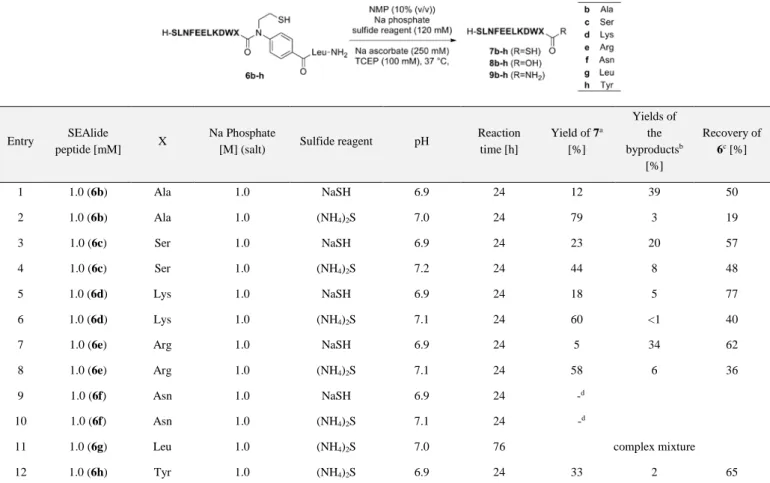
This result encouraged us to examine the effect of different C-terminal amino acid residues on the hydrothiolysis reaction (Table 2). The C-terminal amino acid was replaced with a series of typical amino acids (e.g., Ala, Ser, Lys, Arg, Asn, Leu or Tyr), and the resulting peptides were treated with NaSH or (NH4)2S as
a hydrosulfide source. For peptides 6b–e and 6h (Ala, Ser, Lys, Arg or Tyrderivative), the corresponding thioacids 7b–e and 7h were successfully formed. Higher yields of the thioacid were observed when (NH4)2S was used instead of NaSH (Table 2,
entries 1–8). Whereas two peaks their mass was identical to the
was very slow and gave a complex mixture. In addition, the HPLC analysis of this reaction mixture revealed the formation of multiple peaks derived from byproducts other than 8g and 9g (data not shown). Given that this phenomenon was not observed when the C-terminal amino acid was Lys or Arg, it was assumed that the presence of a methyl group at the γ-position of Leu was having an adverse impact on the rate of the hydrothiolysis
through steric hindrance, and that the side reactions therefore proceeded at a relatively higher rate to generate a complex mixture of products.
Table 2. Hydrothiolysis reactions of the SEAlide peptides containing various amino acids at their C-terminal position
Entry SEAlide
peptide [mM] X
Na Phosphate
[M] (salt) Sulfide reagent pH
Reaction time [h] Yield of 7a [%] Yields of the byproductsb [%] Recovery of 6c[%] 1 1.0 (6b) Ala 1.0 NaSH 6.9 24 12 39 50 2 1.0 (6b) Ala 1.0 (NH4)2S 7.0 24 79 3 19 3 1.0 (6c) Ser 1.0 NaSH 6.9 24 23 20 57 4 1.0 (6c) Ser 1.0 (NH4)2S 7.2 24 44 8 48 5 1.0 (6d) Lys 1.0 NaSH 6.9 24 18 5 77 6 1.0 (6d) Lys 1.0 (NH4)2S 7.1 24 60 <1 40
7 1.0 (6e) Arg 1.0 NaSH 6.9 24 5 34 62
8 1.0 (6e) Arg 1.0 (NH4)2S 7.1 24 58 6 36
9 1.0 (6f) Asn 1.0 NaSH 6.9 24 -d
10 1.0 (6f) Asn 1.0 (NH4)2S 7.1 24 -d
11 1.0 (6g) Leu 1.0 (NH4)2S 7.0 76 complex mixture
12 1.0 (6h) Tyr 1.0 (NH4)2S 6.9 24 33 2 65
The yield of 7, yields of the byproducts and recovery of 6 were determined by HPLC separation (detection at 220 nm) using the following calculations (integ. = peak area).
aYield of 7 = integ. 7/(integ. 6 + integ. 7 + integ. 8 + integ. 9)×100.
bYields of the byproducts = (integ. 8 + integ. 9)/(integ. 6 + integ. 7 + integ. 8 + integ. 9)×100. cRecovery of 6 = integ. 6/(integ. 6 + integ. 7 + integ. 8 + integ. 9)×100.
The isolated yields of the peptide thioacids 7a–e were estimated and the results are summarized in Table 3. The trend in the isolated yields was identical to that of the HPLC-based yields for 7a–e shown in Tables 1 and 2. The isolated yields of the SEAlide peptides with Ala (7b) and Lys (7d) at the C-terminus were higher than those of the other peptides prepared in this study. These results therefore suggested that our newly developed method is practical when the C-terminal amino acid was appropriately chosen.
Figure 2. HPLC estimation of the epimerization of 7b during the hydrothiolysis. (A) Mixture of 7b and its epimer at the C-terminal Ala residue (7b’). (B) Crude reaction mixture after the hydrothiolysis of 6b. The reaction conditions are shown in entry 2 of Table 2.
Figure 3. Structure of the aspartimide byproduct 10. Table 3. Isolated yields of the peptide thioacids 7a–ea
Entry Peptide thioacid X Isolated yield [%] 1 7a Gly 30 2 7b Ala 45 3 7c Ser 10 4 7d Lys 47 5 7e Arg 26 aPeptides 6a–e (1 mM), 120 mM (NH 4)2S, 100 mM TCEP·HCl and 250 mM sodium ascorbate in 1.0 M sodium phosphate buffer (pH 7), 10% (v/v) NMP, 37 °C, 24 h.
3. Conclusion
An Fmoc SPPS-compatible synthetic protocol for the synthesis of C-terminal peptide thioacids from the corresponding SEAlide peptides was developed. Characteristic chemical behavior of the SEAlide peptide in the presence of phosphate salt enabled the facile preparation of thioacids under mild conditions. After the optimization of the reaction conditions, we successfully evaluated the scope and limitations of this new process. This new method worked well for various C-terminal
4. Experimental section
4.1. General methods
All of the reactions involving small molecules were carried out under a positive pressure of argon at room temperature. Purifications by column chromatography were performed over silica gel (KANTO KAGAKU N-60). Mass spectra were recorded on a Waters MICROMASS® LCT PREMIER™
(ESI-TOF) or a Bruker Esquire200T (ESI-Ion Trap). NMR spectra were measured using a Bruker AV400N at 400 MHz frequency for 1H and a JEOL JNM-AL300 at 75 MHz frequency for 13C.
Purifications by HPLC were performed over a Cosmosil 5C18
-AR-II analytical column (Nacalai Tesque, 4.6 × 250 mm, flow rate 1.0 mL/min), a 5C18-AR-II semi-preparative column
(Nacalai Tesque, 10 × 250 mm, flow rate 3 mL/min) or a 5C18
-AR-II preparative column (Nacalai Tesque, 20 × 250 mm, flow rate 10 mL/min) with UV detection at 220 nm. A solvent system consisting of 0.1% (v/v) TFA in H2O (solvent A) and 0.1% TFA
(v/v) in MeCN (solvent B) was used as the mobile phase for the HPLC purification processes. The system was eluted with a linear gradient of solvent A in solvent B over 30 min according to the description provided below unless otherwise noted. Optical rotations were measured using a JASCO P-2200 polarimeter (concentration in g/100 mL).
4.2. Typical procedure for the preparation of the 4-[(Fmoc-Xaa){2-(triphenylmethylsulfanyl)ethyl}amino]benzoic acid.
N-Methylaniline (303 µl, 2.79 mmol) and Pd(PPh3)4 (32.3 mg,
27.9 µmol) were added to a solution of allyl 4-[{Fmoc-Lys(Boc)}{2-(triphenylmethylsulfanyl)ethyl}amino]benzoate
11d11b (260 mg, 279 µmol) in THF (6.2 ml), and the resulting
mixture was stirred overnight. The reaction mixture was evaporated to dryness to give a residue, which was treated with monohexylamine (32 µL, 28 µmol) and ethyl acetate. The resulting mixture was stirred for 5 min and evaporated to dryness to give a solid, which was washed with Et2O. The solid
was partitioned between EtOAc and saturated aqueous citric acid, and the organic layer was collected, washed with 5% (w/v) aqueous citric acid and dried over MgSO4. The solvent was
subsequently evaporated under reduced pressure to afford the desired product 3d (211 mg) in 85% isolated yield.
4-[{Fmoc-Lys(Boc)}{2-(triphenylmethylsulfanyl)ethyl}amino]-benzoic acid (3d) [α]19 D +71.0 (c 1.00, CHCl3); 1H NMR (CDCl3, 400 MHz) δ = 1.01-1.30 (4H, br m), 1.31-1.52 (2H, m), 1.41 (9H, s), 2.29 (1H, m), 2.54 (1H, m), 2.95 (2H, br s), 3.31 (1H, m), 3.60 (1H, m), 4.12-4.27 (1H, m), 4.19 (1H, t, J = 7.0 Hz), 4.35 (2H, d, J = 7.0 Hz), 4.54 (1H, s), 5.68 (1H, br d, J = 8.2 Hz), 7.05-7.44 (19H, m), 7.39 (2H, t, J = 7.4 Hz), 7.59 (2H, dd, J = 5.6 and 7.7 Hz), 7.75 (2H, d, J = 7.5 Hz), 8.07 (2H, d, J = 8.3 Hz); 13C NMR (CDCl3, 75 MHz) δ = 22.3, 28.5, 29.3, 29.3, 32.6, 40.1, 47.2, 49.2, 51.6, 67.1, 67.2, 79.3, 120.1, 125.3, 126.8, 127.2, 127.8,
CHCl3); 1H NMR (CDCl3, 400 MHz) δ = 1.27-1.35 (2H, m), 1.38 (3H, s), 1.39 (3H, s), 1.42-1.52 (2H, m), 2.03 (3H, s), 2.22-2.34 (1H, m), 2.32 (3H, s), 2.38-2.58 (2H, m), 2.52 (3H, s), 2.71-2.92 (1H, br m), 2.71-2.92 (2H, m), 3.20 (1H, ddd, J = 13.1, 9.1, 5.7 Hz), 3.73 (1H, br m), 4.16 (1H, t, J = 6.9 Hz), 4.18-4.25 (2H, m), 4.30-4.40 (2H, m), 5.96 (1H, br d, J = 8.0 Hz), 6.25 (2H, br s), 7.06 (2H, d, J = 8.0 Hz), 7.09-7.44 (20H, m), 7.54 (1H, d, J = 7.4 Hz), 7.58 (1H, d, J = 7.4 Hz ), 7.75 (2H, d, J = 7.5 Hz), 8.02 (2H, d, J = 8.0 Hz); 13C NMR (CDCl 3, 75 MHz) δ = 12.6, 17.9, 19.4, 24.7, 28.7, 29.2, 30.8, 40.1, 43.3, 47.2, 49.1, 50.7, 67.2, 67.5, 86.5, 117.6, 120.2, 120.2, 124.8, 125.2, 126.9, 127.3, 127.9, 128.0, 128.4, 129.6, 130.5, 131.9, 132.6, 138.7, 141.4, 143.6, 143.7, 144.4, 144.5, 156.7, 156.8, 158.9, 168.5, 171.4; HRMS (ESI-TOF) m/z calcd for C62H63N5O8S2 ([M+H]+)
1070.4196, found 1070.4196.
4-[(Fmoc-Leu){2-(triphenylmethylsulfanyl)ethyl}amino]benzoic acid (3g)
Compound 11g was prepared according to the method described in reference 11b. 3g, 1.27 g, (77%); [α]19 D +95.3 (c 1.00, CHCl3); 1H NMR (CDCl3, 400 MHz) δ = 0.37 (3H, d, J = 6.0 Hz), 0.72 (3H, d, J = 6.1 Hz), 1.09-1.20 (1H, m), 1.34-1.51 (2H, m), 2.27-2.35 (1H, m), 2.49-2.60 (1H, m), 3.24-3.35 (1H, m), 3.57-3.68 (1H, m), 4.20 (1H, t, J = 7.1 Hz), 4.23-4.39 (3H, m), 5.50 (1H, d, J = 9.1 Hz), 7.10-7.36 (19H, m), 7.39 (2H, t, J = 7.4 Hz), 7.59 (1H, d, J = 7.2 Hz), 7.60 (1H, d, J = 7.2 Hz), 7.76 (2H, d, J = 7.5 Hz), 8.11 (2H, d, J = 8.1 Hz); 13C NMR (CDCl 3, 75 MHz) δ =20.9, 23.4, 24.5, 29.4, 42.3, 47.3, 49.2, 50.5, 67.2, 120.1, 125.3, 126.8, 127.2, 127.8, 128.0, 128.6, 129.3, 129.7, 131.9, 141.5, 143.9, 144.0, 144.7, 145.5, 156.4, 169.4, 172.9; HRMS (ESI-TOF) m/z calcd for C49H46N2NaO5S ([M+Na]+)
797.3025, found 797.3036.
4.3. General procedure for the preparation of SEAlide peptides
6
NovaSyn TGR resin (Rink amide type: 0.22 mmol amine/g, 0.46 g, 0.10 mmol) was coupled with Fmoc-Leu-OH (106 mg, 0.30 mmol) using HBTU (110 mg, 0.29 mmol) and DIPEA (52 µL, 0.30 mmol) in DMF at room temperature for 0.5 h. The subsequent removal of the Fmoc group with 20% (v/v) piperidine in DMF gave the corresponding Leu-incorporated resin. This material was then treated with a mixture of 3 (0.20 mmol, preparation of 3a–c, 3f and 3h are described in reference 4i, 11b and 19), HATU (72 mg, 0.19 mmol) and DIPEA (32 µl, 0.20 mmol) in DMF at room temperature for 2 h to yield the Fmoc-aminoacyl SEAlide-incorporated resin 4. This resin was subjected to a standard Fmoc SPPS (coupling: Fmoc amino acid/HBTU/DIEPA (3.0/2.9/3.0 equiv), 0.5 h; Fmoc removal: 20% (v/v) piperidine in DMF, 10 min) for the elongation of the peptide chain to give the protected peptide resin 5. The completed resin (30 or 200 mg) was exposed to a TFA-based mixture of reagents (i.e., TFA/thioanisole/m-cresol/EDT/H2O –
82:5:5:3:5 (v/v), 50 µL/1 mg of the resin) at room temperature for 120–150 min. The reaction mixture was filtered and treated with cold Et2O to afford a precipitate, which was collected by
centrifugation and purified by reversed-phase preparative HPLC to give SEAlide peptide 6.
6a, 15.6 mg (25% as 6a·2TFA); Analytical HPLC conditions:
20-40%, retention time = 24.8 min; LRMS (ESI-Ion Trap) m/z calcd. for [M+H]+ 1628.8, found 1628.2.
6b, 22.9 mg (36% as 6b·2TFA); Analytical HPLC conditions:
20-40%, retention time = 25.6 min; LRMS (ESI-Ion Trap) m/z calcd. for [M+H]+ 1642.8, found 1643.1.
6c, 21.4 mg (34% as 6c·2TFA); Analytical HPLC conditions:
20-40%, retention time = 23.4 min; LRMS (ESI-Ion Trap) m/z calcd. for [M+H]+ 1658.8, found 1659.0.
6d, 13.6 mg (18% as 6d·3TFA); Analytical HPLC conditions:
20-40%, retention time = 22.7 min; LRMS (ESI-Ion Trap) m/z calcd. for [M+H]+ 1699.8, found 1700.3.
6e, 19.4 mg (22% as 6e·3TFA); Analytical HPLC conditions:
20-40%, retention time = 23.2 min; LRMS (ESI-TOF) m/z calcd. for [M+H]+ 1727.8, found 1727.9.
6f, 0.5 mg (5% as 6f·2TFA); Analytical HPLC conditions:
20-40%, retention time = 22.1 min; LRMS (ESI-Ion Trap) m/z calcd. for [M+H]+ 1685.8, found 1686.1.
6g, 17.3 mg (33% as 6g·2TFA); Analytical HPLC conditions:
20-50%, retention time = 23.0 min; LRMS (ESI-TOF) m/z calcd. for [M+2H]2+ 842.9, found 842.7.
6h, 20.9 mg (32% as 6h·2TFA); Analytical HPLC conditions:
20-50%, retention time = 21.4 min; LRMS (ESI-TOF) m/z calcd. for [M+2H]2+ 867.9, found 867.6.
4.4. General procedure for preparation of C-terminal peptide thioacids 7a-h
To a solution of the SEAlide peptide 6 (1.0 µmol) in NMP (100 µL) were added 1.0 M Na phosphate buffer (900 µL) containing 120 mM NaSH or (NH4)2S, 100 mM TCEP·HCl and
250 mM Na ascorbate, and the resulting mixture was incubated at 37 °C. Five-microliter aliquots of the reaction mixture were collected at regular time intervals and analyzed by analytical HPLC. To determine the isolated yields, we fractionated an entire reaction mixture by semi-preparative HPLC following 24 h of the reaction and the product was obtained after lyophilization.
7a. Analytical HPLC conditions: 20-40%, retention time = 20.3
min; LRMS (ESI-TOF) m/z calcd. for [M+2H]2+ 677.3, found
677.3.
8a. Analytical HPLC conditions: 20-40%, retention time = 16.7
min; LRMS (ESI-TOF) m/z calcd. for [M+2H]2+ 669.3, found
669.3.
9a. Analytical HPLC conditions: 20-40%, retention time = 15.8
min; LRMS (ESI-TOF) m/z calcd. for [M+2H]2+ 668.8, found
668.8.
Thioester of 6a. Analytical HPLC conditions: 20-40%, retention time = 25.6 min; LRMS (ESI-TOF) m/z calcd. for [M+2H]2+
814.9, found 814.9.
SEAlide deriv. Analytical HPLC conditions: 20-40%, retention time = 21.7 min; LRMS (ESI-TOF) m/z calcd. for [M+H]+ 310.2,
found 310.4.
7b. Analytical HPLC conditions: 20-40%, retention time = 21.3
min; LRMS (ESI-TOF) m/z calcd. for [M+2H]2+ 684.3, found
684.2.
8b. Analytical HPLC conditions: 20-40%, retention time = 16.8
min; LRMS (ESI-TOF) m/z calcd. for [M+2H]2+ 676.3, found
676.2.
9b. Analytical HPLC conditions: 20-40%, retention time = 15.8
min; LRMS (ESI-TOF) m/z calcd. for [M+2H]2+ 675.8, found
675.8.
7c. Analytical HPLC conditions: 20-40%, retention time = 19.0
min; LRMS (ESI-TOF) m/z calcd. for [M+2H]2+ 692.3, found
692.5.
8c. Analytical HPLC conditions: 20-40%, retention time = 16.1
min; LRMS (ESI-TOF) m/z calcd. for[M+2H]2+ 684.3, found
684.5.
9c. Analytical HPLC conditions: 20-40%, retention time = 15.2
min; LRMS (ESI-TOF) m/z calcd. for [M+2H]2+ 683.8, found
683.9.
7d. Analytical HPLC conditions: 20-40%, retention time = 16.0
min; LRMS (ESI-TOF) m/z calcd. for [M+2H]2+ 712.9, found
8d. Analytical HPLC conditions: 20-40%, retention time = 13.0
min; LRMS (ESI-TOF) m/z calcd. for [M+2H]2+ 704.9, found
704.8
9d. Analytical HPLC conditions: 20-40%, retention time = 12.1
min; LRMS (ESI-Ion Trap) m/z calcd. for [M+2H]2+ 704.4,
found 704.6.
7e. Analytical HPLC conditions: 20-40%, retention time = 16.3
min; LRMS (ESI-TOF) m/z calcd. for [M+2H]2+ 726.8, found
726.7.
8e. Analytical HPLC conditions: 20-40%, retention time = 13.5
min; LRMS (ESI-TOF) m/z calcd. for [M+2H]2+ 718.9, found
718.8.
9e. Analytical HPLC conditions: 20-40%, retention time = 12.7
min; LRMS (ESI-TOF) m/z calcd. for [M+2H]2+ 718.4, found
718.4.
7g. Analytical HPLC conditions: 15-45%, retention time = 26.6
min; LRMS (ESI-TOF) m/z calcd. for [M+2H]2+ 705.3, found
705.2.
8g. Analytical HPLC conditions: 15-45%, retention time = 23.0
min; LRMS (ESI-TOF) m/z calcd. for [M+2H]2+ 697.3, found
697.3.
9g. Analytical HPLC conditions: 15-45%, retention time = 22.2
min; LRMS (ESI-TOF) m/z calcd. for [M+2H]2+ 696.9, found
696.8.
7h. Analytical HPLC conditions: 20-50%, retention time = 17.4
min; LRMS (ESI-TOF) m/z calcd. for [M+2H]2+ 730.3, found
730.2.
8h. Analytical HPLC conditions: 20-50%, retention time = 14.6
min; LRMS (ESI-TOF) m/z calcd. for [M+2H]2+ 722.3, found
722.3.
9h. Analytical HPLC conditions: 20-50%, retention time = 13.6
min; LRMS (ESI-TOF) m/z calcd. for [M+2H]2+ 721.8, found
721.8.
10. Analytical HPLC conditions: 20-40%, retention time = 15.8
min; LRMS (ESI-TOF) m/z calcd. for [M+2H]2+ 688.8, found
688.8.
4.5. Examination of the C-terminal epimerization
Analyte 7b was prepared using the protocol described above and analyzed by HPLC using two analytical columns, which were connected in sequence. The analytical HPLC conditions were as follows: 22%–32% over 120 min, retention times = 74.3 min (7b) and 72.7 min (7b’: epimer of 7b at the C-terminal Ala residue).
The epimer of 7b at the C-terminal Ala residue was prepared as follows. Peptide thioester 12 was prepared via a Boc SPPS method using an in situ neutralization protocol20 on
HSCH2CH2CO-Leu-MBHA resin (0.70 mmol amine/g, 0.14 g,
12, which was dissolved in 5 mL of 1.0 M sodium phosphate
containing 120 mM NaSH (pH 9.1). The resulting solution was held at room temperature for 1 h before being fractionated by preparative HPLC to give pure 7b’ after lyophilization. Analytical HPLC conditions: 20-40%, retention time = 22.7 min; LRMS (ESI-Ion Trap) m/z calcd. for [M+H]+ 1367.6, found
1368.0.
Acknowledgement
This research was supported in part by a Grant-in-Aid for Scientific Research (KAKENHI). KS and RM thank the Yoshida Scholarship foundation and the Shoshisya for scholarships, respectively.
References and Notes
1. Dawson, P. E.; Muir, T. W.; Clark-Lewis, I.; Kent, S. B. H. Science 1994, 266, 776-779.
2. For reviews, see: (a) Dawson, P. E.; Kent, S. B. H.
Ann. Rev. Biochem. 2000, 69, 923-960; (b)
Hackenberger, C. P. R.; Schwarzer, D. Angew. Chem.
Int. Ed. 2008, 47, 10030-10074; (c) Kent, S. B. H. Chem. Soc. Rev. 2009, 38, 338-351.
3. For reviews, see: (a) Kang, J.; Macmillan, D. Org.
Biomol. Chem. 2010, 8, 1993-2002; (b) Mende, F.;
Seitz, O. Angew. Chem. Int. Ed. 2011, 50, 1232-1240; (c) Macmillan, D.; Adams, A.; Premdjee, B. Isr. J.
Chem. 2011, 51, 885-899; (d) Raibaut, L.; Ollivier,
N.; Melnyk, O. Chem. Soc. Rev. 2012, 41, 7001-7015; (e) Zheng, J.-S.; Tang, S.; Huang, Y.-C.; Liu, L. Acc.
Chem. Res. 2013, 46, 2475-2484; (f) Kawakami, T. Top. Curr. Chem. 2015, 362, 107-135; (g) Tailhades,
J.; Patil, N. A.; Hossain, M. A.; Wade, J. D. J. Pept.
Sci. 2015, 21, 139-147.
4. (a) Ingentio, R.; Bianchi, E.; Fattori, D.; Pessi, A. J.
Am. Chem. Soc. 1999, 121, 11369-11374; (b) Shin,
Y.; Winans, K. A.; Backes, B. J.; Kent, S. B. H.; Ellman, J. A.; Bertozzi, C. R. J. Am. Chem. Soc. 1999,
121, 11684-11689; (c) Mezzato, S..; Schaffrath, M.;
Unverzagt, C. Angew. Chem. Int. Ed. 2005, 44, 1650-1654; (d) Ollivier, N.; Behr, J.-B.; El-Mahdi, O.: Blanpain, A.; Melnyk, O. Org. Lett. 2005, 7, 2647-2650; (e) Ohta, Y.; Itoh, S.; Shigenaga, A.; Shintaku, S.; Fujii, N.; Otaka, A. Org. Lett. 2006, 8, 467-470; (f) He, Y.; Wilkins, J. P.; Kiessling, L. L. Org. Lett. 2006,
8, 2483-2485; (g) Nagaike, F.; Onuma, Y.; Kanazawa,
C.; Hojo, H.; Ueki, A.; Nakahara, Y.; Nakahara, Y.
Org. Lett. 2006, 8, 4465-4468; (h) Nakamura, K.;
Kanao, T.; Uesugi, T.; Hara, T.; Sato, T.; Kawakami, T.; Aimoto, S. J. Pept. Sci. 2009, 15, 731-737; (i) Tsuda, S.; Shigenaga, A.; Bando, K.; Otaka, A. Org.
Lett. 2009, 11, 823-826.; (j) Kawakami, T.; Aimoto, S. Tetrahedron 2009, 65, 3871-3877; (k) Tofteng, A. P.;
Sørensen, K. K.; Conde-Frieboes, K. W.; Hoeg-Jensen, T.; Jensen, K. J. Angew. Chem. Int. Ed. 2009, 48, 7411-7414; (l) Ollivier, N.; Dheur, J.; Mhidia, R.; Blanpain, A.; Melnyk, O. Org. Lett. 2010, 12, 5238-5241; (m) Hou, W.; Zhang, X.; Li, F.; Liu, C.-F. Org.
(r) Asahina, Y.; Nabeshima, K.; Hojo, H. Tetrahedron
Lett. 2015, 56, 1370-1373; (s) Blanco-Canosa, J. B.;
Nardone, B.; Albericio, F.; Dawson, P. E. J. Am.
Chem. Soc. 2015, 137, 7197-7209; (t) Terrier, V. P.;
Adihou, H.; Arnould, M.; Delmas, A. F.; Aucagne, V.
Chem. Sci. in press (doi: 10.1039/c5sc02630j)
5. (a) Shigenaga, A.; Sumikawa, Y.; Tsuda. S.; Sato. K.; Otaka. A. Tetrahedron 2010. 66. 3290-3296; (b) Tsuji, K.; Shigenaga, A.; Sumikawa, Y.; Tanegashima, K.; Sato, K.; Aihara, K.; Hara, T.; Otaka, A. Bioorg. Med.
Chem. 2011, 19, 4014-4020.
6. (a) Blake, J. Int. J. Pept. Protein Res. 1981, 17, 273-274; (b) Black, J.; Li, C. H. Proc. Natl. Acad. Sci. U. S.
A. 1981, 78, 4055-4058; (c) Cheng, H.-C.; Yamashiro,
D. Int. J. Pept. Protein Res. 1991, 38, 70-78; (d) Liu, C.-F.; Rao, C.; Tam, J. P. Tetrahedron Lett. 1996, 37, 933-936; (e) Canne, L. E.; Botti, P.; Simon, R. J.; Chen, Y.; Dennis, E. A.; Kent, S. B. H. J. Am. Chem.
Soc. 1999, 121, 8720-8727; (f) Crich, D.; Sharma, I. Angew. Chem. Int. Ed. 2009, 48, 2355-2358; (g) Crich,
D.; Sharma, I. Angew. Chem. Int. Ed. 2009, 48, 7591-7594; (h) Sasaki, K; Crich, D. Org. Lett, 2010, 12, 3254-3257; (i) Assem, N.; Natarajan, A.; Yudin, A. K.
J. Am. Chem. Soc. 2010, 132, 10986-10987; (j) Zhang,
X.; Li, F.; Liu, C.-F. Chem. Commun. 2011, 47, 1746-1748; (k) Karmakar, P.; Talan, R. S.; Sucheck, S. J.
Org. Lett. 2011, 13, 5298-5301; (l) Dyer, F. B.; Park,
C.-M.; Joseph, R.; Garner, P. J. Am. Chem. Soc. 2011,
133, 20033-20035; (m) Mali, S. M.; Jadhav, S. V.;
Gopi, H, N. Chem. Commun. 2012, 48, 7085-7087; (n) Murray, C.; Dyer, F. B.; Garner, P. Tetrahedron
Lett. 2015, 56, 3636-3638; (o) Roberts, A. G.;
Johnston, E. V.; Shieh, J.-H.; Sondey, J. P.; Hendrickson, R. C.; Moore, M. A. S.; Danishefsky, S. J. J. Am. Chem. Soc. 2015, 137, 13167-13175. 7. (a) Schwabacher, A. W.; Maynard, T. L. Tetrahedron
Lett. 1993, 34, 1269-1270; (b) Canne, L. E.; Walker, S.
M.; Kent, S. B. H. Tetrahedron Lett. 1995, 36, 1217-1220; (c) Goldstein, A. S.; Gelb, M. H. Tetrahedron
Lett. 2000, 41, 2797-2800; (d) Gaertner, H.; Villain,
M.; Botti, P.; Canne, L. Tetrahedron Lett. 2004, 45, 2239-2241; (e) Zhang, X.; Lu, X.-W.; Liu, C.-F.
Tetrahedron Lett. 2008, 49, 6122-6125.
8. Crich, D.; Sana, K. J. Org. Chem. 2009, 74, 7383-7388.
9. (a) Raz, R.; Rademann, J. Org. Lett. 2012, 14, 5038-5041; (b) Pira, S. L.; Boll, E.; Melnyk, O. Org. Lett.
2013, 15, 5346-5349; (c) Chen, C.; Huang, Y.; Xu, L.;
Zheng, Y.; Xu, H.; Guo, Q.; Tian, C.; Li Y.; Shi, J.
Org. Biomol. Chem. 2014, 12. 9413-9418.
10. For reviews, see: (a) Otaka, A.; Sato, K.; Ding, H.; Shigenaga, A. Chem. Rec. 2012, 12, 479-490; (b) Otaka, A.; Sato, K.; Shigenaga, A. Top. Curr. Chem.
2015, 363, 33-56.
11. (a) Sato, K.; Shigenaga, A.; Tsuji, K.; Tsuda, S.; Sumikawa, Y.; Sakamoto, K.; Otaka, A.
ChemBioChem 2011, 12, 1840-1844; (b) Sakamoto,
K.; Sato, K.; Shigenaga, A.; Tsuji, K.; Tsuda, S.; Hibino, H.; Nishiuchi, Y.; Otaka, A. J. Org. Chem.
2012, 77, 6948-6958.
12. Tsuji, K.; Tanegashima, K.; Sato, K.; Sakamoto, K.; Shigenaga, A.; Inokuma, T.; Hara. T.; Otaka, A.
Bioorg. Med. Chem. 2015, 23, 5909-5914.
13. For review, see: Pertovaara, A.; Ostergard, M.; Anko, M.-L.; Lehti-Koivunen, S.; Brandt, A.; Hong, W.;
Kopri, E. R.; Panula, P. Neurosci. 2005, 134, 1023-1032.
14. Rohde, H.; Schmalisch, J.; Harpaz, Z.; Diezmann, F.; Seitz, O. ChemBioChem 2011, 12, 1396-1400. 15. Payne, R. J.; Ficht, S.; Greenberg, W. A.; Wong, C.-H.
Angew. Chem. Int. Ed. 2008, 47, 4411-4415.
16. Tan, X.-H.; Yang, R.; Wirjo, A.; Liu, C.-F.
Tetrahedron. Lett. 2008, 49, 2891-2894.
17. A Ser thioester can easily epimerize compared with other amino acid thioesters, see reference 4j.
18. Sunbirós-Funosas, R.; El-Faham, A.; Albericio, F.
Tetrahedron. 2011, 67, 8595-8606.
19. Miyajima, R.; Tsuda, Y.; Inokuma, T.; Shigenaga, A.; Imanishi, M.; Futaki, S.; Otaka, A. Biopolymers (Pept.
Sci.) in press (doi: 10.1002/bip.22757).
20. (a) Schnölzer, M.; Alewood, P.; Jones, A.; Alewood, D.; Kent, S. B. H. Int. J. Pept. Protein Res. 1992, 40, 180-193; (b) Hackeng, T. M.; Griffin, J. H., Dawson, P. E. Proc. Natl. Acad. Sci. USA 1999, 96, 10068-10073.
![Table 1. Hydrothiolysis of SEAlide peptide 6a under various reaction conditions. Entry SEAlide peptide [mM] Na phosphate [M] (salt) Sulfide](https://thumb-ap.123doks.com/thumbv2/123deta/6814168.1166947/4.892.49.828.117.535/hydrothiolysis-sealide-peptide-reaction-conditions-sealide-phosphate-sulfide.webp)