The Politics of Spirits and the Legacy of
The Exorcist
The Historical Construction of Discourses of Spirit
Possession in Contemporary Japan and Italy
De Antoni Andrea
*Abstract
This article analyzes processes of construction of discourses about the existence of possessing spirits. It focuses on contemporary Japan and Italy, where cases of exorcism and spirit possession are reportedly increasing. Classic anthropological approaches tend to link spirit possession and the occult to changes in economic systems and resistance to modernity, while more recent research proposed analyses based on perception and interactions with the environment. Yet, these approaches do not explain the processes of construction of the possibilities that certain experiences are considered as spirit possession, or as a particular kind of possession. This article sheds light on these processes, analyzing the political strategies that shaped them, while unveiling the multidimensional interrelatedness among modernization, globalization, categorization of religion and superstition , and popular culture. The analysis firstly focuses on Inoue Enryō s (1858-1919) work and the modernization of Meiji Japan. Subsequently, it sheds light on the influence of the film The Exorcist (1973) in creating an international boom of the
occult that revived possession both in Japan and Italy. Furthermore, it shows the ways in which the Vatican and Catholic Roman exorcists – particularly Father Gabriele Amorth, official exorcist of the Diocese of Rome – strategically reacted to it. In an attempt to open new possibilities for cross-cultural research, I argue that, in both the Japanese and Italian cases, discourses of the existence of possessing entities were not only the result of conservative policies reacting to modernization. They also empowered particular people in national and religious institutions. In this sense, I argue that spirits do not exclusively have resisting roles: they play an active part in constructing and mediating political strategies.
Key words: spirit possession, exorcism, modernization, globalization, politics, religion, superstition, Inoue Enryō , Gabriele Amorth, Japan, Italy
1 Introduction
Narratives and practices related to the occult and the supernatural have long been a subject of investigation in anthropology. For instance, Evans-Pritchard s (1937)work highlighted the elements of intellect and moral imagination,
showing that occult beliefs and practices were rational and meaningful to people when contextualized. Since then anthropologists have focused on a variety of practices and contexts, providing both a massive amount of ethnographic data and a wide array of interpretations and theorizations.
Classic anthropological approaches tend to link beliefs and practices related to the occult to changes in economic systems, proposing analyses that interpreted indigenous ideas and beliefs related to zombies, witchcraft, and spirit possession, as providing a symbolic framework for critiques of
colonialism, capitalism, and related immoralities(e.g. Comaroff and Comaroff 1993, 2002; Taussig 1977, 1980). Yet, analyzing and critiquing these anthropological analytics about of the occult, Sanders(2008: 198)pointed out that while Taussig s and kindred arguments have been thoroughly criticized on methodological, empirical, and theoretical grounds, the suggestion that varied devil iconographies, witchcraft, spirits, zombies and other spectralities can be read as locally-inflected critiques of capitalism, modernity, neoliberalism, and globalization has remained popular . In addition, he argued that in recent years, such explanations have come to form a deep-seated and seductive anthropological analytic and that while this analytic has proved productive, the explanations it invites often hinge more on theoretical expectations than empirical demonstrations(Sanders 2008: 109).
In order to address this gap and to propose an approach to the occult that deviates from the above-mentioned seductive anthropological analytic, in this article I will focus on a phenomenon that is witnessing a renewed interest not only in anthropology, but that also in other social and cognitive sciences: spirit possession.
2 Discourses of Possession
Spirit possession may be broadly defined as any altered or unusual state of consciousness and allied behaviour that is indigenously understood in terms of the influence of an alien spirit, demon, or deity. The possessed act as though another personality(…)has entered their body and taken control. (Crapanzano 2005: 8687). This very definition, though, is problematic, for
possession is spread all over the world. Anthropologist Erika Bourguignon (1976)found that in a sample of 488 societies 74 percent believe in spirit
possession. According to her research, the highest incidence is found in the Pacific area and the lowest in North and South American Indian cultures. Beliefs and practices related to possession can be found among peoples of Eurasia, Africa, and the circum-Mediterranean region, as well as among descendants of Africans in the Americas. Moreover, altered states of consciousness, such as trance, are not always interpreted as spirit possession: among the societies studied by Bourguignon, although 437(90%)have one or more institutionalized forms of altered states of consciousness, only 251 of these(52% of the total)understand them in terms of spirit possession.
As a consequence of this complexity, there have been numerous attempts in influential sociological and anthropological theories to classify possession phenomena in several ways. For instance, Aiwa Ong, in her work about Malaysian factory workers in multinational companies, connected spirit possession to the rapid industrialization and modernization of the country. She argued that spirit possession is a traditional way of rebelling against authority without punishment, and saw it is a means of protesting the untenable working conditions and sexual harassment that the women were compelled to endure. Moreover, she pointed out that the idiom of possession may provide a means to be taken seriously and lead to an improvement of the conditions of the possessed person(Ong 1987).
Similarly, Lewis(1971)distinguishes between central and peripheral spirit possession. The former is highly valued and considered desirable by at least a segment of society, it tends to support the society's moral, political and religious assumptions, and the spirits are considered to be benign. The latter does not directly support the moral, political, and religious order and it is considered undesirable, it requires some form of cure, the spirits are thought to be malign, it is the domain of oppressed women of marginal social status,
and an expression of protest and resistance.
These interpretations resemble the above-mentioned seductive anthropological analytic , although they stress more the social and political features of phenomena of possession as related to marginality, resistance and empowerment. Nevertheless they were widely criticized, partly on the grounds that the connections that they trace with oppression and resilience were hardly verifiable(Cohen 2007).
Therefore possession, like many other topics in anthropology, resisted being defined as a singular phenomenon spread all over the world. Moreover, a context-free definition glosses over the peculiarities of each phenomenon of possession and of the locality in which they are embedded. Consequently, anthropological research started focusing on local qualities of possession, while giving way to particularistic interpretive accounts. Possession was no longer considered one single entity to be defined while separating it from the whole within which it could be more properly understood, also because of the holistic perspective, through which anthropologists define their own discipline.
Yet, in the last few years, anthropological research on possession and the occult witnessed a re-flourishing interest, driven by new approaches that focus on the relational features of these phenomena and lived experience. They started to interpret experiences in haunted places as a particular way of interaction between human and non-human actors(De Antoni 2011, 2013), to focus on the role of the body in creating experiences of possession and religious healing(Csordas 1994, 2002), or on the creation of divine worlds through concrete relations and actions among persons and things, by which spirits and deities take tangible or intangible forms through experience(Ishii 2012). Furthermore, approaches relying mainly on cognitive sciences have started inducing apparitions through experiments with humans and robots in
laboratories(Blanke et al 2014), or elaborating approaches that consider different kinds of possession as represented according to basic sets of panhuman cognitive processes(Cohen 2008 : 22).
These studies offer new approaches to interpret spirit possession and experiences with the supernatural in general, that move again towards the possibility of cross-cultural research. Yet they do not explain the processes through which these experiences can be considered real and interpreted as possessions. Furthermore, since even studies that analyze relational processes of construction of possession are mostly based on fieldwork carried out in pre-capitalistic or modern societies, they tend to provide a theoretical perspective on theories of modernity. Consequently, a focus on postmodern societies, where narratives and practices linked to the occult are related to fluid beliefs connected to processes of commoditization, consumption and globalization, is missing.
This article constitutes an attempt to move a step in the direction of opening possibilities for cross-cultural research in this field. In particular, here I am interested in shedding light on the processes of construction of the possibility that certain experiences are interpreted as spirit possession in postmodern societies, and why some experiences are interpreted as a particular kind of possession rather than another. In other words, in order to interpret certain symptoms and experiences as possession, it is necessary to imply the possibility of existence of certain possessing entities. In this article, I will highlight the discursive processes through which these possibilities were constructed, or not debunked notwithstanding ongoing socio-economic processes of modernization and secularization.
In order to do so, I will focus on the creation of discourses about possession and the supernatural in contemporary Japan and Italy, shedding light in
particular on the politics that shaped them. I intend discourse as a form of power that circulates in the social field and can attach to strategies of domination as well as those of resistance(Diamond and Quinby 1988: 185)or, in Butler s(1997: 34)words, as the limits of acceptable speech , the limits of truth. In this sense, therefore, I employ the concept of politics of possession or, more generally, politics of spirits , in order to stress the close interrelatedness between power and what can be considered possible or existing in one particular context.
The choice of the two contexts of investigation, that challenges orientalist and essentialist assumptions of a dichotomy between monolithic East and West , is based on several reasons. Firstly, although both Japan and Italy are countries where Western medical science is well grounded and widespread, reported cases of spirit possession and exorcisms are increasing. In the case of Japan, they increased after the 3/11 disaster(e.g. Sankei 2012), whereas in Italy the Catholic Diocese of Milan has even created a call centre to call exorcists in case of emergency(e.g. Huffington Post 2012)Moreover, since 2005 the Vatican has organized interdisciplinary courses at Regina Apostolorum University in Rome to train new exorcists and people interested in the phenomenon, in order to face the high number of requests(Telegraph 2005).1) These data, that would be enough to challenge assumptions based on
theories of modernity and secularization, show that in both contexts phenomena that are perceived as possession are present and, therefore, the existence of possessing entities is considered possible.
Possession in the two contexts presents very different features, as I will point out below. For now, suffice it to say that in the case of contemporary Japan, ghost possession(i.e. possession by the spirit of a dead person)is the most widespread, whereas in the Italian context possession is mainly demonic.
Nevertheless, in both cases, as I will show below, besides modernization processes, a particular common actor was crucial in enhancing the phenomena in the two countries: The Exorcist, the film directed by William Friedkin and released in 1973.
In the following sections, therefore, I will shed light on the historical processes that contributed to the creation of the possibility of the existence of possessing entities. I will argue that, in both cases, discourses of modernization and categorizations of religion and superstition played a fundamental role in shaping choices carried out by identifiable actors, who are related to political and religious institutions. Secondly, I also aim to provide some considerations on the globalization of religion , following Csordas(2009: 3), who suggests that it is more productive to understand globalization from outset as a multidimensional process, with religion, popular culture, politics, and economics as necessarily coeval and intimately intertwined, as they are in the lives of actors responsible for bringing about globalization in the first place. I will demonstrate that discourses about the existence of possessing entities in Japan and Italy are the result of conservative choices that opposed modernization, empowering certain groups or people within institutions, while disempowering others. Finally, I will argue that spirit do not exclusively have a resisting role: they play an active part in constructing and mediating political strategies.
3 Research Methods
This article mainly relies on data drawn from primary sources. As for Japan, I will rely on secondary sources to create my narrative about the contextualization and historicization of discourses of possession Subsequently, I will focus
mainly on the work of Inoue Enryō(1858-1919), a Buddhist priest of the Jōdo Shin( True Pure Land )sect, who played a fundamental role in the debunking of the mysterious through scientific rationalization in modern Japan(see below). Part of the analysis relies on ethnographic data. In 2010-2012 I carried out fieldwork in haunted places in Kyoto and, as a consequence, I got in contact with people interested in ghosts, who belong to an internet community on Mixi – a Japanese SNS – that revolves around a famous ghost storyteller. Overtime, some of them started telling me their experiences of possession. I will rely on their accounts, in order to draw a general picture of the symptoms of ghost possession in contemporary Japan.
As for Italy, I will draw mainly on secondary sources in order to explain the development of possession and Catholic exorcism in relation to the modernization of the Church. However, as for the contemporary revival of exorcism and possession, I will rely on the work of Father Gabriele Amorth – an Italian Roman Catholic priest and exorcist of the Diocese of Rome – as well as on documents published by the Vatican. Furthermore, since during Summer 2014 I carried out a preliminary fieldwork in Italy, succeeding in extensively interviewing three Catholic exorcists, I will also rely on the information that they kindly gave me.
4 The Mysterious and Modernity in Japan
Spirit possession seems to be a relevant and increasing phenomenon in contemporary Japan, not only according to the above-mentioned media reports, but also to my personal research. Some of my research partners started telling me about their experiences with spirit possession Moreover, even casual conversations in bars or restaurants with people I met for the first
time or with friends of friends, often revealed that these experiences are not as uncommon as I expected. According to these accounts, contemporary spirit possession in Japan is mainly ghost possession, i.e. possession by the spirit of a dead person, who is not necessarily related to the possessed, though it tends to be a part of the family line. People who are possessed by ghosts accuse mainly psychological stress, but also bodily symptoms that range from generalized weariness to localized pain.
Yet, as I will show below, historically speaking ghosts were only one of the possible possessing entities that used to be exorcised through religious healing. In fact, although there was a wide local variety, also foxes(kitsune), that were considered to be deceiving magical animals, used to possess people. Nevertheless, this possibility seems to have decreased in contemporary Japan. My interest in this article is demonstrating how this happened and, in order to do so, at first it is necessary to focus on the process of modernization during the Meiji period(1868-1912).
The phenomenon of possession in Japan has been widely documented by studies, most of them focusing on its traditional aspects. They took into consideration possession and related healing practices mainly from a historical standpoint, shedding light on the complex array of healing practices and rituals, as well as on the fundamental role that they played throughout the history of Japanese religion. These practices were carried out by clergy in institutionalized religions, but they were perhaps more commonly found within the framework of so-called folk religion(minkan shink ), a general category for non-sectarian Japanese religious practice, carried out by mountain ascetics (yamabushi)and female shamans: miko, itako, okamisama, or yuta,
according to local traditions(e.g. Hori 1968, Blacker 2004).
the mythical account of the opening of the rock cave, into which the Sun Goddess, Amaterasu, secluded herself as a consequence of a series of misdeeds by her brother, Susanoo. This narrative legitimizes mythical origins of Shinto ritual performances(kagura), but it is also considered the alleged divine antecedent of spirit possession in Japan(e.g. Staemmler 2009).
Providing an account of the complex processes of legitimization of spirit possession through myth and mythology, or the history of the phenomenon in Japan goes beyond the scope of this article, for they have already been widely investigated(e.g. Staemmler 2009, Hardacre 1989). Yet it is important to point out that, until the early-modern period, the religious syncretic landscape was scattered with monsters, magical animals, spirits and demons, and that people used to perform a wide array of rituals to dominate them. Accounts of possession by magic animals, in particular the fox(kitsune), and by ghosts (y rei)are present in several literary texts. According to Hashimoto(2015),
possession by evil spirits was more relevant from ancient times through to the medieval period, while kitsune tsuki, or fox possession, became more dominant from the pre-modern Edo period(1603–1869)onwards.
Indeed, during this period the vast majority of interaction between priests and parishioners was for the purpose of practical, this-worldly benefits(genze
riyaku)or memorial rituals for the dead(kuy ). The day-to-day life of Buddhist priests of all sects was filled with the performance of exorcisms, funerals, distributing healing charms, and spells for rain. Many of these rituals were intended for apotropaic purposes, banishing monsters, limiting their negative effects, or transforming the curses of ancestors and kami into blessings(Josephson 2006: 152-153).
Yet, Japan s expanding involvement with Western modernity and the influx of scientific rationalism from the Meiji period onwards, as well as the resulting
intellectual and social tensions, were major forces shaping ideas on the supernatural, attempting to discern real experiences from illusory, and exercising a systematic attempt to purge the religious landscape from spirits.2)
In this trend, Japanese Buddhism was vulnerable, as it was linked to the previous regime and to what Meiji intellectuals and political leaders of so-called bunmei kaika( civilization and enlightenment )perceived as Japan s weak polity, as well as technological and scientific backwardness. Anti-Buddhist sentiments in the form of popular xenophobia and the National Learning Campaign begun to merge, resulting in a trend that would damage Buddhism: when the Meiji regime took power, elements within the new leadership led to the attempt to establish a new state creed and destabilize Buddhism. This resulted in the haibutsu kishaku(literally abolish Buddhism and destroy Shākyamuni )riots of the late 1860s.3) In this movement,
Buddhism was labeled as a corrupt and decadent foreign cult, opposed to Shinto , as the original religion of Japan(Breen and Teeuwen 2000, Josephson 2012). In 1868 Buddhism and Shinto tradition were separated by law (shinbutsu bunri), resulting in anti-Buddhism uprisings and the loss of
revenue for many of the formerly most relevant Buddhist temples. Healing and exorcism by spirit mediums were declared superstitions and banned in 1873. The new Constitution of 1889 did guarantee religious freedom, but at the condition that it did not interfere with duty of being loyal to the Emperor and the nation(Staemmler 2009, Josephson 2012). Nevertheless, as Hashimoto (2015: 52)points out, after the Meiji Restoration people s beliefs in kitsune
tsuki lived on(…). While psychiatrists began to try to understand kitsune
tsuki and other forms of possession in medical terms, traditional therapies
continued to emphasize the exorcism of evil spirits.
attempt to match Japanese and Western concepts such as sh ky and religion , though, created a wide debate among Japanese scholars and intellectuals, that involved the study of the use of such concept in the West, on which they tried to draw carefully, but also selectively. Sh ky was clearly modeled on Protestant Christianity, resulting in creating an alterity, namely
superstition , that had to be eradicated in the name of modernity.
Several studies argued that this process of disciplining monsters(e.g. Figal 1999, Foster 2009)or, more generally, superstition(Josephson 2006, 2012), as well as the creation of links with mental illness and psychotherapy(Harding, Iwata and Yoshinaga 2015), became central in the creation of modernity and the state in Meiji Japan. Yet, As Foster (2009: 78)argued, the movement from a mystic landscape to a scientific one succeeds, not in destroying mystery, but in producing fresh modes of enchantment and modern sources of mystery . All these studies pointed at the centrality of the figure of Inoue Enryō in the creation of this process.
4.1 Inoue Enry and the Creation of “Superstition”
Inoue Enryō(1858-1919)was born as Inoue Kishimaru to a Buddhist priest of the Jōdo Shin( True Pure Land )sect(Higashi Honganji)in the rural province of Ichigo, present-day Niigata Prefecture.4) At the age of ten, he was sent to
study Chinese classics with the Western-trained medical doctor Ishiguro Tadanori, but he changed the focus of his studies to the modern West in 1873. During this period, he also became a novice in his father s Ōtani sect, taking the Buddhist name Enryō, by which he is most widely known.
Financially supported by the sect, he enrolled in the Department of Literature and Philosophy at the prestigious Tokyo Imperial University in 1881, where he studied Chinese, Indian and Western philosophies and gained an
interest in psychology. In 1882 he co-founded the Tetsugaku kai (Philosophical Society), that attracted well-known officials, intellectuals and
prominent Buddhist leaders. Inoue continued his activity within the Society even after he graduated in 1885, starting in 1886 to publish the journal
Tetsugaku zasshi, that would become very influential.
The works he published were widely read by Buddhist activists, helping reframing a weakened Buddhism through nationalism and anti-Christianity. Inoue criticized Christianity for being unscientific, whereas he saw Buddhism as rational, though it needed to get rid of superstitious elements in order to become a modern religion for intellectuals.
In 1886 Inoue organized a group called Fushigi kenky kai(Mystery Research Society),5) aimed to investigate strange phenomena of all sorts and
composed by members specialized in a variety of fields, from biological sciences and medicine, to literature and philosophy. The group lasted only for three months, but this did not discourage Enryō, who continued pursuing his research interests. From 1887 on he engaged in teaching, lecturing and writing on a variety of subjects, that he claimed were oriented to the reformation of Buddhism. Inoue founded the Tetsugaku kan(Philosophy Hall), that became present Tōyō University and transformed the Fushigi kenky kai into a group aimed to the eradication of superstition called Y kai kenky kai(Monster Research Society), extending the meaning of y kai – usually monster – to mysterious and supernatural phenomena in general. Indeed, in Inoue s words, monsters are nothing but superstition, and to the same degree we could say superstitions are nothing but monsters (Inoue 2000a: 131, quoted in Josephson 206: 153).6) From 1893 he published six volumes on Monsterology
(Y kai gaku), trying to establish it as an academic discipline, though his fellow scholars did not see its academic value. In 1896 he was awarded a
doctorate at Tokyo Imperial University, he became a prominent educator and popular author, teaching several students, both Buddhist and secular, who would become influential in the following years, and thus earning the name of
Doctor Monster(y kai hakase).
Although there is little evidence that Inoue s work directly influenced the anti-superstition campaign that was carried out by Buddhist journals from the 1890s, many of the most influential intellectuals in this movement had a direct connection with him, having been his students or involved in the Philosophical Society.7)
Inoue s work was a systematic attempt to discern areas of appropriate operation for religion and science, while identifying the rest as superstition and trying to debunk it through the use of rational scientific thought. Faithful to his motto gokoku airi( defend the nation, love reason ), that denotes his nationalistic attitude(Staggs 1983), by popularizing philosophy he aimed to create citizens for the modern Japanese nation-state. He was assiduous in cultivating government and popular support for his schema: seeking to demonstrate, for example, that psychology could help in ridding Japan of harmful superstitions, for which real Buddhism had no time and bore no responsibility.(Harding 2015: 26).
His strategy relied on separating the material(busshitsu)and the psychological or spiritual(seishin), the former being governed by physical laws, while only the latter pertaining to religion. Therefore, neither the buddhas nor kamis nor religion have control over the material world. Instead it must be observed that [religion] commands the foundations of the spiritual world.(Inoue 2000a: 267, quoted in Josephson 2006: 56). In this sense he insisted on the compatibility of science and religion, at the condition that Buddhism rid itself of all its array of superstitions. Nevertheless, as Yoshinaga
(2015: 89)points out, he did not(…)want to exclude all of what a true materialist might consider the superstitious elements of religion because he saw a value in faith and faith healing and he defended the existence of the individual spirit against materialism.
Inoue s project of deconstructing and unveiling superstitions is particularly clear in two of his works: Meishinkai( An explanation of superstition )and
Meishin to sh ky ( Superstition and religion ). The first, published in 1904, was written focusing on a short section on superstition in the new government-sponsored national ethics textbook(Kokutei sh gaku
sh shinsho). The second was published in 1916 – three years before Inoue s death – and consisted in an expansion of the first, combining the elimination of superstition with the introduction of the concept of religion. In Inoue analysis, foxes, monsters, and spirits were superstitions because they were simply not real: they could be explained through animal physiology. His agenda was guided by a list that he reproduced from the above-mentioned national ethics textbook(Robertson 2006: 154):
1. Do not say that foxes or badgers deceive or possess people. 2. There is no such thing as winged goblins(tengu). 3. There is no such thing as curses.
4. Do not believe in dubious ritual prayers(kaji kit ). 5. Do not trust in the efficacy of magic or holy water.
6. Do not put your trust in divination, whether by written oracles, physiognomy, geomancy, astrology, or ink stamp.
7. It is wrong to be concerned with omens and auspicious or inauspicious days. 8. Do not otherwise believe in anything that is generally similar to these things [above].
The processes through which Inoue carries out his analysis have been examined by Josephson(2006), who points out that, as a result of Inoue s efforts, [g]one are the various realms of existence and their attendant hungry ghosts and hell beings. Also eliminated are all the darker creatures in the Buddhist pantheon. The only remaining entities are the buddhas and the gods; however, even they have been transformed into merely temporary names for an abstract truth. They are no longer capable of interaction.(…)The physical world is completely controlled by scientific laws and the spiritual plane, while mentioned, is never adequately described. (Josephson 2006: 161-162). Moreover, monsters are severed from the present and located as part of the past, now as superstitions that emerged because of insufficient knowledge of the universe, that is, science(Tanaka 2004: 75-76)
Yet, on the one hand, significant are the things not dismissed as superstitions, such as the kami, gods, buddhas, bodhisattvas, angels, or ancestral spirits(Josephson 2006: 156). On the other hand, ghosts(y rei)– that are not mentioned in the previous list – are also an exception to this process. Although Josephson(2006)did notice the issue of the ambiguity of ghosts in a footnote(note 19: 156), he did not explain why they were problematic and they were not simply debunked by Inoue as it happened to other spirits, monsters, and foxes. In the next section, therefore, I will take this issue into consideration, while arguing that the reasons that allowed ghosts not to be debunked and, consequently, persist, were fundamentally political, and involved the very construction of the modern state, as well as Inoue s personal beliefs.
4.2 The Politics of Ghosts
with ghost stories. They do not appear in historical records until the Edo period, when they reached their peak, as they entered vernacular literature as collections of oral-derived narratives. Contemporarily it also became popular to gather together and narrate tales of the supernatural(Reider 2000, 2002). Ghost stories reached their peak during the middle of the eighteenth century, because of the adoption of print. As Reider(2000: 269)argues, in seventeenth- and eighteenth-century Japan,(…)the general appeal of kaidan appears to be fourfold: 1. fascination with the grotesque, 2. plausible explanations for unexplained common occurrences, 3. attraction to the exotic, and 4. social commentary.
However, as I mentioned above, along with the progressive modernization of the country, as well as the strong ideological campaign carried out by intellectuals such as Inoue Enryō, the Meiji government and Buddhist intellectuals tried to get rid of spirits. Sanyūtei Enchō(1839–1900), an oral storyteller, complained about the fact that the teachers of the Age of Enlightenment(i.e., the Meiji period)thought that the supernatural was the product of the mind, and kaidan an extension of that neuropathy(quoted in Reider 2000: 345).
Inoue s discussion of ghosts in Meishin to sh ky takes its steps from an earlier work of his, the Religious Studies Section(sh ky gaku bumon)in his Y kai gaku k gi( Lectures in Monsterology , 2000b)and, particularly, the first Chapter, called Y rei hen( Chapter on Ghosts )(p. 13-70). In Meishin
to sh ky Inoue extends and elaborates his previous work, while providing an
accurate discussion of several approaches to the existence of human spirit. The actual existence of ghosts is framed within this discussion as Inoue sees ghosts as standing between his fundamental analytical dichotomy between the material and the psychological/spiritual. Needless to say, for him the problem
of the existence of ghosts, becomes a problem of actual authenticity(Inoue 2000a: 288).
Consequently, Inoue takes into consideration the problem of the immortality of the human spirit(reikon),8) in fact there is no other main argument(…)
from people who believe in ghosts(p. 288). However, he continues, it is not difficult to find out that so-called ghosts in the present world are completely different to the spirits that people who believe in the immortality of spirits indicate because so-called ghosts have form, color, voice, weight, whereas (…)the spirit points at people s psychology (p. 288)and this would imply
that the spirit would take form and color once separated from the body. Consequently, what appears to people, is not a human spirit, or a ghost, but something else.
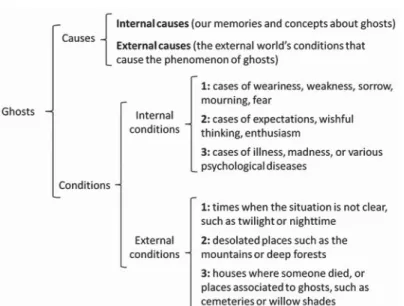
Inoue painstakingly takes a series of hypotheses into consideration, meticulously confuting them, through the use of scientific rationality. The reason lies in his attempt to maintain the existence of the human spirit, while debunking what he sees as superstition, or as experiences resulting from other conditions(Fig. 2). Yet, his very attempt to protect the existence of the human spirit, prevents him from claiming that ghosts are superstitions themselves. In his own words: I am not trying to claim that there are absolutely no ghosts. Moreover, I do not want to try to attack people who maintain that they absolutely exist(Inoue 2000a: 289-290). Nonetheless, he addresses people who believe in ghosts claiming that before arriving to these conclusions, there could be other interpretations.
Inoue, therefore, differently from the previously mentioned cases of foxes, goblins and the like, is not trying to debunk ghosts themselves. His concern is to provide alternative interpretations of their alleged manifestations in the material world, in order to confute the assumption that accepting the
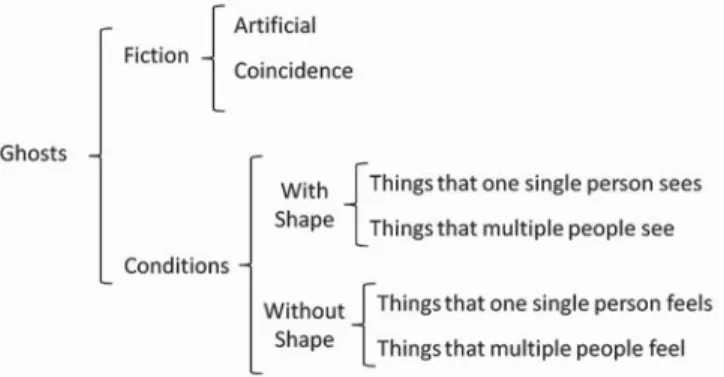
existence of the human spirit implies accepting of the existence of ghosts, for so-called ghosts are of a completely different quality to what supporters of the immortality of spirit call spirit(p. 288). In order to do so, he goes through a categorization of the possible typologies of apparitions and, secondly, he categorizes possible causes and conditions for ghosts, summarizing his considerations in the two figures below.
Fig. 1: Explicatory table on typologies of ghosts. Translated and adapted
from Inoue 2000a: 328.
In Fig. 1 by artificial (jingi), Inoue refers to the cases in which the existence of ghosts is proved relying on legends. Coincidence indicates those cases in which, for instance, ghosts are acknowledged when human shapes emerge because of reflections or distortions of light(p. 328). In the lower part of the table, Inoue takes conditions under consideration, while categorizing cases in which people see a ghost with human shape, separating them from the ones in which people feel a ghost or in which it manifests itself through some interaction with people or the environment.
organs, language, and behavior that are not different from the living , entities that have only half of their bodies and float in the air, showing only the head, or that only move and have no language(p. 330). As for shapeless ghosts, he lists hearing voices or the sound of steps, or feeling the weight of a dead person through the sense of touch and ghosts that although perform actions such as visiting temples, opening doors, or ringing bells, do not manifest their form(p. 330).
Inoue s analysis proceeds by taking into consideration the causes of apparitions of ghosts, either seen or felt by one single person, or by multiple people. In both cases, he claims that the experience could be ascribed to individual or collective psychological causes such as hallucination, delusion, expectations or wishful thinking(p. 336), thus claiming that no matter how usual discussions about actual experiences of ghosts can be, they cannot be taken as demonstration of the actual existence [of ghosts] in an absolute sense(p. 338).
Subsequently, he explains the causes and conditions for apparitions of ghosts, in order to provide an analytical framework also for future reports, so that first of all, when encounters with ghosts happen, it should be necessary to note the various causes and conditions(p. 339), that are summarized in Fig. 2. He continues, when, from now on, someone encounters a ghost, necessarily with no preconceptions, in case the aforementioned causes and conditions can be excluded, it is necessary to assess if there is something that can be truly recognized as a ghost. Yet, if the ghost exists exclusively according to the aforementioned conditions, I would call it a non-mystery(hankai). Thus, I believe that what should be called a true mystery(shinkai), is only the fact that a spirit itself could have corporality and substance.(…)However, this spirit would exist on the mysterious absolute border, and only release its
brightness on our spirit. It is absolutely not something that has any material form(p. 339).
Fig. 2: Explicatory table about causes and conditions for the apparitions of
ghosts. Translated and adapted from Inoue 2000a: 339.
As it appears from these sentences, therefore, in spite of Inoue s efforts to trace a borderline between the psychological/spiritual and the material through the attempt of debunking accounts of experiences with ghosts, his analytical narrative keeps the possibility of existence of ghosts themselves open, not succeeding in killing ghosts permanently. This was due, on the one hand, to his belief in the existence of the human spirit. On the other, though, it also had very political features, that were grounded in his nationalistic attitude.
( defend the nation, love reason ). Inoue attracted his fellow countrymen at a time, some twenty years after the Restoration, when the sentiment of
kokusuishugi, or ultra-nationalism, was prevalent in reaction to the earlier
indiscriminate Westernization(Staggs 1983: 254). He insisted in stressing the benefits that the newly established Meiji government and Buddhism could have through mutual collaboration. His works on monsterology became the basis for the anti-superstition campaign and copies were presented directly to the Emperor(Staggs 1983: 278).
Considering Inoue s political stance and position, it becomes evident that keeping the possibility of the existence of the human spirit and consequently of ghosts, would go well beyond his personal beliefs. In fact, any attempt to obliterate ghosts would have been extremely delicate, given that the newly established Meiji state was centered on the cult of the Emperor that, in turn, was based on practices and mythological narratives connected to ancestor worship(see e.g. Hardacre 1989, Shimazono 2009). Moreover, soldiers who had died fighting for the Meiji government, had their spirits enshrined in
Sh konsha, shrines for invoking the dead , a system that not only established
collective memorials, but also pacified in the name of the Emperor potentially dangerous and vengeful spirits, who suffered violent death(Antoni 1988). Consequently, any attempt to debunk the human spirit, would have endangered the whole Meiji apparatus.
The governmental campaign against superstition started including ghosts, monsters, the dog-god and human-foxes after 1904(Josephson 2012: 242). These attitudes towards the mysterious continued to the early years of the Shōwa period: [i]n the dominant discourse of the early twentieth century,
y kai were no longer considered part of the living present; rather, they were
similar forms of mystic practices were marginalized, and the supernatural entertainments that took their place – such as the hypnosis craze(…)– were subsumed within the expanding realm of the sciences and increasingly divorced from the y kai tradition(Foster 2009: 116).
Nevertheless, despite Inoue s efforts and the whole governmental campaign against superstition, though, people continued believing not only in ghosts, but also in monsters, foxes and goblins(Josephson 2006, Reider 2000). This may be related to the fact that, until the early twenties, authorities had been relatively lenient towards heterodox opinion and practices, as long as they were limited to a quite minority and not involved in politics. However, In 1925, the Peace Preservation Law(chihan ijih )was promulgated, imposing strict restrictions on freedom of action and speech. As a consequence, deviance from orthodoxy increasingly resulted in suppression(Hunter 1986: 196). Yet, because of the influence of globalization, ghosts and possession would be revamped in the 1970s.
5. The Exorcist: Globalizing Possession
Since the 1970s, Japan witnessed an increasing interest in spiritualism, spirit possession and divination, that emerged in the Japanese New Age scene, in the development of New Religious Movements, as well as in popular culture, such as films, manga or novels(Nakamura 2011, Staemmler 2009). This increase is generally referred to as the spiritual boom(supirichuaru b mu), or occult boom(okaruto b mu). Along with socio-economic causes, such as improved economic conditions, an increasing individualization in Japanese society, issues related to bioethics, and the spread of networks of self-help(e.g. Shimazono 2004), the success of American horror films was one of the elements that
boosted the boom.9) Among these films The Exorcist was fundamental(e.g.
Matsuura 2008, Yumiyama 1994).
This film, directed by William Friedkin, was released by Warner Bros on December the 26th 1973 in the US and, subsequently, worldwide. It was
screened for the first time in Europe in the UK, on the 16th of March 1974, in
Italy on the 4th of October 1974 and in Japan on the 6th of July 1974(IMDb
2015). The film earned around 230 million dollars only in the US, a total of more than 440 millions worldwide, and it ranks 9th in the all time Adjusted for
Ticket Price Inflation chart(Box Office Mojo 2015). It is the adaptation of an homonymous 1971 novel written by William Peter Blatty, that marked the first time exorcisms had been mentioned in such a public way since the 1600s (Goodman 1981). The film is loosely based on true events that took place in
Maryland in 1949, when 14-year-old "John Hoffman" underwent an exorcism.
The Exorcist deals with the demonic possession of a 12-year-old girl and the
mother's attempts to regain her child, through an exorcism conducted by two priests.
Its production process is renown to be cursed: a mysterious fire devoured one soundstage and at least nine people connected to the project died during filming. Even a Catholic priest who worked as technical advisor to Friedkin, at the crew's request, carried out a ceremony to rid the set of malign influences (Independent 2010). The film had an enormous success both in the US and
Europe and people queued for several hours in order to see it. However, it provoked violent reactions among the audience: the media reported numerous cases of cinemagoers suffering fits, fainting, vomiting, or leaving the theatre (e.g. BBC News 2001).
Taniguchi(2006)provides an analysis of what he calls the Exorcist shock that followed the film release in Japan. The film was introduced to the
Japanese audience through a massive promotional campaign that focused on the fact that it was a real story, as well as on the violent audience reactions in other countries. From this perspective, the case of Japan was not an exception: people queued for hours to see the film and, yet, many of them had the same reactions as above. Announces that the film would be prohibited to minors, and that the uncut version would be available only for a brief time, only enhanced the film s mysterious image and boosted the revenues.
However, The Exorcist did not only contribute to an increase in the occult as a genre. In fact, specialized teenager magazines started spreading rumors, suggesting that by watching the film, you would really be possessed by the devil , or that An evil spirit among the low-level ones, will possess you10)
(Taniguchi 2006: 97). The viewer s bodily reactions became the mediators between the film s narrative and the reality of spirit possession, and watching the film became the evidence of the occult .
As mentioned above, this increase of interest in the reality of spirit possession in Japan was paralleled by a flourishing period for spirituality related movements, that could offer discourses and practices related to it. Yet the same cannot be said for the Roman Catholic Church. In order to face the increase of demand for exorcisms that followed the screening of the film, in fact, the Vatican had to elaborate new policies, as I will show in the next session.
6. The Renewal of Exorcism in Italy
When The Exorcist was released in Europe, people had basically no background information about this ritual. Demand for real Catholic exorcisms rose in the whole Europe, but the priests trained to carry them out were very
few, and the Catholic Church gave very seldom permission to perform them (Goodman 1986: ix-x). In fact, this situation was the result of political choices
that were made by the Second Vatican Council(Concilium Oecumenicum
Vaticanum Secundum in Latin), that occurred in the years from 1962 to 1967.
The Council s first aim was renewing the relationships between the Catholic Church and the modern world, in order to modernize the Church(PCCMW 1965). Among the many changes that followed the Council, such as the use of vernacular language instead of Latin in the Holy Mass, the disuse of clerical regalia and the revision of Eucharistic prayers and rituals, there was a revision of the Ritual of Exorcism and the positions of exorcists within the Church.
In fact, the order of exorcists was dismantled, along with other minor orders, by Pope Paul VI(Ministeria Quaedam 1972), and exorcism was transformed into one of the sacramentals , namely "sacred signs which(…)signify effects, particularly of a spiritual nature, which are obtained through the intercession of the Church. By them men are disposed to receive the chief effect of the sacraments, and various occasions in life are rendered holy"(CSLSC 1963). In other words, in its search for modernization, the Council dismembered exorcists as a group, but decided to keep the possibility of performing the ritual of exorcism, though in a more controlled and modern form.
According to the Catechism of the Catholic Church(hereafter CCC 1997), exorcism refers to [w]hen the Church asks publicly and authoritatively in the name of Jesus Christ that a person or object be protected against the power of the Evil One and withdrawn from his dominion(CCC 1997: 1673). Technically speaking, everyone is able to perform an exorcism in Christ s name, as stated in Mark 16:17(Amorth 2010: 45). Yet the solemn exorcism, called major exorcism(i.e. the ritual that is portrayed in the film) can be performed only
by a priest and with the permission of the bishop(CCC 1997: 1673). The major exorcism is a ritual, directed at the expulsion of demons or to the liberation from demonic possession(CCC 1997: 1673), that basically consists in reading an array of prayers and impositions to the devil written in the Ritual.
Originally the exorcists used the so-called Roman Ritual (Rituale
Romanum), written in Latin. Yet, as a consequence of the modernization process, the Vatican issued a revised rite of exorcism on the 26th of January
1998, making it the last of the Church s liturgical books to be updated after the Second Vatican Council. This new version, that disciplines present-day exorcism and should be used by every exorcist, is called Of Exorcisms and
Certain Supplications(De Exorcismis et Supplicationibus Quibusdam,
DESQ 2001 hereafter)11) and, differently from the previous version, it carries a
new warning that exorcists first of all, must not consider people to be vexed by demons who are suffering above all from some psychic illness . Moreover it cautions against treating people as possessed, who are instead victims of imagination (NCR 2001).12) These warnings are perfectly in line with the
attempt to create a modern Catholic Church, in front of a cultural situations characterized by a large diffusion of deviant, or openly superstitious cultural practices(DESQ 2001: 5).
On the one hand, according to the trend of creating a modern Church, the Vatican imposed collaboration with medical practitioners, a clear limitation to the use of exorcism. This was not the only limitation, as I will show below. On the other, though, the reference to superstitious practices shows a perceived necessity to distinguish them from religion and proper exorcism.
As Csordas(2009: 9)pointed out, quoting a 1998 article of the New York
Times, priests attribute the increased demand to social and cultural
dealing with spiritism but also(…)the influence of the Charismatic Renewal movement, which since the end of the 1960s has popularized prayer for deliverance from evil spirits outside formally controlled ecclesiastical channels .
Therefore, although the Second Vatican Council imposed stricter regulations on exorcisms in the name of modernization , the Vatican had to face competition with other religious groups and practices offering a prompter response to the increasing demand that followed The Exorcist. The strategies employed to face this dilemma are the key for understanding the contemporary increase of Catholic exorcisms and exorcists,.
6.1 Father Gabriele Amorth and the Dispute on the New Ritual In 1991 Father Gabriele Amorth, Roman Catholic priest born in 1925 and official exorcist of the Diocese of Rome since 1986, published a book called Un
esorcista racconta(An Exorcist Tells his Story). In this work, he told about his experience as an exorcist, providing unprecedented insights on the practice, as well as on the demand. He claims that, as he became an exorcist, he realized that In Italy, there were pretty few exorcists, and very few well prepared. The situation in other states is even worse: I found myself blessing people who came from France, Austria, Germany, Switzerland, Spain, England, where(…)they could not find an exorcist (Amorth 2010: 9-10).
Since then, Father Amorth tirelessly worked on promoting Catholic exorcism. He published eight books related to exorcism in Italian, two of which were allegedly translated into 18 languages, and he appeared in interviews in the Italian national media and international documentaries and films. Furthermore, he founded the National Association of Exorcists in 1990, that became International in 1993 and has been extremely successful overtime:
only three people attended the first meeting in 1996, while in 1999 attendants were two hundred. Moreover, in 2014, it was officially recognized by the Vatican(e.g. Huffingon Post 2014.07.02.)
Although Father Amorth claimed that he performed more than 160.000 exorcisms(Huffington Post 2013.05.31), he insists that actual cases of possession are very rare(Amorth 2010: 33). Understanding this discrepancy in numbers is one of the keys to unveil the politics of the Evil One .
Possession is one of the extraordinary demonic activities , that go beyond ordinary temptation. Amorth(2010: 31-34)classifies them into six categories: 1)External physical pain caused by Satan, 2)demonic possession, that occurs when Satan takes full possession of the body(not the soul), 3)diabolic oppression, whose symptoms vary from very serious to mild illness, but with no possession, loss of consciousness, or involuntary action, 4)diabolic obsession, with symptoms including sudden attacks of obsessive thoughts, sometimes even rationally absurd, but of such nature that the victim is unable to free himself, 5)diabolic infestation, that affects houses, things, or animals, 6) diabolical subjugation, or dependence, in which people fall when they voluntarily submit to Satan.
The new version of the Ritual of exorcism limits its use exclusively to cases of possession, recognized according to some signs, including aversion to the sacred, speaking languages that were before unknown to the victim, revealing information that the victim is not supposed to know, manifesting exceptional strength. These signs, though, may constitute simple indicators and therefore should not necessarily be considered as coming from the devil(DESQ 2001: 28). The Ritual forbids the performance of exorcism in any other case, thus enormously limiting the possibilities for the exorcist s action.
about his reaction to the modernizing intentions of the Council. In an interview (Trenta Giorni 2001)he defined the new Ritual a joke , an incredible
bondage that risks to prevent us from operating against the devil . In fact, the imposition to operate only in cases of ascertained possession, implies the prohibition of performing exorcisms in case of curses(malefici), that was allowed by the Roman Ritual. In Amorth s words, curses are by far the greatest cause of demonically caused sufferings: not less than 90 percent. This is like telling exorcists not to operate anymore. He also lamented that the effective prayers were deleted: prayers with twelve centuries of history, while new ones have been created, but they are ineffective13) and that the ritual is a
masterpiece of incompetence: the certainty of demonic presence within a person is achievable only through exorcism.(…)[T]he compilers did not realise that they were in contradiction with the Catechism of the Catholic Church, that indicates to perform exorcisms both in case of diabolic possession, and of demonically caused sufferings(Trenta Giorni 2001).
According to Father Amorth, the ritual is contradictory because the exorcist cannot diagnose spirit possession before performing an exorcism. Moreover, it is in conflict with the CCC. The first point is the explanation of the high number of exorcisms performed by Father Amorth: according to my research partners, he performs so-called diagnostic exorcisms , namely exorcisms aimed not to expel demons, but to identify their presence.
At first glance, this would seem in contradiction to the limitations imposed by the new Ritual. Yet, as Amorth pointed out, the Catechism provided an expedient to bypass the issue. On this point, Father Amorth indicates the fundamental role of Cardinal Joseph Ratzinger, the future Pope Benedict XVI in supporting the mission of exorcists: beginning with the drafting of the
administrate the sacramental of exorcism not only on people who undergo demonic possession, but also on those who are subjected to other demonic disturbances, such as diabolic oppression and infestation(Il Fatto Quotidiano 2013.02.14). In fact, the dispute about the existence and the action of the devil involved the high spheres of the Vatican, and it was a challenge to the modernization of Catholicism.
6.2 The Politics of the Evil One
Despite the Second Vatican Council s efforts to limit the exorcism, in front of the increasing demand, the practice was revived even at the highest levels of the Vatican. Pope John Paul II was the first Pope in 400 years to face the demon in a rite of exorcism on April 4th 1982(La Stampa 2012.03.30). Yet,
Cardinal Joseph Ratzinger, who was ordered Cardinal-Prefect of the Congregation for the Doctrine of the Faith(formerly known as the Holy Office and, especially around the sixteenth century, as the Roman Inquisition)by Pope John Paul II in 1981, had an even more key role in supporting exorcists, while showing conservative tendencies and a traditionalist views of the Catholic Church.
In 1986 Cardinal Ratzinger chaired the Commission of 12 Cardinals and Bishops, ordered by Pope John Paul II, to draft the text of the CCC that was published in 1992(Apostolic Constitution Fidei Depositum 1992). The texts is very clear on the existence of the devil not as a metaphor for or a symbol of evil, but as a real entity. In the section dedicated to the Lord s Prayer, the CCC explains that in the verse but deliver us from evil , evil is not an abstraction, but refers to a person, Satan, the Evil One, the angel who opposes God(CCC 1997: 2851). Moreover, according to the CCC, through exorcism the Church requests publicly and authoritatively that a person or object is protected
against the influence of the evil one (CCC 1997: 1673).14) In this sense,
therefore, exorcists are not only legitimized to operate because Satan exists. They are also allowed to perform exorcisms in many more cases than the very rare diabolic possession.
Amorth also mentioned that Cardinal Ratzinger and Cardinal Medina, who were involved in the revision of the Ritual, attempted to a maneuver in
extremis introducing into the liturgical book an article authorizing exorcists
to use the previous Rituale Romanum. This was unsuccessful, but on the day after the presentation of the new Ritual, Medina published a notification to the effect that also the old Ritual could be used, upon agreement by the Bishop (Hauke 2006: 41).
Furthermore, in 2005 Pope Benedict XVI addressed the participants in the National Congress of Italian Exorcists and encouraged them to continue in their important ministry at the service of the Church, supported by the solicitous care of their bishops and the incessant prayer of the Christian community(General Audience, 2005.09.14, quoted from Zenit 2005)and ordered bishops to nominate exorcists to tackle the rise of Satanism(Daily
Mail 2007.12.29).
These strategies, therefore, allowed exorcists to continue using the Rituale
Romanum, bypassing the restrictions imposed by the Second Vatican Council,
and mediating a conservative, traditionalist view on exorcism and the Catholic Doctrine in general.15) On the other hand, they created the conditions to
properly react to the increasing demand and, probably, to keep it high.
7. Conclusions
existence of spirit possession and possessing entities in Japan and Italy. In doing so, while providing empirical data, it confirmed the anthropological analytic that interprets spirits as related to resistance to processes of modernization that tend to rationalize and marginalize them. This happened both in the case of early twentieth Century Japan and in the case of the Second Vatican Council.
Nevertheless, in the first instance, this study also showed that discourses are negotiated in the interactions among a variety of actors, that include state apparatuses and their modernizing strategies, but also intellectuals, religious groups and practitioners, as well as transnational flows of images and ideologies.
According to these interactions, discourses about modernity can be re-negotiated and balances of power can shift. With changes in discourses of spirits and spirit possession, some groups can access new ways of empowerment, as in the case of the film The Exorcist and Catholic exorcists, or spirituality related groups in 1970s Japan. Thus, so long as the possibility of existence of possessing entities is acknowledged to a certain extent, spirits do not only resist : they also have an active, creative political role. They can move and mediate politics, negotiate processes of modernization, as well as categories of religion and superstition .
On the one hand, therefore, a focus on the politics of spirits can offer a new ground for an understanding of the complexity and multidimensionality of spirit possession form a cross-cultural perspective. On the other hand, though, thinking that national politics of spirits are negotiated in localities through different practices is legitimate. Therefore further investigation on the processes through which experiences of possession are constructed through practice, can offer new insights not only on the interrelatedness of religion,
spirituality, politics and globalization, but also on the ways in which they shape, and are shaped by, bodily perceptions and realities of spirits.
Acknowledgements: I am deeply grateful to Dr. Giorgio Fabio Colombo
(Nagoya University)and Marlies Möderndorfer(the University of Vienna)for their precious insights, comments and suggestions, that greatly contributed to improve this article.
Notes
1) In 2015 the X Course on Exorcism and Prayers of Liberation will be held from the 13th
to the 18th of April. According to the Course s homepage, this annual Course on
Exorcism seeks to explore the theoretical and practical implications of the ministry of exorcism and it will take into consideration aspects of exorcism from the viewpoint of several disciplines, including anthropological, phenomenological, social, theological, liturgical, spiritual, medical, neuroscientific and physical, symbolic, criminological, legal, and juridical aspects(Sacerdos 2015).
2) Works by Screech(2002)and Vande Walle and Kasaya(2001)showed that ideas about natural history and science entered Japan much earlier, in the late 1700s, through the importation of European knowledge and so called Dutch-studies(rangaku). Nevertheless, as Foster(2009)points out, it was not until the Meiji period that taken-for-granted assumptions about the world were rethought.
3) On religious conflict in this period and haibutsu kishaku, see for instance Ketelar(1993) and Thelle(1987).
4) Biographical data about Inoue Enryō can be found, among others, in Figal(1999), Foster (2009), Josephson(2006, 2012), Kikuchi(2013), Staggs(1983). This section is heavily
indebted to these works.
5) English translations of this name are discordant, due to the wide semantic field of the word fushigi. They include Paranormal Research Society(Josephson 2006: 151), Strangeness Research Group(Yoshinaga 2015: 88), or Mystery Research Society (Figal 1999: 44, Foster 2009: 79). I agree with this last translation because, one the one
hand, even though it is true that the society was modeled on the British Society for Psychical Research(Figal 2009: 44), the idea of paranormal was not present in Japan at the time and it is too narrow to be superimposed to fushigi . On the other hand, I
think that the idea of mysterious or mystery is a better rendition than strange or strangeness in this case. For a discussion about the translation of fushigi , see Foster (2009: 15-21).
6) In the present article, I used the 2000 edition of the complete collection of Inoue s writings. All translations are mine, if not otherwise specified.
7) These intellectuals included, among others, names such as Kiyozawa Manshi, Inoue Tetsujirō, Ōuchi Seiran, Sakaino Kōyō, Katō Genchi, Hirai Kinzō, Unshō, Ōya Tokujō and Katō Totsudō(Josephson 2006: 163).
8) I prefer the translation spirit to soul , for the latter is heavily related to Christian tradition.
9) For a history of the occult boom in Japan see Ichiyanagi 2006.
10) Both are quotations from the very popular fashion magazine for female teenager
Seventeen, respectively the 06/09/1974 and 08/13/1974 issues. The second quotation is
particularly interesting in my view, because it shows a shift between the demonic possession portrayed in the film and the possession by an evil spirit(akurei), that was more familiar to the Japanese context, as I explained above.
11) On the theological grounds on which the DESQ is based, see Hauke 2006.
12) In this case, I quoted from an official Catholic website in English, since the English version of the De Exorcismis et Supplicationibus Quibusdam is not available. Therefore, the following quotations from the text are based on the Italian version, Rito
degli esorcismi e preghiere per circostanze particolari(2001)available online and translated by the author.
13) Amorth does not clarify what the effectiveness of prayers is based on. All the exorcists I interviewed, though, agreed with Amorth on this point and claimed that this is the result of having deleted prayers that ordered the devil to leave the body, substituting them with their supplicant form(see also Hauke 2006: 65).
14) This is my translation from the Italian version, to which Amorth refers. Yet, curiously enough, the English translation is slightly different and gives a narrower interpretation of exorcism, as directed at the expulsion of demons or to the liberation from demonic possession(CCC 1997: 1673).
15) For instance, Amorth claimed that Oriental practices, such as yoga, are deceitful and dangerous. One thinks to perform them for relaxing purposes, but they lead to Hinduism. All Oriental religions are based on the false belief in reincarnation , that Halloween is singing Hosanna to the devil , and that Harry Potter leads to magic and, hence, to evil. Also in Harry Potter the demon acted in a hidden and sly way, disguised as extraordinary powers, magic and curses(Il Fatto Quotidiano 2001.11.24).
References
Amorth, G. 2010(1991). Un esorcista racconta(An Exorcist Tells His Story). Bologna: Ed. Dehoniane.
Antoni, K. 1988. Yasukuni-Jinja and Folk Religion: The Problem of Vengeful Spirits. Asian
Folklore Studies 47(1): 123-36.
Bourguignon, E. 1968. A Cross-Cultural Study of Dissociational States. Columbus: Research Foundation, Ohio State University.
Blanke et al. 2014. Neurological and Robot-Controlled Induction of an Apparition. Current
Biology 24: 1-6.
Blacker, C. 2004(1975). The catalpa bow: a study of shamanistic practices in Japan. London: Routledge Curzon.
Breen, J., and M. Teeuwen(eds.). 2000. Shinto in History: Ways of the Kami. Honolulu: University of Hawaii Press
Butler, J. 1997. Excitable Speech: A Politics of the Performative. New York: Routledge. Cohen, Emma. 2007. The Mind Possessed: The Cognition of Spirit Possession in an
Afro-Brazilian Religious Tradition. New York: Oxford University Press.
_ 2008. What is Spirit Possession? Defining, Comparing and Explaining Two Possession Forms. Ethnos: Journal in Anthropology 73(1): 101-126.
Comaroff, J., and J.L. Comaroff. 1993. Introduction. In Comaroff, J., and J. L. Comaroff (eds.). Modernity and Its Malcontents: Ritual and Power in Postcolonial Africa.
Chicago: University of Chicago Press: xi–xxxviii.
_ 2002. Alien-Nation: Zombies, Immigrants, and Millennial Capitalism. South
Atlantic Quarterly 101(4): 779–805.
Crapanzano, V. 2005. Spirit possession: an overview. In L. Jones(ed.), Encyclopedia of
Religion(2nd edn). Detroit: Macmillan Reference USA: 8687–94.
Csordas, T.J. 1994. The Sacred Self: A Cultural Phenomenology of Charismatic Healing. Berkeley: University of California Press.
_ 2002. Body/Meaning/Healing. Basingtoke: Palgrave Macmillan.
_ 2009. Introduction: Modalities of Transnational Transcendence. In Csordas, T. J.(ed.)Transnational Transcendence. Berkeley and Los Angeles: University of California Press.
De Antoni, A. 2011. Ghost in Translation: Non-Human Actors, Relationality and Haunted Places in Contemporary Kyoto. Japanese Review of Cultural Anthropology 12: 27-49.
_ 2013.「死者へ接続するツアー―現代京都におけるダークツーリズムの再考」(The
Tour that Links to the Dead: Rethinking Dark Tourism in Contemporary Kyoto)『観光学 評論』(Tourism Studies Review)1(1): 75-86(in Japanese).
Diamond, I. and Quinby L. 1988. Feminism and Foucault: Reflections on Resistance. Boston, MA: Northeastern University Press.
Evans Pritchard, E.E. 1937. Witchcraft, Oracles and Magic among the Azande. Oxford: Clarendon.
Figal, G. 1999. Civilization and Monsters: Spirits of Modernity in Modern Japan. Durham: Duke University Press.
Foster, M.D. 2009. Pandemonium and Parade: Japanese Monsters and the Culture of
Y kai. Berkeley, Los Angeles, London: University of California Press.
Goodman, F. 1981. The Exorcism of Anneliese Michel. Garden City: Doubleday and Co. Hashimoto, A. 2015. Psychiatry and Religion in Modern Japan: Traditional Temple and Shrine
Therapies. In Harding, C. Iwata, F., and S. Yoshinaga. Religion and Psychotherapy in
Modern Japan. London and New York: Routledge: 51-75.
Hardacre, H. 1989. Shinto and the State, 1868–1988. Princeton: Princeton University Press. Harding, C. 2015. Religion and Psychotherapy in Modern Japan: A Four-Phase View. In
Harding, C. Iwata, F., and S. Yoshinaga(eds.). Religion and Psychotherapy in Modern
Japan. London and New York: Routledge: 25-50.
Harding, C. Iwata, F., and S. Yoshinaga(eds.). 2015. Religion and Psychotherapy in
Modern Japan. London and New York: Routledge.
Hauke, M. 2006. The Theological Battle over the Rite of Exorcism, Cinderella of the New
Rituale Romanum. Antiphon 10(1): 32-69.
Hori, I. 1968. Folk Religion in Japan: Continuity and Change. Chicago: University of Chicago Press.
Hunter, J. 1989. The Emergence of Modern Japan: An Introductory History since 1853. London: Longman.
Ichiyanagi, Hirotaka一柳 廣孝 . 2006. 『オカルトの帝国―1970 年代の日本を読む』(The
Empire of the Occult: Reading the 1970s Japan). Tokyo: Seikyūsha.
Inoue, Enryō 井上円了 . 2000a(1916). 「迷信と宗教」(Superstition and Religion). In『妖怪 学全集』第 5 巻(Complete Collection of Monsterology, Vol. 5). Tokyo: Kashiwa Shoten: 127-343.
_ 2000b(1894).「 妖怪学講義−巻 6 −宗教学部門」(Lectures in Monsterology, Vol. 6, Religious Studies Section)『妖怪学全集』第 3 巻(Complete Collection of Monsterology, Vol. 5). Tokyo: Kashiwa Shoten: 13-70.
Ishii, M. 2012. Acting with Things: Self-Poiesis, Actuality, and Contingency in the Formation of Divine Worlds. HAU: Journal of Ethnographic Theory 2(2): 371-388.
Isomae, Jun ichi 磯前 順一 . 2003.『近代日本の宗教言説とその系譜 ‐ 宗教・国家・神道』 (Discourses on Religion in Modern Japan and Their Genealogy: Religion, State,