• 検索結果がありません。

Potential Developing Countries for Foreign Direct Investment: A Panel Data Analysis

N/A
N/A
Protected

Academic year: 2021

シェア "Potential Developing Countries for Foreign Direct Investment: A Panel Data Analysis"

Copied!
8
0
0

読み込み中.... (全文を見る)

全文

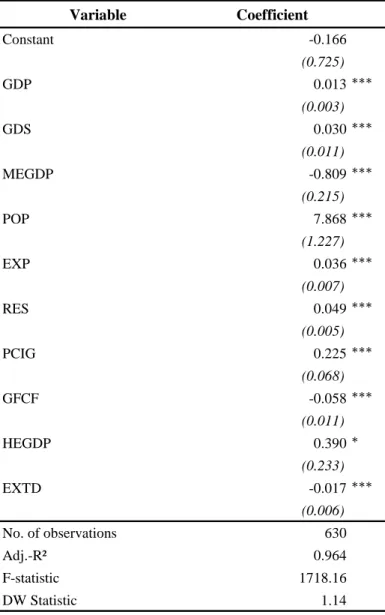
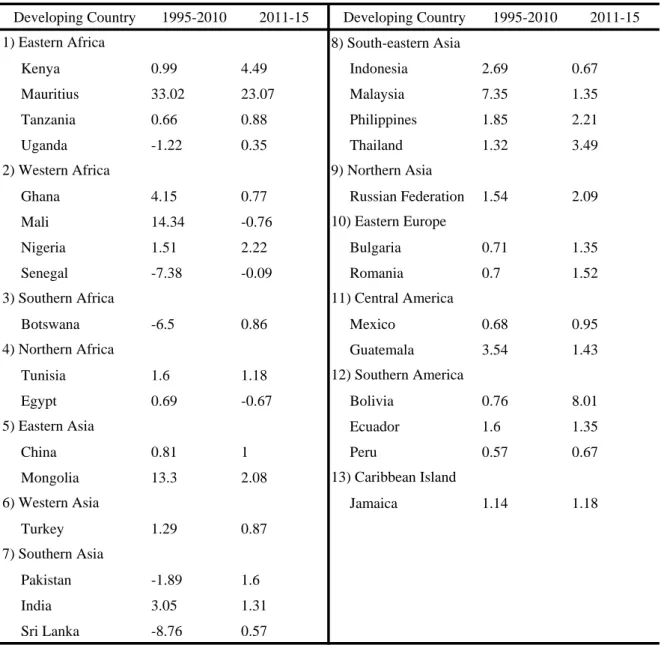
International Journal of South Asian Studies, Vol. 10 (2020). 11 ©Japanese Association for South Asian Studies. Potential Developing Countries for Foreign Direct Investment: A Panel Data Analysis. Abdul Waheed∗. Abstract Foreign direct investment is considered an important tool for accelerating economic growth and development. This study aims to identify the potential developing countries for foreign direct investment. The study uses a panel data of 30 countries from 13 regions of the world for the period 1995-2015. The estimation results highlight ten factors that significantly affect the inflow of foreign direct investment. The estimation of FDI potential identifies seventeen developing countries out of 30 countries that should have higher FDI inflows than actual, based on their development level and economic performance. Based on the results of the model, the study urges policymakers to focus on identified macroeconomic factors to attract greater foreign direct investment in the country. . Keywords: FDI, Determinants, Potential, Panel Data . 1. Introduction. The past few years have seen a tremendous inflow of foreign direct investment (FDI) in many developing countries. The history shows that FDI has played an important role in the growth and development of many countries. The enormous increase in FDI inflows in different countries is a reflection of the greater integration of world economies. It is believed that FDI inflow benefits the host country through higher economic growth and development. FDI is considered the most significant channels for the transfer of modern technology.. Since the mid-1980s, the developing countries experienced a rapid increase of FDI even faster than the world trade. Each developing country have a plan to attract FDI in the country. The key issue is –what causes the FDI inflow? There are several studies on determinants of FDI, but the results are inclusive. This study bridges this gap and tries to identify the key determinants of FDI inflows. This will help the policymakers to directly focus on these factors and design clear policies to attract FDI.. Analysis of the literature of FDI reveals that there is a lack of comprehensive theory on FDI. There are a variety of theoretical models that explain FDI and the location decision. Given the expected role of FDI in enhancing economic growth and development, the developing countries are generally interested in attracting it. Many countries are taking various policy measures to facilitate foreign investors. During the last two decades, there has been an inflow of FDI in different developing countries. The fluctuation in FDI is a great concern for developing countries. The policymakers are interested to compare their actual FDI with predicted FDI, which will be based on their macroeconomic performance. This study provides a comparison for 30 developing countries. The regression model of determinants of FDI will be used to estimate the predicted FDI based on macroeconomic performance. Based on actual and predicted FDI, the potential developing countries will be identified for possible inflow of foreign direct investment.. Thus, the objectives of this study are two-fold. First to investigate the macroeconomic determinants of FDI using panel data. Second, based on the results of the panel regression model, to identify the. ∗ Professor, Department of Economics, University of Karachi, Karachi, Pakistan Email address: [email protected]. Potential Developing Countries for Foreign Direct Investment. 12 ©Japanese Association for South Asian Studies. developing countries that are suitable for foreign direct investment on the basis of their economic performance and development level. The findings of this study will be a great help for policymakers in developing countries to design concrete policies to attract more FDI. The result of FDI potential will help the MNCs to select the developing countries for the possible location of their industry.. The paper is organized into six sections. Following the introduction, section 2 conducts a brief review of recent literate on determinants of FDI. Section 3 formulates a model based on a review of literature and discusses the source of data. Section 4 presents the estimation results of the long-run model. Section 5 highlights the potential countries suitable for FDI. The last section concludes the study, discusses the policy implications and set directions for further research.. 2. Review of Literature. In empirical literature, there a is lack of consensus on the core determinants of FDI. This literature survey limit to the empirical studies on determinants of FDI in developing countries and mostly focused on findings of the panel or cross-sectional studies 1 . Azam and Lukman (2010) examined the effect of economic factors on FDI inflows to three countries viz India, Indonesia, and Pakistan for the period 1971- 2005. The results showed that market size, external debt, trade openness, physical infrastructure, and domestic investment were important determinants of FDI. Asiedu (2002) examines the determinants of FDI in sub-Saharan and non-sub-Saharan African countries. The study used 32 sub-Saharan and 30 non-sub- Saharan African countries. The results showed that for non-sub-Saharan African countries, higher returns on investment and better infrastructure have a positive impact on FDI inflow. The openness to trade promotes FDI to sub-Saharan and non-sub- Saharan African countries.. Leitao and Faustino (2010) using a panel data of European countries (EU-15), United States, Canada, Brazil, and Japan identified the significant determinants of FDI in Portugal. The results of the fixed effects estimator showed that trade openness has a significant positive effect and the tax level has a significant negative effect on FDI. Inflation, which is used as a proxy for economic stability, should have a negative effect on FDI but the study found it positive. The results of GMM estimation showed the insignificant effect of inflation on FDI. The significant determinants of FDI were found as labor cost, market size, trade openness, and taxes. The study suggested for a deeper analysis that should include market growth, language and cultural similarity and human capital in the extended model.. Koojaroenprasit (2013) analyzed the determinants of FDI in Australia from the USA, UK, and Japan for the period 1986 to 2011. Simple linear regression model in log form is used and the OLS method was applied for identifying the determinants of FDI. The study found that the impact of openness, corporate tax, customs duty, interest rate, and exchange rate are negative on FDI. The impact of market size was found to be positive on FDI. The study also found a significant negative impact of wage, trade openness, customs duty, exchange rate, corporate tax rate and research and development expenditures for country-specific regression models of inward FDI from the US, UK, and Japan.. Bakari et al. (2013) tested the effect of macroeconomic and socio-political factors on FDI inflows to Nigeria over the period 1970 to 2010. The error correction model revealed that FDI inflows in Nigeria depend on the degree of openness, exchange rate, unemployment rate, and political risk index. The study also found that there exists a long-run relationship between FDI and economic growth, openness of market, stable exchange rate, lower discount rate, and stable political environment.. 1 For a review of theoretical literature on FDI, see Offiong and Atsu (2014):1541-1543.. Abdul Waheed. 13 ©Japanese Association for South Asian Studies. Jayasekara (2014) investigated the factors that determine foreign direct investment inflows in Sri Lanka during the period of 1975-2012. The study used several variables in fully modified least squares (FM-OLS) regression model to estimate the significant determinants of FDI. The study found a significant positive effect of GDP growth rate, inflation rate, labor force, population growth rate, corporate tax, and infrastructure quality on FDI in Sri Lanka. The exchange rate depreciation had a negative effect on FDI. The study also tested several other variables2, in the model, however, these were not significant in the case of Sri Lanka.. Mottaleb (2007) identified the main factors that determine FDI inflow in 60 developing countries. The panel regression result showed that larger GDP, higher GDP growth, business-friendly environment and modern infrastructure facilities (internet) attract FDI.. Jha et al. (2013) analyzed the determinants of FDI in six South Asian countries - India, Pakistan, Bangladesh, Sri Lanka, Nepal, and Maldives. The results of the pooled least squares methods for the period 1990 to 2010 showed that trade openness, GDP, and capital formation have a positive impact on FDI whereas labor force had a negative influence. Ranjan and Agrawal (2011) explored the determinants of FDI in BRIC countries (Brazil, Russian Federation, India and China). The study used panel data over 35 years ranging from 1975 to 2009. The results of the random effect model showed that market size, trade openness, labor cost, infrastructure facilities, and inflation rate are potential determinants of FDI in these countries.. Garibaldi et al. (2002) analyzed foreign direct and portfolio investment flows to 25 transition economies in Eastern Europe including the former Soviet Union from 1991 to 1999. The estimation results showed that economic reforms, trade liberalization, natural resource endowment, privatization methods, and barriers to foreign investment explain FDI inflows.. The above brief review of the literature shows that the results of the previous studies are inconclusive. There are some core variables that affect FDI inflows but the effect of many other macroeconomic variables are still to be measured. This study will try to fill this gap and study the effects of different macroeconomic variables for a bigger set of developing countries with a larger sample size. . 3. Methodological Framework. There is no well-developed comprehensive theory on FDI. Based on the review of empirical literature, different variables are used to reflect a range of factors that potentially affect FDI. 𝐹𝐹𝐹𝐹𝐹𝐹𝑖𝑖𝑖𝑖 = 𝛽𝛽0 + 𝛽𝛽1𝐺𝐺𝐹𝐹𝐺𝐺𝑖𝑖𝑖𝑖 + 𝛽𝛽2𝐺𝐺𝐹𝐹𝐺𝐺𝑖𝑖𝑖𝑖 + 𝛽𝛽3𝑀𝑀𝑀𝑀𝐺𝐺𝐹𝐹𝐺𝐺𝑖𝑖𝑖𝑖 + 𝛽𝛽4𝐺𝐺𝑃𝑃𝐺𝐺𝑖𝑖𝑖𝑖 + 𝛽𝛽5𝑀𝑀𝐸𝐸𝐺𝐺𝑖𝑖𝑖𝑖 +𝛽𝛽6𝑅𝑅𝑀𝑀𝐺𝐺𝑖𝑖𝑖𝑖 + 𝛽𝛽7𝐺𝐺𝑃𝑃𝐹𝐹𝐺𝐺𝑖𝑖𝑖𝑖 + 𝛽𝛽8𝐺𝐺𝐹𝐹𝑃𝑃𝐹𝐹𝑖𝑖𝑖𝑖 + 𝛽𝛽9𝐻𝐻𝑀𝑀𝐺𝐺𝐹𝐹𝐺𝐺𝑖𝑖𝑖𝑖 + 𝛽𝛽10𝑀𝑀𝐸𝐸𝐸𝐸𝐹𝐹𝑖𝑖𝑖𝑖 + µ𝑖𝑖 (3.1) . where FDI is a net foreign direct investment, GDP is the gross domestic product, which is proxy for market potential. In cross-sectional econometric studies, it is found that there is a well-established correlation between FDI and the size of the market. GDS is the gross domestic saving. MEGDP is military expenditure as ratio of GDP, which is a proxy for internal and external conflict (Bakari et al. 2013). Political conflicts are also an important determinant of FDI inflows. Political instability, expressed in terms of internal conflict (crime level, riots, labor disputes, and corruption) and external conflict (tension with neighboring countries,. 2 These variables were government consumption expenditure, lending interest rate, international trade volume, trade. balance, taxes on international trade, and literacy rate.. Potential Developing Countries for Foreign Direct Investment. 14 ©Japanese Association for South Asian Studies. fear of war, and military tension at the border) is an important factor that can restrain inflow of foreign direct investment. POP is the population, which reflect market size.. EXP is the export of goods and services. It is found that open economies encourage more foreign investment. One indicator of a country’s openness is the relative size of the export sector. Tsai (1994) shown that exports are significant determinants of FDI flows. Multinational Corporations (MNCs) tend to invest in the trade partner markets, with which they are familiar.. RES is the foreign exchange reserve of the country. PCIG is per capita income growth, which reflects improvement in the standard of living and increase in purchasing power. GFCF in gross fixed capital formation, which is proxy for domestic investment. Higher gross capital formation leads to greater economic growth, which helps to attract higher FDI inflows. However, in some cases, the greater domestic investment may lower the need for foreign investment. Therefore, a positive or negative relationship between FDI and capital formation is expected.. HEGDP is government expenditure on health as a percent of GDP, which is a proxy for human capital. Sun et al. (2002) identified human capital as significant determinants of FDI in China. Rodriguez and Pallas (2008) identified that human capital and the export potential are the important determinants of FDI in Spain. EXTD is the stock of external debt of the country, which is expected to have a negative effect on FDI inflows. 𝛽𝛽0 is the drift component and µ𝑖𝑖 is the usual white noise residuals. The parameters β1 to β10 correspond to the long-run relationship. . 4. Panel Estimation Results. The long run determinants of FDI is investigated by constructing panel data of 30 developing countries from 13 different regions of the world for 21 years covering the period 1995 to 2015. The selection of the countries is made on the basis of the availability of complete data on all core macroeconomic variables for the period under consideration. The selected countries therefore have good documentation of their economic data, which is another source of attraction for FDI inflows. The data for the study is taken from World Development Indicators (WDI) of the World Bank. The model is estimated employing the panel least square method. . Table 1 shows that the coefficient of GDP has an expected positive sign and it is statistically significant at 1% level. This shows that an increase in market size will attract more FDI. The coefficient of GDS and RES are also positive and statistically significant at 1% level. Thus, higher domestic savings and foreign exchange reserves will attract more FDI. The coefficient of POP and HEGDP are also positive, while the former is statistically significant at 1% the latter is at 10%. These two variables show that the availability of skilled and unskilled worker with good health attract FDI. The coefficient of EXP is positive and statistically significant, reflecting that an open economy has more chance to attract FDI in the country. The coefficient of GFCF is negative and statistically significant at 1% level. This shows that domestic and foreign investment are a substitute rather than complement. The coefficient of PCIG is positive and highly significant reflecting that higher purchasing power attracts greater FDI inflow. Finally, the coefficient of MEGDP is negative and highly significant. This shows that military expenditure (which is a proxy for internal and external conflict) has a serious negative effect on FDI inflows.. The results presented in Table 1 have gone through several robustness checks. The results of the model are as per findings of the previous studies, which used different samples and estimation methods. The results of the model are good based on the adjusted-R2 and F-statistics. The adjusted-R2 is 0.97, which means 97 percent variation in FDI inflows is explained by these ten variables that are included in the model. This is the high goodness of fit based on the panel data. The F-statistic shows that model is overall highly. Abdul Waheed. 15 ©Japanese Association for South Asian Studies. statistically significant. The bias proportion (0.000) and the variance proportion (0.001) are also reasonable, showing good forecast ability of the model.. Using the results of the above estimated model, first expected FDI will be estimated for each year and then it will be divided by the actual FDI to get FDI potential. The following section discusses this in detail.. Table 1. Long Run Macroeconomic Determinants of FDI. 5. Potential Countries for FDI Inflows. Table 2 shows the estimation results of average FDI potential for 1995-2010 and 2011-2015. In Eastern African region, Kenya and Mauritius have potential to absorb FDI. In Western Africa, Nigeria and in Northern Africa, Tunisia has the potential for greater FDI inflows. The other countries (Tanzania, Uganda, Ghana, and Botswana) exhausted the potential, while the situation is alarming in Mali, Senegal, and Egypt within the African region. In Eastern Asia, Mongolia and in Southern Asia Pakistan and India has the. Variable Coefficient Constant -0.166. (0.725) GDP 0.013 ***. (0.003) GDS 0.030 ***. (0.011) MEGDP -0.809 ***. (0.215) POP 7.868 ***. (1.227) EXP 0.036 ***. (0.007) RES 0.049 ***. (0.005) PCIG 0.225 ***. (0.068) GFCF -0.058 ***. (0.011) HEGDP 0.390 *. (0.233) EXTD -0.017 ***. (0.006) No. of observations 630 Adj.-R² 0.964 F-statistic 1718.16 DW Statistic 1.14. Source : Author’s estimation.. Note : *, and *** indicate 10% and 1% statistical significance respectively. Standard errors are reported in parenthesis.. Potential Developing Countries for Foreign Direct Investment. 16 ©Japanese Association for South Asian Studies. potential for FDI inflows. In South-eastern Asia, Malaysia, Philippines, and Thailand and in Northern Asia, Russian Federation has the potential for FDI inflows. . In the Asian region, China, Turkey, Sri Lanka, and Indonesia have exhaustive their FDI potential. In Europe, Bulgaria and Romania are potential countries for FDI inflows. In Central and South America, Guatemala, Bolivia, and Ecuador are the main countries that have a high potential for FDI inflows, while Mexico and Peru exhausted its potential for FDI. In the Caribbean Islands, Jamaica is identified as potential developing country for FDI inflows.. The results show that Egypt, Mali, and Senegal are the countries that show net average outflows during 2011-2015 based on their macroeconomic performance and political stability. In sub-Saharan Africa, Botswana, Uganda showed improvement in FDI potential as its average estimated value changed from negative to positive. In Asia, Pakistan and Sri Lanka showed good economic and political stability which turn their FDI potential from negative to positive value. Pakistan has a high potential for FDI while Sri Lanka has exhausted its FDI potential.. Developing Country 1995-2010 2011-15 Developing Country 1995-2010 2011-15. 8) South-eastern Asia. Kenya 0.99 4.49 Indonesia 2.69 0.67. Mauritius 33.02 23.07 Malaysia 7.35 1.35. Tanzania 0.66 0.88 Philippines 1.85 2.21. Uganda -1.22 0.35 Thailand 1.32 3.49. Ghana 4.15 0.77 Russian Federation 1.54 2.09. Mali 14.34 -0.76. Nigeria 1.51 2.22 Bulgaria 0.71 1.35. Senegal -7.38 -0.09 Romania 0.7 1.52. Botswana -6.5 0.86 Mexico 0.68 0.95. Guatemala 3.54 1.43. Tunisia 1.6 1.18. Egypt 0.69 -0.67 Bolivia 0.76 8.01. Ecuador 1.6 1.35. China 0.81 1 Peru 0.57 0.67. Mongolia 13.3 2.08. Jamaica 1.14 1.18. Turkey 1.29 0.87. Pakistan -1.89 1.6. India 3.05 1.31. Sri Lanka -8.76 0.57 Source: Author’s calculation.. 4) Northern Africa. 5) Eastern Asia. 6) Western Asia. 7) Southern Asia. 13) Caribbean Island. 12) Southern America. 3) Southern Africa 11) Central America. Table 2. FDI Potential in Selected Developing Countries. 1) Eastern Africa. 2) Western Africa 9) Northern Asia. 10) Eastern Europe. Abdul Waheed. 17 ©Japanese Association for South Asian Studies. 6. Conclusion and Policy Implications. This study initiated with twin objectives. The first objective was to investigate the determinants of FDI and the second was to identify the developing countries, where actual FDI inflow is less than the estimated inflow based on their economic performance and political stability. The study is based on secondary panel data of 30 developing countries from 13 regions of the world covering the period from 1995 to 2015. The regression results identified ten core variables that explain 97 percent variation in FDI inflows to developing countries. The study found that market size, domestic saving, population, openness, foreign exchange reserve, per capita income growth, public expenditure on health have a significant positive effect on FDI inflows. The political instability, external debt and domestic gross capital formation have a negative effect on FDI inflows to developing countries.. The second objective was to identify the developing countries from the 13 region of the world that has a potential for FDI inflows. The results show that among African countries, Kenya, Mauritius, Nigeria, and Tunisia have the potential to attract more FDI. In Asian countries, Mongolia, Pakistan, India, Malaysia, Philippines, Thailand, and the Russian Federation have great potential to attract FDI. In European countries, Bulgaria and Romania have good potential to attract FDI. In Central and South American countries, Guatemala, Bolivia, and Ecuador have a potential to absorb more FDI inflows. Jamaica is a country in the Caribbean Island that has potential to absorb more FDI.. The policy implications of this study are clear for the governments of these countries. The policymakers need to pay attention on the macroeconomic factors that are responsible for FDI inflows/outflows mentioned in this study. The countries identified for potential FDI inflows need to strengthen their relationship with the FDI source countries and government and should design policies to facilitate FDI inflows.. As a future direction for this research, it is suggested that studies should be conducted to identify the potential sectors in such developing countries that are capable to attract FDI based on their economic performance and political stability.. References. Asiedu, E. (2002). On the Determinants of Foreign Direct Investment to Developing Countries: Is Africa. Different? World Development, 30(1):107-119. Azam, M. and Lukman, L. (2010). Determinants of Foreign Direct Investment in India, Indonesia and. Pakistan: A Quantitative Approach. Journal of Managerial Sciences, 4(1):31-44. Bakari, H. R., Chamalwa, H. A. and Jackson, S. Y. (2013). Determinants of Foreign Direct Investment. (FDI) Inflows to Nigeria (1970-2010). IOSR Journal of Mathematics, 9(1):24-35. Devi Sh. S. (2014). Determinants of Foreign Direct Investment: Empirical Evidence from India. Journal of Global Economy, 10(1):15-22 Garibaldi, P., Mora, N. Sahay, R. and Zettelmeyer, J. (2002). What Moves Capital to Transition. Economies? IMF Working Paper No. WP/02/64. International Monetary Fund. Jayasekara, S. D. (2014). Determinants of Foreign Direct Investment in Sri Lanka. Journal of the University. of Ruhuna, 2:4-13. Jha, G. M., Agrawal, A., Gupta, A., and Mishra, A. K. (2013). Determinants of FDI in South Asia. . International Research Journal of Social Sciences, 2(1):1-6.. Potential Developing Countries for Foreign Direct Investment. 18 ©Japanese Association for South Asian Studies. Koojaroenprasit, S. (2013). Determinants of Foreign Direct investment in Australia. Australian Journal of Business and Management Research, 3(8):20-30.. Leitao, N. C. and Faustino, H. C. (2010). Determinants of Foreign Direct Investment in Portugal. Journal of Applied Business and Economics, 11(3):19-26.. Mottaleb, K. A. (2007), Determinants of Foreign Direct Investment and Its Impact on Economic Growth in Developing Countries. MPRA Paper No. 9457. . Offiong, I. A. and Atsu, A. I. (2014). Determinants of Foreign Direct Investment in Nigeria. International Review of Management and Business Research, 3(3): 1538-1550.. Ranjan V. and Agrawal, G. (2011). FDI Inflow Determinants in BRIC countries: A Panel Data Analysis. International Business Research, 4(4):225-263.. Rodriguez, X. and Pallas, J. (2008). Determinants of Foreign Direct Investment in Spain. Applied Economics, 40:2443-2450.. Sun, Q., Tong, W. and Yu, Q. (2002). Determinants of Foreign Direct Investment across China. Journal of International Money and Finance, 21:79-113.. Tsai, P. L. (1994). Determinants of Foreign Direct Investment and Its Impact on Economic Growth. Journal of Economic Development, 19(1):137-163.

Table 2 shows the estimation results of average FDI potential for 1995-2010 and 2011-2015
Table 2. FDI Potential in Selected Developing Countries

参照

関連したドキュメント

The inclusion of the cell shedding mechanism leads to modification of the boundary conditions employed in the model of Ward and King (199910) and it will be

Keywords: Convex order ; Fréchet distribution ; Median ; Mittag-Leffler distribution ; Mittag- Leffler function ; Stable distribution ; Stochastic order.. AMS MSC 2010: Primary 60E05

It is suggested by our method that most of the quadratic algebras for all St¨ ackel equivalence classes of 3D second order quantum superintegrable systems on conformally flat

In particular, we consider a reverse Lee decomposition for the deformation gra- dient and we choose an appropriate state space in which one of the variables, characterizing the

In order to prove these theorems, we need rather technical results on local uniqueness and nonuniqueness (and existence, as well) of solutions to the initial value problem for

Inside this class, we identify a new subclass of Liouvillian integrable systems, under suitable conditions such Liouvillian integrable systems can have at most one limit cycle, and

Here we continue this line of research and study a quasistatic frictionless contact problem for an electro-viscoelastic material, in the framework of the MTCM, when the foundation

1,2 Extensive research by Negishi showed that the best results (reaction rate, yield, and stereoselectivity) are obtained when organozincs are coupled in the presence of Pd