• 検索結果がありません。

トップページ - 横浜国立大学学術情報リポジトリ

N/A
N/A
Protected

Academic year: 2021

シェア "トップページ - 横浜国立大学学術情報リポジトリ"

Copied!
22
0
0

読み込み中.... (全文を見る)

全文

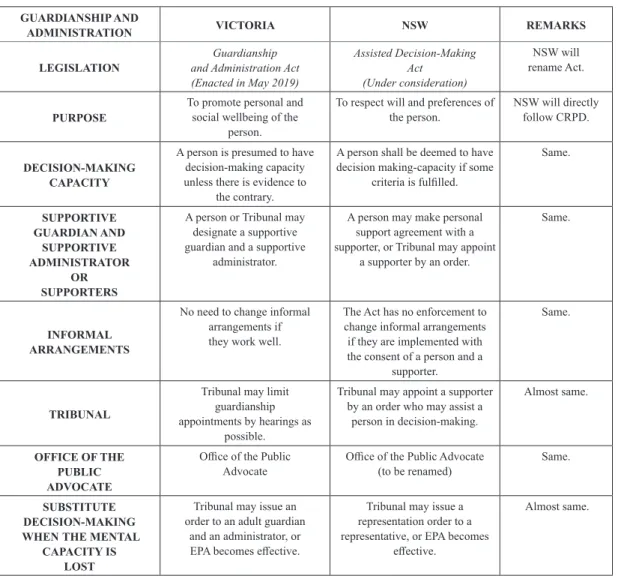
Australian Adult Support and Protection for Vulnerable Adults: Through Law Reforms of Guardianship and Elder Abuse Legislation (Part I). Yukio Sakurai. Part I (covered by this edition) 1.Introduction 2.Australian Guardianship and Administration 2‒1 Australian Guardianship and Administration Laws 2‒2 Guardianship State Acts (1) Victorian State Act (2) NSW State Act: Summary (3) Number of Applications/Orders in Tribunal 2‒3 Amendments to Victoria and NSW State Acts (1) Amendments to Victorian State Act (2) Draft Amendments to NSW State Act (3) Comparison between Amendments to Victoria and NSW State Acts (4) Comments. Part II (to be covered by the next edition) 3.Australian National Elder Abuse Legislation (1) Background of National Elder Abuse Legislation (2) ALRC Report 131 and The Responses (3) Comments on National Elder Abuse Legislation 4.Australian Principle Values and The Implications 4‒1 Discussion (1) Australian Projects and Adult Support and Protection Legislation (2) Theoretical Framework 4‒2 Possible Implications from Australian Legislation 5.Conclusion Acknowledgements/Bibliography. 120 Yokohama Journal of Social Sciences, Vol. 25, No. 2. 1.Introduction. The purpose of this paper is to focus on amendments to state laws concerning guardianship and administration in the states of Victoria and New South Wales (hereinafter referred to as ʻNSWʼ) of Australia, and national legislation for elder abuse. It provides an outline of legal content, policy objectives, and features of the legislation. The meaning and intention of Australian legislation will be examined from the viewpoint of a legal concept of an adult support and protection system. The reason why Australian law is taken up is that the states of Victoria and NSW, two leading states in guardianship law, are in the process of amending state laws related to adult guardianship and supported decision-making for the first time in over 30 years. In addition, Australia is in the process of developing national law to prevent elder abuse. It can be assumed that the significance and purpose of an adult support and protection legislation would be clarified by analyzing the Australian legislative projects. And those state law reforms and national legislation in Australia may suggest some implications to Japanʼs legislation and public policy over the adult guardianship system, supported decision-making, and elder abuse safeguards. In fact, a clear legal definition has not been established for the ʻadult support and protection systemʼ.1) Nevertheless the former South Australian Public Advocate John Brayley addressed his idea in 2009, which implied the basics of adult support and protection paradigm. According to Brayley, the advantages of ʻadult protectionʼ are that ʻthe focus is on vulnerability not incapacityʼ, ʻthere is an emphasis on teamwork, partnership and local responsibilityʼ, and ʻthe adult protection strategy offers a range of health, social service and legal practical assistanceʼ.2) In this article, the adult support and protection system provisionally refers to an offer of necessary support, according to individual characteristics, that minimizes restriction of a principalʼs rights and is considered to replace other less restrictive alternative measures available. The scope of the adult support and protection legislation is composed of the adult guardianship system, supported decision-making, and safeguards against elder abuse including financial exploitation.3) This may suggest that the adult support and protection system is not a single law but rather a legal concept of multiple laws related to adult support and protection which is applied to vulnerable adults.4) Research methods include. (262). Remarks: The titles of the Japanese publications are translated into English by the author (Yukio Sakurai) in case of missing English title. The mark ‘*’ is put after these titles. All website accesses were reconfirmed as on March 26, 2020.. 1) It was recognized that no common methods nor definitions of the terms regarding ʻadult safeguardingʼ were available among countries, such as Scotland, England, Northern Ireland, Canada and Australia. (Sarah Donnelly, Marita OʼBrien, Judy Walsh, Joanne McInerney, Jim Campbell and Naonori Kodate, Adult Safeguarding Legislation and Policy Rapid Realist Literature Review (Health Service Executive, 2017)176.) It was explained that this implication could be applied to the adult support and protection.; Montgomery, L., J. Anand, K. McKay, B., K. C. Pearson, and C. M. Harper, ʻImplications of Divergences in Adult Protection Legislationʼ (2016) 18 (3) Journal of Adult Protection 1, 16.. 2) John Brayley, ʻSupported Decision-making in Australiaʼ (Conference Paper, Victorian Office of the Public Advocate, December 14, 2009) 16‒17.. 3) Financial exploitation was reviewed by Yukio Sakurai, ʻLegal Challenge and Measures for Property Management of the Elderly: Focusing on Financial Exploitation and de facto Adult Guardianshipʼ (2018c) 48 The Graduate School Law Review, Nihon University 224, 176. (in Japanese). 4) The term ʻvulnerable adultsʼ is used as the object of adult support and protection legislation in this article although the object is defined by each relevant law.. 121Australian Adult Support and Protection for Vulnerable Adults(Yukio Sakurai). literature research and interviews with experts.5) The previous studies on the Australian adult guardianship system and supported decision-making mainly refer to Australian and some international literature surveys because those in Japan are limited to Suga (2007),6) Nishida (2015),7) Japan Federation of Bar Associations (2015),8) Sakurai (2018b),9) Kiguchi et al. (2020),10) and the like. Then the following three research questions will be examined: ⅰ What new acts and draft amendments to the adult guardianship and administration state laws are being. enacted in Victoria and proposed by the NSW Law Reform Commission respectively, and what do those mean from a legal perspective?. ⅱ What draft proposals to the national legislation for elder abuse are being made by the Australian Law Reform Commission, and what do those mean from a legal perspective?. ⅲ What do the Australian projects mean from an adult support and protection legislative perspective, and how does a comparative law study show those projects affecting possible adult support and protection legislation in Japan in the future?. Following ʻ1. Introduction,ʼ these research questions will be reviewed in four parts. The first part ʻ2. Australian Guardianship and Administrationʼ reviews guardianship and administration laws in Australia, particularly in the states of Victoria and NSW as representatives of Australia, then the law reform in the same states to clarify the legal framework and its characteristics (covered by Part I). The second part ʻ3. Australian National Elder Abuse Legislationʼ reviews national elder abuse legislation and its relevant policy, including the legislation of some states. The third part ʻ4. Australian Principle Values and Its Implicationsʼ discusses Australian principles and values behind the adult support and protection legislation process and possible implications to the other countries, including Japan. And the fourth part ʻ5. Conclusionʼ concludes the. (263). 5) In March 2017 and March 2019, the author conducted interview survey in Melbourne, Victoria. The subjects of. the survey were the Victorian Civil and Administrative Tribunal (VCAT), the Office of the Public Advocate (OPA), State Trustees Limited (STL) headquarters and VCAT satellite offices, the Social Equity Research Institute; Melbourne Central Police, the Seniors Rights Victoria and COTA Victoria, Researchers in the University of Melbourne, Monash University, La Trobe University, and the University of Sydney and Queensland University of Technology who joined the Australian Adult Guardianship and Administration Council conference (AGAC2019) in Canberra. The author had an interview appointment with each institution or researcher and sent a questionnaire in advance. Responses were received at each meeting verbally. The author also attended a supported decision-making workshop (eight days course), conducted by Cher Nicholson in Adelaide, South Australia, in February 2016.. 6) Fumie Suga, ʻAustraliaʼs Adult Guardianship System―From a Comparative Law Perspectiveʼ (2007) 20 Adult Guardianship Practices 106, 117. (in Japanese) *. 7) Kazuhiro Nishida, ʻTrends in Welfare Legislation on Guardianship and Responsibility and Role of Public: Based on Australian Lawʼ (2015) 2636 Weekly Social Security 46, 51. (in Japanese) *. 8) Japan Federation of Bar Associations, ʻSupported Decision-Making (SDM) Model in the South Australiaʼ (Online, 2015) (in Japanese) *. <https://www.nichibenren.or.jp/library/ja/jfba_info/organization/data/58th_keynote_report2_cd_2.pdf>. 9) Yukio Sakurai, ʻAdult Guardianship System in Australia and its Recent Discussion Pointsʼ (2018b) 7 Quarterly. Comparative Guardianship Law 30, 41. (in Japanese) 10) Kiguchi, Emiko, Masaru Nagawa and Yukio Sakurai, ʻAustralian Guardianship and National Disability Insurance. Scheme: Focusing on Supported Decision-Making Practices in the States of Victoria and New South Walesʼ (2020) 33 Journal of Australian Studies 1, 14. (in Japanese). 122 Yokohama Journal of Social Sciences, Vol. 25, No. 2. discussion (to be covered by Part II).. 2.Australian Guardianship and Administration. 2‒1 Australian Guardianship and Administration Laws The Commonwealth of Australia (hereinafter referred to as ʻAustraliaʼ) comprises ten territories and six states, i.e., Victoria, NSW, Queensland, South Australia, Western Australia, and Tasmania. Of the ten territories, the Northern Territory and the Australian Capital Territory are special territories with self-governing powers. Those states and special territories have their own constitutions, parliaments, governments and laws. Those parliaments are permitted to pass laws related to any matter that is not controlled by the federation under Section 51 and Section 52 of the Australian Constitution. Australia has a common law system, and the sources of the laws include legislation made by parliament and case laws developed by the judiciary. Under such legal structure, the guardianship and administration system is defined by legislation of each state and special territory.11) Although the names of the legal systems and public agencies in each state and special territory are not entirely same, the guardianship and administration system in Australia has uniformity. Namely, each state and special territory has three main Acts: Guardianship and Administration Act, Power of Attorney Act, and Civil and Administrative Tribunal Act. And each state and special territory has three main public agencies: Office of the Public Advocate or the Public Guardian, Civil and Administrative Tribunal, and State or Public Trustee, which work for the guardianship and administration system. The summary is provided in Table 1 and Table 2 in the next page. As seen in Table 1, the states of Victoria and NSW enacted the Guardianship and Administration Act 198612). and the Guardianship Act 1987 respectively and offered guardianship and administration models in Australia. Both states, being somewhat in a rivalry in the area of public policy, have played leading roles in Australia regarding guardianship and administration laws.13)Namely, Victoria took the lead by providing basic structures of guardianship and administration. Within a few years after the enactment of legislation in 1986, other Australian states and territories followed by creating guardianship tribunals together with associated public advocates, or the more restricted form, public guardians. Arrangements made by financial management agencies were also adopted.. (264). 11) The guardianship and administration system in Australia may include two main duties conducted by two. independent adult guardians i.e., the guardian and/or the administrator to be nominated separately by the Tribunal orders. The guardian takes care of personal affairs of the principal and the administrator takes care of financial management of the principal. Therefore, ʻadministrationʼ as a duty of the administrator in this article refers to financial management of the principal.. 12) The original name of the law was The Guardianship and Administration Board Act 1985 (Vic), which came into force in 1987, and was renamed Guardianship and Administration Act 1986 (Vic) in 1998 by the Tribunals and Licensing Authorities (Miscellaneous Amendments) Act 1998 (Vic) s. 115. OʼNeill, Nick and Carmelle Peisah, ʻChapter 5―The Development of Modern Guardianship and Administrationʼ in O'Neill, Nick and Peisah, Carmelle (eds) Capacity and the Law (Online, Sydney University Press, 2011) 12. <http://classic.austlii.edu.au/au/journals/SydUPLawBk/2011/7.html>.. 13) Victoriaʼs adult guardianship and administration system was known as the ʻVictorian Modelʼ, based on a concept ʻone-stop-shopʼ. Victoria and NSW were in a rivalry relation with each other to make guardianship and administration models. Terry Carney and David Tait, The Adult Guardianship: Experiment Tribunals and Popular Justice (The Federation Press, 1997) 18 and 23; Interview with OPA Victoria in March 2017 by the author.. 123Australian Adult Support and Protection for Vulnerable Adults(Yukio Sakurai) (265). Table 1 Relevant Legislation by Jurisdiction. JURISDICTION GUARDIANSHIP AND ADMINISTRATION POWER OF ATTORNEY. CIVIL AND ADMINISTRATIVE. TRIBUNAL. AUSTRALIAN CAPITAL. TERITORY (ACT). Guardianship and Management of Property. Act 1991. Power of Attorney Act 2006. ACT Civil and Administrative. Tribunal Act 2008. NOTHERN TERRITORY (NT). Guardianship of Adults Act 2016. Power of Attorney Act 1992. Northern Territory Civil and. Administrative Tribunal Act 2014. NEW SOUTH WALES (NSW) Guardianship Act 1987. Power of Attorney Act 2003. Civil and Administrative Tribunal Act 2013. QUEENSLAND Guardianship and Administration Act 2000 Power of Attorney. Act 1998. Queensland Civil and Administrative. Tribunal Act 2009. SOUTH AUSTRALIA (SA). Guardianship and Administration Act 1993. Power of Attorney Act and Agency. 1984. South Australian Civil and Administrative Tribunal Act 2013. TASMANIA Guardianship and. Administration Act 1995 Wills Act 2008. Power of Attorney Act 2000. Guardianship and Administration. Regulations 2017. VICTORIA Guardianship and. Administration Act 1986 / 2019. Power of Attorney Act 2014. Victorian Civil and Administrative. Tribunal Act 1998. WESTERN AUSTRALIA (WA). Guardianship and Administration Act 1990. Power of Attorney Act 1990. State Administrative Tribunal Act 2004. Source: Field, Sue, Karen Williams and Carolyn Sappideen, Elder Law: A Guide to Working with Older Australians (the Federation Express, 2018) 15.. Partly modified by the author.. Table 2 Guardianship and Trustee Agencies by Jurisdiction. JURISDICTION GUARDIANSHIP AGENCY TRUSTEE AGENCY. ACT The Public Trustee and Guardian* The Public Trustee and Guardian*. NT Office of the Public Guardian Public Trustee Community Services Division. NSW Office of the Public Guardian** NSW Trustee and Guardian**. QUEENSLAND Office of the Public Guardian Public Trustees. SA Office of the Public Advocate Public Trustee. TASMANIA Office of the Public Guardian The Public Trustee. VICTORIA Office of the Public Advocate State Trustees Limited***. WA Office of the Public Advocate Public Trust Office. Remarks:   * The agency merged on April 1, 2016 with both offices of public guardian and public trustee.   **The administration department of both institutions has been shared since 2009.   *** State Trustees Limited in Victoria is a 100 per cent state-owned corporation, and the other trustee agencies belong to. each stateʼs treasury institution. Source: Table 1, 25.. 124 Yokohama Journal of Social Sciences, Vol. 25, No. 2. NSW took the lead by enacting provisions for substitute consent for medical treatment.14) It is understood that the legislation and policies of those two states in the areas of guardianship and administration may generally represent the basic stances of Australian legislation at large. Therefore, the analysis provided in this article will focus on those two states, Victoria and NSW, as representatives of Australian guardianship and administration models. In the states of Victoria and NSW, draft amendments to the guardianship and administration state laws were made for the first time in over 30 years. In Victoria the bill passed the state Parliament in May 2019 and Guardianship and Administration 2019 Act was put into force in March 2020. A national statutory policy regarding elder abuse was also tabled in June 2017 at the federal Parliament aiming to legislate the elder abuse. This process of amendments to state laws and national legislation was being carried out in response to social environmental changes that are happening across Australia as follows. First, Australia is seeing a steady rise in ageing of the population15) and there is a rapid increase in the number of the elderly who have dementia.16) People having intellectual disabilities previously comprised people with insufficient mental capacity,17) but now mostly consist of the elderly with dementia. Citizens with higher brain dysfunction and those with mental disabilities are also increasing.18) Australian state and special territory governments are now being requested to respond to those who have various disabilities, including inadequate mental capacity. Second, for legislative acceptance of the United Nations Convention on the Rights of Persons with Disabilities (hereinafter referred to as ʻCRPDʼ) which was ratified by Australia with a declaration of reservation in 2008,19) national legislation that respects autonomy and the right to self-determination of a person with. (266). 14) The Mental Health Act 1983 (NSW) was enacted in NSW and that Act explored critical discussion, including. the article: Michael R. Errington, ʻThe Operation of the Mental Health Act, 1983 (NSW)ʼ (1986) 20(3) Australian and New Zealand Journal of Psychiatry 278, 292.; In NSW, with the enactment of the Protected Estates Act 1983 (NSW), ʻthe Protective Commissioner and what became the Office of the Protective Commissioner under that Actʼ was created in 1985 as an evolution of guardianship system. OʼNeill, Nick and Carmelle Peisah, ʻChapter 5―The Development of Modern Guardianship and Administrationʼ.. 15) The ageing ratio for the elderly aged 65 and over in Australia was 15.6 per cent (2019) and is expected to rise to 23.0 per cent (2055). 30 per cent of the elderly aged 85 and over suffer from dementia, and that number is expected to be over 1.1 million in 2056. The population of Australia is approx. 25 million. Australian Law Reform Commission (ALRC), Elder Abuse―A National Legal Response Final Report (ALRC Report No. 131, 2017) 18.. 16) According to Dementia Australia, there is an estimate of 436, 366 Australians living with dementia, and the number of people with dementia is expected to increase to 589,807 by 2028 and 1,076,129 by 2058. (2018 research by the National Centre for Social and Economic Modelling (NATSEM)) Dementia Australia, Dementia Statistics (Web Page, January 2020) <https://www.dementia.org.au/statistics>.. 17) In 1980s, the main social issue was how to accommodate people with intellectual disabilities in community with deinstitutionalization of psychiatric hospitals. Steve Bottomley, ʻMental Health Law Reform and Psychiatric Deinstitutionalization: The Issues in New South Walesʼ (1987) 10 International Journal of Law and Psychiatry 369, 362.. 18) The largest group now is people with dementia, and people with mental disabilities and people with higher brain dysfunction are increasing in NSW. This tendency is common over Australia. New South Wales Law Reform Commission (NSW LRC), Review of the Guardianship Act 1987 (NSW LRC Report No. 145, 2018) xxii.. 19) The federal government of Australia made a declaration of reservation at the ratification of CRPD on July 17, 2008 to ensure their policy stance to reserve a substituted decision-making by a third party as a last resort when the person lost capacity and it was proved by the doctorʼs statement of certificate. United Nations, Treaty Collection: Australia: 15. Convention on the Rights of Persons with Disabilities.. 125Australian Adult Support and Protection for Vulnerable Adults(Yukio Sakurai). disabilities is required.20) National legislation must be in accordance with the values of the CRPD. In practice, supported decision-making activities recommended by the CRPD to realize the will and preferences of persons with disabilities are gradually being implemented in the community,21) and the consciousness and mindset of supporters who support persons with disabilities are now changing.22) Third, Australian society has become more multicultural as a result of accepting immigrants with diverse languages and cultures particularly since the 1970ʼs. Acceptance and maintenance of diversity, including the elderly, must now be considered as much as possible.. 2‒2 Guardianship State Acts (1) Victorian State Act A.Guardianship Legislation In the state of Victoria (capital city: Melbourne), Guardianship and Administration 2019 Act was enacted in May 2019 and put into force in March 2020. I will though review the earlier legislation, Guardianship and Administration Act 198623) (hereinafter referred to as ʻstate Act 1986ʼ) and Power of Attorney Act 2014 (hereinafter referred to as ʻPoA Act 2014ʼ, Power of Attorney is referred to as ʻPoAʼ). Both Acts are the essential laws to prescribe the legal frameworks of the adult guardianship and administration system. The main points are summarized as follows.24). ⒜ The guardianship and administration system is mainly divided into two types: a guardianship for personal affairs of the principal and an administration for financial management of the principal.25) The Victorian Civil and Administrative Tribunal26) (hereinafter referred to as ʻVCATʼ) appoints ʻthe. (267). 20) The values of the CRPD are addressed at Article 3 (General principlesʼ in the Convention and Optional Protocol):. The principles of the present Convention shall be: (a) Respect for inherent dignity, individual autonomy including the freedom to make oneʼs own choices, and independence of persons; (b) Non-discrimination; (c) Full and effective participation and inclusion in society; (d) Respect for difference and acceptance of persons with disabilities as part of human diversity and humanity; (e) Equality of opportunity; (f) Accessibility; (g) Equality between men and women; (h) Respect for the evolving capacities of children with disabilities and respect for the right of children with disabilities to preserve their identities. United Nations, Convention on the Rights of Persons with Disabilities (CRPD).. 21) Australia have many practices of supported decision-making, which explored discussion for research, such as legal capacity, autonomy, dignity of risk, and elder abuse. Piers Gooding, ʻSupported Decision Making: A Rights-based Disability Concept and its Implications for Mental Health Lawʼ (2013) 20(3) Psychiatry, Psychology and Law 431, 451.. 22) Typical articles on supported decision-making in Australia: Michelle Browning, Christine Bigby and Jacinta Douglas, ʻSupported Decision Making: Understanding How its Conceptual Link to Legal Capacity is Influencing the Development of Practiceʼ (2014) 1‒1 Research and Practice in Intellectual and Developmental Disabilities 34, 45.; Anna Arstein-Kerslake et al, ʻFuture Direction is Supported Decision-Makingʼ (Online, 2017) 37(1) Disability Studies Quarterly <https://dsq- sds.org/article/view/5070/4549>.. 23) Section 3(1) (Definitions) of state Act 1986 indicates that the term ʻdisabilityʼ includes physical disability. The Japanʼs adult guardianship system is not subject to people with physical disability. Victoria state government, Guardianship and Administration Act 1986.. 24) The main features are summarized by the author based on Victorian state Act 1986, PoA Act 2014, and website information of Office of the Public Advocate, Guardianship and Administration (Web Page) <https://www. publicadvocate.vic.gov.au/guardianship-administration>.. 25) ʻThe represented personʼ in law is referred to as ʻthe principalʼ in this paper. 26) The emergence of the tribunal-based guardianship system was first in Tasmania in 1963. OʼNeill, Nick and. Carmelle Peisah, ʻChapter 5―The Development of Modern Guardianship and Administrationʼ 3.. 126 Yokohama Journal of Social Sciences, Vol. 25, No. 2. guardianʼ and/or ʻthe administratorʼ separately (section 22 and section 46 in the state Act 1986). They are responsible for personal affairs (the guardian) and financial management (the administrator) of the principal. Multiple appointments of adult guardian and/or administrator are also being made to appoint two or more persons for one role, and in this case, everyone in charge of the duty needs to agree on the substituted decision.. ⒝ A friend or relative of the principal is usually appointed as the guardian. If the friend or relative is not a qualified person, VCAT may appoint a public advocate as the adult guardian (section 23). The public advocate may further assign his/her duties to either an advocate guardian belonging to the Office of the Public Advocate (hereinafter referred to as ʻOPAʼ), or a community guardian27) who is an individual or a Not-for-Profit organization (hereinafter referred to as ʻNPOʼ) that has participated in an adult guardianship training course in the community (section 18).. ⒞ Among friends, relatives, solicitor, accountant, State Trustees Limited, and so on, an administrator shall be appointed by VCAT as a person appropriate for the principal in financial management (section 47). The public advocate is not appointed as an administrator. The administrator conducts financial processes such as banking affairs, payments, sales of assets, and makes legal decisions that are in the best interest of the principal (section 48). The administrator makes decisions that match as closely as possible the requests of the principal, respects the freedom of his/her actions, and considers less restrictive alternatives as much as possible.. ⒟ PoA Act 2014 establishes a general power of attorney (PoA) and an enduring power of attorney (hereinafter referred to as ʻEPAʼ). The designated third party by PoA or EPA makes decisions concerning the principal. A PoA loses its effect if the mental capacity of the principal is lost. An EPA is popular in the common law jurisdictions, including the U.K., the U.S. and Canada. Even if the principal loses his/her mental capacity, a proxy can be made for decisions by a designated third party. EPA is not required to register at any authority. It is widely encouraged for those who are over the age of 18, i.e., citizens who can understand the meaning and impact of an EPA. PoA Act 2014 also introduces the supportive attorney appointment. The supportive attorney appointment was regarded as a milestone with proceeding to a supported decision-making.28). B.Public Agencies The State of Victoria has three public agencies that are largely involved in adult guardianship and administration as follows. ⒜ Office of Public Advocate (hereinafter referred to as ʻOPAʼ)29) was established within the Ministry of Justice. (268). 27) Twenty-five (25) community guardians were appointed in Victoria in 2018‒19. Office of the Public Advocate. (OPA), Annual Report 2018‒19 (Web Page, 2019) 11. <https://www.publicadvocate.vic.gov.au/our-services/ publications-forms/638-opa-annual-report-2018-19?path=>.. 28) The supportive attorney appointment was introduced as a legal device to respond to the Victorian Law Reform Commissionʼs one of recommendations in the VLRC Report No. 24 to implement supported decision-making in the future. Victoria State Government, Justice and Community Safety, (Web Page) <https://www.justice.vic.gov.au/justice- system/laws-and-regulation/civil-law/powers-of-attorney-act-2014>.. 29) OPA has 111 paid employees with an annual income of AS$13.5 million, which breaks down into AS$11.2 million by output appropriation (the state budget) and AS$2.3 million by the grants. Office of the Public Advocate (OPA), Annual Report 2018‒19, 65, 66.. 127Australian Adult Support and Protection for Vulnerable Adults(Yukio Sakurai). of the state of Victoria, based on the state Act 1986. That director general of OPA, the Public Advocate, is the individual who is appointed by the Governor in Council, whose duty term is seven years.30) The Public Advocate is independent from the state government and is responsible for directly reporting to the state Parliament.31) The main roles of OPA are as follows: advice and consultation services, research and policy planning in advocacy for persons with disabilities, education, public relations, seminar activities, and operating volunteer programs, including the Community Visitor program (section 15 and section 16).. ⒝ The Victorian Civil and Administrative Tribunal (VCAT) was established in 1998 based on the Victorian Civil and Administrative Tribunal Act 1998. It became an independent institute from the state Courts system by the Court Services Victoria Act 2014. It has a total of 46 satellite offices by district in the state of Victoria. VCAT primarily deals with civil disputes such as wide range of tenancy contracts and human rights affairs. Total 85,850 cases concerning tenancy contracts and human rights affairs were lodged annually, of which some 14,076 cases (approx. 16.4 per cent) were adult guardianship and administration cases at a part of human rights category in 2018‒19.32)VCAT executives are judges, but the adult guardianship and administration board members consist of experts who have practical experiences in VCAT for adult guardianship and administration.33)They have hearings34) at VCAT with the applicants and its related citizens, including family, relative, friend, nursing home practitioner and interpreter35)and so on, within thirty days after receiving the applications. VCAT member issues an order for adult guardianship and/or administration with one to three years self-revoking term.36) VCAT member judges whether to renew. (269). 30) Guardianship and Administration Act 1986 (Victoria) schedule 3 cl 1(1). 31) Ibid cl 1(5). 32) There were 17,948 major applications and activities in 2018‒19 by the Act. The breakdown by section showed. 6,609 guardianship and/or administration orders, 6,833 reassessment orders, 2,793 advice to administrator, 734 power of attorney, and 979 the others. The number of PoA applications was as small as 4 per cent. But the potential conflicts cases of PoA became double and the cases of complicated EPA increased. Victorian Civil and Administrative Tribunal (VCAT), Annual Report 2018‒19, 9 and 15. <https://www.vcat.vic.gov.au/resources/annual-report-2018‒19>.. 33) In the state of Victoria, one VCAT member conducts hearings while in the state of NSW, three members who are composed of lawyer, welfare practitioner, and community representative conduct hearings.. 34) In March 2019, the author attended four sessions of hearing at VCAT in Melbourne with permission. Hearings are set in 45-minute increments and may end in less time. In the first case, a wife who has been living with her husband for more than ten years was nominated as an administrator for the hospitalized husband whose brain was heavily damaged by a traffic accident and the higher brain dysfunction occurred. Although he could not attend the hearing because he was in the hospital, VCAT member considered it necessary to issue a quick order, considering the doctorʼs medical statements and a good marital relationship. The second case was that an elderly woman who lived in a nursing home developed dementia. Her daughters sold the house and returned to a mother country and she lived alone without any relative, receiving public pension. VCAT member appointed State Trustees Limited as an administrator without fees. The principal cannot speak English and an interpreter was arranged by VCAT. The third case was to renew the son as the administrator of older father with dementia. In the fourth case, State Trustees Limited was appointed as the administrator for older women with dementia.. 35) An interpreter is arranged by VCAT for VCATʼs account for interpreting English into a mother language and vice versa for those applicants who cannot speak English.. 36) VCAT decision statement is published in web-database with privacy considerations: VCAT Database <http:// www8.austlii.edu.au/cgi-bin/viewdb/au/cases/vic/VCAT/>.. 128 Yokohama Journal of Social Sciences, Vol. 25, No. 2. the order or not at the re-hearing when the term is over.37). ⒞ State Trustees Limited (hereinafter referred to as ʻSTLʼ), a state-run financial management company in Victoria, provides financial management with fees.38)They provide various financial management services with citizens, including wills, PoA/EPA, estates, and personal financial administration.39) If the friend or relative is not a qualified person, VCAT may appoint a STL as the administrator with or without fees (section 47).40) STL assists VCAT by contract on reviewing and reporting financial reports which the administrators must submit annually to VCAT.41)STL has a satellite office in VCAT headquarter and its manager is in charge of any business transaction between STL and VCAT, including financial exploitation claims.42). C.Unique Legislations The state of Victoria has three unique legislations in advance care directives, voluntary assisted dying, and charter of human rights as follows. ⒜ VCAT can grant the authority of medical consent to the third party after conducting a hearing, and normally. nominate person other than the adult guardian and administrator.43) Victorian Medical Treatment Planning and Decisions Act 201644) was enacted in 2016, and a medical decision-making system based on advance care directives came into force with an enforcement power by law on March 12, 2018. In this law, the role of a medical support person is to support the principal by communicating information on the principalʼs medical treatment decisions. A medical support person represents the interests of the principal with respect to the principalʼs medical treatment, including when the principal does not have decision-making capacity. However, a medical support person acting in the capacity of the principal does not have the power to make a principalʼs . (270). 37) Victorian Civil and Administrative Tribunal Act 1998―Section 148 (1) (Appeals from the Tribunal) mentions. that a party to a proceeding may appeal on a question of law from an order of the Tribunal in the proceeding― (b) in any other case, to the Trial Division of the Supreme Court with leave of the Trial Division.. 38) The shares of State Trustees Limited (STL) is 100 per cent owned by the Victorian state Treasurer and its policy is determined by the board members nominated by the Victorian Minister of Treasure. According to Annual Report 2019, STL had 437 employees with an income AS$ 70.4M, and AS$ 18.8 (approximately 27 per cent) was ʻCommunity Service Agreement Incomeʼ, which is a state subsidy. This state subsidy is due to statutory arrangement regulated by Section 21 of the State Trustees (State Owned Company) Act 1994. Victorian State Trustees Limited, Annual Report 2019 (Web Page, 2019) <https://www.statetrustees.com.au/wp-content/uploads/media/STL_Annual_Report_2019.pdf>.. 39) The guardianship and administration relies on about 9,000 administrators for the STL, and 98 per cent of cases are looked after by administrators in full guardianship order. About 6,700 EPA contracts are accepted by the STL (From the interview with STL in March 2019 by the author). The STL also takes care of 220,000 wills and 31,000 estates. Victorian STL, Homepage (Web Page, March 2020) <https://www.statetrustees.com.au/>.. 40) If the principal does not have enough property, VCAT may appeal that the principal does not have to pay fees to the STL. In such a case, the fees are paid from the state budget on behalf of the principal (From the interview with VCAT in March 2019 by the author); There was the case that VCAT appointed a STL as the administrator because of potential conflict of interest between the principal and the son. SA (Guardianship) [2008] VCAT 2345 (17 November 2008).. 41) From the interview with VCAT on March 5, 2019 by the author. 42) From the interview with STL on March 1‒3, 2017 and on March 6, 2019 by the author. 43) The civil administrative tribunals of each state and territory except Northern Territory can grant the authority of. medical consent to the third party by trial. Field, Sue, Karen Williams and Carolyn Sappideen, Elder Law: A Guide to Working with Older Australians 27.. 44) Futoshi Iwata, ʻThe Role of the Law in the Medical Care and Care of the Elderly in Australia: Focusing on the Recent Revision of Victoria State Lawʼ (2019) 80 (1) Comparative Law Research 42, 55. (in Japanese)*. 129Australian Adult Support and Protection for Vulnerable Adults(Yukio Sakurai). medical treatment decisions (section 32). The medical treatment decision maker, not a medical support person, who is appointed by the principal or VCAT has the power to make the principalʼs medical treatment decisions (section 55). . ⒝ Voluntary Assisted Dying Act 2017 was introduced on November 29, 2017 and came into force on June 19, 2019. The law allows an 18-month implementation period to give health services time to plan and prepare for the voluntary assisted dying.45). ⒞ Charter of Human Rights and Responsibilities Act 2006 is a law that sets out the basic rights, freedoms and responsibilities of people in Victoria. It regulates the relationship between government and the people it serves.46) The Constitution in Australia does not state a bill of rights. The human rights are protected by case laws and statute laws. This Act is a comprehensive law that empowered human rights in the state of Victoria. However, critiques were addressed with lack of some rights.47). D.Dispute Response Mechanism VCAT has adopted a dispute response mechanism known as an alternative dispute resolution (hereinafter referred to as ʻADRʼ). Four measures can be processed through VCAT: complaint resolution, mediation, Fast Track Mediation and Hearing service (hereinafter referred to as ʻFTMHʼ) and appeals to the Supreme Court. It is understood that people can choose a method from the four measures. Regarding financial exploitation, statistics in 2016 indicate that approximately 15 per cent of cases employing mediation or a hearing through VCAT could recover the financial damage.48) These were mostly dispute between older mothers and their sons. In such a family dispute case, it is assumed by statistics that a mediation or a FTMH would be appropriate, keeping peopleʼs sentiments and privacy in mind. According to VCATʼs Annual Report 2018‒2019, people are provided a low-cost, accessible, efficient,. (271). 45) The interview with the Victorian Department of Health and Human Services on March 8, 2019 by the author. indicated that approx. 50 applicants in 2019 and approx. 150 applicants in 2020 and over were expected to use the voluntary assisted dying annually. The law was drafted as a model law in the state of Oregon in the U.S.. The Department had three administrative staff in charge of this Act in the Head office.. 46) Twenty fundamental human rights are listed in the Charter. The Victorian Equal Opportunity and Human Rights Commission, Victoriaʼs Charter of Human Rights and Responsibilities.. 47) Some rights are not included in the Charter after debates, such as the right to life and the right to self- determination because ʻthe Charter only includes human rights that had very strong, certainly at least majority, community supportʼ. Williams, George, ʻThe Victorian Charter of Human Rights and Responsibilities: Origins and Scopeʼ (2006) 30 (3) Melbourne University Law Review 880, 905.. 48) The situation in 2016 analyzed by Victorian STL can be summarized as follows: �60 per cent of financial elder abuse cases are perpetrated by adult children, with sons more likely than daughters to. be perpetrators. �Those at risk include widows/widowers, singles, women, and people whose first language is not English. �Older Victorians often rely on their children for financial assistance, with higher expectations placed on daughters. �Victims: 56 per cent female; Perpetrators: 55 per cent male. �Perpetrators: 49 per cent no formal authority, 27 per cent power of attorney, 20 per cent property manager by. Tribunal order. �2014‒2015 results: 26 per cent investigation not progressing due to personal death, etc.; 39 per cent insufficient. evidence; 20 per cent not choosing legal procedure; 15 per cent using legal procedure to recover damages. Melanie Lewis, ʻFinancial Elder Abuse in a Victorian Context: Now and into the Futureʼ (Conference Paper, 4th. National Elder Abuse Conference, February 23‒25, 2016).. 130 Yokohama Journal of Social Sciences, Vol. 25, No. 2. and independent tribunal delivering high-quality dispute resolution processes, including ADR.49). ⒜ Any member of the public or group of people (including companies or public sector agencies) can make a complaint through VCAT.50)VCAT takes a three-tiered approach (i.e., frontline resolution, investigation, internal review) to resolve complaints. In fact, VCAT received 300 complaints in 2018‒2019, and in almost 80 percent of those cases, VCAT provided a final response within 10 business days of receiving the complaint.. ⒝ VCAT advocates mediation as the preferred option for resolving disputes. A mediation provides an alternative to a hearing as a way to resolve a dispute. Mediation is more informal and less stressful for those involved and can lead to better outcomes―people feel empowered by the process.. ⒞ VCAT expanded the reach of the FTMH in 2017. If the amount in dispute is between A$500 and A$10,000, parties may be invited to attend a mediation―an opportunity to resolve the dispute by talking through the issues with the other people involved. It is assisted by an accredited mediator from the Dispute Settlement Centre of Victoria (hereinafter referred to as ʻDSCVʼ) or VCAT. If the dispute is not resolved at mediation, the dispute goes to a VCAT hearing within a few hours. At the hearing, a VCAT member decides about the case. There are no hearing fees for this same-day service. In 2018‒2019, VCAT assessed 3,147 cases as being suitable for FTMH, a vast increase from the previous yearʼs figure of 926. The settlement rate also improved this year. Some 55 percent of cases were settled at mediation. The Victorian government is supporting this program with $6.26 million, over four years to DSCV.. ⒟ VCAT decisions can be appealed to the Supreme Court only on questions of law―that is, where a party believes the judge or member made a legal error. In 2018‒2019, the total number of appeals lodged was 109, and only six of those appeals were granted and upheld by the Supreme Court.51). E.Main Characteristics Viewing the above, the main characteristics of the Victorian guardianship and administration system can be summarized to the following five points:52). (272). 49) ONE-VCAT: President’s Review of the Victorian Civil and Administrative Tribunal made by the Law Institute. Victoria (LIV) emphasized that the person with disability must be included in any process of ADR so that the principalʼs wishes were considered in the resolution of the dispute. Victoria, Law Institute Victoria, ONE-VCAT: President’s Review of the Victorian Civil and Administrative Tribunal (VCAT, 2009) 29. <https://www.tuv.org.au/articles/files/housing_ statistics/One-VCAT-report.pdf>.. 50) VCAT has posted the below message on its website and prepared for measures. You can ask VCAT for advice: • if there is a potential conflict of interest, • if you have a dispute with a guardian or. joint administrator that cannot be resolved, • if circumstances have made it impossible for you to continue to administer the estate under the terms of the order.. Alternatively, people may complain with the Victorian Ombudsman. 51) The appeals to the Supreme Court are regulated by Section 148 of Victorian Civil and Administrative Tribunal Act 1998.. The former president of VCAT addressed that ʻwhen this occurs, decisions made by the trial and appeal divisions of the Supreme Court, and the High Court of Australia, are critical in determining the tribunal “settings”ʼ. Stuart Morris, ʻVCAT Practices and Procedures: Recent Developmentsʼ (Speech delivered at a Seminar in Melbourne, July 20, 2004) 8.. 52) Five principles of adult guardianship law in Australia were summarized from a different angle: 1) the presumption of capacity, 2) least restrictive option taken by decision-maker, 3) respect for autonomy, 4) inclusion as a valued member of the community, and 5) the adultʼs welfare and interests, by Willmott L, White BP, Stackpoole CJ, Then S, Man H, Yu M, and Shen W., ʻGuardianship and Health Decisions in China and Australia: A Comparative Analysisʼ (2017) 12(2) Asian Journal of Comparative Law 371, 400.. 131Australian Adult Support and Protection for Vulnerable Adults(Yukio Sakurai). ⅰ The roles of the adult guardian, administrator, and medical support person are legally separated.53) ⅱ Emphasis is placed on ʻthe principle of necessityʼ and ʻthe less restrictive alternative principleʼ in adult. guardianship and administration system.54). ⅲ VCAT as the tribunal, not the courts, makes judgment on the adult guardianship and administration by hearings and issues orders.. ⅳ OPA provides various support for the adult guardianship and administration in policy reviewing that contributes to the community.. ⅴ A state-run financial management company, STL provides financial management services with fees. F.Summary Please refer to Table 3 as the summary of Victoria state Act 1986.. (273). 53) According to the interview with OPA Victoria on March 5, 2019 by the author, such divisions of roles and. duties by adult guardian, administrator, and medical support person may give merits to the principal because of cross- checking and balancing the function one another. In this sense, they say that the worst case is where the guardian can do everything to the principal without any accountability.. 54) There was the case that VCAT withdrew a guardianship order with ʻan emphasis on exploring less restrictive options, promoting ACʼs best interests and giving effect to his wishesʼ. AC (Guardianship) [2009] VCAT 753 (8 May 2009).. Table 3 Victorian state Act 1986. ITEMS COMMENTS. ADULT GUARDIANSHIP SYSTEM. Divided into two types: an adult guardianship and a financial management or administration which are responsible for personal affairs and financial management of the represented person.. ADULT GUARDIAN A friend or relative familiar with the represented person is usually appointed. If the friend or relative is not a qualified person, VCAT may appoint a public advocate (an advocate guardian).. ADMINISTRATOR Among friends, relatives, staff solicitor, accountant, state trustees, and so on, an administrator shall be appointed by VCAT as a person appropriate for the represented person in financial management.. ENDURING POWER OF ATTORNEY. (EPA). EPA is widely encouraged for those who are over the age of 18, that can understand the meaning and impact of an EPA.. OFFICE OF PUBLIC ADVOCATE. (OPA). OPA has been established within the Ministry of Justice of Victoria. The main roles of OPA are as follows: advice and consultation services, research and policy planning in advocacy for persons with disabilities, education, public relations, seminar activities, and operating volunteer programs, including the Community Visitor program. VICTORIAN CIVIL AND ADMINISTRATIVE TRIBUNAL (VCAT). A total of 46 satellite offices by district in Victoria. VCAT primarily deals with disputes concerning human rights affairs including adult guardianship. The staff member consists of expert who has a long experience in adult guardianship and administration.. MEDICAL TREATMENT. PLANNING AND DECISIONS ACT 2016. A medical decision-making system based on an advanced care directive came into force on March 12, 2018. Voluntary Assisted Dying Act 2017 was introduced and came into force on June 19, 2019.. Source: Made by the author. 132 Yokohama Journal of Social Sciences, Vol. 25, No. 2. (2) NSW State Act: Summary Please refer to Table 4 as the summary of NSW state Act (Guardianship Act 1987).55). (3) Number of Applications / Orders in Tribunal According to Australian Guardianship and Administration Council (hereinafter referred to as ʻAGACʼ),56) the number of applications for guardianship list in the state of Victoria for one year (from July 2017 to June 2018) was 6,097 applications for guardianship list (i.e., 2,958 for guardians and 3,139 for administrators). It was 3,701 tribunal orders (i.e., 1,470 for guardians and 2,231 for administrators). While in the state of NSW, it was 6,126 applications for guardianship list (i.e., 3,229 for guardians and 2,897 for administrators). It was 3,996 tribunal orders (i.e., 1,872 for guardians and 2,124 for administrators). The difference between the number of applications to guardianship list and that of tribunal orders was assumed to be the number of rehearing applications after the end of the guardianship term.. (274). Table 4 NSW state Act 1987. ITEMS COMMENTS. ADULT GUARDIANSHIP. SYSTEM. Mainly divided into two types: a guardianship and a financial management. Guardianship Act 1987 is the key legislation in NSW which protects the rights of people with impaired decision-making capacity.. ADULT GUARDIAN. A guardian is a substitute decision-maker appointed by NCAT or the Supreme Court with authority to make health and lifestyle decisions about the person under guardianship.. FINANCIAL MANAGER. A financial manager shall be appointed as a person appropriate for the represented person in financial management among friends, relatives, staff solicitor, accountant, NSW Trustee and Guardian, and so on.. ENDURING POWER OF ATTORNEY (EPA). EPA is widely encouraged for those who are over the age of 18, that can understand the meaning and impact of an EPA.. OFFICE OF NSW PUBLIC GUARDIAN. (OPG). OPG promotes the rights and interests of people with disabilities through the practice of guardianship, advocacy and education. PG is a statutory official appointed by the Guardianship Division of the NSW Civil and Administrative Tribunal (NCAT) or the Supreme Court under the Guardianship Act 1987.. NSW CIVIL AND ADMINISTRATIVE TRIBUNAL (NCAT). NCAT exercises a protective jurisdiction under the Guardianship Act 1987. Its purpose is to protect and promote the rights and welfare of adults with impaired decision-making capacity.. MEDICAL TREATMENT GUIDELINES. Guardianship Act 1987 (section 33) regulates medical treatments. The Medical Treatment Guidelines (April 2016) offers further details.. Source: Made by the author. 55) The scope of a person with disability is defined in a broader sense. Article 3(2): In this Act, a reference to a. person who has a disability is a reference to a person:(a) who is intellectually, physically, psychologically or sensorily disabled, (b) who is of advanced age, (c) who is a mentally ill person within the meaning of the Mental Health Act 2007, or (d) who is otherwise disabled, and who, by virtue of that fact, is restricted in one or more major life activities to such an extent that he or she requires supervision or social habilitation.. 56) Australian Guardianship and Administration Council (AGAC), Australian Adult Guardianship Orders 2017‒18 (Web Page, January 31, 2019) <https://www.agac.org.au/images/stories/agac-g-adm-orders-rep-2017-18.pdf>.. 133Australian Adult Support and Protection for Vulnerable Adults(Yukio Sakurai). Regarding the breakdown between public and private guardians and administrators in tribunal orders (public: public institutions such as Office of the Public Advocate or Public Guardian etc.; private: relatives, friends, professionals, etc.), the public and private ratios of the guardians and administrators in both states are more or less 50:50, except for the Victorian administratorsʼ public-private ratio (32:68).57). The annual number of tribunal orders across Australia was 16,537 in total. It should be noted that the number of guardianship applications and tribunal orders includes cases where the same applicants apply for both guardians and administrators. If there is a 50 per cent overlap between guardians and administrators where the same applicants apply, the number of tribunal orders per year could be estimated to be approximately 12,800 on a different applicant basis. The number of applications / orders per year is approximately 36,000 in Japan, which has a population that is five times as great as that of Australia. To compare the number of orders between Australia and Japan with an Australian population scale, it would be adjusted to 12,800 in Australia and 7,200 in Japan. It is therefore understood that the guardianship system is used considerably more in Australia than in Japan. There are no statistics indicating the number of contracted EPA, because that document is not required by law to be registered at public agencies. In case of dispute on EPA, relevant people can lodge a petition to the tribunal to settle a dispute.58). 2‒3 Amendments to Victoria and NSW State Acts (1) Amendments to Victorian State Act In the state of Victoria, the Guardianship and Administration Act 201959) (hereinafter referred to as ʻVictorian Act 2019ʼ) was enacted in May 201960) and put into force in March 2020 to have superseded the state Act 1986. The main features of the new Act can mainly be summarized as follows.61). ⅰ The Act indicates that ʻa person is presumed to have decision-making capacity unless there is evidence to the contrary,ʼ and recognizes that ʻa person has capacity to make a decision in relation to a matter (decision-. (275). 57) In the state of Victoria, the guardiansʼ public-private ratio was 49:51, the administratorsʼ public-private ratio was. 32:68, while in the state of NSW the guardiansʼ public-private ratio was 46:54 and the administratorsʼ public-private ratio was 52:48 (AGAC).. 58) There was the case, for example, that the tribunal reviewed the EPA and revoked it, then issued an order to appoint the other person as a public guardian. QBU [2008] NSWGT 18 (4 July 2008).. 59) Section 3 (1) (Definitions) indicates that ʻdisabilityʼ in relation to a person means neurological impairment, intellectual impairment, mental disorder, brain injury, physical disability or dementia.. 60) The Guardianship and Administration bill 2012 did not pass the state Parliament in 2012, but the bill 2018 duly passed in May 2019. Both bill contents had no considerable changes, and it was assumed that the necessity of law amendments to guardianship and administration was well understood in 2019 as the ageing of the population has progressed. It was in part influenced by ALRC Report No. 124 (2014) that indicated national guideline principles for guardianship and administration. In fact, there were no considerable objections in parliamentary debates. The session on 19 December 2018 was the turning point to conclude the bill in the Parliament. The Process of parliamentary debates for the bill 2018 refers to Parliament of Victoria, Parliamentary Debates (HANSARD) in Legislative Assembly, Fifty-Eighth Parliament, First Session (Wednesday, 7 March 2018 and Thursday, 29 March 2018) and in Legislative Assembly, Fifty-Ninth Parliament, First Session (Wednesday, 19 December 2018 and Tuesday, 28 May 2019). <https:// www.parliament.vic.gov.au/hansard/daily-hansard>.. 61) The main features of Guardianship and Administration Act 2019 are summarized in (i) to (vi) above by the author and the relevant part/clause number of the law are attached in the brackets.. 134 Yokohama Journal of Social Sciences, Vol. 25, No. 2. making capacity)ʼ (section 5 in the Victorian Act 2019).62) The supported decision-making is incorporated into the legislative system (Part 4―supportive guardianship orders and supportive administration orders).. ⅱ In accordance with the values of the CRPD, the purpose of this new Act is ʻto promote the personal and social wellbeing of a personʼ (section 4). For that reason, ʻthe will and preferences of a person with a disability should direct, as far as practicable, decisions made for that personʼ (section 8).. ⅲ The principal can designate a supportive guardian and a supportive administrator who have legal authority to make supportive decision-making in personal affairs and financial management respectively. Also, on behalf of the principal, VCAT may designate a supportive guardian and a supportive administrator. In either case, it is deemed to be the decision of the principal, based on the agreement between the principal and the supporter (Part 4).. ⅳ Even when some support is needed for the principal, it is not always the case that the supportive guardian and supportive administrator are appointed by VCAT. If a close relative plays such a role properly, there is no need to change (section 31).. ⅴ The appointment of the adult guardian will be limited by VCAT as a last resort. The adult guardian and administrator thus must respect the will and preferences of the principal, substitute the principalʼs decision as far as necessary, and explain the substituted decision so that the principal can understand the content (section 41 and section 46).. ⅵ If an adult guardian or administrator performs an illegal act, such as financial exploitation, the provisions to impose penalties are stipulated (section 188 and section189), and a warranty for damages is included in the law (section 181 and section 185).. (2) Draft Amendments to NSW State Act In the state of NSW, the draft amendment to the Guardianship Act 1987 was tabled in the NSW state parliament in August 2018 but the consideration of its implementation has been deferred. The main points of proposal for amendments to the state law can mainly be summarized as follows.63). ⅰ The draft amendments propose to dispel the substituted decision-making in the adult guardianship system to minimize possible restrictions on the rights of the principal. Instead, it will, as much as possible, introduce supported decision-making to respect the principalʼs will and preferences.. ⅱ The revised law will be renamed as Assisted Decision-Making Act. If the principal is age 18 or older and desires assisted decision-making by an appropriate supporter, the principal may make a personal support agreement with the supporter. The supporter must not be 16 years of age or younger, the Public Trustee or the Public Advocate, or subject to bankruptcy or possessing a criminal record if financial management is the subject of support. Personal support agreements are prepared in a predetermined format and witness procedures are necessary.. (276). 62) A human-rights approach to the assessment of legal capacity is incorporated in this way. Lise Barry and. Susannah Sage-Jacobson, ʻHuman Rights, Older People and Decision Making in Australiaʼ (2015) 9 Elder Law Review 1, 21.. 63) The passages (i) to (vii) above were summarized by the author based on the NSW LRC Report 145. It is still uncertain whether the Report proposals will be accepted by the NSW state parliament. It will be subject to change with the NSW state parliamentary debates and drafting bill, according to Terry Carneyʼs remarks in the AGAC2019 Conference in Canberra in March 2019.. 135Australian Adult Support and Protection for Vulnerable Adults(Yukio Sakurai). ⅲ Each official name are to be renamed as follows: ʻthe Guardianʼ to ʻthe Advocateʼ, ʻthe Public Guardianʼ to ʻthe Public Representativeʼ, ʻthe Guardian Division of the NSW Civil and Administrative Tribunalʼ to ʻthe Assisted Decision-Making Division of the NSW Civil and Administrative Tribunalʼ, ʻthe NSW Trustee and Guardianʼ to ʻthe NSW Trusteeʼ, and ʻthe Public Guardianʼ to ʻthe Public Advocateʼ. As the result, the term of guardian is entirely deleted. The duties of the Office of the Public Advocate cover assistance for supportive decision-making, problem-solving, information provision, aid and support, abuse, and neglect.. ⅳ The principal shall be deemed to have decision-making capacity if the following acts could be performed: ʻunderstand the relevant information; understand the nature of the decision and the consequences of making or failing to make that decision; retain the information to the extent necessary to make the decision; use the information or weigh it as part of the decision-making process; communicate the decision in some wayʼ.. ⅴ The supporter carries out decision-making support in accordance with the decision support agreements or a tribunal order. When providing assistance, the supporter is obliged to observe the general principles of the revised Act.. ⅵ The tribunal may appoint a supporter by a tribunal support order if required, and the supporter may assist the principal in decision-making. In addition to the principal, a public advocate, office of the public advocate, or any other person who is truly involved in the life and welfare of the principal may also make this application to the tribunal. The Act has no enforcement to change any informal arrangements if they are implemented with the consent of the principal and the supporter.. ⅶ If the mental capacity of the principal is lost, and the substituted decision-making for the principal is required as a last resort, the tribunal may issue a representation order to the representative. If the principal is in possession of an EPA with a third party, then the agreement becomes effective and the designated third party will take the substitute decision-making in line with the EPA.. (3) Comparison between Amendments to Victoria and NSW State Acts The main comparisons between amendments to Victoria and NSW state Acts can be summarized as the Table 5 in the next page. (4) Comments A.Victoria vs. NSW The Victorian Act 2019 reflects a number of values of the CRPD.64) It respects the will and preferences of the principal, understands the policy to implement the values of the CRPD as much as possible. It also tries to fuse the values of the CRPD with the existing adult guardianship and administration system. On the other hand, NSW LRC Report 145 proposes a more advanced institutional design in line with the values of the CRPD compared to those of the state of Victoria. In particular, the report suggests that the paternalistic aspect of the adult guardianship and administration system is undesirable. A policy will be introduced to prioritize the. (277). 64) The paragraph 27 of General Comment 1 (in the corrected form issued in 2018) for CRPD provides, ʻSubstituted. decision-making regimes can take many different forms, including plenary guardianship, judicial interdiction and partial guardianship. However, these regimes have certain common characteristics: they can be defined as systems where: (a) legal capacity is removed from a person, even if this is in respect of a single decision; (b) a substitute decision maker can be appointed by someone other than the person concerned, and this can be done against his or her will; or (c) any decision made by a substitute decision maker is based on what is believed to be in the objective “best interests” of the person concerned, as opposed to being based on the personʼs own will and preferencesʼ.. 136 Yokohama Journal of Social Sciences, Vol. 25, No. 2. respect for autonomy and the right to self-determination more, even if the protection of the principal may be somewhat lessened.65) Overall, it is assumed that autonomy and the right to self-determination of the principal is to be directly respected in NSW LRC Report 145. The purpose of Victorian Act 2019 is ʻto promote social and personal wellbeing of the personʼ. It is considered to be a compromise between ʻbest interestsʼ as current criteria and ʻthe will and preferencesʼ as. (278). 65) The comments from Sydney Health Law, NSW Law Reform Commission Recommends Far-reaching Reform of. Guardianship Legislation (Web Page, February 21, 2018) <https://sydneyhealthlaw.com/tag/assisted-decision-making/>.. Table 5 Main Comparisons between Amendments to Victoria and NSW state Acts. GUARDIANSHIP AND ADMINISTRATION VICTORIA NSW REMARKS. LEGISLATION Guardianship. and Administration Act (Enacted in May 2019). Assisted Decision-Making Act. (Under consideration). NSW will rename Act.. PURPOSE To promote personal and social wellbeing of the. person.. To respect will and preferences of the person.. NSW will directly follow CRPD.. DECISION-MAKING CAPACITY. A person is presumed to have decision-making capacity unless there is evidence to. the contrary.. A person shall be deemed to have decision making-capacity if some. criteria is fulfilled.. Same.. SUPPORTIVE GUARDIAN AND. SUPPORTIVE ADMINISTRATOR. OR SUPPORTERS. A person or Tribunal may designate a supportive. guardian and a supportive administrator.. A person may make personal support agreement with a. supporter, or Tribunal may appoint a supporter by an order.. Same.. INFORMAL ARRANGEMENTS. No need to change informal arrangements if they work well.. The Act has no enforcement to change informal arrangements if they are implemented with the consent of a person and a. supporter.. Same.. TRIBUNAL. Tribunal may limit guardianship. appointments by hearings as possible.. Tribunal may appoint a supporter by an order who may assist a person in decision-making.. Almost same.. OFFICE OF THE PUBLIC. ADVOCATE. Office of the Public Advocate. Office of the Public Advocate (to be renamed). Same.. SUBSTITUTE DECISION-MAKING. WHEN THE MENTAL CAPACITY IS. LOST. Tribunal may issue an order to an adult guardian and an administrator, or EPA becomes effective.. Tribunal may issue a representation order to a. representative, or EPA becomes effective.. Almost same.. Source: Made by the author. 137Australian Adult Support and Protection for Vulnerable Adults(Yukio Sakurai). CRPD requires for the principal.66) Supportive decision-making is incorporated into the legal system, and a supportive guardian and a supportive administrator have a role similar to that of an adult guardian and administrator. The difference is that the formerʼs duty basically derives from the supportive agreement while the latterʼs duty derives from the VCAT order. In consideration of the respect for the will and preferences of the principal, an adult guardian and an administrator can conduct substitute decision-making only in case that it is deemed necessary. An adult guardian and an administrator must fulfill accountability to the principal. They are obliged to report the contents of the substituted decision-making to VCAT annually in writing. As a system, substituted decision-making is clearly regarded as a last resort, narrowing down opportunities for substituted decision-making as much as possible. Instead, urging the supportive decision-making as an alternative. This policy seems to indicate that the Victorian Act 2019 is largely corresponding to the challenges and demands by Victoria67) as well as CRPD. The purpose of the NSW draft amendment to the law is ʻto respect the will and preferences of the principalʼ, to implement, and to ensure the will and preferences of the principal. The intent of various official renaming is to newly design a system that is entirely different from the current guardianship and administration system. NSW LRC Report 145 intends to use the terms, ʻsupporterʼ and ʻrepresentativeʼ, following ALRC Report 2014.68) The revised law is to be called the Assisted Decision-Making Act rather than the Guardianship Act 1987. It pushes forward ʻassisted decision-makingʼ as a new legal concept. If the mental capacity of the principal is lost, and substitute decision-making for the principal is required as a last resort, the tribunal may issue a representation order to the representative. The revised law is thus intended to replace a part of the Guardianship Act 1987 and the Power of Attorney Act 2003 (NSW). The operational guidelines for supportive decision-making are shown in the guidebook made by Victorian OPA. In fact, it seems that there are many points to be clarified when the supporters practice supportive decision-making on site.69) The Victorian Act 2019 does not state any details about the scope of supportive decision-making. For example, a Canadian report points out that the use of supported decision-making should be limited to a certain area. This report suggests the available scope of supported decision-making practice. (279). 66) It was called a ʻstrategic compromiseʼ. From the interview with OPA Victoria on March 5, 2019 by the author. 67) From the interviews with various experts on March 1‒3, 2017 by the author, Victoriaʼs challenges could be. summarized in four points: �Rapid and appropriate response by the OPA and VCAT to adult guardianship and administration cases are. increasing in number and have become more complicated. �Amending the law for improving the above challenges. �Efforts to reform the adult guardianship and administration system from the viewpoint of international human. rights, and realization of supported decision-making. �Coping with elder abuse in an ageing society, especially responding to adults at risk for undue influence and. financial exploitation. Yukio Sakurai, ʻAdult Guardianship System in Australia and its Recent Discussion Pointsʼ (2018b) 7 Quarterly. Comparative Guardianship Law 30, 41. (in Japanese) 68) ALRC Report 2014 provides the statutory concepts: ʻsupported decision-makingʼ and ʻrepresentative decision-. makingʼ. 69) In Australia, supported decision-making has been widely practiced on sites in community. Jan Killeen, Supported. Decision-making: Learning from Australia (Rights for Persons with Cognitive Disabilities, 2016).. 138 Yokohama Journal of Social Sciences, Vol. 25, No. 2. by type of disability and no such report is seen in Australia so far.70) A challenge is how to deal with possible undue influence71) and illegal acts accompanying supportive decision-making. In addition, VCAT is requested to have hearings with applicants as much as possible. It is practically questionable whether VCAT may have that many hearings, taking the principalʼs will and preferences into consideration. Even if many hearings are physically possible, there will be a concern that VCATʼs administrative efficiency may be severely hindered. Thus, securing a balance between administrative efficiency and courteous hearings at VCAT would be a challenge. Whilst the operational guidelines have been prepared in NSW like the case in the state of Victoria,72) assisted decision-making is a challenge to administer. The Challenges are to avoid possible undue influence and illegal acts accompanying assisted decision-making. Personal support agreements are not required to be registered with authorities. And it is thus unclear to what degree public institutions get involved in the event of a dispute or misbehavior related to assisted decision-making contract. The new Act in Victoria and the law reform report in NSW have been produced through a democratic process by the state Law Reform Commission and the state Parliament. Both referred to the public opinions expressed by the Office of the Public Advocate/the Guardian, relevant public agencies, NGOs, scholars, and civil society. It is recognized that people in Australia respect the consensus-making process of reviewing the democratic process, even though it takes time to make law and public policy concerning guardianship and administration. B.What are the Common Values? What are the values that are common in two law reforms? It is presumed by Terry Carney and other scholar in Australia that those are mentioned as four ʻNational Decision-Making Principlesʼ addressed in the Equality, Capacity and Disability in Commonwealth Laws Final Report (ALRC Report No. 124, 2014, hereinafter referred to as ʻALRC Report 124ʼ).73) ALRC Report 124 is the national guardianship and administration law reform report, which has mainly examined equal recognition before the law and legal capacity, provides the National Decision-Making Principles. Namely, Principle 1: The equal right to make decisions (All adults have an equal right to make decisions that affect their lives and to have those decisions. (280). 70) In the province of Ontario in Canada, a report was issued. It indicated that the subjects which were relatively. suitable for supported decision-making were persons with mental disabilities. Supported decision-making was not well suited to persons with psychiatric and social psychological disabilities. In addition, elderly with dementia should use an informal arrangement for a certain period until the proceedings of substituted decision-making start. Krista James and Laura Watts, ʻUnderstanding the Lived Experiences of Supported Decision-Making in Canada: Legal Capacity, Decision- Making and Guardianshipʼ (Online Study Paper, Canadian Center for Elder Law (CCEL) commissioned by the Law Commission of Ontario, March 2014) 77, 78. <https://www.bcli.org/project/understanding-lived-experience-supported- decision-making>.. 71) Under the principle of autonomy, a principal having inadequate mental capacity might be assisted through supported decision-making activity by a third-party for the principalʼs best interests. But in fact, the principal might be forced to engage in action that serves the interests of a third-party. Mary Joy Quinn, ʻUndue Influence and Elder Abuseʼ (2002) 23(1) Geriatric Nursing 11, 17.. 72) New South Wales (NSW) government, Communities & Justice, Capacity Toolkit (Web Page, July 8, 2019) <https://www.justice.nsw.gov.au/diversityservices/Pages/divserv/ds_capacity_tool/ds_capacity_tool.aspx>.. 73) From the interview and email correspondence with Terry Carney and OPA Victoria on March 14, 2019 and later by the author.. 139Australian Adult Support and Protection for Vulnerable Adults(Yukio Sakurai). respected.), Principle 2: Support (Persons who require support in decision-making must be provided with access to the support necessary for them to make, communicate and participate in decisions that affect their lives.) , Principle 3: Will, preferences and rights (The will, preferences and rights of persons who may require decision-making support must direct decisions that affect their lives.), Principle 4: Safeguards (Laws and legal frameworks must contain appropriate and effective safeguards in relation to interventions for persons who may require decision-making support, including to prevent abuse and undue influence). In addition, the ALRC Report 124 provides five Framing Principles for guiding the recommendations for reform: dignity; equality; autonomy; inclusion and participation; and accountability.74) There has been wide support by stakeholders for these principles, which are reflected in the decision- making model that is developed in the ALRC Report 124.75) These principles and the ALRC Report 124 are widely known in Australia and cited in administrative/judicial documents, academic articles, and parliamentary debates.76) Furthermore, the ALRC Report 124 has become known by international agencies because the Australian government submitted its combined second and third reports under the CRPD on September 7, 2018 to the U.N. Committee on the Rights of Persons with Disabilities. The reports explained a recommendation addressed by the ALRC Report 124 that ʻa Commonwealth decision-making model be introduced into relevant laws and legal frameworks that encourages supported decision-makingʼ.77). In summary, it could be assumed that draft amendments to NSW law is more advanced than Victorian Act 2019 in respects that the purpose of the law follows CRPD straight. Supported decision-making concept are more incorporated into the law reform plan. Also, its renaming of the Assisted Decision-Making Act gives an innovative image to citizens who listen to and see this naming. It could be supposing that this system has been entirely renewed from the current guardianship and administration system. Those law reforms would follow four ʻNational Decision-Making Principlesʼ and five Framing Principles addressed in ALRC Report 2014.. [さくらい ゆきお 横浜国立大学大学院国際社会科学府博士課程後期]. (281). 74) ALRC Report 124, 47‒62. 75) Ibid 12. 76) The section 148 of ALRC Report 124 addresses, ʻthe Australian Government is considering the recommendations. made by ALRC Report 124, including the recommendation a Commonwealth decision-making model be introduced into relevant Commonwealth laws and legal frameworks that encourages supported decision makingʼ.. 77) United Nations, ʻCombined Second and Third Periodic Reports submitted by Australia under Article 35 of the Convention, due in 2018ʼ (Web Page, February 5, 2019) 17. <https://tbinternet.ohchr.org/_layouts/15/treatybodyexternal/ Download.aspx?symbolno=CRPD/C/AUS/2-3&Lang=en>.

Table 1 Relevant Legislation by Jurisdiction JURISDICTION GUARDIANSHIP AND
Table 3 Victorian state Act 1986
Table 5 Main Comparisons between Amendments to Victoria and NSW state Acts GUARDIANSHIP AND

参照

関連したドキュメント

The only thing left to observe that (−) ∨ is a functor from the ordinary category of cartesian (respectively, cocartesian) fibrations to the ordinary category of cocartesian

Keywords: Convex order ; Fréchet distribution ; Median ; Mittag-Leffler distribution ; Mittag- Leffler function ; Stable distribution ; Stochastic order.. AMS MSC 2010: Primary 60E05

She reviews the status of a number of interrelated problems on diameters of graphs, including: (i) degree/diameter problem, (ii) order/degree problem, (iii) given n, D, D 0 ,

Inside this class, we identify a new subclass of Liouvillian integrable systems, under suitable conditions such Liouvillian integrable systems can have at most one limit cycle, and

Greenberg and G.Stevens, p-adic L-functions and p-adic periods of modular forms, Invent.. Greenberg and G.Stevens, On the conjecture of Mazur, Tate and

Our method of proof can also be used to recover the rational homotopy of L K(2) S 0 as well as the chromatic splitting conjecture at primes p &gt; 3 [16]; we only need to use the

The proof uses a set up of Seiberg Witten theory that replaces generic metrics by the construction of a localised Euler class of an infinite dimensional bundle with a Fredholm

We have introduced this section in order to suggest how the rather sophis- ticated stability conditions from the linear cases with delay could be used in interaction with