Functionalization of Nanocarbons and Application for Catalysis
September 2020
Muhammad Sohail Ahmad
The Graduate School of Natural Science and Technology (Doctor Course)
Okayama University (Japan)
I
II
Summary
Catalysts are widely used in organic synthesis, environmental protection, and energy-related systems. The conventional catalysts are composed of noble transition metals or their oxides. The activity and selectivity of the metal catalysts can be tuned by modification of their ligands, and support materials, and numerous metal-based catalysts have been developed and used in diverse reactions. However, the transition metal-catalyzed reactions still have limitations due to the inherent drawbacks of the systems. Firstly, metal-based catalysts are generally expensive because of the high cost of transition metals, ligands, and support materials. Secondly, these metals are toxic and difficult to remove the trace amounts of residues from the products, which is problematic in the field of pharmaceuticals and electronic devices. Thirdly, some of the transition metal catalysts are very sensitive to moisture and oxygen; thus, special environment and techniques are needed. Finally, sometimes co-catalysts/additives are required to initiate the reactions and enhance the selectivity of the products. To address these problems, recently, nanocarbons have been widely explored to replace conventional metal-based catalysts.
In chapter 1, an introductory section, presents the background of this research and general consideration of state of the art in the field of carbocatalysis, focusing on active sites and applications for organic reactions. Initially, the carbon-based catalysts were applied for the functional group transformations, such as oxidation and esterification reactions. Recently, they have been used for the construction of C–C bonds, which are fundamental reactions in the synthesis of fine chemicals, medicinal and pharmaceutical agents, agrochemicals, and organic electronics materials; however, these reactions are performed under metal-based catalytic systems.
Therefore, catalysts from sustainable materials, such as carbon, could replace the transition metal- based catalytic systems. Graphene-based materials have large surface area and a 2D morphology making accessible most of the atoms that make these materials suitable as a catalyst, and the structure of graphene is tunable by chemical treatment. This is one of the reasons why there is growing interest in exploring the potential of graphene-based materials as heterogeneous catalysts.
Carbon materials as a catalyst have been developed since over 100 year ago, but it has not been mainstream materials due to the low activity. On the other hand, recent advantages of reliable and well-established production of graphene have motivated researchers to study carbocatalysts.
III
In chapter 2, the catalytic activity of the graphene-based carbon materials for the C−H functionalization reaction was investigated, and found that the carbocatalyst can facilitate the C−H functionalization of unactivated arenes to obtain biaryl products. In order to elucidate the nature of the intrinsic catalytic active site of carbons for the C−H functionalization reaction, in-situ electron spin resonance spectroscopy of the catalyst was performed before and after the reaction.
It has been proposed that radical species and stable pyrrolic groups play an important role in this transformation, further, the mechanism was confirmed by density functional theory calculations.
Regarding the recyclability of the carbocatalyst, it could be recycled up to several times without loss of significant activity. The chemical composition of the catalyst was not changed after several runs, as confirmed by Fourier transform infrared and X-ray photoelectron spectroscopy. The present methodology offers a diverse substrate scope without any dry or inert conditions and avoiding any expensive or toxic transition metals. Thus, this method opens the door for the development of an alternative to the metal-based coupling reactions.
In chapter 3, the efficiency and reactivity of the carbon nanomaterials were studied for the selective hydrogenation of nitroaromatic compounds. Usually, the selective hydrogenation of nitro moiety is a difficult task in the presence of other reducible functional groups such as alkene and alkyne with molecular hydrogen as a reducing agent. Recently, a similar reaction has been reported using Co, and N co-catalyst supported on carbon materials. In my study, the carbon-based catalyst without any metal can catalyze the selective reduction of the substituted nitro-groups using H2 as a reducing agent. The analytical and experimental data suggested that the hydrogenation reaction proceeds via a radical mechanism in which the localized radicals of the carbocatalyst activate the molecular hydrogen and work as a reducing agent. Finally, the unusual activity of the carbocatalyst and high potentials for the selective hydrogenation of multi functionalized nitro compounds provide a great perspective to replace noble metal catalysts and contribute to simple and greener strategies for organic synthesis.
Chapter 4, comprasis the radical properties of the graphene based materials which may catalyse the alkylation reaction of ketones woth benzylic alcohols. The reaction mechanism of the alkylation of ketone with alcohol is still a matter of debate, is it a Meerwein-Ponndorf-Verley like process, or are hydrogen borrowing process by transition metals? Here, the alkylation reaction of ketones with benzylic alcohols via a radical pathway has been developed, where base treated
IV
graphene works as an initiator of radical reaction. Mechanistic study support that the radical anion of the benzylic alcohol is proposed to be the key intermediate, which further undergoes coupling with ketones via aldol condensation to form a new C−C bond with water the only byproduct.
In chapter 5, the conclusion of the research results obtained in the duration of this doctoral thesis has led to the following points.
The graphene-based carbocatalyst was utilized as a metal-free catalyst for the C−C coupling reactions.
The chemoselective hydrogenation reaction of nitro-moieties was achieved using the carbocatalyst.
Several experimental and analytical studies about the active sites of the carbocatalysts revealed that non-metal species (free radicals and pyrrolic groups) are involved in these transformations
V
List of Contents Chapter 1
1 Introduction 2
1.1 Introduction to catalysis 2
1.1.1 Issues for metal-catalyzed systems 3
1.1.2 Metal-free catalysis: organocatalysis and carbocatalysis 4
1.1.3 In the early stage: how carbocatalysis started 4
1.2 Carbon and its family (brief discussion) 6
1.3 Preparation methods of graphene-based carbocatalysts 9
1.3.1 Doping of graphene-based materials 13
1.4 Typical liquid phase reactions catalyzed by carbocatalyst 15
1.4.1 Oxidation reactions 15
1.4.2 Hydrogenation reactions 20
1.4.3 C−C Coupling reactions 21
1.4.3.1 Oxidative coupling reactions 21
1.4.3.2 Aldol type reactions 24
1.4.3.3 Friedel Crafts type reactions 25
1.4.3.4 CH−CH homo-coupling reactions 26
1.4.3.5 CH−CH cross-coupling reactions 27
1.5 Objective and scope of the present study 27
1.6 Thesis outline 29
1.7 References 31
Chapter 2
2 Introduction 382.1 Results and discussion 39
2.1.1 Characterization 42
2.1.2 Catalytic activity of NrGOs and optimization of the reaction 46
2.1.3 Determination of the active sites of the catalyst 49
VI
2.1.4 Reaction scopes for C−H functionalization 52
2.1.5 KIE experiment 53
2.1.6 Effect of radical scavenger 54
2.1.7 Plausible mechanism 55
2.1.8 Leaching and heterogeneity test 56
2.2 Experimental 58
2.2.1 General information 58
2.2.2 Catalyst preparation 58
2.2.3 Catalytic reaction 59
2.2.4 Procedure for KIE experiment 59
2.2.5 Method for the leaching experiment 59
2.2.6 Method for the heterogeneity test 59
2.3 References and notes 61
Chapter 3
3 Introduction 653.1 Results and discussion 67
3.1.1 Optimization course 67
3.1.2 The role radical in hydrogenation reaction 69
3.1.3 Reaction scope 71
3.1.4 Mechanistic investigations 72
3.1.5 Ketones hydrogenation 73
3.1.6 Chemoselective competitive hydrogenation 74
3.1.7 Recyclability of the catalyst 76
3.2 Experimental 78
3.2.1 Structural analysis of NrGO 79
3.2.2 General procedure for the hydrogenation of nitroarenes 82
3.2.3 General procedure for the hydrogenation of ketones 82
3.2.4 Selective competitive experiment 83
3.2.5 Representative procedure 83
3.2.6 Product identification 84
VII
3.2.7 ESR study 85
3.2.8 Spin trap experiments 87
3.2.9 Method for the recyclability test 87
3.2.10 Surface characterization of the recycled catalyst 87
3.3 References and notes 90
Chapter 4
4 Introduction 954.1 Results and discussion 97
4.1.1 Optimization course 97
4.1.2 Surface analysis of the catalyst 97
4.1.3 Reaction scope 102
4.1.4 Mechanistic study 104
4.2 Experimental 108
4.2.1 General 108
4.2.2 Catalyst preparation 108
4.2.3 General procedure 109
4.2.3.1 Typical procedure for the optimization of the reaction 109
4.2.3.2 Procedure for table 4.2 109
4.2.4 ESR study 109
4.2.4.1 ESR measurement of the reaction mixture 109
4.2.4.2 Controlled ESR measurement 110
4.2.4.3 In-situ analysis of ESR 111
4.2.5 1H NMR data of the product 113
4.3 References 115
Chapter 5
5 Conclusion 118
1
Chapter 1: General Introduction
2 1 Introduction
1.1 Introduction to catalysis
In the early 19th century, the scientific study of chemistry began with great interest. It was feasible, at this time, for a scientist to provide an annual report that demonstrated the progress of the achievements across the chemistry over the recent year. Approximately 200 years ago, the importance of undertaking this assignment for the Stockholm Academy of Sciences lay with the eminent chemist J.J. Berzelius (1779-1848), indeed, it had been done for many years.1 In his work, Berzelius systematically reviewed various experimental observations in catalytic systems, both homogeneous and heterogeneous, which reported on the occurrence of chemical reactions happening only if within the presence of a small quantity of substances that weren’t participating within the reaction by themselves.2 He suggested that these observations may be rationally linked to the existence of an inherent new force, which he named it the catalytic force, with ‘catalysis’
being the label used to depict the decomposition of bodies by this force.
Many bodies have the property of exerting on other bodies, which is even different from chemical affinity. Employing this action, they build decomposition in bodies and generate new compounds into the composition they do not enter. To this unknown new power, called it catalytic control, and also catalysis the decomposition of bodies by this force. 3 In the years of Berzelius‘s discovery, some other examples of catalytic action have also been reported; as science gets advanced, theoretical and experimental methodologies were proposed that might enable to precisely explore the rates of the chemical reactions.2 After these discoveries, Ostwald define a catalyst as:
A reagent that increases the rate at which a chemical reaction system come up equilibrium, without being utilized in the process.2
Sustainable chemical processes are fundamental to enable the current and future worldwide production and use of energy and chemicals while avoiding adverse environmental consequences.
Catalysis is crucial in developing sustainable strategies,4 as clearly designated by one of the twelve principles of green chemistry.5 In this context, the real catalyst should enable a reaction to proceed at mild conditions, engrossing minimum energy, low waste, a cost-effective process, and easy separation from the reaction mixture. Currently, up to 90% of all commercially available chemical
3
products involve using catalysts at a particular production stage,6 which obscures the important role of catalysis in various industries and the world economy. Most of the catalytic reactions on industrial scales are accomplished via transition metal-based catalysis. Most of the chemical reactions utilize expensive metals, suffer from the limited natural abundance sources, and produce waste materials, presenting enormous sustainability and environmental challenges.
1.1.1 Issues for metal-catalyzed systems
Most of the catalysis is currently ruled by the use of transition metals (TMs), either as coordination complexes, free ions, clusters, or nanoparticles, that act as active sites.7–12 TM catalysts have become the utmost studied homogeneous catalysts. By taking leverage of the metals d orbitals, these catalysts may activate the reagents and speed up the reactions via coordinations, ligand exchange, elimination, and insertion, etc., leading to the cleavage formation of H−H, C−C, and C−H bonds. The activity and selectivity of TM catalysts can be tuned on purpose, for example, by modification of their ligands, in this context, various TM catalysts have been developed and used in the diverse areas of the catalysis. Examples, i) asymmetric hydrogenation reactions catalyzed by Ru, Ir, and Rh, with ligands containing P or N, ii) asymmetric epoxidation, and dihydroxylation reactions catalyzed by Os or Ti complexes with cinchona alkaloid derivatives or tartaric acid, iii) metathesis reactions of olefin with Mo, or Ru catalysts, and lastly iv) Pd based system catalyzed coupling reactions between electrophiles and nucleophiles. Tons of chemicals and materials are produced every year via TM catalyzed reactions (oxidation and hydrogenation reaction, hydrosilation, hydroformylation, and the Wacker oxidation of ethylene, and many others).
Surprisingly, the TM catalysts have been reported for organic transformations showing high activity (with turnover numbers 1×10⁶ and turnover frequencies greater than 1×10⁵ h−1) and enantioselectivity or even greater than those of enzyme systems.
However, the TM catalyzed reactions still have limitations due to the immanent drawbacks of the systems. Firstly, TM catalysts are generally expensive because of the high cost of the metals, support materials, and ligands. Secondly, TM is toxic and difficult to remove the trace amounts of debris from the products, which is problematic in the field of pharmaceuticals and electronic devices.13–15 Thirdly, some of the TM catalysts are very sensitive to moisture and air; thus, a unique environment and techniques are required. Fourthly, in some cases, cocatalysts/additives are needed
4
to initiate the reactions and enhance the selectivity of the products.16–22 lastly, the massive utilization of TM on the industrial scale does not meet the terms of sustainable developments.23,24 Therefore, the need to develop highly active and alternative related method under TM free conditions are quite attractive.25
1.1.2 Metal-free catalysis: organocatalysis and carbocatalysis
Most of the organocatalysts are consist of small molecules; mostly, they are utilized in the homogeneous catalytic systems. Organocatalysts are more direct, easily accessible, and often less toxic compared with enzymes and inorganic catalysts. Organocatalysts may be advised as minimal biocatalysts because they are closer to the amino acid residues and co-factors that make up an enzyme. Because of the molecular characters of organocatalysts, stability, and recyclability are issues to be solved. For the sake of sustainability, switching the homogenous catalytic system into a heterogeneous catalytic system is desirable; thus, carbocatalyst is the green option for catalytic transformations. Accordingly, we will talk about carbon and its family briefly here.
1.1.3 In the early stage: how carbocatalysis started
The definition of carbocatalyst is the catalytic system that uses carbon materials as a catalyst for organic transformations. It should be famed that carbocatalysis are known for decades since the first discovery of catalytic activities of carbon materials.26 In 1925, Rideal utilized active charcoal as a catalyst for the oxalic acid oxidation reaction.27 In the absence of carbon materials, no conversion was observed.28 The reaction is evident to start from the aerobic oxidization of carbon to generate geminal diols. In the presence of ambient oxygen, the diols further generate peroxide intermediates, which then reacts with the substrate to produce carbon dioxide and water (Scheme 1.1). Charcoal also shows other types of dehydration and oxidation ability.29
Scheme 1.1: Charcoal as a catalyst for the aerobic oxidation of oxalic acid.
5
Active carbon was used as a catalyst for the oxidative dehydrogenation (ODH) reaction of ethylbenzene to styrene in 1980.30 Ritter used graphite for the degradation 4-chlorophenol, which yielded CO2, HCl, and H2O.31 The reactivity of the graphite catalyst was found similar to that of Fenton’s reagent.32 Howbeit, carbon-based catalyst materials did not attract much attention at that time. Carbon-based catalysts can catalyze a series of reactions, but most of them show lower activity than metal-based catalysts. To crack the problem, researcher focused on large surface area materials. In 2010, Bielawski reported that graphene oxide (GO) could catalyze the aerobic oxidation of benzylic hydrocarbons.33 After 2010, graphene-based materials have been progressively utilized as a carbocatalyst for various organic transformations such as oxidation,34–
36 reduction reaction,37–39 and many others.40–42 In this thesis, we have focused on the nature of the active site encountered in graphene-based materials in organic transformations. The active site is always associated with defect int eh structure of ideal graphene materials. Scheme 1.2 shows a pictorial illustration of some of the active sites that have been proposed to be active in catalysis.
Scheme 1.2: Possible active sites on the surface of graphene-based materials.
6 1.2 Carbon and it's family (a brief discussion)
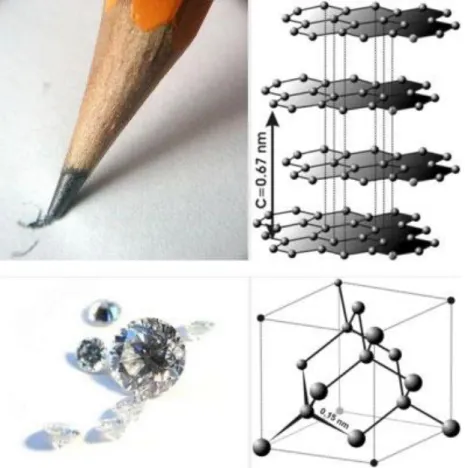
Carbon is one of the most abundantly available element in the earth's crust and can form strong covalent bonds with various elements yielding versatile carbonaceous compounds that constitute organic chemistry. Withal, what sets carbon apart from other elements is its tendency to generate strong covalent bonds with itself, resulting in an array of kinetically stable allotropes having different dimensions. The extensive structural diversity found for carbon materials can result in different properties, such as fullerenes, carbon nanotubes, graphite (sp2 hybridization), and diamond (sp3 hybridization).43,44 With interest, graphite is characterized being dull, soft, and opaque. In contrast, the diamond stands out for being brilliant, transparent hard (Figure 1.1).
C
6
12 CARBON
7
Figure 1.1: Diamond (bottom) vs. graphene structure (top). Source: German Wikipedia, original upload 7. Feb 2004.
Carbon nanomaterials are specifically attractive because of their mechanical and physicochemical properties, e.g., large surface area, electronic properties, corrosion resistance, and thermal stability. Due to these characteristics, carbon materials have been widely utilized as excellent catalytic supports for metal-based catalysts.45,46 Nevertheless, amorphous carbon materials have different drawbacks, such as low stability and low oxidation resistance. Recently, many nanocarbon materials have been developed, e.g., fullerenes,47 activated carbon,48 carbon nanotubes,49 carbon nanofibers,50 and graphene-based materials51 (Figure 1.2).
8
Figure 1.2: Carbonaceous materials. Reprinted with permission from ref.52. Copyright 2007 springer Nature.
The peculiar structure and the exceptional electrical, mechanical, and optical properties53,54 of these materials have extensive development in various areas, for example, composite materials or optoelectronic sensors and many more. These carbon-based materials have also emerged as efficient support for the TM and metal nanoparticles in heterogeneous catalysis.55 Comparing with the rest of the carbon family, graphene and its derivatives have recently attracted much attention of the researchers because of its outstanding properties.
Graphene, two-dimensional materials formed by a monolayer hexagonal arrangement of sp2 hybridized carbon atoms, is two hundred times stronger than steel, very featherlight, and flexible. Besides, graphene materials offer the highest intrinsic carrier mobility at mild conditions
9
with a perfect atomic lattice and magnificent thermal, electrical, optical, and mechanical properties.
Graphene was discovered and characterized by Andre Geim and Konstantin Novoselov in 2004 at the university of manchester, while both professors were awarded the Nobel Prize in 2010 For their groundbreaking experiments regarding the 2-dimensional material (graphene).
As commented previously, graphene materials have the largest surface area (2630 m2/g) as compare to the rest of the nanostructures carbon materials (100 to 1000 m2/g). Besides, in graphene oxide, the high degree of oxygenated groups present on the surface allows easy covalent, non- covalent, as well as ionic functionalization of the materials. The feature makes graphene materials ideal candidates ina new sustainable heterogeneous catalytic system.
1.3 Preparation methods of graphene-based carbocatalysts
Preparation of graphene and its derivatives have already been reported.57–63 Therefore, this thesis only focuses on the preparation methods of graphene materials suitable for catalyst applications. GO and reduced graphene oxide (rGO), which contain a certain degree of defect sits, are by far the most common graphene-based carbocatalysts. The oxidation of graphite in the presence of potassium chlorate (KClO3) and fuming nitric acid (HNO3) was developed by B.C.
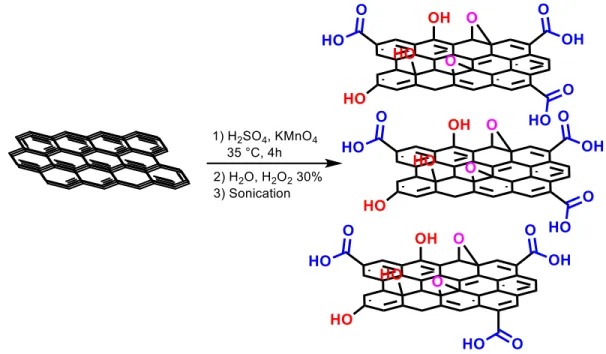
Brodie, in 1859. He was the first to treat graphitic powder with KClO3 in concentrated fuming HNO3,64 and got new materials, which was later determined to consist of carbon, oxygen, and hydrogen results, increasing the overall mass the flake graphite. Brodie method was further improved by Staudenmaier 65 in 1898, by adding concentrated sulfuric acid as an extra additive, which led to a highly oxidized graphite oxide in a single reaction vessel. In 1937 Hoffman66 utilized concentrated sulfuric acid in combination with concentrated nitric acid and KClO3 for the graphite oxide synthesis. In 1958 Hummer’s and Offeman shows an alternative method67 with the aid of strong acid (nitric and/or sulfuric acid) and oxidant (permanganate) (Scheme 1.3); however, the real structure of GO is still under argument (Figure 1.3).
10
Scheme 1.3: Modified Hummers-Offeman’s method for the synthesis of GO.
Figure 1.3: Proposed structures of GO materials and reported methods for the synthesis of GO.
11
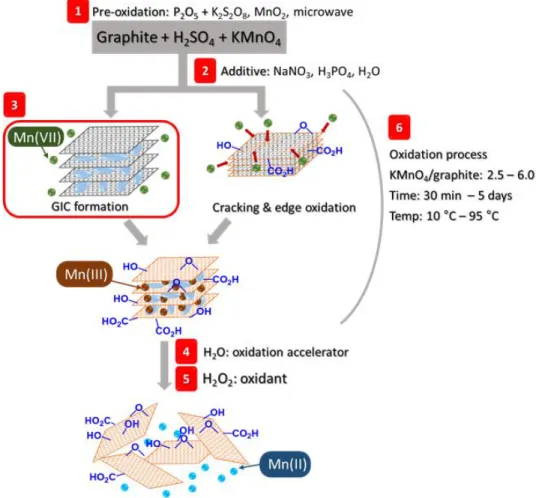
The most popular method is Hummer’s method, which has been further improved and modified.68 For example, NaNO3 converts to various harmful and environmentally unfriendly gases; thus, analogous ways that do not utilize this salt are desired. For instance, Kovtyukhova demonstrated that the pre-treatment of graphite with P2O5 and K2S2O8 in H2SO4 enabled the NaNO3-free synthesis of GO.69 Likewise, pre-treating graphite with MnO270 or irradiation of microwave71 also promotes the efficient formation of GO (Figure 1.4, step 1). Tour utilized H3PO4
instead of NaNO3,72 and Shi noted that water enhances the oxidation of graphite (Figure 1.4, step 2).73 Besides, treatment methods after oxidation water and H2O2 are reported to accelerate the oxidation degree of GO.74,75 Despite many improved methods for GO production, as mentioned above, we have shown that the pre-oxidation of graphite is not needed and that the critical reagents (KMnO4 and concentrated H2SO4) are required to facilitate Hummer’s-type oxidations. Also, the use of less than 5 vol.% of water was found to facilitate the formation of single-layer GO.76
Figure 1.4: Summary of various synthesis methods of GO from graphite and remarks.
12
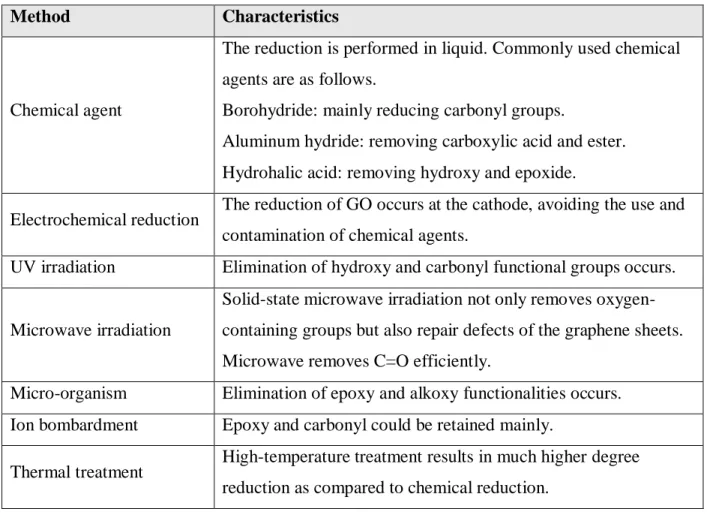
Due to the high quantity of the oxygen functional groups on GO and the reactivity of the oxygenated functional groups, GO can inevitably undergo decomposition and aging under catalytic conditions. To tailor the properties of GO on purpose, enormous research has been done to remove the oxygenated functional groups from GO (Table 1.1).77,78 Various methods and techniques, such as chemical agents,79 electrochemistry,80,81 UV irradiations,82,83 microwave irradiations,84 micro-organisms,85 ion bombardment,86 or thermal treatments,80,82,87 were developed to tune the properties of rGO. The material design includes the C/O ratio, selective removal of the oxygenated functional groups such as hydroxyl, carboxyl, and epoxy, healing of the surface defects to maintain and improve the properties which are required for carbocatalyst.[98,99] the proposed structure of rGO is presented in the below (Scheme 1.4). Please note that this is only an example; there is no definitive structure of GO, as no stoichiometric definition so far).
Table 1.1: Summary of various reduction methods of GO to rGO.
Method Characteristics
Chemical agent
The reduction is performed in liquid. Commonly used chemical agents are as follows.
Borohydride: mainly reducing carbonyl groups.
Aluminum hydride: removing carboxylic acid and ester.
Hydrohalic acid: removing hydroxy and epoxide.
Electrochemical reduction The reduction of GO occurs at the cathode, avoiding the use and contamination of chemical agents.
UV irradiation Elimination of hydroxy and carbonyl functional groups occurs.
Microwave irradiation
Solid-state microwave irradiation not only removes oxygen- containing groups but also repair defects of the graphene sheets.
Microwave removes C=O efficiently.
Micro-organism Elimination of epoxy and alkoxy functionalities occurs.
Ion bombardment Epoxy and carbonyl could be retained mainly.
Thermal treatment High-temperature treatment results in much higher degree reduction as compared to chemical reduction.
13 Scheme 1.4: Synthesis of rGO with various methods.
1.3.1 Doping of graphene-based materials
One of the prospects to incorporate the active site on graphene materials is to replace one carbon atom by other elements, e.g., nitrogen, sulfur, etc., leading to doped graphene-based materials. The most widely utilized dopant elements are B and N, recently doping with S, P have also been reported.90,91 Definitely, the dopant of heteroatoms having empty and full orbitals will be of large potential in the field of catalysis, because of that the variety of Lewis acidic and basic sites of having strength in solid catalysts that can catalyze a large number of organic reactions.92,93
The parameters with impact in catalysis, for the doped or functionalized graphene, are the loading of the dopant element and its dispersion through different types according to their bond structure. The dopant element also influences the electronic and geometrical properties of the graphene oxide, causing around the dopant element a remarkable deviation from the local electronic density, planarity, and bond angles of the ideal graphene materials.94 Among other considerations, dopant elements can also introduce Lewis acid or basic sites depending on the number of electrons or orbitals acquaint by the heteroatom and may work as FLP sites. Theoretical
14
studies have shown that working with simple models, the presence of heteroatoms on graphene generates a gap between the empty and full frontier orbitals, and accordingly, doped graphene exhibits behavior as a semiconductor in contrast to the conductive properties of the ideal graphene materials. There are various possibilities to synthesize doped graphene oxide, as presented below (Scheme 1.5).
Scheme 1.5: Synthesis methods to obtain doped graphene-based materials.
Another approach for preparing doped graphene starts with GO that reacts, generally in the liquid phase, with a specific substrate of the dopant element, such as NH3 or urea. The oxygenated functional groups (epoxy or hydroxy, etc.) of GO react with precursors (dopant element) by substitution, nucleophilic, or condensation reaction leading to doped GO, in which the dopant element is bonded to the carbon of graphene materials. This method is very convenient because of the easy availability of GO, its high solubility in various solvents, and its high reactivity with different nucleophilic substrates. In principle, the loading levels that are accomplished from GO can be substantial, seeing the proportion of functional groups. For example, alginate, a polysaccharide of mannuronic and guluronic acids, may be esterified with boric or phosphoric acids.95 The OH group of sugars tend to generate esters with inorganic acid and carboxylic acids.
Pyrolysis of these modified esters of inorganic acids gives graphene containing heteroatom, for instance, B, N, S, and P. Furthermore, if chitosan, already containing N, is modified with boric
15
acid to generate the corresponding borate ester, then pyrolysis of this modified chitosan leads to the formation of B and N codoped graphene.93
1.4 Typical liquid-phase reaction catalyzed by carbocatalyst
Since Bielawski and co-workers33 demonstrated the ability of graphene-based materials to facilitate a number of synthetically useful transformations, the concept of “carbocatalysis” being widely explored and considered as an intriguing new direction in chemistry and materials science, the surface-bound oxygenated functional groups on the aromatic scaffold of GO is believed to allow ionic and nonionic interactions with a series of atoms and molecules. Numerous organic transformations, such as oxidation of alcohols and alkenes into their respective aldehydes and ketones, and the hydration of alkynes, carbon-carbon coupling reaction, have been carried out using graphene-based materials as a carbocatalyst. Here in this thesis, we will briefly review the catalytic performance of the graphene-based materials as carbocatalyst.
1.4.1 Oxidation reaction
The selective oxidation reaction of alcohols to carbonyls was traditionally accomplished in several ways, most of which need inorganic oxidants. The insertion of oxygen into organic substrates using oxidation or hydration transformations are generally achieved by TM based catalysts, which are quite expensive, toxic, difficult to remove, and are obtained from limited natural resources. Thus, the search for an alternative catalyst that combines the toxicological benefits of a metal-free synthesis with the convenience of heterogeneous setup, while maintaining high activity, is a continuing endeavor of critical importance.96 Bielawski reported that the easily available and inexpensive carbon-based material as a catalyst for the generation of aldehydes or ketones from different alcohols, alkenes, and alkynes (Scheme 1.6).33 These reactions were found under relatively mild reaction conditions and afforded the target products (aldehyde, ketone, or acid) in good yields. Notwithstanding, excellent chemoselectivity and activity were achieved, while a high GO loading (200 wt %) was needed.
16 Scheme 1.6: GO catalyzed oxidation reaction.
Similarly, alcohol can be oxidized with N-doped graphene (N-Graphene) as carbocatalyst.97 Wang and coworkers reported that the graphitic sp2 nitrogenic sites are the active site for catalytic reactions based on a Langmuir-Hinshelwood mechanism through the possible generation of the sp2 N-O2 adduct transition state that shows high reactivity towards alcohols (Scheme 1.7). The non-catalytic conversion of the alcohols by carbene or electron-deficient defects on N-Gr was also speculated.
Scheme 1.7: Proposed reaction pathway for aerobic alcohol oxidation over N-rGO.
Kim prepared NrGO, which contained 6.3 at.% of N and was found to a significantly active for the oxidation of styrene, benzyl alcohol to the corresponding aromatic products through a free- radical pathway with tertbutylhydroperoxide (TBHP).98 The inclusion of methanol yielded aromatic esters, while without the TBHP, aromatic ethers were observed instead. Moreover, using
17
a facile technique based on the microsonochemical method, and NrGO loading of only 30 wt % was needed to give high yield with high selectivity.
In addition, the oxidation reaction of alcohol, GO has also been utilized to activate the benzylic C(sp3)−H and C(sp2)−H bonds. This catalytic reaction was first reported with GO catalyst by Bielawski, who reported the corresponding ketone products in high yields, while a large quantity of the GO was required.99 This method was found not suitable to obtain aldehyde product.
Several other doped graphene materials were then investigated to prevent the limitations of GO.
Ma and coworkers prepared NrGO starts from GO with acetonitrile as N source via a chemical vapor deposition process. Furthermore, the NrGO was utilized as a catalyst for the oxidation reaction of aryl alkanes, linear hydrocarbons, and cyclic paraffin to the corresponding oxidized compounds with TBHP oxidant.100 Similar to the work above of Wang,97 graphitic sp2 nitrogen was assigned as the active site of the catalyst. Notably, the graphitic sp2 nitrogen did not proceed with the catalytic process but changed the electronic properties of the neighboring carbon atoms and enhanced the generation of reactive oxygen species (peroxide radicals). Aside from that, Kim reported that the conversion of aliphatic chains into aliphatic ketones with N‐rGO.98 Moreover, N, B, co-doped-rGO (N 5.6 at.wt %, and B 2.1 at.wt %) and could selectively catalyze the oxidation reaction of cyclooctene and benzylic hydrocarbons to the corresponding ketones and alcohols (Scheme 1.8) with a low catalyst loading (0.1 wt %), with low conversion (50 %).93 Control investigations were conducted with bare GO, B, and N‐doped graphene, activated carbon, and MWCNTs showed much lower conversion rates. Besides, styrene was converted by N, B, co- doped-rGO into styrene oxide and benzaldehyde in low yields. Antonietti and coworkers investigated the synergistic effect of graphene/g‐C3N4 nanocomposite for the cyclic saturated hydrocarbons oxidation reaction.101 By this system, cyclohexane, a 12 % conversion with 94 % selectivity for cyclohexanone, was accomplished. Howbeit, the non-catalytic behavior toward n- hexane and DMSO highlighted the need for pre‐adsorption of starting materials before the catalytic reaction may proceed over superoxide anion radicals.
18
Scheme 1.8: 1) Oxidation reaction of tetralin to the corresponding alcohol and ketone catalyzed by B, N, co-dopedrGO, 2) Aerobic oxidative coupling reaction amine to imine utilizing porous GO as a catalyst.
GO was also found active the oxidation of thiol to disulfides without over oxidation and with high conversion rates, which are generally achieved only with TM catalysts (Fe, Mo, and Pd) as reported by Bielawski (Scheme 1.9).102 The catalytic performances of other carbons such as activated carbon, graphite, and hydrazine-reduced GO paled compared to that of GO. The reactivity of arene-functionalized substrates bettered that of alkyl-functionalized substrates.
Furthermore, the application of GO was extended as a catalyst for the oxidation reaction of sulfide to the sulfoxide, which is conventionally catalyzed by Ru and Fe catalysts. This was, however, only possible with a GO loading of 300 wt %. GO worked as an oxidant and was reduced throughout the reactions.
Scheme 1.9: GO catalyzed oxidation of thiophenol.
The catalytic oxidation reaction of amines to imines using molecular oxygen as an oxidant was also demonstrated with GO (Scheme 1.8) reported by Fan.103 Natural flake graphite, MWCNTs, activated carbon, and rGO were reported lower to GO for this catalytic reaction. The effect of trace metal in GO catalyzed reaction measured with ICP-MS, and found 30 ppb of manganese, while the other trace metals were found below the detection limit. Primary and
19
secondary amines have also been oxidized with high yields, but aliphatic amines and amines lacking a hydrogen atom at the -carbon position was not reactive. Furthermore, the syntheses of asymmetrical and cyclic imines were also attained. Loh synthesized porous GO by several acids and base treatments, without metallic impurities, while additional defects and pores were introduced into the graphene framework. Furthermore, the author utilized GO as a catalyst for aerobic oxidative coupling of amines to imines with porous GO catalyst.104 The appearance of the ovoids was found to provide a high amount of edges with localized spins and found effective with the combination of carboxylic acid groups on the porous GO. This study clarified the functional groups of GO materials that gave rise to their catalytic effects. Ma and coworkers showed the synthesis method of the thiuram disulfide from secondary amines and carbon disulfide with rGO, which is one-pot synthesis bis(aminothiocarbonyl)disulfides (Scheme 1.10). The rGO can be recycled at least four times without any loss of catalytic activity and selectivity.105
Scheme 1.10: rGO catalyzed the bis(aminothiocarbonyl)disulfides in one-pot.
Alkylamine and cyclic secondary amines were transformed into the thiuram disulfide in high yields. However, secondary aromatic amines were reported less reactive and required a strong base to facilitate the reaction. The authors also claimed that the unpaired electrons at the edges of the graphene might activate the O2 to superoxide anion radicals, which further initiate a coupling reaction with dithiocarbamic acids to generate thiuram disulfide.
20 1.4.2 Hydrogenation reaction
One of the most important catalytic reactions in the petrochemical industry is the hydrogenation of multiple C−C bonds, which often require transition noble metals (Pt, Pd, Ni, Rh, and Fe) as a catalyst. The ability of graphene-based materials to act as a catalyst for the hydrogenation reaction and will contribute to this challenging area of chemistry. Bao utilized rGO as a catalyst for the hydrogenation reaction of nitrobenzene to aniline (Scheme 1.11),106 the results reveal that the electronic properties of rGO are effective and the rGO can be a new alternative metal-free catalysts. The zig-zag edges of rGO may act as active catalytic sites to facilitate the activation of a reactant molecule. Garcia and coworkers also reported the selective hydrogenation of acetylene and other alkenes catalyzed by graphene-based materials as metal-free alternatives catalyst.107
Scheme 1.11: 1) Hydrogenation of nitrobenzene to aniline using rGO, 2) aerobic oxidative dehydrogenation reaction of hydrazo compounds with rGO.
Defective graphene can also catalyze the oxidative degradation of C=C in conjugated alkenes (Scheme 1.12). Strizhak explored the catalytic activity of thermally reduced GO (TrGO) and nitrogen-doped thermally reduced GO (N-TrGO) for the hydrogenation of acetylene, while in the temperature range of 50 to 400 °C.89 The author hypothesized that the doping of the nitrogen in the graphene framework decreases the total activity for acetylene hydrogenation and the selectivity for ethylene. While the oxygen-containing functional groups like ketone and hydroxyl groups may also contribute to catalytic activity, but they did not explore with characterization.
21
Scheme 1.12: rGO catalyzed the hydrogenation reaction of acetylene.
Hydrothermally treated GO has been reported as a new metal-free catalyst for the activation of NaBH4, which further reduces the 4-nitrophenol to 4-aminophenol.108 Generally, carbon material donates electron density to the metal center and enhances the hydride transfer. The experimental and theoretical studies suggested that pores and defects in the carbon sheet formed by acidic hydroxyl groups benefit this activity, meaning FLP structure sites can be assigned.
1.4.3 C−C coupling reaction
1.4.3.1 Oxidative and reductive coupling reaction
Loh and coworkers improved the activity of GO by a sequential base and acid treatment and obtained a 98 % yield of imine at a five wt % catalyst loading.104 This means that there is great potential to improve the catalytic performance of the graphene catalyst. However, the amount of catalyst used was still higher than that of the metal catalyst. A model molecule (1‐Pyrenecarboxylic acid) was used as a catalyst and found that the origin of the activity was attributed to the synergistic effect of the carboxyl group on the edge and unpaired electrons next to the COOH group of an adjacent benzene ring (Scheme 1.13).
22
Scheme 1.13: Oxidative coupling reaction of amines to imines over GO. Reprinted with permission from ref.104.Copyright 2007 American Chemical Society.
GO can also catalyze the Claisen-Schmidt coupling reactions of a series of alkynes or methyl ketones with alcohols and aldehydes to generate chalcones related compounds.109 The reactions occur via in a tandem process: GO first proceed the hydration or oxidation of various alkynes or alcohols to their corresponding methyl ketones or aldehydes, respectively, and then these species further undergoes to the coupling reactions.
The oxidative homo-coupling reaction of β-naphthols gives binaphthols, which are widely utilized as ligands and DNA cross-linking reagents.110,111 Commonly, binaphthols are synthesized by Fe,112 Cu,113 and V114 catalysts. To overcome these limitations, Ranganath utilized GO as an efficient catalyst for the oxidative coupling of 2-naphthols.115 It was observed that solvent plays an essential role in this reaction; when the reaction was performed in aqueous media, which leads to polymerization of the product, while in organic solvents, the reactants go selectively to binaphthol (Scheme 1.14). Furthermore, to arbitrate the effect of GO, various carbon materials such as graphite, carbon nanotubes, functionalized CNTs, and activated charcoal were utilized as catalysts under the optimized reaction conditions, but lower product yields were observed.
Additives such as NaOH or KOH was required to generate the product in >90% yield; without the additive, only 20% of the target product was obtained. The GO catalyst could be recycled three times, but the active site and the effect of solvents is not clear at this stage.
23
Scheme 1.14: Oxidative coupling of -naphthol catalyzed by GO.
Gong investigated the active catalytic center on GO using various small molecules with various oxygen functional groups, such as hydroxy, carbonyl, epoxide, and carboxylic acid, and different π-conjugated systems.116 Albeit, no product was observed, indicating that only a single functional group does not attribute to the catalytic property of GO. Other carbon-based materials, such as activated carbon, graphite, acetylene black, and rGO, were also tested, but all were found inactive. These findings indicate that the catalytic activity of GO was irrelevant to the π-conjugated system. Thus, the author proposes that the unpaired electrons on the GO might play a crucial role in the coupling reaction, which is already presented in the hydrogenation reaction104 (Scheme 1.15).
In this context, hydrogen may be captured by the unpaired electron on the GO edge, and the aromatic radical is generated. Finally, the radical coupling reaction subsequently occurs with the coupling partner, and the desired product can be generated. Oxidative carbocatalysis has the potential to replace several TM catalyzed or stoichiometric oxidative reactions. It should be commented that further experiments are needed to rule out the possibilities of metal-induced catalysis, because contamination of ppm level of metal species may not be prevented in the most of the carbon materials.117
Scheme 1.15: Mechanism of homo-coupling of -naphthol catalyzed by GO.
24
We reported a radical coupling reaction between aryldiazonium salts and electron-rich five- membered heterocycles catalyzed by rGO (Scheme 1.16).118 The reaction provides rapid access to 2-arylfurans, pyrroles, and thiophenes under mild conditions, and the rGO catalysts can be reused several times. The localized radicals on the surface of rGO play a vital role in the coupling reaction.
Scheme 1.16: GO catalyzed the coupling reaction between aryldiazonium salts and five-membered heterocycles.
1.4.3.2 Aldol-type reaction
The aldol reaction is one of the essential methods of forming carbon-carbon bonds. The products, chalcone derivatives, are precursors for the biosynthesis of flavonoids and isoflavonoids.119 The capability of GO as a catalyst was also examined for aldol reaction over various electron-withdrawing and electron-donating aromatic aldehydes with acetophenone under the condition solvent-free (Scheme 1.17).120 In this study, the authors reported that GO works as a base catalyst. In contrast, Zali modified the surface of carbon materials with −SO3H, which showed higher catalytic activity than sulfuric acid.121 Asphaltene oxide (AO) produced by the Hummer’s type oxidation of asphaltene also catalyze aldol reaction.122 The origin of catalytic activity was examined by changing various parameters such as the effect of elemental composition, the dosage of catalyst, and particle size. In the presence of a base (i.e., pyridine), the product was not observed due to a neutralization reaction. Thus, the catalytically active sites are acidic sites on the carbocatalyst. GO catalyzed reactions are sometimes argued because of the contamination of metal species, removal of its oxygenated groups, and residual acids/oxidants.123
Cid developed a bifunctional amine catalyst, in which piperazine was grafted on to rGO.124 The presence of two nitrogen atoms in piperazine provides a possible route to iminium and basic ammonium activation for aldol reaction. In the case of aldol reaction, the rGO support did not offer
25
any noticeable stabilization effect for the catalyst. The bared rGO was utterly inactive for aldol reaction.
Scheme 1.17: Aldol condensation reaction between acetophenone and benzaldehyde catalyzed by GO.
1.4.3.3 Freidel-Crafts-type reaction
The alkylation of arenes is generally catalyzed by TM catalysts to get pharmaceutical component and fine chemicals. Interestingly, graphene-based materials was also found effective that catalyze the direct Friedel-Crafts alkylation reaction of arenes with styrene and alcohols.125 The surface electrons of graphene are considered to affect the electrophilic intermediate. In this context, Kumar and Rao utilized GO as a catalyst for the Friedel-Crafts-type alkylation reaction of indoles to α,β-unsaturated ketones, or nitrostyrene (Scheme 1.18).127
Scheme 1.18: Friedel-Crafts addition of indoles to ,-unsaturated substrate catalyzed by GO.
Guerra reported GO as catalyst for the Friedel-Crafts reaction between indole and epoxides (Scheme 1.19).128 graphite and carbon were used as catalysts for comparison, but showed negligible yield, suggesting the activity of GO is probably due to the carboxylic and hydroxy groups. The product was obtained regioselectively with complete inversion, indicating that the
26
GO-catalyzed reaction was SN2 fashion. This reaction is typically catalyzed by nanocrystalline TiO2,129 Fe3O4 or CuFe2O4.130
Scheme 1.19: Regioselective ring-opening reaction of styrene oxide with indole catalyzed by GO.
1.4.3.4 CH−CH homocoupling reactions
The activation of C−H bonds by carbocatalysts to form C−C bonds has recently emerged as a hot topic in carbocatalysis. The development of metal-free carbocatalysts for CH−CH type coupling, one of the most difficult chemical transformations, has rarely been reported.131 We reported the use of GO as a catalyst for the formation of the C−C bond of anisoles and derivatives, of which mechanism was clarified as a free radical pathway.132 The reaction conditions were initially optimized in the oxidative coupling of 3,4-dimethoxytoluene to the corresponding dimer.
It was found that GO, in conjunction with BF3·OEt2 afforded the biaryl product in excellent yield;
however, GO was reduced and lost its activity after the reaction (Scheme 1.20). It was demonstrated that the developed conditions are superior to those using hypervalent iodine reagent, PhI(OAc)2. Impressively, the substrate scope was shown to include halogen-containing substrates, which could be used as handles for traditional cross-coupling reactions. The reaction mechanism was investigated by adding a radical scavenger (TEMPO) and monitered the reaction by electron spin resonance (ESR), confirming the presence of radical species in situ.
Scheme 1.20: GO catalyzed the homocoupling of anisole derivatives.
27 1.4.3.5 CH−CH cross-coupling reactions
CH−CH cross-coupling is one of the most challenging reactions. Recently, fine-tuning the substrates and reaction conditions enabled the selective functionalization of C−H bonds. Loh and Su carried out the cross-coupling of xanthenes or thioxanthene with arenes in the presence of GO with TsOH·H2O, yielding 85 % of the corresponding CH−CH cross-coupling products with high selectivity (Scheme 1.21).133 The mechanistic study showed that the reactivity of GO was corresponded to the concentration of quinone type species (C=O) but had no apparent relationship with the content of epoxide and hydroxy groups. The use of small-molecules analogs allowed mimicking the active site of the catalyst. Molecular analogs such as benzyl alcohol, hydroxy, epoxides, and carboxy groups were not effective. Whereas their zig-zag edges counterpart, such as tetracene and pentacene, afford higher reactivity (54 %). Anthraquinone, which incorporates both the zig-zag edges and the C=O species, furnished the best performance (76 %) among all the tested small-molecule analogs.
Scheme 1.21: GO catalyzed CH−CH cross-coupling of xanthene with arenes.
1.5 Objective and scope of the present study
Based on the aforementioned problems associated with the metal-based catalysts, the present study provides an effective response to them. In general, this study attempts to design and functionalized highly active, durable, and easily recyclable carbocatalyst for organic transformations such as coupling and reduction reactions. Based on the previous discussion, graphene materials have the highest surface area (2630 m2/g) in comparison to the rest of the nanostructures carbonaceous materials (100 to 1000 m2/g). Additionally, for example, in the case
28
of graphene oxide, the high degree of oxygen functional groups present on the structure allows as easy covalent and non-covalent functionalization of the materials. The feature makes graphene materials ideal candidates ina new sustainable heterogeneous catalytic system. Nishina is working in graphene-based materials for various applications, also started this material for catalyst application Figure 1.5.
Figure 1.5: Unpaired electron on nanocarbon for catalysis.
Graphene and graphene-based materials have been developed over the last ten years as carbocatalsyts, and it is doubtless that such materials can catalyze many liquid phase reactions in organic chemistry. Although the actual mechanisms and the active sites of the carbon catalysts remain issues to be solved, the activity of carbon catalysts may be improved by optimizing the catalyst preparation and reaction conditions.
29
Now lets recall that in the first part of this chapter, talking about catalysis, we usually spontaneously think about transition metals, either as molecular species or as colloidal objects.
Some of these transition metals are rare, and questions of sustainability do the search for alternatives a mandatory endeavor. In addition, many metals are not tolerant against functionality or are sensitive, e.g., against water and sulfur compounds, and especially the growing fields of modern biorefinery and biomass processing are strictly limited by the use of catalysts that can satisfy these criteria. In the last few years, it turned out that (metal-free) carbon-based materials, with large specific surface areas, are indeed effective as heterogeneous catalysts and have the potential to circumvent the described problems. Carbocatalysis for liquid-phase reactions, especially for organic synthesis, is an emerging research discipline and has undergone rapid development in recent years, Nishina reviews this topic up to somehow very recently in 2020.134
The intrinsic acidity and basicity of carbon materials as catalysts are related to the oxygenated functional groups or doped heteroatoms. Still, the distribution of acid/base functionalities is not well described in most of the studies reviewed here. More importantly, minor components may have any influence on the catalytic performance. In particular, when graphene oxide, which is prepared from graphite in H2SO4 and KMnO4, is used, it always contains impurities by insufficient purification. One of the major motivation of this thesis is to overcome such problems in designing metal-free carbocatalyst, which will give the activity similar to or better than the metal catalyst. This dissertation also aims to provide an in-depth understanding of how the carbocatalyst works.
1.6 Thesis outline
As already seen, chapter 1 consists of an introduction relevant to the thesis work and the overall project objectives. We also discussed the synthesis methods of carbocatalyst and various effects of the strong oxidant, along with this, we also give a brief touch to the reduction of graphene oxide by various methods. Finally, the Overview of graphene-based materials as catalyst, also presents a comprehensive literature review of carbocatalysis.
In chapter 2 comprise the synthesis of nitrogen-doped reduced graphene oxide and its activity for CH functionalization reactions. The active catalytic sits are considered, and the mechanistic study was discussed.
30
Chapter 3 provides details of the catalytic activity of the carbocatalyst in terms of challenging chemoselective hydrogenation reactions, and the role of radicals was explored. The main conclusion resulting in this project are summarized in chapter 4, possible future work of research is also included.
In chapter 4, comprise the reaction mechanism of the alkylation of ketone with alcohol is still a matter of debate, is it a Meerwein-Ponndorf-Verley like process, or is hydrogen borrowing process by transition metals? Here, the alkylation reaction of ketones with benzylic alcohols via a radical pathway has been developed, where base treated graphene works as an initiator of radical reaction. Mechanistic study support that the radical anion of the benzylic alcohol is proposed to be the key intermediate, which further undergoes coupling with ketones via aldol condensation to form a new C−C bond with water the only byproduct. Chapter 5 concludes the work covered in this thesis.
31 1.7 References
[1] J. Matthey, The Early History of Catalysis,
https://www.technology.matthey.com/article/19/2/64-69/, (accessed June 18, 2020).
[2] G. Bond and the late David Thompson, Gold Bull., 2009, 42, 247–259.
[3] I. M. Campbell, Catalysis at Surfaces, Springer Netherlands, 1988.
[4] J. Meurig Thomas and R. Raja, Annu. Rev. Mater. Res., 2005, 35, 315–350.
[5] P. T. Anastas and J. C. Warner, Green Chemistry: Theory and Practice, Oxford University Press, Oxford, 2000.
[6] H. Hu, J. H. Xin, H. Hu, X. Wang and Y. Kong, Appl. Catal. Gen., 2015, 492, 1–9.
[7] S. Navalon, A. Dhakshinamoorthy, M. Alvaro and H. Garcia, Coord. Chem. Rev., 2016, 312, 99–148.
[8] D. Astruc, F. Lu and J. R. Aranzaes, Angew. Chem. Int. Ed., 2005, 44, 7852–7872.
[9] L. Ackermann, R. Vicente and A. R. Kapdi, Angew. Chem. Int. Ed., 2009, 48, 9792–9826.
[10] D. Sempere, S. Navalon, M. Dančíková, M. Alvaro and H. Garcia, Appl. Catal. B Environ., 2013, 142–143, 259–267.
[11] J. Lee, O. K. Farha, J. Roberts, K. A. Scheidt, S. T. Nguyen and J. T. Hupp, Chem. Soc.
Rev., 2009, 38, 1450.
[12] E. A. B. Kantchev, C. J. O’Brien and M. G. Organ, Angew. Chem. Int. Ed., 2007, 46, 2768–2813.
[13] D. Nair, J. T. Scarpello, L. S. White, L. M. Freitas dos Santos, I. F. J. Vankelecom and A.
G. Livingston, Tetrahedron Lett., 2001, 42, 8219–8222.
[14] J. Rivera-Utrilla, I. Bautista-Toledo, M. A. Ferro-Garcı́a and C. Moreno-Castilla, Carbon, 2003, 41, 323–330.
[15] C. E. Garrett and K. Prasad, Adv. Synth. Catal., 2004, 346, 889–900.
[16] A. Gansäuer and H. Bluhm, Chem. Rev., 2000, 100, 2771–2788.
[17] C. Wang and Z. Xi, Chem. Soc. Rev., 2007, 36, 1395–1406.
[18] J. Oxgaard, W. J. Tenn, R. J. Nielsen, R. A. Periana and W. A. Goddard, Organometallics, 2007, 26, 1565–1567.
[19] Y. Boutadla, D. L. Davies, S. A. Macgregor and A. I. Poblador-Bahamonde, Dalton Trans., 2009, 5887–5893.
[20] Y. Boutadla, D. L. Davies, S. A. Macgregor and A. I. Poblador-Bahamonde, Dalton Trans., 2009, 5820–5831.
[21] L. Ackermann, Chem. Rev., 2011, 111, 1315–1345.
[22] D. Lapointe and K. Fagnou, Chem. Lett., 2010, 39, 1118–1126.
[23] P. J. Dunn, Chem. Soc. Rev., 2012, 41, 1452–1461.
[24] C.-J. Li and B. M. Trost, Proc. Natl. Acad. Sci., 2008, 105, 13197–13202.
[25] M.-M. Titirici, R. J. White, N. Brun, V. L. Budarin, D. S. Su, F. del Monte, J. H. Clark and M. J. MacLachlan, Chem. Soc. Rev., 2014, 44, 250–290.
[26] F. Rodríguez-reinoso, Carbon, 1998, 36, 159–175.
[27] E. K. Rideal and W. M. Wright, J. Chem. Soc. Trans., 1925, 127, 1347–1357.
[28] E. Keightley Rideal and W. Mary Wright, J. Chem. Soc. Resumed, 1926, 129, 1813–1821.
[29] J. F. Keegel, W. A. Suruda and C. Schwob, J. Am. Chem. Soc., 1938, 60, 2483–2486.
[30] L. E. Cadus, L. A. Arrua, O. F. Gorriz and J. B. Rivarola, Ind. Eng. Chem. Res., 1988, 27, 2241–2246.
[31] F. Lücking, H. Köser, M. Jank and A. Ritter, Water Res., 1998, 32, 2607–2614.
32
[32] H. J. H. Fenton, J. Chem. Soc. Trans., 1894, 65, 899–910.
[33] D. R. Dreyer, H.-P. Jia and C. W. Bielawski, Angew. Chem. Int. Ed., 2010, 49, 6813–6816.
[34] J.-H. Yang, G. Sun, Y. Gao, H. Zhao, P. Tang, J. Tan, A.-H. Lu and D. Ma, Energy Environ. Sci., 2013, 6, 793–798.
[35] J. Luo, H. Yu, H. Wang, H. Wang and F. Peng, Chem. Eng. J., 2014, 240, 434–442.
[36] K. Savaram, M. Li, K. Tajima, K. Takai, T. Hayashi, G. Hall, E. Garfunkel, V. Osipov and H. He, Carbon, 2018, 139, 861–871.
[37] Q. Wei, F. Qin, Q. Ma and W. Shen, Carbon, 2019, 141, 542–552.
[38] M. S. Ahmad, H. He and Y. Nishina, Org. Lett., 2019, 21, 8164–8168.
[39] J. Xi, Q. Wang, J. Liu, L. Huan, Z. He, Y. Qiu, J. Zhang, C. Tang, J. Xiao and S. Wang, J.
Catal., 2018, 359, 233–241.
[40] X. Hu, Y. Liu, H. Huang, B. Huang, G. Chai and Z. Xie, Green Chem., , DOI:10.1039/C9GC03781K.
[41] B. Jurca, C. Bucur, A. Primo, P. Concepción, V. I. Parvulescu and H. García, ChemCatChem, 2019, 11, 985–990.
[42] E. G. Gordeev, E. O. Pentsak and V. P. Ananikov, J. Am. Chem. Soc., , DOI:10.1021/jacs.9b10887.
[43] D. S. Su, G. Wen, S. Wu, F. Peng and R. Schlögl, Angew. Chem. Int. Ed., 2017, 56, 936–
964.
[44] Y. Zhai, Z. Zhu and S. Dong, ChemCatChem, 2015, 7, 2806–2815.
[45] A. Schaetz, M. Zeltner and W. J. Stark, ACS Catal., 2012, 2, 1267–1284.
[46] P. Serp, M. Corrias and P. Kalck, Appl. Catal. Gen., 2003, 253, 337–358.
[47] M. J. Ahmed, J. Environ. Chem. Eng., 2016, 4, 89–99.
[48] Z. Li, Z. Liu, H. Sun and C. Gao, Chem. Rev., 2015, 115, 7046–7117.
[49] A. Hirsch and C. Backes, Angew. Chem. Int. Ed., 2010, 49, 1722–1723.
[50] M. Wang, Z.-H. Huang, Y. Bai, F. Kang and M. Inagaki, Curr. Org. Chem., 2013, 17, 1434–1447.
[51] C. N. R. Rao, U. Maitra and H. S. S. R. Matte, in Graphene, John Wiley & Sons, Ltd, 2012, pp. 1–47.
[52] A. K. Geim and K. S. Novoselov, Nat. Mater., 2007, 6, 183–191.
[53] X.-C. Dong, H. Xu, X.-W. Wang, Y.-X. Huang, M. B. Chan-Park, H. Zhang, L.-H. Wang, W. Huang and P. Chen, ACS Nano, 2012, 6, 3206–3213.
[54] V. Presser, M. Heon and Y. Gogotsi, Adv. Funct. Mater., 2011, 21, 810–833.
[55] E. Pérez-Mayoral, V. Calvino-Casilda and E. Soriano, Catal. Sci. Technol., 2016, 6, 1265–
1291.
[56] S. Filippone, E. E. Maroto, Á. Martín‐Domenech and N. Martín, in Advances in
Organometallic Chemistry and Catalysis, John Wiley & Sons, Ltd, 2013, pp. 459–472.
[57] B. Qiu, M. Xing and J. Zhang, Chem. Soc. Rev., 2018, 47, 2165–2216.
[58] Z.-S. Wu, Y. Sun, Y.-Z. Tan, S. Yang, X. Feng and K. Müllen, J. Am. Chem. Soc., 2012, 134, 19532–19535.
[59] C. N. R. Rao, A. K. Sood, K. S. Subrahmanyam and A. Govindaraj, Angew. Chem. Int.
Ed., 2009, 48, 7752–7777.
[60] T. Kuila, S. Bose, A. K. Mishra, P. Khanra, N. H. Kim and J. H. Lee, Prog. Mater. Sci., 2012, 57, 1061–1105.
[61] L. Chen, Y. Hernandez, X. Feng and K. Müllen, Angew. Chem. Int. Ed., 2012, 51, 7640–
7654.
33
[62] A. W. Robertson and J. H. Warner, Nano Lett., 2011, 11, 1182–1189.
[63] L. Wang, X. Zhang, H. L. W. Chan, F. Yan and F. Ding, J. Am. Chem. Soc., 2013, 135, 4476–4482.
[64] B. C. Brodie, Philos. Trans. R. Soc. Lond., 1859, 149, 249–259.
[65] L. Staudenmaier, Berichte Dtsch. Chem. Ges., 1898, 31, 1481–1487.
[66] U. Hofmann and E. König, Z. Für Anorg. Allg. Chem., 1937, 234, 311–336.
[67] W. S. Hummers and R. E. Offeman, J. Am. Chem. Soc., 1958, 80, 1339–1339.
[68] R. K. Singh, R. Kumar and D. P. Singh, RSC Adv., 2016, 6, 64993–65011.
[69] N. I. Kovtyukhova, P. J. Ollivier, B. R. Martin, T. E. Mallouk, S. A. Chizhik, E. V.
Buzaneva and A. D. Gorchinskiy, Chem. Mater., 1999, 11, 771–778.
[70] J. Sun, N. Yang, Z. Sun, M. Zeng, L. Fu, C. Hu and S. Hu, ACS Appl. Mater. Interfaces, 2015, 7, 21356–21363.
[71] Z. Luo, Y. Lu, L. A. Somers and A. T. C. Johnson, J. Am. Chem. Soc., 2009, 131, 898–
899.
[72] D. C. Marcano, D. V. Kosynkin, J. M. Berlin, A. Sinitskii, Z. Sun, A. Slesarev, L. B.
Alemany, W. Lu and J. M. Tour, ACS Nano, 2010, 4, 4806–4814.
[73] J. Chen, Y. Zhang, M. Zhang, B. Yao, Y. Li, L. Huang, C. Li and G. Shi, Chem. Sci., 2016, 7, 1874–1881.
[74] J. H. Kang, T. Kim, J. Choi, J. Park, Y. S. Kim, M. S. Chang, H. Jung, K. T. Park, S. J.
Yang and C. R. Park, Chem. Mater., 2016, 28, 756–764.
[75] L. Yang, R. Zhang, B. Liu, J. Wang, S. Wang, M.-Y. Han and Z. Zhang, Angew. Chem.
Int. Ed Engl., 2014, 53, 10109–10113.
[76] N. Morimoto, H. Suzuki, Y. Takeuchi, S. Kawaguchi, M. Kunisu, C. W. Bielawski and Y.
Nishina, Chem. Mater., 2017, 29, 2150–2156.
[77] N. Morimoto, T. Kubo and Y. Nishina, Sci. Rep., 2016, 6, 1–8.
[78] S. Pei and H.-M. Cheng, Carbon, 2012, 50, 3210–3228.
[79] C. K. Chua and M. Pumera, Chem. Soc. Rev., 2013, 43, 291–312.
[80] D. R. Dreyer, S. Park, C. W. Bielawski and R. S. Ruoff, Chem. Soc. Rev., 2009, 39, 228–
240.
[81] O. Ö. Ekiz, M. Ürel, H. Güner, A. K. Mizrak and A. Dâna, ACS Nano, 2011, 5, 2475–
2482.
[82] S. Park and R. S. Ruoff, Nat. Nanotechnol., 2009, 4, 217–224.
[83] W. Gao, Ed., Graphene Oxide: Reduction Recipes, Spectroscopy, and Applications, Springer International Publishing, 2015.
[84] D. Voiry, J. Yang, J. Kupferberg, R. Fullon, C. Lee, H. Y. Jeong, H. S. Shin and M.
Chhowalla, Science, 2016, 353, 1413–1416.
[85] E. C. Salas, Z. Sun, A. Lüttge and J. M. Tour, ACS Nano, 2010, 4, 4852–4856.
[86] P. Šimek, Z. Sofer, O. Jankovský, D. Sedmidubský and M. Pumera, Adv. Funct. Mater., 2014, 24, 4878–4885.
[87] Z.-S. Wu, W. Ren, L. Gao, J. Zhao, Z. Chen, B. Liu, D. Tang, B. Yu, C. Jiang and H.-M.
Cheng, ACS Nano, 2009, 3, 411–417.
[88] A. T. Smith, A. M. LaChance, S. Zeng, B. Liu and L. Sun, Nano Mater. Sci., 2019, 1, 31–
47.
[89] A. A. Abakumov, I. B. Bychko, O. V. Selyshchev, D. R. T. Zahn, X. Qi, J. Tang and P. E.
Strizhak, Carbon, 2020, 157, 277–285.